

How Censorship in China Allows Government Criticism but Silences Collective Expression
Open accessThe DOI matches its Crossref record; 53 of the 54 references it cites were found in a registry or an index, and 1 are not checked yet; none of the 12 sources its claims cite is checked for support yet.
Abstract
We offer the first large scale, multiple source analysis of the outcome of what may be the most extensive effort to selectively censor human expression ever implemented. To do this, we have devised a system to locate, download, and analyze the content of millions of social media posts originating from nearly 1,400 different social media services all over China before the Chinese government is able to find, evaluate, and censor (i.e., remove from the Internet) the subset they deem objectionable. Using modern computer-assisted text analytic methods that we adapt to and validate in the Chinese language, we compare the substantive content of posts censored to those not censored over time in each of 85 topic areas. Contrary to previous understandings, posts with negative, even vitriolic, criticism of the state, its leaders, and its policies are not more likely to be censored. Instead, we show that the censorship program is aimed at curtailing collective action by silencing comments that represent, reinforce, or spur social mobilization, regardless of content. Censorship is oriented toward attempting to forestall collective activities that are occurring now or may occur in the future—and, as such, seem to clearly expose government intent.
Checked 2026-11-22 · 1 reference not checked yet
Overview
CoChat Summary
TL;DR
The paper uses large-scale, real-time collection of Chinese social media posts to test why China censors online expression. It finds that censorship does not target criticism of the state or leaders; instead, it targets posts with collective action potential, regardless of whether they support or criticize the government.
Key findings
- Across the data, an average of approximately 13% of all social media posts were censored. Ex ante political sensitivity had only a weak relationship with censorship: Low and Medium categories were censored at 16% and 17%, respectively, versus 24% for High.
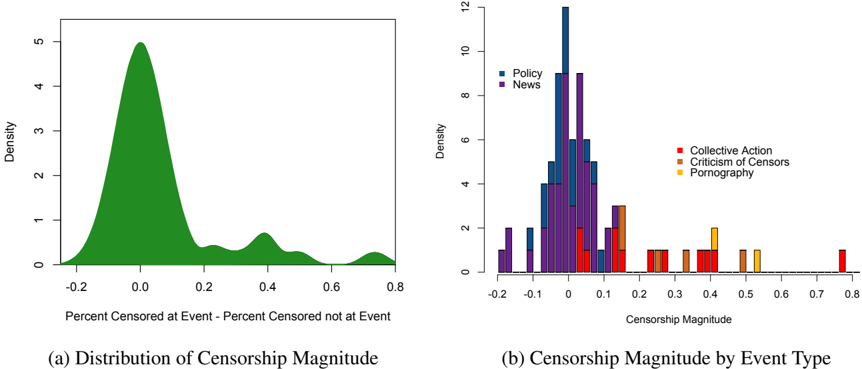
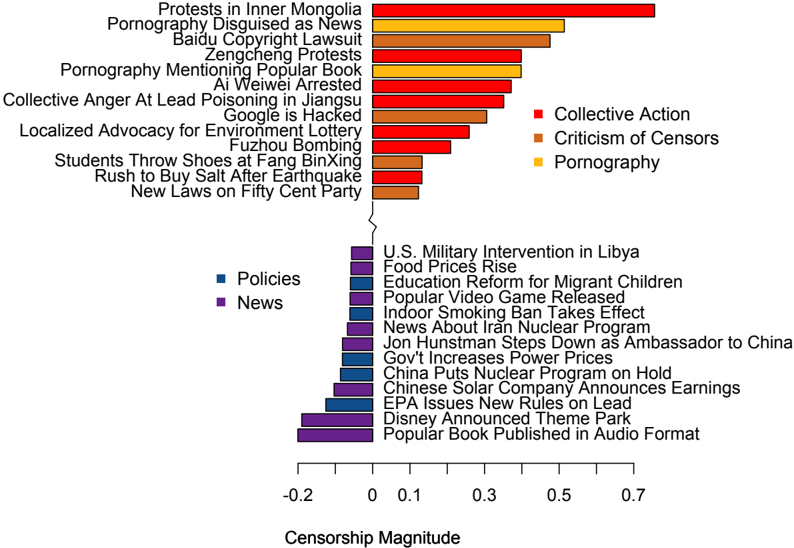
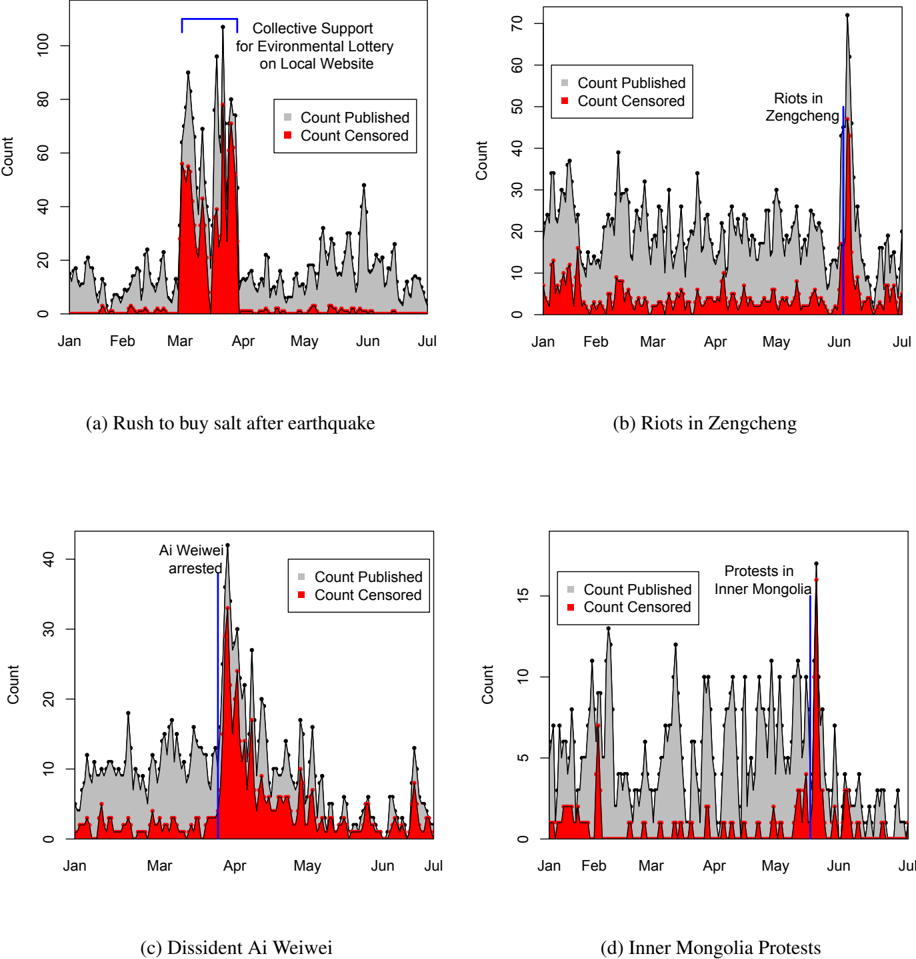
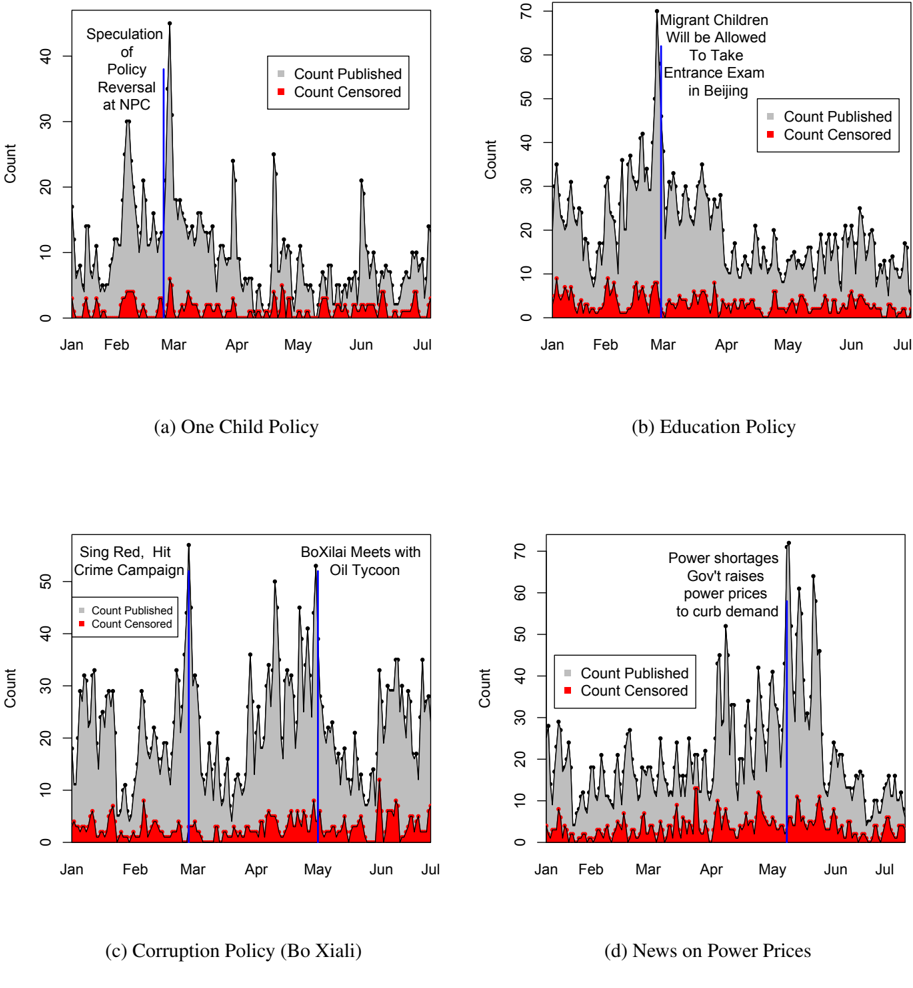
- Censorship was much higher during volume bursts tied to collective action: average censorship magnitude was 27% for collective action, compared with -1% for policy and -4% for news.
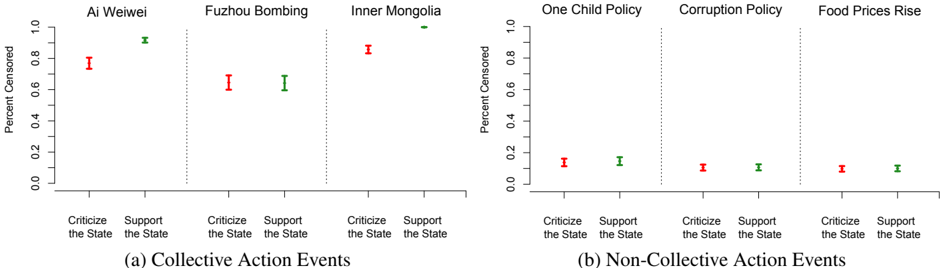
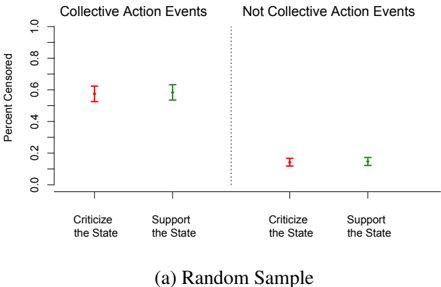
- For collective action events such as Ai Weiwei’s arrest, Inner Mongolia protests, and Fuzhou bombings, posts were censored at about 80% on average whether they criticized or supported the state. For non-collective-action events such as the one child policy, corruption policy, and food prices, censorship was about 10% on average for both critical and supportive posts.
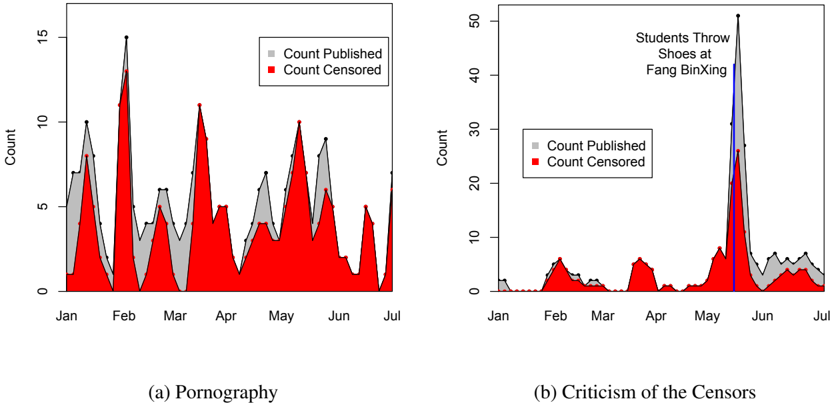
- Censorship also targeted pornography and criticism of the censors, but not government policy or other news. The authors argue censorship is aimed at curtailing collective action by silencing comments that represent, reinforce, or spur social mobilization.
Methods
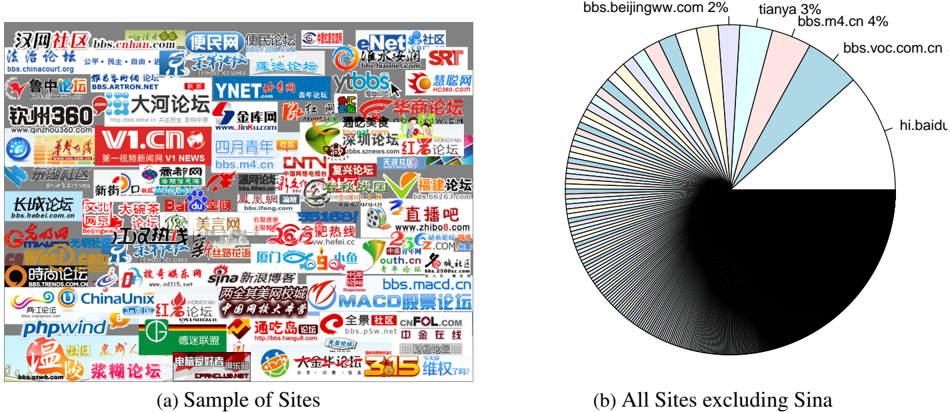
- The authors built a system to locate, download, and analyze posts from 1,382 Chinese websites during the first half of 2011, before government censors could remove them. They collected 3,674,698 posts, randomly selected 127,283 for further analysis, and overall collected and analyzed 11,382,221 posts.
- They used a stratified random sampling design covering 85 topic areas across three hypothesized political sensitivity levels, detected 87 volume bursts in 67 of the 85 topic areas using robust regression-based burst detection, and classified events into collective action potential, criticism of censors, pornography, government policies, and other news.
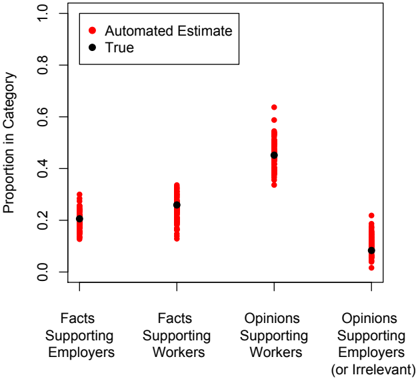
- To analyze content, they adapted the Hopkins and King “ReadMe” automated text analysis method to Chinese and extended it with a Bayesian procedure to estimate the percent censored within categories. Validation used native Chinese speakers coding 1,000 posts about 2010 labor strikes, with 100 as training and 900 as test; event coding reliability was 98.9% (86 of 87 events).
Limitations
- The paper states that its methodology misses self-censorship and censorship that may occur before the post is obtained; it also does not quantify the direct effects of the Great Firewall, keyword blocking, or search filtering.
- The authors state they have not studied physical violence, such as arrest of bloggers, or threats of the same; although many officials and levels of government influence censorship decisions, their data only sometimes distinguish among these sources, and they cannot determine the consequences of these limitations.
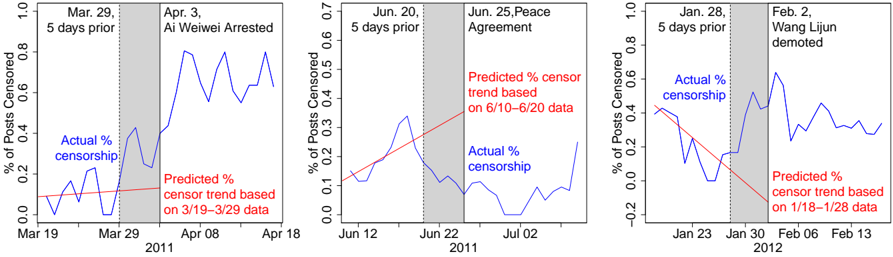
- The authors note that the presumably smaller number of discussions they cannot observe are likely to be those of most interest to the Chinese government, and they offer little evidence connecting social media findings to press freedom or other types of human expression in China. They also state that the predictive analysis was conducted retrospectively and with only three events, so further prospective validation would be valuable.
Model-written summary. Check it against the paper before relying on it.
Integrity signals
Registry
Cites
Statistics
Figures
Verification
Claims the paper makes
0 Valid · 7 Not valid · 7 Not checked · 88 Own results and interpretations
A result the paper reports from its own data — it cites no other source for it, so there is none to check. The quote shows it is in the paper.
In the paper
“Our data show that the Chinese censorship program allows for a wide variety of criticisms of the Chinese government, its officials, and its policies.”
§ How Censorship in China Allows Government Criticism but Silences Collective Expression * > Outline of Results
plain- Asserted: passes — The authors put it forward as true.
- Checkable: passes — It can be checked against evidence.
- Load-bearing: passes — The paper’s conclusions depend on it.
- Based: passes — The paper gives a reason why it holds.
A result the paper reports from its own data — it cites no other source for it, so there is none to check. The quote shows it is in the paper.
In the paper
“Contrary to previous understandings, posts with negative, even vitriolic, criticism of the state, its leaders, and its policies are not more likely to be censored.”
- Also stated in: § 1 Introduction · plain
“we find that when the Chinese people write scathing criticisms of their government and its leaders, the probability that their post will be censored does not increase.”
§ How Censorship in China Allows Government Criticism but Silences Collective Expression * > Abstract
plain- Asserted: passes — The authors put it forward as true.
- Checkable: passes — It can be checked against evidence.
- Load-bearing: passes — The paper’s conclusions depend on it.
- Based: passes — The paper gives a reason why it holds.
- Also stated in: § 1 Introduction · plain
A result the paper reports from its own data — it cites no other source for it, so there is none to check. The quote shows it is in the paper.
In the paper
“Large increases in online volume are good predictors of censorship when these increases are associated with events related to collective action, e.g., protest on the ground.”
§ How Censorship in China Allows Government Criticism but Silences Collective Expression * > Outline of Results
plainstates an association- Asserted: passes — The authors put it forward as true.
- Checkable: passes — It can be checked against evidence.
- Load-bearing: passes — The paper’s conclusions depend on it.
- Based: passes — The paper gives a reason why it holds.
A result the paper reports from its own data — it cites no other source for it, so there is none to check. The quote shows it is in the paper.
In the paper
“In addition, we measure sentiment within each of these events and show that during these events, the government censors views that are both supportive and critical of the state.”
§ How Censorship in China Allows Government Criticism but Silences Collective Expression * > Outline of Results
plainstates a cause- Asserted: passes — The authors put it forward as true.
- Checkable: passes — It can be checked against evidence.
- Load-bearing: passes — The paper’s conclusions depend on it.
- Based: passes — The paper gives a reason why it holds.
A result the paper reports from its own data — it cites no other source for it, so there is none to check. The quote shows it is in the paper.
In the paper
“We thus conduct the same analysis for the demotion of Wang Lijun in Panel (c) of Figure 11, and again see a large difference in actual and predicted percent censorship before Wang's demotion.”
§ How Censorship in China Allows Government Criticism but Silences Collective Expression * > Additional information
plainSingle case- Asserted: passes — The authors put it forward as true.
- Checkable: passes — It can be checked against evidence.
- Load-bearing: unclear — It is unclear whether the paper’s conclusions depend on it.
- Based: passes — The paper gives a reason why it holds.
46 more claims
Create a free account to see all 102 claims and every source verdict.
- Probably not a substantial claim. 26
- It may state two separate claims as one. 33
Claims other papers make about this one
Each is checked against this paper’s own text: does it say what the citing paper says it does?
The source backs part of the claim, not all of it — or backs it for a different population, condition or comparison.
In the citing paper
“Authorities are keen to review social media posts and have contentious messages removed (King etal., 2013) to ensure that potential threats remain invisible.”
From How Dictators Control the Internet: A Review Essay (2020) · cites this paper as King et al., 2013
Experimental — accuracy not yet measuredThe source backs part of the claim, not all of it — or backs it for a different population, condition or comparison.
In the citing paper
“In most autocratic regimes, governmental interference in digital infrastructure and communication is commonplace.”
From How Dictators Control the Internet: A Review Essay (2020) · cites this paper as King et al., 2013
Experimental — accuracy not yet measuredThe source backs part of the claim, not all of it — or backs it for a different population, condition or comparison.
In the citing paper
“First, the timing of censorship during a coup is consistent with many studies that have shown that Internet censorship is targeted during sensitive political time periods and periods of potential power transitions, such as elections and large-scale protests [23,25,44,47,73].”
From A multi-perspective view of Internet censorship in Myanmar (2021) · cites this paper as [44]
Experimental — accuracy not yet measuredThe cited source says what the claim attributes to it.
In the citing paper
“research has shown how mobilization organized through public coordination is repressed using that very same public information-for instance, repression is preemptively increased before focal days (Truex 2019); and autocracies censor online calls for collective action (King, Pan, and Roberts 2013), coerce online opinion leaders (Pan and Siegel 2020), and at times, turn off the internet entirely.”
From Coordinated Dis-Coordination (2024) · cites this paper as King, Pan, and Roberts 2013
The check wasn’t confident either way, so it gives no verdict — never disputed.
In the citing paper
“In China, for instance, two virtual police officers remind citizens that their browsing behavior is monitored (King etal., 2013).”
From How Dictators Control the Internet: A Review Essay (2020) · cites this paper as King et al., 2013
Experimental — accuracy not yet measured
1 more claim about this paper
Create a free account to see every claim other papers make about this one.
Citations
Cites
Robust estimation of a location parameter
Huber, P. J. (1964) · The Annals of Mathematical Statistics · doi:10.1214/aoms/1177703732 · Cited by 7,228
Robust Regression and Outlier Detection
Piepel, G. F. (1989) · Technometrics · doi:10.1080/00401706.1989.10488524 · Cited by 6,144
Robust Regression and Outlier Detection
Rousseeuw, P. J., & Leroy, A. M. (1987) · Wiley Series in Probability and Statistics · doi:10.1002/0471725382 · Cited by 5,609
Logistic Regression in Rare Events Data
King, G., & Zeng, L. (2001) · Political Analysis · doi:10.1093/oxfordjournals.pan.a004868 · Cited by 4,316 · cited 1×
“We do this via well-known and widely used case-control methodology (King and Zeng 2001).”
MethodSelf-citationDemocracy and Development: Political Institutions and Well-Being in the World, 1950–1990
Przeworski, A., Alvarez, M. E., Cheibub, J. A., & Limongi, F. (2000) · doi:10.1017/cbo9780511804946 · Cited by 2,845
Rightful Resistance in Rural China
O'Brien, K. J., & Li, L. (2006) · Cambridge University Press eBooks · doi:10.1017/cbo9780511791086 · Cited by 1,104
The Dynamics of Informational Cascades: The Monday Demonstrations in Leipzig, East Germany, 1989–91
Lohmann, S. (1994) · World Politics · doi:10.2307/2950679 · Cited by 1,035 · cited 1×
“Protests in East Germany, Eastern Europe, and most recently the Middle East have all preceded regime change (Ash 2002; Lohmann 1994; Przeworski et al. 2000).”
BackgroundRightful Resistance in Rural China
O'Brien, K., & Li, L.-J. (2006) · doi:10.1017/cbo9780511791086.003 · Cited by 987
China's Changing of the Guard: Authoritarian Resilience
Nathan, A. J. (2003) · Journal of Democracy · doi:10.1353/jod.2003.0019 · Cited by 927
Sparks and prairie fires: A theory of unanticipated political revolution
Kuran, T. (1989) · Public Choice · doi:10.1007/bf00116762 · Cited by 905 · cited 1×
“In fact, Kuran (1989) and Lohmann (2002) show that it is information about a collective action event that propels collective action and so distinguishing this from explicit calls for collective action would be difficult if not impossible.”
Background
Research works printed but not linked: 13
- 22. Freedom House. 2012. "Freedom of the Press, 2012." www.freedomhouse.org.
- 8. Chang, Parris. 1983. Elite Conflict in the Post-Mao China. New York: Occasional Papers Reprints.
- 26. Hinton, Harold. 1955. The "Unprincipled Dispute" Within Chinese Communist Top Lead- ership. Washington, DC: U.S. Information Agency.
- 44. Perry, Elizabeth. 2002. Challenging the Mandate of Heaven: Social Protest and State Power in China. Armork, NY: M. E. Sharpe.
- 52. Schurmann, Franz. 1966. Ideology and Organization in Communist China. Berkeley, CA: University of California Press.
- Tsai, 2007, Capitalism without Democracy: The Private Sector in Contemporary China
- 48. Qiang, Xiao. 2011. The Rise of Online Public Opinion and Its Political Impact. In Chang- ing Media, Changing China, ed. Susan Shirk. New York: Oxford University Press pp. 202-224.
- 9. Charles, David. 1966. The Dismissal of Marshal P'eng Teh-huai. In China Under Mao: Politics Takes Command, ed. Roderick MacFarquhar. Cambridge: MIT University Press pp. 20-33.
- 54. Shirk, Susan. 2007. China: Fragile Superpower: How China's Internal Politics Could Derail Its Peaceful Rise. New York: Oxford University Press.
- 56. Teiwes, Frederick. 1979. Politics and Purges in China: Retification and the Decline of Party Norms. Armork, NY: M. E. Sharpe. Tsai, Kellee. 2007a. Capitalism without Democracy: The Private Sector in Contemporary China. Ithaca, NY: Cornell University Press.
- 15. Duan, Qing. 2007. China's IT Leadership. Vdm Verlag.
- 38. MacFarquhar, Roderick. 1974. The Origins of the Cultural Revolution Volume 1: Contra- dictions Among the People 1956-1957. New York: Columbia University Press.
- 12. Chen, Xiaoyan and Peng Hwa Ang. 2011. Internet Police in China: Regulation, Scope and Myths. In Online Society in China: Creating, Celebrating, and Instrumentalising the Online Carnival, ed. David Herold and Peter Marolt. New York: Routledge pp. 40-52.
Cited by
Items 301–400 of 2,443
How Authoritarianism Transforms: A Framework for the Study of Digital Dictatorship
Schlumberger, O., Edel, M., Maati, A., & Saglam, K. (2024) · Government and Opposition · doi:10.1017/gov.2023.20 · Cited by 48
“Some question whether this successfully silences all critics (Pan and Siegel 2020; Roberts 2020), but empirics suggest that the existing power gap between dictators and their critics increases to benefit the former (King et al. 2013; see transformation 3 above).”
‘Russian Spring’ or ‘Spring Betrayal’? The Media as a Mirror of Putin’s Evolving Strategy in Ukraine
Lankina, T. V., & Watanabe, K. (2017) · Europe Asia Studies · doi:10.1080/09668136.2017.1397603 · Cited by 69
Liu, L. L., Li, T. M., Teo, A. R., Kato, T. A., & Wong, P. W. (2018) · JMIR Mental Health · doi:10.2196/mental.8509 · Cited by 48
“First, because of the tight internet censorship of the Chinese Government, to avoid being shut down, internet content providers will self-censor their content [25].”
BackgroundDynamic dictators: improving the research agenda on autocratization and authoritarian resilience
Sinkkonen, E. (2021) · Democratization · doi:10.1080/13510347.2021.1903881 · Cited by 63
Unpacking government social media messaging strategies during the COVID‐19 pandemic in China
Li, Y., Chandra, Y., & Fan, Y. (2021) · Policy & Internet · doi:10.1002/poi3.282 · Cited by 59
The Power of the Street: Evidence from Egypt's Arab SpringPreprint
Acemoğlu, D., Hassan, T., & Tahoun, A. (2017) · SSRN Electronic Journal · doi:10.2139/ssrn.2485984 · Cited by 357
Discursive accommodation: popular protest and strategic elite communication in China
Steinhardt, H. C. (2016) · European Political Science Review · doi:10.1017/s1755773916000102 · Cited by 48
“The pattern of more outspoken elite communication on protest also stands in stark contrast to the finding that China’s gargantuan internet censorship system is primarily geared at removing popular discourse on the very same issue (King et al., 2013).”
BackgroundResultIs Any Publicity Good Publicity? Media Coverage, Party Institutions, and Authoritarian Power-Sharing
Feng-ming, L., & Ma, X. (2018) · Political Communication · doi:10.1080/10584609.2018.1490836 · Cited by 51
“To collect useful information, authoritarian rulers sometimes allow criticisms of officials in social media (King et al., 2013, 2014).”
Zheng, Q. (2023) · Public Relations Review · doi:10.1016/j.pubrev.2023.102296 · Cited by 77
Informally Governing Information: How Criminal Rivalry Leads to Violence against the Press in Mexico
Holland, B., & Ríos, V. (2015) · Journal of Conflict Resolution · doi:10.1177/0022002715600756 · Cited by 56
Liu, J. (2016) · Mass Communication & Society · doi:10.1080/15205436.2016.1203954 · Cited by 60
“…with a highly repressive policy against protests in order to suppress the outbreak of political contention and to prevent the dispersal of its influence to a large scale, in particular, via digital media (e.g., King, Pan, & Roberts, 2013; also see Bamman, O'Connor, & Smith, 2012; MacKinnon, 2009).”
BackgroundSocial media use, political affect, and participation among university students in urban China
Chen, G., Lee, F. L. F., & Li, Y. (2017) · Telematics and Informatics · doi:10.1016/j.tele.2017.04.002 · Cited by 56
DASGUPTA, A. (2018) · American Political Science Review · doi:10.1017/s000305541800031x · Cited by 46
“…that entrenched political elites possess strategic incentives to block or carefully manage technological change (e.g., Acemoglu and Robinson 2006; King, Pan, and Roberts 2013), adding to an existing literature that highlights other barriers to technological change, including insecure property…”
BackgroundLi, F., Liu, Y., & Meng, T. (2019) · Telematics and Informatics · doi:10.1016/j.tele.2019.06.001 · Cited by 46
Rivals within: political factions, loyalty, and elite competition under authoritarianism
Chen, T., & Hong, J. Y. (2020) · Political Science Research and Methods · doi:10.1017/psrm.2019.61 · Cited by 51
Do, S., Ollion, É., & Shen, R. (2024) · Sociological Methods & Research · doi:10.1177/00491241221134526 · Cited by 54
“See among others (Barberá et al. 2021; King, Pan, and Roberts 2013).”
Strategic Communication in Dictatorships: Performance, Patriotism, and Intimidation
Baturo, A., & Tolstrup, J. (2023) · The Journal of Politics · doi:10.1086/726945 · Cited by 52
“Authoritar-ian rhetoric is also an invaluable source of information about regime legitimation (Grauvogel and von Soest 2014; King, Pan, and Roberts 2013; Rozenas and Stukal 2019), and research shows that authoritarian communication strategies have important consequences in the sense that the topics…”
BackgroundTsui, L. (2015) · Chinese Journal of Communication · doi:10.1080/17544750.2015.1058834 · Cited by 59
“In addition, King, Pan, and Roberts (2013) argue that the Chinese government relies on a sophisticated combination of technology, human censors, and traditional propaganda to prevent citizens from organizing and coordinating.”
BackgroundHow Do Science and Technology Affect International Affairs?
Weiss, C. (2015) · Minerva · doi:10.1007/s11024-015-9286-1 · Cited by 70
Zhang, X., & Zhong, Z.-J. (2020) · Telematics and Informatics · doi:10.1016/j.tele.2020.101378 · Cited by 63
Social Media and International Relations
Kreps, S. E. (2020) · Cambridge University Press eBooks · doi:10.1017/9781108920377 · Cited by 57
When Autocrats Threaten Citizens with Violence: Evidence from China
Carter, E. B., & Carter, B. L. (2021) · British Journal of Political Science · doi:10.1017/s0007123420000575 · Cited by 46
The Political Economics of Non-democracy
Egorov, G., & Сонин, К. И. (2020) · Journal of Economic Literature · doi:10.1257/jel.20221494 · Cited by 72
Promote diligently and censor politely: how Sina Weibo intervenes in online activism in China
Li, M. (2021) · Information Communication & Society · doi:10.1080/1369118x.2021.1983001 · Cited by 59
Cosmetic Responsiveness: Why and How Local Authorities Respond to Mundane Online Complaints in China
Wang, Y., & Han, R. (2022) · Journal of Chinese Political Science · doi:10.1007/s11366-022-09798-z · Cited by 50
“In such cases, while there still can be principal-agent problems, both the central and local authorities are motivated to respond quickly, resolutely, and often repressively in such cases [10, 32].”
BackgroundResultInfluentialRegional variation in Chinese internet filtering
Wright, J. (2014) · Information, Communication & Society · doi:10.1080/1369118x.2013.853818 · Cited by 51
Zhang, Y., & Гуо, Л. (2019) · Information Communication & Society · doi:10.1080/1369118x.2019.1662073 · Cited by 65
“Despite online surveillance, the Chinese government allows alternative voices on social media as long as the content does not aim to mobilize collective actions (King et al., 2013).”
BackgroundHyun, K. D., Kim, J., & Sun, S. (2014) · Asian Journal of Communication · doi:10.1080/01292986.2014.944922 · Cited by 49
Ma, P., Song, Y. H., & Zhang, M. (2023) · Journal of Environmental Management · doi:10.1016/j.jenvman.2023.118046 · Cited by 44
The cost of humour: Political satire on social media and censorship in China
Luqiu, L. R. (2017) · Global Media and Communication · doi:10.1177/1742766517704471 · Cited by 55
“Studies show that the Chinese government allows criticism of the state, its policies and even its leaders on social media, but silences posts that might trigger or mobilize collective action (King et al., 2013).”
Backgroundvan den Dool, A. (2022) · Policy Studies Journal · doi:10.1111/psj.12456 · Cited by 47
“Online censorship is triggered by a perceived threat of mobilization, regardless of whether online posts support or criticize the government (King et al., 2013).”
Communicating beyond Information? Mobile Phones and Mobilization to Offline Protests in China
Liu, J. (2014) · Television & New Media · doi:10.1177/1527476414544972 · Cited by 48
Introduction: Journalism, democratic culture, and creative reconstruction
Alexander, J. C. (2016) · Cambridge University Press eBooks · doi:10.1017/cbo9781316050774.002 · Cited by 49
Thomson, H. (2018) · Comparative Political Studies · doi:10.1177/0010414018758757 · Cited by 43
How Information Flows from the World to China
Lu, Y., Schaefer, J., Park, K., Joo, J., & Pan, J. (2022) · The International Journal of Press/Politics · doi:10.1177/19401612221117470 · Cited by 50
“…fi ltering, keyword blocking, account deletion, and post-hoc censorship that are implemented by domestic Chinese social media fi rms (Earl, Maher, and Pan 2022; Fu, Chan, and Chau 2013; Jiang 2014; King, Pan, and Roberts 2013, 2014; Miller 2018; Qiang 2019; Qin, Strömberg, and Wu 2017; Roberts 2018).”
BackgroundSelf-citationCitizenship in China: a Comparison of Rights with the East and West
Janoski, T. (2014) · Journal of Chinese Political Science · doi:10.1007/s11366-014-9303-5 · Cited by 49
“Thus, media freedom has increased tremendously mainly through the web and internet, but few countries attempt the censorship that China actively maintains in this area [2, 14, 40].”
BackgroundSocial constructivist account of the world’s largest gay social app: Case study of Blued in China
Miao, W., & Chan, L. S. (2020) · The Information Society · doi:10.1080/01972243.2020.1762271 · Cited by 49
“Collective actions are what the Communist Party of China strives to curtail (King, Pan, and Roberts 2013).”
BackgroundSteinhardt, H. C. (2015) · Asian Studies Review · doi:10.1080/10357823.2014.993920 · Cited by 57
“The censorship of online discourse about street protests (Elmer, 2012; King et al., 2013) and the role of the Internet in protest mobilisation (Huang and Yip, 2012) have also been subject to research.”
BackgroundCentral State vs. Local Levels of Government: Understanding News Media Censorship in China
Kuang, X. (2018) · Chinese Political Science Review · doi:10.1007/s41111-018-0091-5 · Cited by 51
Mobilization without Movement: How the Chinese State “Fixed” Labor Insurgency
Chen, P., & Gallagher, M. E. (2018) · Industrial and Labor Relations Review · doi:10.1177/0019793918759066 · Cited by 45
“And in keeping with general policy to prevent collective gatherings outside of strict state control (King et al. 2013), the ACFTU prevents free association and organization among workers.”
BackgroundMachine Learning Predictions as Regression Covariates
Fong, C., & Tyler, M. (2020) · Political Analysis · doi:10.1017/pan.2020.38 · Cited by 81
Lying or Believing? Measuring Preference Falsification from a Political Purge in ChinaPreprint
Jiang, J., & Yang, D. L. (2015) · SSRN Electronic Journal · doi:10.2139/ssrn.2564413 · Cited by 42
Zhu, Y., & Fu, K. (2020) · New Media & Society · doi:10.1177/1461444820959016 · Cited by 47
“…the machinery of censorship (Bamman et al., 2012; Fu et al., 2013; King et al., 2013, 2014; Zhu et al., 2013), these research projects mainly focus on the technical factors of the censorship system in order to unveil the government’s interest, intention, and goals (King et al., 2013).”
BackgroundInfluentialPernia, R. A. (2021) · Asian Journal of Comparative Politics · doi:10.1177/2057891121992118 · Cited by 51
“…censorship in the digital space and curtailing of online and offline public opinion that made it resilient amidst struggles for democratization (King et al., 2013, 2017; Stockmann, 2013; Tsai, 2016), its capacity to deliver on economic needs for its people remains instrumental in generating…”
BackgroundNet Inclusion: New Media’s Impact on Deliberative Politics in China
Lewis, O. A. (2013) · Journal of Contemporary Asia · doi:10.1080/00472336.2013.769387 · Cited by 41
Jackson, G., & Rathert, N. (2017) · Emerald Group Publishing Limited eBooks · doi:10.1108/s0733-558x20160000049015 · Cited by 51
A new global communication order for a multipolar world
Thussu, D. K. (2018) · Communication Research and Practice · doi:10.1080/22041451.2018.1432988 · Cited by 44
Ong, L. H., & Han, D. (2018) · Political Studies · doi:10.1177/0032321718763558 · Cited by 71
“Other studies have looked at why the authoritarian regime may tolerate dissent: protest is used as an informationgathering mechanism (Lorentzen, 2013) and the government allows for only selective online criticisms while silencing collective expression (King et al., 2013).”
BackgroundThe transformation of partisan rhetoric in American presidential campaigns, 1952–2012
Rhodes, J. H., & Albert, Z. (2015) · Party Politics · doi:10.1177/1354068815610968 · Cited by 46
“…to confirm that ReadMe was able to reproduce category proportions reliably; our analysis showed that ReadMe was very accurate, performing at a level consistent with that of previous published studies (e.g. Grimmer et al., 2012; King et al., 2013; see Supplemental Materials for details).”
ResultKuang, X., & Wei, R. (2017) · Journalism · doi:10.1177/1464884917731179 · Cited by 51
“…to Luther and Zhou (2005) who used the potential socio-economic ramifications and government control incurred to evaluate news sensitivity and King et al. (2013) who found that issues spurring collective action were considered as sensitive in China, we considered both issues as sensitive.”
BackgroundCyber conflict or democracy “hacked”? How cyber operations enhance information warfare
Whyte, C. (2020) · Journal of Cybersecurity · doi:10.1093/cybsec/tyaa013 · Cited by 64
Governing Generation Z in China: Bilibili, bidirectional mediation, and online community governance
Chen, Z., & Yang, D. L. (2022) · The Information Society · doi:10.1080/01972243.2022.2137866 · Cited by 48
“While there is little doubt that such censorship is an important part of China’s Internet control system (King, Pan, and Roberts 2013; MacKinnon 2009), alternative practices, such as the cultivation of pro-regime voices, have received much less attention (Han 2015a).”
BackgroundInvestigating the civic emotion dynamics during the COVID-19 lockdown: Evidence from social media
Zhao, Q., He, Y., Wang, Y., Li, W., Wu, L., & Qiu, W. (2024) · Sustainable Cities and Society · doi:10.1016/j.scs.2024.105403 · Cited by 36
Twitter and the Challenges of Digital Diplomacy
Duncombe, C. (2018) · The SAIS review of international affairs · doi:10.1353/sais.2018.0019 · Cited by 56
Automated content analysis across six languages
Windsor, L., Cupit, J. G., & Windsor, A. J. (2019) · PLoS ONE · doi:10.1371/journal.pone.0224425 · Cited by 55
“Though computational text analysis has lagged behind in the field of international relations, scholars are increasingly using text-as-data approaches to understand issues like censorship in social media [13,24], crises in authoritarian regimes [25], foreign policy in state media [14], and leaders’ resolve [26,27].”
BackgroundShoring Up Autocracy: Participatory Technologies and Regime Support in Putin’s Russia
Chapman, H. S. (2021) · Comparative Political Studies · doi:10.1177/0010414021989759 · Cited by 47
“Scholarship on the internet and social media, for example, has examined the ways in which autocrats repress, coopt, censor, and regulate independent political communication to prevent these tools from being used against the regime (Howard et al., 2011; King et al., 2013; Morozov, 2012; Roberts, 2018; Sanovich et al.,…”
BackgroundMethodA comparative analysis of Indian and Chinese FDI into Africa: The role of governance and alliances
Munjal, S., Varma, S., & Bhatnagar, A. (2022) · Journal of Business Research · doi:10.1016/j.jbusres.2022.05.087 · Cited by 56
Informational Autocracy: Theory and Empirics of Modern Authoritarianism.Preprint
Guriev, S. M., & Treisman, D. S. (2015) · SSRN Electronic Journal · doi:10.2139/ssrn.2571905 · Cited by 48
“Networked” Revolutions? ICTs and Protest Mobilization in Non-Democratic Regimes
Anderson, A. (2020) · Political Research Quarterly · doi:10.1177/1065912920958071 · Cited by 48
“As numerous studies have shown, dictators have routinely adopted ICTs to bolster their support, using them to anticipate citizen grievances (King et al. 2013), discredit political opposition (MacKinnon 2012; Rundle 2011), and strengthen government legitimacy through the distribution of propaganda and norms (King et al.”
BackgroundXu, P., Ye, Y., & Zhang, M. (2022) · Global Media and China · doi:10.1177/20594364221115270 · Cited by 54
Stoycheff, E., Nisbet, E. C., & Epstein, D. (2016) · Communication Research · doi:10.1177/0093650216644645 · Cited by 53
“Online public spheres, or websites where citizens can engage in international deliberation and information seeking (Jiang, 2010), and behaviors that promote collective action (King et al., 2013) are viewed as some of the most pernicious to the sustainability of non-democratic governments.”
BackgroundActive resistance to democratic diffusion
Vanderhill, R. (2017) · Communist and Post-Communist Studies · doi:10.1016/j.postcomstud.2017.01.003 · Cited by 46
Yan, Y.-C., & Lyu, S.-J. (2023) · Government Information Quarterly · doi:10.1016/j.giq.2023.101812 · Cited by 50
Dorobantu, S., Henisz, W. J., & Nartey, L. J. (2023) · Academy of Management Journal · doi:10.5465/amj.2021.0103 · Cited by 44
Timoneda, J. C., & Vera, S. V. (2024) · The Journal of Politics · doi:10.1086/730737 · Cited by 75
“Topic models in particular have been widely used to cluster texts into groups without labelled training data (Grimmer, 2010; Roberts, Stewart and Tingley, 2016; Catalinac, 2016; King, Pan and Roberts, 2013).”
BackgroundThe Strength of Weak Review: National Courts, Interpretive Canons, and Human Rights Treaties
Lupu, Y., Verdier, P.-H., & Versteeg, M. (2019) · International Studies Quarterly · doi:10.1093/isq/sqz026 · Cited by 39
A Theory of Strategic Uncertainty and Cultural Diversity
Kets, W., & Sandroni, A. (2020) · The Review of Economic Studies · doi:10.1093/restud/rdaa037 · Cited by 44
Demand for Online News under Government Control: Evidence from Russia
Simonov, A., & Rao, J. M. (2021) · Journal of Political Economy · doi:10.1086/717351 · Cited by 51
“…et al., 2014), education (Kearney and Levine, 2015), and voting 7More broadly, our results add to the empirical literature (e.g., Durante and Knight, 2012; King et al., 2013, 2014; Roberts, 2014; Bai et al., 2015; Garcia-Arenas, 2016; Hobbs and Roberts, 2018; Knight and Tribin, 2019; Szeidl and…”
ResultDigital Technology, Politics, and Policy-Making
Gilardi, F. (2022) · Cambridge University Press eBooks · doi:10.1017/9781108887304 · Cited by 57
A multi-perspective view of Internet censorship in Myanmar
Padmanabhan, R., Filastò, A., Xynou, M., Raman, R. S., Middleton, K., Zhang, M., Madory, D., Roberts, M., & Dainotti, A. (2021) · Proceedings of the ACM SIGCOMM 2021 Workshop on Free and Open Communications on the Internet · doi:10.1145/3473604.3474562 · Cited by 40
“First, the timing of censorship during a coup is consistent with many studies that have shown that Internet censorship is targeted during sensitive political time periods and periods of potential power transitions, such as elections and large-scale protests [23, 25, 44, 47, 73].”
BackgroundSelf-citationCreating Democratic Citizens: Political Effects of the Internet in China
Huhe, N., Tang, M., & Chen, J. (2018) · Political Research Quarterly · doi:10.1177/1065912918764338 · Cited by 42
Chinese views on nuclear weapons: Evidence from an online survey
Egel, N., & Hines, R. L. (2021) · Research & Politics · doi:10.1177/20531680211032840 · Cited by 38
“The CCP exerts considerable resources to influence, censor, and monitor public opinion (King et al., 2013, 2017; Meng et al., 2017).”
BackgroundDoes Analytic Thinking Insulate Against Pro‐Kremlin Disinformation? Evidence From Ukraine
Erlich, A., Garner, C., Pennycook, G., & Rand, D. G. (2022) · Political Psychology · doi:10.1111/pops.12819 · Cited by 79
Medaglia, R., & Yang, Y. (2016) · Information Communication & Society · doi:10.1080/1369118x.2016.1203974 · Cited by 46
“Firstly, although the choice of discussion topics has been aimed explicitly at providing data that is as free as possible from bias or external influence, we are not able to estimate, for instance, to what extent the sample used is missing messages due to platform moderation, censorship, or paid posters (C. Chen et al…”
BackgroundA Psychological Firewall? Risk Perceptions and Public Support for Online Censorship in Russia*
Nisbet, E. C., Kamenchuk, O., & Dal, A. (2017) · Social Science Quarterly · doi:10.1111/ssqu.12435 · Cited by 47
Xu, C. L. (2017) · The Sociological Review · doi:10.1177/0038026117732669 · Cited by 45
“In contradistinction, across the border there is said to be ‘a state-sponsored atheism [that] has been imposed from above - sometimes with the use of extreme force’ (Vickers & Kumar, 2015: 19) as well as regular ideological monitoring and speech censorship (King, Pan, & Roberts, 2013).”
BackgroundSu, Y., & Xiao, X. (2020) · Chinese Journal of Communication · doi:10.1080/17544750.2020.1839777 · Cited by 37
“In the past, China harshly punished media for posting content that potentially disrupted authoritarian propaganda, triggered collective actions, or threatened societal stability (King et al., 2013).”
BackgroundLankina, T. V., Watanabe, K., & Netesova, Y. (2020) · Oxford University Press eBooks · doi:10.1093/oso/9780190093488.003.0006 · Cited by 45
Crabtree, C. D., & Nelson, M. J. (2017) · International Studies Quarterly · doi:10.1093/isq/sqw056 · Cited by 36
“, 2013; Alvarez, Hall and Hyde, 2009; Beaulieu and Hyde, 2009; Beber and Scacco, 2012; Simpser, 2008), limitations on the ability to worship freely (Toft, Philpott and Shah, 2011; Vala and O’Brien, 2007), and the freedom to assemble for political or non-political purposes (Davenport, 2014; Earl, Soule and McCarthy, 20…”
BackgroundInfluentialJilke, S., Lu, J., Xu, C., & Shinohara, S. (2018) · Journal of Public Administration Research and Theory · doi:10.1093/jopart/muy021 · Cited by 45
Climate change communication from cities in the USA
Boussalis, C., Coan, T., & Holman, M. R. (2018) · Climatic Change · doi:10.1007/s10584-018-2223-1 · Cited by 45
“We build on an innovative body of scholarship that uses text documents to evaluate the stances of political actors and institutions (e.g., Grimmer and Stewart 2013, King et al. 2013, Greene and O’Brien 2016).”
BackgroundPolitical Self-Censorship in Authoritarian States: The Spatial-Temporal Dimension of Trouble
Chang, C., & Manion, M. (2021) · Comparative Political Studies · doi:10.1177/0010414021989762 · Cited by 44
“The Chinese state is on guard against talk that threatens social order, it seems, without distinction between disruptive crowds and unplanned shows of public support (King et al., 2013).”
BackgroundPolitical corporate social responsibility in authoritarian contexts
Maier, A.-L. (2021) · Journal of International Business Policy · doi:10.1057/s42214-020-00085-3 · Cited by 44
Wang, Z., & Tao, Y. (2021) · Journal of Chinese Political Science · doi:10.1007/s11366-021-09728-5 · Cited by 50
Government-Led or Public-Led? Chinese Policy Agenda Setting during the COVID-19 Pandemic
Dai, Y., Li, Y., Cheng, C.-Y., Zhao, H. V., & Meng, T. (2021) · Journal of Comparative Policy Analysis Research and Practice · doi:10.1080/13876988.2021.1878887 · Cited by 46
“For example, issues that may lead to collective action and threaten social stability are filtered by internet censorship (King et al. 2013, 2014).”
BackgroundWhy Give it Away When You Need it Yourself? Understanding Public Support for Foreign Aid in China
Cheng, Z., & Smyth, R. (2015) · The Journal of Development Studies · doi:10.1080/00220388.2015.1068294 · Cited by 39
Focal Moments and Protests in Autocracies: How Pro-democracy Anniversaries Shape Dissent in China
Carter, E. B., & Carter, B. L. (2020) · Journal of Conflict Resolution · doi:10.1177/0022002720932995 · Cited by 35
“The CCP amplifies censorship around pro-democracy holidays (Fu, Chan, and Chau 2013; King, Pan, and Roberts 2013; Roberts 2018).”
BackgroundInfluentialManley, A., Silk, M., Chung, C., Wang, Y., & Bailey, R. A. (2020) · Leisure Sciences · doi:10.1080/01490400.2020.1817200 · Cited by 46
“…socio-political shift and infiltration of global cultural values postMao, comments concerning Scotland’s quality of life and an apparent open-minded, free and accepting culture reflected the heightened levels of censorship that have become synonymous with Chinese society (King et al., 2013).”
BackgroundIgnorance is Bliss: The Chinese Art of Not Knowing
Matthyssen, M. (2021) · Palgrave Studies in Indigenous Psychology · doi:10.1007/978-3-030-73902-7 · Cited by 39
Liu, W., & Heugens, P. P. M. A. R. (2023) · Journal of International Business Studies · doi:10.1057/s41267-023-00644-9 · Cited by 51
“In autocratic contexts, however, an important audience of NGOs is the government, which only allows NGOs to achieve their objectives via collaborative tactics (King et al., 2013).”
Cybersecurity Law and Regulation in China: Securing the Smart State
Creemers, R. J. E. H. (2023) · China Law and Society Review · doi:10.1163/25427466-06020001 · Cited by 49
“In this process, the cac’s priorities are continuing to maintain control in the online information space and prevent organized opposition (King, Pan, and Roberts 2013), as explicitly underlined in regulations dedicated to services “with public opinion properties and social mobilization capability”…”
Public administration in authoritarian regimes: propositions for comparative research
Chan, K. N. (2024) · Asia Pacific Journal of Public Administration · doi:10.1080/23276665.2024.2306554 · Cited by 54
“In China, the regime not only targets regime critics who promote anti-regime views, it has also acquired capabilities to locate discontent among ordinary citizens (King et al., 2013).”
Petition and Repression in China's Authoritarian Regime: Evidence from a Natural Experiment
Wong, S. H., & Peng, M. (2015) · Journal of East Asian Studies · doi:10.1017/s1598240800004161 · Cited by 38
Google Politics: The Political Determinants of Internet Censorship in Democracies
Meserve, S. A., & Pemstein, D. (2017) · Political Science Research and Methods · doi:10.1017/psrm.2017.1 · Cited by 38
THE DILEMMA OF CRITICISM: DISENTANGLING THE DETERMINANTS OF MEDIA CENSORSHIP IN CHINA
Shao, L. H. (2018) · Journal of East Asian Studies · doi:10.1017/jea.2018.19 · Cited by 35
“The survey experiment reconfirms that the regime is concerned about information regarding collective action, as King et al. (2013, 2014) argue.”
BackgroundMethodInfluentialLuo, Y., & Harrison, T. M. (2019) · Global Media and China · doi:10.1177/2059436419835771 · Cited by 35
The Co-optation of Dissent in Hybrid States: Post-Soviet Graffiti in Moscow
Lerner, A. (2019) · Comparative Political Studies · doi:10.1177/0010414019879949 · Cited by 39
Online Fraud Victimization in China: A Case Study of Baidu Tieba
Lee, C. S. (2021) · Victims & Offenders · doi:10.1080/15564886.2020.1838372 · Cited by 47
“…communities, online spaces and society (Herold & Marolt, 2011; Marolt & Herold, 2015), online parody (Meng, 2011), contentious politics and online activism (Sullivan & Xie, 2009; Yang, 2011), and censorship (King et al., 2013, 2014; Liang & Lu, 2010), as well as Internet sovereignty (Jiang, 2010).”
BackgroundCatch me if you care: International development organizations and national corruption
Ferry, L. L., Hafner-Burton, E. M., & Schneider, C. J. (2020) · The Review of International Organizations · doi:10.1007/s11558-019-09371-z · Cited by 36
“Moreover, public outcry or efforts to criticize the government through media would almost certainly be suppressed (King et al. 2013).”
Background
Metadata
- Authors
- KING, G., PAN, J., & ROBERTS, M. E.
- Affiliations
- Harvard University (US)
- Corresponding author
- KING, GARY
- PAN, JENNIFER
- Venue
- American Political Science Review
- Publisher
- Cambridge University Press (CUP)
- Published
- 2013-05
- Volume
- 107
- Issue
- 2
- Pages
- 326-343
- ISSN
- 0003-0554 (ISSN-L)
- 1537-5943
- OpenAlex
- W2144188763
- Cited by
- 2,415
- References
- 48
- Citations by year
- 2026: 161 · 2025: 206 · 2024: 249 · 2023: 272 · 2022: 230 · 2021: 193 · 2020: 206 · 2019: 157 · 2018: 178 · 2017: 153 · 2016: 137 · 2015: 120 · 2014: 91 · 2013: 54
- FWCI
- 395.09
- Type
- journal article
- Language
- en
- Open access
- green
- nrs.harvard.edu
- Licence
- Locations
- American Political Science Review (publishedVersion)
- Digital Access to Scholarship at Harvard (DASH) (Harvard University) (submittedVersion, cc-by)
- RePEc: Research Papers in Economics (submittedVersion)
- Topics
- Social Sciences › Communication › Social Media and Politics
- Social Sciences › Law › Freedom of Expression and Defamation
- Social Sciences › Sociology and Political Science › Media Influence and Politics
- Keywords
- internet censorship, Chinese government, social media, collective action, social mobilization, political criticism, online speech
About these checks
Registry, retraction, Cites and statistics results are computed, not judged, with one exception: a printed reference that no index lists is read once by a model before it counts as a citation error. Claims are extracted by a model and kept only when their quote appears verbatim in the text; each cited source is then checked, with a model’s help, for whether it says what the claim relies on. Those verdicts can be wrong — read the claim’s quote and the cited source before relying on one.
A language model drew the claims from the paper on 2026-10-11, under version 3 of the claim definition (model deepseek-v4.1-flash, prompt extract-v3).
A second model labelled each claim on 2026-10-11 (model jev-1.13-20260917, definition revision gold-guideline-v0.2).
Statistics and arithmetic are recomputed, not judged.
Confidence bands are shown only for fields calibrated on our annotated test set. None is calibrated yet, so no band is shown.
What counts as a claim ›How we measure confidence ›How we check this ›
Are you an author, or do you see a problem with this page? Request a review
Data sources
Bibliographic data: Semantic Scholar, OpenAlex, Crossref.
Contains information from the Semantic Scholar Academic Graph Datasets, made available under the ODC Attribution License (ODC-BY 1.0).
Semantic Scholar’s data is described in: Kinney, R., et al. (2023). The Semantic Scholar Open Data Platform. arXiv:2301.10140.
