

How Censorship in China Allows Government Criticism but Silences Collective Expression
Open accessThe DOI matches its Crossref record; 53 of the 54 references it cites were found in a registry or an index, and 1 are not checked yet; none of the 12 sources its claims cite is checked for support yet.
Abstract
We offer the first large scale, multiple source analysis of the outcome of what may be the most extensive effort to selectively censor human expression ever implemented. To do this, we have devised a system to locate, download, and analyze the content of millions of social media posts originating from nearly 1,400 different social media services all over China before the Chinese government is able to find, evaluate, and censor (i.e., remove from the Internet) the subset they deem objectionable. Using modern computer-assisted text analytic methods that we adapt to and validate in the Chinese language, we compare the substantive content of posts censored to those not censored over time in each of 85 topic areas. Contrary to previous understandings, posts with negative, even vitriolic, criticism of the state, its leaders, and its policies are not more likely to be censored. Instead, we show that the censorship program is aimed at curtailing collective action by silencing comments that represent, reinforce, or spur social mobilization, regardless of content. Censorship is oriented toward attempting to forestall collective activities that are occurring now or may occur in the future—and, as such, seem to clearly expose government intent.
Checked 2026-11-22 · 1 reference not checked yet
Overview
CoChat Summary
TL;DR
The paper uses large-scale, real-time collection of Chinese social media posts to test why China censors online expression. It finds that censorship does not target criticism of the state or leaders; instead, it targets posts with collective action potential, regardless of whether they support or criticize the government.
Key findings
- Across the data, an average of approximately 13% of all social media posts were censored. Ex ante political sensitivity had only a weak relationship with censorship: Low and Medium categories were censored at 16% and 17%, respectively, versus 24% for High.
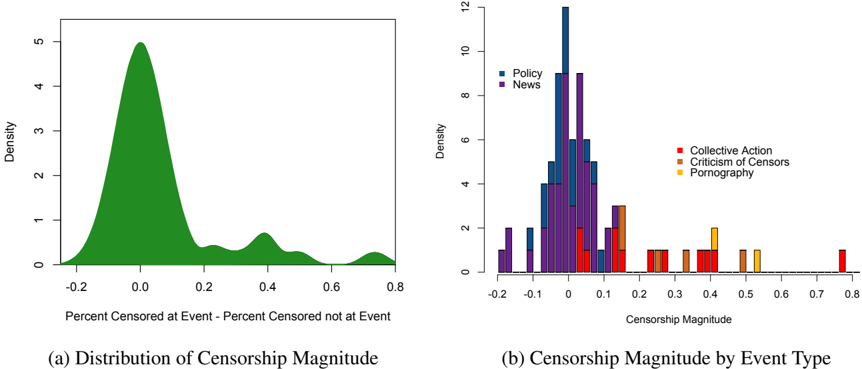
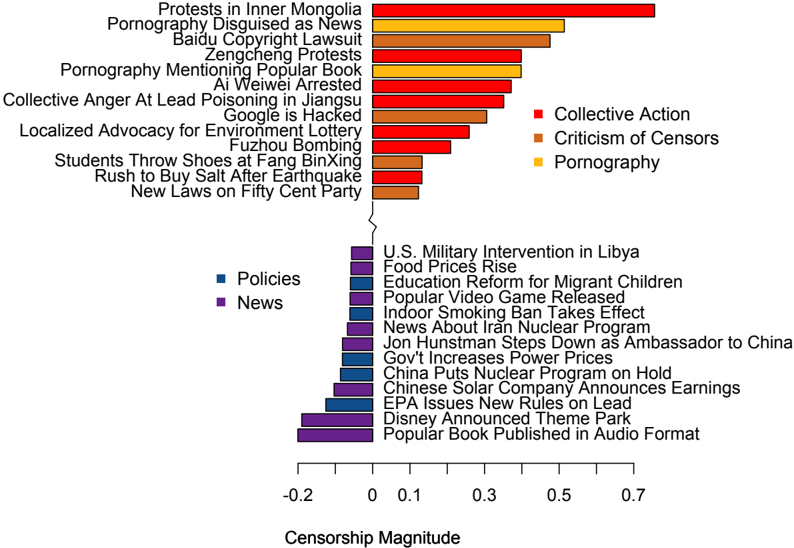
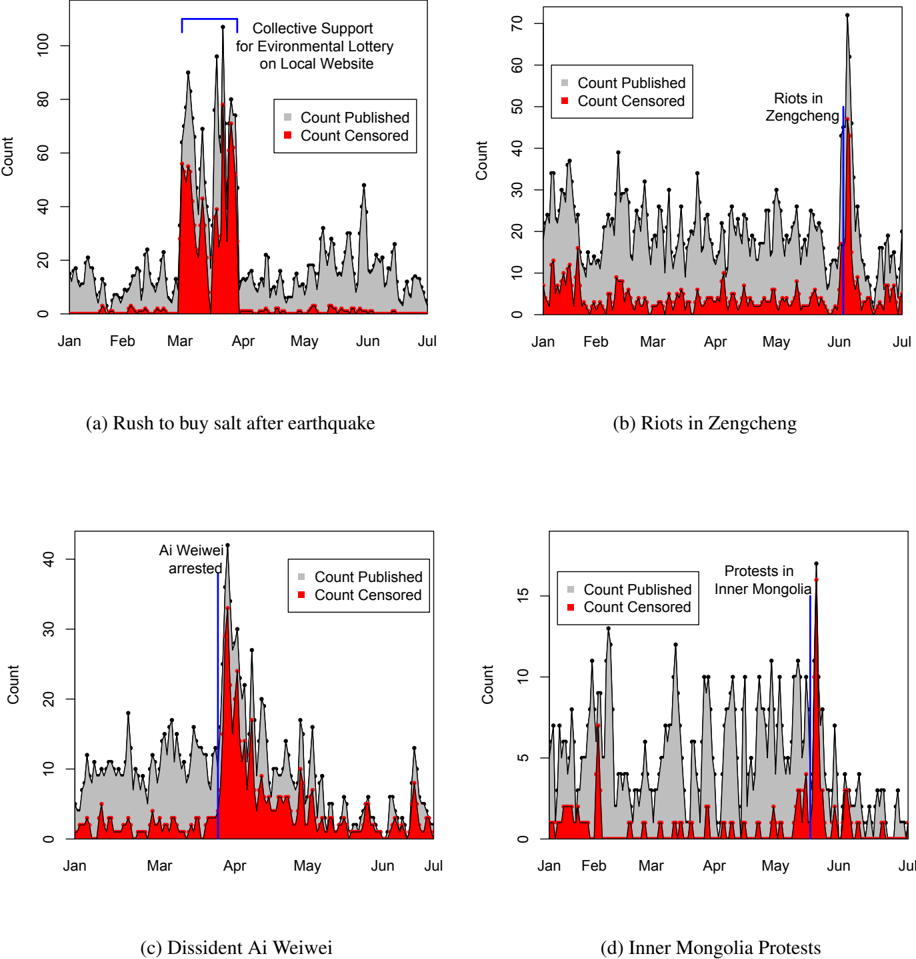
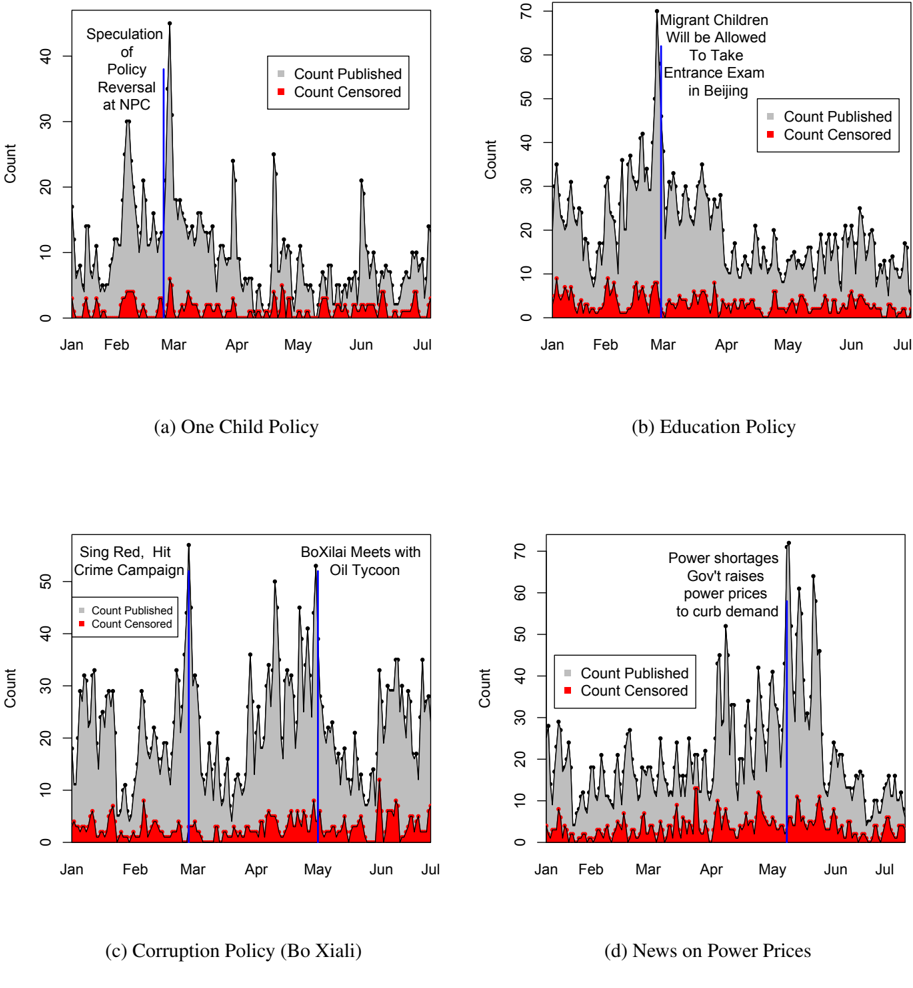
- Censorship was much higher during volume bursts tied to collective action: average censorship magnitude was 27% for collective action, compared with -1% for policy and -4% for news.
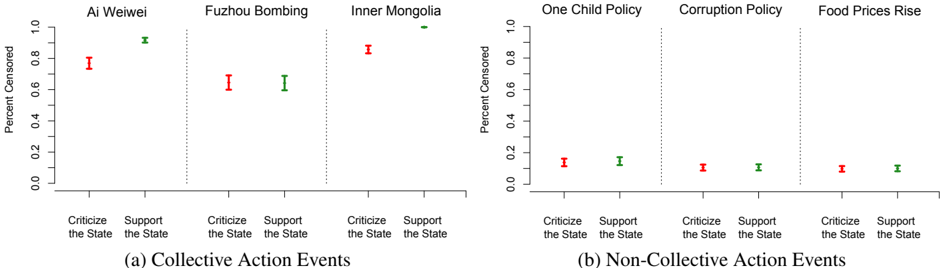
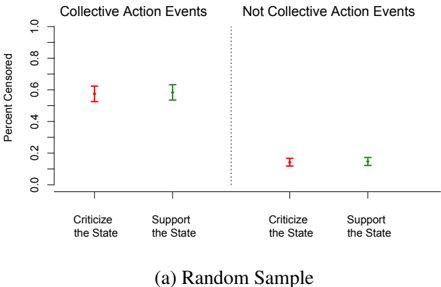
- For collective action events such as Ai Weiwei’s arrest, Inner Mongolia protests, and Fuzhou bombings, posts were censored at about 80% on average whether they criticized or supported the state. For non-collective-action events such as the one child policy, corruption policy, and food prices, censorship was about 10% on average for both critical and supportive posts.
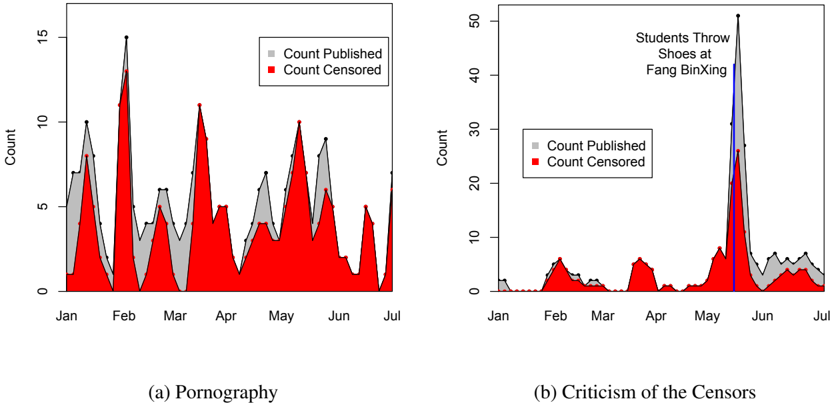
- Censorship also targeted pornography and criticism of the censors, but not government policy or other news. The authors argue censorship is aimed at curtailing collective action by silencing comments that represent, reinforce, or spur social mobilization.
Methods
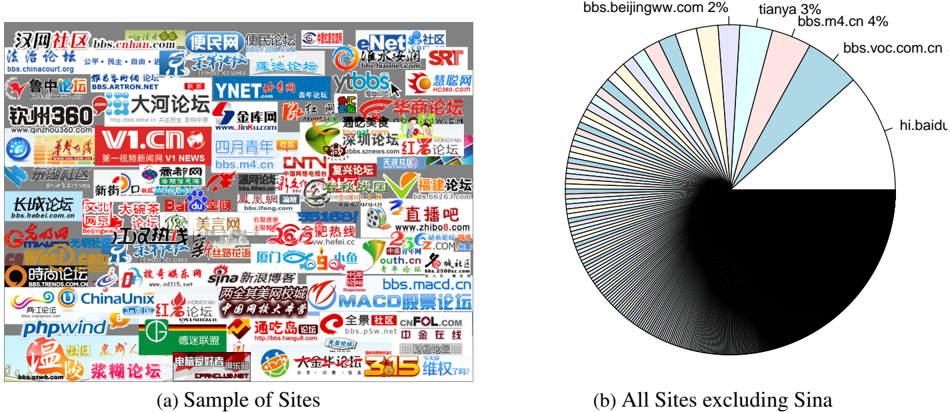
- The authors built a system to locate, download, and analyze posts from 1,382 Chinese websites during the first half of 2011, before government censors could remove them. They collected 3,674,698 posts, randomly selected 127,283 for further analysis, and overall collected and analyzed 11,382,221 posts.
- They used a stratified random sampling design covering 85 topic areas across three hypothesized political sensitivity levels, detected 87 volume bursts in 67 of the 85 topic areas using robust regression-based burst detection, and classified events into collective action potential, criticism of censors, pornography, government policies, and other news.
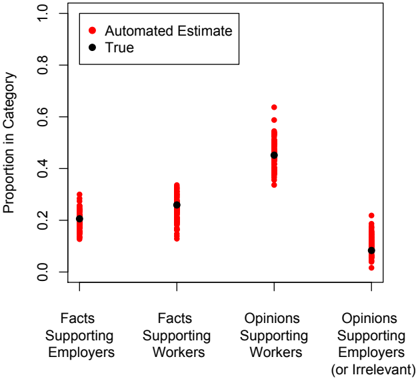
- To analyze content, they adapted the Hopkins and King “ReadMe” automated text analysis method to Chinese and extended it with a Bayesian procedure to estimate the percent censored within categories. Validation used native Chinese speakers coding 1,000 posts about 2010 labor strikes, with 100 as training and 900 as test; event coding reliability was 98.9% (86 of 87 events).
Limitations
- The paper states that its methodology misses self-censorship and censorship that may occur before the post is obtained; it also does not quantify the direct effects of the Great Firewall, keyword blocking, or search filtering.
- The authors state they have not studied physical violence, such as arrest of bloggers, or threats of the same; although many officials and levels of government influence censorship decisions, their data only sometimes distinguish among these sources, and they cannot determine the consequences of these limitations.
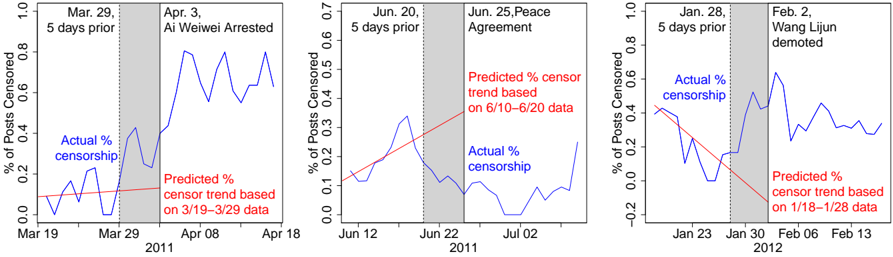
- The authors note that the presumably smaller number of discussions they cannot observe are likely to be those of most interest to the Chinese government, and they offer little evidence connecting social media findings to press freedom or other types of human expression in China. They also state that the predictive analysis was conducted retrospectively and with only three events, so further prospective validation would be valuable.
Model-written summary. Check it against the paper before relying on it.
Integrity signals
Registry
Cites
Statistics
Figures
Verification
Claims the paper makes
0 Valid · 7 Not valid · 7 Not checked · 88 Own results and interpretations
A result the paper reports from its own data — it cites no other source for it, so there is none to check. The quote shows it is in the paper.
In the paper
“Our data show that the Chinese censorship program allows for a wide variety of criticisms of the Chinese government, its officials, and its policies.”
§ How Censorship in China Allows Government Criticism but Silences Collective Expression * > Outline of Results
plain- Asserted: passes — The authors put it forward as true.
- Checkable: passes — It can be checked against evidence.
- Load-bearing: passes — The paper’s conclusions depend on it.
- Based: passes — The paper gives a reason why it holds.
A result the paper reports from its own data — it cites no other source for it, so there is none to check. The quote shows it is in the paper.
In the paper
“Contrary to previous understandings, posts with negative, even vitriolic, criticism of the state, its leaders, and its policies are not more likely to be censored.”
- Also stated in: § 1 Introduction · plain
“we find that when the Chinese people write scathing criticisms of their government and its leaders, the probability that their post will be censored does not increase.”
§ How Censorship in China Allows Government Criticism but Silences Collective Expression * > Abstract
plain- Asserted: passes — The authors put it forward as true.
- Checkable: passes — It can be checked against evidence.
- Load-bearing: passes — The paper’s conclusions depend on it.
- Based: passes — The paper gives a reason why it holds.
- Also stated in: § 1 Introduction · plain
A result the paper reports from its own data — it cites no other source for it, so there is none to check. The quote shows it is in the paper.
In the paper
“Large increases in online volume are good predictors of censorship when these increases are associated with events related to collective action, e.g., protest on the ground.”
§ How Censorship in China Allows Government Criticism but Silences Collective Expression * > Outline of Results
plainstates an association- Asserted: passes — The authors put it forward as true.
- Checkable: passes — It can be checked against evidence.
- Load-bearing: passes — The paper’s conclusions depend on it.
- Based: passes — The paper gives a reason why it holds.
A result the paper reports from its own data — it cites no other source for it, so there is none to check. The quote shows it is in the paper.
In the paper
“In addition, we measure sentiment within each of these events and show that during these events, the government censors views that are both supportive and critical of the state.”
§ How Censorship in China Allows Government Criticism but Silences Collective Expression * > Outline of Results
plainstates a cause- Asserted: passes — The authors put it forward as true.
- Checkable: passes — It can be checked against evidence.
- Load-bearing: passes — The paper’s conclusions depend on it.
- Based: passes — The paper gives a reason why it holds.
A result the paper reports from its own data — it cites no other source for it, so there is none to check. The quote shows it is in the paper.
In the paper
“We thus conduct the same analysis for the demotion of Wang Lijun in Panel (c) of Figure 11, and again see a large difference in actual and predicted percent censorship before Wang's demotion.”
§ How Censorship in China Allows Government Criticism but Silences Collective Expression * > Additional information
plainSingle case- Asserted: passes — The authors put it forward as true.
- Checkable: passes — It can be checked against evidence.
- Load-bearing: unclear — It is unclear whether the paper’s conclusions depend on it.
- Based: passes — The paper gives a reason why it holds.
46 more claims
Create a free account to see all 102 claims and every source verdict.
- Probably not a substantial claim. 26
- It may state two separate claims as one. 33
Claims other papers make about this one
Each is checked against this paper’s own text: does it say what the citing paper says it does?
The source backs part of the claim, not all of it — or backs it for a different population, condition or comparison.
In the citing paper
“Authorities are keen to review social media posts and have contentious messages removed (King etal., 2013) to ensure that potential threats remain invisible.”
From How Dictators Control the Internet: A Review Essay (2020) · cites this paper as King et al., 2013
Experimental — accuracy not yet measuredThe source backs part of the claim, not all of it — or backs it for a different population, condition or comparison.
In the citing paper
“In most autocratic regimes, governmental interference in digital infrastructure and communication is commonplace.”
From How Dictators Control the Internet: A Review Essay (2020) · cites this paper as King et al., 2013
Experimental — accuracy not yet measuredThe source backs part of the claim, not all of it — or backs it for a different population, condition or comparison.
In the citing paper
“First, the timing of censorship during a coup is consistent with many studies that have shown that Internet censorship is targeted during sensitive political time periods and periods of potential power transitions, such as elections and large-scale protests [23,25,44,47,73].”
From A multi-perspective view of Internet censorship in Myanmar (2021) · cites this paper as [44]
Experimental — accuracy not yet measuredThe cited source says what the claim attributes to it.
In the citing paper
“research has shown how mobilization organized through public coordination is repressed using that very same public information-for instance, repression is preemptively increased before focal days (Truex 2019); and autocracies censor online calls for collective action (King, Pan, and Roberts 2013), coerce online opinion leaders (Pan and Siegel 2020), and at times, turn off the internet entirely.”
From Coordinated Dis-Coordination (2024) · cites this paper as King, Pan, and Roberts 2013
The check wasn’t confident either way, so it gives no verdict — never disputed.
In the citing paper
“In China, for instance, two virtual police officers remind citizens that their browsing behavior is monitored (King etal., 2013).”
From How Dictators Control the Internet: A Review Essay (2020) · cites this paper as King et al., 2013
Experimental — accuracy not yet measured
1 more claim about this paper
Create a free account to see every claim other papers make about this one.
Citations
Cites
Robust estimation of a location parameter
Huber, P. J. (1964) · The Annals of Mathematical Statistics · doi:10.1214/aoms/1177703732 · Cited by 7,228
Robust Regression and Outlier Detection
Piepel, G. F. (1989) · Technometrics · doi:10.1080/00401706.1989.10488524 · Cited by 6,144
Robust Regression and Outlier Detection
Rousseeuw, P. J., & Leroy, A. M. (1987) · Wiley Series in Probability and Statistics · doi:10.1002/0471725382 · Cited by 5,609
Logistic Regression in Rare Events Data
King, G., & Zeng, L. (2001) · Political Analysis · doi:10.1093/oxfordjournals.pan.a004868 · Cited by 4,316 · cited 1×
“We do this via well-known and widely used case-control methodology (King and Zeng 2001).”
MethodSelf-citationDemocracy and Development: Political Institutions and Well-Being in the World, 1950–1990
Przeworski, A., Alvarez, M. E., Cheibub, J. A., & Limongi, F. (2000) · doi:10.1017/cbo9780511804946 · Cited by 2,845
Rightful Resistance in Rural China
O'Brien, K. J., & Li, L. (2006) · Cambridge University Press eBooks · doi:10.1017/cbo9780511791086 · Cited by 1,104
The Dynamics of Informational Cascades: The Monday Demonstrations in Leipzig, East Germany, 1989–91
Lohmann, S. (1994) · World Politics · doi:10.2307/2950679 · Cited by 1,035 · cited 1×
“Protests in East Germany, Eastern Europe, and most recently the Middle East have all preceded regime change (Ash 2002; Lohmann 1994; Przeworski et al. 2000).”
BackgroundRightful Resistance in Rural China
O'Brien, K., & Li, L.-J. (2006) · doi:10.1017/cbo9780511791086.003 · Cited by 987
China's Changing of the Guard: Authoritarian Resilience
Nathan, A. J. (2003) · Journal of Democracy · doi:10.1353/jod.2003.0019 · Cited by 927
Sparks and prairie fires: A theory of unanticipated political revolution
Kuran, T. (1989) · Public Choice · doi:10.1007/bf00116762 · Cited by 905 · cited 1×
“In fact, Kuran (1989) and Lohmann (2002) show that it is information about a collective action event that propels collective action and so distinguishing this from explicit calls for collective action would be difficult if not impossible.”
Background
Research works printed but not linked: 13
- 22. Freedom House. 2012. "Freedom of the Press, 2012." www.freedomhouse.org.
- 8. Chang, Parris. 1983. Elite Conflict in the Post-Mao China. New York: Occasional Papers Reprints.
- 26. Hinton, Harold. 1955. The "Unprincipled Dispute" Within Chinese Communist Top Lead- ership. Washington, DC: U.S. Information Agency.
- 44. Perry, Elizabeth. 2002. Challenging the Mandate of Heaven: Social Protest and State Power in China. Armork, NY: M. E. Sharpe.
- 52. Schurmann, Franz. 1966. Ideology and Organization in Communist China. Berkeley, CA: University of California Press.
- Tsai, 2007, Capitalism without Democracy: The Private Sector in Contemporary China
- 48. Qiang, Xiao. 2011. The Rise of Online Public Opinion and Its Political Impact. In Chang- ing Media, Changing China, ed. Susan Shirk. New York: Oxford University Press pp. 202-224.
- 9. Charles, David. 1966. The Dismissal of Marshal P'eng Teh-huai. In China Under Mao: Politics Takes Command, ed. Roderick MacFarquhar. Cambridge: MIT University Press pp. 20-33.
- 54. Shirk, Susan. 2007. China: Fragile Superpower: How China's Internal Politics Could Derail Its Peaceful Rise. New York: Oxford University Press.
- 56. Teiwes, Frederick. 1979. Politics and Purges in China: Retification and the Decline of Party Norms. Armork, NY: M. E. Sharpe. Tsai, Kellee. 2007a. Capitalism without Democracy: The Private Sector in Contemporary China. Ithaca, NY: Cornell University Press.
- 15. Duan, Qing. 2007. China's IT Leadership. Vdm Verlag.
- 38. MacFarquhar, Roderick. 1974. The Origins of the Cultural Revolution Volume 1: Contra- dictions Among the People 1956-1957. New York: Columbia University Press.
- 12. Chen, Xiaoyan and Peng Hwa Ang. 2011. Internet Police in China: Regulation, Scope and Myths. In Online Society in China: Creating, Celebrating, and Instrumentalising the Online Carnival, ed. David Herold and Peter Marolt. New York: Routledge pp. 40-52.
Cited by
Items 801–900 of 2,443
Zhao, Y., & Lin, Z. (2020) · Discourse & Communication · doi:10.1177/1750481320917578 · Cited by 13
“Much empirical research has shed light on the mechanism and substantive content of Chinese censorship (King et al., 2013; Mou et al., 2016; Rauchfleisch and Schafer, 2015; Yang, 2016), eroding government filtering mechanisms through digital means (Wines and LaFraniere, 2011) or examining…”
BackgroundGovernmental Responses to Terrorism in Autocracies: Evidence from China
Potter, P., & Wang, C. (2021) · British Journal of Political Science · doi:10.1017/s0007123420000514 · Cited by 14
Sun, Y., & Huang, V. G. (2021) · Chinese Journal of Communication · doi:10.1080/17544750.2021.1963997 · Cited by 14
“significantly disrupt the existing social order (King et al., 2013).”
BackgroundSocial Media and Press Freedom
Koçak, K., & Kıbrıs, Ö. (2022) · British Journal of Political Science · doi:10.1017/s0007123421000594 · Cited by 14
“Much scholarly attention has focused on internet censorship (King, Pan, and Roberts 2013; Tufekci 2017).”
BackgroundDefending workers' rights on social media: Chinese seafarers during the COVID‐19 pandemic
Tang, L. (2022) · Industrial Relations Journal · doi:10.1111/irj.12357 · Cited by 13
WeChat and the Sharing of News in Networked China
Xu, V. W. (2022) · Digital Journalism · doi:10.1080/21670811.2022.2053335 · Cited by 17
“Moreover, King, Pan, and Roberts (2013, 2014) show that regulators that have been more alert to information that may support collective action.”
BackgroundFreiman, O. (2023) · Minerva · doi:10.1007/s11024-023-09498-9 · Cited by 14
Digital Citizen Activism in Central Asia: Beyond Contestation and Cooperation
Kurmanov, B. (2023) · Springer eBooks · doi:10.1007/978-3-031-44584-2_9 · Cited by 23
Workers’ rights defence on China's internet: an analysis of actors
Tang, L., Shan, D., & Yang, P. (2015) · Information Communication & Society · doi:10.1080/1369118x.2015.1107613 · Cited by 15
Censorship of Online Encyclopedias: Implications for NLP Models
Yang, E., & Roberts, M. E. (2021) · ACM Conference on Fairness, Accountability, and Transparency (FAccT) · doi:10.1145/3442188.3445916 · Cited by 29
“Government censorship of social media, news, and websites directly affects large corpuses of text by blocking users’ access, deleting individualmessages, adding content through propaganda, or inducing self-censorship through intimidation and laws [11, 19, 20, 22, 25, 32, 34].”
BackgroundSelf-citationFrom Online Mass Incidents to Defiant Enclaves: Political Dissent on China’s Internet
Yang, S., & Wu, F. (2021) · The China Journal · doi:10.1086/717610 · Cited by 13
Gorbachev versus Deng: A Review of Chris Miller’s The Struggle to Save the Soviet Economy
Guriev, S. M. (2019) · Journal of Economic Literature · doi:10.1257/jel.20171470 · Cited by 17
Geographic and Longitudinal Trends in Media Framing of Obesity in the United States
Chiang, J., Arons, A., Pomeranz, J. L., Siddiqi, A., & Hamad, R. (2020) · Obesity · doi:10.1002/oby.22845 · Cited by 15
“This method has been previously validated and used in the social science literature to examine censorship patterns in Chinese media (29), to investigate patterns in political spending (30), to forecast election results based on political sentiments in the media (31), and to explore how racial ancestry is framed in the…”
MethodBlurring the Lines: Rethinking Censorship Under AutocracyPreprint
Gueorguiev, D. D., Shao, L. H., & Crabtree, C. (2017) · SSRN Electronic Journal · doi:10.2139/ssrn.3075481 · Cited by 28
The Pervasive Presence of Chinese Government Content on Douyin Trending VideosPreprint
Lu, Y., & Pan, J. (2021) · Social Science Research Network · doi:10.2139/ssrn.3794898 · Cited by 38
“…on information control in authoritarian regimes, which tends to assume that autocrats, including the Chinese regime, would censor objectionable content (using strategies ranging from censorship to repression) and produce propaganda (Huang, DOUYIN 25 2015; King et al., 2013; Pan & Siegel, 2020).”
BackgroundSelf-citationBeraja, M., Kao, A., Yang, D., & Yuchtman, N. (2021) · National Bureau of Economic Research · doi:10.3386/w29466 · Cited by 20
“The Chinese regime is particularly concerned with protests and unrest (Shirk, 2007; King et al., 2013).”
BackgroundDeng, W., Hsu, J., Löfgren, K., & Cho, W. (2021) · doi:10.26686/wgtn.14925384.v1 · Cited by 13
The rise of authoritarian informationalism: escalating surveillance, manipulation, and control
Garbe, L., & Maerz, S. F. (2026) · Democratization · doi:10.1080/13510347.2025.2579105 · Cited by 11
“63 Targeted cyberattacks on opposition websites supplement these efforts, effectively incapacitating critical voices in a focused and often less visible way.”
Huang, V. G., & Xie, Z. (2024) · Discourse & Communication · doi:10.1177/17504813231224030 · Cited by 11
“The censorship scholarship has found that platform companies work hand-in-hand with the state to conduct surveillance and censorship (Han, 2018; Jia and Han, 2020), which is especially the case during social movements (King et al., 2013).”
BackgroundQiu, P., Zhou, S., & Ferrara, E. (2025) · Information Sciences · doi:10.1016/j.ins.2025.122702 · Cited by 34
“This pattern aligns with prior work indicating that Chinese censorship tends to tolerate criticism but suppresses content perceived as mobilising collective dissent [18].”
Guan, T., & Chen, X. (2022) · Public Understanding of Science · doi:10.1177/09636625221113957 · Cited by 15
Chinese Nationalism: Insights and Opportunities for Comparative Studies
Stroup, D. R. (2022) · Nationalities Papers · doi:10.1017/nps.2022.99 · Cited by 14
Pulling through elections by pulling the plug: Internet disruptions and electoral violence in Uganda
Garbe, L. (2024) · Journal of Peace Research · doi:10.1177/00223433231168190 · Cited by 11
“Simultaneously, governments increasingly monitor online discourse to identify antiregime sentiment and relevant opposition activists (King, Pan & Roberts, 2013; Qin, Stro¨mberg & Wu, 2017).”
Unpacking ‘public silence’: Civil society activism under authoritarian rule in Ethiopia
Pellerin, C. L. (2023) · Public Administration and Development · doi:10.1002/pad.2026 · Cited by 17
Community Deception From a Node-Centric Perspective
Pirrò, G. (2023) · IEEE Transactions on Network Science and Engineering · doi:10.1109/tnse.2023.3311762 · Cited by 13
“The issue arises when these spontaneously shared pieces of information are improperly used, as in the Cambridge Ana-lytica case, where private personal information was improperly used, or when information about communities is used to block forms of society self-organization [4].”
Policy responsiveness and its administrative organisation in China
Liu, Y., Araral, E., & Wu, J. (2024) · Policy & Politics · doi:10.1332/03055736y2023d000000015 · Cited by 12
Dixon, J. (2014) · Nationalities Papers · doi:10.1080/00905992.2014.969693 · Cited by 13
FilteredWeb: A framework for the automated search-based discovery of blocked URLs
Darer, A., Farnan, O., & Wright, J. (2017) · Network Traffic Measurement and Analysis Conference (TMA) · doi:10.23919/tma.2017.8002914 · Cited by 11
“[33] that posits that the Chinese government aims to reduce collective action potential rather than individuals.”
BackgroundWu, A. X. (2017) · Media Culture & Society · doi:10.1177/0163443717734409 · Cited by 13
“It is the comments which ‘represent, reinforce, and spur social mobilization’ that censors primarily target (King et al., 2013: 236).”
BackgroundDemand for democracy in resilient authoritarianism: evidence from rural China
Guan, Y. (2018) · Democratization · doi:10.1080/13510347.2018.1445086 · Cited by 12
Yu, T. (2019) · Political Science Research and Methods · doi:10.1017/psrm.2019.41 · Cited by 14
“More broadly, this paper relates to the literature on information control in autocracies (Egorov et al., 2009; Gehlbach and Sonin, 2014; Guriev and Treisman, 2015; Lorentzen, 2014; Luo and Rozenas, 2016; King et al., 2013; Shadmehr and Bernhardt, 2015; Hollyer et al., 2015).”
BackgroundMeng, T. (2019) · 中国社会科学:英文版 · doi:10.1080/02529203.2019.1674041 · Cited by 11
Guan, T., & Hu, T. (2020) · Continuum · doi:10.1080/10304312.2020.1724882 · Cited by 14
“…hardline approach to dealing with political dissidents and intellectuals who have criticized the authority is unchanged, it has increased its tolerance for ordinary people’s alternative, challenging, and even radical expressions in everyday life and in cyberspace (e.g. King, Pan, and Roberts 2013).”
BackgroundDebating China beyond the Great Firewall: Digital Disenchantment and Authoritarian Resilience
Han, R. (2022) · Journal of Chinese Political Science · doi:10.1007/s11366-022-09812-4 · Cited by 16
Big data-mediated repression: a novel form of preemptive repression in China’s Xinjiang region
Öztığ, L. İ. (2023) · Contemporary Politics · doi:10.1080/13569775.2023.2203568 · Cited by 15
He, K., Eldridge, S. A., & Broersma, M. (2023) · Journal of Information Technology & Politics · doi:10.1080/19331681.2023.2290515 · Cited by 16
“Furthermore, while working with Weibo data is necessarily affected by the censorship regime as some data might have been deleted or blocked post-publication (King, Pan, & Roberts, 2013).”
InfluentialZhu, Y. (2024) · Big Data & Society · doi:10.1177/20539517241242450 · Cited by 17
“Posts related to collective actions, criticisms of censors, pornography (King et al., 2013, 2014) and other political events (Bamman et al., 2012; Fu et al., 2013) often face higher censorship rates.”
One Disaster, Three Institutional Responses
Liu, S. N., & Chang, T. (2016) · Journalism Studies · doi:10.1080/1461670x.2016.1190666 · Cited by 11
“…cannot be simplified as voices of the people, since there exists both coercive control of information, like government censorship and filtering (King, Pan, and Roberts 2013; Wright 2014), and hidden instruments of whitewash or guidance of public opinion, such as the fifty-cent party, a group…”
BackgroundSoh, K., & Yecies, B. (2017) · Global Media and China · doi:10.1177/2059436416687105 · Cited by 22
Legitimationsstrategien von Autokratien: Eine Einführung
Kailitz, S., & Wurster, S. (2017) · Zeitschrift für Vergleichende Politikwissenschaft · doi:10.1007/s12286-017-0338-9 · Cited by 18
Xue, T., & van Stekelenburg, J. (2018) · Current Sociology · doi:10.1177/0011392118783525 · Cited by 15
A Tale of Two Deltas: Labour Politics in Jiangsu and Guangdong
Elfström, M. (2019) · British Journal of Industrial Relations · doi:10.1111/bjir.12467 · Cited by 11
“…it has been argued that the government uses unrest to generate valuable information about its local agents (Lorentzen 2013), and it permits criticisms online — at least those criticisms that do not contain collective action potential — to allow citizens a pressure release valve (King et al. 2013).”
BackgroundBenign dataveillance? Examining novel data-driven governance systems in India and China
Arora, P. (2019) · First Monday · doi:10.5210/fm.v24i4.9840 · Cited by 19
Making the news: environmental NGOs and their media visibility in China
Zhang, N., & Škorić, M. M. (2019) · Chinese Journal of Communication · doi:10.1080/17544750.2019.1610468 · Cited by 18
Sun, Y., Graham, T., & Broersma, M. (2020) · Journal of Language and Politics · doi:10.1075/jlp.19104.sun · Cited by 12
How to think about media policy silence
Li, L. (2020) · Media Culture & Society · doi:10.1177/0163443720948004 · Cited by 20
“Even when interviews with government officials are possible, King et al. (2013) have realistically pointed out that researchers are ‘in the position of having to read tea leaves to ascertain what their informants really believe’ (p. 327).”
BackgroundHu, A. (2020) · British Journal of Sociology · doi:10.1111/1468-4446.12798 · Cited by 12
Playing by the Informal Rules: Why the Chinese Regime Remains Stable despite Rising Protests
Li, Y. (2018) · Cambridge University Press eBooks · doi:10.1017/9781108557054 · Cited by 32
Ai, M., & Nan, Z. (2021) · International Communication Gazette · doi:10.1177/17480485211029061 · Cited by 13
“In addition, Weibo, the counterpart of Twitter in China, had 511 million monthly active users (Weibo, 2020) and WeChat had 1,212 million monthly active users (WeChat, 2020).”
BackgroundNews coverage of social protests in global society
Zhang, Y., Thorgusen, S., & Fan, X. (2022) · International Journal of Comparative Sociology · doi:10.1177/00207152221085601 · Cited by 15
“One direct and important political condition that influences media attention in the digital era is Internet censorship (Humprecht and Esser, 2018; King et al., 2013; Lei, 2016).”
BackgroundMethodInfluentialCommunity deception: from undirected to directed networks
Fionda, V., Madi, S. A., & Pirrò, G. (2022) · Social Network Analysis and Mining · doi:10.1007/s13278-022-00896-7 · Cited by 13
“…shared pieces of information are improperly used, as in the Cambridge Analytica case, where private personal information about users and their social relationships were used without their consent, or when information about communities is used to block forms of self-organization (King et al. 2013).”
MethodSearching for ‘Digital Asia’ in its Networks: Where the Spatial Turn Meets the Digital Turn
Schneider, F. (2015) · Asiascape Digital Asia · doi:10.1163/22142312-12340020 · Cited by 14
“For the Chinese case, for instance, Gary King and his colleagues have traced how Chinese government censorship works online (King et al. 2013), and Jason Q.”
BackgroundInfluentialLeetaru, K. H. (2013) · Illinois Digital Environment for Access to Learning and Scholarship (University of Illinois at Urbana-Champaign) · Cited by 11
Bounded Articulation: An Analysis of CPPCC Proposals, 2008–12
Bin, Y. (2015) · Journal of Chinese Political Science · doi:10.1007/s11366-015-9329-3 · Cited by 17
Focal Points, Dissident Calendars, and Preemptive RepressionPreprint
Truex, R. (2019) · SSRN Electronic Journal · doi:10.2139/ssrn.2802859 · Cited by 98
“In the Chinese case, King, Pan and Roberts describe how the Chinese Communist Party (CCP) skillfully censors social media posts aimed at stirring up protests or demonstrations, again targeting the mobilization stage of contentious behavior (King et al. 2013, 2014).”
BackgroundDoes Analytic Thinking Insulate Against Pro-Kremlin Disinformation? Evidence from UkrainePreprint
Erlich, A., Garner, C., Pennycook, G., et al. (2021) · doi:10.31234/osf.io/4yrdj · Cited by 11
Does Social Media Influence Conflict? Evidence from the 2012 Gaza ConflictPreprint
Zeitzoff, T. C. (2014) · SSRN Electronic Journal · doi:10.2139/ssrn.2407804 · Cited by 11
Tao, Y., Wang, Z., Zhan, Z., & Zhou, H. (2024) · Contemporary Politics · doi:10.1080/13569775.2024.2350082 · Cited by 10
“Furthermore, because the government prohibits offline campaigns (Chen, 2011) and censors online comments to limit collective action (King et al., 2013), populism is unlikely to develop into social movements in China today.”
Min, C., Shen, F., & Yu, W. (2020) · Government Information Quarterly · doi:10.1016/j.giq.2020.101542 · Cited by 12
Selective Control: The Political Economy of Censorship
Corduneanu-Huci, C., & Hamilton, A. (2022) · Political Communication · doi:10.1080/10584609.2022.2074587 · Cited by 20
“State censorship in China, for example, is largely and officially subcontracted to private entities (King et al., 2013).”
InfluentialAuthoritarian media and foreign protests: evidence from a decade of Russian news
Otlan, Y., Kuzmina, Y., Rumiantseva, A., & Tertytchnaya, K. (2023) · Post-Soviet Affairs · doi:10.1080/1060586x.2023.2264079 · Cited by 14
“…scholarship on authoritarian politics focuses on state-controlled outlets’ decision to cover protests that take place at home (e.g. Egorov, Guriev, and Sonin 2009; King, Pan, and Roberts 2013; Smyth and Oates 2015) and has less to say about the decision to cover protests in the rest of the world.”
BackgroundWu, X. (2024) · Media Culture & Society · doi:10.1177/01634437231219132 · Cited by 18
“Within the firewall, online censorship is executed mainly through technological forms and human power (King et al., 2013).”
Zhang, T. H., Xu, J., & Liu, J. (2024) · The China Quarterly · doi:10.1017/s0305741024000602 · Cited by 14
Regime Type and Data Manipulation: Evidence from the COVID-19 Pandemic
Wigley, S. (2024) · Journal of Health Politics Policy and Law · doi:10.1215/03616878-11373750 · Cited by 11
Wang, Z., Kim, D.-G., & Zhu, J. (2024) · International Journal of Public Opinion Research · doi:10.1093/ijpor/edae031 · Cited by 11
RezaeeDaryakenari, B., Ghafouri, V., & Kasap, N. (2024) · Foreign Policy Analysis · doi:10.1093/fpa/orae033 · Cited by 17
What is ‘6B4T’ in China? New wave of radical digital feminism on Douban
Li, S., & Gu, Y. (2025) · Journal of Gender Studies · doi:10.1080/09589236.2025.2521682 · Cited by 21
“The Chinese internet censorship apparatus prioritizes movements with collective potential and expressions of state critique (King et al., 2013), making feminist organizing particularly vulnerable to surveillance and restriction.”
Análise de valências, debate acadêmico e contenda política
Júnior, J. F. (2016) · Revista Brasileira de Ciência Política · doi:10.1590/0103-335220162009 · Cited by 13
Trends in the Regulation of Hate Speech and Fake News: A Threat to Free Speech?
Santuraki, S. U. (2019) · Hasanuddin Law Review · doi:10.20956/halrev.v5i2.1625 · Cited by 15
Huang, G., & Pang, M. R. (2022) · Asian Journal of Comparative Politics · doi:10.1177/20578911221078030 · Cited by 13
“Second, many authoritarian governments maintain their survival by controlling the flow of news and information (King et al., 2013; Schatz, 2009).”
BackgroundDoes Internet Connect to Social Justice Perception in China?
Zhou, D., Zhu, J., & Guo, Y. (2022) · Frontiers in Psychology · doi:10.3389/fpsyg.2022.917039 · Cited by 12
Official Media as Emotional Valves
Lu, F., Huang, Z., & Meng, T. (2023) · Asian Survey · doi:10.1525/as.2023.1831404 · Cited by 11
Disinformation and Artificial Intelligence: the Case of Online Journalism in China
Ibáñez, D. B., Jamil, S., & Montemayor, D. J. D. L. G. (2023) · Estudios sobre el Mensaje Periodístico · doi:10.5209/esmp.88543 · Cited by 12
Quantitative Content Analysis: A Primer and Call for Robustness
Boydstun, A. E. (2023) · Oxford University Press eBooks · doi:10.1093/oxfordhb/9780192868282.013.54 · Cited by 12
Exploring the Cuban blogosphere: Discourse networks and informal politics
Vicari, S. (2014) · New Media & Society · doi:10.1177/1461444814529285 · Cited by 16
“King et al. (2013), for instance, show that Chinese social media censorship follows a specific strategy: individuals are free to use Chinese social media to post messages against the state, leaders, or policies.”
BackgroundBei, G., & Jiang, Y. (2015) · Journal of International Communication · doi:10.1080/13216597.2014.998700 · Cited by 12
The Emergence of Subversive Charities in China
Marquis, C., Zhou, Y., & Yang, Z. (2015) · eCommons (Cornell University) · Cited by 10
Internet Freedom in Asia: Case of Internet Censorship in China
Monggilo, Z. M. Z. (2016) · Jurnal Studi Pemerintahan · doi:10.18196/jgp.2016.0026 · Cited by 10
Speaking out: Testimonial narratives of Chinese cyberpetitioners under networked authoritarianism
Huang, V. G. (2016) · Discourse Context & Media · doi:10.1016/j.dcm.2016.09.002 · Cited by 10
Comparing Methods for Generating Large Scale Political Event Data Sets
Schrodt, P. A., & Analytics, P. (2015) · Cited by 11
Zhang, X. (2017) · Journal of Chinese Political Science · doi:10.1007/s11366-017-9497-4 · Cited by 12
Jurisdiction Scale Matters: County Size and External Political Efficacy in China
Huang, J., & Deng, Y. (2017) · Political Studies · doi:10.1177/0032321717695292 · Cited by 10
Contentious Politics in the Trump Era
Crabtree, C. D., Davenport, C., Chenoweth, E., Moss, D. M., Earl, J., Ritter, E. H., & Sullivan, C. M. (2017) · PS Political Science & Politics · doi:10.1017/s104909651700141x · Cited by 12
“Important research is now examining the limits of digital mobilization and, in particular, the ways in which governments restrict access and surveil usage to manage contentious politics (e.g., Lynch 2011; King et al. 2013; Lorentzen 2014).”
BackgroundEnvironmental Governance in China: State, Society, and Market
Turiel, J., Ding, I., & Liu, J. C. (2017) · Brill Research Perspectives in Governance and Public Policy in China · doi:10.1163/24519227-12340002 · Cited by 10
Muise, D., & Pan, J. (2018) · Asian Journal of Communication · doi:10.1080/01292986.2018.1453850 · Cited by 14
“It tests a spe-cific theory—that censorship is focused on posts with collective action potential rather than posts that criticize the regime, which was generated through computational methods of text analysis in King, Pan, and Roberts (2013).”
MethodSelf-citationComplex Mediation in the Formation of Political Opinions
Kou, Y., & Nardi, B. A. (2018) · CHI Conference on Human Factors in Computing Systems · doi:10.1145/3173574.3174210 · Cited by 11
“For example, on commercial social media sites such as Weibo, China’s largest micro-blogging service, deletion of social media posts can take place minutes after their creation [55].”
BackgroundHow Propaganda Moderates the Influence of Opinion Leaders on Social Media in China
Huang, H., Wang, F., & Shao, L. H. (2018) · International journal of communication · Cited by 21
Social media and regime support in Russia: does it matter which website is used?
Placek, M. (2019) · East European Politics · doi:10.1080/21599165.2019.1658078 · Cited by 12
“Furthermore, the Chinese government has been known to use digital media as a sort of “pressure release valve”, where they allow government criticism, but silence collective expression (King, Pan, and Roberts 2013).”
BackgroundYang, Y., & Chen, W. (2019) · The China Quarterly · doi:10.1017/s0305741019001371 · Cited by 10
Crabtree, C. D., Kern, H., & Pfaff, S. J. (2016) · International Studies Quarterly · doi:10.1093/isq/sqy007 · Cited by 17
Neagli, J. P. (2021) · Journal of Current Chinese Affairs · doi:10.1177/1868102621989717 · Cited by 14
Trauth-Goik, A., & Bernot, A. (2021) · Surveillance & Society · doi:10.24908/ss.v19i4.14371 · Cited by 15
Leading with hearts and minds: emotion contagion in China’s online activism
Liu, N., & Liu, J. (2021) · Social movement studies · doi:10.1080/14742837.2021.2011716 · Cited by 13
“King et al. (2013) exemplify that online censorship strategically targets content with offline collective action mobilization potential.”
BackgroundHeavenly Mandate: Public Opinion and China's Space Activities
Hines, R. L. (2022) · Space Policy · doi:10.1016/j.spacepol.2021.101460 · Cited by 14
The Impact of Data Persistence Bias on Social Media Studies
Elmas, T. (2023) · ACM Web Science Conference (WebSci) · doi:10.1145/3578503.3583630 · Cited by 16
“[21] showed that Chinese censors remove social media posts that promote collective action within 24 hours, making it impossible to study civil unrest through social media.”
BackgroundApplying Search Words and BBS Posts to Societal Risk Perception and Harmonious Society Measurement
Tang, X. (2013) · Conference proceedings/Conference proceedings - IEEE International Conference on Systems, Man, and Cybernetics · doi:10.1109/smc.2013.375 · Cited by 10
Authoritarian Regimes and Their Permitted Oppositions: Election Day Outcomes in Cuba
Domínguez, J. I., Galvis, Á. F., & Superti, C. (2017) · Latin American Politics and Society · doi:10.1111/laps.12017 · Cited by 11
Zhang, H. (2016) · SSRN Electronic Journal · doi:10.2139/ssrn.2647222 · Cited by 10
Truth Replaced by Silence: A Field Experiment on Private Censorship in RussiaPreprint
Crabtree, C. D., Fariss, C. J., & Kern, H. (2015) · SSRN Electronic Journal · doi:10.2139/ssrn.2708274 · Cited by 11
Big data challenges for the social sciences: from society and opinion to replicationsPreprint
Boullier, D. (2016) · arXiv (Cornell University) · doi:10.48550/arxiv.1607.05034 · Cited by 13
Metadata
- Authors
- KING, G., PAN, J., & ROBERTS, M. E.
- Affiliations
- Harvard University (US)
- Corresponding author
- KING, GARY
- PAN, JENNIFER
- Venue
- American Political Science Review
- Publisher
- Cambridge University Press (CUP)
- Published
- 2013-05
- Volume
- 107
- Issue
- 2
- Pages
- 326-343
- ISSN
- 0003-0554 (ISSN-L)
- 1537-5943
- OpenAlex
- W2144188763
- Cited by
- 2,415
- References
- 48
- Citations by year
- 2026: 161 · 2025: 206 · 2024: 249 · 2023: 272 · 2022: 230 · 2021: 193 · 2020: 206 · 2019: 157 · 2018: 178 · 2017: 153 · 2016: 137 · 2015: 120 · 2014: 91 · 2013: 54
- FWCI
- 395.09
- Type
- journal article
- Language
- en
- Open access
- green
- nrs.harvard.edu
- Licence
- Locations
- American Political Science Review (publishedVersion)
- Digital Access to Scholarship at Harvard (DASH) (Harvard University) (submittedVersion, cc-by)
- RePEc: Research Papers in Economics (submittedVersion)
- Topics
- Social Sciences › Communication › Social Media and Politics
- Social Sciences › Law › Freedom of Expression and Defamation
- Social Sciences › Sociology and Political Science › Media Influence and Politics
- Keywords
- internet censorship, Chinese government, social media, collective action, social mobilization, political criticism, online speech
About these checks
Registry, retraction, Cites and statistics results are computed, not judged, with one exception: a printed reference that no index lists is read once by a model before it counts as a citation error. Claims are extracted by a model and kept only when their quote appears verbatim in the text; each cited source is then checked, with a model’s help, for whether it says what the claim relies on. Those verdicts can be wrong — read the claim’s quote and the cited source before relying on one.
A language model drew the claims from the paper on 2026-10-11, under version 3 of the claim definition (model deepseek-v4.1-flash, prompt extract-v3).
A second model labelled each claim on 2026-10-11 (model jev-1.13-20260917, definition revision gold-guideline-v0.2).
Statistics and arithmetic are recomputed, not judged.
Confidence bands are shown only for fields calibrated on our annotated test set. None is calibrated yet, so no band is shown.
What counts as a claim ›How we measure confidence ›How we check this ›
Are you an author, or do you see a problem with this page? Request a review
Data sources
Bibliographic data: Semantic Scholar, OpenAlex, Crossref.
Contains information from the Semantic Scholar Academic Graph Datasets, made available under the ODC Attribution License (ODC-BY 1.0).
Semantic Scholar’s data is described in: Kinney, R., et al. (2023). The Semantic Scholar Open Data Platform. arXiv:2301.10140.
