

How Censorship in China Allows Government Criticism but Silences Collective Expression
Open accessThe DOI matches its Crossref record; 53 of the 54 references it cites were found in a registry or an index, and 1 are not checked yet; none of the 12 sources its claims cite is checked for support yet.
Abstract
We offer the first large scale, multiple source analysis of the outcome of what may be the most extensive effort to selectively censor human expression ever implemented. To do this, we have devised a system to locate, download, and analyze the content of millions of social media posts originating from nearly 1,400 different social media services all over China before the Chinese government is able to find, evaluate, and censor (i.e., remove from the Internet) the subset they deem objectionable. Using modern computer-assisted text analytic methods that we adapt to and validate in the Chinese language, we compare the substantive content of posts censored to those not censored over time in each of 85 topic areas. Contrary to previous understandings, posts with negative, even vitriolic, criticism of the state, its leaders, and its policies are not more likely to be censored. Instead, we show that the censorship program is aimed at curtailing collective action by silencing comments that represent, reinforce, or spur social mobilization, regardless of content. Censorship is oriented toward attempting to forestall collective activities that are occurring now or may occur in the future—and, as such, seem to clearly expose government intent.
Checked 2026-11-22 · 1 reference not checked yet
Overview
CoChat Summary
TL;DR
The paper uses large-scale, real-time collection of Chinese social media posts to test why China censors online expression. It finds that censorship does not target criticism of the state or leaders; instead, it targets posts with collective action potential, regardless of whether they support or criticize the government.
Key findings
- Across the data, an average of approximately 13% of all social media posts were censored. Ex ante political sensitivity had only a weak relationship with censorship: Low and Medium categories were censored at 16% and 17%, respectively, versus 24% for High.
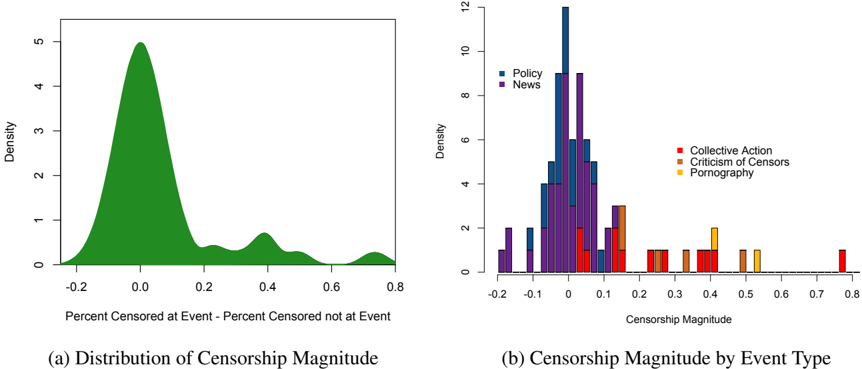
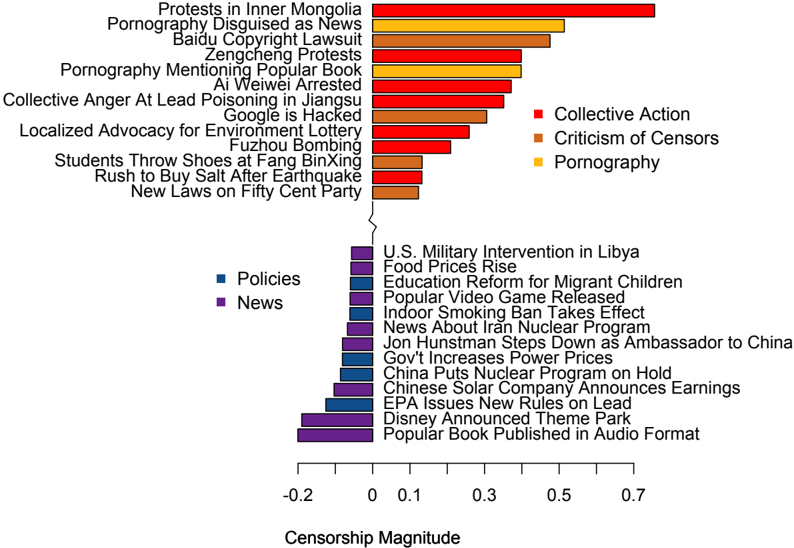
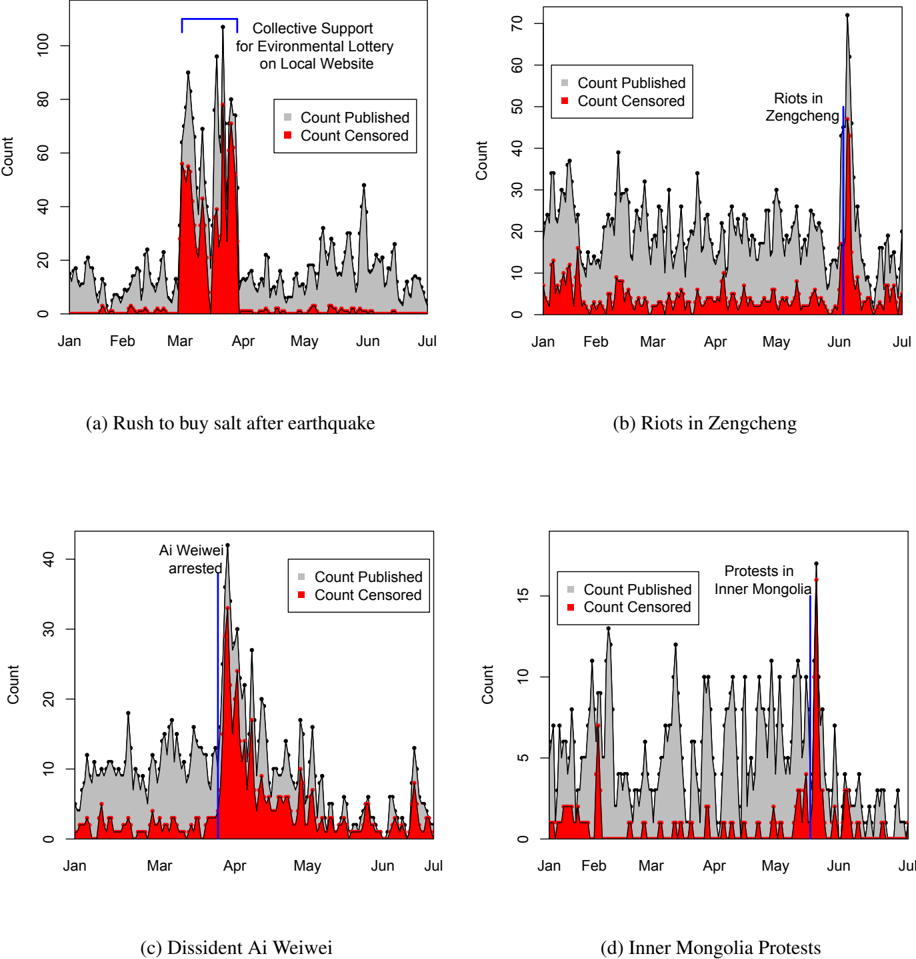
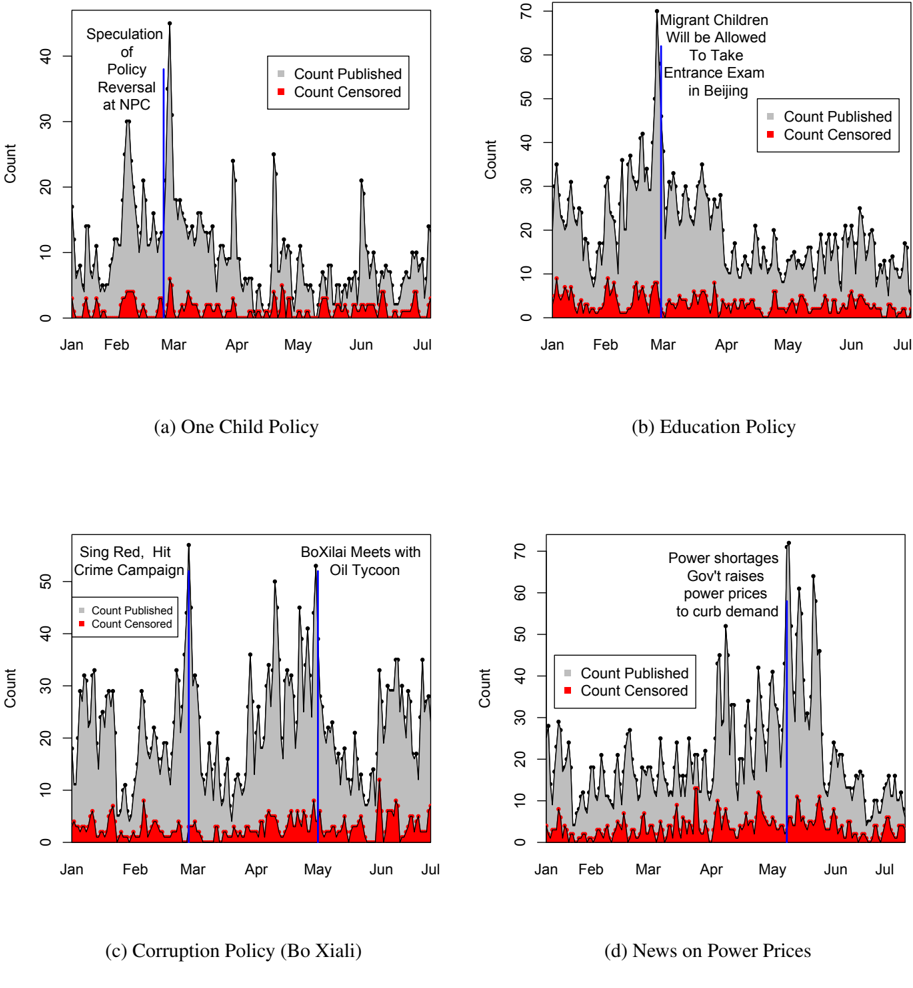
- Censorship was much higher during volume bursts tied to collective action: average censorship magnitude was 27% for collective action, compared with -1% for policy and -4% for news.
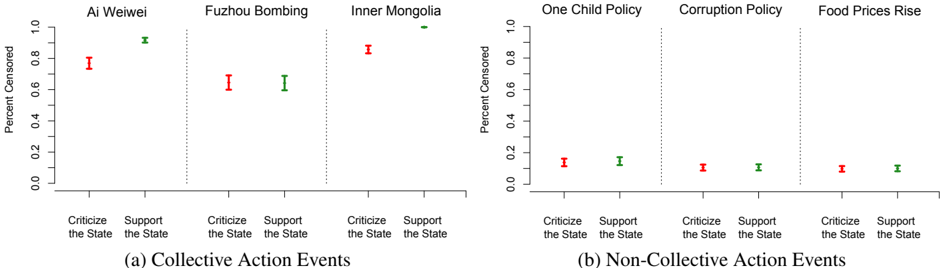
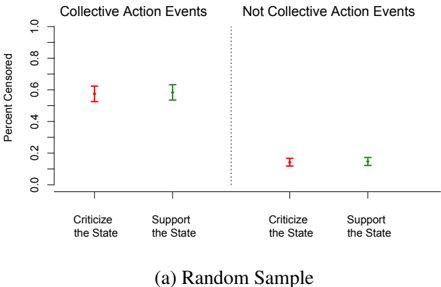
- For collective action events such as Ai Weiwei’s arrest, Inner Mongolia protests, and Fuzhou bombings, posts were censored at about 80% on average whether they criticized or supported the state. For non-collective-action events such as the one child policy, corruption policy, and food prices, censorship was about 10% on average for both critical and supportive posts.
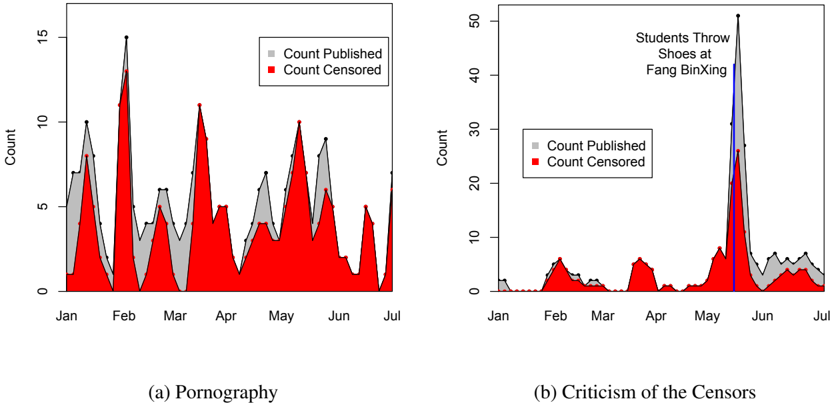
- Censorship also targeted pornography and criticism of the censors, but not government policy or other news. The authors argue censorship is aimed at curtailing collective action by silencing comments that represent, reinforce, or spur social mobilization.
Methods
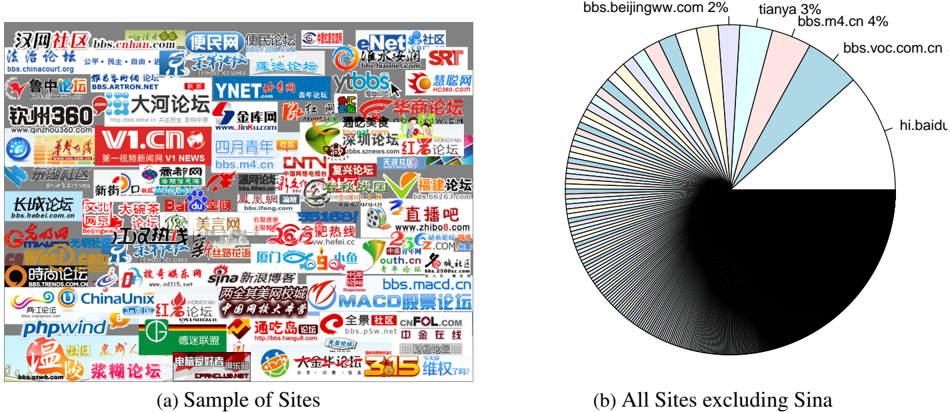
- The authors built a system to locate, download, and analyze posts from 1,382 Chinese websites during the first half of 2011, before government censors could remove them. They collected 3,674,698 posts, randomly selected 127,283 for further analysis, and overall collected and analyzed 11,382,221 posts.
- They used a stratified random sampling design covering 85 topic areas across three hypothesized political sensitivity levels, detected 87 volume bursts in 67 of the 85 topic areas using robust regression-based burst detection, and classified events into collective action potential, criticism of censors, pornography, government policies, and other news.
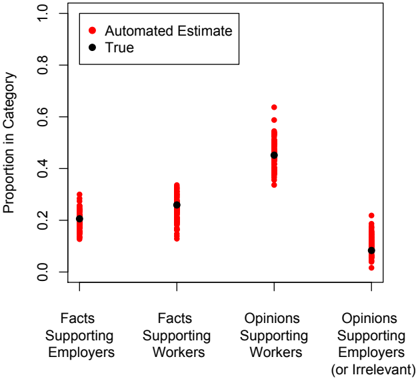
- To analyze content, they adapted the Hopkins and King “ReadMe” automated text analysis method to Chinese and extended it with a Bayesian procedure to estimate the percent censored within categories. Validation used native Chinese speakers coding 1,000 posts about 2010 labor strikes, with 100 as training and 900 as test; event coding reliability was 98.9% (86 of 87 events).
Limitations
- The paper states that its methodology misses self-censorship and censorship that may occur before the post is obtained; it also does not quantify the direct effects of the Great Firewall, keyword blocking, or search filtering.
- The authors state they have not studied physical violence, such as arrest of bloggers, or threats of the same; although many officials and levels of government influence censorship decisions, their data only sometimes distinguish among these sources, and they cannot determine the consequences of these limitations.
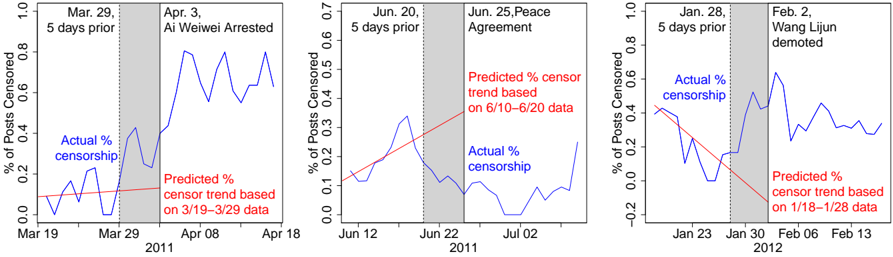
- The authors note that the presumably smaller number of discussions they cannot observe are likely to be those of most interest to the Chinese government, and they offer little evidence connecting social media findings to press freedom or other types of human expression in China. They also state that the predictive analysis was conducted retrospectively and with only three events, so further prospective validation would be valuable.
Model-written summary. Check it against the paper before relying on it.
Integrity signals
Registry
Cites
Statistics
Figures
Verification
Claims the paper makes
0 Valid · 7 Not valid · 7 Not checked · 88 Own results and interpretations
A result the paper reports from its own data — it cites no other source for it, so there is none to check. The quote shows it is in the paper.
In the paper
“Our data show that the Chinese censorship program allows for a wide variety of criticisms of the Chinese government, its officials, and its policies.”
§ How Censorship in China Allows Government Criticism but Silences Collective Expression * > Outline of Results
plain- Asserted: passes — The authors put it forward as true.
- Checkable: passes — It can be checked against evidence.
- Load-bearing: passes — The paper’s conclusions depend on it.
- Based: passes — The paper gives a reason why it holds.
A result the paper reports from its own data — it cites no other source for it, so there is none to check. The quote shows it is in the paper.
In the paper
“Contrary to previous understandings, posts with negative, even vitriolic, criticism of the state, its leaders, and its policies are not more likely to be censored.”
- Also stated in: § 1 Introduction · plain
“we find that when the Chinese people write scathing criticisms of their government and its leaders, the probability that their post will be censored does not increase.”
§ How Censorship in China Allows Government Criticism but Silences Collective Expression * > Abstract
plain- Asserted: passes — The authors put it forward as true.
- Checkable: passes — It can be checked against evidence.
- Load-bearing: passes — The paper’s conclusions depend on it.
- Based: passes — The paper gives a reason why it holds.
- Also stated in: § 1 Introduction · plain
A result the paper reports from its own data — it cites no other source for it, so there is none to check. The quote shows it is in the paper.
In the paper
“Large increases in online volume are good predictors of censorship when these increases are associated with events related to collective action, e.g., protest on the ground.”
§ How Censorship in China Allows Government Criticism but Silences Collective Expression * > Outline of Results
plainstates an association- Asserted: passes — The authors put it forward as true.
- Checkable: passes — It can be checked against evidence.
- Load-bearing: passes — The paper’s conclusions depend on it.
- Based: passes — The paper gives a reason why it holds.
A result the paper reports from its own data — it cites no other source for it, so there is none to check. The quote shows it is in the paper.
In the paper
“In addition, we measure sentiment within each of these events and show that during these events, the government censors views that are both supportive and critical of the state.”
§ How Censorship in China Allows Government Criticism but Silences Collective Expression * > Outline of Results
plainstates a cause- Asserted: passes — The authors put it forward as true.
- Checkable: passes — It can be checked against evidence.
- Load-bearing: passes — The paper’s conclusions depend on it.
- Based: passes — The paper gives a reason why it holds.
A result the paper reports from its own data — it cites no other source for it, so there is none to check. The quote shows it is in the paper.
In the paper
“We thus conduct the same analysis for the demotion of Wang Lijun in Panel (c) of Figure 11, and again see a large difference in actual and predicted percent censorship before Wang's demotion.”
§ How Censorship in China Allows Government Criticism but Silences Collective Expression * > Additional information
plainSingle case- Asserted: passes — The authors put it forward as true.
- Checkable: passes — It can be checked against evidence.
- Load-bearing: unclear — It is unclear whether the paper’s conclusions depend on it.
- Based: passes — The paper gives a reason why it holds.
46 more claims
Create a free account to see all 102 claims and every source verdict.
- Probably not a substantial claim. 26
- It may state two separate claims as one. 33
Claims other papers make about this one
Each is checked against this paper’s own text: does it say what the citing paper says it does?
The source backs part of the claim, not all of it — or backs it for a different population, condition or comparison.
In the citing paper
“Authorities are keen to review social media posts and have contentious messages removed (King etal., 2013) to ensure that potential threats remain invisible.”
From How Dictators Control the Internet: A Review Essay (2020) · cites this paper as King et al., 2013
Experimental — accuracy not yet measuredThe source backs part of the claim, not all of it — or backs it for a different population, condition or comparison.
In the citing paper
“In most autocratic regimes, governmental interference in digital infrastructure and communication is commonplace.”
From How Dictators Control the Internet: A Review Essay (2020) · cites this paper as King et al., 2013
Experimental — accuracy not yet measuredThe source backs part of the claim, not all of it — or backs it for a different population, condition or comparison.
In the citing paper
“First, the timing of censorship during a coup is consistent with many studies that have shown that Internet censorship is targeted during sensitive political time periods and periods of potential power transitions, such as elections and large-scale protests [23,25,44,47,73].”
From A multi-perspective view of Internet censorship in Myanmar (2021) · cites this paper as [44]
Experimental — accuracy not yet measuredThe cited source says what the claim attributes to it.
In the citing paper
“research has shown how mobilization organized through public coordination is repressed using that very same public information-for instance, repression is preemptively increased before focal days (Truex 2019); and autocracies censor online calls for collective action (King, Pan, and Roberts 2013), coerce online opinion leaders (Pan and Siegel 2020), and at times, turn off the internet entirely.”
From Coordinated Dis-Coordination (2024) · cites this paper as King, Pan, and Roberts 2013
The check wasn’t confident either way, so it gives no verdict — never disputed.
In the citing paper
“In China, for instance, two virtual police officers remind citizens that their browsing behavior is monitored (King etal., 2013).”
From How Dictators Control the Internet: A Review Essay (2020) · cites this paper as King et al., 2013
Experimental — accuracy not yet measured
1 more claim about this paper
Create a free account to see every claim other papers make about this one.
Citations
Cites
Robust estimation of a location parameter
Huber, P. J. (1964) · The Annals of Mathematical Statistics · doi:10.1214/aoms/1177703732 · Cited by 7,228
Robust Regression and Outlier Detection
Piepel, G. F. (1989) · Technometrics · doi:10.1080/00401706.1989.10488524 · Cited by 6,144
Robust Regression and Outlier Detection
Rousseeuw, P. J., & Leroy, A. M. (1987) · Wiley Series in Probability and Statistics · doi:10.1002/0471725382 · Cited by 5,609
Logistic Regression in Rare Events Data
King, G., & Zeng, L. (2001) · Political Analysis · doi:10.1093/oxfordjournals.pan.a004868 · Cited by 4,316 · cited 1×
“We do this via well-known and widely used case-control methodology (King and Zeng 2001).”
MethodSelf-citationDemocracy and Development: Political Institutions and Well-Being in the World, 1950–1990
Przeworski, A., Alvarez, M. E., Cheibub, J. A., & Limongi, F. (2000) · doi:10.1017/cbo9780511804946 · Cited by 2,845
Rightful Resistance in Rural China
O'Brien, K. J., & Li, L. (2006) · Cambridge University Press eBooks · doi:10.1017/cbo9780511791086 · Cited by 1,104
The Dynamics of Informational Cascades: The Monday Demonstrations in Leipzig, East Germany, 1989–91
Lohmann, S. (1994) · World Politics · doi:10.2307/2950679 · Cited by 1,035 · cited 1×
“Protests in East Germany, Eastern Europe, and most recently the Middle East have all preceded regime change (Ash 2002; Lohmann 1994; Przeworski et al. 2000).”
BackgroundRightful Resistance in Rural China
O'Brien, K., & Li, L.-J. (2006) · doi:10.1017/cbo9780511791086.003 · Cited by 987
China's Changing of the Guard: Authoritarian Resilience
Nathan, A. J. (2003) · Journal of Democracy · doi:10.1353/jod.2003.0019 · Cited by 927
Sparks and prairie fires: A theory of unanticipated political revolution
Kuran, T. (1989) · Public Choice · doi:10.1007/bf00116762 · Cited by 905 · cited 1×
“In fact, Kuran (1989) and Lohmann (2002) show that it is information about a collective action event that propels collective action and so distinguishing this from explicit calls for collective action would be difficult if not impossible.”
Background
Research works printed but not linked: 13
- 22. Freedom House. 2012. "Freedom of the Press, 2012." www.freedomhouse.org.
- 8. Chang, Parris. 1983. Elite Conflict in the Post-Mao China. New York: Occasional Papers Reprints.
- 26. Hinton, Harold. 1955. The "Unprincipled Dispute" Within Chinese Communist Top Lead- ership. Washington, DC: U.S. Information Agency.
- 44. Perry, Elizabeth. 2002. Challenging the Mandate of Heaven: Social Protest and State Power in China. Armork, NY: M. E. Sharpe.
- 52. Schurmann, Franz. 1966. Ideology and Organization in Communist China. Berkeley, CA: University of California Press.
- Tsai, 2007, Capitalism without Democracy: The Private Sector in Contemporary China
- 48. Qiang, Xiao. 2011. The Rise of Online Public Opinion and Its Political Impact. In Chang- ing Media, Changing China, ed. Susan Shirk. New York: Oxford University Press pp. 202-224.
- 9. Charles, David. 1966. The Dismissal of Marshal P'eng Teh-huai. In China Under Mao: Politics Takes Command, ed. Roderick MacFarquhar. Cambridge: MIT University Press pp. 20-33.
- 54. Shirk, Susan. 2007. China: Fragile Superpower: How China's Internal Politics Could Derail Its Peaceful Rise. New York: Oxford University Press.
- 56. Teiwes, Frederick. 1979. Politics and Purges in China: Retification and the Decline of Party Norms. Armork, NY: M. E. Sharpe. Tsai, Kellee. 2007a. Capitalism without Democracy: The Private Sector in Contemporary China. Ithaca, NY: Cornell University Press.
- 15. Duan, Qing. 2007. China's IT Leadership. Vdm Verlag.
- 38. MacFarquhar, Roderick. 1974. The Origins of the Cultural Revolution Volume 1: Contra- dictions Among the People 1956-1957. New York: Columbia University Press.
- 12. Chen, Xiaoyan and Peng Hwa Ang. 2011. Internet Police in China: Regulation, Scope and Myths. In Online Society in China: Creating, Celebrating, and Instrumentalising the Online Carnival, ed. David Herold and Peter Marolt. New York: Routledge pp. 40-52.
Cited by
Items 701–800 of 2,443
MEDIA EXPOSURE AND REGIME SUPPORT UNDER COMPETITIVE AUTHORITARIANISM: EVIDENCE FROM SOUTH KOREA
Cho, J. E., Lee, J. S., & Song, B. (2017) · Journal of East Asian Studies · doi:10.1017/jea.2016.41 · Cited by 26
“…such as the Chinese Communist Party (CCP) regime used the press media in propagandizing the legal system as overly positive (Stockmann and Gallagher 2011) and exercised its bureaucratic capacity to censor information on the Internet that may spur collective action (King, Pan, and Roberts 2013).”
Background"Positive Energy": Perceptions and Attitudes Towards COVID-19 Information on Social Media in China
Lu, Z., Jiang, Y., Shen, C., Jack, M., Wigdor, D., & Naaman, M. (2021) · Proceedings of the ACM on Human-Computer Interaction · doi:10.1145/3449251 · Cited by 32
“Chinese citizens are hired to censor sensitive posts, comments, and misinformation on social media according to official government published guidelines [39].”
BackgroundReassessing the Quality of Government in ChinaPreprint
Boittin, M., Distelhorst, G., & Fukuyama, F. (2016) · SSRN Electronic Journal · doi:10.2139/ssrn.2875244 · Cited by 15
The Dictator's Dilemma: A Theory of Propaganda and RepressionPreprint
Gitmez, A. A., & Сонин, К. И. (2023) · SSRN Electronic Journal · doi:10.2139/ssrn.4451613 · Cited by 21
Directed Digital Dissidence in Autocracies: How China Wins Online
Gainous, J., Han, R., MacDonald, A. W., & Wagner, K. M. (2023) · doi:10.1093/oso/9780197680384.001.0001 · Cited by 21
Visual propaganda in chinese central and local news agencies: a douyin case study
Zhao, J., & Zhang, D. (2024) · Humanities and Social Sciences Communications · doi:10.1057/s41599-024-03059-5 · Cited by 34
“This strategic communication is instrumental in underpinning the legitimacy and control of the CCP (Brady 2008; Zhang and Jamali 2022; King et al. 2013; Zhang and Xu 2023).”
The decade-long growth of government-authored news media in China under Xi Jinping
Waight, H. C., Yuan, Y., Roberts, M. E., & Stewart, B. (2025) · Proceedings of the National Academy of Sciences · doi:10.1073/pnas.2408260122 · Cited by 19
Self-citationRights-oriented or responsibility-oriented? Two subtypes of populism in contemporary China
Guan, T., & Yang, Y. (2020) · International Political Science Review · doi:10.1177/0192512120925555 · Cited by 19
“…to dealing with political dissidents and intellectuals who have criticized the government is unchanged, its increased tolerance towards ordinary people’s alternative, challenging, and even radical expressions in both everyday life and in cyberspace have been observed (e.g. King et al., 2013).”
BackgroundAmusing Ourselves to Loyalty? Entertainment, Propaganda, and Regime Resilience in China
Xia, S. (2021) · Political Research Quarterly · doi:10.1177/10659129211049389 · Cited by 19
Artificial Intelligence, Surveillance, and Big Data
Karpa, D. F., Klarl, T., & Rochlitz, M. (2022) · Advanced studies in diginomics and digitalization · doi:10.1007/978-3-031-04063-4_8 · Cited by 24
Chan, M., Lee, F. L. F., & Chen, H. (2021) · New Media & Society · doi:10.1177/14614448211053559 · Cited by 16
“In China, activists need to tread a fine line as any content that instigates collective action are strictly censored (King et al., 2013).”
BackgroundJin, Y., Schaub, S., Tosun, J., & Wesseler, J. (2022) · Public Understanding of Science · doi:10.1177/09636625211070150 · Cited by 21
“Traditionally, the regime has applied various censorship methods to suppress online criticism of the regime (Chang and Lin, 2020; Keremoğlu and Weidmann, 2020; King et al., 2013).”
MethodOverestimation of the Level of Democracy Among Citizens in Nondemocracies
Yeung, E. S. F. (2022) · Comparative Political Studies · doi:10.1177/00104140221089647 · Cited by 20
“Indeed, autocrats often censor the media as they fear collective action (King et al., 2013), but one added benefit from media control that the extant scholarship has neglected is its boost of democratic legitimacy.”
BackgroundWhy “cheap” threats are meaningful: Threat perception and resolve in North Korean propaganda
Sukin, L. (2022) · International Interactions · doi:10.1080/03050629.2022.2068542 · Cited by 17
Political Coalitions and Social Media: Evidence from Pakistan
Mir, A., Mitts, T., & Staniland, P. (2022) · Perspectives on Politics · doi:10.1017/s1537592722001931 · Cited by 37
“…studied how authoritarian regimes aim to manipulate and control the online sphere, with Saudi Arabia and China being prominent examples (Gohdes 2020; Hobbs and Roberts 2018; Keremoglu and Weidmann 2020; King, Pan, and Roberts 2013, 2014, 2017; Munger et al. 2019; Pan and Siegel 2020; Roberts 2018).”
BackgroundWang, C., Zhu, J., & Zhang, D. (2023) · Political Studies · doi:10.1177/00323217231191399 · Cited by 20
“To support regime stability and survival, authoritarian governments often use various strategies to manipulate information flow (Edmond, 2013; Guriev and Treisman, 2019; Han, 2018; King et al., 2013, 2017; Roberts, 2018).”
Communication and Deliberation for Environmental Governance
Erbaugh, J. T., Chang, C. H., Masuda, Y. J., & Ribot, J. (2024) · Annual Review of Environment and Resources · doi:10.1146/annurev-environ-112321-082450 · Cited by 34
Implementation responsiveness: linking public opinion to policy implementation
Liu, Y., Zheng, Y., & Wu, J. (2024) · Journal of Chinese Governance · doi:10.1080/23812346.2024.2372948 · Cited by 20
Homburg, V. M. F., Moody, R., Yang, Q., & Bekkers, V. (2020) · International Review of Administrative Sciences · doi:10.1177/0020852319887480 · Cited by 14
“As a result, Chinese citizens can be viewed as individually free to express themselves on microblogs but collectively chained (King et al., 2013).”
BackgroundMethodInfluentialState-Led Digital Governance in Contemporary China
Gao, X. (2020) · Emerging-economy state and international policy studies · doi:10.1007/978-981-13-8898-9_3 · Cited by 16
Meng, X., & Li, Y. (2021) · Journalism Practice · doi:10.1080/17512786.2020.1867623 · Cited by 19
“Yang and Jiang (2015) examined online political satire as a type of “resistance” and “ritual” in the cybersphere of China, which is implicitly permitted by the government as long as such practices do not induce collective actions (King, Pan, and Roberts 2013).”
BackgroundWong, S. H., & Liang, J. (2021) · Journal of Information Technology & Politics · doi:10.1080/19331681.2021.1879343 · Cited by 18
“Despite the presence of Internet censorship in China, one can still easily find criticisms of local governments (Tang & Huhe, 2020).”
BackgroundInfluentialLiu, H. Y. (2022) · Gender Work and Organization · doi:10.1111/gwao.12859 · Cited by 17
Steinhardt, H. C. (2015) · Modern China · doi:10.1177/0097700415581158 · Cited by 23
“…or worsened since the early 2000s.2 Although a recent study on Internet control has indicated that the authorities can be tolerant of some sorts of critical statements, it has also shown that censorship is unswerving for claims that are regarded as particularly sensitive (King et al., 2013).”
BackgroundClark, T. S., Staton, J. K., Wang, Y., & Agichtein, E. (2018) · Journal of Law and Courts · doi:10.1086/695423 · Cited by 23
The Logic of Fragmented Activism among Chinese State-Owned Enterprise Workers
Chen, X. (2018) · The China Journal · doi:10.1086/700282 · Cited by 15
Solis, J. A., & Sagarzazu, I. (2019) · Political Communication · doi:10.1080/10584609.2019.1660440 · Cited by 24
Playing by the Informal Rules: Why the Chinese Regime Remains Stable despite Rising Protests
Li, Y. (2018) · Cited by 14
Griffiths, M., & Barbour, K. (2016) · University of Adelaide Press eBooks · doi:10.20851/publics · Cited by 18
Do Political Blogs Matter? Corruption in State-Controlled Companies, Blog Postings, and DDoS AttacksPreprint
Enikolopov, R., Petrova, M., & Sonin, K. (2012) · SSRN Electronic Journal · doi:10.2139/ssrn.2153378 · Cited by 8
Lu, Y., Pan, J., Xu, X., & Xu, Y. (2025) · American Journal of Political Science · doi:10.1111/ajps.12990 · Cited by 34
Self-citationDisappearing Research: Academic Control and Self-Censorship in China
Leng, N., & Plantan, E. (2025) · The China Journal · doi:10.1086/735160 · Cited by 18
Remaking Guangzhou: Geo-Identity and Place-Making on Sina Weibo
Wang, W. Y. (2015) · Media International Australia · doi:10.1177/1329878x1515600105 · Cited by 14
Strategic Social Network Analysis
Michalak, T., Rahwan, T., & Wooldridge, M. (2017) · Proceedings of the AAAI Conference on Artificial Intelligence · doi:10.1609/aaai.v31i1.11142 · Cited by 18
“For instance, it is highly unlikely that legal privacy-protection mechanisms will be enforced by authoritarian regimes who typically censor internet content including social media (King et al. 2013).”
BackgroundSong, L. (2022) · Television & New Media · doi:10.1177/15274764221080914 · Cited by 18
“Although the platform is censored like any other Chinese platforms, Chinese censorship typically allows public expressions as long as they do not spur social mobilization (King et al. 2013).”
BackgroundLams, L., & Zhou, W. W. (2022) · Asian Journal of Communication · doi:10.1080/01292986.2022.2144919 · Cited by 17
“Therefore, the Chinese party-state censors messages that might spur or facilitate the mobilization of collective actions (King et al., 2013), heightens the barriers for information-accessing (Roberts, 2018), recruits, encourages, and co-opts commentators and influencers to maneuver public opinion…”
BackgroundDivision of Chinese opinion on Russia-Ukraine War: Analyzing Key Actors’ Strategic Framing on Weibo
Sun, W. (2022) · European Journal of Law and Political Science · doi:10.24018/ejpolitics.2022.1.5.45 · Cited by 16
“Such a finding is consistent with King’s conclusion that strict censorship in China is oriented toward radical collective action rather than different, negative, or even criticism of the state (King et al., 2013).”
ResultBrussee, V. (2022) · Asiascape Digital Asia · doi:10.1163/22142312-bja10033 · Cited by 18
Platform-mediated live musical performance in China: New social practices and urban cultural spaces
Zhang, M., & Xiao, Z. (2023) · Geoforum · doi:10.1016/j.geoforum.2023.103723 · Cited by 18
Arendt, F. (2023) · Political Communication · doi:10.1080/10584609.2023.2238652 · Cited by 24
“Note that the media’s forum function also includes its capability to coordinate opposition (see Bueno de Mesquita & Downs, 2005; King et al., 2013).”
BackgroundManazir, S. H. (2023) · Discover Global Society · doi:10.1007/s44282-023-00018-4 · Cited by 31
“The authors tend to place excessive emphasis on utilising big data, although it should be viewed as just one component in the initial stages of the process [10, 14].”
BackgroundHow user language affects conflict fatality estimates in ChatGPT
Steinert, C., & Kazenwadel, D. (2024) · Journal of Peace Research · doi:10.1177/00223433241279381 · Cited by 26
Self-representation and ethnic minority rights in China
Sautman, B. (2014) · Asian Ethnicity · doi:10.1080/14631369.2014.880588 · Cited by 14
Em defesa das valências: uma réplica
Júnior, J. F. (2016) · Revista Brasileira de Ciência Política · doi:10.1590/0103-335220161911 · Cited by 27
Do Islamic State’s Deadly Attacks Disengage, Deter, or Mobilize Supporters?
Barceló, J., & Labzina, E. (2018) · British Journal of Political Science · doi:10.1017/s0007123418000340 · Cited by 17
Chinese views of the United States: evidence from Weibo
Guan, Y., Tingley, D. H., Romney, D., Jamal, A., & Keohane, R. O. (2018) · International Relations of the Asia-Pacific · doi:10.1093/irap/lcy021 · Cited by 19
Programmatic Dreams: Technographic Inquiry into Censorship of Chinese Chatbots
Xu, Y. (2018) · Social Media + Society · doi:10.1177/2056305118808780 · Cited by 22
“King, Pan, and Roberts (2013) in their analysis of censored social media posts on the Chinese Internet discovered that online censorship is not merely intended to filter out terms and content but rather prevent social and collective action and movements.”
BackgroundChristensen, B., & Groshek, J. (2019) · International Communication Gazette · doi:10.1177/1748048518825323 · Cited by 19
“As we begin to understand the challenges and complexities of our interconnected, online lives, we need to continue to grasp at understanding the sociopolitical potential of ICTs as the uses of such technologies are not decidedly democratic or authoritarian (Aday et al., 2010; Bailard, 2014; Corrales and Westhoff, 2006…”
BackgroundResultInfluentialZhao, Y., Chen, X., Miao, X.-H., Tan, Y.-R., & Song, X. (2019) · Emerging Markets Finance and Trade · doi:10.1080/1540496x.2019.1643318 · Cited by 14
Is China exporting media censorship? China’s rise, media freedoms, and democracy
Gamso, J. (2021) · European Journal of International Relations · doi:10.1177/13540661211015722 · Cited by 23
“China’s domestic-level censorship efforts are well known and much studied (e.g. King et al., 2013; Lorentzen, 2014; Roberts, 2018); China’s efforts to pressure media companies beyond its borders have also received attention (e.g. Mozur, 2018).”
BackgroundWhat Drives Chinese Internet Users to Watch State-Media Broadcasts? An Audience Analysis
Hu, Y., & Shao, Z. (2021) · Journal of Chinese Political Science · doi:10.1007/s11366-021-09756-1 · Cited by 14
Machine Anthropology: A View from International Relations
Adler‐Nissen, R., Eggeling, K. A., & Wangen, P. (2021) · Big Data & Society · doi:10.1177/20539517211063690 · Cited by 21
“…scholars studying international diplomacy follow the ‘ digital divide ’ conducting either large-N studies of digital datasets (e.g. Barberá and Zeitzoff, 2017; Grimmer, 2010; Iakhnis and Badawy, 2019; King et al., 2013) or thick description of of fl ine practices (e.g. Neumann, 2012; Sharp, 2009).”
BackgroundThe making of an online celebrity: A critical analysis of Han Han’s blog
Strafella, G., & Berg, D. (2015) · China Information · doi:10.1177/0920203x15608130 · Cited by 19
Overcoming coordination failure in a critical mass game: Strategic motives and action disclosure
Masiliūnas, A. (2017) · Journal of Economic Behavior & Organization · doi:10.1016/j.jebo.2017.04.018 · Cited by 17
“, 2014) while others censor certain content, especially posts that encourage social mobilization (King et al., 2013).”
BackgroundNavigation, Circumvention and Brokerage: The Tricks of the Trade of Developing NGOs in China
Gåsemyr, H. J. (2017) · The China Quarterly · doi:10.1017/s0305741016001557 · Cited by 17
Resisting the Censorship Infrastructure in China
Kou, Y., Kow, Y. M., & Gui, X. (2017) · Hawaii International Conference on System Sciences (HICSS) · doi:10.24251/hicss.2017.282 · Cited by 24
“examined deleted social media content on the Chinese Internet, arguing that China’s censorship is designed to silence comments which encouraged or organized social mobilization; and all forms of mobilization aimed at spurring offline collective actions were targeted regardless of their political inclinations [17].”
BackgroundParsing the Effect of the Internet on Regime Support in China
Tang, M., & Huhe, N. (2018) · Government and Opposition · doi:10.1017/gov.2017.39 · Cited by 18
Are ICTs Democratizing Dictatorships? New Media and Mass Mobilization*
Stein, E. A. (2017) · Social Science Quarterly · doi:10.1111/ssqu.12439 · Cited by 21
Big Data in Sociology: New Data, New Sociology?
Губа, К. С. (2018) · Sotsiologicheskoe Obozrenie / Russian Sociological Review · doi:10.17323/1728-192x-2018-1-213-236 · Cited by 29
Toward Area‐Smart Data Science: Critical Questions for Working With Big Data From China
Stockmann, D. (2016) · Policy & Internet · doi:10.1002/poi3.192 · Cited by 16
Countering Violent Extremism and Radical Rhetoric
Mitts, T. (2021) · International Organization · doi:10.1017/s0020818321000242 · Cited by 25
“King, Pan, and Roberts 2013; Pan and Siegel 2020; Steinert-Threlkeld 2017.”
BackgroundRussia, Ukraine, and the West: Social Media Sentiment in the Euromaidan ProtestsPreprint
Etling, B. (2014) · SSRN Electronic Journal · doi:10.2139/ssrn.2501761 · Cited by 22
Online repression and tactical evasion: evidence from the 2020 Day of Anger protests in Egypt
Lutscher, P. M., & Ketchley, N. (2023) · Democratization · doi:10.1080/13510347.2022.2140798 · Cited by 13
The sources of national pride: Evidence from China and the United States
Ni, J., Wang, M., & Quek, K. (2024) · Nations and Nationalism · doi:10.1111/nana.13007 · Cited by 25
The Self-Image of Propaganda: Biopolitics of Yuqing Governance
Wang, C. Y. (2024) · Critical Asian Studies · doi:10.1080/14672715.2024.2398666 · Cited by 14
Guan, Y., & Göbel, C. (2025) · Problems of Post-Communism · doi:10.1080/10758216.2025.2490926 · Cited by 13
“Although the data published on these platforms is subject to censorship (Hartford 2005, 233–234; King, Pan, and Roberts 2013; Liebman et al. 2020, 189; Roberts 2018), it still offers critical insights into otherwise opaque information flows within authoritarian regimes.”
InfluentialEarthquakes and the typologies of state–society relations in China
Sun, T. (2017) · China Information · doi:10.1177/0920203x17720337 · Cited by 14
Huang, Y., & Wang, L. (2021) · International Journal of Sociology · doi:10.1080/00207659.2021.1881870 · Cited by 16
Song, L., & Liu, S.-D. (2022) · Asian Studies Review · doi:10.1080/10357823.2022.2098254 · Cited by 18
“…how the party-state influences and shapes digital communication networks in direct and indirect ways (MacKinnon, 2011, 33), exploring topics such as censorship (King et al., 2013), distraction and diversion (King et al., 2017), and propaganda work (Creemers, 2017; Perry, 2013; Schneider, 2016).”
BackgroundWang, H., Xiong, L., Guo, J., Lu, M., & Qingshi, M. (2023) · International Journal of Disaster Risk Reduction · doi:10.1016/j.ijdrr.2023.103582 · Cited by 18
Website blocking in the European Union: Network interference from the perspective of Open Internet
Ververis, V., Lasota, L., Ermakova, T., & Fabian, B. (2023) · Policy & Internet · doi:10.1002/poi3.367 · Cited by 17
“…such as China (Chen et al., 2013; Clayton et al., 2006; Dunna et al., 2018; Ensa fi et al., 2015; Holowczak & Houmansadr, 2015; Hounsel et al., 2018; King et al., 2013, 2014; Knockel et al., 2015, 2017, 2018; Lowe et al., 2007; Marczak et al., 2015; Ng et al., 2018; Park & Crandall, 2010;…”
Chang, A. C.-H., & Tang, Y. (2023) · Asian Politics & Policy · doi:10.1111/aspp.12715 · Cited by 20
Russian Invasion of Ukraine and Chinese Public Support for War
Aksoy, D., Enamorado, T., & Yang, T. Z. (2024) · International Organization · doi:10.1017/s0020818324000043 · Cited by 18
“9 In the realm of foreign policy, public opinion on using military force can be important for several reasons.”
Good governance in autocratic international organizations
Hafner-Burton, E. M., Pevehouse, J. C. W., & Schneider, C. J. (2024) · The Review of International Organizations · doi:10.1007/s11558-024-09550-7 · Cited by 14
“Moreover, public outcry or efforts to criticize the government through media would almost certainly be suppressed (King et al., 2013).”
Political biases and inconsistencies in bilingual GPT models—the cases of the U.S. and China
Zhou, D., & Zhang, Y. (2024) · Scientific Reports · doi:10.1038/s41598-024-76395-w · Cited by 42
“As previous studies have established, the simplified Chinese internet is subject to strict state control 17,18 , potentially leading to bias embedded in the training corpus of the Chinese GPT models.”
MethodAfter the spillover effect: news flows and power relations in Chinese mainstream media
Lin, F., Chang, T., & Zhang, X. (2014) · Asian Journal of Communication · doi:10.1080/01292986.2014.955859 · Cited by 17
“…on Chinese social media shows strong evidence of selective censorship: the state does tolerate negative expression and comments about the state, its policies and its leaders, but uncompromisingly eliminates discussions associated with events that have collective action potential (King et al. 2013).”
BackgroundHamad, R., Pomeranz, J. L., Siddiqi, A., & Basu, S. (2014) · Obesity · doi:10.1002/oby.20955 · Cited by 15
“Using a publicly available automated content analysis program, we demonstrate that this approach reliably “learns” from and matches the findings of hand-coders, consistent with prior literature that has validated this method in political science and sociology studies (8, 9, 10).”
MethodResultZhang, C. (2017) · Journal of Chinese Political Science · doi:10.1007/s11366-017-9464-0 · Cited by 21
Terrorism and internet censorship
Meserve, S. A., & Pemstein, D. (2020) · Journal of Peace Research · doi:10.1177/0022343320959369 · Cited by 23
“…which features all manner of coercive control—from human censors, relatively porous blocking of the ability to see outside country content, and the production of a flood of misinformation that makes finding the truth difficult online for Chinese citizens (King, Pan & Roberts 2013, Roberts 2018).”
BackgroundZhou, S., & Zhang, Z. (2021) · Youth & Society · doi:10.1177/0044118x211040095 · Cited by 15
E-participation in contemporary China: A comparison with conventional offline participation
Xu, P., Johnson, K., & Rundlett, A. (2022) · Chinese Public Administration Review · doi:10.1177/15396754221107115 · Cited by 16
“…others are less optimistic about the e-government’s democratic prospects in China because of the large-scale censorship efforts implemented in online spaces, which limits free exchange of information on the Internet and limit its potential for political mobilization (King et al. 2013; 2017).”
BackgroundSu, C. (2022) · Television & New Media · doi:10.1177/15274764221087994 · Cited by 21
“The aim, contestably, “is not to suppress criticism of the state or the Communist Party,” but to “reduce the probability of collective action” (King et al. 2013).”
BackgroundHe, X. (2017) · Social & Legal Studies · doi:10.1177/0964663916681068 · Cited by 13
“According to a recent study, China is most concerned with social events that have the potential for escalation into mass incidents (King et al., 2013).”
BackgroundWhyte, C. (2018) · Politics and Governance · doi:10.17645/pag.v6i2.1338 · Cited by 18
I Know What You Mean: Information Compensation in an Authoritarian Country
Zhu, J., & Wang, C. (2020) · The International Journal of Press/Politics · doi:10.1177/1940161220963572 · Cited by 13
“Therefore, information is tightly controlled, especially regarding topics that are deemed sensitive by the government, such as political scandals, elite politics, or large-scale collective actions (King et al. 2013).”
BackgroundWei, L., Yao, E., & Zhang, H. (2021) · Chinese Sociological Review · doi:10.1080/21620555.2021.1967737 · Cited by 15
“…category, including both contentious actions such as street demonstrations (Chen 2012; Zhang and Pan 2019), as well as non-contentious actions such as posting complaints on public platforms in an effort to attract government attention and response (Yang 2009; King, Pan, and Roberts 2013).”
BackgroundQuantifying Anecdotes: Google Search Data and Political Developments in Egypt
Koehler‐Derrick, G. (2013) · PS Political Science & Politics · doi:10.1017/s1049096513000267 · Cited by 13
“…political science, the contributions to this symposium, as well as by other prominent researchers, suggest the significant potential of Internet data even in authoritarian and restrictive research environments (Chestnut-Greitens 2013, this issue; Hassanpour 2011; King, Pan, and Roberts 2012).”
BackgroundThreat modeling and circumvention of Internet censorship
Fifield, D. A. (2017) · UC Berkeley · Cited by 27
Changing Dynamics of Digital Entertainment Media in China
Su, C. (2019) · Queensland University of Technology · doi:10.5204/thesis.eprints.130744 · Cited by 21
A theory of informational autocracyPreprint
Guriev, S., & Treisman, D. (2020) · Journal of Public Economics · doi:10.2139/ssrn.3426238 · Cited by 159
Social Media vs. Democracy: Evidence from the January 6th InsurrectionPreprint
Müller, K., Schwarz, C. R., & Shen, Z. (2022) · SSRN Electronic Journal · doi:10.2139/ssrn.4296306 · Cited by 13
HASSAN, M. (2024) · American Political Science Review · doi:10.1017/s0003055423000291 · Cited by 12
“…dissidents oppose repressive regimes must continually determine new ways to analyze data that is systematically missing or intentionally inaccurate (King, Pan, and Roberts 2013; Mitts 2022) or learn from in-depth, real-time engagement from dissidents themselves about their subversive mobilization…”
BackgroundFriction and bureaucratic control in authoritarian regimes
Chan, K. N., & Fan, S. (2020) · Regulation & Governance · doi:10.1111/rego.12310 · Cited by 15
Harmoniously Denied: COVID-19 and the Latent Effects of Censorship
Zhang, J., & Barr, M. (2021) · Surveillance & Society · doi:10.24908/ss.v19i3.14102 · Cited by 14
Seeing Politics Through Popular Culture
Chen, D. (2023) · Journal of Chinese Political Science · doi:10.1007/s11366-023-09859-x · Cited by 21
“Though numerous political science studies have examined the patterns of China’s Internet censorship (e.g., [31, 40–42], looking at online culture would allow us to further understand how netizens react to online censorship and other political issues.”
Liu, M. (2023) · Feminist Media Studies · doi:10.1080/14680777.2023.2285718 · Cited by 14
“Weibo has enforced a real-name registration rule since 2017 requiring users to supply a government-issued ID (Gary, Pan, and Roberts 2013), a move that can encourage self-censorship when users engage in public discussions.”
Mihr, A., & Pierobon, C. (2023) · Springer eBooks · doi:10.1007/978-3-031-44584-2 · Cited by 23
Day, M. J. (2024) · Compass Journal of Learning and Teaching · doi:10.21100/compass.v17i1.1492 · Cited by 19
Detecting Censorable Content on Sina Weibo: A Pilot Study
Ng, K. Y., Feldman, A., & Leberknight, C. (2018) · Hellenic Conference on Artificial Intelligence · doi:10.1145/3200947.3201037 · Cited by 17
Regime Threats and State Solutions: Bureaucratic Loyalty and Embeddedness in Kenya
Hassan, M. (2020) · Cited by 12
Metadata
- Authors
- KING, G., PAN, J., & ROBERTS, M. E.
- Affiliations
- Harvard University (US)
- Corresponding author
- KING, GARY
- PAN, JENNIFER
- Venue
- American Political Science Review
- Publisher
- Cambridge University Press (CUP)
- Published
- 2013-05
- Volume
- 107
- Issue
- 2
- Pages
- 326-343
- ISSN
- 0003-0554 (ISSN-L)
- 1537-5943
- OpenAlex
- W2144188763
- Cited by
- 2,415
- References
- 48
- Citations by year
- 2026: 161 · 2025: 206 · 2024: 249 · 2023: 272 · 2022: 230 · 2021: 193 · 2020: 206 · 2019: 157 · 2018: 178 · 2017: 153 · 2016: 137 · 2015: 120 · 2014: 91 · 2013: 54
- FWCI
- 395.09
- Type
- journal article
- Language
- en
- Open access
- green
- nrs.harvard.edu
- Licence
- Locations
- American Political Science Review (publishedVersion)
- Digital Access to Scholarship at Harvard (DASH) (Harvard University) (submittedVersion, cc-by)
- RePEc: Research Papers in Economics (submittedVersion)
- Topics
- Social Sciences › Communication › Social Media and Politics
- Social Sciences › Law › Freedom of Expression and Defamation
- Social Sciences › Sociology and Political Science › Media Influence and Politics
- Keywords
- internet censorship, Chinese government, social media, collective action, social mobilization, political criticism, online speech
About these checks
Registry, retraction, Cites and statistics results are computed, not judged, with one exception: a printed reference that no index lists is read once by a model before it counts as a citation error. Claims are extracted by a model and kept only when their quote appears verbatim in the text; each cited source is then checked, with a model’s help, for whether it says what the claim relies on. Those verdicts can be wrong — read the claim’s quote and the cited source before relying on one.
A language model drew the claims from the paper on 2026-10-11, under version 3 of the claim definition (model deepseek-v4.1-flash, prompt extract-v3).
A second model labelled each claim on 2026-10-11 (model jev-1.13-20260917, definition revision gold-guideline-v0.2).
Statistics and arithmetic are recomputed, not judged.
Confidence bands are shown only for fields calibrated on our annotated test set. None is calibrated yet, so no band is shown.
What counts as a claim ›How we measure confidence ›How we check this ›
Are you an author, or do you see a problem with this page? Request a review
Data sources
Bibliographic data: Semantic Scholar, OpenAlex, Crossref.
Contains information from the Semantic Scholar Academic Graph Datasets, made available under the ODC Attribution License (ODC-BY 1.0).
Semantic Scholar’s data is described in: Kinney, R., et al. (2023). The Semantic Scholar Open Data Platform. arXiv:2301.10140.
