

How Censorship in China Allows Government Criticism but Silences Collective Expression
Open accessThe DOI matches its Crossref record; 53 of the 54 references it cites were found in a registry or an index, and 1 are not checked yet; none of the 12 sources its claims cite is checked for support yet.
Abstract
We offer the first large scale, multiple source analysis of the outcome of what may be the most extensive effort to selectively censor human expression ever implemented. To do this, we have devised a system to locate, download, and analyze the content of millions of social media posts originating from nearly 1,400 different social media services all over China before the Chinese government is able to find, evaluate, and censor (i.e., remove from the Internet) the subset they deem objectionable. Using modern computer-assisted text analytic methods that we adapt to and validate in the Chinese language, we compare the substantive content of posts censored to those not censored over time in each of 85 topic areas. Contrary to previous understandings, posts with negative, even vitriolic, criticism of the state, its leaders, and its policies are not more likely to be censored. Instead, we show that the censorship program is aimed at curtailing collective action by silencing comments that represent, reinforce, or spur social mobilization, regardless of content. Censorship is oriented toward attempting to forestall collective activities that are occurring now or may occur in the future—and, as such, seem to clearly expose government intent.
Checked 2026-11-22 · 1 reference not checked yet
Overview
CoChat Summary
TL;DR
The paper uses large-scale, real-time collection of Chinese social media posts to test why China censors online expression. It finds that censorship does not target criticism of the state or leaders; instead, it targets posts with collective action potential, regardless of whether they support or criticize the government.
Key findings
- Across the data, an average of approximately 13% of all social media posts were censored. Ex ante political sensitivity had only a weak relationship with censorship: Low and Medium categories were censored at 16% and 17%, respectively, versus 24% for High.
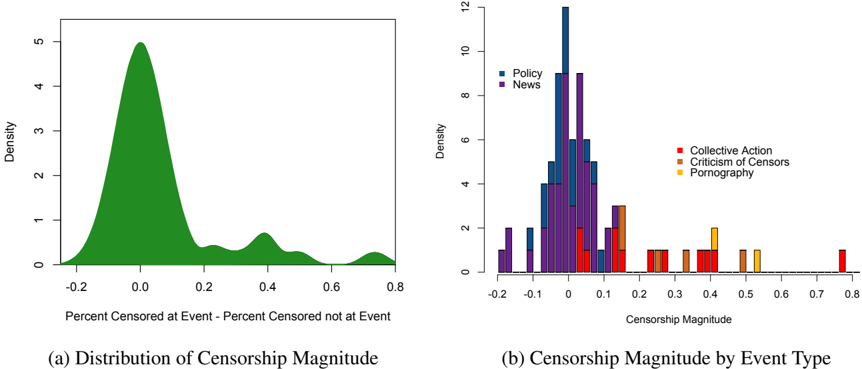
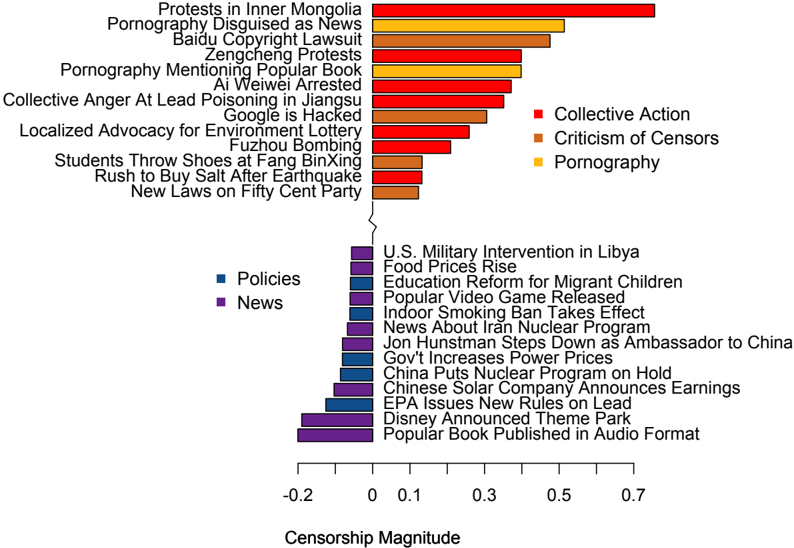
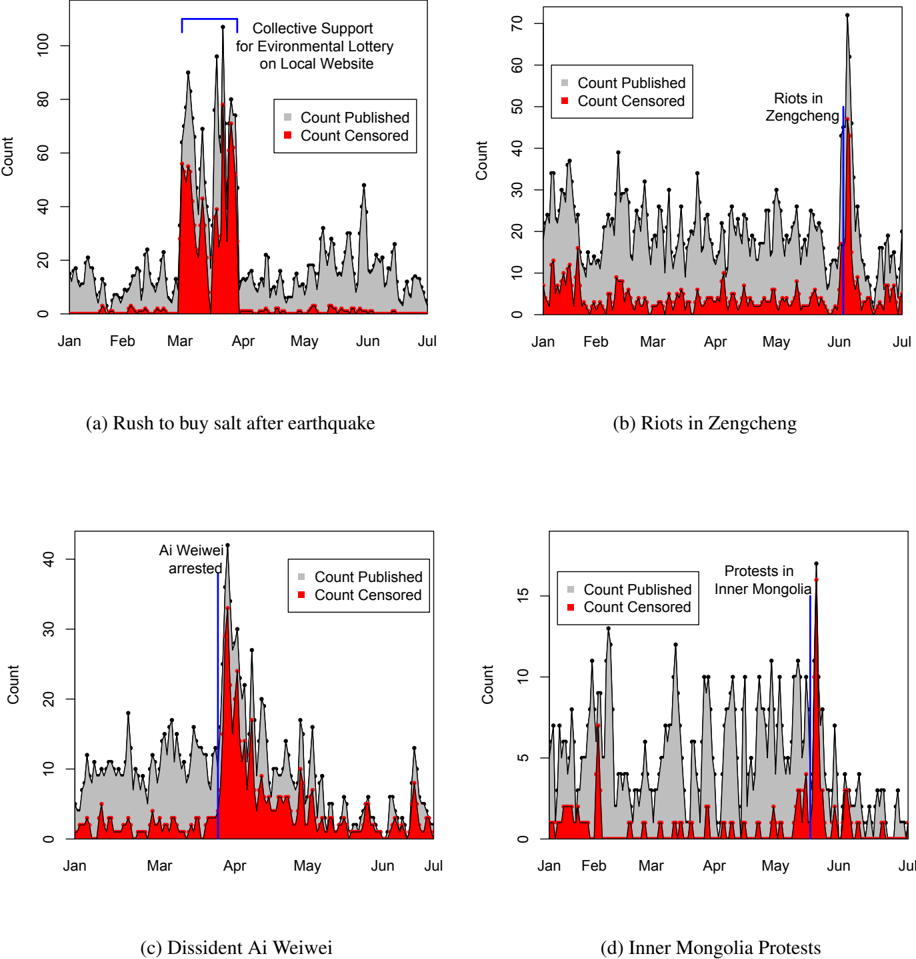
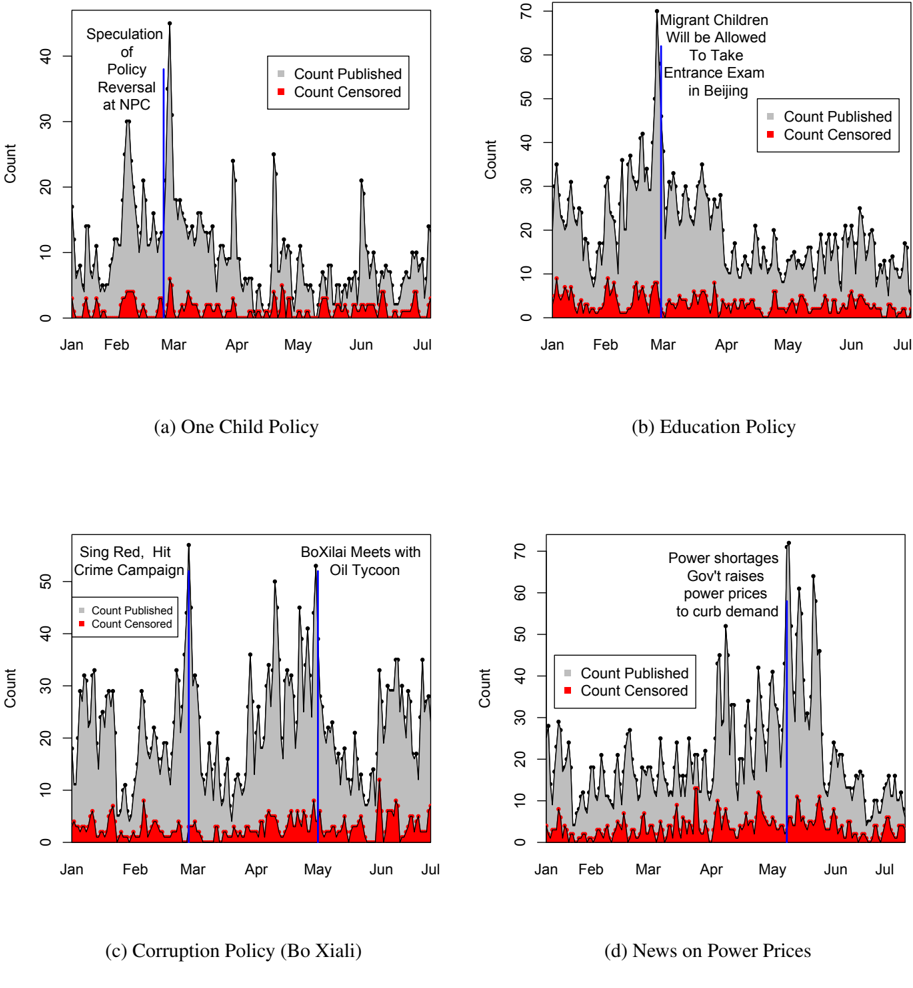
- Censorship was much higher during volume bursts tied to collective action: average censorship magnitude was 27% for collective action, compared with -1% for policy and -4% for news.
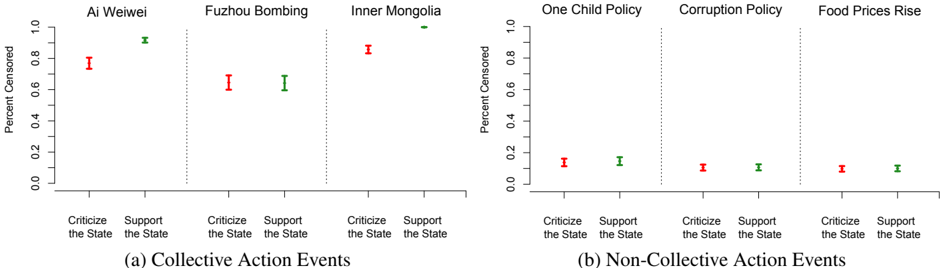
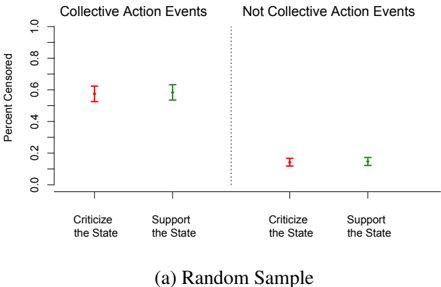
- For collective action events such as Ai Weiwei’s arrest, Inner Mongolia protests, and Fuzhou bombings, posts were censored at about 80% on average whether they criticized or supported the state. For non-collective-action events such as the one child policy, corruption policy, and food prices, censorship was about 10% on average for both critical and supportive posts.
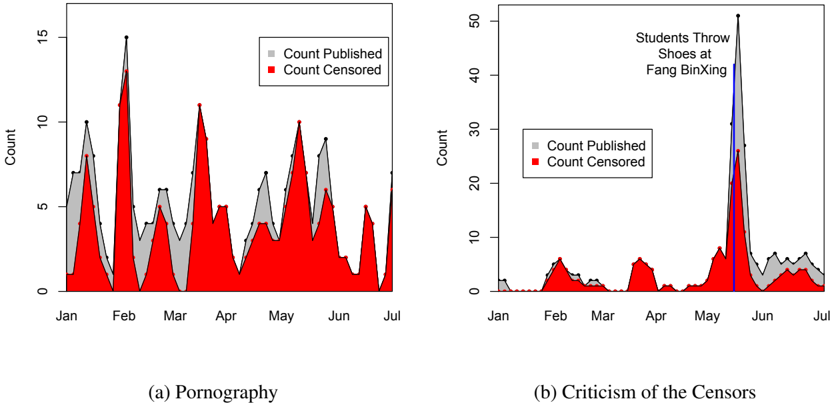
- Censorship also targeted pornography and criticism of the censors, but not government policy or other news. The authors argue censorship is aimed at curtailing collective action by silencing comments that represent, reinforce, or spur social mobilization.
Methods
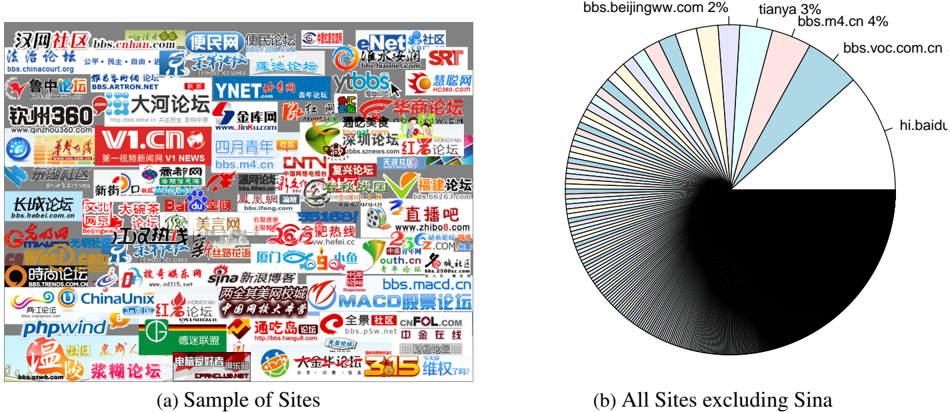
- The authors built a system to locate, download, and analyze posts from 1,382 Chinese websites during the first half of 2011, before government censors could remove them. They collected 3,674,698 posts, randomly selected 127,283 for further analysis, and overall collected and analyzed 11,382,221 posts.
- They used a stratified random sampling design covering 85 topic areas across three hypothesized political sensitivity levels, detected 87 volume bursts in 67 of the 85 topic areas using robust regression-based burst detection, and classified events into collective action potential, criticism of censors, pornography, government policies, and other news.
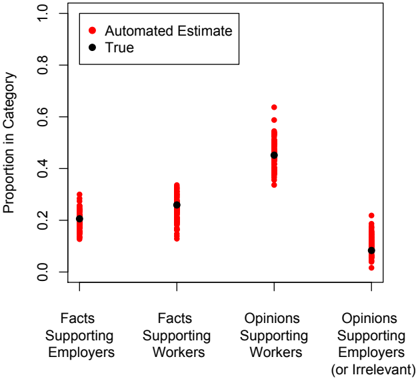
- To analyze content, they adapted the Hopkins and King “ReadMe” automated text analysis method to Chinese and extended it with a Bayesian procedure to estimate the percent censored within categories. Validation used native Chinese speakers coding 1,000 posts about 2010 labor strikes, with 100 as training and 900 as test; event coding reliability was 98.9% (86 of 87 events).
Limitations
- The paper states that its methodology misses self-censorship and censorship that may occur before the post is obtained; it also does not quantify the direct effects of the Great Firewall, keyword blocking, or search filtering.
- The authors state they have not studied physical violence, such as arrest of bloggers, or threats of the same; although many officials and levels of government influence censorship decisions, their data only sometimes distinguish among these sources, and they cannot determine the consequences of these limitations.
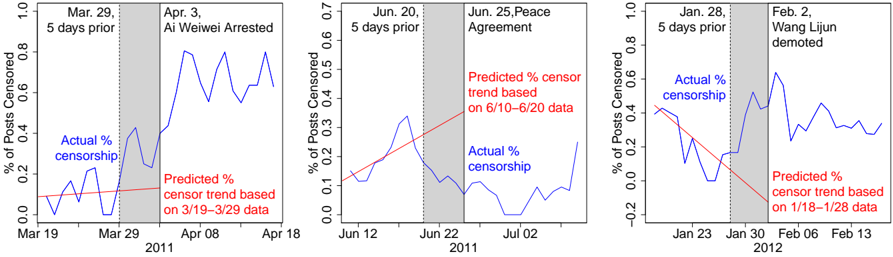
- The authors note that the presumably smaller number of discussions they cannot observe are likely to be those of most interest to the Chinese government, and they offer little evidence connecting social media findings to press freedom or other types of human expression in China. They also state that the predictive analysis was conducted retrospectively and with only three events, so further prospective validation would be valuable.
Model-written summary. Check it against the paper before relying on it.
Integrity signals
Registry
Cites
Statistics
Figures
Verification
Claims the paper makes
0 Valid · 7 Not valid · 7 Not checked · 88 Own results and interpretations
A result the paper reports from its own data — it cites no other source for it, so there is none to check. The quote shows it is in the paper.
In the paper
“Our data show that the Chinese censorship program allows for a wide variety of criticisms of the Chinese government, its officials, and its policies.”
§ How Censorship in China Allows Government Criticism but Silences Collective Expression * > Outline of Results
plain- Asserted: passes — The authors put it forward as true.
- Checkable: passes — It can be checked against evidence.
- Load-bearing: passes — The paper’s conclusions depend on it.
- Based: passes — The paper gives a reason why it holds.
A result the paper reports from its own data — it cites no other source for it, so there is none to check. The quote shows it is in the paper.
In the paper
“Contrary to previous understandings, posts with negative, even vitriolic, criticism of the state, its leaders, and its policies are not more likely to be censored.”
- Also stated in: § 1 Introduction · plain
“we find that when the Chinese people write scathing criticisms of their government and its leaders, the probability that their post will be censored does not increase.”
§ How Censorship in China Allows Government Criticism but Silences Collective Expression * > Abstract
plain- Asserted: passes — The authors put it forward as true.
- Checkable: passes — It can be checked against evidence.
- Load-bearing: passes — The paper’s conclusions depend on it.
- Based: passes — The paper gives a reason why it holds.
- Also stated in: § 1 Introduction · plain
A result the paper reports from its own data — it cites no other source for it, so there is none to check. The quote shows it is in the paper.
In the paper
“Large increases in online volume are good predictors of censorship when these increases are associated with events related to collective action, e.g., protest on the ground.”
§ How Censorship in China Allows Government Criticism but Silences Collective Expression * > Outline of Results
plainstates an association- Asserted: passes — The authors put it forward as true.
- Checkable: passes — It can be checked against evidence.
- Load-bearing: passes — The paper’s conclusions depend on it.
- Based: passes — The paper gives a reason why it holds.
A result the paper reports from its own data — it cites no other source for it, so there is none to check. The quote shows it is in the paper.
In the paper
“In addition, we measure sentiment within each of these events and show that during these events, the government censors views that are both supportive and critical of the state.”
§ How Censorship in China Allows Government Criticism but Silences Collective Expression * > Outline of Results
plainstates a cause- Asserted: passes — The authors put it forward as true.
- Checkable: passes — It can be checked against evidence.
- Load-bearing: passes — The paper’s conclusions depend on it.
- Based: passes — The paper gives a reason why it holds.
A result the paper reports from its own data — it cites no other source for it, so there is none to check. The quote shows it is in the paper.
In the paper
“We thus conduct the same analysis for the demotion of Wang Lijun in Panel (c) of Figure 11, and again see a large difference in actual and predicted percent censorship before Wang's demotion.”
§ How Censorship in China Allows Government Criticism but Silences Collective Expression * > Additional information
plainSingle case- Asserted: passes — The authors put it forward as true.
- Checkable: passes — It can be checked against evidence.
- Load-bearing: unclear — It is unclear whether the paper’s conclusions depend on it.
- Based: passes — The paper gives a reason why it holds.
46 more claims
Create a free account to see all 102 claims and every source verdict.
- Probably not a substantial claim. 26
- It may state two separate claims as one. 33
Claims other papers make about this one
Each is checked against this paper’s own text: does it say what the citing paper says it does?
The source backs part of the claim, not all of it — or backs it for a different population, condition or comparison.
In the citing paper
“Authorities are keen to review social media posts and have contentious messages removed (King etal., 2013) to ensure that potential threats remain invisible.”
From How Dictators Control the Internet: A Review Essay (2020) · cites this paper as King et al., 2013
Experimental — accuracy not yet measuredThe source backs part of the claim, not all of it — or backs it for a different population, condition or comparison.
In the citing paper
“In most autocratic regimes, governmental interference in digital infrastructure and communication is commonplace.”
From How Dictators Control the Internet: A Review Essay (2020) · cites this paper as King et al., 2013
Experimental — accuracy not yet measuredThe source backs part of the claim, not all of it — or backs it for a different population, condition or comparison.
In the citing paper
“First, the timing of censorship during a coup is consistent with many studies that have shown that Internet censorship is targeted during sensitive political time periods and periods of potential power transitions, such as elections and large-scale protests [23,25,44,47,73].”
From A multi-perspective view of Internet censorship in Myanmar (2021) · cites this paper as [44]
Experimental — accuracy not yet measuredThe cited source says what the claim attributes to it.
In the citing paper
“research has shown how mobilization organized through public coordination is repressed using that very same public information-for instance, repression is preemptively increased before focal days (Truex 2019); and autocracies censor online calls for collective action (King, Pan, and Roberts 2013), coerce online opinion leaders (Pan and Siegel 2020), and at times, turn off the internet entirely.”
From Coordinated Dis-Coordination (2024) · cites this paper as King, Pan, and Roberts 2013
The check wasn’t confident either way, so it gives no verdict — never disputed.
In the citing paper
“In China, for instance, two virtual police officers remind citizens that their browsing behavior is monitored (King etal., 2013).”
From How Dictators Control the Internet: A Review Essay (2020) · cites this paper as King et al., 2013
Experimental — accuracy not yet measured
1 more claim about this paper
Create a free account to see every claim other papers make about this one.
Citations
Cites
Robust estimation of a location parameter
Huber, P. J. (1964) · The Annals of Mathematical Statistics · doi:10.1214/aoms/1177703732 · Cited by 7,228
Robust Regression and Outlier Detection
Piepel, G. F. (1989) · Technometrics · doi:10.1080/00401706.1989.10488524 · Cited by 6,144
Robust Regression and Outlier Detection
Rousseeuw, P. J., & Leroy, A. M. (1987) · Wiley Series in Probability and Statistics · doi:10.1002/0471725382 · Cited by 5,609
Logistic Regression in Rare Events Data
King, G., & Zeng, L. (2001) · Political Analysis · doi:10.1093/oxfordjournals.pan.a004868 · Cited by 4,316 · cited 1×
“We do this via well-known and widely used case-control methodology (King and Zeng 2001).”
MethodSelf-citationDemocracy and Development: Political Institutions and Well-Being in the World, 1950–1990
Przeworski, A., Alvarez, M. E., Cheibub, J. A., & Limongi, F. (2000) · doi:10.1017/cbo9780511804946 · Cited by 2,845
Rightful Resistance in Rural China
O'Brien, K. J., & Li, L. (2006) · Cambridge University Press eBooks · doi:10.1017/cbo9780511791086 · Cited by 1,104
The Dynamics of Informational Cascades: The Monday Demonstrations in Leipzig, East Germany, 1989–91
Lohmann, S. (1994) · World Politics · doi:10.2307/2950679 · Cited by 1,035 · cited 1×
“Protests in East Germany, Eastern Europe, and most recently the Middle East have all preceded regime change (Ash 2002; Lohmann 1994; Przeworski et al. 2000).”
BackgroundRightful Resistance in Rural China
O'Brien, K., & Li, L.-J. (2006) · doi:10.1017/cbo9780511791086.003 · Cited by 987
China's Changing of the Guard: Authoritarian Resilience
Nathan, A. J. (2003) · Journal of Democracy · doi:10.1353/jod.2003.0019 · Cited by 927
Sparks and prairie fires: A theory of unanticipated political revolution
Kuran, T. (1989) · Public Choice · doi:10.1007/bf00116762 · Cited by 905 · cited 1×
“In fact, Kuran (1989) and Lohmann (2002) show that it is information about a collective action event that propels collective action and so distinguishing this from explicit calls for collective action would be difficult if not impossible.”
Background
Research works printed but not linked: 13
- 22. Freedom House. 2012. "Freedom of the Press, 2012." www.freedomhouse.org.
- 8. Chang, Parris. 1983. Elite Conflict in the Post-Mao China. New York: Occasional Papers Reprints.
- 26. Hinton, Harold. 1955. The "Unprincipled Dispute" Within Chinese Communist Top Lead- ership. Washington, DC: U.S. Information Agency.
- 44. Perry, Elizabeth. 2002. Challenging the Mandate of Heaven: Social Protest and State Power in China. Armork, NY: M. E. Sharpe.
- 52. Schurmann, Franz. 1966. Ideology and Organization in Communist China. Berkeley, CA: University of California Press.
- Tsai, 2007, Capitalism without Democracy: The Private Sector in Contemporary China
- 48. Qiang, Xiao. 2011. The Rise of Online Public Opinion and Its Political Impact. In Chang- ing Media, Changing China, ed. Susan Shirk. New York: Oxford University Press pp. 202-224.
- 9. Charles, David. 1966. The Dismissal of Marshal P'eng Teh-huai. In China Under Mao: Politics Takes Command, ed. Roderick MacFarquhar. Cambridge: MIT University Press pp. 20-33.
- 54. Shirk, Susan. 2007. China: Fragile Superpower: How China's Internal Politics Could Derail Its Peaceful Rise. New York: Oxford University Press.
- 56. Teiwes, Frederick. 1979. Politics and Purges in China: Retification and the Decline of Party Norms. Armork, NY: M. E. Sharpe. Tsai, Kellee. 2007a. Capitalism without Democracy: The Private Sector in Contemporary China. Ithaca, NY: Cornell University Press.
- 15. Duan, Qing. 2007. China's IT Leadership. Vdm Verlag.
- 38. MacFarquhar, Roderick. 1974. The Origins of the Cultural Revolution Volume 1: Contra- dictions Among the People 1956-1957. New York: Columbia University Press.
- 12. Chen, Xiaoyan and Peng Hwa Ang. 2011. Internet Police in China: Regulation, Scope and Myths. In Online Society in China: Creating, Celebrating, and Instrumentalising the Online Carnival, ed. David Herold and Peter Marolt. New York: Routledge pp. 40-52.
Cited by
Items 601–700 of 2,443
Framing as an Information Control Strategy in Times of Crisis
Xia, S., Huang, H., & Zhang, D. (2022) · Journal of East Asian Studies · doi:10.1017/jea.2022.5 · Cited by 28
Elements of Deterrence: Strategy, Technology, and Complexity in Global Politics
Gartzke, E. A., & Lindsay, J. R. (2024) · doi:10.1093/oso/9780197754443.001.0001 · Cited by 26
Collective Resistance under Authoritarianism: Elite–Mass Strategies in an Experimental Game
Chong, D., Liu, M., & Zhang, Q. (2016) · Political Behavior · doi:10.1007/s11109-016-9342-z · Cited by 20
Han, L., & Lee, C. (2018) · China Information · doi:10.1177/0920203x18807083 · Cited by 24
The Private Sector in Public Office: Selective Property Rights in China
Hou, Y. (2019) · Cambridge University Press eBooks · doi:10.1017/9781108632522 · Cited by 118
Measuring Media Freedom: An Item Response Theory Analysis of Existing Indicators
Solis, J. A., & Waggoner, P. (2020) · British Journal of Political Science · doi:10.1017/s0007123420000101 · Cited by 22
Post-reform gender politics: how do Chinese Internet users portray Theresa May on Zhihu
Peng, A. Y., Cummings, J., & Li, Y. (2020) · Feminist Media Studies · doi:10.1080/14680777.2020.1788110 · Cited by 25
“The CCP tolerates the existence of some critical commentary on the Internet, as long as this is not fundamentally aimed at the political infrastructure (King, Pan, and Roberts 2013).”
BackgroundPower Sharing and Media Freedom in Dictatorships
Sheen, G. C.-H., Tung, H. H., & Wu, W. (2021) · Political Communication · doi:10.1080/10584609.2021.1988009 · Cited by 24
“As recent studies on the Chinese censorship show (King et al., 2013; Qin et al., 2017; Roberts, 2018), to be able to have access to local information and respond to possible issues timely, the Chinese government did not censor all criticisms on the Internet against it as long as criticisms only…”
BackgroundThe function of expert involvement in China's local policy making
Shen, Y., Ieong, M. U., & Zhu, Z. (2021) · Politics & Policy · doi:10.1111/polp.12450 · Cited by 21
A Double-Edge Sword? Mass Media and Nonviolent Dissent in Autocracies
Gleditsch, K. S., Macías-Medellín, M., & Rivera, M. (2022) · Political Research Quarterly · doi:10.1177/10659129221080921 · Cited by 22
“However, autocrats can also use ICTs and social media to manipulate information and undermine antiregime protest (e.g., King, Pan, and Roberts 2013; Lorentzen 2014; Rød and Weidmann 2015).2 The emphasis on the relevance of new communication technologies for popular dissent sometimes downplays…”
BackgroundIndependent media under pressure: evidence from Russia
Paskhalis, T., Rosenfeld, B. R. M., & Tertytchnaya, K. (2022) · Post-Soviet Affairs · doi:10.1080/1060586x.2022.2065840 · Cited by 30
Disaggregating Repression: Identifying Physical Integrity Rights Allegations in Human Rights Reports
Cordell, R., Clay, K. C., Fariss, C. J., Wood, R. M., & Wright, T. M. (2022) · International Studies Quarterly · doi:10.1093/isq/sqac016 · Cited by 40
When “Home” Becomes the “Field”: Ethical Considerations in Digital and Remote Fieldwork
Konken, L. C., & Howlett, M. (2022) · Perspectives on Politics · doi:10.1017/s1537592722002572 · Cited by 29
Mehra, V., Singh, P., Bharany, S., & Sawhney, R. S. (2023) · Decision Analytics Journal · doi:10.1016/j.dajour.2023.100321 · Cited by 32
Pollution Matters: The Political Impact of Information Disclosure
Chen, X., Shen, X., & Zhuge, A. (2023) · Governance · doi:10.1111/gove.12847 · Cited by 23
A Turning IR Landscape in a Shifting Media Ecology: The State of IR Literature on New Media1
Jackson, S. T. (2018) · International Studies Review · doi:10.1093/isr/viy046 · Cited by 28
Informal Institutions and Authoritarian Information Systems: Theory and Evidence from ChinaPreprint
Jiang, J., & Wallace, J. (2017) · SSRN Electronic Journal · doi:10.2139/ssrn.2992165 · Cited by 24
From Cell Phones to Conflict? Reflections on the Emerging ICT-Political Conflict Research AgendaPreprint
Dafoe, A., & Lyall, J. (2014) · SSRN Electronic Journal · doi:10.2139/ssrn.2409639 · Cited by 20
Authoritarian Journalism: Controlling the News in Post-Conflict Rwanda
Moon, R. (2023) · doi:10.1093/oso/9780197623411.001.0001 · Cited by 28
Censors Get Smart: Evidence from Psiphon in Iran
Deibert, R. J., Oliver, J., & Senft, A. (2019) · Review of Policy Research · doi:10.1111/ropr.12333 · Cited by 21
Information Credibility under Authoritarian Rule: Evidence from China
Chang, C. (2021) · Political Communication · doi:10.1080/10584609.2021.1901806 · Cited by 23
“Should such new technologies be in government’s hands, it will be equipped to forestall all kinds of citizen opposition (MacKinnon, 2011; Morozov, 2012; Greitens, 2013; Edmond, 2013; King et al., 2013, 2014, 2017; Little 2016; Gallagher & Miller, 2019; Lu & Pan, 2020).”
BackgroundRegulating and governing China's internet and digital media in the Xi Jinping era
Xu, J. L., & Yu, H. (2022) · Media International Australia · doi:10.1177/1329878x221116402 · Cited by 24
“In the relatively small but fast-growing field of Chinese internet studies, the regulation and governance of China’s internet and digital media has been one of the most concerned topics (Cai and Dai, 2021; Griffiths, 2019; King et al., 2013; Miao et al., 2021; Roberts, 2018; Shen, 2016).”
BackgroundBuilding Theory in Political Communication: The Politics-Media-Politics Approach
Wolfsfeld, G., Sheafer, T., & Althaus, S. L. (2022) · doi:10.1093/oso/9780197634998.001.0001 · Cited by 25
Ji, P. (2015) · Telematics and Informatics · doi:10.1016/j.tele.2015.06.017 · Cited by 20
Dynamics of policy change in authoritarian countries: a multiple-case study on China
Wu, Y. (2018) · Journal of Public Policy · doi:10.1017/s0143814x18000351 · Cited by 24
Personality, media choice and political ideology: explaining ideological pluralism in China
Ma, D., & Lewis, O. A. (2019) · Democratization · doi:10.1080/13510347.2019.1696775 · Cited by 24
Can Police Patrols Prevent Pollution? The Limits of Authoritarian Environmental Governance in China
van der Kamp, D. S. (2020) · Comparative Politics · doi:10.5129/001041521x15982729490361 · Cited by 22
Public Engagement in Climate Communication on China’s Weibo: Network Structure and Information Flows
Yang, Y., & Stoddart, M. C. J. (2021) · Politics and Governance · doi:10.17645/pag.v9i2.3754 · Cited by 37
“King, Pan, and Roberts (2013) showed that censor-ship is only limited to curtailing mobilisation of subver-sive collective action.”
BackgroundZhou, S., & Zheng, X. (2022) · Communication Studies · doi:10.1080/10510974.2022.2082504 · Cited by 20
“On one hand, both local and central governments tried to avoid arguing with the public on controversial issues to maintain stability (King et al., 2013).”
BackgroundOppositional consciousness, cultural preservation, and everyday resistance on the Uyghur Internet
Clothey, R. A., & Koku, E. F. (2016) · Asian Ethnicity · doi:10.1080/14631369.2016.1158636 · Cited by 25
Bolsover, G. (2016) · Asian Journal of Communication · doi:10.1080/01292986.2016.1214743 · Cited by 27
Reach and messages of the world's largest ivory burn
Braczkowski, A. R., Holden, M. H., O’Bryan, C. J., Choi, C., Gan, X., Beesley, N., Gao, Y., Allan, J. R., Tyrrell, P., Stiles, D., et al. (2018) · Conservation Biology · doi:10.1111/cobi.13097 · Cited by 23
Aragona, B., & Rosa, R. D. (2018) · Mathematical Population Studies · doi:10.1080/08898480.2017.1418113 · Cited by 26
“Data-intensive policies: Opportunities and risks King et al. (2013), Lorentzen (2014), and Höchtl et al. (2016) argue that monitoring in nearly real-time is the main change brought by big data.”
BackgroundTolkach, D. (2018) · Tourism Management · doi:10.1016/j.tourman.2018.02.011 · Cited by 21
Li, L., & Zhou, K. (2024) · New Media & Society · doi:10.1177/14614448241263933 · Cited by 36
“However, major empirical research as such seeks to reverse-engineer the machinery of censorship through large-scale, computer-assisted text analysis of which content is censored and which is not (Bamman et al., 2012; Fu et al., 2013; King et al., 2013, 2014; Tai and Fu, 2020).”
Managing impressions online: Microblogs and the state media’s adaptation of online logics in China
Song, Y., & Chang, T. (2016) · Journalism · doi:10.1177/1464884916636168 · Cited by 23
“Although much has been published emphasizing China’s success in censoring the Internet and in preventing Weibo from becoming the civic space many had envisioned (e.g. King et al., 2013), insufficient attention has been paid to the possibility of state interest in the Internet beyond censorship.”
BackgroundMovement-press dynamics and news diffusion: A typology of activism in digital china*
Lin, F., & Zhang, X. (2018) · Project Muse (Johns Hopkins University) · Cited by 26
Contingent symbiosis: news start-ups and local cyberspace administration in contemporary China
Huang, V. G., & Wu, H. (2021) · Information Communication & Society · doi:10.1080/1369118x.2021.1954973 · Cited by 19
“tends to tolerate criticism while censoring information that has the potential to provoke collective action (King et al., 2013).”
BackgroundLu, J., Tuo, P., Pan, J., et al. (2023) · Sustainability · doi:10.3390/su15021437 · Cited by 18
Self-citationThe Nexus of Digital Authoritarianism and Religious Populism
Yılmaz, İ. (2023) · Religions · doi:10.3390/rel14060747 · Cited by 26
The Culture of Censorship: State Intervention and Complicit Creativity in Global Film Production
Fang, J. (2024) · American Sociological Review · doi:10.1177/00031224241236750 · Cited by 27
“It is also “selective,” silencing information that may cause collective action, but allowing occasional government criticism (King, Pan, and Roberts 2013).”
BackgroundThe Russia–Ukraine War in Chinese Social Media: LLM Analysis Yields a Bias Toward Neutrality
Rogers, R., & Zhang, X. (2024) · Social Media + Society · doi:10.1177/20563051241254379 · Cited by 28
“Once referred to as 50c party posts (King et al., 2013, 2017), these contributions appear to be from genuine users.”
Gåsemyr, H. J. (2015) · Asian Studies Review · doi:10.1080/10357823.2015.1087464 · Cited by 18
“Many NGOs have come together in national networks or umbrella organs, but overtly active mobilisation across organisations and geographical areas is something the one-party government is known to be particularly wary of (King et al., 2013, p. 326), and network organisers are therefore cautious.”
BackgroundZhang, C. (2017) · Sociological Theory · doi:10.1177/0735275117693038 · Cited by 26
Kornai, J. (2017) · Revue d’études comparatives Est-Ouest · doi:10.4074/s0338059917001097 · Cited by 32
“Let me pick a few from the varied literature: Pei (2006), Tsai (2007), Chen – Dickson (2008), Huang (2008), Schambaugh (2008), Xu (2011), McGregor (2012), King et al. (2013), Lardy (2014), Redding – Witt (2014), Székely-Doby (2014), Naughton – Tsai (2015), Csanádi (2016) and Schell (2016).”
Chinese online public opinions on the Two-Child Policy
Wang, S., & Song, Y. (2018) · Online Information Review · doi:10.1108/oir-07-2017-0217 · Cited by 18
Zidani, S. (2018) · Social Media + Society · doi:10.1177/2056305118809512 · Cited by 27
Intertextuality and nationalism discourse: a critical discourse analysis of microblog posts in China
Guo, M. (2019) · Asian Journal of Communication · doi:10.1080/01292986.2019.1628286 · Cited by 26
Socialbots Supporting Human Rights
Suárez–Serrato, P., Richards, E. I. V., & Yazdani, M. (2018) · Proceedings of the AAAI/ACM Conference on AI Ethics and Society · doi:10.1145/3278721.3278734 · Cited by 23
“that they were helping to provide access to the report issued by the CNDH. This type of behavior sets them apart from the typically observed bots that have spam, or even censorship, intentions [23], [13]. It is important to pause here and notice that in an instance like this it is not a clear matter whether these bots…”
BackgroundBringing in China: Insights for Building Comparative Political Theory
Tsai, L. L. (2016) · Comparative Political Studies · doi:10.1177/0010414016672236 · Cited by 19
Media Openings and Political Transitions:GlasnostversusYulun Jiandu
Repnikova, M. (2017) · Problems of Post-Communism · doi:10.1080/10758216.2017.1307118 · Cited by 28
“Recent studies have shown how digital censorship appears to be selective and targeted, to the effect that criticisms of politicians may be tolerated, but discussions connected to potential social mobilization are all off limits (King et al. 2013).”
BackgroundSocial Desirability of Dissent: an IAT Experiment with Chinese University Students
Zhou, Y. J., Tang, W., & Lei, X. (2019) · Journal of Chinese Political Science · doi:10.1007/s11366-019-09628-9 · Cited by 32
Zhang, T. H. (2020) · The Social Science Journal · doi:10.1080/03623319.2020.1727221 · Cited by 22
“Furthermore, only with actual political participation can liberal attitudes be reinforced (Quintelier & Van Deth, 2014); democracies provide people with opportunities for participation, while non-democracies try their best to ensure the opposite (King et al., 2013).”
BackgroundThe Popularity of Authoritarian Leaders: A Cross-National InvestigationPreprint
Guriev, S. M., & Treisman, D. S. (2016) · SSRN Electronic Journal · doi:10.2139/ssrn.2882915 · Cited by 18
Persuasion on NetworksPreprint
Egorov, G., & Сонин, К. И. (2019) · SSRN Electronic Journal · doi:10.2139/ssrn.3396730 · Cited by 32
The Functions of Letters to the Editor in Reform-Era Cuba
Dimitrov, M. K. (2019) · Latin American Research Review · doi:10.25222/larr.232 · Cited by 21
Normalization of Censorship: Evidence from ChinaPreprint
Yang, T. Z. (2022) · SSRN Electronic Journal · doi:10.2139/ssrn.3835217 · Cited by 18
Do, S., Ollion, É., & Shen, R. (2022) · doi:10.31235/osf.io/3fkzc · Cited by 18
Sun, L., & Dai, L. (2024) · Feminist Media Studies · doi:10.1080/14680777.2024.2400488 · Cited by 20
“The Chinese state has developed and employed sophisticated techniques of censorship (Gary King, Jennifer Pan and Margaret E Roberts 2013; Lei 2018) and has been promoting pro-state narratives (Maria Repnikova and Kecheng Fang 2018).”
Meeting the Dalai Lama and perceptions of democracy in China: a quasi-natural experiment
Gruffydd-Jones, J. J. (2017) · Democratization · doi:10.1080/13510347.2017.1411904 · Cited by 18
The mixed strategy of authoritarian labor rights repression
Wang, Z. (2020) · Journal of Human Rights · doi:10.1080/14754835.2020.1746179 · Cited by 18
“In a recent study, King, Pan, and Roberts (2013) convincingly demonstrated that the Chinese government minimizes possibilities of collective action by censoring online posts that call for organized public defiance.”
BackgroundBlackhawk, M., Carpenter, D. P., Resch, T., & Schneer, B. (2020) · Legislative Studies Quarterly · doi:10.1111/lsq.12305 · Cited by 23
“See for example King, Pan, and Roberts (2013) or King, Schneer and White (2017); we provide details of these procedures in the Appendix.”
BackgroundConstraints and military coordination: How ICTs shape the intensity of rebel violence
Macías-Medellín, M., & Atuesta, L. H. (2021) · International Interactions · doi:10.1080/03050629.2021.1898959 · Cited by 19
Wang, W. Y. (2021) · Asian Journal of Communication · doi:10.1080/01292986.2021.1923766 · Cited by 18
“Many studies have interrogated the role of the state in managing the development of media and communication technologies (King et al., 2013; Qin, Stroemberg, & Wu, 2017).”
BackgroundUnderstandings of Democracy: Origins and Consequences Beyond Western Democracies
Lu, J., & Chu, Y. (2021) · doi:10.1093/oso/9780197570401.001.0001 · Cited by 57
Hot topics: Denial-of-Service attacks on news websites in autocracies
Lutscher, P. M. (2021) · Political Science Research and Methods · doi:10.1017/psrm.2021.68 · Cited by 20
“King et al. (2013) found that social media posts in China are deleted when they contain collective action potential, while recent studies suggest that posts that are critical of the government may also be censored (Gueorguiev and Malesky, 2019).”
InfluentialMiao, H., Wu, H., & Huang, O. (2022) · Journal of Asian Public Policy · doi:10.1080/17516234.2021.2022851 · Cited by 19
“Those narratives that condemn the central government were still not allowed in the sphere of social media (King et al., 2013).”
BackgroundLiu, H., Chen, Q., & Evans, R. D. (2022) · International Journal of Environmental Research and Public Health · doi:10.3390/ijerph19116751 · Cited by 18
“However, content posted to social media was not always censored like the state-controlled media [41]; this ultimately affected the spread of anxiety and fear among citizens [42].”
BackgroundSubjective Freedom of Speech: Why Do Citizens Think They Cannot Speak Freely?
Menzner, J., & Traunmüller, R. (2022) · Politische Vierteljahresschrift · doi:10.1007/s11615-022-00414-6 · Cited by 32
“Social media has an ambivalent connection to the question of free speech (King et al. 2013; Tucker et al. 2017; Roberts 2018, 2020).”
BackgroundUnderstanding subjective inequality in China
Song, X. (2022) · European Sociological Review · doi:10.1093/esr/jcac047 · Cited by 17
Piao, L., & Wu, H. (2023) · Asian Survey · doi:10.1525/as.2023.1808498 · Cited by 18
Relay activism and the flows of contentious publicness on WeChat: a case study of COVID-19 in China
Sun, Y., & Wright, S. (2023) · Information Communication & Society · doi:10.1080/1369118x.2023.2205474 · Cited by 21
“There has been a lot of research on how censorship works in China (e.g., King et al., 2013), and some scholarly attention paid to the contention of censorship (Brunner & DeLuca, 2019; Deluca et al., 2016; Dodge, 2017; Esarey & Xiao, 2008; Link & Qiang, 2013; Mina, 2014; Rauch fl eisch & Schäfer,…”
InfluentialAccountability from cyberspace? Scandal exposure on the Internet and official governance in China
Chen, S., & Li, Y. (2023) · Political Science Research and Methods · doi:10.1017/psrm.2023.13 · Cited by 22
“We believe it reso-nates with King et al .”
Influential"Whole-Process People’s Democracy" in China: Evidence from Shanghai
Hu, J., & Wu, T. (2023) · Chinese Political Science Review · doi:10.1007/s41111-023-00245-9 · Cited by 17
“Online ethnographic data were drawn from Sina Weibo ( 新浪微博 ), which is an important internet platform for citizens to openly express their complaints, suggestions and criticisms of the government (King et al. 2013).”
Zhou, S., Yang, X., Wang, Y., Zheng, X., & Zhang, Z. (2023) · Humanities and Social Sciences Communications · doi:10.1057/s41599-023-02265-x · Cited by 26
Simonson, M. D., Block Jr, R., Druckman, J. N., Ognyanova, K., & Lazer, D. M. J. (2024) · doi:10.1017/9781009415842 · Cited by 17
Measuring online political activity: introducing the digital society project dataset
Mechkova, V., Pemstein, D., Seim, B., & Wilson, S. L. (2024) · Journal of Information Technology & Politics · doi:10.1080/19331681.2024.2350495 · Cited by 26
“While much of this work highlights social media’s potential for citizen mobilization in closed regimes, authoritarian states with high technical capacity – notably China – are able to allow substantial political criticism on social media while stymying collective action (King, Pan, & Roberts, 2013).”
Digital activism and authoritarian legitimation in post-Soviet Central Asia
Kurmanov, B., & Knox, C. (2024) · The Information Society · doi:10.1080/01972243.2024.2374714 · Cited by 24
“Chinese authorities, for example, created a set of elaborate mechanisms (e.g. “50 cent army” of online users) for controlling social media space and crafting a government message (Han 2015; King, Pan, and Roberts 2013; Zeng, Dai, and Jiang 2019).”
‘We are not North Korea’: propaganda and professionalism in the People’s Republic of China
Simons, M., Nolan, D., & Wright, S. (2016) · Media Culture & Society · doi:10.1177/0163443716643154 · Cited by 28
Sun, Y., Graham, T., & Broersma, M. (2017) · Springer eBooks · doi:10.1007/978-3-319-61708-4_13 · Cited by 17
Introducing computational social science for Asia-Pacific communication research
Peng, T., Liang, H., & Zhu, J. J. H. (2019) · Asian Journal of Communication · doi:10.1080/01292986.2019.1602911 · Cited by 23
“In order to investigate the censorship in China, King, Pan, and Roberts (2013) collected the data from various websites systematically.”
BackgroundSilencing the crowd: China, the NBA, and leveraging market size to export censorship
O’Connell, W. D. (2021) · Review of International Political Economy · doi:10.1080/09692290.2021.1905683 · Cited by 24
Evade and Deceive? Citizen Responses to Surveillance
Eck, K., Hatz, S., Crabtree, C. D., & Tago, A. (2021) · The Journal of Politics · doi:10.1086/715073 · Cited by 19
“…research and theorizing about surveillance and preference falsification has thus focused on authoritarian states (Jiang and Yang 2016; Kalinin 2016; King, Pan, and Roberts 2013; Kuran 1997; Lorentzen 2014; Roberts 2018; Robinson and Tannenberg 2018), since citizens who express dissenting opinions…”
BackgroundThe Meaning of ‘Limited Pluralism’ in Media Reporting under Authoritarian Rule
Heinrich, A., & Pleines, H. (2018) · Politics and Governance · doi:10.17645/pag.v6i2.1238 · Cited by 27
Fu, K., Chan, C., & Chau, M. (2013) · SSRN Electronic Journal · Cited by 17
Shen, F., & Zhang, Z. (2016) · SSRN Electronic Journal · doi:10.2139/ssrn.2733659 · Cited by 17
Bias and Trust in Authoritarian MediaPreprint
Truex, R. (2016) · SSRN Electronic Journal · doi:10.2139/ssrn.2802841 · Cited by 19
The Political Economics of Non-democracy
Egorov, G., & Сонин, К. И. (2020) · National Bureau of Economic Research · doi:10.3386/w27949 · Cited by 25
Han, R. (2021) · Journal of Contemporary China · doi:10.1080/10670564.2021.1884957 · Cited by 28
Governing by the Internet: Local Governance in the Digital Age
Han, R., & Jia, L. (2019) · Springer eBooks · doi:10.1007/978-981-13-2799-5_21 · Cited by 17
Гуо, Л., & Chen, H. (2021) · Journalism & Mass Communication Quarterly · doi:10.1177/10776990211057139 · Cited by 23
“Third, the Chinese government tolerates online discussion critical of the official discourse as long as the discussion does not speak to any actual political action (King et al., 2013).”
BackgroundKoesel, K. J., & Bunce, V. J. (2020) · Oxford University Press eBooks · doi:10.1093/oso/9780190093488.003.0004 · Cited by 16
Intergovernmental Conflict and Censorship: Evidence from China’s Anti-Corruption Campaign
Zhuang, M. (2022) · Journal of the European Economic Association · doi:10.1093/jeea/jvac036 · Cited by 23
Messaging Apps: A Rising Tool for Informational Autocrats
Trauthig, I. K., Martin, Z., & Woolley, S. (2023) · Political Research Quarterly · doi:10.1177/10659129231190932 · Cited by 25
“Therefore, scholars have argued that states censor to avoid resentment and resulting collective action (King, Pan, and Roberts 2013a) but also to inhibit societal discontent initially already (de Juan, Haass, and Pierskalla 2021; Lorentzen 2014).”
BackgroundAI as a Tool for Surveillance: China’s Concave Trilemma
Woods, D. (2025) · Journal of Chinese Political Science · doi:10.1007/s11366-025-09907-8 · Cited by 23
“Citizens initially engage in self-censorship as surveillance increases to avoid punishment or repercussions [22, 32].”
Interdisciplinary study on popularity prediction of social classified hot online events in China
Liu, T., Zhong, Y., & Chen, K. (2016) · Telematics and Informatics · doi:10.1016/j.tele.2016.05.022 · Cited by 18
Zhang, L., Hooimeijer, P., Lin, Y., & Geertman, S. C. M. (2019) · Geoforum · doi:10.1016/j.geoforum.2019.08.006 · Cited by 19
Opposition Media, State Censorship, and Political Accountability: Evidence from Chavez’s Venezuela
Knight, B. G., & Tribin, A. M. (2019) · The World Bank Economic Review · doi:10.1093/wber/lhab018 · Cited by 31
Jia, H. (2022) · Public Understanding of Science · doi:10.1177/09636625221090729 · Cited by 23
“The level of censorship often depends on whether the debated topics are politically sensitive or whether they trigger huge online visits (King et al., 2013).”
BackgroundThe Chinese Ideology: Reconciling the Politics with the Economics of Contemporary Reform
Lieber, A. (2013) · Journal of Chinese Political Science · doi:10.1007/s11366-013-9259-x · Cited by 24
Metadata
- Authors
- KING, G., PAN, J., & ROBERTS, M. E.
- Affiliations
- Harvard University (US)
- Corresponding author
- KING, GARY
- PAN, JENNIFER
- Venue
- American Political Science Review
- Publisher
- Cambridge University Press (CUP)
- Published
- 2013-05
- Volume
- 107
- Issue
- 2
- Pages
- 326-343
- ISSN
- 0003-0554 (ISSN-L)
- 1537-5943
- OpenAlex
- W2144188763
- Cited by
- 2,415
- References
- 48
- Citations by year
- 2026: 161 · 2025: 206 · 2024: 249 · 2023: 272 · 2022: 230 · 2021: 193 · 2020: 206 · 2019: 157 · 2018: 178 · 2017: 153 · 2016: 137 · 2015: 120 · 2014: 91 · 2013: 54
- FWCI
- 395.09
- Type
- journal article
- Language
- en
- Open access
- green
- nrs.harvard.edu
- Licence
- Locations
- American Political Science Review (publishedVersion)
- Digital Access to Scholarship at Harvard (DASH) (Harvard University) (submittedVersion, cc-by)
- RePEc: Research Papers in Economics (submittedVersion)
- Topics
- Social Sciences › Communication › Social Media and Politics
- Social Sciences › Law › Freedom of Expression and Defamation
- Social Sciences › Sociology and Political Science › Media Influence and Politics
- Keywords
- internet censorship, Chinese government, social media, collective action, social mobilization, political criticism, online speech
About these checks
Registry, retraction, Cites and statistics results are computed, not judged, with one exception: a printed reference that no index lists is read once by a model before it counts as a citation error. Claims are extracted by a model and kept only when their quote appears verbatim in the text; each cited source is then checked, with a model’s help, for whether it says what the claim relies on. Those verdicts can be wrong — read the claim’s quote and the cited source before relying on one.
A language model drew the claims from the paper on 2026-10-11, under version 3 of the claim definition (model deepseek-v4.1-flash, prompt extract-v3).
A second model labelled each claim on 2026-10-11 (model jev-1.13-20260917, definition revision gold-guideline-v0.2).
Statistics and arithmetic are recomputed, not judged.
Confidence bands are shown only for fields calibrated on our annotated test set. None is calibrated yet, so no band is shown.
What counts as a claim ›How we measure confidence ›How we check this ›
Are you an author, or do you see a problem with this page? Request a review
Data sources
Bibliographic data: Semantic Scholar, OpenAlex, Crossref.
Contains information from the Semantic Scholar Academic Graph Datasets, made available under the ODC Attribution License (ODC-BY 1.0).
Semantic Scholar’s data is described in: Kinney, R., et al. (2023). The Semantic Scholar Open Data Platform. arXiv:2301.10140.
