

How Censorship in China Allows Government Criticism but Silences Collective Expression
Open accessThe DOI matches its Crossref record; 53 of the 54 references it cites were found in a registry or an index, and 1 are not checked yet; none of the 12 sources its claims cite is checked for support yet.
Abstract
We offer the first large scale, multiple source analysis of the outcome of what may be the most extensive effort to selectively censor human expression ever implemented. To do this, we have devised a system to locate, download, and analyze the content of millions of social media posts originating from nearly 1,400 different social media services all over China before the Chinese government is able to find, evaluate, and censor (i.e., remove from the Internet) the subset they deem objectionable. Using modern computer-assisted text analytic methods that we adapt to and validate in the Chinese language, we compare the substantive content of posts censored to those not censored over time in each of 85 topic areas. Contrary to previous understandings, posts with negative, even vitriolic, criticism of the state, its leaders, and its policies are not more likely to be censored. Instead, we show that the censorship program is aimed at curtailing collective action by silencing comments that represent, reinforce, or spur social mobilization, regardless of content. Censorship is oriented toward attempting to forestall collective activities that are occurring now or may occur in the future—and, as such, seem to clearly expose government intent.
Checked 2026-11-22 · 1 reference not checked yet
Overview
CoChat Summary
TL;DR
The paper uses large-scale, real-time collection of Chinese social media posts to test why China censors online expression. It finds that censorship does not target criticism of the state or leaders; instead, it targets posts with collective action potential, regardless of whether they support or criticize the government.
Key findings
- Across the data, an average of approximately 13% of all social media posts were censored. Ex ante political sensitivity had only a weak relationship with censorship: Low and Medium categories were censored at 16% and 17%, respectively, versus 24% for High.
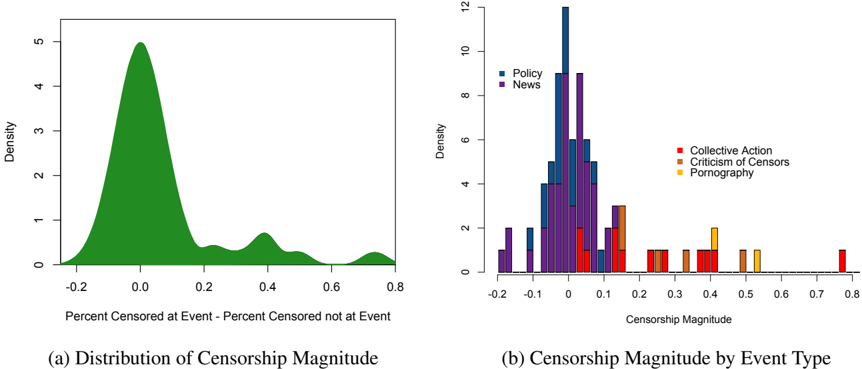
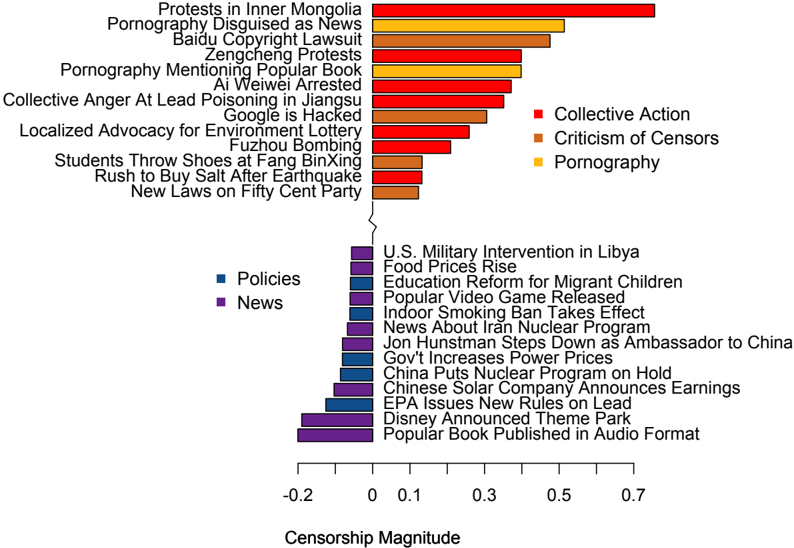
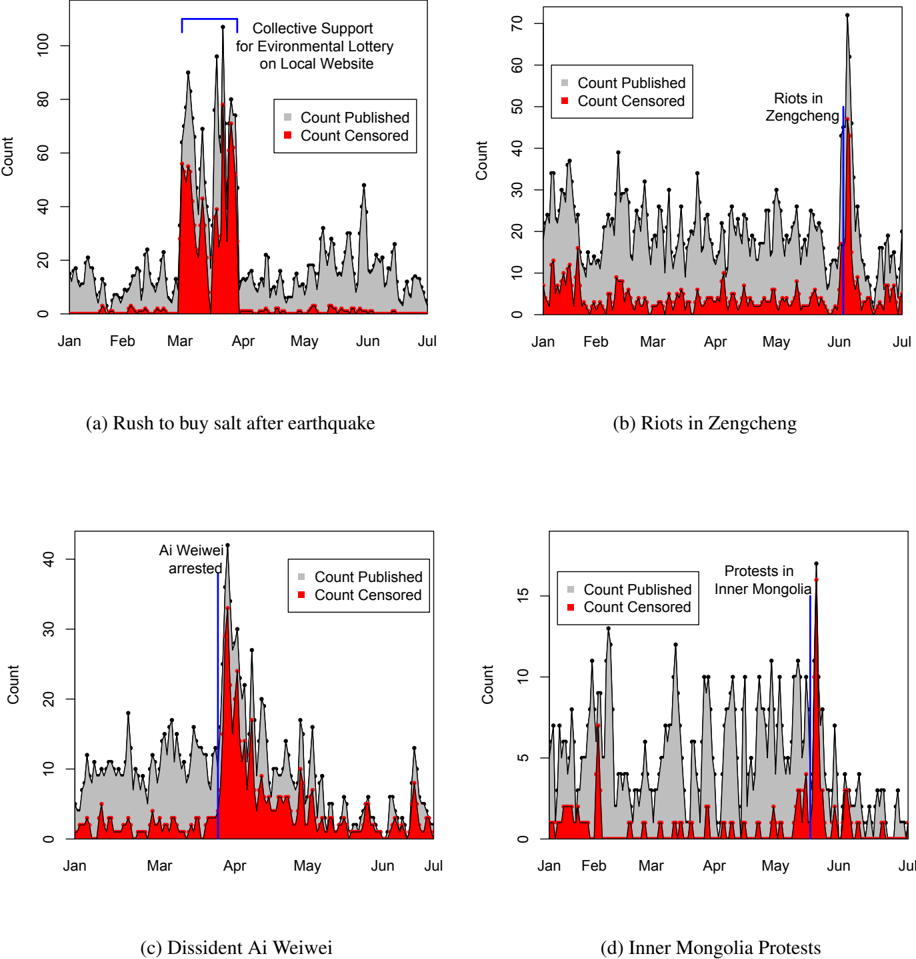
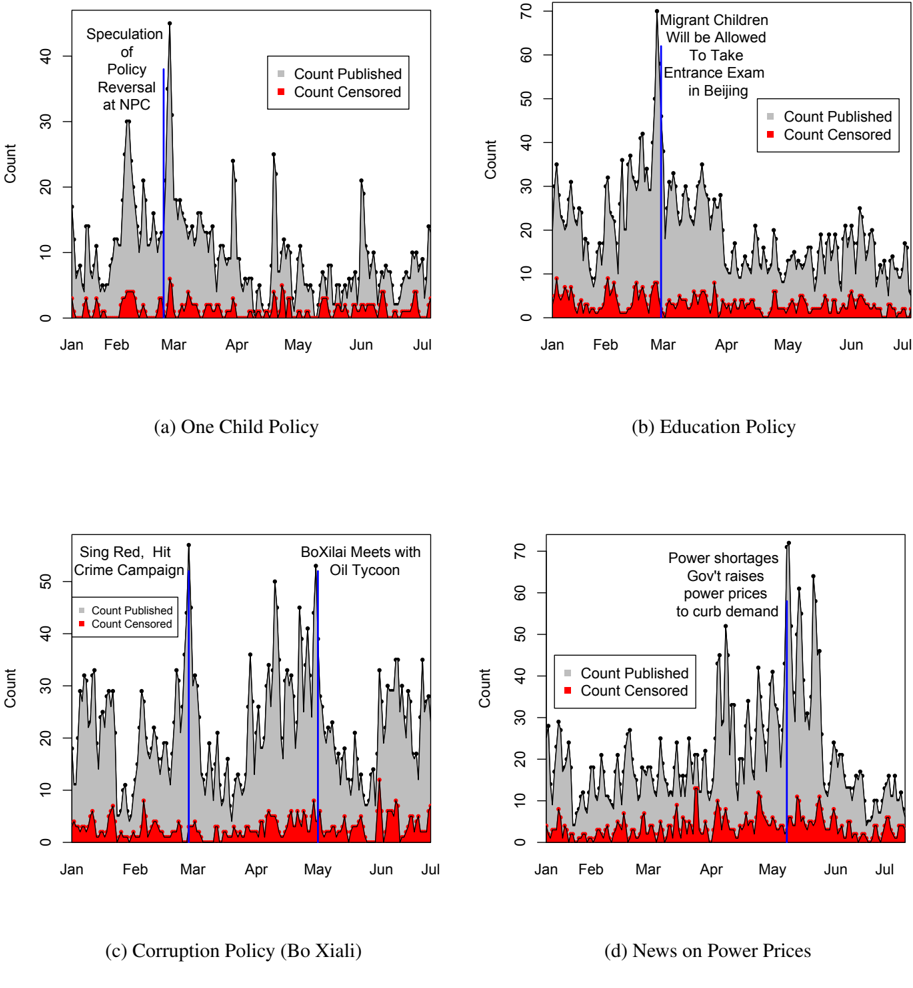
- Censorship was much higher during volume bursts tied to collective action: average censorship magnitude was 27% for collective action, compared with -1% for policy and -4% for news.
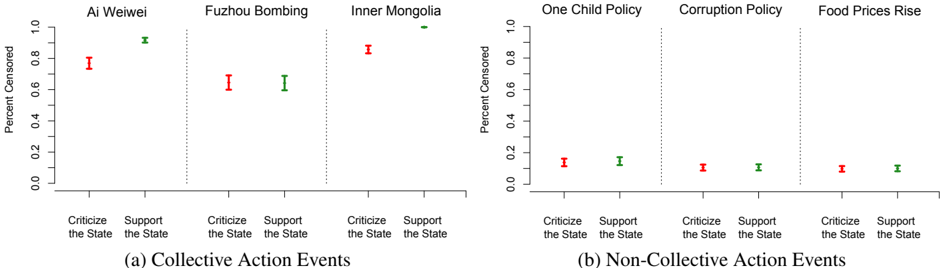
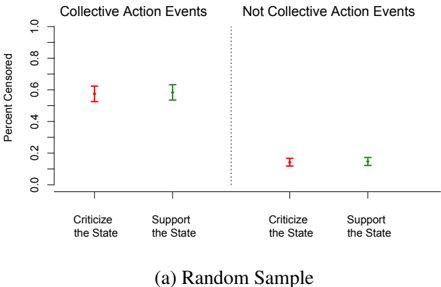
- For collective action events such as Ai Weiwei’s arrest, Inner Mongolia protests, and Fuzhou bombings, posts were censored at about 80% on average whether they criticized or supported the state. For non-collective-action events such as the one child policy, corruption policy, and food prices, censorship was about 10% on average for both critical and supportive posts.
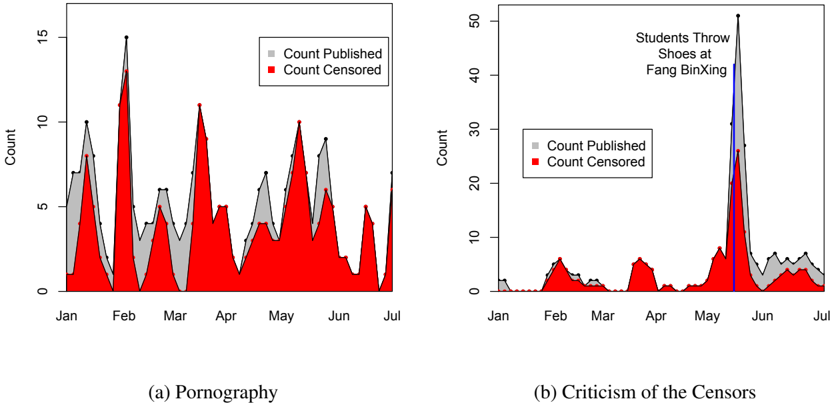
- Censorship also targeted pornography and criticism of the censors, but not government policy or other news. The authors argue censorship is aimed at curtailing collective action by silencing comments that represent, reinforce, or spur social mobilization.
Methods
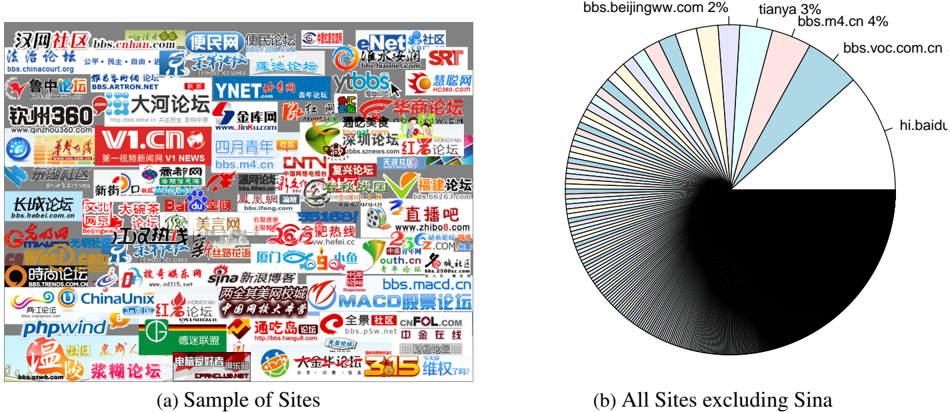
- The authors built a system to locate, download, and analyze posts from 1,382 Chinese websites during the first half of 2011, before government censors could remove them. They collected 3,674,698 posts, randomly selected 127,283 for further analysis, and overall collected and analyzed 11,382,221 posts.
- They used a stratified random sampling design covering 85 topic areas across three hypothesized political sensitivity levels, detected 87 volume bursts in 67 of the 85 topic areas using robust regression-based burst detection, and classified events into collective action potential, criticism of censors, pornography, government policies, and other news.
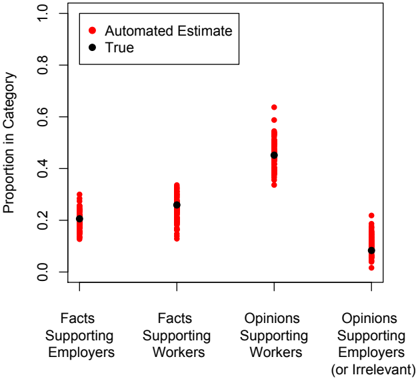
- To analyze content, they adapted the Hopkins and King “ReadMe” automated text analysis method to Chinese and extended it with a Bayesian procedure to estimate the percent censored within categories. Validation used native Chinese speakers coding 1,000 posts about 2010 labor strikes, with 100 as training and 900 as test; event coding reliability was 98.9% (86 of 87 events).
Limitations
- The paper states that its methodology misses self-censorship and censorship that may occur before the post is obtained; it also does not quantify the direct effects of the Great Firewall, keyword blocking, or search filtering.
- The authors state they have not studied physical violence, such as arrest of bloggers, or threats of the same; although many officials and levels of government influence censorship decisions, their data only sometimes distinguish among these sources, and they cannot determine the consequences of these limitations.
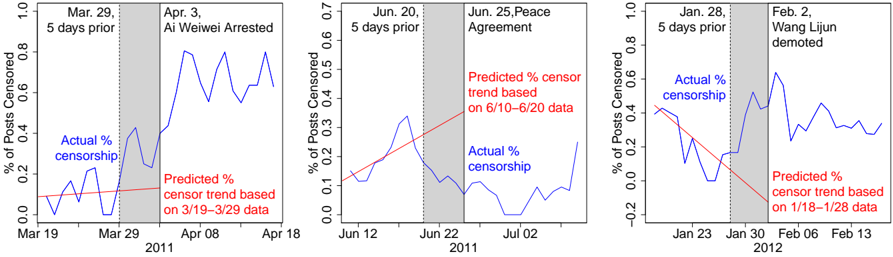
- The authors note that the presumably smaller number of discussions they cannot observe are likely to be those of most interest to the Chinese government, and they offer little evidence connecting social media findings to press freedom or other types of human expression in China. They also state that the predictive analysis was conducted retrospectively and with only three events, so further prospective validation would be valuable.
Model-written summary. Check it against the paper before relying on it.
Integrity signals
Registry
Cites
Statistics
Figures
Verification
Claims the paper makes
0 Valid · 7 Not valid · 7 Not checked · 88 Own results and interpretations
A result the paper reports from its own data — it cites no other source for it, so there is none to check. The quote shows it is in the paper.
In the paper
“Our data show that the Chinese censorship program allows for a wide variety of criticisms of the Chinese government, its officials, and its policies.”
§ How Censorship in China Allows Government Criticism but Silences Collective Expression * > Outline of Results
plain- Asserted: passes — The authors put it forward as true.
- Checkable: passes — It can be checked against evidence.
- Load-bearing: passes — The paper’s conclusions depend on it.
- Based: passes — The paper gives a reason why it holds.
A result the paper reports from its own data — it cites no other source for it, so there is none to check. The quote shows it is in the paper.
In the paper
“Contrary to previous understandings, posts with negative, even vitriolic, criticism of the state, its leaders, and its policies are not more likely to be censored.”
- Also stated in: § 1 Introduction · plain
“we find that when the Chinese people write scathing criticisms of their government and its leaders, the probability that their post will be censored does not increase.”
§ How Censorship in China Allows Government Criticism but Silences Collective Expression * > Abstract
plain- Asserted: passes — The authors put it forward as true.
- Checkable: passes — It can be checked against evidence.
- Load-bearing: passes — The paper’s conclusions depend on it.
- Based: passes — The paper gives a reason why it holds.
- Also stated in: § 1 Introduction · plain
A result the paper reports from its own data — it cites no other source for it, so there is none to check. The quote shows it is in the paper.
In the paper
“Large increases in online volume are good predictors of censorship when these increases are associated with events related to collective action, e.g., protest on the ground.”
§ How Censorship in China Allows Government Criticism but Silences Collective Expression * > Outline of Results
plainstates an association- Asserted: passes — The authors put it forward as true.
- Checkable: passes — It can be checked against evidence.
- Load-bearing: passes — The paper’s conclusions depend on it.
- Based: passes — The paper gives a reason why it holds.
A result the paper reports from its own data — it cites no other source for it, so there is none to check. The quote shows it is in the paper.
In the paper
“In addition, we measure sentiment within each of these events and show that during these events, the government censors views that are both supportive and critical of the state.”
§ How Censorship in China Allows Government Criticism but Silences Collective Expression * > Outline of Results
plainstates a cause- Asserted: passes — The authors put it forward as true.
- Checkable: passes — It can be checked against evidence.
- Load-bearing: passes — The paper’s conclusions depend on it.
- Based: passes — The paper gives a reason why it holds.
A result the paper reports from its own data — it cites no other source for it, so there is none to check. The quote shows it is in the paper.
In the paper
“We thus conduct the same analysis for the demotion of Wang Lijun in Panel (c) of Figure 11, and again see a large difference in actual and predicted percent censorship before Wang's demotion.”
§ How Censorship in China Allows Government Criticism but Silences Collective Expression * > Additional information
plainSingle case- Asserted: passes — The authors put it forward as true.
- Checkable: passes — It can be checked against evidence.
- Load-bearing: unclear — It is unclear whether the paper’s conclusions depend on it.
- Based: passes — The paper gives a reason why it holds.
46 more claims
Create a free account to see all 102 claims and every source verdict.
- Probably not a substantial claim. 26
- It may state two separate claims as one. 33
Claims other papers make about this one
Each is checked against this paper’s own text: does it say what the citing paper says it does?
The source backs part of the claim, not all of it — or backs it for a different population, condition or comparison.
In the citing paper
“Authorities are keen to review social media posts and have contentious messages removed (King etal., 2013) to ensure that potential threats remain invisible.”
From How Dictators Control the Internet: A Review Essay (2020) · cites this paper as King et al., 2013
Experimental — accuracy not yet measuredThe source backs part of the claim, not all of it — or backs it for a different population, condition or comparison.
In the citing paper
“In most autocratic regimes, governmental interference in digital infrastructure and communication is commonplace.”
From How Dictators Control the Internet: A Review Essay (2020) · cites this paper as King et al., 2013
Experimental — accuracy not yet measuredThe source backs part of the claim, not all of it — or backs it for a different population, condition or comparison.
In the citing paper
“First, the timing of censorship during a coup is consistent with many studies that have shown that Internet censorship is targeted during sensitive political time periods and periods of potential power transitions, such as elections and large-scale protests [23,25,44,47,73].”
From A multi-perspective view of Internet censorship in Myanmar (2021) · cites this paper as [44]
Experimental — accuracy not yet measuredThe cited source says what the claim attributes to it.
In the citing paper
“research has shown how mobilization organized through public coordination is repressed using that very same public information-for instance, repression is preemptively increased before focal days (Truex 2019); and autocracies censor online calls for collective action (King, Pan, and Roberts 2013), coerce online opinion leaders (Pan and Siegel 2020), and at times, turn off the internet entirely.”
From Coordinated Dis-Coordination (2024) · cites this paper as King, Pan, and Roberts 2013
The check wasn’t confident either way, so it gives no verdict — never disputed.
In the citing paper
“In China, for instance, two virtual police officers remind citizens that their browsing behavior is monitored (King etal., 2013).”
From How Dictators Control the Internet: A Review Essay (2020) · cites this paper as King et al., 2013
Experimental — accuracy not yet measured
1 more claim about this paper
Create a free account to see every claim other papers make about this one.
Citations
Cites
Robust estimation of a location parameter
Huber, P. J. (1964) · The Annals of Mathematical Statistics · doi:10.1214/aoms/1177703732 · Cited by 7,228
Robust Regression and Outlier Detection
Piepel, G. F. (1989) · Technometrics · doi:10.1080/00401706.1989.10488524 · Cited by 6,144
Robust Regression and Outlier Detection
Rousseeuw, P. J., & Leroy, A. M. (1987) · Wiley Series in Probability and Statistics · doi:10.1002/0471725382 · Cited by 5,609
Logistic Regression in Rare Events Data
King, G., & Zeng, L. (2001) · Political Analysis · doi:10.1093/oxfordjournals.pan.a004868 · Cited by 4,316 · cited 1×
“We do this via well-known and widely used case-control methodology (King and Zeng 2001).”
MethodSelf-citationDemocracy and Development: Political Institutions and Well-Being in the World, 1950–1990
Przeworski, A., Alvarez, M. E., Cheibub, J. A., & Limongi, F. (2000) · doi:10.1017/cbo9780511804946 · Cited by 2,845
Rightful Resistance in Rural China
O'Brien, K. J., & Li, L. (2006) · Cambridge University Press eBooks · doi:10.1017/cbo9780511791086 · Cited by 1,104
The Dynamics of Informational Cascades: The Monday Demonstrations in Leipzig, East Germany, 1989–91
Lohmann, S. (1994) · World Politics · doi:10.2307/2950679 · Cited by 1,035 · cited 1×
“Protests in East Germany, Eastern Europe, and most recently the Middle East have all preceded regime change (Ash 2002; Lohmann 1994; Przeworski et al. 2000).”
BackgroundRightful Resistance in Rural China
O'Brien, K., & Li, L.-J. (2006) · doi:10.1017/cbo9780511791086.003 · Cited by 987
China's Changing of the Guard: Authoritarian Resilience
Nathan, A. J. (2003) · Journal of Democracy · doi:10.1353/jod.2003.0019 · Cited by 927
Sparks and prairie fires: A theory of unanticipated political revolution
Kuran, T. (1989) · Public Choice · doi:10.1007/bf00116762 · Cited by 905 · cited 1×
“In fact, Kuran (1989) and Lohmann (2002) show that it is information about a collective action event that propels collective action and so distinguishing this from explicit calls for collective action would be difficult if not impossible.”
Background
Research works printed but not linked: 13
- 22. Freedom House. 2012. "Freedom of the Press, 2012." www.freedomhouse.org.
- 8. Chang, Parris. 1983. Elite Conflict in the Post-Mao China. New York: Occasional Papers Reprints.
- 26. Hinton, Harold. 1955. The "Unprincipled Dispute" Within Chinese Communist Top Lead- ership. Washington, DC: U.S. Information Agency.
- 44. Perry, Elizabeth. 2002. Challenging the Mandate of Heaven: Social Protest and State Power in China. Armork, NY: M. E. Sharpe.
- 52. Schurmann, Franz. 1966. Ideology and Organization in Communist China. Berkeley, CA: University of California Press.
- Tsai, 2007, Capitalism without Democracy: The Private Sector in Contemporary China
- 48. Qiang, Xiao. 2011. The Rise of Online Public Opinion and Its Political Impact. In Chang- ing Media, Changing China, ed. Susan Shirk. New York: Oxford University Press pp. 202-224.
- 9. Charles, David. 1966. The Dismissal of Marshal P'eng Teh-huai. In China Under Mao: Politics Takes Command, ed. Roderick MacFarquhar. Cambridge: MIT University Press pp. 20-33.
- 54. Shirk, Susan. 2007. China: Fragile Superpower: How China's Internal Politics Could Derail Its Peaceful Rise. New York: Oxford University Press.
- 56. Teiwes, Frederick. 1979. Politics and Purges in China: Retification and the Decline of Party Norms. Armork, NY: M. E. Sharpe. Tsai, Kellee. 2007a. Capitalism without Democracy: The Private Sector in Contemporary China. Ithaca, NY: Cornell University Press.
- 15. Duan, Qing. 2007. China's IT Leadership. Vdm Verlag.
- 38. MacFarquhar, Roderick. 1974. The Origins of the Cultural Revolution Volume 1: Contra- dictions Among the People 1956-1957. New York: Columbia University Press.
- 12. Chen, Xiaoyan and Peng Hwa Ang. 2011. Internet Police in China: Regulation, Scope and Myths. In Online Society in China: Creating, Celebrating, and Instrumentalising the Online Carnival, ed. David Herold and Peter Marolt. New York: Routledge pp. 40-52.
Cited by
Items 201–300 of 2,443
Iyer, G. R., & Jarvis, L. C. (2019) · International Journal of Contemporary Hospitality Management · doi:10.1108/ijchm-06-2018-0451 · Cited by 95
The Velocity of Censorship: High-Fidelity Detection of Microblog Post DeletionsPreprint
Zhu, T., Phipps, D., Pridgen, A., Crandall, J. R., & Wallach, D. S. (2013) · arXiv (Cornell University) · doi:10.48550/arxiv.1303.0597 · Cited by 159
“China employs both backbone-level filtering of IP packets [5, 6, 11, 23, 37, 43] and higher level filtering implemented in the software of, for example, blog platforms [15, 20, 28], chat programs [13, 29] and search engines [30, 41].”
MethodChen, D. (2017) · Modern China · doi:10.1177/0097700417706704 · Cited by 79
State Repression of Chinese Labor NGOs: A Chilling Effect?
Franceschini, I., & Nesossi, E. (2018) · The China Journal · doi:10.1086/696986 · Cited by 90
Internet Censorship detection: A survey
Aceto, G., & Pescapè, A. (2015) · Computer Networks · doi:10.1016/j.comnet.2015.03.008 · Cited by 87
“[87] 2013 – – – – – – – (c) X – – – Extensive set of Chinese user-generated-content”
BackgroundChen, Y., & Yang, D. (2015) · SSRN Electronic Journal · doi:10.2139/ssrn.2652587 · Cited by 72
Why Does China Allow Freer Social Media? Protests versus Surveillance and PropagandaPreprint
Qin, B., & Wu, Y. (2017) · SSRN Electronic Journal · doi:10.2139/ssrn.2910223 · Cited by 70
The Dictator's Digital Toolkit: Explaining Variation in Internet Filtering in Authoritarian Regimes
Hellmeier, S. (2016) · Politics & Policy · doi:10.1111/polp.12189 · Cited by 69
Watanabe, R., & Watanabe, T. (2019) · Renewable and Sustainable Energy Reviews · doi:10.1016/j.rser.2019.04.017 · Cited by 71
China’s Policy Processes and the Advocacy Coalition Framework
Li, W., & Weible, C. M. (2019) · Policy Studies Journal · doi:10.1111/psj.12369 · Cited by 71
Factors influencing the use of artificial intelligence in government: Evidence from China
Zhang, W., Zuo, N., He, W., Li, S., & Yu, L. (2021) · Technology in Society · doi:10.1016/j.techsoc.2021.101675 · Cited by 69
Ideological Asymmetry in the Reach of Pro-Russian Digital Disinformation to United States Audiences
Hjorth, F., & Adler-Nissen, R. (2019) · Journal of Communication · doi:10.1093/joc/jqz006 · Cited by 68
Evolution of online public opinions on social impact induced by NIMBY facility
Wang, Y., Li, H., Zuo, J., & Wang, Z. (2019) · Environmental Impact Assessment Review · doi:10.1016/j.eiar.2019.106290 · Cited by 70
Anti-Americanism and Anti-Interventionism in Arabic Twitter Discourses
Jamal, A., Keohane, R. O., Romney, D., & Tingley, D. H. (2015) · Perspectives on Politics · doi:10.1017/s1537592714003132 · Cited by 85
How Sudden Censorship Can Increase Access to InformationPreprint
Hobbs, W., & Roberts, M. E. (2017) · SSRN Electronic Journal · doi:10.2139/ssrn.2990593 · Cited by 68
Self-citationEarl, J. (2018) · The Wiley Blackwell Companion to Social Movements · doi:10.1002/9781119168577.ch16 · Cited by 68
Wang, H., & Shi, F. (2017) · Information Communication & Society · doi:10.1080/1369118x.2017.1289234 · Cited by 81
“First, according to King, Pan, and Roberts (2013), any type of mobilization message calling for collective action is strictly forbidden and immediately censored in contemporary China.”
BackgroundHow to think about cyber sovereignty: the case of China
Hong, Y., & Goodnight, G. T. (2019) · Chinese Journal of Communication · doi:10.1080/17544750.2019.1687536 · Cited by 95
“By portraying a contest-and-conquest relationship between the state preoc-cupied with regime insecurity and varying social usages, the dual foci implicitly frame the Chinese Intranet against the globalist internet (King, Pan, & Roberts, 2013; Rauchfleisch & Sch € afer, 2015).”
BackgroundKim, H. M., Sabri, S., & Kent, A. (2020) · Elsevier eBooks · doi:10.1016/b978-0-12-818886-6.00002-2 · Cited by 94
Propaganda and Protest in Autocracies
Carter, E. B., & Carter, B. L. (2020) · Journal of Conflict Resolution · doi:10.1177/0022002720975090 · Cited by 84
“…world’s autocrats attempt to inoculate themselves: by incarcerating dissidents (Truex 2019), censoring their citizens’ informational environments (King, Pan, and Roberts 2013; Shadmehr and Bernhardt 2015; Qin, Stro¨mberg, and Wu 2017; Roberts 2018; Gallagher and Miller 2019), deploying bots to…”
BackgroundDoes State Repression Spark Protests? Evidence from Secret Police Surveillance in Communist Poland
Hager, A., & Krakowski, K. (2021) · American Political Science Review · doi:10.1017/s0003055421000770 · Cited by 79
Yue, L. Q., Wang, J., & Yang, B. (2018) · Administrative Science Quarterly · doi:10.1177/0001839218770456 · Cited by 85
“…maintaining political stability is an important task, local government officials tend to ignore citizen grievances as long as they do not lead to mass incidents that disrupt social stability or attract the attention of their supervisors (King, Pan, and Roberts, 2013, 2014; Chen, Pan, and Xu, 2015).”
BackgroundSong, Y., Dai, X.-Y., & Wang, J. (2016) · Computers in Human Behavior · doi:10.1016/j.chb.2016.02.086 · Cited by 64
From cell phones to conflict? Reflections on the emerging ICT–political conflict research agenda
Dafoe, A., & Lyall, J. (2015) · Journal of Peace Research · doi:10.1177/0022343314563653 · Cited by 67
“…too, has managed the threat of Internet-fueled opposition handily so far, allowing citizens to express grievances – and thus provide useful information about potential regime weaknesses – while preventing collective action through a rigorous application of censorship (King, Pan & Roberts, 2013).”
BackgroundAuthoritarian media and diversionary threats: lessons from 30 years of Syrian state discourse
Alrababa’h, A., & Blaydes, L. (2020) · Political Science Research and Methods · doi:10.1017/psrm.2020.28 · Cited by 72
“2For example, see Grimmer (2010), Grimmer and Stewart (2013), King et al. (2013), and Benoit et al. (2019) ht tp s: // do i.o rg /1 0.”
BackgroundChen, Z., & Chan, M. (2017) · Cyberpsychology Behavior and Social Networking · doi:10.1089/cyber.2016.0174 · Cited by 74
“7 More-over, the Chinese regime has to a large extent co-opted the social media as an autocratic tool through countermobi-lization, discourse framing, and elite coordination.”
InfluentialCivic Disobedience: Does Internet Use Stimulate Political Unrest in East Asia?
Gainous, J., Wagner, K. M., & Abbott, J. P. (2015) · Journal of Information Technology & Politics · doi:10.1080/19331681.2015.1034909 · Cited by 63
“King, Pan, and Roberts (2013) find compelling evidence that the Chinese government is well aware of the potential of the Internet to stimulate such protest-related collective action.”
BackgroundCheng, Y., & Lee, C.-J. (2019) · Public Relations Review · doi:10.1016/j.pubrev.2019.101826 · Cited by 70
Protest in electoral autocracies: a new dataset
Lankina, T. V., & Tertytchnaya, K. (2019) · Post-Soviet Affairs · doi:10.1080/1060586x.2019.1656039 · Cited by 72
“The insights that LAruPED provides could be just as valuable as a reference point for comparative analysis of protests in contexts as different as Nigeria, China, or Argentina.”
BackgroundInfluentialHow Much Should We Trust the Dictator's GDP Growth Estimates?Preprint
Martínez, L. R. (2019) · SSRN Electronic Journal · doi:10.2139/ssrn.3093296 · Cited by 22
Voice, power and connectivity in China’s microblogosphere: Digital divides on SinaWeibo
Svensson, M. (2014) · China Information · doi:10.1177/0920203x14540082 · Cited by 91
Censorship in the Wild: Analyzing Internet Filtering in Syria
Chaabane, A., Chen, T., Cunche, M., Cristofaro, E. D., Friedman, A., & Kâafar, M. (2014) · ACM/SIGCOMM Internet Measurement Conference · doi:10.1145/2663716.2663720 · Cited by 106
“Prior work has analyzed censorship practices in China [13, 14, 19, 28, 29], Iran [2, 4, 25], Pakistan [17], and a few Arab countries [9], however, mostly based on probing, i.e., inferring what information is being censored by generating requests and observing what content is blocked.”
BackgroundThe sound of one hand clapping: transparency without accountability
Seligsohn, D., Liu, M., & Zhang, B. (2018) · Environmental Politics · doi:10.1080/09644016.2018.1452522 · Cited by 66
“…hotlines, etc.) to monitor local-level bureaucrats, to monitor and diffuse collective action, to improve citizens’ attitudes toward the regime, and even through monitoring to improve local government performance (Egorov et al. 2009, King et al. 2013, Lorentzen 2014, Chen and Xu 2017, Truex 2017).”
BackgroundSon, J., & Feng, Q. (2018) · Social Indicators Research · doi:10.1007/s11205-018-2026-9 · Cited by 74
Gainous, J., Wagner, K. M., & Ziegler, C. E. (2017) · Democratization · doi:10.1080/13510347.2017.1315566 · Cited by 81
Studying the Internet and Violent conflict
Gohdes, A. (2017) · Conflict Management and Peace Science · doi:10.1177/0738894217733878 · Cited by 86
“Countries across the world make use of different types of censorship tools, some of which are highly sophisticated (King et al., 2013), while others are more crude, or bought ‘‘off the shelf’’ from surveillance software companies (Marquis-Boire, 2015).”
BackgroundYang, Y. (2021) · Global Media and China · doi:10.1177/20594364211021316 · Cited by 84
“Beyond the widely discussed strict online censorship and surveillance in the Chinese Internet (Fu et al., 2013; King et al., 2013; G. Yang, 2009), the Chinese state has been found to proactively manage public opinion without coercion (R. Han, 2015a) and experiment with new modes of ideological…”
BackgroundInfluentialGleiss, M. S. (2015) · Media Culture & Society · doi:10.1177/0163443714566897 · Cited by 77
“Concurring with this, King et al. (2013) argue that censorship of microblogs is targeted at curtailing collective action, while criticism of state leaders and policies is tolerated.”
BackgroundIn Government We Trust: Implicit Political Trust and Regime Support in China
Huang, H., Intawan, C., & Nicholson, S. P. (2022) · Perspectives on Politics · doi:10.1017/s1537592722001037 · Cited by 75
“…2008; Tang 2016), as evidenced by its pervasive media censorship and propa-ganda, repression, extraordinary spending on domestic stability, and sometimes hyper-responsiveness (Gueorguiev and Malesky 2019; Huang 2015b; King, Pan, and Roberts 2013; Shambaugh 2007; Tang 2016; Wang and Minzner 2015)?”
BackgroundLin, S., Zhou, Z., Hu, X., Chen, S., & Huang, J. (2024) · Journal of Cleaner Production · doi:10.1016/j.jclepro.2024.141807 · Cited by 72
Rethinking China’s Internet censorship: The practice of recoding and the politics of visibility
Yang, F. (2016) · New Media & Society · doi:10.1177/1461444814555951 · Cited by 60
“While the topic of Internet censorship in China has been of continuous scholarly concern (e.g. Deibert, 2009; Dowell, 2006; Hachigian, 2002; King et al., 2013; MacKinnon, 2008; Qiu, 1999/2000; Wacker, 2003; Yang, 2009), the practice of recoding in the continuously changing media landscape that is…”
BackgroundRepression in the Digital Age: Surveillance, Censorship, and the Dynamics of State Violence
Gohdes, A. R. (2024) · Oxford University Press · doi:10.1093/oso/9780197743577.001.0001 · Cited by 59
Ang, Y. Y. (2014) · Comparative Politics · doi:10.5129/001041514813623100 · Cited by 68
Wang, D., & Liu, S. (2021) · Qualitative Inquiry · doi:10.1177/10778004211014610 · Cited by 100
“The Chinese censorship system not only filters public information through computation and human reading (King et al., 2013; Yang & Wu, 2018) but also fabricates hundreds of millions social media comments every year to distract the public from criticisms of the regime (King et al.”
BackgroundOnline Political Participation in China: Local Government and Differentiated Response
Cai, Y., & Zhou, T. (2019) · The China Quarterly · doi:10.1017/s0305741019000055 · Cited by 71
Surviving Online Censorship in China: Three Satirical Tactics and their Impact
Lee, S. (2016) · The China Quarterly · doi:10.1017/s0305741016001454 · Cited by 58
Li, X., Shi, W., & Zhu, B. (2018) · Research & Politics · doi:10.1177/2053168018759127 · Cited by 65
The Lexicon of Fear: Chinese Internet Control Practice in Sina Weibo Microblog Censorship
Vuori, J. A., & Paltemaa, L. (2015) · Surveillance & Society · doi:10.24908/ss.v13i3/4.5404 · Cited by 70
“Recently, King et al. (2013, 2014) data-mined all mainland Chinese blogging services and found that the blogs which contained information with ‘collective action potential’ were the main target of censorship activities.”
BackgroundResultTweeting under pressure: analyzing trending topics and evolving word choice on sina weibo
Chen, L., Zhang, C., & Wilson, C. (2013) · Conference on Online Social Networks · doi:10.1145/2512938.2512940 · Cited by 76
“In particular, users have been observed using abbreviations, anglicanizations of Chinese characters, neologisms (newly invented words), homophones (words that sound the same), and homographs (words that look similar) to avoid keyword-based censorship [25, 49].”
BackgroundMethodAkgül, M., & Kırlıdoğ, M. (2015) · Internet Policy Review · doi:10.14763/2015.2.366 · Cited by 57
China's Newsmakers: Official Media Coverage and Political Shifts in the Xi Jinping Era
Jaros, K. A., & Pan, J. (2017) · The China Quarterly · doi:10.1017/s0305741017001679 · Cited by 66
Self-citationLiu, C., & Friedman, E. D. (2021) · The China Journal · doi:10.1086/714292 · Cited by 73
Layers of Political Repression: Integrating Research on Social Movement Repression
Earl, J., & Braithwaite, J. M. (2022) · Annual Review of Law and Social Science · doi:10.1146/annurev-lawsocsci-050520-092713 · Cited by 70
Yang, Y., Deng, W., Zhang, Y., & Mao, Z. (2020) · International Journal of Environmental Research and Public Health · doi:10.3390/ijerph18010118 · Cited by 69
“The government cannot limit the expressive power of the people [103].”
BackgroundThe Two Faces of Security in Hybrid Political Orders: A Framework for Analysis and Research
Luckham, R., & Kirk, T. G. (2013) · Stability International Journal of Security and Development · doi:10.5334/sta.cf · Cited by 57
Li, P., Cho, H., Qin, Y., & Chen, A. (2020) · Social Science Computer Review · doi:10.1177/0894439320956790 · Cited by 70
“On the other hand, because the Chinese government is very vigilant about and intolerant of any form of collective action, the development of this movement constantly encountered online censorship from the authorities (King et al., 2013).”
BackgroundHigashijima, M. (2021) · University of Michigan Press eBooks · doi:10.3998/mpub.11978139 · Cited by 81
Regulating the platform giants: Building and governing China's online economy
McKnight, S. D., Kenney, M. F., & Breznitz, D. (2023) · Policy & Internet · doi:10.1002/poi3.336 · Cited by 91
Internet Censorship in China: Examining User Awareness and Attitudes
Wang, D., & Mark, G. J. (2015) · ACM Transactions on Computer-Human Interaction · doi:10.1145/2818997 · Cited by 71
“For example, abbreviations, neologisms, homophones, and homographs have been used to avoid keyword-based automated censorship [King et al. 2013].”
BackgroundMethodСергеевич, Е. Р., & Petrova, M. (2015) · Handbook of media economics · doi:10.1016/b978-0-444-63685-0.00017-6 · Cited by 87
Stoycheff, E., Burgess, G. S., & Martucci, M. C. (2020) · Information, Communication & Society · doi:10.1080/1369118x.2018.1518472 · Cited by 55
“…explanation as to why the internet has failed to produce sweeping democratic reforms is that governments – acting out of self-preservation – employ various suppression technologies that thwart citizens’ collective action potential (Bernal, 2016; King et al., 2013; Meserve & Pemstein, 2018).”
BackgroundInfluentialAuthoritarian transparency: China's missing cases in court disclosure
Liu, Z., Wong, T. J., Yang, Y., & Zhang, T. (2021) · Journal of Comparative Economics · doi:10.1016/j.jce.2021.09.001 · Cited by 52
Responsive E-government in China: A way of gaining public support
Chen, T., Liang, Z., Yi, H., & Chen, S. (2023) · Government Information Quarterly · doi:10.1016/j.giq.2023.101809 · Cited by 73
Zhang, X., & Lin, W. (2014) · International journal of communication · Cited by 81
The Power of the Street: Evidence from Egypt's Arab Spring
Acemoğlu, D., Hassan, T. A., & Tahoun, A. (2014) · National Bureau of Economic Research · doi:10.3386/w20665 · Cited by 85
Online Repression and Self-Censorship: Evidence from Southeast Asia
Ong, E. (2019) · Government and Opposition · doi:10.1017/gov.2019.18 · Cited by 75
“The purpose is to silence these online activists, forestall collective action, as well as to spread fear in their fellow online sympathizers (Deibert 2015; Gainous et al. 2018; King et al. 2013, 2014, 2017).”
BackgroundYıldırım, K., Baruh, L., & Çarkoğlu, A. (2020) · Political Communication · doi:10.1080/10584609.2020.1765913 · Cited by 63
“…and particularly PPP, defined as the level of alignment between news organizations and political parties (Hallin & Mancini, 2004), focus on issues related to bias in coverage of politics and censorship (Haselmayer et al., 2017; King et al., 2013; Van der Pas et al., 2017; Voltmer, 2008).”
BackgroundFrom SARS to COVID-19: Digital infrastructures of surveillance and segregation in exceptional times
Tan, S. B., Chiu-Shee, C., & Duarte, F. (2021) · Cities · doi:10.1016/j.cities.2021.103486 · Cited by 53
“…is that censorship in China seeks to erase criticism of the Chinese government, a 2013 study instead observed that censors seem to target posts that represent, reinforce, or encourage social mobilization, and thus seem to prioritize the damp-ening of collective action (King et al., 2013).”
BackgroundCoordination Structures and Mechanisms for Crisis Management in China: Challenges of Complexity
Christensen, T., & Ma, L. (2018) · Public Organization Review · doi:10.1007/s11115-018-0423-9 · Cited by 73
‘Hidden in plain sight’: Expressing political criticism on Chinese social media
Wu, X., & Fitzgerald, R. (2020) · Discourse Studies · doi:10.1177/1461445620916365 · Cited by 65
“Together with more recent work, it highlights the complexity of forms of censorship including the relations between different forces and participants as well as the use of political criticism and censorship control within levels of government (see Han, 2015; King et al., 2013; Shao, 2018; Xu and Feng, 2015).”
BackgroundInfluentialFocusing Events in Disasters and Development
Birkland, T. A., & Warnement, M. K. (2014) · Springer eBooks · doi:10.1007/978-3-319-04468-2_3 · Cited by 52
Liu, J. (2016) · Social movement studies · doi:10.1080/14742837.2016.1192027 · Cited by 62
Chinese “Tongzhi” community, civil society, and online activism
Cao, J., & Гуо, Л. (2016) · Communication and the Public · doi:10.1177/2057047316683199 · Cited by 52
A Zero-Sum Game? Repression and Protest in China
Li, Y. (2017) · Government and Opposition · doi:10.1017/gov.2017.24 · Cited by 53
“It has deliberately increased its coercive capacity by dramatically expanding its domestic security apparatus (Guo 2012; Wang and Minzner 2015), emphasized government officials’ responsibility for reducing the occurrence of social protests (Chen 2012; Li 2013), censored discussions that have the potential to generate…”
BackgroundPerforming Authoritarian Citizenship: Public Transcripts in China
Distelhorst, G., & Fu, D. (2019) · Perspectives on Politics · doi:10.1017/s1537592718004024 · Cited by 58
“40 King, Pan, and Roberts 2014, 2013.”
Government responsiveness and citizen satisfaction: Evidence from environmental governance
Nie, L., & Wang, H. (2022) · Governance · doi:10.1111/gove.12723 · Cited by 70
Personal Ties, Meritocracy, and China's Anti-Corruption CampaignPreprint
Lorentzen, P., & Lu, X. (2016) · SSRN Electronic Journal · doi:10.2139/ssrn.2835841 · Cited by 106
Countering Capture: Elite Networks and Government Responsiveness in China’s Land Market Reform
Jiang, J., & Zeng, Y. (2019) · The Journal of Politics · doi:10.1086/705595 · Cited by 52
The Story of Two Big Chimneys: A Frame Analysis of Climate Change in US and Chinese Newspapers
Xie, L. (2015) · Journal of Intercultural Communication Research · doi:10.1080/17475759.2015.1011593 · Cited by 77
Using social media to measure foreign policy dynamics
Zeitzoff, T., Kelly, J., & Lotan, G. (2015) · Journal of Peace Research · doi:10.1177/0022343314558700 · Cited by 65
Kwon, K. H., & Rao, H. R. (2017) · Government Information Quarterly · doi:10.1016/j.giq.2017.04.002 · Cited by 54
Jia, H., Wang, D., Miao, W., & Zhu, H. (2017) · Science Communication · doi:10.1177/1075547017735114 · Cited by 66
Progress and disillusion: Civil repair and its discontents
Alexander, J. C. (2016) · Thesis Eleven · doi:10.1177/0725513616674405 · Cited by 63
“In China, activist threads and memes quickly were disappeared (King et al., 2013), and grass-roots mobilizations were immediately shut down by party teams (Lee, 2013).”
BackgroundAt Home and Abroad: The Use of Denial-of-service Attacks during Elections in Nondemocratic Regimes
Lutscher, P. M., Weidmann, N. B., Roberts, M. E., Jonker, M., King, A., & Dainotti, A. (2020) · Journal of Conflict Resolution · doi:10.1177/0022002719861676 · Cited by 50
Self-citationWinning Hearts and Minds? Cadres as Microbloggers in China
Esarey, A. (2015) · Journal of Current Chinese Affairs · doi:10.1177/186810261504400204 · Cited by 62
Digital Globalization: Politics, Policy, and a Governance Paradox
Weymouth, S. J. (2023) · Cambridge University Press eBooks · doi:10.1017/9781108974158 · Cited by 65
Living under the dome: Individual strategies against air pollution in Beijing
Johnson, T. R., MOL, A. P. J., Zhang, L., et al. (2016) · Habitat International · doi:10.1016/j.habitatint.2016.11.014 · Cited by 50
Computer-Assisted Reading and Discovery for Student Generated Text in Massive Open Online Courses
Reich, J., Tingley, D. H., Leder-Luis, J., Roberts, M. E., & Stewart, B. (2014) · Journal of Learning Analytics · doi:10.18608/jla.2015.21.8 · Cited by 93
Self-citationPublic Sentiment on Chinese Social Media during the Emergence of COVID19
Lu, Y., Pan, J., & Xu, Y. (2021) · Journal of Quantitative Description Digital Media · doi:10.51685/jqd.2021.013 · Cited by 59
“If censors decide that a discussion on Weibo needs to be removed, there exists a window of time before posts are fully removed (King et al., 2013; Zhu et al., 2013), and the Weiboscope data takes advantage of this time gap to generate its dataset.”
BackgroundSelf-citationGoverning by the Internet: local governance in the digital age
Han, R., & Jia, L. (2018) · Journal of Chinese Governance · doi:10.1080/23812346.2018.1429175 · Cited by 57
Scaling Authoritarian Information Control: How China Adjusts the Level of Online Censorship
Han, R., & Shao, L. H. (2022) · Political Research Quarterly · doi:10.1177/10659129211064536 · Cited by 51
What explains popular support for government monitoring in China?
Su, Z., Xu, X., & Cao, X. (2021) · Journal of Information Technology & Politics · doi:10.1080/19331681.2021.1997868 · Cited by 66
“King, Pan, and Roberts (2013) revealed that the government mainly deletes online posts that incite collective action, while ignoring others, even those expressing grievances and involving sensitive topics.”
BackgroundTransparency by Conformity: A Field Experiment Evaluating Openness in Local Governments
ben‐Aaron, J., Denny, M., Desmarais, B. A., & Wallach, H. (2016) · Public Administration Review · doi:10.1111/puar.12596 · Cited by 57
Adapting or Freezing? Ideological Reactions of Communist Regimes to a Post-Communist World
Dukalskis, A., & Gerschewski, J. (2018) · Government and Opposition · doi:10.1017/gov.2018.40 · Cited by 53
“Autocracies censor the public sphere to shield their legitimation messages from public challenge and ultimately to quash the potential for anti-regime collective action (Dukalskis 2017; King et al. 2013).”
BackgroundCensorship as Reward: Evidence from Pop Culture Censorship in Chile
Esberg, J. (2020) · American Political Science Review · doi:10.1017/s000305542000026x · Cited by 58
Lawrence, L. (2020) · Qualitative Research · doi:10.1177/1468794120974157 · Cited by 76
“King et al. (2013) found that while the Chinese government allows some criticism, collective action, whether real or suggested, is heavily censored.”
BackgroundSpecial Issue on Transparency and Open Data Policies: Guest Editors´ Introduction
Zuiderwijk, A., Gascó‐Hernández, M., Parycek, P., & Janssen, M. (2014) · Journal of theoretical and applied electronic commerce research · doi:10.4067/s0718-18762014000300001 · Cited by 56
“China, for example, has in recent years allowed for a greater flow of information and government criticism, and focuses its censorship on the restriction of collective action and the hampering of social mobilization [35].”
BackgroundSocial media on the picket line
Qiu, J. L. (2016) · Media Culture & Society · doi:10.1177/0163443716643012 · Cited by 54
“In their big-data study, Gary King et al. (2013) reveal a surprising pattern: Chinese censors demonstrate quite some tolerance toward sharp critique against the government.”
BackgroundAuthoritarianism as a Research Constraint: Political Scientists in China*
Reny, M. (2016) · Social Science Quarterly · doi:10.1111/ssqu.12345 · Cited by 62
Participatory censorship: How online fandom community facilitates authoritarian rule
Luo, Z., & Li, M.-Y. (2022) · New Media & Society · doi:10.1177/14614448221113923 · Cited by 49
“We collected data from fandom groups on Douban, a popular social media site in China.”
BackgroundInfluential
Metadata
- Authors
- KING, G., PAN, J., & ROBERTS, M. E.
- Affiliations
- Harvard University (US)
- Corresponding author
- KING, GARY
- PAN, JENNIFER
- Venue
- American Political Science Review
- Publisher
- Cambridge University Press (CUP)
- Published
- 2013-05
- Volume
- 107
- Issue
- 2
- Pages
- 326-343
- ISSN
- 0003-0554 (ISSN-L)
- 1537-5943
- OpenAlex
- W2144188763
- Cited by
- 2,415
- References
- 48
- Citations by year
- 2026: 161 · 2025: 206 · 2024: 249 · 2023: 272 · 2022: 230 · 2021: 193 · 2020: 206 · 2019: 157 · 2018: 178 · 2017: 153 · 2016: 137 · 2015: 120 · 2014: 91 · 2013: 54
- FWCI
- 395.09
- Type
- journal article
- Language
- en
- Open access
- green
- nrs.harvard.edu
- Licence
- Locations
- American Political Science Review (publishedVersion)
- Digital Access to Scholarship at Harvard (DASH) (Harvard University) (submittedVersion, cc-by)
- RePEc: Research Papers in Economics (submittedVersion)
- Topics
- Social Sciences › Communication › Social Media and Politics
- Social Sciences › Law › Freedom of Expression and Defamation
- Social Sciences › Sociology and Political Science › Media Influence and Politics
- Keywords
- internet censorship, Chinese government, social media, collective action, social mobilization, political criticism, online speech
About these checks
Registry, retraction, Cites and statistics results are computed, not judged, with one exception: a printed reference that no index lists is read once by a model before it counts as a citation error. Claims are extracted by a model and kept only when their quote appears verbatim in the text; each cited source is then checked, with a model’s help, for whether it says what the claim relies on. Those verdicts can be wrong — read the claim’s quote and the cited source before relying on one.
A language model drew the claims from the paper on 2026-10-11, under version 3 of the claim definition (model deepseek-v4.1-flash, prompt extract-v3).
A second model labelled each claim on 2026-10-11 (model jev-1.13-20260917, definition revision gold-guideline-v0.2).
Statistics and arithmetic are recomputed, not judged.
Confidence bands are shown only for fields calibrated on our annotated test set. None is calibrated yet, so no band is shown.
What counts as a claim ›How we measure confidence ›How we check this ›
Are you an author, or do you see a problem with this page? Request a review
Data sources
Bibliographic data: Semantic Scholar, OpenAlex, Crossref.
Contains information from the Semantic Scholar Academic Graph Datasets, made available under the ODC Attribution License (ODC-BY 1.0).
Semantic Scholar’s data is described in: Kinney, R., et al. (2023). The Semantic Scholar Open Data Platform. arXiv:2301.10140.
