

How Censorship in China Allows Government Criticism but Silences Collective Expression
Open accessThe DOI matches its Crossref record; 53 of the 54 references it cites were found in a registry or an index, and 1 are not checked yet; none of the 12 sources its claims cite is checked for support yet.
Abstract
We offer the first large scale, multiple source analysis of the outcome of what may be the most extensive effort to selectively censor human expression ever implemented. To do this, we have devised a system to locate, download, and analyze the content of millions of social media posts originating from nearly 1,400 different social media services all over China before the Chinese government is able to find, evaluate, and censor (i.e., remove from the Internet) the subset they deem objectionable. Using modern computer-assisted text analytic methods that we adapt to and validate in the Chinese language, we compare the substantive content of posts censored to those not censored over time in each of 85 topic areas. Contrary to previous understandings, posts with negative, even vitriolic, criticism of the state, its leaders, and its policies are not more likely to be censored. Instead, we show that the censorship program is aimed at curtailing collective action by silencing comments that represent, reinforce, or spur social mobilization, regardless of content. Censorship is oriented toward attempting to forestall collective activities that are occurring now or may occur in the future—and, as such, seem to clearly expose government intent.
Checked 2026-11-22 · 1 reference not checked yet
Overview
CoChat Summary
TL;DR
The paper uses large-scale, real-time collection of Chinese social media posts to test why China censors online expression. It finds that censorship does not target criticism of the state or leaders; instead, it targets posts with collective action potential, regardless of whether they support or criticize the government.
Key findings
- Across the data, an average of approximately 13% of all social media posts were censored. Ex ante political sensitivity had only a weak relationship with censorship: Low and Medium categories were censored at 16% and 17%, respectively, versus 24% for High.
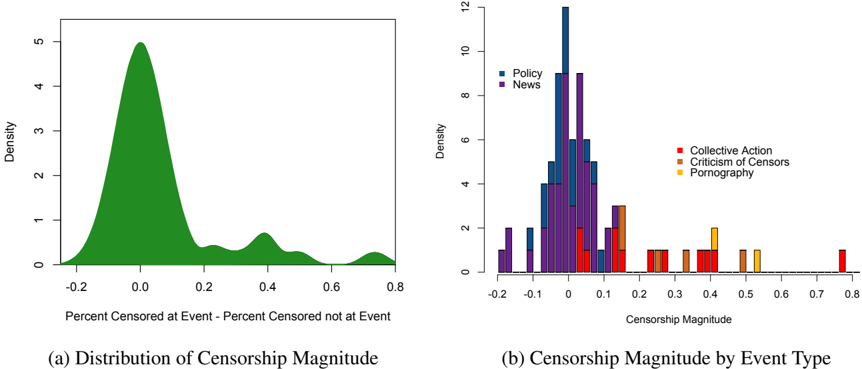
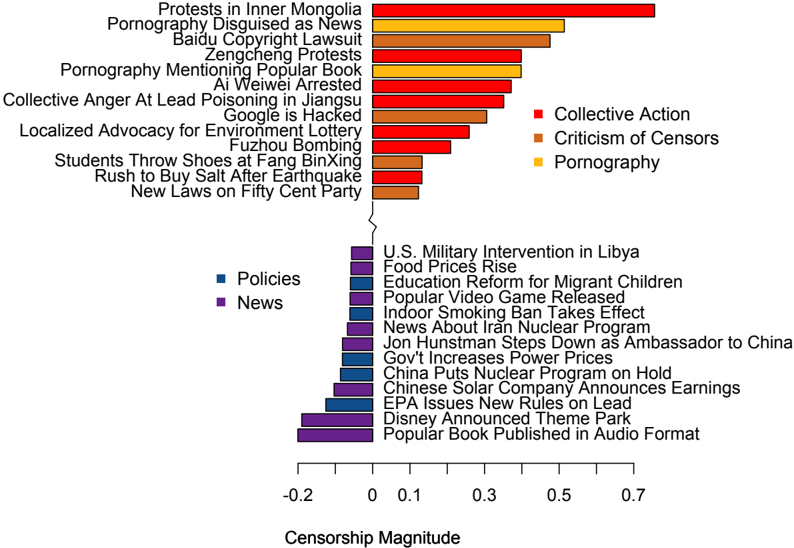
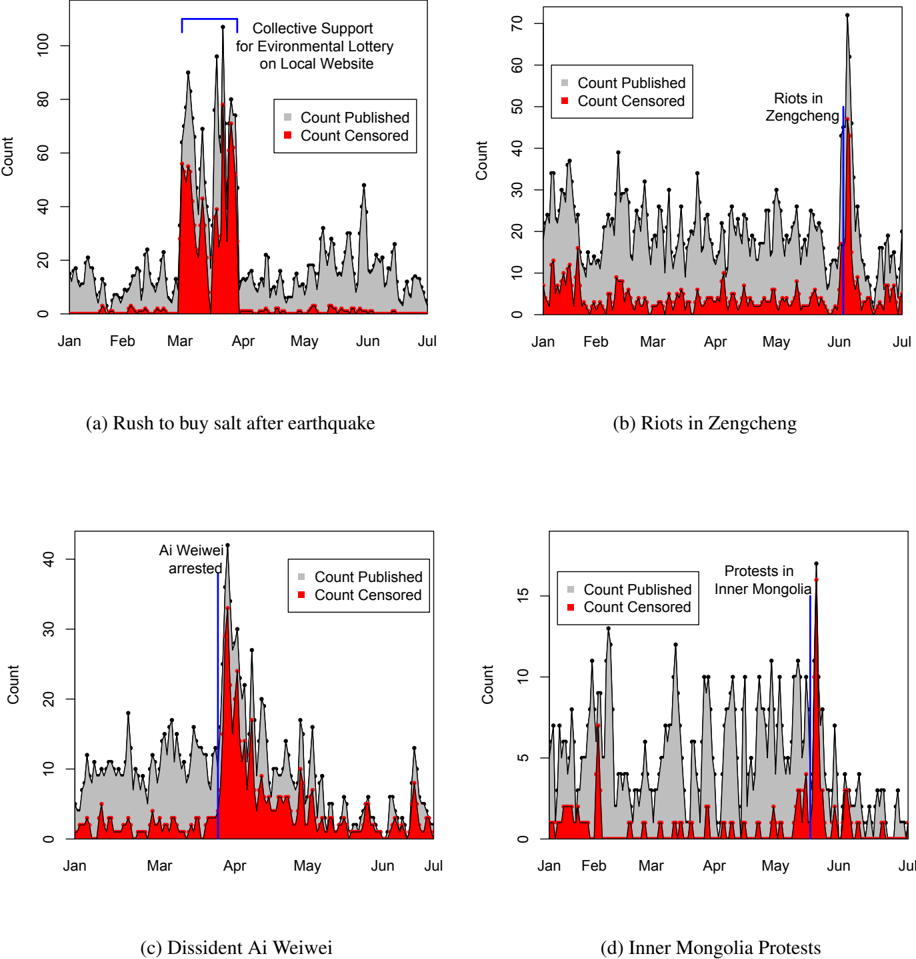
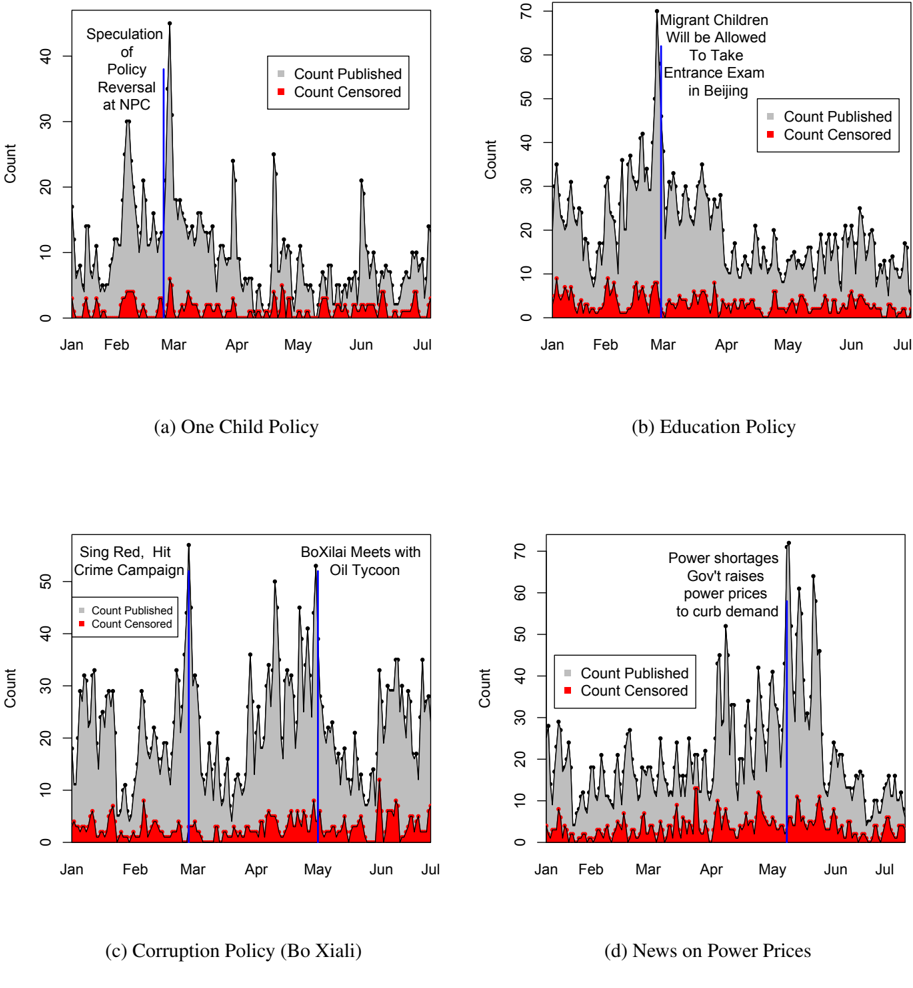
- Censorship was much higher during volume bursts tied to collective action: average censorship magnitude was 27% for collective action, compared with -1% for policy and -4% for news.
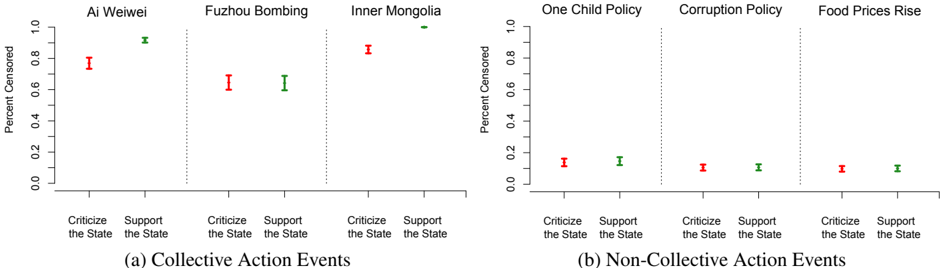
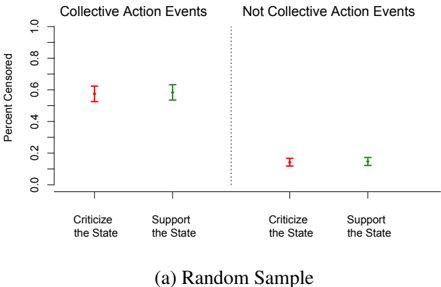
- For collective action events such as Ai Weiwei’s arrest, Inner Mongolia protests, and Fuzhou bombings, posts were censored at about 80% on average whether they criticized or supported the state. For non-collective-action events such as the one child policy, corruption policy, and food prices, censorship was about 10% on average for both critical and supportive posts.
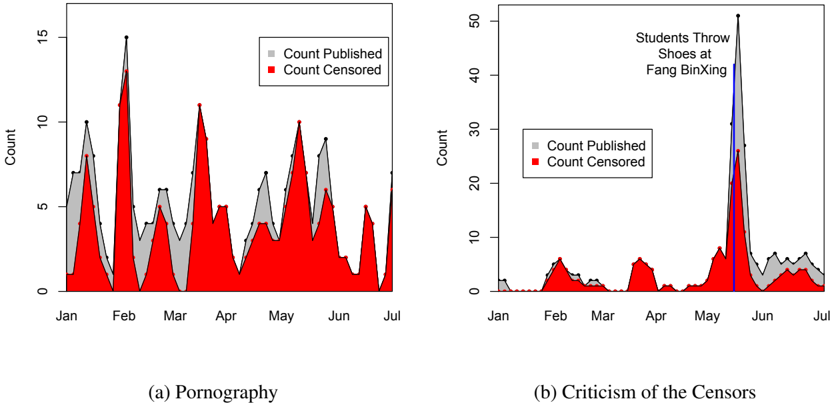
- Censorship also targeted pornography and criticism of the censors, but not government policy or other news. The authors argue censorship is aimed at curtailing collective action by silencing comments that represent, reinforce, or spur social mobilization.
Methods
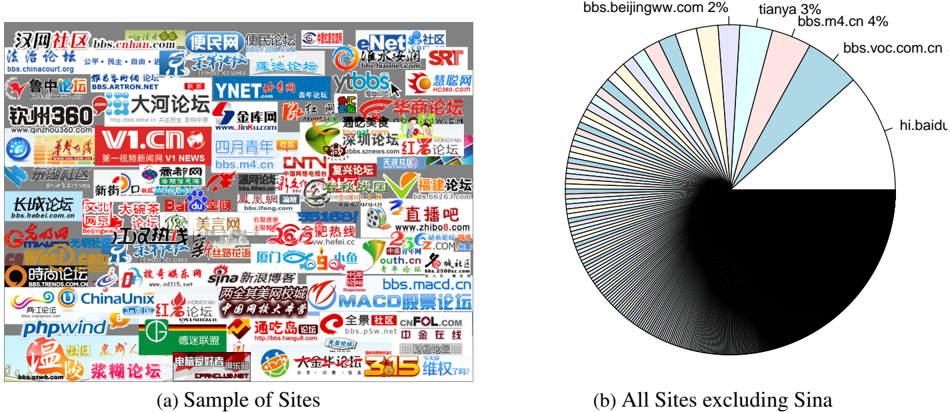
- The authors built a system to locate, download, and analyze posts from 1,382 Chinese websites during the first half of 2011, before government censors could remove them. They collected 3,674,698 posts, randomly selected 127,283 for further analysis, and overall collected and analyzed 11,382,221 posts.
- They used a stratified random sampling design covering 85 topic areas across three hypothesized political sensitivity levels, detected 87 volume bursts in 67 of the 85 topic areas using robust regression-based burst detection, and classified events into collective action potential, criticism of censors, pornography, government policies, and other news.
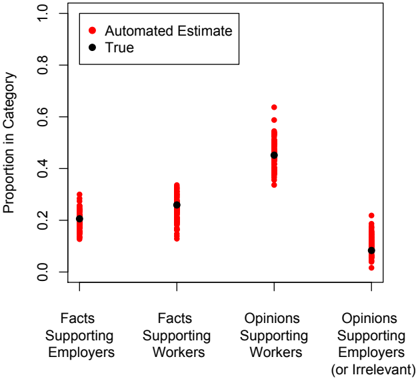
- To analyze content, they adapted the Hopkins and King “ReadMe” automated text analysis method to Chinese and extended it with a Bayesian procedure to estimate the percent censored within categories. Validation used native Chinese speakers coding 1,000 posts about 2010 labor strikes, with 100 as training and 900 as test; event coding reliability was 98.9% (86 of 87 events).
Limitations
- The paper states that its methodology misses self-censorship and censorship that may occur before the post is obtained; it also does not quantify the direct effects of the Great Firewall, keyword blocking, or search filtering.
- The authors state they have not studied physical violence, such as arrest of bloggers, or threats of the same; although many officials and levels of government influence censorship decisions, their data only sometimes distinguish among these sources, and they cannot determine the consequences of these limitations.
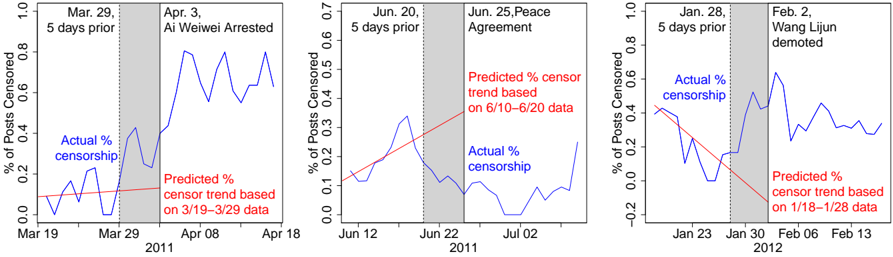
- The authors note that the presumably smaller number of discussions they cannot observe are likely to be those of most interest to the Chinese government, and they offer little evidence connecting social media findings to press freedom or other types of human expression in China. They also state that the predictive analysis was conducted retrospectively and with only three events, so further prospective validation would be valuable.
Model-written summary. Check it against the paper before relying on it.
Integrity signals
Registry
Cites
Statistics
Figures
Verification
Claims the paper makes
0 Valid · 7 Not valid · 7 Not checked · 88 Own results and interpretations
A result the paper reports from its own data — it cites no other source for it, so there is none to check. The quote shows it is in the paper.
In the paper
“Our data show that the Chinese censorship program allows for a wide variety of criticisms of the Chinese government, its officials, and its policies.”
§ How Censorship in China Allows Government Criticism but Silences Collective Expression * > Outline of Results
plain- Asserted: passes — The authors put it forward as true.
- Checkable: passes — It can be checked against evidence.
- Load-bearing: passes — The paper’s conclusions depend on it.
- Based: passes — The paper gives a reason why it holds.
A result the paper reports from its own data — it cites no other source for it, so there is none to check. The quote shows it is in the paper.
In the paper
“Contrary to previous understandings, posts with negative, even vitriolic, criticism of the state, its leaders, and its policies are not more likely to be censored.”
- Also stated in: § 1 Introduction · plain
“we find that when the Chinese people write scathing criticisms of their government and its leaders, the probability that their post will be censored does not increase.”
§ How Censorship in China Allows Government Criticism but Silences Collective Expression * > Abstract
plain- Asserted: passes — The authors put it forward as true.
- Checkable: passes — It can be checked against evidence.
- Load-bearing: passes — The paper’s conclusions depend on it.
- Based: passes — The paper gives a reason why it holds.
- Also stated in: § 1 Introduction · plain
A result the paper reports from its own data — it cites no other source for it, so there is none to check. The quote shows it is in the paper.
In the paper
“Large increases in online volume are good predictors of censorship when these increases are associated with events related to collective action, e.g., protest on the ground.”
§ How Censorship in China Allows Government Criticism but Silences Collective Expression * > Outline of Results
plainstates an association- Asserted: passes — The authors put it forward as true.
- Checkable: passes — It can be checked against evidence.
- Load-bearing: passes — The paper’s conclusions depend on it.
- Based: passes — The paper gives a reason why it holds.
A result the paper reports from its own data — it cites no other source for it, so there is none to check. The quote shows it is in the paper.
In the paper
“In addition, we measure sentiment within each of these events and show that during these events, the government censors views that are both supportive and critical of the state.”
§ How Censorship in China Allows Government Criticism but Silences Collective Expression * > Outline of Results
plainstates a cause- Asserted: passes — The authors put it forward as true.
- Checkable: passes — It can be checked against evidence.
- Load-bearing: passes — The paper’s conclusions depend on it.
- Based: passes — The paper gives a reason why it holds.
A result the paper reports from its own data — it cites no other source for it, so there is none to check. The quote shows it is in the paper.
In the paper
“We thus conduct the same analysis for the demotion of Wang Lijun in Panel (c) of Figure 11, and again see a large difference in actual and predicted percent censorship before Wang's demotion.”
§ How Censorship in China Allows Government Criticism but Silences Collective Expression * > Additional information
plainSingle case- Asserted: passes — The authors put it forward as true.
- Checkable: passes — It can be checked against evidence.
- Load-bearing: unclear — It is unclear whether the paper’s conclusions depend on it.
- Based: passes — The paper gives a reason why it holds.
46 more claims
Create a free account to see all 102 claims and every source verdict.
- Probably not a substantial claim. 26
- It may state two separate claims as one. 33
Claims other papers make about this one
Each is checked against this paper’s own text: does it say what the citing paper says it does?
The source backs part of the claim, not all of it — or backs it for a different population, condition or comparison.
In the citing paper
“Authorities are keen to review social media posts and have contentious messages removed (King etal., 2013) to ensure that potential threats remain invisible.”
From How Dictators Control the Internet: A Review Essay (2020) · cites this paper as King et al., 2013
Experimental — accuracy not yet measuredThe source backs part of the claim, not all of it — or backs it for a different population, condition or comparison.
In the citing paper
“In most autocratic regimes, governmental interference in digital infrastructure and communication is commonplace.”
From How Dictators Control the Internet: A Review Essay (2020) · cites this paper as King et al., 2013
Experimental — accuracy not yet measuredThe source backs part of the claim, not all of it — or backs it for a different population, condition or comparison.
In the citing paper
“First, the timing of censorship during a coup is consistent with many studies that have shown that Internet censorship is targeted during sensitive political time periods and periods of potential power transitions, such as elections and large-scale protests [23,25,44,47,73].”
From A multi-perspective view of Internet censorship in Myanmar (2021) · cites this paper as [44]
Experimental — accuracy not yet measuredThe cited source says what the claim attributes to it.
In the citing paper
“research has shown how mobilization organized through public coordination is repressed using that very same public information-for instance, repression is preemptively increased before focal days (Truex 2019); and autocracies censor online calls for collective action (King, Pan, and Roberts 2013), coerce online opinion leaders (Pan and Siegel 2020), and at times, turn off the internet entirely.”
From Coordinated Dis-Coordination (2024) · cites this paper as King, Pan, and Roberts 2013
The check wasn’t confident either way, so it gives no verdict — never disputed.
In the citing paper
“In China, for instance, two virtual police officers remind citizens that their browsing behavior is monitored (King etal., 2013).”
From How Dictators Control the Internet: A Review Essay (2020) · cites this paper as King et al., 2013
Experimental — accuracy not yet measured
1 more claim about this paper
Create a free account to see every claim other papers make about this one.
Citations
Cites
Robust estimation of a location parameter
Huber, P. J. (1964) · The Annals of Mathematical Statistics · doi:10.1214/aoms/1177703732 · Cited by 7,228
Robust Regression and Outlier Detection
Piepel, G. F. (1989) · Technometrics · doi:10.1080/00401706.1989.10488524 · Cited by 6,144
Robust Regression and Outlier Detection
Rousseeuw, P. J., & Leroy, A. M. (1987) · Wiley Series in Probability and Statistics · doi:10.1002/0471725382 · Cited by 5,609
Logistic Regression in Rare Events Data
King, G., & Zeng, L. (2001) · Political Analysis · doi:10.1093/oxfordjournals.pan.a004868 · Cited by 4,316 · cited 1×
“We do this via well-known and widely used case-control methodology (King and Zeng 2001).”
MethodSelf-citationDemocracy and Development: Political Institutions and Well-Being in the World, 1950–1990
Przeworski, A., Alvarez, M. E., Cheibub, J. A., & Limongi, F. (2000) · doi:10.1017/cbo9780511804946 · Cited by 2,845
Rightful Resistance in Rural China
O'Brien, K. J., & Li, L. (2006) · Cambridge University Press eBooks · doi:10.1017/cbo9780511791086 · Cited by 1,104
The Dynamics of Informational Cascades: The Monday Demonstrations in Leipzig, East Germany, 1989–91
Lohmann, S. (1994) · World Politics · doi:10.2307/2950679 · Cited by 1,035 · cited 1×
“Protests in East Germany, Eastern Europe, and most recently the Middle East have all preceded regime change (Ash 2002; Lohmann 1994; Przeworski et al. 2000).”
BackgroundRightful Resistance in Rural China
O'Brien, K., & Li, L.-J. (2006) · doi:10.1017/cbo9780511791086.003 · Cited by 987
China's Changing of the Guard: Authoritarian Resilience
Nathan, A. J. (2003) · Journal of Democracy · doi:10.1353/jod.2003.0019 · Cited by 927
Sparks and prairie fires: A theory of unanticipated political revolution
Kuran, T. (1989) · Public Choice · doi:10.1007/bf00116762 · Cited by 905 · cited 1×
“In fact, Kuran (1989) and Lohmann (2002) show that it is information about a collective action event that propels collective action and so distinguishing this from explicit calls for collective action would be difficult if not impossible.”
Background
Research works printed but not linked: 13
- 22. Freedom House. 2012. "Freedom of the Press, 2012." www.freedomhouse.org.
- 8. Chang, Parris. 1983. Elite Conflict in the Post-Mao China. New York: Occasional Papers Reprints.
- 26. Hinton, Harold. 1955. The "Unprincipled Dispute" Within Chinese Communist Top Lead- ership. Washington, DC: U.S. Information Agency.
- 44. Perry, Elizabeth. 2002. Challenging the Mandate of Heaven: Social Protest and State Power in China. Armork, NY: M. E. Sharpe.
- 52. Schurmann, Franz. 1966. Ideology and Organization in Communist China. Berkeley, CA: University of California Press.
- Tsai, 2007, Capitalism without Democracy: The Private Sector in Contemporary China
- 48. Qiang, Xiao. 2011. The Rise of Online Public Opinion and Its Political Impact. In Chang- ing Media, Changing China, ed. Susan Shirk. New York: Oxford University Press pp. 202-224.
- 9. Charles, David. 1966. The Dismissal of Marshal P'eng Teh-huai. In China Under Mao: Politics Takes Command, ed. Roderick MacFarquhar. Cambridge: MIT University Press pp. 20-33.
- 54. Shirk, Susan. 2007. China: Fragile Superpower: How China's Internal Politics Could Derail Its Peaceful Rise. New York: Oxford University Press.
- 56. Teiwes, Frederick. 1979. Politics and Purges in China: Retification and the Decline of Party Norms. Armork, NY: M. E. Sharpe. Tsai, Kellee. 2007a. Capitalism without Democracy: The Private Sector in Contemporary China. Ithaca, NY: Cornell University Press.
- 15. Duan, Qing. 2007. China's IT Leadership. Vdm Verlag.
- 38. MacFarquhar, Roderick. 1974. The Origins of the Cultural Revolution Volume 1: Contra- dictions Among the People 1956-1957. New York: Columbia University Press.
- 12. Chen, Xiaoyan and Peng Hwa Ang. 2011. Internet Police in China: Regulation, Scope and Myths. In Online Society in China: Creating, Celebrating, and Instrumentalising the Online Carnival, ed. David Herold and Peter Marolt. New York: Routledge pp. 40-52.
Cited by
Items 101–200 of 2,443
Mobilizing without the Masses: Control and Contention in China
Fu, D. (2017) · Cited by 136
Media Disruption and Revolutionary Unrest: Evidence From Mubarak's Quasi-Experiment
Hassanpour, N. (2014) · Political Communication · doi:10.1080/10584609.2012.737439 · Cited by 136
“Similarly, King, Pan, and Roberts (2013) find the Chinese censorship operations to be a preamble to the regime’s political actions.”
BackgroundHow Modern Dictators Survive: An Informational Theory of the New Authoritarianism
Guriev, S., & Treisman, D. (2015) · National Bureau of Economic Research · doi:10.3386/w21136 · Cited by 132
“…political controversy and meets the party’s propaganda requirements,” one analyst wrote in 2005 (Esarey 2005, pp.57-9).8 Censorship of the internet, meanwhile, focused on blocking collective action rather than on suppressing criticism of the government and party (King, Pan, and Roberts 2013).”
Focal Points, Dissident Calendars, and Preemptive Repression
Truex, R. (2019) · Journal of Conflict Resolution · doi:10.1177/0022002718770520 · Cited by 134
Digital Authoritarianism and the Future of Human Rights
Dragu, T., & Lupu, Y. (2021) · International Organization · doi:10.1017/s0020818320000624 · Cited by 134
Undermining Resistance: Mobilization, Repression, and the Enforcement of Political Order
Sullivan, C. M. (2016) · Journal of Conflict Resolution · doi:10.1177/0022002714567951 · Cited by 133
Beraja, M., Kao, A., Yang, D. Y., & Yuchtman, N. (2023) · The Quarterly Journal of Economics · doi:10.1093/qje/qjad012 · Cited by 133
Local–national political trust patterns: Why China is an exception
Wu, C., & Wilkes, R. (2018) · International Political Science Review · doi:10.1177/0192512116677587 · Cited by 130
“While a number of Asian countries, including Vietnam, Cambodia, and Mongolia, are also authoritarian or autocratic, Chinese censorship, aimed at maintaining the stability of the national authoritarian state, is by far the world’s most extensive (King et al., 2013).”
BackgroundInfluentialThe Human Right to Free Internet Access
Reglitz, M. (2019) · Journal of Applied Philosophy · doi:10.1111/japp.12395 · Cited by 159
Zeng, J. (2020) · Journalism Practice · doi:10.1080/17512786.2019.1706622 · Cited by 132
“As a number of researchers point out (Fu 2017; King, Pan, and Roberts 2013; Zheng and Wu 2005) online activism, which can potentially lead to large-scale collective action, has long been a major target of the Chinese authorities’ censorship.”
BackgroundInfluentialResilience to Online Censorship
Roberts, M. E. (2020) · Annual Review of Political Science · doi:10.1146/annurev-polisci-050718-032837 · Cited by 131
“King et al. (2013, 2014) show that the Chinese government individually removes large numbers of social media posts, often related to collective focused in certain geographies, massively affecting the distribution of information available on-line.”
BackgroundSelf-citationChina's Media Censorship: A Dynamic and Diversified Regime
Tai, Q. (2014) · Journal of East Asian Studies · doi:10.1017/s1598240800008900 · Cited by 166
Crisis Coordination and the Role of Social Media in Response to COVID-19 in Wuhan, China
Li, Y., Chandra, Y., & Kapucu, N. (2020) · The American Review of Public Administration · doi:10.1177/0275074020942105 · Cited by 149
Hyun, K. D., & Kim, J. (2015) · Information, Communication & Society · doi:10.1080/1369118x.2014.994543 · Cited by 131
How Dictators Control the Internet: A Review Essay
Keremoğlu, E., & Weidmann, N. B. (2020) · Comparative Political Studies · doi:10.1177/0010414020912278 · Cited by 131
“In China, for instance, two virtual police officers remind citizens that their browsing behavior is monitored (King et al., 2013).”
BackgroundInfluentialCapturing Clicks: How the Chinese Government Uses Clickbait to Compete for Visibility
Lu, Y., & Pan, J. (2021) · Political Communication · doi:10.1080/10584609.2020.1765914 · Cited by 130
“…of internet penetration, social media usage, and government control over online spaces (Bamman et al., 2012; Brady, 2009; Clayton et al., 2006; Deibert, 2002; King et al., 2013, 2014; MacKinnon, 2011; Repnikova & Fang, 2018; Sullivan, 2012; Yang, 2009; Zhu et al., 2013; Zittrain & Edelman, 2003).”
BackgroundSelf-citationConcealing Corruption: How Chinese Officials Distort Upward Reporting of Online Grievances
PAN, J., & CHEN, K. (2018) · American Political Science Review · doi:10.1017/s0003055418000205 · Cited by 125
“In the digital age, these citizen complaints are often posted online where they remain uncensored and publicly accessible (King, Pan, and Roberts 2013).”
BackgroundSelf-citationA public policy perspective of the Dark Web
Chertoff, M. (2017) · Journal of Cyber Policy · doi:10.1080/23738871.2017.1298643 · Cited by 122
Digital masquerading: Feminist media activism in China
Tan, J. (2017) · Crime, Media, Culture: An International Journal · doi:10.1177/1741659017710063 · Cited by 122
“Internet content in China is censored in a number of ways: “the Great Firewall” that blocks foreign websites or services such as Facebook or Twitter; keyword filtering that automatically forbids posts that contain sensitive words or phrases; and real-life inspectors who screen and delete sensitive posts online (King e…”
BackgroundSanovich, S., Stukal, D., & Tucker, J. A. (2018) · Comparative Politics · doi:10.5129/001041518822704890 · Cited by 118
Hashtag activism: social media and the #FreeYouth protests in Thailand
Sinpeng, A. (2021) · Critical Asian Studies · doi:10.1080/14672715.2021.1882866 · Cited by 121
The Rise of Data Politics: Digital China and Evolving International Relations
Liu, L. (2020) · Studies in Comparative International Development · doi:10.1007/s12116-021-09319-8 · Cited by 166
Internal Government Assessments of the Quality of Governance in China
Dimitrov, M. K. (2015) · Studies in Comparative International Development · doi:10.1007/s12116-014-9170-2 · Cited by 120
Can Social Media Clear the Air? A Case Study of the Air Pollution Problem in Chinese Cities
Kay, S., Zhao, B., & Sui, D. Z. (2014) · The Professional Geographer · doi:10.1080/00330124.2014.970838 · Cited by 135
“Many recent cases, such as the discussion of the Bo Xilai scandal on microblogs, show how the government will allow many online debates to continue more or less unfettered as long as these online discussions are not translated into organized political actions (King, Pan, and Roberts 2013).”
BackgroundTaneja, H., & Wu, A. X. (2014) · The Information Society · doi:10.1080/01972243.2014.944728 · Cited by 148
“A recent study shows that censors of microblogs primarily expunge comments that “represent, reinforce, and spur social mobilization,” but are more likely to permit vocal discontent with the government (King, Pan, and Roberts 2013).”
BackgroundCairns, C., & Carlson, A. R. (2016) · The China Quarterly · doi:10.1017/s0305741015001708 · Cited by 146
Gohdes, A. R. (2015) · Journal of Peace Research · doi:10.1177/0022343314551398 · Cited by 118
Contesting Food Safety in the Chinese Media: Between Hegemony and Counter-Hegemony
Yang, G. (2013) · The China Quarterly · doi:10.1017/s0305741013000386 · Cited by 120
Zhao, S. (2016) · Journal of democracy · doi:10.1353/jod.2016.0051 · Cited by 148
Authoritarianism Online: What Can We Learn from Internet Data in Nondemocracies?
Greitens, S. C. (2013) · Political Science and Politics · doi:10.1017/s1049096513000346 · Cited by 113
Public deliberation on government-managed social media: A study on Weibo users in China
Medaglia, R., & Zhu, D. (2017) · Government Information Quarterly · doi:10.1016/j.giq.2017.05.003 · Cited by 114
Zhang, S., Li, Y., Hao, Y., & Zhang, Y. (2018) · Energy Policy · doi:10.1016/j.enpol.2018.02.025 · Cited by 115
"Positive Energy": Hegemonic Intervention and Online Media Discourse in China's Xi Jinping Era
Yang, P., & Tang, L. (2018) · China An International Journal · doi:10.1353/chn.2018.0000 · Cited by 128
Breaking the News: The Role of State-Run Media
Walker, C., & Orttung, R. W. (2014) · Journal of democracy · doi:10.1353/jod.2014.0015 · Cited by 113
Hassan, M., Mattingly, D., & Nugent, E. R. (2022) · Annual Review of Political Science · doi:10.1146/annurev-polisci-051120-013321 · Cited by 113
The Challenge of Big Data and Data Science
Brady, H. E. (2019) · Annual Review of Political Science · doi:10.1146/annurev-polisci-090216-023229 · Cited by 142
Chan, M., Chen, H., & Lee, F. L. F. (2016) · New Media & Society · doi:10.1177/1461444816653190 · Cited by 144
“On the other hand, communications of non-sanctioned information and views, especially through microblogs, are allowed so long as they do not extend to calls for collective mobilization (King et al., 2013).”
BackgroundPulling the Strings? The Strategic Use of Pro-Government Mobilization in Authoritarian Regimes
Hellmeier, S., & Weidmann, N. B. (2019) · Comparative Political Studies · doi:10.1177/0010414019843559 · Cited by 141
“This helps to understand why the Chinese government censors bottom-up efforts to organize pro-government rallies (King et al., 2013). The risks of mobilization do not outweigh the potential benefits as the Chinese state has the capacity to use other, more direct, repressive means to manage dissent. Finally, autocrats…”
BackgroundAlternative framing: The effect of the Internet on political support in authoritarian China
Tang, M., & Huhe, N. (2013) · International Political Science Review · doi:10.1177/0192512113501971 · Cited by 128
“A recent comprehensive survey of social media websites in China conducted by King et al. (2012) confirms this pattern and shows that negative, even vitriolic, criticism of the state, political elites and public policies is allowed on the web as long as it has no potential for collective action…”
BackgroundInfluentialPolitical Bias in Corporate News: The Role of Conglomeration Reform in China
Piotroski, J. D., Wong, T. J., & Zhang, T. (2015) · The Journal of Law and Economics · doi:10.1086/693096 · Cited by 109
Contemporary Social Movements in a Hybrid Media Environment
Caren, N., Andrews, K. T., & Lu, T. (2020) · Annual Review of Sociology · doi:10.1146/annurev-soc-121919-054627 · Cited by 108
“Others, however, increasingly worried about the potential of new media to exacerbate inequalities (Schradie 2019), generate thin forms of “clicktivism” (Shulman 2009), and enhance the capacities for surveillance and repression of movements (King et al. 2013, Tufekci 2017).”
BackgroundDoes Social Media Influence Conflict? Evidence from the 2012 Gaza Conflict
Zeitzoff, T. (2016) · Journal of Conflict Resolution · doi:10.1177/0022002716650925 · Cited by 144
Political determinants of e-government performance revisited: Comparing democracies and autocracies
Stier, S. (2015) · Government Information Quarterly · doi:10.1016/j.giq.2015.05.004 · Cited by 135
Essays on the political economy
Fonseca Galvis, A. M. (1989) · Choice Reviews Online · doi:10.5860/choice.27-1023 · Cited by 107
COMO CRIAR E CLASSIFICAR CATEGORIAS PARA FAZER ANÁLISE DE CONTEÚDO: UMA QUESTÃO METODOLÓGICA
Carlomagno, M. C., & da Rocha, L. C. (2016) · Revista Eletrônica de Ciência Política · doi:10.5380/recp.v7i1.45771 · Cited by 459
Bleck, J., & Michelitch, K. G. (2017) · The Journal of Politics · doi:10.1086/690616 · Cited by 109
Zhu, J., Huang, H., & Zhang, D. (2017) · Public Administration Review · doi:10.1111/puar.12866 · Cited by 102
“The big-data approach also mitigates the reliability problem of answering political support questions in an authoritarian context during surveys because netizens in China actually enjoy a large degree of “freedom of speech” on the internet (King, Pan, and Roberts 2013 ).”
BackgroundTai, Y., & Fu, K. (2020) · Journal of Communication · doi:10.1093/joc/jqaa032 · Cited by 132
Correlation between PM2.5 pollution and its public concern in China: Evidence from Baidu Index
Li, W., Yang, G., & Li, X. (2021) · Journal of Cleaner Production · doi:10.1016/j.jclepro.2021.126091 · Cited by 114
Lawless: the secret rules that govern our digital lives
Suzor, N. P. (2018) · doi:10.31235/osf.io/ack26 · Cited by 101
Information Manipulation and Reform in Authoritarian Regimes
Chen, J., & Xu, Y. (2017) · Political Science Research and Methods · doi:10.1017/psrm.2015.21 · Cited by 99
“…to distort citizens ’ incentives of joining the protest (see, e.g., Shirk 2010; Shadmehr and Bernhardt 2011; Stockmann and Gallagher 2011; King, Pan and Roberts 2013; Stockmann 2013; Dimitrov 2014; King, Pan and Roberts 2014; Lorentzen, Landry and Yasuda 2014; Wallace 2014; Huang 2015;…”
BackgroundGruffydd-Jones, J. J. (2018) · Comparative Political Studies · doi:10.1177/0010414018784066 · Cited by 112
“…have various incentives to allow their public to hear criticism of their rule: criticism may not be particularly damaging without mobilisation (King et al. 2013); over-zealous censorship may impose credibility costs (Roberts & Stewart 2017; Jones-Rooy 2017; Chen & Xu 2017); criticism may…”
BackgroundDatafication, dataveillance, and the social credit system as China’s new normal
Lee, C. S. (2019) · Online Information Review · doi:10.1108/oir-08-2018-0231 · Cited by 132
Sometimes Less Is More: Censorship, News Falsification, and Disapproval in 1989 East Germany
Gläßel, C., & Paula, K. (2020) · American Journal of Political Science · doi:10.1111/ajps.12501 · Cited by 98
“In view of the asserted effectiveness of information manipulation, it is puzzling that contemporary autoc-racies do not fully exhaust their capacity to implement all-encompassing censorship (Gunitsky 2015; King, Pan, and Roberts 2013, 2017).”
BackgroundRenegotiating the World Order: Institutional Change in International Relations
Lipscy, P. Y. (2017) · Cited by 96
Zeng, J., Chan, C., & Fu, K. (2017) · Policy & Internet · doi:10.1002/poi3.155 · Cited by 110
The Microfoundations of State Cybersecurity: Cyber Risk Perceptions and the Mass Public
Kostyuk, N., & Wayne, C. (2021) · Journal of Global Security Studies · doi:10.1093/jogss/ogz077 · Cited by 93
Responsive Authoritarianism in China -- a Review of Responsiveness in Xi and Hu Administrations
Qiaoan, R., & Teets, J. C. (2019) · Journal of Chinese Political Science · doi:10.1007/s11366-019-09640-z · Cited by 141
Why Botter: How Pro-Government Bots Fight Opposition in Russia
STUKAL, D., SANOVICH, S., BONNEAU, R., & TUCKER, J. A. (2022) · American Political Science Review · doi:10.1017/s0003055421001507 · Cited by 94
“…attacks (Lutscher et al. 2019), special regulations on Internet service providers to block or remove online content (Deibert and Rohozinski 2010; King, Pan, and Roberts 2013)—among other techniques employed to increase what Roberts (2018) dubbed as fear, friction, and flooding—are other tools…”
BackgroundKing, G. (2013) · PS Political Science & Politics · doi:10.1017/s1049096513001534 · Cited by 113
Self-citationInformation Control and Public Support for Social Credit Systems in China
Xu, X., Kostka, G., & Cao, X. (2021) · The Journal of Politics · doi:10.1086/718358 · Cited by 108
“A great number of authoritarian regimes conduct censorship (Gunitsky 2015); information that could stimulate collective actions, including news about targeted repression against political opponents, is often removed from the public sphere (King, Pan, and Roberts 2013).”
BackgroundPan, J. (2017) · Problems of Post-Communism · doi:10.1080/10758216.2016.1181525 · Cited by 92
Self-citationFrom the web to the streets: internet and protests under authoritarian regimes
Ruijgrok, K. (2016) · Democratization · doi:10.1080/13510347.2016.1223630 · Cited by 155
Social media, political expression, and participation in Confucian Asia
Škorić, M. M., Zhu, Q., & Pang, N. L.-S. (2016) · Chinese Journal of Communication · doi:10.1080/17544750.2016.1143378 · Cited by 110
Seeking Legitimacy through CSR Reporting: Evidence from China
Dai, N. T., Du, F., Young, S. M., & Tang, G. (2016) · Journal of Management Accounting Research · doi:10.2308/jmar-51627 · Cited by 109
Who Not What: The Logic of China's Information Control Strategy
Gallagher, M. E., & Miller, B. (2021) · The China Quarterly · doi:10.1017/s0305741021000345 · Cited by 112
Blunt force regulation and bureaucratic control: Understanding China's war on pollution
van der Kamp, D. S. (2020) · Governance · doi:10.1111/gove.12485 · Cited by 99
“China’s struggle to implement pollution policies suggests that when central orders conflict with local interests, the state’s sophisticated information-gathering capacities (King et al. 2013, Lorentzen 2014, Truex 2017) may not be enough to overcome bureaucratic principal-agent problems.”
BackgroundFarrell, H. J., & Newman, A. L. (2021) · International Organization · doi:10.1017/s0020818320000302 · Cited by 114
“See King, Pan, and Roberts 2013; Roberts 2018; Tucker et al. 2017. unanticipated consequences of the liberal international information order for liberal states are becoming clear.”
BackgroundYiu, D. W., Wan, W. P., Chen, K. X., & Tian, X. (2021) · Journal of International Business Studies · doi:10.1057/s41267-020-00380-4 · Cited by 105
Baum, M., & Zhukov, Y. M. (2015) · Journal of Peace Research · doi:10.1177/0022343314554791 · Cited by 119
Adjusting for Confounding with Text Matching
Roberts, M. E., Stewart, B. M., & Nielsen, R. A. (2020) · American Journal of Political Science · doi:10.1111/ajps.12526 · Cited by 86
Self-citationSocial media for collaborative planning: A typology of support functions and challenges
Lin, Y. (2022) · Cities · doi:10.1016/j.cities.2022.103641 · Cited by 132
Will the real Weibo please stand up? Chinese online contention and actor-network theory
Poell, T., de Kloet, J., & Zeng, G. (2013) · Chinese Journal of Communication · doi:10.1080/17544750.2013.816753 · Cited by 98
“In turn, King, Pan, and Roberts (2012) have discovered in their analysis of millions of social media posts from nearly 1,400 different social media services all over China, that the Chinese censorship system is specifically “aimed at curtailing collective action by silencing comments that represent,…”
BackgroundThe Popularity of Authoritarian Leaders: A Cross-National Investigation
Guriev, S. M., & Treisman, D. S. (2020) · World Politics · doi:10.1017/s0043887120000167 · Cited by 148
“35 King, Pan, and Roberts 2013; Roberts 2018.”
Elites Tweet to Get Feet Off the Streets: Measuring Regime Social Media Strategies During Protest
Munger, K., Bonneau, R., Nagler, J., & Tucker, J. A. (2019) · Political Science Research and Methods · doi:10.1017/psrm.2018.3 · Cited by 84
“The fi rst generation is to restrict access to the internet (Howard, Agarwal and Hussain 2011), and the second is to censor certain kinds of information posted online (King, Pan and Roberts 2013).”
Authoritarian responsiveness: Online consultation with “issue publics” in China
Kornreich, Y. (2019) · Governance · doi:10.1111/gove.12393 · Cited by 94
“In their analysis of Internet censorship, King et al. (2013) found that the Chinese government deletes online pieces that could prompt citizens to engage in collective action.”
BackgroundThe Power of Empty Promises: Quasi-Democratic Institutions and Activism in China
Distelhorst, G. (2016) · Comparative Political Studies · doi:10.1177/0010414015617960 · Cited by 117
Cantoni, D., Chen, Y., Yang, D., Yuchtman, N., & Zhang, Y. J. (2014) · National Bureau of Economic Research · doi:10.3386/w20112 · Cited by 92
How government-controlled media shifts policy attitudes through framing
Pan, J., Shao, Z., & Xu, Y. (2021) · Political Science Research and Methods · doi:10.1017/psrm.2021.35 · Cited by 100
“…to the strength of the ruling CCP,6 and where, perhaps more than any other country in the world, state control over information is deep and far-reaching, encompassing media, education, culture, sports, and even non-governmental organizations and research (King et al., 2013; Cantoni et al., 2017).”
BackgroundSelf-citationNationalism on Weibo: Towards a Multifaceted Understanding of Chinese Nationalism
Zhang, Y., Liu, J., & Wen, J.-R. (2018) · The China Quarterly · doi:10.1017/s0305741018000863 · Cited by 114
Lin, K., Button, D. M., Su, M., & Chen, S. (2016) · Sexuality Research and Social Policy · doi:10.1007/s13178-016-0223-3 · Cited by 86
State surveillance and the COVID-19 crisis
Eck, K., & Hatz, S. (2020) · Journal of Human Rights · doi:10.1080/14754835.2020.1816163 · Cited by 77
Bernauer, T., Gampfer, R., Meng, T., & Su, Y. (2016) · Global Environmental Change · doi:10.1016/j.gloenvcha.2016.06.001 · Cited by 85
No! Formal Theory, Causal Inference, and Big Data Are Not Contradictory Trends in Political Science
Monroe, B. L., Pan, J., Roberts, M. E., Sen, M., & Sinclair, B. (2014) · PS Political Science & Politics · doi:10.1017/s1049096514001760 · Cited by 92
Self-citationChan, K. N., & Zhao, S. (2015) · Policy Studies Journal · doi:10.1111/psj.12138 · Cited by 96
Social media policies as responses for social media affordances: The case of China
Chen, Q., Xu, X., Cao, B., & Zhang, W. (2016) · Government Information Quarterly · doi:10.1016/j.giq.2016.04.008 · Cited by 99
Gender and China's Online Censorship Protest Culture
WALLIS, C. J. (2014) · Feminist Media Studies · doi:10.1080/14680777.2014.928645 · Cited by 95
Public opinion, international reputation, and audience costs in an authoritarian regime
Li, X., & Chen, D. (2020) · Conflict Management and Peace Science · doi:10.1177/0738894220906374 · Cited by 89
“See, for example, Hassid (2012), King et al. (2013), and Lorentzen (2014).”
BackgroundTirole, J. (2021) · American Economic Review · doi:10.1257/aer.20201214 · Cited by 75
“For instance, King et al (2013) argue that the Chinese government’s main concern is to prevent collective expression; the paper finds that some forms of small, isolated protests and of criticism of party officials (in particular local ones) are tolerated by the censorship, while anything that could…”
BackgroundDerailed emotions: The transformation of claims and targets during the Wenzhou online incident
Bondes, M., & Schucher, G. (2013) · Information Communication & Society · doi:10.1080/1369118x.2013.853819 · Cited by 92
“Despite the multi-layered censorship of China’s Internet that is particularly directed at curtailing collective action (King et al., 2013), the cost of participating in such personalized connective action can be regarded as almost negligible for the majority of netizens when compared to the cost of traditional collect…”
BackgroundInternet Activism & the Party-State in China
Yang, G. (2014) · Daedalus · doi:10.1162/daed_a_00276 · Cited by 79
Bækkeskov, E., & Rubin, O. (2016) · Governance · doi:10.1111/gove.12244 · Cited by 79
Middle East respiratory syndrome risk perception among students at a university in South Korea, 2015
Yang, S., & Cho, S. (2017) · American Journal of Infection Control · doi:10.1016/j.ajic.2017.02.013 · Cited by 77
“10 The World Health Organization suggested that outbreak communication should incorporate the following 5 key factors: (1) building, maintaining, or restoring trust; (2) announcing early; (3) maintaining transparency; (4) understanding the public; and (5) planning of all aspects of the response to an outbreak.”
Discursive strategies of resistance on Weibo: A case study of the 2015 Tianjin explosions in China
Wu, X. (2018) · Discourse Context & Media · doi:10.1016/j.dcm.2018.05.002 · Cited by 82
Launching Revolution: Social Media and the Egyptian Uprising’s First Movers
Clarke, K., & Kocak, K. (2020) · British Journal of Political Science · doi:10.1017/s0007123418000194 · Cited by 72
Mapping the public agenda with topic modeling: The case of the Russian livejournal
Koltsova, O. Y., & Koltcov, S. (2013) · Policy & Internet · doi:10.1002/1944-2866.poi331 · Cited by 90
Media, Protest Diffusion, and Authoritarian Resilience
Huang, H., Boranbay-Akan, S., & Huang, L. (2019) · Political Science Research and Methods · doi:10.1017/psrm.2016.25 · Cited by 75
Can You Hear Me Now? How Communication Technology Affects Protest and Repression
Christensen, D., & Garfias, F. (2018) · Quarterly Journal of Political Science · doi:10.1561/100.00016129 · Cited by 72
Information capacity and social order: The local politics of information integration in China
Chen, H., & Greitens, S. C. (2021) · Governance · doi:10.1111/gove.12592 · Cited by 110
Kornai, J. (2016) · Acta Oeconomica · doi:10.1556/032.2016.66.4.1 · Cited by 113
Metadata
- Authors
- KING, G., PAN, J., & ROBERTS, M. E.
- Affiliations
- Harvard University (US)
- Corresponding author
- KING, GARY
- PAN, JENNIFER
- Venue
- American Political Science Review
- Publisher
- Cambridge University Press (CUP)
- Published
- 2013-05
- Volume
- 107
- Issue
- 2
- Pages
- 326-343
- ISSN
- 0003-0554 (ISSN-L)
- 1537-5943
- OpenAlex
- W2144188763
- Cited by
- 2,415
- References
- 48
- Citations by year
- 2026: 161 · 2025: 206 · 2024: 249 · 2023: 272 · 2022: 230 · 2021: 193 · 2020: 206 · 2019: 157 · 2018: 178 · 2017: 153 · 2016: 137 · 2015: 120 · 2014: 91 · 2013: 54
- FWCI
- 395.09
- Type
- journal article
- Language
- en
- Open access
- green
- nrs.harvard.edu
- Licence
- Locations
- American Political Science Review (publishedVersion)
- Digital Access to Scholarship at Harvard (DASH) (Harvard University) (submittedVersion, cc-by)
- RePEc: Research Papers in Economics (submittedVersion)
- Topics
- Social Sciences › Communication › Social Media and Politics
- Social Sciences › Law › Freedom of Expression and Defamation
- Social Sciences › Sociology and Political Science › Media Influence and Politics
- Keywords
- internet censorship, Chinese government, social media, collective action, social mobilization, political criticism, online speech
About these checks
Registry, retraction, Cites and statistics results are computed, not judged, with one exception: a printed reference that no index lists is read once by a model before it counts as a citation error. Claims are extracted by a model and kept only when their quote appears verbatim in the text; each cited source is then checked, with a model’s help, for whether it says what the claim relies on. Those verdicts can be wrong — read the claim’s quote and the cited source before relying on one.
A language model drew the claims from the paper on 2026-10-11, under version 3 of the claim definition (model deepseek-v4.1-flash, prompt extract-v3).
A second model labelled each claim on 2026-10-11 (model jev-1.13-20260917, definition revision gold-guideline-v0.2).
Statistics and arithmetic are recomputed, not judged.
Confidence bands are shown only for fields calibrated on our annotated test set. None is calibrated yet, so no band is shown.
What counts as a claim ›How we measure confidence ›How we check this ›
Are you an author, or do you see a problem with this page? Request a review
Data sources
Bibliographic data: Semantic Scholar, OpenAlex, Crossref.
Contains information from the Semantic Scholar Academic Graph Datasets, made available under the ODC Attribution License (ODC-BY 1.0).
Semantic Scholar’s data is described in: Kinney, R., et al. (2023). The Semantic Scholar Open Data Platform. arXiv:2301.10140.
