

Rapid antidepressant effects of the psychedelic ayahuasca in treatment-resistant depression: a randomized placebo-controlled trial
Open accessPublished version of a preprint
The DOI matches its Crossref record; 55 of the 55 references it cites were found in a registry or an index.
Abstract
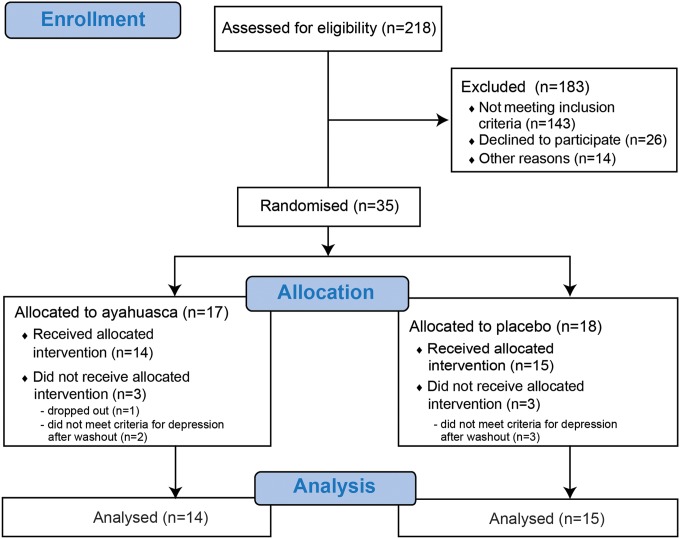
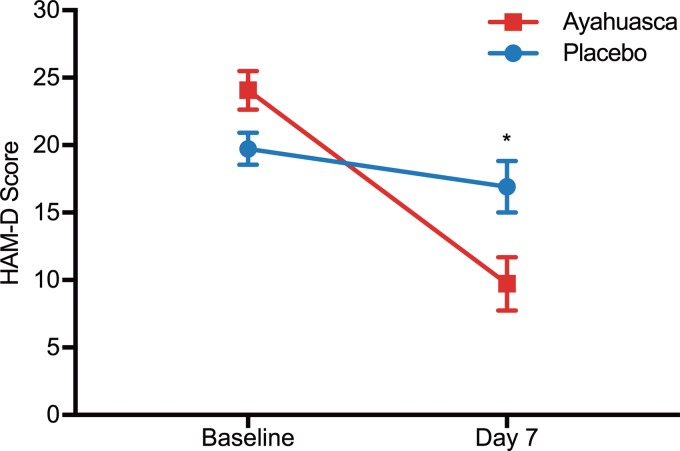
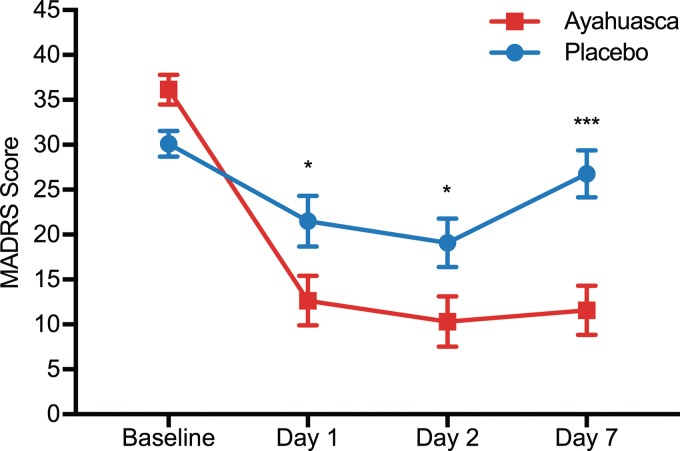
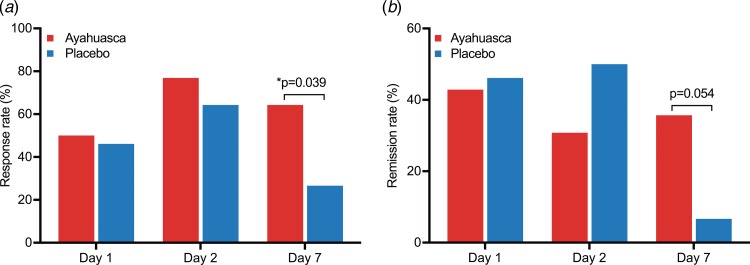
Background: Recent open-label trials show that psychedelics, such as ayahuasca, hold promise as fast-onset antidepressants in treatment-resistant depression. Methods: To test the antidepressant effects of ayahuasca, we conducted a parallel-arm, double-blind randomized placebo-controlled trial in 29 patients with treatment-resistant depression. Patients received a single dose of either ayahuasca or placebo. We assessed changes in depression severity with the Montgomery-Åsberg Depression Rating Scale (MADRS) and the Hamilton Depression Rating scale at baseline, and at 1 (D1), 2 (D2), and 7 (D7) days after dosing. Results: We observed significant antidepressant effects of ayahuasca when compared with placebo at all-time points. MADRS scores were significantly lower in the ayahuasca group compared with placebo at D1 and D2 ( p = 0.04), and at D7 ( p < 0.0001). Between-group effect sizes increased from D1 to D7 (D1: Cohen's d = 0.84; D2: Cohen's d = 0.84; D7: Cohen's d = 1.49). Response rates were high for both groups at D1 and D2, and significantly higher in the ayahuasca group at D7 (64% v. 27%; p = 0.04). Remission rate showed a trend toward significance at D7 (36% v. 7%, p = 0.054). Conclusions: To our knowledge, this is the first controlled trial to test a psychedelic substance in treatment-resistant depression. Overall, this study brings new evidence supporting the safety and therapeutic value of ayahuasca, dosed within an appropriate setting, to help treat depression. This study is registered at http://clinicaltrials.gov (NCT02914769).
Overview
The claims and statistics of this paper haven’t been checked yet.
Free: it reads the open-access text and checks the first 5 claims that cite a source we can check. Create a free account to check every claim.
Integrity signals
Registry
Cites
Statistics
Figures
Verification
Claims the paper makes
The claims and statistics of this paper haven’t been checked yet.
Free: it reads the open-access text and checks the first 5 claims that cite a source we can check. Create a free account to check every claim.
Claims other papers make about this one
Each is checked against this paper’s own text: does it say what the citing paper says it does?
The cited source doesn’t support the claim as written.
In the citing paper
“overall psychiatric scales in the ayahuasca group were significatively higher than those in the placebo group in all time points after dosing.”
From Virtual reality and psychedelics for the treatment of psychiatric disease: A systematic literature review (2020) · doi:10.36131/cnfioritieditore20200606 · cites this paper as Palhano-Fontes et al. (2019)
Checked by a reasoning model — may be wrong.
Experimental — accuracy not yet measuredThe source backs part of the claim, not all of it — or backs it for a different population, condition or comparison.
In the citing paper
“Ayahuasca stimulates emotional dream-like experiences involving potent cognitive-affective changes and spiritual insights (Dobkin de Rios, 1971) that have been associated with substantial and enduring antidepressant effects (Palhano-Fontes et al., 2019; Weiss et al., 2021).”
From Prospective examination of the therapeutic role of psychological flexibility and cognitive reappraisal in the ceremonial use of ayahuasca (2022) · cites this paper as Palhano-Fontes et al., 2019
Experimental — accuracy not yet measuredThe source backs part of the claim, not all of it — or backs it for a different population, condition or comparison.
In the citing paper
“Ayahuasca, or its chemical equivalent known as pharmahuasca, has emerged as a tool for psychotherapy in the contexts of affective and substance use disorders [130,131], thus calling for a better understanding of its possible mechanisms of action.”
From Molecular and Functional Imaging Studies of Psychedelic Drug Action in Animals and Humans. (2021) · cites this paper as [130]
Experimental — accuracy not yet measuredThe source backs part of the claim, not all of it — or backs it for a different population, condition or comparison.
In the citing paper
“Moreover, comorbid conditions such as suicidality and substance use disorders further complicate research efforts (13, 18, 20, 21).”
From Psychoanalytically informed MDMA-assisted therapy for pathological narcissism: a novel theoretical approach (2025) · cites this paper as [20]
Experimental — accuracy not yet measuredThe source backs part of the claim, not all of it — or backs it for a different population, condition or comparison.
In the citing paper
“Ayahuasca has been demonstrated to be safe in naturalistic (35, 108) and clinical settings, across varying dosages and multiple administrations (26, 109–112).”
From Ayahuasca-assisted meaning reconstruction therapy for grief: a non-randomized clinical trial protocol (2025) · cites this paper as [26]
Experimental — accuracy not yet measured
16 more claims about this paper
Create a free account to see every claim other papers make about this one.
Self-check
Percentages, sums and reported differences re-computed from the paper’s own numbers.
The self-check needs the paper’s full text.
Citations
Cites
Hamilton, M. (1960) · Journal of Neurology, Neurosurgery & Psychiatry · doi:10.1136/jnnp.23.1.56 · Cited by 32,817 · cited 1×
“HAM-D was applied only at baseline and D7, as it was designed to access depression symptoms present in the last week (Hamilton, 1960).”
MethodAntidepressant effects of ketamine in depressed patients
Berman, R. M., Cappiello, A., Anand, A., Oren, D. A., Heninger, G. R., Charney, D. S., & Krystal, J. H. (2000) · Biological Psychiatry · doi:10.1016/s0006-3223(99)00230-9 · Cited by 3,856 · cited 7×
“While we find a response rate to placebo of 46% at D1, and 26% at D7, ketamine trials have found a placebo effect of the order of 0 – 6% at D1, and 0 – 11% at D7 (Berman et al. , 2000; Zarate et al. , 2006; Murrough et al. , 2013; Lapidus et al. , 2014).”
BackgroundInfluentialA randomized trial of an N-methyl-D-aspartate antagonist in treatment-resistant major depression.
Zarate, C. A., Singh, J. B., Carlson, P. J., Brutsche, N. E., Ameli, R., Luckenbaugh, D. A., Charney, D. S., & Manji, H. K. (2006) · Archives of General Psychiatry · doi:10.1001/archpsyc.63.8.856 · Cited by 3,766 · cited 4×
“At D7, the ketamine response rate ranges between 7 and 35% (Berman et al., 2000; Zarate et al., 2006; Murrough et al., 2013; Lapidus et al., 2014), while in our study 64% responded to ayahuasca.”
BackgroundInfluentialOtte, C., Gold, S. M., Penninx, B. W., Pariante, C. M., Etkin, A., Fava, M., Mohr, D. C., & Schatzberg, A. F. (2016) · Nature Reviews Disease Primers · doi:10.1038/nrdp.2016.65 · Cited by 2,269 · cited 2×
“We recently found that a single ayahuasca session in patients with depression increases blood flow in brain regions consistently implicated in the regulation of mood and emotions, such as the left nucleus accumbens, right insula and left subgenual area (Otte et al. , 2016; Sanches et al. , 2016).”
BackgroundGriffiths, R. R., Johnson, M. W., Carducci, M. A., Umbricht, A., Richards, W. A., Richards, B. D., Cosimano, M. P., & Klinedinst, M. A. (2016) · Journal of Psychopharmacology · doi:10.1177/0269881116675513 · Cited by 2,201
Nichols, D. E. (2016) · Pharmacological Reviews · doi:10.1124/pr.115.011478 · Cited by 1,762
Ross, S., Bossis, A., Guss, J., Agin-Liebes, G., Malone, T., Cohen, B., Mennenga, S. E., Belser, A., Kalliontzi, K., Babb, J., et al. (2016) · Journal of Psychopharmacology · doi:10.1177/0269881116675512 · Cited by 1,698 · cited 4×
“Prior studies suggest that elements of the psychedelic experience, such as experiences of mystical-type, account for the therapeutic benefit (Bogenschutz et al., 2015; Garcia-Romeu et al., 2015; Majić et al., 2015; Griffiths et al., 2016; Ross et al., 2016).”
BackgroundInfluentialCarhart-Harris, R. L., Bolstridge, M., Rucker, J., Day, C. M. J., Erritzoe, D., Kaelen, M., Bloomfield, M., Rickard, J. A., Forbes, B., Feilding, A., et al. (2016) · The Lancet Psychiatry · doi:10.1016/s2215-0366(16)30065-7 · Cited by 1,540 · cited 4×
“substances affect the brain, and also probing their potential in treating different psychiatric conditions, including mood disorders (Grob et al., 2011; Osório et al., 2015; Carhart-Harris et al., 2016; Griffiths et al., 2016; Ross et al., 2016; Sanches et al., 2016).”
BackgroundResultInfluentialThe default mode network and self-referential processes in depression
Sheline, Y. I., Barch, D. M., Price, J. L., Rundle, M. M., Vaishnavi, S. N., Snyder, A. Z., Mintun, M. A., Wang, S., Coalson, R. S., & Raichle, M. E. (2009) · Proceedings of the National Academy of Sciences · doi:10.1073/pnas.0812686106 · Cited by 1,480 · cited 2×
“Moreover, we have shown that ayahuasca reduces the activity of the Default Mode Network (Palhano-Fontes et al. , 2015), a brain network found to be hyperactive in depression (Sheline et al. , 2009).”
BackgroundPilot Study of Psilocybin Treatment for Anxiety in Patients With Advanced-Stage Cancer
Grob, C. S., Danforth, A. L., Chopra, G. S., Hagerty, M., McKay, C. R., Halberstadt, A. L., & Greer, G. R. (2011) · Archives of General Psychiatry · doi:10.1001/archgenpsychiatry.2010.116 · Cited by 1,206 · cited 2×
“…exploring how these substances affect the brain, and also probing their potential in treating different psychiatric conditions, including mood disorders (Grob et al. , 2011; Osório et al. , 2015; Carhart-Harris et al. , 2016; Griffiths et al. , 2016; Ross et al. , 2016; Sanches et al. , 2016).”
Background
Research works printed but not linked: 3
- World Health Organization (2017) Depression and Other Common Mental Disorders: Global Health Estimates. Rep. CC BY-NC-SA 3.0 IGO. Geneva: World Health Organization.
- Tafur J (2017) The Fellowship of the River: A Medical Doctor's Exploration into Traditional Amazonian Plant Medicine. Espiritu, Phoenix.
- Luna LE (2011) Indigenous and Mestizo use of Ayahuasca. An Overview. The Ethnopharmacology of Ayahuasca. Tivandrum: Transworld Research Network.
Cited by
Items 401–500 of 850
Echeverry, C., Pazos, M., Torres‐Pérez, M., & Prunell, G. (2024) · Neuroscience · doi:10.1016/j.neuroscience.2024.12.039 · Cited by 14
Longo, M. S. C., Bienemann, B., Multedo, M., Negreiros, M. A., Schenberg, E. E., & Mograbi, D. C. (2022) · Journal of Psychoactive Drugs · doi:10.1080/02791072.2022.2112788 · Cited by 15
The possible place for psychedelics in pharmacotherapy of mental disorders
Wojtas, A. (2023) · Pharmacological Reports · doi:10.1007/s43440-023-00550-9 · Cited by 14
“For 64% of participants, there was a significant decrease in depressive symptoms, while 36% of them were in complete remission as measured 7 days after the drug administration [159].”
BackgroundAyahuasca: Between Cognition and Culture
Peláez, I. E. A. (2020) · Publicacions URV eBooks · doi:10.17345/9788484248347 · Cited by 11
Campagnoli, A. P. S., Pereira, L. A. S., & Bueno, J. L. O. (2020) · Brazilian Journal of Medical and Biological Research · doi:10.1590/1414-431x20209278 · Cited by 18
“In addition, in terms of therapeutic purposes, ayahuasca has shown psychological and physiologic effects, with potential use in mental illness as a substance with antidepressant potential (4,14,16).”
BackgroundRecent Evidence on the Antidepressant Effects of Ayahuasca
Palhano-Fontes, F., Mota-Rolim, S. A., Soares, B. L., Coelho, N. L. G., Maia‐de‐Oliveira, J. P., & de Araújo, D. B. (2021) · Springer eBooks · doi:10.1007/978-3-030-55688-4_2 · Cited by 14
Self-citationSu, B., Cheng, S., Wang, L., & Wang, B. (2022) · Bioengineered · doi:10.1080/21655979.2022.2059937 · Cited by 14
“MiRNAs, approximately 22 ribonucleotides produced in the nucleus, could regulate gene expression and protein translation [7].”
BackgroundRetractedSelf-Care Practices with Psychedelics–A Qualitative Study of Users’ Perspectives
Soares, C. M., Leite, Â., & Pinto, M. (2023) · Journal of Psychoactive Drugs · doi:10.1080/02791072.2022.2071134 · Cited by 10
“2021); treatment-resistant depression (CarhartHarris et al. 2016; Palhano-Fontes et al. 2018; Zarate et al. 2006); substance addictions (Bogenschutz et al.”
BackgroundLoizaga-Velder, A. K., Giovannetti, C., Gomez, R. C., Valenzuela, T. C., Jaime, G. R. O., Agin-Liebes, G., Marcus, O., & Rush, B. R. (2023) · Journal of Psychoactive Drugs · doi:10.1080/02791072.2023.2255182 · Cited by 13
“…effects in addressing mental health challenges such as depression, PTSD, anxiety, complicated grief, and substance use disorders (Calabrese 2007; Hamill et al. 2019; Maia et al. 2023; Palhano-Fontes et al. 2019; Perkins et al. 2022; Perkins et al. 2023; Rush et al. 2022; Sarris et al. 2021).”
BackgroundTherapeutic potential of psychedelics: History, advancements, and unexplored frontiers
Maia, J. M., de Oliveira, B. S. A., Branco, L. G. S., & Soriano, R. N. (2024) · Progress in Neuro-Psychopharmacology and Biological Psychiatry · doi:10.1016/j.pnpbp.2024.110951 · Cited by 12
Lowe, M. X., Kettner, H., Jolly, D. R. P., Carhart-Harris, R. L., & Jackson, H. (2024) · Frontiers in Psychiatry · doi:10.3389/fpsyt.2024.1279887 · Cited by 19
Mueller, M. J., Aicher, H., Dornbierer, D., Marten, L., Suay, D., Meling, D., Elsner, C., Wicki, I. A., Müller, J., Poetzsch, S. N., et al. (2024) · The International Journal of Neuropsychopharmacology · doi:10.1093/ijnp/pyaf001 · Cited by 14
Lashgari, N., Khalaji, M., Rana, P., Badrabadi, F., Rahnama, M., Nasoori, H., Roudsari, N. M., Nia, M. M. K., & Shafaroodi, H. (2025) · Molecular Neurobiology · doi:10.1007/s12035-025-05097-9 · Cited by 10
“The primary side effect was nausea, which affected about half of the participants [40, 41].”
Classic psychedelics as therapeutics for psychiatric disorders
Nichols, C. D., & Hendricks, P. S. (2020) · Handbook of behavioral neuroscience · doi:10.1016/b978-0-444-64125-0.00049-9 · Cited by 18
Fissler, P., Vandersmissen, A., Filippi, M., Mavioğlu, R. N., Scholkmann, F., Karabatsiakis, A., & Krähenmann, R. (2023) · Journal of Psychopharmacology · doi:10.1177/02698811231164707 · Cited by 11
“has been shown for depression (Carhart-Harris et al., 2016, 2018, 2021; Galvão-Coelho et al., 2021; Nygart et al., 2022; Palhano-Fontes et al., 2019), anxiety in life-threatening diseases such as cancer (Gasser et al.”
BackgroundRossi, G. N., Crevelin, E. J., Silveira, G. D. O., Queiroz, M. E. C., Yonamine, M., Hallak, J. E. C., & SANTOS, R. G. D. (2019) · Journal of Psychedelic Studies · doi:10.1556/2054.2019.009 · Cited by 10
Self-citationExperimental Therapeutics in Treatment-Resistant Major Depressive Disorder
Kaur, M., & Sanches, M. (2021) · Journal of Experimental Pharmacology · doi:10.2147/jep.s259302 · Cited by 13
Adverse Effects After Ayahuasca Administration in the Clinical Setting
Rocha, J. M., Rossi, G. N., Osório, F. L., Hallak, J. E. C., & SANTOS, R. G. D. (2022) · Journal of Clinical Psychopharmacology · doi:10.1097/jcp.0000000000001536 · Cited by 10
Self-citationThreshold-free estimation of entropy from a Pearson matrix
Felippe, H., Viol, A., de Araújo, D. B., da Luz, M. G. E., Palhano-Fontes, F., Onias, H., Raposo, E. P., & Viswanathan, G. M. (2023) · Europhysics Letters (EPL) · doi:10.1209/0295-5075/acb5bd · Cited by 17
Self-citationEarleywine, M., Altman, B. R., & De Leo, J. (2022) · Journal of Psychoactive Drugs · doi:10.1080/02791072.2021.1912863 · Cited by 9
“Extending this work to other psychedelic-assisted therapies, including ayahuasca (Palhano-Fontes et al. 2019), MDMA (Vermetten and Yehuda 2020), and psilocybin (Carhart-Harris et al. 2016) for depression, might illuminate the credibility of these alternative treatments for depression and other…”
BackgroundColosimo, F. A., Borsellino, P., Krider, R. I., Márquez, R., & Vida, T. A. (2024) · Psychoactives · doi:10.3390/psychoactives3010007 · Cited by 11
Childhood trauma, challenging experiences, and posttraumatic growth in ayahuasca use
Cassidy, E. K., Healy, C. J., Henje, E., & D'Andrea, W. M. (2024) · Drug Science Policy and Law · doi:10.1177/20503245241238316 · Cited by 10
Existential feelings as a phenomenological framework for psychedelic therapy
Tijhuis, F. B., Coninx, S., & de Bruin, L. C. (2024) · Philosophical Psychology · doi:10.1080/09515089.2024.2412195 · Cited by 10
“…experiences of oceanic boundlessness and mystical experiences correlate robustly with decreases in symptom load in various clinical trials (Carhart-Harris, Bolstridge, et al., 2018; Gukasyan et al., 2022; Kałużna et al., 2022; Ko et al., 2022; Palhano-Fontes et al., 2019; Roseman et al., 2018).”
Masking Influences: A Systematic Review of Placebo Control and Masking in Psychedelic Studies
Barstowe, A., & Kajonius, P. (2024) · Journal of Psychoactive Drugs · doi:10.1080/02791072.2024.2424272 · Cited by 12
Berlowitz, I., Pesantes, M. A., Palacios, C. C., Martin-Söelch, C., Wolf, U., & Maake, C. (2025) · PLOS Global Public Health · doi:10.1371/journal.pgph.0003912 · Cited by 15
Wießner, I., Falchi-Carvalho, M., Laborde, S., Barros, H., Bolcont, R., Silva, S. R. B., Pantrigo, É. J., Medina, M., Arichelle, F., de Almeida, R. N., et al. (2025) · European Neuropsychopharmacology · doi:10.1016/j.euroneuro.2025.06.002 · Cited by 13
Self-citationSANTOS, R. G. D., Crippa, J. A. S., Osório, F. D. L., Rocha, J. M., Rossi, G. N., Marchioni, C., Queiroz, M. E. C., Silveira, G. D. O., Yonamine, M., & Hallak, J. E. C. (2018) · Journal of Clinical Psychopharmacology · doi:10.1097/jcp.0000000000000973 · Cited by 10
Self-citationZandonadi, F. D. S., Silva, A., Melo, A. A. S., Ignarro, R. S., Matos, T. S., dos Santos, E. A. F., Barbosa, L. D., de Oliveira, A. L. R., Porcari, A. M., & Sussulini, A. (2023) · Analytical and Bioanalytical Chemistry · doi:10.1007/s00216-023-04556-3 · Cited by 12
Psychophysiological responses to group cognitive-behavioral therapy in depressive patients
Varela, Y. M., de Almeida, R. N., Galvão, A. C. D. M., de Sousa, G. M., de Lima, A. C. L., da Silva, N. G., Leocádio-Miguel, M. A., Soares, B. L., Hallak, J. E. C., Maia‐de‐Oliveira, J. P., et al. (2021) · Current Psychology · doi:10.1007/s12144-020-01324-9 · Cited by 11
Self-citationWoolsey, A. J., Nanji, J. A., Moreau, C., Sivapalan, S., Bourque, S. L., Ceccherini‐Nelli, A., & Gragasin, F. S. (2021) · Brazilian Journal of Psychiatry · doi:10.1590/1516-4446-2020-1705 · Cited by 10
Psychedelics and fNIRS neuroimaging: exploring new opportunities
Scholkmann, F., & Vollenweider, F. X. (2022) · Neurophotonics · doi:10.1117/1.nph.10.1.013506 · Cited by 9
d-Lysergic acid diethylamide has major potential as a cognitive enhancerPreprint
da Silva, F. A. C., Ornelas, I. M., Marcos, E., Goto‐Silva, L., Nascimento, J. M., Ruschi, S., Salerno, J. A., Karmirian, K., Costa, M., Sequerra, E. B., et al. (2019) · bioRxiv (Cold Spring Harbor Laboratory) · doi:10.1101/866814 · Cited by 10
“Agonists of serotonin receptors have been shown to have foremost utility for the treatment of depression (12, 13) and terminal anxiety (14-16).”
BackgroundSelf-citationAyahuasca reverses ischemic stroke-induced neuroinflammation and oxidative stress
Joaquim, L. D. S., da Rosa, L. R., Strickert, Y. R., Machado, R. S., Lanzzarin, E., Bernardes, G., Ramos, S. D. S., Júnior, L. R. D. N., Steiner, B., Farias, B., et al. (2025) · Behavioural Brain Research · doi:10.1016/j.bbr.2025.115521 · Cited by 10
Self-citationŚwieczkowski, D., Kwaśny, A., & Cubała, W. J. (2025) · Progress in Neuro-Psychopharmacology and Biological Psychiatry · doi:10.1016/j.pnpbp.2025.111419 · Cited by 11
Sousa, D. D. N., Azevedo, M. D. A., dos Santos, M. L., Borges, T. K. D. S., de Oliveira, D. M., & Caldas, E. D. (2025) · Metabolic Brain Disease · doi:10.1007/s11011-025-01650-6 · Cited by 13
“In summary, the findings of this study are consistent with previous reports demonstrating the antidepressant-like effects of ayahuasca and its main psychoactive component DMT in various animal models of depression (Goulart da Silva et al. 2022; Palhano-Fontes et al. 2019; Cameron et al. 2018 ).”
Klučková, T., Nikolič, M., Tylš, F., Viktorin, V., Vejmola, Č., Viktorinová, M., Bravermanová, A., Androvičová, R., Andrashko, V., Korčák, J., et al. (2025) · Pharmacological Reports · doi:10.1007/s43440-025-00742-5 · Cited by 10
“Because of these rapid effects, psilocybin, ketamine, and other psychedelic drugs have been combined into a new class of so-called rapid-onset antidepressants [10–12].”
da Cruz, R. V. L., Costa, R. B. G. D. M., de Queiroz, G. M., Stojanovic, T., Moulin, T. C., & Leão, R. N. (2026) · Translational Psychiatry · doi:10.1038/s41398-026-03852-7 · Cited by 11
“Palhano-Fontes et al. [37] conducted a randomized placebo-controlled trial con fi rming that ayahuasca produced a signi fi cant and rapid antidepressant effect compared to placebo.”
Hallucinogen Use and Misuse in Older Adults
Redden, W. M., Paracha, S.-U.-R., & Sheheryar, Q. (2021) · Clinics in Geriatric Medicine · doi:10.1016/j.cger.2021.07.007 · Cited by 8
Christopher, N., & Tamplin, J. (2022) · American Journal of Dance Therapy · doi:10.1007/s10465-022-09371-4 · Cited by 10
“1 3 the safety of drugs in treatment resistant depression (Al-Harbi, 2012b; Karp et al., 2014; Palhano-Fontes et al., 2019), little is known regarding the specific potential of emotional safety and trust in treating resistant depression through dance/movement therapy.”
BackgroundCortical structural differences following repeated ayahuasca use hold molecular signatures
Mallaroni, P., Mason, N. L., Kloft, L., Reckweg, J. T., van Oorsouw, K. I. M., & Ramaekers, J. G. (2023) · Frontiers in Neuroscience · doi:10.3389/fnins.2023.1217079 · Cited by 9
A Critical View on New and Future Antidepressants
Serretti, A. (2024) · Clinical Psychopharmacology and Neuroscience · doi:10.9758/cpn.23.1145 · Cited by 13
“Then a randomized placebo-controlled trial confirmed a very rapid effect in treatment resistant depression since day 1, with an impressive effect size of d = 1.49 at day 6 of treatment, with a remission of 36% after 7 days [64].”
BackgroundInfluentialEMBARK Psychedelic Therapy for Depression: A New Approach for the Whole Person
Brennan, B., & Belser, A. (2024) · doi:10.1093/9780197762622.001.0001 · Cited by 8
Rodrigues, L. S., Reis, J. A. S., Rossi, G. N., Guerra, L. T. L., Maekawa, R. M., Osório, F. D. L., Bouso, J. C., Santos, F. P., Paranhos, B. A. P. B., Yonamine, M., et al. (2024) · Journal of Clinical Psychopharmacology · doi:10.1097/jcp.0000000000001872 · Cited by 10
Self-citationSind Psychedelika schnell wirksame Antidepressiva?
Gründer, G., Brand, M., Kärtner, L., Scharf, D., Schmitz, C. N., Spangemacher, M., & Mertens, L. J. (2022) · Der Nervenarzt · doi:10.1007/s00115-021-01255-1 · Cited by 8
“IneinerStudiewurde Ayahuasca verabreicht [25].”
BackgroundTurkia, M. (2022) · Psychiatry Research Case Reports · doi:10.1016/j.psycr.2022.100029 · Cited by 18
The influence of context on ayahuasca experiences: An analysis of experience reports
Sapoznikow, A., Walsh, Z., Tupper, K. W., Erowid, E., & Erowid, F. (2019) · Journal of Psychedelic Studies · doi:10.1556/2054.2019.028 · Cited by 10
Artificial and Human Intelligence in Mental Health
Sigman, M., Slezak, D. F., Drucaroff, L. J., Ribeiro, S. T. G., & Carrillo, F. (2021) · AI Magazine · doi:10.1002/j.2371-9621.2021.tb00009.x · Cited by 8
Can Psychedelics be the Treatment for the Crisis in Psychopharmacology?Preprint
Oña, G., & Bouso, J. C. (2019) · Preprints.org · doi:10.20944/preprints201901.0249.v1 · Cited by 8
“…and produce rapid and durable improvement in social anxiety symptoms in autistic adults AEs reported Inclusion criteria not comprehensive Palhano-Fontes et al. 2018 Ayahuasca for the treatment of depression 29 Ayahuasca is safe and dosed within an appropriate setting, has therapeutic…”
BackgroundTranslational evidence for ayahuasca as an antidepressant: what’s next?
SANTOS, R. G. D., & Bouso, J. C. (2019) · Brazilian Journal of Psychiatry · doi:10.1590/1516-4446-2019-4104 · Cited by 24
Psychedelic drugs as a long-needed innovation in psychiatryPreprint
Oña, G., & Bouso, J. C. (2020) · Qeios · doi:10.32388/t3em5e · Cited by 7
Potential therapeutic use of ayahuasca: A literature review
Costa, S. P. M., CARVALHO, K. C., GOMES, I. N., Calazans, C. L., Silva, M. T. A., de Miranda, J. A., Barreto, I. C., Matheus Vinícius Guimarães de, M. E. L. O., de Holanda, K. E. R., & Filho, J. M. T. D. A. (2024) · Acta Amazonica · doi:10.1590/1809-4392202301821 · Cited by 13
Gonçalves, K. T. D. C., Tavares, V. D. D. O., Barros, M. L. D. M., de Brito, A. J. C., Cavalcanti-Ribeiro, P., Palhano-Fontes, F., Falchi-Carvalho, M., Arcoverde, E., SANTOS, R. G. D., Hallak, J. E. C., et al. (2024) · European Archives of Psychiatry and Clinical Neuroscience · doi:10.1007/s00406-024-01925-6 · Cited by 13
Self-citationPerkins, D., Sarris, J. J., Cowley‐Court, T., Aicher, H., Tófoli, L. F., Bouso, J. C., Opaleye, E. S., Halman, A., Coelho, N. L. G., & Schubert, V. (2024) · Journal of Psychoactive Drugs · doi:10.1080/02791072.2024.2424288 · Cited by 10
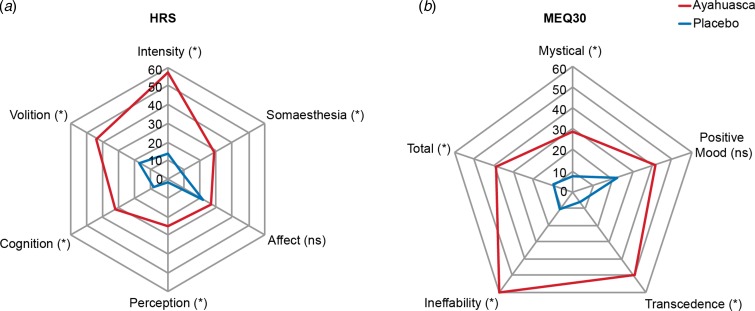
“…PWG. Interestingly, a small ayahuasca clinical trial reported subjective mystical experience, measured via the MEQ-30 (Mystical Experience Questionnaire) ( n = 15) and the HRS (Hallucinogen Rating Scale) ( n = 27), to have little association with therapeutic outcomes (Palhano-Fontes et al. 2019).”
Self-citationDoss, M. K., Kloft, L., Mason, N. L., Mallaroni, P., Reckweg, J. T., van Oorsouw, K. I. M., Tupper, N., Otgaar, H., & Ramaekers, J. G. (2024) · Journal of Psychopharmacology · doi:10.1177/02698811241301216 · Cited by 11
“…and lysergic acid diethylamide (LSD), activation of 5-HT 2A receptors largely contributes to ayahuasca’s psychoactive effects (Valle et al., 2016), and DMT (D’Souza et al., 2022) and ayahuasca (Palhano-Fontes et al., 2019; Sanches et al., 2016) are showing promise for the treatment of depression.”
Giovannetti, C., Loizaga-Velder, A. K., Gomez, R. C., Jaime, G. R. O., Valenzuela, T. C., Sanchez, G., Marcus, O., Agin-Liebes, G., & Rush, B. R. (2025) · Journal of Psychedelic Studies · doi:10.1556/2054.2024.00401 · Cited by 8
Long-Term Mental Health and Wellbeing Outcomes Associated with Naturalistic Ayahuasca Consumption
Pagni, B. A., Halman, A., Sarris, J. J., Chenhall, R. D., Bogenschutz, M. P., & Perkins, D. (2025) · Journal of Psychoactive Drugs · doi:10.1080/02791072.2025.2465800 · Cited by 10
“In a double-blind clinical trial, Palhano-Fontes et al. (2019) randomized patients with major depressive disorder (MDD) to ayahuasca or an active placebo with pur-gative effects.”
Joga, R., Yerram, S., Patnam, J. D., Choudhary, K. K., Varpe, P. C., Raghuvanshi, R. S., & Srivastava, S. (2025) · Health Policy · doi:10.1016/j.healthpol.2025.105392 · Cited by 7
Yngwe, H., Plavén‐Sigray, P., Ekman, C. J., Henje, E., Berglund, A., Tiger, M., Beckman, M., & Lundberg, J. O. (2026) · JAMA Network Open · doi:10.1001/jamanetworkopen.2026.12589 · Cited by 12
Wizła, M., Kraus, S. W., & Lewczuk, K. (2022) · Comprehensive Psychiatry · doi:10.1016/j.comppsych.2022.152303 · Cited by 9
Ayahuasca ceremony leaders’ perspectives on special considerations for eating disorders
Williams, M., Miller, A. K., & Lafrance, A. (2023) · Eating Disorders · doi:10.1080/10640266.2023.2271201 · Cited by 8
“Ayahuasca has been found to have utility in the treatment of mental health concerns such as depression (e.g., de Lima Osório et al., 2015; Palhano-Fontes et al., 2019), anxiety (dos Santos et al., 2007; Jacob & Presti, 2005), suicidality (Zeifman et al., 2019), and substance use disorders (e.g.,…”
BackgroundNovel extended-release transdermal formulations of the psychedelic N,N-dimethyltryptamine (DMT)
Witowski, C. G., Hess, M. R., Jones, N., Pellitteri-Hahn, M. C., Razidlo, J. A., Bhavsar, R., Beer, C., Gonzalez-Velazquez, N. M., Scarlett, C. O., Wenthur, C. J., et al. (2024) · European Journal of Pharmaceutical Sciences · doi:10.1016/j.ejps.2024.106803 · Cited by 10
Psychedelic intimacy: Altered states of consciousness in romantic relationships
Neubert, J. J., Anderson, K., & Mason, N. L. (2024) · Journal of Psychedelic Studies · doi:10.1556/2054.2024.00319 · Cited by 12
Ayahuasca and Psychotherapy: Beyond Integration
Diament, M., Gomes, B. R., & Tófoli, L. F. (2021) · Springer eBooks · doi:10.1007/978-3-030-55688-4_4 · Cited by 7
Self-citationTherapeutic Use of Hallucinogens
Wiltenburg, V. D., Prado, D. D. R., & Mendes, F. R. (2021) · Springer eBooks · doi:10.1007/978-3-030-62855-0_35 · Cited by 8
de Sousa, M. B. C., Grilo, M. L. P. D. M., & Coelho, N. L. G. (2021) · Frontiers in Behavioral Neuroscience · doi:10.3389/fnbeh.2021.674256 · Cited by 10
Daldegan‐Bueno, D., Favaro, V. M., Tófoli, L. F., Sussulini, A., Cassas, F., & Oliveira, M. G. M. (2021) · Journal of Psychoactive Drugs · doi:10.1080/02791072.2021.1971342 · Cited by 8
Self-citationThal, S. B., Wieberneit, M., Sharbanee, J. M., Skeffington, P., Bruno, R., Wenge, T., & Bright, S. J. (2023) · Journal of Humanistic Psychology · doi:10.1177/00221678231168516 · Cited by 10
do Nascimento, D. C., da Silva, J. R. S., Ara, A., Sato, J. R., & da Costa, L. C. C. (2023) · Frontiers in Computational Neuroscience · doi:10.3389/fncom.2023.1132160 · Cited by 9
Psychedelics and Hallucinogens in Psychiatry: Finding New Pharmacological Targets
de Sousa, T. R., Rema, J., Machado, S. E. D. C., & Novais, F. (2021) · Current Topics in Medicinal Chemistry · doi:10.2174/1568026621666211201145800 · Cited by 8
Erhan, E., Külahlı, İ., Kandemir, O., Cemiloglu, R., Yigitbasi, O. G., & Cüreoğlu, S. (1996) · PubMed · Cited by 8
Extraction of Depression Symptoms From Social Networks
Chilwal, B., & Mishra, A. K. (2021) · Wiley eBooks · doi:10.1002/9781119761655.ch17 · Cited by 7
Albert, A. E., & Back, A. L. (2025) · Frontiers in Psychiatry · doi:10.3389/fpsyt.2025.1529427 · Cited by 6
Sabucedo, P., Andión, O., Neimeyer, R. A., Soto-Angona, O., Javkin, J., Haro, J. M., Farré, M., & González, D. (2025) · Frontiers in Psychiatry · doi:10.3389/fpsyt.2024.1484736 · Cited by 6
Khubsing, R. S. I., van Leerdam, M., Haijen, E. C. H. M., & Kuypers, K. P. C. (2024) · Psychoactives · doi:10.3390/psychoactives3020011 · Cited by 10
Roméo, B., Kervadec, E., Fauvel, B., Strika-Bruneau, L., Amirouche, A., Verroust, V., Piolino, P., & Benyamina, A. (2025) · Progress in Neuro-Psychopharmacology and Biological Psychiatry · doi:10.1016/j.pnpbp.2025.111300 · Cited by 10
Calnan, M., Blest‐Hopley, G., Busch, C., Adams, M., Ruffell, S., Piper, T., Roseman, L., Kettner, H., & Carhart-Harris, R. L. (2025) · Brain and Behavior · doi:10.1002/brb3.70660 · Cited by 10
5-HT2A receptors shape whole-brain monoaminergic coherence in male mice
Butler, J. J., Virgili, M., Giovanni, G. D., Chagraoui, A., Beyeler, A., & Deurwaerdère, P. D. (2025) · Progress in Neuro-Psychopharmacology and Biological Psychiatry · doi:10.1016/j.pnpbp.2025.111437 · Cited by 7
Serotonin 5-HT2C Receptor Signaling Analysis Reveals Psychedelic Biased Agonism
Bonniwell, E. M., Alabdali, R., Hennessey, J. J., McKee, J. L., Cavalco, N. G., Lammers, J. C., Moore, E. J., Franchini, L., Orlandi, C., & McCorvy, J. D. (2025) · ACS Chemical Neuroscience · doi:10.1021/acschemneuro.5c00647 · Cited by 9
Stocker, K., Hartmann, M., Schmid, Y., Vogt, S. B., Becker, A., Ley, L., Straumann, I., Arikci, D., Klaiber, A., Erne, L., et al. (2025) · Journal of Psychopharmacology · doi:10.1177/02698811251397328 · Cited by 11
“The HRS, while less frequently used in clinical trials, has also shown predictive utility: its Perception subscale correlated with antidepressant response (Palhano-Fontes et al., 2019), and its Intensity subscale predicted improvements in alcohol use disorder (Bogenschutz et al., 2015).”
Taylor, J. J., Szigeti, B., Silverberg, N. D., Ahmadzad-Asl, M., Kare, M. R., Webler, R. D., Orsini, D. K., Rosenblat, J. D., Bschor, T., Baethge, C., et al. (2026) · The Lancet Psychiatry · doi:10.1016/s2215-0366(26)00018-0 · Cited by 7
Paradigm Lost: Towards an Evidence-based Ontology in Psychedelic Medicine?
Marcus, O., & Dakwar, E. (2023) · International Journal of Mental Health and Addiction · doi:10.1007/s11469-023-01157-0 · Cited by 8
The Hallucinogen Rating Scale: Updated Factor Structure in a Large, Multistudy Sample
Calder, A. E., Qualls, C., Hasler, G., Elmiger, D., & Strassman, R. J. (2024) · Biological Psychiatry Global Open Science · doi:10.1016/j.bpsgos.2024.100436 · Cited by 10
Classic Psychedelics for the Treatment of Depression: Potential Benefits and Challenges
Ghaznavi, S., & Richter, S. G. (2025) · Drugs · doi:10.1007/s40265-025-02172-2 · Cited by 10
“The studies reviewed here, with rare exceptions [43], involve a psychotherapeutic component that is often referred to as psychological support , with a focus on facilitating safe and therapeutic experiences for patients, given that the altered experience arising from classic psychedelics can be…”
OAV and 5D-ASC for Brazilian Portuguese: A validation and adaptation study
Rodrigues, R., Wießner, I., Daldegan‐Bueno, D., Bienemann, B., Pontual, A. A. D. D., Tófoli, L. F., & Mograbi, D. C. (2025) · Journal of Psychopharmacology · doi:10.1177/02698811251344685 · Cited by 6
“Several ground-breaking studies have explored the neurocognitive mechanisms or therapeutic potential related to ayahuasca (Palhano-Fontes et al., 2015, 2019), LSD (Wießner et al., 2021, 2022, 2023), DMT (Falchi-Carvalho et al., 2024a, 2024b), ibogaine (Gomes and Tofoli, 2022; Schenberg et al.,…”
Self-citationForstmann, M., & Sagioglou, C. (2021) · European Psychologist · doi:10.1027/1016-9040/a000447 · Cited by 9
López‐Arnau, R., Camarasa, J., Carbó, M., Nadal‐Gratacós, N., Puigseslloses, P., Espinosa‐Velasco, M., Urquizu, E., Escubedo, E., & Pubill, D. (2022) · Frontiers in Psychiatry · doi:10.3389/fpsyt.2022.990405 · Cited by 7
Preliminary evidence of links between ayahuasca use and the corpus callosum
Simonsson, O., Bouso, J. C., Kurth, F., de Araújo, D. B., Gaser, C., Riba, J., & Eileen Luders, A. (2022) · Frontiers in Psychiatry · doi:10.3389/fpsyt.2022.1002455 · Cited by 6
Self-citationN, N -dimethyltryptamine forms oxygenated metabolites via CYP2D6 - an in vitro investigation
Eckernäs, E., Macan-Schönleben, A., Bergström, M. A., Birgersson, S., Hoffmann, K., & Ashton, M. (2023) · Xenobiotica · doi:10.1080/00498254.2023.2278488 · Cited by 9
“In recent years, DMT/ayahuasca has gained increased attention, as it has been shown to reduce symptoms in patients suffering from severe depression (Sanches et al. 2016; Palhano-Fontes et al. 2019; D’Souza et al. 2022).”
BackgroundTreatment resistant depression
Vaccarino, S. R., & Kennedy, S. H. (2020) · Elsevier eBooks · doi:10.1016/b978-0-12-821033-8.00003-4 · Cited by 8
Psychedelic Medicines in Major Depression: Progress and Future Challenges
Bouso, J. C., Oña, G., SANTOS, R. G. D., & Hallak, J. E. C. (2021) · Advances in experimental medicine and biology · doi:10.1007/978-981-33-6044-0_26 · Cited by 11
Self-citationArgento, E., Capler, R., THOMAS, G. W., Lucas, P., & Tupper, K. W. (2021) · Springer eBooks · doi:10.1007/978-3-030-55688-4_10 · Cited by 6
Myers, M. G., & Toal, C. B. (1995) · PubMed · Cited by 7
d’Andrea, G., Chiappini, S., Ciavoni, L., Tucci, R., Martino, F., Semeraro, F. M., Battista, D. D., Mosca, A., Miuli, A., Carlo, F. D., et al. (2025) · Translational Psychiatry · doi:10.1038/s41398-025-03654-3 · Cited by 11
“Multiple studies support the potential antidepressant ef fi cacy of ayahuasca, with recent data also generated from placebo-controlled RCT [87] that indicate safety and low risk of side effects.”
Predictors of therapeutic response to psychedelic-assisted therapy: A systematic review
Viljoen, G., Walter, H., Bendau, A., Koslowski, M., & Betzler, F. (2025) · Journal of Psychopharmacology · doi:10.1177/02698811251389581 · Cited by 12
“While several trials reported links between global measures of acute drug effects or MTEs and symptom improvement (Carhart-Harris et al., 2018; Palhano-Fontes et al., 2019; Roseman et al., 2018b), others found no such associations (D’Souza et al., 2022; Sloshower et al., 2023).”
InfluentialEl ritual de la Ayahuasca: patrimonio cultural nacional de Perú
Giove, R. (2022) · Cultura y Droga · doi:10.17151/culdr.2022.27.33.2 · Cited by 9
“A decrease in depression is observed in subjects who ingest Ayahuasca (Palhano-Fontes et al., 2019), and the Takiwasi Center was founded in 1992 to treat drug addiction with Ayahuasca and traditional Amazonian medicine showing promising efficacy (Giove, 2002; Berlowitz et al., 2019).”
BackgroundThe Effects of Ayahuasca on Psychological Disorders: A Systematic Literature Review
Sheth, R., Parikh, E., Olayeye, K., Pfeifer, K., & Khanna, D. (2024) · Cureus · doi:10.7759/cureus.55574 · Cited by 13
“A single dose of ayahuasca has shown significant therapeutic potential in patients who are resistant to treatment [11].”
BackgroundInfluentialThe Therapeutic Effects of Classic Psychedelics in Alcohol Use Disorder
Pagni, B. A., Wong, J. M., & Bogenschutz, M. P. (2024) · Current Addiction Reports · doi:10.1007/s40429-024-00581-z · Cited by 8
“…[17, 45, 46, 47, 48]; three placebo-controlled trials have examined psilocybin in the treatment of major depression (MDD) [16, 49, 50]; and one placebo-controlled trial examined ayahuasca for treatment-resistant depression [51] – all of which had outcomes supporting the efficacy of psychedelics.”
Sherwin, M., Friso, F., Fachner, J. C., & Politi, M. (2025) · Journal of Psychedelic Studies · doi:10.1556/2054.2024.00370 · Cited by 6
Using Psychedelics in Clinical Practice: Comparing Therapeutic Uses and Potential Harms
Tariq, R. (2022) · Current Clinical Pharmacology · doi:10.2174/2772432817666220321142707 · Cited by 5
Bormann, N. L., Weber, A. N., Miskle, B., Woodson-DeFauw, N., Arndt, S. V., & Lynch, A. C. (2023) · Social Psychiatry and Psychiatric Epidemiology · doi:10.1007/s00127-023-02448-6 · Cited by 8
Metadata
- Authors
- Palhano-Fontes, F., Barreto, D., Onias, H., Andrade, K. C., Novaes, M. M., Pessoa, J. A., Mota-Rolim, S. A., Osório, F. L., Sanches, R., dos Santos, R. G., Tófoli, L. F., de Oliveira Silveira, G., Yonamine, M., Riba, J., Santos, F. R., Silva-Junior, A. A., Alchieri, J. C., Galvão-Coelho, N. L., Lobão-Soares, B., Hallak, J. E. C., Arcoverde, E., Maia-de-Oliveira, J. P., & Araújo, D. B.
- Affiliations
- Universidade Federal do Rio Grande do Norte (BR)
- Universidade de São Paulo (BR)
- Universidade Estadual de Campinas (UNICAMP) (BR)
- Corresponding author
- Araújo, Dráulio B.
- ORCID
- Venue
- Psychological Medicine
- Publisher
- Cambridge University Press (CUP)
- Published
- 2018-06-15
- Volume
- 49
- Issue
- 4
- Pages
- 655-663
- ISSN
- 0033-2917 (ISSN-L)
- 1469-8978
- PMC
- PMC6378413
- OpenAlex
- W2952169207
- Semantic Scholar
- 8e6a44612a52817ea7aa6d429c7bebd0e4d85192
- Cited by
- 852
- References
- 55
- Citations by year
- 2026: 93 · 2025: 98 · 2024: 142 · 2023: 124 · 2022: 131 · 2021: 116 · 2020: 77 · 2019: 45 · 2018: 22
- FWCI
- 76.38
- Type
- journal article
- Language
- en
- Open access
- hybrid
- doi.org
- Locations
- Psychological Medicine (publishedVersion, cc-by)
- bioRxiv (Cold Spring Harbor Laboratory) (acceptedVersion)
- Europe PMC (PubMed Central) (publishedVersion, cc-by)
- PubMed Central (publishedVersion, cc-by)
- PubMed (publishedVersion)
- Americanae (AECID Library) (publishedVersion, other-oa)
- LA Referencia (Red Federada de Repositorios Institucionales de Publicaciones Científicas) (publishedVersion, other-oa)
- Funders
- Coordenação de Aperfeiçoamento de Pessoal de Nível Superior (#1677/2012, 1577/2013)
- Conselho Nacional de Desenvolvimento Científico e Tecnológico (466760/2014, #479466/2013)
- Universidade Federal do Rio Grande do Norte
- Topics
- Social Sciences › Psychology › Clinical Psychology › Psychedelics and Drug Studies
- Health Sciences › Medicine › Pharmacology (medical) › Treatment of Major Depression
- Life Sciences › Neuroscience › Biological Psychiatry › Tryptophan and brain disorders
- Keywords
- ayahuasca, treatment-resistant depression, antidepressant effects, psychedelics, single-dose administration, depression remission
- MeSH terms
- Adult, Antidepressive Agents, Double-Blind Method, Female, Hallucinogens, Humans, Male, Phytotherapy, Psychiatric Status Rating Scales, Time Factors, Treatment Outcome, Banisteriopsis, Depressive Disorder, Treatment-Resistant
About these checks
Registry, retraction, Cites and statistics results are computed, not judged, with one exception: a printed reference that no index lists is read once by a model before it counts as a citation error. Claims are extracted by a model and kept only when their quote appears verbatim in the text; each cited source is then checked, with a model’s help, for whether it says what the claim relies on. Those verdicts can be wrong — read the claim’s quote and the cited source before relying on one.
Statistics and arithmetic are recomputed, not judged.
Confidence bands are shown only for fields calibrated on our annotated test set. None is calibrated yet, so no band is shown.
What counts as a claim ›How we measure confidence ›How we check this ›
Are you an author, or do you see a problem with this page? Request a review
Data sources
Bibliographic data: Semantic Scholar, OpenAlex, Crossref.
Contains information from the Semantic Scholar Academic Graph Datasets, made available under the ODC Attribution License (ODC-BY 1.0).
Semantic Scholar’s data is described in: Kinney, R., et al. (2023). The Semantic Scholar Open Data Platform. arXiv:2301.10140.
