

Rapid antidepressant effects of the psychedelic ayahuasca in treatment-resistant depression: a randomized placebo-controlled trial
Open accessPublished version of a preprint
The DOI matches its Crossref record; 55 of the 55 references it cites were found in a registry or an index.
Abstract
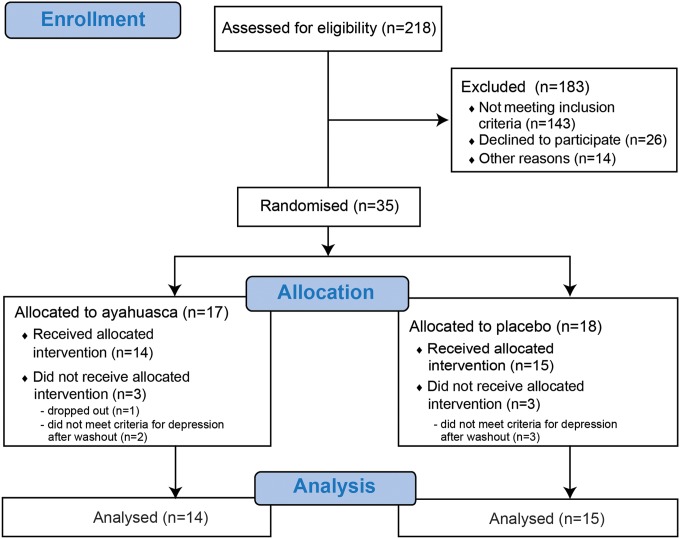
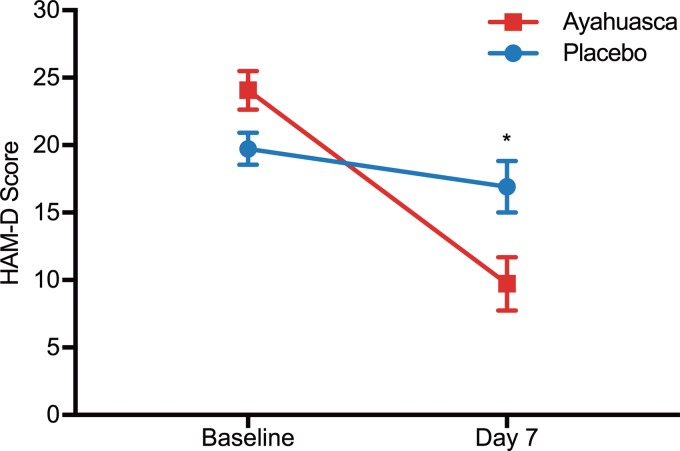
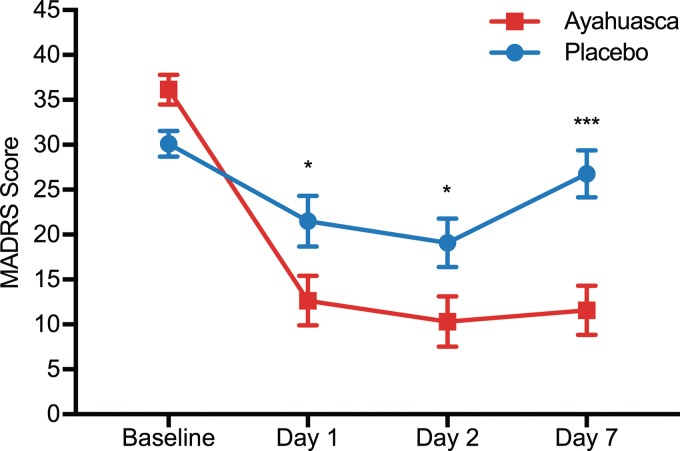
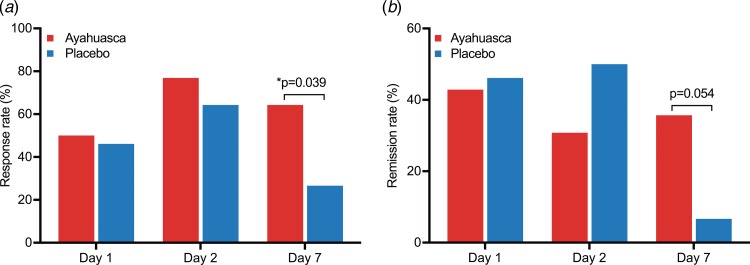
Background: Recent open-label trials show that psychedelics, such as ayahuasca, hold promise as fast-onset antidepressants in treatment-resistant depression. Methods: To test the antidepressant effects of ayahuasca, we conducted a parallel-arm, double-blind randomized placebo-controlled trial in 29 patients with treatment-resistant depression. Patients received a single dose of either ayahuasca or placebo. We assessed changes in depression severity with the Montgomery-Åsberg Depression Rating Scale (MADRS) and the Hamilton Depression Rating scale at baseline, and at 1 (D1), 2 (D2), and 7 (D7) days after dosing. Results: We observed significant antidepressant effects of ayahuasca when compared with placebo at all-time points. MADRS scores were significantly lower in the ayahuasca group compared with placebo at D1 and D2 ( p = 0.04), and at D7 ( p < 0.0001). Between-group effect sizes increased from D1 to D7 (D1: Cohen's d = 0.84; D2: Cohen's d = 0.84; D7: Cohen's d = 1.49). Response rates were high for both groups at D1 and D2, and significantly higher in the ayahuasca group at D7 (64% v. 27%; p = 0.04). Remission rate showed a trend toward significance at D7 (36% v. 7%, p = 0.054). Conclusions: To our knowledge, this is the first controlled trial to test a psychedelic substance in treatment-resistant depression. Overall, this study brings new evidence supporting the safety and therapeutic value of ayahuasca, dosed within an appropriate setting, to help treat depression. This study is registered at http://clinicaltrials.gov (NCT02914769).
Overview
The claims and statistics of this paper haven’t been checked yet.
Free: it reads the open-access text and checks the first 5 claims that cite a source we can check. Create a free account to check every claim.
Integrity signals
Registry
Cites
Statistics
Figures
Verification
Claims the paper makes
The claims and statistics of this paper haven’t been checked yet.
Free: it reads the open-access text and checks the first 5 claims that cite a source we can check. Create a free account to check every claim.
Claims other papers make about this one
Each is checked against this paper’s own text: does it say what the citing paper says it does?
The cited source doesn’t support the claim as written.
In the citing paper
“overall psychiatric scales in the ayahuasca group were significatively higher than those in the placebo group in all time points after dosing.”
From Virtual reality and psychedelics for the treatment of psychiatric disease: A systematic literature review (2020) · doi:10.36131/cnfioritieditore20200606 · cites this paper as Palhano-Fontes et al. (2019)
Checked by a reasoning model — may be wrong.
Experimental — accuracy not yet measuredThe source backs part of the claim, not all of it — or backs it for a different population, condition or comparison.
In the citing paper
“Ayahuasca stimulates emotional dream-like experiences involving potent cognitive-affective changes and spiritual insights (Dobkin de Rios, 1971) that have been associated with substantial and enduring antidepressant effects (Palhano-Fontes et al., 2019; Weiss et al., 2021).”
From Prospective examination of the therapeutic role of psychological flexibility and cognitive reappraisal in the ceremonial use of ayahuasca (2022) · cites this paper as Palhano-Fontes et al., 2019
Experimental — accuracy not yet measuredThe source backs part of the claim, not all of it — or backs it for a different population, condition or comparison.
In the citing paper
“Ayahuasca, or its chemical equivalent known as pharmahuasca, has emerged as a tool for psychotherapy in the contexts of affective and substance use disorders [130,131], thus calling for a better understanding of its possible mechanisms of action.”
From Molecular and Functional Imaging Studies of Psychedelic Drug Action in Animals and Humans. (2021) · cites this paper as [130]
Experimental — accuracy not yet measuredThe source backs part of the claim, not all of it — or backs it for a different population, condition or comparison.
In the citing paper
“Moreover, comorbid conditions such as suicidality and substance use disorders further complicate research efforts (13, 18, 20, 21).”
From Psychoanalytically informed MDMA-assisted therapy for pathological narcissism: a novel theoretical approach (2025) · cites this paper as [20]
Experimental — accuracy not yet measuredThe source backs part of the claim, not all of it — or backs it for a different population, condition or comparison.
In the citing paper
“Ayahuasca has been demonstrated to be safe in naturalistic (35, 108) and clinical settings, across varying dosages and multiple administrations (26, 109–112).”
From Ayahuasca-assisted meaning reconstruction therapy for grief: a non-randomized clinical trial protocol (2025) · cites this paper as [26]
Experimental — accuracy not yet measured
16 more claims about this paper
Create a free account to see every claim other papers make about this one.
Self-check
Percentages, sums and reported differences re-computed from the paper’s own numbers.
The self-check needs the paper’s full text.
Citations
Cites
Hamilton, M. (1960) · Journal of Neurology, Neurosurgery & Psychiatry · doi:10.1136/jnnp.23.1.56 · Cited by 32,817 · cited 1×
“HAM-D was applied only at baseline and D7, as it was designed to access depression symptoms present in the last week (Hamilton, 1960).”
MethodAntidepressant effects of ketamine in depressed patients
Berman, R. M., Cappiello, A., Anand, A., Oren, D. A., Heninger, G. R., Charney, D. S., & Krystal, J. H. (2000) · Biological Psychiatry · doi:10.1016/s0006-3223(99)00230-9 · Cited by 3,856 · cited 7×
“While we find a response rate to placebo of 46% at D1, and 26% at D7, ketamine trials have found a placebo effect of the order of 0 – 6% at D1, and 0 – 11% at D7 (Berman et al. , 2000; Zarate et al. , 2006; Murrough et al. , 2013; Lapidus et al. , 2014).”
BackgroundInfluentialA randomized trial of an N-methyl-D-aspartate antagonist in treatment-resistant major depression.
Zarate, C. A., Singh, J. B., Carlson, P. J., Brutsche, N. E., Ameli, R., Luckenbaugh, D. A., Charney, D. S., & Manji, H. K. (2006) · Archives of General Psychiatry · doi:10.1001/archpsyc.63.8.856 · Cited by 3,766 · cited 4×
“At D7, the ketamine response rate ranges between 7 and 35% (Berman et al., 2000; Zarate et al., 2006; Murrough et al., 2013; Lapidus et al., 2014), while in our study 64% responded to ayahuasca.”
BackgroundInfluentialOtte, C., Gold, S. M., Penninx, B. W., Pariante, C. M., Etkin, A., Fava, M., Mohr, D. C., & Schatzberg, A. F. (2016) · Nature Reviews Disease Primers · doi:10.1038/nrdp.2016.65 · Cited by 2,269 · cited 2×
“We recently found that a single ayahuasca session in patients with depression increases blood flow in brain regions consistently implicated in the regulation of mood and emotions, such as the left nucleus accumbens, right insula and left subgenual area (Otte et al. , 2016; Sanches et al. , 2016).”
BackgroundGriffiths, R. R., Johnson, M. W., Carducci, M. A., Umbricht, A., Richards, W. A., Richards, B. D., Cosimano, M. P., & Klinedinst, M. A. (2016) · Journal of Psychopharmacology · doi:10.1177/0269881116675513 · Cited by 2,201
Nichols, D. E. (2016) · Pharmacological Reviews · doi:10.1124/pr.115.011478 · Cited by 1,762
Ross, S., Bossis, A., Guss, J., Agin-Liebes, G., Malone, T., Cohen, B., Mennenga, S. E., Belser, A., Kalliontzi, K., Babb, J., et al. (2016) · Journal of Psychopharmacology · doi:10.1177/0269881116675512 · Cited by 1,698 · cited 4×
“Prior studies suggest that elements of the psychedelic experience, such as experiences of mystical-type, account for the therapeutic benefit (Bogenschutz et al., 2015; Garcia-Romeu et al., 2015; Majić et al., 2015; Griffiths et al., 2016; Ross et al., 2016).”
BackgroundInfluentialCarhart-Harris, R. L., Bolstridge, M., Rucker, J., Day, C. M. J., Erritzoe, D., Kaelen, M., Bloomfield, M., Rickard, J. A., Forbes, B., Feilding, A., et al. (2016) · The Lancet Psychiatry · doi:10.1016/s2215-0366(16)30065-7 · Cited by 1,540 · cited 4×
“substances affect the brain, and also probing their potential in treating different psychiatric conditions, including mood disorders (Grob et al., 2011; Osório et al., 2015; Carhart-Harris et al., 2016; Griffiths et al., 2016; Ross et al., 2016; Sanches et al., 2016).”
BackgroundResultInfluentialThe default mode network and self-referential processes in depression
Sheline, Y. I., Barch, D. M., Price, J. L., Rundle, M. M., Vaishnavi, S. N., Snyder, A. Z., Mintun, M. A., Wang, S., Coalson, R. S., & Raichle, M. E. (2009) · Proceedings of the National Academy of Sciences · doi:10.1073/pnas.0812686106 · Cited by 1,480 · cited 2×
“Moreover, we have shown that ayahuasca reduces the activity of the Default Mode Network (Palhano-Fontes et al. , 2015), a brain network found to be hyperactive in depression (Sheline et al. , 2009).”
BackgroundPilot Study of Psilocybin Treatment for Anxiety in Patients With Advanced-Stage Cancer
Grob, C. S., Danforth, A. L., Chopra, G. S., Hagerty, M., McKay, C. R., Halberstadt, A. L., & Greer, G. R. (2011) · Archives of General Psychiatry · doi:10.1001/archgenpsychiatry.2010.116 · Cited by 1,206 · cited 2×
“…exploring how these substances affect the brain, and also probing their potential in treating different psychiatric conditions, including mood disorders (Grob et al. , 2011; Osório et al. , 2015; Carhart-Harris et al. , 2016; Griffiths et al. , 2016; Ross et al. , 2016; Sanches et al. , 2016).”
Background
Research works printed but not linked: 3
- World Health Organization (2017) Depression and Other Common Mental Disorders: Global Health Estimates. Rep. CC BY-NC-SA 3.0 IGO. Geneva: World Health Organization.
- Tafur J (2017) The Fellowship of the River: A Medical Doctor's Exploration into Traditional Amazonian Plant Medicine. Espiritu, Phoenix.
- Luna LE (2011) Indigenous and Mestizo use of Ayahuasca. An Overview. The Ethnopharmacology of Ayahuasca. Tivandrum: Transworld Research Network.
Cited by
Items 801–850 of 850
Psychedelics and Their Clinical Use
Jeyakumar, S., & Messias, E. (2026) · Springer eBooks · doi:10.1007/978-3-032-15772-0_15
Talin, P. (2024) · theses.fr (ABES) · doi:10.70675/a7d8d4c4z3a2az4f27z8cb0za0401171e275 · Cited by 3
Raihan, A. (2026) · Journal of Behavioral and Cognitive Therapy · doi:10.1016/j.jbct.2026.100571
Bouso, J. C., Andión, Ó., Cantillo, J., Pérez, I. H., Farré, M., Obiols, J. E., & González, D. (2026) · Psychedelics · doi:10.1016/j.psyche.2026.100018
Hinchcliffe, J. K., Bartlett, J., Thomas, C. W., Golden, C. T., Gilmour, G., Bortolotto, Z., & Robinson, E. S. J. (2026) · bioRxiv (Cold Spring Harbor Laboratory) · doi:10.64898/2026.04.20.719483
Mano‐Sousa, B. J., Fontes, M. C. G., Gonçalves, A. A., Galduróz, J. C. F., & Duarte‐Almeida, J. M. (2026) · Journal of Psychoactive Drugs · doi:10.1080/02791072.2026.2661580
Psychedelics: Future Therapeutics in Major Depression?
Olivier, B., & Olivier, J. D. A. (2026) · Advances in experimental medicine and biology · doi:10.1007/978-981-95-6872-7_25
Psychedelic Use and Psychological Healing Among Gender Exploring Clients: Clinicians’ Perspectives
Cassidy, E. K., Riccardi, J., Healy, B., Golakoti, S. S. M., & Farvid, P. (2026) · Women & Therapy · doi:10.1080/02703149.2026.2667141 · Cited by 1
“…et al., 2020; Zaretsky et al., 2024), substance use disorders (Bogenschutz et al., 2015, 2016; Piper et al., 2025), depression (Ko et al., 2023; Palhano-Fontes et al., 2019), anxiety (Feulner et al., 2023; Griffiths et al., 2016), eating disorders (Cuerva et al., 2024; Lafrance et al., 2017),…”
Ayahuasca use and improvements in suicidal behavior: An exploratory qualitative study
Santos, N. V. M., Silveira, C. F., Costa, C. G. D. S. S., Basso, H. P., Barbosa, P. C. R., & Morais, P. R. (2026) · Psychedelics · doi:10.1016/j.psyche.2026.100023
Eliasen, J. N., Rezagholizadeh, A., Jacobsen, H. P., & Kohlmeier, K. A. (2026) · Journal of Neurochemistry · doi:10.1111/jnc.70463
A trip through the psychiatric use of psychedelics in Brazil: A scoping review
Kami, V. R., Salle, B. B. B., Porto, G., Cavalari, V. C., & Roza, T. H. (2026) · Psychedelics · doi:10.1016/j.psyche.2026.100024
Varela, Y. M., Ribeiro, P. C., de Sousa, G. M., Falchi-Carvalho, M., Barbalho, J. D. S. F., Gomes, R. B. D. O., Gurgel, M. M. M., Pereira, B. C., Souza, P. M. D. L., Gonçalves, K. T. D. C., et al. (2026) · medRxiv · doi:10.64898/2026.05.31.26354555
Self-citationPersonalised Perception: The Effect of Personality on the Sensory Effects of Psychedelics
Boardman, A. D., Whelan, J., & Ward, R. D. (2026) · Drug and Alcohol Review · doi:10.1111/dar.70172
Guimarães, A. L., Beserra, F. R., da Cruz, L. V. M., Bienemann, B., FREIND, J. M. K., Guinle, V., Rodrigues, R., Regalado, J. A., & Mograbi, D. C. (2026) · Clinical Therapeutics · doi:10.1016/j.clinthera.2026.05.012 · Cited by 1
Ten practical suggestions for setting up a psychedelic study
Caulfield, A., Butler, M., & Mehta, M. A. (2026) · Journal of Psychopharmacology · doi:10.1177/02698811261458350
“…(Bogenschutz et al., 2015; Butler et al., 2025; Carhart-Harris et al., 2018a; Davis et al., 2021; Gasser et al., 2014; Griffiths et al., 2016; Grob et al., 2011; Johnson et al., 2017; Moreno et al., 2006; Palhano-Fontes et al., 2019; Ross et al., 2016; Rucker et al., 2024a; Sanches et al., 2016).”
The purpose of the psychosocial protocol in the psychedelic-assisted therapy: A scoping review
Ferreira, F. G. D. P., Fernandes, J. A. B., Filev, R., da Silveira, D. X., & Fidalgo, T. M. (2026) · Journal of Psychopharmacology · doi:10.1177/02698811261453850
Estela-Fernandez, C. A., Elsheikh, R. M. Y., Beatrice, D. F., Alhendal, A. A., Ewe, C. I., Montesinos, S. Y., Wensel, J., Mishra, A. P., Yousif, A. A., & Ali, H. T. (2026) · Neuropsychiatrie · doi:10.1007/s40211-026-00584-4
Lodetti, G., de Bitencourt, R. M., Inserra, A., Redivo, H., Teixeira, A. G., de Farias, A. C. S., Pickler, K. D. P., Rohling, J. P. V., Endler, A. T., Zampronio, E. P., et al. (2026) · Progress in Neuro-Psychopharmacology and Biological Psychiatry · doi:10.1016/j.pnpbp.2026.111817
Self-citationProliferative Effects of the Psychedelic N,N -Dimethyltryptamine (DMT) in Human Neural Stem Cells
Salerno, J. A., Dominguez, E. R., Karmirian, K., Arrais, B. A. B. M. S., Alves, J., Erjautz, G., Kroening, K., Souza, L. R. Q., Ornelas, I. M., & Rehen, S. K. (2026) · ACS Chemical Neuroscience · doi:10.1021/acschemneuro.6c00209
Averill, L. A., & Neitzke‐Spruill, L. (2026) · FOCUS The Journal of Lifelong Learning in Psychiatry · doi:10.1176/appi.focus.20260006
Integration in classic psychedelic-assisted therapies for mental health conditions: A scoping review
Vucak, N., Bruno, R., Quealy, J. J., Casimaty, J. G., Rossell, S. L., Castle, D. J., & Acevedo, N. (2026) · Psychedelics · doi:10.1016/j.psyche.2026.100030
Depression und andere affektive Erkrankungen
Mertens, L. J., & Spangemacher, M. (2026) · Elsevier eBooks · doi:10.1016/b978-3-437-21293-2.00011-3
Potential Role of Psychedelics in the Treatment of Depressive Disorder
Wang, S., & Bahk, W.-M. (2026) · Springer eBooks · doi:10.1007/978-981-92-1331-3_12
dos Santos, C. D. L., Tófoli, L. F., Montanari, Í., & Breitkreitz, M. C. (2026) · Research Square · doi:10.21203/rs.3.rs-10329454/v1
Self-citationShahar, O., Botvinnik, A., Chaykin, M., Shwartz, A., Lerer, E., Golding, P., Ari, M. B., Shalev, O., Lifschytz, T., & Lerer, B. (2026) · bioRxiv (Cold Spring Harbor Laboratory) · doi:10.64898/2026.08.06.743248
“Investigation of DMT and Ayahuasca’s therapeutic potential is underway 20-24 , necessitating further research to elucidate the brain mechanisms activated by DMT specifically and classical psychedelics more generally.”
Ross, B. M. (2026) · Journal of Psychedelic Studies · doi:10.1556/2054.2026.00517
Jurlando, C. (2026) · Psychedelics · doi:10.1016/j.psyche.2026.100037
Ogbu, J. I., Moreira, C. V. L., Olusola, A. J., Lacerda, R. F., Maggi, L. E., Filho, A. S. S., Xavier, C. H., Pedrino, G. R., Costa, É. A., & Fajemiroye, J. O. (2026) · Current Pharmacology Reports · doi:10.1007/s40495-026-00472-z
Szeszko, A. M., Czernek, W. M., Cichorzewska, M., Płachta, M., Wojtan, R. M., & Lubowiecka, M. (2026) · International Journal of Innovative Technologies in Social Science · doi:10.31435/ijitss.3(51).2026.6062
“For example, Palhano-Fontes et al. (2019) showed fast antidepressant effects from ayahuasca use in a randomized placebo-controlled study of treatment-resistant depression.”
Huachuma, the Andean psychedelic cactus, is drawing Western seekers and raising ethical questions
Mahdavi, P. (2026) · The Conversation · doi:10.64628/aai.chv6yd5d9
Passie, T., & van Elk, M. (2026) · Journal of Psychopharmacology · doi:10.1177/02698811261478606
Psychedelics in the Future of Global Mental Healthcare
Aleksandrova, L. R., Thiessen, K. A., Chen, F. X. F., Phillips, A. G., Schütz, C. G., & Krausz, M. (2026) · Springer eBooks · doi:10.1007/978-3-319-70134-9_174-1
Civardi, S. C., Besana, F., Durbano, F., Toscano, M. O. M., Raffone, F., Dell’Osso, B. M., & Olivola, M. (2026) · Frontiers in Psychiatry · doi:10.3389/fpsyt.2026.1858319
“Across studies, ayahuasca is consistently associated with a rapid onset of antidepressant effects, typically emerging within 24 – 48 hours and peaking within the fi rst week (67, 68).”
InfluentialThe Case for More Aggressive Masking in Psychedelic Trials
Yang, K. H., Heifets, B. D., Krystal, A. D., & Woolley, J. D. (2026) · JAMA Psychiatry · doi:10.1001/jamapsychiatry.2026.2858 · Cited by 1
Psychedelics and suicidality: A double-edged sword - risks, mechanisms, and moving forward
Mallevays, M., & Berkovitch, L. (2026) · European Neuropsychopharmacology · doi:10.1016/j.euroneuro.2026.113878
Lodetti, G., Redivo, H., Teixeira, A. G., de Farias, A. C. S., Pacagnan, L. D. O., Rohling, J. P. V., Endler, A. T., Zampronio, E. P., de Souza, D. D. P., Assis, V. F., et al. (2026) · Journal of Neural Transmission · doi:10.1007/s00702-026-03287-w · Cited by 1
Self-citationSouza, E. V., Floresta, L. R. D. S., Andrade, A. R. D. S., de Amorim, P. L., Silva, D. D. M. E., Silva, A. C. A., & Oliveira, J. M. (2026) · Phytomedicine Plus · doi:10.1016/j.phyplu.2026.101046
Maekawa, R. M., Guerra, L. T. L., Villanova, B., de Paula, C. C., Vicentini, A. B., Rodrigues, L. S., Reis, J. A. S., Rossi, G. N., Bouso, J. C., Hallak, J. E. C., et al. (2026) · Journal of Clinical Psychopharmacology · doi:10.1097/jcp.0000000000002264
Self-citationPeixoto, R. L., & Freitas, L. (2026) · Aracê. · doi:10.56238/arev8n9-174
Schimmels, J., & Nobbs, M. (2026) · Issues in Mental Health Nursing · doi:10.1080/01612840.2026.2740656
Florineth, G. A., Boeker, A. L., Müller, F., Bracht, T., Denier, N., Jung, A. C., Wopfner, A., Adorjan, K., & Soravia, L. M. (2026) · Therapeutic Advances in Psychopharmacology · doi:10.1177/20451253261492600
García-Bitar, A., Castañeda, E. J., Buenrostro-Rangel, J. R., Vázquez-Flores, A. K., Santibañez-Patiño, P. D., & Moreno‐Jiménez, S. (2026) · Surgical Neurology International · doi:10.25259/sni_962_2026
“e evidence in non-oncological depression, [8,10,15] and the rapid antidepressant effects of DMT, 5-MeO-DMT, and ayahuasca, [22,35,37] reinforce the antidepressant signal of the class as a whole.”
InfluentialQiu, R., Mann, S. G. A., do Nascimento, T. H., Perley, J. O., Richardson, M. B., Deschênes, D. A. R., Bezerra, M., Alves, A. B. D. C., Alves, A. O., Schietti, J., et al. (2026) · bioRxiv (Cold Spring Harbor Laboratory) · doi:10.64898/2026.10.06.754717
Corona, C. F., Lima, F. A. A., Sumensse, J. S. C. D. S., Carvalho, K. D., Grignet, P. H., Confortim, H. D., Gross, M. C., Firmino, F. A., Evangelista, F. F., do Nascimento, F. P., et al. (2026) · Journal of Neuroendocrinology · doi:10.1111/jne.70290
“71,72 Ayahuasca reversal of BLE-induced anxiogenic-like behavior observed in this study may be related to serotonergic modulation and to harmine pro-neurogenic properties, which stimulate neural progenitor cell proliferation and reduce amygdala hyperactivity, therefore contributing to hippocampal…”
Salud intercultural en Pastaza: regulación del uso de plantas medicinales y de la ayahuasca
Iglesias-Quintana, J. X., Jiménez-Montenegro, J. M., Marfetan-Marfetan, V. D. R., & Piñas-Piñas, L. F. (2026) · Verdad y Derecho. Revista Arbitrada de Ciencias Jurídicas y Sociales. · doi:10.62574/n08gyqka
Uso inadecuado de la ayahuasca y sus impactos en la salud: percepción de consumidores
Illicachi-Erazo, A. M., & Toapanta-Amores, D. A. (2026) · Verdad y Derecho. Revista Arbitrada de Ciencias Jurídicas y Sociales. · doi:10.62574/g9gn9z5t
French psychiatric caregivers’ perceptions of psychedelics: A national survey
Buot, A., Burdairon, J.-D., Mallet, L., Gaillard, R., Rolland, B., & Berkovitch, L. (2026) · L Encéphale · doi:10.1016/j.encep.2026.06.015
de Paula, C. C., Vicentini, A. B., Guerra, L. T. L., Maekawa, R. M., Reis, J. A. S., Villanova, B., Gomes, C. C., Bellucci, T., Rossi, G. N., Bouso, J. C., et al. (2026) · Journal of Clinical Psychopharmacology · doi:10.1097/jcp.0000000000002267
Self-citationBehavioral Shifts in Natural Speech, Language, and Facial Expression Following Ayahuasca Ceremonies
Masucci, M. D., Cohen, A. S., Cox, C. R., Rodriguez, Z. B., Granrud, O. E., Campbell, W. K., & Weiss, B. (2026) · Psychedelic Medicine · doi:10.1177/28314425261484374
Psychedelics and psychosis: A systematic review of recent-era studies (1984–2025)
Reis, J. A. S., Ueta, L. Z., Bouso, J. C., Hallak, J. E. C., & SANTOS, R. G. D. (2026) · Journal of Psychopharmacology · doi:10.1177/02698811261488575
Self-citation
Metadata
- Authors
- Palhano-Fontes, F., Barreto, D., Onias, H., Andrade, K. C., Novaes, M. M., Pessoa, J. A., Mota-Rolim, S. A., Osório, F. L., Sanches, R., dos Santos, R. G., Tófoli, L. F., de Oliveira Silveira, G., Yonamine, M., Riba, J., Santos, F. R., Silva-Junior, A. A., Alchieri, J. C., Galvão-Coelho, N. L., Lobão-Soares, B., Hallak, J. E. C., Arcoverde, E., Maia-de-Oliveira, J. P., & Araújo, D. B.
- Affiliations
- Universidade Federal do Rio Grande do Norte (BR)
- Universidade de São Paulo (BR)
- Universidade Estadual de Campinas (UNICAMP) (BR)
- Corresponding author
- Araújo, Dráulio B.
- ORCID
- Venue
- Psychological Medicine
- Publisher
- Cambridge University Press (CUP)
- Published
- 2018-06-15
- Volume
- 49
- Issue
- 4
- Pages
- 655-663
- ISSN
- 0033-2917 (ISSN-L)
- 1469-8978
- PMC
- PMC6378413
- OpenAlex
- W2952169207
- Semantic Scholar
- 8e6a44612a52817ea7aa6d429c7bebd0e4d85192
- Cited by
- 852
- References
- 55
- Citations by year
- 2026: 93 · 2025: 98 · 2024: 142 · 2023: 124 · 2022: 131 · 2021: 116 · 2020: 77 · 2019: 45 · 2018: 22
- FWCI
- 76.38
- Type
- journal article
- Language
- en
- Open access
- hybrid
- doi.org
- Locations
- Psychological Medicine (publishedVersion, cc-by)
- bioRxiv (Cold Spring Harbor Laboratory) (acceptedVersion)
- Europe PMC (PubMed Central) (publishedVersion, cc-by)
- PubMed Central (publishedVersion, cc-by)
- PubMed (publishedVersion)
- Americanae (AECID Library) (publishedVersion, other-oa)
- LA Referencia (Red Federada de Repositorios Institucionales de Publicaciones Científicas) (publishedVersion, other-oa)
- Funders
- Coordenação de Aperfeiçoamento de Pessoal de Nível Superior (#1677/2012, 1577/2013)
- Conselho Nacional de Desenvolvimento Científico e Tecnológico (466760/2014, #479466/2013)
- Universidade Federal do Rio Grande do Norte
- Topics
- Social Sciences › Psychology › Clinical Psychology › Psychedelics and Drug Studies
- Health Sciences › Medicine › Pharmacology (medical) › Treatment of Major Depression
- Life Sciences › Neuroscience › Biological Psychiatry › Tryptophan and brain disorders
- Keywords
- ayahuasca, treatment-resistant depression, antidepressant effects, psychedelics, single-dose administration, depression remission
- MeSH terms
- Adult, Antidepressive Agents, Double-Blind Method, Female, Hallucinogens, Humans, Male, Phytotherapy, Psychiatric Status Rating Scales, Time Factors, Treatment Outcome, Banisteriopsis, Depressive Disorder, Treatment-Resistant
About these checks
Registry, retraction, Cites and statistics results are computed, not judged, with one exception: a printed reference that no index lists is read once by a model before it counts as a citation error. Claims are extracted by a model and kept only when their quote appears verbatim in the text; each cited source is then checked, with a model’s help, for whether it says what the claim relies on. Those verdicts can be wrong — read the claim’s quote and the cited source before relying on one.
Statistics and arithmetic are recomputed, not judged.
Confidence bands are shown only for fields calibrated on our annotated test set. None is calibrated yet, so no band is shown.
What counts as a claim ›How we measure confidence ›How we check this ›
Are you an author, or do you see a problem with this page? Request a review
Data sources
Bibliographic data: Semantic Scholar, OpenAlex, Crossref.
Contains information from the Semantic Scholar Academic Graph Datasets, made available under the ODC Attribution License (ODC-BY 1.0).
Semantic Scholar’s data is described in: Kinney, R., et al. (2023). The Semantic Scholar Open Data Platform. arXiv:2301.10140.
