

Rapid antidepressant effects of the psychedelic ayahuasca in treatment-resistant depression: a randomized placebo-controlled trial
Open accessPublished version of a preprint
The DOI matches its Crossref record; 55 of the 55 references it cites were found in a registry or an index.
Abstract
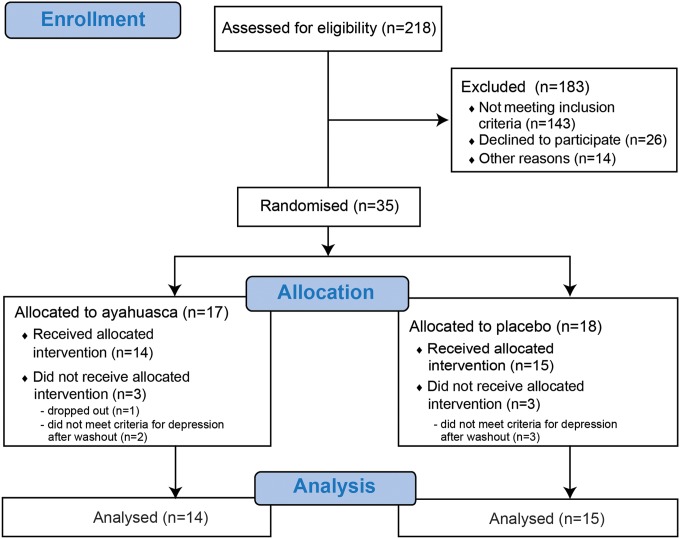
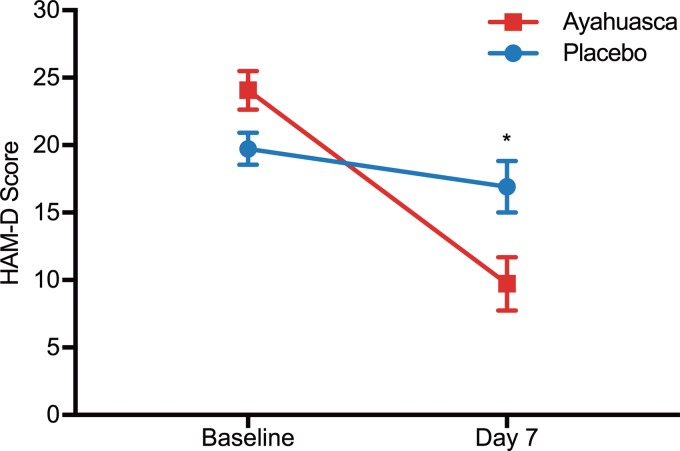
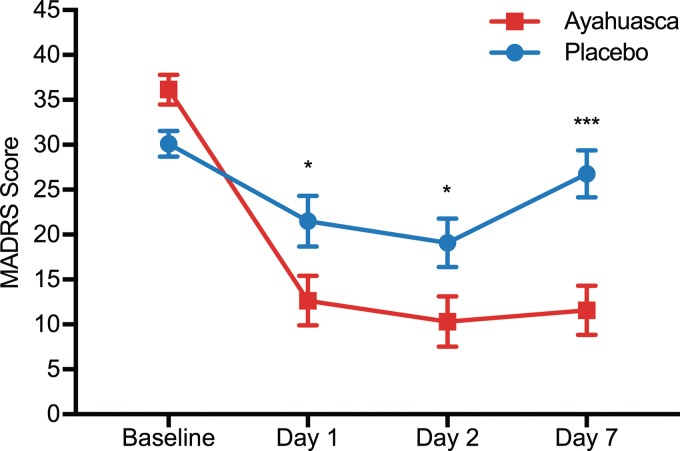
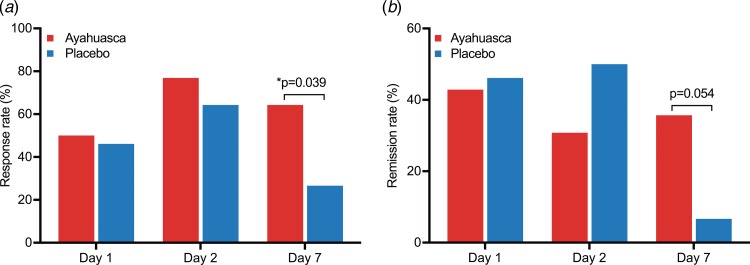
Background: Recent open-label trials show that psychedelics, such as ayahuasca, hold promise as fast-onset antidepressants in treatment-resistant depression. Methods: To test the antidepressant effects of ayahuasca, we conducted a parallel-arm, double-blind randomized placebo-controlled trial in 29 patients with treatment-resistant depression. Patients received a single dose of either ayahuasca or placebo. We assessed changes in depression severity with the Montgomery-Åsberg Depression Rating Scale (MADRS) and the Hamilton Depression Rating scale at baseline, and at 1 (D1), 2 (D2), and 7 (D7) days after dosing. Results: We observed significant antidepressant effects of ayahuasca when compared with placebo at all-time points. MADRS scores were significantly lower in the ayahuasca group compared with placebo at D1 and D2 ( p = 0.04), and at D7 ( p < 0.0001). Between-group effect sizes increased from D1 to D7 (D1: Cohen's d = 0.84; D2: Cohen's d = 0.84; D7: Cohen's d = 1.49). Response rates were high for both groups at D1 and D2, and significantly higher in the ayahuasca group at D7 (64% v. 27%; p = 0.04). Remission rate showed a trend toward significance at D7 (36% v. 7%, p = 0.054). Conclusions: To our knowledge, this is the first controlled trial to test a psychedelic substance in treatment-resistant depression. Overall, this study brings new evidence supporting the safety and therapeutic value of ayahuasca, dosed within an appropriate setting, to help treat depression. This study is registered at http://clinicaltrials.gov (NCT02914769).
Overview
The claims and statistics of this paper haven’t been checked yet.
Free: it reads the open-access text and checks the first 5 claims that cite a source we can check. Create a free account to check every claim.
Integrity signals
Registry
Cites
Statistics
Figures
Verification
Claims the paper makes
The claims and statistics of this paper haven’t been checked yet.
Free: it reads the open-access text and checks the first 5 claims that cite a source we can check. Create a free account to check every claim.
Claims other papers make about this one
Each is checked against this paper’s own text: does it say what the citing paper says it does?
The cited source doesn’t support the claim as written.
In the citing paper
“overall psychiatric scales in the ayahuasca group were significatively higher than those in the placebo group in all time points after dosing.”
From Virtual reality and psychedelics for the treatment of psychiatric disease: A systematic literature review (2020) · doi:10.36131/cnfioritieditore20200606 · cites this paper as Palhano-Fontes et al. (2019)
Checked by a reasoning model — may be wrong.
Experimental — accuracy not yet measuredThe source backs part of the claim, not all of it — or backs it for a different population, condition or comparison.
In the citing paper
“Ayahuasca stimulates emotional dream-like experiences involving potent cognitive-affective changes and spiritual insights (Dobkin de Rios, 1971) that have been associated with substantial and enduring antidepressant effects (Palhano-Fontes et al., 2019; Weiss et al., 2021).”
From Prospective examination of the therapeutic role of psychological flexibility and cognitive reappraisal in the ceremonial use of ayahuasca (2022) · cites this paper as Palhano-Fontes et al., 2019
Experimental — accuracy not yet measuredThe source backs part of the claim, not all of it — or backs it for a different population, condition or comparison.
In the citing paper
“Ayahuasca, or its chemical equivalent known as pharmahuasca, has emerged as a tool for psychotherapy in the contexts of affective and substance use disorders [130,131], thus calling for a better understanding of its possible mechanisms of action.”
From Molecular and Functional Imaging Studies of Psychedelic Drug Action in Animals and Humans. (2021) · cites this paper as [130]
Experimental — accuracy not yet measuredThe source backs part of the claim, not all of it — or backs it for a different population, condition or comparison.
In the citing paper
“Moreover, comorbid conditions such as suicidality and substance use disorders further complicate research efforts (13, 18, 20, 21).”
From Psychoanalytically informed MDMA-assisted therapy for pathological narcissism: a novel theoretical approach (2025) · cites this paper as [20]
Experimental — accuracy not yet measuredThe source backs part of the claim, not all of it — or backs it for a different population, condition or comparison.
In the citing paper
“Ayahuasca has been demonstrated to be safe in naturalistic (35, 108) and clinical settings, across varying dosages and multiple administrations (26, 109–112).”
From Ayahuasca-assisted meaning reconstruction therapy for grief: a non-randomized clinical trial protocol (2025) · cites this paper as [26]
Experimental — accuracy not yet measured
16 more claims about this paper
Create a free account to see every claim other papers make about this one.
Self-check
Percentages, sums and reported differences re-computed from the paper’s own numbers.
The self-check needs the paper’s full text.
Citations
Cites
Hamilton, M. (1960) · Journal of Neurology, Neurosurgery & Psychiatry · doi:10.1136/jnnp.23.1.56 · Cited by 32,817 · cited 1×
“HAM-D was applied only at baseline and D7, as it was designed to access depression symptoms present in the last week (Hamilton, 1960).”
MethodAntidepressant effects of ketamine in depressed patients
Berman, R. M., Cappiello, A., Anand, A., Oren, D. A., Heninger, G. R., Charney, D. S., & Krystal, J. H. (2000) · Biological Psychiatry · doi:10.1016/s0006-3223(99)00230-9 · Cited by 3,856 · cited 7×
“While we find a response rate to placebo of 46% at D1, and 26% at D7, ketamine trials have found a placebo effect of the order of 0 – 6% at D1, and 0 – 11% at D7 (Berman et al. , 2000; Zarate et al. , 2006; Murrough et al. , 2013; Lapidus et al. , 2014).”
BackgroundInfluentialA randomized trial of an N-methyl-D-aspartate antagonist in treatment-resistant major depression.
Zarate, C. A., Singh, J. B., Carlson, P. J., Brutsche, N. E., Ameli, R., Luckenbaugh, D. A., Charney, D. S., & Manji, H. K. (2006) · Archives of General Psychiatry · doi:10.1001/archpsyc.63.8.856 · Cited by 3,766 · cited 4×
“At D7, the ketamine response rate ranges between 7 and 35% (Berman et al., 2000; Zarate et al., 2006; Murrough et al., 2013; Lapidus et al., 2014), while in our study 64% responded to ayahuasca.”
BackgroundInfluentialOtte, C., Gold, S. M., Penninx, B. W., Pariante, C. M., Etkin, A., Fava, M., Mohr, D. C., & Schatzberg, A. F. (2016) · Nature Reviews Disease Primers · doi:10.1038/nrdp.2016.65 · Cited by 2,269 · cited 2×
“We recently found that a single ayahuasca session in patients with depression increases blood flow in brain regions consistently implicated in the regulation of mood and emotions, such as the left nucleus accumbens, right insula and left subgenual area (Otte et al. , 2016; Sanches et al. , 2016).”
BackgroundGriffiths, R. R., Johnson, M. W., Carducci, M. A., Umbricht, A., Richards, W. A., Richards, B. D., Cosimano, M. P., & Klinedinst, M. A. (2016) · Journal of Psychopharmacology · doi:10.1177/0269881116675513 · Cited by 2,201
Nichols, D. E. (2016) · Pharmacological Reviews · doi:10.1124/pr.115.011478 · Cited by 1,762
Ross, S., Bossis, A., Guss, J., Agin-Liebes, G., Malone, T., Cohen, B., Mennenga, S. E., Belser, A., Kalliontzi, K., Babb, J., et al. (2016) · Journal of Psychopharmacology · doi:10.1177/0269881116675512 · Cited by 1,698 · cited 4×
“Prior studies suggest that elements of the psychedelic experience, such as experiences of mystical-type, account for the therapeutic benefit (Bogenschutz et al., 2015; Garcia-Romeu et al., 2015; Majić et al., 2015; Griffiths et al., 2016; Ross et al., 2016).”
BackgroundInfluentialCarhart-Harris, R. L., Bolstridge, M., Rucker, J., Day, C. M. J., Erritzoe, D., Kaelen, M., Bloomfield, M., Rickard, J. A., Forbes, B., Feilding, A., et al. (2016) · The Lancet Psychiatry · doi:10.1016/s2215-0366(16)30065-7 · Cited by 1,540 · cited 4×
“substances affect the brain, and also probing their potential in treating different psychiatric conditions, including mood disorders (Grob et al., 2011; Osório et al., 2015; Carhart-Harris et al., 2016; Griffiths et al., 2016; Ross et al., 2016; Sanches et al., 2016).”
BackgroundResultInfluentialThe default mode network and self-referential processes in depression
Sheline, Y. I., Barch, D. M., Price, J. L., Rundle, M. M., Vaishnavi, S. N., Snyder, A. Z., Mintun, M. A., Wang, S., Coalson, R. S., & Raichle, M. E. (2009) · Proceedings of the National Academy of Sciences · doi:10.1073/pnas.0812686106 · Cited by 1,480 · cited 2×
“Moreover, we have shown that ayahuasca reduces the activity of the Default Mode Network (Palhano-Fontes et al. , 2015), a brain network found to be hyperactive in depression (Sheline et al. , 2009).”
BackgroundPilot Study of Psilocybin Treatment for Anxiety in Patients With Advanced-Stage Cancer
Grob, C. S., Danforth, A. L., Chopra, G. S., Hagerty, M., McKay, C. R., Halberstadt, A. L., & Greer, G. R. (2011) · Archives of General Psychiatry · doi:10.1001/archgenpsychiatry.2010.116 · Cited by 1,206 · cited 2×
“…exploring how these substances affect the brain, and also probing their potential in treating different psychiatric conditions, including mood disorders (Grob et al. , 2011; Osório et al. , 2015; Carhart-Harris et al. , 2016; Griffiths et al. , 2016; Ross et al. , 2016; Sanches et al. , 2016).”
Background
Research works printed but not linked: 3
- World Health Organization (2017) Depression and Other Common Mental Disorders: Global Health Estimates. Rep. CC BY-NC-SA 3.0 IGO. Geneva: World Health Organization.
- Tafur J (2017) The Fellowship of the River: A Medical Doctor's Exploration into Traditional Amazonian Plant Medicine. Espiritu, Phoenix.
- Luna LE (2011) Indigenous and Mestizo use of Ayahuasca. An Overview. The Ethnopharmacology of Ayahuasca. Tivandrum: Transworld Research Network.
Cited by
Items 201–300 of 850
Egger, K., Aicher, H., Cumming, P. D., & Scheidegger, M. (2024) · Cellular and Molecular Life Sciences · doi:10.1007/s00018-024-05353-6 · Cited by 47
Psychedelic medicine: The biology underlying the persisting psychedelic effects
Kuypers, K. P. C. (2019) · Medical Hypotheses · doi:10.1016/j.mehy.2019.02.029 · Cited by 35
Santos, B. W. L., Oliveira, R. C. D., Sonsin-Oliveira, J., Fagg, C. W., Barbosa, J. B. F., & Caldas, E. D. (2020) · Plants · doi:10.3390/plants9070870 · Cited by 33
Trends in the Top-Cited Articles on Classic Psychedelics
Lawrence, D. W., Sharma, B., Griffiths, R. R., & Carhart-Harris, R. (2021) · Journal of Psychoactive Drugs · doi:10.1080/02791072.2021.1874573 · Cited by 35
Castelhano, J., Lima, G., Teixeira, M., Soares, C., Pais, M. L., & Castelo-Branco, M. S. (2021) · Frontiers in Pharmacology · doi:10.3389/fphar.2021.739053 · Cited by 48
“…psychiatric disorders, such as posttraumatic stress disorder (Mitchell et al., 2021), treatmentresistant depression (Carhart-Harris et al., 2016a; Palhano-Fontes et al., 2019), substance addictions (Johnson et al., 2014; Bogenschutz et al., 2015); obsessive-compulsive disorder (Moreno et al.,…”
BackgroundA Qualitative Study of Intention and Impact of Ayahuasca Use by Westerners
Bathje, G. J., Fenton, J., Pillersdorf, D., & Hill, L. C. (2021) · Journal of Humanistic Psychology · doi:10.1177/00221678211008331 · Cited by 40
Quality of reporting on psychological interventions in psychedelic treatments: a systematic review
Seybert, C., Schimmers, N., Silva, L., Breeksema, J. J., Veraart, J. K. E., Bessa, B. S., d’Orsi, D., Schoevers, R. A., & Oliveira-Maia, A. J. (2024) · The Lancet Psychiatry · doi:10.1016/s2215-0366(24)00333-x · Cited by 39
Ayahuasca, a psychedelic beverage, modulates neuroplasticity induced by ethanol in mice
Almeida, C. A. D. F., Pereira-Júnior, A. A., Rangel, J. G., Pereira, B. P., Costa, K. C. M., Bruno, V., Silveira, G. D. O., Ceron, C. S., Yonamine, M., Camarini, R., et al. (2021) · Behavioural Brain Research · doi:10.1016/j.bbr.2021.113546 · Cited by 38
Self-citationPsychedelics in the treatment of unipolar and bipolar depression
Bosch, O. G., Halm, S., & Seifritz, E. (2022) · International Journal of Bipolar Disorders · doi:10.1186/s40345-022-00265-5 · Cited by 41
“…performed successfully, three more robust classic psychedelics treatment studies with more rigorous, randomized, placebo-controlled designs in unipolar depression followed, one with ayahuasca and two with psilocybin (Carhart-Harris et al., 2021; Davis et al., 2021; Palhano-Fontes et al., 2019).”
BackgroundResultInfluentialThe ritual use of ayahuasca during treatment of severe physical illnesses: a qualitative study
Maia, L. O., Daldegan-Bueno, D., & Tófoli, L. F. (2021) · Journal of Psychoactive Drugs · doi:10.1080/02791072.2020.1854399 · Cited by 32
Self-citationAicher, H. D., Mueller, M. J., Dornbierer, D. A., Suay, D., Elsner, C., Wicki, I., Meling, D., Caflisch, L., Hempe, A., Steinhart, C., et al. (2024) · Frontiers in Psychiatry · doi:10.3389/fpsyt.2023.1302559 · Cited by 33
How do serotonergic psychedelics treat depression: The potential role of neuroplasticity
Artin, H., Zisook, S., & Ramanathan, D. (2021) · World Journal of Psychiatry · doi:10.5498/wjp.v11.i6.201 · Cited by 33
Rossi, G. N., Guerra, L. T. L., Baker, G. B., Dursun, S. M., Bouso, J. C., Hallak, J. E. C., & SANTOS, R. G. D. (2022) · Biomolecules · doi:10.3390/biom12111618 · Cited by 40
“, 2019 3 [38] Twenty-nine volunteers (fourteen of whom ingested ayahuasca) HAM-D, MADRS, BPRS, CADSS, HRS, MEQ30 and YMRS Reduction in depressive symptoms up to 7 days after administration”
BackgroundResultSelf-citationRole of Psychedelics in Treatment-Resistant Depression
Kamal, S., Jha, M. K., & Radhakrishnan, R. (2023) · Psychiatric Clinics of North America · doi:10.1016/j.psc.2023.02.004 · Cited by 38
Copa, D., Erritzøe, D., Giribaldi, B., Nutt, D. J., Carhart-Harris, R. L., & Tagliazucchi, E. (2024) · Journal of Affective Disorders · doi:10.1016/j.jad.2024.02.089 · Cited by 40
Adverse pharmacokinetic interactions between illicit substances and clinical drugs
Abbott, K. L., Flannery, P. C., Gill, K. S., Boothe, D. M., Dhanasekaran, M., Mani, S., & Pondugula, S. R. (2019) · Drug Metabolism Reviews · doi:10.1080/03602532.2019.1697283 · Cited by 38
Classic Psychedelics in Addiction Treatment: The Case for Psilocybin in Tobacco Smoking Cessation
Johnson, M. W. (2022) · Current topics in behavioral neurosciences · doi:10.1007/7854_2022_327 · Cited by 49
Dornbierer, D. A., Marten, L., Mueller, J., Aicher, H. D., Mueller, M. J., Boxler, M., Kometer, M., Kosanic, D., von Rotz, R., Puchkov, M., et al. (2023) · Frontiers in Pharmacology · doi:10.3389/fphar.2023.1246892 · Cited by 32
Argento, E., Socias, M. E., Hayashi, K., Choi, J., Mackay, L., Christie, D., Milloy, M., & DeBeck, K. (2021) · International Journal of Drug Policy · doi:10.1016/j.drugpo.2021.103518 · Cited by 37
The role of serotonin neurotransmission in rapid antidepressant actions
Pehrson, A. L., Roberts, D., Khawaja, A., & McNair, R. (2022) · Psychopharmacology · doi:10.1007/s00213-022-06098-5 · Cited by 37
Benefits and Challenges of Ultra-Fast, Short-Acting Psychedelics in the Treatment of Depression
Ramaekers, J. G., Reckweg, J. T., & Mason, N. L. (2025) · American Journal of Psychiatry · doi:10.1176/appi.ajp.20230890 · Cited by 39
Psychedelics as Novel Therapeutics in Alzheimer’s Disease: Rationale and Potential Mechanisms
Garcia‐Romeu, A., Darcy, S., Jackson, H., White, T., & Rosenberg, P. B. (2021) · Current topics in behavioral neurosciences · doi:10.1007/7854_2021_267 · Cited by 36
“…illness (Gasser et al. 2014), as well as rapid, sustained antidepressant effects of psilocybin in patients with treatment-resistant major depression lasting 3 months (Carhart-Harris et al. 2016), and rapid antidepressant effects of ayahuasca lasting at least 7 days (Palhano-Fontes et al. 2019).”
Giving Consent to the Ineffable
Villiger, D. (2024) · Neuroethics · doi:10.1007/s12152-024-09545-6 · Cited by 32
Mind the Psychedelic Hype: Characterizing the Risks and Benefits of Psychedelics for Depression
Meling, D., Ehrenkranz, R. C., Nayak, S. M., Aicher, H., Funk, X., van Elk, M., Graziosi, M., Bauer, P. R., Scheidegger, M., & Yaden, D. B. (2024) · Psychoactives · doi:10.3390/psychoactives3020014 · Cited by 35
Kaasik, H., & Kreegipuu, K. (2020) · Journal of Psychoactive Drugs · doi:10.1080/02791072.2020.1748773 · Cited by 31
“This may explain the antidepressant action of ayahuasca found in clinical research (Palhano-Fontes et al. 2019), subjective relief from depression reported by participants,”
BackgroundMystical Experiences in Retrospective Reports of First Times Using a Psychedelic in Finland
Kangaslampi, S., Hausen, A., & Rauteenmaa, T. (2020) · Journal of Psychoactive Drugs · doi:10.1080/02791072.2020.1767321 · Cited by 31
Analysis of recreational psychedelic substance use experiences classified by substance
Hase, A., Erdmann, M., Limbach, V., & Hasler, G. (2022) · Psychopharmacology · doi:10.1007/s00213-022-06062-3 · Cited by 35
Ayahuasca and tobacco smoking cessation: results from an online survey in Brazil
Daldegan‐Bueno, D., Maia, L. O., Massarentti, C. M., & Tófoli, L. F. (2022) · Psychopharmacology · doi:10.1007/s00213-022-06063-2 · Cited by 39
Self-citationThe Altered States Database: Psychometric data from a systematic literature review
Prugger, J., Derdiyok, E., Dinkelacker, J., Costines, C., & Schmidt, T. T. (2022) · Scientific Data · doi:10.1038/s41597-022-01822-4 · Cited by 36
New insights into the chemical composition of Ayahuasca
Rodríguez, L., López, A., Moyna, G., Seoane, G. A., Davyt, D., Vázquez, Á., Hernández, G., & Carrera, I. (2022) · ACS Omega · doi:10.1021/acsomega.2c00795 · Cited by 30
Santiago, G. T. P., Galvão, A. C. D. M., de Almeida, R. N., Mota-Rolim, S. A., Palhano-Fontes, F., Maia‐de‐Oliveira, J. P., de Araújo, D. B., Soares, B. L., & Coelho, N. L. G. (2020) · Frontiers in Behavioral Neuroscience · doi:10.3389/fnbeh.2020.00044 · Cited by 33
Self-citationWięckiewicz, G., Stokłosa, I., Piegza, M. J., Gorczyca, P. W., & Pudło, R. (2021) · Pharmaceuticals · doi:10.3390/ph14080793 · Cited by 39
“[30] 2019 RCT 29 Subjects with treatmentresistant major depressive disorder (MDD) Patients received a single dose of either ayahuasca or placebo.”
ResultDissolving the self:Active inference, psychedelics, and ego-dissolution
Deane, G. (2020) · Philosophy and the Mind Sciences · doi:10.33735/phimisci.2020.i · Cited by 37
Falchi-Carvalho, M., Wießner, I., Silva, S. R. B., Maia, L. O., Barros, H., Laborde, S., Arichelle, F., Tullman, S., Silva-Costa, N., Assunção, A., et al. (2023) · European Neuropsychopharmacology · doi:10.1016/j.euroneuro.2023.12.006 · Cited by 39
Self-citationDimethyltryptamine: Endogenous Role and Therapeutic Potential
Rodrigues, A. V., Almeida, F., & Vieira‐Coelho, M. A. (2019) · Journal of Psychoactive Drugs · doi:10.1080/02791072.2019.1602291 · Cited by 38
Efficacité des psychédéliques en psychiatrie, une revue systématique
Berkovitch, L., Roméo, B., Karila, L., Gaillard, R., & Benyamina, A. (2021) · L Encéphale · doi:10.1016/j.encep.2020.12.002 · Cited by 37
Stress, memory, and implications for major depression
de Sousa, G. M., Vargas, H. D. Q., Barbosa, F. F., & Coelho, N. L. G. (2021) · Behavioural Brain Research · doi:10.1016/j.bbr.2021.113410 · Cited by 36
Lyubomirsky, S. (2022) · Perspectives on Psychological Science · doi:10.1177/17456916211055369 · Cited by 35
History repeating: A roadmap to address common problems in psychedelic science
van Elk, M., & Fried, E. I. (2023) · doi:10.31234/osf.io/ak6gx · Cited by 9
A role for the serotonin 2A receptor in the expansion and functioning of human transmodal cortex
Luppi, A. I., Girn, M., Rosas, F. E., Timmermann, C., Roseman, L., Erritzøe, D., Nutt, D. J., Stamatakis, E. A., Spreng, R. N., Xing, L., et al. (2023) · Brain · doi:10.1093/brain/awad311 · Cited by 35
The Mystical Experience Questionnaire 4-Item and Challenging Experience Questionnaire 7-Item
Strickland, J. C., Garcia‐Romeu, A., & Johnson, M. W. (2024) · Psychedelic Medicine · doi:10.1089/psymed.2023.0046 · Cited by 30
“36,37 ), and are generally consistent with the notion that classic psychedelics are often more anxiety-provoking than MDMA (e.g., Ref.”
Rush, B. R., Marcus, O., García, S., Loizaga-Velder, A. K., Loewinger, G. C., Spitalier, A., & Mendive, F. M. (2021) · Frontiers in Pharmacology · doi:10.3389/fphar.2021.659644 · Cited by 40
“, 2019) as well as other mental health challenges, in particular depression and anxiety (Osório et al., 2015; Tupper et al., 2015; Palhano-Fontes et al., 2018; Muttoni et al., 2019), many of which co-occur with problematic substance use (Chan et al.”
BackgroundResultPerkins, D., Ruffell, S., Day, K., Rubiano, D. P., & Sarris, J. J. (2023) · Frontiers in Neuroscience · doi:10.3389/fnins.2022.879221 · Cited by 54
“, 2022), and ayahuasca for depression (Palhano-Fontes et al., 2019).”
Boehnke, K. F., Cox, K., Weston, C. L., Herberholz, M., Glynos, N. G., Kolbman, N., Fields, C. W., Barron, J., & Kruger, D. J. (2023) · Frontiers in Psychiatry · doi:10.3389/fpsyt.2023.1224551 · Cited by 32
Winne, J., Ciralli, B., Malfatti, T., Brisa, E., Doerl, J. G., Nogueira, I., Leão, K. E., & Leão, R. N. (2020) · Experimental Neurology · doi:10.1016/j.expneurol.2020.113175 · Cited by 28
How does ayahuasca work from a psychiatric perspective? Pros and cons of the entheogenic therapy
Orsolini, L., Chiappini, S., Papanti, D., Latini, R., Volpe, U., Fornaro, M., Tomasetti, C., Vellante, F., & Berardis, D. D. (2020) · Human Psychopharmacology Clinical and Experimental · doi:10.1002/hup.2728 · Cited by 37
“…after being involved in a 4-day ritual of AYA consumption • Manic episode with psychotic symptoms after AYA consumption and subsequent depressive episode after discontinuation Palhano-Fontes et al. (2019) Parallel-arm, double-blind randomized placebo-controlled trial in 29 patients with…”
BackgroundMethodInfluentialThal, S. B., Baker, P., Marinis, J., Wieberneit, M., Sharbanee, J. M., Bruno, R., Skeffington, P., & Bright, S. J. (2023) · Clinical Psychology & Psychotherapy · doi:10.1002/cpp.2945 · Cited by 38
Ayahuasca for the Treatment of Depression
Palhano-Fontes, F., Soares, B. L., Coelho, N. L. G., Arcoverde, E., & de Araújo, D. B. (2021) · Current topics in behavioral neurosciences · doi:10.1007/7854_2021_277 · Cited by 35
Self-citationSantos, B. W. L., Moreira, D. C., Borges, T. K. D. S., & Caldas, E. D. (2022) · Molecules · doi:10.3390/molecules27082500 · Cited by 40
“Depression is indeed one of the main neurological conditions for which the therapeutical use of ayahuasca has been investigated, including studies with humans [4,5,7].”
BackgroundHibicke, M., & Nichols, C. D. (2022) · Scientific Reports · doi:10.1038/s41598-022-14165-2 · Cited by 29
Kaup, K., Vasser, M., Tulver, K., Munk, M., Pikamäe, J., & Aru, J. (2023) · Frontiers in Psychiatry · doi:10.3389/fpsyt.2023.1088896 · Cited by 33
“Preliminary results regarding the efficacy of such methods have been promising (24, 25, 27, 29) and have even shown strong effects in patients whose ailment has not responded to conventional methods (11, 12, 15) [see also (6–10)].”
BackgroundKiraga, M. K., Kuypers, K. P. C., Uthaug, M. V., Ramaekers, J. G., & Mason, N. L. (2022) · Frontiers in Psychiatry · doi:10.3389/fpsyt.2022.883869 · Cited by 26
Storm on predictive brain: A neurocomputational account of ketamine antidepressant effect
Bottemanne, H., Berkovitch, L., Gauld, C., Balcerac, A., Schmidt, L., Mouchabac, S., & Fossati, P. (2023) · Neuroscience & Biobehavioral Reviews · doi:10.1016/j.neubiorev.2023.105410 · Cited by 33
Bahji, A., Lunsky, I. O., Gutiérrez, G., & Vázquez, G. H. (2023) · Journal of Psychoactive Drugs · doi:10.1080/02791072.2023.2278586 · Cited by 35
“Palhano-Fontes et al. (2019) used ayahuasca to manage TRD but was not included in the meta-analysis as there was only one study of its type.”
A rapid narrative review of the clinical evolution of psychedelic treatment in clinical trials
Kishon, R., Modlin, N. L., Cycowicz, Y. M., Mourtada, H., Wilson, T., Williamson, V., Cleare, A. J., & Rucker, J. (2024) · npj Mental Health Research · doi:10.1038/s44184-024-00068-9 · Cited by 34
Hsu, T., Tsai, C., Kao, Y., Thompson, T., Carvalho, A. F., Yang, F., Tseng, P., Hsu, C.-W., Yu, C., Tu, Y., et al. (2024) · BMJ · doi:10.1136/bmj-2023-078607 · Cited by 38
(2024) · doi:10.1177/02698811231215420 · Cited by 25
“Eight studies investigated treatment-resistant or recurrent MDD, five using psilocybin (Carhart-Harris et al., 2016, 2021; Davis et al., 2021; Goodwin et al., 2022; Sloshower et al., 2023) and three using ayahuasca (Osorio et al., 2015; Palhano-Fontes et al., 2019; Sanches et al., 2016).”
BackgroundMethodInfluentialMindlin, I., Herzog, R. A., Belloli, L. M. L., Manasova, D., Monge-Asensio, M., Vohryzek, J., Escrichs, A., Alnagger, N., Nùñez, P., Gosseries, O., et al. (2024) · Communications Biology · doi:10.1038/s42003-024-06852-9 · Cited by 34
“Atthesametime,overthepastyearsthe use of psychedelics for treating mental health disorders has shown promising results in conditions such as depression 21 – 24 and obsessive-compulsive disorder 25 .”
New agents and perspectives in the pharmacological treatment of major depressive disorder
Sanches, M., Quevedo, J., & Soares, J. C. (2020) · Progress in Neuro-Psychopharmacology and Biological Psychiatry · doi:10.1016/j.pnpbp.2020.110157 · Cited by 31
“Furthermore, a randomized, placebo-controlled study analyzed the efficacy of a single dose of ayahuasca in the management of treatment-resistant depression (Palhano-Fontes et al., 2019).”
BackgroundGómez-Sousa, M. D. L., Jiménez-Garrido, D. F., Oña, G., SANTOS, R. G. D., Hallak, J. E. C., Alcázar‐Córcoles, M. Á., & Bouso, J. C. (2021) · Journal of Clinical Psychopharmacology · doi:10.1097/jcp.0000000000001343 · Cited by 31
“The results on depression scores (both the HAM-D and the depression scale of the SCL90-R questionnaire) observed in patients 2, 5, 6, and 7 are in line with a randomized, placebo-controlled trial in which ayahuasca was administered to patients with treatment-resistant MD.20 Notably, the authors of the trial also repor…”
ResultSelf-citationPsychedelic innovations and the crisis of psychopharmacology
Langlitz, N. (2022) · BioSocieties · doi:10.1057/s41292-022-00294-4 · Cited by 28
Hibicke, M., Kramer, H. M., & Nichols, C. D. (2023) · Psychedelic Medicine · doi:10.1089/psymed.2022.0012 · Cited by 29
Kohek, M., Ona, G., van Elk, M., Dos Santos, R. G., Hallak, J. E. C., Alcázar-Córcoles, M. Á., & Bouso, J. C. (2023) · Journal of Psychoactive Drugs · doi:10.1080/02791072.2022.2077155 · Cited by 24
Self-citationVilliger, D. (2024) · International Review of Psychiatry · doi:10.1080/09540261.2024.2357669 · Cited by 31
da Silva, M. G., Daros, G. C., Santos, F. P., Yonamine, M., & de Bitencourt, R. M. (2022) · Behavioural Brain Research · doi:10.1016/j.bbr.2022.114007 · Cited by 29
Self-citationEckernäs, E., Timmermann, C., Carhart-Harris, R. L., Röshammar, D., & Ashton, M. (2022) · Clinical and Translational Science · doi:10.1111/cts.13410 · Cited by 25
Thal, S. B., Wieberneit, M., Sharbanee, J. M., Skeffington, P., Baker, P., Bruno, R., Wenge, T., & Bright, S. J. (2022) · Journal of Psychopharmacology · doi:10.1177/02698811221127954 · Cited by 26
“Some modern investigations use curated playlists (e.g., Davis et al., 2021; Palhano-Fontes et al., 2019; Sloshower et al., 2020a) while others encourage participants to adjust the playlist to their liking (e.”
BackgroundNutt, D. J., Hunt, P., Schlag, A. K., & Fitzgerald, P. B. (2024) · British Journal of Pharmacology · doi:10.1111/bph.17398 · Cited by 27
Co-design of Guidance for Patient and Public Involvement in Psychedelic Research
Close, J. B., Bornemann, J., Piggin, M., Jayacodi, S., Luan, L. X., Carhart-Harris, R. L., & Spriggs, M. J. (2021) · Frontiers in Psychiatry · doi:10.3389/fpsyt.2021.727496 · Cited by 27
Rossi, G. N., Hallak, J. E. C., Bouso, J. C., & SANTOS, R. G. D. (2022) · Expert Opinion on Drug Safety · doi:10.1080/14740338.2022.2066650 · Cited by 29
Self-citationSoliman, P., Curley, D. E., Capone, C., Eaton, E. M., & Haass‐Koffler, C. L. (2024) · Psychopharmacology · doi:10.1007/s00213-024-06598-6 · Cited by 31
“The dosing for these studies was 0.36 mg/kg (Palhano-Fontes et al. 2019), and 0.46 mg/kg DMT (Dos Santos et al. 2021).”
InfluentialColaço, C. S., Alves, S. S., Nolli, L. M., Pinheiro, W. O., de Oliveira, D. G. R., Santos, B. W. L., Taylor, A. P., Mortari, M. R., & Caldas, E. D. (2021) · Metabolic Brain Disease · doi:10.1007/s11011-021-00854-w · Cited by 23
Humphreys, K. N., Korthuis, P. T., Stjepanović, D., & Hall, W. (2024) · Annual Review of Psychology · doi:10.1146/annurev-psych-020124-023532 · Cited by 32
Williams, Z. J., Barnett, H., & Szigeti, B. (2026) · JAMA Psychiatry · doi:10.1001/jamapsychiatry.2025.4809 · Cited by 29
da Silva, M. G., Daros, G. C., & de Bitencourt, R. M. (2020) · Behavioural Brain Research · doi:10.1016/j.bbr.2020.113003 · Cited by 28
Davis, A. K., Arterberry, B. J., Xin, Y., Agin-Liebes, G., Schwarting, C. M., & Williams, M. T. (2022) · Frontiers in Epidemiology · doi:10.3389/fepid.2022.876706 · Cited by 24
Dworkin, R. H., Anderson, B. T., Andrews, N., Edwards, R. R., Grob, C. S., Ross, S., Satterthwaite, T. D., & Strain, E. C. (2022) · Journal of Pain · doi:10.1016/j.jpain.2022.05.003 · Cited by 27
Bedside to bench: the outlook for psychedelic research
Acero, V. P., Cribas, E. S., Browne, K. D., Rivellini, O. M., Burrell, J. C., O’Donnell, J. C., Das, S., & Cullen, D. K. (2023) · Frontiers in Pharmacology · doi:10.3389/fphar.2023.1240295 · Cited by 28
Hübner, S., Haijen, E., Kaelen, M., Carhart-Harris, R. L., & Kettner, H. (2021) · Journal of Medical Internet Research · doi:10.2196/25973 · Cited by 22
Tagliazucchi, E., Zamberlán, F., Cavanna, F., de la Fuente, L., Romero, C., Perl, Y. S., & Pallavicini, C. (2021) · Frontiers in Psychiatry · doi:10.3389/fpsyt.2021.720066 · Cited by 34
The science of psychedelic medicine
Siegel, J. S., Liston, C. M., Nicol, G. E., Carhart-Harris, R. L., & Bogenschutz, M. P. (2026) · Nature Medicine · doi:10.1038/s41591-025-04194-5 · Cited by 29
“Smaller trials also suggest antidepressant potential for ayahuasca 113 and LSD 114 .”
SANTOS, R. G. D., Rocha, J. M., Rossi, G. N., Osório, F. D. L., Oña, G., Bouso, J. C., Silveira, G. D. O., Yonamine, M., Marchioni, C., Crevelin, E. J., et al. (2022) · Human Psychopharmacology Clinical and Experimental · doi:10.1002/hup.2834 · Cited by 24
Self-citationScoping Review of Experiential Measures from Psychedelic Research and Clinical Trials
Herrmann, Z. M., Earleywine, M., Leo, J. A. D., Slabaugh, S., Kenny, T., & Rush, A. J. (2022) · Journal of Psychoactive Drugs · doi:10.1080/02791072.2022.2125467 · Cited by 21
“…for treatment of some mental health conditions including major depressive disorder (MDD) (Carhart-Harris et al. 2021, 2016; Davis et al. 2021; Palhano-Fontes et al. 2019; Sanches et al. 2016), alcohol use disorder (AUD) (Bogenschutz et al. 2015), tobacco use disorder (TUD) (Johnson et al.…”
BackgroundPsychedelic renaissance: Revitalized potential therapies for psychiatric disorders
Rhee, T. G., Davoudian, P. A., Sanacora, G., & Wilkinson, S. T. (2023) · Drug Discovery Today · doi:10.1016/j.drudis.2023.103818 · Cited by 24
Current status of psychedelic therapy in Australia and New Zealand: Are we falling behind?
Inserra, A. (2019) · Australian & New Zealand Journal of Psychiatry · doi:10.1177/0004867418824018 · Cited by 25
Ayahuasca and the traveller: A scoping review of risks and possible benefits
Houle, S. K. D., Evans, D., Carter, C. A., & Schlagenhauf, P. (2021) · Travel Medicine and Infectious Disease · doi:10.1016/j.tmaid.2021.102206 · Cited by 20
Højlund, M., Kafalı, H. Y., Kırmızı, B., Fusar‐Poli, P., Correll, C. U., Cortese, S., Sabé, M., Fiedorowicz, J. G., Saraf, G., Zein, J., et al. (2025) · European Neuropsychopharmacology · doi:10.1016/j.euroneuro.2025.09.011 · Cited by 25
Eckernäs, E., Bendrioua, A., Cancellerini, C., Timmermann, C., Carhart-Harris, R. L., Hoffmann, K., & Ashton, M. (2022) · Journal of Pharmaceutical and Biomedical Analysis · doi:10.1016/j.jpba.2022.114642 · Cited by 19
Ayahuasca, a potentially rapid acting antidepressant: focus on safety and tolerability
Rossi, G. N., Dias, I. C. D. S., Baker, G. B., Bouso, J. C., Dursun, S. M., Hallak, J. E. C., & SANTOS, R. G. D. (2022) · Expert Opinion on Drug Safety · doi:10.1080/14740338.2022.2054988 · Cited by 23
“For the most common gastrointestinal AEs, compared to placebo, nausea was reported in four trials with a prevalence of 83% [36], 71% [27], 23.”
BackgroundMethodInfluentialSelf-citationJames, E., Erritzøe, D., Benway, T. A., Joel, Z., Timmermann, C., Good, M., Agnorelli, C., Weiss, B., Barba, T., Campbell, G., et al. (2024) · Frontiers in Psychiatry · doi:10.3389/fpsyt.2023.1305796 · Cited by 26
Nogueira, M., Golbert, D. C. F., de Menezes, R. S. T., de Almeida, R. N., Coelho, N. L. G., Siroky, A. N., Lima, T. Z., Maia, H., Leão, K. E., & Leão, R. N. (2024) · Molecular Psychiatry · doi:10.1038/s41380-024-02655-w · Cited by 26
“Serotonergic psychedelics have been reported to mitigate anxiety and mood disorders symptoms after just a single dose [1 – 8] with long-lasting effects likely due to structural plasticity [9 – 17].”
A Phase 1 single ascending dose study of pure oral harmine in healthy volunteers
Ables, J. L., Israel, L., Wood, O., Govindarajulu, U., Fremont, R., Banerjee, R., Liu, H.-T., Cohen, J., Wang, P., Kumar, K., et al. (2024) · Journal of Psychopharmacology · doi:10.1177/02698811241273772 · Cited by 18
“Indeed, several recent small but well-controlled clinical trials found significant antidepressant and anxiolytic effects of Ayahuasca (Dos Santos et al., 2021; Palhano-Fontes et al., 2019; Rocha et al., 2021; Sanches et al., 2016).”
InfluentialPsychedelic drug use and schizotypy in young adults
Lebedev, A. V., Acar, K., Garzón, B., Almeida, R., Raback, J., Åberg, A., Martinsson, S., Olsson, A., Louzolo, A., Pärnamets, P., et al. (2021) · Scientific Reports · doi:10.1038/s41598-021-94421-z · Cited by 21
A Phenomenology of Challenging Psychedelic Experiences: From Relational Trauma to Relational Healing
Guthrie, L. (2021) · Cited by 23
Pharmacologic Similarities and Differences Among Hallucinogens
Waters, K. (2021) · The Journal of Clinical Pharmacology · doi:10.1002/jcph.1917 · Cited by 22
Dijkstra, J. M., & Nagatsu, T. (2021) · Journal of Neural Transmission · doi:10.1007/s00702-021-02450-9 · Cited by 28
Schenberg, E. E., & Gerber, K. (2022) · Transcultural Psychiatry · doi:10.1177/13634615211062962 · Cited by 23
Macrodosing to microdosing with psychedelics: Clinical, social, and cultural perspectives
Kaypak, A. C., & Raz, A. (2022) · Transcultural Psychiatry · doi:10.1177/13634615221119386 · Cited by 24
“In this second coming of psychedelic research, contemporary studies have examined the clinical benefits of psychedelics in the treatment of depression (R. Carhart-Harris et al., 2018; Carhart-Harris et al., 2016; Osório et al., 2015; Palhano-Fontes et al., 2019; Sanches et al., 2016), end-of-life distress with termina…”
BackgroundThe current state of ayahuasca research in animal models: A systematic review
Daldegan‐Bueno, D., Simionato, N. M., Favaro, V. M., & Maia, L. O. (2023) · Progress in Neuro-Psychopharmacology and Biological Psychiatry · doi:10.1016/j.pnpbp.2023.110738 · Cited by 23
Cowley‐Court, T., Chenhall, R. D., Sarris, J. J., Bouso, J. C., Tófoli, L. F., Opaleye, E. S., Schubert, V., & Perkins, D. (2023) · Psychoactives · doi:10.3390/psychoactives2020014 · Cited by 26
Self-citation
Metadata
- Authors
- Palhano-Fontes, F., Barreto, D., Onias, H., Andrade, K. C., Novaes, M. M., Pessoa, J. A., Mota-Rolim, S. A., Osório, F. L., Sanches, R., dos Santos, R. G., Tófoli, L. F., de Oliveira Silveira, G., Yonamine, M., Riba, J., Santos, F. R., Silva-Junior, A. A., Alchieri, J. C., Galvão-Coelho, N. L., Lobão-Soares, B., Hallak, J. E. C., Arcoverde, E., Maia-de-Oliveira, J. P., & Araújo, D. B.
- Affiliations
- Universidade Federal do Rio Grande do Norte (BR)
- Universidade de São Paulo (BR)
- Universidade Estadual de Campinas (UNICAMP) (BR)
- Corresponding author
- Araújo, Dráulio B.
- ORCID
- Venue
- Psychological Medicine
- Publisher
- Cambridge University Press (CUP)
- Published
- 2018-06-15
- Volume
- 49
- Issue
- 4
- Pages
- 655-663
- ISSN
- 0033-2917 (ISSN-L)
- 1469-8978
- PMC
- PMC6378413
- OpenAlex
- W2952169207
- Semantic Scholar
- 8e6a44612a52817ea7aa6d429c7bebd0e4d85192
- Cited by
- 852
- References
- 55
- Citations by year
- 2026: 93 · 2025: 98 · 2024: 142 · 2023: 124 · 2022: 131 · 2021: 116 · 2020: 77 · 2019: 45 · 2018: 22
- FWCI
- 76.38
- Type
- journal article
- Language
- en
- Open access
- hybrid
- doi.org
- Locations
- Psychological Medicine (publishedVersion, cc-by)
- bioRxiv (Cold Spring Harbor Laboratory) (acceptedVersion)
- Europe PMC (PubMed Central) (publishedVersion, cc-by)
- PubMed Central (publishedVersion, cc-by)
- PubMed (publishedVersion)
- Americanae (AECID Library) (publishedVersion, other-oa)
- LA Referencia (Red Federada de Repositorios Institucionales de Publicaciones Científicas) (publishedVersion, other-oa)
- Funders
- Coordenação de Aperfeiçoamento de Pessoal de Nível Superior (#1677/2012, 1577/2013)
- Conselho Nacional de Desenvolvimento Científico e Tecnológico (466760/2014, #479466/2013)
- Universidade Federal do Rio Grande do Norte
- Topics
- Social Sciences › Psychology › Clinical Psychology › Psychedelics and Drug Studies
- Health Sciences › Medicine › Pharmacology (medical) › Treatment of Major Depression
- Life Sciences › Neuroscience › Biological Psychiatry › Tryptophan and brain disorders
- Keywords
- ayahuasca, treatment-resistant depression, antidepressant effects, psychedelics, single-dose administration, depression remission
- MeSH terms
- Adult, Antidepressive Agents, Double-Blind Method, Female, Hallucinogens, Humans, Male, Phytotherapy, Psychiatric Status Rating Scales, Time Factors, Treatment Outcome, Banisteriopsis, Depressive Disorder, Treatment-Resistant
About these checks
Registry, retraction, Cites and statistics results are computed, not judged, with one exception: a printed reference that no index lists is read once by a model before it counts as a citation error. Claims are extracted by a model and kept only when their quote appears verbatim in the text; each cited source is then checked, with a model’s help, for whether it says what the claim relies on. Those verdicts can be wrong — read the claim’s quote and the cited source before relying on one.
Statistics and arithmetic are recomputed, not judged.
Confidence bands are shown only for fields calibrated on our annotated test set. None is calibrated yet, so no band is shown.
What counts as a claim ›How we measure confidence ›How we check this ›
Are you an author, or do you see a problem with this page? Request a review
Data sources
Bibliographic data: Semantic Scholar, OpenAlex, Crossref.
Contains information from the Semantic Scholar Academic Graph Datasets, made available under the ODC Attribution License (ODC-BY 1.0).
Semantic Scholar’s data is described in: Kinney, R., et al. (2023). The Semantic Scholar Open Data Platform. arXiv:2301.10140.
