

A developmental, mentalization-based approach to the understanding and treatment of borderline personality disorder
Open accessThe DOI matches its Crossref record; 231 of the 239 references it cites were found in a registry or an index; 32 of the 232 sources its claims cite were checked for support.
Abstract
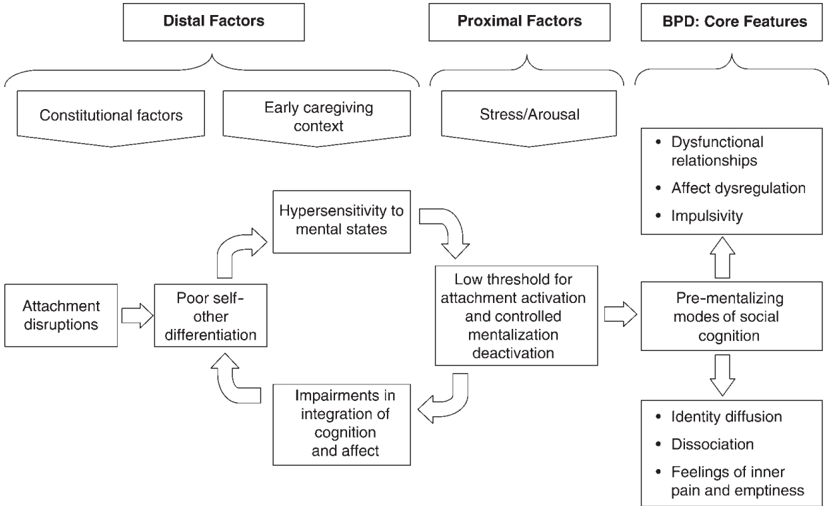
The precise nature and etiopathogenesis of borderline personality disorder (BPD) continues to elude researchers and clinicians. Yet, increasing evidence from various strands of research converges to suggest that affect dysregulation, impulsivity, and unstable relationships constitute the core features of BPD. Over the last two decades, the mentalization-based approach to BPD has attempted to provide a theoretically consistent way of conceptualizing the interrelationship between these core features of BPD, with the aim of providing clinicians with a conceptually sound and empirically supported approach to BPD and its treatment. This paper presents an extended version of this approach to BPD based on recently accumulated data. In particular, we suggest that the core features of BPD reflect impairments in different facets of mentalization, each related to impairments in relatively distinct neural circuits underlying these facets. Hence, we provide a comprehensive account of BPD by showing how its core features are related to each other in theoretically meaningful ways. More specifically, we argue that BPD is primarily associated with a low threshold for the activation of the attachment system and deactivation of controlled mentalization, linked to impairments in the ability to differentiate mental states of self and other, which lead to hypersensitivity and increased susceptibility to contagion by other people's mental states, and poor integration of cognitive and affective aspects of mentalization. The combination of these impairments may explain BPD patients' propensity for vicious interpersonal cycles, and their high levels of affect dysregulation and impulsivity. Finally, the implications of this expanded mentalization-based approach to BPD for mentalization-based treatment and treatment of BPD more generally are discussed.
Overview
CoChat Summary
TL;DR
This paper presents an expanded developmental, mentalization-based model of borderline personality disorder (BPD), arguing that its core features reflect impairments in different facets of mentalization linked to relatively distinct neural circuits. It proposes that BPD involves low thresholds for attachment-system activation and controlled-mentalization deactivation, explaining vicious interpersonal cycles, affect dysregulation, impulsivity, identity diffusion, dissociation, and inner pain.
Key findings
- BPD’s core features are emotional dysregulation, high impulsivity leading to self-harm and suicidality, and disturbed interpersonal functioning; lifetime prevalence is estimated to be as much as 6%, and between 25 and 33% may meet criteria in outpatient and forensic populations.
- Mentalization is multidimensional—automatic/controlled, cognitive/affective, internal/external, and self/other focused—and BPD is primarily associated with failures of explicit, internal, cognitive mentalization, alongside a low threshold for attachment activation and deactivation of controlled mentalization.
- These impairments may produce hypersensitivity and susceptibility to contagion by others’ mental states, poor self-other differentiation, hypermentalization or mentalization failure, and reemergence of prementalizing modes such as psychic equivalence, pretend mode, and teleological mode.
- Treatment implications include aiming for an optimal balance between attachment activation and mentalization; insight-oriented treatments focused on traumatic past may be contraindicated for patients with serious mentalization impairments.
Methods
- Theoretical/review paper presenting an expanded mentalization-based developmental model of BPD, integrating prior formulations with recently accumulated data.
- Draws on extant neuroimaging, developmental social and cognitive research, factor analytic and clinical studies, attachment research, and treatment literature; no new empirical sample or primary data collection is reported.
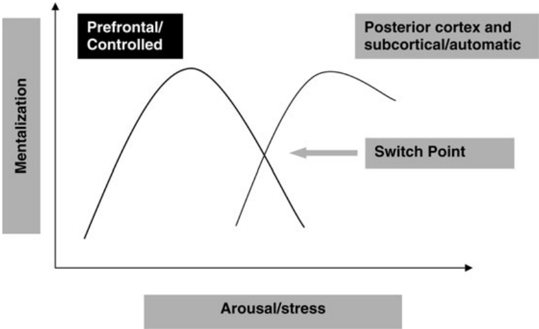
- Main analysis is a conceptual synthesis relating BPD features to four mentalization polarities and proposed neural systems, including a biobehavioral switch model of stress and controlled versus automatic mentalization.
Limitations
- The paper states that cited neuroimaging and physiological studies require further replication because of sometimes small sample sizes, disparate experimental paradigms, and heterogeneity in sample selection (e.g., comorbidity with depression, childhood abuse, PTSD, and copying styles).
- The paper notes that reliable description of BPD in adolescence remains controversial regarding homogeneity, comorbidity between and within axes, arbitrary cutoffs, and poor test-retest reliability, and that stability into adulthood is suggestive rather than well-established.
- The paper states that some predictions remain to be investigated (e.g., recovery time of mentalization with hyperactivating versus deactivating strategies) and that evidence on maladaptive parental mentalizing is still lacking; evident from the text, it is a conceptual/review article and does not empirically test the proposed model.
Model-written summary. Check it against the paper before relying on it.
Integrity signals
Registry
Cites
Statistics
Figures
Verification
Claims the paper makes
24 Valid · 11 Not valid · 130 Not checked · 108 Own results and interpretations
The cited sources support only part of this claim — read each source’s verdict below.
In the paper
“As we have already noted, retrospective evaluations have led to recognition that disorganization of the attachment system is a key aspect of the psychopathology of BPD (Gunderson & Lyons-Ruth, 2008).”
What the sources say
- Partly supportedcites Gunderson & Lyons-Ruth, 2008 matched to “BPD's Interpersonal Hypersensitivity Phenotype: A Gene-Environment-Developmental Model” (2008) sourceExperimental — accuracy not yet measured
The paper calls disorganized attachment especially important to understanding BPD and links it to an adult attachment pattern seen in patients (passage [1], section labeled Abstract). Its Conclusions describe attachment disorganization as one likely developmental pathway, not a defining feature of BPD psychopathology. The RETROSPECTIVE REPORTS section discusses patients’ accounts of difficult childhood relationships but does not say those evaluations established attachment disorganization. (LLM, conf=0.82)
plainstates an association- Asserted: passes — The authors put it forward as true.
- Checkable: passes — It can be checked against evidence.
- Load-bearing: passes — The paper’s conclusions depend on it.
- Based: passes — The paper gives a reason why it holds.
- Partly supported
The cited sources support only part of this claim — read each source’s verdict below.
In the paper
“Indeed, studies of adult attachment patterns of BPD patients repeatedly highlight a combination of preoccupied and unresolved attachment associated with BPD (Agrawal, Gunderson, Holmes, & Lyons-Ruth, 2004; Fonagy et al., 1996; Nakash-Eisikovits, Dutra, & Westen, 2002).”
What the sources say
- Supportedcites Agrawal, Gunderson, Holmes, & Lyons-Ruth, 2004 matched to “Attachment Studies with Borderline Patients: A Review” (2004) source
The Results report that all five studies using the Adult Attachment Interview found the greatest proportion of borderline individuals in the preoccupied or unresolved categories. The Discussion states that BPD attachments seem best characterized as unresolved with preoccupied features in relation to parents, matching the attributed claim. (LLM, conf=0.94)
- Not checked yetcites Fonagy et al., 1996 matched to “The relation of attachment status, psychiatric classification, and response to psychotherapy.” (1996) source
- Partly supportedcites Nakash-Eisikovits, Dutra, & Westen, 2002 matched to “Relationship Between Attachment Patterns and Personality Pathology in Adolescents” (2002) sourceExperimental — accuracy not yet measured
The Association Between Attachment Status and Axis II Pathology section links both anxious/ambivalent and disorganized/unresolved attachment to borderline personality disorder. But this paper studies adolescents, not adult BPD patients, and reports the two associations separately rather than a combined attachment pattern. Its discussion of an adult association concerns preoccupied attachment only. (LLM, conf=0.88)
boostedstates an association- Asserted: passes — The authors put it forward as true.
- Checkable: passes — It can be checked against evidence.
- Load-bearing: unclear — It is unclear whether the paper’s conclusions depend on it.
- Based: passes — The paper gives a reason why it holds.
- Supported
The cited sources support only part of this claim — read each source’s verdict below.
In the paper
“Such gene-environment effects could be one way that the known influence of heredity (Distel et al., 2008; LyonsRuth et al., 2007; Ni et al., 2007) is mediated in BPD.”
What the sources say
- Supportedcites Distel et al., 2008 matched to “Heritability of borderline personality disorder features is similar across three countries” (2008) source
The citation supports the sentence’s reference to a known hereditary influence, not its proposed gene–environment mechanism. The indexed paper’s title identifies its subject as the heritability of borderline personality disorder features; it does not need to establish the citing authors’ speculative explanation of how that influence is mediated. (LLM, conf=0.84)
- Supportedcites LyonsRuth et al., 2007 matched to “Serotonin transporter polymorphism and borderline or antisocial traits among low-income young adults” (2007) source
The Conclusions report genetic influence on liability to borderline and antisocial personality disorders. The Discussion proposes that the observed genetic association may reflect a gene–environment interaction, while noting that the interaction was not tested in this study. That supports the citing sentence’s tentative ‘could be’ formulation. (LLM, conf=0.90)
- Not matchedcites Ni et al., 2007
This doesn’t read as a citation we can look up.
hedgedstates a possible cause- Asserted: passes — The authors put it forward as true.
- Checkable: passes — It can be checked against evidence.
- Load-bearing: unclear — It is unclear whether the paper’s conclusions depend on it.
- Based: passes — The paper gives a reason why it holds.
- Supported
The cited sources support only part of this claim — read each source’s verdict below.
In the paper
“dissociative comorbidity is more frequently reported by patients with BPD than other groups”
What the sources say
- Not checked — no full text of the sourcecites Sar, Akyuz, Kugu, Ozturk, & Ertem-Vehid, 2006 matched to “Axis I Dissociative Disorder Comorbidity in Borderline Personality Disorder and Reports of Childhood Trauma” (2006) source
- Partly supportedcites Zanarini, Frankenburg, Jager-Hyman, Reich, & Fitzmaurice, 2008 matched to “The course of dissociation for patients with borderline personality disorder and axis II comparison subjects: a 10‐year follow‐up study” (2008) sourceExperimental — accuracy not yet measured
The Results report that 76 borderline patients, but only two axis II comparison subjects, had high dissociation scores at baseline. This supports a difference in reported dissociative symptoms between those groups, not a higher frequency of diagnosed dissociative comorbidity across other groups generally. The paper measures symptoms with the Dissociative Experiences Scale rather than reporting rates of comorbid dissociative disorders. (LLM, conf=0.86)
plainstates an association- Asserted: passes — The authors put it forward as true.
- Checkable: passes — It can be checked against evidence.
- Load-bearing: unclear — It is unclear whether the paper’s conclusions depend on it.
- Based: passes — The paper gives a reason why it holds.
The cited sources that could be checked couldn’t confirm or dispute this claim.
In the paper
“may be an extreme indication of such separateness (Ross, 2007; Zanarini et al., 2008).”
What the sources say
- Not checked — no full text of the sourcecites Ross, 2007 matched to “Borderline Personality Disorder and Dissociation” (2007) source
- Could not verifycites Zanarini et al., 2008 matched to “The course of dissociation for patients with borderline personality disorder and axis II comparison subjects: a 10‐year follow‐up study” (2008) sourceExperimental — accuracy not yet measured
The Methods describe dissociation through absorption, depersonalization, and amnesia, while the Discussion reports how their severity changed over time. Neither section characterizes dissociation as an extreme indication of separateness; searches for separateness and related descriptions found no such passage. Page numbers were not available in our copy. (LLM, conf=0.75)
hedgedstates an association- Asserted: passes — The authors put it forward as true.
- Checkable: passes — It can be checked against evidence.
- Load-bearing: unclear — It is unclear whether the paper’s conclusions depend on it.
- Based: passes — The paper gives a reason why it holds.
157 more claims · 13 with their cited sources checked
Create a free account to see all 273 claims and to verify the 9 references still open.
- Probably not a substantial claim. 41
- It may state two separate claims as one. 81
Claims other papers make about this one
Each is checked against this paper’s own text: does it say what the citing paper says it does?
The source backs part of the claim, not all of it — or backs it for a different population, condition or comparison.
In the citing paper
“In this account, an insecure attachment relationship between primary caregiver and child results in avoidance of internal thinking and feeling states in the child because acknowledging such internal states would further threaten an already vulnerable relationship with the caregiver.”
From First evidence of a prospective relation between avoidance of internal states and borderline personality disorder features in adolescents. (2015) · cites this paper as [19]
Experimental — accuracy not yet measuredThe source backs part of the claim, not all of it — or backs it for a different population, condition or comparison.
In the citing paper
“In turn, the child is at increased risk of developing BPD.”
From First evidence of a prospective relation between avoidance of internal states and borderline personality disorder features in adolescents. (2015) · cites this paper as [19]
Experimental — accuracy not yet measuredThe source backs part of the claim, not all of it — or backs it for a different population, condition or comparison.
In the citing paper
“In line with this, mentalization as an emotion regulation strategy has been considered a top-down strategy, relying in the explicit emotion regulation and in the theory of mind brain systems (Fonagy and Luyten, 2009; Vrticka and Vuilleumier, 2012).”
From Mindfulness and Emotion Regulation: Insights from Neurobiological, Psychological, and Clinical Studies (2017) · cites this paper as Fonagy and Luyten, 2009
Experimental — accuracy not yet measuredIn the citing paper
“stress and distress is thought to have a detrimental impact on the capacity to mentalize, especially if the stress is interpersonal in nature.”
From Investigating the association between parental reflective functioning and distress tolerance in motherhood. (2015) · cites this paper as Fonagy & Luyten, 2009
In the citing paper
“Stress and heightened arousal may inhibit the engagement of cortically-controlled processes of explicit mentalization that underscore reflection and reasoning when engaged with others (Fonagy & Luyten, 2009).”
From Investigating the association between parental reflective functioning and distress tolerance in motherhood. (2015) · cites this paper as Fonagy & Luyten, 2009
Citations
Cites
Fredrickson, B. L. (2001) · American Psychologist · doi:10.1037//0003-066x.56.3.218 · Cited by 18,025 · cited 2×
“…insight into BPD. Studies suggest that the ability to continue to mentalize even under considerable stress leads to so-called “broaden and build” (Fredrickson, 2001) cycles of attachment security, which reinforce feelings of secure attachment, personal agency, and affect regulation (“build”),…”
BackgroundRizzolatti, G., & Craighero, L. (2004) · Annual Review of Neuroscience · doi:10.1146/annurev.neuro.27.070203.144230 · Cited by 7,433 · cited 1×
“…system involves a more body-based, frontoparietal mirror neuron system that is involved in understanding the multimodal embodied self (e.g., face and body recognition) and understanding others through motor-simulation mechanisms (Gallese, Keysers, & Rizzolatti, 2004; Rizzolatti & Craighero, 2004).”
Background(1993) · Cited by 7,136
Attachment in adulthood: structure, dynamics, and change
(2008) · Choice Reviews Online · doi:10.5860/choice.45-2903 · Cited by 4,315
Affect Regulation, Mentalization, and the Development of the Self
Fonagy, P., Gergely, G., Jurist, E. L., & Target, M. (2018) · doi:10.4324/9780429471643 · Cited by 3,886
Self-citationThe Child's Conception of Space
Lawrence, E., Piaget, J., Inhelder, B., Langdon, F. J., & Lunzer, J. L. (1957) · British Journal of Educational Studies · doi:10.2307/3118882 · Cited by 3,213
Cattaneo, L., & Rizzolatti, G. (2009) · Archives of Neurology · doi:10.1001/archneurol.2009.41 · Cited by 3,137
Self-referential processing in our brain—A meta-analysis of imaging studies on the self
Northoff, G., Heinzel, A., de Greck, M., Bermpohl, F., Dobrowolny, H., & Panksepp, J. (2006) · NeuroImage · doi:10.1016/j.neuroimage.2005.12.002 · Cited by 2,792 · cited 1×
“The aFMC is involved in mentalizing (Frith & Frith, 2006; Gilbert et al., 2007) and self-referential processing (Northoff et al., 2006).”
BackgroundMayberg, H. S., Liotti, M., Brannan, S. K., McGinnis, S., Mahurin, R. K., Jerabek, P. A., Silva, J. A., Tekell, J. L., Martin, C. C., Lancaster, J. L., et al. (1999) · American Journal of Psychiatry · doi:10.1176/ajp.156.5.675 · Cited by 2,416 · cited 2×
“…for attention and long-term memory (Cabeza & Nyberg, 2000), perhaps specifically responsible for integrating emotion and cognition (e.g., emotional encoding of episodic memories; Maddock, 1999) and subserving moodmediated inhibition or enhancement of cognitive processing (Mayberg et al., 1999).”
BackgroundThe debate over dopamine’s role in reward: the case for incentive salience
Berridge, K. C. (2007) · Psychopharmacology · doi:10.1007/s00213-006-0578-x · Cited by 2,347 · cited 1×
“These findings suggest that for securely attached mothers, infant cues (whether positive or negative in affect) may act as an important affective signal of “incentive salience” (Berridge, 2007), reinforcing and motivating responsive maternal care.”
Background
Research works printed but not linked: 12
- Williams, 2006, Handbook of mentalisation based treatments
- 10.1093/med/9780198569183.001.0001 · DOI · Paper page
- 10.1111/1469-7610.0013_7 · doi:10.1111/1469-7610.0013_7 · Paper page
- Gergely, 1996, The social biofeedback model of parental affect-mirroring, International Journal of Psycho-Analysis, 77, 1181
- Luyten, 2009, The interpersonal regulation of stress
- Bloom, 2004, Descartes' baby
- Hobson, 2002, The cradle of thought: Explorations of the origins of thinking
- Fearon, 2006, Handbook of mentalisaiton based treatments
- Diamond, 1991, Self–other differentiation of object representations
- Hesse, 2008, Handbook of attachment theory and research, 552
- Luyten, 2009, Mentalization as a multidimensional concept
- O'Connor, 2006, Developmental psychopathology: Vol. 3. Risk, disorder and adaptation, 202
Cited by
Items 501–600 of 1,140
Cohen, S. J. (2015) · International Journal of Applied Psychoanalytic Studies · doi:10.1002/aps.1461 · Cited by 12
Lumsden, V., Kerr, S. L., & Feigenbaum, J. (2016) · Journal of Family Studies · doi:10.1080/13229400.2015.1108859 · Cited by 9
“A mentalization-based conceptualization of BPD (Fonagy & Luyten, 2009) suggests that an interaction between neurobiological development and early experiences of disruption in the attachment relationship combined with later traumatic experiences leads to hyper-responsiveness of the attachment…”
Watson, J. C. (2018) · Psychotherapy Research · doi:10.1080/10503307.2018.1435920 · Cited by 16
“…and provides an increased sense of competence and mastery with respect to knowing what one is feeling as well as how to express it interpersonally in more appropriate and optimal ways, thereby contributing to clients’ development as self-regulating agents (Fonagy & Luyten, 2009; Schore, 2003).”
BackgroundYang, M.-J., Sawhney, V., McHugh, R. K., & Leyro, T. M. (2020) · Journal of American College Health · doi:10.1080/07448481.2020.1810053 · Cited by 11
Cyrkot, T., Szczepanowski, R., Jankowiak-Siuda, K., Gawęda, Ł., & Cichoń, E. (2021) · European Archives of Psychiatry and Clinical Neuroscience · doi:10.1007/s00406-020-01227-7 · Cited by 11
Mentalization‐inspired case formulation: Minding the difficult patient
Simonsen, S., Nørgaard, N. L., Larsen, K. A., et al. (2011) · Personality and Mental Health · doi:10.1002/pmh.154 · Cited by 8
Neural correlates of fears of abandonment and rejection in borderline personality disorder
Romaniuk, L., Pope, M., Nicol, K., Steele, J. D., & Hall, J. (2016) · Wellcome Open Research · doi:10.12688/wellcomeopenres.10331.1 · Cited by 8
Hannibal, N., & Schwantes, M. (2017) · Voices A World Forum for Music Therapy · doi:10.15845/voices.v17i2.897 · Cited by 8
“The model originates from verbal therapy (Fonagy, 1989; Fonagy, Gergely, Jurist, & Target, 2002; Fonagy & Luyten, 2009), however it is our belief that it is well-suited to music therapy and actually supports our methods and thinking about music therapy in psychiatry in very effective ways.”
Versión Española del Cuestionario de Función Reflexiva Parental (CFRP-18)
Gordo, L., Elejalde, L. I., & Martínez‐Pampliega, A. (2020) · Revista Iberoamericana de Diagnóstico y Evaluación - e Avaliação Psicológica · doi:10.21865/ridep55.2.01 · Cited by 15
“…que participaron en el estudio, puesto que en otros estudios desarrollados con progenitores con altos niveles de estrés parental se ha observado un mayor uso de modos prementalizadores en la relación con sus hijos/as (Fonagy & Luyten, 2009; Nijssens, Bleys, Casalin, Vliegen, & Luyten, 2018).”
Background« Classe des familles » : de la formation à la pratique
Mayer, C., Bailly, R., Simbron, C., de la Garanderie, J. P., & Baleyte, J. (2022) · Thérapie Familiale · doi:10.3917/tf.221.0013 · Cited by 7
Derks, S. D. M., Willemen, A. M., Wouda, M., & Sterkenburg, P. S. (2023) · Journal of Applied Research in Intellectual Disabilities · doi:10.1111/jar.13170 · Cited by 9
Al‐Attar, Z., & Worthington, R. (2024) · Advances in Autism · doi:10.1108/aia-07-2023-0041 · Cited by 11
Ciringione, L., Perinelli, E., Mancini, F., & Prunetti, E. (2025) · Brain Sciences · doi:10.3390/brainsci15080889 · Cited by 13
Personality Disorders, Attachment and Psychodynamic Psychotherapy
Weinstein, L., Pérez-Rodríguez, M. M., & Siever, L. J. (2014) · Psychopathology · doi:10.1159/000366135 · Cited by 8
Zajenkowska, A. M., Nowakowska, I., Cieciuch, J., Gawęda, Ł., Rogoza, R., Pinkham, A. E., & Czajkowska-Łukasiewicz, K. (2024) · Development and Psychopathology · doi:10.1017/s0954579424000506 · Cited by 11
Fuchs, C., Silveira, S., Meindl, T., Musil, R., Austerschmidt, K. L., Eilert, D. W., Müller, N., Möller, H., Engel, R. R., Reiser, M. F., et al. (2024) · Brain Sciences · doi:10.3390/brainsci14050461 · Cited by 8
Mentalization based treatment for a broad range of personality disorders: a naturalistic study
Rizzi, E., Weijers, J. G., ten Kate, C., & Selten, J. (2024) · BMC Psychiatry · doi:10.1186/s12888-024-05865-2 · Cited by 10
“According to Fonagy and Luyten [48], the process of mentalization can be described along four key axes, each with opposing poles: implicit versus explicit, cognitive versus affective, internal versus external, and self versus others.”
BackgroundInfluentialSharp, C., & Kalpakci, A. H. (2014) · Scandinavian Journal of Child and Adolescent Psychiatry and Psychology · doi:10.21307/sjcapp-2015-005 · Cited by 8
Stellwagen, K. K., & Kerig, P. K. (2018) · Journal of Child and Family Studies · doi:10.1007/s10826-018-1161-x · Cited by 9
L’expérience d’une équipe de liaison en addictologie pour adolescents en établissement soin/étude
Har, A., Escaut, A., & Phan, O. (2020) · Neuropsychiatrie de l Enfance et de l Adolescence · doi:10.1016/j.neurenf.2020.02.004 · Cited by 9
Law, A. R. M., Thackeray, L. A., Morris, E., & Sleed, M. (2021) · Journal of Infant Child and Adolescent Psychotherapy · doi:10.1080/15289168.2021.1918044 · Cited by 9
“Mentalizing can fail during moments of high arousal resulting from stressful situations, and there are established links between stress and non-mentalizing (Fonagy & Luyten, 2009; Nolte et al., 2013).”
BackgroundWang, K. Y. H., Kealy, D., & Cox, D. W. (2022) · Journal of Adult Development · doi:10.1007/s10804-022-09418-3 · Cited by 8
Bäumer, A.-V., Fürer, L., Birkenberger, C., Wyssen, A., Steppan, M., Zimmermann, R., Gaab, J., Kaess, M., & Schmeck, K. (2022) · Borderline Personality Disorder and Emotion Dysregulation · doi:10.1186/s40479-022-00200-1 · Cited by 10
Hüwe, L., Laser, L., & Andreas, S. (2023) · Psychotherapy Research · doi:10.1080/10503307.2023.2226812 · Cited by 13
“Mentalizing is a multidimensional construct with four different dimensions with different underlying neural systems (Fonagy & Luyten, 2009).”
BackgroundAttachment as a predictor of dropout in mentalization‐based treatment
Remeeus, M. G. A., Smits, M. L., Bal‐Bax, A. M., Feenstra, D. J., & Luyten, P. (2023) · Psychology and Psychotherapy Theory Research and Practice · doi:10.1111/papt.12478 · Cited by 9
Self-citationEnsink, K., Fonagy, P., Berthelot, N., Normandin, L., & Bernazzani, O. (2015) · Frontiers in Psychology · doi:10.3389/fpsyg.2015.00697 · Cited by 8
“Considering that mentalization as we are measuring it, involves coordination by prefrontal and temporo-parietal systems (Fonagy and Luyten, 2009), this suggests that closely related neurobiological system are involved in the two processes.”
BackgroundSelf-citationWang, Y., Guo, J.-N., Yin, X., Zhang, Q., Dong, L.-Y., Wang, K., & Wang, Y. (2021) · Journal of Forensic Psychiatry and Psychology · doi:10.1080/14789949.2021.1886314 · Cited by 8
Azhari, A., Gabrieli, G., Bizzego, A., Bornstein, M. H., & Esposito, G. (2020) · bioRxiv (Cold Spring Harbor Laboratory) · doi:10.1101/2020.01.23.917641 · Cited by 7
“An anxiously-attached mother predominantly engages in emotional mentalisation, comprising automatic processes that rely on social cues (e.g., facial expressions) to form an understanding of the mental state of others (Fonagy & Luyten, 2009; Lieberman, 2007).”
BackgroundMethodInfluentialIs the Balint Group an Opportunity to Mentalize?
Farkas, K., Csukly, G., & Fonagy, P. (2023) · British Journal of Psychotherapy · doi:10.1111/bjp.12880 · Cited by 11
“Studies in neuroscience and behaviour have suggested that mentalization can be organized around four dimensions or polarities (Fonagy & Luyten, 2009).”
Self-citationComte, A., Szymanska, M., Monnin, J., Moulin, T., Nezelof, S., Magnin, É., Jardri, R., & Vulliez‐Coady, L. (2024) · Attachment & Human Development · doi:10.1080/14616734.2024.2384393 · Cited by 9
“…related to rational inferences about the mental states and intentions of others, are often described as fundamental in the process of mentalizing (Fonagy & Luyten, 2009): they encode memories about previous interactions with others, and may help predict the consequences of future social…”
Jurist, J., Traynor, J. M., Murray, G. E., Ren, B., Masland, S. R., Mermin, S. A., Meehan, K. B., & Choi-Kain, L. W. (2025) · Psychopathology · doi:10.1159/000543363 · Cited by 10
“Disruptions in the capacity to understand mental states, both in oneself and others, behind observable actions fl exibly and accurately in context may underlie the emotional, interpersonal, and behavioral instabilities diagnostic of BPD and other severe PDs [4, 5].”
Impathy and Emotion Recognition: How Attachment Shapes Self- and Other-Focused Emotion Processing
Eilert, D. W., de Punder, K., Maerz, J., Dose, J., Gander, M., Mensah, P., Neubrand, S., Hinterhoelzl, J., & Buchheim, A. (2025) · Brain Sciences · doi:10.3390/brainsci15050516 · Cited by 7
“Fonagy and Luyten [64] proposed that high levels of mentalization, typically associated with security-based attachment strategies, may promote resilience in the context of social stress and help maintain affiliative and caregiving systems, even under emotional strain.”
Høgenhaug, S. S., Steffensen, S. V., Orsucci, F. F., Zimatore, G., Schiepek, G., Kongerslev, M., BATEMAN, A. W., & Telléus, G. K. (2024) · Frontiers in Psychology · doi:10.3389/fpsyg.2024.1408183 · Cited by 9
“BPD is associated with insecure or disorganized attachment, impaired mentalization (the ability to understand the mental states of self and others), and reduced epistemic trust (the ability to take in new social knowledge from others) (Fonagy and Luyten, 2009).”
BackgroundRossi, A. A., Tagliagambe, A., Scuderi, A., Ragione, L. D., & Mannarini, S. (2025) · Nutrients · doi:10.3390/nu17203233 · Cited by 8
Brain responses to social cues of attachment in mid-childhood
Schoett, M. J. S., Basten, U., Deichmann, R., Fiebach, C. J., & Fischmann, T. (2021) · Attachment & Human Development · doi:10.1080/14616734.2020.1840791 · Cited by 7
“This is in accordance with theoretical approaches by Vrtička (2017) and Fonagy and Luyten (2009) that affective and cognitive evaluation of attachment-relevant stimuli are recruited according to individually experienced attachment stress – which in our study design may (at least partly) depend upon…”
ResultTohme, P., & Kolev, M. V. (2021) · Frontiers in Psychology · doi:10.3389/fpsyg.2021.708393 · Cited by 5
Creating safe schools by building safe relationships
Eppler-Wolff, N., & Martin, A. (2021) · International Journal of Applied Psychoanalytic Studies · doi:10.1002/aps.1723 · Cited by 6
de la Cerda, C., & Dagnino, P. (2021) · Frontiers in Psychology · doi:10.3389/fpsyg.2021.725739 · Cited by 9
“Successful psychotherapies positively influence these skills (Levy et al., 2006a,b; Fonagy and Luyten, 2009).”
BackgroundEvidence-based pharmacotherapy of personality disorders
Ripoll, L. H., Triebwasser, J., & Siever, L. J. (2012) · Cambridge University Press eBooks · doi:10.1017/cbo9780511910395.015 · Cited by 6
The neuroscience of prevention
Fonagy, P. (2012) · Journal of the Royal Society of Medicine · doi:10.1258/jrsm.2012.12k008 · Cited by 8
Self-citationStöger‐Schmidinger, B., Aichhorn, W., Schöller, H. J., Aas, B., & Schiepek, G. K. (2016) · Familiendynamik · doi:10.21706/fd-41-4-322 · Cited by 7
Appel, F. (2016) · Familiendynamik · doi:10.21706/fd-41-4-356 · Cited by 6
Fluctuations of mentalization in the context of relational stimuli and representational contents
Górska, D. (2018) · Current Issues in Personality Psychology · doi:10.5114/cipp.2018.80197 · Cited by 7
Kasper, L. A., Zettl, M., Hauschild, S., & Taubner, S. (2019) · Praxis der Kinderpsychologie und Kinderpsychiatrie · doi:10.13109/prkk.2019.68.8.760 · Cited by 6
La medida de la capacidad reflexiva: instrumentos disponibles en castellano y tareas pendientes
Pascual, M. S., León-Quismondo, L., de Arenosa, A. G. L., Hesse, J. M., & Liria, A. F. (2015) · Revista de la Asociación Española de Neuropsiquiatría · doi:10.4321/s0211-57352015000300004 · Cited by 15
Psychodynamic Psychotherapy with Severely Disturbed Adolescents: Changes in Reflective Functioning
Cropp, C., Taubner, S., Salzer, S., & Streeck-Fischer, A. (2019) · Journal of Infant Child and Adolescent Psychotherapy · doi:10.1080/15289168.2019.1643212 · Cited by 9
“Fonagy and Luyten (2009) also note that mentalizing is no longer apparent when self-protective reactions like fighting, flight and freezing dominate the behavior of a person.”
BackgroundAre difficulties in mentalizing associated with severity of Antisocial Personality Disorder
Newbury-Helps, J. (2011) · UCL Discovery (University College London) · Cited by 11
Lamsma, J., Raine, A., Kia, S. M., Cahn, W., Arold, D., Banaj, N., Barone, A., Brosch, K., Brouwer, R. M., Brunetti, A., et al. (2024) · medRxiv · doi:10.1101/2024.02.04.24302268 · Cited by 5
Mentalizing individuals, families and systems: Towards a translational socioecological approach
Luyten, P., Malcorps, S., BATEMAN, A. W., & Fonagy, P. (2024) · Psychology and Psychotherapy Theory Research and Practice · doi:10.1111/papt.12544 · Cited by 14
“…(b) controlled versus automatic mentalizing, (c) mentalizing based on internal (e.g. thoughts, feelings) versus external (e.g. prosody, facial expressions) features of self and others, and (d) cognitive versus affective aspects of mentalizing (Fonagy & Luyten, 2009; Luyten, Malcorps, et al., 2019).”
Self-citationAras, A., Fonagy, P., Campbell, C., & Rosan, C. (2024) · Attachment & Human Development · doi:10.1080/14616734.2024.2421432 · Cited by 11
“Neuroscientific advances in social cognition have led to a reconceptualization of menta-lization from a singular understanding to a multidimensional framework (Bateman & Fonagy, 2019; Fonagy & Luyten, 2009).”
Self-citationValidation of the Mentalization Scale (MentS) in francophone control and clinical samples
Descartes, F., Besch, V., Bouteloup, M., Nicastro, R., Pham, E., Rüfenacht, E., Perroud, N. A., & Debbané, M. (2025) · PLoS ONE · doi:10.1371/journal.pone.0332724 · Cited by 6
Pugliese, E., Papa, C., Filippelli, M. C., Murabito, F., Riposo, S., & Carcione, A. (2025) · Journal of Aggression Maltreatment & Trauma · doi:10.1080/10926771.2025.2585270 · Cited by 5
“Sexual violence can profoundly compromise self-reflective and other-reflective capacities, disrupting theory of mind and self-referential processing (Allen et al., 2008; Fonagy & Luyten, 2009).”
Malcorps, S., Vliegen, N., Rutherford, H. J. V., & Luyten, P. (2025) · Development and Psychopathology · doi:10.1017/s0954579425100424 · Cited by 6
Self-citationLahnakoski, J. M., Nolte, T., Solway, A., Vilares, I., Hula, A., Feigenbaum, J., Lohrenz, T. M., King‐Casas, B., Fonagy, P., Montague, P. R., et al. (2024) · Journal of Affective Disorders · doi:10.1016/j.jad.2024.05.125 · Cited by 6
“A cascade of deteriorating disease states in patients is often provoked by heightened interpersonal stress/threat (e.g. rejection, abandonment, or isolation) accompanied by a reduced sense of agency and a resulting propensity to react (Fonagy and Luyten, 2009; Nolte et al., 2019).”
Self-citationDerome, M., Morosan, L., Heller, P., & Debbané, M. (2025) · Frontiers in Psychiatry · doi:10.3389/fpsyt.2024.1385782 · Cited by 7
Sikand, M., Bhola, P., & Meena, K. S. (2025) · Personality and Mental Health · doi:10.1002/pmh.70009 · Cited by 8
Fagan, S., Hodge, S., & Morris, C. (2022) · Psychological Reports · doi:10.1177/00332941211000661 · Cited by 5
“BPD is characterised by difficulties with emotional regulation, impulse control and interpersonal relationships, including selfto-self relating (Fonagy & Luyten, 2009; Lieb et al., 2004).”
BackgroundHauschild, S., Kasper, L. A., & Taubner, S. (2021) · Praxis der Kinderpsychologie und Kinderpsychiatrie · doi:10.13109/prkk.2021.70.5.386 · Cited by 7
Altavilla, D., Adornetti, I., Chiera, A., Deriu, V., Acciai, A., & Ferretti, F. (2022) · Experimental Brain Research · doi:10.1007/s00221-022-06441-4 · Cited by 7
“1994; Decety and Jackson 2004; Fonagy and Luyten 2009; Vrticka and Vuilleumier 2012).”
BackgroundPourmohammad, P., Imani, M., & Goodarzi, M. A. (2022) · Current Psychology · doi:10.1007/s12144-022-04063-1 · Cited by 8
“Subsequent univariate analyses of variance (ANOVAs) revealed that the BPD group had significant higher scores in the emo - has been considered a critical environmental risk factor in developing BPD in several conceptual models (Fonagy & Luyten, 2009; Linehan, 1993b; Zanarini & Frankenburg, 1997).”
BackgroundPsychometric Properties of the Italian Version of the Embodied Sense-of-Self Scale
Patti, A., Santarelli, G., Boy, O. B., Fascina, I., Altomare, A. I., Ballerini, A., & Ricca, V. (2022) · Brain Sciences · doi:10.3390/brainsci13010034 · Cited by 5
“A scarce mentalization capacity can be explained as a failed attempt to understand oneself through integrated, intentional functions; such a deficit may be a constitutive element of the psychopathology of certain disorders and, consequently, provide a viable option to trace their trajectory and provide early intervent…”
BackgroundFrölander, H.-E., Möller, C., Rudner, M., Mishra, S., Marshall, J. D., Piacentini, H., & Lyxell, B. (2015) · Frontiers in Psychology · doi:10.3389/fpsyg.2015.01426 · Cited by 8
“In addition, focused attention and cognitive efforts are required in advanced ToM processing (Fonagy and Luyten, 2009).”
BackgroundHow do art therapists structure their approach to borderline personality disorder?
Springham, N., & Whitaker, R. (2015) · The Arts in Psychotherapy · doi:10.1016/j.aip.2014.10.013 · Cited by 5
“…with BPD appeared to have marked difficulties processing Oxytocin in trust games (Bartz et al., 2011), a lower threshold for the activation of the fight or flight system (Fonagy & Luyten, 2009), and high susceptibility to be destabilised once the amygdale had been stimulated (Arnsten, 1998).”
BackgroundFischer-Roßbach, R. (2016) · Familiendynamik · doi:10.21706/fd-41-4-357 · Cited by 5
Thevenet, M., Dondé, C., Machabert, R., Ancona, L., Jost, C., & Georgieff, N. (2017) · L Encéphale · doi:10.1016/j.encep.2017.10.008 · Cited by 7
Angulo, B., Estévez, A., Iriarte, L., & Troyas, I. (2019) · Ansiedad y Estrés · doi:10.1016/j.anyes.2019.04.004 · Cited by 11
Norup, D. A., & Bo, S. (2019) · Scandinavian Journal of Child and Adolescent Psychiatry and Psychology · doi:10.21307/sjcapp-2019-002 · Cited by 6
“According to the mentalization-based model of BPD, the core pathology underlying BPD is associated with dysfunctions in mentalizing (7) and thus lie at the foundation of disturbances in interpersonal relations, impulsivity and affective instability that is part of the BPD concept (8-10), and is empirically supported i…”
BackgroundResultBarnicot, K. (2021) · Journal of Psychological Therapies · doi:10.33212/jpt.v5n2.2020.148 · Cited by 5
Seminars in the Psychotherapies
(2021) · Cambridge University Press eBooks · doi:10.1017/9781108686976 · Cited by 6
Drinkwater, J. F. (2018) · Cambridge University Press eBooks · doi:10.1017/9781108472647 · Cited by 24
Association between attachment anxiety and the gaze direction-related N170
Burra, N., & Vrtička, P. (2022) · Attachment & Human Development · doi:10.1080/14616734.2022.2091337 · Cited by 6
“Through influencing the initiation and maintenance of social bonds throughout the life span, attachment is also linked to mental and physical health (Debbane et al., 2016; Fonagy & Luyten, 2009).”
BackgroundFitzpatrick, S., Liebman, R. E., Varma, S., Norouzian, N., Chafe, D., Traynor, J. M., Goss, S., Earle, E., Bartolomeo, A. A. D., Latham, M., et al. (2023) · Cognitive and Behavioral Practice · doi:10.1016/j.cbpra.2022.11.002 · Cited by 7
“The failed mentalization theory (Fonagy & Luyten, 2009) similarly proposes that disturbed infant–caregiver relationships result in fundamental deficits in mentalization (i.e., a poor capacity to read the mental states of self and others).”
Natividad, A., Huxley, E., Townsend, M. L., Grenyer, B. F. S., & Pickard, J. A. (2023) · Journal of Mental Health · doi:10.1080/09638237.2023.2182425 · Cited by 12
“Difficulty describing our internal experiences may be associated with difficulties in understanding the underlying mental state of oneself or others, referred to as mentalisation (Fonagy & Luyten, 2009), and result in feelings of further disconnection.”
BackgroundChatwin, J., & McEvoy, P. (2019) · Journal of Enabling Technologies · doi:10.1108/jet-11-2018-0051 · Cited by 5
Stänicke, L. I., Arnevik, E. A., Pettersen, M. S., Baltzersen, Å.-L., Zahl, K., Eikenæs, I. U.-M., Pedersen, G., Wilberg, T., & Kvarstein, E. H. (2022) · Nordic Psychology · doi:10.1080/19012276.2022.2062038 · Cited by 7
“PDs are severe mental disorders characterized by disturbances in both self and interpersonal functioning, and those suffering from PDs often struggle with emotion regulation, risk behavior, and considerable vulnerability in attachment and separation (APA, 2013; Fonagy & Luyten, 2009).”
BackgroundBorderline personality disorder: treatment approaches and perspectives
Nelson, K. J., Zagoloff, A. D., Quinn, S., Swanson, H., Garber, C., & Schulz, S. C. (2014) · Clinical Practice · doi:10.2217/cpr.14.24 · Cited by 8
Kooiman, C. G., & Koelen, J. A. (2012) · Tijdschrift voor Psychotherapie · doi:10.1007/s12485-012-0030-0 · Cited by 5
Kalpakci, A. H., Venta, A. C., & Sharp, C. (2014) · Borderline Personality Disorder and Emotion Dysregulation · doi:10.1186/2051-6673-1-11 · Cited by 9
“In Fonagy and colleagues’ [9,10] account, insecure attachment leads to maladaptive mentalizing in which the reflection on self-other relatedness becomes distorted, thereby disrupting the development of a coherent self.”
BackgroundChapter 1. Theoretical Models of Psychodynamic Psychotherapy
Fonagy, P., Hepworth, M., & Campbell, C. (2022) · American Psychiatric Association Publishing eBooks · doi:10.1176/appi.books.9781615375233.gg01 · Cited by 5
Self-citationFornells, M. G., Testor, C. P., & Baró, M. S. (2018) · Contemporary Family Therapy · doi:10.1007/s10591-018-9457-y · Cited by 7
Ditmar, M. F. (2010) · Elsevier eBooks · doi:10.1016/b978-0-323-06561-0.00002-1 · Cited by 7
McMahon, K., Kim, K. K., Fang, C. M., Neacsiu, A. D., & Rosenthal, M. Z. (2019) · Journal of Experimental Psychopathology · doi:10.1177/2043808718818878 · Cited by 6
“Other models of BPD propose that symptoms of the disorder are reflections of social cognitive impairments (Bateman & Fonagy, 2006; Fonagy & Luyten, 2009).”
BackgroundBarnby, J. M., Nguyen, J., Griem, J., Wloszek, M., Burgess, H., Richards, L. J., Kingston, J. L., Cooper, G., Montague, P. R., Dayan, P., et al. (2025) · eLife · doi:10.7554/elife.104008 · Cited by 12
“Childhood trauma, persecution, and poor mentalising in BPD are all predicted to disrupt the integration of information from others ( Fonagy and Luyten, 2009 ).”
Self-citationBagby, R. M., Zito, L., Lau, S. C. L., Mortezaei, A., Porcelli, P., & Taylor, G. J. (2025) · Journal of Intelligence · doi:10.3390/jintelligence13070089 · Cited by 11
“…scholars have increasingly turned to mentalization theory to bridge these constructs, framing alexithymia as a failure in affect-focused mentalizing—that is, in the capacity to interpret one’s own and others’ emotional states as meaningful and intentional (Fonagy and Luyten 2009; Jurist 2005).”
Attachment-Based Mentalization Profiles of Iranian Children: A Mixed-Method Approach
Zandpour, M., Lind, M., Sharp, C., Hasani, J., Sheykhangafshe, F. B., & Borelli, J. L. (2024) · Children · doi:10.3390/children11020258 · Cited by 5
“Mentalizing, often operationalized as reflective functioning (RF), refers to the mental ability to reflect on and interpret one’s own and other people’s behaviors in terms of internal mental states such as feelings, thoughts, intentions, and desires [1].”
BackgroundTrauma-related symptoms in adolescents: the differential roles of sexual abuse and mentalizing
Wais, M., Bégin, M., Sharp, C., & Ensink, K. (2024) · Frontiers in Psychology · doi:10.3389/fpsyg.2024.1364001 · Cited by 12
Abel, T., Happel, M., Daerr, F., Spitzer, C., Benecke, C., & Dulz, B. (2025) · Research in Psychotherapy Psychopathology Process and Outcome · doi:10.4081/ripppo.2025.810 · Cited by 9
“If I could read your mind…”: parental mentalizing in mothers with borderline personality disorder
Zitzmann, J., Georg, A. K., Rosenbach, C., & Renneberg, B. (2025) · Borderline Personality Disorder and Emotion Dysregulation · doi:10.1186/s40479-025-00290-7 · Cited by 7
“As proposed by Fonagy and Luyten [55], the process of mentalization is facilitated by slight elevations in arousal levels.”
Maheux, J., Collin‐Vézina, D., MacIntosh, H. B., Berthelot, N., & Hétu, S. (2016) · Revue québécoise de psychologie · doi:10.7202/1040162ar · Cited by 9
“Courriel : Julie.Maheux@uqtr.ca Mentalisation spécifique au trauma 94 meilleure régulation émotionnelle (Allen, Fonagy, & Bateman, 2008; Fonagy & Luyten, 2009).”
McLaren, V., & Sharp, C. (2020) · Springer eBooks · doi:10.1007/978-3-030-42875-4_1 · Cited by 4
Picazo, M. F., Cormenzana, S., & Martínez‐Pampliega, A. (2021) · Revista Iberoamericana de Diagnóstico y Evaluación - e Avaliação Psicológica · doi:10.21865/ridep61.4.09 · Cited by 10
“En esta línea, en relación al rol agresor, la literatura señala que la dificultad en la capacidad de mentalización puede influir en la capacidad de regular la impulsividad y de forma relacionada, inhibir los comportamientos violentos (Bateman, Bolton, & Fonagy, 2013, Fonagy & Luyten, 2009).”
BackgroundFour attachment-based categories of emotion regulation in adolescent psychic troubles
Robin, M., Surjous, L., Belbèze, J., Bonnardel, L., Lamas, C., Silva, J., Peres, V., & Corcos, M. (2023) · Frontiers in Psychology · doi:10.3389/fpsyg.2023.1133980 · Cited by 13
“Attachment modalities toward caregivers have been shown to influence emotion regulation (Fonagy and Luyten, 2009; Timpano and Port, 2021).”
BackgroundEpistemisches Vertrauen und therapeutische Beziehung
Nolte, T. (2024) · Die Psychotherapie · doi:10.1007/s00278-024-00722-9 · Cited by 4
Jørgensen, M. S., Vestergaard, M., Beck, E., Storebø, O. J., Poulsen, S., Simonsen, E. H., & Bo, S. (2024) · Child Psychiatry & Human Development · doi:10.1007/s10578-024-01735-w · Cited by 6
“This may play an important role for the intragenerational transmission of insecure attachment [27], which is of specific relevance to the development of BPD [31].”
Czik, A., Elizarov, E., & Ziv, Y. (2024) · Early Childhood Research Quarterly · doi:10.1016/j.ecresq.2024.11.010 · Cited by 6
Intersubjectivity in therapeutic interaction: a pragmatic analysis
Knox, J., & Lepper, G. (2013) · Psychoanalytic Psychotherapy · doi:10.1080/02668734.2013.840331 · Cited by 5
“…and intentions of others, emerges through interactions with others (Biven & Panksepp, 2008; Csibra & Gergely, 1998, 2007; Decety & Chaminade, 2003; Farrer & Frith, 2002; Fonagy & Luyten, 2009; Fonagy et al., 2002; Gallagher, 2000; Gallese, 2007; Gergely & Watson, 1996; Meltzoff & Gopnik, 1993).”
Mentalisierungsbasierte Therapie einer Jugendlichen mit Störung des Sozialverhaltens
Reiter, M., Bock, A., Althoff, M.-L., Taubner, S., & Sevecke, K. (2017) · Praxis der Kinderpsychologie und Kinderpsychiatrie · doi:10.13109/prkk.2017.66.5.362 · Cited by 4
Maheux, J., Normandin, L., Parent, K., Ensink, K., & Sabourin, S. (2016) · Revue québécoise de psychologie · doi:10.7202/1040168ar · Cited by 7
“Elle peut porter à la fois sur des états internes ou des réalités externes ainsi que sur soi ou sur l’autre, contribuant à interpréter adéquatement et à comprendre le monde interne et les relations sociales (Fonagy & Luyten, 2009).”
BackgroundSelected Posters From the 2010 Annual Poster Session
Authors, V. (2010) · Journal of the American Psychoanalytic Association · doi:10.1177/0003065110376303 · Cited by 4
“…working model of attachment on mental state decoding, more specifically the following characteristics of a dimensional model of mentalization (Fonagy and Luyten 2009), was assessed: the capacity to interpret the mental states of others, to infer inner states from external features, to P o s…”
BackgroundComponents of emotion dysregulation in borderline personality disorder: A review of recent research
Grzegorzewski, P., & Kucharska, K. (2018) · Postępy Psychiatrii i Neurologii · doi:10.5114/ppn.2018.77033 · Cited by 5
Metadata
- Authors
- Fonagy, P., & Luyten, P.
- Affiliations
- University College London (GB)
- KU Leuven (BE)
- Corresponding author
- Fonagy, Peter
- Venue
- Development and Psychopathology
- Publisher
- Cambridge University Press (CUP)
- Published
- 2009-10-14
- Volume
- 21
- Issue
- 4
- Pages
- 1355-1381
- ISSN
- 0954-5794 (ISSN-L)
- 1469-2198
- OpenAlex
- W2098937677
- Cited by
- 1,146
- References
- 239
- Citations by year
- 2026: 77 · 2025: 87 · 2024: 115 · 2023: 56 · 2022: 68 · 2021: 120 · 2020: 87 · 2019: 73 · 2018: 100 · 2017: 60 · 2016: 63 · 2015: 70 · 2014: 43 · 2013: 43 · 2012: 32
- FWCI
- 3.56
- Type
- journal article
- Language
- en
- Open access
- green
- discovery.ucl.ac.uk
- Locations
- Development and Psychopathology (publishedVersion)
- PubMed (publishedVersion)
- UCL Discovery (University College London) (submittedVersion)
- Digital Access to Libraries (Université catholique de Louvain (UCL), l'Université de Namur (UNamur) and the Université Saint-Louis (USL-B)) (submittedVersion)
- Topics
- Social Sciences › Psychology › Clinical Psychology › Personality Disorders and Psychopathology
- Social Sciences › Psychology › Clinical Psychology › Psychoanalysis and Psychopathology Research
- Social Sciences › Psychology › Clinical Psychology › Personality Traits and Psychology
- Keywords
- borderline personality disorder, mentalization, affect dysregulation, impulsivity, unstable relationships, attachment system, cognitive-affective integration, neural circuits, etiopathogenesis, mentalization-based treatment
- MeSH terms
- Affect, Borderline Personality Disorder, Cognition, Emotions, Humans, Interpersonal Relations, Self Concept, Theory of Mind
About these checks
Registry, retraction, Cites and statistics results are computed, not judged, with one exception: a printed reference that no index lists is read once by a model before it counts as a citation error. Claims are extracted by a model and kept only when their quote appears verbatim in the text; each cited source is then checked, with a model’s help, for whether it says what the claim relies on. Those verdicts can be wrong — read the claim’s quote and the cited source before relying on one.
The claim verdicts this report counts are experimental: their accuracy is not yet measured.
A language model drew the claims from the paper on 2026-10-10, under version 3 of the claim definition (model deepseek-v4.1-flash, prompt extract-v3).
A second model labelled each claim on 2026-10-10 (model jev-1.13-20260917, definition revision gold-guideline-v0.2).
Cited sources are checked with a language model’s help (gpt-6-sol).
Statistics and arithmetic are recomputed, not judged.
Confidence bands are shown only for fields calibrated on our annotated test set. None is calibrated yet, so no band is shown.
What counts as a claim ›How we measure confidence ›How we check this ›
Are you an author, or do you see a problem with this page? Request a review
Data sources
Bibliographic data: Semantic Scholar, OpenAlex, Crossref.
Contains information from the Semantic Scholar Academic Graph Datasets, made available under the ODC Attribution License (ODC-BY 1.0).
Semantic Scholar’s data is described in: Kinney, R., et al. (2023). The Semantic Scholar Open Data Platform. arXiv:2301.10140.
