

A developmental, mentalization-based approach to the understanding and treatment of borderline personality disorder
Open accessThe DOI matches its Crossref record; 231 of the 239 references it cites were found in a registry or an index; 32 of the 232 sources its claims cite were checked for support.
Abstract
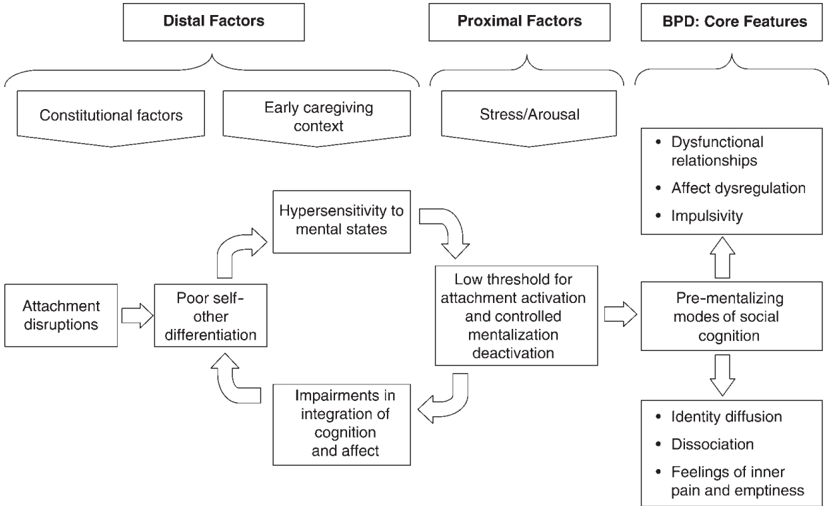
The precise nature and etiopathogenesis of borderline personality disorder (BPD) continues to elude researchers and clinicians. Yet, increasing evidence from various strands of research converges to suggest that affect dysregulation, impulsivity, and unstable relationships constitute the core features of BPD. Over the last two decades, the mentalization-based approach to BPD has attempted to provide a theoretically consistent way of conceptualizing the interrelationship between these core features of BPD, with the aim of providing clinicians with a conceptually sound and empirically supported approach to BPD and its treatment. This paper presents an extended version of this approach to BPD based on recently accumulated data. In particular, we suggest that the core features of BPD reflect impairments in different facets of mentalization, each related to impairments in relatively distinct neural circuits underlying these facets. Hence, we provide a comprehensive account of BPD by showing how its core features are related to each other in theoretically meaningful ways. More specifically, we argue that BPD is primarily associated with a low threshold for the activation of the attachment system and deactivation of controlled mentalization, linked to impairments in the ability to differentiate mental states of self and other, which lead to hypersensitivity and increased susceptibility to contagion by other people's mental states, and poor integration of cognitive and affective aspects of mentalization. The combination of these impairments may explain BPD patients' propensity for vicious interpersonal cycles, and their high levels of affect dysregulation and impulsivity. Finally, the implications of this expanded mentalization-based approach to BPD for mentalization-based treatment and treatment of BPD more generally are discussed.
Overview
CoChat Summary
TL;DR
This paper presents an expanded developmental, mentalization-based model of borderline personality disorder (BPD), arguing that its core features reflect impairments in different facets of mentalization linked to relatively distinct neural circuits. It proposes that BPD involves low thresholds for attachment-system activation and controlled-mentalization deactivation, explaining vicious interpersonal cycles, affect dysregulation, impulsivity, identity diffusion, dissociation, and inner pain.
Key findings
- BPD’s core features are emotional dysregulation, high impulsivity leading to self-harm and suicidality, and disturbed interpersonal functioning; lifetime prevalence is estimated to be as much as 6%, and between 25 and 33% may meet criteria in outpatient and forensic populations.
- Mentalization is multidimensional—automatic/controlled, cognitive/affective, internal/external, and self/other focused—and BPD is primarily associated with failures of explicit, internal, cognitive mentalization, alongside a low threshold for attachment activation and deactivation of controlled mentalization.
- These impairments may produce hypersensitivity and susceptibility to contagion by others’ mental states, poor self-other differentiation, hypermentalization or mentalization failure, and reemergence of prementalizing modes such as psychic equivalence, pretend mode, and teleological mode.
- Treatment implications include aiming for an optimal balance between attachment activation and mentalization; insight-oriented treatments focused on traumatic past may be contraindicated for patients with serious mentalization impairments.
Methods
- Theoretical/review paper presenting an expanded mentalization-based developmental model of BPD, integrating prior formulations with recently accumulated data.
- Draws on extant neuroimaging, developmental social and cognitive research, factor analytic and clinical studies, attachment research, and treatment literature; no new empirical sample or primary data collection is reported.
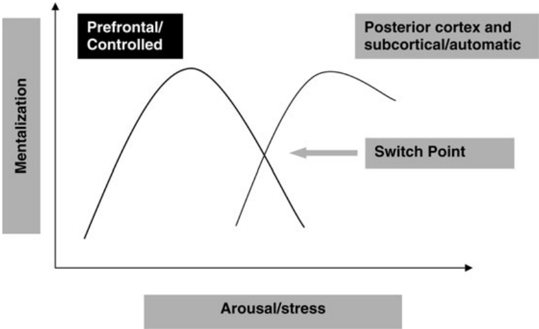
- Main analysis is a conceptual synthesis relating BPD features to four mentalization polarities and proposed neural systems, including a biobehavioral switch model of stress and controlled versus automatic mentalization.
Limitations
- The paper states that cited neuroimaging and physiological studies require further replication because of sometimes small sample sizes, disparate experimental paradigms, and heterogeneity in sample selection (e.g., comorbidity with depression, childhood abuse, PTSD, and copying styles).
- The paper notes that reliable description of BPD in adolescence remains controversial regarding homogeneity, comorbidity between and within axes, arbitrary cutoffs, and poor test-retest reliability, and that stability into adulthood is suggestive rather than well-established.
- The paper states that some predictions remain to be investigated (e.g., recovery time of mentalization with hyperactivating versus deactivating strategies) and that evidence on maladaptive parental mentalizing is still lacking; evident from the text, it is a conceptual/review article and does not empirically test the proposed model.
Model-written summary. Check it against the paper before relying on it.
Integrity signals
Registry
Cites
Statistics
Figures
Verification
Claims the paper makes
24 Valid · 11 Not valid · 130 Not checked · 108 Own results and interpretations
The cited sources support only part of this claim — read each source’s verdict below.
In the paper
“As we have already noted, retrospective evaluations have led to recognition that disorganization of the attachment system is a key aspect of the psychopathology of BPD (Gunderson & Lyons-Ruth, 2008).”
What the sources say
- Partly supportedcites Gunderson & Lyons-Ruth, 2008 matched to “BPD's Interpersonal Hypersensitivity Phenotype: A Gene-Environment-Developmental Model” (2008) sourceExperimental — accuracy not yet measured
The paper calls disorganized attachment especially important to understanding BPD and links it to an adult attachment pattern seen in patients (passage [1], section labeled Abstract). Its Conclusions describe attachment disorganization as one likely developmental pathway, not a defining feature of BPD psychopathology. The RETROSPECTIVE REPORTS section discusses patients’ accounts of difficult childhood relationships but does not say those evaluations established attachment disorganization. (LLM, conf=0.82)
plainstates an association- Asserted: passes — The authors put it forward as true.
- Checkable: passes — It can be checked against evidence.
- Load-bearing: passes — The paper’s conclusions depend on it.
- Based: passes — The paper gives a reason why it holds.
- Partly supported
The cited sources support only part of this claim — read each source’s verdict below.
In the paper
“Indeed, studies of adult attachment patterns of BPD patients repeatedly highlight a combination of preoccupied and unresolved attachment associated with BPD (Agrawal, Gunderson, Holmes, & Lyons-Ruth, 2004; Fonagy et al., 1996; Nakash-Eisikovits, Dutra, & Westen, 2002).”
What the sources say
- Supportedcites Agrawal, Gunderson, Holmes, & Lyons-Ruth, 2004 matched to “Attachment Studies with Borderline Patients: A Review” (2004) source
The Results report that all five studies using the Adult Attachment Interview found the greatest proportion of borderline individuals in the preoccupied or unresolved categories. The Discussion states that BPD attachments seem best characterized as unresolved with preoccupied features in relation to parents, matching the attributed claim. (LLM, conf=0.94)
- Not checked yetcites Fonagy et al., 1996 matched to “The relation of attachment status, psychiatric classification, and response to psychotherapy.” (1996) source
- Partly supportedcites Nakash-Eisikovits, Dutra, & Westen, 2002 matched to “Relationship Between Attachment Patterns and Personality Pathology in Adolescents” (2002) sourceExperimental — accuracy not yet measured
The Association Between Attachment Status and Axis II Pathology section links both anxious/ambivalent and disorganized/unresolved attachment to borderline personality disorder. But this paper studies adolescents, not adult BPD patients, and reports the two associations separately rather than a combined attachment pattern. Its discussion of an adult association concerns preoccupied attachment only. (LLM, conf=0.88)
boostedstates an association- Asserted: passes — The authors put it forward as true.
- Checkable: passes — It can be checked against evidence.
- Load-bearing: unclear — It is unclear whether the paper’s conclusions depend on it.
- Based: passes — The paper gives a reason why it holds.
- Supported
The cited sources support only part of this claim — read each source’s verdict below.
In the paper
“Such gene-environment effects could be one way that the known influence of heredity (Distel et al., 2008; LyonsRuth et al., 2007; Ni et al., 2007) is mediated in BPD.”
What the sources say
- Supportedcites Distel et al., 2008 matched to “Heritability of borderline personality disorder features is similar across three countries” (2008) source
The citation supports the sentence’s reference to a known hereditary influence, not its proposed gene–environment mechanism. The indexed paper’s title identifies its subject as the heritability of borderline personality disorder features; it does not need to establish the citing authors’ speculative explanation of how that influence is mediated. (LLM, conf=0.84)
- Supportedcites LyonsRuth et al., 2007 matched to “Serotonin transporter polymorphism and borderline or antisocial traits among low-income young adults” (2007) source
The Conclusions report genetic influence on liability to borderline and antisocial personality disorders. The Discussion proposes that the observed genetic association may reflect a gene–environment interaction, while noting that the interaction was not tested in this study. That supports the citing sentence’s tentative ‘could be’ formulation. (LLM, conf=0.90)
- Not matchedcites Ni et al., 2007
This doesn’t read as a citation we can look up.
hedgedstates a possible cause- Asserted: passes — The authors put it forward as true.
- Checkable: passes — It can be checked against evidence.
- Load-bearing: unclear — It is unclear whether the paper’s conclusions depend on it.
- Based: passes — The paper gives a reason why it holds.
- Supported
The cited sources support only part of this claim — read each source’s verdict below.
In the paper
“dissociative comorbidity is more frequently reported by patients with BPD than other groups”
What the sources say
- Not checked — no full text of the sourcecites Sar, Akyuz, Kugu, Ozturk, & Ertem-Vehid, 2006 matched to “Axis I Dissociative Disorder Comorbidity in Borderline Personality Disorder and Reports of Childhood Trauma” (2006) source
- Partly supportedcites Zanarini, Frankenburg, Jager-Hyman, Reich, & Fitzmaurice, 2008 matched to “The course of dissociation for patients with borderline personality disorder and axis II comparison subjects: a 10‐year follow‐up study” (2008) sourceExperimental — accuracy not yet measured
The Results report that 76 borderline patients, but only two axis II comparison subjects, had high dissociation scores at baseline. This supports a difference in reported dissociative symptoms between those groups, not a higher frequency of diagnosed dissociative comorbidity across other groups generally. The paper measures symptoms with the Dissociative Experiences Scale rather than reporting rates of comorbid dissociative disorders. (LLM, conf=0.86)
plainstates an association- Asserted: passes — The authors put it forward as true.
- Checkable: passes — It can be checked against evidence.
- Load-bearing: unclear — It is unclear whether the paper’s conclusions depend on it.
- Based: passes — The paper gives a reason why it holds.
The cited sources that could be checked couldn’t confirm or dispute this claim.
In the paper
“may be an extreme indication of such separateness (Ross, 2007; Zanarini et al., 2008).”
What the sources say
- Not checked — no full text of the sourcecites Ross, 2007 matched to “Borderline Personality Disorder and Dissociation” (2007) source
- Could not verifycites Zanarini et al., 2008 matched to “The course of dissociation for patients with borderline personality disorder and axis II comparison subjects: a 10‐year follow‐up study” (2008) sourceExperimental — accuracy not yet measured
The Methods describe dissociation through absorption, depersonalization, and amnesia, while the Discussion reports how their severity changed over time. Neither section characterizes dissociation as an extreme indication of separateness; searches for separateness and related descriptions found no such passage. Page numbers were not available in our copy. (LLM, conf=0.75)
hedgedstates an association- Asserted: passes — The authors put it forward as true.
- Checkable: passes — It can be checked against evidence.
- Load-bearing: unclear — It is unclear whether the paper’s conclusions depend on it.
- Based: passes — The paper gives a reason why it holds.
157 more claims · 13 with their cited sources checked
Create a free account to see all 273 claims and to verify the 9 references still open.
- Probably not a substantial claim. 41
- It may state two separate claims as one. 81
Claims other papers make about this one
Each is checked against this paper’s own text: does it say what the citing paper says it does?
The source backs part of the claim, not all of it — or backs it for a different population, condition or comparison.
In the citing paper
“In this account, an insecure attachment relationship between primary caregiver and child results in avoidance of internal thinking and feeling states in the child because acknowledging such internal states would further threaten an already vulnerable relationship with the caregiver.”
From First evidence of a prospective relation between avoidance of internal states and borderline personality disorder features in adolescents. (2015) · cites this paper as [19]
Experimental — accuracy not yet measuredThe source backs part of the claim, not all of it — or backs it for a different population, condition or comparison.
In the citing paper
“In turn, the child is at increased risk of developing BPD.”
From First evidence of a prospective relation between avoidance of internal states and borderline personality disorder features in adolescents. (2015) · cites this paper as [19]
Experimental — accuracy not yet measuredThe source backs part of the claim, not all of it — or backs it for a different population, condition or comparison.
In the citing paper
“In line with this, mentalization as an emotion regulation strategy has been considered a top-down strategy, relying in the explicit emotion regulation and in the theory of mind brain systems (Fonagy and Luyten, 2009; Vrticka and Vuilleumier, 2012).”
From Mindfulness and Emotion Regulation: Insights from Neurobiological, Psychological, and Clinical Studies (2017) · cites this paper as Fonagy and Luyten, 2009
Experimental — accuracy not yet measuredIn the citing paper
“stress and distress is thought to have a detrimental impact on the capacity to mentalize, especially if the stress is interpersonal in nature.”
From Investigating the association between parental reflective functioning and distress tolerance in motherhood. (2015) · cites this paper as Fonagy & Luyten, 2009
In the citing paper
“Stress and heightened arousal may inhibit the engagement of cortically-controlled processes of explicit mentalization that underscore reflection and reasoning when engaged with others (Fonagy & Luyten, 2009).”
From Investigating the association between parental reflective functioning and distress tolerance in motherhood. (2015) · cites this paper as Fonagy & Luyten, 2009
Citations
Cites
Fredrickson, B. L. (2001) · American Psychologist · doi:10.1037//0003-066x.56.3.218 · Cited by 18,025 · cited 2×
“…insight into BPD. Studies suggest that the ability to continue to mentalize even under considerable stress leads to so-called “broaden and build” (Fredrickson, 2001) cycles of attachment security, which reinforce feelings of secure attachment, personal agency, and affect regulation (“build”),…”
BackgroundRizzolatti, G., & Craighero, L. (2004) · Annual Review of Neuroscience · doi:10.1146/annurev.neuro.27.070203.144230 · Cited by 7,433 · cited 1×
“…system involves a more body-based, frontoparietal mirror neuron system that is involved in understanding the multimodal embodied self (e.g., face and body recognition) and understanding others through motor-simulation mechanisms (Gallese, Keysers, & Rizzolatti, 2004; Rizzolatti & Craighero, 2004).”
Background(1993) · Cited by 7,136
Attachment in adulthood: structure, dynamics, and change
(2008) · Choice Reviews Online · doi:10.5860/choice.45-2903 · Cited by 4,315
Affect Regulation, Mentalization, and the Development of the Self
Fonagy, P., Gergely, G., Jurist, E. L., & Target, M. (2018) · doi:10.4324/9780429471643 · Cited by 3,886
Self-citationThe Child's Conception of Space
Lawrence, E., Piaget, J., Inhelder, B., Langdon, F. J., & Lunzer, J. L. (1957) · British Journal of Educational Studies · doi:10.2307/3118882 · Cited by 3,213
Cattaneo, L., & Rizzolatti, G. (2009) · Archives of Neurology · doi:10.1001/archneurol.2009.41 · Cited by 3,137
Self-referential processing in our brain—A meta-analysis of imaging studies on the self
Northoff, G., Heinzel, A., de Greck, M., Bermpohl, F., Dobrowolny, H., & Panksepp, J. (2006) · NeuroImage · doi:10.1016/j.neuroimage.2005.12.002 · Cited by 2,792 · cited 1×
“The aFMC is involved in mentalizing (Frith & Frith, 2006; Gilbert et al., 2007) and self-referential processing (Northoff et al., 2006).”
BackgroundMayberg, H. S., Liotti, M., Brannan, S. K., McGinnis, S., Mahurin, R. K., Jerabek, P. A., Silva, J. A., Tekell, J. L., Martin, C. C., Lancaster, J. L., et al. (1999) · American Journal of Psychiatry · doi:10.1176/ajp.156.5.675 · Cited by 2,416 · cited 2×
“…for attention and long-term memory (Cabeza & Nyberg, 2000), perhaps specifically responsible for integrating emotion and cognition (e.g., emotional encoding of episodic memories; Maddock, 1999) and subserving moodmediated inhibition or enhancement of cognitive processing (Mayberg et al., 1999).”
BackgroundThe debate over dopamine’s role in reward: the case for incentive salience
Berridge, K. C. (2007) · Psychopharmacology · doi:10.1007/s00213-006-0578-x · Cited by 2,347 · cited 1×
“These findings suggest that for securely attached mothers, infant cues (whether positive or negative in affect) may act as an important affective signal of “incentive salience” (Berridge, 2007), reinforcing and motivating responsive maternal care.”
Background
Research works printed but not linked: 12
- Williams, 2006, Handbook of mentalisation based treatments
- 10.1093/med/9780198569183.001.0001 · DOI · Paper page
- 10.1111/1469-7610.0013_7 · doi:10.1111/1469-7610.0013_7 · Paper page
- Gergely, 1996, The social biofeedback model of parental affect-mirroring, International Journal of Psycho-Analysis, 77, 1181
- Luyten, 2009, The interpersonal regulation of stress
- Bloom, 2004, Descartes' baby
- Hobson, 2002, The cradle of thought: Explorations of the origins of thinking
- Fearon, 2006, Handbook of mentalisaiton based treatments
- Diamond, 1991, Self–other differentiation of object representations
- Hesse, 2008, Handbook of attachment theory and research, 552
- Luyten, 2009, Mentalization as a multidimensional concept
- O'Connor, 2006, Developmental psychopathology: Vol. 3. Risk, disorder and adaptation, 202
Cited by
Items 201–300 of 1,140
Mizen, C. S., & Hook, J. (2020) · BJPsych Advances · doi:10.1192/bja.2020.63 · Cited by 38
Developmental Contributions to Emotional Awareness
Smith, R. S., Quinlan, D. M., SCHWARTZ, G. E. R., Sanova, A., Alkozei, A., & Lane, R. D. (2018) · Journal of Personality Assessment · doi:10.1080/00223891.2017.1411917 · Cited by 42
“…important theoretical advances regarding the developmental processes that contribute to theory of mind (ToM; also called mentalization) abilities, which overlap considerably with the EA construct (Beebe & Lachmann, 2014; Fonagy & Luyten, 2009; Luyten, Houdenhove, Lemma, Target, & Fonagy, 2012).”
BackgroundShai, D., & Meins, E. (2018) · Infancy · doi:10.1111/infa.12244 · Cited by 48
The role of mentalising in the management of violence
Adshead, G. M. J., Moore, E., Humphrey, M., Wilson, C., & Tapp, J. (2013) · Advances in Psychiatric Treatment · doi:10.1192/apt.bp.110.008243 · Cited by 43
“In reviewing the basis for a mentalisation-based approach for people with borderline personality disorder, Fonagy & Luyten (2009) refer to this group as having difficulty in tasks that require a direct focus on mental interiors, while being adept at understanding external characteristics.”
BackgroundBoldrini, T., Pontillo, M., Tanzilli, A., Giovanardi, G., Cicilia, G. D., Salcuni, S., Vicari, S., & Lingiardi, V. (2020) · Schizophrenia Research · doi:10.1016/j.schres.2020.05.052 · Cited by 53
Primary emotional traits in patients with personality disorders
Karterud, S., Pedersen, G., Johansen, M. S., Wilberg, T., Davis, K., & Panksepp, J. (2016) · Personality and Mental Health · doi:10.1002/pmh.1345 · Cited by 39
Pos, K., Bartels‐Velthuis, A. A., Simons, C. J. P., Korver‐Nieberg, N., Meijer, C. J., de Haan, L., for GROUP, Bruggeman, R., Cahn, W., de Haan, L., et al. (2014) · Australian & New Zealand Journal of Psychiatry · doi:10.1177/0004867414546386 · Cited by 43
“Fonagy and Luyten (2009) argue that higher anxious attachment is associated with a lowered threshold for the activation of defensive/insecure coping mechanisms (activation of insecure attachment-related behaviour) and simultaneously for ToM/mentalization deactivation; persons with higher scores on…”
Bo, S., & Kongerslev, M. (2017) · Borderline Personality Disorder and Emotion Dysregulation · doi:10.1186/s40479-017-0055-7 · Cited by 48
“Mentalization refers to the ability to understand the self and others as intentional agents with minds [30].”
BackgroundDinsdale, N. L., & Crespi, B. J. (2012) · Journal of Personality Disorders · doi:10.1521/pedi_2012_26_071 · Cited by 36
The Social Neuroscience of Attachment
Vrtička, P. (2017) · Springer eBooks · doi:10.1007/978-3-319-68421-5_5 · Cited by 44
Childhood maltreatment and mentalizing capacity: A meta-analysis
Yang, L., & Huang, M. (2024) · Child Abuse & Neglect · doi:10.1016/j.chiabu.2023.106623 · Cited by 52
Morosan, L., Ghisletta, P., Badoud, D., Sprüngli‐Toffel, E., Eliez, S., & Debbané, M. (2019) · Child Psychiatry & Human Development · doi:10.1007/s10578-019-00910-8 · Cited by 44
Fonagy, P. (2015) · Psychoanalytic Inquiry · doi:10.1080/07351690.2015.1022481 · Cited by 42
“In disruptions and repair of ongoing regulations, expectations are violated and ensuing efforts to resolve these breaches are hypothesized to underpin the generation of further psychic structure (see also Blatt and Behrends, 1987; Blatt and Luyten, 2009).”
BackgroundResultInfluentialSelf-citationTreating Borderline Personality Disorder With Psychotherapy
Fonagy, P., Luyten, P., & BATEMAN, A. W. (2017) · JAMA Psychiatry · doi:10.1001/jamapsychiatry.2016.4302 · Cited by 38
Self-citationSharp, C., Vanwoerden, S., Jouriles, E. N., Godfrey, D. A., Babcock, J., McLaren, V., McFarlane, J., Brashear, B., Walton, Q., & Temple, J. R. (2020) · Child Abuse & Neglect · doi:10.1016/j.chiabu.2020.104448 · Cited by 34
Taubner, S., & Kotte, S. C. (2018) · Springer eBooks · doi:10.1007/978-3-662-49483-7_41 · Cited by 34
Why is fathers’ reflective function important?
Benbassat, N., & Priel, B. (2015) · Psychoanalytic Psychology · doi:10.1037/a0038022 · Cited by 48
Kernmodell der Mentalisierungsbasierten Therapie
Taubner, S., & Sevecke, K. (2015) · Psychotherapeut · doi:10.1007/s00278-015-0012-0 · Cited by 37
“In jüngster Zeit ist das Konzept der Mentalisierung einer Erweiterung unterzogen worden, die Men talisierung als multidimensionales und dynamisches Konstrukt begreift, was die Einführung eines stressabhängigen Schaltmodells der Mentalisierung begründet („biobehaviouralswitchmodel“, [9]).”
BackgroundCurrent trends in BPD research as indicative of a broader sea-change in psychiatric nosology.
Sharp, C. (2016) · Personality Disorders Theory Research and Treatment · doi:10.1037/per0000199 · Cited by 43
“In Fonagy’s attachment and mentalization-based theory of BPD (Fonagy & Luyten, 2009), as well as Gunderson and Lyons-Ruth’s (2008)’s gene–environment developmental model, genetic factors (inherited theory of mind capacity and hypersensitivity to interpersonal stressors) and environmental factors…”
BackgroundInfluentialFoubert, K., Collins, T., & Backer, J. D. (2017) · Frontiers in Psychology · doi:10.3389/fpsyg.2017.00537 · Cited by 45
“…difficulties in maintaining close relationships, and attachment relationships in particular (e.g., romantic partner, Melges and Swartz, 1989; Levy, 2005; Gunderson and Lyons-Ruth, 2008; Choi-Kain et al., 2009; Fonagy and Luyten, 2009; Beckes and Coan, 2011; Levy et al., 2015; Beeney et al., 2016).”
BackgroundAttachment and medically unexplained somatic symptoms: The role of mentalization
Riem, M. M. E., Doedée, E. N. E. M., Broekhuizen-Dijksman, S. C., & Beijer, E. (2018) · Psychiatry Research · doi:10.1016/j.psychres.2018.06.056 · Cited by 47
Kalpakci, A. H., Vanwoerden, S., Elhai, J. D., & Sharp, C. (2015) · Journal of Personality Disorders · doi:10.1521/pedi_2015_29_192 · Cited by 46
“E-mail: csharp2@uh.edu G4474.indd 242 3/15/2016 10:30:17 AM disorder (Fonagy & Luyten, 2009; Gunderson, 2007; Linehan, 1993; Sharp, 2014), in that marked impairment in maintaining stable and healthy relationships is one of the most debilitating features of the disorder.”
BackgroundHertzmann, L., Target, M., Hewison, D., Casey, P., Fearon, P. R. M., & Lassri, D. (2016) · Psychotherapy · doi:10.1037/pst0000092 · Cited by 66
Georg, A. K., Meyerhöfer, S., Taubner, S., & Volkert, J. (2023) · Clinical Psychology Review · doi:10.1016/j.cpr.2023.102322 · Cited by 36
Mentalization within close relationships: The role of specific attachment style
Bączkowski, B. M., & Cierpiałkowska, L. (2015) · Polish Psychological Bulletin · doi:10.1515/ppb-2015-0035 · Cited by 42
“Based on these findings, Fonagy and Luyten (2009) proposed that mentalization is underpinned by four functional polarities: (1) automatic – controlled, (2) internally-focused – externally-focused, (3) self-oriented – other-oriented, (4) cognitive – affective.”
BackgroundMethodInfluentialExamining Mindfulness and Its Relation to Self-Differentiation and Alexithymia
Teixeira, R. J., & Pereira, M. G. (2013) · Mindfulness · doi:10.1007/s12671-013-0233-7 · Cited by 58
“…positive attachment and affiliative relationships, emotions may become more dangerous and difficult to explore, think about, or reflect on, even becoming a source of avoidance and alexithymia (Fonagy and Luyton 2009; Fonagy and Target 2006; Liotti and Gilbert 2011; Mikulincer and Shaver 2007).”
BackgroundVanwoerden, S., Kalpakci, A. H., & Sharp, C. (2017) · Psychiatry Research · doi:10.1016/j.psychres.2017.08.015 · Cited by 42
“These studies have been instrumental in providing important empirical support for long-held theories of BPD development (Fonagy and Luyten, 2009; Linehan, 1993) that state that harmful parent-child dynamics contribute to the development and maintenance of BPD.”
School-Aged Children With Higher Reflective Functioning Exhibit Lower Cardiovascular Reactivity
Borelli, J. L., Ensink, K., Hong, K., Sereno, A. T., Drury, R. L., & Fonagy, P. (2018) · Frontiers in Medicine · doi:10.3389/fmed.2018.00196 · Cited by 50
“At the same time, mentalization is impacted by emotional arousal—higher levels of arousal may inhibit effortful and deliberate RF (31, 40).”
BackgroundSelf-citationThe ‘Self' and Borderline Personality Disorder: Conceptual and Clinical Considerations
Kerr, I. B., Finlayson-Short, L., McCutcheon, L., Beard, H., & Chanen, A. M. (2015) · Psychopathology · doi:10.1159/000438827 · Cited by 40
Reflective functioning, affect consciousness, and mindfulness: Are these different functions?
Falkenström, F., Solbakken, O. A., Möller, C. M., Lech, B., Sandell, R., & Holmqvist, R. (2014) · Psychoanalytic Psychology · doi:10.1037/a0034049 · Cited by 54
“1 More recently Fonagy and Luyten (2009) have added a fourth dimension—mentalization based on internal versus external features of self and others.”
BackgroundRipoll, L. H. (2011) · Current Opinion in Psychiatry · doi:10.1097/yco.0b013e32834c3f19 · Cited by 37
Luyten, P., Blatt, S. J., & Mayes, L. C. (2011) · Humana Press eBooks · doi:10.1007/978-1-60761-792-1_21 · Cited by 41
Self-citationModelling the effect of religion on human empathy based on an adaptive temporal–causal network model
van Ments, L., Roelofsma, P. H. M. P., & Treur, J. (2018) · Computational Social Networks · doi:10.1186/s40649-017-0049-z · Cited by 36
“Mentalizing can occur both consciously or unconsciously, concern the self or others, and is both cognitive and affective [19].”
BackgroundJain, F. A., & Fonagy, P. (2018) · Mindfulness · doi:10.1007/s12671-018-0969-1 · Cited by 43
“On the basis of functional brain imaging studies, mentalizing has been deconstructed into four attributes, each of which is dimensional in nature and can be defined by its extreme poles: cognition–emotion, implicit–explicit, internal– external, self–other (Fonagy and Luyten 2009).”
BackgroundSelf-citationDunn, A., Cartwright‐Hatton, S., Startup, H. M., & Papamichail, A. (2020) · Frontiers in Psychology · doi:10.3389/fpsyg.2020.01913 · Cited by 40
A Five‐Factor Model Framework for Understanding Childhood Personality Disorder Antecedents
Clercq, B. J. D., & Fruyt, F. D. (2012) · Journal of Personality · doi:10.1111/j.1467-6494.2012.00778.x · Cited by 37
Górska, D., & Marszał, M. (2014) · PubMed · Cited by 51
The Routledge Handbook of Attachment: Implications and Interventions
(2014) · Routledge eBooks · doi:10.4324/9781315764283 · Cited by 32
“43 24 /9 78 13 15 76 From the point of view of parenting, important features of BPD include affective instability; an unstable sense of self; substance abuse; and episodes of deliberate self-harm.”
BackgroundMethodInfluentialSchnell, K., & Herpertz, S. C. (2018) · Journal of Personality Disorders · doi:10.1521/pedi.2018.32.supp.12 · Cited by 32
A nationwide study of social–emotional problems in young children in Turkey
Karabekiroğlu, K., Uslu, R. I., Kapci-Seyitoglu, E. G., Özbaran, B., Öztop, D. B., Özel-Özcan, Ö., Doğangün, B., Şişmanlar, Ş. G., Görker, İ., Fidan, T., et al. (2013) · Infant Behavior and Development · doi:10.1016/j.infbeh.2012.11.007 · Cited by 36
Fossati, A., Somma, A., Krueger, R. F., Markon, K. E., & Borroni, S. (2017) · Clinical Psychology & Psychotherapy · doi:10.1002/cpp.2091 · Cited by 40
Green, J. A., Berry, K., Danquah, A., & Pratt, D. (2020) · Clinical Psychology & Psychotherapy · doi:10.1002/cpp.2445 · Cited by 37
Borderline personality disorder in adolescents: the He-who-must-not-be-named of psychiatry
Larrivée, M.-P. (2013) · Dialogues in Clinical Neuroscience · doi:10.31887/dcns.2013.15.2/mplarrivee · Cited by 50
“40 MBT aims to improve the patient’s ability to understand his own and other’s mental states (mentalizing) in the context of attachment relationships, which is demonstrated as helpful in both affective and behavioral aspects of BPD. Concretely, this is done using weekly individual sessions and group sessions.”
BackgroundInfluentialOxytocin and Borderline Personality Disorder
Bertsch, K., & Herpertz, S. C. (2017) · Current topics in behavioral neurosciences · doi:10.1007/7854_2017_26 · Cited by 37
Mentalization-Based Treatment for Adolescents with Borderline Traits
Fonagy, P., Rossouw, T. I., Sharp, C., BATEMAN, A. W., Allison, L., & Farrar, C. (2014) · Springer eBooks · doi:10.1007/978-1-4939-0591-1_21 · Cited by 37
Self-citationLocati, F., Benzi, I. M. A., Milesi, A., Campbell, C., Midgley, N., Fonagy, P., & Parolin, L. A. L. (2023) · Journal of Adolescence · doi:10.1002/jad.12226 · Cited by 32
“emotions and behaviors (Allen, 2018): its conceptualization encompasses four polarities, including implicit or explicit, internal or external, directed toward the self or others, and cognitive or a ff ective characterizations (Fonagy & Luyten, 2009).”
BackgroundSelf-citationGeerling, I., Roberts, R., & Williams, A. S. (2019) · Infant Mental Health Journal · doi:10.1002/imhj.21776 · Cited by 34
Soloff, P. H., Feske, U., & Fabio, A. (2008) · Journal of Personality Disorders · doi:10.1521/pedi.2008.22.3.221 · Cited by 29
Georg, A. K., Schröder, P., Cierpka, M., & Taubner, S. (2018) · Praxis der Kinderpsychologie und Kinderpsychiatrie · doi:10.13109/prkk.2018.67.5.421 · Cited by 36
Davies, G., Hayward, M., Evans, S., & Mason, O. J. (2020) · Psychiatry Research · doi:10.1016/j.psychres.2020.112864 · Cited by 35
Edwards, E. R., Rose, N. L. J., Gromatsky, M. A., Feinberg, A., Kimhy, D., Doucette, J. T., Goodman, M. S., McClure, M. M., Pérez-Rodríguez, M. M., New, A. S., et al. (2021) · Journal of Personality Disorders · doi:10.1521/pedi_2021_35_513 · Cited by 60
Attachment and Parenting in Adult Patients with Anxiety Disorders
Picardi, A., Caroppo, E., Fabi, E., Proietti, S., Gennaro, G. D., Meldolesi, G., & Martinotti, G. (2013) · Clinical Practice and Epidemiology in Mental Health · doi:10.2174/1745017901309010157 · Cited by 39
“Indeed, authors from different theoretical perspectives, such as psychoanalysis [42-45], cognitive therapy”
BackgroundREFLECTING TOGETHER: REFLECTIVE FUNCTIONING AS A FOCUS FOR DEEPENING GROUP SUPERVISION
Heffron, M. C., Reynolds, D., & Talbot, B. (2016) · Infant Mental Health Journal · doi:10.1002/imhj.21608 · Cited by 34
Attachment styles modulate neural markers of threat and imagery when engaging in self-criticism
Kim, J. J., Kent, K. M., Cunnington, R., Gilbert, P., & Kirby, J. N. (2020) · Scientific Reports · doi:10.1038/s41598-020-70772-x · Cited by 35
Koelen, J. A., Eurelings-Bontekoe, E. H. M., Stuke, F., & Luyten, P. (2015) · The International Journal of Psychiatry in Medicine · doi:10.1177/0091217415589303 · Cited by 36
“, impaired abilities to reflect upon mental states in self and others, particularly under high levels of arousal.(55,56) Attachment hyperactivation strategies were negatively associated with cognitive but not affective alexithymia.”
BackgroundSelf-citationByström, K., Grahn, P., & Hägerhäll, C. (2019) · International Journal of Environmental Research and Public Health · doi:10.3390/ijerph16234673 · Cited by 27
“For young children, strong negative emotions are associated with experiences of stress and they need help with regulation of affect [65,85].”
BackgroundChelouche-Dwek, G., & Fonagy, P. (2024) · European Child & Adolescent Psychiatry · doi:10.1007/s00787-024-02578-5 · Cited by 48
“The Peaceful Schools project [20, 25 ] included children’s self-reported experiences of and beliefs about aggression and victimization using various measures.”
Self-citationKøster, A. (2017) · Theory & Psychology · doi:10.1177/0959354317711031 · Cited by 32
“According to Fonagy and Luyten (2009), we need to distinguish between four dimensions that define mentalization, where each dimension is suspended between two poles: the first specifies a distinction between explicit vs. implicit mentalization.”
BackgroundCooper, E. B., Anderson, J. L., Sharp, C., Langley, H. A., & Venta, A. C. (2021) · Borderline Personality Disorder and Emotion Dysregulation · doi:10.1186/s40479-021-00163-9 · Cited by 36
“This lack of emotional sharing results in the child not understanding how to interpret others’ or their own emotions, including their parent’s, leading to impaired self and interpersonal functioning [3, 5].”
BackgroundResultInfluentialMoreira, H., & Fonseca, A. (2022) · Child Psychiatry & Human Development · doi:10.1007/s10578-021-01288-2 · Cited by 38
“For instance, high emotional arousal can lead to automatic mentalization and suppress controlled mentalization [18].”
BackgroundSharp, C. (2022) · New England Journal of Medicine · doi:10.1056/nejmra2120164 · Cited by 36
Martin-Gagnon, G., Normandin, L., Fonagy, P., & Ensink, K. (2023) · Frontiers in Psychology · doi:10.3389/fpsyg.2023.1237735 · Cited by 46
“According to the MZ developmental model of BPD, early maltreatment disrupts the development of MZ, leading to poorer affect regulation, self-other differentiation, and a low threshold for controlled MZ deactivation, which all contribute to the risk of developing BPD symptoms (Fonagy and Luyten, 2009; Duval et al., 201…”
MethodResultSelf-citationEnsink, K., Biberdzic, M., Normandin, L., & Clarkin, J. F. (2015) · Journal of Infant Child and Adolescent Psychotherapy · doi:10.1080/15289168.2015.1007715 · Cited by 38
“Furthermore, Lieberman (2007) makes a distinction between a reflective mode and a reflexive mode of mentalizing that is likely to be particularly relevant for understanding the interpersonal evaluation biases in individuals with BPD (Fonagy & Luyten, 2009).”
BackgroundGrasping the process of implicit mentalization
Davidsen, A. S., & Fosgerau, C. F. (2015) · Theory & Psychology · doi:10.1177/0959354315580605 · Cited by 43
“The term mentalized affectivity was introduced to account for what is considered the most fundamental form of mentalizing, which establishes a kind of emotional knowledge (Allen et al., 2008; Fonagy & Luyten, 2009; Jurist, 2010).”
BackgroundInfluentialTang, E., Bleys, D., & Vliegen, N. (2018) · Frontiers in Psychology · doi:10.3389/fpsyg.2018.01189 · Cited by 30
“, abuse or neglect) the attachment system becomes disorganized (for a comprehensive review, see Cicchetti and Valentino, 2006) and mentalizing capacities remain underdeveloped (Fonagy and Luyten, 2009) or become conflicted as a form of decoupling, inhibition, or even a phobic reaction to mentalizing (Pace et al.”
BackgroundBenzi, I. M. A., Fontana, A., Barone, L., Preti, E., Parolin, L. A. L., & Ensink, K. (2022) · Journal of Adolescence · doi:10.1002/jad.12134 · Cited by 29
Sikder, A. T., Yang, F. C., Schafer, R., Dowling, G. A., Traeger, L. N., & Jain, F. A. (2019) · JMIR Aging · doi:10.2196/12850 · Cited by 30
“Mentalization refers to the process by which we consider and understand mental states along different dimensions: self and other, cognitive and affective, implicit automatic cognition and explicitly controlled, direct internal consideration of thoughts and feelings, and observation of external facial and behavioral cu…”
BackgroundGambling and Attachment: The Mediating Role of Alexithymia in Adolescents and Young Adults
Estévez, A., Jáuregui, P., Macía, L., & López-González, H. (2020) · Journal of Gambling Studies · doi:10.1007/s10899-020-09965-y · Cited by 35
Wurman, T. V., Lee, T., BATEMAN, A. W., Fonagy, P., & Nolte, T. (2020) · Counselling Psychology Quarterly · doi:10.1080/09515070.2020.1814694 · Cited by 27
Self-citationAzhari, A., Gabrieli, G., Bizzego, A., Bornstein, M. H., & Esposito, G. (2020) · Attachment & Human Development · doi:10.1080/14616734.2020.1840790 · Cited by 29
“According to Fonagy and Luyten (2009) and Lieberman (2007), mentalisation can be distinguished into two processes that are adopted differentially based on adult attachment style: one is emotional and the other is cognitive.”
BackgroundInfluentialParada‐Fernández, P., Herrero‐Fernández, D., Macías, M. O., & Rohwer, H. (2021) · Scandinavian Journal of Psychology · doi:10.1111/sjop.12717 · Cited by 43
A social inference model of idealization and devaluation.
Story, G. W., Smith, R. S., Moutoussis, M., Berwian, I. M., Nolte, T., Bilek, E., Siegel, J. Z., & Dolan, R. J. (2024) · Psychological Review · doi:10.1037/rev0000430 · Cited by 37
“…is therefore congruent with an idea that splitting derives in part from an invalidating or emotionally impoverished childhood environment, as described by the developmental theories considered in the introduction (Bender & Skodol, 2007; Crowell et al., 2009; Fonagy & Luyten, 2009; Kernberg, 1967).”
BackgroundActivating Mentalization in Parents: An Integrative Framework
Malberg, N. T. (2015) · Journal of Infant Child and Adolescent Psychotherapy · doi:10.1080/15289168.2015.1068002 · Cited by 26
“Contemporary attachment theorist, Peter Fonagy and collaborators (Fonagy & Allison, 2014; Fonagy & Luyten, 2009) have recently point out to the evolutionary value of mentalization, specifically in the context of the development of epistemic trust.”
BackgroundLuyten, P., Lowyck, B., & Blatt, S. J. (2017) · Psychoanalytic Inquiry · doi:10.1080/07351690.2017.1285187 · Cited by 31
“…in that resilient individuals have been shown to actively influence and select their environment (as evidenced in changing one’s job, breaking contact with old friends, etc.)—a process that may also occur in successful psychotherapy (Hauser, Allen, and Golden, 2006; Fonagy and Luyten, 2009).”
BackgroundSelf-citationBennett, C., Melvin, G. A., Quek, J., Saeedi, N., Gordon, M. S., & Newman, L. K. (2018) · Child Psychiatry & Human Development · doi:10.1007/s10578-018-0833-5 · Cited by 31
Attachment Security and Suicide Ideation and Behaviour: The Mediating Role of Reflective Functioning
Green, J., Berry, K., Danquah, A., & Pratt, D. (2021) · International Journal of Environmental Research and Public Health · doi:10.3390/ijerph18063090 · Cited by 25
“Fonagy and Luton’s [50] mentalisation-based model postulates that distal (attachment disruptions) and proximal risk factors (stress and arousal) interact to lower a person’s threshold for activation of their attachment system, and subsequent deactivation of their mentalising capabilities.”
BackgroundInfluentialMirror neuron activations in encoding of psychic pain in borderline personality disorder
Sosic-Vasic, Z., Eberhardt, J., Bosch, J. E., Dommes, L., Labek, K., Buchheim, A., & Viviani, R. (2019) · NeuroImage Clinical · doi:10.1016/j.nicl.2019.101737 · Cited by 56
“In contrast, the type of social cognition often referred to as mentalization or theory-of-mind (Saxe and Kanwisher, 2003; Frith and Frith, 2003; Fonagy and Luyten, 2009) refers to the ability to read the reasons for the behavior of others and take them into account in one's own responses to manage interpersonal relati…”
Fatimah, H., Wiernik, B. M., Gorey, C. M., McGue, M. K., Iacono, W. G., & Bornovalova, M. A. (2019) · Psychological Medicine · doi:10.1017/s0033291719001260 · Cited by 41
“The influences of parental psychopathology, parent–child interactions, and family environment have been prominent in both theoretical frameworks of BPD (Kernberg, 2004; Fonagy and Luyten, 2009) and in empirical research (Paris, 2000; Zanarini, 2000; Gratz et al., 2011; Belsky et al., 2012).”
BackgroundKyrios, M., Nelson, B., Ahern, C., Fuchs, T. A. E., & Parnas, J. (2015) · Psychopathology · doi:10.1159/000438876 · Cited by 26
Mentalizing in mothers and children with type 1 diabetes
Costa‐Cordella, S., Luyten, P., Cohen, D., Salas, F. M., & Fonagy, P. (2020) · Development and Psychopathology · doi:10.1017/s0954579419001706 · Cited by 33
Self-citationSalaminios, G., Morosan, L., Sprüngli‐Toffel, E., Tanzer, M., Eliez, S., Badoud, D., Armando, M., & Debbané, M. (2020) · Early Intervention in Psychiatry · doi:10.1111/eip.13011 · Cited by 35
“Good mentalizing entails the integration of these processes to construe a sensitive understanding of the internal states (ie, thoughts, feelings) underpinning one's own and others' intentions (Fonagy, Gergely, Jurist, & Target, 2002; Fonagy & Luyten, 2009).”
BackgroundMeulemeester, C. D., Lowyck, B., Panagiotopoulou, E., Fotopoulou, A., & Luyten, P. (2021) · Personality Disorders Theory Research and Treatment · doi:10.1037/per0000415 · Cited by 31
“…with SOD are assumed to stem from difficulties in mentalizing, that is, the ability to reflect upon the internal mental states of self and others (Fonagy & Luyten, 2009; Luyten, Campbell, & Fonagy, 2019), which is for an important part rooted in bodily processes, that is, in the experience of…”
BackgroundSelf-citationDollberg, D. G., Hanetz‐Gamliel, K., & Levy, S. (2021) · Current Psychology · doi:10.1007/s12144-021-02476-y · Cited by 31
Liotti, M., Spitoni, G. F., Lingiardi, V., Marchetti, A., Speranza, A. M., Valle, A., Jurist, E. L., & Giovanardi, G. (2021) · PLoS ONE · doi:10.1371/journal.pone.0260678 · Cited by 27
“As Fonagy and Luyten [42] already suggested, the mentalization deficits described above (not dissimilar to that observed in borderline personality disorder; [38]) could be the result of poor integration between a “lower”, implicit form of mentalizing, more related to affects, and a “higher” form, more related to refle…”
BackgroundQuevedo, Y., Booij, L., Herrera, L., Hernández, C., & Jiménez, J. P. (2022) · Frontiers in Human Neuroscience · doi:10.3389/fnhum.2022.955005 · Cited by 31
“Mentalization can be understood as a mental activity that allows interpreting behavior in terms of intentional mental states of others (needs, desires, feelings, goals), constituting a form of social cognition (Fonagy and Luyten, 2009).”
BackgroundInfluentialAttachment and perceived stress in patients with ulcerative colitis, a case–control study
Agostini, A., Fornarini, G. S., Ercolani, M., & Campieri, M. (2016) · Journal of Psychiatric and Mental Health Nursing · doi:10.1111/jpm.12331 · Cited by 27
Macfie, J., Kurdziel, G., Mahan, R. M., & Kors, S. B. (2017) · Journal of Personality Disorders · doi:10.1521/pedi_2017_31_275 · Cited by 36
“…an understanding would then inform interventions for mothers with BPD in individual (Bateman & Fonagy, 2008; Crowell, Beauchaine, & Linehan, 2009; Fonagy & Luyten, 2009; Kellogg & Young, 2006; Levy et al., 2006; Linehan, 1993) and mother-child dyadic (Fraiberg, Adelson, & Shapiro, 1975;…”
Emotional understanding, aggression, and social functioning among preschoolers.
Laurent, G., Hecht, H. K., Ensink, K., & Borelli, J. L. (2020) · American Journal of Orthopsychiatry · doi:10.1037/ort0000377 · Cited by 34
Keng, S.-L., & Wong, Y. Y. (2017) · Borderline Personality Disorder and Emotion Dysregulation · doi:10.1186/s40479-017-0075-3 · Cited by 23
“While there are several developmental models of BPD [4, 5], one of the most dominant models is Linehan’s biosocial theory of BPD [6].”
BackgroundSmith, R., Kaszniak, A. W., Katsanis, J., Lane, R. D., & Nielsen, L. (2019) · Consciousness and Cognition · doi:10.1016/j.concog.2018.12.004 · Cited by 23
Ziv, Y., & Arbel, R. (2020) · International Journal of Environmental Research and Public Health · doi:10.3390/ijerph17010358 · Cited by 26
“, the inability to be reflective about others’ thoughts and feelings, is likely to result in lower social skills and major functioning difficulties [15,16].”
BackgroundAttachment-related dimensions in the epigenetic era: A systematic review of the human research
Craig, F., Tenuta, F., Rizzato, V., Costabile, A., Trabacca, A., & Montirosso, R. (2021) · Neuroscience & Biobehavioral Reviews · doi:10.1016/j.neubiorev.2021.03.006 · Cited by 26
Mousavi, P. S. S., Vahidi, E., Ghanbari, S., Khoshroo, S., & Sakkaki, S. Z. (2021) · Journal of Infant Child and Adolescent Psychotherapy · doi:10.1080/15289168.2021.1945721 · Cited by 34
“…finding is in line with studies suggesting that attachment anxiety and attachment avoidance are both maladaptive strategies to regulate affect in response to emotionally and physically unavailable caregivers, and thus are related to impairments in RF (Fonagy & Luyten, 2009; Luyten et al., 2017).”
BackgroundRüfenacht, E., Pham, E., Nicastro, R., Dieben, K., Hasler, R., Weibel, S., & Perroud, N. A. (2021) · Biomedicines · doi:10.3390/biomedicines9101469 · Cited by 25
The psychological impact of sarcoma on affected patients
Franzoi, I. G., Granieri, A., Sauta, M. D., Agnesone, M., Gonella, M., Grimaldi, C., Vallauri, I., Boglione, A., Vana, F., Bergnolo, P., et al. (2023) · Psycho-Oncology · doi:10.1002/pon.6240 · Cited by 28
“11,17,18 Considering these aspects is important, particularly for patients with rare forms of cancer.”
BackgroundMentalizing in and out of awareness: A meta-analytic review of implicit and explicit mentalizing
Kivity, Y., Levy, K. N., Johnson, B. N., Rosenstein, L. K., & LeBreton, J. M. (2024) · Clinical Psychology Review · doi:10.1016/j.cpr.2024.102395 · Cited by 26
Gambin, M., Gambin, T., & Sharp, C. (2015) · Journal of Adolescence · doi:10.1016/j.adolescence.2015.08.010 · Cited by 25
Shepherd, A., Sanders, C., Doyle, M., & Shaw, J. (2016) · International Journal of Social Psychiatry · doi:10.1177/0020764015589133 · Cited by 23
“Fonagy and Luyten (2009) argue that BPD is characterised by a lowered threshold for activation of attachment behaviour, with accompanying loss of ‘mentalization’.”
BackgroundBorderline personality disorder in adolescents: the He-who-must-not-be-named of psychiatry.
Larrivée, M.-P. (2013) · Europe PMC (PubMed Central) · Cited by 23
The Social-Cognitive Basis of Personality Disorders: Commentary on the Special Issue
Herpertz, S. C. (2013) · Journal of Personality Disorders · doi:10.1521/pedi.2013.27.1.113 · Cited by 24
Metadata
- Authors
- Fonagy, P., & Luyten, P.
- Affiliations
- University College London (GB)
- KU Leuven (BE)
- Corresponding author
- Fonagy, Peter
- Venue
- Development and Psychopathology
- Publisher
- Cambridge University Press (CUP)
- Published
- 2009-10-14
- Volume
- 21
- Issue
- 4
- Pages
- 1355-1381
- ISSN
- 0954-5794 (ISSN-L)
- 1469-2198
- OpenAlex
- W2098937677
- Cited by
- 1,146
- References
- 239
- Citations by year
- 2026: 77 · 2025: 87 · 2024: 115 · 2023: 56 · 2022: 68 · 2021: 120 · 2020: 87 · 2019: 73 · 2018: 100 · 2017: 60 · 2016: 63 · 2015: 70 · 2014: 43 · 2013: 43 · 2012: 32
- FWCI
- 3.56
- Type
- journal article
- Language
- en
- Open access
- green
- discovery.ucl.ac.uk
- Locations
- Development and Psychopathology (publishedVersion)
- PubMed (publishedVersion)
- UCL Discovery (University College London) (submittedVersion)
- Digital Access to Libraries (Université catholique de Louvain (UCL), l'Université de Namur (UNamur) and the Université Saint-Louis (USL-B)) (submittedVersion)
- Topics
- Social Sciences › Psychology › Clinical Psychology › Personality Disorders and Psychopathology
- Social Sciences › Psychology › Clinical Psychology › Psychoanalysis and Psychopathology Research
- Social Sciences › Psychology › Clinical Psychology › Personality Traits and Psychology
- Keywords
- borderline personality disorder, mentalization, affect dysregulation, impulsivity, unstable relationships, attachment system, cognitive-affective integration, neural circuits, etiopathogenesis, mentalization-based treatment
- MeSH terms
- Affect, Borderline Personality Disorder, Cognition, Emotions, Humans, Interpersonal Relations, Self Concept, Theory of Mind
About these checks
Registry, retraction, Cites and statistics results are computed, not judged, with one exception: a printed reference that no index lists is read once by a model before it counts as a citation error. Claims are extracted by a model and kept only when their quote appears verbatim in the text; each cited source is then checked, with a model’s help, for whether it says what the claim relies on. Those verdicts can be wrong — read the claim’s quote and the cited source before relying on one.
The claim verdicts this report counts are experimental: their accuracy is not yet measured.
A language model drew the claims from the paper on 2026-10-10, under version 3 of the claim definition (model deepseek-v4.1-flash, prompt extract-v3).
A second model labelled each claim on 2026-10-10 (model jev-1.13-20260917, definition revision gold-guideline-v0.2).
Cited sources are checked with a language model’s help (gpt-6-sol).
Statistics and arithmetic are recomputed, not judged.
Confidence bands are shown only for fields calibrated on our annotated test set. None is calibrated yet, so no band is shown.
What counts as a claim ›How we measure confidence ›How we check this ›
Are you an author, or do you see a problem with this page? Request a review
Data sources
Bibliographic data: Semantic Scholar, OpenAlex, Crossref.
Contains information from the Semantic Scholar Academic Graph Datasets, made available under the ODC Attribution License (ODC-BY 1.0).
Semantic Scholar’s data is described in: Kinney, R., et al. (2023). The Semantic Scholar Open Data Platform. arXiv:2301.10140.
