

A developmental, mentalization-based approach to the understanding and treatment of borderline personality disorder
Open accessThe DOI matches its Crossref record; 231 of the 239 references it cites were found in a registry or an index; 32 of the 232 sources its claims cite were checked for support.
Abstract
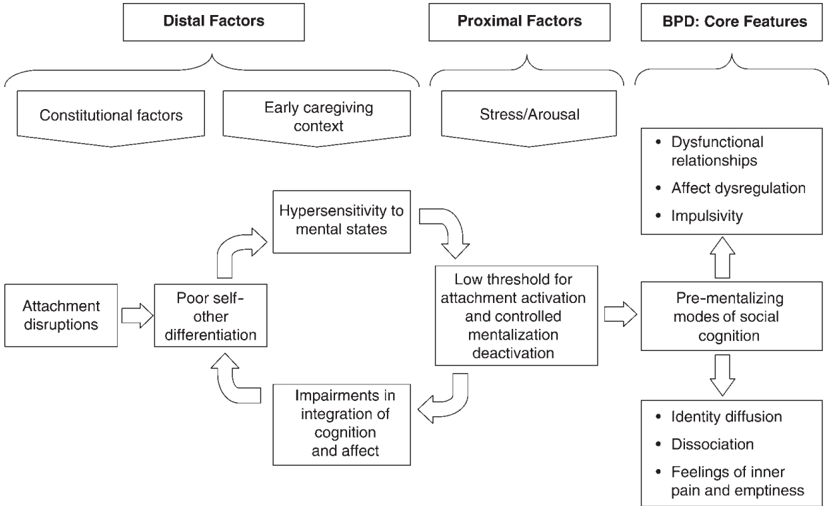
The precise nature and etiopathogenesis of borderline personality disorder (BPD) continues to elude researchers and clinicians. Yet, increasing evidence from various strands of research converges to suggest that affect dysregulation, impulsivity, and unstable relationships constitute the core features of BPD. Over the last two decades, the mentalization-based approach to BPD has attempted to provide a theoretically consistent way of conceptualizing the interrelationship between these core features of BPD, with the aim of providing clinicians with a conceptually sound and empirically supported approach to BPD and its treatment. This paper presents an extended version of this approach to BPD based on recently accumulated data. In particular, we suggest that the core features of BPD reflect impairments in different facets of mentalization, each related to impairments in relatively distinct neural circuits underlying these facets. Hence, we provide a comprehensive account of BPD by showing how its core features are related to each other in theoretically meaningful ways. More specifically, we argue that BPD is primarily associated with a low threshold for the activation of the attachment system and deactivation of controlled mentalization, linked to impairments in the ability to differentiate mental states of self and other, which lead to hypersensitivity and increased susceptibility to contagion by other people's mental states, and poor integration of cognitive and affective aspects of mentalization. The combination of these impairments may explain BPD patients' propensity for vicious interpersonal cycles, and their high levels of affect dysregulation and impulsivity. Finally, the implications of this expanded mentalization-based approach to BPD for mentalization-based treatment and treatment of BPD more generally are discussed.
Overview
CoChat Summary
TL;DR
This paper presents an expanded developmental, mentalization-based model of borderline personality disorder (BPD), arguing that its core features reflect impairments in different facets of mentalization linked to relatively distinct neural circuits. It proposes that BPD involves low thresholds for attachment-system activation and controlled-mentalization deactivation, explaining vicious interpersonal cycles, affect dysregulation, impulsivity, identity diffusion, dissociation, and inner pain.
Key findings
- BPD’s core features are emotional dysregulation, high impulsivity leading to self-harm and suicidality, and disturbed interpersonal functioning; lifetime prevalence is estimated to be as much as 6%, and between 25 and 33% may meet criteria in outpatient and forensic populations.
- Mentalization is multidimensional—automatic/controlled, cognitive/affective, internal/external, and self/other focused—and BPD is primarily associated with failures of explicit, internal, cognitive mentalization, alongside a low threshold for attachment activation and deactivation of controlled mentalization.
- These impairments may produce hypersensitivity and susceptibility to contagion by others’ mental states, poor self-other differentiation, hypermentalization or mentalization failure, and reemergence of prementalizing modes such as psychic equivalence, pretend mode, and teleological mode.
- Treatment implications include aiming for an optimal balance between attachment activation and mentalization; insight-oriented treatments focused on traumatic past may be contraindicated for patients with serious mentalization impairments.
Methods
- Theoretical/review paper presenting an expanded mentalization-based developmental model of BPD, integrating prior formulations with recently accumulated data.
- Draws on extant neuroimaging, developmental social and cognitive research, factor analytic and clinical studies, attachment research, and treatment literature; no new empirical sample or primary data collection is reported.
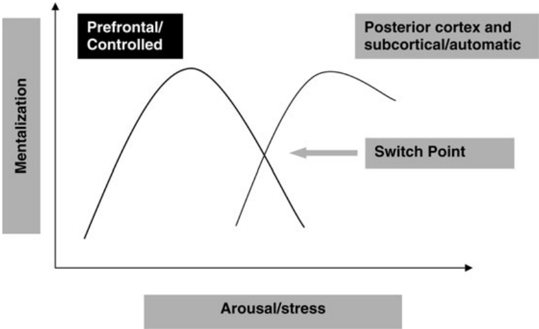
- Main analysis is a conceptual synthesis relating BPD features to four mentalization polarities and proposed neural systems, including a biobehavioral switch model of stress and controlled versus automatic mentalization.
Limitations
- The paper states that cited neuroimaging and physiological studies require further replication because of sometimes small sample sizes, disparate experimental paradigms, and heterogeneity in sample selection (e.g., comorbidity with depression, childhood abuse, PTSD, and copying styles).
- The paper notes that reliable description of BPD in adolescence remains controversial regarding homogeneity, comorbidity between and within axes, arbitrary cutoffs, and poor test-retest reliability, and that stability into adulthood is suggestive rather than well-established.
- The paper states that some predictions remain to be investigated (e.g., recovery time of mentalization with hyperactivating versus deactivating strategies) and that evidence on maladaptive parental mentalizing is still lacking; evident from the text, it is a conceptual/review article and does not empirically test the proposed model.
Model-written summary. Check it against the paper before relying on it.
Integrity signals
Registry
Cites
Statistics
Figures
Verification
Claims the paper makes
24 Valid · 11 Not valid · 130 Not checked · 108 Own results and interpretations
The cited sources support only part of this claim — read each source’s verdict below.
In the paper
“As we have already noted, retrospective evaluations have led to recognition that disorganization of the attachment system is a key aspect of the psychopathology of BPD (Gunderson & Lyons-Ruth, 2008).”
What the sources say
- Partly supportedcites Gunderson & Lyons-Ruth, 2008 matched to “BPD's Interpersonal Hypersensitivity Phenotype: A Gene-Environment-Developmental Model” (2008) sourceExperimental — accuracy not yet measured
The paper calls disorganized attachment especially important to understanding BPD and links it to an adult attachment pattern seen in patients (passage [1], section labeled Abstract). Its Conclusions describe attachment disorganization as one likely developmental pathway, not a defining feature of BPD psychopathology. The RETROSPECTIVE REPORTS section discusses patients’ accounts of difficult childhood relationships but does not say those evaluations established attachment disorganization. (LLM, conf=0.82)
plainstates an association- Asserted: passes — The authors put it forward as true.
- Checkable: passes — It can be checked against evidence.
- Load-bearing: passes — The paper’s conclusions depend on it.
- Based: passes — The paper gives a reason why it holds.
- Partly supported
The cited sources support only part of this claim — read each source’s verdict below.
In the paper
“Indeed, studies of adult attachment patterns of BPD patients repeatedly highlight a combination of preoccupied and unresolved attachment associated with BPD (Agrawal, Gunderson, Holmes, & Lyons-Ruth, 2004; Fonagy et al., 1996; Nakash-Eisikovits, Dutra, & Westen, 2002).”
What the sources say
- Supportedcites Agrawal, Gunderson, Holmes, & Lyons-Ruth, 2004 matched to “Attachment Studies with Borderline Patients: A Review” (2004) source
The Results report that all five studies using the Adult Attachment Interview found the greatest proportion of borderline individuals in the preoccupied or unresolved categories. The Discussion states that BPD attachments seem best characterized as unresolved with preoccupied features in relation to parents, matching the attributed claim. (LLM, conf=0.94)
- Not checked yetcites Fonagy et al., 1996 matched to “The relation of attachment status, psychiatric classification, and response to psychotherapy.” (1996) source
- Partly supportedcites Nakash-Eisikovits, Dutra, & Westen, 2002 matched to “Relationship Between Attachment Patterns and Personality Pathology in Adolescents” (2002) sourceExperimental — accuracy not yet measured
The Association Between Attachment Status and Axis II Pathology section links both anxious/ambivalent and disorganized/unresolved attachment to borderline personality disorder. But this paper studies adolescents, not adult BPD patients, and reports the two associations separately rather than a combined attachment pattern. Its discussion of an adult association concerns preoccupied attachment only. (LLM, conf=0.88)
boostedstates an association- Asserted: passes — The authors put it forward as true.
- Checkable: passes — It can be checked against evidence.
- Load-bearing: unclear — It is unclear whether the paper’s conclusions depend on it.
- Based: passes — The paper gives a reason why it holds.
- Supported
The cited sources support only part of this claim — read each source’s verdict below.
In the paper
“Such gene-environment effects could be one way that the known influence of heredity (Distel et al., 2008; LyonsRuth et al., 2007; Ni et al., 2007) is mediated in BPD.”
What the sources say
- Supportedcites Distel et al., 2008 matched to “Heritability of borderline personality disorder features is similar across three countries” (2008) source
The citation supports the sentence’s reference to a known hereditary influence, not its proposed gene–environment mechanism. The indexed paper’s title identifies its subject as the heritability of borderline personality disorder features; it does not need to establish the citing authors’ speculative explanation of how that influence is mediated. (LLM, conf=0.84)
- Supportedcites LyonsRuth et al., 2007 matched to “Serotonin transporter polymorphism and borderline or antisocial traits among low-income young adults” (2007) source
The Conclusions report genetic influence on liability to borderline and antisocial personality disorders. The Discussion proposes that the observed genetic association may reflect a gene–environment interaction, while noting that the interaction was not tested in this study. That supports the citing sentence’s tentative ‘could be’ formulation. (LLM, conf=0.90)
- Not matchedcites Ni et al., 2007
This doesn’t read as a citation we can look up.
hedgedstates a possible cause- Asserted: passes — The authors put it forward as true.
- Checkable: passes — It can be checked against evidence.
- Load-bearing: unclear — It is unclear whether the paper’s conclusions depend on it.
- Based: passes — The paper gives a reason why it holds.
- Supported
The cited sources support only part of this claim — read each source’s verdict below.
In the paper
“dissociative comorbidity is more frequently reported by patients with BPD than other groups”
What the sources say
- Not checked — no full text of the sourcecites Sar, Akyuz, Kugu, Ozturk, & Ertem-Vehid, 2006 matched to “Axis I Dissociative Disorder Comorbidity in Borderline Personality Disorder and Reports of Childhood Trauma” (2006) source
- Partly supportedcites Zanarini, Frankenburg, Jager-Hyman, Reich, & Fitzmaurice, 2008 matched to “The course of dissociation for patients with borderline personality disorder and axis II comparison subjects: a 10‐year follow‐up study” (2008) sourceExperimental — accuracy not yet measured
The Results report that 76 borderline patients, but only two axis II comparison subjects, had high dissociation scores at baseline. This supports a difference in reported dissociative symptoms between those groups, not a higher frequency of diagnosed dissociative comorbidity across other groups generally. The paper measures symptoms with the Dissociative Experiences Scale rather than reporting rates of comorbid dissociative disorders. (LLM, conf=0.86)
plainstates an association- Asserted: passes — The authors put it forward as true.
- Checkable: passes — It can be checked against evidence.
- Load-bearing: unclear — It is unclear whether the paper’s conclusions depend on it.
- Based: passes — The paper gives a reason why it holds.
The cited sources that could be checked couldn’t confirm or dispute this claim.
In the paper
“may be an extreme indication of such separateness (Ross, 2007; Zanarini et al., 2008).”
What the sources say
- Not checked — no full text of the sourcecites Ross, 2007 matched to “Borderline Personality Disorder and Dissociation” (2007) source
- Could not verifycites Zanarini et al., 2008 matched to “The course of dissociation for patients with borderline personality disorder and axis II comparison subjects: a 10‐year follow‐up study” (2008) sourceExperimental — accuracy not yet measured
The Methods describe dissociation through absorption, depersonalization, and amnesia, while the Discussion reports how their severity changed over time. Neither section characterizes dissociation as an extreme indication of separateness; searches for separateness and related descriptions found no such passage. Page numbers were not available in our copy. (LLM, conf=0.75)
hedgedstates an association- Asserted: passes — The authors put it forward as true.
- Checkable: passes — It can be checked against evidence.
- Load-bearing: unclear — It is unclear whether the paper’s conclusions depend on it.
- Based: passes — The paper gives a reason why it holds.
157 more claims · 13 with their cited sources checked
Create a free account to see all 273 claims and to verify the 9 references still open.
- Probably not a substantial claim. 41
- It may state two separate claims as one. 81
Claims other papers make about this one
Each is checked against this paper’s own text: does it say what the citing paper says it does?
The source backs part of the claim, not all of it — or backs it for a different population, condition or comparison.
In the citing paper
“In this account, an insecure attachment relationship between primary caregiver and child results in avoidance of internal thinking and feeling states in the child because acknowledging such internal states would further threaten an already vulnerable relationship with the caregiver.”
From First evidence of a prospective relation between avoidance of internal states and borderline personality disorder features in adolescents. (2015) · cites this paper as [19]
Experimental — accuracy not yet measuredThe source backs part of the claim, not all of it — or backs it for a different population, condition or comparison.
In the citing paper
“In turn, the child is at increased risk of developing BPD.”
From First evidence of a prospective relation between avoidance of internal states and borderline personality disorder features in adolescents. (2015) · cites this paper as [19]
Experimental — accuracy not yet measuredThe source backs part of the claim, not all of it — or backs it for a different population, condition or comparison.
In the citing paper
“In line with this, mentalization as an emotion regulation strategy has been considered a top-down strategy, relying in the explicit emotion regulation and in the theory of mind brain systems (Fonagy and Luyten, 2009; Vrticka and Vuilleumier, 2012).”
From Mindfulness and Emotion Regulation: Insights from Neurobiological, Psychological, and Clinical Studies (2017) · cites this paper as Fonagy and Luyten, 2009
Experimental — accuracy not yet measuredIn the citing paper
“stress and distress is thought to have a detrimental impact on the capacity to mentalize, especially if the stress is interpersonal in nature.”
From Investigating the association between parental reflective functioning and distress tolerance in motherhood. (2015) · cites this paper as Fonagy & Luyten, 2009
In the citing paper
“Stress and heightened arousal may inhibit the engagement of cortically-controlled processes of explicit mentalization that underscore reflection and reasoning when engaged with others (Fonagy & Luyten, 2009).”
From Investigating the association between parental reflective functioning and distress tolerance in motherhood. (2015) · cites this paper as Fonagy & Luyten, 2009
Citations
Cites
Fredrickson, B. L. (2001) · American Psychologist · doi:10.1037//0003-066x.56.3.218 · Cited by 18,025 · cited 2×
“…insight into BPD. Studies suggest that the ability to continue to mentalize even under considerable stress leads to so-called “broaden and build” (Fredrickson, 2001) cycles of attachment security, which reinforce feelings of secure attachment, personal agency, and affect regulation (“build”),…”
BackgroundRizzolatti, G., & Craighero, L. (2004) · Annual Review of Neuroscience · doi:10.1146/annurev.neuro.27.070203.144230 · Cited by 7,433 · cited 1×
“…system involves a more body-based, frontoparietal mirror neuron system that is involved in understanding the multimodal embodied self (e.g., face and body recognition) and understanding others through motor-simulation mechanisms (Gallese, Keysers, & Rizzolatti, 2004; Rizzolatti & Craighero, 2004).”
Background(1993) · Cited by 7,136
Attachment in adulthood: structure, dynamics, and change
(2008) · Choice Reviews Online · doi:10.5860/choice.45-2903 · Cited by 4,315
Affect Regulation, Mentalization, and the Development of the Self
Fonagy, P., Gergely, G., Jurist, E. L., & Target, M. (2018) · doi:10.4324/9780429471643 · Cited by 3,886
Self-citationThe Child's Conception of Space
Lawrence, E., Piaget, J., Inhelder, B., Langdon, F. J., & Lunzer, J. L. (1957) · British Journal of Educational Studies · doi:10.2307/3118882 · Cited by 3,213
Cattaneo, L., & Rizzolatti, G. (2009) · Archives of Neurology · doi:10.1001/archneurol.2009.41 · Cited by 3,137
Self-referential processing in our brain—A meta-analysis of imaging studies on the self
Northoff, G., Heinzel, A., de Greck, M., Bermpohl, F., Dobrowolny, H., & Panksepp, J. (2006) · NeuroImage · doi:10.1016/j.neuroimage.2005.12.002 · Cited by 2,792 · cited 1×
“The aFMC is involved in mentalizing (Frith & Frith, 2006; Gilbert et al., 2007) and self-referential processing (Northoff et al., 2006).”
BackgroundMayberg, H. S., Liotti, M., Brannan, S. K., McGinnis, S., Mahurin, R. K., Jerabek, P. A., Silva, J. A., Tekell, J. L., Martin, C. C., Lancaster, J. L., et al. (1999) · American Journal of Psychiatry · doi:10.1176/ajp.156.5.675 · Cited by 2,416 · cited 2×
“…for attention and long-term memory (Cabeza & Nyberg, 2000), perhaps specifically responsible for integrating emotion and cognition (e.g., emotional encoding of episodic memories; Maddock, 1999) and subserving moodmediated inhibition or enhancement of cognitive processing (Mayberg et al., 1999).”
BackgroundThe debate over dopamine’s role in reward: the case for incentive salience
Berridge, K. C. (2007) · Psychopharmacology · doi:10.1007/s00213-006-0578-x · Cited by 2,347 · cited 1×
“These findings suggest that for securely attached mothers, infant cues (whether positive or negative in affect) may act as an important affective signal of “incentive salience” (Berridge, 2007), reinforcing and motivating responsive maternal care.”
Background
Research works printed but not linked: 12
- Williams, 2006, Handbook of mentalisation based treatments
- 10.1093/med/9780198569183.001.0001 · DOI · Paper page
- 10.1111/1469-7610.0013_7 · doi:10.1111/1469-7610.0013_7 · Paper page
- Gergely, 1996, The social biofeedback model of parental affect-mirroring, International Journal of Psycho-Analysis, 77, 1181
- Luyten, 2009, The interpersonal regulation of stress
- Bloom, 2004, Descartes' baby
- Hobson, 2002, The cradle of thought: Explorations of the origins of thinking
- Fearon, 2006, Handbook of mentalisaiton based treatments
- Diamond, 1991, Self–other differentiation of object representations
- Hesse, 2008, Handbook of attachment theory and research, 552
- Luyten, 2009, Mentalization as a multidimensional concept
- O'Connor, 2006, Developmental psychopathology: Vol. 3. Risk, disorder and adaptation, 202
Cited by
Items 701–800 of 1,140
The Cognitive-Emotional Features of Avoidant Attachment on Memory Processing
翟, 晶. (2015) · Advances in Psychology · doi:10.12677/ap.2015.511082 · Cited by 2
“回避型依恋系统的情绪–认知表征 IWMs 是一个认知/情感性的组织,其中关于自我和他人的内部表征是一种主观的、内在的心理印象, 一种关于自我和他人的感觉模式,既包含了认知信息,也包含了相应的情绪调节特征。与之相似,Fonagy 和 Luyten (2009)提出我们需要对理解和回应他人的社会加工过程做出基本的区分,即情绪和认知表征过 程。根据这个区分,情绪表征对应于更加自动的、内隐的、甚至无意识的加工他人外在信息(如表情、动 作等)的过程;相反,认知表征系统属于更加外显和自主水平的社会情感加工过程(Lieberman, 2007),它…”
Maljuna, I., Ajduković, M., & Ostojić, D. (2020) · Socijalna psihijatrija · doi:10.24869/spsih.2020.20 · Cited by 2
“Deficiti u mentaliziranju (funkcioniranja na predmentalizacijskim i nementalizacijskim razinima razmišljanja) povezuju se s modelima nesigurne privrženosti, a iskustva osobe su tada prekonkretna, potpuno beznačajna ili je razumijevanje motiva za ponašanje potpuno fizičko (29).”
BackgroundInfluentialPersonal experience: Suicide and psychiatric care – a lament
Holmes, J. A. (2015) · BJPsych Bulletin · doi:10.1192/pb.bp.113.046466 · Cited by 2
Evidence-Based Pharmacotherapy for Personality Disorders
Ripoll, L. H., Triebwasser, J., & Siever, L. J. (2013) · FOCUS The Journal of Lifelong Learning in Psychiatry · doi:10.1176/appi.focus.11.2.225 · Cited by 2
Forgiveness and Gandhian Nonviolence: Their Confrontation in Light of Psychological Research
Paloutzian, R. F., Shankar, U., & Luyten, P. (2014) · Lirias · Cited by 2
Self-citationDie Rolle der kindlichen Theory of Mind für die Diagnose und Behandlung der PTBS
Sprung, M. S. (2017) · Psychosomatik im Zentrum · doi:10.1007/978-3-662-54146-3_17 · Cited by 3
Mentalization in Children and Adolescents, and Treatment Based on Mentalization for Adolescents
Maršanić, V. B., Bolfan, L. K., Flander, G. B., & Grgić, V. (2017) · Socijalna psihijatrija · doi:10.24869/spsih.2017.43 · Cited by 4
“Pažnja pacijenata s GPL je tada hipervigilna i fokusirana na prekide odnosa zbog mogućeg odbacivanja ili napuštanja (15, 18).”
BackgroundInfluentialPersonality and Personality Disorders
Scalabrini, A., Mucci, C., & Northoff, G. (2018) · Springer eBooks · doi:10.1007/978-3-319-75112-2_18 · Cited by 3
Jauk, E., & Kanske, P. (2019) · Journal of Intelligence · doi:10.3390/jintelligence7020010 · Cited by 2
“ToM deficits in borderline personality disorder can, depending on emotional arousal, result from overmentalizing (excessive, but incorrect mentalizing) [10–12] or also under- or nonmentalizing under high arousal [13].”
BackgroundEsposito, G., Perla, V., Passeggia, R., Fertuck, E. A., & Mergenthaler, E. (2021) · Research in Psychotherapy Psychopathology Process and Outcome · doi:10.4081/ripppo.2020.463 · Cited by 8
“For example, mentalizing has also been conceptualized as the result of four dimensions organized in eight polarities (Fonagy & Luyten, 2009): i) automatic/controlled; ii) self/other; iii) internal/external; iv) cognitive/affective.”
BackgroundBrief Psychodynamic Psychotherapies
Margison, F. R. (2021) · Cambridge University Press eBooks · doi:10.1017/9781108686976.010 · Cited by 3
Psychedelic-Assisted Psychotherapy
Read, T. (2021) · Cambridge University Press eBooks · doi:10.1017/9781108686976.030 · Cited by 2
Mentalization and Its Multidimensional Nature
Ahmadi, M., Bagherian-Sararoudi, R., & Mosavi, S. M. H. (2021) · Journal of Research in Behavioural Sciences · doi:10.52547/rbs.18.4.616 · Cited by 3
A Comparative Study on Emotion Regulation of Older and Younger Adults
Saeidi, N., Lotfi, M., Akbarian, M., Saeidi, A. R., & Salehi, A. (2021) · Salmand · doi:10.32598/sija.2021.16.3.3153.1 · Cited by 5
Decarli, A., Pierrehumbert, B., Schulz, A., & Vögele, C. (2022) · Springer eBooks · doi:10.1007/978-3-658-35744-3_7 · Cited by 2
Mentalisieren und soziales Lernen: Ihre Bedeutung in Kultur und Psychopathologie
Fonagy, P., & Nolte, T. (2022) · Vandenhoeck & Ruprecht eBooks · doi:10.13109/9783666408038.105 · Cited by 2
Self-citationÉvaluer la mentalisation sans cotation : la tâche des états mentaux
Beaulieu‐Pelletier, G., & Philippe, F. L. (2016) · Revue québécoise de psychologie · doi:10.7202/1040167ar · Cited by 9
Relationship between Parental Bonding, Alexithymia and Dissociation in Adults with PTSD
Zdankiewicz-Ścigała, E., & Strzeszkowska, P. (2019) · Polish Psychological Bulletin · doi:10.24425/124343 · Cited by 4
Recherches en psychopathologie de l'enfant
Corcos, M., & Robin, M. (2019) · Érès eBooks · doi:10.3917/eres.bydlo.2019.01.0137 · Cited by 2
Mentalisierungsbasierte Therapie zur Förderung von Persönlichkeitsfunktionen in der Adoleszenz
Taubner, S., Kasper, L. A., & Hauschild, S. (2020) · Kinderanalyse · doi:10.21706/ka-28-2-90 · Cited by 2
Psychodynamic Aspects of Suicide and Homicide
Gibbons, R., & Adshead, G. M. J. (2021) · Cambridge University Press eBooks · doi:10.1017/9781108686976.021 · Cited by 3
Las polaridades de la mentalización en la práctica clínica
Castelli, G. L. (2011) · Clínica e Investigación Relacional · doi:10.21110/19882939.2011.050204 · Cited by 11
Commentary: The Coming of Age of Psychoanalytic Treatment Research
Luyten, P. (2011) · Humana Press eBooks · doi:10.1007/978-1-60761-792-1_20 · Cited by 2
Self-citationCarlisle, J. (2014) · UCL Discovery (University College London) · Cited by 3
Personality Dimensions in Psychopathy: Potential Explanatory Models for Primary and Secondary TraitsPreprint
Murphy, B. A., & Giurgiutiu, D. (2012) · SSRN Electronic Journal · doi:10.2139/ssrn.1978268 · Cited by 1
Jewell, T. (2021) · OSF Preprints (OSF Preprints) · doi:10.31219/osf.io/ru8sd · Cited by 3
Zajenkowska, A. M., Nowakowska, I., Cieciuch, J., Gawęda, Ł., Rogoza, R., Pinkham, A. E., & Czajkowska-Łukasiewicz, K. (2024) · OSF Preprints (OSF Preprints) · doi:10.31219/osf.io/yx7tz · Cited by 2
Vospernik, P. (2014) · CUNY Academic Works (City University of New York) · Cited by 3
Chapter 35. Mentalizing in Psychotherapy
Allen, J. G., & Fonagy, P. (2019) · American Psychiatric Association Publishing eBooks · doi:10.1176/appi.books.9781615372980.lr35 · Cited by 1
Self-citationBindung und Mentalisierung bei sozialem Trauma
Holl, J., & Taubner, S. (2022) · Springer eBooks · doi:10.1007/978-3-662-64997-8_17 · Cited by 1
Capacity for mentalization in adolescents: The contribution of parenting styles
Živković-Rančić, Ž., & Todorović, J. (2023) · Zbornik Instituta za pedagoska istrazivanja · doi:10.2298/zipi2301093z · Cited by 2
Bayesian Decision-Making Under Uncertainty in Borderline Personality Disorder
Manavalan, M., Song, X., Nolte, T., Fonagy, P., Montague, P. R., & Vilares, I. (2024) · Journal of Personality Disorders · doi:10.1521/pedi.2024.38.1.53 · Cited by 3
“…such as impulsiveness, rapid changes in the perception of themselves and others, as well as sudden changes in mood and behavior, we hypothesized that this could stem from an overall low reliance in prior information and potential inability to use prior information appropriately, which may then…”
Self-citationAldunate, N., López‐Silva, P., Brotfeld, C., Guerra, E., & Kronmüller, E. (2024) · PLoS ONE · doi:10.1371/journal.pone.0296691 · Cited by 2
Deniz, P., & Uluç, S. (2024) · Ayna Klinik Psikoloji Dergisi · doi:10.31682/ayna.1399049 · Cited by 1
Mind-mindedness in mothers of infants with excessive crying/sleeping/eating disorders
Licata‐Dandel, M., Kristen, S., Marx, S., & Mall, V. (2024) · Frontiers in Child and Adolescent Psychiatry · doi:10.3389/frcha.2024.1331016 · Cited by 2
Pazhooyan, M., Lavasani, F. F., Shateri, Z. E., & Tajrishi, K. Z. (2024) · Child and Adolescent Psychiatry and Mental Health · doi:10.1186/s13034-024-00802-3 · Cited by 6
“Mentalization is a particular dimension of social cognition that explains how people make sense of their social world by envisioning their mental states and those of others (e.g., feelings, beliefs, intentions, and desires) to make sense of their social world [10].”
BackgroundIst Mentalisieren lehrbar? – Zur Aus- und Weiterbildung in mentalisierungsbasierter Pädagogik
Kirsch, H., Behringer, N., Henter, M., Hutsebaut, J., Link, P.-C., Kreuzer, T. F., Nolte, T., Turner, A., Schwarzer, N.-H., & Gingelmaier, S. (2024) · Vandenhoeck & Ruprecht eBooks · doi:10.13109/9783666700170.428 · Cited by 1
Mentalisieren als Professionalisierungsstrategie für Sonderpädagog: innen
Schwarzer, N.-H. (2024) · Vandenhoeck & Ruprecht eBooks · doi:10.13109/9783666700170.419 · Cited by 1
Cannavò, M., Gullo, J., Falgares, G., Lamis, D. A., & Barberis, N. (2025) · Psychology Health & Medicine · doi:10.1080/13548506.2025.2482952 · Cited by 2
“For instance, parents engaging in maltreating behaviors often dismiss their child’s perspective, discourage emotional expression, and neglect to establish a secure environment for the child to explore their inner world (Allen et al., 2008, Fonagy & Luyten, 2009).”
Matin, H., Etemadi, O., & Abedi, M. R. (2025) · The Family Journal · doi:10.1177/10664807251335642 · Cited by 4
Dawson, N., Sleed, M., & Chunga, E. (2025) · Infant Mental Health Journal · doi:10.1002/imhj.70018 · Cited by 1
“Parental trauma history is understood to negatively impact on PRF (Fonagy & Luyten, 2009; Moser et al., 2019).”
The “Favorite Person” in Borderline Personality Disorder: A Content Analysis of Social Media Posts
Stein, A. G., & Johnson, B. N. (2025) · Interpersona An International Journal on Personal Relationships · doi:10.5964/ijpr.14779 · Cited by 1
Barnby, J. M., Nguyen, J., Griem, J., Wloszek, M., Burgess, H., Richards, L. J., Kingston, J. L., Cooper, G., Montague, P. R., Dayan, P., et al. (2025) · eLife · doi:10.7554/elife.104008.4 · Cited by 6
Self-citationPaz, A., Rafaeli, E., Bar‐Kalifa, E., Gilboa‐Schechtman, E., Gannot, S., Narayanan, S. S., & Atzil–Slonim, D. (2025) · Psychotherapy Research · doi:10.1080/10503307.2025.2534973 · Cited by 1
“Ineffec-tive affect regulation and, consequently, deficits in experiential engagement are related to several forms of psychopathology (e.g., Fonagy & Luyten, 2009), most prominently, depression (Hayes et al., 2015).”
Psychological functioning in pregnant women who experienced complex trauma
Lapointe, G. M., Drouin‐Maziade, C., Garon‐Bissonnette, J., Bordeleau, F., Lemieux, R., & Berthelot, N. (2025) · Frontiers in Global Women s Health · doi:10.3389/fgwh.2025.1611034 · Cited by 4
“Secondly, childhood maltreatment has been linked to various forms of impairments in mentalizing (50, 51), de fi ned as the capacity to understand behaviors in terms of intentional mental states (52).”
Strifler, Y., & Diamond, G. M. (2025) · Attachment & Human Development · doi:10.1080/14616734.2025.2539276 · Cited by 1
“According to Fonagy and Luyten’s biobehavioral switch model (Fonagy & Luyten, 2009; Luyten & Fonagy, 2015), the link between stress, as expressed by the arousal of negative emotions, and mentalizing may not be linear.”
Matin, H., Etemadi, O., & Abedi, M. R. (2025) · Journal of Child and Family Studies · doi:10.1007/s10826-025-03136-6 · Cited by 4
Atasoy, S. U., & Arslan, M. (2025) · The Journal of Nervous and Mental Disease · doi:10.1097/nmd.0000000000001855 · Cited by 1
Li, E. T., Campbell, C., Mayes, L. C., McRedmond, G., & Luyten, P. (2025) · Borderline Personality Disorder and Emotion Dysregulation · doi:10.1186/s40479-025-00333-z · Cited by 2
Self-citationLai, X., Deng, J., Ou, Y., Huang, Z., & Zhang, M. (2026) · Frontiers in Psychology · doi:10.3389/fpsyg.2026.1729297 · Cited by 1
Kamza, A., Luyten, P., Duras, J., Carone, N., Dzielińska, M., & Piotrowski, K. (2026) · Journal of Marriage and the Family · doi:10.1111/jomf.70080 · Cited by 3
Self-citationJańczak, M. O., Górska, D., & Nolte, T. (2026) · Journal of Personality Disorders · doi:10.1521/pedi.2026.40.3.236 · Cited by 3
Personality Functioning Cannot Only Be One Thing: A Call for Theoretical Pluralism
Zavlis, O. (2026) · Personality and Mental Health · doi:10.1002/pmh.70085 · Cited by 1
“Finally, we reach Fonagy and colleagues' mentalising model of personality (Fonagy and Allison 2023; Fonagy and Luyten 2009, 2018; Fonagy et al. 2015, 2017, 2018; Fonagy and Target 1997).”
Chelouche-Dwek, G., Miracle, A., McHugh, B., Dawson, N., Hillman, M., & Fonagy, P. (2026) · Children · doi:10.3390/children13070911 · Cited by 1
“Alternatively, when combined with playful reframing, the play element may reduce the cognitive–emotional load of reflective work, rendering mentalization more accessible during emotionally charged moments, in line with the biobehavioural switch model [15,56].”
Self-citationOntdekken ‘how the mind works’
Smits, M. L., Luyten, P., & Bales, D. L. (2015) · Tijdschrift voor Psychotherapie · doi:10.1007/s12485-015-0038-3 · Cited by 5
Self-citationAttachement au père et relation d’activation en thérapie familiale
Lethiais, L., & Har, A. (2015) · Cahiers critiques de thérapie familiale et de pratiques de réseaux · doi:10.3917/ctf.054.0053 · Cited by 4
Martins, P., Gonçalves, P. D., Arcuri, S., Netto, O. F. L., Macedo, G., & Louzã, M. (2012) · Jornal Brasileiro de Psiquiatria · doi:10.1590/s0047-20852012000400011
Mental State Understanding: Individual Differences in Typical and Atypical Development
Bulgarelli, D., Henning, A., & Molina, P. (2017) · Frontiers research topics · doi:10.3389/978-2-88945-268-2 · Cited by 1
Mentalisierungsbasierte Therapie für Patienten mit Borderline-Persönlichkeitsstörung
Volkert, J., Bark, C., & Taubner, S. (2018) · Nervenheilkunde · doi:10.1055/s-0038-1668318 · Cited by 2
Liu, C., & Xu, C. H. E. N. (2018) · Advances in Psychological Science · doi:10.3724/sp.j.1042.2018.01590 · Cited by 1
Romeo, A., Tesio, V., Vicino, B., Colonna, F., Fusaro, E., Converso, D., & Castelli, L. (2019) · PSICOLOGIA DELLA SALUTE · doi:10.3280/pds2019-001007 · Cited by 1
Störungsspezifische Behandlung von Persönlichkeitsstörungen – eine Falldarstellung
Wirth, U. (2019) · Psychosomatik im Zentrum · doi:10.1007/978-3-662-58639-6_9 · Cited by 1
Episodios de mentalización durante psicoterapia de adolescentes con difusión de identidad
Quevedo, Y., Hernández, C., Gómez, D. M., Díaz, C. G., & Valdés, N. (2019) · Revista de psicología · doi:10.5354/0719-0581.2019.53941 · Cited by 1
“…teoría de la mente (Fonagy & Luyten, 2009), es entendida como la capacidad que tiene un individuo para interpretar el comportamiento humano basado en estados mentales (e.g., necesidades, deseos, sentimientos, y metas), por lo que es en esencia una forma de cognición social (Fonagy & Luyten, 2009).”
BackgroundInfluentialThevenet, M., Machabert, R., & Georgieff, N. (2019) · La psychiatrie de l enfant · doi:10.3917/psye.622.0395 · Cited by 2
Relationship between Mentalizing Style and Mental Health in Postgraduates
方, 杨. (2020) · Advances in Psychology · doi:10.12677/ap.2020.102021 · Cited by 1
Hohagen, F., Klein, J. P., Stieglitz, R., Bohus, M., Caspar, F., Fabry, G., & Berger, T. (2015) · Elsevier eBooks · doi:10.1016/b978-3-437-22484-3.00006-2 · Cited by 1
Mayer, D., Berkic, J., & Beckh, K. (2020) · Diskurs Kindheits- und Jugendforschung / Discourse Journal of Childhood and Adolescence Research · doi:10.3224/diskurs.v15i3.06 · Cited by 3
Psychological Models for Case Formulation
Gibbons, R. (2021) · Cambridge University Press eBooks · doi:10.1017/9781108686976.007 · Cited by 2
The Psychodynamics of Self-Harm
Gibbons, R. (2021) · Cambridge University Press eBooks · doi:10.1017/9781108686976.020 · Cited by 1
Psychodynamic Theory: The Development of a Model of the Mind
O’Reilly, J. (2021) · Cambridge University Press eBooks · doi:10.1017/9781108686976.003 · Cited by 1
Cognitive Analytic Therapy (CAT): Developing the Model and the Method
Hepple, J. (2021) · Cambridge University Press eBooks · doi:10.1017/9781108686976.012 · Cited by 1
Die Liebe in den Zeiten der Amygdala
Storck, T., & Taubner, S. (2014) · Springer eBooks · doi:10.1007/978-3-642-44986-4_29 · Cited by 1
Rigoli, F. (2022) · Personality Disorders Theory Research and Treatment · doi:10.1037/per0000549 · Cited by 3
“Simulation 3: interpersonal cycles The interpersonal sphere is critical for understanding BP (Dimaggio et al., 2007; Fonagy & Luyten, 2009; Liotti, 2014; Semerari & Fiore, 2007).”
BackgroundBorderline Personality Disorder and the Heart
Boldrini, A. (2020) · Springer eBooks · doi:10.1007/978-3-319-90305-7_25-1 · Cited by 1
Relationale Ansätze in der Mentalisierungsbasierten Therapie
Volkert, J. (2022) · PDP – Psychodynamische Psychotherapie · doi:10.21706/pdp-21-1-45 · Cited by 1
Mentalization-Based Treatment voor patienten met een borderlinepersoonlijkheidsstoornis
Bales, D. L., Nijssens, L., van Beek, N., & BATEMAN, A. W. (2017) · Bohn Stafleu van Loghum eBooks · doi:10.1007/978-90-368-0931-3_16 · Cited by 2
Szél, E., Kóródi, K., Gori, A., Jámbori, S., & Szabó, É. (2023) · Magyar Pszichológiai Szemle · doi:10.1556/0016.2023.00029 · Cited by 2
Mentalization, Oxytocin, and Cortisol in the General Population
Török, E., Kelemen, O., & Kéri, S. (2023) · Life · doi:10.3390/life13061329 · Cited by 2
“Mentalization can be spontaneous, fast, or consciously controlled, driven by internal or external features of ourselves and others [4].”
BackgroundRokach, A., & Clayton, S. (2023) · Elsevier eBooks · doi:10.1016/b978-0-323-85853-3.00005-7 · Cited by 1
Salaminios, G., & Debbané, M. (2023) · Springer eBooks · doi:10.1007/978-3-031-41788-7_9 · Cited by 1
Taurogiński, B., Janusz, B., Bergmann, J., & Peräkylä, A. (2023) · Frontiers in Psychology · doi:10.3389/fpsyg.2023.1232594 · Cited by 4
Abbasi, N., Dehghani, A., Ghamrani, A., & Abedi, M. R. (2023) · Pajouhan Scientific Journal · doi:10.61186/psj.21.1.22 · Cited by 3
Svernell, M., & Hall, H. D. (2024) · Journal of Infant Child and Adolescent Psychotherapy · doi:10.1080/15289168.2024.2307276 · Cited by 3
“Mentalizing encompasses four distinct dimensions: automatic versus controlled, affective versus cognitive, self versus other, and inner versus outer, as elucidated by Fonagy and Luyten (2009).”
BackgroundA relational frame approach to perspective taking in persons with Borderline Personality Disorder
Walton, C. J., Rasmussen, A., Villatte, M., Vilardaga, R., Irwin, L., & Rossiter, R. C. (2024) · Journal of Contextual Behavioral Science · doi:10.1016/j.jcbs.2024.100777 · Cited by 2
“Fonagy and Luyten (2009) suggest that mentalising capacity in persons with BPD may only be compromised in situations where their attachment system is activated.”
Fontana, A., Mangialavori, S., Terrone, G., Trani, L., Topino, E., Trincia, V., Lisi, G., Ducci, G., & Cacioppo, M. (2024) · International Journal of Environmental Research and Public Health · doi:10.3390/ijerph21070848 · Cited by 1
“Some authors have also found that support from both partners and family is the strongest predictor of maternal reflective functioning, which entails the ability to imagine thoughts, feelings, needs, and intentions within oneself and others [20,21].”
BackgroundSørensen, K. D., Bremer, K., & Wilberg, T. (2024) · Frontiers in Psychology · doi:10.3389/fpsyg.2024.1412665 · Cited by 3
“In other words, the development of mentalizing abilities (Fonagy and Luyten, 2009) is assumed to take place within the intersubjective space Mentalizing or metacognitive abilities (the ability to understand mental states) are fundamental for inferring others’ as well as one’s own intentions,…”
BackgroundMentalisierungsbasierte Inklusions- und Sonderpädagogik: Bildungsraum Schule
Link, P.-C., Behringer, N., Turner, A., Kreuzer, T. F., Schwarzer, N.-H., & Ruprecht, V. &. (2024) · Vandenhoeck & Ruprecht eBooks · doi:10.13109/9783666700170 · Cited by 6
Kramer, U., Simonini, A., Rrustemi, E., Fellrath, R., Stucchi, K., Noseda, E., Martin-Söelch, C., Kolly, S., Machinea, J. B., Boritz, T. Z., et al. (2024) · Psychotherapy Research · doi:10.1080/10503307.2024.2406543 · Cited by 1
Associations between neurolinguistic deficits and personality traits in people with epilepsy
Floros, N., Papagiannakis, N., Kyrozis, A., Chroni, E., & Polychronopoulos, P. (2024) · Frontiers in Neurology · doi:10.3389/fneur.2024.1416713 · Cited by 1
“…explanation might assume the existence of different pathogenetic mechanics that share a common feature of disrupting lingual modalities, such as symbol formation and mentalization capabilities, which according to Fonagy et al. (49), emerge in the early years of the developing brain (type III, 50).”
BackgroundMethodMayer, C., Bailly, R., Lhande, P., et al. (2024) · Thérapie Familiale · doi:10.3917/tf.244.0058 · Cited by 1
Dissociative and Psychotic Features
Cavelti, M., Thomson, M., & Kaess, M. (2025) · Oxford University Press eBooks · doi:10.1093/9780191964343.003.0013 · Cited by 1
Borderline personality disorder in adolescents: An underrecognized diagnosis
Nazir, D., Raj, R., Margoob, M. A., & Wani, Z. A. (2025) · Industrial Psychiatry Journal · doi:10.4103/ipj.ipj_39_25 · Cited by 3
“…was reported less frequently in our study group, in contrast other studies highlighted identity dysregulation as a major feature of adolescent BPD. [16] This discrepancy may reflect differences in cultural variations in symptom expression in our population and use of different assessment tools in…”
InfluentialGrassl, R., Lodermeier, F., Karwautz, A. F. K., & Löffler‐Stastka, H. (2015) · Psychotherapie Forum · doi:10.1007/s00729-015-0034-7 · Cited by 1
Theory of Mind und Borderline-Persönlichkeitsstörung
Rentrop, M., & Scheller, E. (2012) · Springer eBooks · doi:10.1007/978-3-642-24916-7_25 · Cited by 4
Castelli, G. L. (2017) · Clínica e Investigación Relacional · doi:10.21110/19882939.2017.110311 · Cited by 1
Die mentale Welt der Anderen: Theory of Mind (Mentalisierung) und ihre neuronalen Grundlagen
Mohnke, S., Walter, H., & Tantchik, W. (2018) · Nervenheilkunde · doi:10.1055/s-0038-1668316 · Cited by 1
Zur Diagnostik und Therapie der Identitätsdiffusion im Kindes- und Jugendalter
Feulner, J., Haid-Stecher, N., Fleischmann, S., Fuchs, M., & Sevecke, K. (2018) · Praxis der Kinderpsychologie und Kinderpsychiatrie · doi:10.13109/prkk.2018.67.7.624 · Cited by 2
Truth and Falsehood in Science and the Arts
Bokus, B., & Kosowska, E. (2020) · Wydawnictwa Uniwersytetu Warszawskiego eBooks · doi:10.31338/uw.9788323542209 · Cited by 1
Relations between self-understanding and other-understanding: similarities and interactions
Smurzyńska, A. (2020) · Avant · doi:10.26913/avant.2020.02.07 · Cited by 1
“Perspective-taking enables adequate attribution of mental states to both oneself and others (Fonagy & Luyten, 2009).”
Background
Metadata
- Authors
- Fonagy, P., & Luyten, P.
- Affiliations
- University College London (GB)
- KU Leuven (BE)
- Corresponding author
- Fonagy, Peter
- Venue
- Development and Psychopathology
- Publisher
- Cambridge University Press (CUP)
- Published
- 2009-10-14
- Volume
- 21
- Issue
- 4
- Pages
- 1355-1381
- ISSN
- 0954-5794 (ISSN-L)
- 1469-2198
- OpenAlex
- W2098937677
- Cited by
- 1,146
- References
- 239
- Citations by year
- 2026: 77 · 2025: 87 · 2024: 115 · 2023: 56 · 2022: 68 · 2021: 120 · 2020: 87 · 2019: 73 · 2018: 100 · 2017: 60 · 2016: 63 · 2015: 70 · 2014: 43 · 2013: 43 · 2012: 32
- FWCI
- 3.56
- Type
- journal article
- Language
- en
- Open access
- green
- discovery.ucl.ac.uk
- Locations
- Development and Psychopathology (publishedVersion)
- PubMed (publishedVersion)
- UCL Discovery (University College London) (submittedVersion)
- Digital Access to Libraries (Université catholique de Louvain (UCL), l'Université de Namur (UNamur) and the Université Saint-Louis (USL-B)) (submittedVersion)
- Topics
- Social Sciences › Psychology › Clinical Psychology › Personality Disorders and Psychopathology
- Social Sciences › Psychology › Clinical Psychology › Psychoanalysis and Psychopathology Research
- Social Sciences › Psychology › Clinical Psychology › Personality Traits and Psychology
- Keywords
- borderline personality disorder, mentalization, affect dysregulation, impulsivity, unstable relationships, attachment system, cognitive-affective integration, neural circuits, etiopathogenesis, mentalization-based treatment
- MeSH terms
- Affect, Borderline Personality Disorder, Cognition, Emotions, Humans, Interpersonal Relations, Self Concept, Theory of Mind
About these checks
Registry, retraction, Cites and statistics results are computed, not judged, with one exception: a printed reference that no index lists is read once by a model before it counts as a citation error. Claims are extracted by a model and kept only when their quote appears verbatim in the text; each cited source is then checked, with a model’s help, for whether it says what the claim relies on. Those verdicts can be wrong — read the claim’s quote and the cited source before relying on one.
The claim verdicts this report counts are experimental: their accuracy is not yet measured.
A language model drew the claims from the paper on 2026-10-10, under version 3 of the claim definition (model deepseek-v4.1-flash, prompt extract-v3).
A second model labelled each claim on 2026-10-10 (model jev-1.13-20260917, definition revision gold-guideline-v0.2).
Cited sources are checked with a language model’s help (gpt-6-sol).
Statistics and arithmetic are recomputed, not judged.
Confidence bands are shown only for fields calibrated on our annotated test set. None is calibrated yet, so no band is shown.
What counts as a claim ›How we measure confidence ›How we check this ›
Are you an author, or do you see a problem with this page? Request a review
Data sources
Bibliographic data: Semantic Scholar, OpenAlex, Crossref.
Contains information from the Semantic Scholar Academic Graph Datasets, made available under the ODC Attribution License (ODC-BY 1.0).
Semantic Scholar’s data is described in: Kinney, R., et al. (2023). The Semantic Scholar Open Data Platform. arXiv:2301.10140.
