

A developmental, mentalization-based approach to the understanding and treatment of borderline personality disorder
Open accessThe DOI matches its Crossref record; 231 of the 239 references it cites were found in a registry or an index; 32 of the 232 sources its claims cite were checked for support.
Abstract
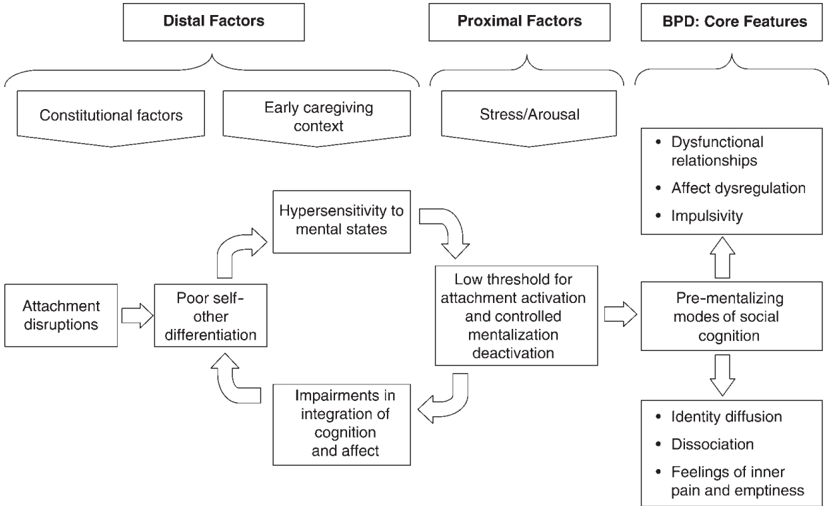
The precise nature and etiopathogenesis of borderline personality disorder (BPD) continues to elude researchers and clinicians. Yet, increasing evidence from various strands of research converges to suggest that affect dysregulation, impulsivity, and unstable relationships constitute the core features of BPD. Over the last two decades, the mentalization-based approach to BPD has attempted to provide a theoretically consistent way of conceptualizing the interrelationship between these core features of BPD, with the aim of providing clinicians with a conceptually sound and empirically supported approach to BPD and its treatment. This paper presents an extended version of this approach to BPD based on recently accumulated data. In particular, we suggest that the core features of BPD reflect impairments in different facets of mentalization, each related to impairments in relatively distinct neural circuits underlying these facets. Hence, we provide a comprehensive account of BPD by showing how its core features are related to each other in theoretically meaningful ways. More specifically, we argue that BPD is primarily associated with a low threshold for the activation of the attachment system and deactivation of controlled mentalization, linked to impairments in the ability to differentiate mental states of self and other, which lead to hypersensitivity and increased susceptibility to contagion by other people's mental states, and poor integration of cognitive and affective aspects of mentalization. The combination of these impairments may explain BPD patients' propensity for vicious interpersonal cycles, and their high levels of affect dysregulation and impulsivity. Finally, the implications of this expanded mentalization-based approach to BPD for mentalization-based treatment and treatment of BPD more generally are discussed.
Overview
CoChat Summary
TL;DR
This paper presents an expanded developmental, mentalization-based model of borderline personality disorder (BPD), arguing that its core features reflect impairments in different facets of mentalization linked to relatively distinct neural circuits. It proposes that BPD involves low thresholds for attachment-system activation and controlled-mentalization deactivation, explaining vicious interpersonal cycles, affect dysregulation, impulsivity, identity diffusion, dissociation, and inner pain.
Key findings
- BPD’s core features are emotional dysregulation, high impulsivity leading to self-harm and suicidality, and disturbed interpersonal functioning; lifetime prevalence is estimated to be as much as 6%, and between 25 and 33% may meet criteria in outpatient and forensic populations.
- Mentalization is multidimensional—automatic/controlled, cognitive/affective, internal/external, and self/other focused—and BPD is primarily associated with failures of explicit, internal, cognitive mentalization, alongside a low threshold for attachment activation and deactivation of controlled mentalization.
- These impairments may produce hypersensitivity and susceptibility to contagion by others’ mental states, poor self-other differentiation, hypermentalization or mentalization failure, and reemergence of prementalizing modes such as psychic equivalence, pretend mode, and teleological mode.
- Treatment implications include aiming for an optimal balance between attachment activation and mentalization; insight-oriented treatments focused on traumatic past may be contraindicated for patients with serious mentalization impairments.
Methods
- Theoretical/review paper presenting an expanded mentalization-based developmental model of BPD, integrating prior formulations with recently accumulated data.
- Draws on extant neuroimaging, developmental social and cognitive research, factor analytic and clinical studies, attachment research, and treatment literature; no new empirical sample or primary data collection is reported.
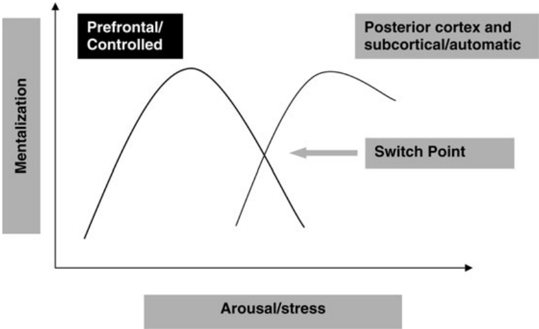
- Main analysis is a conceptual synthesis relating BPD features to four mentalization polarities and proposed neural systems, including a biobehavioral switch model of stress and controlled versus automatic mentalization.
Limitations
- The paper states that cited neuroimaging and physiological studies require further replication because of sometimes small sample sizes, disparate experimental paradigms, and heterogeneity in sample selection (e.g., comorbidity with depression, childhood abuse, PTSD, and copying styles).
- The paper notes that reliable description of BPD in adolescence remains controversial regarding homogeneity, comorbidity between and within axes, arbitrary cutoffs, and poor test-retest reliability, and that stability into adulthood is suggestive rather than well-established.
- The paper states that some predictions remain to be investigated (e.g., recovery time of mentalization with hyperactivating versus deactivating strategies) and that evidence on maladaptive parental mentalizing is still lacking; evident from the text, it is a conceptual/review article and does not empirically test the proposed model.
Model-written summary. Check it against the paper before relying on it.
Integrity signals
Registry
Cites
Statistics
Figures
Verification
Claims the paper makes
24 Valid · 11 Not valid · 130 Not checked · 108 Own results and interpretations
The cited sources support only part of this claim — read each source’s verdict below.
In the paper
“As we have already noted, retrospective evaluations have led to recognition that disorganization of the attachment system is a key aspect of the psychopathology of BPD (Gunderson & Lyons-Ruth, 2008).”
What the sources say
- Partly supportedcites Gunderson & Lyons-Ruth, 2008 matched to “BPD's Interpersonal Hypersensitivity Phenotype: A Gene-Environment-Developmental Model” (2008) sourceExperimental — accuracy not yet measured
The paper calls disorganized attachment especially important to understanding BPD and links it to an adult attachment pattern seen in patients (passage [1], section labeled Abstract). Its Conclusions describe attachment disorganization as one likely developmental pathway, not a defining feature of BPD psychopathology. The RETROSPECTIVE REPORTS section discusses patients’ accounts of difficult childhood relationships but does not say those evaluations established attachment disorganization. (LLM, conf=0.82)
plainstates an association- Asserted: passes — The authors put it forward as true.
- Checkable: passes — It can be checked against evidence.
- Load-bearing: passes — The paper’s conclusions depend on it.
- Based: passes — The paper gives a reason why it holds.
- Partly supported
The cited sources support only part of this claim — read each source’s verdict below.
In the paper
“Indeed, studies of adult attachment patterns of BPD patients repeatedly highlight a combination of preoccupied and unresolved attachment associated with BPD (Agrawal, Gunderson, Holmes, & Lyons-Ruth, 2004; Fonagy et al., 1996; Nakash-Eisikovits, Dutra, & Westen, 2002).”
What the sources say
- Supportedcites Agrawal, Gunderson, Holmes, & Lyons-Ruth, 2004 matched to “Attachment Studies with Borderline Patients: A Review” (2004) source
The Results report that all five studies using the Adult Attachment Interview found the greatest proportion of borderline individuals in the preoccupied or unresolved categories. The Discussion states that BPD attachments seem best characterized as unresolved with preoccupied features in relation to parents, matching the attributed claim. (LLM, conf=0.94)
- Not checked yetcites Fonagy et al., 1996 matched to “The relation of attachment status, psychiatric classification, and response to psychotherapy.” (1996) source
- Partly supportedcites Nakash-Eisikovits, Dutra, & Westen, 2002 matched to “Relationship Between Attachment Patterns and Personality Pathology in Adolescents” (2002) sourceExperimental — accuracy not yet measured
The Association Between Attachment Status and Axis II Pathology section links both anxious/ambivalent and disorganized/unresolved attachment to borderline personality disorder. But this paper studies adolescents, not adult BPD patients, and reports the two associations separately rather than a combined attachment pattern. Its discussion of an adult association concerns preoccupied attachment only. (LLM, conf=0.88)
boostedstates an association- Asserted: passes — The authors put it forward as true.
- Checkable: passes — It can be checked against evidence.
- Load-bearing: unclear — It is unclear whether the paper’s conclusions depend on it.
- Based: passes — The paper gives a reason why it holds.
- Supported
The cited sources support only part of this claim — read each source’s verdict below.
In the paper
“Such gene-environment effects could be one way that the known influence of heredity (Distel et al., 2008; LyonsRuth et al., 2007; Ni et al., 2007) is mediated in BPD.”
What the sources say
- Supportedcites Distel et al., 2008 matched to “Heritability of borderline personality disorder features is similar across three countries” (2008) source
The citation supports the sentence’s reference to a known hereditary influence, not its proposed gene–environment mechanism. The indexed paper’s title identifies its subject as the heritability of borderline personality disorder features; it does not need to establish the citing authors’ speculative explanation of how that influence is mediated. (LLM, conf=0.84)
- Supportedcites LyonsRuth et al., 2007 matched to “Serotonin transporter polymorphism and borderline or antisocial traits among low-income young adults” (2007) source
The Conclusions report genetic influence on liability to borderline and antisocial personality disorders. The Discussion proposes that the observed genetic association may reflect a gene–environment interaction, while noting that the interaction was not tested in this study. That supports the citing sentence’s tentative ‘could be’ formulation. (LLM, conf=0.90)
- Not matchedcites Ni et al., 2007
This doesn’t read as a citation we can look up.
hedgedstates a possible cause- Asserted: passes — The authors put it forward as true.
- Checkable: passes — It can be checked against evidence.
- Load-bearing: unclear — It is unclear whether the paper’s conclusions depend on it.
- Based: passes — The paper gives a reason why it holds.
- Supported
The cited sources support only part of this claim — read each source’s verdict below.
In the paper
“dissociative comorbidity is more frequently reported by patients with BPD than other groups”
What the sources say
- Not checked — no full text of the sourcecites Sar, Akyuz, Kugu, Ozturk, & Ertem-Vehid, 2006 matched to “Axis I Dissociative Disorder Comorbidity in Borderline Personality Disorder and Reports of Childhood Trauma” (2006) source
- Partly supportedcites Zanarini, Frankenburg, Jager-Hyman, Reich, & Fitzmaurice, 2008 matched to “The course of dissociation for patients with borderline personality disorder and axis II comparison subjects: a 10‐year follow‐up study” (2008) sourceExperimental — accuracy not yet measured
The Results report that 76 borderline patients, but only two axis II comparison subjects, had high dissociation scores at baseline. This supports a difference in reported dissociative symptoms between those groups, not a higher frequency of diagnosed dissociative comorbidity across other groups generally. The paper measures symptoms with the Dissociative Experiences Scale rather than reporting rates of comorbid dissociative disorders. (LLM, conf=0.86)
plainstates an association- Asserted: passes — The authors put it forward as true.
- Checkable: passes — It can be checked against evidence.
- Load-bearing: unclear — It is unclear whether the paper’s conclusions depend on it.
- Based: passes — The paper gives a reason why it holds.
The cited sources that could be checked couldn’t confirm or dispute this claim.
In the paper
“may be an extreme indication of such separateness (Ross, 2007; Zanarini et al., 2008).”
What the sources say
- Not checked — no full text of the sourcecites Ross, 2007 matched to “Borderline Personality Disorder and Dissociation” (2007) source
- Could not verifycites Zanarini et al., 2008 matched to “The course of dissociation for patients with borderline personality disorder and axis II comparison subjects: a 10‐year follow‐up study” (2008) sourceExperimental — accuracy not yet measured
The Methods describe dissociation through absorption, depersonalization, and amnesia, while the Discussion reports how their severity changed over time. Neither section characterizes dissociation as an extreme indication of separateness; searches for separateness and related descriptions found no such passage. Page numbers were not available in our copy. (LLM, conf=0.75)
hedgedstates an association- Asserted: passes — The authors put it forward as true.
- Checkable: passes — It can be checked against evidence.
- Load-bearing: unclear — It is unclear whether the paper’s conclusions depend on it.
- Based: passes — The paper gives a reason why it holds.
157 more claims · 13 with their cited sources checked
Create a free account to see all 273 claims and to verify the 9 references still open.
- Probably not a substantial claim. 41
- It may state two separate claims as one. 81
Claims other papers make about this one
Each is checked against this paper’s own text: does it say what the citing paper says it does?
The source backs part of the claim, not all of it — or backs it for a different population, condition or comparison.
In the citing paper
“In this account, an insecure attachment relationship between primary caregiver and child results in avoidance of internal thinking and feeling states in the child because acknowledging such internal states would further threaten an already vulnerable relationship with the caregiver.”
From First evidence of a prospective relation between avoidance of internal states and borderline personality disorder features in adolescents. (2015) · cites this paper as [19]
Experimental — accuracy not yet measuredThe source backs part of the claim, not all of it — or backs it for a different population, condition or comparison.
In the citing paper
“In turn, the child is at increased risk of developing BPD.”
From First evidence of a prospective relation between avoidance of internal states and borderline personality disorder features in adolescents. (2015) · cites this paper as [19]
Experimental — accuracy not yet measuredThe source backs part of the claim, not all of it — or backs it for a different population, condition or comparison.
In the citing paper
“In line with this, mentalization as an emotion regulation strategy has been considered a top-down strategy, relying in the explicit emotion regulation and in the theory of mind brain systems (Fonagy and Luyten, 2009; Vrticka and Vuilleumier, 2012).”
From Mindfulness and Emotion Regulation: Insights from Neurobiological, Psychological, and Clinical Studies (2017) · cites this paper as Fonagy and Luyten, 2009
Experimental — accuracy not yet measuredIn the citing paper
“stress and distress is thought to have a detrimental impact on the capacity to mentalize, especially if the stress is interpersonal in nature.”
From Investigating the association between parental reflective functioning and distress tolerance in motherhood. (2015) · cites this paper as Fonagy & Luyten, 2009
In the citing paper
“Stress and heightened arousal may inhibit the engagement of cortically-controlled processes of explicit mentalization that underscore reflection and reasoning when engaged with others (Fonagy & Luyten, 2009).”
From Investigating the association between parental reflective functioning and distress tolerance in motherhood. (2015) · cites this paper as Fonagy & Luyten, 2009
Citations
Cites
Fredrickson, B. L. (2001) · American Psychologist · doi:10.1037//0003-066x.56.3.218 · Cited by 18,025 · cited 2×
“…insight into BPD. Studies suggest that the ability to continue to mentalize even under considerable stress leads to so-called “broaden and build” (Fredrickson, 2001) cycles of attachment security, which reinforce feelings of secure attachment, personal agency, and affect regulation (“build”),…”
BackgroundRizzolatti, G., & Craighero, L. (2004) · Annual Review of Neuroscience · doi:10.1146/annurev.neuro.27.070203.144230 · Cited by 7,433 · cited 1×
“…system involves a more body-based, frontoparietal mirror neuron system that is involved in understanding the multimodal embodied self (e.g., face and body recognition) and understanding others through motor-simulation mechanisms (Gallese, Keysers, & Rizzolatti, 2004; Rizzolatti & Craighero, 2004).”
Background(1993) · Cited by 7,136
Attachment in adulthood: structure, dynamics, and change
(2008) · Choice Reviews Online · doi:10.5860/choice.45-2903 · Cited by 4,315
Affect Regulation, Mentalization, and the Development of the Self
Fonagy, P., Gergely, G., Jurist, E. L., & Target, M. (2018) · doi:10.4324/9780429471643 · Cited by 3,886
Self-citationThe Child's Conception of Space
Lawrence, E., Piaget, J., Inhelder, B., Langdon, F. J., & Lunzer, J. L. (1957) · British Journal of Educational Studies · doi:10.2307/3118882 · Cited by 3,213
Cattaneo, L., & Rizzolatti, G. (2009) · Archives of Neurology · doi:10.1001/archneurol.2009.41 · Cited by 3,137
Self-referential processing in our brain—A meta-analysis of imaging studies on the self
Northoff, G., Heinzel, A., de Greck, M., Bermpohl, F., Dobrowolny, H., & Panksepp, J. (2006) · NeuroImage · doi:10.1016/j.neuroimage.2005.12.002 · Cited by 2,792 · cited 1×
“The aFMC is involved in mentalizing (Frith & Frith, 2006; Gilbert et al., 2007) and self-referential processing (Northoff et al., 2006).”
BackgroundMayberg, H. S., Liotti, M., Brannan, S. K., McGinnis, S., Mahurin, R. K., Jerabek, P. A., Silva, J. A., Tekell, J. L., Martin, C. C., Lancaster, J. L., et al. (1999) · American Journal of Psychiatry · doi:10.1176/ajp.156.5.675 · Cited by 2,416 · cited 2×
“…for attention and long-term memory (Cabeza & Nyberg, 2000), perhaps specifically responsible for integrating emotion and cognition (e.g., emotional encoding of episodic memories; Maddock, 1999) and subserving moodmediated inhibition or enhancement of cognitive processing (Mayberg et al., 1999).”
BackgroundThe debate over dopamine’s role in reward: the case for incentive salience
Berridge, K. C. (2007) · Psychopharmacology · doi:10.1007/s00213-006-0578-x · Cited by 2,347 · cited 1×
“These findings suggest that for securely attached mothers, infant cues (whether positive or negative in affect) may act as an important affective signal of “incentive salience” (Berridge, 2007), reinforcing and motivating responsive maternal care.”
Background
Research works printed but not linked: 12
- Williams, 2006, Handbook of mentalisation based treatments
- 10.1093/med/9780198569183.001.0001 · DOI · Paper page
- 10.1111/1469-7610.0013_7 · doi:10.1111/1469-7610.0013_7 · Paper page
- Gergely, 1996, The social biofeedback model of parental affect-mirroring, International Journal of Psycho-Analysis, 77, 1181
- Luyten, 2009, The interpersonal regulation of stress
- Bloom, 2004, Descartes' baby
- Hobson, 2002, The cradle of thought: Explorations of the origins of thinking
- Fearon, 2006, Handbook of mentalisaiton based treatments
- Diamond, 1991, Self–other differentiation of object representations
- Hesse, 2008, Handbook of attachment theory and research, 552
- Luyten, 2009, Mentalization as a multidimensional concept
- O'Connor, 2006, Developmental psychopathology: Vol. 3. Risk, disorder and adaptation, 202
Cited by
Items 601–700 of 1,140
Zhou, M., Chen, X., Chen, W., & Bai, X. (2019) · Behavioural Brain Research · doi:10.1016/j.bbr.2019.112073 · Cited by 4
OD PREOKUPIRAJUĆEG VEZIVANJA DO DEPRESIJE: SERIJSKI MEDIJACIJSKI MODEL NA UZORKU ŽENA
Stanojević, T. S., Radev, M. T., & Bogdanović, A. (2021) · Annual of Social Work · doi:10.3935/ljsr.v27i1.334 · Cited by 5
Abdo, M. M. M., Mohamed, A. S., Hammed, M. A. M., Hashem, R. E., & Nagar, Z. M. E. (2021) · Middle East Current Psychiatry · doi:10.1186/s43045-021-00142-4 · Cited by 5
“Some studies have found a decrease or no change in ToM in BPD patients [6, 13, 14], while other studies have found increased performance compared to healthy controls on ToM [4, 6].”
ResultAttachment style dimensions are associated with neural activation during projection of mental states
Lai, C., Ciacchella, C., Altavilla, D., Veneziani, G., Aceto, P., Cecchini, M. G., & Luciani, M. (2022) · Frontiers in Human Neuroscience · doi:10.3389/fnhum.2022.899418 · Cited by 4
“However, the negative association between the need for approval and orbital and prefrontal cortex sustained the idea that anxious attachment is negatively associated with the levels of mentalization (Fonagy and Luyten, 2009; Hünefeldt et al., 2013).”
BackgroundResultCampbell, C., & Fonagy, P. (2022) · Behavioral and Brain Sciences · doi:10.1017/s0140525x22001297 · Cited by 4
Self-citationApplying principles of mentalizing based therapy to music therapy methods
Head, J. H., & Orme, W. H. (2023) · The Arts in Psychotherapy · doi:10.1016/j.aip.2023.102017 · Cited by 6
Chapter 4. Theory and Practice of Mentalization-Based Treatment
BATEMAN, A. W., Choi-Kain, L. W., & Unruh, B. T. (2022) · American Psychiatric Association Publishing eBooks · doi:10.1176/appi.books.9781615375233.gg04 · Cited by 8
Ozdemir, E., MacBeth, A. M., & GRIFFITHS, H. M. (2023) · Psychology and Psychotherapy Theory Research and Practice · doi:10.1111/papt.12503 · Cited by 6
“Hypo-mentalizing is particularly relevant to the current research, as in this mode, the accuracy of the inferred mental state can be held with absolute conviction, resembling psychotic-like experiences (Fonagy & Luyten, 2009).”
Hilzinger, R., Schweitzer, J., & Hunger‐Schoppe, C. (2016) · Familiendynamik · doi:10.21706/fd-41-4-334 · Cited by 6
Personal and parents’ life stories in patients with borderline personality disorder
Lind, M., Thomsen, D. K., Bøye, R., Heinskou, T., Simonsen, S., & Jørgensen, C. R. (2019) · Scandinavian Journal of Psychology · doi:10.1111/sjop.12529 · Cited by 48
The Neurobiology of Attachment and Mentalizing: A Neurodevelopmental Perspective
Luyten, P., & Fonagy, P. (2018) · UCL Discovery (University College London) · Cited by 4
Self-citationMentalization-Based Treatment for a Physician With Borderline Personality Disorder
Drozek, R. P., & Unruh, B. T. (2022) · American Journal of Psychotherapy · doi:10.1176/appi.psychotherapy.20210019 · Cited by 30
15 Mentalization-Based Treatment voor patiënten met een borderline-persoonlijkheidsstoornis
Bales, D. L., van Beek, N., & BATEMAN, A. W. (2009) · Bohn Stafleu van Loghum eBooks · doi:10.1007/978-90-313-6821-1_15 · Cited by 5
Young, S. L., Schactman, L., & Snyder, M. (2014) · Psychiatric Quarterly · doi:10.1007/s11126-014-9292-8 · Cited by 4
Ensink, K., Fonagy, P., Normandin, L., Berthelot, N., Biberdzic, M., & Duval, J. (2015) · Estilos da Clinica · doi:10.11606/issn.1981-1624.v20i1p76-91 · Cited by 17
“Além disso, esses pais podem prejudicar o desenvolvimento da mentalização na criança quando se recusam a reconhecer o sofrimento por eles infligido à criança (Fonagy & Luyten, 2009).”
BackgroundSelf-citationDonges, U., Dukalski, B., & Suslow, T. (2016) · Psychopathology · doi:10.1159/000445804 · Cited by 4
Group attachment through art practice: a phenomenological analysis of being seen and showing
Sagan, O., & Sochos, A. (2016) · Therapeutic Communities The International Journal of Therapeutic Communities · doi:10.1108/tc-01-2015-0002 · Cited by 4
“We have drawn on studies in the area of mentalisation therapy (Bateman and Fonagy, 2004; Fonagy and Luyten, 2009) and attachment to groups (Eastwood, 2012) to describe the specific ways in which art appeared to function in the life of one artist.”
BackgroundExamining mentalizing ability in the process of psychiatric and psychotherapeutic diagnosis.
Dejko–Wańczyk, K. (2015) · Psychiatria Polska · doi:10.12740/pp/27303 · Cited by 6
“A correlation between a low level of the ability to mentalize and a risk of developing borderline personality disorders [1, 7, 8], abuse of psychoactive substances [6], psychopathic and aggressive behaviour [9], psychosomatic disorders [10], anankastic personality disorders [11], panic disorder syndrome [12], and schi…”
BackgroundPersonality in the Light of Identity, Reputation and Role Taking: A Review of Socioanalytic Theory
Gottlieb, T., Furnham, A. F., & Klewe, J. B. (2021) · Psychology · doi:10.4236/psych.2021.1212123 · Cited by 6
Mentalizing During Social InterAction: A Four Component ModelPreprint
Wu, H., Liu, X., Hagan, C. C., et al. (2019) · doi:10.31234/osf.io/ftgs3 · Cited by 4
The Assessment of Relational Risk in Early Parent-Infant Relationships
Sleed, M. (2014) · UCL Discovery (University College London) · Cited by 20
Dawson, N., & Bain, K. (2022) · Qualitative Research in Psychology · doi:10.1080/14780887.2021.1966559 · Cited by 4
“Neuroscience shows that automatic, spontaneous and implicit ways of thinking make use of independent and distinct neural pathways from those used for explicit, verbal declarations (Fonagy and Luyten 2009; Lieberman 2007; Uddin et al. 2007).”
BackgroundSanz, P., Tur, N., & Lana, F. (2024) · Frontiers in Psychiatry · doi:10.3389/fpsyt.2024.1240393 · Cited by 6
“Together these processes will lead to the development of a more robust bidirectional self-regulating dyad for both members, fostering a second-person perspective (63).”
BackgroundPark, M., & Song, H. (2024) · PLoS ONE · doi:10.1371/journal.pone.0312350 · Cited by 4
Asztalos, L., Senra, H., O’Driscoll, C., Feigenbaum, J., Griem, J., King‐Casas, B., Nolte, T., Pratt, R., Vaziri, F., Montague, P. R., et al. (2025) · Journal of Affective Disorders · doi:10.1016/j.jad.2025.01.031 · Cited by 4
Self-citationDoba, K., Debbané, M., Auger, É., & Nandrino, J. (2025) · Journal of Affective Disorders · doi:10.1016/j.jad.2025.01.052 · Cited by 5
Mentalizing Oneself and Others in Anorexia Nervosa: From Subjective Evaluation to Performance
Auger, É., Nandrino, J., & Doba, K. (2025) · Journal of Clinical Psychology · doi:10.1002/jclp.23791 · Cited by 5
One and one makes three—mothers' and fathers' attachment, mentalizing and parenting sensitivity
Ismair, S., Dinzinger, A., Marková, G., Schropp, J., Brisch, K. H., Sperl, W., & Priewasser, B. (2025) · Frontiers in Psychology · doi:10.3389/fpsyg.2025.1582698 · Cited by 4
Yirmiya, K., Marjoribanks, S., Fonagy, P., & BATEMAN, A. W. (2025) · British Journal of Clinical Psychology · doi:10.1111/bjc.70010 · Cited by 5
“MBT was initially developed for individuals with borderline personality disorder (BPD), who typically exhibit pronounced deficits in mentalizing (Fonagy & Bateman, 2006; Fonagy & Luyten, 2009; Vogt & Norman, 2019).”
Self-citationAsgarizadeh, A., Kafteroudi, A. H. D., Mazaheri, M. A., & Ghanbari, S. (2025) · BMJ Open · doi:10.1136/bmjopen-2025-107520 · Cited by 3
“23 24 Our review will thus examine whether and how existing measures address this contextual component.”
Tromp, N., van Dijk, R., Saunders, R., & Fonagy, P. (2021) · Journal of Personality Disorders · doi:10.1521/pedi_2021_35_517 · Cited by 4
“Mentalizing is ineffective and likely to be inaccurate when it is dominated by automatic, excessively self-focused, emotion-driven ideas or when it is excessively focused on others, overly cognitive, and reflective in a ruminative manner (Fonagy & Luyten, 2009).”
BackgroundSelf-citationRuptures or Disruption: Identity Diffusion and the Therapeutic Relationship
Boyer, M. F. M. (2022) · Contemporary Psychoanalysis · doi:10.1080/00107530.2023.2212343 · Cited by 3
“It is widely shared as a central concept, albeit variously defined (Akhtar, 1991; Caligor et al., 2018; Fonagy & Luyten, 2009).”
BackgroundMediation 2.0: a mentalizing-informed framework for renewed purpose and practice
Howieson, J., Mancini, V. O., Ruggiero, M., & Moroney, D. M. (2024) · Psychiatry Psychology and Law · doi:10.1080/13218719.2024.2313999 · Cited by 5
“…same capacity to mentalize is important for practitioners, particularly for those who work with high-risk clients (e.g. borderline personality disorder, antisocial personality disorder, trauma history or schizophrenia) where the capacity to mentalize is frequently impaired (Fonagy & Luyten, 2009).”
InfluentialKurt, Y. (2025) · Personality and Mental Health · doi:10.1002/pmh.70006 · Cited by 4
Katangwe‐Chigamba, T., Murdoch, J., Irvine, K., Redfern, S., & Midgley, N. (2025) · Clinical Child Psychology and Psychiatry · doi:10.1177/13591045251321032 · Cited by 3
“The established links between caregiver mentalizing and sensitive caregiving (Ensink, Berthelot, et al., 2014; Ensink et al., 2014b; Fonagy & Luyten, 2009), and between child attachment security and subsequent positive social, emotional, and psychological outcomes, have led to mentalization-based…”
Hemmati, A., Nazari, A., Sharp, C., & Komasi, S. (2025) · Journal of Personality Assessment · doi:10.1080/00223891.2025.2545323 · Cited by 3
Yearwood, K., Vliegen, N., Luyten, P., Chau, C., & Corveleyn, J. M. T. (2016) · Revista de Psicología · doi:10.18800/psico.201701.004 · Cited by 6
Self-citationDrinkwater, J. F. (2019) · Cited by 117
Borderline Personality Disorder and the Heart
Boldrini, A. (2020) · Springer eBooks · doi:10.1007/978-3-030-28008-6_25 · Cited by 3
Lind, M., Hagelquist, J. O., & Rasmussen, H. (2020) · Current Psychology · doi:10.1007/s12144-020-00749-6 · Cited by 4
Validation of computerized reflective function: A replication study
Ilagan, G. S., Iliakis, E. A., & Choi-Kain, L. W. (2020) · Psychotherapy Research · doi:10.1080/10503307.2020.1844920 · Cited by 3
“Our findings may suggest that mentalization capacities of those with BPD may be state-dependent (Badoud et al., 2018; Fonagy & Luyten, 2009; Liotti & Gilbert, 2011), and RF may indicate various levels of severity beyond current BPD symptoms.”
BackgroundKhabir, L., Mohamadi, N., Rahimi, C., & Dastgheib, S. A. (2020) · Middle East Journal of Rehabilitation and Health Studies · doi:10.5812/mejrh.104149 · Cited by 3
“One of the important theories that explain BPD is the biosocial developmental model (Linehan, 1995) -the basis of DBT- (Figure 1) (7), and the newer theory proposed is the mentalization-based theory as the basis of MBT (Figure 2) (8).”
BackgroundSchwaiger, T., & Williamson, E. (2021) · The Arts in Psychotherapy · doi:10.1016/j.aip.2021.101795 · Cited by 3
Vanwoerden, S., Penner, F., Pearson, C., Bick, J. R., Yoshida, H., & Sharp, C. (2021) · Journal of Personality Disorders · doi:10.1521/pedi_2021_35_505 · Cited by 4
Maresh, E. L., & Andrews‐Hanna, J. R. (2021) · Springer eBooks · doi:10.1007/978-3-030-51890-5_33 · Cited by 9
The Functional Domain of Affect Regulation
Altimir, C., de la Cerda, C., & Dagnino, P. (2021) · Depression and personality · doi:10.1007/978-3-030-70699-9_3 · Cited by 4
Stuhrmann, L. Y., Brodersen, S., Göbel, A., Alexander, N., & Mudra, S. (2022) · Praxis der Kinderpsychologie und Kinderpsychiatrie · doi:10.13109/prkk.2022.71.3.220 · Cited by 4
Taubner, S., & Kotte, S. C. (2022) · Springer eBooks · doi:10.1007/978-3-030-81938-5_48 · Cited by 4
Taubner, S., & Kotte, S. C. (2015) · Springer eBooks · doi:10.1007/978-3-662-45119-9_41-1 · Cited by 3
Clarifying Identity and the Self in a CBT Context
Kyrios, M., Ali, K., & Fassnacht, D. B. (2022) · Springer eBooks · doi:10.1007/978-3-031-06932-1_11 · Cited by 8
Kennedy-Turner, J., Sawrikar, V., Clark, L., & GRIFFITHS, H. M. (2022) · Current Psychology · doi:10.1007/s12144-022-03614-w · Cited by 3
Wang, Y., Jiang, X., Zhao, W., Xuan, R., Zu, X., Wang, H., Zhang, L., Li, N., Xie, S., Dong, Y., et al. (2024) · Current Psychology · doi:10.1007/s12144-024-05855-3 · Cited by 5
“Attachment and attachment figures have an impact on the development of mentalization (Fonagy & Luyten, 2009).”
Validation of the english version of the Multidimensional Mentalizing Questionnaire (MMQ)
Cruz, G. V., Rochat, L., Liberacka-Dwojak, M., Wiłkość-Dębczyńska, M., Khan, R., & Khazaal, Y. (2024) · BMC Psychology · doi:10.1186/s40359-024-01837-z · Cited by 5
“Particularly, mentalizing deficiency has been found to be associated with poor mental health [5] and psychopa-thologies states such as borderline personality disorder (BPD [7, 8].”
BackgroundGiles, A., Williams, A. S., Webb, S. N., Drioli‐Phillips, P., & Winter, A. (2024) · Borderline Personality Disorder and Emotion Dysregulation · doi:10.1186/s40479-024-00269-w · Cited by 4
“Previous research has shown that mothers’ reflective ability can be compromised when emotionally aroused [16, 71, 72], yet participants in this study articulated numerous accounts of keeping their children in mind during affective intensity, confirming the improvement noted at earlier follow-up…”
BackgroundProgress in mentalizing ability among people with psychosis through dialogic literary gatherings
Fernández-Villardón, A., de Ibarra, A. S., Domínguez-Panchón, A. I., & García-Carrión, R. (2025) · BMC Psychology · doi:10.1186/s40359-025-02381-0 · Cited by 6
“Mentalization is inherently multidimensional, requiring the ability to balance and adapt its various dimensions to contextual demands [11].”
Associations of Child Amygdala Development With Borderline Personality Symptoms During Adolescence
Constantino-Pettit, A. M., Gilbert, K., Boone, K., Luking, K. R., Geselowitz, B., Tillman, R., Whalen, D. J., Luby, J. L., Barch, D. M., & Vogel, A. C. (2025) · Biological Psychiatry Cognitive Neuroscience and Neuroimaging · doi:10.1016/j.bpsc.2025.01.010 · Cited by 4
“Instead, BPD is increasingly being recognized as a developmental disorder the earliest signs and symptoms of which can be seen during childhood (8).”
Goals and outcomes of chaplaincy in varying outpatient, primary, and community care contexts
Rosie, X. J. S., Visser, A., Damen, A., Olsman, E., Schuhmann, C. M., Jacobs, G., van Zundert, M., & Muthert, H. (2025) · Journal of Health Care Chaplaincy · doi:10.1080/08854726.2025.2507411 · Cited by 3
“…perspectives that allow them to understand and differentiate their own and others’ behavior, resulting in cognitive insights (Allen et al., 2008; Fonagy & Luyten, 2009; ten Kate & Muller, 2007) – which is support that focuses more on the interaction between the client and their…”
Sekowski, M. M., & Gambin, M. (2025) · Journal of Clinical Psychology · doi:10.1002/jclp.70019 · Cited by 5
Hezelyova, I., Cribben, H., Melunsky, N. D., Moalypour, S., Goodwin, H., Serrat, C. M., Rahmanian, H., & Dunčko, R. (2021) · Journal of Personality Disorders · doi:10.1521/pedi_2021_35_519 · Cited by 4
Rothschild‐Yakar, L., Goshen, D., Enoch‐Levy, A., Raanan, H., Gur, E., Stein, D. J., & Golan, O. (2021) · Clinical Psychology & Psychotherapy · doi:10.1002/cpp.2626 · Cited by 3
Robin, M., Bellone, L., Belbèze, J., Kazemian, K., Radjack, R., & Corcos, M. (2023) · Frontiers in Psychiatry · doi:10.3389/fpsyt.2023.1110788 · Cited by 5
“In all cases, attention to the internal world is diminished, likely due to difficulties accessing early parental mirroring functions (83).”
BackgroundErbe, J. K., Diamond, D., & Fertuck, E. A. (2012) · Neuropsychoanalysis · doi:10.1080/15294145.2012.10773703 · Cited by 4
“Fonagy and Luyten (2009) argue that this deficit in the capacity for mentalization is related to the insecure and/or disorganized working models of attachment that tends to characterize patients with BPD.”
BackgroundAggressivität, emotionale Instabilität und Impulsivität bei der Borderline-Persönlichkeitsstörung
Herpertz, S. C., Mancke, F., & Bertsch, K. (2016) · Forensische Psychiatrie Psychologie Kriminologie · doi:10.1007/s11757-016-0379-y · Cited by 4
Choe, H., & Song, H. (2017) · Studies on Korean Youth · doi:10.14816/sky.2017.28.3.179 · Cited by 3
Paloutzian, R. F., & SAĞIR, Z. (2019) · Peace psychology book series · doi:10.1007/978-3-030-14943-7_12 · Cited by 6
Gill, D. J., Warburton, W., & Sweller, N. (2019) · Current Psychology · doi:10.1007/s12144-019-00440-5 · Cited by 4
Über den Umgang mit Widerstand in der Behandlung junger Erwachsener
Sannwald, R. (2020) · Forum der Psychoanalyse · doi:10.1007/s00451-020-00399-1 · Cited by 3
Wiwe, M. (2021) · Frontiers in Psychology · doi:10.3389/fpsyg.2021.789120 · Cited by 4
Ulvestad, D. A., Johansen, M. S., Kvarstein, E. H., Pedersen, G., & Wilberg, T. (2022) · Nordic Journal of Psychiatry · doi:10.1080/08039488.2022.2123040 · Cited by 7
“Mentalizing is defined as the imaginative mental activity that enables us to perceive and interpret human behavior in terms of intentional mental states like beliefs, thoughts, and feelings [1].”
BackgroundMentalisieren und Mentalisierungsbasierte Therapie (MBT) bei Essstörungen
Stalujanis, E., Zeeck, A., & Euler, S. (2023) · PDP – Psychodynamische Psychotherapie · doi:10.21706/pdp-22-1-27 · Cited by 3
Mentalisieren in der Sozialen Arbeit
Kirsch, H. (2018) · Vandenhoeck & Ruprecht eBooks · doi:10.13109/9783666452499.196 · Cited by 3
Attachment, mentalization, and the self
Fonagy, P., & Luyten, P. (2018) · UCL Discovery (University College London) · Cited by 30
Self-citationAlexithymia, attachment and psychological wellbeing in young adults leaving care.
Paull, K. (2013) · ORCA Online Research @Cardiff (Cardiff University) · Cited by 14
Personality Disorders in Adolescence
Wall, K., Leavitt, J., & Sharp, C. (2020) · Wiley eBooks · doi:10.1002/9781119171492.wecad500 · Cited by 4
Editorial: Parental mentalization: New frontiers
Kalland, M., Rutherford, H. J. V., & Pajulo, M. (2023) · Frontiers in Psychology · doi:10.3389/fpsyg.2023.1154250 · Cited by 5
“, 2002), and disruptions in mentalization have been associated with psychopathology (Fonagy and Luyten, 2009).”
BackgroundKomoróczy, E., Sörnyei, D., Vass, Á., Szuromi, B., Vizin, G., Réthelyi, J., & Farkas, K. (2024) · medRxiv · doi:10.1101/2024.07.12.24310324 · Cited by 2
“Our in quiry aligns with the mentalization theory proposed by Fonagy, Luyten, and Bateman, subsequently extended to illuminate diverse psychopathological phenomena (Fonagy & Allison, 2014; Fonagy & Bateman, 2016; Fonagy & Luyten, 2009; Luyten & Fonagy, 2015, 2018) .”
MethodMentalisierungsbasierte Prävention mit Familien
Taubner, S. (2018) · Psychoanalytische Familientherapie · doi:10.30820/8217.02 · Cited by 2
A multi-method study of interpersonal complementarity and mentalization
Asan, A. E., Pincus, A. L., & Ansell, E. B. (2023) · Journal of Research in Personality · doi:10.1016/j.jrp.2024.104478 · Cited by 4
Carvalho, H., Ferreira, T., Santos, B., Costa, M., Matos, P. M., & Mota, C. P. (2024) · Journal of Public Child Welfare · doi:10.1080/15548732.2024.2329230 · Cited by 5
“The links between attachment, RF, and developmental trajectories in children who have experienced trauma seem to be a “fertile ground” for implementing interventions in children’s residential care settings (Allen, Lemma, & Fonagy, 2012; Fonagy & Luyten, 2009).”
Haverkamp, E., Olsman, E., Ćurĉić‐Blake, B., Ramírez, V. V., Aleman, A., Ket, J. C. F., & Schaap‐Jonker, H. (2025) · Frontiers in Psychology · doi:10.3389/fpsyg.2025.1569514 · Cited by 7
Bizzi, F., Tironi, M., Conte, F. P., Brusadelli, E., & Locati, F. (2025) · Research on Child and Adolescent Psychopathology · doi:10.1007/s10802-025-01347-5 · Cited by 2
“Difficulties in mentalizing have been theorized to be central to the development of mental problems (Ciccarelli et al., 2022; Poznyak et al., 2023 ) and personality pathology (Fonagy & Luyten, 2009 ).”
Giannoulis, E., Nousis, C., Krokou, M., Zikou, I., & Malogiannis, I. A. (2025) · Journal of Clinical Medicine · doi:10.3390/jcm14144973 · Cited by 5
“Advances in neuromodulation and personalised treatment approaches thatintegrate conventional psychotherapy with targeted interventions, hold promise for improving outcomes [12].”
The teacher-student relationship in inclusive contexts: the role of mentalization and closeness
Cecere, G., Penna, I. L., Cerciello, F., Cavallaro, A., Ponticorvo, M., Sica, L. S., & Frolli, A. (2025) · Frontiers in Psychology · doi:10.3389/fpsyg.2025.1579785 · Cited by 9
“Therefore, this psychological construct represents a central competence in social cognition (Bateman and Fonagy, 2016; Desatnik et al., 2023; Fonagy and Luyten, 2009) and is associated with more effective emotional regulation (Ghanbari et al., 2023; Schwarzer et al., 2021).”
Enav, Y., Refaeli, L. B., & Levinger, I. (2025) · Research in Developmental Disabilities · doi:10.1016/j.ridd.2025.105194 · Cited by 2
Jourdan, J., Estric, C., O'Donoghue, B. N., Chanen, A. M., & Schandrin, A. (2026) · Psychological Medicine · doi:10.1017/s0033291726103432 · Cited by 3
“From a dimensional perspective, the co-occurrence of BPD and psychotic disorders could reflect an interaction between stress sensitivity and socio-cognitive dysregulation mechanisms (Crowell, Beauchaine, & Linehan, 2009; Fonagy & Luyten, 2009; Lysaker et al., 2020).”
Talbot, M., Bisaillon, C., Terradas, M. M., Lebel, C. A., & Emond-Bouchard, M. (2022) · Devenir · doi:10.3917/dev.224.0357 · Cited by 4
Meulemeester, C. D., Lowyck, B., Boets, B., der Donck, S. V., Verhaest, Y., & Luyten, P. (2023) · Journal of Personality Disorders · doi:10.1521/pedi.2023.37.2.213 · Cited by 2
Self-citationPischiutta, L., Garzitto, M., Zamparutti, G., Moratti, E., Albert, U., Colizzi, M., & Balestrieri, M. (2023) · Addictive Behaviors Reports · doi:10.1016/j.abrep.2023.100497 · Cited by 7
Heekerens, J. B., Schulze, L., Enge, J., Renneberg, B., & Roepke, S. (2023) · Borderline Personality Disorder and Emotion Dysregulation · doi:10.1186/s40479-023-00229-w · Cited by 7
“In this study, we investigate the temporal links between negative affective arousal and self-esteem in BPD.”
BackgroundSprecher, E. A., Cresswell, C., Kerr-Davis, A., Sleed, M., & Midgley, N. (2023) · Journal of Infant Child and Adolescent Psychotherapy · doi:10.1080/15289168.2023.2274200 · Cited by 6
“…theory predicts that caregivers’ attachment systems are activated by children’s emotional dysregulation, and when caregiver arousal is too high or too low caregivers struggle to effectively maintain their mentalizing capacities (Fonagy & Luyten, 2009; Fonagy & Target, 1997; Luyten & Fonagy, 2015).”
BackgroundBenfante, A., Cisarò, F., Ribaldone, D. G., Castelli, L., Sandroni, N., & Romeo, A. (2023) · International Journal of Environmental Research and Public Health · doi:10.3390/ijerph20237125 · Cited by 5
“…character of this deficit has been largely confirmed by previous studies that have investigated it in mood and psychotic disorders [37–40], in other diseases such as borderline personality disorder [41–43], eating disorders [44,45], somatic symptoms disorder [46], and breast cancer [47].”
ResultBuczó, D., Koós, M., Nagy, L., Demetrovics, Z., & Bőthe, B. (2024) · Sexuality Research and Social Policy · doi:10.1007/s13178-023-00919-8 · Cited by 5
“Consequently, it is possible that relationship satisfaction in adulthood has a deeper relation to CSA, as it is the relationship patterns developed in early ages that influence our later relationship patterns (Fonagy & Luyten, 2009).”
Strifler, Y., & Diamond, G. M. (2024) · Psychotherapy Research · doi:10.1080/10503307.2024.2309285 · Cited by 4
“Our findings showing that parents ’ moderate levels of emotional arousal were associated with optimal reflective functioning are consistent with Fonagy and Luyten ’ s bio-behavioral model (Fonagy & Luyten, 2009; Luyten & Fonagy, 2015).”
Wolfs, B. (2024) · Psychodynamic Practice · doi:10.1080/14753634.2024.2343697 · Cited by 2
Cerciello, F., Esposito, C., Penna, I. L., Sica, L. S., & Frolli, A. (2024) · Frontiers in Psychology · doi:10.3389/fpsyg.2024.1407933 · Cited by 3
A General Review of Borderline Personality Disorder
Zhong, Y. (2024) · Interdisciplinary Humanities and Communication Studies · doi:10.61173/bsk2rt71 · Cited by 2
“The authors suggest that effective treatment must focus on stabilizing mentalization during times of emotional stress, thereby addressing the core psychopathological features of BPD [18].”
BackgroundDevi, K. D., Bhola, P., & Chandra, P. S. (2024) · Industrial Psychiatry Journal · doi:10.4103/ipj.ipj_350_24 · Cited by 4
“[2,3] This results in a complete lack of understanding of the mental states of self and others or the development of complex models of people’s minds that are not anchored in reality.”
Ydrefelt, E., Björling, P., Freidlitz, J., & Sundström, N. (2025) · Oxford University Press eBooks · doi:10.1093/9780191964343.003.0022 · Cited by 3
Input From the Adult Attachment Projective System for Clinical Assessment and the Rorschach
Mazzeschi, C., Delvecchio, E., Lis, A., Messina, S., Mirandi, M., & Aschieri, F. (2025) · Rorschachiana Journal of the International Society for the Rorschach · doi:10.1027/1192-5604/a000190 · Cited by 3
Desarrollo de la conciencia social y la mentalización en la infancia: Implicaciones Educativas
Galeano, J. J. A., & Guerrero, Y. (2025) · RHS-Revista Humanismo y Sociedad · doi:10.22209/rhs.v13n1a09 · Cited by 2
Metadata
- Authors
- Fonagy, P., & Luyten, P.
- Affiliations
- University College London (GB)
- KU Leuven (BE)
- Corresponding author
- Fonagy, Peter
- Venue
- Development and Psychopathology
- Publisher
- Cambridge University Press (CUP)
- Published
- 2009-10-14
- Volume
- 21
- Issue
- 4
- Pages
- 1355-1381
- ISSN
- 0954-5794 (ISSN-L)
- 1469-2198
- OpenAlex
- W2098937677
- Cited by
- 1,146
- References
- 239
- Citations by year
- 2026: 77 · 2025: 87 · 2024: 115 · 2023: 56 · 2022: 68 · 2021: 120 · 2020: 87 · 2019: 73 · 2018: 100 · 2017: 60 · 2016: 63 · 2015: 70 · 2014: 43 · 2013: 43 · 2012: 32
- FWCI
- 3.56
- Type
- journal article
- Language
- en
- Open access
- green
- discovery.ucl.ac.uk
- Locations
- Development and Psychopathology (publishedVersion)
- PubMed (publishedVersion)
- UCL Discovery (University College London) (submittedVersion)
- Digital Access to Libraries (Université catholique de Louvain (UCL), l'Université de Namur (UNamur) and the Université Saint-Louis (USL-B)) (submittedVersion)
- Topics
- Social Sciences › Psychology › Clinical Psychology › Personality Disorders and Psychopathology
- Social Sciences › Psychology › Clinical Psychology › Psychoanalysis and Psychopathology Research
- Social Sciences › Psychology › Clinical Psychology › Personality Traits and Psychology
- Keywords
- borderline personality disorder, mentalization, affect dysregulation, impulsivity, unstable relationships, attachment system, cognitive-affective integration, neural circuits, etiopathogenesis, mentalization-based treatment
- MeSH terms
- Affect, Borderline Personality Disorder, Cognition, Emotions, Humans, Interpersonal Relations, Self Concept, Theory of Mind
About these checks
Registry, retraction, Cites and statistics results are computed, not judged, with one exception: a printed reference that no index lists is read once by a model before it counts as a citation error. Claims are extracted by a model and kept only when their quote appears verbatim in the text; each cited source is then checked, with a model’s help, for whether it says what the claim relies on. Those verdicts can be wrong — read the claim’s quote and the cited source before relying on one.
The claim verdicts this report counts are experimental: their accuracy is not yet measured.
A language model drew the claims from the paper on 2026-10-10, under version 3 of the claim definition (model deepseek-v4.1-flash, prompt extract-v3).
A second model labelled each claim on 2026-10-10 (model jev-1.13-20260917, definition revision gold-guideline-v0.2).
Cited sources are checked with a language model’s help (gpt-6-sol).
Statistics and arithmetic are recomputed, not judged.
Confidence bands are shown only for fields calibrated on our annotated test set. None is calibrated yet, so no band is shown.
What counts as a claim ›How we measure confidence ›How we check this ›
Are you an author, or do you see a problem with this page? Request a review
Data sources
Bibliographic data: Semantic Scholar, OpenAlex, Crossref.
Contains information from the Semantic Scholar Academic Graph Datasets, made available under the ODC Attribution License (ODC-BY 1.0).
Semantic Scholar’s data is described in: Kinney, R., et al. (2023). The Semantic Scholar Open Data Platform. arXiv:2301.10140.
