

A developmental, mentalization-based approach to the understanding and treatment of borderline personality disorder
Open accessThe DOI matches its Crossref record; 231 of the 239 references it cites were found in a registry or an index; 32 of the 232 sources its claims cite were checked for support.
Abstract
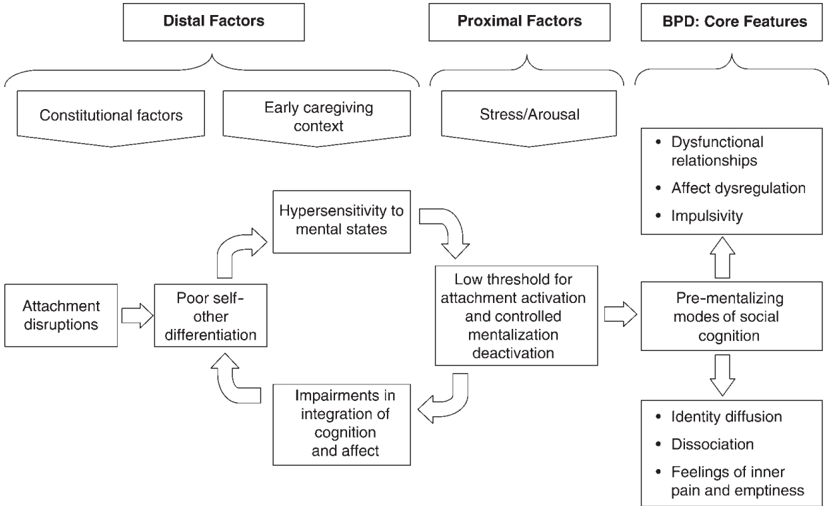
The precise nature and etiopathogenesis of borderline personality disorder (BPD) continues to elude researchers and clinicians. Yet, increasing evidence from various strands of research converges to suggest that affect dysregulation, impulsivity, and unstable relationships constitute the core features of BPD. Over the last two decades, the mentalization-based approach to BPD has attempted to provide a theoretically consistent way of conceptualizing the interrelationship between these core features of BPD, with the aim of providing clinicians with a conceptually sound and empirically supported approach to BPD and its treatment. This paper presents an extended version of this approach to BPD based on recently accumulated data. In particular, we suggest that the core features of BPD reflect impairments in different facets of mentalization, each related to impairments in relatively distinct neural circuits underlying these facets. Hence, we provide a comprehensive account of BPD by showing how its core features are related to each other in theoretically meaningful ways. More specifically, we argue that BPD is primarily associated with a low threshold for the activation of the attachment system and deactivation of controlled mentalization, linked to impairments in the ability to differentiate mental states of self and other, which lead to hypersensitivity and increased susceptibility to contagion by other people's mental states, and poor integration of cognitive and affective aspects of mentalization. The combination of these impairments may explain BPD patients' propensity for vicious interpersonal cycles, and their high levels of affect dysregulation and impulsivity. Finally, the implications of this expanded mentalization-based approach to BPD for mentalization-based treatment and treatment of BPD more generally are discussed.
Overview
CoChat Summary
TL;DR
This paper presents an expanded developmental, mentalization-based model of borderline personality disorder (BPD), arguing that its core features reflect impairments in different facets of mentalization linked to relatively distinct neural circuits. It proposes that BPD involves low thresholds for attachment-system activation and controlled-mentalization deactivation, explaining vicious interpersonal cycles, affect dysregulation, impulsivity, identity diffusion, dissociation, and inner pain.
Key findings
- BPD’s core features are emotional dysregulation, high impulsivity leading to self-harm and suicidality, and disturbed interpersonal functioning; lifetime prevalence is estimated to be as much as 6%, and between 25 and 33% may meet criteria in outpatient and forensic populations.
- Mentalization is multidimensional—automatic/controlled, cognitive/affective, internal/external, and self/other focused—and BPD is primarily associated with failures of explicit, internal, cognitive mentalization, alongside a low threshold for attachment activation and deactivation of controlled mentalization.
- These impairments may produce hypersensitivity and susceptibility to contagion by others’ mental states, poor self-other differentiation, hypermentalization or mentalization failure, and reemergence of prementalizing modes such as psychic equivalence, pretend mode, and teleological mode.
- Treatment implications include aiming for an optimal balance between attachment activation and mentalization; insight-oriented treatments focused on traumatic past may be contraindicated for patients with serious mentalization impairments.
Methods
- Theoretical/review paper presenting an expanded mentalization-based developmental model of BPD, integrating prior formulations with recently accumulated data.
- Draws on extant neuroimaging, developmental social and cognitive research, factor analytic and clinical studies, attachment research, and treatment literature; no new empirical sample or primary data collection is reported.
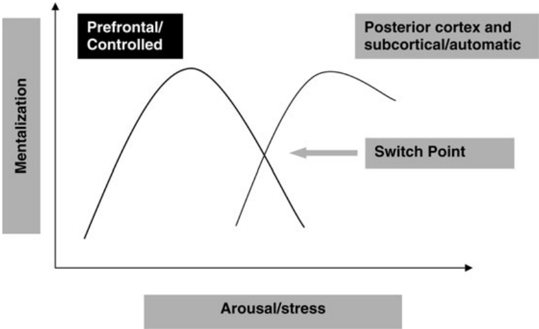
- Main analysis is a conceptual synthesis relating BPD features to four mentalization polarities and proposed neural systems, including a biobehavioral switch model of stress and controlled versus automatic mentalization.
Limitations
- The paper states that cited neuroimaging and physiological studies require further replication because of sometimes small sample sizes, disparate experimental paradigms, and heterogeneity in sample selection (e.g., comorbidity with depression, childhood abuse, PTSD, and copying styles).
- The paper notes that reliable description of BPD in adolescence remains controversial regarding homogeneity, comorbidity between and within axes, arbitrary cutoffs, and poor test-retest reliability, and that stability into adulthood is suggestive rather than well-established.
- The paper states that some predictions remain to be investigated (e.g., recovery time of mentalization with hyperactivating versus deactivating strategies) and that evidence on maladaptive parental mentalizing is still lacking; evident from the text, it is a conceptual/review article and does not empirically test the proposed model.
Model-written summary. Check it against the paper before relying on it.
Integrity signals
Registry
Cites
Statistics
Figures
Verification
Claims the paper makes
24 Valid · 11 Not valid · 130 Not checked · 108 Own results and interpretations
The cited sources support only part of this claim — read each source’s verdict below.
In the paper
“As we have already noted, retrospective evaluations have led to recognition that disorganization of the attachment system is a key aspect of the psychopathology of BPD (Gunderson & Lyons-Ruth, 2008).”
What the sources say
- Partly supportedcites Gunderson & Lyons-Ruth, 2008 matched to “BPD's Interpersonal Hypersensitivity Phenotype: A Gene-Environment-Developmental Model” (2008) sourceExperimental — accuracy not yet measured
The paper calls disorganized attachment especially important to understanding BPD and links it to an adult attachment pattern seen in patients (passage [1], section labeled Abstract). Its Conclusions describe attachment disorganization as one likely developmental pathway, not a defining feature of BPD psychopathology. The RETROSPECTIVE REPORTS section discusses patients’ accounts of difficult childhood relationships but does not say those evaluations established attachment disorganization. (LLM, conf=0.82)
plainstates an association- Asserted: passes — The authors put it forward as true.
- Checkable: passes — It can be checked against evidence.
- Load-bearing: passes — The paper’s conclusions depend on it.
- Based: passes — The paper gives a reason why it holds.
- Partly supported
The cited sources support only part of this claim — read each source’s verdict below.
In the paper
“Indeed, studies of adult attachment patterns of BPD patients repeatedly highlight a combination of preoccupied and unresolved attachment associated with BPD (Agrawal, Gunderson, Holmes, & Lyons-Ruth, 2004; Fonagy et al., 1996; Nakash-Eisikovits, Dutra, & Westen, 2002).”
What the sources say
- Supportedcites Agrawal, Gunderson, Holmes, & Lyons-Ruth, 2004 matched to “Attachment Studies with Borderline Patients: A Review” (2004) source
The Results report that all five studies using the Adult Attachment Interview found the greatest proportion of borderline individuals in the preoccupied or unresolved categories. The Discussion states that BPD attachments seem best characterized as unresolved with preoccupied features in relation to parents, matching the attributed claim. (LLM, conf=0.94)
- Not checked yetcites Fonagy et al., 1996 matched to “The relation of attachment status, psychiatric classification, and response to psychotherapy.” (1996) source
- Partly supportedcites Nakash-Eisikovits, Dutra, & Westen, 2002 matched to “Relationship Between Attachment Patterns and Personality Pathology in Adolescents” (2002) sourceExperimental — accuracy not yet measured
The Association Between Attachment Status and Axis II Pathology section links both anxious/ambivalent and disorganized/unresolved attachment to borderline personality disorder. But this paper studies adolescents, not adult BPD patients, and reports the two associations separately rather than a combined attachment pattern. Its discussion of an adult association concerns preoccupied attachment only. (LLM, conf=0.88)
boostedstates an association- Asserted: passes — The authors put it forward as true.
- Checkable: passes — It can be checked against evidence.
- Load-bearing: unclear — It is unclear whether the paper’s conclusions depend on it.
- Based: passes — The paper gives a reason why it holds.
- Supported
The cited sources support only part of this claim — read each source’s verdict below.
In the paper
“Such gene-environment effects could be one way that the known influence of heredity (Distel et al., 2008; LyonsRuth et al., 2007; Ni et al., 2007) is mediated in BPD.”
What the sources say
- Supportedcites Distel et al., 2008 matched to “Heritability of borderline personality disorder features is similar across three countries” (2008) source
The citation supports the sentence’s reference to a known hereditary influence, not its proposed gene–environment mechanism. The indexed paper’s title identifies its subject as the heritability of borderline personality disorder features; it does not need to establish the citing authors’ speculative explanation of how that influence is mediated. (LLM, conf=0.84)
- Supportedcites LyonsRuth et al., 2007 matched to “Serotonin transporter polymorphism and borderline or antisocial traits among low-income young adults” (2007) source
The Conclusions report genetic influence on liability to borderline and antisocial personality disorders. The Discussion proposes that the observed genetic association may reflect a gene–environment interaction, while noting that the interaction was not tested in this study. That supports the citing sentence’s tentative ‘could be’ formulation. (LLM, conf=0.90)
- Not matchedcites Ni et al., 2007
This doesn’t read as a citation we can look up.
hedgedstates a possible cause- Asserted: passes — The authors put it forward as true.
- Checkable: passes — It can be checked against evidence.
- Load-bearing: unclear — It is unclear whether the paper’s conclusions depend on it.
- Based: passes — The paper gives a reason why it holds.
- Supported
The cited sources support only part of this claim — read each source’s verdict below.
In the paper
“dissociative comorbidity is more frequently reported by patients with BPD than other groups”
What the sources say
- Not checked — no full text of the sourcecites Sar, Akyuz, Kugu, Ozturk, & Ertem-Vehid, 2006 matched to “Axis I Dissociative Disorder Comorbidity in Borderline Personality Disorder and Reports of Childhood Trauma” (2006) source
- Partly supportedcites Zanarini, Frankenburg, Jager-Hyman, Reich, & Fitzmaurice, 2008 matched to “The course of dissociation for patients with borderline personality disorder and axis II comparison subjects: a 10‐year follow‐up study” (2008) sourceExperimental — accuracy not yet measured
The Results report that 76 borderline patients, but only two axis II comparison subjects, had high dissociation scores at baseline. This supports a difference in reported dissociative symptoms between those groups, not a higher frequency of diagnosed dissociative comorbidity across other groups generally. The paper measures symptoms with the Dissociative Experiences Scale rather than reporting rates of comorbid dissociative disorders. (LLM, conf=0.86)
plainstates an association- Asserted: passes — The authors put it forward as true.
- Checkable: passes — It can be checked against evidence.
- Load-bearing: unclear — It is unclear whether the paper’s conclusions depend on it.
- Based: passes — The paper gives a reason why it holds.
The cited sources that could be checked couldn’t confirm or dispute this claim.
In the paper
“may be an extreme indication of such separateness (Ross, 2007; Zanarini et al., 2008).”
What the sources say
- Not checked — no full text of the sourcecites Ross, 2007 matched to “Borderline Personality Disorder and Dissociation” (2007) source
- Could not verifycites Zanarini et al., 2008 matched to “The course of dissociation for patients with borderline personality disorder and axis II comparison subjects: a 10‐year follow‐up study” (2008) sourceExperimental — accuracy not yet measured
The Methods describe dissociation through absorption, depersonalization, and amnesia, while the Discussion reports how their severity changed over time. Neither section characterizes dissociation as an extreme indication of separateness; searches for separateness and related descriptions found no such passage. Page numbers were not available in our copy. (LLM, conf=0.75)
hedgedstates an association- Asserted: passes — The authors put it forward as true.
- Checkable: passes — It can be checked against evidence.
- Load-bearing: unclear — It is unclear whether the paper’s conclusions depend on it.
- Based: passes — The paper gives a reason why it holds.
157 more claims · 13 with their cited sources checked
Create a free account to see all 273 claims and to verify the 9 references still open.
- Probably not a substantial claim. 41
- It may state two separate claims as one. 81
Claims other papers make about this one
Each is checked against this paper’s own text: does it say what the citing paper says it does?
The source backs part of the claim, not all of it — or backs it for a different population, condition or comparison.
In the citing paper
“In this account, an insecure attachment relationship between primary caregiver and child results in avoidance of internal thinking and feeling states in the child because acknowledging such internal states would further threaten an already vulnerable relationship with the caregiver.”
From First evidence of a prospective relation between avoidance of internal states and borderline personality disorder features in adolescents. (2015) · cites this paper as [19]
Experimental — accuracy not yet measuredThe source backs part of the claim, not all of it — or backs it for a different population, condition or comparison.
In the citing paper
“In turn, the child is at increased risk of developing BPD.”
From First evidence of a prospective relation between avoidance of internal states and borderline personality disorder features in adolescents. (2015) · cites this paper as [19]
Experimental — accuracy not yet measuredThe source backs part of the claim, not all of it — or backs it for a different population, condition or comparison.
In the citing paper
“In line with this, mentalization as an emotion regulation strategy has been considered a top-down strategy, relying in the explicit emotion regulation and in the theory of mind brain systems (Fonagy and Luyten, 2009; Vrticka and Vuilleumier, 2012).”
From Mindfulness and Emotion Regulation: Insights from Neurobiological, Psychological, and Clinical Studies (2017) · cites this paper as Fonagy and Luyten, 2009
Experimental — accuracy not yet measuredIn the citing paper
“stress and distress is thought to have a detrimental impact on the capacity to mentalize, especially if the stress is interpersonal in nature.”
From Investigating the association between parental reflective functioning and distress tolerance in motherhood. (2015) · cites this paper as Fonagy & Luyten, 2009
In the citing paper
“Stress and heightened arousal may inhibit the engagement of cortically-controlled processes of explicit mentalization that underscore reflection and reasoning when engaged with others (Fonagy & Luyten, 2009).”
From Investigating the association between parental reflective functioning and distress tolerance in motherhood. (2015) · cites this paper as Fonagy & Luyten, 2009
Citations
Cites
Fredrickson, B. L. (2001) · American Psychologist · doi:10.1037//0003-066x.56.3.218 · Cited by 18,025 · cited 2×
“…insight into BPD. Studies suggest that the ability to continue to mentalize even under considerable stress leads to so-called “broaden and build” (Fredrickson, 2001) cycles of attachment security, which reinforce feelings of secure attachment, personal agency, and affect regulation (“build”),…”
BackgroundRizzolatti, G., & Craighero, L. (2004) · Annual Review of Neuroscience · doi:10.1146/annurev.neuro.27.070203.144230 · Cited by 7,433 · cited 1×
“…system involves a more body-based, frontoparietal mirror neuron system that is involved in understanding the multimodal embodied self (e.g., face and body recognition) and understanding others through motor-simulation mechanisms (Gallese, Keysers, & Rizzolatti, 2004; Rizzolatti & Craighero, 2004).”
Background(1993) · Cited by 7,136
Attachment in adulthood: structure, dynamics, and change
(2008) · Choice Reviews Online · doi:10.5860/choice.45-2903 · Cited by 4,315
Affect Regulation, Mentalization, and the Development of the Self
Fonagy, P., Gergely, G., Jurist, E. L., & Target, M. (2018) · doi:10.4324/9780429471643 · Cited by 3,886
Self-citationThe Child's Conception of Space
Lawrence, E., Piaget, J., Inhelder, B., Langdon, F. J., & Lunzer, J. L. (1957) · British Journal of Educational Studies · doi:10.2307/3118882 · Cited by 3,213
Cattaneo, L., & Rizzolatti, G. (2009) · Archives of Neurology · doi:10.1001/archneurol.2009.41 · Cited by 3,137
Self-referential processing in our brain—A meta-analysis of imaging studies on the self
Northoff, G., Heinzel, A., de Greck, M., Bermpohl, F., Dobrowolny, H., & Panksepp, J. (2006) · NeuroImage · doi:10.1016/j.neuroimage.2005.12.002 · Cited by 2,792 · cited 1×
“The aFMC is involved in mentalizing (Frith & Frith, 2006; Gilbert et al., 2007) and self-referential processing (Northoff et al., 2006).”
BackgroundMayberg, H. S., Liotti, M., Brannan, S. K., McGinnis, S., Mahurin, R. K., Jerabek, P. A., Silva, J. A., Tekell, J. L., Martin, C. C., Lancaster, J. L., et al. (1999) · American Journal of Psychiatry · doi:10.1176/ajp.156.5.675 · Cited by 2,416 · cited 2×
“…for attention and long-term memory (Cabeza & Nyberg, 2000), perhaps specifically responsible for integrating emotion and cognition (e.g., emotional encoding of episodic memories; Maddock, 1999) and subserving moodmediated inhibition or enhancement of cognitive processing (Mayberg et al., 1999).”
BackgroundThe debate over dopamine’s role in reward: the case for incentive salience
Berridge, K. C. (2007) · Psychopharmacology · doi:10.1007/s00213-006-0578-x · Cited by 2,347 · cited 1×
“These findings suggest that for securely attached mothers, infant cues (whether positive or negative in affect) may act as an important affective signal of “incentive salience” (Berridge, 2007), reinforcing and motivating responsive maternal care.”
Background
Research works printed but not linked: 12
- Williams, 2006, Handbook of mentalisation based treatments
- 10.1093/med/9780198569183.001.0001 · DOI · Paper page
- 10.1111/1469-7610.0013_7 · doi:10.1111/1469-7610.0013_7 · Paper page
- Gergely, 1996, The social biofeedback model of parental affect-mirroring, International Journal of Psycho-Analysis, 77, 1181
- Luyten, 2009, The interpersonal regulation of stress
- Bloom, 2004, Descartes' baby
- Hobson, 2002, The cradle of thought: Explorations of the origins of thinking
- Fearon, 2006, Handbook of mentalisaiton based treatments
- Diamond, 1991, Self–other differentiation of object representations
- Hesse, 2008, Handbook of attachment theory and research, 552
- Luyten, 2009, Mentalization as a multidimensional concept
- O'Connor, 2006, Developmental psychopathology: Vol. 3. Risk, disorder and adaptation, 202
Cited by
Items 801–900 of 1,140
Exploring Paternal Mentalization Among Fathers of Toddlers Through a Clay-Sculpting Task
Bauch, N. G., & Or, M. B. (2021) · Frontiers in Psychology · doi:10.3389/fpsyg.2021.518480 · Cited by 5
“Switches in mentalization, a rapid shifting from controlled to automatic thinking (Fonagy and Luyten, 2009), were found when the participant: (1) suddenly changed the topic of the discussion (e.”
BackgroundStage-specific interventions for emotion dysregulation disorders in adolescents
Ivanova, V., Celen, Z., & Piguet, C. (2021) · Swiss Archives of Neurology Psychiatry and Psychotherapy · doi:10.4414/sanp.2021.03213 · Cited by 1
Hohagen, F., Schweiger, U., Klein, J. P., Stieglitz, R.-D. B., Caspar, F., Fabry, G., & Berger, T. (2019) · Elsevier eBooks · doi:10.1016/b978-3-437-22485-0.00006-3 · Cited by 1
Altering the Point of You: Perspectives on Intersubjectivity and Metacognition
Liljenfors, R. (2012) · Lund University Publications (Lund University) · Cited by 1
Masin-Moyer, M. (2017) · ScholarlyCommons (University of Pennsylvania) · Cited by 2
Draper, E. L. R. (2017) · UCL Discovery (University College London) · Cited by 1
The association between therapists' attachment security and mentalizing capacity
Wyatt-Brooks, K. (2013) · UCL Discovery (University College London) · Cited by 3
Development and Validation of the Mentalising Profile Q-Sort (MQS)
Hoyos, W. A. G. (2020) · UCL Discovery (University College London) · Cited by 1
Suominen, P. (2020) · SSRN Electronic Journal · doi:10.2139/ssrn.3721233 · Cited by 2
Visual strategies underpinning social cognition in traumatic brain injury
Greene, L. (2019) · Sheffield Hallam University · doi:10.7190/shu-thesis-00320 · Cited by 1
Gulamani, T. (2019) · TSpace (University of Toronto) · Cited by 1
Risk factors for violent behavior in people with psychotic disorders
Lamsma, J. (2021) · Utrecht University Repository (Utrecht University) · doi:10.33540/496 · Cited by 1
Torok, E., & Kéri, S. (2020) · PsyArXiv (OSF Preprints) · doi:10.31234/osf.io/njbx5 · Cited by 4
White, L. O., Schulz, C. C., Schoett, M. J. S., Kungl, M., Keil, J., Borelli, J. L., & Vrtička, P. (2020) · PsyArXiv (OSF Preprints) · doi:10.31234/osf.io/95eph · Cited by 1
Saju, P. J. (2021) · Cambridge University Press eBooks · doi:10.1017/9781108686976.011 · Cited by 1
Emerging Personality Disorders
Kerr, S., Fonagy, P., & Sharp, C. (2021) · Wiley eBooks · doi:10.1002/9781118686089.ch13 · Cited by 2
Self-citationSocially Transformative Resilience: A Conceptual Model and Research Agenda for a New ConstructPreprint
Leventhal, K. S., Sawrikar, V., Jain, S., & MacBeth, A. M. (2021) · PsyArXiv (OSF Preprints) · doi:10.31234/osf.io/t97qh · Cited by 1
Yakeley, J. (2021) · Cambridge University Press eBooks · doi:10.1017/9781108686976.022 · Cited by 2
Barnby, J. M., Nguyen, J., Griem, J., Wloszek, M., Burgess, H., Richards, L. J., Kingston, J. L., Cooper, G., Montague, P. R., Dayan, P., et al. (2025) · eLife · doi:10.7554/elife.104008.1 · Cited by 1
Self-citationBarnby, J. M., Nguyen, J., Griem, J., Wloszek, M., Burgess, H., Richards, L. J., Kingston, J. L., Cooper, G., Montague, P. R., Dayan, P., et al. (2025) · eLife · doi:10.7554/elife.104008.2 · Cited by 1
Self-citationBerko, Z. (2015) · CUNY Academic Works (City University of New York) · Cited by 1
Empathy, autism and the extreme female brain
Dinsdale, N. L. (2012) · Summit (Simon Fraser University)
Fisher, R. (2011) · ERA · Cited by 3
11 Psychodynamische modellen: van Freud tot Fonagy
Eurelings‐Bontekoe, L., Koelen, J. A., & Snellen, W. M. (2009) · Bohn Stafleu van Loghum eBooks · doi:10.1007/978-90-313-6821-1_11
Hohagen, F., Stieglitz, R., Bohus, M., Caspar, F., & Berger, T. (2012) · Elsevier eBooks · doi:10.1016/b978-3-437-22483-6.10006-3
Jones, B. (2015) · Therapeutic Communities The International Journal of Therapeutic Communities · doi:10.1108/tc-11-2014-0036
Cognitive and emotional processing associated with borderline personality disorder
Lawrence, L. M. (2016) · Figshare · doi:10.25916/sut.26259638
Without you there is no me: An interpersonal framing of psychosis
Strand, J. (2014) · Gothenburg University Publications Electronic Archive (Gothenburg University) · Cited by 1
Planjer, A. (2012) · Tijdschrift voor Psychotherapie · doi:10.1007/s12485-012-0050-9
Representational and Encoding Processes
Rothschild‐Yakar, L., Waniel, A., & Stein, D. J. (2014) · Journal of the American Psychoanalytic Association · doi:10.1177/0003065114539554
Empathic Accuracy and Borderline Personality Disorder
Ripoll, L. H. (2012) · Neuropsychoanalysis · doi:10.1080/15294145.2012.10773704
“…erotomania, and/or dissociation, relationships marked by projective identification, chronic emptiness and identity diffusion, affective lability, impulsive aggression, and conflicted uncertainty regarding potential dependency (Deutsch, 1942; Fonagy & Luyten, 2009; Kernberg, 1975; Masterson, 1988).”
BackgroundInfluentialKnox, J. (2010) · Journal of Analytical Psychology · doi:10.1111/j.1468-5922.2010.01867_4.x
Stenholm, N., & Wass, C. (2013) · Lund University Publications Student Papers (Lund University)
En studie av samband mellan mentaliseringsförmåga och affektregleringsstrategier
Määttä, J., & Danielsson, G. (2011) · Lund University Publications Student Papers (Lund University)
An interpersonal framing of psychosis
Strand, J. (2014)
Early and subsequent life stress: physiological responses, moderating events and outcome
Muller, D. (2015) · University of the Witwatersrand, Johannesburg Institutional Repository on DSpace (University of the Witwatersrand, Johannesburg)
Gezinsinterventies op basis van mentaliseren
Asen, E., & Fonagy, P. (2016) · Gezinstherapie Wereldwijd · doi:10.1007/s12440-015-0003-z
Self-citationPersonality Disorders: A Short Review
Lorenzini, N., & Fonagy, P. (2013)
Self-citationAntonsen, B. T. (2016) · NVA (Nasjonalt vitenarkiv)
Mangelpatologi i parforhold- en teoretisk drøfting ut fra relasjonelt orientert psykoanalyse
Løchen, S. (2013) · NORA - Norwegian Open Research Archives
Schechter, D. S. (2011) · PubMed Central
Loth, W. (2016) · Familiendynamik · doi:10.21706/fd-41-4-359
Psychotherapeutenausbildung 2.0
Baumann, S. (2016) · Familiendynamik · doi:10.21706/fd-41-4-347
Pascual, M. S., León-Quismondo, L., García, A., de Arenosa, L., Hesse, M., & Liria, A. F. (2015)
Theory of mind and emotion regulation difficulties in adolescents with
Sharp, C., Pane, H. M., Sturek, J. C., Patel, A. B., & Fonagy, P. (2011)
Self-citation»Die Kritikerin in mir«: Psychologische Beratung einer Klientin mit Prüfungsangst
Frei, I. (2016) · Familiendynamik · doi:10.21706/fd-41-4-353
Epple, H. (2016) · Familiendynamik · doi:10.21706/fd-41-4-349 · Cited by 1
Hypermentalisering: Når frykten tar overhånd
Hanken, A.-H. E. (2013) · Cited by 1
Hovedoppgave ved Psykologisk Institutt
Hegdal, M., & Lütchen-Lehn, M. H. (2011)
The Second-Person Perspective in the Preface of Nicholas of Cusa's De Visione Dei
Hollingsworth, A. O. (2013) · European Journal for Philosophy of Religion · doi:10.24204/ejpr.v5i4.210
Psychotherapy for borderline personality disorder: Where do we go from here?
Fonagy, P., Luyten, P., & BATEMAN, A. W. (2017) · UCL Discovery (University College London)
Self-citationMentalisation in Anorexia Nervosa and disordered eating
Watkins, H. (2016) · ERA
Cosentino, N. (2016) · TSpace (University of Toronto)
La realidad psíquica y la naturaleza de lo consciente
Fonagy, P., & Allison, E. (2016) · The International Journal of Psychoanalysis (en español) · doi:10.1080/2057410x.2016.1351678 · Cited by 1
Self-citationTizón, J. L. (2017) · FMC - Formación Médica Continuada en Atención Primaria · doi:10.1016/j.fmc.2017.03.003 · Cited by 1
Rainer Krause – Die Rolle der Affekte in der neueren analytischen Entwicklungspsychologie
Kaiser, J. (2017) · Vandenhoeck & Ruprecht eBooks · doi:10.13109/9783666451386.208 · Cited by 1
An Attachment‐Informed Approach to Working with Addiction
Curran, D. B., & Mehdikhani, M. (2017) · Wiley eBooks · doi:10.1002/9781118489710.ch2 · Cited by 1
Lana, F., Martí-Bonany, J., Moreno, G., Pérez, V., & de la Cruz, M. Á. (2017)
Gezinsgeweld mentaliseren (deel 2): technieken en interventies
Asen, E., & Fonagy, P. (2018) · Gezinstherapie Wereldwijd · doi:10.1007/s12440-018-0064-x
Self-citationGezinsgeweld mentaliseren (deel 1): conceptueel raamwerk
Asen, E., & Fonagy, P. (2018) · Gezinstherapie Wereldwijd · doi:10.1007/s12440-018-0062-z
Self-citationApego y rasgos límites de la personalidad: el papel mediador de la regulación emocional
Casado, M. V. (2018) · Gredos (University of Salamanca) · doi:10.14201/gredos.137558
What is the Nature of the Therapeutic Encounter in an Adolescent Psychotherapy Group?
Maxwell, M. (2016) · Staff Publications Online (The Tavistock and Portman) · doi:10.15123/pub.7091
Mentalisieren in der Sozialen Arbeit
Kirsch, H. (2018) · Vandenhoeck & Ruprecht eBooks · doi:10.13109/9783666452499.208
Partizipation aus der Sicht eines intersubjektiven Gemeinschaftsgefühls
Pap, G. (2018) · Zeitschrift für freie psychoanalytische Forschung und Individualpsychologie · doi:10.15136/2018.5.1.1-24
Zdolność do mentalizacji a wykorzystanie seksualne w dzieciństwie
Węglerska, O. (2018) · Dziecko Krzywdzone. Teoria, badania, praktyka · Cited by 1
Robinson, P., Skårderud, F., & Sommerfeldt, B. (2018) · Springer eBooks · doi:10.1007/978-3-319-95121-8_7
Kirsch, H. (2019) · Zeitschrift für Individualpsychologie · doi:10.13109/zind.2019.44.1.36 · Cited by 1
Mentalizing : Competence and process
Möller, C. M. (2018) · Linköping studies in behavioural science · doi:10.3384/diss.diva-152253 · Cited by 3
Can Attachment Style and Temperament Predict Personality Organization
Smith, C. L. (2018)
Kazemeini, T., Shamloo, Z. S., Mashhadi, A., & Gharravi, M. M. (2018)
Mentalizing Diabetes in the Mother-Child Dyad
Costa‐Cordella, S., & Maria, S. (2019) · UCL Discovery (University College London) · Cited by 1
Kim, S. J., Kim, J.-M., & hee, H. I. (2019) · Korean Journal of Child Studies · doi:10.5723/kjcs.2019.40.6.77
Arsonist, Persecutor and Ruthless Property Developer?
Drinkwater, J. F. (2018) · Cambridge University Press eBooks · doi:10.1017/9781108472647.012
Developing a model of living with HIV in individuals with personality-related difficulties
Larsson, E. E. C. (2019)
Interpersonal hypersensitivity and Social Cognition in Borderline Personality Disorder
Sato, M. (2018) · UCL Discovery (University College London)
Imaging of personality disorders
Paret, C., & Schmahl, C. G. (2020) · doi:10.1093/med/9780198713005.003.0121
Drinkwater, J. F. (2018) · Cambridge University Press eBooks · doi:10.1017/9781108472647.003
Drinkwater, J. F. (2018) · Cambridge University Press eBooks · doi:10.1017/9781108472647.004
Quando è importante la verità?
Allison, E., & Fonagy, P. (2020) · PSICOTERAPIA E SCIENZE UMANE · doi:10.3280/pu2020-001002 · Cited by 1
Self-citationWhen Does Simulation Enable Us Adequately to Attribute Mental States to Others?
Smurzyńska, A. (2020) · Wydawnictwa Uniwersytetu Warszawskiego eBooks · doi:10.31338/uw.9788323542209.pp.212-220
Loverseed, A.-C. (2010) · University of Surrey Open Research repository · Cited by 1
Remmers, C. (2020) · Psychotherapie: Praxis · doi:10.1007/978-3-662-60318-5_13
Gonçalves, L., & da Rocha, N. S. (2020) · Revista Brasileira de Psicoterapia · doi:10.5935/2318-0404.20200010
La mentalización y el funcionamiento reflexivo: aparición y desarrollo en la Psicología Clínica.
Abbasi, F., Goodarzi, M. A., & Sarafraz, M. R. (2019) · Dilemas contemporáneos Educación Política y Valores · doi:10.46377/dilemas.v26i1.1499 · Cited by 1
Intentions: The Integrative Imperative in the Theater of Personal Stories
Baim, C. (2020) · Springer eBooks · doi:10.1007/978-3-030-46555-1_5 · Cited by 1
Davies, L. (2019) · UWE Research Repository (UWE Bristol) · Cited by 1
Kiedy symulacja pozwala na adekwatne przypisywanie innym stanów mentalnych?
Smurzyńska, A. (2020) · Wydawnictwa Uniwersytetu Warszawskiego eBooks · doi:10.31338/uw.9788323542223.pp.217-226
Wie können Mentalisieren, Epistemisches Vertrauen und soziales Lernen in der Krise gelingen?
Volkert, J. (2020) · PDP – Psychodynamische Psychotherapie · doi:10.21706/pdp-19-3-340
Bruneau-Bhérer, R., Tremblay, S.-E., Matte-Landry, A., Pepin, C., & Collin-Vézina, D. (2020) · International Journal of Child and Adolescent Resilience · doi:10.7202/1072596ar
“La faible concordance entre les résultats rapportés par les jeunes et leurs éducateurs est probablement due aux difficultés de mentalisation, fréquentes et sévères, chez cette population (Fonagy & Luyten, 2009).”
BackgroundAttachment and Mentalization in Social Trauma
Holl, J., & Taubner, S. (2020) · Springer eBooks · doi:10.1007/978-3-030-47817-9_17
Kim, H.-J., Park, M.-J., Cha, H.-M., & Kim, E. Y. (2020) · 한국심리학회지: 일반 · doi:10.22257/kjp.2020.12.39.4.633
Mentalisierungsbasierte Therapie zur Behandlung von Borderline-Persönlichkeitsstörungen
Taubner, S., & Hauschild, S. (2021) · PSYCH up2date · doi:10.1055/a-1169-3313
Sé e altri nel sistema mente-cervello-corpo: verso un'organizzazione intersoggettiva del Sé
Mucci, C., & Scalabrini, A. (2021) · SETTING · doi:10.3280/set2020-044004
Drinkwater, J. F. (2018) · Cambridge University Press eBooks · doi:10.1017/9781108472647.008
Drinkwater, J. F. (2018) · Cambridge University Press eBooks · doi:10.1017/9781108472647.010
Referral for Psychodynamic Psychotherapy: Processes and Considerations
O’Reilly, J. (2021) · Cambridge University Press eBooks · doi:10.1017/9781108686976.005
Psychological Approaches to Affective Disorders
Stuart-Smith, S. (2021) · Cambridge University Press eBooks · doi:10.1017/9781108686976.015
Mentalizing in Psychiatric Practice
BATEMAN, A. W. (2021) · Cambridge University Press eBooks · doi:10.1017/9781108686976.014 · Cited by 1
Metadata
- Authors
- Fonagy, P., & Luyten, P.
- Affiliations
- University College London (GB)
- KU Leuven (BE)
- Corresponding author
- Fonagy, Peter
- Venue
- Development and Psychopathology
- Publisher
- Cambridge University Press (CUP)
- Published
- 2009-10-14
- Volume
- 21
- Issue
- 4
- Pages
- 1355-1381
- ISSN
- 0954-5794 (ISSN-L)
- 1469-2198
- OpenAlex
- W2098937677
- Cited by
- 1,146
- References
- 239
- Citations by year
- 2026: 77 · 2025: 87 · 2024: 115 · 2023: 56 · 2022: 68 · 2021: 120 · 2020: 87 · 2019: 73 · 2018: 100 · 2017: 60 · 2016: 63 · 2015: 70 · 2014: 43 · 2013: 43 · 2012: 32
- FWCI
- 3.56
- Type
- journal article
- Language
- en
- Open access
- green
- discovery.ucl.ac.uk
- Locations
- Development and Psychopathology (publishedVersion)
- PubMed (publishedVersion)
- UCL Discovery (University College London) (submittedVersion)
- Digital Access to Libraries (Université catholique de Louvain (UCL), l'Université de Namur (UNamur) and the Université Saint-Louis (USL-B)) (submittedVersion)
- Topics
- Social Sciences › Psychology › Clinical Psychology › Personality Disorders and Psychopathology
- Social Sciences › Psychology › Clinical Psychology › Psychoanalysis and Psychopathology Research
- Social Sciences › Psychology › Clinical Psychology › Personality Traits and Psychology
- Keywords
- borderline personality disorder, mentalization, affect dysregulation, impulsivity, unstable relationships, attachment system, cognitive-affective integration, neural circuits, etiopathogenesis, mentalization-based treatment
- MeSH terms
- Affect, Borderline Personality Disorder, Cognition, Emotions, Humans, Interpersonal Relations, Self Concept, Theory of Mind
About these checks
Registry, retraction, Cites and statistics results are computed, not judged, with one exception: a printed reference that no index lists is read once by a model before it counts as a citation error. Claims are extracted by a model and kept only when their quote appears verbatim in the text; each cited source is then checked, with a model’s help, for whether it says what the claim relies on. Those verdicts can be wrong — read the claim’s quote and the cited source before relying on one.
The claim verdicts this report counts are experimental: their accuracy is not yet measured.
A language model drew the claims from the paper on 2026-10-10, under version 3 of the claim definition (model deepseek-v4.1-flash, prompt extract-v3).
A second model labelled each claim on 2026-10-10 (model jev-1.13-20260917, definition revision gold-guideline-v0.2).
Cited sources are checked with a language model’s help (gpt-6-sol).
Statistics and arithmetic are recomputed, not judged.
Confidence bands are shown only for fields calibrated on our annotated test set. None is calibrated yet, so no band is shown.
What counts as a claim ›How we measure confidence ›How we check this ›
Are you an author, or do you see a problem with this page? Request a review
Data sources
Bibliographic data: Semantic Scholar, OpenAlex, Crossref.
Contains information from the Semantic Scholar Academic Graph Datasets, made available under the ODC Attribution License (ODC-BY 1.0).
Semantic Scholar’s data is described in: Kinney, R., et al. (2023). The Semantic Scholar Open Data Platform. arXiv:2301.10140.
