

The DOI matches its Crossref record; 75 of the 75 references it cites were found in a registry or an index; none of the 61 sources its claims cite is checked for support yet.
The hippocampus: a manifesto for change
Open accessAbstract
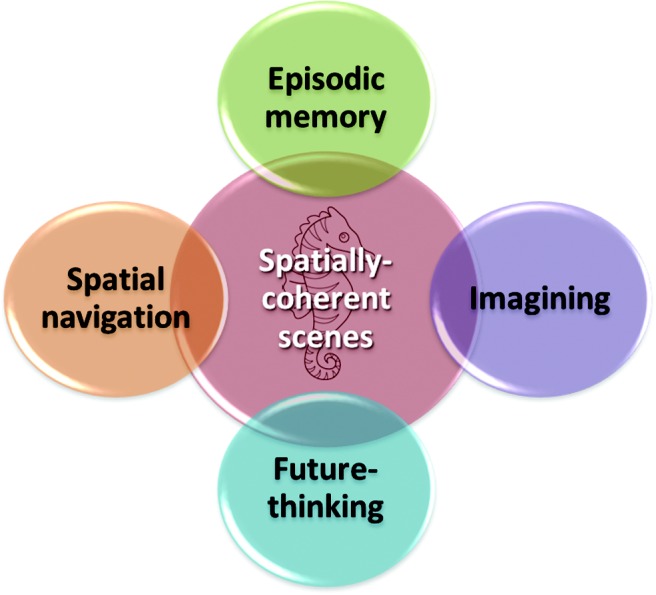
We currently lack a unified and mechanistic account of how the hippocampus supports a range of disparate cognitive functions that includes episodic memory, imagining the future, and spatial navigation. Here, we argue that in order to leverage this long-standing issue, traditional notions regarding the architecture of memory should be eschewed. Instead, we invoke the idea that scenes are central to hippocampal information processing. This view is motivated by mounting evidence that the hippocampus is constantly constructing spatially coherent scenes, automatically anticipating and synthesizing representations of the world beyond the immediate sensorium. By characterizing the precise relationship between scenes and the hippocampus, we believe a theoretically enriched understanding of its fundamental role and its breakdown in pathology can emerge.
Overview
AI snapshot
Written from the paper’s full text.
TL;DR
Maguire argues that the hippocampus is not primarily an episodic memory device but instead automatically constructs spatially coherent scenes, a view termed scene construction theory (SCT). This framework is proposed to unify episodic memory, future imagining, spatial navigation, and related functions, with boundary extension and fMRI evidence cited as key support.
Key findings
- SCT posits that scenes are the “primary currency” of the hippocampus: it constructs atemporal, spatially coherent scenes that provide the backdrop for episodic memories, imagined future experiences, spatial navigation, and perhaps mind wandering and dreaming.
- In Mullally, Intraub, and Maguire (2012), seven patients with selective bilateral hippocampal damage and amnesia showed more veridical memory and significantly fewer boundary-extension errors than controls across three independent measures; in the haptic task, patients’ reconstructed scene areas did not differ significantly from studied scenes, whereas controls’ reconstructed scenes were significantly larger.
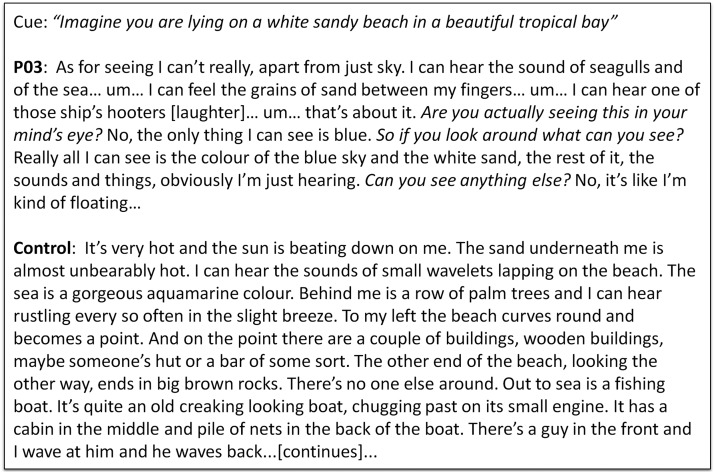
- In a scene probe task, these patients could recount expected beyond-view details conceptually but produced significantly fewer spatial details than controls and typically reported being unable to visualize the extended scene in their mind’s eye.
- Chadwick, Mullally, and Maguire (in press) found that boundary extension in healthy controls was associated with hippocampus and parahippocampal cortex engagement, with the hippocampus exerting top-down influence on PHC and early visual cortex; patient P01, densely amnesic but with preserved scene construction, engaged remnant right hippocampus during scene construction.
Methods
- Theoretical manifesto/review, not an empirical study; the authors synthesize neuropsychological and neuroimaging findings to propose SCT and compare it with alternative accounts such as relational memory, constructive episodic simulation, and cognitive map/boundary vector cell models.
- Evidence discussed includes prior studies of patients with bilateral hippocampal lesions/amnesia, including seven patients in Mullally et al. (2012) and patient P01, plus fMRI studies in healthy participants and P01.
- Main analysis is conceptual: the paper argues that scene construction, rather than memory or time, is the common hippocampal process underlying disparate functions.
Limitations
- The authors state their proposal is “not bulletproof” and requires a good deal more investigation; the piece is not intended as a forensic comparison of hippocampal theories or an exhaustive literature review.
- The authors state further work is needed to elucidate boundary extension in patients with lesions outside the hippocampus, to uncover exactly how the hippocampus facilitates scene construction, to examine its relationship with pattern separation and pattern completion, and to definitively establish that an inability to construct scenes explains the full constellation of deficits from hippocampal pathology.
- The text makes evident that no new primary data are reported and that some proposals are speculative, such as the suggestion that verbal memory tasks may benefit from scene-based imagery strategies; SCT could be falsified by a patient with impaired scene construction and preserved episodic memory, which has not yet been identified.
Model-written summary. Check it against the paper before relying on it.
Integrity signals
Registry
Cites
Statistics
Figures
Verification
Claims the paper makes
43 Not checked yet · 31 Own interpretation · 1 No basis given
In the paper
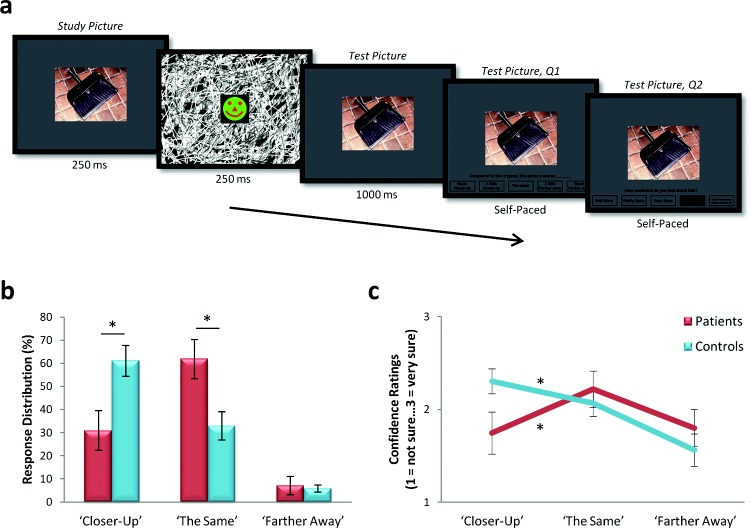
“Seven patients with selective bilateral hippocampal damage and amnesia correctly identified that the study and test pictures were identical with greater frequency than controls, demonstrating more veridical memory (see Figure 4b).”
§ The Hippocampus: A Manifesto for Change > Scene Construction and Boundary Extension
What the sources say
- Not checked yetcites Mullally, Intraub, & Maguire, 2012
boostedcorrelationaln = 7- Asserted: passes — The authors put it forward as true.
- Checkable: passes — It can be checked against evidence.
- Load-bearing: passes — The paper’s conclusions depend on it.
- Based: passes — The paper gives a reason why it holds.
A conclusion the paper draws from its own results — it cites no other source for it, so there is none to check. The quote shows it is in the paper.
In the paper
“The SCT posits that the hippocampus facilitates the construction of atemporal scenes allowing the event details of episodic memories and imagined future experiences to be martialed, bound and played out in a coherent spatial context.”
§ The Hippocampus: A Manifesto for Change > Episodic Memory and Imagination
plaindirect- Asserted: passes — The authors put it forward as true.
- Checkable: passes — It can be checked against evidence.
- Load-bearing: passes — The paper’s conclusions depend on it.
- Based: passes — The paper gives a reason why it holds.
A conclusion the paper draws from its own results — it cites no other source for it, so there is none to check. The quote shows it is in the paper.
In the paper
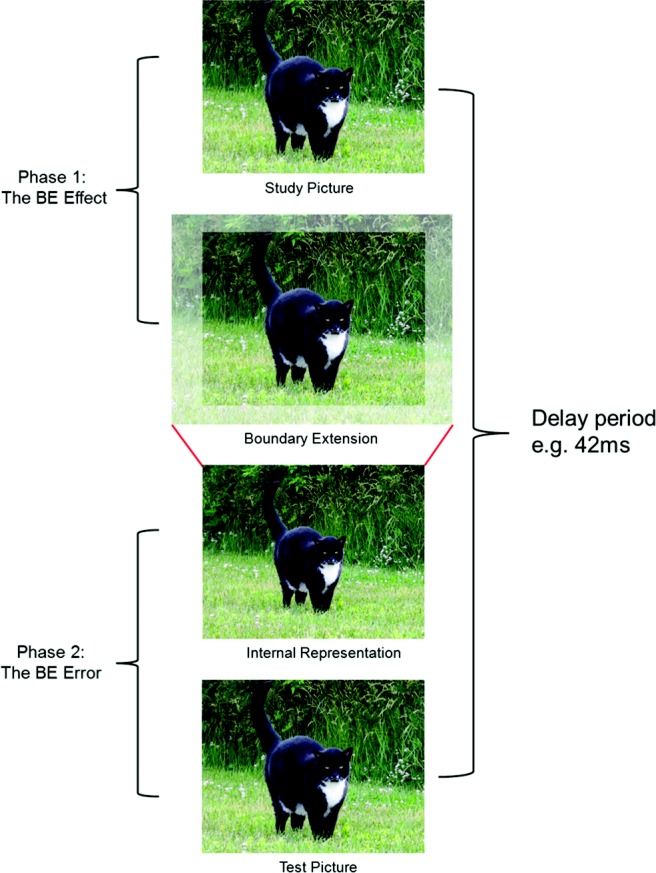
“The first (the BE effect) requires intact scene construction because it involves the active extrapolation of the scene beyond its physical boundaries resulting in an internally generated “extended scene” representation, which persists when the scene is no longer visible.”
§ The Hippocampus: A Manifesto for Change > Scene Construction and Boundary Extension
plaindirect- Asserted: passes — The authors put it forward as true.
- Checkable: passes — It can be checked against evidence.
- Load-bearing: passes — The paper’s conclusions depend on it.
- Based: passes — The paper gives a reason why it holds.
In the paper
“In both instances, the amnesic patients’ BE was greatly attenuated.”
§ The Hippocampus: A Manifesto for Change > Scene Construction and Boundary Extension
What the sources say
- Not checked yetcites Mullally, Intraub, & Maguire, 2012
plain- Asserted: passes — The authors put it forward as true.
- Checkable: passes — It can be checked against evidence.
- Load-bearing: passes — The paper’s conclusions depend on it.
- Based: passes — The paper gives a reason why it holds.
A conclusion the paper draws from its own results — it cites no other source for it, so there is none to check. The quote shows it is in the paper.
In the paper
“SCT proposes that despite the differences between them, these functions each require a crucial ingredient that is supplied by the hippocampus, and that is the ability to internally construct spatially coherent scenes.”
§ The Hippocampus: A Manifesto for Change > Episodic Memory and Imagination
plaindirect- Asserted: passes — The authors put it forward as true.
- Checkable: passes — It can be checked against evidence.
- Load-bearing: passes — The paper’s conclusions depend on it.
- Based: passes — The paper gives a reason why it holds.
None of the sources cited for this claim have been checked yet.
In the paper
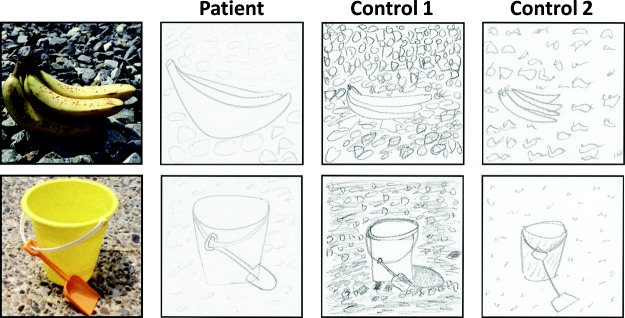
“However, it does not account for why patients with hippocampal amnesia cannot construct spatially coherent atemporal fictitious scenes (see Figure 1), a task that is not future oriented or personally relevant (Hassabis, Kumaran, Vann, & Maguire, 2007; Mullally, Intraub, & Maguire, 2012).”
§ The Hippocampus: A Manifesto for Change > Episodic Memory and Imagination
What the sources say
- Not checked yetcites Hassabis, Kumaran, Vann, & Maguire, 2007
- Not checked yetcites Mullally, Intraub, & Maguire, 2012
plaindirect- Asserted: passes — The authors put it forward as true.
- Checkable: passes — It can be checked against evidence.
- Load-bearing: passes — The paper’s conclusions depend on it.
- Based: passes — The paper gives a reason why it holds.
In the paper
“Indeed, a recent functional magnetic resonance imaging (fMRI) study revealed that frontal and parietal cortices, but not the hippocampus, supported mental time travel (Nyberg et al., 2010).”
§ The Hippocampus: A Manifesto for Change > Episodic Memory and Imagination
What the sources say
- Not checked yetcites Nyberg et al., 2010
plain- Asserted: passes — The authors put it forward as true.
- Checkable: passes — It can be checked against evidence.
- Load-bearing: passes — The paper’s conclusions depend on it.
- Based: passes — The paper gives a reason why it holds.
In the paper
“Overall, it seems that although the conscious awareness of time could be a core component of episodic memory, and the hippocampus might make use of temporal information when pertinent to the task at hand (MacDonald, Lepage, Eden, & Eichenbaum, 2011), the evidence suggests that for the hippocampus, it may not be primarily about time (Hassabis & Maguire, 2007).”
§ The Hippocampus: A Manifesto for Change > Episodic Memory and Imagination
What the sources say
- Not checked yetcites Hassabis & Maguire, 2007
hedged- Asserted: passes — The authors put it forward as true.
- Checkable: passes — It can be checked against evidence.
- Load-bearing: passes — The paper’s conclusions depend on it.
- Based: passes — The paper gives a reason why it holds.
In the paper
“Overall, therefore, these hippocampal-damaged patients had significantly reduced BE relative to healthy-matched controls across three independent measures.”
§ The Hippocampus: A Manifesto for Change > Scene Construction and Boundary Extension
What the sources say
- Not checked yetcites Mullally, Intraub, & Maguire, 2012
plain- Asserted: passes — The authors put it forward as true.
- Checkable: passes — It can be checked against evidence.
- Load-bearing: passes — The paper’s conclusions depend on it.
- Based: passes — The paper gives a reason why it holds.
In the paper
“Importantly, the patients displayed greater confidence in their correct “the same” judgments than in their incorrect (BE-driven) closer-up responses (see Figure 4c).”
§ The Hippocampus: A Manifesto for Change > Scene Construction and Boundary Extension
What the sources say
- Not checked yetcites Mullally, Intraub, & Maguire, 2012
plainn = 7- Asserted: passes — The authors put it forward as true.
- Checkable: passes — It can be checked against evidence.
- Load-bearing: unclear — It is unclear whether the paper’s conclusions depend on it.
- Based: passes — The paper gives a reason why it holds.
- It may state two separate claims as one. 17
- Probably not a substantial claim. 6
In the paper
“Although the margins for error here were large, the patients’ placement of the borders was so accurate that the area of their reconstructed scenes did not differ significantly from the area of the studied scenes. This was not the case for controls, whose reconstructed scenes were significantly larger than the studied scenes.”
§ The Hippocampus: A Manifesto for Change > Scene Construction and Boundary Extension
What the sources say
- Not checked yetcites Mullally, Intraub, & Maguire, 2012
plain- Asserted: passes — The authors put it forward as true.
- Checkable: passes — It can be checked against evidence.
- Load-bearing: passes — The paper’s conclusions depend on it.
- Based: passes — The paper gives a reason why it holds.
It may state two separate claims as one.
In the paper
“Andrews-Hanna, Reidler, Sepulcre, Poulin, and Buckner (2010) showed that imagining scenes actually accounted best for activity in the hippocampus and medial temporal lobes, whereas other regions were concerned with the self and time.”
§ The Hippocampus: A Manifesto for Change > Episodic Memory and Imagination
What the sources say
- Not checked yetcites Andrews-Hanna, Reidler, Sepulcre, Poulin, and Buckner, 2010
plaincorrelational- Asserted: passes — The authors put it forward as true.
- Checkable: passes — It can be checked against evidence.
- Load-bearing: passes — The paper’s conclusions depend on it.
- Based: passes — The paper gives a reason why it holds.
It may state two separate claims as one.
In the paper
“They also made significantly fewer BE-driven errors (“closer-up” responses), whereas the number of random errors (“farther away” responses) did not differ between the groups.”
§ The Hippocampus: A Manifesto for Change > Scene Construction and Boundary Extension
What the sources say
- Not checked yetcites Mullally, Intraub, & Maguire, 2012
plainn = 7- Asserted: passes — The authors put it forward as true.
- Checkable: passes — It can be checked against evidence.
- Load-bearing: passes — The paper’s conclusions depend on it.
- Based: passes — The paper gives a reason why it holds.
It may state two separate claims as one.
In the paper
“We know this because episodic memory subsumes multiple cognitive processes, some of which are not hippocampal dependent (Nyberg, Kim, Habib, Levine, & Tulving, 2010).”
§ The Hippocampus: A Manifesto for Change > Abstract
What the sources say
- Not checked yetcites Nyberg, Kim, Habib, Levine, & Tulving, 2010
boosted- Asserted: passes — The authors put it forward as true.
- Checkable: passes — It can be checked against evidence.
- Load-bearing: passes — The paper’s conclusions depend on it.
- Based: passes — The paper gives a reason why it holds.
It may state two separate claims as one.
A conclusion the paper draws from its own results — it cites no other source for it, so there is none to check. The quote shows it is in the paper.
In the paper
“In this way, scene construction is held to underpin not only episodic memory and imagining the future but also cognitive functions such as spatial navigation (see Figure 2), and perhaps even mind wandering and dreaming.”
§ The Hippocampus: A Manifesto for Change > Episodic Memory and Imagination
hedgeddirect- Asserted: passes — The authors put it forward as true.
- Checkable: passes — It can be checked against evidence.
- Load-bearing: passes — The paper’s conclusions depend on it.
- Based: passes — The paper gives a reason why it holds.
It may state two separate claims as one.
None of the sources cited for this claim have been checked yet.
In the paper
“The findings that hippocampal activity appears to be correlated with the number of boundaries imagined during fMRI (Bird, Capponi, King, Doeller, & Burgess, 2010) and place cell activity becomes less spatially specific when boundaries are removed (Barry et al., 2006) appear to bolster this argument.”
§ The Hippocampus: A Manifesto for Change > Scene Construction and the Cognitive Map Theory
What the sources say
- Not checked yetcites Bird, Capponi, King, Doeller, & Burgess, 2010
- Not checked yetcites Barry et al., 2006
hedgedcorrelational- Asserted: passes — The authors put it forward as true.
- Checkable: passes — It can be checked against evidence.
- Load-bearing: passes — The paper’s conclusions depend on it.
- Based: passes — The paper gives a reason why it holds.
It may state two separate claims as one.
In the paper
“This led to the cognitive map theory, which posits that a fundamental function of the hippocampus is the construction and maintenance of allocentric spatial maps of the environment (O’Keefe & Nadel, 1978).”
§ The Hippocampus: A Manifesto for Change > Scene Construction and the Cognitive Map Theory
What the sources say
- Not checked yetcites O’Keefe & Nadel, 1978
plaindirect- Asserted: passes — The authors put it forward as true.
- Checkable: passes — It can be checked against evidence.
- Load-bearing: passes — The paper’s conclusions depend on it.
- Based: passes — The paper gives a reason why it holds.
Probably not a substantial claim.
A conclusion the paper draws from its own results — it cites no other source for it, so there is none to check. The quote shows it is in the paper.
In the paper
“The implication of this view is that the primary role of the hippocampus is not mnemonic.”
§ The Hippocampus: A Manifesto for Change > Current Exposition of the SCT
plain- Asserted: passes — The authors put it forward as true.
- Checkable: passes — It can be checked against evidence.
- Load-bearing: passes — The paper’s conclusions depend on it.
- Based: passes — The paper gives a reason why it holds.
Probably not a substantial claim.
None of the sources cited for this claim have been checked yet.
In the paper
“Despite the rise and fall of imagery-based memory theories across the decades (Paivio, 1969), there is much evidence to suggest that visual imagery not only boosts paired-associate recall in healthy participants but also enabled patients with left temporal lobectomies to partially compensate for their verbal memory deficits (Jones, 1974).”
§ The Hippocampus: A Manifesto for Change > Scene Construction and Verbal Memory
What the sources say
- Not checked yetcites Paivio, 1969
- Not checked yetcites Jones, 1974
hedgeddirect- Asserted: passes — The authors put it forward as true.
- Checkable: passes — It can be checked against evidence.
- Load-bearing: passes — The paper’s conclusions depend on it.
- Based: passes — The paper gives a reason why it holds.
It may state two separate claims as one.
In the paper
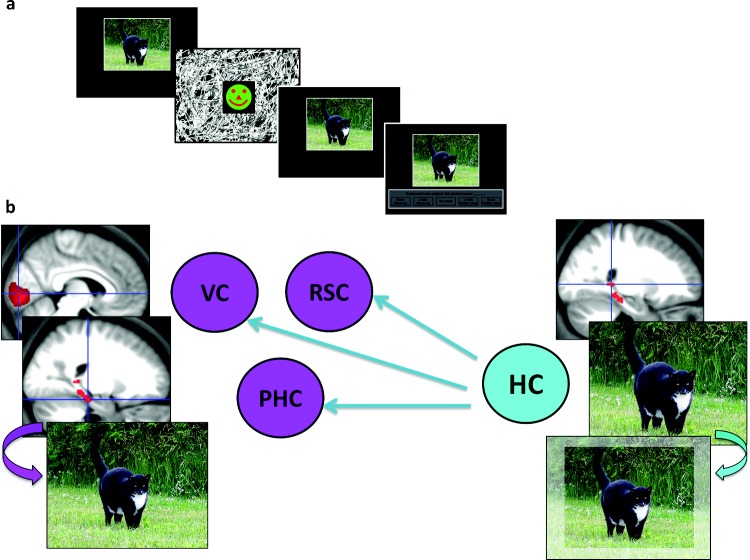
“Chadwick, Mullally, and Maguire (in press) found that in healthy controls, the extrapolation of scenes (the BE effect) occurred rapidly around the time a scene was first viewed and was associated with engagement of the hippocampus and parahippocampal cortex (PHC; see Figure 6).”
§ The Hippocampus: A Manifesto for Change > Scene Construction and Boundary Extension
What the sources say
- Not checked yetcites Chadwick, Mullally, and Maguire, in press
plaincorrelational- Asserted: passes — The authors put it forward as true.
- Checkable: passes — It can be checked against evidence.
- Load-bearing: passes — The paper’s conclusions depend on it.
- Based: passes — The paper gives a reason why it holds.
It may state two separate claims as one.
A conclusion the paper draws from its own results — it cites no other source for it, so there is none to check. The quote shows it is in the paper.
In the paper
“Rather, scene construction is viewed as an essential component of episodic memory without which episodic memories could not be truly and vividly expressed.”
§ The Hippocampus: A Manifesto for Change > The Hippocampus and Episodic Memory
plaindirect- Asserted: passes — The authors put it forward as true.
- Checkable: passes — It can be checked against evidence.
- Load-bearing: passes — The paper’s conclusions depend on it.
- Based: passes — The paper gives a reason why it holds.
Probably not a substantial claim.
A conclusion the paper draws from its own results — it cites no other source for it, so there is none to check. The quote shows it is in the paper.
In the paper
“Instead, we suggest the hippocampus drives this automatic, anticipatory scene construction process, the product of which is fed back down the processing stream, enabling other areas to express the subjective experience of a seamless and continuous reality.”
§ The Hippocampus: A Manifesto for Change > Current Exposition of the SCT
hedgeddirect- Asserted: passes — The authors put it forward as true.
- Checkable: passes — It can be checked against evidence.
- Load-bearing: passes — The paper’s conclusions depend on it.
- Based: unclear — It is unclear why the paper says it holds.
It may state two separate claims as one.
A conclusion the paper draws from its own results — it cites no other source for it, so there is none to check. The quote shows it is in the paper.
In the paper
“As far as we are aware, this makes SCT unique, as no other theory of hippocampal function has scenes at its core.”
§ The Hippocampus: A Manifesto for Change > Current Exposition of the SCT
hedged- Asserted: passes — The authors put it forward as true.
- Checkable: passes — It can be checked against evidence.
- Load-bearing: fails — The paper’s conclusions may not depend on it.
- Based: fails — The paper may give no reason why it holds.
Probably not a substantial claim. The paper’s conclusions may not depend on it. The paper may give no reason why it holds.
None of the sources cited for this claim have been checked yet.
In the paper
“In this way, the hippocampus’ role in scene processing differs from the contributions of other so-called scene-selective brain regions like PHC, which is believed to represent the local visual scene (Epstein, 2008, 2011) or three-dimensional space (Mullally & Maguire, 2011; Zeidman, Mullally, Schwarzkopf, & Maguire, 2012), and retrosplenial cortex, which may play a specific role in representing”
§ The Hippocampus: A Manifesto for Change > Current Exposition of the SCT
What the sources say
- Not checked yetcites Epstein, 2008, 2011
- Not checked yetcites Mullally & Maguire, 2011
- Not checked yetcites Auger, Mullally, & Maguire, 2012
hedged- Asserted: passes — The authors put it forward as true.
- Checkable: passes — It can be checked against evidence.
- Load-bearing: passes — The paper’s conclusions depend on it.
- Based: passes — The paper gives a reason why it holds.
It may state two separate claims as one.
None of the sources cited for this claim have been checked yet.
In the paper
“This finding accords with SCT in linking the hippocampus with scene construction but is at odds with the view of Squire et al. (2010), who argued that “for P01 future imagining was not hippocampal-dependent” (p. 19047; see also Maguire & Hassabis, 2011).”
§ The Hippocampus: A Manifesto for Change > The Hippocampus and Episodic Memory
What the sources say
- Not checked yetcites Squire et al. (2010)
- Not checked yetcites Maguire & Hassabis, 2011
plaincorrelationalSingle case- Asserted: passes — The authors put it forward as true.
- Checkable: passes — It can be checked against evidence.
- Load-bearing: passes — The paper’s conclusions depend on it.
- Based: passes — The paper gives a reason why it holds.
It may state two separate claims as one.
In the paper
“To summarize, although SCT does not preclude the existence of other mechanisms within the hippocampus, such as those that permit the binding of mnemonic details within a specific context (Ranganath, 2010), it maintains that for the hippocampus, scenes are special.”
§ The Hippocampus: A Manifesto for Change > Current Exposition of the SCT
What the sources say
- Not checked yetcites Ranganath, 2010
plain- Asserted: passes — The authors put it forward as true.
- Checkable: passes — It can be checked against evidence.
- Load-bearing: passes — The paper’s conclusions depend on it.
- Based: passes — The paper gives a reason why it holds.
It may state two separate claims as one.
A conclusion the paper draws from its own results — it cites no other source for it, so there is none to check. The quote shows it is in the paper.
In the paper
“Regardless, however, SCT does not permit the possibility that impaired scene construction could coexist with preserved episodic memory (the opposite pattern to that observed in P01) because within the SCT framework, scene construction and episodic memory are not considered to be independent processes.”
§ The Hippocampus: A Manifesto for Change > The Hippocampus and Episodic Memory
plaindirect- Asserted: passes — The authors put it forward as true.
- Checkable: passes — It can be checked against evidence.
- Load-bearing: passes — The paper’s conclusions depend on it.
- Based: passes — The paper gives a reason why it holds.
It may state two separate claims as one.
A conclusion the paper draws from its own results — it cites no other source for it, so there is none to check. The quote shows it is in the paper.
In the paper
“They may in fact be restricted to what is in front of their eyes, deprived of a level of subjective continuity, unable to visualize what is outside of their immediate view, what is behind them, or what is just around the corner.”
§ The Hippocampus: A Manifesto for Change > Current Exposition of the SCT
hedgedconditional- Asserted: passes — The authors put it forward as true.
- Checkable: passes — It can be checked against evidence.
- Load-bearing: passes — The paper’s conclusions depend on it.
- Based: unclear — It is unclear why the paper says it holds.
It may state two separate claims as one.
In the paper
“Although SCT argues that the hippocampus is primarily concerned with constructing scenes, and this underpins episodic memory by providing the spatial backdrop within which an episodic memory is played out, SCT explicitly recognizes that episodic memory requires additional processes on top of this scene construction process (Hassabis & Maguire, 2007, 2009).”
§ The Hippocampus: A Manifesto for Change > The Hippocampus and Episodic Memory
What the sources say
- Not checked yetcites Hassabis & Maguire, 2007, 2009
plaindirect- Asserted: passes — The authors put it forward as true.
- Checkable: passes — It can be checked against evidence.
- Load-bearing: passes — The paper’s conclusions depend on it.
- Based: passes — The paper gives a reason why it holds.
Probably not a substantial claim. It may state two separate claims as one.
A conclusion the paper draws from its own results — it cites no other source for it, so there is none to check. The quote shows it is in the paper.
In the paper
“In this way, the BVC model views boundaries as inward bounding (containing the space within specific boundaries), whereas SCT views boundaries (either physical boundaries such as walls or the edges of our current view) as outward looking, the point from which the hippocampus must extrapolate in order to make predictions about, and so imagine, the upcoming spatial environment.”
§ The Hippocampus: A Manifesto for Change > Scene Construction and the Cognitive Map Theory
plaindirect- Asserted: passes — The authors put it forward as true.
- Checkable: passes — It can be checked against evidence.
- Load-bearing: passes — The paper’s conclusions depend on it.
- Based: passes — The paper gives a reason why it holds.
It may state two separate claims as one.
A conclusion the paper draws from its own results — it cites no other source for it, so there is none to check. The quote shows it is in the paper.
In the paper
“For many of us, scenes are the language of thought, and we argue that the hippocampus actively and automatically predicts and constructs the scenes we need to fuel our cognition.”
§ The Hippocampus: A Manifesto for Change > Conclusions
plaindirect- Asserted: passes — The authors put it forward as true.
- Checkable: passes — It can be checked against evidence.
- Load-bearing: passes — The paper’s conclusions depend on it.
- Based: fails — The paper may give no reason why it holds.
Probably not a substantial claim. The paper may give no reason why it holds.
A conclusion the paper draws from its own results — it cites no other source for it, so there is none to check. The quote shows it is in the paper.
In the paper
“The construction of scenes and BE involve anticipating what is likely to be beyond the view.”
§ The Hippocampus: A Manifesto for Change > Conclusions
plaindirect- Asserted: passes — The authors put it forward as true.
- Checkable: passes — It can be checked against evidence.
- Load-bearing: passes — The paper’s conclusions depend on it.
- Based: unclear — It is unclear why the paper says it holds.
It may state two separate claims as one.
The paper relies on this without support.
There is currently no unified and mechanistic account of how the hippocampus supports episodic memory, imagining the future, and spatial navigation.
“We currently lack a unified and mechanistic account of how the hippocampus supports a range of disparate cognitive functions that includes episodic memory, imagining the future, and spatial navigation.”
The paper relies on this without support.
Scenes have not featured prominently in accounts of hippocampal function.
“Up until now, scenes have not featured prominently in accounts of hippocampal function.”
The paper relies on this without support.
The memory literature is awash with experiments investigating hippocampal processes that have used scene stimuli but that pay little or no attention to the effect of the scenes themselves.
“The memory literature is awash with experiments investigating hippocampal processes (such as associative memory) that have used scene stimuli but that pay little or no attention to the effect of the scenes themselves.”
Claims other papers make about this one
Each is checked against this paper’s own text: does it say what the citing paper says it does?
In the citing paper
“In fact, previous accounts suggested that prediction and mental imagery may involve overlapping brain mechanisms [6, 43, 44], and mental imagery might have evolved from predictive brain mechanisms.”
From Decoding sound and imagery content in early visual cortex (2014) · cites this paper as [43]
Citations
Cites
The free-energy principle: a unified brain theory?
Friston, K. (2010) · Nature Reviews Neuroscience · doi:10.1038/nrn2787 · Cited by 8,120 · cited 2×
“This also resonates with emerging ideas concerning prior knowledge and schema (Tse et al., 2007), templates (Dragoi & Tonegawa, 2011), and predictive coding (Friston, 2010).”
(1978) · UA Campus Repository (The University of Arizona) · Cited by 8,010
LOSS OF RECENT MEMORY AFTER BILATERAL HIPPOCAMPAL LESIONS
Scoville, W. B., & Milner, B. (1957) · Journal of Neurology, Neurosurgery & Psychiatry · doi:10.1136/jnnp.20.1.11 · Cited by 7,322 · cited 1×
“It is 56 years since formal cognitive studies of the human hippocampus began in earnest (Scoville & Milner, 1957), and yet we remain bereft of a widely agreed-upon answer to what it does.”
BackgroundThe hippocampus as a spatial map. Preliminary evidence from unit activity in the freely-moving rat
O'Keefe, J., & Dostrovsky, J. (1971) · Brain Research · doi:10.1016/0006-8993(71)90358-1 · Cited by 6,151 · cited 1×
“The hippocampus has long been linked to spatial navigation, with place cells in the hippocampus exhibiting location-specific firing (O’Keefe & Dostrovsky, 1971).”
BackgroundMemory and the hippocampus: A synthesis from findings with rats, monkeys, and humans.
Squire, L. R. (1992) · Psychological Review · doi:10.1037/0033-295x.99.2.195 · Cited by 5,376 · cited 1×
“Nor does it appear to be specifically concerned only with the conscious (declarative) expression of long-term memory (Squire, 1992; but see Hannula & Greene, 2012).”
BackgroundThe hippocampus as a cognitive map
Passingham, R. E. (1979) · Neuroscience · doi:10.1016/0306-4522(79)90015-0 · Cited by 5,128
Episodic memory: from mind to brain
Tulving, E. (2002) · Annual Review of Psychology · doi:10.1146/annurev.psych.53.100901.135114 · Cited by 4,950 · cited 2×
“One process that episodic memory and imagining future events seem to share is a subjective sense of the self over time (“autonoesis”; Tulving, 2002), which is closely coupled with the capacity for mental time travel (the ability to project oneself forwards or backwards in time).”
BackgroundTulving, E. (1985) · Canadian Psychology / Psychologie canadienne · doi:10.1037/h0080017 · Cited by 4,638
Functional-anatomic fractionation of the brain’s default network
Andrews-Hanna, J. R., Reidler, J. S., Sepulcre, J., Poulin, R., & Buckner, R. L. (2010) · Neuron · doi:10.1016/j.neuron.2010.02.005 · Cited by 2,767
Buckner, R. L., & Carroll, D. C. (2007) · Trends in Cognitive Sciences · doi:10.1016/j.tics.2006.11.004 · Cited by 2,691
The human hippocampus and spatial and episodic memory
Burgess, N., Maguire, E. A., & O'Keefe, J. (2002) · Neuron · doi:10.1016/s0896-6273(02)00830-9 · Cited by 2,401
Self-citationAddis, D. R., Wong, A. T., & Schacter, D. L. (2007) · Neuropsychologia · doi:10.1016/j.neuropsychologia.2006.10.016 · Cited by 1,949 · cited 1×
“…(reviewed in Lee, Yeung, & Barense, 2012) and the fMRI observations that the healthy hippocampus is engaged when imagining fictitious (Hassabis, Kumaran, & Maguire, 2007) and future (Addis et al., 2007) scenes, led Hassabis and Maguire (2007, 2009) to propose the scene construction theory (SCT).”
BackgroundMemory, amnesia, and the hippocampal system
(1994) · Choice Reviews Online · doi:10.5860/choice.31-5148 · Cited by 1,533
Patients with hippocampal amnesia cannot imagine new experiences
Hassabis, D., Kumaran, D., Vann, S. D., & Maguire, E. A. (2007) · Proceedings of the National Academy of Sciences · doi:10.1073/pnas.0610561104 · Cited by 1,414
Self-citationThe future of memory: remembering, imagining, and the brain
Schacter, D. L., Addis, D. R., Hassabis, D., Martin, V. C., Spreng, R. N., & Szpunar, K. K. (2012) · Neuron · doi:10.1016/j.neuron.2012.11.001 · Cited by 1,398
Mental imagery in associative learning and memory.
Paivio, A. (1969) · Psychological Review · doi:10.1037/h0027272 · Cited by 1,350 · cited 2×
“Despite the rise and fall of imagery-based memory theories across the decades (Paivio, 1969), there is much evidence to suggest that visual imagery not only boosts pairedassociate recall in healthy participants but also enabled patients with left temporal lobectomies to partially compensate for…”
BackgroundSchemas and Memory Consolidation.
Tse, D., Langston, R. F., Kakeyama, M., Bethus, I., Spooner, P. A., Wood, E. R., Witter, M. P., & Morris, R. G. M. (2007) · Science · doi:10.1126/science.1135935 · Cited by 1,244 · cited 1×
“This also resonates with emerging ideas concerning prior knowledge and schema (Tse et al., 2007), templates (Dragoi & Tonegawa, 2011), and predictive coding (Friston, 2010).”
Deconstructing episodic memory with construction
Hassabis, D., & Maguire, E. A. (2007) · Trends in Cognitive Sciences · doi:10.1016/j.tics.2007.05.001 · Cited by 1,229 · cited 3×
“…with constructing scenes, and this underpins episodic memory by providing the spatial backdrop within which an episodic memory is played out, SCT explicitly recognizes that episodic memory requires additional processes on top of this scene construction process (Hassabis & Maguire, 2007, 2009).”
BackgroundSelf-citationHippocampal ‘time cells’ bridge the gap in memory for discontiguous events
MacDonald, C. J., Lepage, K. Q., Eden, U. T., & Eichenbaum, H. (2011) · Neuron · doi:10.1016/j.neuron.2011.07.012 · Cited by 1,193 · cited 1×
“In this way, observations such as hippocampal time cells (MacDonald et al., 2011) could be accommodated within SCT. P01’s constellation of deficits could be explicable in terms of the location of his functioning hippocampal tissue, which in this case was in the right posterior hippocampus—a region…”
MethodFrom Conditioning to Conscious Recollection
Eichenbaum, H., & Cohen, N. J. (2004) · doi:10.1093/acprof:oso/9780195178043.001.0001 · Cited by 1,026 · cited 2×
“Mnemonic accounts (Eichenbaum & Cohen, 2001; Ranganath, 2010; Schacter et al., 2012) of scene construction are therefore difficult to reconcile with the BE and scene probe data, as they would contend (a) that the patients performed differently to controls because they failed to encode or recollect…”
BackgroundResultParahippocampal and retrosplenial contributions to human spatial navigation
Epstein, R. A. (2008) · Trends in Cognitive Sciences · doi:10.1016/j.tics.2008.07.004 · Cited by 961 · cited 1×
“…differs from the contributions of other so-called scene-selective brain regions like PHC, which is believed to represent the local visual scene (Epstein, 2008, 2011) or three-dimensional space (Mullally & Magu- ire, 2011; Zeidman, Mullally, Schwarzkopf, & Maguire, 2012), and retrosplenial…”
BackgroundUsing Imagination to Understand the Neural Basis of Episodic Memory
Hassabis, D., Kumaran, D., & Maguire, E. A. (2007) · The Journal of Neuroscience · doi:10.1523/jneurosci.4549-07.2007 · Cited by 744
Self-citationPreplay of future place cell sequences by hippocampal cellular assemblies
Dragoi, G., & Tonegawa, S. (2011) · Nature · doi:10.1038/nature09633 · Cited by 716 · cited 1×
“This also resonates with emerging ideas concerning prior knowledge and schema (Tse et al., 2007), templates (Dragoi & Tonegawa, 2011), and predictive coding (Friston, 2010).”
The cognitive neuroscience of remote episodic, semantic and spatial memory
Moscovitch, M., Nadel, L., Winocur, G., Gilboa, A., & Rosenbaum, R. S. (2006) · Current Opinion in Neurobiology · doi:10.1016/j.conb.2006.03.013 · Cited by 711
Addis, D. R., Pan, L., Vu, M.-A. T., Laiser, N., & Schacter, D. L. (2008) · Neuropsychologia · doi:10.1016/j.neuropsychologia.2008.10.026 · Cited by 635
Klein, S. B., Loftus, J., & Kihlstrom, J. F. (2002) · Social Cognition · doi:10.1521/soco.20.5.353.21125 · Cited by 553
Loss of Recent Memory After Bilateral Hippocampal Lesions
Scoville, W. B., & Milner, B. A. (2000) · Journal of Neuropsychiatry · doi:10.1176/jnp.12.1.103-a · Cited by 546
A map of visual space in the primate entorhinal cortex
Killian, N. J., Jutras, M. J., & Buffalo, E. A. (2012) · Nature · doi:10.1038/nature11587 · Cited by 501
THE NEUROANATOMY OF AMNESIA: A CRITIQUE OF THE HIPPOCAMPAL MEMORY HYPOTHESIS
HOREL, J. A. (1978) · Brain · doi:10.1093/brain/101.3.403 · Cited by 493
The construction system of the brain
Hassabis, D., & Maguire, E. A. (2009) · Philosophical Transactions of the Royal Society B: Biological Sciences · doi:10.1098/rstb.2008.0296 · Cited by 483 · cited 2×
“…with constructing scenes, and this underpins episodic memory by providing the spatial backdrop within which an episodic memory is played out, SCT explicitly recognizes that episodic memory requires additional processes on top of this scene construction process (Hassabis & Maguire, 2007, 2009).”
BackgroundSelf-citationGraham, K. S., Barense, M. D., & Lee, A. C. H. (2010) · Neuropsychologia · doi:10.1016/j.neuropsychologia.2010.01.001 · Cited by 404
Doubts about double dissociations between short- and long-term memory
Ranganath, C., & Blumenfeld, R. S. (2005) · Trends in Cognitive Sciences · doi:10.1016/j.tics.2005.06.009 · Cited by 403
The Boundary Vector Cell Model of Place Cell Firing and Spatial Memory
Barry, C., Lever, C., Hayman, R., Hartley, T., Burton, S., O'Keefe, J., Jeffery, K., & Burgess, Ν. (2006) · Reviews in the Neurosciences · doi:10.1515/revneuro.2006.17.1-2.71 · Cited by 401 · cited 1×
“The findings that hippocampal activity appears to be correlated with the number of boundaries imagined during fMRI (Bird, Capponi, King, Doeller, & Burgess, 2010) and place cell activity becomes less spatially specific when boundaries are removed (Barry et al., 2006) appear to bolster this argument.”
BackgroundRanganath, C. (2010) · Hippocampus · doi:10.1002/hipo.20852 · Cited by 375
Relational memory and the hippocampus: Representations and methods
Konkel, A. (2009) · Frontiers in Neuroscience · doi:10.3389/neuro.01.023.2009 · Cited by 372 · cited 1×
“In a similar vein, the relational theory proposes that the hippocampus is required for binding arbitrary or accidentally occurring relations among individual elements within an experience (Cohen & Eichenbaum, 1993; Eichenbaum & Cohen, 2001; Konkel & Cohen, 2009).”
BackgroundThoughts, behaviour, and brain dynamics during navigation in the real world
Spiers, H. J., & Maguire, E. A. (2006) · NeuroImage · doi:10.1016/j.neuroimage.2006.01.037 · Cited by 371 · cited 1×
“…two decades that the human hippocampus is also vital for a variety of cognitive functions that are not purely mnemonic, including spatial navigation (Spiers & Maguire, 2006), but also imagining fictitious (Hassabis, Kumaran, & Maguire, 2007; Hassabis, Kumaran, Vann, & Maguire, 2007) and future…”
BackgroundSelf-citationPerceptual deficits in amnesia: challenging the medial temporal lobe ‘mnemonic’ view
Lee, A. C. H., Bussey, T. J., Murray, E. A., Saksida, L. M., Epstein, R. A., Kapur, N., Hodges, J. R., & Graham, K. S. (2004) · Neuropsychologia · doi:10.1016/j.neuropsychologia.2004.07.017 · Cited by 330
Race, E., Keane, M. M., & Verfaellie, M. (2011) · Journal of Neuroscience · doi:10.1523/jneurosci.1145-11.2011 · Cited by 328 · cited 1×
“…in patients with bilateral hippocampal damage (Andelman et al., 2010; Hassa- bis, Kumaran, Vann, & Maguire, 2007; Mullally, Intraub, & Maguire, 2012; Race et al., 2011; Rosenbaum et al., 2009; Tulving, 1985), coupled with reports of selective sceneprocessing deficits following hippocampal damage…”
BackgroundWide-angle memories of close-up scenes.
Intraub, H., & Richardson, M. D. (1989) · Journal of Experimental Psychology Learning Memory and Cognition · doi:10.1037/0278-7393.15.2.179 · Cited by 328 · cited 2×
“These new insights have arisen by bringing to bear a phenomenon not usually linked to the hippocampus, namely, boundary extension (BE; Intraub & Richardson, 1989).”
BackgroundSpecialization in the medial temporal lobe for processing of objects and scenes
Lee, A. C. H., Buckley, M. J., Pegman, S. J., Spiers, H. J., Scahill, V. L., Gaffan, D., Bussey, T. J., Davies, R., Kapur, N., Hodges, J. R., et al. (2005) · Hippocampus · doi:10.1002/hipo.20101 · Cited by 320
The hippocampus and visual perception
Lee, A. C. H., Yeung, L., & Barense, M. D. (2012) · Frontiers in Human Neuroscience · doi:10.3389/fnhum.2012.00091 · Cited by 268 · cited 1×
“…& Graham, 2007) and fMRI studies (Barense, Henson, Lee, & Graham, 2010; Lee, Brodersen, & Rudebeck, 2013), which have led to the suggestion that the hippocampus plays a role in complex spatial perception, and specifically in the discrimination of complex scenes (see a review in Lee et al., 2012).”
BackgroundMoscovitch, M. (2008) · Canadian Journal of Experimental Psychology/Revue canadienne de psychologie expérimentale · doi:10.1037/1196-1961.62.1.62 · Cited by 245 · cited 2×
“cortex to sort the wheat from the chaff (Moscovitch, 2008).”
BackgroundOn the nature of medial temporal lobe contributions to the constructive simulation of future events
Schacter, D. L., & Addis, D. R. (2009) · Philosophical Transactions of the Royal Society B Biological Sciences · doi:10.1098/rstb.2008.0308 · Cited by 226 · cited 2×
“…hippocampal theories (Bird, Bisby, & Burgess, 2012; Moscovitch, Nadel, Winocure, Gilboa, & Rosenbaum, 2006; O’Keefe & Nadel, 1978; Ranganath, 2010; Schacter & Addis, 2009), is why patients with hippocampal amnesia are usually impaired on verbally mediated memory tasks such as recalling short…”
BackgroundJones, M. K. (1974) · Neuropsychologia · doi:10.1016/0028-3932(74)90023-2 · Cited by 224 · cited 1×
“…memory theories across the decades (Paivio, 1969), there is much evidence to suggest that visual imagery not only boosts pairedassociate recall in healthy participants but also enabled patients with left temporal lobectomies to partially compensate for their verbal memory deficits (Jones, 1974).”
BackgroundRole of the hippocampus in remembering the past and imagining the future
Squire, L. R., van der Horst, A. S., McDuff, S. G. R., Frascino, J. C., Hopkins, R. O., & Mauldin, K. N. (2010) · Proceedings of the National Academy of Sciences · doi:10.1073/pnas.1014391107 · Cited by 206 · cited 1×
“This finding accords with SCT in linking the hippocampus with scene construction but is at odds with the view of Squire et al. (2010), who argued that “for P01 future imagining was not hippocampal-dependent” (p. 19047; see also Maguire & Hassabis, 2011).”
ResultRetrosplenial cortex codes for permanent landmarks
Auger, S. D., Mullally, S. L., & Maguire, E. A. (2012) · PLoS ONE · doi:10.1371/journal.pone.0043620 · Cited by 205
Self-citationConsciousness of subjective time in the brain
Nyberg, L. H., Kim, A. S. N., Habib, R., Levine, B., & Tulving, E. (2010) · Proceedings of the National Academy of Sciences · doi:10.1073/pnas.1016823108 · Cited by 200 · cited 3×
“Indeed, a recent functional magnetic resonance imaging (fMRI) study revealed that frontal and parietal cortices, but not the hippocampus, supported mental time travel (Nyberg et al., 2010).”
BackgroundInfluentialA New Role for the Parahippocampal Cortex in Representing Space
Mullally, S. L., & Maguire, E. A. (2011) · Journal of Neuroscience · doi:10.1523/jneurosci.0267-11.2011 · Cited by 197 · cited 1×
“…scene-selective brain regions like PHC, which is believed to represent the local visual scene (Epstein, 2008, 2011) or three-dimensional space (Mullally & Magu- ire, 2011; Zeidman, Mullally, Schwarzkopf, & Maguire, 2012), and retrosplenial cortex, which may play a specific role in…”
BackgroundSelf-citationRosenbaum, R. S., Gilboa, A., Levine, B., Winocur, G., & Moscovitch, M. (2008) · Neuropsychologia · doi:10.1016/j.neuropsychologia.2008.11.028 · Cited by 190 · cited 2×
“…hippocampal theories (Bird, Bisby, & Burgess, 2012; Moscovitch, Nadel, Winocure, Gilboa, & Rosenbaum, 2006; O’Keefe & Nadel, 1978; Ranganath, 2010; Schacter & Addis, 2009), is why patients with hippocampal amnesia are usually impaired on verbally mediated memory tasks such as recalling short…”
BackgroundAttenuated Boundary Extension Produces a Paradoxical Memory Advantage in Amnesic Patients
Mullally, S. L., Intraub, H., & Maguire, E. A. (2012) · Current Biology · doi:10.1016/j.cub.2012.01.001 · Cited by 184 · cited 1×
“Mullally, Intraub, and Maguire (2012) investigated BE using the rapid serial visual presentation BE task alluded to above (see also Figure 4a) whereby participants were consecutively presented with two identical scenes and asked to rate the second scene relative to the first (note that on any one…”
Self-citationBarense, M. D., Henson, R. N. A., Lee, A. C. H., & Graham, K. S. (2010) · Hippocampus · doi:10.1002/hipo.20641 · Cited by 177
Intact Memory for Irrelevant Information Impairs Perception in Amnesia
Barense, M. D., Groen, I. I. A., Lee, A. C. H., Yeung, L., Brady, S., Gregori, M., Kapur, N., Bussey, T. J., Saksida, L. M., & Henson, R. N. (2012) · Neuron · doi:10.1016/j.neuron.2012.05.014 · Cited by 152 · cited 1×
“This model is supported by a series of neuropsychological (Barense et al., 2012; Lee et al., 2006; Lee, Buckley, et al., 2005; Lee, Bussey, et al., 2005; Lee, Levi, Davies, Hodges, & Graham, 2007) and fMRI studies (Barense, Henson, Lee, & Graham, 2010; Lee, Brodersen, & Rudebeck, 2013), which have…”
Lee, A. C. H., Buckley, M. J., Gaffan, D., Emery, T., Hodges, J. R., & Graham, K. S. (2006) · Journal of Neuroscience · doi:10.1523/jneurosci.3157-05.2006 · Cited by 147 · cited 2×
“This model is supported by a series of neuropsychological (Barense et al., 2012; Lee et al., 2006; Lee, Buckley, et al., 2005; Lee, Bussey, et al., 2005; Lee, Levi, Davies, Hodges, & Graham, 2007) and fMRI studies (Barense, Henson, Lee, & Graham, 2010; Lee, Brodersen, & Rudebeck, 2013), which have…”
ResultTulving, E. (2003) · The MIT Press eBooks · doi:10.7551/mitpress/2834.003.0045 · Cited by 147
“SYRINGE IN SYRINGE” NIPPLE SPLINT
Choudhary, S., & Curnier, A. (2002) · Plastic & Reconstructive Surgery · doi:10.1097/00006534-200204150-00050 · Cited by 142
The hippocampus reevaluated in unconscious learning and memory: at a tipping point?
Hannula, D. E., & Greene, A. J. (2012) · Frontiers in Human Neuroscience · doi:10.3389/fnhum.2012.00080 · Cited by 139 · cited 1×
“Nor does it appear to be specifically concerned only with the conscious (declarative) expression of long-term memory (Squire, 1992; but see Hannula & Greene, 2012).”
BackgroundGaffan, D. (2002) · Philosophical Transactions of the Royal Society B Biological Sciences · doi:10.1098/rstb.2002.1110 · Cited by 131 · cited 1×
“This idea is not new; in fact, some have argued that the concept of a hippocampal memory system is actually harmful (Gaffan, 2001, 2002; Horel, 1978), proposing instead that the hippocampus is involved “only to the extent that spatial information is needed for some kinds of memory” (Gaffan, 2001,…”
BackgroundBilateral hippocampal lesion and a selective impairment of the ability for mental time travel
Andelman, F., Hoofien, D., Goldberg, I., Aizenstein, O., & Neufeld, M. Y. (2010) · Neurocase · doi:10.1080/13554791003623318 · Cited by 120 · cited 1×
“The scene construction deficit observed in patients with bilateral hippocampal damage (Andelman et al., 2010; Hassa- bis, Kumaran, Vann, & Maguire, 2007; Mullally, Intraub, & Maguire, 2012; Race et al., 2011; Rosenbaum et al., 2009; Tulving, 1985), coupled with reports of selective sceneprocessing…”
BackgroundEstablishing the Boundaries: The Hippocampal Contribution to Imagining Scenes
Bird, C. M., Capponi, C., King, J. A., Doeller, C. F., & Burgess, N. (2010) · Journal of Neuroscience · doi:10.1523/jneurosci.0723-10.2010 · Cited by 117
Surface construal and the mental representation of scenes.
Gottesman, C. V., & Intraub, H. (2002) · Journal of Experimental Psychology Human Perception & Performance · doi:10.1037//0096-1523.28.3.589 · Cited by 117 · cited 1×
“Of note, it only occurs in relation to scenes and not single isolated objects (Gottesman & Intraub, 2002).”
BackgroundRole of the hippocampus in imagination and future thinking
Maguire, E. A., & Hassabis, D. (2011) · Proceedings of the National Academy of Sciences · doi:10.1073/pnas.1018876108 · Cited by 94 · cited 1×
“This finding accords with SCT in linking the hippocampus with scene construction but is at odds with the view of Squire et al. (2010), who argued that “for P01 future imagining was not hippocampal-dependent” (p. 19047; see also Maguire & Hassabis, 2011).”
ResultSelf-citationScene Construction in Amnesia: An fMRI Study
Mullally, S. L., Hassabis, D., & Maguire, E. A. (2012) · Journal of Neuroscience · doi:10.1523/jneurosci.5522-11.2012 · Cited by 89
Self-citationThe hippocampus extrapolates beyond the view in scenes: an fMRI study of boundary extension
Chadwick, M. J., Mullally, S. L., & Maguire, E. A. (2013) · Cortex · doi:10.1016/j.cortex.2012.11.010 · Cited by 80
Self-citationFalse Memory 1/20th of a Second Later
Intraub, H., & Dickinson, C. A. (2008) · Psychological Science · doi:10.1111/j.1467-9280.2008.02192.x · Cited by 74 · cited 1×
“The original scene need only be absent for as little as 42 ms for BE to be apparent, underscoring the online and spontaneous nature of the BE effect (Intraub & Dickinson, 2008).”
Lee, A. C. H., Levi, N., DAVIES, R., HODGES, J., & Graham, K. S. (2007) · Neuropsychologia · doi:10.1016/j.neuropsychologia.2007.01.010 · Cited by 74
Misremembering Pictured Objects: People of All Ages Demonstrate the Boundary Extension Illusion
Seamon, J. G., Schlegel, S. E., Hiester, P. M., Landau, S. M., & Blumenthal, B. F. (2002) · The American Journal of Psychology · doi:10.2307/1423432 · Cited by 65 · cited 2×
“Landau, & Blumenthal, 2002), children (Seamon et al., 2002), and even babies (Quinn & Intraub, 2007).”
BackgroundWhat is a memory system? Horel's critique revisited
Gaffan, D. (2001) · Behavioural Brain Research · doi:10.1016/s0166-4328(01)00360-6 · Cited by 62 · cited 2×
“…idea is not new; in fact, some have argued that the concept of a hippocampal memory system is actually harmful (Gaffan, 2001, 2002; Horel, 1978), proposing instead that the hippocampus is involved “only to the extent that spatial information is needed for some kinds of memory” (Gaffan, 2001, p. 9).”
BackgroundSurface construal and the mental representation of scenes.
Gottesman, C. V., & Intraub, H. (2002) · Journal of Experimental Psychology Human Perception & Performance · doi:10.1037/0096-1523.28.3.589 · Cited by 56
Exploring the parahippocampal cortex response to high and low spatial frequency spaces
Zeidman, P., Mullally, S. L., Schwarzkopf, D. S., & Maguire, E. A. (2012) · Neuroreport · doi:10.1097/wnr.0b013e328353766a · Cited by 45
Self-citationThe hippocampus and spatial constraints on mental imagery
Bird, C. M., Bisby, J. A., & Burgess, N. (2012) · Frontiers in Human Neuroscience · doi:10.3389/fnhum.2012.00142 · Cited by 41 · cited 1×
“However, an important difference becomes obvious when considering the most recent incarnation of the cognitive map theory, the boundary vector cell (BVC) model (reviewed in Bird et al., 2012).”
BackgroundLee, A. C. H., Brodersen, K. H., & Rudebeck, S. R. (2012) · Journal of Cognitive Neuroscience · doi:10.1162/jocn_a_00301 · Cited by 41
Counterfactual thinking in patients with amnesia
Mullally, S. L., & Maguire, E. A. (2014) · Hippocampus · doi:10.1002/hipo.22323 · Cited by 32 · cited 1×
“Moreover, new evidence is beginning to emerge suggesting that hippocampal-damaged patients can engage in counterfactual thinking (Mullally & Maguire, 2013).”
BackgroundSelf-citationQuinn, P. C., & Intraub, H. (2007) · Child Development · doi:10.1111/j.1467-8624.2007.01000.x · Cited by 32 · cited 1×
“It is a robust and consistent effect found in adults (Intraub & Richardson, 1989; Seamon, Schlegel, Hiester, Landau, & Blumenthal, 2002), children (Seamon et al., 2002), and even babies (Quinn & Intraub, 2007).”
BackgroundCognitive Neuroscience: Scene Layout from Vision and Touch
Epstein, R. A. (2011) · Current Biology · doi:10.1016/j.cub.2011.04.037 · Cited by 16 · cited 1×
“…differs from the contributions of other so-called scene-selective brain regions like PHC, which is believed to represent the local visual scene (Epstein, 2008, 2011) or three-dimensional space (Mullally & Magu- ire, 2011; Zeidman, Mullally, Schwarzkopf, & Maguire, 2012), and retrosplenial…”
BackgroundHayman, R. M. A., Donnett, J. G., & Jeffery, K. J. (2007) · Journal of Neuroscience Methods · doi:10.1016/j.jneumeth.2007.08.014 · Cited by 7
Cited by
Sorted by citations
Episodic memory and beyond: the hippocampus and neocortex in transformation
Moscovitch, M., Cabeza, R., Winocur, G., & Nadel, L. (2016) · Annual Review of Psychology · doi:10.1146/annurev-psych-113011-143733 · Cited by 1,062
“…in healthy controls in fMRI studies, was similar to that obtained on recall of autobiographical episodes (BenYakov & Dudai 2011, Furman et al. 2012, Maguire & Mullally 2013) [Supplemental Figure 3 (follow the Supplemental Material link in the online version of this article or at http://…”
InfluentialCan We Reconcile the Declarative Memory and Spatial Navigation Views on Hippocampal Function?
Eichenbaum, H., & Cohen, N. J. (2014) · Neuron · doi:10.1016/j.neuron.2014.07.032 · Cited by 654
Anterior hippocampus: the anatomy of perception, imagination and episodic memory
Zeidman, P., & Maguire, E. A. (2016) · Nature Reviews Neuroscience · doi:10.1038/nrn.2015.24 · Cited by 542
Self-citationA map for social navigation in the human brain
Tavares, R. M., Mendelsohn, A., Grossman, Y., Williams, C. H., Shapiro, M., Trope, Y., & Schiller, D. (2015) · Neuron · doi:10.1016/j.neuron.2015.06.011 · Cited by 505
“More recent work suggests that the hippocampus constructs spatially coherent scenes that are representative egocentrically (Maguire and Mullally, 2013).”
The role of the hippocampus in flexible cognition and social behavior
Rubin, R. D., Watson, P. D., Duff, M. C., & Cohen, N. J. (2014) · Frontiers in Human Neuroscience · doi:10.3389/fnhum.2014.00742 · Cited by 489
“…with points of emphasis of other contemporary investigators, including ideas about the role of the hippocampus in scene (re)construction (e.g., Maguire and Mullally, 2013), and in the generation of simulated future events (Buckner and Carroll, 2007), as well as the functional relationship…”
Metadata
- Authors
- Maguire, E. A., & Mullally, S. L.
- Affiliations
- Wellcome Centre for Human Neuroimaging (GB)
- Corresponding author
- Maguire, Eleanor A.
- Venue
- Journal of Experimental Psychology: General
- Published
- 2013-11
- Volume
- 142
- Issue
- 4
- Pages
- 1180-1189
- ISSN
- 0096-3445 (ISSN-L)
- 1939-2222
- PMC
- PMC3906798
- OpenAlex
- W2103374823
- Semantic Scholar
- d2c54fbe4881e323a62d8b1d9924facd4f6a889a
- Cited by
- 393
- References
- 75
- Citations by year
- 2026: 25 · 2025: 29 · 2024: 37 · 2023: 23 · 2022: 28 · 2021: 25 · 2020: 57 · 2019: 37 · 2018: 28 · 2017: 36 · 2016: 17 · 2015: 26 · 2014: 18 · 2013: 7
- FWCI
- 12.43
- Type
- journal article
- Language
- en
- Open access
- hybrid
- doi.org
- Licence
- Locations
- Journal of Experimental Psychology General (publishedVersion, other-oa)
- Europe PMC (PubMed Central) (publishedVersion, cc-by)
- PubMed Central (publishedVersion, cc-by)
- PubMed (publishedVersion)
- UCL Discovery (University College London) (submittedVersion)
- Newcastle University ePrints (Newcastle Univesity) (cc-by)
- Funders
- Wellcome Trust
- Topics
- Life Sciences › Neuroscience › Cognitive Neuroscience › Memory and Neural Mechanisms
- Life Sciences › Neuroscience › Cognitive Neuroscience › Memory Processes and Influences
- Social Sciences › Psychology › Experimental and Cognitive Psychology › Spatial Cognition and Navigation
- Keywords
- hippocampus, episodic memory, scene memory, spatial navigation, future imaginings, memory architecture, hippocampal dysfunction, scene construction
- MeSH terms
- Cognition, Hippocampus, Humans, Imagination, Memory, Space Perception, Spatial Behavior
About these checks
Registry, retraction, Cites and statistics results are computed, not judged, with one exception: a printed reference that no index lists is read once by a model before it counts as a citation error. Claims are extracted by a model and kept only when their quote appears verbatim in the text; each cited source is then checked, with a model’s help, for whether it says what the claim relies on. Those verdicts can be wrong — read the claim’s quote and the cited source before relying on one.
A language model drew the claims from the paper on 2026-10-10, under version 3 of the claim definition (model deepseek-v4.1-flash, prompt extract-v3).
A second model labelled each claim on 2026-10-10 (model jev-1.13-20260917, definition revision gold-guideline-v0.2).
Statistics and arithmetic are recomputed, not judged.
Confidence bands are shown only for fields calibrated on our annotated test set. None is calibrated yet, so no band is shown.
What counts as a claim ›How we measure confidence ›How we check this ›
Are you an author, or do you see a problem with this page? Request a review
