

Algorithm aversion: People erroneously avoid algorithms after seeing them err.
Open accessThe DOI matches its Crossref record; 23 of the 23 references it cites were found in a registry or an index; none of the 22 sources its claims cite is checked for support yet.
Abstract
Research shows that evidence-based algorithms more accurately predict the future than do human forecasters. Yet when forecasters are deciding whether to use a human forecaster or a statistical algorithm, they often choose the human forecaster. This phenomenon, which we call algorithm aversion, is costly, and it is important to understand its causes. We show that people are especially averse to algorithmic forecasters after seeing them perform, even when they see them outperform a human forecaster. This is because people more quickly lose confidence in algorithmic than human forecasters after seeing them make the same mistake. In 5 studies, participants either saw an algorithm make forecasts, a human make forecasts, both, or neither. They then decided whether to tie their incentives to the future predictions of the algorithm or the human. Participants who saw the algorithm perform were less confident in it, and less likely to choose it over an inferior human forecaster. This was true even among those who saw the algorithm outperform the human.
Overview
CoChat Summary
TL;DR
People become less willing to use a statistical algorithm after seeing it perform and make mistakes, even when it outperforms a human forecaster. This “algorithm aversion” is driven partly by people losing confidence in algorithms more quickly than in humans after observing errors.
Key findings
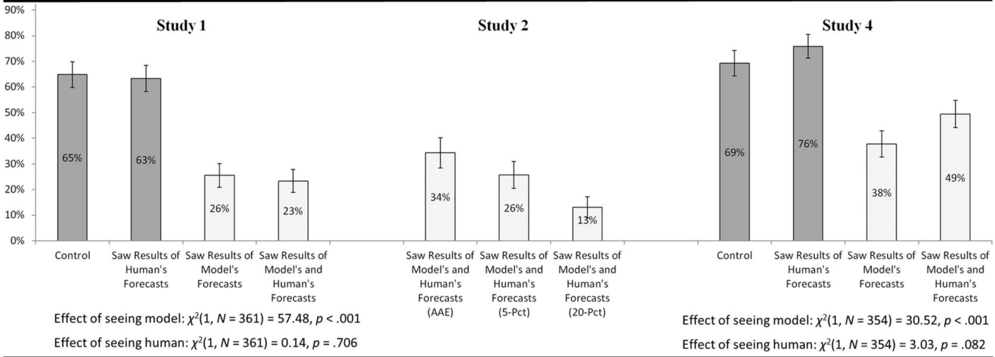
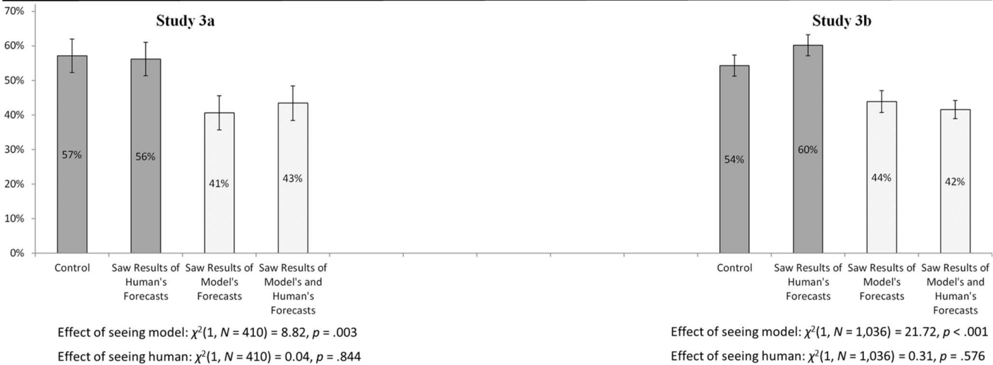
- Across five studies, seeing the algorithm perform reduced participants’ likelihood of choosing it over a human forecaster. In the model-and-human conditions, 610 of 741 participants (83%) saw the model outperform the human, yet these participants were among the least likely to choose the model.
- The model outperformed humans in all five studies. For example, bonuses if choosing model vs. human were Study 1: $1.78 vs. $1.38; Study 2: $1.77 vs. $1.09; Study 3a: $0.48 vs. $0.31; Study 3b: $0.49 vs. $0.30; Study 4: $1.79 vs. $1.38. Human forecasters produced 15–29% more error in the MBA task and 90–97% more error in the airline-passenger task.
- Seeing the model perform significantly decreased confidence in the model’s forecasts in all four studies where this was tested, whereas seeing the human perform significantly decreased confidence in the human only in Study 4. Confidence in the model’s forecasts significantly mediated the effect of seeing the model perform on choosing the model; confidence in the human did not.
- In Study 2, participants paid for forecasts within 20 percentiles were less likely to choose the model than those paid within 5 percentiles, χ²(1, N = 139) = 3.56, p = .059, and those paid by average absolute error, χ²(1, N = 136) = 8.56, p = .003; this effect was mediated by confidence in their own forecasts, not confidence in the model’s forecasts.
Methods
- Five studies had participants forecast real outcomes: MBA student success (Studies 1, 2, and 4) or U.S. state rank in airline passengers (Studies 3a and 3b). Participants were assigned to control, human, model, or model-and-human conditions, then chose whether to tie incentivized bonuses to the model or the human forecaster (themselves in Studies 1–3, another participant in Study 4).
- Final samples were Study 1: 361; Study 2: 206; Study 3a: 410; Study 3b: 1,036; Study 4: 354. Studies 1, 2, and 4 were run in the Wharton Behavioral Lab; Studies 3a and 3b used Amazon Mechanical Turk.
- Main analyses compared forecasting performance and choice rates, measured confidence and beliefs, and used binary mediation analyses with Preacher and Hayes’s bootstrapping procedure.
Limitations
- The paper states it did not explore all boundaries of the effect, including whether it would persist if algorithms were many times more accurate than humans, and whether results depend on features shared by the two forecasting tasks.
- The paper states it did not explore how algorithm variations—complexity, transparency, forecaster involvement in construction, and designer expertise—affect algorithm aversion.
- The paper states algorithm aversion is not entirely driven by seeing algorithms err, and it has little to say about how best to reduce aversion among those who have seen an algorithm err. The text also cautions that cross-experiment comparisons should be made cautiously.
Model-written summary. Check it against the paper before relying on it.
Integrity signals
Registry
Cites
Statistics
Figures
Verification
Claims the paper makes
0 Valid · 2 Not valid · 16 Not checked · 90 Own results and interpretations
A result the paper reports from its own data — it cites no other source for it, so there is none to check. The quote shows it is in the paper.
In the paper
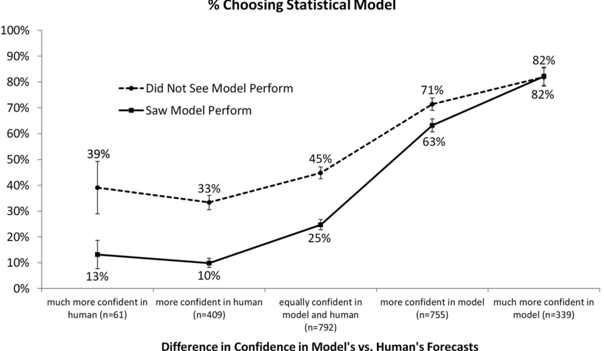
“the majority of people who were equally confident in the model's and human's forecasts chose to tie their bonuses to the human's forecasts, particularly when they had seen the model perform.”
plainstates an association- Asserted: passes — The authors put it forward as true.
- Checkable: passes — It can be checked against evidence.
- Load-bearing: passes — The paper’s conclusions depend on it.
- Based: passes — The paper gives a reason why it holds.
A result the paper reports from its own data — it cites no other source for it, so there is none to check. The quote shows it is in the paper.
In the paper
“Consistent with research on the adoption of decision aids (see Highhouse, 2008), participants thought that the human forecasters were better than the model at getting better with practice, learning from mistakes, and finding underappreciated candidates.”
plain- Asserted: passes — The authors put it forward as true.
- Checkable: passes — It can be checked against evidence.
- Load-bearing: passes — The paper’s conclusions depend on it.
- Based: passes — The paper gives a reason why it holds.
A result the paper reports from its own data — it cites no other source for it, so there is none to check. The quote shows it is in the paper.
In the paper
“Our studies show that this resistance at least partially arises from greater intolerance for error from algorithms than from humans.”
plainstates a possible cause- Asserted: passes — The authors put it forward as true.
- Checkable: passes — It can be checked against evidence.
- Load-bearing: passes — The paper’s conclusions depend on it.
- Based: passes — The paper gives a reason why it holds.
A result the paper reports from its own data — it cites no other source for it, so there is none to check. The quote shows it is in the paper.
In the paper
“Participants rightfully thought that the model was better than human forecasters at avoiding obvious mistakes, appropriately weighing various attributes, and consistently weighing information.”
plain- Asserted: passes — The authors put it forward as true.
- Checkable: passes — It can be checked against evidence.
- Load-bearing: unclear — It is unclear whether the paper’s conclusions depend on it.
- Based: passes — The paper gives a reason why it holds.
A result the paper reports from its own data — it cites no other source for it, so there is none to check. The quote shows it is in the paper.
In the paper
“This effect was evident in two distinct domains of judgment, including one in which the human forecasters produced nearly twice as much error as the algorithm.”
plain- Asserted: passes — The authors put it forward as true.
- Checkable: passes — It can be checked against evidence.
- Load-bearing: unclear — It is unclear whether the paper’s conclusions depend on it.
- Based: passes — The paper gives a reason why it holds.
75 more claims
Create a free account to see all 108 claims and to verify the 12 references still open.
- It may state two separate claims as one. 13
- Probably not a substantial claim. 16
Claims other papers make about this one
Each is checked against this paper’s own text: does it say what the citing paper says it does?
The source backs part of the claim, not all of it — or backs it for a different population, condition or comparison.
In the citing paper
“Traditional theorizing assumes trade-offs between trust and skepticism (Dietvorst et al., 2015), automation and engagement (Freeman et al., 2014), or efficiency and depth (Ishowo-Oloko et al., 2019)”
From Pedagogical partnerships with generative AI in higher education: how dual cognitive pathways paradoxically enable transformative learning (2026) · cites this paper as Dietvorst et al., 2015
Experimental — accuracy not yet measuredThe source backs part of the claim, not all of it — or backs it for a different population, condition or comparison.
In the citing paper
“Existing research typically examines trust versus skepticism in human-AI interactions as binary constructs (Dietvorst et al., 2015; Logg et al., 2019), missing the possibility that partnerships might simultaneously activate both vigilant and offloading behaviors.”
From Pedagogical partnerships with generative AI in higher education: how dual cognitive pathways paradoxically enable transformative learning (2026) · cites this paper as Dietvorst et al., 2015
Experimental — accuracy not yet measuredThe source backs part of the claim, not all of it — or backs it for a different population, condition or comparison.
In the citing paper
“It aligns with the theoretical rationale on algorithm aversion (Dietvorst et al. 2015;Hohensinn et al. 2024) and appreciation (Logg et al. 2019), which suggests that people are more likely to accept and trust AI systems when they produce desirable results but become skeptical when outcomes are unfavorable.”
From Holding AI Accountable Like Herding Cats: The Contingent Impact on the Legitimacy of Algorithmic Bureaucracy (2026) · cites this paper as Dietvorst et al. 2015
Experimental — accuracy not yet measuredThe source backs part of the claim, not all of it — or backs it for a different population, condition or comparison.
In the citing paper
“Research on algorithm appreciation and algorithm aversion further suggests that people may either defer to algorithms or reject them depending on prior experience, perceived expertise, and error visibility (Dietvorst et al., 2015; Logg et al., 2019).”
From College students' metacognitive awareness of generative-AI reliance: an experimental study of decision confidence and attribution bias (2026) · cites this paper as Dietvorst et al., 2015
Experimental — accuracy not yet measuredThe source backs part of the claim, not all of it — or backs it for a different population, condition or comparison.
In the citing paper
“Earlier research has mentioned gender, self-confidence, expertise, and general algorithm aversion or appreciation.15,28”
From Appropriate trust in artificial intelligence for the optical diagnosis of colorectal polyps: the role of human/artificial intelligence interaction (2024) · cites this paper as [28]
Experimental — accuracy not yet measured
22 more claims about this paper
Create a free account to see every claim other papers make about this one.
Statistics recomputed
Every reported test result, recomputed from its test statistic and degrees of freedom. A result shows as not adding up only once an independent check has confirmed it.
- Consistentt(360) = 4.98reported p < .001 · recomputed p < .001
“t (360) = 4.98, p < .001”
- Consistentt(204) = 6.26reported p < .001 · recomputed p < .001
“t (204) = 6.26, p < .001”
- Consistentt(405) = 7.73reported p < .001 · recomputed p < .001
“t (405) = 7.73, p < .001”
- Consistentt(353) = 5.11reported p < .001 · recomputed p < .001
“t (353) = 5.11, p < .001”
- Consistentχ²(1) = 39.94reported p < .001 · recomputed p < .001
“χ 2 (1, N = 271) = 39.94, p < .001”
19 more recomputed tests
Create a free account to see every test the Stats check recomputed.
Self-check
Percentages, sums and reported differences re-computed from the paper’s own numbers.
Self-check results appear here once an independent check has confirmed them.
Citations
Cites
Preacher, K. J., & Hayes, A. F. (2008) · Behavior Research Methods · doi:10.3758/brm.40.3.879 · Cited by 34,117 · cited 1×
“We then used Preacher and Hayes’s (2008) bootstrapping procedure to obtain unbiased 95% confidence intervals around the mediated effects.”
Method(2023) · doi:10.1126/science · Cited by 6,063
The trouble with overconfidence.
Moore, D. A., & Healy, P. J. (2008) · Psychological Review · doi:10.1037/0033-295x.115.2.502 · Cited by 2,358
“Clinical versus Actuarial Judgment.”
Dawes, R. M., Faust, D., & Meehl, P. E. (1989) · Science · doi:10.1126/science.2648573 · Cited by 2,298
The robust beauty of improper linear models in decision making.
Dawes, R. M. (1979) · American Psychologist · doi:10.1037/0003-066x.34.7.571 · Cited by 1,966
Preference and belief: Ambiguity and competence in choice under uncertainty
Heath, C., & Tversky, A. (1991) · Journal of Risk and Uncertainty · doi:10.1007/bf00057884 · Cited by 1,654
Clinical versus mechanical prediction: a meta-analysis
Grove, W. M., Zald, D. H., Lebow, B. S., Snitz, B. E., & Nelson, C. (2000) · Psychological Assessment · doi:10.1037/1040-3590.12.1.19 · Cited by 1,640
Grove, W. M., & Meehl, P. E. (1996) · Psychology, Public Policy, and Law · doi:10.1037/1076-8971.2.2.293 · Cited by 1,457 · cited 4×
“…1996), the notion that algorithms cannot properly consider individual targets (Grove & Meehl, 1996), concerns about the ethicality of relying on algorithms to make important decisions (Dawes, 1979), and the presumed inability of algorithms to incorporate qualitative data (Grove & Meehl, 1996).”
BackgroundMethodInfluential(2007) · Cited by 1,133
Competing on analytics: the new science of winning
(2007) · Choice Reviews Online · doi:10.5860/choice.44-6322 · Cited by 941
Research works printed but not linked: 1
- Clark, D. (2012, November 7). How Nate Silver won the 2012 presidential election. Harvard Business Review Blog . Retrieved from http://blogs .hbr.org/cs/2012/11/how\_nate\_silver\_won\_the\_2012\_p.html
Cited by
Items 601–700 of 3,918
Designing AI-Based Work Processes: How the Timing of AI Advice Affects Diagnostic Decision Making
Yin, J., Ngiam, K. Y., Tan, S. S.-L., & Teo, H. (2025) · Management Science · doi:10.1287/mnsc.2022.01454 · Cited by 63
Pan, S., Qin, Z., & Zhang, Y. (2024) · Journal of theoretical and applied electronic commerce research · doi:10.3390/jtaer19040157 · Cited by 48
“A large number of studies on prediction [42], medical diagnosis [63,64], and chat-bots [65] have shown that algorithmic aversion reflects various types of biases harbored by consumers toward algorithm-based AI products [66].”
Artificial Intelligence (AI) and Workplace Communication: Promises, Perils, and Recommended Policy
Quaquebeke, N. V., & Gerpott, F. H. (2024) · Journal of Leadership & Organizational Studies · doi:10.1177/15480518241289644 · Cited by 50
“So, as humans come to rely on AI copiloting for their communication, a deskilling process may happen such that they eventually become worse at the underlying communication skills ( “ use it or lose it ” hypothesis; Dietvorst et al., 2018, 2015).”
Soto-Sanfiel, M. T., Angulo-Brunet, A., & Lutz, C. (2025) · Humanities and Social Sciences Communications · doi:10.1057/s41599-025-05978-3 · Cited by 49
A QUANTITATIVE STUDY ON AI-DRIVEN EMPLOYEE PERFORMANCE ANALYTICS IN MULTINATIONAL ORGANIZATIONS
Business, M. I. I., Faruk, O. M., & Islam, M. R. (2023) · American Journal of Interdisciplinary Studies · doi:10.63125/vrsjp515 · Cited by 44
Ramaul, L., Ritala, P., Kostis, A., & Aaltonen, P. (2026) · Journal of Management Studies · doi:10.1111/joms.13246 · Cited by 41
How future work self salience shapes the effects of interacting with artificial intelligence
Voigt, J., & Strauss, K. (2024) · Journal of Vocational Behavior · doi:10.1016/j.jvb.2024.104054 · Cited by 48
Call it robot: anthropomorphic framing and failure of self-service technologies
Barone, A. M., Stagno, E., & Donato, C. (2023) · Journal of Services Marketing · doi:10.1108/jsm-05-2023-0169 · Cited by 45
Huo, W., Zhang, Z., Qu, J., Yan, J., Yan, S., Yan, J., & Shi, B. (2024) · International Journal of Human–Computer Interaction · doi:10.1080/10447318.2023.2176985 · Cited by 35
Roongruangsee, R., & Patterson, P. G. (2023) · Australasian Marketing Journal (AMJ) · doi:10.1177/14413582231195990 · Cited by 46
“Finally, and in a similar vein, the notion of algorithm aversion (Dietvorst et al., 2015) has shown that a large segment of consumers believes humans make better decision than AI, irrespective of the evidence demonstrating AI systematically makes better decisions.”
Machine Replacement: A Mind-Role Fit Perspective
Yam, K. C., Eng, A., & Gray, K. J. (2024) · Annual Review of Organizational Psychology and Organizational Behavior · doi:10.1146/annurev-orgpsych-030223-044504 · Cited by 47
Miedema, E., Waschull, S., & Emmanouilidis, C. (2025) · Computers in Industry · doi:10.1016/j.compind.2025.104409 · Cited by 51
Regulating Government AI and the Challenge of Sociotechnical Design
Engstrom, D. F., & Haim, A. (2023) · Annual Review of Law and Social Science · doi:10.1146/annurev-lawsocsci-120522-091626 · Cited by 48
Guo, W., & Chen, Y. (2025) · Journal of Medical Internet Research · doi:10.2196/66760 · Cited by 47
“In contrast, the algorithm aversion literature argues that people are suspicious of AI decision makers for several reasons, including the lack of transparency of algorithms in the decision-making process and the absence of human expertise in certain domains [22].”
Lisauskiene, N., & Darškuvienė, V. (2021) · Organizations and Markets in Emerging Economies · doi:10.15388/omee.2021.12.65 · Cited by 54
Fan, Y., & Liu, X. (2022) · Frontiers in Psychology · doi:10.3389/fpsyg.2022.1009173 · Cited by 40
“, 2019), or compared algorithmic decisions with human decisions to derive the reasons and factors influencing preferences (Dietvorst et al., 2015; Dietvorst and Bharti, 2020; Yalcin et al., 2022), while studies exploring the interactive processes and psychological mechanisms of consumer-algorithmic decisionmaking are…”
BackgroundImpact of artificial intelligence on pathologists’ decisions: an experiment
Meyer, J. M., Khademi, A., Têtu, B., Han, W., Nippak, P. M. D., & Remisch, D. (2022) · Journal of the American Medical Informatics Association · doi:10.1093/jamia/ocac103 · Cited by 47
Mazzù, M. F., Baccelloni, A., Romani, S., & Andria, A. (2022) · European Journal of Marketing · doi:10.1108/ejm-10-2021-0764 · Cited by 48
Can you count on a calculator? The role of agency and affect in judgments of robots as moral agents
Nijssen, S. R. R., Müller, B. C. N., Bosse, T., & Paulus, M. (2022) · Human-Computer Interaction · doi:10.1080/07370024.2022.2080552 · Cited by 41
Ostinelli, M., Bonezzi, A., & Lisjak, M. (2024) · Journal of Consumer Psychology · doi:10.1002/jcpy.1416 · Cited by 42
Heßler, P. O., Pfeiffer, J., & Hafenbrädl, S. (2022) · Business & Information Systems Engineering · doi:10.1007/s12599-022-00754-y · Cited by 49
Navigating AI Convergence in Human–Artificial Intelligence Teams: A Signaling Theory Approach
Smith, A., Wagoner, H. P. V., Keplinger, K., & Çelebi, C. (2025) · Journal of Organizational Behavior · doi:10.1002/job.2856 · Cited by 51
“…to AI tools that make decisions independently and do not allow human control, especially in contexts with moral implications and high levels of uncertainty (Dietvorst, Simmons, and Massey 2015; Dietvorst and Bharti 2020; Jussupow, Benbasat, and Heinzl 2020; Longoni, Bonezzi, and Morewedge 2019).”
Bianchi, I., Branchini, E., Uricchio, T., & Bongelli, R. (2025) · Frontiers in Psychology · doi:10.3389/fpsyg.2025.1648480 · Cited by 45
Creativity in the age of AI: the human condition and the limits of machine generation
Lockhart, E. N. S. (2025) · Journal of Cultural Cognitive Science · doi:10.1007/s41809-024-00158-2 · Cited by 39
“Research indicates that people often exhibit algorithm aversion, expressing a preference for human-generated content over AI-generated outputs (Burton et al., 2019; Dietvorst et al., 2015; Kobis & Mossink, 2021).”
Xiong, W., Wang, C., & Ma, L. (2023) · Computers in Human Behavior · doi:10.1016/j.chb.2022.107556 · Cited by 39
Human-AI joint task performance: Learning from uncertainty in autonomous driving systems
Constantinides, P., Monteiro, E., & Mathiassen, L. (2024) · Information and Organization · doi:10.1016/j.infoandorg.2024.100502 · Cited by 45
人工智能醫學應用的前景與風險: The Promise and Perils of AI in Medicine
SPARROW, R., & HATHERLEY, J. (2019) · International Journal of Chinese & Comparative Philosophy of Medicine · doi:10.24112/ijccpm.171678 · Cited by 36
Bai, Z. (2021) · Journal of Behavioral and Experimental Finance · doi:10.1016/j.jbef.2021.100461 · Cited by 40
Persua: A Visual Interactive System to Enhance the Persuasiveness of Arguments in Online Discussion
Xia, M., Zhu, Q., Wang, X., Nie, F., Qu, H., & Ma, X. (2022) · Proceedings of the ACM on Human-Computer Interaction · doi:10.1145/3555210 · Cited by 45
A consumer acceptance model in the artificial intelligence era
Pramanik, P., & Jana, R. K. (2025) · Management Decision · doi:10.1108/md-03-2024-0574 · Cited by 45
Shaikh, S. J., & Cruz, I. (2022) · AI & Society · doi:10.1007/s00146-021-01335-5 · Cited by 44
AutoML in The Wild: Obstacles, Workarounds, and Expectations
Sun, Y., Song, Q., Gui, X., Ma, F., & Wang, T. (2023) · CHI Conference on Human Factors in Computing Systems · doi:10.1145/3544548.3581082 · Cited by 48
Perception of Fairness in Algorithmic Decisions: Future Developers' Perspective
Kleanthous, S., Kasinidou, M., Barlas, P., & Otterbacher, J. (2021) · Patterns · doi:10.1016/j.patter.2021.100380 · Cited by 48
Psychology of AI: How AI impacts the way people feel, think, and behave
Williams, G. Y., & Lim, S. (2024) · Current Opinion in Psychology · doi:10.1016/j.copsyc.2024.101835 · Cited by 48
Fostering effective hybrid human-LLM reasoning and decision making
Passerini, A., Gema, A. P., Minervini, P., Sayin, B., & Tentori, K. (2025) · Frontiers in Artificial Intelligence · doi:10.3389/frai.2024.1464690 · Cited by 52
Overcoming Algorithm Aversion: A Comparison between Process and Outcome Control
Cheng, L., & Chouldechova, A. (2023) · CHI Conference on Human Factors in Computing Systems · doi:10.1145/3544548.3581253 · Cited by 54
“Recent work on human-AI interaction has closely examined the phenomenon of algorithm aversion, wherein human decision-makers are reluctant to use algorithms even when those algorithms demonstrably outperform expert human judgment [12, 13, 17].”
BackgroundWang, S., & Zhang, H. (2026) · International Journal of Educational Technology in Higher Education · doi:10.1186/s41239-026-00585-x · Cited by 38
Gelbrich, K., Roschk, H., Miederer, S., & Kerath, A. (2026) · Journal of Marketing · doi:10.1177/00222429251344139 · Cited by 38
“A general algorithm aversion, often described in the literature (Dietvorst, Simmons, and Massey 2015), is thus not supported.”
Wang, R., Harper, F. M., & Zhu, H. (2020) · arXiv (Cornell University) · doi:10.48550/arxiv.2001.09604 · Cited by 29
The Virtues of Interpretable Medical AI
Hatherley, J. J., Sparrow, R., & Howard, M. (2023) · Cambridge Quarterly of Healthcare Ethics · doi:10.1017/s0963180122000664 · Cited by 49
Gladden, M. E., Fortuna, P., & Modliński, A. (2022) · Human Technology · doi:10.14254/1795-6889.2022.18-2.2 · Cited by 48
Downen, T., Kim, S., & Lee, L. S. (2023) · International Journal of Accounting Information Systems · doi:10.1016/j.accinf.2023.100664 · Cited by 43
Islam, M. M., & Miraz, A. I. (2022) · doi:10.63125/k22shk74 · Cited by 39
Cecil, J., Lermer, E., Hudecek, M. F. C., Sauer, J., & Gaube, S. (2024) · Scientific Reports · doi:10.1038/s41598-024-60220-5 · Cited by 37
Frontiers: Generative AI and Personalized Video Advertisements
Kapoor, A., & Kumar, M. (2025) · Marketing Science · doi:10.1287/mksc.2023.0494 · Cited by 37
Time, trading and algorithms in financial sector security
Thompson, G. F. (2016) · New Political Economy · doi:10.1080/13563467.2016.1183116 · Cited by 42
Jung, M., & Seiter, M. (2021) · Journal of Management Control · doi:10.1007/s00187-021-00326-3 · Cited by 50
Understanding User Perception of Automated News Generation System
Oh, C., Choi, J., Lee, S., Park, S., Kim, D., Song, J., Kim, D., Lee, J., & Suh, B. (2020) · Proceedings of the 2020 CHI Conference on Human Factors in Computing Systems · doi:10.1145/3313831.3376811 · Cited by 32
AI-Generated News Content: The Impact of AI Writer Identity and Perceived AI Human-Likeness
Lee, D. C., Jhang, J., & Baek, T. H. (2025) · International Journal of Human-Computer Interaction · doi:10.1080/10447318.2025.2477739 · Cited by 43
“Dietvorst et al. (2015) highlighted that when algorithms and humans make identical mistakes, people lose confidence in algorithms more quickly.”
InfluentialMotivating consumers for health and fitness: The role of app features
Stancu, V., Frank, D., Lähteenmäki, L., & Grunert, K. G. (2022) · Journal of Consumer Behaviour · doi:10.1002/cb.2108 · Cited by 42
Effect of Transparency and Trust on Acceptance of Automatic Online Comment Moderation Systems
Brunk, J., Mattern, J., & Riehle, D. M. (2019) · IEEE Conference on Business Informatics · doi:10.1109/cbi.2019.00056 · Cited by 51
The active construction of passive investors: roboadvisors and algorithmic ‘low-finance’
Hayes, A. S. (2019) · Socio-Economic Review · doi:10.1093/ser/mwz046 · Cited by 49
The cold-start problem in nascent AI strategy: Kickstarting data network effects
Vomberg, A., Wiegand, N., Krakowski, S. M., Bogusz, C. I., Gijsenberg, M. J., & Bleier, A. (2023) · Journal of Business Research · doi:10.1016/j.jbusres.2023.114236 · Cited by 40
“Aversion may stem from a confirmation bias, in which users, having experienced a mistake made by an algorithm, believe that all algorithms err (Dietvorst et al., 2015).”
Human bias in evaluating AI product creativity
Hattori, E. A., Yamakawa, M., & Miwa, K. (2024) · Journal of Creativity · doi:10.1016/j.yjoc.2024.100087 · Cited by 45
Myers, S., & Everett, J. A. C. (2024) · Cognition · doi:10.1016/j.cognition.2024.106028 · Cited by 40
“For example, people lose confidence in statistical models more quickly than in humans after seeing both make the same mistake (Dietvorst et al., 2015; Prahl & Van Swol, 2017), and place greater weight on the same advice given by human experts than statistical models ( ¨ Goodwin, Thomson, G ¨ onül,…”
Cao, Z., Li, M., & Pavlou, P. A. (2024) · Decision Sciences · doi:10.1111/deci.12655 · Cited by 41
Trust in artificial intelligence: a survey experiment to assess trust in algorithmic decision-making
Orbán, F., & Stefkovics, Á. (2025) · AI & Society · doi:10.1007/s00146-025-02237-6 · Cited by 51
“For instance, the phenomenon called algorithm aversion means, that even if the algorithms can more accurately predict the future, the forecasters are willing to choose more often the human forecaster, instead of a statistical algorithm (Dietvorst et al. 2015).”
Rizk, A., & Lindgren, I. (2025) · Government Information Quarterly · doi:10.1016/j.giq.2025.102061 · Cited by 56
To Rely or Not to Rely? Evaluating Interventions for Appropriate Reliance on Large Language Models
Bo, J. Y., Wan, S., & Anderson, A. (2025) · Proceedings of the 2025 CHI Conference on Human Factors in Computing Systems · doi:10.1145/3706598.3714097 · Cited by 36
“On the individual level, people may also be averse or appreciative towards algorithms, perhaps through pre-conceptions or judgments formed after seeing the AI’s performance [21, 37, 53, 57, 62].”
Kaufmann, E. (2021) · Computers and Education: Artificial Intelligence · doi:10.1016/j.caeai.2021.100028 · Cited by 36
Seeing the Bigger Picture? Ramping up Production with the Use of Augmented Reality
Wuttke, D., Upadhyay, A., Siemsen, E., & Wuttke-Linnemann, A. (2022) · Manufacturing & Service Operations Management · doi:10.1287/msom.2021.1070 · Cited by 36
Pooler, B. D., Garrett, J. W., Southard, A. M., Summers, R. M., & Pickhardt, P. J. (2023) · American Journal of Roentgenology · doi:10.2214/ajr.22.28745 · Cited by 37
Frank, D., Elbæk, C. T., Børsting, C. K., Mitkidis, P., Otterbring, T., & Borau, S. (2021) · PLoS ONE · doi:10.1371/journal.pone.0259928 · Cited by 40
Cao, B., Li, Z., & Jiang, L. (2024) · Telematics and Informatics · doi:10.1016/j.tele.2024.102189 · Cited by 42
Mattila, A. S., Wu, L. L., & Wang, P. (2025) · Journal of Hospitality and Tourism Management · doi:10.1016/j.jhtm.2025.01.017 · Cited by 38
Recovering customer satisfaction after a chatbot service failure – The effect of gender
Rese, A., & Witthohn, L. (2025) · Journal of Retailing and Consumer Services · doi:10.1016/j.jretconser.2025.104257 · Cited by 40
Human-centered NLP Fact-checking: Co-Designing with Fact-checkers using Matchmaking for AI
Liu, H., Das, A., Boltz, A., Zhou, D., Pinaroc, D., Lease, M., & Lee, M. K. (2024) · Proceedings of the ACM on Human-Computer Interaction · doi:10.1145/3686962 · Cited by 48
“During our matchmaking, many fact-checkers initially exhibited algorithm aversion [35, 82].”
Harašta, J., Novotná, T., & Šavelka, J. (2024) · Artificial Intelligence and Law · doi:10.1007/s10506-024-09422-w · Cited by 48
Immersive and Generative Technology: New Tools for Marketing, New Tools for Consumer Response
Pizzi, G., Matta, S., Caboni, F., & Stewart, D. W. (2025) · Psychology and Marketing · doi:10.1002/mar.70036 · Cited by 42
Machine Learning Algorithms for Financial Asset Price ForecastingPreprint
Ndikum, P. (2020) · RePEc: Research Papers in Economics · doi:10.48550/arxiv.2004.01504 · Cited by 49
Artificial Intelligence Disclosure in Cause-Related Marketing: A Persuasion Knowledge Perspective
Qiu, X., Wang, Y., Zeng, Y., & Cong, R. (2025) · Journal of Theoretical and Applied Electronic Commerce Research · doi:10.3390/jtaer20030193 · Cited by 35
Machine learning for healthcare that matters: Reorienting from technical novelty to equitable impact
Balagopalan, A., Baldini, I., Celi, L. A., Gichoya, J. W., McCoy, L. G., Naumann, T., Shalit, U., van der Schaar, M., & Wagstaff, K. L. (2024) · PLOS Digital Health · doi:10.1371/journal.pdig.0000474 · Cited by 43
“Well-characterized issues include automation bias [112–114] (overreliance on machine recommendations), algorithm aversion [115,116] (underreliance on machine recommendations), and alarm fatigue [117] (becoming overwhelmed by the frequency of alerts).”
BackgroundTask-specific algorithm advice acceptance: A review and directions for future research
Kaufmann, E., Chacon, A., Kausel, E. E., Herrera, N., & Reyes, T. H. (2023) · Data and Information Management · doi:10.1016/j.dim.2023.100040 · Cited by 49
Koch‐Bayram, I., & Kaibel, C. (2023) · Human Resource Management Journal · doi:10.1111/1748-8583.12528 · Cited by 39
“In exploratory analyses, Dietvorst et al. (2015) asked participants to compare algorithms and humans on specific attributes.”
BackgroundComputed compatibility: examining user perceptions of AI and matchmaking algorithms
Paul, A., & Ahmed, S. (2023) · Behaviour and Information Technology · doi:10.1080/0144929x.2023.2196579 · Cited by 41
“This could have resulted in what Dietvorst, Simmons, and Massey (2015) call algorithmic aversion toward dating algorithms where people tend to punish algorithms when algorithms falter.”
BackgroundShin, H. H., Choi, S., & Kim, H. (2025) · International Journal of Hospitality Management · doi:10.1016/j.ijhm.2025.104230 · Cited by 42
“Role of Human-AI interaction in selective prediction,”
Bondi, E., Koster, R., Sheahan, H., Chadwick, M., Bachrach, Y., Cemgil, T., Paquet, U., & Dvijotham, K. (2022) · Proceedings of the AAAI Conference on Artificial Intelligence · doi:10.1609/aaai.v36i5.20465 · Cited by 30
Are Visual Explanations Useful? A Case Study in Model-in-the-Loop Prediction
Chu, E., Roy, D., & Andreas, J. (2020) · arXiv · doi:10.48550/arxiv.2007.12248 · Cited by 34
““Algorithmic aversion” refers to human loss of trust in a model after seeing it make a mistake [12, 47].”
BackgroundSimanTov‐Nachlieli, I. (2024) · Organization Science · doi:10.1287/orsc.2023.17515 · Cited by 42
Trust and Reliance Based on System Accuracy
Yu, K., Berkovsky, S., Conway, D., Taib, R., Zhou, J., & Chen, F. (2016) · Proceedings of the 2016 Conference on User Modeling Adaptation and Personalization · doi:10.1145/2930238.2930290 · Cited by 32
Wolf, C. T., Zhu, H., Bullard, J., Lee, M. K., & Brubaker, J. R. (2018) · Companion of the 2018 ACM Conference on Computer Supported Cooperative Work and Social Computing · doi:10.1145/3272973.3273005 · Cited by 32
The Virtues of Interpretable Medical Artificial Intelligence
Hatherley, J. J., Sparrow, R., & Howard, M. (2022) · Cambridge Quarterly of Healthcare Ethics · doi:10.1017/s0963180122000305 · Cited by 40
Human-artificial intelligence interaction in gastrointestinal endoscopy
Campion, J. R., O’Connor, D. B., & Lahiff, C. J. (2024) · World Journal of Gastrointestinal Endoscopy · doi:10.4253/wjge.v16.i3.126 · Cited by 37
“This results in the user being substantially more likely to disregard the algorithm’s future advice, a phenomenon known as algorithm aversion[70].”
Wang, Y., Liu, W., & Yao, M. Z. (2024) · New Media & Society · doi:10.1177/14614448231223517 · Cited by 41
Adomavičius, G., & Yang, M. (2019) · ACM Transactions on Management Information Systems · doi:10.1145/3519420 · Cited by 37
Too concise to decide? The impact of AI-generated review summaries on tourist decision satisfaction
Wang, Y., Zhang, Z., Wang, C., Li, Z., Law, R., & Zhang, Z. (2026) · Tourism Management · doi:10.1016/j.tourman.2026.105415 · Cited by 34
Hyperbole or reality? The effect of auditors' AI education on audit report timeliness
Liao, F., Zhang, C., Zhang, J., Yan, X., & Chen, T.-X. (2023) · International Review of Financial Analysis · doi:10.1016/j.irfa.2023.103050 · Cited by 38
Student and Faculty Perceptions of Generative Artificial Intelligence in Student Writing
Hostetter, A. B., Call, N., Frazier, G., James, T., Linnertz, C., Nestle, E., & Tucci, M. (2024) · Teaching of Psychology · doi:10.1177/00986283241279401 · Cited by 36
“…were more accepting of using GenAI to produce an outline that is then expanded by the student ’ s own hand, a fi nding which aligns with literature suggesting that people are more likely to accept the use of AI if a human is responsible for the fi nal output or decision (Dietvorst et al., 2015).”
Toward a science of human–AI teaming for decision making: a complementarity framework
Gonzalez, C., Donahue, K., Goldstein, D. G., Heidari, H., Jalali, M. S., Schelble, B., Singh, A., & Woolley, A. W. (2026) · PNAS Nexus · doi:10.1093/pnasnexus/pgag030 · Cited by 33
“This orchestration reduces over-or under-trust (algorithm aversion) and curbs automation complacency (93, 110) while leveraging the benefits of conspicuous errors for calibration (94).”
Thuillard, S., Adams, M., Jelmini, G., Schmutz, S., Sonderegger, A., & Sauer, J. (2022) · Computers in Human Behavior · doi:10.1016/j.chb.2022.107270 · Cited by 37
Mahnke, M. S., Grunnet, J., & Tarp, N. T. (2017) · First Monday · doi:10.5210/fm.v22i4.7574 · Cited by 42
Humans’ Use of AI Assistance: The Effect of Loss Aversion on Willingness to Delegate Decisions
Bockstedt, J. C., & Buckman, J. R. (2025) · Management Science · doi:10.1287/mnsc.2024.05585 · Cited by 54
Snow, T. (2021) · Data & Policy · doi:10.1017/dap.2020.25 · Cited by 31
Use of contextual and model-based information in adjusting promotional forecasts
Sroginis, A., Fildes, R. A., & Kourentzes, N. (2022) · European Journal of Operational Research · doi:10.1016/j.ejor.2022.10.005 · Cited by 35
Expert-AI pairings: Expert interventions in AI-powered decisions
Cruz, I. (2024) · Information and Organization · doi:10.1016/j.infoandorg.2024.100527 · Cited by 45
Arakawa, R., & Yakura, H. (2021) · CHI Conference on Human Factors in Computing Systems · doi:10.1145/3411764.3445339 · Cited by 36
Li, S., Huang, X., Sheng, Y., & Chen, K. (2024) · Journal of Retailing and Consumer Services · doi:10.1016/j.jretconser.2024.104200 · Cited by 37
“Computer says no”: Algorithmic decision support and organisational responsibility
Adensamer, A., Gsenger, R., & Klausner, L. D. (2021) · Journal of Responsible Technology · doi:10.1016/j.jrt.2021.100014 · Cited by 41
You, Me, and the AI: The Role of Third‐Party Human Teammates for Trust Formation Toward AI Teammates
Erengin, T., Briker, R., & de Jong, S. B. (2025) · Journal of Organizational Behavior · doi:10.1002/job.2857 · Cited by 41
Exploring undergraduate students' perceptions of AI vs. human scoring and feedback
Thomas, M. L., Yildirim‐Erbasli, S. N., & Hariharan, S. (2025) · The Internet and Higher Education · doi:10.1016/j.iheduc.2025.101052 · Cited by 41
Metadata
- Authors
- Dietvorst, B. J., Simmons, J. P., & Massey, C.
- Affiliations
- University of Pennsylvania (US)
- Venue
- Journal of Experimental Psychology: General
- Published
- 2015
- Volume
- 144
- Issue
- 1
- Pages
- 114-126
- ISSN
- 0096-3445 (ISSN-L)
- 1939-2222
- OpenAlex
- W3125633690
- Cited by
- 3,232
- References
- 22
- Citations by year
- 2026: 1025 · 2025: 563 · 2024: 445 · 2023: 404 · 2022: 266 · 2021: 216 · 2020: 137 · 2019: 88 · 2018: 41 · 2017: 26 · 2016: 14 · 2015: 5
- FWCI
- 13.96
- Type
- journal article
- Language
- en
- Open access
- green
- doi.org
- Locations
- Journal of Experimental Psychology General (publishedVersion)
- SSRN Electronic Journal (publishedVersion)
- PubMed (publishedVersion)
- ScholarlyCommons (University of Pennsylvania) (submittedVersion)
- Funders
- Wharton Behavioral Laboratory
- Wharton Risk Center Ackoff Doctoral Student Fellowship
- Topics
- Social Sciences › Decision Sciences › General Decision Sciences › Decision-Making and Behavioral Economics
- Social Sciences › Decision Sciences › Management Science and Operations Research › Forecasting Techniques and Applications
- Social Sciences › Human Factors and Ergonomics › Human-Automation Interaction and Safety
- Keywords
- algorithm aversion, trust in algorithms, prediction confidence, evidence-based algorithm, decision-making
- MeSH terms
- Algorithms, Avoidance Learning, Culture, Decision Making, Female, Forecasting, Humans, Male, Motivation, Comprehension, Young Adult
About these checks
Registry, retraction, Cites and statistics results are computed, not judged, with one exception: a printed reference that no index lists is read once by a model before it counts as a citation error. Claims are extracted by a model and kept only when their quote appears verbatim in the text; each cited source is then checked, with a model’s help, for whether it says what the claim relies on. Those verdicts can be wrong — read the claim’s quote and the cited source before relying on one.
A language model drew the claims from the paper on 2026-11-14, under version 3 of the claim definition (model deepseek-v4.1-flash, prompt extract-v3).
A second model labelled each claim on 2026-11-14 (model jev-1.13-20260917, definition revision gold-guideline-v0.2).
Statistics and arithmetic are recomputed, not judged.
Confidence bands are shown only for fields calibrated on our annotated test set. None is calibrated yet, so no band is shown.
What counts as a claim ›How we measure confidence ›How we check this ›
Are you an author, or do you see a problem with this page? Request a review
Data sources
Bibliographic data: Semantic Scholar, OpenAlex, Crossref.
Contains information from the Semantic Scholar Academic Graph Datasets, made available under the ODC Attribution License (ODC-BY 1.0).
Semantic Scholar’s data is described in: Kinney, R., et al. (2023). The Semantic Scholar Open Data Platform. arXiv:2301.10140.
