

Algorithm aversion: People erroneously avoid algorithms after seeing them err.
Open accessThe DOI matches its Crossref record; 23 of the 23 references it cites were found in a registry or an index; none of the 22 sources its claims cite is checked for support yet.
Abstract
Research shows that evidence-based algorithms more accurately predict the future than do human forecasters. Yet when forecasters are deciding whether to use a human forecaster or a statistical algorithm, they often choose the human forecaster. This phenomenon, which we call algorithm aversion, is costly, and it is important to understand its causes. We show that people are especially averse to algorithmic forecasters after seeing them perform, even when they see them outperform a human forecaster. This is because people more quickly lose confidence in algorithmic than human forecasters after seeing them make the same mistake. In 5 studies, participants either saw an algorithm make forecasts, a human make forecasts, both, or neither. They then decided whether to tie their incentives to the future predictions of the algorithm or the human. Participants who saw the algorithm perform were less confident in it, and less likely to choose it over an inferior human forecaster. This was true even among those who saw the algorithm outperform the human.
Overview
CoChat Summary
TL;DR
People become less willing to use a statistical algorithm after seeing it perform and make mistakes, even when it outperforms a human forecaster. This “algorithm aversion” is driven partly by people losing confidence in algorithms more quickly than in humans after observing errors.
Key findings
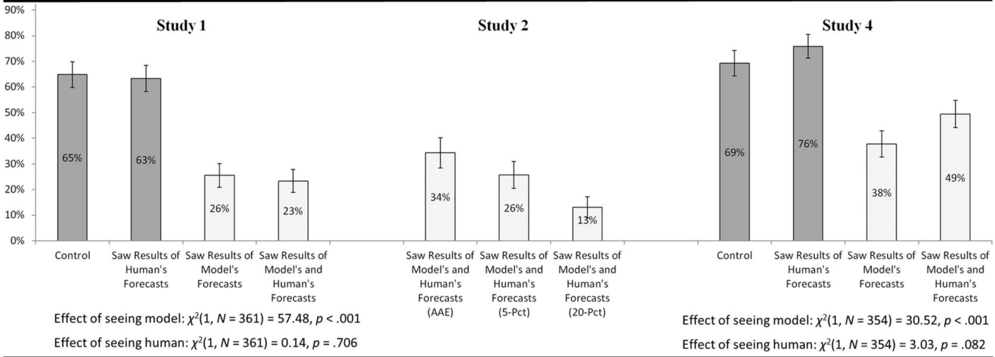
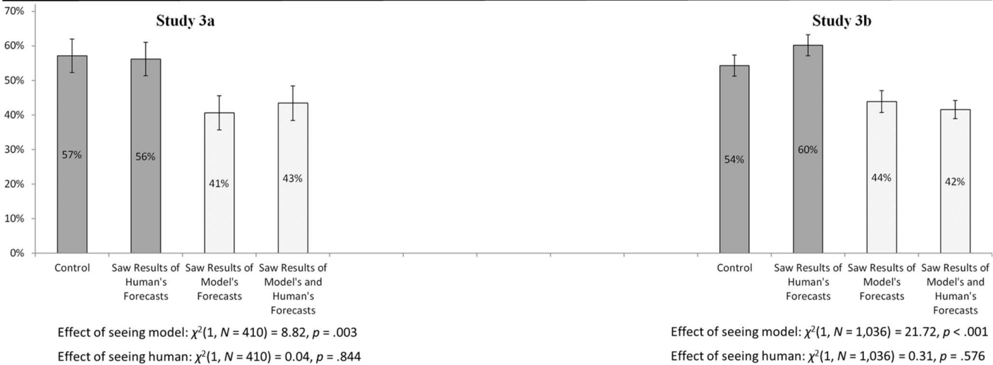
- Across five studies, seeing the algorithm perform reduced participants’ likelihood of choosing it over a human forecaster. In the model-and-human conditions, 610 of 741 participants (83%) saw the model outperform the human, yet these participants were among the least likely to choose the model.
- The model outperformed humans in all five studies. For example, bonuses if choosing model vs. human were Study 1: $1.78 vs. $1.38; Study 2: $1.77 vs. $1.09; Study 3a: $0.48 vs. $0.31; Study 3b: $0.49 vs. $0.30; Study 4: $1.79 vs. $1.38. Human forecasters produced 15–29% more error in the MBA task and 90–97% more error in the airline-passenger task.
- Seeing the model perform significantly decreased confidence in the model’s forecasts in all four studies where this was tested, whereas seeing the human perform significantly decreased confidence in the human only in Study 4. Confidence in the model’s forecasts significantly mediated the effect of seeing the model perform on choosing the model; confidence in the human did not.
- In Study 2, participants paid for forecasts within 20 percentiles were less likely to choose the model than those paid within 5 percentiles, χ²(1, N = 139) = 3.56, p = .059, and those paid by average absolute error, χ²(1, N = 136) = 8.56, p = .003; this effect was mediated by confidence in their own forecasts, not confidence in the model’s forecasts.
Methods
- Five studies had participants forecast real outcomes: MBA student success (Studies 1, 2, and 4) or U.S. state rank in airline passengers (Studies 3a and 3b). Participants were assigned to control, human, model, or model-and-human conditions, then chose whether to tie incentivized bonuses to the model or the human forecaster (themselves in Studies 1–3, another participant in Study 4).
- Final samples were Study 1: 361; Study 2: 206; Study 3a: 410; Study 3b: 1,036; Study 4: 354. Studies 1, 2, and 4 were run in the Wharton Behavioral Lab; Studies 3a and 3b used Amazon Mechanical Turk.
- Main analyses compared forecasting performance and choice rates, measured confidence and beliefs, and used binary mediation analyses with Preacher and Hayes’s bootstrapping procedure.
Limitations
- The paper states it did not explore all boundaries of the effect, including whether it would persist if algorithms were many times more accurate than humans, and whether results depend on features shared by the two forecasting tasks.
- The paper states it did not explore how algorithm variations—complexity, transparency, forecaster involvement in construction, and designer expertise—affect algorithm aversion.
- The paper states algorithm aversion is not entirely driven by seeing algorithms err, and it has little to say about how best to reduce aversion among those who have seen an algorithm err. The text also cautions that cross-experiment comparisons should be made cautiously.
Model-written summary. Check it against the paper before relying on it.
Integrity signals
Registry
Cites
Statistics
Figures
Verification
Claims the paper makes
0 Valid · 2 Not valid · 16 Not checked · 90 Own results and interpretations
A result the paper reports from its own data — it cites no other source for it, so there is none to check. The quote shows it is in the paper.
In the paper
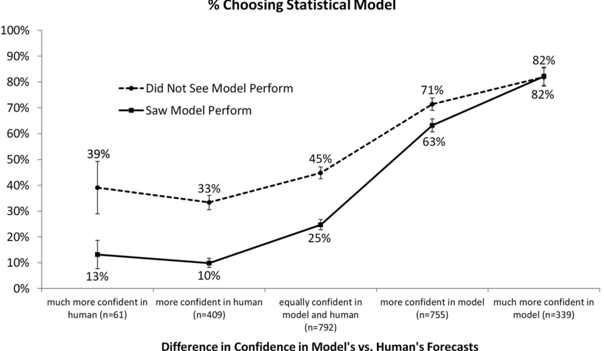
“the majority of people who were equally confident in the model's and human's forecasts chose to tie their bonuses to the human's forecasts, particularly when they had seen the model perform.”
plainstates an association- Asserted: passes — The authors put it forward as true.
- Checkable: passes — It can be checked against evidence.
- Load-bearing: passes — The paper’s conclusions depend on it.
- Based: passes — The paper gives a reason why it holds.
A result the paper reports from its own data — it cites no other source for it, so there is none to check. The quote shows it is in the paper.
In the paper
“Consistent with research on the adoption of decision aids (see Highhouse, 2008), participants thought that the human forecasters were better than the model at getting better with practice, learning from mistakes, and finding underappreciated candidates.”
plain- Asserted: passes — The authors put it forward as true.
- Checkable: passes — It can be checked against evidence.
- Load-bearing: passes — The paper’s conclusions depend on it.
- Based: passes — The paper gives a reason why it holds.
A result the paper reports from its own data — it cites no other source for it, so there is none to check. The quote shows it is in the paper.
In the paper
“Our studies show that this resistance at least partially arises from greater intolerance for error from algorithms than from humans.”
plainstates a possible cause- Asserted: passes — The authors put it forward as true.
- Checkable: passes — It can be checked against evidence.
- Load-bearing: passes — The paper’s conclusions depend on it.
- Based: passes — The paper gives a reason why it holds.
A result the paper reports from its own data — it cites no other source for it, so there is none to check. The quote shows it is in the paper.
In the paper
“Participants rightfully thought that the model was better than human forecasters at avoiding obvious mistakes, appropriately weighing various attributes, and consistently weighing information.”
plain- Asserted: passes — The authors put it forward as true.
- Checkable: passes — It can be checked against evidence.
- Load-bearing: unclear — It is unclear whether the paper’s conclusions depend on it.
- Based: passes — The paper gives a reason why it holds.
A result the paper reports from its own data — it cites no other source for it, so there is none to check. The quote shows it is in the paper.
In the paper
“This effect was evident in two distinct domains of judgment, including one in which the human forecasters produced nearly twice as much error as the algorithm.”
plain- Asserted: passes — The authors put it forward as true.
- Checkable: passes — It can be checked against evidence.
- Load-bearing: unclear — It is unclear whether the paper’s conclusions depend on it.
- Based: passes — The paper gives a reason why it holds.
75 more claims
Create a free account to see all 108 claims and to verify the 12 references still open.
- It may state two separate claims as one. 13
- Probably not a substantial claim. 16
Claims other papers make about this one
Each is checked against this paper’s own text: does it say what the citing paper says it does?
The source backs part of the claim, not all of it — or backs it for a different population, condition or comparison.
In the citing paper
“Traditional theorizing assumes trade-offs between trust and skepticism (Dietvorst et al., 2015), automation and engagement (Freeman et al., 2014), or efficiency and depth (Ishowo-Oloko et al., 2019)”
From Pedagogical partnerships with generative AI in higher education: how dual cognitive pathways paradoxically enable transformative learning (2026) · cites this paper as Dietvorst et al., 2015
Experimental — accuracy not yet measuredThe source backs part of the claim, not all of it — or backs it for a different population, condition or comparison.
In the citing paper
“Existing research typically examines trust versus skepticism in human-AI interactions as binary constructs (Dietvorst et al., 2015; Logg et al., 2019), missing the possibility that partnerships might simultaneously activate both vigilant and offloading behaviors.”
From Pedagogical partnerships with generative AI in higher education: how dual cognitive pathways paradoxically enable transformative learning (2026) · cites this paper as Dietvorst et al., 2015
Experimental — accuracy not yet measuredThe source backs part of the claim, not all of it — or backs it for a different population, condition or comparison.
In the citing paper
“It aligns with the theoretical rationale on algorithm aversion (Dietvorst et al. 2015;Hohensinn et al. 2024) and appreciation (Logg et al. 2019), which suggests that people are more likely to accept and trust AI systems when they produce desirable results but become skeptical when outcomes are unfavorable.”
From Holding AI Accountable Like Herding Cats: The Contingent Impact on the Legitimacy of Algorithmic Bureaucracy (2026) · cites this paper as Dietvorst et al. 2015
Experimental — accuracy not yet measuredThe source backs part of the claim, not all of it — or backs it for a different population, condition or comparison.
In the citing paper
“Research on algorithm appreciation and algorithm aversion further suggests that people may either defer to algorithms or reject them depending on prior experience, perceived expertise, and error visibility (Dietvorst et al., 2015; Logg et al., 2019).”
From College students' metacognitive awareness of generative-AI reliance: an experimental study of decision confidence and attribution bias (2026) · cites this paper as Dietvorst et al., 2015
Experimental — accuracy not yet measuredThe source backs part of the claim, not all of it — or backs it for a different population, condition or comparison.
In the citing paper
“Earlier research has mentioned gender, self-confidence, expertise, and general algorithm aversion or appreciation.15,28”
From Appropriate trust in artificial intelligence for the optical diagnosis of colorectal polyps: the role of human/artificial intelligence interaction (2024) · cites this paper as [28]
Experimental — accuracy not yet measured
22 more claims about this paper
Create a free account to see every claim other papers make about this one.
Statistics recomputed
Every reported test result, recomputed from its test statistic and degrees of freedom. A result shows as not adding up only once an independent check has confirmed it.
- Consistentt(360) = 4.98reported p < .001 · recomputed p < .001
“t (360) = 4.98, p < .001”
- Consistentt(204) = 6.26reported p < .001 · recomputed p < .001
“t (204) = 6.26, p < .001”
- Consistentt(405) = 7.73reported p < .001 · recomputed p < .001
“t (405) = 7.73, p < .001”
- Consistentt(353) = 5.11reported p < .001 · recomputed p < .001
“t (353) = 5.11, p < .001”
- Consistentχ²(1) = 39.94reported p < .001 · recomputed p < .001
“χ 2 (1, N = 271) = 39.94, p < .001”
19 more recomputed tests
Create a free account to see every test the Stats check recomputed.
Self-check
Percentages, sums and reported differences re-computed from the paper’s own numbers.
Self-check results appear here once an independent check has confirmed them.
Citations
Cites
Preacher, K. J., & Hayes, A. F. (2008) · Behavior Research Methods · doi:10.3758/brm.40.3.879 · Cited by 34,117 · cited 1×
“We then used Preacher and Hayes’s (2008) bootstrapping procedure to obtain unbiased 95% confidence intervals around the mediated effects.”
Method(2023) · doi:10.1126/science · Cited by 6,063
The trouble with overconfidence.
Moore, D. A., & Healy, P. J. (2008) · Psychological Review · doi:10.1037/0033-295x.115.2.502 · Cited by 2,358
“Clinical versus Actuarial Judgment.”
Dawes, R. M., Faust, D., & Meehl, P. E. (1989) · Science · doi:10.1126/science.2648573 · Cited by 2,298
The robust beauty of improper linear models in decision making.
Dawes, R. M. (1979) · American Psychologist · doi:10.1037/0003-066x.34.7.571 · Cited by 1,966
Preference and belief: Ambiguity and competence in choice under uncertainty
Heath, C., & Tversky, A. (1991) · Journal of Risk and Uncertainty · doi:10.1007/bf00057884 · Cited by 1,654
Clinical versus mechanical prediction: a meta-analysis
Grove, W. M., Zald, D. H., Lebow, B. S., Snitz, B. E., & Nelson, C. (2000) · Psychological Assessment · doi:10.1037/1040-3590.12.1.19 · Cited by 1,640
Grove, W. M., & Meehl, P. E. (1996) · Psychology, Public Policy, and Law · doi:10.1037/1076-8971.2.2.293 · Cited by 1,457 · cited 4×
“…1996), the notion that algorithms cannot properly consider individual targets (Grove & Meehl, 1996), concerns about the ethicality of relying on algorithms to make important decisions (Dawes, 1979), and the presumed inability of algorithms to incorporate qualitative data (Grove & Meehl, 1996).”
BackgroundMethodInfluential(2007) · Cited by 1,133
Competing on analytics: the new science of winning
(2007) · Choice Reviews Online · doi:10.5860/choice.44-6322 · Cited by 941
Research works printed but not linked: 1
- Clark, D. (2012, November 7). How Nate Silver won the 2012 presidential election. Harvard Business Review Blog . Retrieved from http://blogs .hbr.org/cs/2012/11/how\_nate\_silver\_won\_the\_2012\_p.html
Cited by
Items 501–600 of 3,918
Delegation Decisions in Finance
Holzmeister, F., Holmén, M., Kirchler, M., Stefan, M., & Wengström, E. (2022) · Management Science · doi:10.1287/mnsc.2022.4555 · Cited by 59
Prahl, A., & Swol, L. M. V. (2021) · Human-Machine Communication · doi:10.30658/hmc.2.11 · Cited by 65
Lin, S., Ma, Y., Xu, Y., Lu, L., He, J., Zhu, J., Peng, Y., Yu, T., Congdon, N., & Zou, H. (2023) · JMIR Public Health and Surveillance · doi:10.2196/41624 · Cited by 52
“On the one hand, algorithm aversion should be noted, which means that compared to manual grading, the residents were in disfavor of the AI-assisted screening technology [34,35].”
BackgroundImpact of Algorithmic Decision Making on Human Behavior: Evidence from Ultimatum Bargaining
Erlei, A., Nekdem, F., Meub, L., Anand, A., & Gadiraju, U. (2020) · Proceedings of the AAAI Conference on Human Computation and Crowdsourcing · doi:10.1609/hcomp.v8i1.7462 · Cited by 48
Lee, D., & Ham, C.-D. (2023) · Journal of Interactive Advertising · doi:10.1080/15252019.2023.2217830 · Cited by 61
Why does my model fail?: contrastive local explanations for retail forecasting
Lucic, A., Haned, H., & de Rijke, M. (2020) · Proceedings of the 2020 Conference on Fairness, Accountability, and Transparency · doi:10.1145/3351095.3372824 · Cited by 45
Rating Reliability and Bias in News Articles: Does AI Assistance Help Everyone?
Horne, B. D., Nevo, D., O’Donovan, J., Cho, J.-H., & Adalı, S. (2019) · Proceedings of the International AAAI Conference on Web and Social Media · doi:10.1609/icwsm.v13i01.3226 · Cited by 44
Conservatism predicts aversion to consequential Artificial Intelligence
Castelo, N., & Ward, A. F. (2021) · PLoS ONE · doi:10.1371/journal.pone.0261467 · Cited by 66
Schlund, R., & Zitek, E. M. (2024) · Communications Psychology · doi:10.1038/s44271-024-00102-8 · Cited by 66
The rise of people analytics and the future of organizational research
Polzer, J. T. (2022) · Research in Organizational Behavior · doi:10.1016/j.riob.2023.100181 · Cited by 76
Kahr, P. K., Rooks, G., Willemsen, M. C., & Snijders, C. C. P. (2023) · Proceedings of the 28th International Conference on Intelligent User Interfaces · doi:10.1145/3581641.3584058 · Cited by 39
Artificial Intelligence and Groups: Effects of Attitudes and Discretion on Collaboration
Bezrukova, K., Griffith, T. L., Spell, C., Rice, V., & Yang, H. E. (2023) · Group & Organization Management · doi:10.1177/10596011231160574 · Cited by 51
“…in this research (a broader topic than attitudes toward AI teams as it includes all forms of algorithms 2 ) is that people across various domains often choose human advice/decisions over those given by algorithms, despite demonstrations of higher accuracy from algorithms (Dietvorst et al., 2015).”
How AI can learn from the law: putting humans in the loop only on appeal
Cohen, I. G., Babic, B., Gerke, S., Xia, Q., Evgeniou, T., & Wertenbroch, K. (2023) · npj Digital Medicine · doi:10.1038/s41746-023-00906-8 · Cited by 51
“…where no AI/ML is involved and experts are the only decision-makers, yet we propose that they can be particularly helpful in AI/ML decision-making in areas that are characterized by concerns about fairness 1 , safety 4 , trust, and unique circumstances such as in medical decision-making 5,6 .”
BackgroundTandon, A., Dhir, A., Malik, A., Budhwar, P. S., & Kaur, P. (2024) · Human Resource Management · doi:10.1002/hrm.22263 · Cited by 56
Privacy matters… or does It? Algorithms, rationalization, and the erosion of concern for privacy
Fast, N. J., & Jago, A. S. (2019) · Current Opinion in Psychology · doi:10.1016/j.copsyc.2019.07.011 · Cited by 59
Banas, J. A., Palomares, N. A., Richards, A. S., Keating, D. M., Joyce, N., & Rains, S. A. (2022) · Human Communication Research · doi:10.1093/hcr/hqac010 · Cited by 50
Wortel, C., Vanwesenbeeck, I., & Tomas, F. (2024) · Emerging Media · doi:10.1177/27523543241292096 · Cited by 50
“However, machines tend to be considered less credible than humans (Dietvorst et al., 2015), and AI disclosures have been found to reduce source credibility in various contexts (Liu et al., 2023).”
InfluentialMobility as a service (MaaS): the importance of transportation psychology
Tomaino, G., Teow, J., Carmon, Z., Lee, L., Ben-Akiva, M. E., Chen, X. C., Leong, W. Y., Li, S., Yang, N., & Zhao, J. (2020) · Marketing Letters · doi:10.1007/s11002-020-09533-9 · Cited by 54
Ethical Issues in AI-Enabled Disease Surveillance: Perspectives from Global Health
Borda, A., Molnar, A., Neesham, C., & Kostkova, P. (2022) · Applied Sciences · doi:10.3390/app12083890 · Cited by 58
A Review of Artificial Intelligence, Algorithms, and Robots Through the Lens of Stakeholder Theory
Matthews, M. J., Su, R., Yonish, L., McClean, S. T., Koopman, J., & Yam, K. C. (2025) · Journal of Management · doi:10.1177/01492063241311855 · Cited by 64
“…prefer a generic computer, human, or an intelligent machine is nuanced, with some studies showing that people will generally prefer humans (Dietvorst, Simmons, & Massey, 2015; Hertz & Wiese, 2019; Zhang, Pentina, & Fan, 2021) and others suggesting that stakeholders will defer to…”
To trust or not to trust smart consumer products: a literature review of trust-building factors
Michler, O., Decker, R., & Stummer, C. (2019) · Management Review Quarterly · doi:10.1007/s11301-019-00171-8 · Cited by 67
Perceived corruption reduces algorithm aversion
Castelo, N. (2023) · Journal of Consumer Psychology · doi:10.1002/jcpy.1373 · Cited by 58
Reicherts, L., Zhang, Z. T., von Oswald, E., Liu, Y., Rogers, Y., & Hassib, M. E. (2025) · CHI Conference on Human Factors in Computing Systems · doi:10.1145/3706598.3713295 · Cited by 64
“However, various challenges persist, including inappropriate reliance on AI [1, 10, 17, 19, 27, 49], deskilling [26, 57], or the difficulty of integrating AI recommendations into users’ decision-making process [4, 34, 65].”
Wahn, B., Schmitz, L., Gerster, F. N., & Weiss, M. (2023) · PLOS ONE · doi:10.1371/journal.pone.0286102 · Cited by 49
“With regard to the second point, if people observe an algorithm making mistakes, their attitude can quickly change from appreciation to aversion [11].”
BackgroundFrank, D., & Otterbring, T. (2024) · British Journal of Management · doi:10.1111/1467-8551.12780 · Cited by 49
Kahr, P. K., Rooks, G., Willemsen, M. C., & Snijders, C. C. P. (2024) · ACM Transactions on Interactive Intelligent Systems · doi:10.1145/3686164 · Cited by 49
“Moreover, trust was (lastingly) damaged and recovered only slowly after experiencing errors in performance [27, 29, 65, 97].”
SolutionChat: Real-time Moderator Support for Chat-based Structured Discussion
Lee, S.-C., Song, J., Ko, E.-Y., Park, S., Kim, J., & Kim, J. (2020) · Proceedings of the 2020 CHI Conference on Human Factors in Computing Systems · doi:10.1145/3313831.3376609 · Cited by 49
“Previous research on algorithmic aversion shows that humans lose trust on algorithms as they make errors, even with overall high accuracy [12].”
BackgroundHuman–Algorithm Collaboration Works Best if Humans Lead (Because it is Fair!)
Cremer, D. D., & McGuire, J. (2021) · Social Justice Research · doi:10.1007/s11211-021-00382-z · Cited by 51
How intelligent automation, service robots, and AI will reshape service products and their delivery
Wirtz, J., & Pitardi, V. (2023) · Italian Journal of Marketing · doi:10.1007/s43039-023-00076-1 · Cited by 63
“A first stream of studies provides support for the so-called ‘algorithm aversion’ phenomenon (Dietvorst et al., 2015) and shows that customers prefer human and personal services in a variety of settings including medical, financial, and organizational contexts.”
BackgroundSimplifying tree-based methods for retail sales forecasting with explanatory variables
Wellens, A. P., Boute, R. N., & Udenio, M. (2023) · European Journal of Operational Research · doi:10.1016/j.ejor.2023.10.039 · Cited by 59
Stability and Innovation in the Use of Forecasting Systems: A Case Study in a Supply-Chain Company
Fildes, R. A., & Goodwin, P. B. (2020) · International Journal of Forecasting · doi:10.1016/j.ijforecast.2020.11.004 · Cited by 55
Anxiety about artificial intelligence from patient and doctor-physician
Li, W., & Liu, X. (2024) · Patient Education and Counseling · doi:10.1016/j.pec.2024.108619 · Cited by 54
Hiding Behind Machines: Artificial Agents May Help to Evade Punishment
Feier, T., Gogoll, J., & Uhl, M. (2022) · Science and Engineering Ethics · doi:10.1007/s11948-022-00372-7 · Cited by 55
The Price of InterpretabilityPreprint
Bertsimas, D., Delarue, A., Jaillet, P., & Martin, S. (2019) · arXiv (Cornell University) · doi:10.48550/arxiv.1907.03419 · Cited by 55
Misplaced Trust: Measuring the Interference of Machine Learning in Human Decision-Making
Suresh, H., Lao, N., & Liccardi, I. (2020) · 12th ACM Conference on Web Science · doi:10.1145/3394231.3397922 · Cited by 49
“Some studies have shown a preference for human judgment over algorithmic judgment in “subjective” domains such as joke recommendation [38], after seeing the algorithm make a mistake [10], or when the algorithmic output is presented”
BackgroundFairPlay: Detecting and Deterring Online Customer Misbehavior
Wu, J., Zheng, Z., & Zhao, J. L. (2021) · Information Systems Research · doi:10.1287/isre.2021.1035 · Cited by 53
Towards Trustworthy AutoGrading of Short, Multi-lingual, Multi-type Answers
Schneider, J., Richner, R., & Riser, M. (2023) · International Journal of Artificial Intelligence in Education · doi:10.1007/s40593-022-00289-z · Cited by 48
Jago, A. S., Raveendhran, R., Fast, N. J., & Gratch, J. S. (2023) · Journal of Experimental Social Psychology · doi:10.1016/j.jesp.2023.104553 · Cited by 54
“For example, some studies have revealed opposition to algorithms (Bigman & Gray, 2018; Dietvorst, Simmons, & Massey, 2015; Newman, Fast, & Harmon, 2020), while others have found that people prefer algorithms for certain tasks where they may feel judged and negatively evaluated by humans, such as…”
BackgroundExplainable Student Agency Analytics
Saarela, M., Heilala, V., Jääskelä, P., Rantakaulio, A., & Kärkkäinen, T. (2021) · IEEE Access · doi:10.1109/access.2021.3116664 · Cited by 59
Preference for human or algorithmic forecasting advice does not predict if and how it is used
Himmelstein, M., & Budescu, D. V. (2023) · Journal of Behavioral Decision Making · doi:10.1002/bdm.2285 · Cited by 35
Justice, trust, and moral judgements when personnel selection is supported by algorithms
Feldkamp, T., Langer, M., Wies, L., & König, C. J. (2023) · European Journal of Work and Organizational Psychology · doi:10.1080/1359432x.2023.2169140 · Cited by 60
FinTech and consumers: a systematic review and integrative framework
Abis, D., Pia, P., & Limbu, Y. B. (2024) · Management Decision · doi:10.1108/md-07-2023-1136 · Cited by 55
Zhao, X., Sun, Y., Liu, W., & Wong, C.-W. (2025) · Journal of Computer-Mediated Communication · doi:10.1093/jcmc/zmae022 · Cited by 59
“However, distrust, or algorithm aversion (Dietvorst et al, 2015), stemming from a perceived lack of human-like qualities such as empathy and contextual understanding (Zhou et al., 2023), remains a challenge.”
BackgroundDell’Acqua, F., Kogut, B., & Perkowski, P. (2020) · The Review of Economics and Statistics · doi:10.1162/rest_a_01328 · Cited by 65
Me vs. the machine? Subjective evaluations of human- and AI-generated advice
Osborne, M. R., & Bailey, E. R. (2025) · Scientific Reports · doi:10.1038/s41598-025-86623-6 · Cited by 55
Man vs. Machine: Comparing Discretionary andSystematic Hedge Fund Performance
Harvey, C. R., Rattray, S., Sinclair, A. J., & Hemert, O. V. (2017) · The Journal of Portfolio Management · doi:10.3905/jpm.2017.43.4.055 · Cited by 48
Putting a human in the loop: Increasing uptake, but decreasing accuracy of automated decision-making
Sele, D., & Chugunova, M. (2024) · PLoS ONE · doi:10.1371/journal.pone.0298037 · Cited by 66
Fears about artificial intelligence across 20 countries and six domains of application.
Dong, M., Conway, J. R., Bonnefon, J., Shariff, A., & Rahwan, I. (2026) · American Psychologist · doi:10.1037/amp0001454 · Cited by 60
Blaming automated vehicles in difficult situations
Franklin, M., Awad, E., & Lagnado, D. (2021) · iScience · doi:10.1016/j.isci.2021.102252 · Cited by 47
Machine Thinking, Fast and Slow
Bonnefon, J., & Rahwan, I. (2020) · Trends in Cognitive Sciences · doi:10.1016/j.tics.2020.09.007 · Cited by 63
Hwang, J., Lee, T., Lee, H., & Byun, S. (2022) · Journal of Medical Internet Research · doi:10.2196/28659 · Cited by 37
Schaap, G., Bosse, T., & Vettehen, P. H. (2023) · AI & Society · doi:10.1007/s00146-023-01649-6 · Cited by 59
“For instance, it could be argued that the benefits are less important in accepting a decision made by an algo-rithm, because algorithms are supposed to be ‘perfect’ (Dietvorst et al. 2015).”
Technology-Augmented Choice: How Digital Innovations Are Transforming Consumer Decision Processes
Melumad, S., Hadi, R., Hildebrand, C., & Ward, A. F. (2020) · Customer Needs and Solutions · doi:10.1007/s40547-020-00107-4 · Cited by 53
Liu, J. (2025) · International Journal of Human-Computer Interaction · doi:10.1080/10447318.2025.2544006 · Cited by 62
“Algorithm aversion refers to the tendency to prefer human judgment over algorithmic decisions, even when the latter is demonstrably more accurate (Dietvorst et al., 2015).”
Impact of Model Interpretability and Outcome Feedback on Trust in AI
Ahn, D., Almaatouq, A., Gulabani, M., & Hosanagar, K. (2024) · CHI Conference on Human Factors in Computing Systems · doi:10.1145/3613904.3642780 · Cited by 69
Algorithm Aversion as an Obstacle in the Establishment of Robo Advisors
Filiz, I., Judek, J. R., Lorenz, M., & Spiwoks, M. (2022) · Journal of risk and financial management · doi:10.3390/jrfm15080353 · Cited by 53
A theory of predictive sales analytics adoption
Habel, J., Alavi, S. H., & Heinitz, N. (2023) · AMS Review · doi:10.1007/s13162-022-00252-0 · Cited by 70
Improving Human Sequential Decision Making with Reinforcement Learning
Bastani, H., Bastani, O., & Sinchaisri, W. P. (2025) · Management Science · doi:10.1287/mnsc.2022.02455 · Cited by 68
Mirkin, S., & Albensi, B. C. (2023) · Frontiers in Aging Neuroscience · doi:10.3389/fnagi.2023.1094233 · Cited by 46
“A study found that people are more likely to lose confidence in an algorithm than a human after seeing both make the same mistake, even if the algorithm can outperform a human in certain situations (Dietvorst et al., 2015).”
BackgroundExploring Motivators for Trust in the Dichotomy of Human—AI Trust Dynamics
Gerlich, M. (2024) · Social Sciences · doi:10.3390/socsci13050251 · Cited by 46
“…research shows that, while AI is now better at predicting outcomes than humans (e.g., weather reports, decision options), there are still cases where people prefer humans to make forecasts and predictions, a phenomenon known as algo-rithm aversion as was explained by Dietvorst et al. (2015).”
OK computer: Worker perceptions of algorithmic recruitment
Fumagalli, E., Rezaei, S., & Salomons, A. (2022) · Research Policy · doi:10.1016/j.respol.2021.104420 · Cited by 46
The Moral Psychology of AI and the Ethical Opt-Out Problem
Bonnefon, J.-F., Shariff, A., & Rahwan, I. (2020) · Ethics of Artificial Intelligence · doi:10.1093/oso/9780190905033.003.0004 · Cited by 42
Eisbach, S., Langer, M., & Hertel, G. (2023) · Computers in Human Behavior: Artificial Humans · doi:10.1016/j.chbah.2023.100015 · Cited by 46
Murtaza, Z., Sharma, I., & Carbonell, P. (2024) · Technological Forecasting and Social Change · doi:10.1016/j.techfore.2024.123806 · Cited by 46
Small steps to accuracy: Incremental belief updaters are better forecasters
Atanasov, P. D., Witkowski, J., Ungar, L., Mellers, B. A., & Tetlock, P. E. (2020) · Organizational Behavior and Human Decision Processes · doi:10.1016/j.obhdp.2020.02.001 · Cited by 50
Simkute, A., Luger, E., Jones, B., Evans, M., & Jones, R. (2021) · Journal of Responsible Technology · doi:10.1016/j.jrt.2021.100017 · Cited by 39
When AI Fails, Who Do We Blame? Attributing Responsibility in Human–AI Interactions
Schoenherr, J. R., & Thomson, R. (2024) · IEEE Transactions on Technology and Society · doi:10.1109/tts.2024.3370095 · Cited by 53
“Delegating responsibility and trusting AI-enabled systems is not straightforward as operators are predisposed to both overtrust [8], [10], [14], [15] and distrust AI-enabled systems [9], [16] (see also, algorithmic aversion; [17], [18], [19]).”
BackgroundHolstein, K., De-Arteaga, M., Tumati, L., & Cheng, Y. (2023) · Proceedings of the ACM on Human-Computer Interaction · doi:10.1145/3579628 · Cited by 38
The social dilemma of big data: Donating personal data to promote social welfare
Hillebrand, K., Hornuf, L., Müller, B., & Vrankar, D. (2023) · Information and Organization · doi:10.1016/j.infoandorg.2023.100452 · Cited by 53
Larkin, C., Drummond Otten, C., & Árvai, J. (2022) · Journal of Risk Research · doi:10.1080/13669877.2021.1958047 · Cited by 43
Chen, Y., Harris, S. K., Rogers, Y., Ahmad, T., & Asselbergs, F. W. (2022) · European Heart Journal · doi:10.1093/eurheartj/ehac030 · Cited by 48
Schweitzer, S., & Cremer, D. D. (2023) · Academy of Management Discoveries · doi:10.5465/amd.2022.0115 · Cited by 53
Predictive model to assess user trust: a psycho-physiological approach
Ajenaghughrure, I. B., Sousa, S., Kosunen, I., & Lamas, D. (2019) · Indian Conference on Human-Computer Interaction (IndiaHCI) · doi:10.1145/3364183.3364195 · Cited by 56
Klein, U., Depping, J., Wohlfahrt, L., & Fassbender, P. (2023) · AI & Society · doi:10.1007/s00146-023-01699-w · Cited by 55
“The assumption here is that people discount the possibility that the algorithm is trainable in the first place and deny the algorithm the ability to learn (Dietvorst et al. 2015).”
A Multilevel Framework for AI Governance
Choung, H., David, P., & Seberger, J. S. (2024) · Routledge eBooks · doi:10.4324/9781003316077-25 · Cited by 54
Using judgment to select and adjust forecasts from statistical models
De Baets, S., & Harvey, N. (2020) · European Journal of Operational Research · doi:10.1016/j.ejor.2020.01.028 · Cited by 44
Anticipating Safety Issues in E2E Conversational AI: Framework and Tooling
Dinan, E., Abercrombie, G., Bergman, A. S., Spruit, S., Hovy, D., Boureau, Y.-L., & Rieser, V. (2021) · arXiv · doi:10.48550/arxiv.2107.03451 · Cited by 44
“This effect is especially pronounced in algorithmic systems, where people apply higher standards than in their interaction with other humans (Dietvorst et al., 2015).”
BackgroundMeasuring the Efficiency of Automation-Aided Performance in a Simulated Baggage Screening Task
Boskemper, M. M., Bartlett, M. L., & McCarley, J. S. (2021) · Human Factors The Journal of the Human Factors and Ergonomics Society · doi:10.1177/0018720820983632 · Cited by 50
The Impact of Machine Learning on Total Joint Arthroplasty Patient Outcomes: A Systemic Review
Karlin, E. A., Lin, C. C., Meftah, M., Slover, J. D., & Schwarzkopf, R. M. (2022) · The Journal of Arthroplasty · doi:10.1016/j.arth.2022.10.039 · Cited by 47
Is optimal recommendation the best? A laboratory investigation under the newsvendor problem
Feng, X., & Gao, J. (2020) · Decision Support Systems · doi:10.1016/j.dss.2020.113251 · Cited by 45
Modliński, A., Fortuna, P., & Rożnowski, B. (2022) · International Journal of Consumer Studies · doi:10.1111/ijcs.12811 · Cited by 48
El-Sayed, A., Lovat, L. B., & Ahmad, O. F. (2025) · Gastroenterology · doi:10.1053/j.gastro.2025.01.254 · Cited by 47
Le, H., Shen, Y., Li, Z., Xia, M., Tang, L., Li, X., Jia, J., Wang, Q., Gašević, D., & Fan, Y. (2025) · British Journal of Educational Technology · doi:10.1111/bjet.13614 · Cited by 48
Algorithmic Gatekeeping for Professional Communicators: Power, Trust, and Legitimacy
van Dalen, A. (2023) · Routledge eBooks · doi:10.4324/9781003375258 · Cited by 64
Yang, L., Bauer, K., Li, X., & Hinz, O. F. (2025) · Management Science · doi:10.1287/mnsc.2022.03918 · Cited by 69
“I Can’t Reply with That”: Characterizing Problematic Email Reply Suggestions
Robertson, R. E., Olteanu, A., Diaz, F., Shokouhi, M., & Bailey, P. (2021) · Proceedings of the 2021 CHI Conference on Human Factors in Computing Systems · doi:10.1145/3411764.3445557 · Cited by 43
Deng, Y., Zheng, J., Huang, L., & Kannan, K. (2023) · MIS Quarterly · doi:10.25300/misq/2022/16813 · Cited by 53
Jussupow, E., Spohrer, K., & Heinzl, A. (2022) · Business & Information Systems Engineering · doi:10.1007/s12599-022-00750-2 · Cited by 56
Ozanne, M., Bhandari, A., Bazarova, N. N., & DiFranzo, D. J. (2022) · Big Data & Society · doi:10.1177/20539517221115666 · Cited by 52
Wu, L., Chen, Z. F., & Tao, W. (2024) · Public Relations Review · doi:10.1016/j.pubrev.2024.102426 · Cited by 52
A Framework for Interpretability in Machine Learning for Medical Imaging
Wang, A. Q., Karaman, B. K., Kim, H., Rosenthal, J., Saluja, R., Young, S. I., & Sabuncu, M. R. (2024) · IEEE Access · doi:10.1109/access.2024.3387702 · Cited by 49
“When users’ levels of trust in algorithmic decision-making aids are mis-calibrated, the result manifests as either automation bias (too much trust) or algorithmic aversion (too much distrust) [28], [44], [92].”
BackgroundBlösser, M., & Weihrauch, A. (2023) · European Journal of Marketing · doi:10.1108/ejm-01-2023-0009 · Cited by 49
Is data-driven decision-making driven only by data? When cognition meets data
Zaitsava, M., Marku, E., & Guardo, M. C. D. (2022) · European Management Journal · doi:10.1016/j.emj.2022.01.003 · Cited by 56
Algorithm aversion? On the influence of advice accuracy on trust in algorithmic advice
Daschner, S., & Obermaier, R. (2022) · Journal of Decision System · doi:10.1080/12460125.2022.2070951 · Cited by 51
Uncertainty in XAI: Human Perception and Modeling Approaches
Chiaburu, T., Haußer, F., & Bießmann, F. (2024) · Machine Learning and Knowledge Extraction · doi:10.3390/make6020055 · Cited by 54
“For the end-user, explanations lacking uncertainty information can either create a false sense of security and overreliance (leading to misuse of AI) or, on the other side of the spectrum, a sense of mistrust and reluctance (leading to disuse of AI [71], a form of algorithm aversion [52]).”
BackgroundWhen Algorithms Err : Differential Impact of Early vs. Late Errors on Users’ Reliance on Algorithms
Kim, A., Yang, M., & Zhang, J. (2020) · ACM Transactions on Computer-Human Interaction · doi:10.1145/3557889 · Cited by 57
Wilczek, B., Thäsler-Kordonouri, S., & Eder, M. (2024) · AI & Society · doi:10.1007/s00146-024-02138-0 · Cited by 53
“These findings align with other studies that showed people’s skepticism toward the trustworthiness of algorithms as decision-making entities (Dietvorst et al. 2015).”
CONTROL ISSUES: HOW PROVIDING INPUT AFFECTS AUDITORS' RELIANCE ON ARTIFICIAL INTELLIGENCE
Commerford, B. P., Eilifsen, A., Hatfield, R. C., Holmstrom, K. M., & Kinserdal, F. (2024) · Contemporary Accounting Research · doi:10.1111/1911-3846.12974 · Cited by 52
Chen, C., & Sundar, S. S. (2023) · Proceedings of the 2023 CHI Conference on Human Factors in Computing Systems · doi:10.1145/3544548.3580805 · Cited by 36
“Studies have shown that algorithm aversion can set in very quickly [14] and is quite difficult to overcome without enabling some user control over the algorithmic decision [15].”
BackgroundFinkel, M., & Krämer, N. C. (2022) · International Journal of Social Robotics · doi:10.1007/s12369-022-00879-w · Cited by 44
Metadata
- Authors
- Dietvorst, B. J., Simmons, J. P., & Massey, C.
- Affiliations
- University of Pennsylvania (US)
- Venue
- Journal of Experimental Psychology: General
- Published
- 2015
- Volume
- 144
- Issue
- 1
- Pages
- 114-126
- ISSN
- 0096-3445 (ISSN-L)
- 1939-2222
- OpenAlex
- W3125633690
- Cited by
- 3,232
- References
- 22
- Citations by year
- 2026: 1025 · 2025: 563 · 2024: 445 · 2023: 404 · 2022: 266 · 2021: 216 · 2020: 137 · 2019: 88 · 2018: 41 · 2017: 26 · 2016: 14 · 2015: 5
- FWCI
- 13.96
- Type
- journal article
- Language
- en
- Open access
- green
- doi.org
- Locations
- Journal of Experimental Psychology General (publishedVersion)
- SSRN Electronic Journal (publishedVersion)
- PubMed (publishedVersion)
- ScholarlyCommons (University of Pennsylvania) (submittedVersion)
- Funders
- Wharton Behavioral Laboratory
- Wharton Risk Center Ackoff Doctoral Student Fellowship
- Topics
- Social Sciences › Decision Sciences › General Decision Sciences › Decision-Making and Behavioral Economics
- Social Sciences › Decision Sciences › Management Science and Operations Research › Forecasting Techniques and Applications
- Social Sciences › Human Factors and Ergonomics › Human-Automation Interaction and Safety
- Keywords
- algorithm aversion, trust in algorithms, prediction confidence, evidence-based algorithm, decision-making
- MeSH terms
- Algorithms, Avoidance Learning, Culture, Decision Making, Female, Forecasting, Humans, Male, Motivation, Comprehension, Young Adult
About these checks
Registry, retraction, Cites and statistics results are computed, not judged, with one exception: a printed reference that no index lists is read once by a model before it counts as a citation error. Claims are extracted by a model and kept only when their quote appears verbatim in the text; each cited source is then checked, with a model’s help, for whether it says what the claim relies on. Those verdicts can be wrong — read the claim’s quote and the cited source before relying on one.
A language model drew the claims from the paper on 2026-11-14, under version 3 of the claim definition (model deepseek-v4.1-flash, prompt extract-v3).
A second model labelled each claim on 2026-11-14 (model jev-1.13-20260917, definition revision gold-guideline-v0.2).
Statistics and arithmetic are recomputed, not judged.
Confidence bands are shown only for fields calibrated on our annotated test set. None is calibrated yet, so no band is shown.
What counts as a claim ›How we measure confidence ›How we check this ›
Are you an author, or do you see a problem with this page? Request a review
Data sources
Bibliographic data: Semantic Scholar, OpenAlex, Crossref.
Contains information from the Semantic Scholar Academic Graph Datasets, made available under the ODC Attribution License (ODC-BY 1.0).
Semantic Scholar’s data is described in: Kinney, R., et al. (2023). The Semantic Scholar Open Data Platform. arXiv:2301.10140.
