

Combination of anti-angiogenic therapy and immune checkpoint blockade normalizes vascular-immune crosstalk to potentiate cancer immunity
Open accessThe DOI matches its Crossref record; 100 of the 100 references it cites were found in a registry or an index.
Abstract
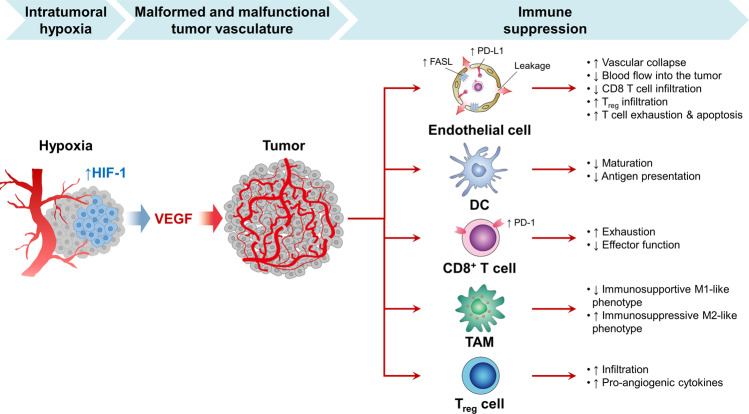
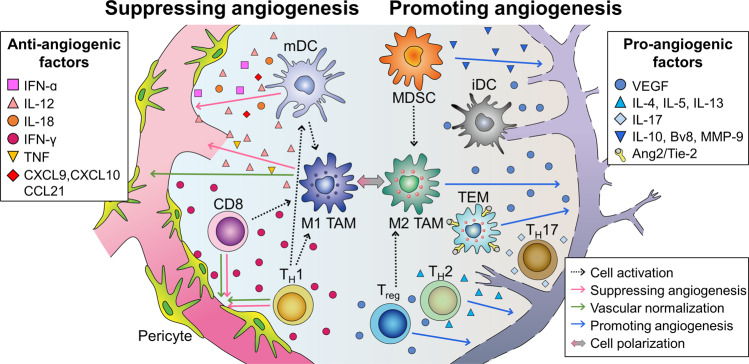
Cancer immunotherapy with immune checkpoint inhibitors (ICIs) has revolutionized the treatment of advanced cancers. However, the tumor microenvironment (TME) functions as a formidable barrier that severely impairs the efficacy of ICIs. While the crosstalk between tumor vessels and immune cells determines the nature of anti-tumor immunity, it is skewed toward a destructive cycle in growing tumors. First, the disorganized tumor vessels hinder CD8+T cell trafficking into the TME, disable effector functions, and even kill T cells. Moreover, VEGF, the key driver of angiogenesis, interferes with the maturation of dendritic cells, thereby suppressing T cell priming, and VEGF also induces TOX-mediated exhaustion of CD8+T cells. Meanwhile, a variety of innate and adaptive immune cells contribute to the malformation of tumor vessels. Protumoral M2-like macrophages as well as T H 2 and Treg cells secrete pro-angiogenic factors that accelerate uncontrolled angiogenesis and promote vascular immaturity. While CD8+T and CD4+T H 1 cells suppress angiogenesis and induce vascular maturation by secreting IFN-γ, they are unable to infiltrate the TME due to malformed tumor vessels. These findings led to preclinical studies that demonstrated that simultaneous targeting of tumor vessels and immunity is a viable strategy to normalize aberrant vascular-immune crosstalk and potentiate cancer immunotherapy. Furthermore, this combination strategy has been evidently demonstrated through recent pivotal clinical trials, granted approval from FDA, and is now being used in patients with kidney, liver, lung, or uterine cancer. Overall, combining anti-angiogenic therapy and ICI is a valid therapeutic strategy that can enhance cancer immunity and will further expand the landscape of cancer treatment.
Overview
The claims and statistics of this paper haven’t been checked yet.
Free: it reads the open-access text and checks the first 5 claims that cite a source we can check. Create a free account to check every claim.
Integrity signals
Registry
Cites
Statistics
Figures
Verification
Claims the paper makes
The claims and statistics of this paper haven’t been checked yet.
Free: it reads the open-access text and checks the first 5 claims that cite a source we can check. Create a free account to check every claim.
Self-check
Percentages, sums and reported differences re-computed from the paper’s own numbers.
The self-check needs the paper’s full text.
Citations
Cites
Cancer immunotherapy using checkpoint blockade
Ribas, A., & Wolchok, J. D. (2018) · Science · doi:10.1126/science.aar4060 · Cited by 6,791
Normalization of Tumor Vasculature: An Emerging Concept in Antiangiogenic Therapy
Jain, R. K. (2005) · Science · doi:10.1126/science.1104819 · Cited by 5,527
Macrophage Diversity Enhances Tumor Progression and Metastasis
Qian, B.-Z., & Pollard, J. W. (2010) · Cell · doi:10.1016/j.cell.2010.03.014 · Cited by 5,188
Interleukin-12 and the regulation of innate resistance and adaptive immunity
Trinchieri, G. (2003) · Nature Reviews Immunology · doi:10.1038/nri1001 · Cited by 3,927
Macrophage plasticity and interaction with lymphocyte subsets: cancer as a paradigm
Biswas, S. K., & Mantovani, A. (2010) · Nature Immunology · doi:10.1038/ni.1937 · Cited by 3,840
Atezolizumab for First-Line Treatment of Metastatic Nonsquamous NSCLC
Socinski, M. A., Jotte, R. M., Cappuzzo, F., Orlandi, F., Stroyakovskiy, D., Nogami, N., Rodríguez-Abreu, D., Moro-Sibilot, D., Thomas, C. A., Barlesi, F., et al. (2018) · New England Journal of Medicine · doi:10.1056/nejmoa1716948 · Cited by 3,733
Pembrolizumab plus axitinib versus sunitinib for advanced renal-cell carcinoma
Rini, B. I., Plimack, E. R., Stus, V., Gafanov, R., Hawkins, R., Nosov, D., Pouliot, F., Alekseev, B., Soulières, D., Melichar, B., et al. (2019) · New England Journal of Medicine · doi:10.1056/nejmoa1816714 · Cited by 3,403
Avelumab plus Axitinib versus Sunitinib for Advanced Renal-Cell Carcinoma
Motzer, R. J., Penkov, K., Haanen, J., Rini, B., Albiges, L., Campbell, M. T., Venugopal, B., Kollmannsberger, C., Negrier, S., Uemura, M., et al. (2019) · New England Journal of Medicine · doi:10.1056/nejmoa1816047 · Cited by 2,503
Macrophage plasticity and polarization in tissue repair and remodelling
Mantovani, A., Biswas, S. K., Galdiero, M. R., Sica, A., & Locati, M. (2013) · The Journal of Pathology · doi:10.1002/path.4133 · Cited by 2,384
Pàez-Ribes, M., Allen, E., Hudock, J., Takeda, T., Okuyama, H., Viñals, F., Inoue, M., Bergers, G., Hanahan, D., & Casanovas, O. (2009) · Cancer Cell · doi:10.1016/j.ccr.2009.01.027 · Cited by 2,339
Cited by
Items 101–200 of 796
Tumor microenvironment diversity and plasticity in cancer multidrug resistance
Li, Z., & Yin, P. (2023) · Biochimica et Biophysica Acta (BBA) - Reviews on Cancer · doi:10.1016/j.bbcan.2023.188997 · Cited by 49
Brocco, D., Lanuti, P., Pieragostino, D., Cufaro, M. C., Simeone, P., Bologna, G., Marino, P. D., Tursi, M. D., Grassadonia, A., Irtelli, L., et al. (2021) · Cancers · doi:10.3390/cancers13040585 · Cited by 49
“, IL6, vascular endothelial growth factor A [VEGFA], indoleamine 2,3-dioxygenase [IDO]) may be pharmacologically modulated, it will be interesting to study whether drugs acting on these pathways may improve ICI response [38].”
BackgroundLi, Z., Ning, F., Wang, C., Yu, H., Ma, Q., & Sun, Y. (2021) · Nanoscale · doi:10.1039/d1nr03387e · Cited by 47
Combination Therapies for the Optimisation of Bispecific T-Cell Engagers in Cancer Treatment
Zhu, W. M., & Middleton, M. R. (2023) · Immunotherapy Advances · doi:10.1093/immadv/ltad013 · Cited by 46
“Vascular endothelial growth factor (VEGF) contributes to several immunosuppressive pathways, but chiefly drives tumour angiogenesis resulting in an abnormal vascular architecture that prevents infiltration by circulating CTLs (step 3; Figure 1) [81].”
Zhu, L., Yu, X., Wang, L., Liu, J., Qu, Z., Zhang, H., Li, L., Chen, J., & Zhou, Q. (2021) · Oncogenesis · doi:10.1038/s41389-021-00335-w · Cited by 46
“In fact, combination anti-angiogenic therapy and ICBs were approved by the US Food Drug Administration (FDA) for the treatment of multiple solid cancers [4], including hepatocellular carcinoma (HCC) [5], metastatic renal cell cancer [6], non-small cell lung cancer (NSCLC) [7], metastatic endometrial cancer [8], and ut…”
BackgroundWang, L., Marfil‐Garza, B. A., Ernst, A. U., Pawlick, R. L., Pepper, A. R., Okada, K., Epel, B., Viswakarma, N., Kotecha, M., Flanders, J. A., et al. (2023) · Nature Biomedical Engineering · doi:10.1038/s41551-023-01145-8 · Cited by 44
“These cytokines have been reported to contribute to mediating neovascularization 44,45 .”
The Interplay of Tumor Vessels and Immune Cells Affects Immunotherapy of Glioblastoma
Ghosh, M., Lenkiewicz, A. M., & Kaminska, B. (2022) · Biomedicines · doi:10.3390/biomedicines10092292 · Cited by 43
Targeting cancer testis antigens in synovial sarcoma
Mitchell, G., Pollack, S. M., & Wagner, M. J. (2021) · Journal for ImmunoTherapy of Cancer · doi:10.1136/jitc-2020-002072 · Cited by 43
Tran, T. T. T., Caulfield, J. I., Zhang, L., Schoenfeld, D. A., Djureinovic, D., Chiang, V., Oria, V. O., Weiss, S. A., Olino, K. L., Jilaveanu, L. B., et al. (2023) · JCI Insight · doi:10.1172/jci.insight.157347 · Cited by 43
“Tumors exploit enhanced VEGF signaling to evade the immune system and to facilitate growth by increasing angiogenesis (6).”
Changing landscape of anti-angiogenic therapy: Novel approaches and clinical perspectives
Gacche, R. N. (2023) · Biochimica et Biophysica Acta (BBA) - Reviews on Cancer · doi:10.1016/j.bbcan.2023.189020 · Cited by 43
Sha, H., Tong, F., Ni, J., Sun, Y., Zhu, Y., Qi, L., Li, X., Li, W., Yang, Y., Gu, Q., et al. (2024) · Signal Transduction and Targeted Therapy · doi:10.1038/s41392-024-01857-6 · Cited by 43
“37 In conclusion, biomolecular exploration analysis indicated that PAAG appeared to be a more ef fi cient treatment, especially for mPC with a baseline TIME not suitable for ICI monotherapy or ICI plus chemotherapy combined treatment.”
Yang, J., Guo, Z., Song, M., Pan, Q., Zhao, J., Huang, Y., Han, Y., Ouyang, D., Yang, C., Chen, H., et al. (2023) · Frontiers in Immunology · doi:10.3389/fimmu.2023.1212577 · Cited by 43
Zhao, F., He, Y., Zhao, Z., He, J., Huang, H., Ai, K., Liu, L., & Cai, X. (2023) · Frontiers in Immunology · doi:10.3389/fimmu.2023.1272133 · Cited by 42
“These induction factors augment the migration and proliferation of ECs, further activating the angiogenic switch and promoting angiogenesis (19).”
BackgroundEmerging Importance of Tyrosine Kinase Inhibitors against Cancer: Quo Vadis to Cure?
Mongre, R. K., Mishra, C. B., Shukla, A. K., Prakash, A., Jung, S., Ashraf-Uz-Zaman, M., & Lee, M. (2021) · International Journal of Molecular Sciences · doi:10.3390/ijms222111659 · Cited by 42
“It is also well reported that the synergistic effect of fibroblast growth factor with VEGF accelerates vasculature mediated angiogenesis in cancers [34].”
BackgroundEvolving landscape of first-line combination therapy in advanced renal cancer: a systematic review
Lalani, A. A., Heng, D. Y. C., Basappa, N. S., Wood, L. A., Iqbal, N., McLeod, D., Soulières, D., & Kollmannsberger, C. (2022) · Therapeutic Advances in Medical Oncology · doi:10.1177/17588359221108685 · Cited by 41
Choi, S. H., Yoo, S. S., Lee, S. Y., & Park, J. Y. (2022) · Archives of Pharmacal Research · doi:10.1007/s12272-022-01382-6 · Cited by 41
“In addition, certain types of immune cells can polarize other immune cells to either pro- or anti-angiogenic phenotypes, indirectly modifying tumor angiogenesis (Huang et al. 2018; Lee et al. 2020).”
BackgroundInfluentialLin, W., Luo, Y., Wu, J. J., Zhang, H., Jin, G., Guo, C., Zhou, H., Liang, H., & Xu, X. (2023) · Journal for ImmunoTherapy of Cancer · doi:10.1136/jitc-2023-007402 · Cited by 41
“33 We hypothesized that the reduced secretion of the above four key cytokines induced by ADAR1 knockdown and IFN-γ treatment was due to the translational inhibition mediated by PKR/EIF2 α signaling.”
BackgroundHe, Y., Zhan, L., Shi, J., Xiao, M., Zuo, R., Wang, C., Liu, Z., Gong, W., Chen, L., Luo, Y., et al. (2023) · Advanced Science · doi:10.1002/advs.202207650 · Cited by 41
Zhou, J., Wang, L., Peng, C. Y., & Peng, F. (2022) · Frontiers in Pharmacology · doi:10.3389/fphar.2022.886198 · Cited by 41
Coumarin Derivatives as Anticancer Agents: Mechanistic Landscape with an Emphasis on Breast Cancer
Hacholli, V. B., Shubha, M. R., Prabhanajan, B. H., Lavanya, M., Pramod, S., Kumar, A., Szeleszczuk, Ł., & Gackowski, M. (2025) · Molecules · doi:10.3390/molecules30214167 · Cited by 41
“…in HRD/BRCA1/2 contexts [85,91]; pair PI3K/PTEN-altered tumors with coumarin designs that attenuate Akt/mTOR ± mTOR inhibitors [92,93]; in PD-L1–positive or otherwise immunogenic settings, test whether coumarin-driven apoptotic/angiogenic modulation can augment immune-checkpoint blockade [94,95].”
Lee, J., Koh, J., Kim, H. K., Hong, S., Kim, K., Park, S., Jung, H. A., Sun, J., Lee, S., Ahn, J. S., et al. (2022) · Journal of Thoracic Oncology · doi:10.1016/j.jtho.2022.04.001 · Cited by 41
Xie, L., Kong, H., Yu, J., Sun, M., Lu, S., Zhang, Y., Hu, J., Du, F., Lian, Q., Xin, H., et al. (2024) · Clinical and Translational Medicine · doi:10.1002/ctm2.1573 · Cited by 40
“52,53 These studies have provided important insights into the immunology of early-stage LUAD.”
BackgroundCurrent and emerging concepts for systemic treatment of metastatic colorectal cancer
Steup, C., Kennel, K. B., Neurath, M. F., Fichtner-Feigl, S., & Greten, F. R. (2025) · Gut · doi:10.1136/gutjnl-2025-335412 · Cited by 39
Reck, M., Popat, S., Grohé, C., Corral, J., Novello, S., Gottfried, M., Brueckl, W. M., Radonjic, D., Kaiser, R., & Heymach, J. V. (2023) · Lung Cancer · doi:10.1016/j.lungcan.2023.03.009 · Cited by 39
Interactions Between Anti-Angiogenic Therapy and Immunotherapy in Glioblastoma
Jain, S., Chalif, E. J., & Aghi, M. K. (2022) · Frontiers in Oncology · doi:10.3389/fonc.2021.812916 · Cited by 39
“MDSCs and neutrophils may promote angiogenesis by producing matrix metalloproteinase 9 as well as Bv8, of which both have been demonstrated to promote release of VEGF (116, 120).”
BackgroundShang, L., Jiang, X., Zhao, X., Huang, X., Wang, X., Jiang, X., Kong, X., Yao, M., Jiang, S., & Wong, P. (2024) · Cell Reports Medicine · doi:10.1016/j.xcrm.2024.101648 · Cited by 38
“2,52 Therefore, these findings highlight the promising potential of our developed strategy compared to other immunotherapies.”
Disrupting cancer angiogenesis and immune checkpoint networks for improved tumor immunity
Anderson, T. S., McCormick, A. L., Piersall, S. L., Okpalanwaka, I. F., & Lowe, D. B. (2022) · Seminars in Cancer Biology · doi:10.1016/j.semcancer.2022.02.009 · Cited by 37
When Natural Compounds Meet Nanotechnology: Nature-Inspired Nanomedicines for Cancer Immunotherapy
Yu, L., Jin, Y., Song, M., Zhao, Y., & Zhang, H. (2022) · Pharmaceutics · doi:10.3390/pharmaceutics14081589 · Cited by 37
Immunotherapy for Metastatic Non-Small Cell Lung Cancer: Therapeutic Advances and Biomarkers
Russano, M., Cava, G. L., Cortellini, A., Citarella, F., Galletti, A., Fazio, G. R. D., Santo, V., Brunetti, L., Vendittelli, A., Fioroni, I., et al. (2023) · Current Oncology · doi:10.3390/curroncol30020181 · Cited by 37
“Furthermore, angiogenetic signals may directly elicit immunosuppression: an hypoxic state in the tumor microenvironment stimulates production of vascular-endothelial growth factor (VEGF) and newly formed vessels express different immunosuppressive molecules such as PD-L1 [65].”
BackgroundT Cell Exhaustion in Cancer Immunotherapy: Heterogeneity, Mechanisms, and Therapeutic Opportunities
Yang, Y. P., Yao, X., Wang, Q., Yang, M., Li, R., Qin, J., Zhuang, J., & Sun, C. (2026) · Advanced Science · doi:10.1002/advs.202520634 · Cited by 36
Shafqat, A., Omer, M. H., Ahmed, E. N., Mushtaq, A. H., Ijaz, E., Ahmed, Z., AlKattan, K. M., & Yaqinuddin, A. (2023) · Frontiers in Immunology · doi:10.3389/fimmu.2023.1200941 · Cited by 36
“Additionally, anti-VEGF medications can counteract the direct immunosuppressive effects of VEGF on various cell types, as discussed earlier (29).”
BackgroundKoumarianou, A. A., & Durán, J. (2021) · Cancers · doi:10.3390/cancers13030363 · Cited by 36
“More specifically, (i) the disorganized network of tumor vessels hinder CD8 + T cell trafficking into the TME; (ii) VEGF interferes with the maturation of dendritic cells and thus suppresses T-cell priming; and (iii) protumoral M2-like macrophages as well as type-2, T-helper cells and regulatory T-cells (Tregs) secret…”
BackgroundXiao, M., Shi, Y., Jiang, S., Cao, M., Chen, W., Xu, Y. F., Xu, Z., & Wang, K. (2022) · Frontiers in Oncology · doi:10.3389/fonc.2022.1039378 · Cited by 36
Luo, Y., Wang, J., Xu, L., Du, Q., Ni, F., Wu, H., Liu, F., Hu, L., Xu, J., Hou, J., et al. (2022) · Acta Biomaterialia · doi:10.1016/j.actbio.2022.10.032 · Cited by 36
The Tumour Vasculature as a Target to Modulate Leucocyte Trafficking
Zhao, Y., Ting, K. K., Coleman, P. R., Qi, Y., Chen, J., Vadas, M. A., & Gamble, J. R. (2021) · Cancers · doi:10.3390/cancers13071724 · Cited by 36
“VEGF binding to VEGFR1 on the endothelium can inhibit the maturation of DCs from immature precursors and thus disrupt T-cell priming against tumours [202].”
BackgroundInfluentialNi, F., Chang, L., Peng, Y., Li, D., Wu, D., Li, K., Zhang, X., Jiang, X., Shao, Z., Chen, Y., et al. (2025) · Bioactive Materials · doi:10.1016/j.bioactmat.2025.08.007 · Cited by 36
“Cytotoxic T cells may inhibit angiogenesis by killing endothelial cells or secreting angiostatin [76].”
Checkpoint Inhibitors as High-Grade Gliomas Treatment: State of the Art and Future Perspectives
Persico, P., Lorenzi, E., Dipasquale, A., Pessina, F., Navarria, P., Politi, L. S., Santoro, A., & Simonelli, M. (2021) · Journal of Clinical Medicine · doi:10.3390/jcm10071367 · Cited by 36
“Moreover, VEGF, the primary driver of tumor angiogenesis, represents also a potent immunosuppressive factor active in both innate and adaptive immunity by inhibiting DCs maturation and antigen presentation, inducing CD8+ T-cells apoptosis, promoting Tregs activity, and polarizing TAMs towards a pro-tumoral phenotype […”
BackgroundGalasso, L., Cerrito, L., Maccauro, V., Termite, F., Mignini, I., Esposto, G., Borriello, R., Ainora, M. E., Gasbarrini, A., & Zocco, M. A. (2024) · International Journal of Molecular Sciences · doi:10.3390/ijms25137191 · Cited by 35
“These effects collectively lead to immunosuppression by depleting lymphocytes, generating oxidative stress, and activating T-regulatory cells [145].”
BackgroundAl-Ostoot, F. H., Salah, S., & Khanum, S. A. (2024) · Cancer Investigation · doi:10.1080/07357907.2024.2361295 · Cited by 35
Vascular co-option in resistance to anti-angiogenic therapy
Ribatti, D., Annese, T., & Tamma, R. (2023) · Frontiers in Oncology · doi:10.3389/fonc.2023.1323350 · Cited by 35
Advances in Targeting Cutaneous Melanoma
Kasakovski, D., Skrygan, M., Gambichler, T., & Susok, L. (2021) · Cancers · doi:10.3390/cancers13092090 · Cited by 35
Zhou, Y. J., Liu, Z., Yu, A., Zhao, G., & Chen, B. (2024) · ImmunoTargets and Therapy · doi:10.2147/itt.s494670 · Cited by 35
Park, H. S., Kim, Y. M., Kim, S., Lee, W. S., Kong, S. J., Yang, H., Kang, B., Cheon, J., Shin, S., Kim, C., et al. (2021) · Journal for ImmunoTherapy of Cancer · doi:10.1136/jitc-2021-003353 · Cited by 35
Self-citationLenvatinib recruits cytotoxic GZMK+CD8 T cells in hepatocellular carcinoma
Yamada, T., Fujiwara, N., Kubota, N., Matsushita, Y., Nakatsuka, T., Kurosaki, S., Minami, T., Tateishi, R., Ichida, A., Arita, J., et al. (2023) · Hepatology Communications · doi:10.1097/hc9.0000000000000209 · Cited by 35
Yu, J., Li, M., Ren, B., Cheng, L., Wang, X., Ma, Z., Yong, W. P., Chen, X., Wang, L., & Goh, B. C. (2023) · Frontiers in Pharmacology · doi:10.3389/fphar.2023.1261575 · Cited by 34
Tumor lysates-constructed hydrogel to potentiate tumor immunotherapy
Chen, X., Jiang, Z., Lin, Y., Yu, C., Nie, X., Xu, G., Xu, W., Jiang, Y., & Luan, Y. (2023) · Journal of Controlled Release · doi:10.1016/j.jconrel.2023.05.005 · Cited by 34
G-quadruplex-guided cisplatin triggers multiple pathways in targeted chemotherapy and immunotherapy
Ma, T., Liu, L., Zeng, Y., Ding, K., Zhang, H., Liu, W., Cao, Q., Xia, W. T., Xiong, X., Wu, C., et al. (2024) · Chemical Science · doi:10.1039/d4sc00643g · Cited by 34
“47 MYT1L is a regulating gene in the nerve cell and plays a signi cant role in mental and neurodegenerative diseases.”
Recent advances and future directions on small molecule VEGFR inhibitors in oncological conditions
Thakur, A., Rana, M., Mishra, A., Kaur, C., Pan, C., & Nepali, K. (2024) · European Journal of Medicinal Chemistry · doi:10.1016/j.ejmech.2024.116472 · Cited by 33
Checkpoint inhibitors and anti-angiogenic agents: a winning combination
Brest, P., Mograbi, B., Pagès, G., Hofman, P. M., & Milano, G. A. (2023) · British Journal of Cancer · doi:10.1038/s41416-023-02437-1 · Cited by 33
“The use of anti-angiogenic agents (anti-VEGF and anti-ANG2) reduces Tregs in fl uence and activates both CD4 and CD8 T cells and increases IFN-γ [28].”
BackgroundNi, B., Yang, Z., Zhou, T., Zhou, H. Q., Yang, Z., Lin, S., Xu, H., Lin, X., Yi, W., He, C., et al. (2024) · Journal of Neuroinflammation · doi:10.1186/s12974-024-03155-y · Cited by 33
“These immune cells release pro-inflammatory factors and other molecules that stimulate endothelial cell proliferation and migration, consequently leading to the formation of abnormal neovessels [2].”
BackgroundReprogramming the tumor microenvironment to overcome immunotherapy resistance in pancreatic cancer
Hui, X., Tian, X., Ding, S., Sun, A., Zhao, T., & Wang, H. (2025) · Frontiers in Immunology · doi:10.3389/fimmu.2025.1717062 · Cited by 32
Minegishi, S., Kinguchi, S., Horita, N., Namkoong, H., Briasoulis, Α., Ishigami, T., Tamura, K., Nishiyama, A., Yano, Y., & Japanese Society of Hypertension working group “Onco-Hypertension” (2022) · Hypertension · doi:10.1161/hypertensionaha.122.19865 · Cited by 32
Sukei, T., Palma, E., & Urbani, L. (2021) · Cancers · doi:10.3390/cancers13215586 · Cited by 32
Metabolism and macrophages in the tumor microenvironment
Yang, H., Kim, C., & Zou, W. (2024) · Current Opinion in Immunology · doi:10.1016/j.coi.2024.102491 · Cited by 32
Self-citationZhai, C., Zhang, X., Ren, L., You, L., Pan, Q., Pan, H., & Han, W. (2021) · Frontiers in Oncology · doi:10.3389/fonc.2020.619010 · Cited by 32
“These cells play various roles in the regulation of tumor angiogenesis (18).”
BackgroundKang, J., Xiang, X., Chen, X., Jiang, J., Zhang, Y., Li, L., & Tang, J. (2023) · Frontiers in Cell and Developmental Biology · doi:10.3389/fcell.2022.1086835 · Cited by 32
“It shows that targeting tumor vasculature and immune checkpoint genes are a potential strategy to potentiate cancer immunotherapy (Lee et al., 2020).”
BackgroundYin, Y., Yan, Y., Fan, B., Huang, W., Zhang, J., Hu, H., Li, X., Xiong, D., Chou, S., Xiao, Y., et al. (2023) · Research · doi:10.34133/research.0098 · Cited by 32
Understanding the complexity of tumor-associated macrophages: Druggable and therapeutic insights
Li, A.-Q., Huang, F., Talaiti, S., Yang, X. Y., Bi, H., & Fang, J. (2025) · Acta Pharmaceutica Sinica B · doi:10.1016/j.apsb.2025.07.021 · Cited by 31
“C motif chemokine ligand 10 (CXCL10), and CCL2, all of which promote the formation of tumor blood vessels 57 .”
Wei, F., Su, Y., Quan, Y., Li, X., Zou, Q., Zhang, L., Li, S., Jiang, M., Lin, G., Liang, P., et al. (2023) · Clinical Cancer Research · doi:10.1158/1078-0432.ccr-22-2757 · Cited by 31
Kim, H. S., Park, S., Kim, H. J., & Lee, D. Y. (2023) · Biomaterials Research · doi:10.1186/s40824-023-00391-w · Cited by 31
“Secondly, combining anti-angiogenic therapy with other treatments such as immunotherapy or immune checkpoint blockade may help mitigate concerns related to immunosuppression and may increase TIL infiltration [70].”
BackgroundFlavonoid-based nanomedicines to target tumor microenvironment
Talib, W. H., Abuawad, A., Thiab, S. H., Alshweiat, A., & Mahmod, A. I. (2022) · OpenNano · doi:10.1016/j.onano.2022.100081 · Cited by 30
How Immunotherapy Modified the Therapeutic Scenario of Endometrial Cancer: A Systematic Review
Maiorano, B. A., Maiorano, M. F. P., Cormio, G., Maglione, A., Lorusso, D., & Maiello, E. (2022) · Frontiers in Oncology · doi:10.3389/fonc.2022.844801 · Cited by 30
Dendritic cells: understanding ontogeny, subsets, functions, and their clinical applications
Li, W., Yu, C., Zhang, X., Gu, Y., He, X., Xu, R., Xu, J. F., Yu, G., & Wu, Y. (2025) · Molecular Biomedicine · doi:10.1186/s43556-025-00300-8 · Cited by 30
“VEGF, induced by hypoxia via HIF-1, stimulates angiogenesis while inhibiting DCs function through VEGFR binding, which attenuates T-cell responses [303, 304].”
Liu, R., Ji, Z., Wang, X., Zhu, L., Xin, J., Ma, L., Zhang, J., Ge, S., Zhang, L., Yang, Y., et al. (2025) · Nature Communications · doi:10.1038/s41467-025-56748-3 · Cited by 30
Meng, X., Wang, J., Xia, J., Wu, T., Luo, Z., Hong, Y., Lu, P., Guo, Y., Ji, Y., Zhang, M., et al. (2024) · European Journal of Cancer · doi:10.1016/j.ejca.2024.114328 · Cited by 30
Maekawa, N., Konnai, S., Asano, Y., Sajiki, Y., Deguchi, T., Okagawa, T., Watari, K., Takeuchi, H., Takagi, S., Hosoya, K., et al. (2022) · Scientific Reports · doi:10.1038/s41598-022-13484-8 · Cited by 30
Andac-Aktas, A. B., & Calibasi‐Kocal, G. (2025) · Frontiers in Molecular Biosciences · doi:10.3389/fmolb.2025.1687556 · Cited by 29
Current and Emerging Treatment Paradigms in Colorectal Cancer: Integrating Hallmarks of Cancer
de Torres, C. S., Baraibar, I., Gonzalez, N. S., Ros, J., Salvà, F., Rodríguez-Castells, M., Alcaráz, A., García, A., Tabernero, J. M., & Élez, E. (2024) · International Journal of Molecular Sciences · doi:10.3390/ijms25136967 · Cited by 29
“Moreover abnormal vessels created in the TME are an obstacle for the arrival of immune They also perpetuate hypoxia within the tumor, which is itself an enhancer of angiogenesis, and concurrently recruit immunosuppressive immune cells by secreting chemotactic factors [44].”
BackgroundColeman, S. S., Xie, M., Tarhini, A. A., & Tan, A. C. (2022) · Molecular Carcinogenesis · doi:10.1002/mc.23442 · Cited by 28
Donati, B., Reggiani, F., Torricelli, F., Santandrea, G., Rossi, T., Bisagni, A., Gasparini, E., Neri, A., Cortesi, L., Ferrari, G., et al. (2023) · Cancer Immunology Research · doi:10.1158/2326-6066.cir-23-0076 · Cited by 28
Targeting tumor-associated macrophages for cancer immunotherapy
Cao, X., Lai, S. W. T., Chen, S., Wang, S., & Feng, M. (2022) · International review of cytology · doi:10.1016/bs.ircmb.2022.02.002 · Cited by 28
Circulating immune cell landscape and T‐cell abnormalities in patients with moyamoya disease
Ge, P., Tao, C., Wang, W., He, Q., Liu, C., Zheng, Z., Mou, S., Zhang, B., Liu, X., Zhang, Q., et al. (2024) · Clinical and Translational Medicine · doi:10.1002/ctm2.1647 · Cited by 28
“47 Furthermore, Treg cells secrete pro-angiogenic factors that promote uncontrolled angiogenesis and incomplete vascular development in tumours, 48,49 which may suggest that Treg cells may be associated with angiogenesis in MMD. Previous studies have suggested potential involvement of RNF213…”
Backgroundβ-Glucan–conjugated anti–PD-L1 antibody enhances antitumor efficacy in preclinical mouse models
Wang, Q., Jiang, H., Zhang, H., Lu, W., Wang, X., Xu, W., Li, J., Lv, Y., Li, G., Cai, C., et al. (2023) · Carbohydrate Polymers · doi:10.1016/j.carbpol.2023.121564 · Cited by 28
Zhang, S., Xu, H., Li, M., Yuan, G., Nie, J., Zhang, Q., Shi, J., Liu, D., Meng, H., Dong, W., et al. (2026) · Journal of Hepatology · doi:10.1016/j.jhep.2025.10.026 · Cited by 27
The Patient-Derived Cancer Organoids: Promises and Challenges as Platforms for Cancer Discovery
Bae, J., Choi, Y. S., Cho, G., & Jang, S. J. (2022) · Cancers · doi:10.3390/cancers14092144 · Cited by 27
van Dorst, D. C. H., van Doorn, L., Colafella, K. M. M., Manintveld, O. C., Hassing, H. C., Danser, A. H. J., Mathijssen, R. H. J., & Versmissen, J. (2021) · Clinical Science · doi:10.1042/cs20200300 · Cited by 27
A guide to the types, structures, and multifaceted functions of matrix metalloproteinases in cancer
Piperigkou, Z., Mangani, S., Kremmydas, S., Koletsis, N. E., & Karamanos, N. K. (2025) · FEBS Journal · doi:10.1111/febs.70296 · Cited by 27
“Preclinical and early-phase trials are now pairing MMPIs with anti-VEGF therapies and immune checkpoint inhibitors, aiming to overcome compensatory mechanisms mediated by aberrant ECM remodeling and immune exclusion [293,294].”
Xu, Q., & Shao, D. (2024) · Frontiers in Immunology · doi:10.3389/fimmu.2024.1487610 · Cited by 27
Muto, H., Kuzuya, T., Kawabe, N., Ohno, E., Funasaka, K., Nagasaka, M., Nakagawa, Y., Miyahara, R., Shibata, T., Hashimoto, S., et al. (2023) · Anticancer Research · doi:10.21873/anticanres.16663 · Cited by 27
“This normalization process facilitates the infiltration of immune cells, such as cytotoxic T cells, into the tumor (14, 15).”
Melaiu, O., Vanni, G., Portarena, I., Pistolese, C. A., Anemona, L., Pomella, S., Bei, R., Buonomo, O. C., Roselli, M., Mauriello, A., et al. (2023) · International Journal of Molecular Sciences · doi:10.3390/ijms24043226 · Cited by 27
“, VEGF, β-defensin, CXCL12, HGF, and CXCL8) that recruit immature DCs from the peripheral blood in the TME and, at the same time, hamper DCs’ maturation and function [88].”
BackgroundHan, Y.-J., Shao, C.-Y., Yao, Y., Zhang, Z., Fang, M., Gong, T., Zhang, Y., & Li, M. (2024) · Postgraduate Medical Journal · doi:10.1093/postmj/qgad136 · Cited by 27
Zhang, L., Wang, W., Ge, S., Li, H., Bai, M., Duan, J., Yang, Y., Ning, T., Liu, R., Wang, X., et al. (2023) · BMC Cancer · doi:10.1186/s12885-023-10661-4 · Cited by 27
“In addition, apatinib has immunomodulatory effects mediated by decreases in regulatory T cells and myeloid-derived suppressor cells as well as enhanced dendritic cell maturation and effector T-cell infiltration[27-30].”
BackgroundSpotlight on Small-Cell Lung Cancer and Other Lung Neuroendocrine Neoplasms
Fernandez‐Cuesta, L., Sexton‐Oates, A., Bayat, L., Foll, M., Lau, S. C. M., & Leal, T. A. B. (2023) · American Society of Clinical Oncology Educational Book · doi:10.1200/edbk_390794 · Cited by 27
Understanding the landscape of immunotherapy in thymic epithelial tumors
Maniar, R., & Loehrer, P. J. (2023) · Cancer · doi:10.1002/cncr.34678 · Cited by 27
“Architectural changes associated with angiogenesis within the TIME can impair immune trafficking and alter immune cell metabolic function diminishing antitumor activity.(81,82) Given the demonstrated efficacy of single‐agent anti‐angiogenesis drugs and synergistic biologic interactions, combined regimens with ICB have…”
BackgroundGiri, S., Lamichhane, G., Pandey, J., Khadayat, R., Sindhu, K. C., Devkota, H. P., & Khadka, D. (2025) · International Journal of Molecular Sciences · doi:10.3390/ijms26072923 · Cited by 26
“Correspondingly, IL-12-based cancer immunotherapy has been shown to reduce microvessel thickness and enhance M1-TAM polarization in various cancer types [55].”
Targeting glutamine metabolism crosstalk with tumor immune response
Dong, C., Zhao, Y., Han, Y., Li, M., & Wang, G. (2025) · Biochimica et Biophysica Acta (BBA) - Reviews on Cancer · doi:10.1016/j.bbcan.2024.189257 · Cited by 26
Unlocking ovarian cancer heterogeneity: advancing immunotherapy through single-cell transcriptomics
Balan, D., Kampan, N. C., Plebanski, M., & Aziz, N. H. A. (2024) · Frontiers in Oncology · doi:10.3389/fonc.2024.1388663 · Cited by 26
Liu, M., Qiu, G., Guan, W., Xiaohong, X., Lin, X., Xie, Z., Zhang, J., Qin, Y., Du, H., Chen, X., et al. (2025) · Signal Transduction and Targeted Therapy · doi:10.1038/s41392-025-02153-7 · Cited by 26
“32 Overall, combining chemo-immunotherapy with anti-VEGFR agents may enhance clinical outcomes for patients with previously untreated ES-SCLC.”
Go, E., Yang, H., Park, W., Lee, S. J., Han, J., Kong, S. J., Lee, W. S., Han, D. K., Chon, H. J., & Kim, C. (2023) · Small · doi:10.1002/smll.202300544 · Cited by 26
Self-citationCesano, A., Augustin, R. C., Barrea, L., Bedognetti, D., Bruno, T. C., Carturan, A., Hammer, C., Ho, W. S., Kather, J. N., Kirchhoff, T., et al. (2025) · Journal for ImmunoTherapy of Cancer · doi:10.1136/jitc-2024-008876 · Cited by 25
“…tumor cell metabolism is associated with hypoxia in the TME, 196 targeting tumorous vasculature to remodel the TME is another area of active investigation, including combinations of anti- PD-1 and anti-angiogenic therapy across multiple indications, 197 such as anti- PD-1 refractory melanoma.”
Duan, H., Shao, C., Luo, Z., Wang, T., Tong, L., Liu, H., Yao, X., Lei, J., Zhao, J., Gao, Y., et al. (2024) · Signal Transduction and Targeted Therapy · doi:10.1038/s41392-024-01992-0 · Cited by 25
Choi, S.-W., Kim, J. H., Hong, J., & Kwon, M. (2025) · Frontiers in Immunology · doi:10.3389/fimmu.2025.1568590 · Cited by 25
Zhu, C., Zhai, T., Su, M., Pan, H., Tang, Q., Huang, B., Chi, X.-R., Li, N., Xie, L.-H., Qiu, S.-Q., et al. (2024) · Communications Biology · doi:10.1038/s42003-024-07341-9 · Cited by 25
Zhou, Y., Gu, Q., Zhu, L., Zhang, S., Wu, H., Pu, X., Jiang, C., & Chen, J. (2023) · Cell Proliferation · doi:10.1111/cpr.13513 · Cited by 25
“18 Moreover, intra-tumoral HEVs could cooperate with lymphocytes to help them cross the endothelial barrier, according to an analysis of the coexistence of HEVs and lymphocytes in tumour tissue.”
BackgroundTowards Immunotherapy-Induced Normalization of the Tumor Microenvironment
Melo, V. A., Bremer, E., & Martin, J. D. (2022) · Frontiers in Cell and Developmental Biology · doi:10.3389/fcell.2022.908389 · Cited by 24
“…2014; Vasudev and Reynolds, 2014; Viallard and Larrivée, 2017; Martin et al., 2019b; Pinter et al., 2021), and vascular normalization could improve responses to ICIs through various mechanisms (Figures 2A, B) (Fukumura et al., 2018; Huang et al., 2018; Khan and Kerbel, 2018; Lee et al., 2020).”
BackgroundWang, D., Deng, X., Wang, J., Che, S., Ma, X., Zhang, S., Dong, Q., Huang, C., Chen, J., Shi, C., et al. (2024) · Journal of Controlled Release · doi:10.1016/j.jconrel.2024.06.052 · Cited by 24
Melanoma Tumour Vascularization and Tissue-Resident Endothelial Progenitor Cells
Hashemi, G., Dight, J., Khosrotehrani, K., & Sormani, L. (2022) · Cancers · doi:10.3390/cancers14174216 · Cited by 24
“This induces immunosuppressive characteristics such as T cell exhaustion and apoptosis [112].”
BackgroundCai, Z., Meng, K., Yu, T., Xi, Y., Yuan, Z., Wang, X., Wang, C., Li, L., & Fu, X. (2025) · Frontiers in Immunology · doi:10.3389/fimmu.2025.1551322 · Cited by 24
Ellert‐Miklaszewska, A., Pilanc, P., Poleszak, K., Roura, A.-J., Cyranowski, S., Ghosh, M., Baluszek, S., Pasierbińska, M., Gielniewski, B., Swatler, J., et al. (2025) · Journal of Experimental & Clinical Cancer Research · doi:10.1186/s13046-025-03393-9 · Cited by 24
“Anti-VEGF drugs enhance the efficacy of ICIs in preclinical settings, including in GBM models [12, 13].”
Targeting the Tumor Microenvironment in EGFR-Mutant Lung Cancer: Opportunities and Challenges
Lim, J. U., Jung, J., Kim, Y. W., Kim, C. Y., Lee, S. H., Park, D. W., Choi, S. I., Ji, W., Yeo, C. D., & Lee, S. H. (2025) · Biomedicines · doi:10.3390/biomedicines13020470 · Cited by 24
“VEGF-mediated modulation also increases vascular permeability, creating a leaky and abnormal vasculature that limits the effective penetration of immune cells and therapeutic agents into tumors [193].”
Self-citation
Metadata
- Authors
- Lee, W. S., Yang, H., Chon, H. J., & Kim, C.
- Affiliations
- CHA University Bundang Medical Center (KR)
- Corresponding author
- Chon, Hong Jae
- Kim, Chan
- Venue
- Experimental & Molecular Medicine
- Published
- 2020-09
- Volume
- 52
- Issue
- 9
- Pages
- 1475-1485
- ISSN
- 1226-3613 (ISSN-L)
- 2092-6413
- PMC
- PMC8080646
- OpenAlex
- W3084409519
- Cited by
- 796
- References
- 99
- Citations by year
- 2026: 154 · 2025: 187 · 2024: 128 · 2023: 137 · 2022: 123 · 2021: 63 · 2020: 4
- FWCI
- 8.94
- Type
- journal article
- Language
- en
- Open access
- gold
- doi.org
- Licence
- cc-by
- creativecommons.org/licenses/by/4.0 (tdm)
- creativecommons.org/licenses/by/4.0 (vor, 10 d)
- Locations
- Experimental & Molecular Medicine (publishedVersion, cc-by)
- PubMed Central (publishedVersion, cc-by)
- PubMed (publishedVersion)
- DOAJ (DOAJ: Directory of Open Access Journals) (submittedVersion)
- Funders
- National Research Foundation
- National Research Foundation of Korea (NRF-2020R1C1C1010722, 2020R1C1C1010722, NRF-2020R1A2C2004530, 2020R1A2C2004530)
- Ministry of Science and ICT, South Korea
- Topics
- Health Sciences › Medicine › Oncology › Cancer Immunotherapy and Biomarkers
- Life Sciences › Biochemistry, Genetics and Molecular Biology › Molecular Biology › Angiogenesis and VEGF in Cancer
- Life Sciences › Immunology and Microbiology › Immunology › Immunotherapy and Immune Responses
- Keywords
- anti-angiogenic therapy, immune checkpoint inhibitors, tumor microenvironment, tumor angiogenesis, vascular endothelial growth factor, CD8+ T cell exhaustion, dendritic cell maturation, M2 macrophages, regulatory T cells, Th2 cells, vascular normalization, cancer immunotherapy, combination therapy, interferon-gamma
- MeSH terms
- Immune Checkpoint Inhibitors, Animals, Antineoplastic Combined Chemotherapy Protocols, Cell Communication, Humans, Neoplasms, Neovascularization, Pathologic, Signal Transduction, Treatment Outcome, Angiogenesis Inhibitors, Immunomodulation, Molecular Targeted Therapy, Tumor Microenvironment
About these checks
Registry, retraction, Cites and statistics results are computed, not judged, with one exception: a printed reference that no index lists is read once by a model before it counts as a citation error. Claims are extracted by a model and kept only when their quote appears verbatim in the text; each cited source is then checked, with a model’s help, for whether it says what the claim relies on. Those verdicts can be wrong — read the claim’s quote and the cited source before relying on one.
Statistics and arithmetic are recomputed, not judged.
Confidence bands are shown only for fields calibrated on our annotated test set. None is calibrated yet, so no band is shown.
What counts as a claim ›How we measure confidence ›How we check this ›
Are you an author, or do you see a problem with this page? Request a review
Data sources
Bibliographic data: Semantic Scholar, OpenAlex, Crossref.
Contains information from the Semantic Scholar Academic Graph Datasets, made available under the ODC Attribution License (ODC-BY 1.0).
Semantic Scholar’s data is described in: Kinney, R., et al. (2023). The Semantic Scholar Open Data Platform. arXiv:2301.10140.
