

Combination of anti-angiogenic therapy and immune checkpoint blockade normalizes vascular-immune crosstalk to potentiate cancer immunity
Open accessThe DOI matches its Crossref record; 100 of the 100 references it cites were found in a registry or an index.
Abstract
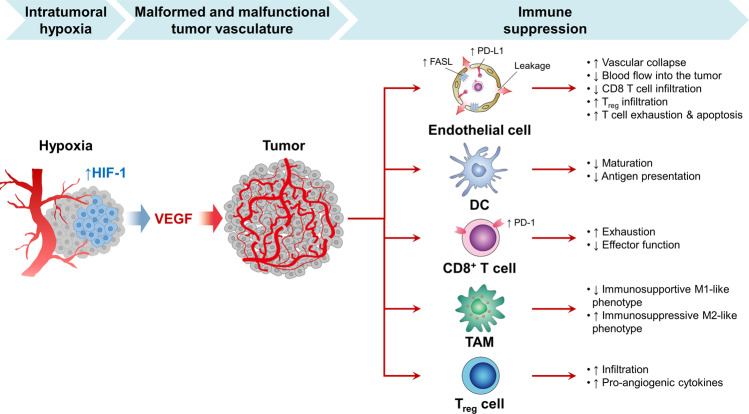
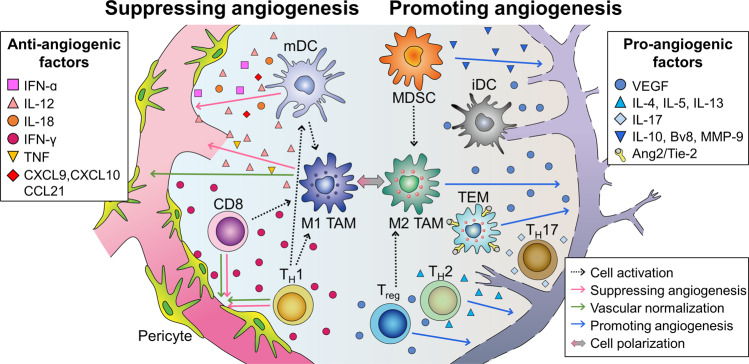
Cancer immunotherapy with immune checkpoint inhibitors (ICIs) has revolutionized the treatment of advanced cancers. However, the tumor microenvironment (TME) functions as a formidable barrier that severely impairs the efficacy of ICIs. While the crosstalk between tumor vessels and immune cells determines the nature of anti-tumor immunity, it is skewed toward a destructive cycle in growing tumors. First, the disorganized tumor vessels hinder CD8+T cell trafficking into the TME, disable effector functions, and even kill T cells. Moreover, VEGF, the key driver of angiogenesis, interferes with the maturation of dendritic cells, thereby suppressing T cell priming, and VEGF also induces TOX-mediated exhaustion of CD8+T cells. Meanwhile, a variety of innate and adaptive immune cells contribute to the malformation of tumor vessels. Protumoral M2-like macrophages as well as T H 2 and Treg cells secrete pro-angiogenic factors that accelerate uncontrolled angiogenesis and promote vascular immaturity. While CD8+T and CD4+T H 1 cells suppress angiogenesis and induce vascular maturation by secreting IFN-γ, they are unable to infiltrate the TME due to malformed tumor vessels. These findings led to preclinical studies that demonstrated that simultaneous targeting of tumor vessels and immunity is a viable strategy to normalize aberrant vascular-immune crosstalk and potentiate cancer immunotherapy. Furthermore, this combination strategy has been evidently demonstrated through recent pivotal clinical trials, granted approval from FDA, and is now being used in patients with kidney, liver, lung, or uterine cancer. Overall, combining anti-angiogenic therapy and ICI is a valid therapeutic strategy that can enhance cancer immunity and will further expand the landscape of cancer treatment.
Overview
The claims and statistics of this paper haven’t been checked yet.
Free: it reads the open-access text and checks the first 5 claims that cite a source we can check. Create a free account to check every claim.
Integrity signals
Registry
Cites
Statistics
Figures
Verification
Claims the paper makes
The claims and statistics of this paper haven’t been checked yet.
Free: it reads the open-access text and checks the first 5 claims that cite a source we can check. Create a free account to check every claim.
Self-check
Percentages, sums and reported differences re-computed from the paper’s own numbers.
The self-check needs the paper’s full text.
Citations
Cites
Cancer immunotherapy using checkpoint blockade
Ribas, A., & Wolchok, J. D. (2018) · Science · doi:10.1126/science.aar4060 · Cited by 6,791
Normalization of Tumor Vasculature: An Emerging Concept in Antiangiogenic Therapy
Jain, R. K. (2005) · Science · doi:10.1126/science.1104819 · Cited by 5,527
Macrophage Diversity Enhances Tumor Progression and Metastasis
Qian, B.-Z., & Pollard, J. W. (2010) · Cell · doi:10.1016/j.cell.2010.03.014 · Cited by 5,188
Interleukin-12 and the regulation of innate resistance and adaptive immunity
Trinchieri, G. (2003) · Nature Reviews Immunology · doi:10.1038/nri1001 · Cited by 3,927
Macrophage plasticity and interaction with lymphocyte subsets: cancer as a paradigm
Biswas, S. K., & Mantovani, A. (2010) · Nature Immunology · doi:10.1038/ni.1937 · Cited by 3,840
Atezolizumab for First-Line Treatment of Metastatic Nonsquamous NSCLC
Socinski, M. A., Jotte, R. M., Cappuzzo, F., Orlandi, F., Stroyakovskiy, D., Nogami, N., Rodríguez-Abreu, D., Moro-Sibilot, D., Thomas, C. A., Barlesi, F., et al. (2018) · New England Journal of Medicine · doi:10.1056/nejmoa1716948 · Cited by 3,733
Pembrolizumab plus axitinib versus sunitinib for advanced renal-cell carcinoma
Rini, B. I., Plimack, E. R., Stus, V., Gafanov, R., Hawkins, R., Nosov, D., Pouliot, F., Alekseev, B., Soulières, D., Melichar, B., et al. (2019) · New England Journal of Medicine · doi:10.1056/nejmoa1816714 · Cited by 3,403
Avelumab plus Axitinib versus Sunitinib for Advanced Renal-Cell Carcinoma
Motzer, R. J., Penkov, K., Haanen, J., Rini, B., Albiges, L., Campbell, M. T., Venugopal, B., Kollmannsberger, C., Negrier, S., Uemura, M., et al. (2019) · New England Journal of Medicine · doi:10.1056/nejmoa1816047 · Cited by 2,503
Macrophage plasticity and polarization in tissue repair and remodelling
Mantovani, A., Biswas, S. K., Galdiero, M. R., Sica, A., & Locati, M. (2013) · The Journal of Pathology · doi:10.1002/path.4133 · Cited by 2,384
Pàez-Ribes, M., Allen, E., Hudock, J., Takeda, T., Okuyama, H., Viñals, F., Inoue, M., Bergers, G., Hanahan, D., & Casanovas, O. (2009) · Cancer Cell · doi:10.1016/j.ccr.2009.01.027 · Cited by 2,339
Cited by
Items 301–400 of 796
Kim, S., Min, H., Nah, J., Jeong, J., Park, K., Kim, W., Lee, Y., Kim, J.-E., An, J., & Seong, R. H. (2023) · Immunology and Cell Biology · doi:10.1111/imcb.12647 · Cited by 12
Anti-Angiogenetic and Anti-Lymphangiogenic Effects of a Novel 2-Aminobenzimidazole Derivative, MFB
Hsu, M., Chen, H., Chen, C., Lien, J., Gao, J., Huang, Y., Hsu, J. B., Lee, G. A., & Huang, S. (2022) · Frontiers in Oncology · doi:10.3389/fonc.2022.862326 · Cited by 12
“Targeting tumor vasculature also improves the potency of chemotherapy (45) and enhances anti-cancer immunity (46).”
BackgroundTyrosine Kinase Inhibitors and Immunotherapy Updates in Neuroendocrine Neoplasms
Mosalem, O. M., Sonbol, M. B., Halfdanarson, T. R., & Starr, J. S. (2023) · Best Practice & Research Clinical Endocrinology & Metabolism · doi:10.1016/j.beem.2023.101796 · Cited by 12
Kim, J. H., Wong, J. S. L., Chen, S., Tai, D., Yang, H., Kim, Y., Kang, B., Kim, I. H., Kim, H., An, C., et al. (2025) · Liver International · doi:10.1111/liv.70493 · Cited by 11
Self-citationSulaiman, S. H., Barzani, H. A. H., Omer, R. A., Jawhar, Z. H., & Mohammedsaeed, A. A. (2026) · Cell Biochemistry and Function · doi:10.1002/cbf.70196 · Cited by 11
Divergent Signaling Pathways May Lead to Convergence in Cancer Therapy - A Review
Qayum, A., Shah, S. M., & Singh, S. K. (2022) · Cellular Physiology and Biochemistry · doi:10.33594/000000512 · Cited by 11
Dazio, G., Epistolio, S., Frattini, M., & Saletti, P. (2022) · Journal of Clinical Medicine · doi:10.3390/jcm11247523 · Cited by 11
Kim, Y., Kim, J. S., Kang, B., Kim, I. H., Kim, H., Lee, W. S., Sang, Y. B., Jung, S., An, C., Kim, C., et al. (2024) · Cancer Research and Treatment · doi:10.4143/crt.2024.237 · Cited by 11
“The recent emergence of immune checkpoint inhibitors (ICIs) has dramatically changed the treatment landscape for unresectable HCC and opened up the possibility of long-term survival in certain patients [7-10].”
Self-citationKang, C., Li, X., Liu, P., Liu, Y., Niu, Y., Zeng, X., Liu, J., Zhao, H., & Qiu, S. (2023) · Współczesna Onkologia · doi:10.5114/wo.2023.133741 · Cited by 11
“The imbalance of Th1/Th2 and Tregs/Th17 is related to various diseases such as allergies, inflammation, and cancer [18–21].”
BackgroundNeuville, C., Aubin, F., Puzenat, E., Popescu, D., Crépin, T., & Nardin, C. (2022) · Frontiers in Oncology · doi:10.3389/fonc.2022.1032844 · Cited by 11
“Indeed, the combination of anti-angiogenic therapy to ICI can potentiate anti-tumor immune response by regulating the interactions between angiogenesis and the immune response (25, 26).”
BackgroundMeng, Y., Liu, H., Zhu, H., Zhang, W., Sun, D., Han, X., Liu, Y., & Luo, G. (2024) · Journal for ImmunoTherapy of Cancer · doi:10.1136/jitc-2023-007171 · Cited by 11
“7 Among the various angiogenic molecules, excessive levels of vascular endothelial growth factor (VEGF) in the TME induce tumor-associated immunosuppression via diverse pathways.”
BackgroundZeng, K., Song, G., Chen, B., Gao, X., Liu, C., Miao, J., Ruan, Y., Luan, Y., Chen, X., Liu, J., et al. (2022) · Translational Oncology · doi:10.1016/j.tranon.2022.101525 · Cited by 11
“Indeed, the combination of anti-angiogenic therapy and immune checkpoint blockade has been validated as an effective treatment strategy to improve cancer immunity [63].”
BackgroundPark, S. H., Eun, R., Heo, J., & Lim, Y. T. (2022) · Drug Delivery and Translational Research · doi:10.1007/s13346-022-01282-8 · Cited by 11
Hsu, M., Chen, H., Lien, J., Huang, Y., & Huang, S. (2022) · Cells · doi:10.3390/cells11132114 · Cited by 11
“Targeting tumor vasculature not only prevents tumors from growing and metastasizing [37] but also improves tumor responses to chemotherapy [38,39] and enhances host anti-tumor immunity [3,7,40].”
BackgroundKim, J. H., Lee, W. S., Lee, H. J., Yang, H., Lee, S. J., Kong, S. J., Je, S., Yang, H., Jung, J., Cheon, J., et al. (2021) · OncoImmunology · doi:10.1080/2162402x.2021.2005280 · Cited by 11
Self-citationPandey, A., Rai, S. K., Ma, L., Higa, L., Khadka, V. S., Yang, H., & Deng, Y. (2026) · Advanced Science · doi:10.1002/advs.202518960 · Cited by 11
Self-citationWang, Y., Sun, X. Y., Han, Y., Wang, K., Cheng, L., Sun, Y., Besenbacher, F., & Yu, M. (2022) · Advanced Healthcare Materials · doi:10.1002/adhm.202200041 · Cited by 11
Recombinant Endostatin as a Potential Radiosensitizer in the Treatment of Non-Small Cell Lung Cancer
Cunningham, C., Bolcaen, J., Bisio, A., Genis, A., Strijdom, H., & Vandevoorde, C. (2023) · Pharmaceuticals · doi:10.3390/ph16020219 · Cited by 11
Bouguerra, R., Hajji, S. E., Wassmer, C., Bakaric, A., Slits, F., Moeckli, B., Rubbia‐Brandt, L., Lacotte, S., & Toso, C. (2025) · Hepatology · doi:10.1097/hep.0000000000001575 · Cited by 10
Zeng, Y., Yu, T., Zhang, S., Song, G., Meng, T., Yuan, H., & Hu, F. (2022) · Biomaterials Science · doi:10.1039/d2bm00600f · Cited by 10
Maiuolo, J., Musolino, V., Gliozzi, M., Carresi, C., Oppedisano, F., Nucera, S., Scarano, F., Scicchitano, M., Guarnieri, L., Bosco, F., et al. (2022) · Nutrients · doi:10.3390/nu14081574 · Cited by 10
“Even worse, the plethora of side effects can limit the success of the chemotherapy program itself due to the need for dosage reduction on one side and patient drop-off on the other [17]; finally, drug resistance can arise, and it no longer fulfills its function.”
BackgroundTowards Targeting Endothelial Rap1B to Overcome Vascular Immunosuppression in Cancer
Nakhchi, B. G., Kosuru, R., & Chrzanowska‐Wodnicka, M. (2024) · International Journal of Molecular Sciences · doi:10.3390/ijms25189853 · Cited by 10
“These beneficial interactions were also observed in breast cancer, pancreatic cancer, RCC, and glioblastoma multiforme [36,59].”
BackgroundEmerging immunologic approaches as cancer anti-angiogenic therapies
Azimi, M., Manavi, M. S., Afshinpour, M., Khorram, R., Vafadar, R., Rezaei‐Tazangi, F., Arabzadeh, D., Arabzadeh, S., Ebrahimi, N., & Aref, A. R. (2024) · Clinical & Translational Oncology · doi:10.1007/s12094-024-03667-2 · Cited by 10
“%) of NSCLC patients who were treated with bevacizumab, carboplatin, and paclitaxel [138].”
Advancement Opportunities and Endeavor of Innovative Targeted Therapies for Small Cell Lung Cancer
Ouyang, W., Xu, Z., Guan, S., Hu, Y., Gou, X., Liu, Z., Guo, W., Huang, Y., Zhang, L., Zhang, X., et al. (2025) · International Journal of Biological Sciences · doi:10.7150/ijbs.105973 · Cited by 10
Andrini, E., Lamberti, G., Mazzoni, F., Riccardi, F., Bonetti, A. V., Follador, A., Artioli, F., Genova, C., Barbieri, F., Frassoldati, A., et al. (2022) · Future Oncology · doi:10.2217/fon-2021-1027 · Cited by 10
You, M., Luo, L., Lu, T., Chen, S., & He, Y. (2024) · Frontiers in Immunology · doi:10.3389/fimmu.2024.1477146 · Cited by 10
Lan, H., Liu, H., Hou, H., Zhang, C., Zhu, J., Zhou, N., & Zhang, X. (2025) · Frontiers in Immunology · doi:10.3389/fimmu.2025.1539616 · Cited by 10
Puttagunta, P., Pamulapati, S. V., Bates, J. E., Gross, J. H., Stokes, W. A., Schmitt, N. C., Steuer, C. E., Teng, Y., & Saba, N. F. (2023) · Frontiers in Oncology · doi:10.3389/fonc.2023.1310106 · Cited by 10
“Given the possible synergistic effects of PD-1 checkpoint inhibitors and anti-angiogenic agents (36), the pairing of ICIs and TKIs is an appealing strategy and has already shown bene fi t in many tumor types.”
BackgroundGong, H., Chen, S., Liu, S., Hu, Q., Li, Y., Li, Y., Li, G., Huang, K., Li, R., & Fang, L. (2024) · Cellular and Molecular Life Sciences · doi:10.1007/s00018-023-05105-y · Cited by 10
Ma, J., Deng, Y., Zhang, M., & Zhang, Q. (2024) · Immunology · doi:10.1111/imm.13841 · Cited by 10
“While it is clear that tumour-infiltrating T cells should be antitumor pioneer in immunotherapy [22], the distributions could be in endless variety followed treatments.”
Kheraldine, H., Gupta, I., Cyprian, F. S., Vranić, S., Farsi, H. F. A., Merhi, M., Dermime, S., & Moustafa, A. A. (2024) · Cancer Cell International · doi:10.1186/s12935-023-03195-z · Cited by 10
“Likewise, other studies have demonstrated a combination of PD-1/PD-L1 inhibitors with anti-angiogenesis drugs to inhibit angiogenesis and induce cancer immunity in lung, kidney, and liver carcinomas [86–90].”
ResultGanjalıkhani-Hakemi, M., Demirel, G. Y., Li, Y., & Jayakumar, N. (2023) · Frontiers in Immunology · doi:10.3389/fimmu.2023.1238698 · Cited by 10
“The TME plays a crucial role in anti-cancer immunity, influencing the effectiveness of immunotherapy and other treatments (2, 3).”
BackgroundSaghazadeh, A. (2023) · Pharmacological Research · doi:10.1016/j.phrs.2023.107010 · Cited by 9
Ranasinghe, A. D. C. U., Tennakoon, T. M. P. B., & Schwarz, M. A. (2024) · Cells · doi:10.3390/cells13030244 · Cited by 9
Tumor-associated high endothelial venules as therapeutic modulation targets in cancer immunotherapy
Zhang, J.-Y., Piao, Z.-Y., Su, G.-L., Zhang, M.-J., & Sun, Z. (2025) · Biochimica et Biophysica Acta (BBA) - Reviews on Cancer · doi:10.1016/j.bbcan.2025.189500 · Cited by 9
Lin, W., Chen, W., Zhong, J., Ueki, H., Xu, A., Watanabe, M., Araki, M., Liu, C., Nasu, Y., & Huang, P. (2022) · Journal of Cancer · doi:10.7150/jca.66922 · Cited by 9
“The therapeutic prospect of renal cell carcinoma (RCC), a highly immunogenic and vascularized cancer type [23], has been recently revolutionized via immunotherapy stimulating the immune system and anti-angiogenesis therapy inhibiting RCC angiogenesis [24].”
BackgroundTanizaki, S., Matsumoto, K., Tamiya, A., Taniguchi, Y., Matsuda, Y., Uchida, J., Ueno, K., Kawachi, H., Tamiya, M., Yanase, T., et al. (2023) · European Journal of Clinical Pharmacology · doi:10.1007/s00228-023-03452-0 · Cited by 9
“In recent years, some researchers demonstrated the interaction between immunotherapy and anti-angiogenic agents [16].”
BackgroundFei, J., Cai, C., Wu, W., Shen, H., Han, Y., & Zeng, S. (2026) · Cell Reports Medicine · doi:10.1016/j.xcrm.2026.102728 · Cited by 9
“121 These therapies also reverse VEGF-induced suppression of DC maturation and prevent CD8 + T cell exhaustion.”
Kim, H. Y., Cho, S., Kim, S. B., Song, E. C., Jung, W., Shin, Y., Suh, J. H., Choi, J., Yoon, I., Kim, U., et al. (2024) · Molecular Therapy · doi:10.1016/j.ymthe.2024.07.014 · Cited by 9
“70,71 Blocking the PD-1 pathway alone can face resistance in the absence of robust T cell priming, suggesting that T cell priming is a crucial step to unlocking the potential of PD-1 ICIs.”
Tadic, S., Ochoa‐Callejero, L., Narro-Íñiguez, J., García-Sanmartín, J., & Martínez, A. (2025) · Frontiers in Immunology · doi:10.3389/fimmu.2025.1604156 · Cited by 9
Pérez-Regalado, S., León, J., & Feriche, B. (2022) · Journal of Cancer Research and Clinical Oncology · doi:10.1007/s00432-022-03918-1 · Cited by 9
“Conversely, the collapses generated in this TME act as a shield against the immune response and drug administration (Lee et al. 2020; Park et al. 2016).”
BackgroundGiatromanolaki, A. N., Kouroupi, M., Kontomanolis, E. N., & Koukourakis, M. I. (2021) · Immunobiology · doi:10.1016/j.imbio.2021.152078 · Cited by 9
Iso, H., Miyanaga, A., Kadoma, N., Shinbu, K., Tozuka, T., Murata, A., Nishima, S., Sato, Y., Nakamichi, S., Matsumoto, M., et al. (2023) · OncoTargets and Therapy · doi:10.2147/ott.s404035 · Cited by 9
“VEGF induces immunosuppression in the tumor microenvironment and promotes factors of anti-tumor immunity.(21) Moreover, VEGF induces the proliferation of regulatory T cells, increases the recruitment of myeloid-derived suppressor cells, and elevates the expression of programmed cell death-1 (PD-1) on CD8(+) cytotoxic…”
BackgroundKim, C., Lee, H. K., Nam, M.-W., Lee, G., & Choi, K. (2022) · Life Sciences · doi:10.1016/j.lfs.2022.121009 · Cited by 9
Self-citationLiu, F., Yin, G., Tao, Y., & Pan, Y. (2025) · International Immunopharmacology · doi:10.1016/j.intimp.2025.114372 · Cited by 9
Shin, S., Kim, C. H., Son, S., Lee, J. A., Kwon, S., You, D. G., Lee, J., Kim, J., Jo, D., Ko, H., et al. (2024) · Biomaterials Research · doi:10.34133/bmr.0068 · Cited by 9
“Also, expression of Fas ligand (FasL) in the tumor vasculature is associated with scarce CD8 + infiltration and a predominance of FoxP3 + regulatory T cells (Tregs) [ 6 , 7 ].”
BackgroundResultInfluentialSelf-citationMechanisms of immunotherapy in cutaneous squamous cell carcinoma in the tumor microenvironment
Dong, Q., Zhang, Z., Li, S., & Liang, L. (2025) · Frontiers in Immunology · doi:10.3389/fimmu.2025.1660272 · Cited by 9
“This neovascularization supplies Tumor Cells with ample nutrients and oxygen, thereby supporting sustained tumor growth and metastasis (29).”
Chiang, H., Lee, Y.-C., Chang, T., Lin, Y., Wu, H., Wang, C.-T., Chen, C., Chen, P., Hsieh, M., Lin, S., et al. (2023) · Cancers · doi:10.3390/cancers15030854 · Cited by 9
“In combination therapy, VEGF inhibitors increase intratumoral infiltration and cytotoxic T lymphocyte survival, resulting in a favorable immune microenvironment for the antitumoral activity of PD-1 inhibitors, which may exert a synergistic effect during combination therapy [24,25].”
BackgroundChen, H., Huang, Y., Wu, Yi, Z., Li, Y., Yang, Z., Zhang, F., & Li, C. (2026) · Advanced Science · doi:10.1002/advs.202523331 · Cited by 8
“Agents such as bevacizumab, a monoclonal antibody that neutralizes VEGF-A, can transiently improve vascular function and enhance the efficacy of chemotherapy or immunotherapy [ 3, 4 ].”
Jeon, Y., Lim, S. H., Lee, J., Kang, W. K., Jang, J. Y., Jeong, S. Y., Choi, D.-H., & Kim, S. T. (2023) · Journal of Gastrointestinal Oncology · doi:10.21037/jgo-23-598 · Cited by 8
“This normalization of the vasculature allows increased tumor entry of immune cells, enhancing the effectiveness of immunotherapy (9,16,17).”
Induced Vascular Normalization—Can One Force Tumors to Surrender to a Better Microenvironment?
Sun, X., Nosrati, Z., Ko, J., Lee, C.-M., Bennewith, K. L., & Bally, M. B. (2023) · Pharmaceutics · doi:10.3390/pharmaceutics15082022 · Cited by 8
“Therefore, agents that inhibit VEGF and/or block the Ang-2/Tie pathway have been widely used in the clinic to support immunotherapies, such as ICIs [47].”
MethodZhang, T., Li, W., Chen, Q., He, W.-P., Sun, J., Li, D., Wang, Q., & Duan, X. (2024) · Frontiers in Immunology · doi:10.3389/fimmu.2024.1508028 · Cited by 8
Li, T., Gao, S., Dong, D., Chen, Y., & Li, S. (2025) · Critical Reviews in Oncology/Hematology · doi:10.1016/j.critrevonc.2025.104905 · Cited by 8
Chen, B., Han, Y., Sheng, S., Deng, J., Vasquez, E., Yau, V., Meng, M., Sun, C., Wang, T., Wang, Y., et al. (2024) · Journal of Cancer Research and Clinical Oncology · doi:10.1007/s00432-024-05606-8 · Cited by 8
“Targeting angiogenesis while immunotherapy has been shown to be an effective and feasible strategy to further expand the applicability of cancer therapy (Lee et al. 2020).”
BackgroundPavlakis, N., Tincknell, G., Lim, L. E., Muro, K., Obermannova, R. L., Lorenzen, S., Chua, Y. J., Jackson, C., Karapetis, C. S., Price, T. J., et al. (2022) · Therapeutic Advances in Medical Oncology · doi:10.1177/17588359221118874 · Cited by 8
Lei, L., Long, J., Chen, C., Zheng, B., Lin, X., Fang, P., Chen, M., Jiang, X., Wang, Y., & Wang, J. (2025) · Biochemical Pharmacology · doi:10.1016/j.bcp.2025.117574 · Cited by 8
Moshe, D. L., Baghaie, L., Leroy, F., Skapinker, E., & Szewczuk, M. R. (2023) · Biomedicines · doi:10.3390/biomedicines11082142 · Cited by 8
“The combination of anti-angiogenic and immune checkpoint inhibitor therapy has demonstrated a synergistic effect in cancer [93].”
BackgroundInfluentialResearch progress of immune checkpoint inhibitors in ovarian cancer
Zhao, L., Zhai, Y., & Niu, G. (2024) · Exploration of Immunology · doi:10.37349/ei.2024.00177 · Cited by 8
Hu, R., Tao, T., Lu, Y., Ding, Q., Zhu, G., Peng, G., Zheng, S., Yang, L., & Wu, S. (2022) · Frontiers in Cell and Developmental Biology · doi:10.3389/fcell.2021.809588 · Cited by 8
Reduction of tumor hypoxia by anti-PD-1 therapy assessed using pimonidazole and [18F]FMISO
Nakajima, K., Homma, M., Suzuki, M., Yokouchi, Y., Matsuda, T., Takakura, H., Hirata, K., Kuge, Y., & Ogawa, M. (2022) · Nuclear Medicine and Biology · doi:10.1016/j.nucmedbio.2022.03.005 · Cited by 8
A case of remarkable response to atezolizumab in ALK-translocated metastatic lung adenocarcinoma
Cheong, E., & Ho, G. F. (2021) · Respiratory Medicine Case Reports · doi:10.1016/j.rmcr.2021.101478 · Cited by 8
“Vascular endothelial growth factor (VEGF), the critical driver of tumor angiogenesis, is a potent immunosuppressive factor in anti-tumor immunity [10].”
BackgroundInfluentialImmunotherapy in the frontline management of advanced and metastatic NSCLC
Segal, E. M. (2021) · The American Journal of Managed Care · doi:10.37765/ajmc.2021.88769 · Cited by 8
Li, B., Chen, J., Zhu, J., Zhou, H., Zhang, Q., Deng, H., Wen, H., Xu, F., Tang, F., Yoshida, S., et al. (2025) · Journal of Extracellular Vesicles · doi:10.1002/jev2.70180 · Cited by 8
Chaux, A. (2025) · Preprints.org · doi:10.20944/preprints202506.1000.v1 · Cited by 8
You, B., Anderson, C. K., Cecere, S. C., Carrot, A., Myers, T. K. N., Heitz, F., Sharma, S. K., Selçukbırıcık, F., Aghajanian, C. A., Fernebro, J., et al. (2025) · Gynecologic Oncology · doi:10.1016/j.ygyno.2025.04.577 · Cited by 8
Iwasa, S., Bando, H., Piao, Y., Yoshizawa, K., & Yamaguchi, K. (2022) · Future Oncology · doi:10.2217/fon-2022-0281 · Cited by 8
Xiong, W., Zheng, B., Liu, D., Pu, M., Zhou, S., & Deng, Y. (2024) · Molecular Carcinogenesis · doi:10.1002/mc.23807 · Cited by 7
“28 In this study, using available online databases covering VEGFR2 expression at the RNA and protein levels, we observed that VEGFR2 expression is very limited in HCC cancer cell lines but is observed in some HCC tumor cells within tumor tissues.”
Silva, D. D. E., Pernomian, L. S., Fernandes, M. D. M., Lenzi, M. C., Gazzoni, G., Fonseca, A., Silveira, L. D. H. J., Beal, J. R., Usón, P. L. S., Moura, F., et al. (2025) · The Oncologist · doi:10.1093/oncolo/oyaf337 · Cited by 7
Biopterin metabolism and nitric oxide recoupling in cancer
Clark, G. C., Lai, A., Agarwal, A., Liu, Z., & Wang, X. (2024) · Frontiers in Oncology · doi:10.3389/fonc.2023.1321326 · Cited by 7
Qi, L., Hu, B., Cao, C., Peng, T., Xu, M., Liu, S., Xu, Y., Liu, X., Ding, W., Li, L., et al. (2025) · Biomedicine & Pharmacotherapy · doi:10.1016/j.biopha.2025.118515 · Cited by 7
Therapeutic In Situ Cancer Vaccine Using Pulsed Stereotactic Body Radiotherapy—A Translational Model
Swamy, K. (2023) · Vaccines · doi:10.3390/vaccines12010007 · Cited by 7
Wei, T., Li, Y., Li, B., Xie, Q., Huang, Y., Wu, Z., Chen, H., Meng, Y., Liang, L., Wang, M., et al. (2023) · International Immunopharmacology · doi:10.1016/j.intimp.2023.111362 · Cited by 7
Anti-diabetic Drugs and Cancer: Integrated Mechanisms of Tumor Suppression and Clinical Translation
Asadalizadeh, M., Rahbar, M. K. M., Mahmoudie, T., Abbasi, M., Akbari, M., Shakiba, D., Shabestari, A. M., & Ebrahimifar, M. (2026) · Indian Journal of Clinical Biochemistry · doi:10.1007/s12291-026-01411-x · Cited by 7
Liu, D., Hu, L., & Shao, H. (2023) · Cancer Chemotherapy and Pharmacology · doi:10.1007/s00280-023-04541-8 · Cited by 7
“Current cancer immunotherapies primarily target CD8 T cells, which are the most effective cytotoxic effectors against non-self antigens (including cancer) [122].”
BackgroundThe Current Role of Antiangiogenics in Colorectal Cancer
Basile, D., Nardo, P. D., Daffinà, M. G., Cortese, C., Giuliani, J., & Aprile, G. (2025) · International Journal of Molecular Sciences · doi:10.3390/ijms262311605 · Cited by 7
“Immune cells directly affect the phenotypes and functions of cancer vessels through various cytokines [28].”
Recent Advances in nccRCC Classification and Therapeutic Approaches
Wang, H., Chang, Y., Wang, K., & Liu, R. (2025) · Cells · doi:10.3390/cells14221781 · Cited by 7
“Synergizing with ICI, it enhances T-cell infiltration and activity, overcoming immunosuppressive microen-vironments to boost immunotherapy efficacy [86].”
Shen, J., Yan, J., Du, J., Li, X., Wei, J., Liu, Q., Yong, H., Wang, X., Chang, X., Ding, Z., et al. (2023) · Frontiers in Immunology · doi:10.3389/fimmu.2023.1133689 · Cited by 7
“Furthermore, crosstalk between tumor vessels and immune cells determines the nature of anti-tumor immunity, which contributes to a destructive cycle in tumor growth (13).”
BackgroundAmoozgar, Z., Ren, J. P., Wang, N., Uccello, T. P., Andersson, P., Ferraro, G. B., Krishnan, S., Lei, P., Subudhi, S., Kawaguchi, K., et al. (2022) · bioRxiv (Cold Spring Harbor Laboratory) · doi:10.1101/2022.09.03.506476 · Cited by 7
“Thus, vascular normalization contributes to significantly increased infiltration of CTLs (11,12).”
Salomaa, T., Pemmari, T., Määttä, J., Kummola, L., Salonen, N., González‐Rodríguez, M. I., Parviainen, L., Hiihtola, L., Vähätupa, M., Järvinen, T. A. H., et al. (2021) · Journal of Investigative Dermatology · doi:10.1016/j.jid.2021.11.013 · Cited by 7
Nagatani, Y., Kiyota, N., Imamura, Y., Koyama, T., Funakoshi, Y., Komatsu, M., Itoh, T., Teshima, M., Nibu, K., Sakai, K., et al. (2024) · Asia-Pacific Journal of Clinical Oncology · doi:10.1111/ajco.14108 · Cited by 7
“38 VEGF induces tumor angiogenesis, causes dysfunction of the vasculature, and inhibits immune cell migration.”
Corte, A. D., Rimini, M., Steidler, S., Palumbo, D., Ratti, F., Aldrighetti, L. A., Cascinu, S., Gardini, A. C., & COBELLI, F. D. (2022) · CardioVascular and Interventional Radiology · doi:10.1007/s00270-022-03327-4 · Cited by 7
Kang, Y. Y., Kang, Y., Zhang, D., & Yao, J. (2024) · Frontiers in Immunology · doi:10.3389/fimmu.2024.1460533 · Cited by 7
Lee, E. K., Xiong, N., Krasner, C. N., Polak, M. M., Campos, S. M., Wright, A. A., Liu, J. F., Shea, M., Yeku, O., Castro, C., et al. (2025) · Gynecologic Oncology · doi:10.1016/j.ygyno.2025.05.006 · Cited by 7
Jia, Z., Maishi, N., Takekawa, H., Matsuda, A., Nakade, T., Nakamura, T., Harashima, H., Hida, Y., & Hida, K. (2024) · Cancer Medicine · doi:10.1002/cam4.70462 · Cited by 7
Nagatani, Y., Kiyota, N., Yamazaki, T., Asada, Y., Higashino, M., Satake, H., Boku, S., Nishimura, A., Uemura, H., Ota, I., et al. (2025) · Japanese Journal of Clinical Oncology · doi:10.1093/jjco/hyaf192 · Cited by 7
“…cells inhibit CD8 + T cell infiltration into the tumor [28], and it has been suggested that the VEGF plays an important role in this mechanism [29]; second, VEGF inhibitors have been reported to have various effects in mouse models, including activation of dendritic cells, suppression of…”
Li, X., Yang, X., Xue, W., Yang, R., He, Z., Ai, L., & Liu, H. (2023) · Frontiers in Oncology · doi:10.3389/fonc.2023.1119763 · Cited by 7
“T-cell development is inhibited by VEGF, a crucial component of angiogenesis, and it is strongly linked to the reduction of CD8(+) T-cells (49).”
BackgroundWu, J., Li, C., Liu, B., Liu, Q., Liu, D.-N., Wang, Z., Wang, X., Jia, W., Tian, X., & Hao, C. (2023) · Annals of Translational Medicine · doi:10.21037/atm-23-460 · Cited by 7
“This combination could normalize vascular-immune crosstalk to potentiate cancer immunity (16).”
Jafari-Matanagh, S., Razavi, S. E., Ehghaghi Bonab, M. B., Omidian, H., & Omidi, Y. (2023) · Computers in Biology and Medicine · doi:10.1016/j.compbiomed.2022.106477 · Cited by 6
Lefebvre, C. C., Giowachini, P., Derrien, J., Naour, M., Corre, I., Thirouard, L., Douillard, E., Chiron, D., Guillonneau, F., Treps, L., et al. (2025) · Cell Death and Disease · doi:10.1038/s41419-025-07920-6 · Cited by 6
The Potential Role of the T2 Ribonucleases in TME-Based Cancer Therapy
Campomenosi, P., Mortara, L., Bassani, B., Valli, R., Porta, G., Bruno, A., & Acquati, F. (2023) · Biomedicines · doi:10.3390/biomedicines11082160 · Cited by 6
A novel approach for transforming breast cancer stem cells into endothelial cells
Mao, Q.-Q., Ji, X.-C., Zhang, J., Teng, W.-F., & Zhou, S. (2023) · Experimental and Therapeutic Medicine · doi:10.3892/etm.2023.12362 · Cited by 6
Mirala, F., Kashkooli, F. M., & Soltani, M. (2026) · Microvascular Research · doi:10.1016/j.mvr.2026.104955 · Cited by 6
Huang, H., Xu, Y., Guo, Z., Zhang, M., Li, W., Song, Y., Nie, J., Hu, W., Hei, T. K., & Zhou, G. (2025) · Journal of Translational Medicine · doi:10.1186/s12967-025-06273-0 · Cited by 6
“Existing antiangiogenic therapies, although effective in inhibiting the tumor vascular system, often face significant limitations such as transient efficacy, development of drug resistance, bleeding risk, and adverse effects on normal vascular function [23–25].”
The role of innate immune cells in modulating vascular dynamics in skin malignancies
Marciniak, M., Stachowicz-Suhs, M., & Wagner, M. (2025) · Biochimica et Biophysica Acta (BBA) - Reviews on Cancer · doi:10.1016/j.bbcan.2025.189331 · Cited by 6
Wang, K., Liu, C., Song, X., Zhao, N., & Zheng, X. M. (2025) · Frontiers in Immunology · doi:10.3389/fimmu.2025.1594935 · Cited by 6
Arteriolar angiogenesis: implications in anti-angiogenic immunotherapy for pancreatic cancers
Beck, A. W., Chen, H., & Ren, B. (2025) · Cytokine & Growth Factor Reviews · doi:10.1016/j.cytogfr.2025.10.002 · Cited by 6
Liang, X.-X., Jiang, Y., Yao, W., Deng, Y., Yang, S., & Liu, Q. (2024) · Translational Cancer Research · doi:10.21037/tcr-23-1333 · Cited by 6
“Anti-angiogenesis treatment promotes macrophage M1 polarization, CD8 + T cell infiltration and secretion of anti-tumor cytokine, including CXCL9 , CXCL10 , CCL21 and IFN - γ (10,11).”
Lei, Y., He, J., & Tang, Y. (2023) · Critical Reviews in Oncology/Hematology · doi:10.1016/j.critrevonc.2023.104102 · Cited by 6
Chen, M., Li, Y., & Cheng, M. (2024) · BMC Gastroenterology · doi:10.1186/s12876-024-03144-8 · Cited by 6
“…boost the sensitivity of immunotherapy within tumours, alter the M1/M2 ratio of tumour-associated macrophages, diminish the infiltration of regulatory T cells and monocytes in tissues, restructure the tumour immune microenvironment, and effectively elevate the efficacy of immunotherapy [11, 12].”
BackgroundGuo, M., Sun, Y., Wang, X., Wang, Z., Yuan, X., Chen, X., Yuan, X., & Wang, L. (2024) · International Journal of Molecular Sciences · doi:10.3390/ijms251910486 · Cited by 6
“In hepatocellular carcinoma, the median PFS was 6.8 months vs. 4.5 months ( p 0.0001) in the atezolizumab and bevacizumab combination group compared with the single-agent sorafenib group, which was significantly longer [132].”
ResultInfluential
Metadata
- Authors
- Lee, W. S., Yang, H., Chon, H. J., & Kim, C.
- Affiliations
- CHA University Bundang Medical Center (KR)
- Corresponding author
- Chon, Hong Jae
- Kim, Chan
- Venue
- Experimental & Molecular Medicine
- Published
- 2020-09
- Volume
- 52
- Issue
- 9
- Pages
- 1475-1485
- ISSN
- 1226-3613 (ISSN-L)
- 2092-6413
- PMC
- PMC8080646
- OpenAlex
- W3084409519
- Cited by
- 796
- References
- 99
- Citations by year
- 2026: 154 · 2025: 187 · 2024: 128 · 2023: 137 · 2022: 123 · 2021: 63 · 2020: 4
- FWCI
- 8.94
- Type
- journal article
- Language
- en
- Open access
- gold
- doi.org
- Licence
- cc-by
- creativecommons.org/licenses/by/4.0 (tdm)
- creativecommons.org/licenses/by/4.0 (vor, 10 d)
- Locations
- Experimental & Molecular Medicine (publishedVersion, cc-by)
- PubMed Central (publishedVersion, cc-by)
- PubMed (publishedVersion)
- DOAJ (DOAJ: Directory of Open Access Journals) (submittedVersion)
- Funders
- National Research Foundation
- National Research Foundation of Korea (NRF-2020R1C1C1010722, 2020R1C1C1010722, NRF-2020R1A2C2004530, 2020R1A2C2004530)
- Ministry of Science and ICT, South Korea
- Topics
- Health Sciences › Medicine › Oncology › Cancer Immunotherapy and Biomarkers
- Life Sciences › Biochemistry, Genetics and Molecular Biology › Molecular Biology › Angiogenesis and VEGF in Cancer
- Life Sciences › Immunology and Microbiology › Immunology › Immunotherapy and Immune Responses
- Keywords
- anti-angiogenic therapy, immune checkpoint inhibitors, tumor microenvironment, tumor angiogenesis, vascular endothelial growth factor, CD8+ T cell exhaustion, dendritic cell maturation, M2 macrophages, regulatory T cells, Th2 cells, vascular normalization, cancer immunotherapy, combination therapy, interferon-gamma
- MeSH terms
- Immune Checkpoint Inhibitors, Animals, Antineoplastic Combined Chemotherapy Protocols, Cell Communication, Humans, Neoplasms, Neovascularization, Pathologic, Signal Transduction, Treatment Outcome, Angiogenesis Inhibitors, Immunomodulation, Molecular Targeted Therapy, Tumor Microenvironment
About these checks
Registry, retraction, Cites and statistics results are computed, not judged, with one exception: a printed reference that no index lists is read once by a model before it counts as a citation error. Claims are extracted by a model and kept only when their quote appears verbatim in the text; each cited source is then checked, with a model’s help, for whether it says what the claim relies on. Those verdicts can be wrong — read the claim’s quote and the cited source before relying on one.
Statistics and arithmetic are recomputed, not judged.
Confidence bands are shown only for fields calibrated on our annotated test set. None is calibrated yet, so no band is shown.
What counts as a claim ›How we measure confidence ›How we check this ›
Are you an author, or do you see a problem with this page? Request a review
Data sources
Bibliographic data: Semantic Scholar, OpenAlex, Crossref.
Contains information from the Semantic Scholar Academic Graph Datasets, made available under the ODC Attribution License (ODC-BY 1.0).
Semantic Scholar’s data is described in: Kinney, R., et al. (2023). The Semantic Scholar Open Data Platform. arXiv:2301.10140.
