

Combination of anti-angiogenic therapy and immune checkpoint blockade normalizes vascular-immune crosstalk to potentiate cancer immunity
Open accessThe DOI matches its Crossref record; 100 of the 100 references it cites were found in a registry or an index.
Abstract
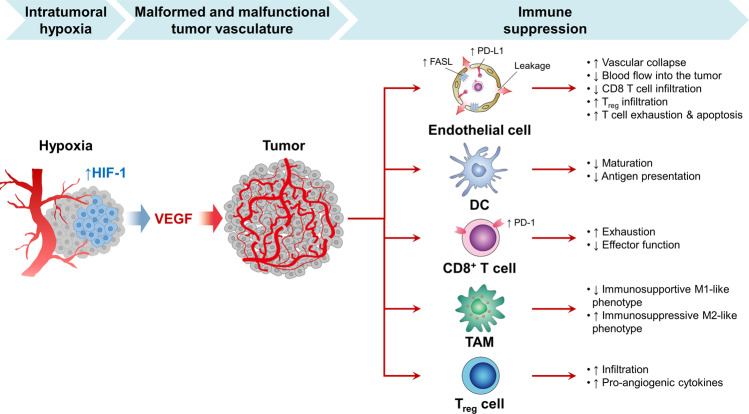
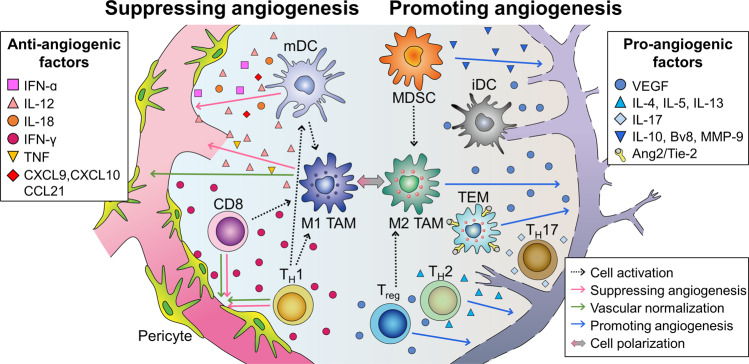
Cancer immunotherapy with immune checkpoint inhibitors (ICIs) has revolutionized the treatment of advanced cancers. However, the tumor microenvironment (TME) functions as a formidable barrier that severely impairs the efficacy of ICIs. While the crosstalk between tumor vessels and immune cells determines the nature of anti-tumor immunity, it is skewed toward a destructive cycle in growing tumors. First, the disorganized tumor vessels hinder CD8+T cell trafficking into the TME, disable effector functions, and even kill T cells. Moreover, VEGF, the key driver of angiogenesis, interferes with the maturation of dendritic cells, thereby suppressing T cell priming, and VEGF also induces TOX-mediated exhaustion of CD8+T cells. Meanwhile, a variety of innate and adaptive immune cells contribute to the malformation of tumor vessels. Protumoral M2-like macrophages as well as T H 2 and Treg cells secrete pro-angiogenic factors that accelerate uncontrolled angiogenesis and promote vascular immaturity. While CD8+T and CD4+T H 1 cells suppress angiogenesis and induce vascular maturation by secreting IFN-γ, they are unable to infiltrate the TME due to malformed tumor vessels. These findings led to preclinical studies that demonstrated that simultaneous targeting of tumor vessels and immunity is a viable strategy to normalize aberrant vascular-immune crosstalk and potentiate cancer immunotherapy. Furthermore, this combination strategy has been evidently demonstrated through recent pivotal clinical trials, granted approval from FDA, and is now being used in patients with kidney, liver, lung, or uterine cancer. Overall, combining anti-angiogenic therapy and ICI is a valid therapeutic strategy that can enhance cancer immunity and will further expand the landscape of cancer treatment.
Overview
The claims and statistics of this paper haven’t been checked yet.
Free: it reads the open-access text and checks the first 5 claims that cite a source we can check. Create a free account to check every claim.
Integrity signals
Registry
Cites
Statistics
Figures
Verification
Claims the paper makes
The claims and statistics of this paper haven’t been checked yet.
Free: it reads the open-access text and checks the first 5 claims that cite a source we can check. Create a free account to check every claim.
Self-check
Percentages, sums and reported differences re-computed from the paper’s own numbers.
The self-check needs the paper’s full text.
Citations
Cites
Cancer immunotherapy using checkpoint blockade
Ribas, A., & Wolchok, J. D. (2018) · Science · doi:10.1126/science.aar4060 · Cited by 6,791
Normalization of Tumor Vasculature: An Emerging Concept in Antiangiogenic Therapy
Jain, R. K. (2005) · Science · doi:10.1126/science.1104819 · Cited by 5,527
Macrophage Diversity Enhances Tumor Progression and Metastasis
Qian, B.-Z., & Pollard, J. W. (2010) · Cell · doi:10.1016/j.cell.2010.03.014 · Cited by 5,188
Interleukin-12 and the regulation of innate resistance and adaptive immunity
Trinchieri, G. (2003) · Nature Reviews Immunology · doi:10.1038/nri1001 · Cited by 3,927
Macrophage plasticity and interaction with lymphocyte subsets: cancer as a paradigm
Biswas, S. K., & Mantovani, A. (2010) · Nature Immunology · doi:10.1038/ni.1937 · Cited by 3,840
Atezolizumab for First-Line Treatment of Metastatic Nonsquamous NSCLC
Socinski, M. A., Jotte, R. M., Cappuzzo, F., Orlandi, F., Stroyakovskiy, D., Nogami, N., Rodríguez-Abreu, D., Moro-Sibilot, D., Thomas, C. A., Barlesi, F., et al. (2018) · New England Journal of Medicine · doi:10.1056/nejmoa1716948 · Cited by 3,733
Pembrolizumab plus axitinib versus sunitinib for advanced renal-cell carcinoma
Rini, B. I., Plimack, E. R., Stus, V., Gafanov, R., Hawkins, R., Nosov, D., Pouliot, F., Alekseev, B., Soulières, D., Melichar, B., et al. (2019) · New England Journal of Medicine · doi:10.1056/nejmoa1816714 · Cited by 3,403
Avelumab plus Axitinib versus Sunitinib for Advanced Renal-Cell Carcinoma
Motzer, R. J., Penkov, K., Haanen, J., Rini, B., Albiges, L., Campbell, M. T., Venugopal, B., Kollmannsberger, C., Negrier, S., Uemura, M., et al. (2019) · New England Journal of Medicine · doi:10.1056/nejmoa1816047 · Cited by 2,503
Macrophage plasticity and polarization in tissue repair and remodelling
Mantovani, A., Biswas, S. K., Galdiero, M. R., Sica, A., & Locati, M. (2013) · The Journal of Pathology · doi:10.1002/path.4133 · Cited by 2,384
Pàez-Ribes, M., Allen, E., Hudock, J., Takeda, T., Okuyama, H., Viñals, F., Inoue, M., Bergers, G., Hanahan, D., & Casanovas, O. (2009) · Cancer Cell · doi:10.1016/j.ccr.2009.01.027 · Cited by 2,339
Cited by
Items 401–500 of 796
Giugliano, F., Valenza, C., Tarantino, P., & Curigliano, G. (2022) · Expert Opinion on Investigational Drugs · doi:10.1080/13543784.2022.2095260 · Cited by 6
Shabbir, L., & Hassan, M. (2022) · iRASD Journal of Management · doi:10.52131/jom.2022.0401.0076 · Cited by 6
Halkola, A. S., Aittokallio, T. A., & Parvinen, K. (2022) · Journal of Theoretical Biology · doi:10.1016/j.jtbi.2022.111147 · Cited by 6
Feng, F., Sun, M., Yao, Y., Gao, C., Zhuang, J., & Sun, C. (2025) · Cancer Control · doi:10.1177/10732748251357465 · Cited by 6
“28,29 The principal clinically validated The dual role of in fl ammation in cancer — both activating antitumor immunity and fostering immunosuppressive microenvironments — has been widely recognized.”
Zhang, B., Liu, H., Shi, C., Gao, Z., Zhong, R., Gu, A., Chu, T., Wang, H., Xiong, L., Zhang, W., et al. (2024) · BMC Cancer · doi:10.1186/s12885-024-12479-0 · Cited by 6
“VEGF can suppress the maturation of dendritic cells, thus interfering with T cell priming [8].”
BackgroundShichiri, K., Tung, K. H.-Y., Takabe, K., & Bartlett, D. L. (2025) · World Journal of Oncology · doi:10.14740/wjon2571 · Cited by 6
“Angiogenesis plays a key role in tumor progression process and crosstalk between angiogenesis and immune regulation in the tumor microenvironment and has gained increasing attention over the recent years [40].”
Xu, W., Liao, X., Wang, K., & Shi, T. (2025) · Translational Lung Cancer Research · doi:10.21037/tlcr-2024-1204 · Cited by 6
“First, they have a synergistic effect with ICIs by promoting vascular normalization and altering the tumor microenvironment (32,39).”
Wahyudi, R., Seang, S., Everts, V. E., Osathanon, T., & Limjeerajarus, C. N. (2023) · Australian Endodontic Journal · doi:10.1111/aej.12736 · Cited by 6
Awasthi, N., Schwarz, M. A., Kaurich, Q., Zhang, C., Hilberg, F., & Schwarz, R. E. (2023) · Frontiers in Oncology · doi:10.3389/fonc.2023.1145999 · Cited by 5
Yang, B., Luo, J., Wang, J., Zhang, J., Zheng, Y., Wang, S., Wang, N., & Wang, Z. (2025) · Phytomedicine · doi:10.1016/j.phymed.2025.157358 · Cited by 5
Xue, L.-M., Liu, Y., Liu, W.-C., & Phang, K. C. (2025) · International Immunopharmacology · doi:10.1016/j.intimp.2025.115948 · Cited by 5
Tang, Z., Huang, T., & Yang, T.-L. (2025) · International Journal of Molecular Sciences · doi:10.3390/ijms262311596 · Cited by 5
“Vascular remodeling normalizes tumor vessels, enhancing adhesion molecule expression like inter-cellular adhesion molecule 1 (ICAM-1) and vascular cell adhesion molecule 1 (VCAM-1), facilitating immune cell entry and forming high endothelial venules for immune priming [29,107].”
Xu, Q., Deng, Z., Liu, J., Zhuo, Y., Zhu, F., Chang, L., Liu, Q., Fu, Y., Li, P., Liu, Y., et al. (2025) · Cancer Discovery · doi:10.1158/2159-8290.cd-25-1315 · Cited by 5
Targeting CD47 and Angiogenesis Demonstrates Effective Anti-Tumor Effect in Bladder Cancer
Huang, X., Wang, Q., Nan, Y., Zhang, X., Ke Cheng, X. U., Ju, D., & Ding, W. (2024) · Biomedicines · doi:10.3390/biomedicines12092152 · Cited by 5
Gan, Y., Hu, Q., Hu, F., & Wu, S. (2025) · Journal of Cancer Research and Clinical Oncology · doi:10.1007/s00432-025-06284-w · Cited by 5
“An increasing amount of clinical and preclinical evidence supports the synergistic effect of chem-immuno - therapy with anti-angiogenic therapy (Lee et al. 2020 ).”
Mechanisms, Imaging Phenotypes, and Therapeutic Advances of Neovascularization in Brain Metastases
Liu, S., Shan, B., Zhang, Y., Xu, L., Zhang, X. C., Ye, L., Diao, H., Cheng, Y., & Tang, J. (2026) · Biomedicines · doi:10.3390/biomedicines14010119 · Cited by 5
“Although appropriately timed and dosed AAT may transiently improve perfusion and enhance T-cell infiltration, the so-called “normalization window” is brief and subject to wide inter-individual variability [71,74,75].”
Li, X., Wang, W., Xu, C., & Yuan, Q. (2025) · Current Cancer Drug Targets · doi:10.2174/0115680096364469250113105648 · Cited by 5
Ibrahim, M., Illa-Bochaca, I., Fa’ak, F., Monson, K. R., Ferguson, R., Lyu, C., de Miera, E. V., Johannet, P. M., Chou, M. M., Mastroianni, J., et al. (2023) · Cancers · doi:10.3390/cancers16010018 · Cited by 5
“The combination of ICIs and VEGFR inhibitors has recently been FDA-approved and is now being used in patients with kidney, liver, lung, and endometrial cancer [37].”
BackgroundLncRNA-MM2P regulates retinal neovascularization through M2 macrophage polarization
Wang, Z., Tan, W., Li, B., Chen, J., Zhu, J., Xu, F., Tang, F., Yoshida, S., & Zhou, Y. (2024) · Experimental Eye Research · doi:10.1016/j.exer.2024.110072 · Cited by 5
Huang, X., Kuerban, K., Fan, J. P., Pan, D., Chen, H., Liu, J., Wang, S., Ju, D., Zhu, Y. Z., Liu, J., et al. (2025) · Asian Journal of Pharmaceutical Sciences · doi:10.1016/j.ajps.2025.101020 · Cited by 5
“Such results align with previous findings that conditional knockout of VEGFR2 in CD8 + T cells can reactivate tumor-specific CD8 + T cells [ 29 ].”
Harnessing Oncolytic Viruses for Targeted Therapy in Triple-Negative Breast Cancer
Tang, S., Yong, L., Cui, Y., Li, H., Bischof, E. Y., & Cai, F. (2025) · International Journal of Medical Sciences · doi:10.7150/ijms.105683 · Cited by 5
“Combining ICIs and OVs can synergistically enhance immune responses and holds great therapeutic potential [137, 172, 173].”
Masuda, C., Onishi, S., Yorozu, K., Kurasawa, M., Morinaga, M., Wakita, D., & Sugimoto, M. (2024) · Clinical & Experimental Metastasis · doi:10.1007/s10585-024-10309-y · Cited by 5
“Moreover, many clinical trials are currently underway, making it one of the most promising combinations in cancer immunotherapy [17, 18].”
Zhao, J., Liu, J., Fang, M., Luo, C., Gu, Z.-B., & Huang, L. (2022) · BMC Neurology · doi:10.1186/s12883-022-02919-4 · Cited by 5
“Combining anti–PD-1 and anti-VEGF therapies has shown synergy and positive outcomes in phases I to III studies and appear to be particularly effective in the setting of high levels of VEGF [11].”
BackgroundHoff, C. O., Heeke, S., Mitani, Y., de Sousa, L. G., Siqueira, J. M., Li, K., Bonini, F., Bell, D., Marques-Piubelli, M. L., Lin, S., et al. (2026) · Clinical Cancer Research · doi:10.1158/1078-0432.ccr-25-4599 · Cited by 4
Liu, P., Li, N., Jiwu, G. U. O., Zhao, G. T., Wang, J., Mou, Z., & Mao, J. (2026) · Frontiers in Immunology · doi:10.3389/fimmu.2026.1716934 · Cited by 4
“Anti-VEGF/VEGFR therapy may “ normalize ” tumor vasculature, reduce the in fi ltration of immunosuppressive cells, and enhance effector T-cell in fi ltration and activity, thereby reshaping the TME to favor immune activation (239).”
[Advances of Immunotherapy Resistance and Coping Strategies in Non-small Cell Lung Cancer].
Jing, Y., Zeng, H., Cheng, R., Tian, P., & Li, Y. (2023) · PubMed Central · doi:10.3779/j.issn.1009-3419.2023.102.03 · Cited by 4
Personalizing Curative Therapy in Stage II to III Triple-Negative Breast Cancer
LeVee, A. A., Hennessy, M. A., Idossa, D. W., Leon-Ferre, R. A., Nanda, R., & McArthur, H. L. (2026) · American Society of Clinical Oncology Educational Book · doi:10.1200/edbk-26-520834 · Cited by 4
Tang, Y., Ding, Y., Wang, L., Yang, Y., Han, Y., Zhou, P., Qu, H., Deng, K., & Xia, J. (2026) · Cancer Medicine · doi:10.1002/cam4.71769 · Cited by 4
“Angiogenic inhibitors serve to normalize the tumor blood vessels, thereby reducing osmolality, alleviating local hypoxia, restoring the penetration and effective delivery of drugs into tumor cells [29], and furthermore, improving the status of immune cells and mitigating immunosuppression.”
Resistance to antiangiogenic treatments: A review
Koltai, T., Reshkin, S. J., & Cardone, R. A. (2022) · Elsevier eBooks · doi:10.1016/b978-0-323-90190-1.00014-7 · Cited by 4
Gao, G., Sun, M., Yang, Z., Li, J., Ji, H., & Yu, G. (2025) · Technology in Cancer Research & Treatment · doi:10.1177/15330338251329248 · Cited by 4
“Combining anti-angiogenic therapy with IT has shown synergistic effects across various cancers, 13 as vascular normalization can enhance immune cell in fi ltration and alter the tumor microenvironment.”
Guo, F., Wang, D., Zhang, L., Fang, Y., Shi, J., Wang, G., Yu, M., Feng, Y., Wang, L., Feng, Y., et al. (2025) · BMC Cancer · doi:10.1186/s12885-025-14426-z · Cited by 4
Synergistic Combinations for Improved Therapeutic Outcomes in Triple Negative Breast Cancer
Jha, A., Venkatesh, S. K. S., Singh, A., & Lakkaniga, N. R. (2026) · Cell Biology International · doi:10.1002/cbin.70157 · Cited by 4
“Consequently, immune‐checkpoint blockade (ICB) alone struggles because immune cells can't effectively reach the tumour, whereas anti‐angiogenic therapy alone leaves effector cells functionally inert (W. S. Lee et al. 2020; Yi et al. 2019).”
Intravesical instillation-based mTOR-STAT3 dual targeting for bladder cancer treatment
Lee, D. H., Yoo, J. K., Um, K. H., Ha, W., Lee, S. M., Park, J., Kye, M. J., Suh, J., & Choi, J. W. (2024) · Journal of Experimental & Clinical Cancer Research · doi:10.1186/s13046-024-03088-7 · Cited by 4
“The inhibition of VEGF boosted the efficacy of immune checkpoint inhibitors [33], whereas GM-CSF is a key regulator responsible for T-cell activation.”
Song, S., Ge, W., Qi, X., Che, X., Wang, Q., & Wu, G. (2025) · BMC Medical Imaging · doi:10.1186/s12880-025-01749-3 · Cited by 4
Reversal of Endothelial Cell Anergy by T Cell-Engaging Bispecific Antibodies
Gonçalves, M., Warwas, K. M., Meyer, M., Schwartz‐Albiez, R., Bulbuc, N., Zörnig, I., Jäger, D., & Momburg, F. (2024) · Cancers · doi:10.3390/cancers16244251 · Cited by 4
A novel STING agonist with systemic and durable anti‐tumour activity
Wang, X., Shen, A., Zhang, Y., Chen, X., Ding, J., Zhang, A., Geng, M., Ding, C., & Xie, Z. (2023) · Clinical and Translational Discovery · doi:10.1002/ctd2.231 · Cited by 4
Shu, D. H., & Yarchoan, M. M. (2025) · Immunity · doi:10.1016/j.immuni.2025.03.009 · Cited by 4
Huang, Y., Wu, S., Lee, C. T., Chung, B.-S., Lin, P., Chan, R., Chen, P.-C., Lin, B., Shen, M.-R., Chen, S., et al. (2026) · Cancer Immunology Immunotherapy · doi:10.1007/s00262-026-04344-9 · Cited by 4
“Angiogenesis is a hallmark of CRC progression [42] and has been increasingly linked to immune suppression by promoting immune exclusion and impaired effector cell infiltration in the TME [32, 42].”
Liu, W., Xu, W., Liu, W., Liang, R., Tang, S., Luo, X., Liu, C., Liao, Q., Sun, H., Wang, Z., et al. (2026) · Frontiers in Immunology · doi:10.3389/fimmu.2026.1738966 · Cited by 4
“TME, which comprises both tumor vasculature and matrix components, exerts a substantial impact on the induction and ef fi cacy of ICD (71, 72).”
Zhang, M., Zhou, G., Xu, Y., Wei, B., Liu, Q., Zhang, G., & Chang, R. (2025) · Scientific Reports · doi:10.1038/s41598-025-91401-5 · Cited by 4
“Additionally, VEGFA negatively affects the maturation of dendritic cells and their antigen-presenting capacity, which limits the activation of tumor-specific T cells, which limits the activation of tumor-specific T cells 57,66,67 .”
Shao, X., Peng, T., Yang, C., Zhu, J., Wang, R., Yang, L., Hou, J., Wang, H., & Huang, Y. (2025) · ACS Applied Materials & Interfaces · doi:10.1021/acsami.5c07923 · Cited by 4
Zhang, J., Zou, Z., Tan, J., Shi, J., Yang, H., Wang, H., Zhou, J., & Xue, J. (2023) · Journal of Cancer · doi:10.7150/jca.83719 · Cited by 4
“Studies [34-37] have found that antiangiogenic drugs can block immunosuppressive signals by reversing vascular endothelial growth factor, promoting lymphocyte infiltration and migration and other pathways, and can also enhance immune efficacy by normalizing tumor blood vessels.”
BackgroundSelf-citationUpmanyu, K., Upadhyay, S., & Gabr, M. T. (2026) · Medicinal Research Reviews · doi:10.1002/med.70076 · Cited by 4
“Combination with VEGF inhibitors such as bevacizumab could therefore achieve more complete vascular normalization, improving perfusion and immune infiltration [126].”
Eichhorn, J. S., & Petrik, J. (2024) · Pathology - Research and Practice · doi:10.1016/j.prp.2024.155370 · Cited by 4
Multi-Target Drug Strategies in the Treatment of Diabetic Retinopathy
Julius, A., Malakondaiah, S., Subbarayalu, R., Renuka, R. R., & Pothireddy, R. B. (2025) · SN Comprehensive Clinical Medicine · doi:10.1007/s42399-025-01936-x · Cited by 4
“Capillary loops and secondary vascular sprouts are formed as a result of endothelial cell proliferation and migration [58].”
Dong, B., Chen, L., Pang, Q., Jiang, O., Ge, H., Cheng, Y., Zhou, R., Meng, X., Li, J., Zhu, X., et al. (2024) · Translational Lung Cancer Research · doi:10.21037/tlcr-24-362 · Cited by 4
“Anti-angiogenic therapy can rapidly normalize the blood vessels, which in turn stabilizes endothelial cells, reduces vascular permeability, increases drug and oxygen delivery, and promotes the infiltration of effector T cells into tumors (8,9).”
Cao, Y.-Z., Pan, J.-Y., Zheng, G.-L., An, C., & Zuo, M. (2024) · Cancer Immunology Immunotherapy · doi:10.1007/s00262-024-03872-6 · Cited by 4
Shibutani, T., Goto, R., Miyazaki, I., Hashimoto, A., Suzuki, T., Ishida, K., Haruma, T., Osada, T., Harada, T., Fujita, H., et al. (2023) · Scientific Reports · doi:10.1038/s41598-023-35985-w · Cited by 4
“The benefits of the combination treatment of anti-angiogenesis inhibitors such as bevacizumab, axitinib, and lenvatinib and anti-PD-1/PD-L1 antibodies have been reported in pre-clinical and even in clinical settings, and some combination therapies have already been approved as cancer treatments 19 .”
Baker, J. H. E., Moosvi, F., Kyle, A. H., Banáth, J. P., Saatchi, K., Häfeli, U. O., Reinsberg, S. A., & Minchinton, A. I. (2023) · Radiotherapy and Oncology · doi:10.1016/j.radonc.2023.109795 · Cited by 4
Brave new world—new and emerging treatments for gastric cancer
Lynch, E., Duffy, A. G., & Kelly, R. J. (2023) · Chinese Clinical Oncology · doi:10.21037/cco-23-13 · Cited by 4
Duan, X., Wu, D., Zhou, C., Tian, Y., Duan, W., Chen, B., Shen, J., Xu, G., Bai, Y., & Mao, X. (2025) · Nature Communications · doi:10.1038/s41467-025-66342-2 · Cited by 4
“…phase III IMbrave050 trial, in which atezolizumab plus bevacizumab effectively delayed early recurrence in high-risk HCC patients (tumor diameter >5cm, >3 tumors, microvascular invasion, Vp1/2 portal vein tumor thrombus [PVTT], or tumor differentiation of grade 3 or 4) following resection 7,8 .”
Guan, Z., Han, L., Chen, B., Ma, Y., Ni, Q., Wang, Z., Yang, J., & Liu, Z. (2026) · Oncology Letters · doi:10.3892/ol.2026.15461 · Cited by 4
“VEGF impairs DC maturation through VEGFR‑2 and reduces antigen presentation, further downregulating endothelial adhesion molecules, restricting the infiltration of CD8 + T cells and NK cells into the tumor parenchyma (63,64).”
Hwang, J.-E., Park, J., Kim, H., Li, S., & Im, H. (2026) · Journal of Hematology & Oncology · doi:10.1186/s13045-026-01811-9 · Cited by 4
Liu, X., Yin, X., Zhuang, L., Wen, J., Wei, Z., Cui, W., Yu, M., Zhao, K., Liu, L., Kong, L., et al. (2025) · BMC Cancer · doi:10.1186/s12885-025-13885-8 · Cited by 4
“This inhibition facilitates immune cell infiltration and fosters an immune-supportive TME, thereby enhancing the efficacy of immunotherapy through a synergistic mechanism [28, 30, 31].”
Kim, H. S., Seol, J. H., Hwang, H. H., & Lee, D. Y. (2023) · Biomaterials Research · doi:10.1186/s40824-023-00420-8 · Cited by 4
Jiang, F., Chen, Y., Tomonobu, N., Kinoshita, R., Komalasari, N. L. G. Y., Kasano-Camones, C. I., Ninomiya, K., Murata, H., Yamamoto, K., Gohara, Y., et al. (2024) · Frontiers in Oncology · doi:10.3389/fonc.2024.1371307 · Cited by 4
“In all these cases, the cancer cells actively leverage their interstitial conditions (1, 2).”
BackgroundLiu, W.-W., Xie, X.-S., & Yang, X.-J. (2026) · Journal of Translational Medicine · doi:10.1186/s12967-026-08278-9 · Cited by 3
“CD8 ⁺ T cells and NK cells can produce IFN-γ, which has been reported to suppress endothelial cell proliferation and VEGF-driven signaling, thereby potentially limiting tumor vascularization and growth [74, 75].”
Rotundo, M. S., Bagnardi, V., Rotundo, M., Comandè, M., & Zampino, M. G. (2022) · Oncology Letters · doi:10.3892/ol.2022.13254 · Cited by 3
Bie, L., Wei, C., Luo, S., Dong, S., Gu, Z., Ma, Y., Xia, Q., Zhang, H., Li, J., Deng, W., et al. (2025) · Cell Reports Medicine · doi:10.1016/j.xcrm.2025.102145 · Cited by 3
“…profiles identified in this study were consistent with those of individual treatments and other immunotherapies in G/GEJ cancers, 3–5, 8 , 19– 22 with no unexpected safety In summary, benmelstobart plus anlotinib and chemotherapy demonstrated favorable efficacy and safety, and the PBIC…”
Cui, S., Zhao, K., Wang, N., Meng, Y. G., Zhao, C., Liu, H., Wen, X., & Kong, F. (2025) · Current Treatment Options in Oncology · doi:10.1007/s11864-025-01353-1 · Cited by 3
Cellular and Molecular Mechanisms of Tumor Promotion
Bode, A. M., & Zhang, T. (2024) · Elsevier eBooks · doi:10.1016/b978-0-323-95488-4.00059-0 · Cited by 3
Wang, Y., MaoYan, T., Peng, C., Yang, J., Liu, F., Ding, D., Guo, Y., Yu, Y., & Han, F. (2026) · International Immunopharmacology · doi:10.1016/j.intimp.2026.116821 · Cited by 3
Gang, X., Sun, Y., Hao, J., Zhao, S., Wang, Y., Yang, X., Li, H., & Zhao, M. (2026) · Lung Cancer · doi:10.1016/j.lungcan.2026.108930 · Cited by 3
Feng, Y., Wang, Y., Li, X., Wang, Y., & Zhang, M. (2026) · Frontiers in Immunology · doi:10.3389/fimmu.2026.1810065 · Cited by 3
“Thus, a VEGF-rich TME often exhibits a paucity of functional CD8 + T cells but an abundance of Tregs and M2 TAMs, contributing to ICI resistance (253).”
Carry-over effect of immunotherapy in patients with advanced hepatocellular carcinoma
Chuang, C.-H., Chen, C.-T., Hsu, C., & Shao, Y. (2025) · Cancer Immunology Immunotherapy · doi:10.1007/s00262-025-04052-w · Cited by 3
Wang, H., Xia, J., Yü, A., Cao, M., Yang, Z., Qin, X., Liu, W., Han, Z., & Jiang, G. (2025) · Anti-Cancer Agents in Medicinal Chemistry · doi:10.2174/0118715206350978241105080452 · Cited by 3
ERBB2 I655V mutation correlates with efficacy of immunotherapy in gallbladder cancer
Gao, Q., You, Y.-N., Lian, S., Pan, C., Zhang, Z.-L., & Li, K.-S. (2026) · World Journal of Surgical Oncology · doi:10.1186/s12957-026-04227-4 · Cited by 3
“…role of VEGF signaling in sustaining abnormal tumor vasculature and fostering an immunosuppressive tumor microenvironment, these observations support a mechanistic rationale for the combination of antiangiogenic therapy with PD-1 inhibition as a therapeutically synergistic strategy [31].”
Wei, C., Tang, C., Zhang, Y., Tang, Y., Liu, D., Tan, Y., & Fu, Y. (2025) · BMC Cardiovascular Disorders · doi:10.1186/s12872-025-05412-1 · Cited by 3
“Furthermore, preclinical and clinical evidence indicates that antiangiogenic agents may augment immuno-therapeutic efficacy through modulation of the tumor microenvironment [15].”
Immunotherapy resistance and strategies in malignant pleural mesothelioma
Xia, W., Li, S., Zeng, Q., Zhang, Y., 赵娟芝, Tan, X., Ju, S., Zou, W., Chen, C., Li, C., et al. (2026) · Cancer Drug Resistance · doi:10.20517/cdr.2025.215 · Cited by 3
Zhang, B., Liu, Q., Li, L., Ye, Y., Guo, X., Xu, W., Chen, L., Mo, X., Nian, S., & Yuan, Q. (2025) · Cancer Immunology Immunotherapy · doi:10.1007/s00262-024-03893-1 · Cited by 3
Loizidis, S., Vogazianos, P., Kordatou, Z., Fotopoulos, G., Orphanos, G. S., Kyriakou, F., & Charalambous, H. (2025) · Current Oncology · doi:10.3390/curroncol32110612 · Cited by 3
“…angiogenesis can normalize the abnormal tumor vasculature, which leads to an increase in the infiltration of immune effector cells into tumors and change the intrinsically immunosuppressive TME to an immune-supportive one, leading to increased efficacy of ICIs when used in combination [28,37].”
Ma, T., Liu, L., Zeng, Y., Ding, K., Liu, W., Xiong, X., & Mao, Z. (2025) · Inorganic Chemistry Frontiers · doi:10.1039/d4qi02098g · Cited by 3
The molecular pathogenesis of placenta accreta spectrum disorder and its clinical applications
Zhao, M., Sun, L., & Wu, D. (2025) · Archives of Gynecology and Obstetrics · doi:10.1007/s00404-025-08221-1 · Cited by 3
“…VEGF facilitates the aggregation and activation of uterine natural killer (NK) cells, which can secrete growth factors and cytokines, such as interferon-gamma (IFN-γ) and interleukin-8 (IL-8), contributing to the maturation and functionality of blood vessels to support the developing placenta [78].”
Future Directions for Receptor Tyrosine Kinases in Cancer Treatment
Sharma, A., Chakraborty, D., & Yadav, M. (2025) · Cancer drug discovery and develogment/Cancer drug discovery and development · doi:10.1007/978-3-031-93894-8_12 · Cited by 3
Roles of minimally invasive techniques in the management of epithelial ovarian cancer (Review)
Yang, R., Gao, J., Cheng, Y., Lu, C., & Li, J. (2025) · Oncology Letters · doi:10.3892/ol.2025.15418 · Cited by 3
“For anti‑angiogenic + ICI: VEGF inhibition is often deliv‑ ered prior to checkpoint blockade to normalize abnormal tumor vasculature and improve effector T‑cell infiltration, followed by PD‑1/PD‑L1 antibodies to sustain the immune response (37,84,85).”
Mechanism-directed combinational immunotherapies in liver cancer hold promise
Marshall, G., & Cao, J. P. (2023) · Cellular and Molecular Immunology · doi:10.1038/s41423-023-01068-z · Cited by 3
“VEGF causes tumor vasculature abnormalities and directly affects immune cells [1].”
Li, M., Gao, J., Lu, F., Gong, C., Zhang, J., Wang, L., & Xia, Y. (2025) · Oncology Letters · doi:10.3892/ol.2025.15180 · Cited by 3
“…multiple dimen‑ sions include the following: First, AAT serves a central role by targeting VEGF/VEGFR and other pathways to reduce tumour vessel density, inhibit abnormal angiogenesis, alleviate hypoxia, improve vascular permeability and promote T‑cell penetration and drug delivery (89,151).”
Sitravatinib and Acquired Immune Checkpoint Inhibitor Resistance: A Gem for the Future?
Minchom, A. R., & Popat, S. (2023) · Journal of Thoracic Oncology · doi:10.1016/j.jtho.2023.03.023 · Cited by 3
Tan, A. C., Kobayashi, K., Saw, S. P. L., Tan, D. S. W., & Lim, W. (2022) · Expert Review of Anticancer Therapy · doi:10.1080/14737140.2023.2152795 · Cited by 3
“The synergistic action of chemoimmunotherapy with anti-angiogenic therapy may be of particular importance, supported by a growing body of clinical and pre-clinical evidence [2].”
BackgroundChoi, D.-H., Lee, J., Lim, H. Y., Kang, W. K., Jang, J. Y., Jeon, Y., Jeong, S. Y., Jung, Y. J., & Kim, S. T. (2023) · Journal of Gastrointestinal Oncology · doi:10.21037/jgo-23-418 · Cited by 3
“Thus, VEGFR inhibitors improve immunosuppression in the TME (14,17) and this theoretical concept allowed us to predict that a combination of an anti-angiogenic agent and an ICI would be effective.”
Huang, L., Qin, Y., Zhao, F., Zhou, S., & Shi, Y. (2021) · PubMed Central · doi:10.3779/j.issn.1009-3419.2021.102.25 · Cited by 3
Li, Q., Guo, J., Wang, F., Yu, H., Wei, Y. G., Zheng, Y., 黄子星, & Ma, J. (2025) · Journal for ImmunoTherapy of Cancer · doi:10.1136/jitc-2025-012416 · Cited by 3
Co-inhibition of PGF and VEGFA enhances the effectiveness of immunotherapy in bladder cancer
Yang, X., Zheng, H., Huang, J., Liu, Y., Li, Y., Zhang, B., Sun, C., Li, Y., Thiery, J. P., & Wu, S. (2024) · International Journal of Medical Sciences · doi:10.7150/ijms.100957 · Cited by 3
Chen, Y., Tang, Y.-X., Zeng, D.-T., Wen, J., Zhan, Y.-T., Li, D., He, R., Huang, Z., Chen, Y., Wei, Q., et al. (2025) · Cancer Control · doi:10.1177/10732748251330059 · Cited by 3
“51 Several studies have shown that the combination of anti-VEGF therapy with immune checkpoint inhibitor therapy is a promising therapeutic approach.”
Xu, Z., Xu, D., You, Z., & Tian, W. (2023) · Combinatorial Chemistry & High Throughput Screening · doi:10.2174/1386207326666230607125353 · Cited by 3
Lotfi, E., & Golab, F. (2026) · Cancer Investigation · doi:10.1080/07357907.2026.2725033 · Cited by 2
Chen, W., Chen, B., Hu, C., Wei, Q., Zhang, L., & Fu, W. (2026) · Frontiers in Immunology · doi:10.3389/fimmu.2026.1693251 · Cited by 2
“…the vascular-normalization hypothesis, appropriately dosed and timed anti-VEGF therapy can improve perfusion and permeability, reduce interstitial pressure, upregulate adhesion molecules, and facilitate effector T-cell in fi ltration, providing a biological rationale for ICI-based combinations (5).”
Peng, T., Weng, Y., Wu, T., Wu, C., Hsu, C.-L., & Hsu, C.-S. (2025) · Cancers · doi:10.3390/cancers17132110 · Cited by 2
“Several ongoing trials that test the combination of TACE with immune checkpoint inhibitors that can stimulate antitumor immune responses, rather than only targeting angiogenesis, and overcome some of the limitations mentioned above [39,40] may provide helpful information in the future.”
Zhang, Q., Wang, W., Yu, H., Wang, F., Chen, X., Liang, Z., & Lu, Y. (2026) · Medical Review · doi:10.1515/mr-2025-0077 · Cited by 2
Wang, N., Wang, C., Wang, X., Meng, Y., Cui, S., Zhao, K., Jia, Y., & Kong, F. (2026) · Biochimica et Biophysica Acta (BBA) - Reviews on Cancer · doi:10.1016/j.bbcan.2026.189587 · Cited by 2
饶应良, Zhang, J., Gu, X., Han, J., & Ye, Z. (2026) · Frontiers in Immunology · doi:10.3389/fimmu.2026.1805039 · Cited by 2
“When combined with anti-angiogenic TKIs, they produce complementary effects: TKIs normalize tumor vasculature, reduce immunosuppressive myeloid populations, and enhance T-cell in fi ltration, thereby boosting ICI activity (6, 7).”
Mason, N. J., & DOW, S. W. (2023) · CABI eBooks · doi:10.1079/9781789245820.0008 · Cited by 2
Keovilay, J. A., Hoskins, J. W., Kinet, J., Lines, T. C., & Kennedy, D. R. (2025) · The FASEB Journal · doi:10.1096/fj.202502774r · Cited by 2
The potential of lenvatinib in breast cancer therapy
Shang, Y., Liu, Y., & Wang, W. (2024) · Medical Oncology · doi:10.1007/s12032-024-02477-4 · Cited by 2
Pavone, G., Spata, A., Puglisi, M., Ricco, V., & Colombo, I. (2026) · Exploration of Targeted Anti-tumor Therapy · doi:10.37349/etat.2026.1002381 · Cited by 2
Shin, K. (2025) · Journal of Korean Medical Association · doi:10.5124/jkma.25.0111 · Cited by 2
Wang, Y., Xu, H., Sa, Q., Zhou, Y., Cheng, H., Gao, R., Xu, B., & Wang, J. (2025) · Therapeutic Advances in Medical Oncology · doi:10.1177/17588359251378934 · Cited by 2
“31 However, only one related study has evaluated the combination of VDAs and immunotherapy, and the absolute gains for PFS and OS were limited.”
Tanzhu, G., Chen, L., Ning, J.-Y., Xiao, G., Wen, S., Wang, C., Wen, H., Zhang, K.-Q., Yang, J., Jia, M.-Y., et al. (2026) · Military Medical Research · doi:10.1016/j.mmr.2026.100047 · Cited by 2
Marchesi, S., Sciortino, C., Etessami, J. D., Damonte, C., Villa, C., Bottelli, A., Alessandrini, S., Chiaramonte, A., Sabella, G., Pietrantonio, F., et al. (2025) · Therapeutic Advances in Medical Oncology · doi:10.1177/17588359251389741 · Cited by 2
The Evolving Role of Immunotherapy for Gastroesophageal Malignancies
Emiloju, O. E., Miao, R., & Alese, O. B. (2025) · Annals of Surgical Oncology · doi:10.1245/s10434-025-17386-7 · Cited by 2
“103,104 Combination Therapies Against Other Targets Early-phase studies utilizing various combination therapies against novel targets are showing promising activity in advanced GEC.”
Metadata
- Authors
- Lee, W. S., Yang, H., Chon, H. J., & Kim, C.
- Affiliations
- CHA University Bundang Medical Center (KR)
- Corresponding author
- Chon, Hong Jae
- Kim, Chan
- Venue
- Experimental & Molecular Medicine
- Published
- 2020-09
- Volume
- 52
- Issue
- 9
- Pages
- 1475-1485
- ISSN
- 1226-3613 (ISSN-L)
- 2092-6413
- PMC
- PMC8080646
- OpenAlex
- W3084409519
- Cited by
- 796
- References
- 99
- Citations by year
- 2026: 154 · 2025: 187 · 2024: 128 · 2023: 137 · 2022: 123 · 2021: 63 · 2020: 4
- FWCI
- 8.94
- Type
- journal article
- Language
- en
- Open access
- gold
- doi.org
- Licence
- cc-by
- creativecommons.org/licenses/by/4.0 (tdm)
- creativecommons.org/licenses/by/4.0 (vor, 10 d)
- Locations
- Experimental & Molecular Medicine (publishedVersion, cc-by)
- PubMed Central (publishedVersion, cc-by)
- PubMed (publishedVersion)
- DOAJ (DOAJ: Directory of Open Access Journals) (submittedVersion)
- Funders
- National Research Foundation
- National Research Foundation of Korea (NRF-2020R1C1C1010722, 2020R1C1C1010722, NRF-2020R1A2C2004530, 2020R1A2C2004530)
- Ministry of Science and ICT, South Korea
- Topics
- Health Sciences › Medicine › Oncology › Cancer Immunotherapy and Biomarkers
- Life Sciences › Biochemistry, Genetics and Molecular Biology › Molecular Biology › Angiogenesis and VEGF in Cancer
- Life Sciences › Immunology and Microbiology › Immunology › Immunotherapy and Immune Responses
- Keywords
- anti-angiogenic therapy, immune checkpoint inhibitors, tumor microenvironment, tumor angiogenesis, vascular endothelial growth factor, CD8+ T cell exhaustion, dendritic cell maturation, M2 macrophages, regulatory T cells, Th2 cells, vascular normalization, cancer immunotherapy, combination therapy, interferon-gamma
- MeSH terms
- Immune Checkpoint Inhibitors, Animals, Antineoplastic Combined Chemotherapy Protocols, Cell Communication, Humans, Neoplasms, Neovascularization, Pathologic, Signal Transduction, Treatment Outcome, Angiogenesis Inhibitors, Immunomodulation, Molecular Targeted Therapy, Tumor Microenvironment
About these checks
Registry, retraction, Cites and statistics results are computed, not judged, with one exception: a printed reference that no index lists is read once by a model before it counts as a citation error. Claims are extracted by a model and kept only when their quote appears verbatim in the text; each cited source is then checked, with a model’s help, for whether it says what the claim relies on. Those verdicts can be wrong — read the claim’s quote and the cited source before relying on one.
Statistics and arithmetic are recomputed, not judged.
Confidence bands are shown only for fields calibrated on our annotated test set. None is calibrated yet, so no band is shown.
What counts as a claim ›How we measure confidence ›How we check this ›
Are you an author, or do you see a problem with this page? Request a review
Data sources
Bibliographic data: Semantic Scholar, OpenAlex, Crossref.
Contains information from the Semantic Scholar Academic Graph Datasets, made available under the ODC Attribution License (ODC-BY 1.0).
Semantic Scholar’s data is described in: Kinney, R., et al. (2023). The Semantic Scholar Open Data Platform. arXiv:2301.10140.
