

Combination of anti-angiogenic therapy and immune checkpoint blockade normalizes vascular-immune crosstalk to potentiate cancer immunity
Open accessThe DOI matches its Crossref record; 100 of the 100 references it cites were found in a registry or an index.
Abstract
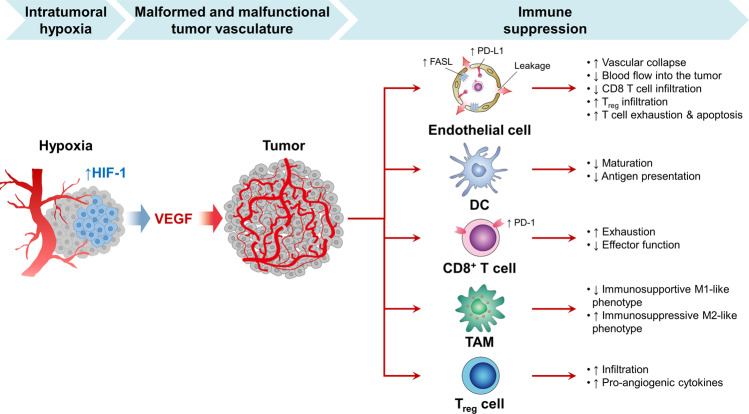
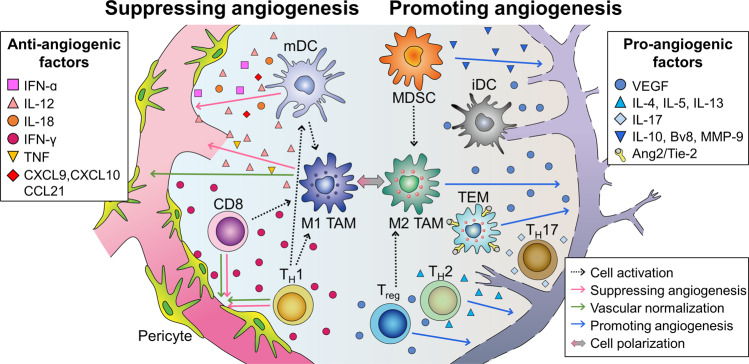
Cancer immunotherapy with immune checkpoint inhibitors (ICIs) has revolutionized the treatment of advanced cancers. However, the tumor microenvironment (TME) functions as a formidable barrier that severely impairs the efficacy of ICIs. While the crosstalk between tumor vessels and immune cells determines the nature of anti-tumor immunity, it is skewed toward a destructive cycle in growing tumors. First, the disorganized tumor vessels hinder CD8+T cell trafficking into the TME, disable effector functions, and even kill T cells. Moreover, VEGF, the key driver of angiogenesis, interferes with the maturation of dendritic cells, thereby suppressing T cell priming, and VEGF also induces TOX-mediated exhaustion of CD8+T cells. Meanwhile, a variety of innate and adaptive immune cells contribute to the malformation of tumor vessels. Protumoral M2-like macrophages as well as T H 2 and Treg cells secrete pro-angiogenic factors that accelerate uncontrolled angiogenesis and promote vascular immaturity. While CD8+T and CD4+T H 1 cells suppress angiogenesis and induce vascular maturation by secreting IFN-γ, they are unable to infiltrate the TME due to malformed tumor vessels. These findings led to preclinical studies that demonstrated that simultaneous targeting of tumor vessels and immunity is a viable strategy to normalize aberrant vascular-immune crosstalk and potentiate cancer immunotherapy. Furthermore, this combination strategy has been evidently demonstrated through recent pivotal clinical trials, granted approval from FDA, and is now being used in patients with kidney, liver, lung, or uterine cancer. Overall, combining anti-angiogenic therapy and ICI is a valid therapeutic strategy that can enhance cancer immunity and will further expand the landscape of cancer treatment.
Overview
The claims and statistics of this paper haven’t been checked yet.
Free: it reads the open-access text and checks the first 5 claims that cite a source we can check. Create a free account to check every claim.
Integrity signals
Registry
Cites
Statistics
Figures
Verification
Claims the paper makes
The claims and statistics of this paper haven’t been checked yet.
Free: it reads the open-access text and checks the first 5 claims that cite a source we can check. Create a free account to check every claim.
Self-check
Percentages, sums and reported differences re-computed from the paper’s own numbers.
The self-check needs the paper’s full text.
Citations
Cites
Cancer immunotherapy using checkpoint blockade
Ribas, A., & Wolchok, J. D. (2018) · Science · doi:10.1126/science.aar4060 · Cited by 6,791
Normalization of Tumor Vasculature: An Emerging Concept in Antiangiogenic Therapy
Jain, R. K. (2005) · Science · doi:10.1126/science.1104819 · Cited by 5,527
Macrophage Diversity Enhances Tumor Progression and Metastasis
Qian, B.-Z., & Pollard, J. W. (2010) · Cell · doi:10.1016/j.cell.2010.03.014 · Cited by 5,188
Interleukin-12 and the regulation of innate resistance and adaptive immunity
Trinchieri, G. (2003) · Nature Reviews Immunology · doi:10.1038/nri1001 · Cited by 3,927
Macrophage plasticity and interaction with lymphocyte subsets: cancer as a paradigm
Biswas, S. K., & Mantovani, A. (2010) · Nature Immunology · doi:10.1038/ni.1937 · Cited by 3,840
Atezolizumab for First-Line Treatment of Metastatic Nonsquamous NSCLC
Socinski, M. A., Jotte, R. M., Cappuzzo, F., Orlandi, F., Stroyakovskiy, D., Nogami, N., Rodríguez-Abreu, D., Moro-Sibilot, D., Thomas, C. A., Barlesi, F., et al. (2018) · New England Journal of Medicine · doi:10.1056/nejmoa1716948 · Cited by 3,733
Pembrolizumab plus axitinib versus sunitinib for advanced renal-cell carcinoma
Rini, B. I., Plimack, E. R., Stus, V., Gafanov, R., Hawkins, R., Nosov, D., Pouliot, F., Alekseev, B., Soulières, D., Melichar, B., et al. (2019) · New England Journal of Medicine · doi:10.1056/nejmoa1816714 · Cited by 3,403
Avelumab plus Axitinib versus Sunitinib for Advanced Renal-Cell Carcinoma
Motzer, R. J., Penkov, K., Haanen, J., Rini, B., Albiges, L., Campbell, M. T., Venugopal, B., Kollmannsberger, C., Negrier, S., Uemura, M., et al. (2019) · New England Journal of Medicine · doi:10.1056/nejmoa1816047 · Cited by 2,503
Macrophage plasticity and polarization in tissue repair and remodelling
Mantovani, A., Biswas, S. K., Galdiero, M. R., Sica, A., & Locati, M. (2013) · The Journal of Pathology · doi:10.1002/path.4133 · Cited by 2,384
Pàez-Ribes, M., Allen, E., Hudock, J., Takeda, T., Okuyama, H., Viñals, F., Inoue, M., Bergers, G., Hanahan, D., & Casanovas, O. (2009) · Cancer Cell · doi:10.1016/j.ccr.2009.01.027 · Cited by 2,339
Cited by
Items 701–796 of 796
History Can Teach Us Something: Angiogenesis Inhibition Revisited
Eberhardt, W., & Sebastian, M. (2024) · Journal of Thoracic Oncology · doi:10.1016/j.jtho.2024.02.008
Xu, Y., Gong, X., He, H., Deng, X., Zhang, Z., Wen, Q., & Li, D. (2025) · Frontiers in Immunology · doi:10.3389/fimmu.2025.1590848
Götz, L. S., Deo, A., Scherer, S. D., D’Antonio, L., Weber, H. T., Sedlmeier, G., Flores, L. P. T., Kaiser, U., Far, E., Raviv, Z., et al. (2026) · bioRxiv (Cold Spring Harbor Laboratory) · doi:10.64898/2026.08.05.742008
“…of angiogenesis suppression with immune checkpoint inhibitors has proven more effective than immune checkpoint inhibitors alone or current standard of care therapies in clinical trials, including for hepatocellular carcinoma, and represents an area of rapidly growing clinical interest [45-46].”
Choudhary, N., Faiyazuddin, M., Kamal, R., Kumar, D., & Webster, T. J. (2026) · Cancer Letters · doi:10.1016/j.canlet.2026.218780
Zhang, P., Wang, X., Li, R., Li, X., Cheng, K., & Cao, D. (2024) · Frontiers in Pharmacology · doi:10.3389/fphar.2024.1447582
Etude du microenvironnement tumoral des cancers de l’ovaire en fonction de l’instabilité génomique
Fumet, J.-D. (2022) · theses.fr (ABES) · doi:10.70675/ed5879b6z2c3az44f3z99cbz8466ad6dca12
Patiënt selectie strategieën doorheen het ziektespectrum van het renaal cel carcinoom
Roussel, E. (2022) · Lirias (KU Leuven)
Zhu, X., Zhang, Y. X., Chen, Y., Li, S., Wang, K., Li, T., Ma, X. M., Ni, Z., & Jiang, H. (2026) · Cancers · doi:10.3390/cancers18132051
“Vascular normalisation windows following anti-angiogenic therapy create opportunities to enhance immune cell infiltration when timed with ICB [59].”
Tadic, S. (2025) · RIUR (Universidad de La Rioja)
Yang, S., Liu, L., Guo, Y., & Dai, L. (2025) · Journal of drug targeting · doi:10.1080/1061186x.2025.2571546
Mathematical modelling and survival prediction in cancer
Halkola, A. S. (2022) · UTUPub (University of Turku)
Gut, M. A. (2024) · Biomedical Journal of Scientific & Technical Research · doi:10.26717/bjstr.2024.58.009118
Hoffmeister‐Wittmann, P., Warwas, K. M., Kraske, J. A., Dieter, S. M., Haag, G. M., & Jäger, D. (2026) · Research Square · doi:10.21203/rs.3.rs-10425463/v1
Yan, J., & Tu, S. (2025) · Current Molecular Medicine · doi:10.2174/0115665240388282250903221303
Sachdeva, K., Yolmo, P., Abdulhamed, A., Conseil, G., Rahimi, S., Berman, D. M., Tyryshkin, K., Li, R., Siemens, D. R., & Koti, M. (2026) · bioRxiv (Cold Spring Harbor Laboratory) · doi:10.64898/2026.08.10.743535
“Within hypoxic intratumoral regions, HIF-1α activation is known to drive transcriptional upregulation of VEGF, inducing aberrant neovascularization characterized by structurally irregular and highly permeable vessels that impede effective immune cell trafficking into the tumor[32, 33].”
Swamy, K., Arakeri, G., Veena, R., Srinivas, A. V., Ram, A., Koushik, A. S. K., Naik, R., Raghavendra, R. M., & Basavalingaiah, A. (2026) · Frontiers in Immunology · doi:10.20944/preprints202411.1830.v2
Liu, J., Jia, J., Wang, C., Zhou, Z., Cheng, Z., Zhang, Z., Jiang, X., Huang, Z., & Li, C. (2026) · Cancer Innovation · doi:10.1002/cai2.70072
“Anti‐angiogenic therapy normalizes tumor vasculature, improves immune cell trafficking, promotes DCs maturation, and shifts macrophages toward more inflammatory phenotypes [162].”
Kim, C., Lee, H. K., Nam, M.-W., Lee, G., & Choi, K. (2022) · SSRN Electronic Journal · doi:10.2139/ssrn.4153272
Self-citationTaking stock of carbon dioxide removal
Bondre, N. R., Thompson, R., Liu, L., & Plail, M. (2024) · Cell Reports Sustainability · doi:10.1016/j.crsus.2024.100152
Liu, Z., Jiang, Y., Zhang, Z., & Jl, L. (2026) · Frontiers in Pharmacology · doi:10.3389/fphar.2026.1850724
“When combined with PD-1/PD-L1 blockade that reinvigorates exhausted tumor-infiltrating lymphocytes, this remodeled microenvironment enables a more effective immune response (Lee et al., 2020).”
InfluentialHuang, L., He, W., Zhou, S.-L., Zhong, R., Zheng, J., & Guo, Y. (2025) · Journal of Gastrointestinal Oncology · doi:10.21037/jgo-2025-557
Apatinib combined with an anti-PD-1 agent promotes antitumour immunity in mice with ovarian cancerPreprint
Luo, W., Liu, C., Cheng, X., Xu, W., Zhou, W., Ma, J., Ren, R., Tian, M., & Ding, J. (2024) · Research Square · doi:10.21203/rs.3.rs-3913800/v1
Editorial: Response/resistance to PD-1 axis inhibitors: focus on the tumor microenvironment
Fazeli, P., Yaghoubi, D., Vathiotis, I. A., Kulasinghe, A., & Aung, T. N. (2025) · Frontiers in Immunology · doi:10.3389/fimmu.2025.1720955
Santo, V., Garbo, E., Pecci, F., Aldea, M. D., Ricciuti, B., & Gariazzo, E. (2025) · Journal of Thoracic Disease · doi:10.21037/jtd-2025-aw-2034
Biomarker-guided immuno-angiogenic therapy in biliary tract cancer: insights from IMbrave151
Cisarovsky, C., & Chau, I. (2026) · Journal of Gastrointestinal Oncology · doi:10.21037/jgo-2026-1-0038
“(21)].”
Amoozgar, Z., Ren, J., Wang, N., Andersson, P., Ferraro, G. B., Krishnan, S., Lei, P., Subudhi, S., Kawaguchi, K., Tay, R. E., et al. (2022) · Journal for ImmunoTherapy of Cancer · doi:10.1136/jitc-2022-sitc2022.0907
Pereira, J., Pereira-Lourenço, M., Ferreira, A. M., Marques, R., Godinho, R., Peralta, J. P., Pereira, B. J., Conceicao, P., & Rabaça, C. (2025) · Cureus · doi:10.7759/cureus.99211
“This provides the rationale for IO-TKI combinations in the perioperative setting [20,21].”
Li, Z., Dong, H., Ma, Z., Shen, Z., & Xia, S. (2026) · BMC Medical Imaging · doi:10.1186/s12880-026-02505-x
Zhang, M., Guo, M., Li, L., Qu, C., Liu, J., Pu, H., Li, X., Li, Y., Guo, L., Jin, Z., et al. (2026) · Lung Cancer · doi:10.1016/j.lungcan.2026.109623
Yu, S., Tang, L., Liu, Y., Yan, M., Chen, J., & Li, J. (2026) · European Journal of Medicinal Chemistry · doi:10.1016/j.ejmech.2026.119354
Wu, B., Zhang, W., Shu, Y., Chen, X., Yang, K., & Hu, J. (2026) · Signal Transduction and Targeted Therapy · doi:10.1038/s41392-026-03077-6
“…blockade mainly arise from vascular normalization, reduced hypoxia, improved endothelial function, increased effector T-cell traf fi cking, and decreased recruitment of Tregs and MDSCs. 209,210 Current clinical evidence indicates that RCC is the best-supported indication for this strategy.”
Ma, J., Wang, M., Wang, K., Wen, J., Liu, X., & Zhao, X. (2026) · ImmunoTargets and Therapy · doi:10.2147/itt.s597338
“14,40 Next, we determined the levels of cytokines related to the activity and function of immune cells.”
Wang, Q., Yang, H., Pang, Y., & Chanyan, Z. (2026) · Discover Oncology · doi:10.1007/s12672-026-05405-2
“The clinical benefit of atezolizumab plus bevacizumab in unresectable HCC highlights the therapeutic relevance of the interaction between angiogenesis and antitumor immunity [32, 33, 35, 36].”
Self-citation迟, 英. (2026) · Frontiers in Medicine · doi:10.3389/fmed.2026.2004545
“VEGF-related signaling can impair dendritic-cell function and T-cell trafficking, favor suppressive populations, and contribute to abnormal tumor vasculature (45 – 47).”
Clearing the bar: adding anti-VEGF therapy to chemoimmunotherapy for biliary tract cancer
King, G., & Sahai, V. (2026) · Journal of Gastrointestinal Oncology · doi:10.21037/jgo-2025-aw-885
Zhai, L., Huang, D., Lin, L., Zheng, R., He, Q., Zhu, X., Liu, R., Jing, F., Zhang, Z., Zhang, X., et al. (2025) · Journal of Ovarian Research · doi:10.1186/s13048-025-01883-0
“For instance, vascular endothelial growth factor (VEGF) can disrupt dendritic cell (DC) maturation and function [19, 20], recruit regulatory T cells (Tregs) and myeloid-derived suppressor cells (MDSCs), and potentiate their immunosuppressive activities within the TME [21–23].”
Guo, X., Cao, R., & Hao, G. (2023) · Research Square · doi:10.21203/rs.3.rs-3186843/v1
Guo, X. C., Yang, J., Cao, R., & Hao, G. (2025) · Discover Oncology · doi:10.1007/s12672-025-01966-w
Dahle, M. A., Førde, J.-L., Egeland, E. V., Creason, A. L., Watson, C., Garred, Ø., Prasmickaite, L., Mælandsmo, G. M., Mills, G. B., Engebraaten, O., et al. (2026) · npj Breast Cancer · doi:10.1038/s41523-026-01025-9
Takano, E. A., Jana, M. K., Gonzalez, L. E. L., Pang, J.-M. B., Salgado, R., Loi, S., & Fox, S. B. (2025) · doi:10.1371/journal.pone.0317331.r001
van Beusekom, S., Smeenk, M. M., & de Langen, A. J. (2026) · Journal of Thoracic Disease · doi:10.21037/jtd-2025-aw-2337
Luo, R., Li, M., Ma, L., & Huang, Z. (2026) · Frontiers in Immunology · doi:10.3389/fimmu.2026.1972995
Said, S. A. (2025) · Radboud Repository (Radboud University)
Advances in Anti-Angiogenesis Therapy for Middle and Advanced Cervical Cancer
位, 凤. (2023) · Advances in Clinical Medicine · doi:10.12677/acm.2023.1381884
Tumor bloedvat coöptie op enkelvoudig celniveau
Teuwen, L.-A. (2022) · Lirias
Maiorano, B. A., Maiorano, M. F. P., Cormio, G., Maglione, A., Lorusso, D., & Maiello, E. (2022) · doi:10.3389/fonc.2022.844801.s001
Spatial Engineering: The Design Era of OncologyPreprint
Porta‐Pardo, E. (2025) · Preprints.org · doi:10.20944/preprints202511.1782.v1
Supporting information 3 of Targeting TRAF3IP2 inhibits angiogenesis in glioblastoma
Izadpanah, A., Daneshimehr, F., Willingham, K., Barabadi, Z., Braun, S. E., Dumont, A., Mostany, R., Chandrasekar, B., Alt, E. U., & Izadpanah, R. (2022) · doi:10.3389/fonc.2022.893820.s003
The Chromosomes and the Kidney
Park, N. H. (2022) · Physician Assistant Clinics · doi:10.1016/j.cpha.2021.11.007
Zhang, Q., Zhang, N., & Lu, Y. Y. (2026) · PubMed Central · doi:10.3760/cma.j.cn501113-20260601-00224
Youlong, W., Huang, Q., Zhong, G., Lv, J., Guo, Q., Ma, Y., Wang, X., & Zeng, J. (2023) · Frontiers in Oncology · doi:10.3389/fonc.2023.1191611
Youlong, W., Huang, Q., Zhong, G., Lv, J., Guo, Q., Ma, Y., Wang, X., & Zeng, J. (2023) · doi:10.3389/fonc.2023.1191611.s003
Wang, Y., Huang, Q., Zhong, G., Lv, J., Guo, Q., Ma, Y., Wang, X., & Zeng, J. (2023) · doi:10.3389/fonc.2023.1191611.s002
Jong, A. D. (2025) · Leiden Repository (Leiden University)
Chaux, A. (2026) · Discovery Medicine · doi:10.24976/discov.med.202638205.28
Li, X., Yang, X., Xue, W., Yang, R., He, Z., Ai, L., & Liu, H. (2023) · doi:10.3389/fonc.2023.1119763.s008
Corbaux, P., & Freyer, G. (2025) · Translational Cancer Research · doi:10.21037/tcr-2025-2069
“Anti-angiogenic agents may suppress the immunosuppressive effects of vascular endothelial growth factor (VEGF) in the tumor microenvironment, and promote immune cell trafficking, therefore enhancing ICIs activity (5,6).”
Marrano, N., Caporusso, M., Matino, C., Caruso, I., Ganini, C., Rizzo, M., Gioia, L. D., Cignarelli, A., Perrini, S., Laviola, L., et al. (2026) · Oncology Research Featuring Preclinical and Clinical Cancer Therapeutics · doi:10.32604/or.2026.074672
“A similar mechanism may occur in endocrine tissues exposed to VEGFR-TKIs, where excessive anti-angiogenic pressure could dampen immune activation and reduce the incidence of endocrine irAEs in VEGFR-TKI + ICI regimens [1–3].”
Influential血管新生阻害剤先行投与がもたらす肺癌免疫療法に与える影響に関する研究
佐藤, 峰. (2023) · Institutional Repositories DataBase (IRDB) · doi:10.14943/doctoral.k15445
Proteasome inhibition by bortezomib augments the efficacy of anti-PD-L1 therapy against lung cancer
Xi, Y., Meng, K., Yu, T., Wang, T., Zeng, C., Hu, S., Yuan, Z., Wang, X., Wang, X., Fu, X., et al. (2026) · European Journal of Pharmacology · doi:10.1016/j.ejphar.2026.178677
Hsu, M.-J., Chen, H.-K., Chen, C.-Y., Lien, J.-C., Gao, J.-Y., Huang, Y.-H., Hsu, J. B.-K., Lee, G. A., & Huang, S.-W. (2022) · doi:10.3389/fonc.2022.862326.s001
Ma, Y., Wang, Y., Zhu, P., Zeng, J., Hu, Y., Wu, H., Shi, H., Fan, W., & Wang, X. (2022) · Research Square · doi:10.21203/rs.3.rs-1530139/v1
Trovato, G., Calegari, M. A., Salvatore, L., Tortora, G., Bria, E., & Basso, M. (2026) · ESMO Gastrointestinal Oncology · doi:10.1016/j.esmogo.2026.100445
“24 The addition of antiangiogenic agents may therefore exert complementary effects by inhibiting angiogenesis and partially reversing VEGF-mediated immunosuppression.”
Lamberti, G. (2023) · AMS Dottorato Institutional Doctoral Theses Repository (University of Bologna) · doi:10.48676/unibo/amsdottorato/10516
First-Line Treatment Strategies in IMDC Favourable-Risk Metastatic Clear Cell Renal Cell Carcinoma
Valdés, A. D., González‐Montero, J., Rojas, C., & Burotto, M. (2026) · Oncology Research Featuring Preclinical and Clinical Cancer Therapeutics · doi:10.32604/or.2026.077711
“The addition of an ICI to a VEGF-directed TKI aims to extend durable disease control in a subset of patients; distinct mechanisms of action may delay resistance, and preclinical data support potential synergy between anti-angiogenic therapy and immunotherapy [85,86].”
Park, J. H., Ryu, W. K., Kim, C.-H., Choi, J.-S., Chang, J. W., Jo, I. Y., Lee, B., Lim, J. H., & Heo, J. (2026) · Scientific Reports · doi:10.1038/s41598-026-71525-y
“These findings support VRS as a noninvasive prognostic imaging marker in NSCLC.”
InfluentialSelf-citationAwasthi, N., Schwarz, M. A., Kaurich, Q., Zhang, C., Hilberg, F., & Schwarz, R. E. (2023) · doi:10.3389/fonc.2023.1145999.s002
Kim, C., Lee, H. K., Nam, M.-W., Lee, G., & Choi, K.-C. (2022) · Research Square · doi:10.21203/rs.3.rs-1615647/v1
Self-citationWang, P., & Xia, L. (2023) · Journal of Biomedical Nanotechnology · doi:10.1166/jbn.2023.3606
You, B., Anderson, C. K., Cecere, S. C., Carrot, A., Myers, T. K. N., Heitz, F., Sharma, S. K., Selçukbırıcık, F., Aghajanian, C. A., Fernebro, J., et al. (2025) · SSRN Electronic Journal · doi:10.2139/ssrn.5127161
Lin, Y., Hu, Y., Zhou, Z., & Chi, M. (2025) · Iranian Journal of Allergy Asthma and Immunology · doi:10.18502/ijaai.v24i4.19127
Yang, M., Wang, J., Chen, K., Liu, Y., Liu, Y., & Sun, L. (2025) · Intelligent Surgery · doi:10.1016/j.isurg.2025.09.001
Kim, H. S., Park, S., Kim, H. J., & Lee, D. Y. (2023) · Figshare · doi:10.6084/m9.figshare.23001713
Роль циркулирующих нейтрофилов в прогрессировании рака почки
Myagdieva, I. R., Абакумова, Т. В., Dolgova, D. R., Gorshkov, O., & Генинг, Т. П. (2024) · Advances in molecular oncology
TGF-β and extracellular vesicles in the tumor microenvironment
Li, C. (2025) · Leiden Repository (Leiden University)
JIANG, F. (2024) · Institutional Repositories DataBase (IRDB) · doi:10.18926/67773
Nan, T., Cai, R., Lian, S., Wu, X., Wei, X., Ye, X., Cai, Y., Su, Y., & Wei, J. (2025) · Chinese Clinical Oncology · doi:10.21037/cco-25-34
Wang, C., Fang, B., Fu, H., & Li, S. (2025) · Brazilian Journal of Pharmaceutical Sciences · doi:10.1590/s2175-97902025e24279
Tang, J., Xu, M., & Ou, X. (2026) · JHEP Reports · doi:10.1016/j.jhepr.2026.101845
“30 Our findings that the expression of ZNF544 was related to the enrichment of Tregs and M2 macrophages in patients with HCC and angiogenesis in HCC cells constitute the first novelty of this study.”
Tang, H.-H., Jiang, Q., Zhang, M.-Q., Zhang, Z.-C., Fan, C., Wang, W.-D., Li, S., Liu, J. L., Shao, H., Zhou, L.-F., et al. (2026) · Research Square · doi:10.21203/rs.3.rs-9990068/v1
Zheng, W., Yao, C., Wang, Z., & Zhang, C. (2026) · BMC Cancer · doi:10.1186/s12885-026-16674-z
“The balance between effector T cells and immunosuppressive cells is a core factor that determines the degree of anti-tumor immune activation [22].”
Li, R.-X., Yang, H.-W., Zhang, Y.-F., & Liu, X.-Y. (2026) · Biologics · doi:10.2147/btt.s639872
Self-citationZheng, L., Zhong, K., Chen, F., & Yang, J. (2026) · Frontiers in Pharmacology · doi:10.3389/fphar.2026.1942976
Lian, K., Cao, H., Si, Z., Ma, J., & Qiao, B. (2026) · Translational Cancer Research · doi:10.21037/tcr-2026-1574
“Although cancer immunotherapy utilizing immune checkpoint inhibitors (ICIs) has rapidly advanced in clinical practice, systematic evaluations regarding the efficacy of immunotherapy-based combination regimens in ICC remain limited (5).”
Beyond the Molecule: Self-Assembled Nanostructures of Natural Products for Cancer Therapy
Jiang, A., Ye, J., Xiang, Y., Zhang, L., Peng, F., & Zhang, Q. (2026) · International Journal of Nanomedicine · doi:10.2147/ijn.s647566
Bao, H., Zhang, J., Wang, Y., Chen, Z., Luo, X., Li, T., Su, H., Bao, H., Cao, X., & Lin, L. (2024) · doi:10.3389/fphar.2024.1448291.s001
Xu, M., Chang, J., Wang, W., Wang, X., Wang, X., Weng, W., Tan, C., Zhang, M., Ni, S., Wang, L., et al. (2022) · doi:10.3389/fimmu.2022.934083.s011
Hu, R., Tao, T., Yu, L., Ding, Q., Zhu, G., Peng, G., Zheng, S., Yang, L., & Wu, S. (2022) · doi:10.3389/fcell.2021.809588.s005
Kang, J., Xiang, X., Chen, X., Jiang, J., Zhang, Y., Li, L., & Tang, J. (2023) · doi:10.3389/fcell.2022.1086835.s010
Shen, J., Yan, J., Du, J., Li, X., Wei, J., Liu, Q., Yong, H., Wang, X., Chang, X., Ding, Z., et al. (2023) · doi:10.3389/fimmu.2023.1133689.s002
Aimidoula, M., Peng, Y., Meng, K., Chen, C., & Tan, C. (2026) · Research Square · doi:10.21203/rs.3.rs-11475519/v1
Metadata
- Authors
- Lee, W. S., Yang, H., Chon, H. J., & Kim, C.
- Affiliations
- CHA University Bundang Medical Center (KR)
- Corresponding author
- Chon, Hong Jae
- Kim, Chan
- Venue
- Experimental & Molecular Medicine
- Published
- 2020-09
- Volume
- 52
- Issue
- 9
- Pages
- 1475-1485
- ISSN
- 1226-3613 (ISSN-L)
- 2092-6413
- PMC
- PMC8080646
- OpenAlex
- W3084409519
- Cited by
- 796
- References
- 99
- Citations by year
- 2026: 154 · 2025: 187 · 2024: 128 · 2023: 137 · 2022: 123 · 2021: 63 · 2020: 4
- FWCI
- 8.94
- Type
- journal article
- Language
- en
- Open access
- gold
- doi.org
- Licence
- cc-by
- creativecommons.org/licenses/by/4.0 (tdm)
- creativecommons.org/licenses/by/4.0 (vor, 10 d)
- Locations
- Experimental & Molecular Medicine (publishedVersion, cc-by)
- PubMed Central (publishedVersion, cc-by)
- PubMed (publishedVersion)
- DOAJ (DOAJ: Directory of Open Access Journals) (submittedVersion)
- Funders
- National Research Foundation
- National Research Foundation of Korea (NRF-2020R1C1C1010722, 2020R1C1C1010722, NRF-2020R1A2C2004530, 2020R1A2C2004530)
- Ministry of Science and ICT, South Korea
- Topics
- Health Sciences › Medicine › Oncology › Cancer Immunotherapy and Biomarkers
- Life Sciences › Biochemistry, Genetics and Molecular Biology › Molecular Biology › Angiogenesis and VEGF in Cancer
- Life Sciences › Immunology and Microbiology › Immunology › Immunotherapy and Immune Responses
- Keywords
- anti-angiogenic therapy, immune checkpoint inhibitors, tumor microenvironment, tumor angiogenesis, vascular endothelial growth factor, CD8+ T cell exhaustion, dendritic cell maturation, M2 macrophages, regulatory T cells, Th2 cells, vascular normalization, cancer immunotherapy, combination therapy, interferon-gamma
- MeSH terms
- Immune Checkpoint Inhibitors, Animals, Antineoplastic Combined Chemotherapy Protocols, Cell Communication, Humans, Neoplasms, Neovascularization, Pathologic, Signal Transduction, Treatment Outcome, Angiogenesis Inhibitors, Immunomodulation, Molecular Targeted Therapy, Tumor Microenvironment
About these checks
Registry, retraction, Cites and statistics results are computed, not judged, with one exception: a printed reference that no index lists is read once by a model before it counts as a citation error. Claims are extracted by a model and kept only when their quote appears verbatim in the text; each cited source is then checked, with a model’s help, for whether it says what the claim relies on. Those verdicts can be wrong — read the claim’s quote and the cited source before relying on one.
Statistics and arithmetic are recomputed, not judged.
Confidence bands are shown only for fields calibrated on our annotated test set. None is calibrated yet, so no band is shown.
What counts as a claim ›How we measure confidence ›How we check this ›
Are you an author, or do you see a problem with this page? Request a review
Data sources
Bibliographic data: Semantic Scholar, OpenAlex, Crossref.
Contains information from the Semantic Scholar Academic Graph Datasets, made available under the ODC Attribution License (ODC-BY 1.0).
Semantic Scholar’s data is described in: Kinney, R., et al. (2023). The Semantic Scholar Open Data Platform. arXiv:2301.10140.
