

Combination of anti-angiogenic therapy and immune checkpoint blockade normalizes vascular-immune crosstalk to potentiate cancer immunity
Open accessThe DOI matches its Crossref record; 100 of the 100 references it cites were found in a registry or an index.
Abstract
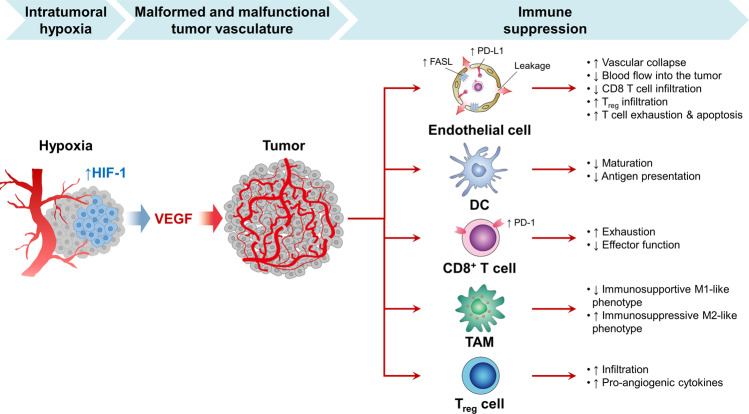
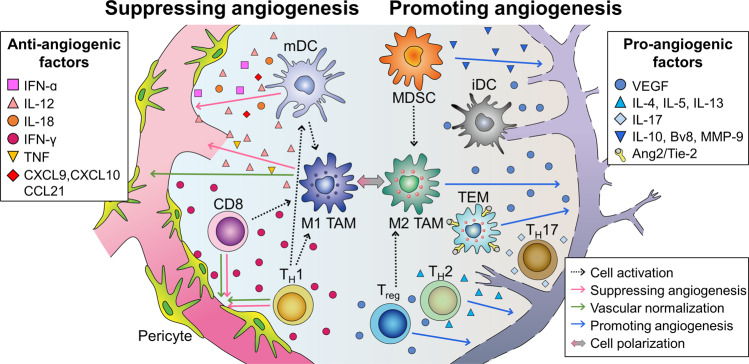
Cancer immunotherapy with immune checkpoint inhibitors (ICIs) has revolutionized the treatment of advanced cancers. However, the tumor microenvironment (TME) functions as a formidable barrier that severely impairs the efficacy of ICIs. While the crosstalk between tumor vessels and immune cells determines the nature of anti-tumor immunity, it is skewed toward a destructive cycle in growing tumors. First, the disorganized tumor vessels hinder CD8+T cell trafficking into the TME, disable effector functions, and even kill T cells. Moreover, VEGF, the key driver of angiogenesis, interferes with the maturation of dendritic cells, thereby suppressing T cell priming, and VEGF also induces TOX-mediated exhaustion of CD8+T cells. Meanwhile, a variety of innate and adaptive immune cells contribute to the malformation of tumor vessels. Protumoral M2-like macrophages as well as T H 2 and Treg cells secrete pro-angiogenic factors that accelerate uncontrolled angiogenesis and promote vascular immaturity. While CD8+T and CD4+T H 1 cells suppress angiogenesis and induce vascular maturation by secreting IFN-γ, they are unable to infiltrate the TME due to malformed tumor vessels. These findings led to preclinical studies that demonstrated that simultaneous targeting of tumor vessels and immunity is a viable strategy to normalize aberrant vascular-immune crosstalk and potentiate cancer immunotherapy. Furthermore, this combination strategy has been evidently demonstrated through recent pivotal clinical trials, granted approval from FDA, and is now being used in patients with kidney, liver, lung, or uterine cancer. Overall, combining anti-angiogenic therapy and ICI is a valid therapeutic strategy that can enhance cancer immunity and will further expand the landscape of cancer treatment.
Overview
The claims and statistics of this paper haven’t been checked yet.
Free: it reads the open-access text and checks the first 5 claims that cite a source we can check. Create a free account to check every claim.
Integrity signals
Registry
Cites
Statistics
Figures
Verification
Claims the paper makes
The claims and statistics of this paper haven’t been checked yet.
Free: it reads the open-access text and checks the first 5 claims that cite a source we can check. Create a free account to check every claim.
Self-check
Percentages, sums and reported differences re-computed from the paper’s own numbers.
The self-check needs the paper’s full text.
Citations
Cites
Cancer immunotherapy using checkpoint blockade
Ribas, A., & Wolchok, J. D. (2018) · Science · doi:10.1126/science.aar4060 · Cited by 6,791
Normalization of Tumor Vasculature: An Emerging Concept in Antiangiogenic Therapy
Jain, R. K. (2005) · Science · doi:10.1126/science.1104819 · Cited by 5,527
Macrophage Diversity Enhances Tumor Progression and Metastasis
Qian, B.-Z., & Pollard, J. W. (2010) · Cell · doi:10.1016/j.cell.2010.03.014 · Cited by 5,188
Interleukin-12 and the regulation of innate resistance and adaptive immunity
Trinchieri, G. (2003) · Nature Reviews Immunology · doi:10.1038/nri1001 · Cited by 3,927
Macrophage plasticity and interaction with lymphocyte subsets: cancer as a paradigm
Biswas, S. K., & Mantovani, A. (2010) · Nature Immunology · doi:10.1038/ni.1937 · Cited by 3,840
Atezolizumab for First-Line Treatment of Metastatic Nonsquamous NSCLC
Socinski, M. A., Jotte, R. M., Cappuzzo, F., Orlandi, F., Stroyakovskiy, D., Nogami, N., Rodríguez-Abreu, D., Moro-Sibilot, D., Thomas, C. A., Barlesi, F., et al. (2018) · New England Journal of Medicine · doi:10.1056/nejmoa1716948 · Cited by 3,733
Pembrolizumab plus axitinib versus sunitinib for advanced renal-cell carcinoma
Rini, B. I., Plimack, E. R., Stus, V., Gafanov, R., Hawkins, R., Nosov, D., Pouliot, F., Alekseev, B., Soulières, D., Melichar, B., et al. (2019) · New England Journal of Medicine · doi:10.1056/nejmoa1816714 · Cited by 3,403
Avelumab plus Axitinib versus Sunitinib for Advanced Renal-Cell Carcinoma
Motzer, R. J., Penkov, K., Haanen, J., Rini, B., Albiges, L., Campbell, M. T., Venugopal, B., Kollmannsberger, C., Negrier, S., Uemura, M., et al. (2019) · New England Journal of Medicine · doi:10.1056/nejmoa1816047 · Cited by 2,503
Macrophage plasticity and polarization in tissue repair and remodelling
Mantovani, A., Biswas, S. K., Galdiero, M. R., Sica, A., & Locati, M. (2013) · The Journal of Pathology · doi:10.1002/path.4133 · Cited by 2,384
Pàez-Ribes, M., Allen, E., Hudock, J., Takeda, T., Okuyama, H., Viñals, F., Inoue, M., Bergers, G., Hanahan, D., & Casanovas, O. (2009) · Cancer Cell · doi:10.1016/j.ccr.2009.01.027 · Cited by 2,339
Cited by
Items 201–300 of 796
Single-arm study of camrelizumab plus apatinib for patients with advanced mucosal melanoma
Zhao, L., Ren, Y., Zhang, G., Zheng, K., Wang, J., Sha, H., Zhao, M., Huang, R., Kang, D., Su, X., et al. (2024) · Journal for ImmunoTherapy of Cancer · doi:10.1136/jitc-2023-008611 · Cited by 24
“Our findings support the need for further validation.”
ResultCurrent Situation and Prospect of Adoptive Cellular Immunotherapy for Malignancies
Zhao, D. H., Zhu, D., Cai, F., Jiang, M., Liu, X., Li, T., & Zheng, Z. (2023) · Technology in Cancer Research & Treatment · doi:10.1177/15330338231204198 · Cited by 24
“121 Based on the application of CAR-T therapy, NK cells are potential immuno-therapy cells.”
BackgroundBreaking the premetastatic niche barrier: the role of endothelial cells and therapeutic strategies
Fang, Y., Cui, W., Yang, Y., Zhang, X., Tian, M., Xie, Z., Guo, Y., Yuan, W., Li, Z., & Yang, S. (2025) · Theranostics · doi:10.7150/thno.113665 · Cited by 24
“VEGF also suppresses dendritic cell activation, thereby impairing T-cell priming [162].”
Wang, J., Zhang, W., Xie, Z., Wang, X., Luo, Y., Jiang, W., Liu, Y., Wang, Z., Ran, H., Song, W., et al. (2022) · Advanced Healthcare Materials · doi:10.1002/adhm.202201399 · Cited by 24
Esfahani, A. T., Mohammadpour, S., Jalali, P., Yaghoobi, A., Karimpour, R., Torkamani, S. S., Pardakhtchi, A., Salehi, Z., & Mojarad, E. N. (2024) · Scientific Reports · doi:10.1038/s41598-024-61000-x · Cited by 24
“The disorganized vascular network within tumors significantly inhibits the infiltration of CD8 + T cells into the tumor microenvironment, thereby compromising their efficacy 70,71 .”
BackgroundA fungal polysaccharide from Fomitopsis officinalis as a multi-target molecule to combat cancer
Liu, W., Shen, Y., Hou, J., Jiang, H., Wang, Q., Zhang, L., Nakajima, A., Lee, D., Xu, J., & Guo, Y. (2024) · International Journal of Biological Macromolecules · doi:10.1016/j.ijbiomac.2024.132543 · Cited by 24
Progress of Immune Checkpoint Inhibitors Therapy for pMMR/MSS Metastatic Colorectal Cancer
Qu, F., Wu, S., & Yu, W. (2024) · OncoTargets and Therapy · doi:10.2147/ott.s500281 · Cited by 23
Zhu, Y., Wei, Z., Wang, J., Pei, Y., Jin, J., Dong, L., Li, Z.-H., Liu, Z., Yu, M., Li, R., et al. (2024) · Nature Communications · doi:10.1038/s41467-024-54661-9 · Cited by 23
“Simultaneous inhibition of the VEGF-VEGFR2 and PD-1-PD-L1 pathways results in a synergistic anti-tumor effect by promoting tumor vascular normalization and enhancing immune cell in fi ltration 22 .”
Mitsuhashi, A., Koyama, K., Ogino, H., Afroj, T., Nguyen, N. T., Yoneda, H., Otsuka, K., Sugimoto, M., Kondoh, O., Nokihara, H., et al. (2023) · Cell Reports · doi:10.1016/j.celrep.2023.112162 · Cited by 23
Cheng, R., Li, S., Ma, X., Zhuang, W., Lei, Y., He, J., Liang, C. L., Nie, W., & Xie, H.-Y. (2025) · Science Advances · doi:10.1126/sciadv.adr1299 · Cited by 23
Tong, J., Feng, Y., Luo, D., & Wang, T. (2021) · Chemical Papers · doi:10.1007/s11696-021-01588-w · Cited by 23
Evolutionary perspectives, heterogeneity and ovarian cancer: a complicated tale from past to present
Achimaș-Cădariu, P., Kubelac, P. M., Irimie, A., Berindan‐Neagoe, I., & Rühli, F. J. (2022) · Journal of Ovarian Research · doi:10.1186/s13048-022-01004-1 · Cited by 23
“Antiangiogenic drugs have been studied extensively as an addition to the chemotherapy backbone [58], but a clear benefit was seen only in a high risk patient population [59], however novel combinations are under way in order to augment their therapeutic potential in combination with immunotherapy [60] or PARPi [61].”
BackgroundWang, Y., Lu, J., Chong, X., Wang, C., Chen, X., Peng, Z., Gu, Y., Wang, Y., Wang, X., Li, J., et al. (2025) · Signal Transduction and Targeted Therapy · doi:10.1038/s41392-025-02193-z · Cited by 22
Macrophages in Glioblastoma Development and Therapy: A Double-Edged Sword
Wu, M., Shi, Y. K., Zhu, L., Chen, L., Zhao, X., & Xu, C. S. (2022) · Life · doi:10.3390/life12081225 · Cited by 22
“Therefore, antiangiogenic therapy potentiates the normalization of the tumor immune microenvironment and may improve the effectiveness of immunotherapy during combination treatment [36].”
BackgroundXu, M., Chang, J., Wang, W., Wang, X., Wang, X., Weng, W., Tan, C., Zhang, M., Ni, S., Wang, L., et al. (2022) · Frontiers in Immunology · doi:10.3389/fimmu.2022.934083 · Cited by 22
“Being inspired by the “REGONIVO/ EPOC1603” trial (57), a phase Ib trial of anti-angiogenetic inhibitors (regorafenib) plus ICIs (nivolumab) for gastric and colorectal cancer, several clinical trials have been established to assess the therapeutic efficacy of a combination of VEGFR/ VEGF inhibitors and ICIs in solid tu…”
BackgroundEmerging immunotherapy and tumor microenvironment for advanced sarcoma: a comprehensive review
Huang, H. W., Fan, Y., Zhang, S., Bai, X., Wang, X., & Shan, F. (2025) · Frontiers in Immunology · doi:10.3389/fimmu.2025.1507870 · Cited by 22
Zhai, L., Shi, Y., Yan, Y., Lu, A., Liu, X., Lei, L., Sun, Y., Jiang, L., Wang, X., Qian, H.-G., et al. (2023) · Chinese Chemical Letters · doi:10.1016/j.cclet.2022.108104 · Cited by 22
Improved Immunotherapy Efficacy by Vascular Modulation
Newport, E., Pedrosa, A., Njegić, A., Hodivala‐Dilke, K., & Muñoz‐Félix, J. M. (2021) · Cancers · doi:10.3390/cancers13205207 · Cited by 21
Li, W., Xu, M., Cheng, M., Wei, J., Zhu, L., Deng, Y., Guo, F., Bi, F., & Liu, M. (2025) · Cancer Medicine · doi:10.1002/cam4.71065 · Cited by 21
Ledys, F., Kalfeist, L., Galland, L., Limagne, E., & Ladoire, S. (2021) · Cancers · doi:10.3390/cancers13235999 · Cited by 21
Stalin, J., Imhof, B. A., Coquoz, O., Marcone, R., Hammel, P., McKee, T., Jemelin, S., Poittevin, M., Pocard, M. D., Matthes, T., et al. (2021) · Cancers · doi:10.3390/cancers13184625 · Cited by 21
“Angiogenic factors promote myeloid cell recruitment and function, and antiangiogenic therapy increases tumor infiltration by immune cells [35].”
BackgroundLee, W. S., Woo, S., Lee, S.-H., Jo, G. H., Kim, I. H., Kim, H., An, C., Jung, S., Kim, G., Kang, H., et al. (2025) · Clinical and Molecular Hepatology · doi:10.3350/cmh.2025.0792 · Cited by 21
Self-citationClassic versus innovative strategies for immuno-therapy in pancreatic cancer
Formelli, M. G., Palloni, A., Tavolari, S., Deiana, C., Andrini, E., Marco, M. D., Campana, D., Lamberti, G., & Brandi, G. (2025) · Advanced Drug Delivery Reviews · doi:10.1016/j.addr.2025.115671 · Cited by 20
Combatting acquired resistance to osimertinib in EGFR-mutant lung cancer
Lee, J., Piotrowska, Z., Soo, R. A., Cho, B. C., & Lim, S. M. (2022) · Therapeutic Advances in Medical Oncology · doi:10.1177/17588359221144099 · Cited by 20
Fejza, A., Polano, M., Camicia, L., Poletto, E., Carobolante, G., Toffoli, G., Mongiat, M., & Andreuzzi, E. (2021) · International Journal of Molecular Sciences · doi:10.3390/ijms22147511 · Cited by 20
“For these reasons, the targeting of the tumor vasculature in combination with immune therapies represents an emerging strategy to improve the treatment of melanoma, as well as other malignancies [10,11].”
BackgroundTumor Angiocrine Signaling: Novel Targeting Opportunity in Cancer
Oria, V. O., & Erler, J. T. (2023) · Cells · doi:10.3390/cells12202510 · Cited by 20
“In addition, VEGF was also reported to inhibit the maturation of dendritic cells, which impeded T-cell priming and activation against tumors [72].”
BackgroundNavigating the Current Landscape of Non-Clear Cell Renal Cell Carcinoma: A Review of the Literature
John, A., Spain, L. A., & Hamid, A. (2023) · Current Oncology · doi:10.3390/curroncol30010070 · Cited by 20
“As such, combination IO and VEGF inhibition is hypothesised to have synergistic anti-tumour activity [77].”
BackgroundTumor-targeting bacteria as immune stimulants – the future of cancer immunotherapy?
Mowday, A. M., van de Laak, J., Fu, Z., Henare, K. L., Dubois, L. J., Lambin, P., Theys, J., & Patterson, A. V. (2024) · Critical Reviews in Microbiology · doi:10.1080/1040841x.2024.2311653 · Cited by 19
“…effectors to supress the immune response via production of numerous immunosuppressive cytokines such as vascular endothelial growth factor (veGF) (lee et al. 2020 there is accumulating evidence that depletion of tregs and/or differentiation of MDScs into mature myeloid cells can diminish the…”
BackgroundGomez-Randulfe, I., Monaca, F., Planchard, D., Bria, E., & Califano, R. (2025) · Critical Reviews in Oncology/Hematology · doi:10.1016/j.critrevonc.2025.104762 · Cited by 19
Wu, J., Zhang, S., Yu, S., An, G., Wang, Y., Yu, Y., Liang, L., Wang, Y., Xu, X., Xiong, Y., et al. (2024) · Nature Communications · doi:10.1038/s41467-024-53109-4 · Cited by 19
Wei, Q., & Taskén, K. (2022) · Biochemical Journal · doi:10.1042/bcj20210233 · Cited by 19
Zhou, Z., Zhong, H., Wang, H., Wang, S., Kridis, W. B., Wang, R., Shen, K., Wang, Z., & Huang, R. (2025) · Discover Oncology · doi:10.1007/s12672-025-03797-1 · Cited by 19
“Exhaustion is further driven by VEGF-mediated suppression of dendritic cell maturation, and involves the transcription factor TOX, which regulates T cell priming [96].”
Fieni, C., Sorrentino, C., Ciummo, S. L., Fontana, A., Lotti, L. V., Scialis, E. S., Garcia, D. C., Caulo, M., & Carlo, E. D. (2024) · Experimental & Molecular Medicine · doi:10.1038/s12276-024-01310-2 · Cited by 19
“…resistance and resumption of tumor progression could be limited by combining IL30 suppression with immunotherapy or other personalized treatments, as observed in the combined treatment protocols that have been successfully used for the management of different types of advanced stage cancer 58,59 .”
BackgroundTang, X., Zhou, H., & Liu, Y. (2023) · Disease Markers · doi:10.1155/2023/9292536 · Cited by 19
“In addition, Th2 cells also secrete proangiogenic factors that accelerate uncontrolled angiogenesis and promote vascular immaturity [47].”
BackgroundMathematical Modeling of Tumor-Immune Interactions: Methods, Applications, and Future Perspectives
Li, C., & Lei, J. (2025) · CSIAM transactions on life sciences. · doi:10.4208/csiam-ls.so-2024-0008 · Cited by 19
Ursino, C., Mouric, C., Gros, L., Bonnefoy, N., & Faget, J. (2023) · Frontiers in Immunology · doi:10.3389/fimmu.2023.1170321 · Cited by 18
“Nat Rev Drug Discov (2020) 19(11):776–800.”
BackgroundInfluentialRoussel, E., Kinget, L., Verbiest, A., Boeckx, B., Zucman‐Rossi, J., Couchy, G., Caruso, S., Baldewijns, M. M. L. L., Joniau, S., Poppel, H. V., et al. (2021) · Acta Oncologica · doi:10.1080/0284186x.2021.1962971 · Cited by 18
Role of N6-methyladenosine in tumor neovascularization
Zhao, L., Li, Q., Zhou, T.-L., Liu, X., Guo, J., Fang, Q., Cao, X., Geng, Q., Yu, Y., Zhang, S., et al. (2024) · Cell Death and Disease · doi:10.1038/s41419-024-06931-z · Cited by 18
“In addition, other immunosuppressive cells such as MDSCs, Tregs, and Tie2-expressing macrophages also contribute to tumor angiogenesis [9, 112].”
BackgroundInfluentialFar, B. F., Rabie, D., Hemati, P., Fooladpanjeh, P., Hamedanchi, N. F., Lomer, N. B., Rouzbahani, A. K., & Naimi‐Jamal, M. R. (2023) · Livers · doi:10.3390/livers3010011 · Cited by 18
“Antiangiogenic medicines have significant potential for treating HCC, owing to the tumor’s vascularity [23].”
BackgroundKim, Y., Yang, H., Lee, W. S., Cheon, J., Sang, Y. B., Kang, B., Chon, H. J., & Kim, C. (2023) · Journal of Cancer · doi:10.7150/jca.81384 · Cited by 18
“The recent emergence of immune checkpoint inhibitors (ICI) has led to a paradigm shift in the landscape of cancer [16-18].”
BackgroundSelf-citationBertrand, C., Meerbeeck, P. V., de Streel, G., Vaherto, N., Benhaddi, F., Rouaud, L., Noël, A., Coulie, P. G., van Baren, N., & Lucas, S. (2021) · Frontiers in Immunology · doi:10.3389/fimmu.2021.704050 · Cited by 18
“It is noteworthy that activated intratumoral T cells can themselves enhance vascular functionality by secreting TNFa, known to upregulate E-selectin on blood endothelial cells (23), and IFNg, which induces expression of chemokines involved in pericyte recruitment (25, 30, 31).”
BackgroundLee, C., Lee, J. B., Park, S. J., Che, J., Kwon, W. S., Kim, H. S., Jung, M., Lee, S., Park, S. R., Koo, D., et al. (2023) · Gastric Cancer · doi:10.1007/s10120-023-01435-9 · Cited by 18
Tumor hypoxia: Classification, detection, and its critical role in cancer progression
Zhao, Y., Zhong, B., Cao, J., Wang, Q., Liang, J., Lu, K., & Lu, S. (2025) · Biomolecules and Biomedicine · doi:10.17305/bb.2025.12318 · Cited by 18
Jang, S., Strickland, B., Finis, L., Kooijman, J. J., Melis, J. J. T. M., Zaman, G. J. R., & Tornout, J. V. (2023) · Cancer Chemotherapy and Pharmacology · doi:10.1007/s00280-023-04534-7 · Cited by 18
“The ability to selectively target VEGFR2 also supports the rationale for combination approaches based on drug mechanism of action; for example, VEGF signaling has been shown to suppress T cell priming and induce T cell exhaustion, providing rationale for antiVEGFR plus immune checkpoint blockade combinations, as both…”
BackgroundSecretion of a VEGF-Blocking scFv Enhances CAR T-cell Potency
Supper, V. M., Donner, H., Birocchi, F., Bratt, A., Escobar, G., Kann, M. C., Park, S., Martin, G., Korell, F., Takei, H., et al. (2025) · Cancer Immunology Research · doi:10.1158/2326-6066.cir-24-0876 · Cited by 17
Targeting the hypoxia signaling pathway with nanomedicine to reverse immunotherapy resistance
Cheng, X., Wang, P., Lyu, H., Lee, Y., Yoon, J., & Dong, H. (2025) · Cancer Drug Resistance · doi:10.20517/cdr.2025.132 · Cited by 17
Shi, Y., Li, Y., Wu, B., Zhong, C., Lang, Q., Liang, Z., Zhang, Y., Lv, C., Han, S., Yu, Y., et al. (2022) · International Immunopharmacology · doi:10.1016/j.intimp.2022.108968 · Cited by 17
Tumor vessel normalization and immunotherapy in gastric cancer
Yu, X., He, S., Shen, J., Huang, Q., Peng, Y., Huang, L., Pu, D., Wang, L., Li, L., Liu, J., et al. (2022) · Therapeutic Advances in Medical Oncology · doi:10.1177/17588359221110176 · Cited by 17
Reprogramming the tumor microenvironment to boost adoptive T cell therapy
Pacheco, M. F. M., & Tai, L. (2025) · Frontiers in Immunology · doi:10.3389/fimmu.2025.1677548 · Cited by 17
Tao, L., Cheng, G., Lv, F., Wang, R. L., Yang, N., Xing, Z., Gu, B., Meng, S., Xu, W., & Huo, M. (2023) · Chemical Engineering Journal · doi:10.1016/j.cej.2023.145092 · Cited by 17
Oaknin, A., Ghamande, S. A., Kasamatsu, Y., Gil-Martín, M., Grau-Béjar, J. F., García-Durán, C., Sato, M., Siddiqui, A., Chaudhary, S. P., Vugmeyster, Y., et al. (2024) · Clinical Cancer Research · doi:10.1158/1078-0432.ccr-23-1829 · Cited by 17
Uliano, J., Nicolò, E., Corvaja, C., Salimbeni, B. T., Trapani, D., & Curigliano, G. (2022) · Expert Review of Clinical Pharmacology · doi:10.1080/17512433.2022.2142559 · Cited by 16
“are produced by pro-tumoral M2-like macrophages, TH2 and Treg cells thus enhancing an uncontrolled neoangiogenesis, thus amplifying an immune suppressive microenvironment [43].”
BackgroundLi, J., Li, Z., & Wang, K. (2025) · Frontiers in Immunology · doi:10.3389/fimmu.2025.1550752 · Cited by 16
Sakai, D., Kadowaki, S., Kawabata, R., Hara, H., Satake, H., Takahashi, M., Takeno, A., Imai, H., Minashi, K., Kawakami, T., et al. (2025) · Journal of Clinical Oncology · doi:10.1200/jco.24.01119 · Cited by 16
Liu, X., Chen, Y.-X., Wan, H., Wang, Y.-L., Wang, Y., Gao, Y., Wu, L.-B., & Pei, Z. (2024) · Scientific Reports · doi:10.1038/s41598-024-54670-0 · Cited by 16
“However, adaptive immune cells such as CD8+ T cells and Th1 cells can secrete IFN-γ, a potent cytokine that inhibits angiogenesis and induces normalization of the TME vasculature, thereby inhibiting tumor vascular survival 58 .”
BackgroundRole of Immunotherapy in Sarcomas
Dalal, S., Shan, K. S., Dar, N. N. T., Hussein, A. M., & Ergle, A. (2024) · International Journal of Molecular Sciences · doi:10.3390/ijms25021266 · Cited by 16
“Preclinically, the normalization of abnormal tumor vessels and the increased infiltration of immune effector cells into tumors by anti-angiogenic TKIs have been shown to enhance the efficacy of ICIs [68].”
BackgroundZhang, C., Wang, H., Li, X., Jiang, Y., Sun, G., & Yu, H. (2025) · Frontiers in Oncology · doi:10.3389/fonc.2025.1526407 · Cited by 16
Guo, Y., Liu, B., Yin, L., Zhou, Y., Wu, Y., Liu, H., Tu, L., Huang, H., Ling, Y., Steinmetz, N. F., et al. (2024) · Chemical Engineering Journal · doi:10.1016/j.cej.2024.158143 · Cited by 16
Werner, W., Kuzminskaya, M., Lurje, I., Tacke, F., & Hammerich, L. (2024) · Seminars in Liver Disease · doi:10.1055/a-2334-8311 · Cited by 15
“269 In addition to other immune effects, yttrium-90 radioembolization has been shown to upregulate the chemokine C-C motif ligand 5 (CCL5) and chemokine C-X-C motif ligand 16 (CXCL16) pathway in the tumors of HCC patients, which led to boosted CTL and NK cell in fi ltration.”
Heterogeneity of the tumor immune microenvironment and clinical interventions
Jin, Z., Zhou, Q., Cheng, J., Jia, Q., & Zhu, B. (2023) · Frontiers of Medicine · doi:10.1007/s11684-023-1015-9 · Cited by 15
Precision Medicine for Metastatic Colorectal Cancer: Where Do We Stand?
Underwood, P. W., & Pawlik, T. M. (2024) · Cancers · doi:10.3390/cancers16223870 · Cited by 15
Metabolism in the tumor microenvironment: implications for pathogenesis and therapeutics
Wik, J. A., Berge, E. R., Stromsnes, K., & Skålhegg, B. S. (2025) · Frontiers in Immunology · doi:10.3389/fimmu.2025.1610255 · Cited by 15
Resistance Mechanisms of the Metastatic Tumor Microenvironment to Anti-Angiogenic Therapy
Schiffmann, L. M., Bruns, C. J., & Schmidt, T. (2022) · Frontiers in Oncology · doi:10.3389/fonc.2022.897927 · Cited by 15
Ye, Z., Cheng, P., Huang, Q., Hu, J., Huang, L., & Hu, G. (2024) · Frontiers in Immunology · doi:10.3389/fimmu.2024.1388176 · Cited by 15
Kim, N., Lee, J., Kim, S. H., Kang, S.-H., Bae, S., Yu, C.-H., Seo, J., & Kim, H.-T. (2024) · Cancer Immunology Immunotherapy · doi:10.1007/s00262-024-03777-4 · Cited by 15
“…tumors are stimulated by various inflammatory cytokines and VEGF secreted from tumor cells and the surrounding immune cells, resulting in endothelial cell inactivation, which reduces the frequency of T cell transmigration from blood vessels into tumors to facilitate immune evasion [27, 31–33].”
BackgroundGas-based therapeutics and delivery platforms in cancer immunotherapy
Nguyen, V.-A. T., Huang, C., & Chen, Y. (2025) · Advanced Drug Delivery Reviews · doi:10.1016/j.addr.2025.115746 · Cited by 15
Advances in the application of immune checkpoint inhibitors in gynecological tumors
Zou, Y., Xu, Y., Chen, X., & Zheng, L. (2023) · International Immunopharmacology · doi:10.1016/j.intimp.2023.109774 · Cited by 15
Armesto, M., Márquez, M., Arestin, M., Errarte, P., Rubio-Zulaika, A., Manterola, L., Lopez, J. I., & Lawrie, C. H. (2021) · Cancers · doi:10.3390/cancers13174401 · Cited by 15
Interrogating the interplay of angiogenesis and immunity in metastatic colorectal cancer
Kampoli, K., Foukas, P. G., Ntavatzikos, A., Arkadopoulos, N. F., & Koumarianou, A. A. (2022) · World Journal of Methodology · doi:10.5662/wjm.v12.i1.43 · Cited by 15
Darzi, A., Shokouhfar, M., Farajee, N., Ghafari, A., Deldar, F., Eini, P., Vanan, A. G., & Bahrami, N. (2025) · Biomedicine & Pharmacotherapy · doi:10.1016/j.biopha.2025.118875 · Cited by 15
Targeting TRAF3IP2 inhibits angiogenesis in glioblastoma
Izadpanah, A., Daneshimehr, F., Willingham, K., Barabadi, Z., Braun, S. E., Dumont, A. S., Mostany, R., Chandrasekar, B., Alt, E., & Izadpanah, R. (2022) · Frontiers in Oncology · doi:10.3389/fonc.2022.893820 · Cited by 15
“This is especially relevant since the combination of antiangiogenic therapy and immune checkpoint blockade, which stimulates antitumor immune response, is suggested to be a more effective in treating malignancy (49).”
BackgroundGhavimi, R., Rahimian, L., Mohammadi, M., Dutta, O., Mohan, H., Chouljenko, V. N., Omolekan, T. O., Chamcheu, J. C., & Kousoulas, K. G. (2025) · Molecular Therapy Oncology · doi:10.1016/j.omton.2025.201100 · Cited by 14
“199,200 OVs, by functioning as an in situ cancer vaccine, can enhance tumor immunogenicity and facilitate T cell infiltration, making them an optimal platform to boost ICI effectiveness.”
Meng, X., Yang, X., Hong, Y., Wang, W., Zhang, Z., Xia, J., Chen, Y., Zhou, Y., Lu, T., Song, M. S., et al. (2025) · Molecular Cancer · doi:10.1186/s12943-025-02376-w · Cited by 14
“Antiangiogenic therapy could shift the immune suppressive tumor microenvironment towards a more immune active state [16].”
The cellular and molecular mediators of metastasis to the lung
Cucanic, O., Farnsworth, R. H., & Stacker, S. A. (2022) · Growth Factors · doi:10.1080/08977194.2022.2087520 · Cited by 14
“This includes the use of therapies that harness the immune system’s potential to target and destroy cancer cells, adjunctly with antiangiogenic therapies to improve the delivery of drugs to affected tumorigenic and metastatic organs (Ghouse et al. 2020; Lee et al. 2020).”
BackgroundWu, D., Jia, B., Jia, M., Zhao, H., Zhao, H., & Zhou, J. (2023) · Frontiers in Oncology · doi:10.3389/fonc.2023.1274754 · Cited by 14
Immunotherapy in Colorectal Cancer — Finding the Achilles’ Heel
Park, R., & Saeed, A. (2024) · NEJM Evidence · doi:10.1056/evidra2300353 · Cited by 14
Ma, K., Chen, S., Chen, X., Zhao, X., & Yang, J. (2022) · Journal of Molecular Neuroscience · doi:10.1007/s12031-022-02060-4 · Cited by 14
“MDSCs directly promote tumor angiogenesis by producing VEGF, FGF2, Bv8, and matrix metalloproteinase (Bruno et al. 2019; Lee et al. 2020).”
BackgroundLiu, Y., Ge, Q., Xu, S., Li, K., & Liu, Y. (2022) · Frontiers in Oncology · doi:10.3389/fonc.2022.942678 · Cited by 14
“High-dose anti-VEGF/ VEGFR monoclonal antibodies/VEGFR-2 TKIs may excessively prune the vasculature, causing severe hypoxia and immunosuppression.”
BackgroundInfluentialAbdallah, F. M., Ghoneim, A. I., Abd-Alhaseeb, M. M., Abdel-Raheem, I. T., & Helmy, M. W. (2024) · Biomedicine & Pharmacotherapy · doi:10.1016/j.biopha.2024.117468 · Cited by 14
Clinical Potential of YY1-Hypoxia Axis for Vascular Normalization and to Improve Immunotherapy
Meo, C., & de Nigris, F. (2024) · Cancers · doi:10.3390/cancers16030491 · Cited by 14
“Therefore, ICI treatment administered concomitantly with antiangiogenic drugs has been shown to be more effective than single [13,17, Indeed, targeting both the immune microenvironment and tumor vessels has been approved by the FDA for the treatment of liver, kidney, lung, and uterine cancer [20].”
BackgroundZhang, Z., Li, Y., Dong, Y., Li, J., Zhang, B., Zhang, C., & Cui, X. (2022) · Frontiers in Oncology · doi:10.3389/fonc.2022.846597 · Cited by 14
“Other mAbs against PD-1 currently on the market all use IgG4 subtypes, while IgG1 is only applied in penpulimab.”
BackgroundInfluential1,3,4‐Thiadiazole Derivatives as VEGFR‐2 Inhibitors and Its Molecular Insight for Cancer Therapy
Gawande, P., Matore, B. W., Murmu, A., Kumar, A., Jana, S., Roy, P. P., & Singh, J. (2025) · Chemistry & Biodiversity · doi:10.1002/cbdv.202501361 · Cited by 14
Single-cell sequencing in diffuse large B-cell lymphoma: C1qC is a potential tumor-promoting factor
Gao, G., Sun, N., Zhang, Y., Li, J., Jiang, Y., Chen, N., Tang, Y., & Shi, W. (2024) · International Immunopharmacology · doi:10.1016/j.intimp.2024.113319 · Cited by 14
Manap, A. S. A., Ngwenya, F. M., Selvan, M. K., Arni, S., Hassan, F. H., Rudy, A. D. M., & Razak, N. N. A. (2024) · Frontiers in Oncology · doi:10.3389/fonc.2024.1459178 · Cited by 14
Nanotechnology-Based Bacterial Immunotherapy
Arya, R. K. K., Sati, D., Bisht, D., & Keservani, R. K. (2022) · Springer eBooks · doi:10.1007/978-981-19-2507-8_1 · Cited by 13
T cell‐dependent bispecific antibodies alter organ‐specific endothelial cell–T cell interaction
Himmels, P., Nguyen, T. T. T., Caunt, M., Arrazate, A., Yeung, S., Burton, J., Clark, R., Tótpál, K., Jesudason, R., Yang, Y. A., et al. (2023) · EMBO Reports · doi:10.15252/embr.202255532 · Cited by 13
“Over the past decades, vascular modulating agents have been shown to have the potential to modulate the tumor microenvironment and improve CIT activity (Fukumura et al , 2018; Ciciola et al , 2020; Lee et al , 2020).”
Weng, K. Q., Liu, J. Y., Hu, L., She, L. L., Qiu, J., Qi, H., Qi, H. Y., Li, Y.-S., & Dai, Y. (2024) · International Immunopharmacology · doi:10.1016/j.intimp.2024.111746 · Cited by 13
Mavuluri, J., Dhungana, Y., Jones, L. L., Bhatara, S., Shi, H., Yang, X., Lim, S.-E., Reyes, N., Chi, H., Yu, J., et al. (2025) · Cancer Discovery · doi:10.1158/2159-8290.cd-24-0841 · Cited by 13
Cure the Incurable? Recent Breakthroughs in Immune Checkpoint Blockade for Hepatocellular Carcinoma
Chu, P., & Chan, S. (2021) · Cancers · doi:10.3390/cancers13215295 · Cited by 13
Yin, X., Wu, J., Xu, M., Tian, T., Zhu, L., Wang, J., Dai, X., Yang, X., Qian, J., Wang, W., et al. (2025) · Molecular Cancer · doi:10.1186/s12943-025-02502-8 · Cited by 13
“VEGF/VEGFR inhibitors show promise in reducing tumor angiogenesis and promoting normalization, which could enhance the infiltration of effective T cells while decreasing the infiltration of immune suppressive cells such as M2 macrophages and Tregs [57].”
Liu, Z., Xu, J., Liu, M., Hu, W., Xu, N., & Zhu, D. (2023) · Scientific Reports · doi:10.1038/s41598-023-30412-6 · Cited by 13
Lamberti, G., Rihawi, K., Mazzoni, F., Riccardi, F., Follador, A., Tiseo, M., Frassoldati, A., Colantonio, I., Bonetti, A. V., Genova, C., et al. (2025) · Journal for ImmunoTherapy of Cancer · doi:10.1136/jitc-2024-010694 · Cited by 13
“36 Indeed, VEGF pathway activation leads to decreased antitumor response through inhibition of dendritic cells maturation and T cells activation, resulting in an immunosuppressive micro-environment.”
Lim, A. R., Vincent, B. G., Weaver, A. M., & Rathmell, W. K. (2021) · Cancer Gene Therapy · doi:10.1038/s41417-021-00345-1 · Cited by 13
Primary vaginal malignant melanoma successfully treated with combination therapy: A case report
Yin, P., Ma, X., Zhang, Y., Song, Y., Wang, Y., & Lü, Z. (2022) · Oncology Letters · doi:10.3892/ol.2022.13550 · Cited by 13
Li, G., & Jiang, Y. (2022) · Frontiers in Oncology · doi:10.3389/fonc.2022.916790 · Cited by 13
“Several clinical trials have demonstrated synergistic antitumor efficacy between ICIs and antiangiogenic agents in various malignancies (35).”
BackgroundWang, X., Wang, J., Wang, Q., Ding, G., Huang, Y., & Feng, Y. (2026) · Journal of Experimental & Clinical Cancer Research · doi:10.1186/s13046-026-03656-z · Cited by 13
“VEGF-A is a growth factor rather than a classic cytokine, but it functions as a potent immunosuppressive mediator that promotes T-cell exclusion through angiogenesis and can directly inhibit T-cell activity [92].”
Targeting FAK to Potentiate Immune Checkpoint Therapy in Solid Tumors
Stanley, K. A., & Holmen, S. L. (2025) · Journal of Cancer Immunology · doi:10.33696/cancerimmunol.7.109 · Cited by 13
“Most anti-angiogenics target vascular endothelial growth factor (VEGF), and the use of these agents with immune checkpoint therapy has been FDA-approved in multiple cancer types [53,54].”
McCann, M. A., Baccouche, B., Li, Y., Roy, P., Sheth, N. P., Lim, J. I., Mieler, W. F., Chau, F. Y., Ulanski, L., Chan, R. V. P., et al. (2025) · Signal Transduction and Targeted Therapy · doi:10.1038/s41392-025-02448-9 · Cited by 12
“36,68 Our observation that anti-VEGF suppressed in fl ammation-related pathways in PDR immune cells indicates that, in the context of clinical PDR, VEGF acts on the immune system to promote in fl ammation.”
Singh, R. K., Srivastava, P., & Manna, P. P. (2024) · Medical Oncology · doi:10.1007/s12032-023-02289-y · Cited by 12
“14th The TME plays an important role in anticancer immunity including effect in immunotherapy and other treatments [57, 58].”
Chemotherapy after nivolumab for advanced gastric cancer (REVIVE): a prospective observational study
Narita, Y., Matsushima, T., Sakamoto, Y., Matsuoka, H., Tanioka, H., Kawakami, T., Shoji, H., Mizukami, T., Izawa, N., Nishina, T., et al. (2023) · ESMO Open · doi:10.1016/j.esmoop.2023.102071 · Cited by 12
“29 A randomized phase II trial for lung cancer demonstrated that the administration of ramucirumab plus pembrolizumab beyond disease progression after treatment with immune checkpoint inhibitors improved OS compared with standard of care (investigator ’ s choice).”
Metadata
- Authors
- Lee, W. S., Yang, H., Chon, H. J., & Kim, C.
- Affiliations
- CHA University Bundang Medical Center (KR)
- Corresponding author
- Chon, Hong Jae
- Kim, Chan
- Venue
- Experimental & Molecular Medicine
- Published
- 2020-09
- Volume
- 52
- Issue
- 9
- Pages
- 1475-1485
- ISSN
- 1226-3613 (ISSN-L)
- 2092-6413
- PMC
- PMC8080646
- OpenAlex
- W3084409519
- Cited by
- 796
- References
- 99
- Citations by year
- 2026: 154 · 2025: 187 · 2024: 128 · 2023: 137 · 2022: 123 · 2021: 63 · 2020: 4
- FWCI
- 8.94
- Type
- journal article
- Language
- en
- Open access
- gold
- doi.org
- Licence
- cc-by
- creativecommons.org/licenses/by/4.0 (tdm)
- creativecommons.org/licenses/by/4.0 (vor, 10 d)
- Locations
- Experimental & Molecular Medicine (publishedVersion, cc-by)
- PubMed Central (publishedVersion, cc-by)
- PubMed (publishedVersion)
- DOAJ (DOAJ: Directory of Open Access Journals) (submittedVersion)
- Funders
- National Research Foundation
- National Research Foundation of Korea (NRF-2020R1C1C1010722, 2020R1C1C1010722, NRF-2020R1A2C2004530, 2020R1A2C2004530)
- Ministry of Science and ICT, South Korea
- Topics
- Health Sciences › Medicine › Oncology › Cancer Immunotherapy and Biomarkers
- Life Sciences › Biochemistry, Genetics and Molecular Biology › Molecular Biology › Angiogenesis and VEGF in Cancer
- Life Sciences › Immunology and Microbiology › Immunology › Immunotherapy and Immune Responses
- Keywords
- anti-angiogenic therapy, immune checkpoint inhibitors, tumor microenvironment, tumor angiogenesis, vascular endothelial growth factor, CD8+ T cell exhaustion, dendritic cell maturation, M2 macrophages, regulatory T cells, Th2 cells, vascular normalization, cancer immunotherapy, combination therapy, interferon-gamma
- MeSH terms
- Immune Checkpoint Inhibitors, Animals, Antineoplastic Combined Chemotherapy Protocols, Cell Communication, Humans, Neoplasms, Neovascularization, Pathologic, Signal Transduction, Treatment Outcome, Angiogenesis Inhibitors, Immunomodulation, Molecular Targeted Therapy, Tumor Microenvironment
About these checks
Registry, retraction, Cites and statistics results are computed, not judged, with one exception: a printed reference that no index lists is read once by a model before it counts as a citation error. Claims are extracted by a model and kept only when their quote appears verbatim in the text; each cited source is then checked, with a model’s help, for whether it says what the claim relies on. Those verdicts can be wrong — read the claim’s quote and the cited source before relying on one.
Statistics and arithmetic are recomputed, not judged.
Confidence bands are shown only for fields calibrated on our annotated test set. None is calibrated yet, so no band is shown.
What counts as a claim ›How we measure confidence ›How we check this ›
Are you an author, or do you see a problem with this page? Request a review
Data sources
Bibliographic data: Semantic Scholar, OpenAlex, Crossref.
Contains information from the Semantic Scholar Academic Graph Datasets, made available under the ODC Attribution License (ODC-BY 1.0).
Semantic Scholar’s data is described in: Kinney, R., et al. (2023). The Semantic Scholar Open Data Platform. arXiv:2301.10140.
