

Combination of anti-angiogenic therapy and immune checkpoint blockade normalizes vascular-immune crosstalk to potentiate cancer immunity
Open accessThe DOI matches its Crossref record; 100 of the 100 references it cites were found in a registry or an index.
Abstract
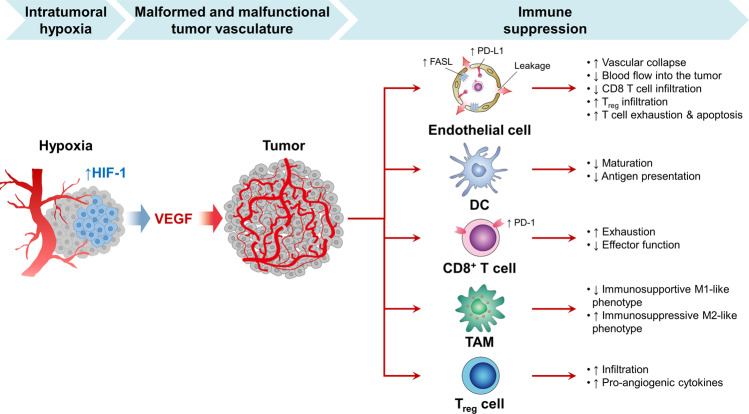
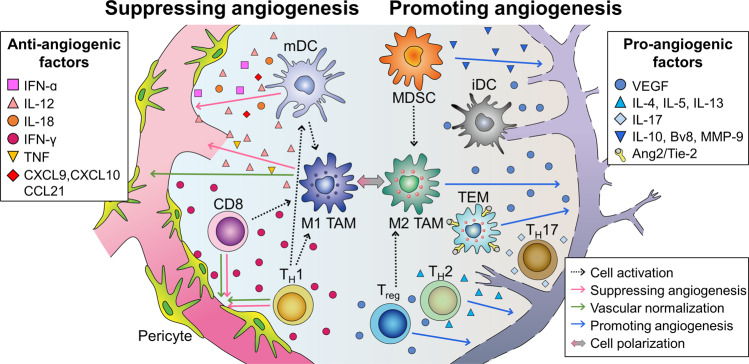
Cancer immunotherapy with immune checkpoint inhibitors (ICIs) has revolutionized the treatment of advanced cancers. However, the tumor microenvironment (TME) functions as a formidable barrier that severely impairs the efficacy of ICIs. While the crosstalk between tumor vessels and immune cells determines the nature of anti-tumor immunity, it is skewed toward a destructive cycle in growing tumors. First, the disorganized tumor vessels hinder CD8+T cell trafficking into the TME, disable effector functions, and even kill T cells. Moreover, VEGF, the key driver of angiogenesis, interferes with the maturation of dendritic cells, thereby suppressing T cell priming, and VEGF also induces TOX-mediated exhaustion of CD8+T cells. Meanwhile, a variety of innate and adaptive immune cells contribute to the malformation of tumor vessels. Protumoral M2-like macrophages as well as T H 2 and Treg cells secrete pro-angiogenic factors that accelerate uncontrolled angiogenesis and promote vascular immaturity. While CD8+T and CD4+T H 1 cells suppress angiogenesis and induce vascular maturation by secreting IFN-γ, they are unable to infiltrate the TME due to malformed tumor vessels. These findings led to preclinical studies that demonstrated that simultaneous targeting of tumor vessels and immunity is a viable strategy to normalize aberrant vascular-immune crosstalk and potentiate cancer immunotherapy. Furthermore, this combination strategy has been evidently demonstrated through recent pivotal clinical trials, granted approval from FDA, and is now being used in patients with kidney, liver, lung, or uterine cancer. Overall, combining anti-angiogenic therapy and ICI is a valid therapeutic strategy that can enhance cancer immunity and will further expand the landscape of cancer treatment.
Overview
The claims and statistics of this paper haven’t been checked yet.
Free: it reads the open-access text and checks the first 5 claims that cite a source we can check. Create a free account to check every claim.
Integrity signals
Registry
Cites
Statistics
Figures
Verification
Claims the paper makes
The claims and statistics of this paper haven’t been checked yet.
Free: it reads the open-access text and checks the first 5 claims that cite a source we can check. Create a free account to check every claim.
Self-check
Percentages, sums and reported differences re-computed from the paper’s own numbers.
The self-check needs the paper’s full text.
Citations
Cites
Cancer immunotherapy using checkpoint blockade
Ribas, A., & Wolchok, J. D. (2018) · Science · doi:10.1126/science.aar4060 · Cited by 6,791
Normalization of Tumor Vasculature: An Emerging Concept in Antiangiogenic Therapy
Jain, R. K. (2005) · Science · doi:10.1126/science.1104819 · Cited by 5,527
Macrophage Diversity Enhances Tumor Progression and Metastasis
Qian, B.-Z., & Pollard, J. W. (2010) · Cell · doi:10.1016/j.cell.2010.03.014 · Cited by 5,188
Interleukin-12 and the regulation of innate resistance and adaptive immunity
Trinchieri, G. (2003) · Nature Reviews Immunology · doi:10.1038/nri1001 · Cited by 3,927
Macrophage plasticity and interaction with lymphocyte subsets: cancer as a paradigm
Biswas, S. K., & Mantovani, A. (2010) · Nature Immunology · doi:10.1038/ni.1937 · Cited by 3,840
Atezolizumab for First-Line Treatment of Metastatic Nonsquamous NSCLC
Socinski, M. A., Jotte, R. M., Cappuzzo, F., Orlandi, F., Stroyakovskiy, D., Nogami, N., Rodríguez-Abreu, D., Moro-Sibilot, D., Thomas, C. A., Barlesi, F., et al. (2018) · New England Journal of Medicine · doi:10.1056/nejmoa1716948 · Cited by 3,733
Pembrolizumab plus axitinib versus sunitinib for advanced renal-cell carcinoma
Rini, B. I., Plimack, E. R., Stus, V., Gafanov, R., Hawkins, R., Nosov, D., Pouliot, F., Alekseev, B., Soulières, D., Melichar, B., et al. (2019) · New England Journal of Medicine · doi:10.1056/nejmoa1816714 · Cited by 3,403
Avelumab plus Axitinib versus Sunitinib for Advanced Renal-Cell Carcinoma
Motzer, R. J., Penkov, K., Haanen, J., Rini, B., Albiges, L., Campbell, M. T., Venugopal, B., Kollmannsberger, C., Negrier, S., Uemura, M., et al. (2019) · New England Journal of Medicine · doi:10.1056/nejmoa1816047 · Cited by 2,503
Macrophage plasticity and polarization in tissue repair and remodelling
Mantovani, A., Biswas, S. K., Galdiero, M. R., Sica, A., & Locati, M. (2013) · The Journal of Pathology · doi:10.1002/path.4133 · Cited by 2,384
Pàez-Ribes, M., Allen, E., Hudock, J., Takeda, T., Okuyama, H., Viñals, F., Inoue, M., Bergers, G., Hanahan, D., & Casanovas, O. (2009) · Cancer Cell · doi:10.1016/j.ccr.2009.01.027 · Cited by 2,339
Cited by
Items 601–700 of 796
Zhang, J., Shi, Y., Zhang, Q., Du, Y., Meng, Y., Wang, Y., Cheng, Q., Chen, X., Li, Z., Yin, Y., et al. (2026) · The Lancet Oncology · doi:10.1016/s1470-2045(26)00378-5 · Cited by 1
Pembrolizumab in recurrent or metastatic cervical cancer
Ganguly, S., & Gogia, A. (2021) · Cancer Research Statistics and Treatment · doi:10.4103/crst.crst_316_21 · Cited by 1
Shen, W., Jin, Y., Yu, Y., Chen, N., & Fan, Y. (2023) · Thoracic Cancer · doi:10.1111/1759-7714.15167 · Cited by 1
Sang, Y. B., Lee, C., Kim, S., Lee, B., Kang, B., Kim, C., & Chon, H. J. (2024) · Journal of Clinical Medicine · doi:10.3390/jcm13051335 · Cited by 1
“This was the first immunotherapy regimen approved by the FDA for the first-line treatment of unresectable HCC, opening an immunotherapeutic era for HCC [2–5].”
BackgroundSelf-citationUnveiling the potential of combining photodynamic with anti-vascular therapy for cancer treatment
Sharma, S. K., Kaur, A., Batra, S., Marisetti, A. L., Kumar, L., & Tewari, D. (2024) · Elsevier eBooks · doi:10.1016/b978-0-443-13937-6.00026-3
Immunosuppressive tumor microenvironment and immunotherapy resistance of esophageal carcinoma
He, Z., Hao, H., Shu, X., Ren, Y., Ji, Y., Zhao, K., Chen, Y., Han, L., & Hu, Y. (2026) · Frontiers in Immunology · doi:10.3389/fimmu.2026.1926551
“Therapeutic strategies aimed at normalizing tumor vasculature, improving oxygen delivery, or inhibiting HIF-dependent signaling may therefore enhance anti-tumor immunity in EC (256).”
Introduction on Personalized Immune-Oncology
Abadi, B., & Rezaei, N. (2022) · Springer eBooks · doi:10.1007/978-3-030-80962-1_286-1
Chen, F. N., Su, Y., Zeng, X., Jiang, M., Huang, Y., Liuye, P., Xiao, L., Qin, Y. R., Cen, X., & Bai, J. (2026) · Frontiers in Immunology · doi:10.3389/fimmu.2026.1872713
Multi-targeted Tyrosine Kinase Inhibitors in the Treatment of Cancer and Neurodegenerative Disorders
Belgin Sever, E. A., Ciftci, H. I., Sever, B., Saso, L., Tzoneva, R., & Onnis, V. (2024) · Frontiers research topics · doi:10.3389/978-2-8325-5295-7
Introduction on Personalized Immune-Oncology
Abadi, B., & Rezaei, N. (2025) · Springer eBooks · doi:10.1007/978-3-032-00773-5_286
Anti-Tumor Immunity in Solid-Organ Transplant Recipients
Wong, J. S. L., Li, K. H. L., Li, B., Leung, R. C., Yap, D. Y. H., Chan, A. C. Y., Cheung, T.-T., & Yau, T. C. C. (2026) · Cancers · doi:10.3390/cancers18081216
Personalized Medicine in Cancer: Challenges and Future Perspectives
Kumari, S., Gupta, R., Dhurve, G., Jia, X., & Chaudhary, N. (2026) · Springer eBooks · doi:10.1007/978-981-92-0477-9_23
Metabolic Symbiosis Between Cancer Cells and Endothelial Cells: A Key Driver of Tumor Angiogenesis
Serpa, J. (2026) · Advances in experimental medicine and biology · doi:10.1007/978-3-032-12166-0_6
Wolde, T., & Belay, M. (2026) · Advances in Cancer Biology - Metastasis · doi:10.1016/j.adcanc.2026.100195
Tissue-engineered Cancer Models in Drug Screening
Cao, R., Fomina, A., & McGuigan, A. P. (2022) · Royal Society of Chemistry eBooks · doi:10.1039/9781839166013-00415
Lang, W., Wang, J., Ouyang, M., Zhao, H., Zhou, T., & Huang, L. (2025) · PLoS ONE · doi:10.1371/journal.pone.0331338
Wahyudi, R., Limjeerajarus, C., & Osathanoon, T. (2021) · Chula Digiverse · doi:10.58837/chula.the.2021.287
“Moreover, IFN-γ and IL-12 are known to act as an anti-angiogenic factors (87).”
BackgroundFu, X., Guo, Y., Gong, B., Lou, J., Wang, N., Chen, X., Hu, H.-T., Wang, R., Guo, X., Shanmei, L., et al. (2026) · Advanced Science · doi:10.1002/advs.78005
“Different combination regimens could influence early tumor response and survival through effects on tumor angiogenesis, vascular normalization, immune-cell infiltration, and disease progression [ 27, 28 ].”
IL-13Rα2 in liver cancer: Endothelial target for precision therapy
Liu, Q., 李娅妮, Tao, R., Yuan, Y., Chen, M., Liang, J., Song, J. L., Zhao, J., Yuan, G., Xu, D., et al. (2026) · Biomedicine & Pharmacotherapy · doi:10.1016/j.biopha.2026.119321
Reprogramming the vascular-immune niche: Towards a new therapeutic paradigm for glioblastoma
Wen, W., Zhang, Z., Wang, Y., Zhu, G., & Zhang, Q. (2026) · Critical Reviews in Oncology/Hematology · doi:10.1016/j.critrevonc.2026.105500
Zhang, L., Chang, S., Liu, Y., Li, M., Xiong, Y., Huang, G., & Pan, S. (2026) · Biochimica et Biophysica Acta (BBA) - Reviews on Cancer · doi:10.1016/j.bbcan.2026.189719
Role of chemokines and chemokine receptors in cancer immunology
Babu, D., Natarajan, K., Rajaram, G., Arulsamy, S., & Natarajan, K. (2026) · Elsevier eBooks · doi:10.1016/b978-0-443-41551-7.00020-5
Angiogenesis and Microvascular Remodeling
Chappell, J. C. (2025) · Physiology in health and disease · doi:10.1007/978-3-031-99609-2_3
Chen, Q., Hang, T., Mao, D., Zhou, A., Xu, J., Liu, T., Zheng, C., Zhang, X., Guo, Q., Ji, L., et al. (2026) · Biochemical and Biophysical Research Communications · doi:10.1016/j.bbrc.2026.154136
Raza, A., Fatima, F., Kumar, K., Ullah, M. S., Shahzad, Z., & Nisar, M. (2026) · American Journal of Therapeutics · doi:10.1097/mjt.0000000000002220
Tao, H., Chen, J., Lv, D., Wang, J., Ma, J., Yi, T., Wu, S., Zhou, X., Zhang, X., Chen, D., et al. (2026) · Holistic Integrative Oncology · doi:10.1007/s44178-026-00281-w
“Pro-angiogenic factors in tumors, including vascular endothelial growth factor (VEGF) and fibroblast growth factor (FGF), promote angiogenesis and induce abnormal tumor vasculature [20].”
Li, B., Zhang, M., Luo, Y., Li, D., Li, Q., Chen, L., Cai, L., Han, G., Yang, Z., & Kang, P. (2025) · Materials & Design · doi:10.1016/j.matdes.2025.115186
Feng, H., Fu, A., Yang, R. T., & Qiao, F. (2024) · Research Square · doi:10.1101/2024.02.21.581365
“Therefore, according to the secretory phenotype of Th2 cells, it is speculated that Th2 cells may be an important factor leading to immunosuppressive phenotype in the glioma microenvironment, which has been reported in relevant studies [49, 50].”
ResultUBE2C is associated with Prognosis of Immunosuppression and Cell Invasiveness in GliomaPreprint
Feng, H., Fu, A., Yang, R., & Qiao, F. (2024) · Research Square · doi:10.21203/rs.3.rs-4019424/v1
Yu, Z., Zheng, H., Tang, S., Zhou, X., Zhou, M., Geng, X., Zhu, Y., Huang, S., Gong, Y., Jiang, Y., et al. (2024) · Research Square · doi:10.21203/rs.3.rs-4117141/v1
Yu, Z., Zheng, H., Tang, S., Zhou, X., Zhou, M., Geng, X., Zhu, Y., Huang, S., Gong, Y., Jiang, Y., et al. (2024) · Research Square · doi:10.21203/rs.3.rs-4323231/v1
Zheng, H., Tang, S., Shi, R., Yu, Z., Zhang, R., Qu, X., Wan, H., Fang, C., Wang, X., Zhu, Y., et al. (2026) · Journal of Cellular and Molecular Medicine · doi:10.1111/jcmm.71203
“Combination therapy involving VEGF blockade therapy and immune checkpoint-targeted immunotherapy is becoming increasingly important and has become a first-line choice for various cancer treatments [33].”
Jia, R., Wang, Y., Liu, F., Ma, Y., Si, H., Han, L., Gou, M., Tan, Z.-L., Zhang, N., Deng, G., et al. (2025) · SSRN Electronic Journal · doi:10.2139/ssrn.5235089
Fatihoğlu, Ö. U., Oflaz, A. B., Özkan, Ö., Şekeroğlu, H. T., & Saatçi, A. O. (2025) · Turkish Journal of Ophthalmology · doi:10.4274/tjo.galenos.2025.03491
Kawabata, R., Hara, H., Takeoka, T., Yasuhara, Y., Yoshihara, T., Kitagawa, A., Takeda, T., Tomihara, H., Naito, A., Murakami, M., et al. (2026) · International Cancer Conference Journal · doi:10.1007/s13691-026-00847-5
Immunotherapy in liver metastases: Challenges, emerging evidence, and future directions
Pham, H. T., Dong, Z., Alba, M. D., Cottle, C., Zhang, M.-Y., Parker, J., Morecroft, R., Chaludiya, K., Ingram, D., Ahmad, A. N., et al. (2026) · World Journal of Clinical Oncology · doi:10.5306/wjco.v17.i3.116093
Haj-Shomaly, J., Castillo‐Kauil, A., Bloom, C., Hodivala‐Dilke, K., & D’Amico, G. (2026) · Journal of Cell Science · doi:10.1242/jcs.264224
Zhang, Y., Cai, Y., Long, K., Wang, Q., Liu, C., & Zeng, F. (2026) · Frontiers in Oncology · doi:10.3389/fonc.2026.1962446
“Endothelial PD-L1 and Fas L can add inhibitory or apoptotic signals, while intense VEGFR inhibition may activate compensatory myeloid and neutrophil pathways in some models (54).”
Mougel, A. (2021) · theses.fr (ABES) · doi:10.70675/a66d14dezcc33z4350z8827zd97cd6f3328c
Xu, Z., Wang, S., Ren, Z., Gao, X., Lin, X., Ren, B., & Zhang, S. (2021) · Research Square · doi:10.21203/rs.3.rs-1187868/v1
Chowdhury, D., Mishra, A., Rao, M. M., Sahu, R., & Bodakhe, S. H. (2026) · Journal of Chemotherapy · doi:10.1080/1120009x.2026.2676345
Tanizaki, S., Matsumoto, K., Tamiya, A., Taniguchi, Y., Matsuda, Y., Uchida, J., Ueno, K., Kawachi, H., Tamiya, M., Yanase, T., et al. (2022) · Research Square · doi:10.21203/rs.3.rs-2203249/v1
Pu, Z., Liu, Z., Jiang, C., Inoue, K., Ruan, Z., Zhu, L., Kikuchi, H., Matsui, A., Huang, P., & Duda, D. G. (2022) · bioRxiv (Cold Spring Harbor Laboratory) · doi:10.1101/2022.06.23.497362
Zhang, T., Zhang, C., Wang, C., Sun, M., Wei, J., Yu, J., Sui, L., & Ma, W. (2026) · Cancer Letters · doi:10.1016/j.canlet.2026.218908
Lee, D. H., Yoo, J. K., Um, K. H., Ha, W., Lee, S. M., Park, J., Kye, M. J., Suh, J., & Choi, J. W. (2024) · Figshare · doi:10.6084/m9.figshare.26054692
Vickers, E. (2024) · Wiley eBooks · doi:10.1002/9781119834090.ch4
苗, 舜. (2025) · Advances in Clinical Medicine · doi:10.12677/acm.2025.1551481
Buss, L. A. (2020) · Otago University Research Archive (University of Otago)
Raza, A., Kalpina, F., Nisar, M., Ullah, M. S., Fatima, F., Sadiq, Z., Fatima, M., & Qureshi, Z. A. (2025) · American Journal of Clinical Oncology · doi:10.1097/coc.0000000000001247
Seleção de anticorpo humano anti-FGF2 a partir do hibridoma secretor do anticorpo monoclonal 3F12E7
Magalhães, C. G. (2021) · Digital Library of Theses and Dissertations (Universidade de São Paulo) · doi:10.11606/t.42.2021.tde-04052022-162508
(2024) · Elsevier eBooks · doi:10.1016/b978-0-443-21798-2.16001-4
Lorestani, P., Robat-Jazi, B., Nejati, N., Jazi, K., Faghihkhorasani, F., Khalili, A., Karimizadeh, Z., Kalantari, A., Mirsharifi, E., Hojjat, S. H., et al. (2026) · Discover Oncology · doi:10.1007/s12672-026-05539-3
“This synergistic approach is based on the premise that blocking VEGF enhances tumor vasculature while minimizing immune suppression, thereby boosting immunotherapy effectiveness [226, 227].”
Zhang, J., Dong, Q., Diao, Y., Sun, X., Yin, H., Cui, X., Zhou, J., Wang, L., Zhang, J., Li, M., et al. (2026) · Research Square · doi:10.21203/rs.3.rs-10842327/v1
Çerme, E., Batur, Ş., Yol, C., Öntaş, E., Turna, A., ÖZ, A. B., & Turna, H. (2026) · International Journal of Translational Medicine · doi:10.3390/ijtm6020017
“Emerging Vessel normalization indicates a shift toward functionally competent, pericyte-covered microvessels that improve perfusion, nutrient and oxygen delivery, and restore endothelial adhesion molecules, thereby facilitating immune cell infiltration [30,31,36,37].”
Zhang, Y., Wang, H., Furukawa, N., Patil, A., Arulraj, T., & Popel, A. S. (2026) · ACS Pharmacology & Translational Science · doi:10.1021/acsptsci.6c00347
Ma, J., Chen, J., Miao, T., Li, Y., Li, Y., Zhao, L., & Tian, H. (2026) · Journal of Translational Medicine · doi:10.1186/s12967-026-08711-z
“Other combinations involving chemotherapy, anti-angiogenic therapy, radiotherapy, or photodynamic approaches aim to improve antigen release, T-cell infiltration, or suppressive microenvironmental barriers [110, 112–114].”
Tertiary lymphoid structures for anti-tumor immunotherapy
Yu, L., Liu, H., Zha, X., Jiang, Z., Zhang, H., Wang, T., & Li, Z. (2026) · Biochimica et Biophysica Acta (BBA) - Reviews on Cancer · doi:10.1016/j.bbcan.2026.189723
Siregar, L., Gani, R. A., Lalisang, T. J. M., Hasan, I., Suhendro, Soejono, H., Kresno, S. B., Siregar, N. C., & Bestari, M. B. (2026) · Biomolecules · doi:10.3390/biom16050723
“In addition, VEGF-induced vascular abnormalities can create a physical barrier that limits the trafficking of TILs into the tumor tissue [27].”
Cui, Y., Bao, X., Yu, G., Fang, F., Li, Q., Mu, H., Liu, C., Wu, Q., Zhang, W., Li, H., et al. (2026) · MedComm · doi:10.1002/mco2.70861
“This, in turn, improves the delivery and efficacy of immunotherapy, enabling a more robust anti-tumor immune response [ 20, 21 ].”
Hu, X., Xu, Y. M., Wang, Z., Yang, L., Zheng, B., Sun, F., Liu, D., Shi, B., Zheng, H., Liu, X., et al. (2026) · Molecular Cancer · doi:10.1186/s12943-026-02675-w
“Anti-angiogenic therapy promotes the normalization of blood vessels, improves blood perfusion in tumor tissues, alleviates hypoxia, and thereby facilitates the infiltration of immune cells, synergistically enhancing the efficacy of immunotherapy [24, 25].”
The role of circulating neutrophils in the progression of kidney cancer
Myagdieva, I. R., Абакумова, Т. В., Dolgova, D. R., Gorshkov, O., & Генинг, Т. П. (2024) · Advances in molecular oncology · doi:10.17650/2313-805x-2024-11-1-99-104
Yang, F., Peng, C., Yang, S., Bian, X., & Yao, X. (2025) · Pathology - Research and Practice · doi:10.1016/j.prp.2025.156305
Caloric restriction suppresses colorectal tumors and melanoma through CD8 T cells in aged mice
Horino, T., Horiguchi, H., Torigoe, D., Yumoto, S., Kadomatsu, T., Harada, K., Sato, M., Moroishi, T., Iwatsuki, M., & Oike, Y. (2026) · Cell Reports · doi:10.1016/j.celrep.2026.117844
Cui, H., Li, H., Liu, J., Zhao, P., Liu, Y., Zhong, R., Li, R., & Cheng, Y. (2024) · Medicine · doi:10.1097/md.0000000000038574
“[25] We need to search for biomarkers that predict immunotherapy responses, and continue to explore immunosuppressive mechanisms and new targets for immuno-therapy, develop new drugs, and achieve precise immunotherapy for LUAD patients.”
BackgroundCai, Z., Wu, S., Wang, H., Liu, X., Dang, W., Zhang, Z., Li, W., Li, M., & He, Y. (2025) · Research Square · doi:10.21203/rs.3.rs-7059672/v1
Immune–angiogenic crosstalk in glioblastoma: Mechanisms and therapeutic opportunities
Supty, S. I., Islam, S. M. S., Riea, A. T. M., Momin, M. A., Sadekuzzaman, M., Mow, S. I., Sabuj, M. S. S., Khasnobish, A., Roy, A. C., & Akanda, M. R. (2026) · Pathology - Research and Practice · doi:10.1016/j.prp.2026.156634
Biologicals and small molecules as target-specific cancer chemotherapeutic agents
Cheke, R. S., Bagwe, P. V., Bhange, S., & Kharkar, P. S. (2023) · Elsevier eBooks · doi:10.1016/b978-0-323-90575-6.00018-1
Hao, Y., Wang, Q., Wang, K., Chen, C., Xu, C., Wang, D., Song, Y. P., Song, Z., & Lv, T. (2025) · Therapeutic Advances in Medical Oncology · doi:10.1177/17588359251338397
“32 Moreover, adaptive immune cells may contribute to the development of vascular abnormalities, creating a complex interplay between the two.”
Editorial: Manipulation of immune-vascular crosstalk in solid tumors
Kumar, V. (2023) · Frontiers in Immunology · doi:10.3389/fimmu.2023.1295953
“For example, a combination of anti-angiogenic therapy and ICIs normalizes vascular-immune cross-talk to increase the antitumor immunity (32).”
BackgroundTruong‐Balderas, K., Chang, R. C., Lasalle, C., Rogers, M. C., Wang, Y., Amber, K. T., & Mansini, A. P. (2026) · Pigment Cell & Melanoma Research · doi:10.1111/pcmr.70127
Huang, Q., Guo, Y., Yin, S., Gan, L., Liu, Z., Ru, W., Lu, Y., Di, S., Nie, F., Yao, S., et al. (2026) · Frontiers in Immunology · doi:10.3389/fimmu.2026.1959437
Lu, Z., Li, Y., Feng, J., Yang, S., Zhang, H., Chai, W., Yang, W., Wang, X., Gui, J., & Guo, Y. (2026) · Clinical Immunology · doi:10.1016/j.clim.2026.110713
Trisya, M., Suryohusodo, A. A., & Prasetyawaty, F. (2025) · doi:10.2196/preprints.88273
Li, Y., Li, S., Li, Y., & Pan, Z. (2026) · Drug Design Development and Therapy · doi:10.2147/dddt.s584230
Nanoparticles in angiogenesis and vascular development: From therapeutics to theragnostic
Zamani, S., Arminfar, A., Rezvani, M., Rad, S. S., Naeiji, M., Vataniman, M., Jahanbazi, R., Vaez, A., & Salehi, M. (2026) · Tissue and Cell · doi:10.1016/j.tice.2026.104048
Li, Y., Zhao, J., Li, R., Yao, X., Dong, X., Chen, W., Chen, J., An, H., Bai, Y., Xu, Y., et al. (2025) · SSRN Electronic Journal · doi:10.2139/ssrn.5391662
Li, Y., Zhao, J., Chen, J., Zhou, C., Yan, Y., Chen, W., Xu, Y., & Li, Y. (2026) · iScience · doi:10.1016/j.isci.2026.114951
“63 63–65 In conclusion, VEGF in the TME can suppress the immune microenvironment through various mechanisms.”
Yang, S., Lingling, Z., Xu, W., Jinmin, X., & Yuxi, Z. (2023) · SSRN Electronic Journal · doi:10.2139/ssrn.4571985
Combined Use of Cabozantinib and Nivolumab in Clinical Practice
Евгеньевич, А. В., Султанбаев, А. В., Меньшиков, К. В., Мусин, Ш. И., Султанбаева, Н. И., Popova, E. V., & Menshikovа, I. A. (2024) · Creative Surgery and Oncology · doi:10.24060/2076-3093-2024-14-1-94-100
Liu, J., Gao, T., Tan, Z., Li, S., Xu, J., Bai, C., Xue, R., Xie, L., Zhang, L., Fan, Z., et al. (2023) · doi:10.1158/1078-0432.c.6532382.v1
Guo, L., Wang, M., Cao, G., Wang, X., Yan, F., Qian, T., & Liu, D. (2025) · Human Vaccines & Immunotherapeutics · doi:10.1080/21645515.2025.2591463
“19,20 Hong et al. showed that in patients with advanced ESCC who had previously received ICIs therapy, after rechallenge with anlotinib combined with an ICI, the mOS and mPFS were 11.1 months and 5.6 months, respectively, and the 12-month OS and PFS rates were 47.6% and 21.4%, respectively.”
InfluentialNi, B., Yang, Z., Zhou, T., Zhou, H., Zhou, Y., Lin, S., Xu, H., Lin, X., Yi, W., He, C., et al. (2024) · Figshare · doi:10.6084/m9.figshare.26738847
Ni, B., Yang, Z., Zhou, T., Zhou, H., Zhou, Y., Lin, S., Xu, H., Lin, X., Yi, W., He, C., et al. (2024) · Figshare · doi:10.6084/m9.figshare.26103972
Ni, B., Yang, Z., Zhou, T., Zhou, H., Zhou, Y., Lin, S., Xu, H., Lin, X., Yi, W., He, C., et al. (2024) · Figshare · doi:10.6084/m9.figshare.26103752
Lu, H., Wang, X., Wang, Z., Chen, M., Zhong, Y., Ma, L., Tang, W., Wang, X., & Li, G. (2026) · Frontiers in Immunology · doi:10.3389/fimmu.2026.1927990
Su, Y., Tey, S., Lee, C., Lin, C., Tsai, J., Lin, C., & Kuo, C. (2025) · The Kaohsiung Journal of Medical Sciences · doi:10.1002/kjm2.70023
Marbun, K. T., & Jo, J. (2023) · Medicinus · doi:10.19166/med.v10i2.7023
“Several studies indicate that a combination of anti-angiogenic and ICI could promote an immunity against cancerous cells.(24,25) It should be clear that immunotherapy efficacy is greatly affected by the immune effector cells within the TME.”
BackgroundMonoclonal Antibodies and Cancer
Ali, S. R., Saxena, G., Jamir, L., Ahmed, N., Singh, G. K., Bhat, H. R., Ghosh, S. K., & Shakya, A. (2025) · Interdisciplinary biotechnological advances · doi:10.1007/978-981-96-4959-4_11
Gao, S., Han, P., He, W., Ge, J., Li, W., Chen, G., Liu, Z., Wang, S., Song, T., & Kang, N. (2026) · Computer Methods and Programs in Biomedicine · doi:10.1016/j.cmpb.2026.109534
Amjad, A., Ali, U., Junaid, M., Khalid, M., Job, M., Maryam, Z., Sikandar, S., & Hashmi, F. N. (2026) · Annals of Medicine and Surgery · doi:10.1097/ms9.0000000000004956
“%) than in the control arm (5.9%), reflecting vigorous antitumor activity [ 19 ] .”
InfluentialJing, X., Ma, M., Bai, Y., Wu, Y., Sun, X., Wu, J., Holgersson, K., Wang, X., Chen, L., Long, S., et al. (2026) · Signal Transduction and Targeted Therapy · doi:10.1038/s41392-026-02952-6
“VEGF plays multifarious functions to suppress the immune response, 60,61 including (1) inhibition of CD8 + T-cell proliferation and migration; (2) promotion of CD8 + T-cell exhaustion; (3) inhibition of CD8 + T recruitment in tumors; (4) stimulation of Treg proliferation and recruitment; (5)…”
Zhang, B., Liu, H., Shi, C., Gao, Z., Zhong, R., Gu, A., 储天晴, Wang, H., Xiong, L., Zhang, W., et al. (2024) · Figshare · doi:10.6084/m9.figshare.26019634
de Jong, A., Sluiter, T. J., Peters, H. A. B., Lamens, A., Jukema, J. W., Arens, R., Quax, P. H. A., & de Vries, M. R. (2025) · JACC Basic to Translational Science · doi:10.1016/j.jacbts.2025.101323
Guo, H., & Li, R. (2026) · Frontiers in Immunology · doi:10.3389/fimmu.2026.1762151
“This combination holds promise for reprogramming “ cold ” tumors into “ hot ” immunologically active phenotypes, thereby enhancing response rates to immunotherapy and expanding its clinical bene fi t (62, 67, 68).”
Qie, Q., Shi, J., Zhao, M., Yin, X., Han, X., Yin, X., Li, N., Mi, L., & Yin, F. (2022) · Research Square · doi:10.21203/rs.3.rs-1971351/v1
Metadata
- Authors
- Lee, W. S., Yang, H., Chon, H. J., & Kim, C.
- Affiliations
- CHA University Bundang Medical Center (KR)
- Corresponding author
- Chon, Hong Jae
- Kim, Chan
- Venue
- Experimental & Molecular Medicine
- Published
- 2020-09
- Volume
- 52
- Issue
- 9
- Pages
- 1475-1485
- ISSN
- 1226-3613 (ISSN-L)
- 2092-6413
- PMC
- PMC8080646
- OpenAlex
- W3084409519
- Cited by
- 796
- References
- 99
- Citations by year
- 2026: 154 · 2025: 187 · 2024: 128 · 2023: 137 · 2022: 123 · 2021: 63 · 2020: 4
- FWCI
- 8.94
- Type
- journal article
- Language
- en
- Open access
- gold
- doi.org
- Licence
- cc-by
- creativecommons.org/licenses/by/4.0 (tdm)
- creativecommons.org/licenses/by/4.0 (vor, 10 d)
- Locations
- Experimental & Molecular Medicine (publishedVersion, cc-by)
- PubMed Central (publishedVersion, cc-by)
- PubMed (publishedVersion)
- DOAJ (DOAJ: Directory of Open Access Journals) (submittedVersion)
- Funders
- National Research Foundation
- National Research Foundation of Korea (NRF-2020R1C1C1010722, 2020R1C1C1010722, NRF-2020R1A2C2004530, 2020R1A2C2004530)
- Ministry of Science and ICT, South Korea
- Topics
- Health Sciences › Medicine › Oncology › Cancer Immunotherapy and Biomarkers
- Life Sciences › Biochemistry, Genetics and Molecular Biology › Molecular Biology › Angiogenesis and VEGF in Cancer
- Life Sciences › Immunology and Microbiology › Immunology › Immunotherapy and Immune Responses
- Keywords
- anti-angiogenic therapy, immune checkpoint inhibitors, tumor microenvironment, tumor angiogenesis, vascular endothelial growth factor, CD8+ T cell exhaustion, dendritic cell maturation, M2 macrophages, regulatory T cells, Th2 cells, vascular normalization, cancer immunotherapy, combination therapy, interferon-gamma
- MeSH terms
- Immune Checkpoint Inhibitors, Animals, Antineoplastic Combined Chemotherapy Protocols, Cell Communication, Humans, Neoplasms, Neovascularization, Pathologic, Signal Transduction, Treatment Outcome, Angiogenesis Inhibitors, Immunomodulation, Molecular Targeted Therapy, Tumor Microenvironment
About these checks
Registry, retraction, Cites and statistics results are computed, not judged, with one exception: a printed reference that no index lists is read once by a model before it counts as a citation error. Claims are extracted by a model and kept only when their quote appears verbatim in the text; each cited source is then checked, with a model’s help, for whether it says what the claim relies on. Those verdicts can be wrong — read the claim’s quote and the cited source before relying on one.
Statistics and arithmetic are recomputed, not judged.
Confidence bands are shown only for fields calibrated on our annotated test set. None is calibrated yet, so no band is shown.
What counts as a claim ›How we measure confidence ›How we check this ›
Are you an author, or do you see a problem with this page? Request a review
Data sources
Bibliographic data: Semantic Scholar, OpenAlex, Crossref.
Contains information from the Semantic Scholar Academic Graph Datasets, made available under the ODC Attribution License (ODC-BY 1.0).
Semantic Scholar’s data is described in: Kinney, R., et al. (2023). The Semantic Scholar Open Data Platform. arXiv:2301.10140.
