

Combination of anti-angiogenic therapy and immune checkpoint blockade normalizes vascular-immune crosstalk to potentiate cancer immunity
Open accessThe DOI matches its Crossref record; 100 of the 100 references it cites were found in a registry or an index.
Abstract
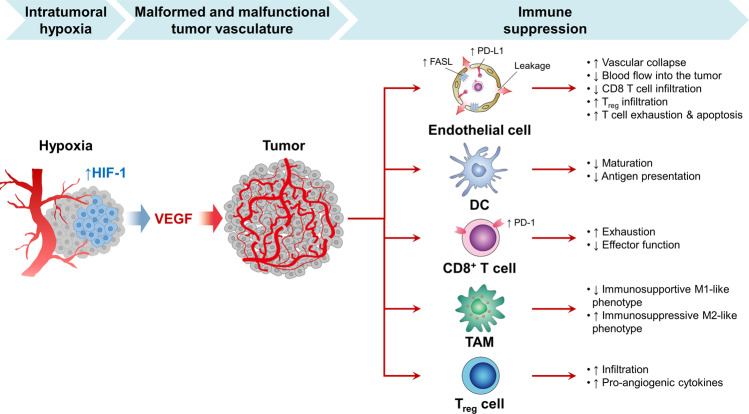
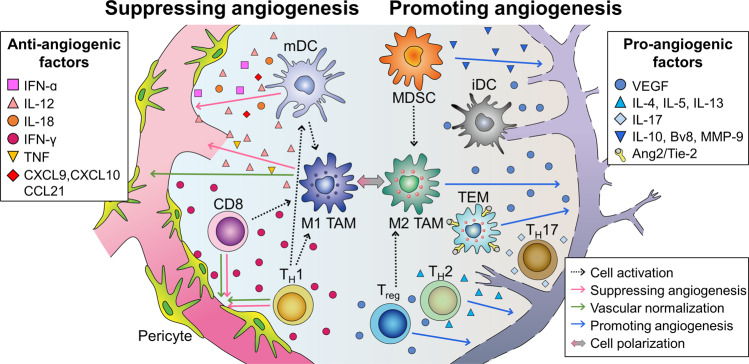
Cancer immunotherapy with immune checkpoint inhibitors (ICIs) has revolutionized the treatment of advanced cancers. However, the tumor microenvironment (TME) functions as a formidable barrier that severely impairs the efficacy of ICIs. While the crosstalk between tumor vessels and immune cells determines the nature of anti-tumor immunity, it is skewed toward a destructive cycle in growing tumors. First, the disorganized tumor vessels hinder CD8+T cell trafficking into the TME, disable effector functions, and even kill T cells. Moreover, VEGF, the key driver of angiogenesis, interferes with the maturation of dendritic cells, thereby suppressing T cell priming, and VEGF also induces TOX-mediated exhaustion of CD8+T cells. Meanwhile, a variety of innate and adaptive immune cells contribute to the malformation of tumor vessels. Protumoral M2-like macrophages as well as T H 2 and Treg cells secrete pro-angiogenic factors that accelerate uncontrolled angiogenesis and promote vascular immaturity. While CD8+T and CD4+T H 1 cells suppress angiogenesis and induce vascular maturation by secreting IFN-γ, they are unable to infiltrate the TME due to malformed tumor vessels. These findings led to preclinical studies that demonstrated that simultaneous targeting of tumor vessels and immunity is a viable strategy to normalize aberrant vascular-immune crosstalk and potentiate cancer immunotherapy. Furthermore, this combination strategy has been evidently demonstrated through recent pivotal clinical trials, granted approval from FDA, and is now being used in patients with kidney, liver, lung, or uterine cancer. Overall, combining anti-angiogenic therapy and ICI is a valid therapeutic strategy that can enhance cancer immunity and will further expand the landscape of cancer treatment.
Overview
The claims and statistics of this paper haven’t been checked yet.
Free: it reads the open-access text and checks the first 5 claims that cite a source we can check. Create a free account to check every claim.
Integrity signals
Registry
Cites
Statistics
Figures
Verification
Claims the paper makes
The claims and statistics of this paper haven’t been checked yet.
Free: it reads the open-access text and checks the first 5 claims that cite a source we can check. Create a free account to check every claim.
Self-check
Percentages, sums and reported differences re-computed from the paper’s own numbers.
The self-check needs the paper’s full text.
Citations
Cites
Cancer immunotherapy using checkpoint blockade
Ribas, A., & Wolchok, J. D. (2018) · Science · doi:10.1126/science.aar4060 · Cited by 6,791
Normalization of Tumor Vasculature: An Emerging Concept in Antiangiogenic Therapy
Jain, R. K. (2005) · Science · doi:10.1126/science.1104819 · Cited by 5,527
Macrophage Diversity Enhances Tumor Progression and Metastasis
Qian, B.-Z., & Pollard, J. W. (2010) · Cell · doi:10.1016/j.cell.2010.03.014 · Cited by 5,188
Interleukin-12 and the regulation of innate resistance and adaptive immunity
Trinchieri, G. (2003) · Nature Reviews Immunology · doi:10.1038/nri1001 · Cited by 3,927
Macrophage plasticity and interaction with lymphocyte subsets: cancer as a paradigm
Biswas, S. K., & Mantovani, A. (2010) · Nature Immunology · doi:10.1038/ni.1937 · Cited by 3,840
Atezolizumab for First-Line Treatment of Metastatic Nonsquamous NSCLC
Socinski, M. A., Jotte, R. M., Cappuzzo, F., Orlandi, F., Stroyakovskiy, D., Nogami, N., Rodríguez-Abreu, D., Moro-Sibilot, D., Thomas, C. A., Barlesi, F., et al. (2018) · New England Journal of Medicine · doi:10.1056/nejmoa1716948 · Cited by 3,733
Pembrolizumab plus axitinib versus sunitinib for advanced renal-cell carcinoma
Rini, B. I., Plimack, E. R., Stus, V., Gafanov, R., Hawkins, R., Nosov, D., Pouliot, F., Alekseev, B., Soulières, D., Melichar, B., et al. (2019) · New England Journal of Medicine · doi:10.1056/nejmoa1816714 · Cited by 3,403
Avelumab plus Axitinib versus Sunitinib for Advanced Renal-Cell Carcinoma
Motzer, R. J., Penkov, K., Haanen, J., Rini, B., Albiges, L., Campbell, M. T., Venugopal, B., Kollmannsberger, C., Negrier, S., Uemura, M., et al. (2019) · New England Journal of Medicine · doi:10.1056/nejmoa1816047 · Cited by 2,503
Macrophage plasticity and polarization in tissue repair and remodelling
Mantovani, A., Biswas, S. K., Galdiero, M. R., Sica, A., & Locati, M. (2013) · The Journal of Pathology · doi:10.1002/path.4133 · Cited by 2,384
Pàez-Ribes, M., Allen, E., Hudock, J., Takeda, T., Okuyama, H., Viñals, F., Inoue, M., Bergers, G., Hanahan, D., & Casanovas, O. (2009) · Cancer Cell · doi:10.1016/j.ccr.2009.01.027 · Cited by 2,339
Cited by
Items 501–600 of 796
CD8+ T cells in atherosclerosis and coronary artery disease
Tandon, I., yosri, M., Soliman, H., Khalifa, A. M., Ley, K. F., & Abdelsamed, H. A. (2026) · Nature Reviews Cardiology · doi:10.1038/s41569-026-01295-7 · Cited by 2
“Conversely, in mice with tumours or lung ischaemia, CD8 + T cell-derived IFNγ suppresses endothelial cell proliferation and promotes apoptosis, thereby inhibiting angiogenesis 274–276 .”
Liu, Z., Jiang, Y., Deng, Y., & Liu, J. (2025) · International Journal of Surgery · doi:10.1097/js9.0000000000004156 · Cited by 2
Ellert‐Miklaszewska, A., Pilanc, P., Poleszak, K., Roura, A.-J., Cyranowski, S., Ghosh, M., Baluszek, S., Pasierbińska, M., Gielniewski, B., Swatler, J., et al. (2024) · bioRxiv (Cold Spring Harbor Laboratory) · doi:10.1101/2024.08.06.606798 · Cited by 2
Jin, S.-M., & Chen, J. (2024) · Immunity Inflammation and Disease · doi:10.1002/iid3.1260 · Cited by 2
“8 Univariate Cox regression analysis was fulfilled to initially identify ICD genes associated with overall survival (OS) in CC.”
BackgroundInfluentialTakano, E. A., Jana, M. K., Gonzalez, L. E. L., Pang, J.-M. B., Salgado, R., Loi, S., & Fox, S. B. (2025) · PLoS ONE · doi:10.1371/journal.pone.0317331 · Cited by 2
Zhao, S., Liu, X., Tan, P., Mu, Y., Tan, S., & Hou, A. (2026) · Frontiers in Immunology · doi:10.3389/fimmu.2025.1747371 · Cited by 2
Tadic, S., García-Sanmartín, J., Narro-Íñiguez, J., & Martínez, A. (2025) · International Journal of Molecular Sciences · doi:10.3390/ijms262110745 · Cited by 2
Classes of therapeutics to amplify the immune response
Hu, Y., & Burkard, M. E. (2021) · Breast Cancer Research and Treatment · doi:10.1007/s10549-021-06369-3 · Cited by 2
Fang, X., Wang, F., Li, H., Xiao, P., Wang, M., Wu, N., Yao, X., & Shi, Y. (2026) · Cancer Letters · doi:10.1016/j.canlet.2026.218824 · Cited by 2
Ishii, S., Yamazaki, K., Li, P., Kubara, K., Ishizuka, Y., Izumi, Y., Kamisako, T., Ishizaki, H., Ono, Y., Mizuno, N., et al. (2025) · Scientific Reports · doi:10.1038/s41598-025-12571-w · Cited by 2
Go, E., Yang, H., Lee, S. J., Yang, H. G., Shin, J. A., Lee, W. S., Lim, H. S., Chon, H. J., & Kim, C. (2023) · OncoImmunology · doi:10.1080/2162402x.2023.2259212 · Cited by 2
“3,12,13,15 Therefore, future antiangiogenic drug development must be pursued in the context of cancer immunotherapy.”
BackgroundSelf-citationStrati, A. D., Zavridou, M., Papavassiliou, K. A., & Papavassiliou, A. G. (2025) · International Journal of Molecular Sciences · doi:10.3390/ijms262311304 · Cited by 2
“In this context, ctDNA detection of MIKI67 or CREBBP mutations in patients receiving combined antiangiogenic/ICI therapy has been associated with poorer PFS compared to mutation-negative cases [31].”
Park, S. J., Cho, Y. S., Lee, J.-H., Kim, S. Y., Byun, Y., Park, J., & Kim, H. R. (2025) · Journal of Controlled Release · doi:10.1016/j.jconrel.2025.114380 · Cited by 2
Rimini, M., Liscia, N., Burgio, V., & Gardini, A. C. (2022) · Expert Opinion on Investigational Drugs · doi:10.1080/13543784.2022.2053108 · Cited by 2
Ratka, Z., Gamian, A., & Woźniak, M. (2026) · International Journal of Molecular Sciences · doi:10.3390/ijms27114923 · Cited by 2
“Angiogenic and Immunosuppressive Signatures VEGF-driven angiogenesis contributes to immune exclusion and resistance to ICIs [69].”
Challenges to addressing the unmet medical needs for immunotherapy targeting cold colorectal cancer
Jeong, K. (2023) · World Journal of Gastrointestinal Oncology · doi:10.4251/wjgo.v15.i2.215 · Cited by 2
Zeng, L., Ruan, Z., Yan, H., Qin, H., Zeng, Z., Zou, C., Huang, Z., Jiang, W., Dai, J., Xu, S., et al. (2025) · Nature Communications · doi:10.1038/s41467-025-67262-x · Cited by 2
“By normalizing tumor vasculature and alleviating hypoxia-induced immune exclusion, VEGF inhibition through lenvatinib facilitates CD8 ⁺ T cell in fi ltration and activation, reduces immunosuppressive cell populations,and synergizes with ICIs to restore effective antitumor immunity 9,26,27 .”
Self-citationLi, M., Han, F., Ling, S., Su, X., Zhao, Y., Lv, S., & Zhang, X. (2026) · Immunity Inflammation and Disease · doi:10.1002/iid3.70408 · Cited by 2
Gao, M., Zhang, X., Yan, H., Zhao, Y., Yuan, F., Sun, D., Yang, X., Ju, Y., Wang, L., Tao, H., et al. (2025) · Therapeutic Advances in Medical Oncology · doi:10.1177/17588359241311058 · Cited by 2
“23 Thus, combining antiangiogenic TKIs with immunotherapy has been considered an exciting strategy in NSCLC.”
Zeng, Z., Huang, W., Zeng, F., Xiong, L., Liu, C., Chen, Z., Zheng, Y., Cai, J., Huang, L., Zhang, X., et al. (2026) · Clinical Cancer Research · doi:10.1158/1078-0432.ccr-25-4770 · Cited by 2
Procailo, K. M. (2021) · The American Journal of Managed Care · doi:10.37765/ajmc.2021.88770 · Cited by 2
Wang, H., Wang, X., Jiang, S., Zhu, J., Liu, J., Zhou, C., Zhu, Y., & Han, Y. P. (2022) · Frontiers in Oncology · doi:10.3389/fonc.2022.956372 · Cited by 2
“At the same time, various innate and acquired immune cells are involved in the formation of blood vessels in tumors, and immune checkpoint inhibitors can promote tumor vascular normalization (17).”
BackgroundWang, F., & Adjei, A. A. (2025) · Journal of Thoracic Oncology · doi:10.1016/j.jtho.2025.06.031 · Cited by 2
Lei, S., Tian, S., Lu, S., Zhou, Q., Long, J., Li, L., & Yang, D. (2024) · Anti-Cancer Agents in Medicinal Chemistry · doi:10.2174/0118715206294031240404071838 · Cited by 2
Role of Immunotherapy in Gastroesophageal Cancers—Advances, Challenges and Future Strategies
Lynch, E., Duffy, A. G., & Kelly, R. J. (2023) · Cancers · doi:10.3390/cancers15225401 · Cited by 2
Zou, H., Ge, Y., Chen, W., Yao, D., Ung, C. O. L., Lai, Y., & Hu, H. (2024) · International Immunopharmacology · doi:10.1016/j.intimp.2024.111947 · Cited by 2
Matsumoto, K., Naito, Y., Shiroyama, T., Tamiya, M., Nishino, K., Tamiya, A., Okishio, K., Kinehara, Y., Kuge, T., Mori, M., et al. (2026) · Cancer Science · doi:10.1111/cas.70336 · Cited by 2
Yuan, Z., Fang, K., Miao, X., Zhang, Y., Gu, M., Xu, W. L., Li, H., Zhu, D., Zhou, J., Sun, J., et al. (2025) · Clinical Epigenetics · doi:10.1186/s13148-025-01882-4 · Cited by 2
“Recent studies show that anti-PD-1 can also regulate VEGF and VEGFR expression indirectly through activated T cell-secreted cytokines (e.g., interferons, IL-2, IL-6, IL-12, TNF-α, TNF-β), which reduce VEGFA production and inhibit tumor angiogenesis [43].”
Shao, J., Na, J., Huang, H., Xiao, L., Dang, F., Zheng, R., Zhong, L., & Zhao, Y. (2026) · Cells · doi:10.3390/cells15040350 · Cited by 2
“Inhibiting angiogenesis in newly emerging liver cancer while promoting maturation of residual blood vessels, and weakening tumour blood supply, improves the tumour microenvironment and suppresses tumour dissemination [84].”
Xu, Q., Zhou, S., Zhang, C., Zhou, Y., He, Y., Jiang, Y., Li, J., Yi, T., Luo, C., Zhang, L., et al. (2026) · Journal of Hepatology · doi:10.1016/j.jhep.2026.06.033 · Cited by 2
[Chinese expert guidance on overall application of lenvatinib in hepatocellular carcinoma].
Yang, X., Sun, H., Xie, Q., Zhang, W. G., Jia, W., Zhao, M. D., Zhao, H. T., Liu, X. F., Zhou, L., Yan, S., et al. (2023) · PubMed Central · doi:10.3760/cma.j.cn115610-20230201-00035-1 · Cited by 2
Xia, J., He, T., Hu, Y., Zhou, D., Zou, D., Li, Y. M., Zhang, M., Li, B., Wang, M., Liu, X., et al. (2025) · Translational Cancer Research · doi:10.21037/tcr-2025-1182 · Cited by 2
“For instance, VEGF signaling can inhibit dendritic cell maturation and promote T-cell exhaustion, whereas JAK-STAT alterations may impair interferon-γ signaling and antigen presentation (32).”
From New Molecular Insights to New Treatment Options in Endometrial Cancer
Hasler-Strub, U. (2022) · healthbook TIMES Oncology Hematology · doi:10.36000//hbt.oh.2022.11.063 · Cited by 2
Prognostic Impact of Smoking on Bevacizumab Combination Chemotherapy for Advanced Breast Cancer
Takada, K., Kashiwagi, S., Iimori, N., Kouhashi, R., Yabumoto, A., Goto, W., Asano, Y., Tauchi, Y., Ogisawa, K., Morisaki, T., et al. (2023) · Anticancer Research · doi:10.21873/anticanres.16227 · Cited by 2
Tamura, K., Matsushita, Y., Watanabe, H., Yanagisawa, T., Mori, K., Morinaka, H., Bekku, K., Toyoda, S., Nukaya, T., Maenosono, R., et al. (2026) · International Journal of Urology · doi:10.1111/iju.70494 · Cited by 2
Wang, J., Luo, H., Yi, L., Yang, P., & Zeng, X. (2024) · Frontiers in Surgery · doi:10.3389/fsurg.2023.1340657 · Cited by 2
Zhang, P., Zhang, M., Wang, Y., Shen, L., & Lu, M. S. (2025) · International Journal of Cancer · doi:10.1002/ijc.70311 · Cited by 2
“22,23 Surufatinib, is a potent, selective, oral tyrosine kinase inhibitor of VEGFR1-3, FGFR1, and CSF-1R.”
Liu, J., Gao, T., Tan, Z., Li, S., Xu, J., Bai, C., Xue, R., Xie, L., Zhang, L., Fan, Z., et al. (2023) · doi:10.1158/1078-0432.c.6532382 · Cited by 2
Kim, W., Kim, J. E., Hong, Y. S., Hwang, D. W., Kim, J., Lee, J. S., Shin, J.-H., Kim, T. W., Nagarkar, D., Byrd, A. L., et al. (2026) · Genome Medicine · doi:10.1186/s13073-026-01680-4 · Cited by 1
“…is important to overcome ICI resistance in MSS CRC. Blockade of vascular endothelial growth factor (VEGF) with PD-1/PD-L1 has been established as an effective combination strategy in kidney and liver cancer [10], and an anti-VEGF antibody, bevacizumab, is also an essential therapeutic agent in CRC.”
Li, Z., Xiong, M., Xiang, Y., Yang, G., & Xiong, Y. (2026) · World Journal of Surgical Oncology · doi:10.1186/s12957-026-04198-6 · Cited by 1
“Additionally, concurrent therapy can induce tumor necrosis or rapid tumor shrinkage, reduce hepatic tumor burden, and further prolong patient survival [5, 25].”
Lu, X., Zhao, G., Tang, Y., Li, F., & Cheng, M. M. H. (2026) · Current Proteomics · doi:10.1016/j.curpro.2026.100139 · Cited by 1
Role of NK Cells in Progression and Treatment of Multiple Myeloma
Chanchiri, I., Christensen, E. B., Abildgaard, N., Barington, T., Lund, T., & Krejcik, J. (2025) · Frontiers in Bioscience-Landmark · doi:10.31083/fbl26205 · Cited by 1
Cancer Cell-Intrinsic Programs That Shape Tumor Immune Ecosystems
Wang, L., Guo, Y., Ma, L., & Miao, K. (2026) · Cancer Biome and Targeted Therapy · doi:10.66505/cbtt.v1i2.33 · Cited by 1
Zhao, R., Chang, L., Zhang, C., He, R., & Wei, X. (2025) · Frontiers in Oncology · doi:10.3389/fonc.2025.1518987 · Cited by 1
Ji, Z., Ding, F., Li, J., Cao, R., Wang, H., Meng, Z., Guo, Z., & Zhao, Y. (2025) · Hepatitis Monthly · doi:10.5812/hepatmon-145022 · Cited by 1
Liu, T., Gao, X., Geng, C., Yao, Y., & Zhang, G.-M. (2025) · World Journal of Surgical Oncology · doi:10.1186/s12957-025-03981-1 · Cited by 1
“Despite the substantial improvement in prognosis that ICIs can offer to patients with advanced cancer, only 20–30% of patients respond to these therapies [31].”
Ran, L., Hu, G., Fan, C., Teng, Y., Zhao, R., Li, Q., Yang, J., & Zhang, C. (2026) · Frontiers in Immunology · doi:10.3389/fimmu.2026.1774959 · Cited by 1
“Therefore, combining ICIs with anti-VEGF agents can ‘ normalize ’ the tumor vasculature, thereby improving perfusion and oxygenation of the TME and facilitating T cell in fi ltration (78 – 80).”
Co-targeting hallmarks of cancer for therapeutic benefit in ovarian cancer: a scoping review
Iacobelli, V., Camarda, F., Anderson, G., Buttarelli, M., Mastrantoni, L., Ferrara, M. G., Trozzi, R., Duranti, S., Salutari, V., Sabetta, G., et al. (2026) · International Journal of Gynecological Cancer · doi:10.1016/j.ijgc.2026.104651 · Cited by 1
Rangel, A. R., Chagas, G. C. L., Chagas, R. C. L., & Osta, B. E. E. (2025) · JCO Oncology Practice · doi:10.1200/op-25-00936 · Cited by 1
Systemic Therapies for the Treatment of Renal Cell Carcinoma
Gowda, S., & Mathew, P. F. (2025) · Springer eBooks · doi:10.1007/978-3-031-97599-8_22 · Cited by 1
Liang, X.-X., Liu, Q., Yao, W., & Zhu, S. (2022) · Frontiers in Oncology · doi:10.3389/fonc.2022.941454 · Cited by 1
“A time course of the entire case is shown in (H). frontiersin.org potentiate the function of Tregs, MDSCs, andM2-type TAMs (13).”
BackgroundInfluentialImmune remodeling of liver metastases: From molecular mechanisms to therapeutic strategies
Xu, W., Liu, J., Zhou, L., & Guo, J. (2026) · Biochimica et Biophysica Acta (BBA) - Reviews on Cancer · doi:10.1016/j.bbcan.2026.189618 · Cited by 1
Chung, B.-S., Lin, P., Chen, S., & Yeh, Y. (2023) · Journal of Cancer Research and Practice · doi:10.4103/ejcrp.ejcrp-d-23-00016 · Cited by 1
Tojjari, A., Park, R., Yu, J. B., & Saeed, A. (2024) · Current Gastroenterology Reports · doi:10.1007/s11894-024-00920-0 · Cited by 1
“The synergistic impact of antiangiogenic therapy in concert with ICIs, pivotal in TME modulation, has been evidenced in preclinical studies to facilitate better T-cell activity and overall immune response, corroborated by clinical trials and FDA approval for various cancer treatments [31].”
Yang, C., Wu, Y., Yang, J., & Xiang, Y. (2026) · Cancers · doi:10.3390/cancers18172771 · Cited by 1
“…IMagyn050 illustrates that the same broad mechanistic rationale—vascular normalization combined with checkpoint blockade—does not translate uniformly across tumor lineages, emphasizing the importance of disease-specific immune architecture, biomarker context, and treatment backbone [8,86,87,122].”
InfluentialSignaling Pathways as Drivers of Immunotherapy Resistance to Checkpoint Inhibitors (A Review)
Kanaan, M. H. G., Tarek, A. M., Lee, B.-J., Abdullah, S. S., Park, C., & Marianne, M. (2026) · Cell and Tissue Biology · doi:10.1134/s1990519x26600067 · Cited by 1
Asleh, K., Bethune, G. C., & Marcato, P. (2025) · Scientific Reports · doi:10.1038/s41598-025-28810-z · Cited by 1
Sun, L., Zhao, Q., & Miao, L. (2026) · Frontiers in Immunology · doi:10.3389/fimmu.2025.1707183 · Cited by 1
“For instance, anti-angiogenic drugs (such as bevacizumab) can improve tumor vascular function, promote T-cell in fi ltration into tumors, and reduce immunosuppression (78, 79).”
Wu, F., Feng, J., Wang, H., Wang, S., Cui, X., Liu, Y., Yan, L., Ye, K., Thorne, R. F., Zhang, X. D., et al. (2025) · Frontiers in Immunology · doi:10.3389/fimmu.2025.1541209 · Cited by 1
Checkpoint inhibitors in a marriage: consented or arranged?
Brest, P., Refae, S., Mograbi, B., Ferrero, J.-M., Bontoux, C., Hofman, P. M., & Milano, G. A. (2022) · British Journal of Cancer · doi:10.1038/s41416-022-01820-8 · Cited by 1
“Disorganised tumour endothelial cells present a biochemical obstacle to the passage of CD8+ T cells in the tumour microenvironment, a local immune deficiency phenomenon that is exacerbated by hypoxia-induced depletion of this immune cell category [2].”
BackgroundEffects of PELP1 on proliferation, metastasis and angiogenesis of epithelial ovarian cancer
Xie, L., Sun, C. M., Mao, Y., Huang, X., Yang, X. Y., Huang, J., Zhang, Y., Li, C., Yang, W., Zhang, W., et al. (2025) · Medical Oncology · doi:10.1007/s12032-025-02908-w · Cited by 1
“Moreover, the vascular structures in solid tumors are markedly different from those in normal tissues [10, 11], resulting in impaired immune cell infiltration and reduced cytotoxic activity [12].”
Research Progress in the Regulation of Tumor Microenvironment for Vascular Normalization
李, 璐. (2023) · Advances in Clinical Medicine · doi:10.12677/acm.2023.134883 · Cited by 1
The vascular niche: an orchestrator of the spatiotemporal dynamics of distant metastasis
Miao, Q., Chen, R., Zhang, D.-M., Zhang, J.-Q., & Chen, M.-F. (2026) · Acta Pharmacologica Sinica · doi:10.1038/s41401-026-01820-x · Cited by 1
“Speci fi cally, by promoting vascular normalization and reducing endothelial fragility, AATs can reinforce the vascular barrier, thereby preventing cancer cell intravasation and enhancing the recruitment of immune cells via checkpoint inhibitors (ICIs) [155].”
Chung, Y. E., Kim, S. I., Noh, J. J., Lee, J., & Lee, Y. J. (2025) · Gynecologic Oncology · doi:10.1016/j.ygyno.2025.10.040 · Cited by 1
Li, P., Xu, J., Zhang, S., Li, P., Chen, F., & Zhu, L. (2026) · Journal of Radiation Research and Applied Sciences · doi:10.1016/j.jrras.2026.102226 · Cited by 1
Yu, S., Li, H., Lu, H., Huang, Z., Chen, K., Xu, Y., Gong, L., Xie, F., Qin, J., Yu, X., et al. (2025) · International Journal of Cancer · doi:10.1002/ijc.70224 · Cited by 1
Paving the Way for Cancer Therapy a Nano Step at a Time
Venkatesh, D., & Merghoub, T. (2023) · Journal of Pharmacology and Experimental Therapeutics · doi:10.1124/jpet.122.001514 · Cited by 1
“In turn, this immune milieu further upregulates the production of angiogenesis-promoting molecules such as the vascular endothelial growth factor (VEGF), thus creating a vicious circle (Lee et al., 2020).”
BackgroundSu, Y., Liang, Y., Zhong, D., Chen, Y., Shuoshuo, M. A., Wang, M., Yang, Q., Yan, H., & Huang, X. (2026) · Frontiers in Immunology · doi:10.3389/fimmu.2026.1808956 · Cited by 1
Boucher, P., Oliveira, M. D. C., Levesque, A., Rutault, A., Savoyaud, P., Bréchot, N., & Germain, S. (2026) · British Journal of Pharmacology · doi:10.1111/bph.70505 · Cited by 1
Shen, X., Zhang, Y., Shan, M., Kou, Y., Jia, X., Yang, M., Yu, C., Li, J., guo, P., li, J., et al. (2026) · Biomaterials Research · doi:10.34133/bmr.0398 · Cited by 1
“Thus, combining vascular normalization with cytotoxic and immunostimulatory therapies represents a promising strategy for TNBC treatment [ 18 – 20 ].”
Zhang, J., Lv, P.-Y., Zhao, X. Q., Liu, M., Qiu, L.-P., Yang, Z., Sun, S., & Zhang, G. (2024) · BMC Cancer · doi:10.1186/s12885-024-12708-6 · Cited by 1
“The synergistic action of chemo-immunotherapy with anti-angiogenic therapy may further improve the prognosis of patients with NSCLC [21, 22].”
BackgroundBao, H., Zhang, J., Wang, Y., Chen, Z., Luo, X., Li, T., Su, H., Bao, H., Cao, X., & Lin, L. (2024) · Frontiers in Pharmacology · doi:10.3389/fphar.2024.1448291 · Cited by 1
Zhao, J., Wang, Y.-S., Gu, H.-Y., Meng, Z.-N., Wang, F., Wu, G., & Zheng, A.-H. (2023) · Medicine · doi:10.1097/md.0000000000035243 · Cited by 1
“Tumor immune environment is more significantly reprogrammed than the systemic immune system by antiangiogenic therapy, [44] which might explain why these cytokines in peripheral blood were not significantly changed by EIC.”
BackgroundQin, H., Yan, H., Zhang, X. Y., Huang, Z., Chen, Y., Zhang, Y., Xiang, S., Zhang, Y., Yang, N., & Zeng, L. (2024) · Frontiers in Oncology · doi:10.3389/fonc.2024.1390299 · Cited by 1
Razavi, A., Mojtahedi, H., Aghakhani, F., Khani, H. H. K., Rezaei, R., & Amani, D. (2026) · PubMed Central · doi:10.22038/ijbms.2025.90209.19446 · Cited by 1
Vaccination against tumour endothelial marker Robo4 inhibits tumour growth
Escobar-Riquelme, F., Kara, M. A., Price, M. J., Hidalgo-Gajardo, A., Carr, H. L., Bending, D., Bicknell, R., Savelyeva, N., Toellner, K., & Zhang, Y. (2025) · Immunotherapy Advances · doi:10.1093/immadv/ltag005 · Cited by 1
Jin, Y., Fu, L., Leng, X., & Tan, Y. (2026) · Frontiers in Immunology · doi:10.3389/fimmu.2026.1802283 · Cited by 1
Immunotherapy of Biliary Tract Cancer
Mertens, J. C., & Fritsch, R. (2023) · Cancer immunotherapy · doi:10.1007/13905_2022_35 · Cited by 1
Aref, M. M. A., Mohamed, A. A., Dahab, M. A., Ibrahim, T. M., Alnami, A. T., Gomaa, H. A. M., Elaraby, A. R., Abdelhamed, M. N., & El‐Zahabi, M. A. (2026) · Journal of Molecular Structure · doi:10.1016/j.molstruc.2026.147399 · Cited by 1
Pourmir, I. (2024) · theses.fr (ABES) · doi:10.70675/f4bbfcecze9fcz4fc6z8866z55483a6d8657 · Cited by 1
Zhao, Y., Li, L., Zhang, B., Li, B., & Zhou, W. (2026) · Advances in Clinical and Experimental Medicine · doi:10.17219/acem/208178 · Cited by 1
Karaman, S., ElGindi, M., & Teo, J. C. M. (2026) · Advanced NanoBiomed Research · doi:10.1002/anbr.202500220 · Cited by 1
Effect of baseline cancer pain on the efficacy of immunotherapy in lung cancer patients
Zhou, H., Wei, J., Sun, W. Y., & Song, Z. (2023) · Journal of Thoracic Disease · doi:10.21037/jtd-23-375 · Cited by 1
“However, only 20% to 30% of patients benefit from ICI monotherapy (13,14).”
BackgroundFang, Y., Zou, W., Ning, L., Li, T., Huang, Y., Song, X., Gao, M., Jia, R., Zhu, M., Qiu, W., et al. (2026) · International Journal of Biological Sciences · doi:10.7150/ijbs.131425 · Cited by 1
“⁺ Conversely, vascular normalization reverses these deficits, enhancing immune cell infiltration, bolstering immunotherapeutic responses, and maximizing drug delivery efficiency [52].”
Wang, B., Yin, H., Liu, J., Zhang, X., Zhuo, H., Jiang, Y., & Deng, Y. (2023) · Frontiers in Pharmacology · doi:10.3389/fphar.2023.1239699 · Cited by 1
Tumor-Infiltrating Lymphocytes (TILs) and Gynecological Cancers
Melli, B., Sileo, F. G., Palicelli, A., Kuhn, E., Nardi, V., & Mandato, V. D. (2023) · Interdisciplinary cancer research · doi:10.1007/16833_2023_161 · Cited by 1
Oncologic strategies and options for the management of metastatic thymic carcinoma
Maniar, R., & Loehrer, P. J. (2026) · Mediastinum · doi:10.21037/med-25-38 · Cited by 1
“The combination of anti-angiogenic agents and ICB was explored due to their synergistic effects on tumor immunity, including enhanced T cell trafficking, dendritic cell activation, and reduction of immunosuppressive cells (82).”
Immuno-oncologic profiling of renal masses using multiparametric MRI: a pilot study
Liu, M., Bane, O., Mu, X., Al-Mubarak, H. F. I., Abboud, G., Reddy, A., Kennedy, P., Robson, P. M., Meilika, K., Zuluaga, L., et al. (2025) · Journal for ImmunoTherapy of Cancer · doi:10.1136/jitc-2025-012833 · Cited by 1
“31 Furthermore, recent evidence shows that change in tumor hypoxia and metabolism due to cellular proliferation may influence the dysregulated immune response in ccRCC and subsequently the immunotherapy response.”
Metabolic-Immune Coupling in Urologic Cancers: Macrophage Reprogramming as a Therapeutic Nexus
Huang, W., Li, W., Shangguan, W., Yang, L., Li, Z., Sun, B., Ma, C., Yang, X., Peng, P., Zhao, J., et al. (2026) · International Journal of Biological Sciences · doi:10.7150/ijbs.127634 · Cited by 1
“Targeting upstream HIF, hypoxia also enhances immune suppression and sustains TAM programs that promote aberrant vasculature, providing a mechanistic rationale to pair HIF-2 α blockade with PD-1/PD-L1 inhibitors [136-138] .”
Reck, M., Syrigos, K. N., Miliauskas, S., Westeinde, S. C. V. ‘., Massutí, B., Buchner, H., Salnikov, A. V., Lorence, R. M., Ellingboe, A.-M., Kitzing, T. M., et al. (2024) · Translational Lung Cancer Research · doi:10.21037/tlcr-24-326 · Cited by 1
“Indeed, there is biological rationale for assessing regimens that incorporate both immunotherapy and anti-angiogenics due to angiogenesis and immunosuppression being interconnected biological processes (8,9).”
Ozaki, Y., Koyama, S., Morita, S., Miyashita, M., Tokuda, E., Shimoi, T., FUKUOKA, M., Masuda, H., Takano, Y., Shibata, N., et al. (2026) · BMJ Open · doi:10.1136/bmjopen-2024-098088 · Cited by 1
“12 16–18 VEGF is also known to increase immunosuppressive cells (eg, regulatory T cells and myeloid-derived suppressor cells) 19 20 ; the high levels of VEGF observed in liver metastases are considered to induce immunosuppression through these suppressive cells.”
Etv2/Myct1 axis in the regulation of tumor angiogenesis and anti-tumor immunity
Kabir, A. U. (2021) · Open Scholarship Institutional Repository (Washington University in St. Louis) · doi:10.7936/hnhj-tq12 · Cited by 1
Civita, M. A. D., Marinelli, D., Michetti, V. M., Artemi, A., Ballario, A., Torchia, A., Pappalardo, L., Pecoraro, M., Speranza, I., Sciarra, A., et al. (2026) · BMC Cancer · doi:10.1186/s12885-025-15462-5 · Cited by 1
“However, the immunostimulatory role of anti-VEGF therapy—enhancing T-cell recruitment, increasing T-cell infiltration in the tumor micro-environment, and normalizing tumor blood vessels [23, 24]—supports the consideration of ICI and anti-VEGF TKI combinations as a compelling therapeutic option.”
Yang, M., Liu, J., Li, Y., Zuo, L., & Liu, H. (2026) · Biochemical Pharmacology · doi:10.1016/j.bcp.2026.118105 · Cited by 1
Liu, X., Liu, T., Sun, Z., Maimaitiming, N., Liu, H., Kong, D., Wang, Y., Cai, J., & Zhao, H. (2026) · American Journal of Cancer Research · doi:10.62347/cmzb1297 · Cited by 1
Anlotinib inhibits esophageal cancer malignancy by ameliorating the immune microenvironment
Zhao, M., Yuan, L., Xi, H., Chunjun, X., Xiaoyi, S., Lingyun, M., Junchang, Y., & Wenyue, Y. (2026) · Discover Oncology · doi:10.1007/s12672-026-04457-8 · Cited by 1
Liu, X., & Xu, S.-Y. (2026) · Current Problems in Cancer Case Reports · doi:10.1016/j.cpccr.2026.100420 · Cited by 1
Wu, Y., Li, H., Peng, Y., & Fan, W. (2026) · Frontiers in Immunology · doi:10.3389/fimmu.2026.1807865 · Cited by 1
Choi, J., Yun, C., Maeng, S., Kim, Y., Park, E., Yi, J., Choi, S. Y., Chang, I. H., & Yoon, A. R. (2026) · Molecular Medicine · doi:10.1186/s10020-026-01535-z · Cited by 1
Metadata
- Authors
- Lee, W. S., Yang, H., Chon, H. J., & Kim, C.
- Affiliations
- CHA University Bundang Medical Center (KR)
- Corresponding author
- Chon, Hong Jae
- Kim, Chan
- Venue
- Experimental & Molecular Medicine
- Published
- 2020-09
- Volume
- 52
- Issue
- 9
- Pages
- 1475-1485
- ISSN
- 1226-3613 (ISSN-L)
- 2092-6413
- PMC
- PMC8080646
- OpenAlex
- W3084409519
- Cited by
- 796
- References
- 99
- Citations by year
- 2026: 154 · 2025: 187 · 2024: 128 · 2023: 137 · 2022: 123 · 2021: 63 · 2020: 4
- FWCI
- 8.94
- Type
- journal article
- Language
- en
- Open access
- gold
- doi.org
- Licence
- cc-by
- creativecommons.org/licenses/by/4.0 (tdm)
- creativecommons.org/licenses/by/4.0 (vor, 10 d)
- Locations
- Experimental & Molecular Medicine (publishedVersion, cc-by)
- PubMed Central (publishedVersion, cc-by)
- PubMed (publishedVersion)
- DOAJ (DOAJ: Directory of Open Access Journals) (submittedVersion)
- Funders
- National Research Foundation
- National Research Foundation of Korea (NRF-2020R1C1C1010722, 2020R1C1C1010722, NRF-2020R1A2C2004530, 2020R1A2C2004530)
- Ministry of Science and ICT, South Korea
- Topics
- Health Sciences › Medicine › Oncology › Cancer Immunotherapy and Biomarkers
- Life Sciences › Biochemistry, Genetics and Molecular Biology › Molecular Biology › Angiogenesis and VEGF in Cancer
- Life Sciences › Immunology and Microbiology › Immunology › Immunotherapy and Immune Responses
- Keywords
- anti-angiogenic therapy, immune checkpoint inhibitors, tumor microenvironment, tumor angiogenesis, vascular endothelial growth factor, CD8+ T cell exhaustion, dendritic cell maturation, M2 macrophages, regulatory T cells, Th2 cells, vascular normalization, cancer immunotherapy, combination therapy, interferon-gamma
- MeSH terms
- Immune Checkpoint Inhibitors, Animals, Antineoplastic Combined Chemotherapy Protocols, Cell Communication, Humans, Neoplasms, Neovascularization, Pathologic, Signal Transduction, Treatment Outcome, Angiogenesis Inhibitors, Immunomodulation, Molecular Targeted Therapy, Tumor Microenvironment
About these checks
Registry, retraction, Cites and statistics results are computed, not judged, with one exception: a printed reference that no index lists is read once by a model before it counts as a citation error. Claims are extracted by a model and kept only when their quote appears verbatim in the text; each cited source is then checked, with a model’s help, for whether it says what the claim relies on. Those verdicts can be wrong — read the claim’s quote and the cited source before relying on one.
Statistics and arithmetic are recomputed, not judged.
Confidence bands are shown only for fields calibrated on our annotated test set. None is calibrated yet, so no band is shown.
What counts as a claim ›How we measure confidence ›How we check this ›
Are you an author, or do you see a problem with this page? Request a review
Data sources
Bibliographic data: Semantic Scholar, OpenAlex, Crossref.
Contains information from the Semantic Scholar Academic Graph Datasets, made available under the ODC Attribution License (ODC-BY 1.0).
Semantic Scholar’s data is described in: Kinney, R., et al. (2023). The Semantic Scholar Open Data Platform. arXiv:2301.10140.
