

On the origin and evolution of SARS-CoV-2
Open accessThe DOI matches its Crossref record; 66 of the 66 references it cites were found in a registry or an index.
Abstract
The severe acute respiratory syndrome coronavirus 2 (SARS-CoV-2) is responsible for the ongoing global outbreak of a coronavirus disease (herein referred to as COVID-19). Other viruses in the same phylogenetic group have been responsible for previous regional outbreaks, including SARS and MERS. SARS-CoV-2 has a zoonotic origin, similar to the causative viruses of these previous outbreaks. The repetitive introduction of animal viruses into human populations resulting in disease outbreaks suggests that similar future epidemics are inevitable. Therefore, understanding the molecular origin and ongoing evolution of SARS-CoV-2 will provide critical insights for preparing for and preventing future outbreaks. A key feature of SARS-CoV-2 is its propensity for genetic recombination across host species boundaries. Consequently, the genome of SARS-CoV-2 harbors signatures of multiple recombination events, likely encompassing multiple species and broad geographic regions. Other regions of the SARS-CoV-2 genome show the impact of purifying selection. The spike (S) protein of SARS-CoV-2, which enables the virus to enter host cells, exhibits signatures of both purifying selection and ancestral recombination events, leading to an effective S protein capable of infecting human and many other mammalian cells. The global spread and explosive growth of the SARS-CoV-2 population (within human hosts) has contributed additional mutational variability into this genome, increasing opportunities for future recombination.
Overview
The claims and statistics of this paper haven’t been checked yet.
Free: it reads the open-access text and checks the first 5 claims that cite a source we can check. Create a free account to check every claim.
Integrity signals
Registry
Cites
Statistics
Figures
Verification
Claims the paper makes
The claims and statistics of this paper haven’t been checked yet.
Free: it reads the open-access text and checks the first 5 claims that cite a source we can check. Create a free account to check every claim.
Claims other papers make about this one
Each is checked against this paper’s own text: does it say what the citing paper says it does?
The source backs part of the claim, not all of it — or backs it for a different population, condition or comparison.
In the citing paper
“The mutations in the spike protein such as deletions, substitutions, and recombinations mainly in RBD can virtually create a highly lethal variant to a highly transmissible one, possibly due to the alteration in ACE-2 binding affinity [34].”
From Waves and variants of SARS-CoV-2: understanding the causes and effect of the COVID-19 catastrophe (2022) · cites this paper as [34]
Experimental — accuracy not yet measured
Self-check
Percentages, sums and reported differences re-computed from the paper’s own numbers.
The self-check needs the paper’s full text.
Citations
Cites
1 retracted
Woo, P. C. Y., Lau, S. K. P., Lam, C. S. F., Tsang, A. K. L., Hui, S., Fan, R. Y. Y., Martelli, P. R., & Yuen, K. (2013) · Journal of Virology · doi:10.1128/jvi.02351-13 · Cited by 177
RetractedA pneumonia outbreak associated with a new coronavirus of probable bat origin
Zhou, P., Yang, X.-L., Wang, X.-G., Hu, B., Zhang, L., Zhang, W., Si, H.-R., Zhu, Y., Li, B., Huang, C.-L., et al. (2020) · Nature · doi:10.1038/s41586-020-2012-7 · Cited by 21,969
Hoffmann, M., Kleine-Weber, H., Schroeder, S., Krüger, N., Herrler, T., Erichsen, S., Schiergens, T. S., Herrler, G., Wu, N.-H., Nitsche, A., et al. (2020) · Cell · doi:10.1016/j.cell.2020.02.052 · Cited by 20,286
Molecular Evolutionary Genetics
Nei, M. (1987) · Columbia University Press eBooks · doi:10.7312/nei-92038 · Cited by 15,271
SWISS-MODEL: homology modelling of protein structures and complexes
Waterhouse, A., Bertoni, M., Bienert, S., Studer, G., Tauriello, G., Gumienny, R., Heer, F. T., de Beer, T. A. P., Rempfer, C., Bordoli, L., et al. (2018) · Nucleic Acids Research · doi:10.1093/nar/gky427 · Cited by 13,067
Lu, R., Zhao, X., Li, J., Niu, P., Yang, B., Wu, H., Wang, W., Song, H., Huang, B., Zhu, N., et al. (2020) · The Lancet · doi:10.1016/s0140-6736(20)30251-8 · Cited by 11,907
Cryo-EM structure of the 2019-nCoV spike in the prefusion conformation
Wrapp, D., Wang, N., Corbett, K. S., Goldsmith, J. A., Hsieh, C.-L., Abiona, O., Graham, B. S., & McLellan, J. S. (2020) · Science · doi:10.1126/science.abb2507 · Cited by 8,897
Angiotensin-converting enzyme 2 is a functional receptor for the SARS coronavirus
Li, W., Moore, M. J., Vasilieva, N., Sui, J., Wong, S. K., Berne, M. A., Somasundaran, M., Sullivan, J. L., Luzuriaga, K., Greenough, T. C., et al. (2003) · Nature · doi:10.1038/nature02145 · Cited by 5,923
Origin and evolution of pathogenic coronaviruses
Cui, J., Li, F., & Shi, Z.-L. (2019) · Nature Reviews Microbiology · doi:10.1038/s41579-018-0118-9 · Cited by 5,515
The proximal origin of SARS-CoV-2
Andersen, K. G., Rambaut, A., Lipkin, W. I., Holmes, E. C., & Garry, R. F. (2020) · Nature Medicine · doi:10.1038/s41591-020-0820-9 · Cited by 5,081
Wan, Y., Shang, J., Graham, R., Baric, R. S., & Li, F. (2020) · Journal of Virology · doi:10.1128/jvi.00127-20 · Cited by 4,341
Korber, B., Fischer, W. M., Gnanakaran, S., Yoon, H., Theiler, J., Abfalterer, W., Hengartner, N., Giorgi, E. E., Bhattacharya, T., Foley, B., et al. (2020) · Cell · doi:10.1016/j.cell.2020.06.043 · Cited by 4,281
Structural basis of receptor recognition by SARS-CoV-2
Shang, J., Ye, G., Shi, K., Wan, Y., Luo, C., Aihara, H., Geng, Q., Auerbach, A., & Li, F. (2020) · Nature · doi:10.1038/s41586-020-2179-y · Cited by 3,661
Structure, Function, and Evolution of Coronavirus Spike Proteins
Li, F. (2016) · Annual Review of Virology · doi:10.1146/annurev-virology-110615-042301 · Cited by 2,740
Initial sequence of the chimpanzee genome and comparison with the human genome
The Chimpanzee Sequencing and Analysis Consortium (2005) · Nature · doi:10.1038/nature04072 · Cited by 2,459
Huang, Y., Yang, C., Xu, X.-F., Xu, W., & Liu, S.-W. (2020) · Acta Pharmacologica Sinica · doi:10.1038/s41401-020-0485-4 · Cited by 2,224
The Architecture of SARS-CoV-2 Transcriptome
Kim, D., Lee, J.-Y., Yang, J.-S., Kim, J. W., Kim, V. N., & Chang, H. (2020) · Cell · doi:10.1016/j.cell.2020.04.011 · Cited by 2,123
Identifying SARS-CoV-2-related coronaviruses in Malayan pangolins
Lam, T. T.-Y., Jia, N., Zhang, Y.-W., Shum, M. H.-H., Jiang, J.-F., Zhu, H.-C., Tong, Y.-G., Shi, Y.-X., Ni, X.-B., Liao, Y.-S., et al. (2020) · Nature · doi:10.1038/s41586-020-2169-0 · Cited by 1,877 · cited 2×
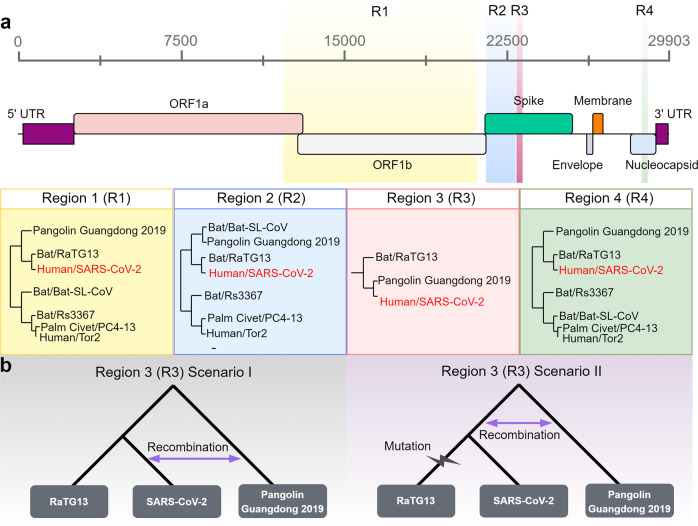
“For regions 1, 2, and 3, phylogenetic relationships were obtained from Lam et al.32; for region 4, phylogenetic relationships were obtained from Boni et al.28.”
MethodIsolation and characterization of a bat SARS-like coronavirus that uses the ACE2 receptor
Ge, X.-Y., Li, J.-L., Yang, X.-L., Chmura, A. A., Zhu, G., Epstein, J. H., Mazet, J. K., Hu, B., Zhang, W., Peng, C., et al. (2013) · Nature · doi:10.1038/nature12711 · Cited by 1,778
Woo, P. C. Y., Lau, S. K. P., Lam, C. S. F., Lau, C. C. Y., Tsang, A. K. L., Lau, J. H. N., Bai, R., Teng, J. L. L., Tsang, C. C. C., Wang, M., et al. (2012) · Journal of Virology · doi:10.1128/jvi.06540-11 · Cited by 1,677 · cited 1×
“The phylogenetic relationships established by Woo et al.(4) were used to draw the figure.”
MethodOn the origin and continuing evolution of SARS-CoV-2
Tang, X., Wu, C., Li, X., Song, Y., Yao, X., Wu, X., Duan, Y., Zhang, H., Wang, Y., Qian, Z., et al. (2020) · National Science Review · doi:10.1093/nsr/nwaa036 · Cited by 1,616 · cited 6×
“also identified three positively selected positions in the RBD of the S protein, although only one of them overlapped with the positively selected sites identified by Tang et al.(27).”
BackgroundInfluentialSpike mutation D614G alters SARS-CoV-2 fitness
Plante, J. A., Liu, Y., Liu, J., Xia, H., Johnson, B. A., Lokugamage, K. G., Zhang, X., Muruato, A. E., Zou, J., Fontes-Garfias, C. R., et al. (2021) · Nature · doi:10.1038/s41586-020-2895-3 · Cited by 1,558
Yang, Z. (1998) · Molecular Biology and Evolution · doi:10.1093/oxfordjournals.molbev.a025957 · Cited by 1,457
SARS-CoV-2 spike-protein D614G mutation increases virion spike density and infectivity
Zhang, L., Jackson, C. B., Mou, H., Ojha, A., Peng, H., Quinlan, B. D., Rangarajan, E. S., Pan, A., Vanderheiden, A., Suthar, M. S., et al. (2020) · Nature Communications · doi:10.1038/s41467-020-19808-4 · Cited by 1,387
The Molecular Biology of Coronaviruses
Lai, M. M. C., & Cavanagh, D. (1997) · Advances in Virus Research · doi:10.1016/s0065-3527(08)60286-9 · Cited by 1,143
Transmission of SARS-CoV-2 on mink farms between humans and mink and back to humans
Oude Munnink, B. B., Sikkema, R. S., Nieuwenhuijse, D. F., Molenaar, R. J., Munger, E., Molenkamp, R., van der Spek, A., Tolsma, P., Rietveld, A., Brouwer, M., et al. (2021) · Science · doi:10.1126/science.abe5901 · Cited by 1,117
King, A. M. Q., Lefkowitz, E. J., Mushegian, A. R., Adams, M. J., Dutilh, B. E., Gorbalenya, A. E., Harrach, B., Harrison, R. L., Junglen, S., Knowles, N. J., et al. (2018) · Archives of Virology · doi:10.1007/s00705-018-3847-1 · Cited by 1,078
Evolutionary origins of the SARS-CoV-2 sarbecovirus lineage responsible for the COVID-19 pandemic
Boni, M. F., Lemey, P., Jiang, X., Lam, T. T.-Y., Perry, B. W., Castoe, T. A., Rambaut, A., & Robertson, D. L. (2020) · Nature Microbiology · doi:10.1038/s41564-020-0771-4 · Cited by 1,014 · cited 8×
“For example, upon comparing the genome sequences of 68 Sarbecovirus strains, including SARS-CoV-2, Boni et al.28 detected numerous recombination breakpoints in the data.”
BackgroundMethodResultInfluentialHosts and Sources of Endemic Human Coronaviruses
Corman, V. M., Muth, D., Niemeyer, D., & Drosten, C. (2018) · Advances in Virus Research · doi:10.1016/bs.aivir.2018.01.001 · Cited by 995
SARS-CoV-2 (COVID-19) by the numbers
Bar-On, Y. M., Flamholz, A., Phillips, R., & Milo, R. (2020) · eLife · doi:10.7554/elife.57309 · Cited by 962
Hearing silence: non-neutral evolution at synonymous sites in mammals
Chamary, J. V., Parmley, J. L., & Hurst, L. D. (2006) · Nature Reviews Genetics · doi:10.1038/nrg1770 · Cited by 831
Emergence of genomic diversity and recurrent mutations in SARS-CoV-2
van Dorp, L., Acman, M., Richard, D., Shaw, L. P., Ford, C. E., Ormond, L., Owen, C. J., Pang, J., Tan, C. C. S., Boshier, F. A. T., et al. (2020) · Infection, Genetics and Evolution · doi:10.1016/j.meegid.2020.104351 · Cited by 774
Synonymous codon usage in Drosophila melanogaster: Natural selection and translational accuracy
Akashi, H. (1994) · Genetics · doi:10.1093/genetics/136.3.927 · Cited by 742
Molecular Evolution of Human Coronavirus Genomes
Forni, D., Cagliani, R., Clerici, M., & Sironi, M. (2017) · Trends in Microbiology · doi:10.1016/j.tim.2016.09.001 · Cited by 739
Isolation of SARS-CoV-2-related coronavirus from Malayan pangolins
Xiao, K., Zhai, J., Feng, Y., Zhou, N., Zhang, X., Zou, J.-J., Li, N., Guo, Y., Li, X., Shen, X., et al. (2020) · Nature · doi:10.1038/s41586-020-2313-x · Cited by 728
Damas, J., Hughes, G. M., Keough, K. C., Painter, C. A., Persky, N. S., Corbo, M., Hiller, M., Koepfli, K.-P., Pfenning, A. R., Zhao, H., et al. (2020) · Proceedings of the National Academy of Sciences · doi:10.1073/pnas.2010146117 · Cited by 633 · cited 2×
“For example, in another analysis with different coronavirus strains, Damas et al.(47) also identified three positively selected positions in the RBD of the S protein, although only one of them overlapped with the positively selected sites identified by Tang et al.”
ResultAnisimova, M., Nielsen, R., & Yang, Z. (2003) · Genetics · doi:10.1093/genetics/164.3.1229 · Cited by 561
Evolutionary history, potential intermediate animal host, and cross‐species analyses of SARS‐CoV‐2
Li, X., Zai, J., Zhao, Q., Nie, Q., Li, Y., Foley, B. T., & Chaillon, A. (2020) · Journal of Medical Virology · doi:10.1002/jmv.25731 · Cited by 434 · cited 1×
“For example, Li et al.(29) and Chaw et al.”
MethodEmergence of SARS-CoV-2 through recombination and strong purifying selection
Li, X., Giorgi, E. E., Marichannegowda, M. H., Foley, B., Xiao, C., Kong, X.-P., Chen, Y., Gnanakaran, S., Korber, B., & Gao, F. (2020) · Science Advances · doi:10.1126/sciadv.abb9153 · Cited by 400 · cited 1×
“On the other hand, Li et al.(49) concluded that strong purifying selection and recombination explained the molecular evolution of the S protein.”
Emergence of a Novel SARS-CoV-2 Variant in Southern California
Zhang, W., Davis, B. D., Chen, S. S., Sincuir Martinez, J. M., Plummer, J. T., & Vail, E. (2021) · JAMA · doi:10.1001/jama.2021.1612 · Cited by 371
Moderate mutation rate in the SARS coronavirus genome and its implications
Zhao, Z., Li, H., Wu, X., Zhong, Y., Zhang, K., Zhang, Y.-P., Boerwinkle, E., & Fu, Y.-X. (2004) · BMC Evolutionary Biology · doi:10.1186/1471-2148-4-21 · Cited by 286
A Case for the Ancient Origin of Coronaviruses
Wertheim, J. O., Chu, D. K. W., Peiris, J. S. M., Kosakovsky Pond, S. L., & Poon, L. L. M. (2013) · Journal of Virology · doi:10.1128/jvi.03273-12 · Cited by 280
Origin, Evolution, and Virulence of Porcine Deltacoronaviruses in the United States
Ma, Y., Zhang, Y., Liang, X., Lou, F., Oglesbee, M., Krakowka, S., & Li, J. (2015) · mBio · doi:10.1128/mbio.00064-15 · Cited by 261
MERS-CoV spillover at the camel-human interface
Dudas, G., Carvalho, L. M., Rambaut, A., & Bedford, T. (2018) · eLife · doi:10.7554/elife.31257 · Cited by 259
Ongoing global and regional adaptive evolution of SARS-CoV-2
Rochman, N. D., Wolf, Y. I., Faure, G., Mutz, P., Zhang, F., & Koonin, E. V. (2021) · Proceedings of the National Academy of Sciences · doi:10.1073/pnas.2104241118 · Cited by 253
Viehweger, A., Krautwurst, S., Lamkiewicz, K., Madhugiri, R., Ziebuhr, J., Hölzer, M., & Marz, M. (2019) · Genome Research · doi:10.1101/gr.247064.118 · Cited by 231
Isabel, S., Graña-Miraglia, L., Gutierrez, J. M., Bundalovic-Torma, C., Groves, H. E., Isabel, M. R., Eshaghi, A., Patel, S. N., Gubbay, J. B., Poutanen, T., et al. (2020) · Scientific Reports · doi:10.1038/s41598-020-70827-z · Cited by 200
SARS-CoV-2 gene content and COVID-19 mutation impact by comparing 44 Sarbecovirus genomes
Jungreis, I., Sealfon, R., & Kellis, M. (2021) · Nature Communications · doi:10.1038/s41467-021-22905-7 · Cited by 184
Jonassen, C. M., Kofstad, T., Larsen, I.-L., Løvland, A., Handeland, K., Follestad, A., & Lillehaug, A. (2005) · Journal of General Virology · doi:10.1099/vir.0.80927-0 · Cited by 163
SARS-CoV-2 Viral Variants—Tackling a Moving Target
Mascola, J. R., Graham, B. S., & Fauci, A. S. (2021) · JAMA · doi:10.1001/jama.2021.2088 · Cited by 163
Cagliani, R., Forni, D., Clerici, M., & Sironi, M. (2020) · Journal of Virology · doi:10.1128/jvi.00411-20 · Cited by 133
Ongoing Global and Regional Adaptive Evolution of SARS-CoV-2Preprint
Rochman, N. D., Wolf, Y., Faure, G., et al. (2020) · bioRxiv · doi:10.1101/2020.10.12.336644 · Cited by 123
Zhang, S., Qiao, S., Yu, J., Zeng, J., Shan, S., Tian, L., Lan, J., Zhang, L., & Wang, X. (2021) · Nature Communications · doi:10.1038/s41467-021-21767-3 · Cited by 116
The origin and underlying driving forces of the SARS-CoV-2 outbreak
Chaw, S., Tai, J., Chen, S.-L., Hsieh, C., Chang, S., Yeh, S., Yang, W., Chen, P., & Wang, H. (2020) · Journal of Biomedical Science · doi:10.1186/s12929-020-00665-8 · Cited by 106 · cited 2×
“and Chaw et al.(30) estimated that the mutation rates in SARS-CoV-2 were 1.”
BackgroundInfluentialLee, J., Hughes, J., Lee, M., Field, H. E., Rovie‐Ryan, J. J., Sitam, F. T., Sipangkui, S., Nathan, S. K. S. S., Saldivar, D. A. R., Subbiah, V. K., et al. (2020) · EcoHealth · doi:10.1007/s10393-020-01503-x · Cited by 96
Heterogeneous Genomic Molecular Clocks in Primates
Kim, S.-H., Elango, N., Warden, C., Vigoda, E., & Yi, S. V. (2006) · PLoS Genetics · doi:10.1371/journal.pgen.0020163 · Cited by 92
Self-citationFirst detection of SARS-CoV-2 spike protein N501 mutation in Italy in August, 2020
Fiorentini, S., Messali, S., Zani, A., Caccuri, F., Giovanetti, M., Ciccozzi, M., & Caruso, A. (2021) · The Lancet Infectious Diseases · doi:10.1016/s1473-3099(21)00007-4 · Cited by 88
Wrobel, A. G., Benton, D. J., Xu, P., Calder, L. J., Borg, A., Roustan, C., Martin, S. R., Rosenthal, P. B., Skehel, J. J., & Gamblin, S. J. (2021) · Nature Communications · doi:10.1038/s41467-021-21006-9 · Cited by 85
Berrío, A., Gartner, V., & Wray, G. A. (2020) · PeerJ · doi:10.7717/peerj.10234 · Cited by 67 · cited 3×
“Berrio et al.52 examined the genomes of SARS-CoV-2 and 6 other Sarbecoviruses to detect excess nucleotide substitutions independent of whether they occur at nonsynonymous or synonymous sites.”
BackgroundInfluentialEvolutionary rate variation in Old World monkeys
Elango, N., Lee, J., Peng, Z., Loh, Y.-H. E., & Yi, S. V. (2009) · Biology Letters · doi:10.1098/rsbl.2008.0712 · Cited by 39
Self-citationMacLean, O. A., Lytras, S., Weaver, S., Singer, J. B., Boni, M. F., Lemey, P., Kosakovsky Pond, S. L., & Robertson, D. L. (2020) · bioRxiv (Cold Spring Harbor Laboratory) · doi:10.1101/2020.05.28.122366 · Cited by 32
Transcriptional and Translational Landscape of Equine Torovirus
Stewart, H., Brown, K., Dinan, A. M., Irigoyen, N., Snijder, E. J., & Firth, A. E. (2018) · Journal of Virology · doi:10.1128/jvi.00589-18 · Cited by 27
Viehweger, A., Krautwurst, S., Lamkiewicz, K., Madhugiri, R., Ziebuhr, J., Hölzer, M., & Marz, M. (2018) · bioRxiv (Cold Spring Harbor Laboratory) · doi:10.1101/483693 · Cited by 23
Jungreis, I., Sealfon, R. S. G., & Kellis, M. (2020) · bioRxiv · doi:10.1101/2020.06.02.130955 · Cited by 17
The origin and underlying driving forces of the SARS-CoV-2 outbreakPreprint
Chaw, S., Tai, J., Chen, S.-L., et al. (2020) · bioRxiv (Cold Spring Harbor Laboratory) · doi:10.1101/2020.04.12.038554 · Cited by 13
SARS-CoV-2 gene content and COVID-19 mutation impact by comparing 44 Sarbecovirus genomesPreprint
Jungreis, I., Sealfon, R. S. G., & Kellis, M. (2020) · Research Square · doi:10.21203/rs.3.rs-80345/v1 · Cited by 9
Research works printed but not linked: 2
- Ge X-Y Isolation and characterization of a bat SARS-like coronavirus that uses the ACE2 receptor Nature 2013 503 535 538 24172901 PMC5389864 · DOI · Paper page
- Almeida J Virology: coronaviruses Nature 1968 220 650 650
Cited by
Waves and variants of SARS-CoV-2: understanding the causes and effect of the COVID-19 catastrophe
Thakur, V., Bhola, S., Thakur, P., Patel, S. K. S., Kulshrestha, S., Ratho, R. K., & Kumar, P. (2022) · Infection · doi:10.1007/s15010-021-01734-2 · Cited by 195
“The mutations in the spike protein such as deletions, substitutions, and recombinations mainly in RBD can virtually create a highly lethal variant to a highly transmissible one, possibly due to the alteration in ACE-2 binding affinity [34].”
BackgroundThe impact of pre-existing cross-reactive immunity on SARS-CoV-2 infection and vaccine responses
Murray, S. M., Ansari, A. M., Frater, J., Klenerman, P., Dunachie, S., Barnes, E., & Ogbe, A. (2023) · Nature Reviews Immunology · doi:10.1038/s41577-022-00809-x · Cited by 167
The origins of COVID‐19 pandemic: A brief overview
Hao, Y., Wang, Y., Wang, M.-Y., Zhou, L., Shi, J., Cao, J., & Wang, D. (2022) · Transboundary and Emerging Diseases · doi:10.1111/tbed.14732 · Cited by 168
“When it comes to the origin of this epidemic, Wuhan, China, must be the first place that comes tomind (Lytras, Xia, Hughes, Jiang, & Robertson, 2021; Singh & Yi, 2021).”
BackgroundZabidi, N. Z., Liew, H. L., Farouk, I. A., Puniyamurti, A., Yip, A. J. W., Wijesinghe, V. N., Low, Z. Y., Tang, J. W.-T., Chow, V. T. K., & Lal, S. K. (2023) · Viruses · doi:10.3390/v15040944 · Cited by 146
Sallam, M., Salim, N. A., Al-Tammemi, A. B., Barakat, M., Fayyad, D., Hallit, S., Harapan, H., Hallit, R., & Mahafzah, A. (2023) · Cureus · doi:10.7759/cureus.35029 · Cited by 130
“Specifically, ChatGPT responses referred to the current scientific consensus of emergence of SARS-CoV-2 as a natural phenomenon [66-68].”
Background
Metadata
- Authors
- Singh, D., & Yi, S. V.
- Affiliations
- Georgia Institute of Technology (US)
- Corresponding author
- Yi, Soojin V.
- Venue
- Experimental & Molecular Medicine
- Published
- 2021-04
- Volume
- 53
- Issue
- 4
- Pages
- 537-547
- ISSN
- 1226-3613 (ISSN-L)
- 2092-6413
- PMC
- PMC8050477
- OpenAlex
- W3154308199
- Semantic Scholar
- 82d4ec7ef6f25fbc560f6bc99a147bbf46c6b256
- Cited by
- 281
- References
- 64
- Citations by year
- 2026: 4 · 2025: 37 · 2024: 55 · 2023: 71 · 2022: 83 · 2021: 30
- FWCI
- 6.99
- Type
- journal article
- Language
- en
- Open access
- gold
- doi.org
- Licence
- cc-by
- creativecommons.org/licenses/by/4.0 (tdm)
- creativecommons.org/licenses/by/4.0 (vor, 15 d)
- Locations
- Experimental & Molecular Medicine (publishedVersion, cc-by)
- PubMed Central (publishedVersion, cc-by)
- PubMed (publishedVersion)
- Funders
- National Science Foundation (2021635)
- National Institute of Mental Health (R01MH103517)
- Topics
- Health Sciences › Medicine › Infectious Diseases › SARS-CoV-2 and COVID-19 Research
- Life Sciences › Biochemistry, Genetics and Molecular Biology › Genetics › Evolution and Genetic Dynamics
- Life Sciences › Agricultural and Biological Sciences › Animal Science and Zoology › Animal Virus Infections Studies
- Keywords
- SARS-CoV-2, COVID-19 pandemic, viral origin, viral evolution, zoonotic transmission, genetic recombination, purifying selection, spike protein, SARS, MERS, epidemic preparedness
- MeSH terms
- COVID-19, SARS-CoV-2, Animals, Biological Evolution, Humans, Mutation, Phylogeny, Recombination, Genetic, Selection, Genetic, Genome, Viral, Coronavirus, Spike Glycoprotein, Coronavirus
About these checks
Registry, retraction, Cites and statistics results are computed, not judged, with one exception: a printed reference that no index lists is read once by a model before it counts as a citation error. Claims are extracted by a model and kept only when their quote appears verbatim in the text; each cited source is then checked, with a model’s help, for whether it says what the claim relies on. Those verdicts can be wrong — read the claim’s quote and the cited source before relying on one.
Statistics and arithmetic are recomputed, not judged.
Confidence bands are shown only for fields calibrated on our annotated test set. None is calibrated yet, so no band is shown.
What counts as a claim ›How we measure confidence ›How we check this ›
Are you an author, or do you see a problem with this page? Request a review
Data sources
Bibliographic data: Semantic Scholar, OpenAlex, Crossref.
Contains information from the Semantic Scholar Academic Graph Datasets, made available under the ODC Attribution License (ODC-BY 1.0).
Semantic Scholar’s data is described in: Kinney, R., et al. (2023). The Semantic Scholar Open Data Platform. arXiv:2301.10140.
