

The role of m6A modification in the biological functions and diseases
Open accessThe DOI matches its Crossref record; 252 of the 253 references it cites were found in a registry or an index.
Abstract
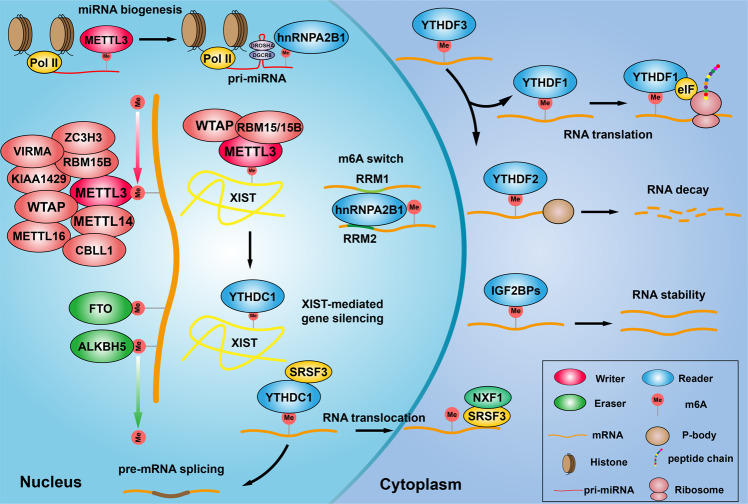
N 6 -methyladenosine (m6A) is the most prevalent, abundant and conserved internal cotranscriptional modification in eukaryotic RNAs, especially within higher eukaryotic cells. m6A modification is modified by the m6A methyltransferases, or writers, such as METTL3/14/16, RBM15/15B, ZC3H3, VIRMA, CBLL1, WTAP, and KIAA1429, and, removed by the demethylases, or erasers, including FTO and ALKBH5. It is recognized by m6A-binding proteins YTHDF1/2/3, YTHDC1/2 IGF2BP1/2/3 and HNRNPA2B1, also known as “readers”. Recent studies have shown that m6A RNA modification plays essential role in both physiological and pathological conditions, especially in the initiation and progression of different types of human cancers. In this review, we discuss how m6A RNA methylation influences both the physiological and pathological progressions of hematopoietic, central nervous and reproductive systems. We will mainly focus on recent progress in identifying the biological functions and the underlying molecular mechanisms of m6A RNA methylation, its regulators and downstream target genes, during cancer progression in above systems. We propose that m6A RNA methylation process offer potential targets for cancer therapy in the future.
Overview
The claims and statistics of this paper haven’t been checked yet.
Free: it reads the open-access text and checks the first 5 claims that cite a source we can check. Create a free account to check every claim.
Integrity signals
Registry
Cites
Statistics
Figures
Verification
Claims the paper makes
The claims and statistics of this paper haven’t been checked yet.
Free: it reads the open-access text and checks the first 5 claims that cite a source we can check. Create a free account to check every claim.
Claims other papers make about this one
Each is checked against this paper’s own text: does it say what the citing paper says it does?
The source backs part of the claim, not all of it — or backs it for a different population, condition or comparison.
In the citing paper
“Phylogenetically conserved RRM domains on readers are responsible for IMP2 identifying m6A marks on RNA [17,27].”
From IMPlications of IMP2 in RNA Biology and Disease (2025) · cites this paper as [17]
Experimental — accuracy not yet measuredThe cited source says what the claim attributes to it.
In the citing paper
“m6A (N6-methyladenosine) is a prevalent post-transcriptional modification found in mRNA and non-coding RNA in eukaryotic cells [17].”
From IMPlications of IMP2 in RNA Biology and Disease (2025) · cites this paper as [17]
In the citing paper
“m6A influences transcript splicing, stability, translation, nuclear export, and RNA structure283,284.”
From Air Pollution as an Environmental Risk Factor for Alzheimer’s Disease and Related Dementias (2024) · cites this paper as [283]
Self-check
Percentages, sums and reported differences re-computed from the paper’s own numbers.
The self-check needs the paper’s full text.
Citations
Cites
Genetics of Food Intake Self-Regulation in Childhood: Literature Review and Research Opportunities
Faith, M. S., Carnell, S., & Kral, T. V. E. (2013) · Human Heredity · doi:10.1159/000353879 · Cited by 7,601
Lippa, N. C., & Sanderson, S. C. (2013) · Human Heredity · doi:10.1159/000353712 · Cited by 6,078
Genome-wide atlas of gene expression in the adult mouse brain
Lein, E. S., Hawrylycz, M. J., Ao, N., Ayres, M., Bensinger, A., Bernard, A., Boe, A. F., Boguski, M. S., Brockway, K. S., Byrnes, E. J., et al. (2007) · Nature · doi:10.1038/nature05453 · Cited by 5,572
Topology of the human and mouse m6A RNA methylomes revealed by m6A-seq
Dominissini, D., Moshitch-Moshkovitz, S., Schwartz, S., Salmon-Divon, M., Ungar, L., Osenberg, S., Cesarkas, K., Jacob-Hirsch, J., Amariglio, N., Kupiec, M., et al. (2012) · Nature · doi:10.1038/nature11112 · Cited by 4,884
Frayling, T. M., Timpson, N. J., Weedon, M. N., Zeggini, E., Freathy, R. M., Lindgren, C. M., Perry, J. R. B., Elliott, K. S., Lango, H., Rayner, N. W., et al. (2007) · Science · doi:10.1126/science.1141634 · Cited by 4,531
Reynolds, B. A., & Weiss, S. (1992) · Science · doi:10.1126/science.1553558 · Cited by 4,482
Comprehensive Analysis of mRNA Methylation Reveals Enrichment in 3′ UTRs and near Stop Codons
Meyer, K. D., Saletore, Y., Zumbo, P., Elemento, O., Mason, C. E., & Jaffrey, S. R. (2012) · Cell · doi:10.1016/j.cell.2012.05.003 · Cited by 4,223
N6-Methyladenosine in nuclear RNA is a major substrate of the obesity-associated FTO
Jia, G., Fu, Y., Zhao, X., Dai, Q., Zheng, G., Yang, Y., Yi, C., Lindahl, T., Pan, T., Yang, Y.-G., et al. (2011) · Nature Chemical Biology · doi:10.1038/nchembio.687 · Cited by 4,106
ALKBH5 Is a Mammalian RNA Demethylase that Impacts RNA Metabolism and Mouse Fertility
Zheng, G., Dahl, J. A., Niu, Y., Fedorcsak, P., Huang, C.-M., Li, C. J., Vågbø, C. B., Shi, Y., Wang, W.-L., Song, S.-H., et al. (2013) · Molecular Cell · doi:10.1016/j.molcel.2012.10.015 · Cited by 3,550
N6-methyladenosine Modulates Messenger RNA Translation Efficiency
Wang, X., Zhao, B. S., Roundtree, I. A., Lu, Z., Han, D., Ma, H., Weng, X., Chen, K., Shi, H., & He, C. (2015) · Cell · doi:10.1016/j.cell.2015.05.014 · Cited by 3,483
Research works printed but not linked: 12
- Pendleton KE The U6 snRNA mA methyltransferase METTL16 regulates SAM synthetase intron retention Cell 2017 169 824 835.e814 10.1016/j.cell.2017.05.003 28525753 PMC5502809 · DOI · Paper page
- Patil DP m(6)A RNA methylation promotes XIST-mediated transcriptional repression Nature 2016 537 369 373 10.1038/nature19342 27602518 PMC5509218 · DOI · Paper page
- Wen J Zc3h13 regulates nuclear RNA m(6)A methylation and mouse embryonic stem cell self-renewal Mol. Cell. 2018 69 1028 1038.e1026 10.1016/j.molcel.2018.02.015 29547716 PMC5858226 · DOI · Paper page
- Huang H Recognition of RNA N-methyladenosine by IGF2BP proteins enhances mRNA stability and translation Nat. Cell Biol. 2018 20 285 295 10.1038/s41556-018-0045-z 29476152 PMC5826585 · DOI · Paper page
- Hsu PJ Ythdc2 is an N(6)-methyladenosine binding protein that regulates mammalian spermatogenesis Cell Res. 2017 27 1115 1127 10.1038/cr.2017.99 28809393 PMC5587856 · DOI · Paper page
- Yoon K-J Temporal control of mammalian cortical neurogenesis by mA methylation Cell 2017 171 877 889.e817 10.1016/j.cell.2017.09.003 28965759 PMC5679435 · DOI · Paper page
- Lv J Endothelial-specific m(6)A modulates mouse hematopoietic stem and progenitor cell development via Notch signaling Cell Res. 2018 28 249 252 10.1038/cr.2017.143 29148543 PMC5799811 · DOI
- Vu LP The N-methyladenosine (mA)-forming enzyme METTL3 controls myeloid differentiation of normal hematopoietic and leukemia cells Nat. Med. 2017 23 1369 1376 10.1038/nm.4416 28920958 PMC5677536 · DOI · Paper page
- Zhou, B. et al. N(6)-methyladenosine reader protein YT521-B Homology domain-containing 2 suppresses liver steatosis by regulation of mRNA stability of lipogenic genes. Hepatology10.1002/hep.31220 (2020). 32150756 · DOI · Paper page
- Shi H YTHDF3 facilitates translation and decay of N(6)-methyladenosine-modified RNA Cell Res. 2017 27 315 328 10.1038/cr.2017.15 28106072 PMC5339834 · DOI · Paper page
- Geula S Stem cells. m6A mRNA methylation facilitates resolution of naive pluripotency toward differentiation Science 2015 347 1002 1006 10.1126/science.1261417 25569111 · DOI · Paper page
- Su R R-2HG exhibits anti-tumor activity by targeting FTO/mA/MYC/CEBPA signaling Cell 2018 172 90 105.e123 10.1016/j.cell.2017.11.031 29249359 PMC5766423 · DOI · Paper page
Cited by
Items 801–900 of 1,006
Ai, S., Li, D., Gu, X., Xu, Y., Wang, Y., Wang, H., & Chen, X.-T. (2023) · Food and Chemical Toxicology · doi:10.1016/j.fct.2023.113821 · Cited by 10
Huang, X., Zhao, Y., Liu, D., Gu, S., Liu, Y., Khoong, Y., Luo, S., Zhang, Z., Xia, W., Wang, M., et al. (2023) · Inflammation and Regeneration · doi:10.1186/s41232-023-00288-0 · Cited by 11
“After recognition by “reader” proteins, the m6A modification affects various aspects of RNA metabolism including RNA stability, translation, splicing, translocation, and high-level structure [6, 7].”
Role of TNF-α-induced m6A RNA methylation in diseases: a comprehensive review
Wang, Y., Liu, J., & Wang, Y. (2023) · Frontiers in Cell and Developmental Biology · doi:10.3389/fcell.2023.1166308 · Cited by 15
“Other components of the m6A methyltransferase complex include KIAA1429, RNA-binding motif protein 15 (RBM15), and Zinc finger CCCH-type containing 13 (ZC3H13) (Hu et al., 2016; Huang et al., 2021; Jiang et al., 2021; Zhang, et al., 2022a).”
Backgroundm6A methylation: a potential key player in understanding and treating COVID-2019 infection
Qian, W., Zhou, J., Duan, L., Wang, H., Xu, S., & Cao, Y. (2023) · Cell Death Discovery · doi:10.1038/s41420-023-01580-1 · Cited by 9
“In addition, other proteins, such as WTAP, KIAA1429, and RBM15, are also implicated in the mediation of m(6)A methylation [30].”
BackgroundSelf-citationXu, K., Du, W., Zhuang, X., Liang, D., Mo, Y., & Wang, J. (2023) · Brain Circulation · doi:10.4103/bc.bc_3_23 · Cited by 13
“[35] Previous studies, including our own, have shown that FTO facilitates cerebral I/R injury through m6A modification.”
BackgroundWang, S., Zhang, J., Chen, J., Tang, L., Ke, M., Xue, Y., He, Y., Gong, Y. Q., & Li, Z. (2024) · Applied Biochemistry and Biotechnology · doi:10.1007/s12010-023-04795-1 · Cited by 10
“In agreement with these findings, we discovered that ω-3PUFAs inhibited pyroptosis in hypoxia-induced microglia, and in turn repressing angiogenesis of MRMECs. m6A is the common and abundant eukaryotic mRNA modification [32].”
Emerging Role of Environmental Epitranscriptomics and RNA Modifications in Parkinson’s Disease
Gionco, J. T., & Bernstein, A. I. (2024) · Journal of Parkinson s Disease · doi:10.3233/jpd-230457 · Cited by 12
Molecular mechanisms of non-genetic aberrant peptide production in cancer
Wernaart, D., Fumagalli, A., & Agami, R. (2024) · Oncogene · doi:10.1038/s41388-024-03069-2 · Cited by 10
Zhong, X., Chen, L., Wang, Y., Liang, Y., Huang, Y., Chen, Z., Cao, W., Liu, J., & Zu, X. (2024) · Molecular Neurobiology · doi:10.1007/s12035-024-04252-y · Cited by 11
“The function of m6A modification, including capping, splicing, and polyadenylation, is regarded as a key factor controlling mammalian protein production [4] and participated in numerous human diseases [5].”
Ni, S., Huang, X., Li, X., Shi, C., Fan, M., Zhao, L., Rong, Z., & Zhang, H. (2024) · The Journals of Gerontology Series A · doi:10.1093/gerona/glae150 · Cited by 13
Iaiza, A., Mazzanti, G., Goeman, F., Cesaro, B., Cortile, C., Corleone, G., Tito, C., Liccardo, F., Angelis, L. D., Petrozza, V., et al. (2024) · Cellular and Molecular Life Sciences · doi:10.1007/s00018-024-05299-9 · Cited by 11
“Recently, IGF2BPs have also been found to recognize this modification [14]. m 6 A modification modulates RNA metabolism, including structure, maturation, stability, splicing, export, translation and decay, affecting different biological processes, as well as hematopoiesis [15–17].”
Liu, Q., Li, Z., He, L., Li, K., Chen, H., Hu, C., Wang, J., Zhou, F., Li, Y., & Xiao, H. (2022) · Frontiers in Oncology · doi:10.3389/fonc.2022.914692 · Cited by 14
“N6-methyladenosine (m6A) is the most common RNA modification in mammalian cells (4) and has been suggested to be involved in various aspects of RNAmetabolism and to play essential roles in different biological processes in mammals (5, 6).”
BackgroundGuo, R., Dai, J., Xu, H., Zang, S., Zhang, L., Ma, N., Zhang, X., Zhao, L., Luo, H., Liu, D., et al. (2022) · Frontiers in Cardiovascular Medicine · doi:10.3389/fcvm.2022.948002 · Cited by 11
Dpr10 and Nocte are required for Drosophila motor axon pathfinding
Lobb-Rabe, M., DeLong, K., Salazar, R. J., Zhang, R., Wang, Y., & Carrillo, R. A. (2022) · Neural Development · doi:10.1186/s13064-022-00165-5 · Cited by 10
Zhang, C., Zhang, W., Shui, Y., Li, P., Tian, Z., Duan, S., & Wei, Q. (2022) · Frontiers in Immunology · doi:10.3389/fimmu.2022.1001506 · Cited by 10
“The biological activity is balanced by methyltransferases to add m6A modifications (writers), demethylases to remove m6A (erasers), and m6A-binding proteins to recognize m6A (readers) (13, 14).”
BackgroundPIEZO Force Sensors and the Heart
McGrane, A., Murray, M., Bartoli, F., Giannoudi, M., Conning-Rowland, M. S., Stewart, L., Levelt, E., Cubbon, R. M., Dall’Armellina, E., Griffin, K. J., et al. (2025) · Cold Spring Harbor Perspectives in Biology · doi:10.1101/cshperspect.a041806 · Cited by 15
“At least in experimental situations, they respond to cell indentation, pressure that stretches the membrane, cell substrate displacement, fluid flow, and traction force (Jiang et al. 2021b).”
InfluentialOverview of distinct N6-Methyladenosine profiles of messenger RNA in osteoarthritis
Yü, Y., Lu, S., Li, Y., & Xu, J. (2023) · Frontiers in Genetics · doi:10.3389/fgene.2023.1168365 · Cited by 9
“Accumulating evidence indicates that m6A modification participates in the regulation of critical biological processes and pathogenesis of numerous human diseases (Zhao et al., 2020; Jiang et al., 2021).”
BackgroundTEGR: A comprehensive Ericaceae genome resource database
Wang, X., Wei, Y., Liu, Z., Yu, T., Fu, Y., & Song, X. (2023) · Journal of Integrative Agriculture · doi:10.1016/j.jia.2023.11.026 · Cited by 9
Chen, W., Li, Z., Zhong, R., Sun, W., & Chu, M. (2023) · G3 Genes Genomes Genetics · doi:10.1093/g3journal/jkad270 · Cited by 10
“The influence of these genes on metabolism and cancers has been reported (Han et al. 2019; Gavini et al. 2020; Jiang et al. 2021); however, little is known about their possible association with reproduction.”
BackgroundThe role of RNA modification in urological cancers: mechanisms and clinical potential
Zhou, X., Zhu, H., Luo, C., Yan, Z., Zheng, G., Zou, X., Zou, J., & Zhang, G. (2023) · Discover Oncology · doi:10.1007/s12672-023-00843-8 · Cited by 9
Tissue-specific RNA methylation prediction from gene expression data using sparse regression models
Jiang, J., Song, B., Meng, J., & Zhou, J. (2023) · Computers in Biology and Medicine · doi:10.1016/j.compbiomed.2023.107892 · Cited by 10
Nurturing gut health: role of m6A RNA methylation in upholding the intestinal barrier
Wang, S., Yang, Y., Jiang, X., Zheng, X., Wei, Q., Dai, W., & Zhang, X. (2024) · Cell Death Discovery · doi:10.1038/s41420-024-02043-x · Cited by 11
Self-citationCui, W., Jin, Z., Lin, H., Wang, B., Chen, G., & Cheng, Y. (2024) · Toxicology Research · doi:10.1093/toxres/tfae099 · Cited by 9
Self-citationXu, L., Chen, Y., Wu, T., Fan, J., Hu, Y., Gao, X., Wang, Y., Chen, T., Zhao, X., Zeng, M., et al. (2024) · iScience · doi:10.1016/j.isci.2024.110505 · Cited by 10
Self-citationMelnik, B. C., Weiskirchen, R., Stremmel, W., John, S. M., & Schmitz, G. (2024) · Nutrients · doi:10.3390/nu16152451 · Cited by 12
m5C RNA methylation: a potential mechanism for infectious Alzheimer’s disease
Teng, S., Han, C., Zhou, J., He, Z., & Qian, W. (2024) · Frontiers in Cell and Developmental Biology · doi:10.3389/fcell.2024.1440143 · Cited by 10
Multifunctional role of DEAD-box helicase 41 in innate immunity, hematopoiesis and disease
Ma, J., & Ross, S. R. (2024) · Frontiers in Immunology · doi:10.3389/fimmu.2024.1451705 · Cited by 14
Zhang, M., Gou, Z., Qu, Y., & Su, X. (2024) · Frontiers in Immunology · doi:10.3389/fimmu.2024.1456891 · Cited by 14
Liang, H., Zhang, C., Hu, M., Hu, F., Wang, S., Wei, W., & Hu, W. (2024) · Molecular Carcinogenesis · doi:10.1002/mc.23826 · Cited by 9
“Different readers have different m 6 A positioning functions [45].”
YTHDC1-mediated microRNA maturation is essential for hematopoietic stem cells maintenance
Zuo, H., Liu, J., Shen, B., Sheng, Y., Ju, Z., & Wang, H. (2024) · Cell Death Discovery · doi:10.1038/s41420-024-02203-z · Cited by 11
Silencing METTL3 Increases HSP70 Expression and Alleviates Fibrosis in Keratocytes
Jing, Y., Li, J., Hao, P., Xing, S., & Li, X. (2024) · Investigative Ophthalmology & Visual Science · doi:10.1167/iovs.65.13.9 · Cited by 12
Nie, G., Li, Y., Zhao, H., Liu, C., Zhang, Y., Yang, X., Tian, F., & Wen, X. (2024) · International Immunopharmacology · doi:10.1016/j.intimp.2024.113638 · Cited by 10
Lai, J., Chen, L., Li, Q., Zhao, G., Li, X., Guo, D., Chen, Z., Zhang, Y., Fan, J., Zhao, H., et al. (2024) · Cellular Signalling · doi:10.1016/j.cellsig.2024.111533 · Cited by 13
Li, X., Peng, L., Yang, X., Luo, J., Wang, J., Mou, K., Zhou, H., Luo, Y., & Li, X. (2024) · Frontiers in Immunology · doi:10.3389/fimmu.2024.1464042 · Cited by 12
Regulatory mechanisms of m6A methylation in dilated cardiomyopathy
Zhang, H., Guo, H., Han, F., & Zheng, Y. (2025) · American Journal of Translational Research · doi:10.62347/aosk8903 · Cited by 10
RBM15-mediated m6A modification of XPR1 promotes the malignant progression of lung adenocarcinoma
Sun, C., Guan, H., Li, J., & Gu, Y. (2025) · Naunyn-Schmiedeberg s Archives of Pharmacology · doi:10.1007/s00210-025-03849-x · Cited by 9
“RBM15 is an m6A writer that recruits the m6A complex to special RNA sites, playing an essential role in cancer progression (Jiang et al. 2021).”
Qiu, C., Zheng, X., Zhou, X., Wang, B., Chen, T., Xu, Y., Yu, X., Lu, W., & Wu, Z. (2025) · Biochimica et Biophysica Acta (BBA) - Molecular Basis of Disease · doi:10.1016/j.bbadis.2025.167797 · Cited by 10
ALKBH5 Improves the Epithelial Cell Tight Junctions to Inhibit Escherichia coli-Induced Mastitis
Wu, X., Xu, H., Peng, Y., Zhang, R., Hu, Y., Guo, A., & Hu, C. (2025) · Cells · doi:10.3390/cells14070521 · Cited by 9
“N 6 -methyladenosine (m 6 A) modification is the most common epigenetic modification on mammalian RNA [15,16].”
YTHDF1/RNF7/p27 axis promotes prostate cancer progression
Shi, Y., Liu, B., Zhang, Y., Zhao, S., Zuo, L., Pu, J., Zhai, H., Mu, D., Du, J. H., Cheng, Y., et al. (2025) · Cell Death and Disease · doi:10.1038/s41419-025-07648-3 · Cited by 12
Self-citationInhibition of ALKBH5 demethylase of m6A pathway potentiates HIV-1 reactivation from latency
Ali, H., Wadas, J., Bendoumou, M., Chen, H., Maiuri, P., Dutilleul, A., Selberg, S., Nestola, L., Lalik, K., Avettand-Fènoël, V., et al. (2025) · Virology Journal · doi:10.1186/s12985-025-02744-4 · Cited by 10
“The m 6 A RNA modification plays an essential role in both physiological and pathological conditions, especially in the initiation and progression of different types of cancers [27].”
Shen, W., Ma, Y., Yang, C., Yan, S., & Ye, K. (2025) · Discover Oncology · doi:10.1007/s12672-025-02644-7 · Cited by 9
“The removal of m⁶A modifications is primarily mediated by demethylases, termed “erasers,” such as FTO and ALKBH5.m⁶A modifications are recognized by m⁶A-binding proteins, including YTHDF1/2/3, YTHDC1/2, IGF2BP1/2/3, and HNRNPA2B1, collectively referred to as “readers” [1, 2].”
Self-citationWang, Y., Zhang, X., Yang, F., Shang, J., & Yang, Q. (2025) · Cancer Genetics · doi:10.1016/j.cancergen.2025.06.003 · Cited by 9
Xu, Y.-Y., Liu, W., Zai, Z., Qian, X., Hu, W.-R., Peng, X., & Chen, F. (2025) · International Journal of Biological Macromolecules · doi:10.1016/j.ijbiomac.2025.145698 · Cited by 11
Zhang, J., Ma, W., Liu, R., Li, X., Yuan, Z., & Cheng, J. (2025) · Neural Regeneration Research · doi:10.4103/nrr.nrr-d-24-01648 · Cited by 15
“…and alkB homolog 5 (ALKBH5) (Jia et al., 2011; Zheng et al., 2013; Schwartz et al., 2014; Geula et al., 2015; Patil et al., 2016; Wen et al., 2018; Jiang et al., 2021b), and interpreted by m 6 A-binding proteins (readers) including YTH N 6 -methyladenosine RNA-binding proteins (YTHDF1/2), YTH…”
Huang, B., Zhang, Y., Chen, Z., Yuan, Y., & Lin, J. (2025) · Breast Cancer Research · doi:10.1186/s13058-025-02099-2 · Cited by 9
“In general, the expression levels of m6A regulators are often aberrantly expressed in various cancers and are related to tumor development and poor clinical outcome [39].”
Mechanistic insights into the role of RNA demethylase ALKBH5 in malignant tumor therapy
An, R., Shao, Y., & Gu, W. (2025) · Journal of Translational Medicine · doi:10.1186/s12967-025-06938-w · Cited by 10
“Its modification is regulated by three primary components: m6A methyltransferases, demeth-ylases, and binding proteins [5].”
Epigenetic mechanisms in maternal-fetal crosstalk: inter- and trans-generational inheritance
Tisato, V., D’Aversa, E., Salvatori, F., Sbracia, M., Peluso, G., Scarpellini, F., & Gemmati, D. (2025) · Epigenomics · doi:10.1080/17501911.2025.2568369 · Cited by 12
“In particular, m6A dynamically controls mRNA stability, splicing, and translation, thereby affecting cell differentiation and tissue remodeling [121].”
Eladl, O., Abdelhady, A., & TagElDein, M. A. (2026) · Biochemical and Biophysical Research Communications · doi:10.1016/j.bbrc.2026.153673 · Cited by 11
Epitranscriptomic signatures in stem cell differentiation to the neuronal lineage
Șelaru, A., Costache, M., & Dinescu, S. (2021) · RNA Biology · doi:10.1080/15476286.2021.1985348 · Cited by 11
“Also, they have found an increase in the expression level of METTL3 in both zebra fish and mice following SCI, demonstrating that the regeneration process is at least partly regulated by epitranscriptomic modifications.”
BackgroundInfluentialN6-Methyladenosine Methylation of mRNA in Cell Senescence
Zhang, L., & Xia, J. (2021) · Cellular and Molecular Neurobiology · doi:10.1007/s10571-021-01168-2 · Cited by 10
“Endogenous retroviruses (ERVs) affect genomic regulation and cellular physiology by affecting the RNA-centric life cycle (Johnson 2019).”
BackgroundChen, Z., Zhang, W., Yan, Z., & Zhang, M. (2022) · Cancer Medicine · doi:10.1002/cam4.4913 · Cited by 12
Ji, F., Yang, Z., Sun, C., Lowe, S., & Qiu, X. (2022) · Clinical & Translational Oncology · doi:10.1007/s12094-022-02940-6 · Cited by 10
“Aberrant expression and gene changes in m6A receptors are highly associated with events such as developmental deficiency, metabolic disturbances [9].”
BackgroundCircAMOTL1 RNA and AMOTL1 Protein: Complex Functions of AMOTL1 Gene Products
Sadlak, J., Joshi, I., Prószyński, T. J., & Kischel, A. (2023) · International Journal of Molecular Sciences · doi:10.3390/ijms24032103 · Cited by 10
“Among them, the N6-adenosine methylation (m6A) is the most abundant and has been extensively studied (reviewed in [61,62]).”
BackgroundLi, Z., Meng, X., Chen, Y., Xu, X., & Guo, J. (2023) · Heliyon · doi:10.1016/j.heliyon.2023.e13721 · Cited by 9
Self-citationLi, L., Sun, Y., Davis, A. E., Shah, S. H., Hamed, L. K., Wu, M.-R., Lin, C., Ding, J., & Wang, S. (2023) · Cell Reports · doi:10.1016/j.celrep.2023.112596 · Cited by 13
Fu, R., Chen, D., Tian, G., Zheng, P., He, J., Yu, J., Mao, X., Huang, Z., Pu, J., & Yu, B. (2023) · Journal of Functional Foods · doi:10.1016/j.jff.2023.105620 · Cited by 11
Dysregulated m6A methylation modification is associated with human peri-implantitis – A pilot study
Sri, H., Kannan, B., Ganapathy, D. M., Jayaseelan, V. P., & Arumugam, P. (2023) · Journal of Stomatology Oral and Maxillofacial Surgery · doi:10.1016/j.jormas.2023.101550 · Cited by 9
Wu, L., & Tang, H. (2023) · Biomedicine & Pharmacotherapy · doi:10.1016/j.biopha.2023.115398 · Cited by 10
Shining a spotlight on m6A and the vital role of RNA modification in endometrial cancer: a review
Jin, Z., Sheng, J., Hu, Y., Zhang, Y., Wang, X., & Huang, Y. (2023) · Frontiers in Genetics · doi:10.3389/fgene.2023.1247309 · Cited by 11
Self-citationMETTL3/MALAT1/ELAVL1 Axis Promotes Tumor Growth in Ovarian Cancer
Xiong, J., Lian, W., Zhao, R., & Gao, K. (2024) · OncoTargets and Therapy · doi:10.2147/ott.s431810 · Cited by 9
“15 Methyltransferase-like 3 (METTL3) is the only catalytic subunit among at least five methyltrans-ferases that consist of m6A methylase complex.”
BackgroundInfluentialChen, D., Zhao, H., Guo, Z., Dong, Z., Yu, Y., Zheng, J., Ma, Y., Sun, H., Zhang, Q. Y., Zhang, J., et al. (2024) · International Immunopharmacology · doi:10.1016/j.intimp.2024.112050 · Cited by 11
Ma, C., Gu, Z., & Yang, Y. (2024) · Journal of Cellular and Molecular Medicine · doi:10.1111/jcmm.18282 · Cited by 11
Jiang, J., Duan, M., Wang, Z., Lai, Y., Zhang, C., & Duan, C. (2024) · Biomedicine & Pharmacotherapy · doi:10.1016/j.biopha.2024.116704 · Cited by 14
Quantitative mapping of the mammalian epitranscriptome
He, B., Chen, Y., & Yi, C. (2024) · Current Opinion in Genetics & Development · doi:10.1016/j.gde.2024.102212 · Cited by 10
Self-citationYTHDF1 facilitates esophageal cancer progression via augmenting m6A-dependent TINAGL1 translation
Zhang, L., Cai, E., Xu, Y., Liu, Z., Zheng, M., Sun, Z., Pei, D., & Wang, Q. (2024) · Cellular Signalling · doi:10.1016/j.cellsig.2024.111332 · Cited by 11
Chen, X., Huang, X., Zhang, X., & Chen, Z. (2024) · Bone · doi:10.1016/j.bone.2024.117382 · Cited by 9
Huang, Z.-D., Lin, L., Liu, Z., Hu, C., Gu, H.-Y., & Wei, R. (2021) · Frontiers in Immunology · doi:10.3389/fimmu.2021.765723 · Cited by 12
“N(6)-methyladenosine (m6A) has a key role in current tumor research (6).”
BackgroundEmerging Roles of Long Noncoding RNAs in Breast Cancer Epigenetics and Epitranscriptomics
Wanowska, E., Samorowska, K., & Szcześniak, M. W. (2022) · Frontiers in Cell and Developmental Biology · doi:10.3389/fcell.2022.922351 · Cited by 9
“The former is stabilized by the m6A methyltransferase WT1-associated protein (WTAP), which is linked to amore resistant BC phenotype (Huang et al., 2021).”
BackgroundRoles of m6A modification in oral cancer (Review)
Liu, H., Wang, Y., Xue, T., Yang, Z., Kan, S., Hao, M., Gao, Y., Wang, D., & Liu, W. (2022) · International Journal of Oncology · doi:10.3892/ijo.2022.5453 · Cited by 11
“m6A readers include the family members of YTH domain proteins [YTH domain family 1 (YTHDF1), YTHDF2, YTHDF3, YTH‐domain‐containing protein 1 (YTHDC1) and YTHDC2], insulin‐like growth factor 2 mRNA binding protein (IGF2BP)1, ‐2 and ‐3 and heteroge‐ neous ribonucleoprotein (HNRNPC and HNRNPA2B1) (18).”
BackgroundInfluentialRNA Epigenetics in Chronic Lung Diseases
Wang, X., Guo, Z., & Yan, F. (2022) · Genes · doi:10.3390/genes13122381 · Cited by 10
“The methylation modification of m6A is regulated by three types of proteases, methyltransferases (writers, including methyltransferase like protein-3/14/16 (METTL3/14/16), RNA-binding motif protein 15/15B (RBM15/15B), zinc finger CCCH type containing 13 (ZC3H13), virlike m6A methyltransferase associated (VIRMA, also k…”
BackgroundWang, L., Zou, Y., Huang, Z., Wang, W., Li, J., Bi, J., & Huo, R. (2022) · Cancer Science · doi:10.1111/cas.15708 · Cited by 9
Demircan, T., Yavuz, M., & Akgül, S. (2021) · OMICS A Journal of Integrative Biology · doi:10.1089/omi.2021.0114 · Cited by 10
“…open the era of epitranscriptome. mRNA methylations are controlled by dynamic reversible mechanisms, and dysregulation of this mechanism is related to a broad range of diseases due to the alterations in the numerous biological processes (BPs) (Jiang et al., 2021; Qin et al., 2020; Wardowska, 2021).”
Emerging epigenetic modifications in renal fibrosis: From mechanisms to treatments
Suo, X., Ge, Q., Peng, L., Zhu, Q., Zhang, M., Cheng, X., Wang, F., Jin, J., Wang, J., & Meng, X. (2025) · Acta Pharmaceutica Sinica B · doi:10.1016/j.apsb.2025.09.012 · Cited by 8
“In terms of molecular mechanisms, m6A is involved in almost all RNA metabolic processes, including export, folding, and stability 57-59 .”
Liu, J., Zhang, W., Luo, W., Liu, S., Jiang, H., Liu, S., Xu, J., & Chen, B. (2023) · Veterinary Sciences · doi:10.3390/vetsci10040300 · Cited by 8
“m6A modification plays an important role in embryonic development, cell differentiation, and nervous system development, and has also been implicated in tumor occurrence and progression [13].”
BackgroundKoch, J. P., Neuberger, M., Schmidt, M., Xu, J., Carneiro, V. C., Ellinger, J., KRIEGMAIR, M. C., Nuhn, P., Erben, P., Michel, M. S., et al. (2023) · iScience · doi:10.1016/j.isci.2023.107300 · Cited by 8
Gao, X., Wang, J., Wang, Y., Li, W., & Pan, Z. (2023) · Stem Cells International · doi:10.1155/2023/5563568 · Cited by 8
“N 6 -methyladenosine (m 6 A) is one of the most prominent posttranscriptional modi fi cations in eukaryotic mRNA. m 6 A mediates almost every aspect of mRNA metabolism, including splicing, export, turnover, translation, and regulates mRNA stability [4 – 6].”
Epigenetic targeting of autophagy for cancer: DNA and RNA methylation
Lin, L., Zhao, Y., Zheng, Q., Zhang, J., Li, H., & Wu, W. (2023) · Frontiers in Oncology · doi:10.3389/fonc.2023.1290330 · Cited by 8
Studying m6A in the brain: a perspective on current methods, challenges, and future directions
Tegowski, M., & Meyer, K. D. (2024) · Frontiers in Molecular Neuroscience · doi:10.3389/fnmol.2024.1393973 · Cited by 9
Guo, W., Wang, T., Huai, Q., Guo, L., Wang, X., & He, J. (2024) · Thoracic Cancer · doi:10.1111/1759-7714.15327 · Cited by 8
“17,18 Earlier studies have revealed atypical expression of RNA methyl-transferases in different cancerous tumors, 13 yet their down-stream regulatory mechanisms have seldom been reported.”
BackgroundGoebel, G. L., Giannino, N., Lampe, P., Qiu, X., Schloßhauer, J. L., Imig, J., Sievers, S., & Wu, P. (2024) · ChemBioChem · doi:10.1002/cbic.202400183 · Cited by 14
RNA binding protein‐directed control of leukemic stem cell evolution and function
Joshi, P., Chahi, A. K., Liu, L., Moreira, S., Vujovic, A., & Hope, K. J. (2024) · HemaSphere · doi:10.1002/hem3.116 · Cited by 10
The role of epigenetic methylations in thyroid Cancer
Yu, X., Zhang, H., Zhang, H., Hou, C., Wang, X., Gu, P., Han, Y. K., Yang, Z., & Zou, W. (2024) · World Journal of Surgical Oncology · doi:10.1186/s12957-024-03568-2 · Cited by 11
“As the most common internal RNA modification in eukaryotic cells, m6A is involved in nearly all stages of the RNA lifecycle, including mRNA transcription, maturation, translation, degradation, and stability [92].”
BackgroundXia, R. Z., Yin, X., Huang, J., Chen, K., Ma, J., Wei, Z. C., Su, J., BLAKE, N. W., Rigden, D. J., Meng, J., et al. (2024) · Molecular Therapy — Nucleic Acids · doi:10.1016/j.omtn.2024.102376 · Cited by 10
“Finally, the relative position of targeted m 6 A on multiple region types was represented by features 49 – 52.”
Zhu, Y., Huang, Y., Shi, Y.-H., Huang, C., Zhao, G., Liu, Z., Ma, M., Ye, J., Xu, X., Liu, Q., et al. (2024) · Advanced Science · doi:10.1002/advs.202406714 · Cited by 16
Rao, R. J., Yang, J., Jiang, S., El-Khoury, W., Hafeez, N., Okawa, S., Tai, Y., Tang, Y. M., Aaraj, Y. A., Sembrat, J., et al. (2024) · American Journal of Physiology-Lung Cellular and Molecular Physiology · doi:10.1152/ajplung.00048.2024 · Cited by 10
Wang, Z., Sun, S., Huang, L., Chen, X., Xu, H., Ma, H., Xiao, M., & Wang, L. (2024) · Molecular Immunology · doi:10.1016/j.molimm.2024.12.001 · Cited by 9
Luo, X., He, C., Yang, B., Yin, S., & Li, L. (2025) · Applied Biochemistry and Biotechnology · doi:10.1007/s12010-024-05106-y · Cited by 11
“WTAP is a well-studied m6A methylation writer known to interact with METTL3 and METTL14, forming a protein complex that facilitates the translocation of the METTL3-METTL14 heterodimer to the nuclear speckle, thereby playing a crucial role in various diseases [16].”
Zhang, N., Yang, J., Zhao, Y., Li, W., Zhao, B., Li, R., He, Z., & Gu, S. (2025) · Cell Death Discovery · doi:10.1038/s41420-024-02284-w · Cited by 8
“And demethylases, FTO and ALKBH5, remove m 6 A modi fi cation, as well methyl-binding proteins, such as YTHDC1/2,YTHDF1/2/3, identify and attach to RNA molecules in an m 6 A-dependent manner [16].”
Cheng, Y., Shang, Y., Zhang, S., & Fan, S. (2025) · Cancer Biology and Medicine · doi:10.20892/j.issn.2095-3941.2024.0415 · Cited by 9
“Writers and erasers add or remove the methyl group in the motif, respectively, and consequently determine RNA methylation level, whereas the readers recognize m 6 A modification and mediate the recruitment of downstream functional complexes, which influence the fate of modified RNAs 57-60 .”
Yu, M., Fei, B., & Chu, S. (2025) · Journal of Biological Chemistry · doi:10.1016/j.jbc.2025.108234 · Cited by 9
“In comparison to previous research, this study is the fi rst to explore the function of HNRNPA2B1 in GCSCs (9, 35, 36).”
Regulatory roles of RNA binding proteins in the Hippo pathway
Peng, S., Li, C., He, Y., Xue, L., & Guo, X. (2025) · Cell Death Discovery · doi:10.1038/s41420-025-02316-z · Cited by 9
Therapeutic Potential of FTO Demethylase in Metabolism and Disease Pathways
Somala, C. S., Sathyapriya, S., Bharathkumar, N., Anand, T., Mathangi, D. C., & Saravanan, K. M. (2025) · The Protein Journal · doi:10.1007/s10930-025-10250-3 · Cited by 11
“In addition, recent studies have demonstrated a connection between variations in the FTO gene and psychiatric disorders like depression, as well as the role of FTO in the development of acute myeloid leukemia [84, 85].”
Yang, P., Wang, H., Meng, L., Kou, Y., Bu, J., & Li, M. (2025) · Journal of Molecular Histology · doi:10.1007/s10735-025-10358-x · Cited by 10
“Methyltransferase like 3 (METTL3) is a well-known methyltransferase, which can recognize the m 6 A site and play a major catalytic role in the addition of m 6 A (Liu et al. 2020; Jiang et al. 2021).”
Liu, F., Liu, Q., Li, X., Wang, Y., Cao, R., Zhang, S., Jiang, S., & Wu, J. (2025) · Frontiers in Immunology · doi:10.3389/fimmu.2025.1538658 · Cited by 15
Li, Q.-H., & Xiang, J. Y. (2025) · Scientific Reports · doi:10.1038/s41598-025-90419-z · Cited by 8
“M6A methylation is involved in the physiological and pathological processes of human diseases, such as neurodegenerative disease, cardiovascular diseases, and metabolic syndrome 26 .”
RNA damage and its implications in genome stability
Olatunji, M., & Liu, Y. (2025) · DNA repair · doi:10.1016/j.dnarep.2025.103821 · Cited by 11
RNA Modification in Metabolism
Liu, Y., Sun, Z., Gui, D., Zhao, Y., & Xu, Y. (2025) · MedComm · doi:10.1002/mco2.70135 · Cited by 12
“The m 6 A modification refers to the methylation of the nitrogen atom at the sixth position of RNA adenine [101–103], and this modification will result in the formation of methylated adenosine and further modulate gene expression [104].”
Chen, H., Guo, F., Zhao, Y., Liu, W., Chen, B., Wang, C., Huang, L., Jiang, S., Ma, X., Ren, H., et al. (2025) · Frontiers in Aging Neuroscience · doi:10.3389/fnagi.2025.1572976 · Cited by 8
“Methyltransferases include METTL3, METTL14, and METTL16 (Jiang et al., 2021); demethylases encompass FTO and alkylation repair homolog protein 5 (ALKBH5) (Gao et al., 2024); and recognition proteins comprise YTH domain-containing proteins 1 and 2 (YTHDC1/2) and YTHDF1/2/3 (Shi et al., 2018; Zálešák et al., 2024). m 6…”
Yin, M., & Liu, H. (2025) · BMC Cardiovascular Disorders · doi:10.1186/s12872-025-04749-x · Cited by 11
“Among these modifications, N6-methyladenosine (m6A) stands out as the most prevalent and abundant methylation mark in eukaryotic cells [9]. m6A modification is a dynamic and reversible process regulated by three key components: methyltransferases (writers), demethylases (erasers), and m6A-binding…”
Yan, Z., Zhang, L., Ma, T., Yuan, Y., Kang, Y., Liu, S., Chen, B., Li, K., Xiao, M., & Xie, Y. (2025) · Frontiers in Pharmacology · doi:10.3389/fphar.2025.1543277 · Cited by 8
“M6A methylation modi fi cation is a dynamic and reversible cotranscriptional response that plays a key role in the post-transcriptional regulation of gene expression (Jiang et al., 2021).”
Metadata
- Authors
- Jiang, X., Liu, B., Nie, Z., Duan, L., Xiong, Q., Jin, Z., Yang, C., & Chen, Y.
- Affiliations
- Kunming Institute of Zoology (CN)
- Kunming Medical University (CN)
- Corresponding author
- Yang, Cuiping
- Chen, Yongbin
- Venue
- Signal Transduction and Targeted Therapy
- Published
- 2021-02-21
- Volume
- 6
- Issue
- 1
- Pages
- 74-74
- ISSN
- 2059-3635 (ISSN-L)
- PMC
- PMC7897327
- OpenAlex
- W3133117790
- Semantic Scholar
- bb3e99165f58f5ec0b7529899c5348c6d862434c
- Cited by
- 2,335
- References
- 253
- Citations by year
- 2026: 366 · 2025: 624 · 2024: 589 · 2023: 426 · 2022: 230 · 2021: 96
- FWCI
- 35.75
- Type
- journal article
- Language
- en
- Open access
- gold
- doi.org
- Licence
- cc-by
- creativecommons.org/licenses/by/4.0 (tdm)
- creativecommons.org/licenses/by/4.0 (vor)
- Locations
- Signal Transduction and Targeted Therapy (publishedVersion, cc-by)
- PubMed Central (publishedVersion, cc-by)
- PubMed (publishedVersion)
- DOAJ (DOAJ: Directory of Open Access Journals) (submittedVersion, cc-by-sa)
- Funders
- National Natural Science Foundation of China (2016YFA0100900, 82060515, U1902216, 2020-1, 81772996, 81672764)
- Youth Innovation Promotion Association of the Chinese Academy of Sciences (2016YFA0100900)
- Recruitment Program of Global Experts
- National Key Research and Development Program of China (2016YFA0100900)
- Youth Innovation Promotion Association (2016YFA0100900)
- National Key Research and Development Program of China Stem Cell and Translational Research (2016YFA0100900)
- Topics
- Life Sciences › Biochemistry, Genetics and Molecular Biology › Molecular Biology › RNA modifications and cancer
- Life Sciences › Biochemistry, Genetics and Molecular Biology › Molecular Biology › RNA regulation and disease
- Life Sciences › Biochemistry, Genetics and Molecular Biology › Molecular Biology › Cancer-related gene regulation
- Keywords
- m6A RNA methylation, N6-methyladenosine, RNA methyltransferase, RNA demethylase, m6A-binding proteins, tumor progression, hematopoietic system, central nervous system, reproductive system, cancer therapy targets
- MeSH terms
- RNA Splicing Factors, Adenosine, Humans, Methylation, Methyltransferases, Neoplasms, Nerve Tissue Proteins, RNA Processing, Post-Transcriptional, RNA-Binding Proteins, Heterogeneous-Nuclear Ribonucleoprotein Group A-B, Epigenesis, Genetic
About these checks
Registry, retraction, Cites and statistics results are computed, not judged, with one exception: a printed reference that no index lists is read once by a model before it counts as a citation error. Claims are extracted by a model and kept only when their quote appears verbatim in the text; each cited source is then checked, with a model’s help, for whether it says what the claim relies on. Those verdicts can be wrong — read the claim’s quote and the cited source before relying on one.
Statistics and arithmetic are recomputed, not judged.
Confidence bands are shown only for fields calibrated on our annotated test set. None is calibrated yet, so no band is shown.
What counts as a claim ›How we measure confidence ›How we check this ›
Are you an author, or do you see a problem with this page? Request a review
Data sources
Bibliographic data: Semantic Scholar, OpenAlex, Crossref.
Contains information from the Semantic Scholar Academic Graph Datasets, made available under the ODC Attribution License (ODC-BY 1.0).
Semantic Scholar’s data is described in: Kinney, R., et al. (2023). The Semantic Scholar Open Data Platform. arXiv:2301.10140.
