

Late-life targeting of the IGF-1 receptor improves healthspan and lifespan in female mice
Open accessThe DOI matches its Crossref record; 53 of the 53 references it cites were found in a registry or an index.
Abstract
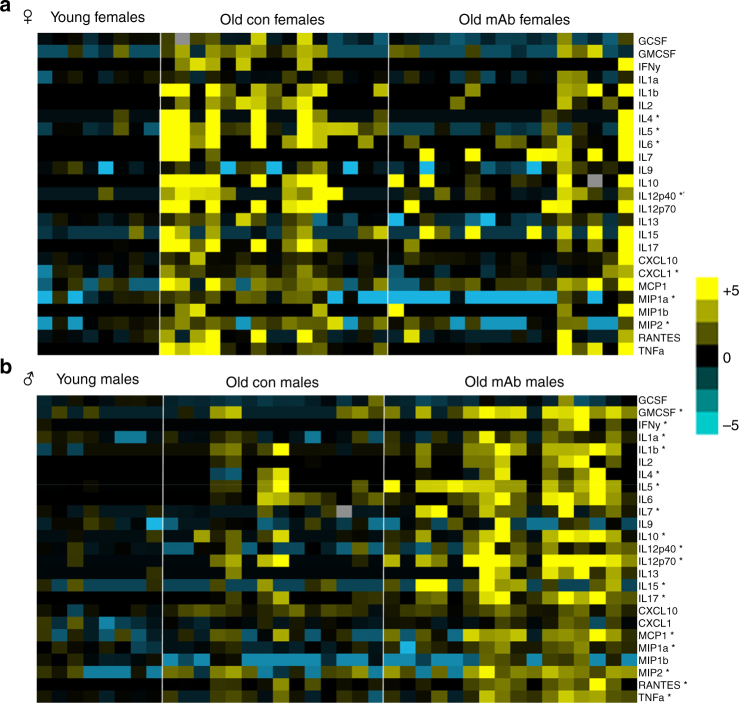
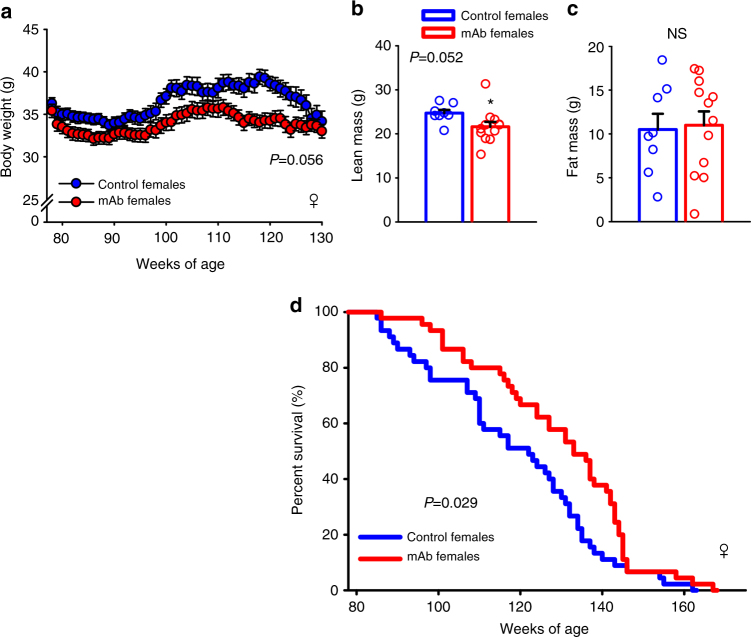
Diminished growth factor signaling improves longevity in laboratory models, while a reduction in the somatotropic axis is favorably linked to human aging and longevity. Given the conserved role of this pathway on lifespan, therapeutic strategies, such as insulin-like growth factor-1 receptor (IGF-1R) monoclonal antibodies (mAb), represent a promising translational tool to target human aging. To this end, we performed a preclinical study in 18-mo-old male and female mice treated with vehicle or an IGF-1R mAb (L2-Cmu, Amgen Inc), and determined effects on aging outcomes. Here we show that L2-Cmu preferentially improves female healthspan and increases median lifespan by 9% (P = 0.03) in females, along with a reduction in neoplasms and inflammation (P ≤ 0.05). Thus, consistent with other models, targeting IGF-1R signaling appears to be most beneficial to females. Importantly, these effects could be achieved at advanced ages, suggesting that IGF-1R mAbs could represent a promising therapeutic candidate to delay aging.
Overview
The claims and statistics of this paper haven’t been checked yet.
Free: it reads the open-access text and checks the first 5 claims that cite a source we can check. Create a free account to check every claim.
Integrity signals
Registry
Cites
Statistics
Figures
Verification
Claims the paper makes
The claims and statistics of this paper haven’t been checked yet.
Free: it reads the open-access text and checks the first 5 claims that cite a source we can check. Create a free account to check every claim.
Claims other papers make about this one
Each is checked against this paper’s own text: does it say what the citing paper says it does?
The source backs part of the claim, not all of it — or backs it for a different population, condition or comparison.
In the citing paper
“An important question for future research is discovering why mTOR inhibitors have sex-specific or sex-biased benefits, as pharmacological treatment with rapamycin or genetic inhibition of insulin-IGF1/PI3K/Akt/mTOR/S6K1 signaling typically (but not always) extends the lifespan of female mice a greater amount than it extends the lifespan of male mice 191–193.”
From Targeting the biology of aging with mTOR inhibitors (2023) · cites this paper as [192]
Experimental — accuracy not yet measuredIn the citing paper
“while long-term administration of an anti-IGF1R antibody increases lifespan and reduces inflammation and cancer development in female mice.218”
From Meta-hallmarks of aging and cancer (2023) · cites this paper as [218]
Self-check
Percentages, sums and reported differences re-computed from the paper’s own numbers.
The self-check needs the paper’s full text.
Citations
Cites
Rapamycin fed late in life extends lifespan in genetically heterogeneous mice
Harrison, D. E., Strong, R., Sharp, Z. D., Nelson, J. F., Astle, C. M., Flurkey, K., Nadon, N. L., Wilkinson, J. E., Frenkel, K., Carter, C. S., et al. (2009) · Nature · doi:10.1038/nature08221 · Cited by 3,766
A C. elegans mutant that lives twice as long as wild type
Kenyon, C., Chang, J., Gensch, E., Rudner, A., & Tabtiang, R. (1993) · Nature · doi:10.1038/366461a0 · Cited by 3,387
IGF-1 receptor regulates lifespan and resistance to oxidative stress in mice
Holzenberger, M., Dupont, J., Ducos, B., Leneuve, P., Géloën, A., Even, P. C., Cervera, P., & Le Bouc, Y. (2003) · Nature · doi:10.1038/nature01298 · Cited by 2,109
Extension of Life-Span by Loss of CHICO, a Drosophila Insulin Receptor Substrate Protein
Clancy, D. J., Gems, D., Harshman, L. G., Oldham, S., Stocker, H., Hafen, E., Leevers, S. J., & Partridge, L. (2001) · Science · doi:10.1126/science.1057991 · Cited by 1,436
Regulation of Longevity and Stress Resistance by Sch9 in Yeast
Fabrizio, P., Pozza, F., Pletcher, S. D., Gendron, C. M., & Longo, V. D. (2001) · Science · doi:10.1126/science.1059497 · Cited by 874
Guevara-Aguirre, J., Balasubramanian, P., Guevara-Aguirre, M., Wei, M., Madia, F., Cheng, C.-W., Hwang, D., Martin-Montalvo, A., Saavedra, J., Ingles, S., et al. (2011) · Science Translational Medicine · doi:10.1126/scitranslmed.3001845 · Cited by 743
Self-citationFunctionally significant insulin-like growth factor I receptor mutations in centenarians
Suh, Y., Atzmon, G., Cho, M.-O., Hwang, D., Liu, B., Leahy, D. J., Barzilai, N., & Cohen, P. (2008) · Proceedings of the National Academy of Sciences · doi:10.1073/pnas.0705467105 · Cited by 703
Self-citationAustad, S. N., & Fischer, K. E. (2016) · Cell Metabolism · doi:10.1016/j.cmet.2016.05.019 · Cited by 593
Interventions to slow aging in humans: are we ready?
Longo, V. D., Antebi, A., Bartke, A., Barzilai, N., Brown‐Borg, H. M., Caruso, C., Curiel, T. J., Cabo, R., Franceschi, C., Gems, D., et al. (2015) · Aging Cell · doi:10.1111/acel.12338 · Cited by 592
Self-citationThe GH/IGF-1 axis in ageing and longevity
Junnila, R. K., List, E. O., Berryman, D. E., Murrey, J. W., & Kopchick, J. J. (2013) · Nature Reviews Endocrinology · doi:10.1038/nrendo.2013.67 · Cited by 574
Transient rapamycin treatment can increase lifespan and healthspan in middle-aged mice
Bitto, A., Ito, T. K., Pineda, V. V., LeTexier, N. J., Huang, H. Z., Sutlief, E., Tung, H., Vizzini, N., Chen, B., Smith, K., et al. (2016) · eLife · doi:10.7554/elife.16351 · Cited by 474
Harrison, D. E., Strong, R., Allison, D. B., Ames, B. N., Astle, C. M., Atamna, H., Fernandez, E., Flurkey, K., Javors, M. A., Nadon, N. L., et al. (2014) · Aging Cell · doi:10.1111/acel.12170 · Cited by 445
Self-citationStrong, R., Miller, R. A., Antebi, A., Astle, C. M., Bogue, M., Denzel, M. S., Fernandez, E., Flurkey, K., Hamilton, K. L., Lamming, D. W., et al. (2016) · Aging Cell · doi:10.1111/acel.12496 · Cited by 362
Tolcher, A. W., Sarantopoulos, J., Patnaik, A., Papadopoulos, K., Lin, C.-C., Rodon, J., Murphy, B., Roth, B., McCaffery, I., Gorski, K. S., et al. (2009) · Journal of Clinical Oncology · doi:10.1200/jco.2009.23.6745 · Cited by 308
Ikeno, Y., Bronson, R. T., Hubbard, G. B., Lee, S., & Bartke, A. (2003) · The Journals of Gerontology Series A: Biological Sciences and Medical Sciences · doi:10.1093/gerona/58.4.b291 · Cited by 297
Self-citationHaluska, P., Shaw, H. M., Batzel, G. N., Yin, D., Molina, J. R., Molife, L. R., Yap, T. A., Roberts, M. L., Sharma, A., Gualberto, A., et al. (2007) · Clinical Cancer Research · doi:10.1158/1078-0432.ccr-07-1118 · Cited by 270
Ikeno, Y., Hubbard, G. B., Lee, S., Cortez, L. A., Lew, C. M., Webb, C. R., Berryman, D. E., List, E. O., Kopchick, J. J., & Bartke, A. (2009) · The Journals of Gerontology Series A: Biological Sciences and Medical Sciences · doi:10.1093/gerona/glp017 · Cited by 238
Self-citationAl-Regaiey, K. A., Masternak, M. M., Bonkowski, M., Sun, L., & Bartke, A. (2005) · Endocrinology · doi:10.1210/en.2004-1120 · Cited by 235
Lutz, S. E., Zhao, Y., Gulinello, M., Lee, S. C., Raine, C. S., & Brosnan, C. F. (2009) · Journal of Neuroscience · doi:10.1523/jneurosci.0341-09.2009 · Cited by 227
Low insulin‐like growth factor‐1 level predicts survival in humans with exceptional longevity
Milman, S., Atzmon, G., Huffman, D. M., Wan, J., Crandall, J. P., Cohen, P., & Barzilai, N. (2014) · Aging Cell · doi:10.1111/acel.12213 · Cited by 220
Self-citationTap, W. D., Demetri, G., Barnette, P., Desai, J., Kavan, P., Tozer, R., Benedetto, P. W., Friberg, G., Deng, H., McCaffery, I., et al. (2012) · Journal of Clinical Oncology · doi:10.1200/jco.2011.37.2359 · Cited by 217
IGF1 Shapes Macrophage Activation in Response to Immunometabolic Challenge
Spadaro, O., Camell, C. D., Bosurgi, L., Nguyen, K. Y., Youm, Y.-H., Rothlin, C. V., & Dixit, V. D. (2017) · Cell Reports · doi:10.1016/j.celrep.2017.03.046 · Cited by 199
The Emerging Role of IGF-1 Deficiency in Cardiovascular Aging: Recent Advances
Ungvari, Z., & Csiszar, A. (2012) · The Journals of Gerontology Series A: Biological Sciences and Medical Sciences · doi:10.1093/gerona/gls072 · Cited by 158
Does Reduced IGF-1R Signaling in Igf1r+/− Mice Alter Aging?
Bokov, A. F., Garg, N., Ikeno, Y., Thakur, S., Musi, N., DeFronzo, R. A., Zhang, N., Erickson, R. C., Gelfond, J., Hubbard, G. B., et al. (2011) · PLoS ONE · doi:10.1371/journal.pone.0026891 · Cited by 151
Self-citationMilman, S., Huffman, D. M., & Barzilai, N. (2016) · Cell Metabolism · doi:10.1016/j.cmet.2016.05.014 · Cited by 150
Self-citationPanici, J. A., Harper, J. M., Miller, R. A., Bartke, A., Spong, A., & Masternak, M. M. (2010) · The FASEB Journal · doi:10.1096/fj.10-163253 · Cited by 144
Ashpole, N. M., Logan, S., Yabluchanskiy, A., Mitschelen, M. C., Han, Y., Farley, J. A., Hodges, E. L., Ungvari, Z. I., Csiszár, A., Chen, S., et al. (2017) · GeroScience · doi:10.1007/s11357-017-9971-0 · Cited by 139
Self-citationBeltran, P. J., Mitchell, P., Chung, Y.-A., Cajulis, E., Lu, J., Belmontes, B., Ho, J., Tsai, M. M., Zhu, M., Vonderfecht, S., et al. (2009) · Molecular Cancer Therapeutics · doi:10.1158/1535-7163.mct-08-1171 · Cited by 133
Self-citationRapamycin transiently induces mitochondrial remodeling to reprogram energy metabolism in old hearts
Chiao, Y. A., Kolwicz, S. C., Basisty, N., Gagnidze, A., Zhang, J., Gu, H., Djukovic, D., Beyer, R. P., Raftery, D., MacCoss, M., et al. (2016) · Aging · doi:10.18632/aging.100881 · Cited by 128
Premature ageing in transgenic mice expressing different growth hormone genes.
Steger, R. W., Bartke, A., & Cecim, M. (1993) · PubMed · Cited by 118
Tazearslan, C., Huang, J., Barzilai, N., & Suh, Y. (2011) · Aging Cell · doi:10.1111/j.1474-9726.2011.00697.x · Cited by 101
Self-citationDeletion of IGF-1 Receptors in Cardiomyocytes Attenuates Cardiac Aging in Male Mice
Ock, S., Lee, W. S., Ahn, J., Kim, H. M., Kang, H., Kim, H.-S., Jo, D., Abel, E. D., Lee, T. J., & Kim, J. (2016) · Endocrinology · doi:10.1210/en.2015-1709 · Cited by 99
Longevity effect of IGF‐1 R+/− mutation depends on genetic background‐specific receptor activation
Xu, J., Gontier, G., Chaker, Z., Lacube, P., Dupont, J., & Holzenberger, M. (2014) · Aging Cell · doi:10.1111/acel.12145 · Cited by 95
Disruption of the GH Receptor Gene in Adult Mice Increases Maximal Lifespan in Females
Junnila, R. K., Duran‐Ortiz, S., Suer, O., Sustarsic, E. G., Berryman, D. E., List, E. O., & Kopchick, J. J. (2016) · Endocrinology · doi:10.1210/en.2016-1649 · Cited by 95
Insulin Resistance and Aging: A Cause or a Protective Response?
Barzilai, N., & Ferrucci, L. (2012) · The Journals of Gerontology Series A: Biological Sciences and Medical Sciences · doi:10.1093/gerona/gls145 · Cited by 94
Self-citationHousing Density Does Not Influence the Longevity Effect of Calorie Restriction
Ikeno, Y., Hubbard, G. B., Lee, S., Richardson, A., Strong, R., Diaz, V., & Nelson, J. F. (2005) · The Journals of Gerontology Series A: Biological Sciences and Medical Sciences · doi:10.1093/gerona/60.12.1510 · Cited by 83
Self-citationThe somatotropic axis and longevity in mice
Brown-Borg, H. M. (2015) · American Journal of Physiology-Endocrinology and Metabolism · doi:10.1152/ajpendo.00262.2015 · Cited by 72
Longevity is impacted by growth hormone action during early postnatal period
Sun, L. Y., Fang, Y., Patki, A., Koopman, J. J., Allison, D. B., Hill, C. M., Masternak, M. M., Darcy, J., Wang, J., McFadden, S., et al. (2017) · eLife · doi:10.7554/elife.24059 · Cited by 71
Self-citationReductions in serum IGF ‐1 during aging impair health span
Gong, Z., Kennedy, O., Sun, H., Wu, Y., Williams, G. A., Klein, L., Cardoso, L., Matheny, R. W., Hubbard, G. B., Ikeno, Y., et al. (2014) · Aging Cell · doi:10.1111/acel.12188 · Cited by 68
Self-citationSlaaby, R. (2015) · Scientific Reports · doi:10.1038/srep07911 · Cited by 63
The somatotropic axis and aging: Benefits of endocrine defects
Bartke, A., List, E. O., & Kopchick, J. J. (2016) · Growth Hormone & IGF Research · doi:10.1016/j.ghir.2016.02.002 · Cited by 61
Effect of exercise and calorie restriction on biomarkers of aging in mice
Huffman, D. M., Moellering, D. R., Grizzle, W. E., Stockard, C. R., Johnson, M. S., & Nagy, T. R. (2008) · American Journal of Physiology-Regulatory, Integrative and Comparative Physiology · doi:10.1152/ajpregu.00890.2007 · Cited by 58
Self-citationThe adverse events profile of anti-IGF-1R monoclonal antibodies in cancer therapy
Ma, H., Zhang, T., Shen, H., Cao, H., & Du, J. (2014) · British Journal of Clinical Pharmacology · doi:10.1111/bcp.12228 · Cited by 49
Huffman, D. M., Johnson, M. S., Watts, A., Elgavish, A., Eltoum, I. A., & Nagy, T. R. (2007) · Cancer Research · doi:10.1158/0008-5472.can-06-1244 · Cited by 47
Self-citationHuffman, D. M., Farias Quipildor, G., Mao, K., Zhang, X., Wan, J., Apontes, P., Cohen, P., & Barzilai, N. (2016) · Aging Cell · doi:10.1111/acel.12415 · Cited by 45
Self-citationQuality control systems in cardiac aging
Quarles, E. K., Dai, D., Tocchi, A., Basisty, N., Gitari, L., & Rabinovitch, P. S. (2015) · Ageing Research Reviews · doi:10.1016/j.arr.2015.02.003 · Cited by 43
Huffman, D. M., Augenlicht, L. H., Zhang, X., Lofrese, J. J., Atzmon, G., Chamberland, J. P., & Mantzoros, C. S. (2013) · Cancer Prevention Research · doi:10.1158/1940-6207.capr-12-0414 · Cited by 40
Self-citationIGF-IR signaling attenuates the age-related decline of diastolic cardiac function
Moellendorf, S., Kessels, C., Peiseler, L., Raupach, A., Jacoby, C., Vogt, N., Lindecke, A., Koch, L., Brüning, J., Heger, J., et al. (2012) · American Journal of Physiology-Endocrinology and Metabolism · doi:10.1152/ajpendo.00538.2011 · Cited by 36
Epitope-Specific Mechanisms of IGF1R Inhibition by Ganitumab
Calzone, F. J., Cajulis, E. E., Chung, Y.-A., Tsai, M. M., Mitchell, P., Lu, J., Chen, C., Sun, J., Radinsky, R., Kendall, R. L., et al. (2013) · PLoS ONE · doi:10.1371/journal.pone.0055135 · Cited by 35
Self-citationCórdoba‐Chacón, J., Gahete, M. D., McGuinness, O. P., & Kineman, R. D. (2014) · American Journal of Physiology-Endocrinology and Metabolism · doi:10.1152/ajpendo.00420.2014 · Cited by 28
IGF1R blockade with ganitumab results in systemic effects on the GH–IGF axis in mice
Moody, G. E., Beltran, P. J., Mitchell, P., Cajulis, E. E., Chung, Y.-A., Hwang, D., Kendall, R. L., Radinsky, R., Cohen, P., & Calzone, F. J. (2014) · Journal of Endocrinology · doi:10.1530/joe-13-0306 · Cited by 26
Self-citationTesting for differences in distribution tails to test for differences in 'maximum' lifespan
Gao, G., Wan, W., Zhang, S., Redden, D. T., & Allison, D. B. (2008) · BMC Medical Research Methodology · doi:10.1186/1471-2288-8-49 · Cited by 25
Self-citationCórdoba‐Chacón, J., Gahete, M. D., Pokala, N., Geldermann, D., Alba, M., Salvatori, R., Luque, R. M., & Kineman, R. D. (2014) · Endocrinology · doi:10.1210/en.2013-1825 · Cited by 25
Cited by
Molecular mechanisms of dietary restriction promoting health and longevity
Green, C. L., Lamming, D. W., & Fontana, L. (2022) · Nature Reviews Molecular Cell Biology · doi:10.1038/s41580-021-00411-4 · Cited by 714
Meta-hallmarks of aging and cancer
López-Otín, C., Pietrocola, F., Roiz-Valle, D., Galluzzi, L., & Kroemer, G. (2023) · Cell Metabolism · doi:10.1016/j.cmet.2022.11.001 · Cited by 529
Targeting the biology of aging with mTOR inhibitors
Mannick, J. B., & Lamming, D. W. (2023) · Nature Aging · doi:10.1038/s43587-023-00416-y · Cited by 372
Justice, J. N., Ferrucci, L., Newman, A. B., Aroda, V. R., Bahnson, J. L., Divers, J., Espeland, M. A., Marcovina, S., Pollak, M. N., Kritchevsky, S. B., et al. (2018) · GeroScience · doi:10.1007/s11357-018-0042-y · Cited by 359
Self-citationHallmarks of cardiovascular ageing
Abdellatif, M., Rainer, P. P., Sedej, S., & Kroemer, G. (2023) · Nature Reviews Cardiology · doi:10.1038/s41569-023-00881-3 · Cited by 274
Metadata
- Authors
- Mao, K., Quipildor, G. F., Tabrizian, T., Novaj, A., Guan, F., Walters, R. O., Delahaye, F., Hubbard, G. B., Ikeno, Y., Ejima, K., Li, P., Allison, D. B., Salimi-Moosavi, H., Beltran, P. J., Cohen, P., Barzilai, N., & Huffman, D. M.
- Affiliations
- Albert Einstein College of Medicine (US)
- The University of Texas at San Antonio Health Science Center (US)
- University of Alabama at Birmingham (US)
- Amgen (United States) (US)
- University of Southern California (US)
- Corresponding author
- Huffman, Derek M.
- ORCID
- Venue
- Nature Communications
- Published
- 2018-06-19
- Volume
- 9
- Issue
- 1
- Pages
- 2394-2394
- ISSN
- 2041-1723 (ISSN-L)
- PMC
- PMC6008442
- OpenAlex
- W2807914406
- Cited by
- 167
- References
- 53
- Citations by year
- 2026: 12 · 2025: 19 · 2024: 21 · 2023: 40 · 2022: 16 · 2021: 25 · 2020: 14 · 2019: 13 · 2018: 7
- FWCI
- 5.80
- Type
- journal article
- Language
- en
- Open access
- gold
- doi.org
- Licence
- cc-by
- creativecommons.org/licenses/by/4.0 (tdm)
- creativecommons.org/licenses/by/4.0 (vor)
- Locations
- Nature Communications (publishedVersion, cc-by)
- Europe PMC (PubMed Central) (publishedVersion, other-oa)
- PubMed Central (publishedVersion, cc-by)
- PubMed (publishedVersion)
- RePEc: Research Papers in Economics (submittedVersion)
- DOAJ (DOAJ: Directory of Open Access Journals) (submittedVersion, cc-by-sa)
- DOAJ (DOAJ: Directory of Open Access Journals) (submittedVersion)
- Funders
- American Federation for Aging Research
- American Institute for Cancer Research
- Prevent Cancer Foundation
- Glenn Foundation for Medical Research
- Amgen
- Fondation pour la Recherche Médicale
- National Institutes of Health
- National Institute on Aging (R56AG052981, P01AG034906, P01AG021654, T32AG23475, P30AG038072, R37AG018381, R00AG037574, P30AG013319, P30AG050886, T32AG023475, P01AG055369)
- National Cancer Institute (P30CA013330)
- National Institute of General Medical Sciences (R01GM090311)
- National Institute of Diabetes and Digestive and Kidney Diseases (P30DK026687, P30DK020541)
- National Institute of Environmental Health Sciences (R01ES020812)
- Topics
- Life Sciences › Biochemistry, Genetics and Molecular Biology › Aging › Genetics, Aging, and Longevity in Model Organisms
- Health Sciences › Medicine › Endocrinology, Diabetes and Metabolism › Growth Hormone and Insulin-like Growth Factors
- Life Sciences › Biochemistry, Genetics and Molecular Biology › Cell Biology › Telomeres, Telomerase, and Senescence
- Keywords
- IGF-1 receptor, aging, healthspan, lifespan, sex differences, somatotropic axis, growth factor signaling, cancer, inflammation, anti-aging therapy
- MeSH terms
- Aging, Animals, Antibodies, Monoclonal, Female, Humans, Longevity, Male, Mice, Inbred C57BL, Motor Activity, Neoplasms, Sex Factors, Signal Transduction, Receptor, IGF Type 1, Tumor Burden
About these checks
Registry, retraction, Cites and statistics results are computed, not judged, with one exception: a printed reference that no index lists is read once by a model before it counts as a citation error. Claims are extracted by a model and kept only when their quote appears verbatim in the text; each cited source is then checked, with a model’s help, for whether it says what the claim relies on. Those verdicts can be wrong — read the claim’s quote and the cited source before relying on one.
Statistics and arithmetic are recomputed, not judged.
Confidence bands are shown only for fields calibrated on our annotated test set. None is calibrated yet, so no band is shown.
What counts as a claim ›How we measure confidence ›How we check this ›
Are you an author, or do you see a problem with this page? Request a review
Data sources
Bibliographic data: Semantic Scholar, OpenAlex, Crossref.
Contains information from the Semantic Scholar Academic Graph Datasets, made available under the ODC Attribution License (ODC-BY 1.0).
Semantic Scholar’s data is described in: Kinney, R., et al. (2023). The Semantic Scholar Open Data Platform. arXiv:2301.10140.
