

The DOI matches its Crossref record; 41 of the 41 references it cites were found in a registry or an index.
High throughput ANI analysis of 90K prokaryotic genomes reveals clear species boundaries
Open accessPublished version of a preprint
Abstract
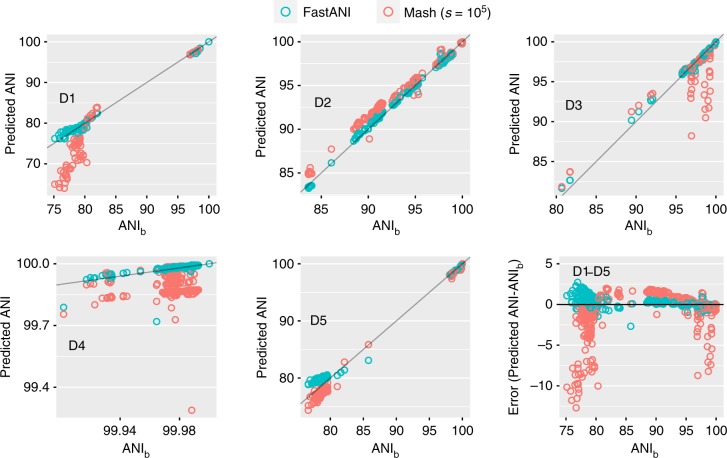
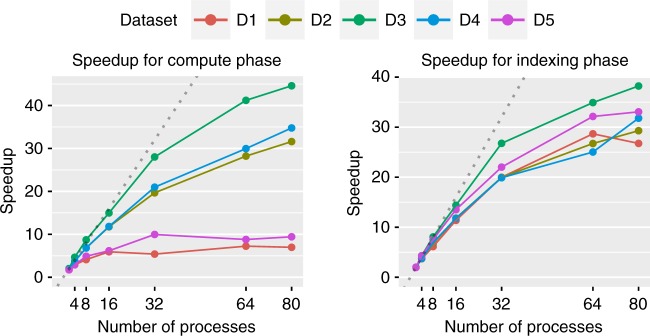
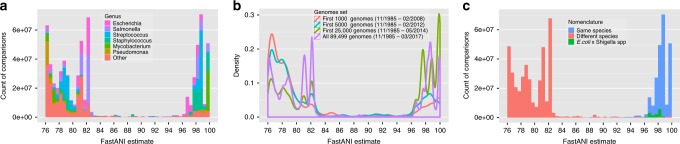
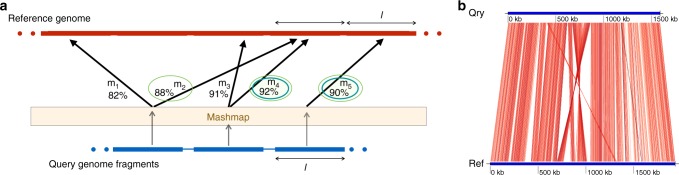
A fundamental question in microbiology is whether there is continuum of genetic diversity among genomes, or clear species boundaries prevail instead. Whole-genome similarity metrics such as Average Nucleotide Identity (ANI) help address this question by facilitating high resolution taxonomic analysis of thousands of genomes from diverse phylogenetic lineages. To scale to available genomes and beyond, we present FastANI, a new method to estimate ANI using alignment-free approximate sequence mapping. FastANI is accurate for both finished and draft genomes, and is up to three orders of magnitude faster compared to alignment-based approaches. We leverage FastANI to compute pairwise ANI values among all prokaryotic genomes available in the NCBI database. Our results reveal clear genetic discontinuity, with 99.8% of the total 8 billion genome pairs analyzed conforming to >95% intra-species and <83% inter-species ANI values. This discontinuity is manifested with or without the most frequently sequenced species, and is robust to historic additions in the genome databases.
Overview
The claims and statistics of this paper haven’t been checked yet.
Run the check — free, no account needed. It reads the open-access text and checks the sources it cites.
Integrity signals
Registry
Cites
Statistics
Figures
Verification
Claims the paper makes
The claims and statistics of this paper haven’t been checked yet.
Run the check — free, no account needed. It reads the open-access text and checks the sources it cites.
Claims other papers make about this one
Each is checked against this paper’s own text: does it say what the citing paper says it does?
The cited source says what the claim attributes to it.
In the citing paper
“FastANI (v1.3.1) (https://github.com/ParBLiSS/FastANI.) was used to calculate the average nucleotide identity between the isolated strains and the original Lp082,47 ensuring isolates were evolved from Lp082”
From Gut microbiota drives structural variation of exogenous probiotics to enhance colonization (2025) · cites this paper as [47]
Self-check
Percentages, sums and reported differences re-computed from the paper’s own numbers.
The self-check needs the paper’s full text.
Citations
Cites
Gapped BLAST and PSI-BLAST: a new generation of protein database search programs
Altschul, S. (1997) · Nucleic Acids Research · doi:10.1093/nar/25.17.3389 · Cited by 73,302
Search and clustering orders of magnitude faster than BLAST
Edgar, R. C. (2010) · Bioinformatics · doi:10.1093/bioinformatics/btq461 · Cited by 21,098
Fast and sensitive protein alignment using DIAMOND
Buchfink, B., Xie, C., & Huson, D. H. (2015) · Nature Methods · doi:10.1038/nmeth.3176 · Cited by 14,201
<tt>BLAT</tt> —The <tt>BLAST</tt> -Like Alignment Tool
Kent, W. J. (2002) · Genome Research · doi:10.1101/gr.229202 · Cited by 8,480
Canu: scalable and accurate long-read assembly via adaptive k -mer weighting and repeat separationPreprint
Koren, S., Walenz, B. P., Berlin, K., Miller, J. R., Bergman, N. H., & Phillippy, A. M. (2017) · Genome Research · doi:10.1101/gr.215087.116 · Cited by 7,260
Self-citationShifting the genomic gold standard for the prokaryotic species definition
Richter, M., & Rossello-Mora, R. A. (2009) · Proceedings of the National Academy of Sciences · doi:10.1073/pnas.0906412106 · Cited by 6,343
Versatile and open software for comparing large genomes
Kurtz, S., Phillippy, A., Delcher, A. L., Smoot, M., Shumway, M., Antonescu, C., & Salzberg, S. L. (2004) · Genome Biology · doi:10.1186/gb-2004-5-2-r12 · Cited by 5,254
Self-citationMauve: Multiple alignment of conserved genomic sequence with rearrangements
Darling, A. C. E., Mau, B., Blattner, F. R., & Perna, N. T. (2004) · Genome Research · doi:10.1101/gr.2289704 · Cited by 4,949
DNA–DNA hybridization values and their relationship to whole-genome sequence similarities
Goris, J., Konstantinidis, K. T., Klappenbach, J. A., Coenye, T., Vandamme, P. A. R., & Tiedje, J. M. (2007) · INTERNATIONAL JOURNAL OF SYSTEMATIC AND EVOLUTIONARY MICROBIOLOGY · doi:10.1099/ijs.0.64483-0 · Cited by 4,733 · cited 2×
“Nevertheless, it closely reflects the traditional microbiological concept of DNA-DNA hybridization relatedness for defining species (3), as it takes into account the fluid nature of the bacterial gene pool and hence implicitly considers shared function.”
BackgroundMethodSelf-citationA large-scale evaluation of algorithms to calculate average nucleotide identity
Yoon, S.-H., Ha, S. M., Lim, J., Kwon, S., & Chun, J. (2017) · Antonie van Leeuwenhoek · doi:10.1007/s10482-017-0844-4 · Cited by 3,614
Research works printed but not linked: 1
- Staley, J. The phylogenomic species concept. Microbiol. Today 36, 80–83 (2009).
Cited by
Sorted by citations
Items 1,001–1,013 of 1,013
Nhu, N. T. K., Phan, M.-D., Hancock, S. J., Peters, K. M., Alvarez-Fraga, L., Forde, B. M., Andersen, S. B., Miliya, T., Harris, P. N., Beatson, S. A., et al. (2024) · eLife · doi:10.7554/elife.91853.3 · Cited by 41
Genomic atlas of Bifidobacterium infantis and B. longum informs infant probiotic design
Shao, Y., Wang, S., Gichuki, B. M., Stares, M. D., Rozday, T. J., Kumar, N., Browne, H. P., Dawson, N. J. R., Njunge, J. M., Tigoi, C., et al. (2026) · Cell · doi:10.1016/j.cell.2026.01.007 · Cited by 17
Genomic and functional diversity of the human-derived isolates of Faecalibacterium
Li, W., Lin, X., Liang, H., Wu, Z., Wang, M., Sun, J., Li, X., He, W., Gao, X., Hu, T., et al. (2024) · Frontiers in Microbiology · doi:10.3389/fmicb.2024.1379500 · Cited by 17
Gut microbiota drives structural variation of exogenous probiotics to enhance colonization
Jiang, S., Huang, S., Zhang, Z., Ma, W., Han, Z., Song, Y., Huo, D., Cui, W., & Zhang, J. (2025) · Gut Microbes · doi:10.1080/19490976.2025.2503371 · Cited by 15
Clark, R. R., Lapierre, P., Lasek-Nesselquist, E., Gray, T. A., & Derbyshire, K. M. (2022) · mBio · doi:10.1128/mbio.00213-22 · Cited by 12
“Boundaries of recipient- and donor-derived segments were defined from nonoverlapping 500-bp sliding windows over the progeny genome to identify the origin of each fragment using identity scores derived from the FASTani algorithm (39).”
MethodCoaggregation of oral pathogens by postbiotic lactobacilli
Golletz, P., Jensen, S. D., Collignon, M., Hall, C., Khamas, A. B., Møllebjerg, A., Schlafer, S., Meyer, R. L., & Tykwinska, K. (2025) · Journal of oral microbiology · doi:10.1080/20002297.2025.2508483 · Cited by 10
“The ANI implementation, fastANI [24] was used with a Kmer size of 16 and a fragment length of 3000.”
Wu, Q., Li, W., Kwok, L.-Y., Lv, H., Sun, J., & Sun, Z. (2024) · Food Research International · doi:10.1016/j.foodres.2024.114840 · Cited by 9
Niu, M.-M., Li, Y., Ma, B., & Meng, X.-C. (2026) · Journal of Agricultural and Food Chemistry · doi:10.1021/acs.jafc.5c12182 · Cited by 5
Lu, W., Zha, B., Lyu, J., LingHu, C., Chen, J., Deng, S., Zhang, X., Li, L., & Wang, G. (2024) · Frontiers in Microbiology · doi:10.3389/fmicb.2024.1500886 · Cited by 4
Fang, S., Wang, S., Liu, Y., Zhu, C., Wang, S., & Xu, F. (2026) · Food Science & Nutrition · doi:10.1002/fsn3.71420 · Cited by 4
Calvanese, C. M., Valentino, V., De Prisco, A., Allesina, S., Amoruso, A., Deidda, F., Visciglia, A., Ercolini, D., Pane, M., & De Filippis, F. (2026) · Cellular and Molecular Life Sciences · doi:10.1007/s00018-026-06107-2 · Cited by 2
“The Average Nucleotide Identity (ANI) values between each pair of genomes was calculated using fastANI (version 1.0) [28 ].”
InfluentialGwak, Y.-S., Suh, H.-Y., Yoon, H.-R., Kim, S., Bae, C.-I., & Kim, M.-J. (2026) · Journal of Microbiology and Biotechnology · doi:10.4014/jmb.2606.06012
Arnoux, J. (2026) · Thèse de doctorat, Université Paris-Saclay / PPanGGOLiN · doi:10.70675/eee354d9zf63dz48ebz9444zd1809f8fb74d
Metadata
- Authors
- Jain, C., Rodriguez-R, L. M., Phillippy, A. M., Konstantinidis, K. T., & Aluru, S.
- Affiliations
- National Institutes of Health (US)
- Georgia Institute of Technology (US)
- Corresponding author
- Konstantinidis, Konstantinos T.
- Aluru, Srinivas
- ORCID
- Venue
- Nature Communications
- Published
- 2018-11-30
- Volume
- 9
- Issue
- 1
- Pages
- 5114-5114
- ISSN
- 2041-1723 (ISSN-L)
- PMC
- PMC6269478
- OpenAlex
- W2951254987
- Cited by
- 5,748
- References
- 40
- Citations by year
- 2026: 1107 · 2025: 1110 · 2024: 977 · 2023: 789 · 2022: 695 · 2021: 617 · 2020: 305 · 2019: 128 · 2018: 16
- FWCI
- 96.11
- Type
- journal article
- Language
- en
- Open access
- gold
- doi.org
- Locations
- Nature Communications (publishedVersion, cc-by)
- bioRxiv (Cold Spring Harbor Laboratory) (acceptedVersion, cc-by)
- Europe PMC (PubMed Central) (publishedVersion, other-oa)
- PubMed Central (publishedVersion, cc-by)
- PubMed (publishedVersion)
- RePEc: Research Papers in Economics (submittedVersion)
- DOAJ (DOAJ: Directory of Open Access Journals) (submittedVersion, cc-by-sa)
- DOAJ (DOAJ: Directory of Open Access Journals) (submittedVersion)
- Funders
- National Science Foundation (1416259, 1816027, 1356288)
- Topics
- Life Sciences › Biochemistry, Genetics and Molecular Biology › Molecular Biology › Genomics and Phylogenetic Studies
- Health Sciences › Medicine › Microbiology (medical) › Bacterial Identification and Susceptibility Testing
- Physical Sciences › Environmental Science › Ecology › Microbial Community Ecology and Physiology
- Keywords
- average nucleotide identity, prokaryotic genomes, species boundaries, taxonomic classification, draft genome sequence
- MeSH terms
- Phylogeny, Prokaryotic Cells, Genetic Variation, Databases, Factual, Genome, Bacterial, Sequence Analysis, DNA
About these checks
Registry, retraction, Cites and statistics results are computed, not judged, with one exception: a printed reference that no index lists is read once by a model before it counts as a citation error. Claims are extracted by a model and kept only when their quote appears verbatim in the text; each cited source is then checked, with a model’s help, for whether it says what the claim relies on. Those verdicts can be wrong — read the claim’s quote and the cited source before relying on one.
Statistics and arithmetic are recomputed, not judged.
Confidence bands are shown only for fields calibrated on our annotated test set. None is calibrated yet, so no band is shown.
What counts as a claim ›How we measure confidence ›How we check this ›
Are you an author, or do you see a problem with this page? Request a review
