

The DOI matches its Crossref record; 41 of the 41 references it cites were found in a registry or an index.
High throughput ANI analysis of 90K prokaryotic genomes reveals clear species boundaries
Open accessPublished version of a preprint
Abstract
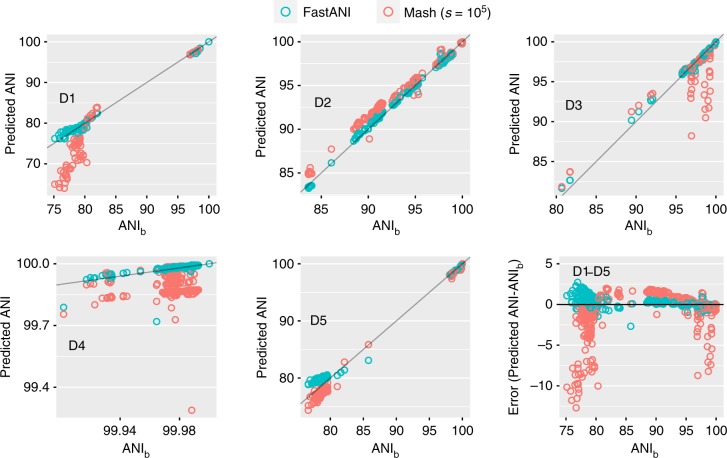
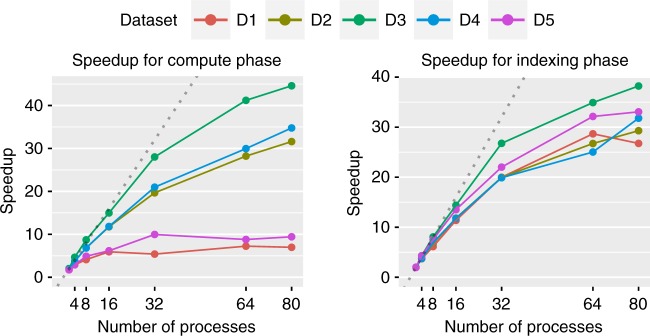
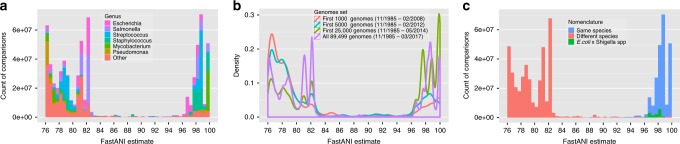
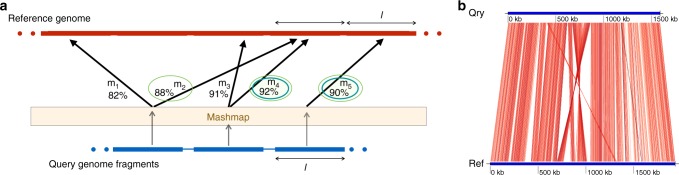
A fundamental question in microbiology is whether there is continuum of genetic diversity among genomes, or clear species boundaries prevail instead. Whole-genome similarity metrics such as Average Nucleotide Identity (ANI) help address this question by facilitating high resolution taxonomic analysis of thousands of genomes from diverse phylogenetic lineages. To scale to available genomes and beyond, we present FastANI, a new method to estimate ANI using alignment-free approximate sequence mapping. FastANI is accurate for both finished and draft genomes, and is up to three orders of magnitude faster compared to alignment-based approaches. We leverage FastANI to compute pairwise ANI values among all prokaryotic genomes available in the NCBI database. Our results reveal clear genetic discontinuity, with 99.8% of the total 8 billion genome pairs analyzed conforming to >95% intra-species and <83% inter-species ANI values. This discontinuity is manifested with or without the most frequently sequenced species, and is robust to historic additions in the genome databases.
Overview
The claims and statistics of this paper haven’t been checked yet.
Run the check — free, no account needed. It reads the open-access text and checks the sources it cites.
Integrity signals
Registry
Cites
Statistics
Figures
Verification
Claims the paper makes
The claims and statistics of this paper haven’t been checked yet.
Run the check — free, no account needed. It reads the open-access text and checks the sources it cites.
Claims other papers make about this one
Each is checked against this paper’s own text: does it say what the citing paper says it does?
The cited source says what the claim attributes to it.
In the citing paper
“FastANI (v1.3.1) (https://github.com/ParBLiSS/FastANI.) was used to calculate the average nucleotide identity between the isolated strains and the original Lp082,47 ensuring isolates were evolved from Lp082”
From Gut microbiota drives structural variation of exogenous probiotics to enhance colonization (2025) · cites this paper as [47]
Self-check
Percentages, sums and reported differences re-computed from the paper’s own numbers.
The self-check needs the paper’s full text.
Citations
Cites
Gapped BLAST and PSI-BLAST: a new generation of protein database search programs
Altschul, S. (1997) · Nucleic Acids Research · doi:10.1093/nar/25.17.3389 · Cited by 73,302
Search and clustering orders of magnitude faster than BLAST
Edgar, R. C. (2010) · Bioinformatics · doi:10.1093/bioinformatics/btq461 · Cited by 21,098
Fast and sensitive protein alignment using DIAMOND
Buchfink, B., Xie, C., & Huson, D. H. (2015) · Nature Methods · doi:10.1038/nmeth.3176 · Cited by 14,201
<tt>BLAT</tt> —The <tt>BLAST</tt> -Like Alignment Tool
Kent, W. J. (2002) · Genome Research · doi:10.1101/gr.229202 · Cited by 8,480
Canu: scalable and accurate long-read assembly via adaptive k -mer weighting and repeat separationPreprint
Koren, S., Walenz, B. P., Berlin, K., Miller, J. R., Bergman, N. H., & Phillippy, A. M. (2017) · Genome Research · doi:10.1101/gr.215087.116 · Cited by 7,260
Self-citationShifting the genomic gold standard for the prokaryotic species definition
Richter, M., & Rossello-Mora, R. A. (2009) · Proceedings of the National Academy of Sciences · doi:10.1073/pnas.0906412106 · Cited by 6,343
Versatile and open software for comparing large genomes
Kurtz, S., Phillippy, A., Delcher, A. L., Smoot, M., Shumway, M., Antonescu, C., & Salzberg, S. L. (2004) · Genome Biology · doi:10.1186/gb-2004-5-2-r12 · Cited by 5,254
Self-citationMauve: Multiple alignment of conserved genomic sequence with rearrangements
Darling, A. C. E., Mau, B., Blattner, F. R., & Perna, N. T. (2004) · Genome Research · doi:10.1101/gr.2289704 · Cited by 4,949
DNA–DNA hybridization values and their relationship to whole-genome sequence similarities
Goris, J., Konstantinidis, K. T., Klappenbach, J. A., Coenye, T., Vandamme, P. A. R., & Tiedje, J. M. (2007) · INTERNATIONAL JOURNAL OF SYSTEMATIC AND EVOLUTIONARY MICROBIOLOGY · doi:10.1099/ijs.0.64483-0 · Cited by 4,733 · cited 2×
“Nevertheless, it closely reflects the traditional microbiological concept of DNA-DNA hybridization relatedness for defining species (3), as it takes into account the fluid nature of the bacterial gene pool and hence implicitly considers shared function.”
BackgroundMethodSelf-citationA large-scale evaluation of algorithms to calculate average nucleotide identity
Yoon, S.-H., Ha, S. M., Lim, J., Kwon, S., & Chun, J. (2017) · Antonie van Leeuwenhoek · doi:10.1007/s10482-017-0844-4 · Cited by 3,614
Research works printed but not linked: 1
- Staley, J. The phylogenomic species concept. Microbiol. Today 36, 80–83 (2009).
Cited by
Sorted by citations
Items 201–300 of 1,013
Microbial hitchhikers harbouring antimicrobial-resistance genes in the riverine plastisphere
Zadjelovic, V., Wright, R. J., Borsetto, C., Quartey, J., Cairns, T. N., Langille, M. G. I., Wellington, E. M. H., & Christie-Oleza, J. A. (2023) · Microbiome · doi:10.1186/s40168-023-01662-3 · Cited by 87
“…used Prodigal [63] for gene calling, HMMER [45] for marker gene identification, pplacer [89] for inserting genomes into reference trees and FastANI [65] for calculating Average Nucleotide Identity (ANI) and therefore species assignment as well as the additional packages FastTree [119], Mash [106],…”
MethodWang, Y., Liang, Q., Lu, B., Shen, H., Liu, S., Shi, Y., Leptihn, S., Li, H., Wei, J., Liu, C., et al. (2021) · BMC Genomics · doi:10.1186/s12864-021-07539-9 · Cited by 88
“The average nucleotide identity (ANI) was calculated using fastANI [38].”
MethodHydrogen-based metabolism as an ancestral trait in lineages sibling to the Cyanobacteria
Carnevali, P. B. M., Schulz, F., Castelle, C. J., Kantor, R. S., Shih, P. M., Sharon, I., Santini, J. M., Olm, M. R., Amano, Y., Thomas, B. C., et al. (2019) · Nature Communications · doi:10.1038/s41467-018-08246-y · Cited by 82
VV Reduction by Polaromonas spp. in Vanadium Mine Tailings
Sun, X., Qiu, L., Kolton, M., Häggblom, M. M., Xu, R., Kong, T., Gao, P., Li, B., Jiang, C., & Sun, W. (2020) · Environmental Science & Technology · doi:10.1021/acs.est.0c05328 · Cited by 84
Diversity, evolution, and classification of virophages uncovered through global metagenomics
Páez-Espino, D., Zhou, J., Roux, S., Nayfach, S., Pavlopoulos, G. A., Schulz, F., McMahon, K. D., Walsh, D. A., Woyke, T., Ivanova, N., et al. (2019) · Microbiome · doi:10.1186/s40168-019-0768-5 · Cited by 84
Winter warming in Alaska accelerates lignin decomposition contributed by Proteobacteria
Tao, X., Feng, J., Yang, Y., Wang, G., Tian, R., Fan, F., Ning, D., Bates, C. T., Hale, L. E., Yuan, M., et al. (2020) · Microbiome · doi:10.1186/s40168-020-00838-5 · Cited by 84
Self-citationWillms, I. M., Rudolph, A. Y., Göschel, I., Bolz, S. H., Schneider, D., Penone, C., Poehlein, A., Schöning, I., & Nacke, H. (2020) · mSphere · doi:10.1128/msphere.00186-20 · Cited by 96
“Additionally, the closest relative of our MAG was identified via FastANI based on whole-genome average nucleotide identity (69).”
Chen, C., Cui, C., Yu, J.-J., Qian, H., Wu, X.-T., He, Y., Cui, Z.-H., Li, C., Jia, Q.-L., Shen, X.-G., et al. (2020) · Genome Medicine · doi:10.1186/s13073-020-00807-5 · Cited by 82
Manck, L. E., Park, J., Tully, B., Poire, A., Bundy, R. M., Dupont, C. L., & Barbeau, K. A. (2021) · The ISME Journal · doi:10.1038/s41396-021-01065-y · Cited by 86
“3) [55] with a fragment length of 1500 bp, were considered to be members of the same species.”
BackgroundPérez-Carrascal, O. M., Tromas, N., Terrat, Y., Moreno, E., Giani, A., Marques, L. C. B., Fortin, N. Y., & Shapiro, B. J. (2021) · Microbiome · doi:10.1186/s40168-021-01140-8 · Cited by 91
Zou, Y., Lin, X., Xue, W., Tuo, L., Chen, M.-S., Chen, X.-H., Sun, C., Li, F.-N., Liu, S., Dai, Y., et al. (2021) · Scientific Reports · doi:10.1038/s41598-021-90786-3 · Cited by 86
Blanco‐Míguez, A., Gálvez, E. J. C., Pasolli, E., Filippis, F. D., Amend, L., Huang, K. D., Manghi, P., Lesker, T.-R., Riedel, T., Cova, L., et al. (2023) · Cell Host & Microbe · doi:10.1016/j.chom.2023.09.013 · Cited by 86
SPIRE: a Searchable, Planetary-scale mIcrobiome REsource
Schmidt, T., Fullam, A., Ferretti, P., Orakov, A. N., Maistrenko, O. M., Ruscheweyh, H., Letunić, I., Duan, Y., Rossum, T. V., Sunagawa, S., et al. (2023) · Nucleic Acids Research · doi:10.1093/nar/gkad943 · Cited by 89
Rhizobia–diatom symbiosis fixes missing nitrogen in the ocean
Tschitschko, B., Esti, M., Philippi, M., Kidane, A. T., Littmann, S., Kitzinger, K., Speth, D. R., Li, S., Kraberg, A. C., Tienken, D., et al. (2024) · Nature · doi:10.1038/s41586-024-07495-w · Cited by 94
Complementary Metagenomic Approaches Improve Reconstruction of Microbial Diversity in a Forest Soil
Alteio, L. V., Schulz, F., Seshadri, R., Varghese, N. J., Rodriguez-Reillo, W., Ryan, E. M., Goudeau, D., Eichorst, S. A., Malmstrom, R. R., Bowers, R. M., et al. (2020) · mSystems · doi:10.1128/msystems.00768-19 · Cited by 82
Anaerobic bacterial degradation of protein and lipid macromolecules in subarctic marine sediment
Pelikan, C., Wasmund, K., Glombitza, C., Hausmann, B., Herbold, C. W., Flieder, M., & Loy, A. (2020) · The ISME Journal · doi:10.1038/s41396-020-00817-6 · Cited by 84
“1 with default parameters [59] and 253 CompareM 0.”
BackgroundMETAnnotatorX2: a Comprehensive Tool for Deep and Shallow Metagenomic Data Set Analyses
Milani, C., Lugli, G. A., Fontana, F., Mancabelli, L., Alessandri, G., Longhi, G., Anzalone, R., Viappiani, A., Turroni, F., van Sinderen, D., et al. (2021) · mSystems · doi:10.1128/msystems.00583-21 · Cited by 87
“This approach represents the gold standard for genome-based, species-level classification of genomes, as proposed by recent publications (25, 32, 33).”
BackgroundMethodInfluentialThe rates of global bacterial and archaeal dispersal
Louca, S. (2021) · The ISME Journal · doi:10.1038/s41396-021-01069-8 · Cited by 82
Vinitha, V., Preeyanghaa, M., Vinesh, V., Dhanalakshmi, R., Neppolian, B., & Sivamurugan, V. (2021) · Emergent Materials · doi:10.1007/s42247-021-00262-x · Cited by 81
“By incorporating Bi into ZnO (Bi-ZnO), the absorbance edge is blue-shifted [116].”
BackgroundMechanistic insights into consumption of the food additive xanthan gum by the human gut microbiota
Ostrowski, M. P., Rosa, S. L. L., Kunath, B. J., Robertson, A., Pereira, G. V., Hagen, L. H., Varghese, N. J., Qiu, L., Yao, T., Flint, G., et al. (2022) · Nature Microbiology · doi:10.1038/s41564-022-01093-0 · Cited by 85
Carroll, L. M., Cheng, R. A., & Kovač, J. (2020) · Frontiers in Microbiology · doi:10.3389/fmicb.2020.580691 · Cited by 82
Andreu-Sánchez, S., Blanco-Míguez, A., Wang, D., Golzato, D., Manghi, P., Heidrich, V., Fackelmann, G., Zhernakova, D. V., Kurilshikov, A., Valles-Colomer, M., et al. (2025) · Cell · doi:10.1016/j.cell.2025.04.014 · Cited by 81
Rehman, Z. U., Vrouwenvelder, J. S., & Saikaly, P. E. (2021) · Frontiers in Microbiology · doi:10.3389/fmicb.2021.668761 · Cited by 79
“The bacteria belonging to the same species typically showed >=95% ANI values (Jain et al., 2018).”
BackgroundThe genomic basis of the Streptococcus thermophilus health-promoting properties
Roux, É., Nicolas, A., Valence, F., Siekaniec, G., Chuat, V., Nicolas, J., Loir, Y. L., & Guédon, É. (2022) · BMC Genomics · doi:10.1186/s12864-022-08459-y · Cited by 82
Microbiota-driven antitumour immunity mediated by dendritic cell migration
Lin, Y.-T., Fukuoka, S., Koyama, S., Motooka, D., Tourlousse, D. M., Shigeno, Y., Matsumoto, Y., Yamano, H., Murotomi, K., Tamaki, H., et al. (2025) · Nature · doi:10.1038/s41586-025-09249-8 · Cited by 84
“The average nucleotide identity (ANI) values were then calculated using fastANI 63 through comparisons of YB328 and closely related species.”
Jeong, H., Arif, B., Caetano‐Anollés, G., Kim, K. M., & Nasir, A. (2019) · Scientific Reports · doi:10.1038/s41598-019-42227-5 · Cited by 79
Function-driven single-cell genomics uncovers cellulose-degrading bacteria from the rare biosphere
Doud, D. F. R., Bowers, R. M., Schulz, F., de Raad, M., Deng, K., Tarver, A., Glasgow, E. M., Meulen, K. A. V., Fox, B. G., Deutsch, S., et al. (2019) · The ISME Journal · doi:10.1038/s41396-019-0557-y · Cited by 78
“Recovery of the same species across all genomes derived from different particles was calculated using an average nucleotide identity species threshold of 95% [61] or greater across using pyani.”
MethodFan, W., Liu, F., Jia, Q., Du, H., Chen, W., Ruan, J., Lei, J., Li, D.-Z., Mower, J. P., & Zhu, A. (2022) · New Phytologist · doi:10.1111/nph.18334 · Cited by 76
Coherence of Microcystis species revealed through population genomics
Pérez-Carrascal, O. M., Terrat, Y., Giani, A., Fortin, N. Y., Greer, C. W., Tromas, N., & Shapiro, B. J. (2019) · The ISME Journal · doi:10.1038/s41396-019-0481-1 · Cited by 80
“genetic discontinuity or bimodal distribution with peaks higher than 95% (intra-species) and 324 lower than 83% (inter-species), but the mechanism for this discontinuity is unclear, and it is 325 difficult to exclude sampling bias as a reason for the discontinuity (47, 48).”
BackgroundYeoh, Y. K., Chen, Z., Wong, M. C. S., Hui, M., Yu, J., Ng, S. C., Sung, J. J. �., Chan, F. K. L., & Chan, P. K. S. (2020) · Gut · doi:10.1136/gutjnl-2019-319635 · Cited by 74
Crits‐Christoph, A., Olm, M. R., Diamond, S., Bouma‐Gregson, K., & Banfield, J. F. (2020) · The ISME Journal · doi:10.1038/s41396-020-0655-x · Cited by 75
Hanson, B. T., Kits, K. D., Löffler, J., Burrichter, A. G., Fiedler, A. W., Denger, K., Frommeyer, B., Herbold, C. W., Rattei, T., Karcher, N., et al. (2021) · The ISME Journal · doi:10.1038/s41396-021-00968-0 · Cited by 70
Anaerobic thiosulfate oxidation by the Roseobacter group is prevalent in marine biofilms
Ding, W., Wang, S., Qin, P., Fan, S., Su, X., Cai, P., Lu, J., Cui, H., Wang, M., Shu, Y., et al. (2023) · Nature Communications · doi:10.1038/s41467-023-37759-4 · Cited by 76
Wang, R., Zhang, A., Sun, S., Yin, G., Wu, X., Ding, Q., Wang, Q., Chen, F., Wang, S., van Dorp, L., et al. (2024) · Nature Communications · doi:10.1038/s41467-023-44351-3 · Cited by 79
Mu, D., Wang, S., Liang, Q., Du, Z.-Z., Tian, R., Ouyang, Y., Wang, X.-P., Zhou, A., Gong, Y., Chen, G., et al. (2020) · Microbiome · doi:10.1186/s40168-020-00902-0 · Cited by 75
Over 50,000 Metagenomically Assembled Draft Genomes for the Human Oral Microbiome Reveal New Taxa
Zhu, J., Tian, L., Chen, P., Han, M., Song, L., Tong, X., Sun, X., Yang, F., Lin, Z., Liu, X., et al. (2021) · Genomics Proteomics & Bioinformatics · doi:10.1016/j.gpb.2021.05.001 · Cited by 76
Zhao, W., Zeng, W., Pang, B., Luo, M., Peng, Y., Xu, J., Kan, B., Li, Z., & Lü, X. (2023) · Frontiers in Microbiology · doi:10.3389/fmicb.2023.1179966 · Cited by 81
Early-Life Immune System Maturation in Chickens Using a Synthetic Community of Cultured Gut Bacteria
Zenner, C., Hitch, T. C. A., Riedel, T., Wortmann, E., Tiede, S., Buhl, E. M., Abt, B., Neuhaus, K., Velge, P., Overmann, J., et al. (2021) · mSystems · doi:10.1128/msystems.01300-20 · Cited by 72
“3) (87) and the percentage of conserved proteins (POCP) (88).”
BackgroundEcology of Endozoicomonadaceae in three coral genera across the Pacific Ocean
Hochart, C., Paoli, L., Ruscheweyh, H., Salazar, G., Boissin, É., Romac, S., Poulain, J., Bourdin, G., Iwankow, G., Moulin, C., et al. (2023) · Nature Communications · doi:10.1038/s41467-023-38502-9 · Cited by 76
“In the MAGs from this study, ANI was >95% in coral host-speci fi c clusters, which corresponds to the threshold used for species delineation 60 .”
LINbase: a web server for genome-based identification of prokaryotes as members of crowdsourced taxa
Tian, L., Huang, C., Mazloom, R., Heath, L. S., & Vinatzer, B. A. (2020) · Nucleic Acids Research · doi:10.1093/nar/gkaa190 · Cited by 73
Podlesny, D., Arze, C., Dörner, E., Verma, S., Dutta, S., Walter, J., & Fricke, W. F. (2022) · Microbiome · doi:10.1186/s40168-022-01251-w · Cited by 73
Feehily, C., O’Neill, I. J., Walsh, C. J., Moore, R., Killeen, S. L., Geraghty, A. A., Lawton, E. M., Byrne, D. F., Sánchez-Gallardo, R., Nori, S. R. C., et al. (2023) · Nature Communications · doi:10.1038/s41467-023-38694-0 · Cited by 74
Recovering prokaryotic genomes from host-associated, short-read shotgun metagenomic sequencing data
Kashaf, S. S., Almeida, A., Segre, J. A., & Finn, R. D. (2021) · Nature Protocols · doi:10.1038/s41596-021-00508-2 · Cited by 72
Host adaptation in gut Firmicutes is associated with sporulation loss and altered transmission cycle
Browne, H. P., Almeida, A., Kumar, N., Vervier, K., Adoum, A., Viciani, E., Dawson, N. J. R., Forster, S. C., Cormie, C., Goulding, D., et al. (2021) · Genome biology · doi:10.1186/s13059-021-02428-6 · Cited by 73
Wu, F., Speth, D. R., Philosof, A., Crémière, A., Narayanan, A. K., Barco, R. A., Connon, S. A., Amend, J. P., Antoshechkin, I. A., & Orphan, V. J. (2022) · Nature Microbiology · doi:10.1038/s41564-021-01039-y · Cited by 68
In-depth characterization of denitrifier communities across different soil ecosystems in the tundra
Pessi, I. S., Viitamäki, S., Virkkala, A., Eronen‐Rasimus, E., Delmont, T. O., Marushchak, M. E., Luoto, M., & Hultman, J. (2022) · Environmental Microbiome · doi:10.1186/s40793-022-00424-2 · Cited by 76
Bernardini, N., Basile, A., Zampieri, G., Kovalovszki, A., Diaz, B. D. D., Offer, E., Wongfaed, N., Angelidaki, İ., Kougias, P., Campanaro, S., et al. (2022) · Microbiome · doi:10.1186/s40168-022-01311-1 · Cited by 72
Vancaester, E., & Blaxter, M. (2023) · PLoS Biology · doi:10.1371/journal.pbio.3001972 · Cited by 76
Dong, X., Peng, Y., Wang, M., Woods, L. C., Wu, W., Wang, Y., Xiao, X., Li, J., Jia, K., Greening, C., et al. (2023) · Nature Communications · doi:10.1038/s41467-023-36877-3 · Cited by 70
Wang, F., Bartosik, D., Sidhu, C., Siebers, R., Lu, D., Trautwein‐Schult, A., Becher, D., Hüettel, B., Rick, J. J., Kirstein, I. V., et al. (2024) · Microbiome · doi:10.1186/s40168-024-01757-5 · Cited by 80
Giordano, N., Gaudin, M., Trottier, C., Delage, E., Nef, C., Bowler, C., & Chaffron, S. (2024) · Nature Communications · doi:10.1038/s41467-024-46374-w · Cited by 75
“This process allowed to identify and select most complete and less contaminated genomes within each species cluster,which yielded 7658non-redundant species-levelgenomeswith an average nucleotide identity below 95%, a threshold previously reported to delineate species level for prokaryotes 86 .”
Metabolic coupling between soil aerobic methanotrophs and denitrifiers in rice paddy fields
Chen, K.-H., Feng, J., Bodelier, P. L. E., Yang, Z., Huang, Q., Delgado‐Baquerizo, M., Cai, P., Tan, W., & Liu, Y. (2024) · Nature Communications · doi:10.1038/s41467-024-47827-y · Cited by 73
“0) was used tocalculate thevaluesof genome ANI as referred to GTDB database 97 .”
Expanding the human gut microbiome atlas of Africa
Maghini, D. G., Oduaran, O. H., Ingasia, L. A. O., Cook, J. A., Smyth, N., Mathema, T., Belger, C. W., Agongo, G., Boua, P. R., Choma, S., et al. (2025) · Nature · doi:10.1038/s41586-024-08485-8 · Cited by 91
How Much Do rRNA Gene Surveys Underestimate Extant Bacterial Diversity?
Rodriguez‐R, L. M., Castro, J. C., Kyrpides, N. C., Cole, J. R., Tiedje, J. M., & Konstantinidis, K. T. (2018) · Applied and Environmental Microbiology · doi:10.1128/aem.00014-18 · Cited by 75
“Genome-derived parameters, such as the 95% average nucleotide identity (ANI), have been shown to better encompass the named species based on isolates (8, 20) and the natural sequence-discrete populations sampled by metagenomics (21), as these parameters capture better than 16S rRNA gene sequence analysis the tradition…”
BackgroundSelf-citationComprehensive pan‐genome analysis of Lactiplantibacillus plantarum complete genomes
Carpi, F. M., Coman, M. M., Silvi, S., Picciolini, M., Verdenelli, M. C., & Napolioni, V. (2022) · Journal of Applied Microbiology · doi:10.1111/jam.15199 · Cited by 72
Overholt, W. A., Hölzer, M., Geesink, P., Diezel, C., Marz, M., & Küsel, K. (2020) · Environmental Microbiology · doi:10.1111/1462-2920.15186 · Cited by 72
“To identify MAGs that were recovered from both assembly methods, FastANI was run on all pairwise comparisons of the Illumina-only and ONT-only MAGs to the hybrid MAGs that were initially assessed using CheckM (82 hybrid, 44 Illumina-only, 35 ONT-only) (Jain et al., 2018).”
MethodInfluentialThe Genomic Landscape of Reference Genomes of Cultivated Human Gut Bacteria
Lin, X., Hu, T., Chen, J., Liang, H., Zhou, J., Wu, Z., Ye, C., Jin, X., Xu, X., Zhang, W., et al. (2021) · Nature Communications · doi:10.1038/s41467-023-37396-x · Cited by 76
Staphylococcal diversity in atopic dermatitis from an individual to a global scale
Kashaf, S. S., Harkins, C. P., Deming, C., Joglekar, P., Conlan, S., Holmes, C. J., Almeida, A., Finn, R. D., Segre, J. A., & Kong, H. H. (2023) · Cell Host & Microbe · doi:10.1016/j.chom.2023.03.010 · Cited by 69
Gut microbiome signatures of extreme environment adaption in Tibetan pig
Zhao, F., Yang, L., Zhang, T., Zhuang, D., Wu, Q., Yu, J., Tian, C., & Zhang, Z. (2023) · npj Biofilms and Microbiomes · doi:10.1038/s41522-023-00395-3 · Cited by 73
Plastics shape the black soldier fly larvae gut microbiome and select for biodegrading functions
Filippis, F. D., Bonelli, M., Bruno, D., Sequino, G., Montali, A., Reguzzoni, M., Pasolli, E., Savy, D., Cangemi, S., Cozzolino, V., et al. (2023) · Microbiome · doi:10.1186/s40168-023-01649-0 · Cited by 76
“To define subspecies, pairwise average nucleotide identities (ANI) were estimated between genomes falling in the same SGB through FastANI [71] and clustered using the Partitioning Around Medoid (PAM) algo-rithm in R, as described recently [72].”
MethodInfluentialEmergence and global spread of a dominant multidrug-resistant clade within Acinetobacter baumannii
Li, S., Jiang, G., Wang, S., Wang, M., Wu, Y., Zhang, J., Liu, X., Zhong, L., Zhou, M., Xie, S., et al. (2025) · Nature Communications · doi:10.1038/s41467-025-58106-9 · Cited by 81
“33 54 , and only 15,643 genomes that exhibited ≥ 95% ANIs to the references were kept in down-stream analysis.”
Correlation of Key Physiological Properties of Methanosarcina Isolates with Environment of Origin
Zhou, J., Holmes, D. E., Tang, H., & Lovley, D. R. (2021) · Applied and Environmental Microbiology · doi:10.1128/aem.00731-21 · Cited by 72
“The genome of M. subterranea is currently not available; however, comparison of the strain DH-2 genome to other Methanosarcina genomes with the FastANI tool (average nucleotide identity [ANI], a measure of nucleotide-level genomic similarity between the coding regions of two genomes) (21) showed that DH-2 is most simi…”
BackgroundMethodInfluentialMethane-derived carbon flows into host–virus networks at different trophic levels in soil
Lee, S., Sieradzki, E. T., Nicolas, A. M., Walker, R. L., Firestone, M. K., Hazard, C., & Nicol, G. W. (2021) · Proceedings of the National Academy of Sciences · doi:10.1073/pnas.2105124118 · Cited by 69
A genome catalogue of lake bacterial diversity and its drivers at continental scale
Garner, R. E., Kraemer, S. A., Onana, V. E., Fradette, M., Varin, M.-P., Huot, Y., & Walsh, D. A. (2023) · Nature Microbiology · doi:10.1038/s41564-023-01435-6 · Cited by 76
Li, X., Brejnrod, A., Thorsen, J., Zachariasen, T., Trivedi, U., Russel, J., Vestergaard, G., Stokholm, J., Rasmussen, M. A., & Sørensen, S. J. (2023) · Nature Communications · doi:10.1038/s41467-023-44289-6 · Cited by 73
Lin, X., Hu, T., Wu, Z., Li, L., Wang, Y., Wen, D., Liu, X., Li, W., Liang, H., Jin, X., et al. (2024) · iMeta · doi:10.1002/imt2.174 · Cited by 71
“32) [53] to compare the genomes for different data sets, and only one of the genomes was retained when the genomes were highly similar (pairwise ANI was 100”
BackgroundGenomic changes underlying host specialization in the bee gut symbiont Lactobacillus Firm5
Ellegaard, K., Brochet, S., Bonilla‐Rosso, G., Emery, O., Glover, N., Hadadi, N., Jaroň, K. S., van der Meer, J. R., Robinson‐Rechavi, M., Sentchilo, V., et al. (2019) · Molecular Ecology · doi:10.1111/mec.15075 · Cited by 70
Marine Dadabacteria exhibit genome streamlining and phototrophy-driven niche partitioning
Graham, E. D., & Tully, B. (2020) · The ISME Journal · doi:10.1038/s41396-020-00834-5 · Cited by 70
“Ecological distribution and environmental correlations For determining the ecological distribution and environmental correlations, a non-redundant set of MAGs was determined using FastANI (Jain et al., 2018) (v1.”
Re-evaluating the evidence for a universal genetic boundary among microbial species
Murray, C. S., Gao, Y., & Wu, M. (2021) · Nature Communications · doi:10.1038/s41467-021-24128-2 · Cited by 70
Waterworth, S. C., Flórez, L. V., Rees, E. R., Hertweck, C., Kaltenpoth, M., & Kwan, J. C. (2020) · mBio · doi:10.1128/mbio.02430-19 · Cited by 71
Chen, Y., Brook, T. C., Soe, C. Z., O’Neill, I. J., Alcon-Giner, C., Leelastwattanagul, O., Phillips, S., Caim, S., Clarke, P., Hall, L. J., et al. (2020) · Microbial Genomics · doi:10.1099/mgen.0.000377 · Cited by 68
Methanotrophy by a Mycobacterium species that dominates a cave microbial ecosystem
van Spanning, R. J. M., Guan, Q., Melkonian, C., Gallant, J., Polerecký, L., Flot, J., Brandt, B. W., Braster, M., Iturbe-Espinoza, P., Aerts, J. W., et al. (2022) · Nature Microbiology · doi:10.1038/s41564-022-01252-3 · Cited by 72
APPLES: Scalable Distance-Based Phylogenetic Placement with or without Alignments
Balaban, M., Sarmashghi, S., & Mirarab, S. (2019) · Systematic Biology · doi:10.1093/sysbio/syz063 · Cited by 69
Ye, L., Mei, R., Liu, W., Ren, H., & Zhang, X.-X. (2020) · Microbiome · doi:10.1186/s40168-020-0794-3 · Cited by 69
Lachance, M., Lee, D. K., & Hsiang, T. (2020) · Antonie van Leeuwenhoek · doi:10.1007/s10482-020-01480-9 · Cited by 68
“This is at considerable variance with the large gap (83–96% ANI) separating interspecific and intraspecific values in prokaryotes (Jain et al. 2018).”
BackgroundGounot, J.-S., Chia, M., Bertrand, D., Saw, W., Ravikrishnan, A., Low, A., Ding, Y., Ng, A. H. Q., Tan, L. W. L., Teo, Y., et al. (2022) · Nature Communications · doi:10.1038/s41467-022-33782-z · Cited by 66
Sex differences in the oral microbiome, host traits, and their causal relationships
Liu, X., Tong, X., Jie, Z., Zhu, J., Tian, L., Sun, Q., Ju, Y., Zou, L., Lu, H., Qiu, X., et al. (2022) · iScience · doi:10.1016/j.isci.2022.105839 · Cited by 68
Roberts, L. W., Harris, P. N. A., Forde, B. M., Zakour, N. L. B., Catchpoole, E. M., Stanton-Cook, M. J., Phan, M., Sidjabat, H. E., Bergh, H., Heney, C., et al. (2020) · Nature Communications · doi:10.1038/s41467-019-14139-5 · Cited by 66
Reply to: “Re-evaluating the evidence for a universal genetic boundary among microbial species”
Rodriguez‐R, L. M., Jain, C., Conrad, R. E., Aluru, S., & Konstantinidis, K. T. (2021) · Nature Communications · doi:10.1038/s41467-021-24129-1 · Cited by 68
Self-citationA Genome-Based Species Taxonomy of the Lactobacillus Genus Complex
Wittouck, S., Wuyts, S., Meehan, C. J., van Noort, V., & Lebeer, S. (2019) · mSystems · doi:10.1128/msystems.00264-19 · Cited by 73
Diversity and evolution of surface polysaccharide synthesis loci in Enterobacteriales
Holt, K. E., Lassalle, F., Wyres, K. L., Wick, R. R., & Mostowy, R. J. (2020) · The ISME Journal · doi:10.1038/s41396-020-0628-0 · Cited by 61
Bernardy, E. E., Petit, R. A., Raghuram, V., Alexander, A. M., Read, T. D., & Goldberg, J. B. (2020) · mBio · doi:10.1128/mbio.00735-20 · Cited by 69
Arikawa, K., Ide, K., Kogawa, M., Saeki, T., Yoda, T., Endoh, T., Matsuhashi, A., Takeyama, H., & Hosokawa, M. (2021) · Microbiome · doi:10.1186/s40168-021-01152-4 · Cited by 72
“ANI was calculated for selected SAGs using FastANI 1.3 [42].”
MethodInfluentialFang, Y., Liu, J., Yang, J., Wu, G., Hua, Z., Dong, H., Hedlund, B. P., Baker, B. J., & Jiang, H. (2022) · mSystems · doi:10.1128/msystems.00335-22 · Cited by 67
“Average nucleotide identity (ANI) analysis demonstrated that each MAG represented a unique species based on the species demarcation threshold of 95% (24).”
BackgroundAchtman, M., Zhou, Z., Charlesworth, J., & Baxter, L. A. (2022) · Philosophical Transactions of the Royal Society B Biological Sciences · doi:10.1098/rstb.2021.0240 · Cited by 70
“Fast 71 computational methods based on k-mer searches, such as FastANI [10], can perform 72 ANI-like calculations on large numbers of genomes, and these calculations are now 73 routinely used by bioinformaticians for taxonomic assignments.”
MethodInfluentialNatural products from reconstructed bacterial genomes of the Middle and Upper Paleolithic
Klapper, M., Hübner, A., Ibrahim, A., Wasmuth, I., Borry, M., Haensch, V. G., Zhang, S., Al‐Jammal, W. K., Suma, H. R., Yates, J. A. F., et al. (2023) · Science · doi:10.1126/science.adf5300 · Cited by 67
Lactococcus lactis in Dairy Fermentation—Health-Promoting and Probiotic Properties
Kondrotienė, K., Zavistanavičiūtė, P., Aksomaitienė, J., Novoslavskij, A., & Malakauskas, M. (2023) · Fermentation · doi:10.3390/fermentation10010016 · Cited by 83
“The integration of a variety of tools, e.g., FastANI [377], mobileOG-db [378], CRISPR/Cas Finder, pLannotate [379], and CGView Builder [380], and their associated visualization capabilities facilitates the identification of genome elements of interest.”
MethodGut microbiota contributes to high-altitude hypoxia acclimatization of human populations
Su, Q., Zhuang, D., Li, Y., Chen, Y., Wang, X.-Y., Ge, M., Xue, T.-Y., Zhang, Q.-Y., Liu, X., Yin, F.-Q., et al. (2024) · Genome biology · doi:10.1186/s13059-024-03373-w · Cited by 73
“According to the 95% average nucleotide identity (ANI) threshold [13], a non-redundant genome set consisting of 4312 species-level genome bins (SGBs) was constructed based on these data and a previously published human microbial genome [14].”
MethodAnderson, C. L., & Fernando, S. C. (2021) · Communications Biology · doi:10.1038/s42003-021-02331-7 · Cited by 66
Diesel and Crude Oil Biodegradation by Cold-Adapted Microbial Communities in the Labrador Sea
Murphy, S., Bautista, M. A., Cramm, M. A., & Hubert, C. R. J. (2021) · Applied and Environmental Microbiology · doi:10.1128/aem.00800-21 · Cited by 75
“FastANI (118), with minimum fragment length set to 1,000 bp and other parameters set to default, was used to compare the percent average nucleotide identity (ANI) of select MAGs and published genomes.”
MethodHarrison, J., Nelson, K., Morcrette, H., Morcrette, C. J., Preston, J., Helmer, L., Titball, R. W., Butler, C. S., & Wagley, S. (2021) · Water Research · doi:10.1016/j.watres.2021.117942 · Cited by 69
Active anaerobic methane oxidation and sulfur disproportionation in the deep terrestrial subsurface
Bell, E., Lamminmäki, T., Alneberg, J., Chen, Q., Xiong, W., Hettich, R. L., Frutschi, M., & Bernier‐Latmani, R. (2022) · The ISME Journal · doi:10.1038/s41396-022-01207-w · Cited by 66
Hu, X., Gu, H., Liu, J., Wei, D., Zhu, P., Cui, X., Zhou, B., Chen, X., Jin, J., Liu, X., et al. (2023) · Agriculture Ecosystems & Environment · doi:10.1016/j.agee.2023.108462 · Cited by 66
Savin, C., Criscuolo, A., Guglielmini, J., Guern, A. L., Carniel, É., Pizarro‐Cerdá, J., & Brisse, S. (2019) · Microbial Genomics · doi:10.1099/mgen.0.000301 · Cited by 65
Methylobacterium ajmalii sp. nov., Isolated From the International Space Station
Bijlani, S., Singh, N. K., Eedara, V. V. R., Podile, A. R., Mason, C. E., Wang, C. C. C., & Venkateswaran, K. J. (2021) · Frontiers in Microbiology · doi:10.3389/fmicb.2021.639396 · Cited by 65
“Genomes of all other strains used in this study were downloaded from NCBI, and the genomic relatedness of ISS strains was identified based on average nucleotide identity (ANI; FastANI) calculations (Jain et al., 2018) and digital DNA-DNA hybridization (dDDH) analysis (Meier-Kolthoff et al., 2013).”
MethodMestre, M. R., Gao, L. A., Shah, S. A., López-Beltrán, A., González-Delgado, A., Martínez‐Abarca, F., Iranzo, J., Redrejo‐Rodríguez, M., Zhang, F., & Toro, N. (2022) · Nucleic Acids Research · doi:10.1093/nar/gkac467 · Cited by 65
Maire, J., Tandon, K., Collingro, A., van de Meene, A., Damjanovic, K., Gøtze, C. R., Stephenson, S., Philip, G. K., Horn, M., Cantin, N. E., et al. (2023) · Science Advances · doi:10.1126/sciadv.adg0773 · Cited by 64
Dyksma, S., & Pester, M. (2024) · Microbiome · doi:10.1186/s40168-024-01909-7 · Cited by 72
“Average nucleotide identities (ANI) between these high-quality, nearly complete genomes ranged between 82.2% and 86.6%, which is below the intra-species cut-off of 95% [57] and suggests that these MAGs represent individual species.”
BackgroundInfluentialLiu, Y., Pei, T., Du, J., Huang, H.-R., Deng, M., & Zhu, H. (2021) · Systematic and Applied Microbiology · doi:10.1016/j.syapm.2021.126202 · Cited by 64
Opposite Sides of Pantoea agglomerans and Its Associated Commercial Outlook
Lorenzi, A. S., Bonatelli, M. L., Chia, M. A., Peressim, L., & Quecine, M. C. (2022) · Microorganisms · doi:10.3390/microorganisms10102072 · Cited by 65
Metadata
- Authors
- Jain, C., Rodriguez-R, L. M., Phillippy, A. M., Konstantinidis, K. T., & Aluru, S.
- Affiliations
- National Institutes of Health (US)
- Georgia Institute of Technology (US)
- Corresponding author
- Konstantinidis, Konstantinos T.
- Aluru, Srinivas
- ORCID
- Venue
- Nature Communications
- Published
- 2018-11-30
- Volume
- 9
- Issue
- 1
- Pages
- 5114-5114
- ISSN
- 2041-1723 (ISSN-L)
- PMC
- PMC6269478
- OpenAlex
- W2951254987
- Cited by
- 5,748
- References
- 40
- Citations by year
- 2026: 1107 · 2025: 1110 · 2024: 977 · 2023: 789 · 2022: 695 · 2021: 617 · 2020: 305 · 2019: 128 · 2018: 16
- FWCI
- 96.11
- Type
- journal article
- Language
- en
- Open access
- gold
- doi.org
- Locations
- Nature Communications (publishedVersion, cc-by)
- bioRxiv (Cold Spring Harbor Laboratory) (acceptedVersion, cc-by)
- Europe PMC (PubMed Central) (publishedVersion, other-oa)
- PubMed Central (publishedVersion, cc-by)
- PubMed (publishedVersion)
- RePEc: Research Papers in Economics (submittedVersion)
- DOAJ (DOAJ: Directory of Open Access Journals) (submittedVersion, cc-by-sa)
- DOAJ (DOAJ: Directory of Open Access Journals) (submittedVersion)
- Funders
- National Science Foundation (1416259, 1816027, 1356288)
- Topics
- Life Sciences › Biochemistry, Genetics and Molecular Biology › Molecular Biology › Genomics and Phylogenetic Studies
- Health Sciences › Medicine › Microbiology (medical) › Bacterial Identification and Susceptibility Testing
- Physical Sciences › Environmental Science › Ecology › Microbial Community Ecology and Physiology
- Keywords
- average nucleotide identity, prokaryotic genomes, species boundaries, taxonomic classification, draft genome sequence
- MeSH terms
- Phylogeny, Prokaryotic Cells, Genetic Variation, Databases, Factual, Genome, Bacterial, Sequence Analysis, DNA
About these checks
Registry, retraction, Cites and statistics results are computed, not judged, with one exception: a printed reference that no index lists is read once by a model before it counts as a citation error. Claims are extracted by a model and kept only when their quote appears verbatim in the text; each cited source is then checked, with a model’s help, for whether it says what the claim relies on. Those verdicts can be wrong — read the claim’s quote and the cited source before relying on one.
Statistics and arithmetic are recomputed, not judged.
Confidence bands are shown only for fields calibrated on our annotated test set. None is calibrated yet, so no band is shown.
What counts as a claim ›How we measure confidence ›How we check this ›
Are you an author, or do you see a problem with this page? Request a review
