

The DOI matches its Crossref record; 41 of the 41 references it cites were found in a registry or an index.
High throughput ANI analysis of 90K prokaryotic genomes reveals clear species boundaries
Open accessPublished version of a preprint
Abstract
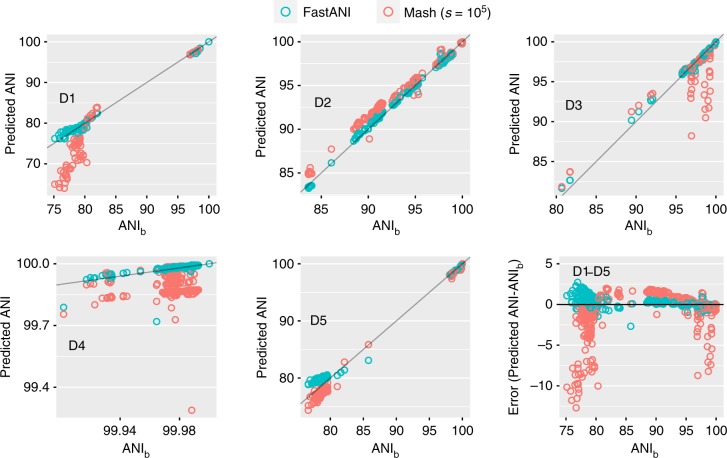
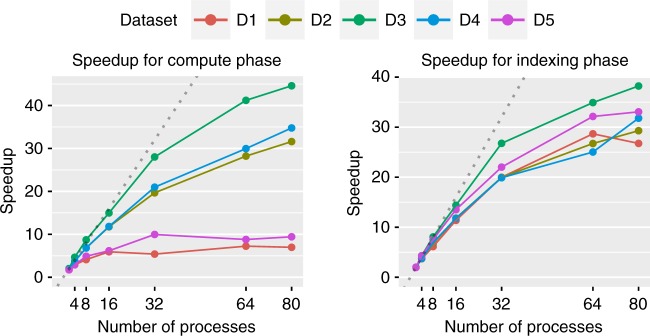
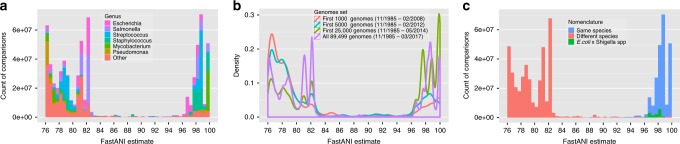
A fundamental question in microbiology is whether there is continuum of genetic diversity among genomes, or clear species boundaries prevail instead. Whole-genome similarity metrics such as Average Nucleotide Identity (ANI) help address this question by facilitating high resolution taxonomic analysis of thousands of genomes from diverse phylogenetic lineages. To scale to available genomes and beyond, we present FastANI, a new method to estimate ANI using alignment-free approximate sequence mapping. FastANI is accurate for both finished and draft genomes, and is up to three orders of magnitude faster compared to alignment-based approaches. We leverage FastANI to compute pairwise ANI values among all prokaryotic genomes available in the NCBI database. Our results reveal clear genetic discontinuity, with 99.8% of the total 8 billion genome pairs analyzed conforming to >95% intra-species and <83% inter-species ANI values. This discontinuity is manifested with or without the most frequently sequenced species, and is robust to historic additions in the genome databases.
Overview
The claims and statistics of this paper haven’t been checked yet.
Run the check — free, no account needed. It reads the open-access text and checks the sources it cites.
Integrity signals
Registry
Cites
Statistics
Figures
Verification
Claims the paper makes
The claims and statistics of this paper haven’t been checked yet.
Run the check — free, no account needed. It reads the open-access text and checks the sources it cites.
Claims other papers make about this one
Each is checked against this paper’s own text: does it say what the citing paper says it does?
The cited source says what the claim attributes to it.
In the citing paper
“FastANI (v1.3.1) (https://github.com/ParBLiSS/FastANI.) was used to calculate the average nucleotide identity between the isolated strains and the original Lp082,47 ensuring isolates were evolved from Lp082”
From Gut microbiota drives structural variation of exogenous probiotics to enhance colonization (2025) · cites this paper as [47]
Self-check
Percentages, sums and reported differences re-computed from the paper’s own numbers.
The self-check needs the paper’s full text.
Citations
Cites
Gapped BLAST and PSI-BLAST: a new generation of protein database search programs
Altschul, S. (1997) · Nucleic Acids Research · doi:10.1093/nar/25.17.3389 · Cited by 73,302
Search and clustering orders of magnitude faster than BLAST
Edgar, R. C. (2010) · Bioinformatics · doi:10.1093/bioinformatics/btq461 · Cited by 21,098
Fast and sensitive protein alignment using DIAMOND
Buchfink, B., Xie, C., & Huson, D. H. (2015) · Nature Methods · doi:10.1038/nmeth.3176 · Cited by 14,201
<tt>BLAT</tt> —The <tt>BLAST</tt> -Like Alignment Tool
Kent, W. J. (2002) · Genome Research · doi:10.1101/gr.229202 · Cited by 8,480
Canu: scalable and accurate long-read assembly via adaptive k -mer weighting and repeat separationPreprint
Koren, S., Walenz, B. P., Berlin, K., Miller, J. R., Bergman, N. H., & Phillippy, A. M. (2017) · Genome Research · doi:10.1101/gr.215087.116 · Cited by 7,260
Self-citationShifting the genomic gold standard for the prokaryotic species definition
Richter, M., & Rossello-Mora, R. A. (2009) · Proceedings of the National Academy of Sciences · doi:10.1073/pnas.0906412106 · Cited by 6,343
Versatile and open software for comparing large genomes
Kurtz, S., Phillippy, A., Delcher, A. L., Smoot, M., Shumway, M., Antonescu, C., & Salzberg, S. L. (2004) · Genome Biology · doi:10.1186/gb-2004-5-2-r12 · Cited by 5,254
Self-citationMauve: Multiple alignment of conserved genomic sequence with rearrangements
Darling, A. C. E., Mau, B., Blattner, F. R., & Perna, N. T. (2004) · Genome Research · doi:10.1101/gr.2289704 · Cited by 4,949
DNA–DNA hybridization values and their relationship to whole-genome sequence similarities
Goris, J., Konstantinidis, K. T., Klappenbach, J. A., Coenye, T., Vandamme, P. A. R., & Tiedje, J. M. (2007) · INTERNATIONAL JOURNAL OF SYSTEMATIC AND EVOLUTIONARY MICROBIOLOGY · doi:10.1099/ijs.0.64483-0 · Cited by 4,733 · cited 2×
“Nevertheless, it closely reflects the traditional microbiological concept of DNA-DNA hybridization relatedness for defining species (3), as it takes into account the fluid nature of the bacterial gene pool and hence implicitly considers shared function.”
BackgroundMethodSelf-citationA large-scale evaluation of algorithms to calculate average nucleotide identity
Yoon, S.-H., Ha, S. M., Lim, J., Kwon, S., & Chun, J. (2017) · Antonie van Leeuwenhoek · doi:10.1007/s10482-017-0844-4 · Cited by 3,614
Research works printed but not linked: 1
- Staley, J. The phylogenomic species concept. Microbiol. Today 36, 80–83 (2009).
Cited by
Sorted by citations
Items 401–500 of 1,013
Dong, H., Gao, R., Dong, Y., Yao, Q., & Zhu, H. (2023) · International Journal of Molecular Sciences · doi:10.3390/ijms24108527 · Cited by 50
Bai, D., Chen, T., Xun, J., Ma, C., Luo, H., Yang, H., Cao, C., Cao, X., Cui, J., Deng, Y., et al. (2025) · iMeta · doi:10.1002/imt2.70001 · Cited by 57
Ebrahimian, F., Bernardini, N., Tsapekos, P., Treu, L., Zhu, X., Campanaro, S., Karimi, K., & Angelidaki, İ. (2022) · Bioresource Technology · doi:10.1016/j.biortech.2022.127701 · Cited by 50
Comparative Genomics of Exiguobacterium Reveals What Makes a Cosmopolitan Bacterium
Zhang, D.-C., Zhu, Z., Li, Y., Li, X., Guan, Z., & Zheng, J. (2021) · mSystems · doi:10.1128/msystems.00383-21 · Cited by 49
Bussi, Y., Kapon, R., & Reich, Z. (2021) · PLoS ONE · doi:10.1371/journal.pone.0258693 · Cited by 51
“Mash, with a default k = 21, and FastANI (used for microbial genomes only), with a default k = 16, have successfully clustered tens of thousands of genomes in less than 100 CPU hours [43, 44].”
BackgroundMethodInfluentialA panoramic view of the genomic landscape of the genus Streptomyces
Nikolaidis, M., Hesketh, A. R., Frangou, N., Mossialos, D., de Peer, Y. V., Oliver, S. G., & Amoutzias, G. D. (2023) · Microbial Genomics · doi:10.1099/mgen.0.001028 · Cited by 54
COBRA improves the completeness and contiguity of viral genomes assembled from metagenomes
Chen, L.-X., & Banfield, J. F. (2024) · Nature Microbiology · doi:10.1038/s41564-023-01598-2 · Cited by 47
“54)), it was termed ‘contaminated bin’ or ‘contaminated join’, respectively.”
Gutiérrez, R., Shalit, T., Markus, B., Yuan, C., Nachum‐Biala, Y., Elad, D., & Harrus, S. (2020) · INTERNATIONAL JOURNAL OF SYSTEMATIC AND EVOLUTIONARY MICROBIOLOGY · doi:10.1099/ijsem.0.003952 · Cited by 49
Singh, A., Schnürer, A., & Westerholm, M. (2021) · Environmental Microbiology · doi:10.1111/1462-2920.15388 · Cited by 49
“Environmental Microbiology published by Society for Applied Microbiology and John Wiley & Sons Ltd., Environmental Microbiology, 23, 1620–1637 Jain et al., 2018).”
BackgroundGenomic Diversity of Azole-Resistant Aspergillus fumigatus in the United States
Etienne, K. A., Berkow, E. L., Gade, L., Nunnally, N., Lockhart, S. R., Beer, K., Jordan, I. K., Rishishwar, L., & Litvintseva, A. P. (2021) · mBio · doi:10.1128/mbio.01803-21 · Cited by 48
“Pairwise average nucleotide identities were estimated using a publicly available script (54).”
MethodSam-on, M. F. S., Mustafa, S., Hashim, A. M., Yusof, M. T., Zulkifly, S., Malek, A. Z. A., Roslan, M. A. H., & Shaufi, M. A. M. (2023) · Microbial Pathogenesis · doi:10.1016/j.micpath.2023.106161 · Cited by 48
The conserved iol gene cluster in Pseudomonas is involved in rhizosphere competence
Sánchez-Gil, J. J., Poppeliers, S. W., Vacheron, J., Zhang, H., Odijk, B., Keel, C., & de Jonge, R. (2023) · Current Biology · doi:10.1016/j.cub.2023.05.057 · Cited by 48
Zhang, Z. J., Cole, C. G., Coyne, M. J., Lin, H., Dylla, N. P., Smith, R. C., Pappas, T. E., Townson, S. A., Laliwala, N., Waligurski, E., et al. (2024) · Cell Host & Microbe · doi:10.1016/j.chom.2024.08.016 · Cited by 48
Genomic evidence of neo-sex chromosomes in the eastern yellow robin
Gan, H. M., Falk, S., Morales, H. E., Austin, C. M., Sunnucks, P., & Pavlova, A. (2019) · GigaScience · doi:10.1093/gigascience/giz111 · Cited by 47
Zhang, Z., Huang, M., Qiu, L., Song, R., Zhang, Z., Ding, Y., Zhou, X. Y., Zhang, X., & Zheng, H. (2020) · Insect Science · doi:10.1111/1744-7917.12770 · Cited by 48
“Whole-genome average nucleotide identity was calculated using FastANI (version 2.0) (Jain et al., 2018).”
MethodInfluentialMetagenomic analysis of bacterial species in tongue microbiome of current and never smokers
Sato, N., Kakuta, M., Hasegawa, T., Yamaguchi, R., Uchino, E., Kobayashi, W., Sawada, K., Tamura, Y., Tokuda, I., Murashita, K., et al. (2020) · npj Biofilms and Microbiomes · doi:10.1038/s41522-020-0121-6 · Cited by 48
Cho, S., Kung, H.-J., Huang, W., Hogenhout, S. A., & Kuo, C. (2020) · Frontiers in Microbiology · doi:10.3389/fmicb.2020.01531 · Cited by 48
Tenea, G. N., & Ortega, C. (2021) · Antibiotics · doi:10.3390/antibiotics10040383 · Cited by 50
Huang, Y. L., Deng, Y., Law, J. C.-F., Yang, Y., Ding, J., Leung, K. S., & Zhang, T. (2021) · Water Research · doi:10.1016/j.watres.2021.117454 · Cited by 48
Public good exploitation in natural bacterioplankton communities
Pollak, S., Gralka, M., Sato, Y., Schwartzman, J. A., Lu, L., & Cordero, O. X. (2021) · Science Advances · doi:10.1126/sciadv.abi4717 · Cited by 48
Comparative Genomics and Specific Functional Characteristics Analysis of Lactobacillus acidophilus
Huang, Z. J., Zhou, X., Stanton, C., Ross, R. P., Zhao, J., Zhang, H., Yang, B. K., & Chen, W. (2021) · Microorganisms · doi:10.3390/microorganisms9091992 · Cited by 50
Host ecology regulates interspecies recombination in bacteria of the genus Campylobacter
Mourkas, E., Yahara, K., Bayliss, S., Calland, J., Johansson, H., Mageiros, L., Muñoz-Ramírez, Z. Y., Futcher, G., Méric, G., Hitchings, M. D., et al. (2022) · eLife · doi:10.7554/elife.73552 · Cited by 45
Liu, Y., Du, J., Pei, T., Du, H., Feng, G.-D., & Zhu, H. (2022) · Systematic and Applied Microbiology · doi:10.1016/j.syapm.2022.126352 · Cited by 47
Botelho, J., Tüeffers, L., Fuß, J., Buchholz, F., Utpatel, C., Klockgether, J., Niemann, S., Tümmler, B., & Schulenburg, H. (2023) · EBioMedicine · doi:10.1016/j.ebiom.2023.104532 · Cited by 49
Landemaine, L., Costa, G. D., Fissier, E., Francis, C., Morand, S. C., Verbeke, J., Michel, M., Briandet, R., Sokol, H., Guéniche, A., et al. (2023) · Frontiers in Immunology · doi:10.3389/fimmu.2023.1098160 · Cited by 50
“31 (47) by calculating the Average Nucleotide Index for each genome pair.”
MethodMaćešić, N., Hawkey, J., Vezina, B., Wisniewski, J. A., Cottingham, H., Blakeway, L. V., Harshegyi, T., Pragastis, K., Badoordeen, G. Z., Dennison, A., et al. (2023) · Nature Communications · doi:10.1038/s41467-023-39915-2 · Cited by 47
“3 to generate pairwise average nucleotide identities between plasmids belonging to the same plasmid group 62 .”
Lindner, B. G., Gerhardt, K., Feistel, D. J., Rodriguez‐R, L. M., Hatt, J. K., & Konstantinidis, K. T. (2023) · International Journal of Food Microbiology · doi:10.1016/j.ijfoodmicro.2023.110488 · Cited by 49
Self-citationGlobal diversity of enterococci and description of 18 previously unknown species
Schwartzman, J. A., Lebreton, F., Salamzade, R., Shea, T., Martin, M. J., Schaufler, K., Urhan, A., Abeel, T., Camargo, I. L. B. D. C., Sgardioli, B. F., et al. (2024) · Proceedings of the National Academy of Sciences · doi:10.1073/pnas.2310852121 · Cited by 61
“S1 C ), validating DL sequence as an accurate predictor of novelty; 96% of isolates with >4 SNPs in the DL exhibited <95% ANI [the operationally defined species boundary (18)] with the genome of the closest identifiable species.”
Dong, W., Fan, X., Guo, Y., Wang, S., Jia, S., Lv, N., Tao, Y., Pan, Y., Xue, Y., Chen, X., et al. (2024) · Nature Communications · doi:10.1038/s41467-024-51864-y · Cited by 57
Stothart, M. R., Greuel, R. J., Gavriliuc, S., Henry, A., Wilson, A. J., McLoughlin, P. D., & Poissant, J. (2020) · Molecular Ecology · doi:10.1111/mec.15747 · Cited by 49
“…are probably phylogenetically conserved in our system is broadly supported by reanalysis of archived bacterial genomes (Berlemont & Martiny, 2013; Jain et al., 2018; Martiny et al., 2013, 2015; Van Assche et al., 2017), and more specifically, by the positive phylogenetic signal we detected with…”
BackgroundLuò, T., Xu, P., Zhang, Y., Porter, J. L., Ghanem, M., Liu, Q., Jiang, Y. Z., Li, J., Miao, Q., Hu, B., et al. (2021) · Nature Communications · doi:10.1038/s41467-021-22760-6 · Cited by 45
Thänert, R., Choi, J., Reske, K. A., Hink, T., Thänert, A., Wallace, M. A., Wang, B., Seiler, S. M., Cass, C., Bost, M. H., et al. (2022) · Cell Host & Microbe · doi:10.1016/j.chom.2022.04.008 · Cited by 47
Mustapha, M. M., Srinivasa, V. R., Griffith, M. P., Cho, S., Evans, D. R., Waggle, K. D., Ezeonwuka, C. D., Snyder, D. J., Marsh, J. W., Harrison, L. H., et al. (2022) · mSystems · doi:10.1128/msystems.01384-21 · Cited by 41
“Because the species of each isolate collected by the EDS-HAT project was initially assigned by the clinical microbiology laboratory, we first conducted pairwise comparisons of ANI for all isolate genomes, plus additional reference genomes downloaded from the NCBI database, and used a standard 95% ANI cutoff to group g…”
MethodHu, P., Qian, Y., Liu, J., Gao, L., Li, Y., Xu, Y., Wu, J., Hong, Y., Ford, T., Radian, A., et al. (2023) · Water Research · doi:10.1016/j.watres.2023.119799 · Cited by 47
Lee, H., Storesund, J. E., Lunestad, B.-T., Hoel, S., Lerfall, J., & Jakobsen, A. N. (2023) · Frontiers in Microbiology · doi:10.3389/fmicb.2023.1175304 · Cited by 47
“To verify the taxonomy, ANI values between the genomes including 22 isolates and eight reference strains were calculated using FastANI (Jain et al., 2018).”
MethodApplying rearrangement distances to enable plasmid epidemiology with pling
Frolova, D., Lima, L., Roberts, L. W., Bohnenkämper, L., Wittler, R., Stoye, J., & Iqbal, Z. (2024) · Microbial Genomics · doi:10.1099/mgen.0.001300 · Cited by 46
Tseng, C., Wong, S. H., Yu, J. Q., Lee, Y. Y., Terauchi, J., Lai, H., Luo, J., Kao, C., Yu, S., Liou, J., et al. (2025) · Gut · doi:10.1136/gutjnl-2024-334501 · Cited by 51
“38 To increase specificity, LBP species should be typed at the strain level, requiring an ANI over 99.99% 39 or a whole-genome similarity over 96%.”
InfluentialHiBC: a publicly available collection of bacterial strains isolated from the human gut
Hitch, T. C. A., Masson, J. M., Pauvert, C., Bosch, J., Nüchtern, S., Treichel, N. S., Baloh, M., Razavi, S., Afrizal, A., Kousetzi, N., et al. (2025) · Nature Communications · doi:10.1038/s41467-025-59229-9 · Cited by 47
“Genomes within the collections were dereplicated at the species level based on >95% ANI values via FastANI 87 .”
Ultrafast and accurate sequence alignment and clustering of viral genomes
Zieleziński, A., Gudyś, A., Barylski, J., Simiński, K., Rozwalak, P., Dutilh, B. E., & Deorowicz, S. (2025) · Nature Methods · doi:10.1038/s41592-025-02701-7 · Cited by 67
Keshavarz-Tohid, V., Vacheron, J., Dubost, A., Prigent‐Combaret, C., Taheri, P., Tarighi, S., Taghavi, S. M., Moënne‐Loccoz, Y., & Muller, D. A. E. (2019) · Systematic and Applied Microbiology · doi:10.1016/j.syapm.2019.04.004 · Cited by 46
Röhling, S., Linné, A., Schellhorn, J., Hosseini, M., Dencker, T., & Morgenstern, B. (2019) · bioRxiv · doi:10.1371/journal.pone.0228070 · Cited by 38
“This is a serious limitation of these methods, since many distantly related genomes share only locally limited homologies, see [41].”
BackgroundWang, L., & Shao, Z. (2021) · Frontiers in Microbiology · doi:10.3389/fmicb.2021.652766 · Cited by 46
“3 (Jain et al., 2018)4, and the standalone Orthologous Average Nucleotide Identity Tool (OAT) (Lee et al., 2016).”
BackgroundLiu, B., Sträuber, H., Saraiva, J., Harms, H., Silva, S. G., Kasmanas, J. C., Kleinsteuber, S., & da Rocha, U. N. (2022) · Microbiome · doi:10.1186/s40168-021-01219-2 · Cited by 45
Viruses direct carbon cycling in lake sediments under global change
Braga, L. P. P., Orland, C., Emilson, E. J. S., Fitch, A. A., Osterholz, H., Dittmar, T., Basiliko, N., Mykytczuk, N., & Tanentzap, A. J. (2022) · Proceedings of the National Academy of Sciences · doi:10.1073/pnas.2202261119 · Cited by 43
Nawaz, M. Z., Shang, H., Sun, J., Geng, A., Ali, S. S., & Zhu, D. (2022) · Chemosphere · doi:10.1016/j.chemosphere.2022.136754 · Cited by 45
Genome dynamics across the evolutionary transition to endosymbiosis
Siozios, S., Nadal‐Jimenez, P., Azagi, T., Sprong, H., Frost, C. L., Parratt, S. R., Taylor, G., Brettell, L. E., Liew, K. C., Croft, L., et al. (2024) · Current Biology · doi:10.1016/j.cub.2024.10.044 · Cited by 47
A defined microbial community reproduces attributes of fine flavour chocolate fermentation
Gopaulchan, D., Moore, C., Ali, N., Sukha, D. A., González, S. L. F., Herrera‐Rocha, F., Yang, N., Lim, M., Dew, T. P., Barrios, A. F. G., et al. (2025) · Nature Microbiology · doi:10.1038/s41564-025-02077-6 · Cited by 48
“81 for species-level definition).”
Isolation, engineering and ecology of temperate phages from the human gut
Dahlman, S., Avellaneda-Franco, L., Rutten, E. L., Gulliver, E. L., Solari, S. M., Chonwerawong, M., Kett, C., Subedi, D., Young, R. B., Campbell, N., et al. (2025) · Nature · doi:10.1038/s41586-025-09614-7 · Cited by 57
Distinct but Intertwined Evolutionary Histories of Multiple Salmonella enterica Subspecies
Park, C. J., & Andam, C. P. (2020) · mSystems · doi:10.1128/msystems.00515-19 · Cited by 46
“To determine the degree of genomic relatedness and clarify the relationships between the subspecies, we calculated the genome-wide average nucleotide identity (ANI) for all possible pairs of genomes using the program FastANI v.1.0 (29).”
InfluentialRamsamy, Y., Mlisana, K. P., Allam, M., Amoako, D. G., Abia, A. L. K., Ismail, A., Singh, R., Kisten, T., Swe-Han, K. S., Muckart, D. J. J., et al. (2020) · Microorganisms · doi:10.3390/microorganisms8010137 · Cited by 46
Duggett, N. A., AbuOun, M., Randall, L. P., Horton, R. A., Lemma, F., Rogers, J., Crook, D. W., Teale, C. J., & Anjum, M. F. (2020) · Scientific Reports · doi:10.1038/s41598-020-76877-7 · Cited by 45
Pangenomics reveals alternative environmental lifestyles among chlamydiae
Köstlbacher, S., Collingro, A., Halter, T., Schulz, F., Jungbluth, S. P., & Horn, M. (2021) · Nature Communications · doi:10.1038/s41467-021-24294-3 · Cited by 45
Granehäll, L., Huang, K. D., Tett, A., Manghi, P., Paladin, A., O’Sullivan, N. J., Rota‐Stabelli, O., Segata, N., Zink, A., & Maixner, F. (2021) · Microbiome · doi:10.1186/s40168-021-01132-8 · Cited by 49
You, L., Bao, W., Yao, C., Zhao, F., Jin, H., Huang, W., Li, B., Kwok, L., & Liu, W. (2022) · Animal nutrition · doi:10.1016/j.aninu.2021.12.004 · Cited by 44
Shropshire, W. C., Konovalova, A., McDaneld, P. M., Gohel, M., Strope, B., Sahasrabhojane, P. V., Tran, C. N., Greenberg, D. E., Kim, J., Zhan, X., et al. (2022) · mSystems · doi:10.1128/msystems.00476-22 · Cited by 44
“31 (70) was used to estimate average nucleotide identity across plasmid and MGE structures with default settings.”
Functional host-specific adaptation of the intestinal microbiome in hominids
Rühlemann, M. C., Bang, C., Gogarten, J. F., Hermes, B. M., Groussin, M., Waschina, S., Poyet, M., Ulrich, M., Akoua-Koffi, C. G., Deschner, T., et al. (2024) · Nature Communications · doi:10.1038/s41467-023-44636-7 · Cited by 50
“SGBs were de fi ned on 95% average nucleotide identity, a measure generally regarded as appropriate 72 , but it is nevertheless prone to clade speci fi c biases, potentially further in fl u-enced by altered speciation dynamics in association with (evolutionary) changes in host lifestyle 73 , i.e .…”
InfluentialLi, X., Bei, Q., Nematabad, M. R., Peng, J., & Liesack, W. (2024) · Microbiome · doi:10.1186/s40168-023-01739-z · Cited by 44
“FastANI was used to calculate genome average nucleotide identity (ANI) values [65].”
BackgroundMethodmetaProbiotics: a tool for mining probiotic from metagenomic binning data based on a language model
Wu, S., Feng, T., Tang, W., Qi, C., Gao, J., He, X., Wang, J., Zhou, H., & Fang, Z. (2024) · Briefings in Bioinformatics · doi:10.1093/bib/bbae085 · Cited by 46
“To identify the bins associated with the intervening strain, we used fastaANI [81] (v1.”
MethodAntagonism as a foraging strategy in microbial communities
Stubbusch, A. K., Peaudecerf, F. J., Lee, K. S., Paoli, L., Schwartzman, J. A., Stocker, R., Basler, M., Schubert, O. T., Ackermann, M., Magnabosco, C., et al. (2025) · Science · doi:10.1126/science.adr8286 · Cited by 47
Bédard, C., Pageau, A., Fijarczyk, A., Mendoza-Salido, D., Alcañiz, A. J., Després, P. C., Durand, R., Plante, S., Alexander, E. M. M., Rouleau, F. D., et al. (2025) · Nature Microbiology · doi:10.1038/s41564-025-02084-7 · Cited by 53
Dialogue on the nomenclature and classification of prokaryotes
Rossello-Mora, R. A., & Whitman, W. B. (2018) · Systematic and Applied Microbiology · doi:10.1016/j.syapm.2018.07.002 · Cited by 44
Tsementzi, D., Rodriguez‐R, L. M., Ruiz-Pérez, C. A., Meziti, A., Hatt, J. K., & Konstantinidis, K. T. (2019) · Systematic and Applied Microbiology · doi:10.1016/j.syapm.2019.03.007 · Cited by 44
Self-citationDeeg, C. M., Zimmer, M., George, E. E., Husník, F., Keeling, P., & Suttle, C. (2019) · PLoS Pathogens · doi:10.1371/journal.ppat.1007801 · Cited by 39
Riiser, E. S., Haverkamp, T. H. A., Varadharajan, S., Borgan, Ø., Jakobsen, K. S., Jentoft, S., & Star, B. (2019) · Environmental Microbiology · doi:10.1111/1462-2920.14652 · Cited by 41
Thompson, D., Cognat, V., Goodfellow, M., Koechler, S., Heintz, D., Carapito, C., DORSSELAER, A. V., Mahmoud, H., Sangal, V., & Ismail, W. A. (2020) · Frontiers in Microbiology · doi:10.3389/fmicb.2020.01417 · Cited by 44
Montero, L., Irazabal, J., Cárdenas, P., Graham, J. P., & Trueba, G. A. (2021) · Frontiers in Microbiology · doi:10.3389/fmicb.2021.709418 · Cited by 48
“The identification of genus and species of the isolates was carried out using fastANI (Jain et al., 2018) with a percentage >80% of identification.”
MethodSoncini, J. G. M., Cerdeira, L., Sano, E., Koga, V. L., Tizura, A. T., Tano, Z. N., Nakazato, G., Kobayashi, R. K. T., Aires, C. A. M., Lincopán, N., et al. (2022) · Scientific Reports · doi:10.1038/s41598-022-13197-y · Cited by 43
Brizuela, J., Kajeekul, R., Roodsant, T. J., Riwload, A., Boueroy, P., Pattanapongpaibool, A., Thaipadungpanit, J., Jenjaroenpun, P., Wongsurawat, T., Batty, E. M., et al. (2023) · Microbial Genomics · doi:10.1099/mgen.0.000952 · Cited by 45
“32 against eight complete S. suis genomes and one complete Streptococcus parasuis genome to confirm the species classification of the isolates (Table S1) [34].”
Minmers are a generalization of minimizers that enable unbiased local Jaccard estimation
Kille, B. L., Garrison, E. P., Treangen, T. J., & Phillippy, A. M. (2023) · Bioinformatics · doi:10.1093/bioinformatics/btad512 · Cited by 41
Self-citationDefence systems and horizontal gene transfer in bacteria
Kogay, R., Wolf, Y. I., & Koonin, E. V. (2024) · Environmental Microbiology · doi:10.1111/1462-2920.16630 · Cited by 43
Two decades of bacterial ecology and evolution in a freshwater lake
Rohwer, R. R., Kirkpatrick, M., Garcia, S. L., Kellom, M., McMahon, K. D., & Baker, B. J. (2025) · Nature Microbiology · doi:10.1038/s41564-024-01888-3 · Cited by 46
Gerhardt, K., Ruiz-Pérez, C. A., Rodriguez‐R, L. M., Jain, C., Tiedje, J. M., Cole, J. R., & Konstantinidis, K. T. (2025) · Nucleic Acids Research · doi:10.1093/nar/gkaf348 · Cited by 43
“…of FastAAI-based AAI values within phyla to determine whether or not reliable AAI thresholds can be identified that distinguish different ranks, similar to the 95% ANI that distinguishes (different) species [ 4 ] or the thresholds that distinguish domain and phylum ranks mentioned above.”
InfluentialSelf-citationA novel bacterial protein family that catalyses nitrous oxide reduction
He, G., Wang, W., Chen, G., Xie, Y., Parks, J. M., Davin, M. E., Hettich, R. L., Konstantinidis, K. T., & Löffler, F. E. (2025) · Nature · doi:10.1038/s41586-025-09401-4 · Cited by 48
Self-citationSoulenthone, P., Tachibana, Y., Suzuki, M., Mizuno, T., Ohta, Y., & Kasuya, K. (2021) · Polymer Degradation and Stability · doi:10.1016/j.polymdegradstab.2021.109481 · Cited by 42
Metagenomic Views of Microbial Communities in Sand Sediments Associated with Coral Reefs
Dong, X., Lan, H., Huang, L., Zhang, H., Lin, X., Weng, S., Peng, Y., Lin, J. H., Wang, J., Peng, J., et al. (2022) · Microbial Ecology · doi:10.1007/s00248-021-01957-8 · Cited by 43
Davison, H., Pilgrim, J., Wybouw, N., Parker, J., Pirro, S., Hunter-Barnett, S., Campbell, P. M., Blow, F., Darby, A. C., Hurst, G. D. D., et al. (2022) · Nature Communications · doi:10.1038/s41467-022-30385-6 · Cited by 45
Site‐tropism of streptococci in the oral microbiome
McLean, A. R., Torres‐Morales, J., Dewhirst, F. E., Borisy, G. G., & Welch, J. L. M. (2022) · Molecular Oral Microbiology · doi:10.1111/omi.12387 · Cited by 44
Gene flow and introgression are pervasive forces shaping the evolution of bacterial species
Diop, A., Torrance, E. L., Stott, C. M., & Bobay, L. (2022) · Genome biology · doi:10.1186/s13059-022-02809-5 · Cited by 42
“, using FastANI [4], in the fact that traditional ANI represents the average nucleotide identity of all orthologous genes shared by any two genomes while the ANI of core genes represents the average nucleotide identity of the core genes shared by a pair of genomes.”
BackgroundMethodResultInfluentialContrasting patterns of microbial dominance in the Arabidopsis thaliana phyllosphere
Lundberg, D. S., de Pedro‐Jové, R., Ayutthaya, P. P. N., Karasov, T. L., Shalev, O., Poersch, K., Ding, W., Bollmann‐Giolai, A., Bezrukov, I., & Weigel, D. (2022) · Proceedings of the National Academy of Sciences · doi:10.1073/pnas.2211881119 · Cited by 38
Kirdat, K., Tiwarekar, B., Sathe, S., & Yadav, A. (2023) · Frontiers in Microbiology · doi:10.3389/fmicb.2023.1123783 · Cited by 42
Pomaranski, E. K., Griffin, M. J., Camus, A. C., Armwood, A. R., Shelley, J., Waldbieser, G. C., LaFrentz, B. R., García, J. C., Yanong, R. P. E., & Soto, E. (2019) · INTERNATIONAL JOURNAL OF SYSTEMATIC AND EVOLUTIONARY MICROBIOLOGY · doi:10.1099/ijsem.0.003838 · Cited by 42
van der Putten, B. C. L., Matamoros, S., Mende, D. R., Scholl, E. R., & Schultsz, C. (2021) · INTERNATIONAL JOURNAL OF SYSTEMATIC AND EVOLUTIONARY MICROBIOLOGY · doi:10.1099/ijsem.0.004609 · Cited by 51
Govender, K. N., & Eyre, D. W. (2022) · Microbial Genomics · doi:10.1099/mgen.0.000886 · Cited by 48
Roy, C., Mandal, S. M., Mondal, S. K., Mukherjee, S., Mapder, T., Ghosh, W., & Chakraborty, R. (2020) · Genomics · doi:10.1016/j.ygeno.2020.11.003 · Cited by 37
“Sequence similarities between SARS-CoV-2 genome pairs were computed using the software FastANI, which uses a high throughput method for average nucleotide identity analysis [21].”
Metagenomic and Metatranscriptomic Study of Microbial Metal Resistance in an Acidic Pit Lake
Ayala, D. E., Burgos, W. D., Sánchez‐España, J., Couradeau, E., Falagán, C., & Macalady, J. L. (2020) · Microorganisms · doi:10.3390/microorganisms8091350 · Cited by 41
Strain Identification and Quantitative Analysis in Microbial Communities
Ghazi, A. R., Münch, P. C., Chen, D., Jensen, J., & Huttenhower, C. (2022) · Journal of Molecular Biology · doi:10.1016/j.jmb.2022.167582 · Cited by 44
McDaniel, E., Scarborough, M., Mulat, D., Lin, X., Sampara, P., Olson, H. M., Young, R., Eder, E., Attah, I. K., Markillie, L. M., et al. (2023) · The ISME Journal · doi:10.1038/s41396-023-01542-6 · Cited by 40
“Average nucleotide identity (ANI) values for genomes of interest were calculated using FastANI [47].”
BackgroundMethodNhu, N. T. K., Phan, M., Hancock, S. J., Peters, K. M., Álvarez-Fraga, L., Forde, B. M., Andersen, S. B., Miliya, T., Harris, P. N. A., Beatson, S. A., et al. (2023) · eLife · doi:10.7554/elife.91853 · Cited by 41
“Assembled contigs 432 were subject to taxonomic profiling using kraken2 [55] and fastANI [58].”
MethodSun, X., Huang, H., Wang, X., Wei, R.-Q., Niu, H.-Y., Chen, H. Y., Luo, M., Abdugheni, R., Wang, Y., Liu, F.-L., et al. (2024) · Gut Microbes · doi:10.1080/19490976.2024.2347725 · Cited by 42
Farag, I., Zhao, R., & Biddle, J. F. (2021) · Applied and Environmental Microbiology · doi:10.1128/aem.02584-20 · Cited by 37
“In addition to phylogenomic analysis, we calculated the average nucleotide identity (ANI) using FastANI (34) and average amino acid identity (AAI) using CompareM (https://github.”
MethodSun, Y., Debeljak, P., & Obernosterer, I. (2021) · The ISME Journal · doi:10.1038/s41396-021-00973-3 · Cited by 41
Braga, L. P. P., Pereira, R. V., Martins, L. F., Moura, L. M. S., Sanchez, F. B., Patané, J. S. L., da Silva, A. M., & Setúbal, J. C. (2021) · BMC Genomics · doi:10.1186/s12864-021-07957-9 · Cited by 42
Liao, Y.-S., Chen, B.-H., Teng, R.-H., Wang, Y.-W., Chang, J.-H., Liang, S.-Y., Tsao, C.-S., Hong, Y.-P., Sung, H.-Y., & Chiou, C. (2021) · Antimicrobial Agents and Chemotherapy · doi:10.1128/aac.01736-21 · Cited by 41
“com/ParBLiSS/FastANI) (62), antimicrobial resistance genes using AMRFinderPlus (https://www.”
MethodPopulation differentiation of Rhodobacteraceae along with coral compartments
Luo, D., Wang, X., Feng, X., Tian, M., Wang, S., Tang, S., Ang, P. O., Yan, A., & Luo, H. (2021) · The ISME Journal · doi:10.1038/s41396-021-01009-6 · Cited by 41
Huang, C.-T., Cho, S., Lin, Y.-C., Tan, C., Chiu, Y.-C., Yang, J., & Kuo, C. (2022) · Frontiers in Microbiology · doi:10.3389/fmicb.2022.773608 · Cited by 40
“1 (Jain et al., 2018) was used to calculate the proportion of genomic segments mapped and the average nucleotide identity (ANI).”
MethodZheng, P., Wei, Z., Zhou, Y., Li, Q., Qi, Z., Diao, X., & Wang, Y. (2022) · mSystems · doi:10.1128/msystems.00077-22 · Cited by 40
“The MAG Bin162 for clade A from SY40 was much different from those for clade B (Bin292, Bin295, and Bin296) in SY153 with ANI values of 69 to 70%, which is much lower than the values for a moderate affinity (ANI 80 to 90%) (33) and supports the divergency between the two marine clades.”
ResultOrellana, L. H., Krüger, K., Sidhu, C., & Amann, R. (2023) · Microbiome · doi:10.1186/s40168-023-01557-3 · Cited by 40
You, L., Jin, H., Kwok, L., Lv, R., Zhao, Z., Bilige, M., Sun, Z., Liu, W., & Zhang, H. (2023) · 中国科学通报:英文版 · doi:10.1016/j.scib.2023.09.001 · Cited by 43
Global emergence of Escherichia coli with PBP3 insertions
Long, H., Zhao, F., Feng, Y., & Zong, Z. (2024) · Journal of Antimicrobial Chemotherapy · doi:10.1093/jac/dkae393 · Cited by 40
Tian, S., Kim, M. S., Zhao, J., Heber, K., Hao, F., Koslicki, D., Tian, S., Singh, V., Patterson, A. D., & Bisanz, J. E. (2025) · Cell Host & Microbe · doi:10.1016/j.chom.2025.02.007 · Cited by 44
Metadata
- Authors
- Jain, C., Rodriguez-R, L. M., Phillippy, A. M., Konstantinidis, K. T., & Aluru, S.
- Affiliations
- National Institutes of Health (US)
- Georgia Institute of Technology (US)
- Corresponding author
- Konstantinidis, Konstantinos T.
- Aluru, Srinivas
- ORCID
- Venue
- Nature Communications
- Published
- 2018-11-30
- Volume
- 9
- Issue
- 1
- Pages
- 5114-5114
- ISSN
- 2041-1723 (ISSN-L)
- PMC
- PMC6269478
- OpenAlex
- W2951254987
- Cited by
- 5,748
- References
- 40
- Citations by year
- 2026: 1107 · 2025: 1110 · 2024: 977 · 2023: 789 · 2022: 695 · 2021: 617 · 2020: 305 · 2019: 128 · 2018: 16
- FWCI
- 96.11
- Type
- journal article
- Language
- en
- Open access
- gold
- doi.org
- Locations
- Nature Communications (publishedVersion, cc-by)
- bioRxiv (Cold Spring Harbor Laboratory) (acceptedVersion, cc-by)
- Europe PMC (PubMed Central) (publishedVersion, other-oa)
- PubMed Central (publishedVersion, cc-by)
- PubMed (publishedVersion)
- RePEc: Research Papers in Economics (submittedVersion)
- DOAJ (DOAJ: Directory of Open Access Journals) (submittedVersion, cc-by-sa)
- DOAJ (DOAJ: Directory of Open Access Journals) (submittedVersion)
- Funders
- National Science Foundation (1416259, 1816027, 1356288)
- Topics
- Life Sciences › Biochemistry, Genetics and Molecular Biology › Molecular Biology › Genomics and Phylogenetic Studies
- Health Sciences › Medicine › Microbiology (medical) › Bacterial Identification and Susceptibility Testing
- Physical Sciences › Environmental Science › Ecology › Microbial Community Ecology and Physiology
- Keywords
- average nucleotide identity, prokaryotic genomes, species boundaries, taxonomic classification, draft genome sequence
- MeSH terms
- Phylogeny, Prokaryotic Cells, Genetic Variation, Databases, Factual, Genome, Bacterial, Sequence Analysis, DNA
About these checks
Registry, retraction, Cites and statistics results are computed, not judged, with one exception: a printed reference that no index lists is read once by a model before it counts as a citation error. Claims are extracted by a model and kept only when their quote appears verbatim in the text; each cited source is then checked, with a model’s help, for whether it says what the claim relies on. Those verdicts can be wrong — read the claim’s quote and the cited source before relying on one.
Statistics and arithmetic are recomputed, not judged.
Confidence bands are shown only for fields calibrated on our annotated test set. None is calibrated yet, so no band is shown.
What counts as a claim ›How we measure confidence ›How we check this ›
Are you an author, or do you see a problem with this page? Request a review
