

Influence of fake news in Twitter during the 2016 US presidential election
Open accessThe DOI matches its Crossref record; 44 of the 44 references it cites were found in a registry or an index.
Abstract
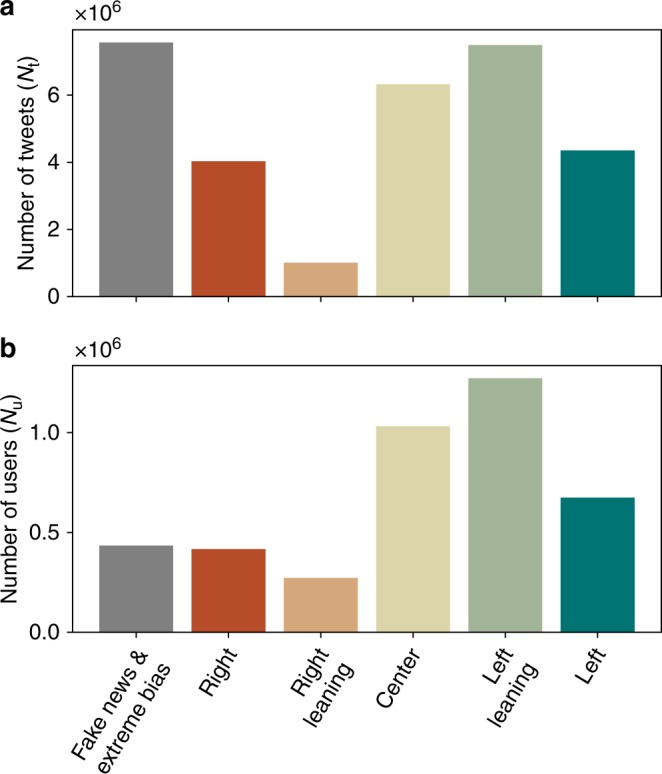
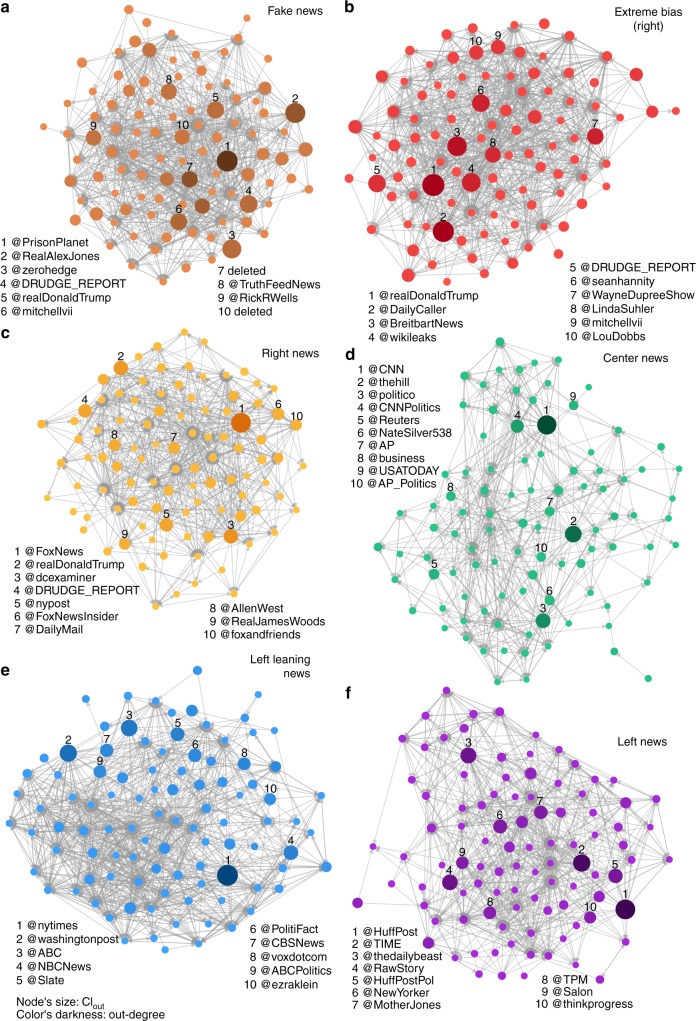
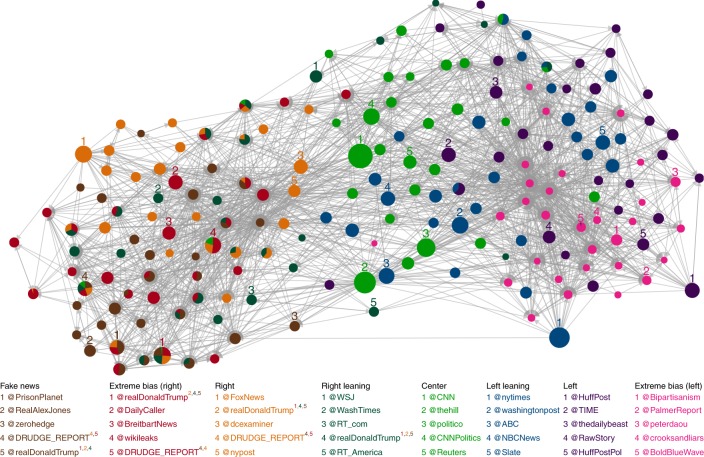
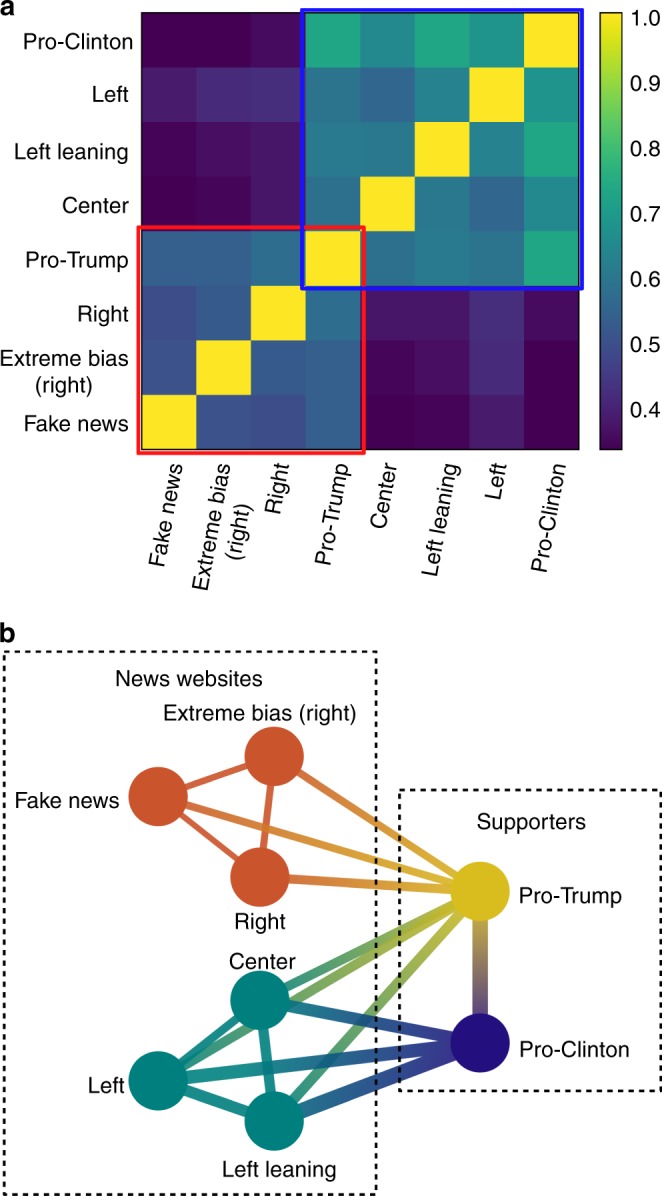
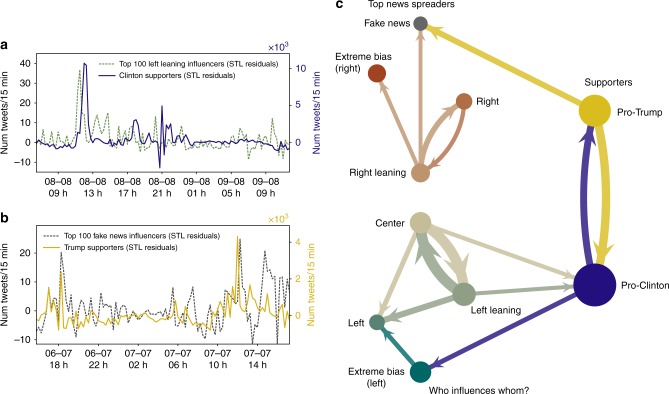
The dynamics and influence of fake news on Twitter during the 2016 US presidential election remains to be clarified. Here, we use a dataset of 171 million tweets in the five months preceding the election day to identify 30 million tweets, from 2.2 million users, which contain a link to news outlets. Based on a classification of news outlets curated by www.opensources.co , we find that 25% of these tweets spread either fake or extremely biased news. We characterize the networks of information flow to find the most influential spreaders of fake and traditional news and use causal modeling to uncover how fake news influenced the presidential election. We find that, while top influencers spreading traditional center and left leaning news largely influence the activity of Clinton supporters, this causality is reversed for the fake news: the activity of Trump supporters influences the dynamics of the top fake news spreaders.
Overview
The claims and statistics of this paper haven’t been checked yet.
Free: it reads the open-access text and checks the first 5 claims that cite a source we can check. Create a free account to check every claim.
Integrity signals
Registry
Cites
Statistics
Figures
Verification
Claims the paper makes
The claims and statistics of this paper haven’t been checked yet.
Free: it reads the open-access text and checks the first 5 claims that cite a source we can check. Create a free account to check every claim.
Claims other papers make about this one
Each is checked against this paper’s own text: does it say what the citing paper says it does?
The cited source says what the claim attributes to it.
In the citing paper
“Real and present concerns exist over the role of mis- and disinformation in public discourse (116–118), the emergence of echo chambers (119) and deepening political polarization (120, 121), in particular around big societal issues like climate change (122).”
From The benefits and dangers of anthropomorphic conversational agents (2025) · cites this paper as [117]
Self-check
Percentages, sums and reported differences re-computed from the paper’s own numbers.
The self-check needs the paper’s full text.
Citations
Cites
1 retracted
Limited individual attention and online virality of low-quality information
Qiu, X., F. M. Oliveira, D., Sahami Shirazi, A., Flammini, A., & Menczer, F. (2017) · Nature Human Behaviour · doi:10.1038/s41562-017-0132 · Cited by 180
RetractedControlling the False Discovery Rate: A Practical and Powerful Approach to Multiple Testing
Benjamini, Y., & Hochberg, Y. (1995) · Journal of the Royal Statistical Society Series B: Statistical Methodology · doi:10.1111/j.2517-6161.1995.tb02031.x · Cited by 109,482
Investigating causal relations by econometric models and cross-spectral methods
Granger, C. W. J. (1969) · Econometrica · doi:10.2307/1912791 · Cited by 22,989
The spread of true and false news online
Vosoughi, S., Roy, D., & Aral, S. (2018) · Science · doi:10.1126/science.aap9559 · Cited by 8,847
Causation, Prediction, and Search
Spirtes, P., Glymour, C., & Scheines, R. (2001) · doi:10.7551/mitpress/1754.001.0001 · Cited by 4,521
A New Status Index Derived from Sociometric Analysis
Katz, L. (1953) · Psychometrika · doi:10.1007/bf02289026 · Cited by 3,866
Exposure to ideologically diverse news and opinion on Facebook
Bakshy, E., Messing, S., & Adamic, L. A. (2015) · Science · doi:10.1126/science.aaa1160 · Cited by 3,245
The spreading of misinformation online
Del Vicario, M., Bessi, A., Zollo, F., Petroni, F., Scala, A., Caldarelli, G., Stanley, H. E., & Quattrociocchi, W. (2016) · Proceedings of the National Academy of Sciences · doi:10.1073/pnas.1517441113 · Cited by 2,407
Confirmation, disconfirmation, and information in hypothesis testing
Klayman, J., & Ha, Y.-W. (1987) · Psychological Review · doi:10.1037/0033-295x.94.2.211 · Cited by 2,094
Ferrara, E., Varol, O., Davis, C., Menczer, F., & Flammini, A. (2016) · Communications of the ACM · doi:10.1145/2818717 · Cited by 1,973
Research works printed but not linked: 2
- Howell L Digital wildfires in a hyperconnected world WEF Rep. 2013 3 15 94
- Cleveland RB Cleveland WS McRae JE Terpenning I STL: a seasonal-trend decomposition procedure based on loess J. Off. Stat. 1990 6 3 73
Cited by
Items 901–1,000 of 1,000
Wilson, F. A., Stimpson, J. P., Young, M. D. T., Bustamante, A. V., Ponce, N. A., & Ortega, A. N. (2025) · BMJ Open · doi:10.1136/bmjopen-2024-096465 · Cited by 1
Media Discourse on Web Portals and Twitter
Holy, M., & Borčić, N. (2023) · Medijska istraživanja · doi:10.22572/mi.29.1.2 · Cited by 1
Detecting Bots Using a Hybrid Approach
Genfi, E. K. (2021) · Cited by 1
Debanath, K., Aich, S., & Srizon, A. Y. (2025) · International Conference on Next-Generation Computing, IoT and Machine Learning (NCIM) · doi:10.1109/ncim65934.2025.11160229 · Cited by 1
Who Follows Whom? The Role of Geography and Similarity in Online Attention Networks
Quintana, A., Guo, Z., Grinberg, N., & Lazer, D. M. J. (2026) · Cambridge University Press eBooks · doi:10.1017/9781009695923 · Cited by 1
Martínez, T. F., López-Martín, Á., & Morales, C. D. R. M. (2026) · European Journal of Communication · doi:10.1177/02673231261422900 · Cited by 1
Diving Into the Complexity of Social Networking: Moving Beyond Likes and Shares
Shankar, C., Sahyaja, & Basha, S. C. (2024) · International Conference on Pervasive Computing and Social Networking (ICPCSN) · doi:10.1109/icpcsn62568.2024.00103 · Cited by 1
Han, Y. (2021) · NC Digital Online Collection of Knowledge and Scholarship (The University of North Carolina at Greensboro) · Cited by 1
Patterns and Actors of Disinformation: Analysis of Debunked Hoaxes in Spain in 2022
Blanco‐Herrero, D., Castillo-Abdul, B., & Romero-Rodríguez, L. M. (2023) · KOME · doi:10.17646/kome.of.3 · Cited by 1
Wu, T., Yu, G., Wang, Q., Liu, C., & Chen, Q. (2023) · Frontiers in artificial intelligence and applications · doi:10.3233/faia231046 · Cited by 1
Polarization, Participation, and Perception: Investigating Social Media’s Role in Modern Politics
Sharma, A. K., Sharma, R., & Duggal, R. (2026) · Emerald Group Publishing Limited eBooks · doi:10.1108/978-1-83708-712-920261001 · Cited by 1
Text Analytics Interpretative Methods and Tools
Khan, M. L. (2025) · Oxford University Press eBooks · doi:10.1093/oso/9780197814222.003.0006 · Cited by 1
Data Gathering, Organizing, and Cleaning
Khan, M. L. (2025) · Oxford University Press eBooks · doi:10.1093/oso/9780197814222.003.0004 · Cited by 1
Genetic Influencers in Gene Regulatory Networks
Makse, H. A., & Zava, M. (2024) · Understanding complex systems · doi:10.1007/978-3-031-78058-5_5 · Cited by 1
Self-citationLiu, Y., Liu, Y., Jin, Z., Kirillin, M., Tang, M., & Zhang, Y. (2026) · Chaos Solitons & Fractals · doi:10.1016/j.chaos.2026.118074 · Cited by 1
Predicting User Tipping in Online Social Networks With Temporal Graph Neural Networks
Kashuv, Y., Alharbi, R., & Thai, M. T. (2025) · IEEE Transactions on Computational Social Systems · doi:10.1109/tcss.2025.3588804 · Cited by 1
Efficient Intervention in the Spread of Misinformation in Social Networks
Sakiyama, T., Nakajima, K., & Aida, M. (2024) · IEEE Access · doi:10.1109/access.2024.3459830 · Cited by 1
TIP: Predicting Tipping for User-Centered Misinformation Prevention
Kashuv, Y., Alharbi, R., & Thai, M. T. (2025) · Lecture notes in computer science · doi:10.1007/978-981-96-6389-7_8 · Cited by 1
Glustein, J. I., Borón, I., Saveika, C., Pinto, C. C., Falcón, M. D. L. Á., Sirolli, H., Larrandart, S., Ostertag, C., Jatar, L., Mordiero, J., et al. (2023) · Salud Ciencia y Tecnología - Serie de Conferencias · doi:10.56294/sctconf2023135 · Cited by 1
Kim, S. C., Vraga, E. K., Cook, J., & Carver, S. (2024) · Wiley eBooks · doi:10.1002/9781394184972.ch11 · Cited by 1
REMOD: Relation Extraction for Modeling Online DiscoursePreprint
Sumpter, M., & Ciampaglia, G. L. (2021) · arXiv (Cornell University) · doi:10.48550/arxiv.2102.11105 · Cited by 1
Creating Visual Persona Profiles in Telegram using NLP
Choi, J., Schäfer, K., & Steinebach, M. (2024) · Electronic Imaging · doi:10.2352/ei.2024.36.1.vda-359 · Cited by 1
الأخبار الزائفة "Fake News" بین الإعلام التقلیدی والرقمی
مکاوى, م. ع. (2020) · Al-Maǧallah Al-Miṣriyyaẗ Li-Buḥūṯ Al-Rāʼī Al-ʿām · doi:10.21608/joa.2020.144410 · Cited by 1
Mahalat, M. H., Priyadarshini, S. B. B., Swain, S., Sahoo, S., Mohapatra, A., & Das, M. (2024) · Microorganisms for sustainability · doi:10.1007/978-981-99-9621-6_4 · Cited by 1
A Comprehensive Infodemiology Analysis on Google Users' Health Interests in Information DisordersPreprint
Cruvinel, T., Jorge, O. S., Lotto, M., Nogueira, B., Jucá, A. M., & Cruvinel, A. F. P. (2024) · Research Square · doi:10.21203/rs.3.rs-3996926/v1 · Cited by 1
Exploring Author Profiling for Fake News DetectionPreprint
Rathod, S. (2021) · doi:10.36227/techrxiv.17197655 · Cited by 1
Kübler, R. V., & Manke, K. (2023) · Springer eBooks · doi:10.1007/978-3-658-39008-2_8 · Cited by 1
A THEORETICAL MODEL OF FALSE INFORMATION CONTROL
Zhang, Y., Vallarano, N., MENG, F., & Tessone, C. J. (2025) · Advances in Complex Systems · doi:10.1142/s0219525925500122 · Cited by 1
Peralta-Granados, D., Aristizabal, J. A., & Tejada, J. (2022) · Revista Interamericana de Psicología/Interamerican Journal of Psychology · doi:10.30849/ripijp.v56i3.1607 · Cited by 1
Adaptive Disinformation Diffusion on Networks With Heterogeneous Node and Link Dynamics
Nanyanzi, A., Radhakrishnan, S., Barker, K., Sirisanagandla, V., & Wang, W. (2026) · IEEE Transactions on Computational Social Systems · doi:10.1109/tcss.2026.3686750 · Cited by 1
4th Workshop on Intelligent Cross-Data Analysis and Retrieval
(2023) · doi:10.1145/3592571 · Cited by 1
Challenges in a Hostile Scenario
Palau-Sampio, D., & García, G. L. (2025) · SpringerBriefs in political science · doi:10.1007/978-3-031-86620-3_4 · Cited by 1
5 Fringe players on political Twitter. Source-sharing dynamics, partisanship and problematic actors
Groen, M., & Geboers, M. A. (2023) · Amsterdam University Press eBooks · doi:10.1515/9789048554249-006 · Cited by 1
Consumer opinion about smoked bacon using Twitter and textual analysis: The challenge continues
Saldaña, E., Valentin, D., Behrens, J. H., Selani, M. M., Patinho, I., & Contreras-Castillo, C. J. (2022) · Elsevier eBooks · doi:10.1016/b978-0-12-822832-6.00013-8 · Cited by 1
Tuncay, N. (2025) · European Conference on Social Media · doi:10.34190/ecsm.12.1.3561 · Cited by 1
Zhang, T., Mahanti, A., & Naha, R. K. (2025) · Online Social Networks and Media · doi:10.1016/j.osnem.2025.100337 · Cited by 1
Wasike, B. (2024) · Social Sciences & Humanities Open · doi:10.1016/j.ssaho.2024.100941 · Cited by 1
Susceptibility to misinformation: a study of climate change, Covid-19, and artificial intelligencePreprint
Grüner, S. (2021) · SocArXiv (OSF Preprints) · doi:10.31235/osf.io/x8efq · Cited by 1
Silva, E. C. D. M., & de Oliveira, A. G. N. (2023) · International Conference on Theory and Practice of Electronic Governance · doi:10.1145/3614321.3614373 · Cited by 1
Arya, A., Dash, S., Akbar, S. Z., Pal, J., & Sen, A. (2022) · ACM SIGCAS/SIGCHI Conference on Computing and Sustainable Societies (COMPASS) · doi:10.1145/3530190.3534838 · Cited by 1
Referencing in YouTube Knowledge Communication Videos
Kim, H., & Gática-Pérez, D. (2023) · ACM International Conference on Interactive Media Experiences · doi:10.1145/3573381.3596163 · Cited by 1
Computational propaganda campaigns by domestic political actors in Pakistan on Facebook
Mustafa, H., Luczak–Roesch, M., & Johnstone, D. (2026) · Journal of Computational Social Science · doi:10.1007/s42001-026-00502-2 · Cited by 1
Understanding the Strategies of Creating Fake News in Social MediaPreprint
Vatsalan, D., Tharani, J. S., & Arachchilage, N. A. G. (2020) · Preprints.org · doi:10.20944/preprints202011.0369.v1 · Cited by 1
Fake News Detection: Tools, Techniques, and Methodologies
Bhushan, D., Agrawal, C., & Yadav, H. (2020) · Algorithms for intelligent systems · doi:10.1007/978-981-15-4936-6_38 · Cited by 1
Marsili, M. (2025) · Studia Administracji i Bezpieczeństwa · doi:10.5604/01.3001.0055.6584 · Cited by 1
Angın, C. (2025) · Kent Akademisi · doi:10.35674/kent.1601280 · Cited by 1
Empirical Evidence of Fake News Awareness Levels Among Students
van Oudtshoorn, M. V. R., Kruger, H., & Drevin, L. (2024) · IFIP advances in information and communication technology · doi:10.1007/978-3-031-62918-1_6 · Cited by 1
Vranić, A., Reis, J. M., Damião, Í., Almeida, P., & Gonçalves-Sá, J. (2025) · doi:10.1145/3746275.3762201 · Cited by 1
The Supply Chain of Misinformation: How Fake News Impacts Global Supply Decisions
Sivan, S., Janathan, S., Jayamani, U., Ibrahim, I., Narayanan, N. S. P., Othman, A. A., & Sundram, V. P. K. (2025) · Information Management and Business Review · doi:10.22610/imbr.v17i3(i).4665 · Cited by 1
FndIP: Fake News Detection on Social Media Using Incompatible Probabilistic Method
Kaliyar, R. K., Agrawal, M., & Goswami, A. (2022) · International Conference on Inventive Computation Technologies (ICICT) · doi:10.1109/icict54344.2022.9850787 · Cited by 1
An Efficient Deep Learning Mechanism for Predicting Fake News/Reviews in Twitter Data
Devan, K. P. K., & Mala, G. S. A. (2024) · International Journal of Artificial Intelligence Tools · doi:10.1142/s0218213024500064 · Cited by 1
Modeling the popularity of twitter hashtags with master equations
Fontanelli, Ó., Hernández, D., & Mansilla, R. (2022) · Social Network Analysis and Mining · doi:10.1007/s13278-022-00861-4 · Cited by 1
Shohan, S. H., Hossain, M. I., Paran, A. I., Ahsan, S., Hossain, J., & Hoque, M. M. (2024) · Arabic Natural Language Processing Workshop (WANLP) · doi:10.18653/v1/2024.arabicnlp-1.54 · Cited by 1
A Cross-Lingual Media Profiling Model for Detecting Factuality and Political Bias
Lin, C., Wang, Y., Li, C., Fan, W., Xu, J., & Wang, Q. (2024) · Applied Sciences · doi:10.3390/app14219837 · Cited by 1
Bansal, P., Kumar, R., Singh, S., Jatowt, A., & Saha, S. (2026) · Findings of the Association for Computational Linguistics: ACL (Findings of ACL) · doi:10.18653/v1/2026.findings-acl.2108 · Cited by 1
Lasisi, M. I., Ajetunmobi, U. O., & Mustapha, M. J. (2021) · Research Square · doi:10.21203/rs.3.rs-1141577/v1 · Cited by 1
The Effect of Twitter Changes on User Satisfaction of X Premium Accounts
Novia, R., Kusumawardhani, T., Meidiyani, A. P., Kurniasih, A., & Lestari, A. P. (2025) · ADPEBI International Journal of Business and Social Science · doi:10.54099/aijbs.v5i2.1366 · Cited by 1
Understanding News Sharing Decisions On Social Media
Wang, L. (2022) · eCommons (Cornell University) · doi:10.7298/sp3n-4f63 · Cited by 1
Creating a Cost to Spread Misinformation on Social Media
Margolin, D., & Wang, Y. S. (2025) · International journal of communication · Cited by 1
Senekal, B. (2023) · Litnet Akademies : 'n Joernaal vir die Geesteswetenskappe, Natuurwetenskappe, Regte en Godsdienswetenskappe · doi:10.56273/1995-5928/2023/j20n2b2 · Cited by 1
Lendvai, G. F., Papp, J. T., Szikora, T. A., & Wasilewski, K. (2026) · Central European Journal of Communication · doi:10.51480/1899-5101.18.3(41).820 · Cited by 1
Exploring Behavioral Tendencies on Social Media: A Perspective Through Claim Check-Worthiness
Zhang, Z., Zhu, Z., Zhang, H., & Li, C. (2025) · Lecture notes in computer science · doi:10.1007/978-3-031-78541-2_23 · Cited by 1
Multilevel Annotation Model for Detecting Fake News in Kazakh-Language Media
Nekessova, A., Nazymkhan, A., Sambetbayeva, M., & Zhaxybayev, D. (2025) · International Conference on Computer Science and Engineering (UBMK) · doi:10.1109/ubmk67458.2025.11206945 · Cited by 1
Twitter Bot Detection to Deter Bogus News Using Machine Learning Algorithms
Sethurajan, M. R., & Natarajan, K. P. (2023) · Algorithms for intelligent systems · doi:10.1007/978-981-99-3485-0_63 · Cited by 1
Applications of social data science to environmental communication on social media
Sanford, M. (2023) · Oxford University Research Archive (ORA) (University of Oxford) · doi:10.5287/ora-xmzj1rgxx · Cited by 1
Machine Learning and Deep Learning for Applications: A Hands-On Study With Python
Celebi, N., Hsu, T.-L., & Liu, Q. (2022) · Advances in educational technologies and instructional design book series · doi:10.4018/978-1-7998-7776-9.ch001 · Cited by 1
Universal Fake News Collection System using Debunking TweetsPreprint
Murayama, T., Wakamiya, S., & Aramaki, E. (2020) · arXiv (Cornell University) · doi:10.48550/arxiv.2007.14083 · Cited by 1
Goldani, M. H., Momtazi, S., & Safabakhsh, R. (2026) · ACM Transactions on Intelligent Systems and Technology · doi:10.1145/3748514 · Cited by 1
Okuyucu, A. F. (2023) · Sabanci University · Cited by 1
Challenges faced by Nigerian fact-checkers with deep fakes during the 2023 general election
Oyedeji, O. (2024) · International Journal of Advanced Mass Communication and Journalism · doi:10.22271/27084450.2024.v5.i2a.81 · Cited by 1
Chandra, M., Mattapalli, A., & Choudhury, M. D. (2023) · arXiv (Cornell University) · doi:10.48550/arxiv.2310.08483 · Cited by 1
محمد, ح. ح. س. (2024) · المجلة العربية لبحوث الاعلام والاتصال · doi:10.21608/jkom.2024.405131 · Cited by 1
Social Security Reform in Brazil: A Twitter Sentiment Analysis
Ricci, R. D., Faria, E. R., Miani, R. S., & Gabriel, P. H. R. (2021) · Lecture notes in computer science · doi:10.1007/978-3-030-86611-2_11 · Cited by 1
Ardian Hafizh Nurhilman (2024) · Repository at Universitas Pendidikan Indonesia (Universitas Pendidikan Indonesia) · Cited by 1
Firstnanda, R. N., & Annisa, F. (2023) · Symposium of Literature Culture and Communication (SYLECTION) 2022 · doi:10.12928/sylection.v3i1.14334 · Cited by 1
Kumar, S., Natrajan, P., & Gupta, P. (2024) · Social Network Analysis and Mining · doi:10.1007/s13278-024-01232-x · Cited by 1
Abdidizaji, S., Baekey, A., Jayalath, C., Mantzaris, A. V., Garibay, Ö. Ö., & Garibay, I. I. (2025) · Lecture notes in computer science · doi:10.1007/978-3-031-78541-2_8 · Cited by 1
EUROPEAN UNION AND GLOBAL EXPERIENCES IN COMBATING DISINFORMATION: A COMPARATIVE ANALYSIS
Angın, C. (2025) · Kafkas Üniversitesi İktisadi ve İdari Bilimler Fakültesi Dergisi · doi:10.36543/kauiibfd.2025.020 · Cited by 1
Ogunleye, M., Saha, H. P., Karim, A. M., & Shantz, D. F. (2025) · ChemistryOpen · doi:10.1002/open.202500352 · Cited by 1
Zero-Shot Forecasting of Network Dynamics through Weight Flow Matching
Zhou, S., Li, R., Wang, H., & Li, Y. (2026) · International World Wide Web Conference (WWW) · doi:10.1145/3774904.3792722 · Cited by 1
Resilience to Online Disinformation: The Role of Civil Society Organizations
Bejma, A., & Kao, Y.-J. (2025) · Polish Political Science Yearbook · doi:10.15804/ppsy202534 · Cited by 1
Optimal control of a kinetic model describing social interactions on a graph
Franceschi, J., & Loy, N. (2025) · Physica A Statistical Mechanics and its Applications · doi:10.1016/j.physa.2025.131141 · Cited by 1
Kumar, S., Jain, P., Mehra, V., & Mirza, A. (2025) · International Journal of Systems Assurance Engineering and Management · doi:10.1007/s13198-025-03095-7 · Cited by 1
Sentiment Analysis of News Headlines as a Tool for Language Learning Enhancement
Hamza, E., & Balhouq, H. S. A. (2025) · Faculty of Languages Journal-Tripoli-Libya · doi:10.5281/zenodo.17619024 · Cited by 1
SARC: Sentiment-Augmented Deep Role Clustering for Fake News Detection
Wang, J., Shang, J., Xu, R., Hao, F., Huang, T., & Min, G. (2026) · ACM International Conference on Web Search and Data Mining (WSDM) · doi:10.1145/3773966.3777976 · Cited by 1
When to Trust Whom: A Context-Aware Graph Routing Mechanism for Information Diffusion Prediction
Feng, Z. Y., Yang, Y., Wu, R., Huang, X. S., Gao, H., & Hu, Q. (2026) · ACM SIGKDD Conference on Knowledge Discovery and Data Mining (KDD) · doi:10.1145/3770855.3818163 · Cited by 1
Ativismo de esquerda nas redes sociais: contradições das novas trincheiras da luta política
Dias, V. T. (2020) · Novos Rumos Sociológicos · doi:10.15210/norus.v8i13.18123 · Cited by 1
Combating Fake News Online: Turkish Fact-Checking Services
Çömlekçi, M. F. (2020) · IGI Global eBooks · doi:10.4018/978-1-7998-7291-7.ch027 · Cited by 1
فاعلية تطبيقات الذكاء الاصطناعي في تحسين قدرة طلاب الإعلام التربوي على تمييز اخبار الزائفة
حسين, إ. ع. س. (2023) · مجلة البحوث فی مجالات التربیة النوعیة · doi:10.21608/jedu.2023.303551.2080 · Cited by 1
DEVELOPING A WEB BROWSER EXTENSION TO PREVENT THE SPREAD OF FAKE NEWS
TAŞÇI, M. E., & Yılmaz, Y. B. (2024) · International Journal Of Engineering And Computer Science · doi:10.18535/ijecs/v13i10.4921 · Cited by 1
CYBERVIGILÂNCIA, DADOS E VIOLAÇÕES DE DIREITOS HUMANOS
Squeff, T. C., & de Morais, J. L. B. (2024) · Revista Digital Constituição e Garantia de Direitos · doi:10.21680/1982-310x.2024v17n2id37437 · Cited by 1
Shell, J. L. (2020) · OhioLink ETD Center (Ohio Library and Information Network) · Cited by 1
The use of information operation activities in foreign electoral interference
Lassila, S. (2019) · Jyväskylä University Digital Archive (University of Jyväskylä) · Cited by 1
Network Regression and Supervised Centrality EstimationPreprint
Cai, J., Yang, D., Zhu, W. Y., Shen, H., & Zhao, L. H. (2021) · SSRN Electronic Journal · doi:10.2139/ssrn.3963523 · Cited by 1
Incitement to Insurrection and the First AmendmentPreprint
Tsesis, A. (2022) · SSRN Electronic Journal · doi:10.2139/ssrn.4264803 · Cited by 1
Measuring the co-evolution of online engagement with (mis)information and its visibility at scalePreprint
Han, Y., Turrini, P., Bazzi, M., Andrighetto, G., Polizzi, E., & Domenico, M. D. (2025) · arXiv (Cornell University) · doi:10.48550/arxiv.2506.06106 · Cited by 1
Covid 19 pandemi krizinde doğrulama mekanizmaları : karşılaştırmalı bir inceleme
Serim, M. (2022) · Dspace Repository (Marmara Üniversitesi) · Cited by 1
Lundberg, F. (2024) · DiVA (Stockholm University) · Cited by 1
Metadata
- Authors
- Bovet, A., & Makse, H. A.
- Affiliations
- City College of New York (US)
- Corresponding author
- Makse, Hernán A.
- Venue
- Nature Communications
- Published
- 2019-01-02
- Volume
- 10
- Issue
- 1
- Pages
- 7-7
- ISSN
- 2041-1723 (ISSN-L)
- PMC
- PMC6315042
- OpenAlex
- W2792307011
- Cited by
- 701
- References
- 40
- Citations by year
- 2026: 38 · 2025: 106 · 2024: 114 · 2023: 105 · 2022: 109 · 2021: 114 · 2020: 86 · 2019: 28
- FWCI
- 130.25
- Type
- journal article
- Language
- en
- Open access
- gold
- doi.org
- Licence
- cc-by
- creativecommons.org/licenses/by/4.0 (tdm)
- creativecommons.org/licenses/by/4.0 (vor)
- Locations
- Nature Communications (publishedVersion, cc-by)
- Europe PMC (PubMed Central) (publishedVersion, other-oa)
- PubMed Central (publishedVersion, cc-by)
- PubMed (publishedVersion)
- Repository of the University of Namur (publishedVersion, cc-by)
- arXiv (Cornell University) (submittedVersion)
- RePEc: Research Papers in Economics (submittedVersion)
- DOAJ (DOAJ: Directory of Open Access Journals) (submittedVersion)
- DOAJ (DOAJ: Directory of Open Access Journals) (submittedVersion, cc-by-sa)
- arXiv (Cornell University) (cc-by)
- Funders
- National Science Foundation
- Schweizerischer Nationalfonds zur Förderung der Wissenschaftlichen Forschung (165158)
- Topics
- Social Sciences › Sociology and Political Science › Misinformation and Its Impacts
- Physical Sciences › Physics and Astronomy › Statistical and Nonlinear Physics › Complex Network Analysis Techniques
- Social Sciences › Communication › Social Media and Politics
- Keywords
- fake news, 2016 US presidential election, Twitter, information dissemination, influential spreaders, election influence, Trump supporters, social media misinformation
About these checks
Registry, retraction, Cites and statistics results are computed, not judged, with one exception: a printed reference that no index lists is read once by a model before it counts as a citation error. Claims are extracted by a model and kept only when their quote appears verbatim in the text; each cited source is then checked, with a model’s help, for whether it says what the claim relies on. Those verdicts can be wrong — read the claim’s quote and the cited source before relying on one.
Statistics and arithmetic are recomputed, not judged.
Confidence bands are shown only for fields calibrated on our annotated test set. None is calibrated yet, so no band is shown.
What counts as a claim ›How we measure confidence ›How we check this ›
Are you an author, or do you see a problem with this page? Request a review
Data sources
Bibliographic data: Semantic Scholar, OpenAlex, Crossref.
Contains information from the Semantic Scholar Academic Graph Datasets, made available under the ODC Attribution License (ODC-BY 1.0).
Semantic Scholar’s data is described in: Kinney, R., et al. (2023). The Semantic Scholar Open Data Platform. arXiv:2301.10140.
