

Influence of fake news in Twitter during the 2016 US presidential election
Open accessThe DOI matches its Crossref record; 44 of the 44 references it cites were found in a registry or an index.
Abstract
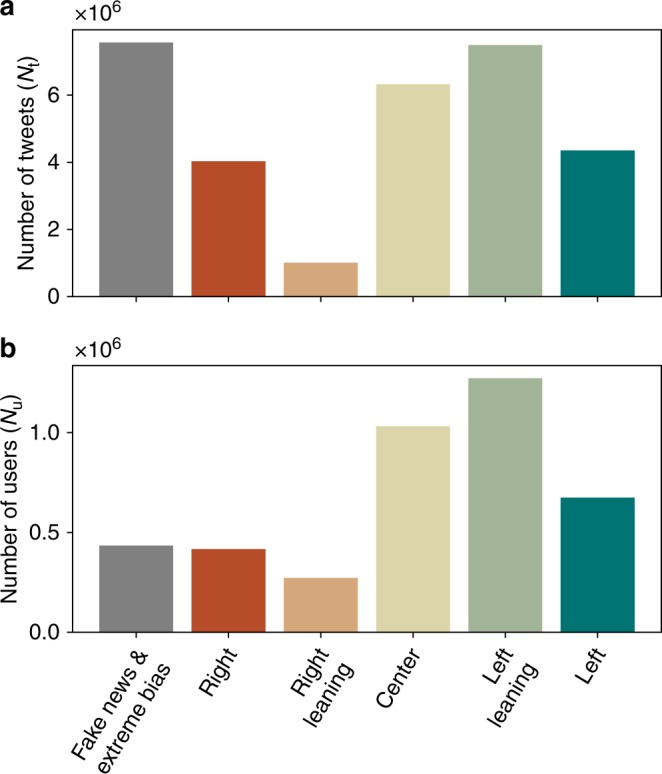
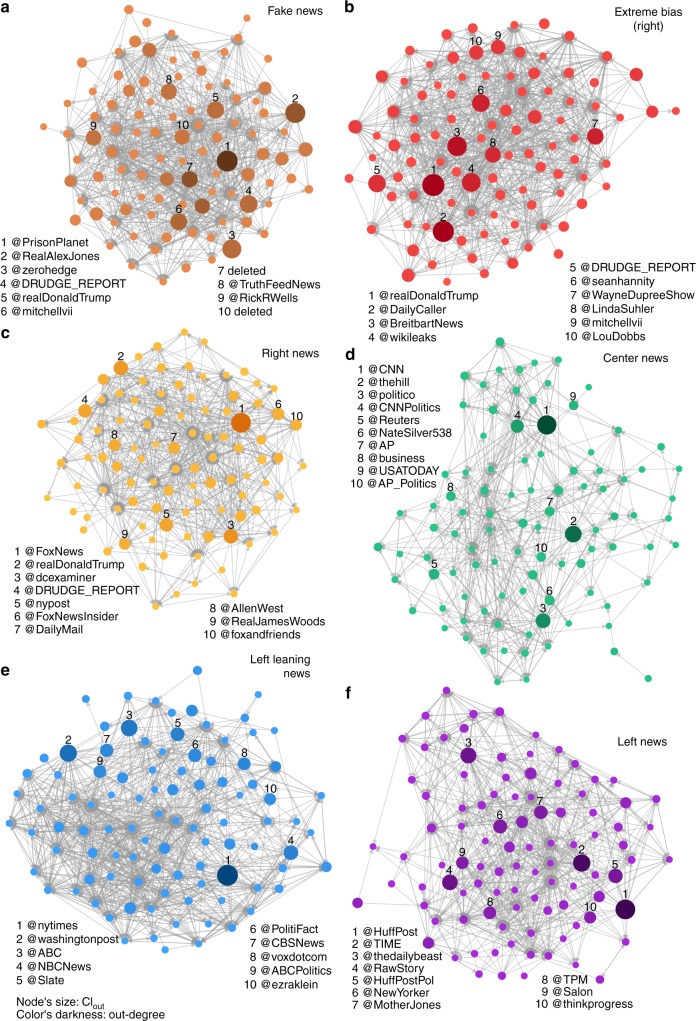
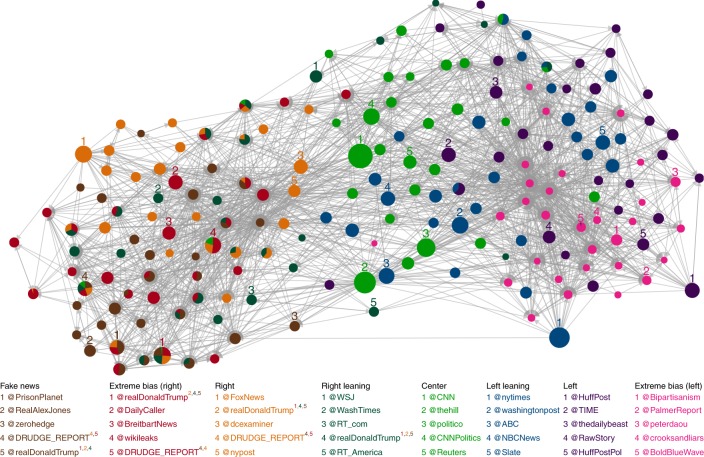
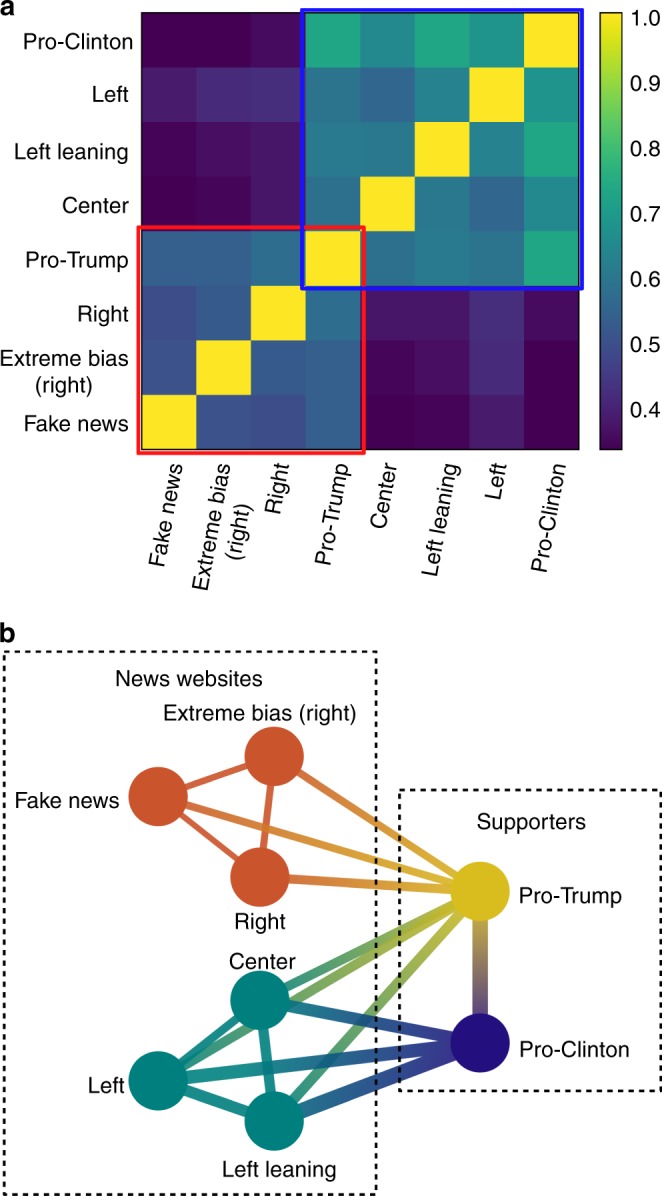
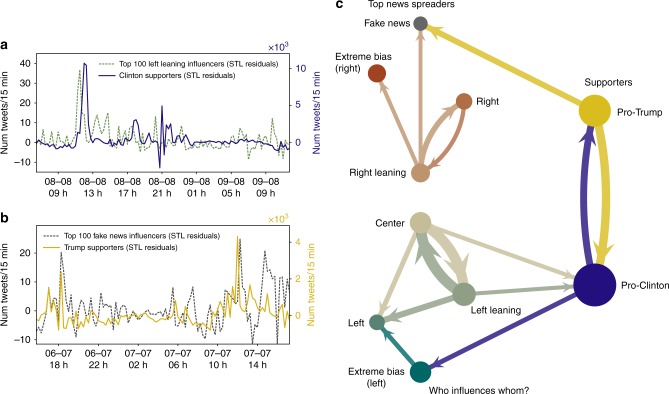
The dynamics and influence of fake news on Twitter during the 2016 US presidential election remains to be clarified. Here, we use a dataset of 171 million tweets in the five months preceding the election day to identify 30 million tweets, from 2.2 million users, which contain a link to news outlets. Based on a classification of news outlets curated by www.opensources.co , we find that 25% of these tweets spread either fake or extremely biased news. We characterize the networks of information flow to find the most influential spreaders of fake and traditional news and use causal modeling to uncover how fake news influenced the presidential election. We find that, while top influencers spreading traditional center and left leaning news largely influence the activity of Clinton supporters, this causality is reversed for the fake news: the activity of Trump supporters influences the dynamics of the top fake news spreaders.
Overview
The claims and statistics of this paper haven’t been checked yet.
Free: it reads the open-access text and checks the first 5 claims that cite a source we can check. Create a free account to check every claim.
Integrity signals
Registry
Cites
Statistics
Figures
Verification
Claims the paper makes
The claims and statistics of this paper haven’t been checked yet.
Free: it reads the open-access text and checks the first 5 claims that cite a source we can check. Create a free account to check every claim.
Claims other papers make about this one
Each is checked against this paper’s own text: does it say what the citing paper says it does?
The cited source says what the claim attributes to it.
In the citing paper
“Real and present concerns exist over the role of mis- and disinformation in public discourse (116–118), the emergence of echo chambers (119) and deepening political polarization (120, 121), in particular around big societal issues like climate change (122).”
From The benefits and dangers of anthropomorphic conversational agents (2025) · cites this paper as [117]
Self-check
Percentages, sums and reported differences re-computed from the paper’s own numbers.
The self-check needs the paper’s full text.
Citations
Cites
1 retracted
Limited individual attention and online virality of low-quality information
Qiu, X., F. M. Oliveira, D., Sahami Shirazi, A., Flammini, A., & Menczer, F. (2017) · Nature Human Behaviour · doi:10.1038/s41562-017-0132 · Cited by 180
RetractedControlling the False Discovery Rate: A Practical and Powerful Approach to Multiple Testing
Benjamini, Y., & Hochberg, Y. (1995) · Journal of the Royal Statistical Society Series B: Statistical Methodology · doi:10.1111/j.2517-6161.1995.tb02031.x · Cited by 109,482
Investigating causal relations by econometric models and cross-spectral methods
Granger, C. W. J. (1969) · Econometrica · doi:10.2307/1912791 · Cited by 22,989
The spread of true and false news online
Vosoughi, S., Roy, D., & Aral, S. (2018) · Science · doi:10.1126/science.aap9559 · Cited by 8,847
Causation, Prediction, and Search
Spirtes, P., Glymour, C., & Scheines, R. (2001) · doi:10.7551/mitpress/1754.001.0001 · Cited by 4,521
A New Status Index Derived from Sociometric Analysis
Katz, L. (1953) · Psychometrika · doi:10.1007/bf02289026 · Cited by 3,866
Exposure to ideologically diverse news and opinion on Facebook
Bakshy, E., Messing, S., & Adamic, L. A. (2015) · Science · doi:10.1126/science.aaa1160 · Cited by 3,245
The spreading of misinformation online
Del Vicario, M., Bessi, A., Zollo, F., Petroni, F., Scala, A., Caldarelli, G., Stanley, H. E., & Quattrociocchi, W. (2016) · Proceedings of the National Academy of Sciences · doi:10.1073/pnas.1517441113 · Cited by 2,407
Confirmation, disconfirmation, and information in hypothesis testing
Klayman, J., & Ha, Y.-W. (1987) · Psychological Review · doi:10.1037/0033-295x.94.2.211 · Cited by 2,094
Ferrara, E., Varol, O., Davis, C., Menczer, F., & Flammini, A. (2016) · Communications of the ACM · doi:10.1145/2818717 · Cited by 1,973
Research works printed but not linked: 2
- Howell L Digital wildfires in a hyperconnected world WEF Rep. 2013 3 15 94
- Cleveland RB Cleveland WS McRae JE Terpenning I STL: a seasonal-trend decomposition procedure based on loess J. Off. Stat. 1990 6 3 73
Cited by
Items 201–300 of 1,000
Communication and crisis in the public space: Dissolution and uncertainty
Palau-Sampio, D., & García, G. L. (2022) · El Profesional de la Informacion · doi:10.3145/epi.2022.may.16 · Cited by 40
Improving Fake News Detection of Influential Domain via Domain- and Instance-Level TransferPreprint
Nan, Q., Wang, D., Zhu, Y., Sheng, Q., Shi, Y., Cao, J., & Li, J. (2022) · arXiv (Cornell University) · doi:10.48550/arxiv.2209.08902 · Cited by 40
Shah, S. B., Thapa, S., Acharya, A., Rauniyar, K., Poudel, S., Jain, S., Masood, A., & Naseem, U. (2025) · IEEE Access · doi:10.1109/access.2024.3406644 · Cited by 39
MEFaND: A Multimodel Framework for Early Fake News Detection
Sormeily, A., Dadkhah, S., Zhang, X., & Ghorbani, A. A. (2024) · IEEE Transactions on Computational Social Systems · doi:10.1109/tcss.2024.3355300 · Cited by 39
Interaction data are identifiable even across long periods of time
Creţu, A.-M., Monti, F., Marrone, S., Dong, X., Bronstein, M., & de Montjoye, Y.-A. (2022) · Nature Communications · doi:10.1038/s41467-021-27714-6 · Cited by 29
Akhtar, M. M., Masood, R., Ikram, M., & Kanhere, S. S. (2024) · ACM Asia Conference on Computer and Communications Security (ASIA CCS) · doi:10.1145/3634737.3644998 · Cited by 39
Neyazi, T. A., Ng, A. Y. K., Kuru, O., & Muhtadi, B. (2022) · Social Media + Society · doi:10.1177/20563051221122792 · Cited by 40
Polarization and trust in the evolution of vaccine discourse on Twitter during COVID-19
Quintana, I. O., Reimann, R., Cheong, M., Alfano, M., & Klein, C. (2022) · PLoS ONE · doi:10.1371/journal.pone.0277292 · Cited by 39
Cheng, M., Yin, C., Nazarian, S., & Bogdan, P. (2021) · Scientific Reports · doi:10.1038/s41598-021-89202-7 · Cited by 40
Gill, H., & Rojas, H. (2020) · Asian Journal of Communication · doi:10.1080/01292986.2020.1825757 · Cited by 39
Ferrara, E. (2025) · First Monday · doi:10.5210/fm.v30i6.14188 · Cited by 41
How people perceive influence of fake news and why it matters
Lee, T. (2021) · Communication Quarterly · doi:10.1080/01463373.2021.1954677 · Cited by 40
Synthesized Social Signals: Computationally-Derived Social Signals from Account Histories
Im, J., Tandon, S., Chandrasekharan, E., Denby, T., & Gilbert, E. (2020) · Proceedings of the 2020 CHI Conference on Human Factors in Computing Systems · doi:10.1145/3313831.3376383 · Cited by 39
Survey of machine learning techniques for Arabic fake news detection
Touahri, I., & Mazroui, A. (2024) · Artificial Intelligence Review · doi:10.1007/s10462-024-10778-3 · Cited by 39
Review of stance detection for rumor verification in social media
Alsaif, H. F., & Al-Dossari, H. Z. (2023) · Engineering Applications of Artificial Intelligence · doi:10.1016/j.engappai.2022.105801 · Cited by 39
Measuring the scope of pro-Kremlin disinformation on Twitter
Golovchenko, Y. (2020) · Humanities and Social Sciences Communications · doi:10.1057/s41599-020-00659-9 · Cited by 38
Deception strategies and threats for online discussions
Varol, O., & Uluturk, I. (2018) · First Monday · doi:10.5210/fm.v22i5.7883 · Cited by 38
Luo, H., Meng, X., Zhao, Y., & Cai, M. (2023) · Telematics and Informatics · doi:10.1016/j.tele.2023.102051 · Cited by 38
Uncovering Coordinated Networks on Social Media.
Pacheco, D. F., Hui, P.-M., Torres-Lugo, C., Truong, B. T., Flammini, A., & Menczer, F. (2020) · Cited by 37
van Baar, J. M., & FeldmanHall, O. (2022) · American Psychologist · doi:10.1037/amp0000814 · Cited by 38
Characterizing engagement dynamics across topics on Facebook
Etta, G., Sangiorgio, E., Marco, N. D., Avalle, M., Scala, A., Cinelli, M., & Quattrociocchi, W. (2023) · PLoS ONE · doi:10.1371/journal.pone.0286150 · Cited by 39
Chen, Y., Long, J. A., Jun, J., Kim, S., Zain, A., & Piacentine, C. (2023) · Public Understanding of Science · doi:10.1177/09636625221146269 · Cited by 38
Liu, H., Li, H., Qi, Y., An, P., Shi, J., & Liu, Y. (2021) · Resources Policy · doi:10.1016/j.resourpol.2021.102370 · Cited by 38
Wendland, A., Zenere, M., & Niemann, J. (2021) · Communications in computer and information science · doi:10.1007/978-3-030-85521-5_19 · Cited by 38
Bibliometric analysis of fake news indexed in Web of Science and Scopus (2001-2020)
Patra, R. K., Pandey, N., & Sudarsan, D. (2022) · Global Knowledge, Memory and Communication · doi:10.1108/gkmc-11-2021-0177 · Cited by 39
Kemp, P. S., Subbiah, G., Barnes, R. A., Boerder, K., O’Leary, B. C., Stewart, B. D., & Williams, C. (2022) · Marine Policy · doi:10.1016/j.marpol.2022.105335 · Cited by 38
Relative engagement with sources of climate misinformation is growing across social media platforms
Storani, S., Falkenberg, M., Quattrociocchi, W., & Cinelli, M. (2025) · Scientific Reports · doi:10.1038/s41598-025-03082-9 · Cited by 38
Anwar, A., Ilyas, H., Yaqub, U., & Zaman, S. (2021) · Annual International Conference on Digital Government Research · doi:10.1145/3463677.3463718 · Cited by 38
Interpretable Propaganda Detection in News Articles
Amazon Alexa AI, S., Yu, S., Martino, G. D. S., Mohtarami, M., Glass, J. R., & Nakov, P. (2021) · International conference Recent advances in natural language processing · doi:10.26615/978-954-452-072-4_179 · Cited by 37
Siebert, J., & Siebert, J. U. (2023) · PLoS ONE · doi:10.1371/journal.pone.0282202 · Cited by 38
Proactive Discovery of Fake News Domains from Real-Time Social Media Feeds
Chen, Z., & Freire, J. (2020) · International World Wide Web Conference (WWW) · doi:10.1145/3366424.3385772 · Cited by 37
Unified Dual-view Cognitive Model for Interpretable Claim Verification
Wu, L., Rao, Y., Lan, Y., Sun, L., & Qi, Z. (2021) · doi:10.18653/v1/2021.acl-long.5 · Cited by 37
Knowledge About COVID-19 in Brazil: Cross-Sectional Web-Based Study
Guimarães, V. H. A., de Oliveira-Leandro, M., Cassiano, C., Marques, A. L. P., Motta, C., Freitas-Silva, A. L., de Sousa, M. A. D., da Silveira, L. A. M., Pardi, T. C., Gazotto, F. C., et al. (2021) · JMIR Public Health and Surveillance · doi:10.2196/24756 · Cited by 38
Multifaceted online coordinated behavior in the 2020 US presidential election
Tardelli, S., Nizzoli, L., Avvenuti, M., Cresci, S., & Tesconi, M. (2024) · EPJ Data Science · doi:10.1140/epjds/s13688-024-00467-0 · Cited by 37
The new denial: climate solution misinformation on social media
Nicolosi, E., Medina, R., Brewer, S., Vorkink, M., & Allred, A. (2025) · Global Sustainability · doi:10.1017/sus.2025.10016 · Cited by 39
Liu, L., Wang, X., Zheng, Y., Fang, W., Tang, S., & Zheng, Z. (2020) · New Journal of Physics · doi:10.1088/1367-2630/ab623c · Cited by 37
On the Origin, Proliferation and Tone of Fake News
Parikh, S. B., Patil, V., & Atrey, P. K. (2019) · IEEE International Conference on Multimedia Information Processing and Retrieval (MIPR) · doi:10.1109/mipr.2019.00031 · Cited by 36
Rumor spreading: A trigger for proliferation or fading away
Zehmakan, A. N., & Galam, S. (2020) · Chaos An Interdisciplinary Journal of Nonlinear Science · doi:10.1063/5.0006984 · Cited by 36
Ratioing the President: An exploration of public engagement with Obama and Trump on Twitter
Minot, J. R., Arnold, M., Alshaabi, T., Danforth, C. M., & Dodds, P. S. (2021) · PLoS ONE · doi:10.1371/journal.pone.0248880 · Cited by 35
FakeYou! - A Gamified Approach for Building and Evaluating Resilience Against Fake News
Clever, L., Assenmacher, D., Müller, K., Seiler, M. V., Riehle, D. M., Preuß, M., & Grimme, C. (2020) · Lecture notes in computer science · doi:10.1007/978-3-030-61841-4_15 · Cited by 35
Calvillo, D. P., & Smelter, T. J. (2020) · Cognitive Research: Principles and Implications · doi:10.1186/s41235-020-00257-y · Cited by 35
A Deep Hybrid Learning Approach to Detect Bangla Fake News
Adib, Q. A. R., Mehedi, M. H. K., Sakib, M. S., Patwary, K. K., Hossain, M. S., & Rasel, A. A. (2021) · International Symposium on Multidisciplinary Studies and Innovative Technologies (ISMSIT) · doi:10.1109/ismsit52890.2021.9604712 · Cited by 35
Explainability in Practice: A Survey of Explainable NLP Across Various DomainsPreprint
Mohammadi, H., Bagheri, R. A., Giachanou, A., & Oberski, D. L. (2025) · arXiv (Cornell University) · doi:10.48550/arxiv.2502.00837 · Cited by 37
Dongo, I., Cardinale, Y., Aguilera, A., Martínez, F., Quintero, Y., Robayo, G., & Cabeza, D. (2021) · International Journal of Web Information Systems · doi:10.1108/ijwis-03-2021-0037 · Cited by 35
A Commitment Theory of PopulismPreprint
Morelli, M., Nicolò, A., & Roberti, P. (2021) · SSRN Electronic Journal · doi:10.2139/ssrn.3982036 · Cited by 35
Wu, S., & Resnick, P. (2021) · Proceedings of the International AAAI Conference on Web and Social Media · doi:10.1609/icwsm.v15i1.18105 · Cited by 34
Location impact on source and linguistic features for information credibility of social media
Aladhadh, S., Zhang, X., & Sanderson, M. (2018) · Online Information Review · doi:10.1108/oir-03-2018-0087 · Cited by 34
Eliciting preferences for truth-telling in a survey of politicians
Janezic, K. A., & Gallego, A. (2020) · Proceedings of the National Academy of Sciences · doi:10.1073/pnas.2008144117 · Cited by 36
Realistic Aspects of Simulation Models for Fake News Epidemics over Social Networks
Lotito, Q. F., Zanella, D., & Casari, P. (2021) · Future Internet · doi:10.3390/fi13030076 · Cited by 36
The supply and demand of news during COVID-19 and assessment of questionable sources production
Gravino, P., Prevedello, G., Martina, G., & Loreto, V. (2022) · Nature Human Behaviour · doi:10.1038/s41562-022-01353-3 · Cited by 34
Xu, S., Mariani, M. S., Lü, L., & Medo, M. (2020) · Journal of Informetrics · doi:10.1016/j.joi.2019.101005 · Cited by 33
A deep dive into COVID-19-related messages on WhatsApp in Pakistan
Javed, R. T., Usama, M., Iqbal, W., Qadir, J., Tyson, G., Castro, I., & Garimella, K. V. (2021) · Social Network Analysis and Mining · doi:10.1007/s13278-021-00833-0 · Cited by 33
Oh, J. (2023) · The Gerontologist · doi:10.1093/geront/gnad092 · Cited by 35
I-FLASH: Interpretable Fake News Detector Using LIME and SHAP
Dua, V., Rajpal, A., Rajpal, S., Agarwal, M., & Kumar, N. (2023) · Wireless Personal Communications · doi:10.1007/s11277-023-10582-2 · Cited by 33
Zhang, R., Sun, S., Zhang, F., Chen, K., Liu, L., & Zhu, N. (2022) · Optics Express · doi:10.1364/oe.459968 · Cited by 32
Flood Impact Mitigation and Resilience Enhancement
Huang, G. (2020) · IntechOpen eBooks · doi:10.5772/intechopen.87806 · Cited by 32
Minici, M., Luceri, L., Cinus, F., & Ferrara, E. (2024) · First Monday · doi:10.5210/fm.v29i11.13831 · Cited by 33
Rossini, P., Stromer‐Galley, J., & Korsunska, A. (2021) · Journal of Language and Politics · doi:10.1075/jlp.21033.ros · Cited by 32
Mathematical Models for Fake News
Brody, D. C., & Meier, D. M. (2022) · WORLD SCIENTIFIC eBooks · doi:10.1142/9789811246494_0018 · Cited by 32
Italian Twitter semantic network during the Covid-19 epidemic
Mattei, M., Caldarelli, G., Squartini, T., & Saracco, F. (2021) · EPJ Data Science · doi:10.1140/epjds/s13688-021-00301-x · Cited by 32
DeVerna, M., Pierri, F., Ahn, Y., Fortunato, S., Flammini, A., & Menczer, F. (2025) · npj Complexity · doi:10.1038/s44260-025-00038-y · Cited by 32
Comparing the Impact of Social Media Regulations on News Consumption
Etta, G., Cinelli, M., Galeazzi, A., Valensise, C. M., Quattrociocchi, W., & Conti, M. (2022) · IEEE Transactions on Computational Social Systems · doi:10.1109/tcss.2022.3171391 · Cited by 31
Matatov, H., Naaman, M., & Amir, O. (2022) · Proceedings of the ACM on Human-Computer Interaction · doi:10.1145/3555599 · Cited by 31
Next generation of nanozymes: A perspective of the challenges to match biological performance
Goya, G. F., Mayoral, Á., Winkler, E. L., Zysler, R. D., Bagnato, C., Raineri, M., Fuentes-García, J. A., & Lima, E. (2021) · Journal of Applied Physics · doi:10.1063/5.0061499 · Cited by 31
Down the bot hole: Actionable insights from a one-year analysis of bot activity on Twitter
Luceri, L., Cardoso, F. M., & Giordano, S. (2021) · First Monday · doi:10.5210/fm.v26i3.11441 · Cited by 31
Boniardi, L., Dons, E., Longhi, F., Scuffi, C., Campo, L., Poppel, M. V., Panis, L. I., & Fustinoni, S. (2021) · Environmental Pollution · doi:10.1016/j.envpol.2021.116530 · Cited by 31
Beyond Fact-Checking: Network Analysis Tools for Monitoring Disinformation in Social Media
Guarino, S., Trino, N., Chessa, A., & Riotta, G. (2019) · Studies in computational intelligence · doi:10.1007/978-3-030-36687-2_36 · Cited by 31
On the efficacy of old features for the detection of new bots
Nicola, R. D., Petrocchi, M., & Pratelli, M. (2021) · Information Processing & Management · doi:10.1016/j.ipm.2021.102685 · Cited by 30
Sustainable development goals as unifying narratives in large UK firms’ Twitter discussions
Patuelli, A., & Saracco, F. (2023) · Scientific Reports · doi:10.1038/s41598-023-34024-y · Cited by 30
Shevtsov, A., Tzagkarakis, C., Antonakaki, D., & Ioannidis, S. (2022) · Proceedings of the International AAAI Conference on Web and Social Media · doi:10.1609/icwsm.v16i1.19349 · Cited by 30
Misinformation detection on YouTube using video captions
Jagtap, R., Kumar, A., Goel, R., Sharma, S., George, C. P., & Sharma, R. (2026) · Online Social Networks and Media · doi:10.1016/j.osnem.2026.100345 · Cited by 30
Lyu, H., Zheng, Z., & Luo, J. (2022) · Health Data Science · doi:10.34133/2022/9858292 · Cited by 30
Chao, F., Zhou, Q., Zhao, J., Xu, Y., & Yu, G. (2024) · Information Processing & Management · doi:10.1016/j.ipm.2024.103747 · Cited by 30
Predicting the virality of fake news at the early stage of dissemination
Esteban-Bravo, M., Jimenez-Rubido, L. D. L. M., & Vidal-Sanz, J. M. (2024) · Expert Systems with Applications · doi:10.1016/j.eswa.2024.123390 · Cited by 30
An international effort using behavioural science to tackle the spread of misinformation
OECD (2022) · Public governance policy papers · doi:10.1787/b7709d4f-en · Cited by 30
DoubleH: Twitter User Stance Detection via Bipartite Graph Neural Networks
Zhang, C., Zhou, Z., Peng, X., & Xu, K. (2024) · Proceedings of the International AAAI Conference on Web and Social Media · doi:10.1609/icwsm.v18i1.31424 · Cited by 30
KAHAN: Knowledge-Aware Hierarchical Attention Network for Fake News detection on Social Media
Tseng, Y.-W., Yang, H.-K., Wang, W., & Peng, W.-C. (2022) · International World Wide Web Conference (WWW) · doi:10.1145/3487553.3524664 · Cited by 31
Du, H., Zheng, X., Zhao, Q., Hu, Z., Wang, H., Zhou, L., & Liu, J. (2021) · Frontiers in Genetics · doi:10.3389/fgene.2021.550676 · Cited by 30
Li, M., Zhang, H., Georgescu, P., & Li, T. (2020) · Physica A Statistical Mechanics and its Applications · doi:10.1016/j.physa.2020.125321 · Cited by 30
Comparison of changes in vegetation and land cover types between Shenzhen and Bangkok
Song, Y., Aryal, J., Tan, L., Jin, L., Gao, Z., & Wang, Y. (2020) · Land Degradation and Development · doi:10.1002/ldr.3788 · Cited by 30
Stress transfer at the nanoscale on graphene ribbons of regular geometry
Manikas, A. C., Carbone, M. G. P., Woods, C. R., Wang, Y., Souli, I., Anagnostopoulos, G., Hadjinicolaou, Μ., Novoselov, K. S., & Galiotis, C. (2019) · Nanoscale · doi:10.1039/c9nr03166a · Cited by 30
Daley–Kendal models in fake-news scenario
Piqueira, J. R. C., Zilbovicius, M., & Batistela, C. M. (2019) · Physica A Statistical Mechanics and its Applications · doi:10.1016/j.physa.2019.123406 · Cited by 30
MetaDetector: Meta Event Knowledge Transfer for Fake News Detection
Ding, Y., Guo, B., Liu, Y., Liang, Y., Shen, H., & Yu, Z. (2022) · ACM Transactions on Intelligent Systems and Technology · doi:10.1145/3532851 · Cited by 29
Calderón, B. J. G., Córdoba-Cabús, A., & López-Martín, Á. (2022) · Doxa Comunicación Revista interdisciplinar de estudios de comunicación y ciencias sociales · doi:10.31921/doxacom.n36a1741 · Cited by 29
The physics of news, rumors, and opinions
Caldarelli, G., Artime, O., Fischetti, G., Guarino, S., Nowak, A. K., Saracco, F., Holme, P., & Domenico, M. D. (2026) · Physics Reports · doi:10.1016/j.physrep.2026.05.002 · Cited by 31
Breathable Biomimetic Chiral Porous MOF Thin Films for Multiple Enantiomers Sensing
Li, N., Zhang, J., Wöll, C., Gu, Z., & Zhang, J. (2025) · Advanced Functional Materials · doi:10.1002/adfm.202422860 · Cited by 29
Margolin, D. (2019) · Communication Methods and Measures · doi:10.1080/19312458.2019.1639144 · Cited by 29
Containing misinformation spreading in temporal social networks
Wang, W., Ma, Y., Wu, T., Dai, Y., Chen, X., & Braunstein, L. A. (2019) · Chaos An Interdisciplinary Journal of Nonlinear Science · doi:10.1063/1.5114853 · Cited by 28
The Manufacture of Partisan Echo Chambers by Follow Train Abuse on Twitter
Torres-Lugo, C., Yang, K.-C., & Menczer, F. (2022) · Proceedings of the International AAAI Conference on Web and Social Media · doi:10.1609/icwsm.v16i1.19354 · Cited by 28
A fusion of BERT, machine learning and manual approach for fake news detection
Ghamdi, M. A. A., Bhatti, M. S., Saeed, A., Gillani, Z., & Almotiri, S. H. (2023) · Multimedia Tools and Applications · doi:10.1007/s11042-023-16669-z · Cited by 28
Opgenhaffen, M. (2022) · Digital Journalism · doi:10.1080/21670811.2021.2011758 · Cited by 28
Binford, M. T., Wojdynski, B. W., Lee, Y.-I., Sun, S., & Briscoe, A. (2020) · Journal of Information Technology & Politics · doi:10.1080/19331681.2020.1805388 · Cited by 28
Specious Sites: Tracking the Spread and Sway of Spurious News Stories at Scale
Hanley, H. W. A., Kumar, D., & Durumeric, Z. (2024) · IEEE Symposium on Security and Privacy (S&P) · doi:10.1109/sp54263.2024.00171 · Cited by 28
A comparison of centrality measures and their role in controlling the spread in epidemic networks
Dudkina, E., Bin, M., Breen, J., Crisostomi, E., Ferraro, P., Kirkland, S., Mareček, J., Murray‐Smith, R., Parisini, T., Stone, L., et al. (2023) · International Journal of Control · doi:10.1080/00207179.2023.2204969 · Cited by 28
A comprehensive overview of fake news detection on social networks
Sharma, U., & Singh, J. (2024) · Social Network Analysis and Mining · doi:10.1007/s13278-024-01280-3 · Cited by 28
How to Protect Yourself from 5G Radiation? Investigating LLM Responses to Implicit Misinformation
Guo, R., Xu, W., & Ritter, A. (2025) · Conference on Empirical Methods in Natural Language Processing (EMNLP) · doi:10.18653/v1/2025.emnlp-main.1468 · Cited by 28
Global-Liar: Factuality of LLMs over Time and Geographic RegionsPreprint
Mirza, S., Coelho, B. G., Cui, Y., Pöpper, C., & McCoy, D. (2024) · arXiv (Cornell University) · doi:10.48550/arxiv.2401.17839 · Cited by 28
Modeling the debate dynamics of political communication in social media networks
Magdaci, O., Matalon, Y., & Yamin, D. (2022) · Expert Systems with Applications · doi:10.1016/j.eswa.2022.117782 · Cited by 29
Artificial Intelligence in Science and Society: The Vision of USERN
Dorigo, T., Brown, G. D., Casonato, C., Cerdà, A., Ciarrochi, J., Lio, M. D., D’Souza, N., Gauger, N. R., Hayes, S. C., Hofmann, S. G., et al. (2025) · IEEE Access · doi:10.1109/access.2025.3529357 · Cited by 27
Internet governance in the “post-truth era”: Analyzing key topics in “fake news” discussions at IGF
Horne, C. L. (2021) · Telecommunications Policy · doi:10.1016/j.telpol.2021.102150 · Cited by 27
Metadata
- Authors
- Bovet, A., & Makse, H. A.
- Affiliations
- City College of New York (US)
- Corresponding author
- Makse, Hernán A.
- Venue
- Nature Communications
- Published
- 2019-01-02
- Volume
- 10
- Issue
- 1
- Pages
- 7-7
- ISSN
- 2041-1723 (ISSN-L)
- PMC
- PMC6315042
- OpenAlex
- W2792307011
- Cited by
- 701
- References
- 40
- Citations by year
- 2026: 38 · 2025: 106 · 2024: 114 · 2023: 105 · 2022: 109 · 2021: 114 · 2020: 86 · 2019: 28
- FWCI
- 130.25
- Type
- journal article
- Language
- en
- Open access
- gold
- doi.org
- Licence
- cc-by
- creativecommons.org/licenses/by/4.0 (tdm)
- creativecommons.org/licenses/by/4.0 (vor)
- Locations
- Nature Communications (publishedVersion, cc-by)
- Europe PMC (PubMed Central) (publishedVersion, other-oa)
- PubMed Central (publishedVersion, cc-by)
- PubMed (publishedVersion)
- Repository of the University of Namur (publishedVersion, cc-by)
- arXiv (Cornell University) (submittedVersion)
- RePEc: Research Papers in Economics (submittedVersion)
- DOAJ (DOAJ: Directory of Open Access Journals) (submittedVersion)
- DOAJ (DOAJ: Directory of Open Access Journals) (submittedVersion, cc-by-sa)
- arXiv (Cornell University) (cc-by)
- Funders
- National Science Foundation
- Schweizerischer Nationalfonds zur Förderung der Wissenschaftlichen Forschung (165158)
- Topics
- Social Sciences › Sociology and Political Science › Misinformation and Its Impacts
- Physical Sciences › Physics and Astronomy › Statistical and Nonlinear Physics › Complex Network Analysis Techniques
- Social Sciences › Communication › Social Media and Politics
- Keywords
- fake news, 2016 US presidential election, Twitter, information dissemination, influential spreaders, election influence, Trump supporters, social media misinformation
About these checks
Registry, retraction, Cites and statistics results are computed, not judged, with one exception: a printed reference that no index lists is read once by a model before it counts as a citation error. Claims are extracted by a model and kept only when their quote appears verbatim in the text; each cited source is then checked, with a model’s help, for whether it says what the claim relies on. Those verdicts can be wrong — read the claim’s quote and the cited source before relying on one.
Statistics and arithmetic are recomputed, not judged.
Confidence bands are shown only for fields calibrated on our annotated test set. None is calibrated yet, so no band is shown.
What counts as a claim ›How we measure confidence ›How we check this ›
Are you an author, or do you see a problem with this page? Request a review
Data sources
Bibliographic data: Semantic Scholar, OpenAlex, Crossref.
Contains information from the Semantic Scholar Academic Graph Datasets, made available under the ODC Attribution License (ODC-BY 1.0).
Semantic Scholar’s data is described in: Kinney, R., et al. (2023). The Semantic Scholar Open Data Platform. arXiv:2301.10140.
