

Influence of fake news in Twitter during the 2016 US presidential election
Open accessThe DOI matches its Crossref record; 44 of the 44 references it cites were found in a registry or an index.
Abstract
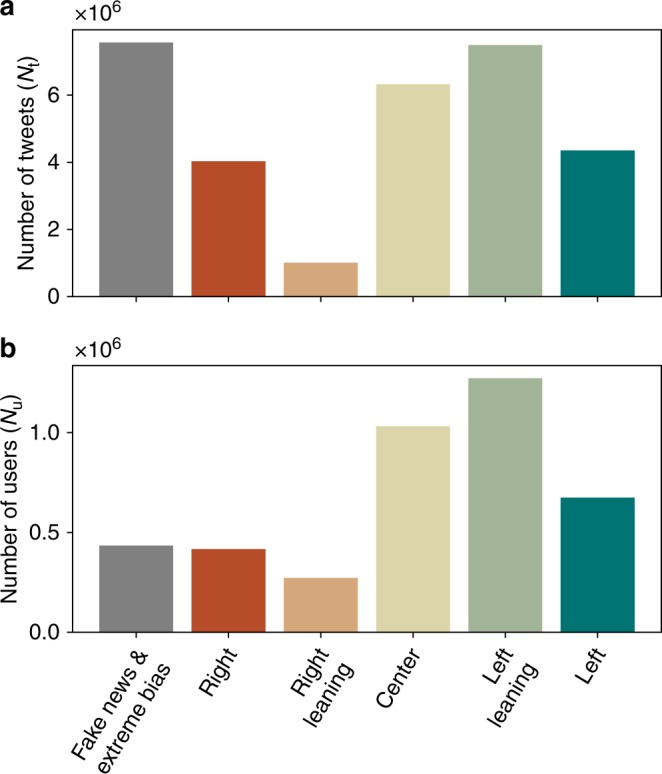
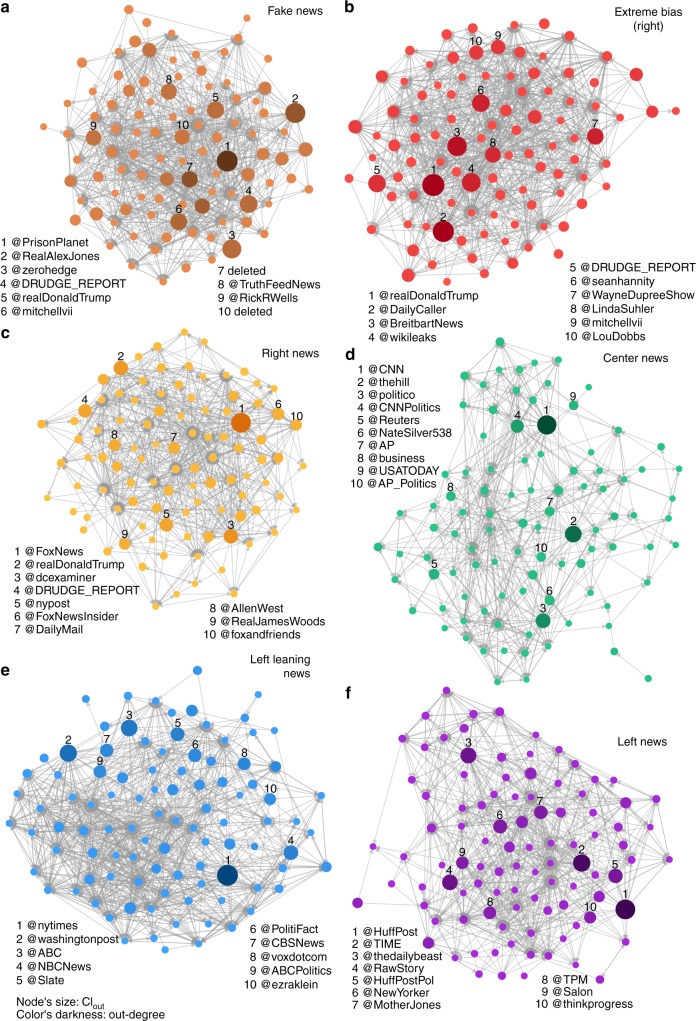
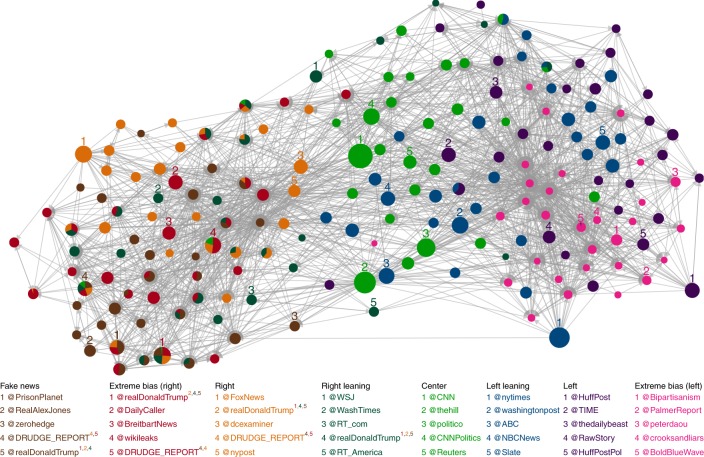
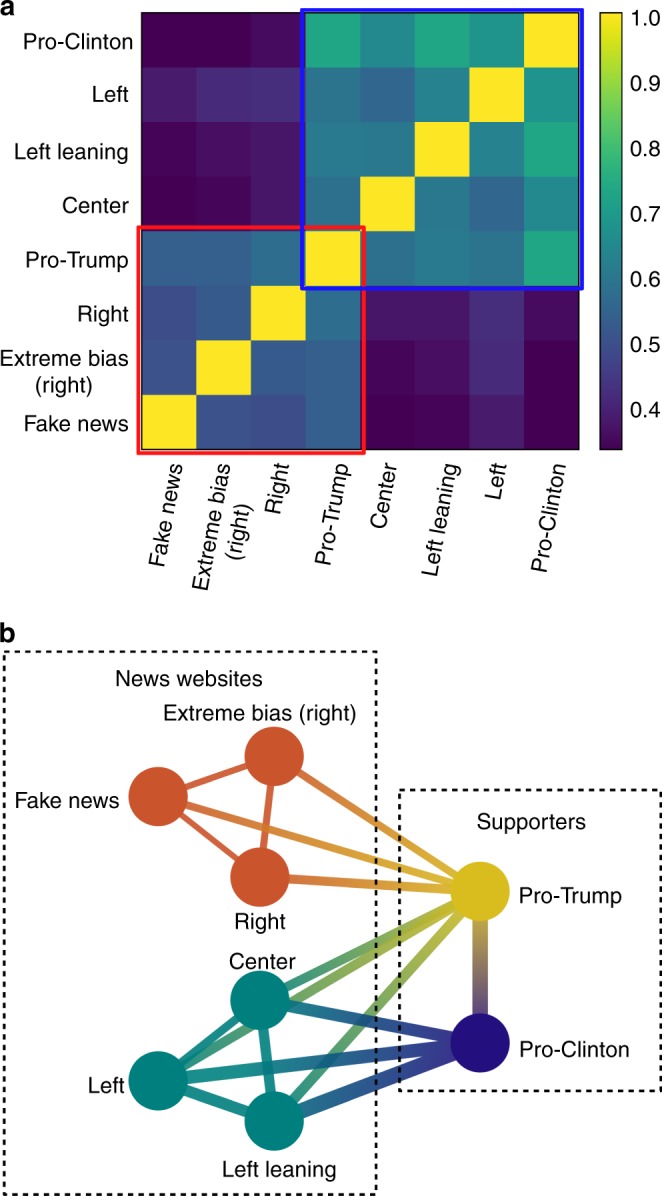
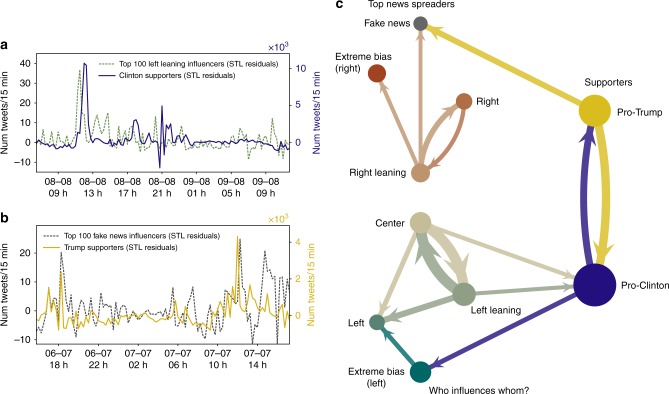
The dynamics and influence of fake news on Twitter during the 2016 US presidential election remains to be clarified. Here, we use a dataset of 171 million tweets in the five months preceding the election day to identify 30 million tweets, from 2.2 million users, which contain a link to news outlets. Based on a classification of news outlets curated by www.opensources.co , we find that 25% of these tweets spread either fake or extremely biased news. We characterize the networks of information flow to find the most influential spreaders of fake and traditional news and use causal modeling to uncover how fake news influenced the presidential election. We find that, while top influencers spreading traditional center and left leaning news largely influence the activity of Clinton supporters, this causality is reversed for the fake news: the activity of Trump supporters influences the dynamics of the top fake news spreaders.
Overview
The claims and statistics of this paper haven’t been checked yet.
Free: it reads the open-access text and checks the first 5 claims that cite a source we can check. Create a free account to check every claim.
Integrity signals
Registry
Cites
Statistics
Figures
Verification
Claims the paper makes
The claims and statistics of this paper haven’t been checked yet.
Free: it reads the open-access text and checks the first 5 claims that cite a source we can check. Create a free account to check every claim.
Claims other papers make about this one
Each is checked against this paper’s own text: does it say what the citing paper says it does?
The cited source says what the claim attributes to it.
In the citing paper
“Real and present concerns exist over the role of mis- and disinformation in public discourse (116–118), the emergence of echo chambers (119) and deepening political polarization (120, 121), in particular around big societal issues like climate change (122).”
From The benefits and dangers of anthropomorphic conversational agents (2025) · cites this paper as [117]
Self-check
Percentages, sums and reported differences re-computed from the paper’s own numbers.
The self-check needs the paper’s full text.
Citations
Cites
1 retracted
Limited individual attention and online virality of low-quality information
Qiu, X., F. M. Oliveira, D., Sahami Shirazi, A., Flammini, A., & Menczer, F. (2017) · Nature Human Behaviour · doi:10.1038/s41562-017-0132 · Cited by 180
RetractedControlling the False Discovery Rate: A Practical and Powerful Approach to Multiple Testing
Benjamini, Y., & Hochberg, Y. (1995) · Journal of the Royal Statistical Society Series B: Statistical Methodology · doi:10.1111/j.2517-6161.1995.tb02031.x · Cited by 109,482
Investigating causal relations by econometric models and cross-spectral methods
Granger, C. W. J. (1969) · Econometrica · doi:10.2307/1912791 · Cited by 22,989
The spread of true and false news online
Vosoughi, S., Roy, D., & Aral, S. (2018) · Science · doi:10.1126/science.aap9559 · Cited by 8,847
Causation, Prediction, and Search
Spirtes, P., Glymour, C., & Scheines, R. (2001) · doi:10.7551/mitpress/1754.001.0001 · Cited by 4,521
A New Status Index Derived from Sociometric Analysis
Katz, L. (1953) · Psychometrika · doi:10.1007/bf02289026 · Cited by 3,866
Exposure to ideologically diverse news and opinion on Facebook
Bakshy, E., Messing, S., & Adamic, L. A. (2015) · Science · doi:10.1126/science.aaa1160 · Cited by 3,245
The spreading of misinformation online
Del Vicario, M., Bessi, A., Zollo, F., Petroni, F., Scala, A., Caldarelli, G., Stanley, H. E., & Quattrociocchi, W. (2016) · Proceedings of the National Academy of Sciences · doi:10.1073/pnas.1517441113 · Cited by 2,407
Confirmation, disconfirmation, and information in hypothesis testing
Klayman, J., & Ha, Y.-W. (1987) · Psychological Review · doi:10.1037/0033-295x.94.2.211 · Cited by 2,094
Ferrara, E., Varol, O., Davis, C., Menczer, F., & Flammini, A. (2016) · Communications of the ACM · doi:10.1145/2818717 · Cited by 1,973
Research works printed but not linked: 2
- Howell L Digital wildfires in a hyperconnected world WEF Rep. 2013 3 15 94
- Cleveland RB Cleveland WS McRae JE Terpenning I STL: a seasonal-trend decomposition procedure based on loess J. Off. Stat. 1990 6 3 73
Cited by
Items 101–200 of 1,000
Online disinformation on Facebook: the spread of fake news during the Portuguese 2019 election
Baptista, J. P., & Gradim, A. (2020) · Journal of Contemporary European Studies · doi:10.1080/14782804.2020.1843415 · Cited by 74
Single atomic site catalysts: synthesis, characterization, and applications
Ye, C., Zhang, N., Wang, D. S., & Li, Y. (2020) · Chemical Communications · doi:10.1039/d0cc03221b · Cited by 73
Falkenberg, M., Zollo, F., Quattrociocchi, W., Pfeffer, J., & Baronchelli, A. (2024) · Nature Communications · doi:10.1038/s41467-024-53868-0 · Cited by 75
Identifying influential nodes in social networks: Centripetal centrality and seed exclusion approach
Wang, Y., Li, H., Zhang, L., Zhao, L., & Li, W. (2022) · Chaos Solitons & Fractals · doi:10.1016/j.chaos.2022.112513 · Cited by 72
CoVaxxy: A Collection of English-Language Twitter Posts About COVID-19 Vaccines
DeVerna, M. R., Pierri, F., Truong, B. T., Bollenbacher, J., Axelrod, D., Loynes, N., Torres-Lugo, C., Yang, K.-C., Menczer, F., & Bryden, J. (2021) · Proceedings of the International AAAI Conference on Web and Social Media · doi:10.1609/icwsm.v15i1.18122 · Cited by 70
Making Online Communities ‘Better’: A Taxonomy of Community Values on Reddit
Weld, G., Zhang, A. X., & Althoff, T. (2024) · Proceedings of the International AAAI Conference on Web and Social Media · doi:10.1609/icwsm.v18i1.31413 · Cited by 71
Mutsvairo, B., & Bebawi, S. (2019) · Journalism & Mass Communication Educator · doi:10.1177/1077695819833552 · Cited by 70
A Closer Look at Fake News Detection: A Deep Learning Perspective
Abedalla, A., Al-Sadi, A., & Abdullah, M. (2019) · International Conference on Advances in Artificial Intelligence (ICAAI) · doi:10.1145/3369114.3369149 · Cited by 69
The systemic impact of deplatforming on social media
Mekacher, A., Falkenberg, M., & Baronchelli, A. (2023) · PNAS Nexus · doi:10.1093/pnasnexus/pgad346 · Cited by 68
Information disorders during the COVID-19 infodemic: The case of Italian Facebook
Guarino, S., Pierri, F., Giovanni, M. D., & Celestini, A. (2021) · Online Social Networks and Media · doi:10.1016/j.osnem.2021.100124 · Cited by 69
Bhuiyan, M. M., Zhang, A. X., Sehat, C. M., & Mitra, T. (2020) · Proceedings of the ACM on Human-Computer Interaction · doi:10.1145/3415164 · Cited by 67
Evaluating the effect of viral posts on social media engagement
Sangiorgio, E., Marco, N. D., Etta, G., Cinelli, M., Cerqueti, R., & Quattrociocchi, W. (2025) · Scientific Reports · doi:10.1038/s41598-024-84960-6 · Cited by 67
Temporal dynamics of coordinated online behavior: Stability, archetypes, and influence
Tardelli, S., Nizzoli, L., Tesconi, M., Conti, M., Nakov, P., Martino, G. D. S., & Cresci, S. (2024) · Proceedings of the National Academy of Sciences · doi:10.1073/pnas.2307038121 · Cited by 68
Right and left, partisanship predicts (asymmetric) vulnerability to misinformation
Nikolov, D., Flammini, A., & Menczer, F. (2021) · Harvard Kennedy School Misinformation Review · doi:10.37016/mr-2020-55 · Cited by 66
GETAE: Graph Information Enhanced Deep Neural NeTwork Ensemble ArchitecturE for fake news detection
Truică, C., Apostol, E., Marogel, M., & Paschke, A. (2025) · Expert Systems with Applications · doi:10.1016/j.eswa.2025.126984 · Cited by 66
Scale-free vertical tracking microscopy
Krishnamurthy, D., Li, H., du Rey, F. B., Cambournac, P., Larson, A. G., Li, E., & Prakash, M. (2020) · Nature Methods · doi:10.1038/s41592-020-0924-7 · Cited by 66
A Process‐Based Model Integrating Remote Sensing Data for Evaluating Ecosystem Services
Niu, Z., He, H., Peng, S., Ren, X., Zhang, L., Gu, F., Zhu, G., Peng, C. H., Li, P., Wang, J., et al. (2021) · Journal of Advances in Modeling Earth Systems · doi:10.1029/2020ms002451 · Cited by 66
Neutral bots probe political bias on social media
Chen, W., Pacheco, D., Yang, K.-C., & Menczer, F. (2021) · Nature Communications · doi:10.1038/s41467-021-25738-6 · Cited by 64
Becatti, C., Caldarelli, G., Lambiotte, R., & Saracco, F. (2019) · Humanities and Social Sciences Communications · doi:10.1057/s41599-019-0300-3 · Cited by 65
The limited reach of fake news on Twitter during 2019 European elections
Cinelli, M., Cresci, S., Galeazzi, A., Quattrociocchi, W., & Tesconi, M. (2020) · PLOS ONE · doi:10.1371/journal.pone.0234689 · Cited by 64
FineFake: A knowledge-enriched dataset for fine-grained multi-domain fake news detection
Zhou, Z., Zhang, X., Zhang, L., Liu, J., Cambria, E., & Li, C. (2026) · Information Fusion · doi:10.1016/j.inffus.2026.104253 · Cited by 64
The perils and promises of fact-checking with large language models
Quelle, D., & Bovet, A. (2024) · Frontiers in Artificial Intelligence · doi:10.3389/frai.2024.1341697 · Cited by 63
Self-citationZhou, X., Zhang, J., Tong, X., Sun, Y., Zhang, H., Min, Y., & Qian, Y. (2021) · Advanced Optical Materials · doi:10.1002/adom.202101517 · Cited by 63
The optical properties of few-layer InSe
Song, C., Huang, S., Wang, C., Luo, J., & Yan, H. (2020) · Journal of Applied Physics · doi:10.1063/5.0018480 · Cited by 62
Sindermann, C., Schmitt, H., Rozgonjuk, D., Elhai, J. D., & Montag, C. (2021) · Heliyon · doi:10.1016/j.heliyon.2021.e06503 · Cited by 62
Rijo, A., & Waldzus, S. (2022) · Computers in Human Behavior · doi:10.1016/j.chb.2022.107619 · Cited by 63
Giachanou, A., Ghanem, B., Ríssola, E. A., Rosso, P., Crestani, F., & Oberski, D. L. (2021) · Data & Knowledge Engineering · doi:10.1016/j.datak.2021.101960 · Cited by 63
Predicting political sentiments of voters from Twitter in multi-party contexts
Khatua, A., Khatua, A., & Cambria, E. (2020) · Applied Soft Computing · doi:10.1016/j.asoc.2020.106743 · Cited by 62
Evidence-backed Fact Checking using RAG and Few-Shot In-Context Learning with LLMs
Singal, R., Patwa, P., Patwa, P., Chadha, A. R., & Das, A. (2024) · Fact Extraction and VERification Workshop (FEVER) · doi:10.18653/v1/2024.fever-1.10 · Cited by 66
Alteri, L., Parks, L., Raffini, L., & Vitale, T. (2021) · PARTECIPAZIONE E CONFLITTO · doi:10.1285/i20356609v14i1p01 · Cited by 62
Influencer identification in dynamical complex systems
Pei, S., Wang, J., Morone, F., & Makse, H. A. (2019) · Journal of Complex Networks · doi:10.1093/comnet/cnz029 · Cited by 62
Self-citationCategory-controlled Encoder-Decoder for Fake News Detection
Wu, L., Rao, Y., Zhang, C., Zhao, Y., & Nazir, A. (2021) · IEEE Transactions on Knowledge and Data Engineering · doi:10.1109/tkde.2021.3103833 · Cited by 62
Web Scraping versus Twitter API: A Comparison for a Credibility Analysis
Dongo, I., Cadinale, Y., Aguilera, A., Martínez, F., Quintero, Y., & Barrios, S. (2020) · International Conference on Information Integration and Web-based Applications & Services (iiWAS) · doi:10.1145/3428757.3429104 · Cited by 61
Mapping the Scholarship of Fake News Research: A Systematic Review
Abu Arqoub, O., Abdulateef Elega, A., Efe Özad, B., Dwikat, H., & Adedamola Oloyede, F. (2022) · Journalism Practice · doi:10.1080/17512786.2020.1805791 · Cited by 60
Fakey: A Game Intervention to Improve News Literacy on Social Media
Micallef, N., Avram, M., Menczer, F., & Patil, S. (2021) · Proceedings of the ACM on Human-Computer Interaction · doi:10.1145/3449080 · Cited by 64
Kauk, J., Kreysa, H., & Schweinberger, S. R. (2021) · PLoS ONE · doi:10.1371/journal.pone.0256179 · Cited by 61
Artificial Intelligence and Sustainability—A Review
Dhiman, R., Miteff, S., Wang, Y., Ma, S.-C., Amirikas, R., & Fabian, B. (2024) · Analytics · doi:10.3390/analytics3010008 · Cited by 59
Vasist, P. N., & Krishnan, S. (2023) · Journal of Cleaner Production · doi:10.1016/j.jclepro.2023.135933 · Cited by 59
Automatic Identification of Fake News Using Deep Learning
Qawasmeh, E., Tawalbeh, M., & Abdullah, M. (2019) · International Conference on Social Networks Analysis, Management and Security (SNAMS) · doi:10.1109/snams.2019.8931873 · Cited by 59
Hussain, F. G., Wasim, M., Hameed, S., Rehman, A., Asim, M. N., & Dengel, A. R. (2025) · IEEE Access · doi:10.1109/access.2025.3553909 · Cited by 60
Beyond phase-in: assessing impacts on disinformation of the EU Digital Services Act
Nannini, L., Bonel, E., Bassi, D., & Maggini, M. J. (2024) · AI and Ethics · doi:10.1007/s43681-024-00467-w · Cited by 59
Political Bias and Factualness in News Sharing across more than 100,000 Online Communities
Weld, G., Glenski, M., & Althoff, T. (2021) · Proceedings of the International AAAI Conference on Web and Social Media · doi:10.1609/icwsm.v15i1.18104 · Cited by 58
A typology of disinformation intentionality and impact
French, A. M., Storey, V. C., & Wallace, L. G. (2023) · Information Systems Journal · doi:10.1111/isj.12495 · Cited by 58
Pierri, F., Luceri, L., Chen, E., & Ferrara, E. (2023) · EPJ Data Science · doi:10.1140/epjds/s13688-023-00420-7 · Cited by 57
Conspiracy vs science: A large-scale analysis of online discussion cascades
Zhang, Y., Wang, L., Zhu, J. J. H., & Wang, X. (2021) · World Wide Web · doi:10.1007/s11280-021-00862-x · Cited by 58
Ravazzi, C., Dabbene, F., Lagoa, C. M., & Proskurnikov, A. V. (2021) · IEEE Control Systems · doi:10.1109/mcs.2021.3092810 · Cited by 56
Make Reddit Great Again: Assessing Community Effects of Moderation Interventions on r/The_Donald
Trujillo, A., & Cresci, S. (2022) · Proceedings of the ACM on Human-Computer Interaction · doi:10.1145/3555639 · Cited by 55
Simon, M., Welbers, K., Kroon, A. C., & Trilling, D. (2022) · Information Communication & Society · doi:10.1080/1369118x.2022.2133549 · Cited by 55
A large-scale sentiment analysis of tweets pertaining to the 2020 US presidential election
Ali, R. H., Pinto, G., Lawrie, E., & Linstead, E. J. (2022) · Journal Of Big Data · doi:10.1186/s40537-022-00633-z · Cited by 55
Anger can make fake news viral online
Chuai, Y., & Zhao, J. (2022) · Frontiers in Physics · doi:10.3389/fphy.2022.970174 · Cited by 54
Detection of fake news campaigns using graph convolutional networks
Michail, D., Kanakaris, N., & Varlamis, I. (2022) · International Journal of Information Management Data Insights · doi:10.1016/j.jjimei.2022.100104 · Cited by 55
Weld, G., Zhang, A. X., & Althoff, T. (2022) · Proceedings of the International AAAI Conference on Web and Social Media · doi:10.1609/icwsm.v16i1.19363 · Cited by 57
Flow of online misinformation during the peak of the COVID-19 pandemic in Italy
Caldarelli, G., De Nicola, R., Petrocchi, M., Pratelli, M., & Saracco, F. (2021) · EPJ Data Science · doi:10.1140/epjds/s13688-021-00289-4 · Cited by 54
Zhang, Y., Lukito, J., Su, M.-H., Suk, J., Xia, Y., Kim, S. J., Doroshenko, L., & Wells, C. (2021) · Journal of Communication · doi:10.1093/joc/jqaa042 · Cited by 54
A multi-layer approach to disinformation detection in US and Italian news spreading on Twitter
Pierri, F., Piccardi, C., & Ceri, S. (2020) · EPJ Data Science · doi:10.1140/epjds/s13688-020-00253-8 · Cited by 54
Mobile Internet and Political PolarizationPreprint
Melnikov, N. (2021) · SSRN Electronic Journal · doi:10.2139/ssrn.3937760 · Cited by 54
Impact of Unreliable Content on Social Media Users during COVID-19 and Stance Detection System
Wani, M. A., Agarwal, N., & Bours, P. (2020) · Electronics · doi:10.3390/electronics10010005 · Cited by 52
Conde, M. H., & Fernández-García, M. (2019) · Teknokultura Revista de Cultura Digital y Movimientos Sociales · doi:10.5209/tekn.63113 · Cited by 52
Çömlekçi, M. F. (2022) · International journal of communication · Cited by 52
Detecting Fake News with Tweets’ Properties
Nyow, N. X., & Chua, H. N. (2019) · 2019 IEEE Conference on Application, Information and Network Security (AINS) · doi:10.1109/ains47559.2019.8968706 · Cited by 51
“Those malicious accounts are created to spread fake news on social media to mislead readers [2] [11].”
BackgroundInfluentialHunt, D. (2020) · Public Health Nutrition · doi:10.1017/s1368980020003353 · Cited by 51
Hu, Z., Liang, J., Ding, K., Ai, Y., Liang, Q., & Sun, H. (2021) · Applied Catalysis A General · doi:10.1016/j.apcata.2021.118339 · Cited by 51
The mass, fake news, and cognition security
Guo, B., Ding, Y., Sun, Y., Ma, S., Li, K., & Yu, Z. (2020) · Frontiers of Computer Science · doi:10.1007/s11704-020-9256-0 · Cited by 50
Analysing Twitter semantic networks: the case of 2018 Italian elections
Radicioni, T., Saracco, F., Pavan, E., & Squartini, T. (2021) · Scientific Reports · doi:10.1038/s41598-021-92337-2 · Cited by 50
Spreading dynamics of information on online social networks
Meng, F., Xie, J., Sun, J., Xu, C., Zeng, Y., Wang, X., Jia, T., Huang, S., Deng, Y., & Hu, Y. (2025) · Proceedings of the National Academy of Sciences · doi:10.1073/pnas.2410227122 · Cited by 52
Make Tweets Great Again: Who Are Opinion Leaders, and What Did They Tweet About Donald Trump?
Alexandre, I. A. R., Yoo, J., & Murthy, D. (2021) · Social Science Computer Review · doi:10.1177/08944393211008859 · Cited by 50
Glycan utilization systems in the human gut microbiota: a gold mine for structural discoveries
Tamura, K., & Brumer, H. (2020) · Current Opinion in Structural Biology · doi:10.1016/j.sbi.2020.11.001 · Cited by 50
Characterizing networks of propaganda on twitter: a case study
Guarino, S., Trino, N., Celestini, A., Chessa, A., & Riotta, G. (2020) · Applied Network Science · doi:10.1007/s41109-020-00286-y · Cited by 49
Zhang, Y., Shah, D. V., Pevehouse, J. C. W., & Valenzuela, S. (2022) · The International Journal of Press/Politics · doi:10.1177/19401612211072793 · Cited by 49
Zhou, F., Lü, L., Liu, J.-G., & Mariani, M. S. (2024) · National Science Review · doi:10.1093/nsr/nwae073 · Cited by 49
Traffic networks are vulnerable to disinformation attacks
Waniek, M., Raman, G., AlShebli, B., Peng, J. C., & Rahwan, T. (2021) · Scientific Reports · doi:10.1038/s41598-021-84291-w · Cited by 49
Anatomy of a rigged election in a hybrid regime: the lessons from Bangladesh
Riaz, A., & Parvez, S. (2021) · Democratization · doi:10.1080/13510347.2020.1867110 · Cited by 49
Meel, P., & Vishwakarma, D. K. (2023) · Expert Systems with Applications · doi:10.1016/j.eswa.2023.120537 · Cited by 49
Subversion, cyber operations, and reverse structural power in world politics
Maschmeyer, L. (2022) · European Journal of International Relations · doi:10.1177/13540661221117051 · Cited by 50
Fake News Detection Using Enhanced BERT
Aljawarneh, S. A., & Swedat, S. A. (2022) · IEEE Transactions on Computational Social Systems · doi:10.1109/tcss.2022.3223786 · Cited by 49
Fake News Detection using Deep Learning
R, V. K., & Anitha Kumari, S. (2020) · International Journal of Innovative Technology and Exploring Engineering · doi:10.35940/ijitee.i7059.079920 · Cited by 48
Characterizing multi-domain false news and underlying user effects on Chinese Weibo
Sheng, Q., Cao, J., Bernard, H. R., Shu, K., Li, J., & Liu, H. (2022) · Information Processing & Management · doi:10.1016/j.ipm.2022.102959 · Cited by 48
Classifying Fake News Detection Using SVM, Naive Bayes and LSTM
Jain, P., Sharma, S., Monica, & Aggarwal, P. K. (2022) · International Conference on Cloud Computing, Data Science & Engineering (Confluence) · doi:10.1109/confluence52989.2022.9734129 · Cited by 47
A Literature Review on Detecting, Verifying, and Mitigating Online Misinformation
Bodaghi, A., Schmitt, K., Watine, P., & Fung, B. C. M. (2023) · IEEE Transactions on Computational Social Systems · doi:10.1109/tcss.2023.3289031 · Cited by 48
Future of disinformation studies: emerging research fields
Salaverría, R., & Cardoso, G. (2023) · El Profesional de la Informacion · doi:10.3145/epi.2023.sep.25 · Cited by 47
Fake news detection using Deep LearningPreprint
Rodríguez, Á. I., & Iglesias, L. L. (2019) · arXiv (Cornell University) · doi:10.48550/arxiv.1910.03496 · Cited by 47
Comparative analysis of social bots and humans during the COVID-19 pandemic
Chang, H.-C. H., & Ferrara, E. (2022) · Journal of Computational Social Science · doi:10.1007/s42001-022-00173-9 · Cited by 46
Evaluating Twitter’s algorithmic amplification of low-credibility content: an observational study
Corsi, G. (2024) · EPJ Data Science · doi:10.1140/epjds/s13688-024-00456-3 · Cited by 45
Beyond online disinformation: assessing national information resilience in four European countries
Dragomir, M., Araújo, J. R., & Horowitz, M. A. (2024) · Humanities and Social Sciences Communications · doi:10.1057/s41599-024-02605-5 · Cited by 45
Truth and Bias, Left and Right: Testing Ideological Asymmetries with a Realistic News Supply
von Hohenberg, B. C. (2023) · Public Opinion Quarterly · doi:10.1093/poq/nfad013 · Cited by 46
Adaptive Interaction Fusion Networks for Fake News Detection
Wu, L., & Yuan, R. (2020) · Frontiers in artificial intelligence and applications · doi:10.3233/faia200348 · Cited by 45
Ding, J., Liu, C., Zheng, Y., Zhang, Y., Yu, Z., Li, R., Chen, H., Piao, J., Huandong, W., Liu, J., et al. (2024) · arXiv (Cornell University) · doi:10.48550/arxiv.2402.16887 · Cited by 45
Twitter spam and false accounts prevalence, detection, and characterization: A survey
Ferrara, E. (2022) · First Monday · doi:10.5210/fm.v27i12.12872 · Cited by 44
Malhotra, B., & Vishwakarma, D. K. (2020) · IEEE International Conference on Multimedia Big Data · doi:10.1109/bigmm50055.2020.00034 · Cited by 42
Why polls fail to predict elections
Zhou, Z., Serafino, M., Cohan, L., Caldarelli, G., & Makse, H. A. (2021) · Journal Of Big Data · doi:10.1186/s40537-021-00525-8 · Cited by 42
Self-citationAkram, M. H., Shahzad, K., & Bashir, M. (2023) · Information Processing & Management · doi:10.1016/j.ipm.2023.103270 · Cited by 42
Durazzi, F., Müller, M., Salathé, M., & Remondini, D. (2021) · Scientific Reports · doi:10.1038/s41598-021-99301-0 · Cited by 41
Silva, B. C., & Proksch, S. (2020) · American Political Science Review · doi:10.1017/s0003055420000817 · Cited by 41
An Empirical View on Consolidation of the Web
Doan, T. V., van Rijswijk-Deij, R., Hohlfeld, O., & Bajpai, V. K. (2022) · ACM Transactions on Internet Technology · doi:10.1145/3503158 · Cited by 41
Mitigating Misinformation in Online Social Network with Top-k Debunkers and Evolving User Opinions
Saxena, A., Hsu, W., Lee, M. L., Chieu, H. L., Ng, L., & Teow, L. N. (2020) · International World Wide Web Conference (WWW) · doi:10.1145/3366424.3383297 · Cited by 42
Mao, Y., Rong, Z., & Wu, Z.-X. (2020) · Applied Mathematics and Computation · doi:10.1016/j.amc.2020.125679 · Cited by 41
Dataset of Fake News Detection and Fact Verification: A Survey
Murayama, T. (2021) · arXiv · doi:10.48550/arxiv.2111.03299 · Cited by 40
“During the 2016 US presidential election, 529 different low-credibility statements [106] were spread on Twitter; 25% of the news outlets linked from tweets, which were either fake or extremely biased and supporting Trump or Clinton, potentially influencing the election [43].”
BackgroundUnderstanding anti-immigration sentiment spreading on Twitter
Nasuto, A., & Rowe, F. (2024) · PLoS ONE · doi:10.1371/journal.pone.0307917 · Cited by 42
Adapting Security Warnings to Counter Online DisinformationPreprint
Kaiser, B., Wei, J., Lucherini, E., Lee, K., Matias, J. N., & Mayer, J. R. (2020) · arXiv (Cornell University) · doi:10.48550/arxiv.2008.10772 · Cited by 40
Bozarth, L., Saraf, A., & Budak, C. (2020) · Proceedings of the International AAAI Conference on Web and Social Media · doi:10.1609/icwsm.v14i1.7278 · Cited by 40
Metadata
- Authors
- Bovet, A., & Makse, H. A.
- Affiliations
- City College of New York (US)
- Corresponding author
- Makse, Hernán A.
- Venue
- Nature Communications
- Published
- 2019-01-02
- Volume
- 10
- Issue
- 1
- Pages
- 7-7
- ISSN
- 2041-1723 (ISSN-L)
- PMC
- PMC6315042
- OpenAlex
- W2792307011
- Cited by
- 701
- References
- 40
- Citations by year
- 2026: 38 · 2025: 106 · 2024: 114 · 2023: 105 · 2022: 109 · 2021: 114 · 2020: 86 · 2019: 28
- FWCI
- 130.25
- Type
- journal article
- Language
- en
- Open access
- gold
- doi.org
- Licence
- cc-by
- creativecommons.org/licenses/by/4.0 (tdm)
- creativecommons.org/licenses/by/4.0 (vor)
- Locations
- Nature Communications (publishedVersion, cc-by)
- Europe PMC (PubMed Central) (publishedVersion, other-oa)
- PubMed Central (publishedVersion, cc-by)
- PubMed (publishedVersion)
- Repository of the University of Namur (publishedVersion, cc-by)
- arXiv (Cornell University) (submittedVersion)
- RePEc: Research Papers in Economics (submittedVersion)
- DOAJ (DOAJ: Directory of Open Access Journals) (submittedVersion)
- DOAJ (DOAJ: Directory of Open Access Journals) (submittedVersion, cc-by-sa)
- arXiv (Cornell University) (cc-by)
- Funders
- National Science Foundation
- Schweizerischer Nationalfonds zur Förderung der Wissenschaftlichen Forschung (165158)
- Topics
- Social Sciences › Sociology and Political Science › Misinformation and Its Impacts
- Physical Sciences › Physics and Astronomy › Statistical and Nonlinear Physics › Complex Network Analysis Techniques
- Social Sciences › Communication › Social Media and Politics
- Keywords
- fake news, 2016 US presidential election, Twitter, information dissemination, influential spreaders, election influence, Trump supporters, social media misinformation
About these checks
Registry, retraction, Cites and statistics results are computed, not judged, with one exception: a printed reference that no index lists is read once by a model before it counts as a citation error. Claims are extracted by a model and kept only when their quote appears verbatim in the text; each cited source is then checked, with a model’s help, for whether it says what the claim relies on. Those verdicts can be wrong — read the claim’s quote and the cited source before relying on one.
Statistics and arithmetic are recomputed, not judged.
Confidence bands are shown only for fields calibrated on our annotated test set. None is calibrated yet, so no band is shown.
What counts as a claim ›How we measure confidence ›How we check this ›
Are you an author, or do you see a problem with this page? Request a review
Data sources
Bibliographic data: Semantic Scholar, OpenAlex, Crossref.
Contains information from the Semantic Scholar Academic Graph Datasets, made available under the ODC Attribution License (ODC-BY 1.0).
Semantic Scholar’s data is described in: Kinney, R., et al. (2023). The Semantic Scholar Open Data Platform. arXiv:2301.10140.
