

Influence of fake news in Twitter during the 2016 US presidential election
Open accessThe DOI matches its Crossref record; 44 of the 44 references it cites were found in a registry or an index.
Abstract
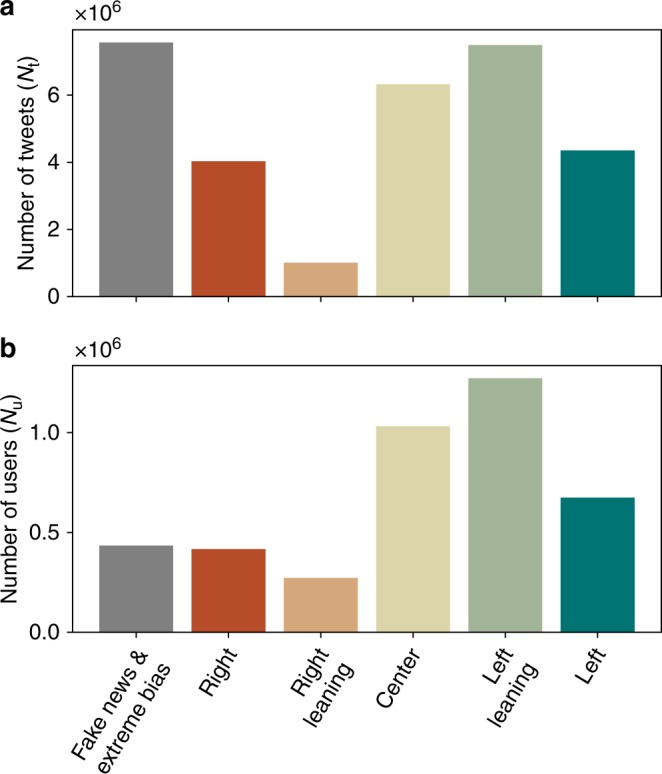
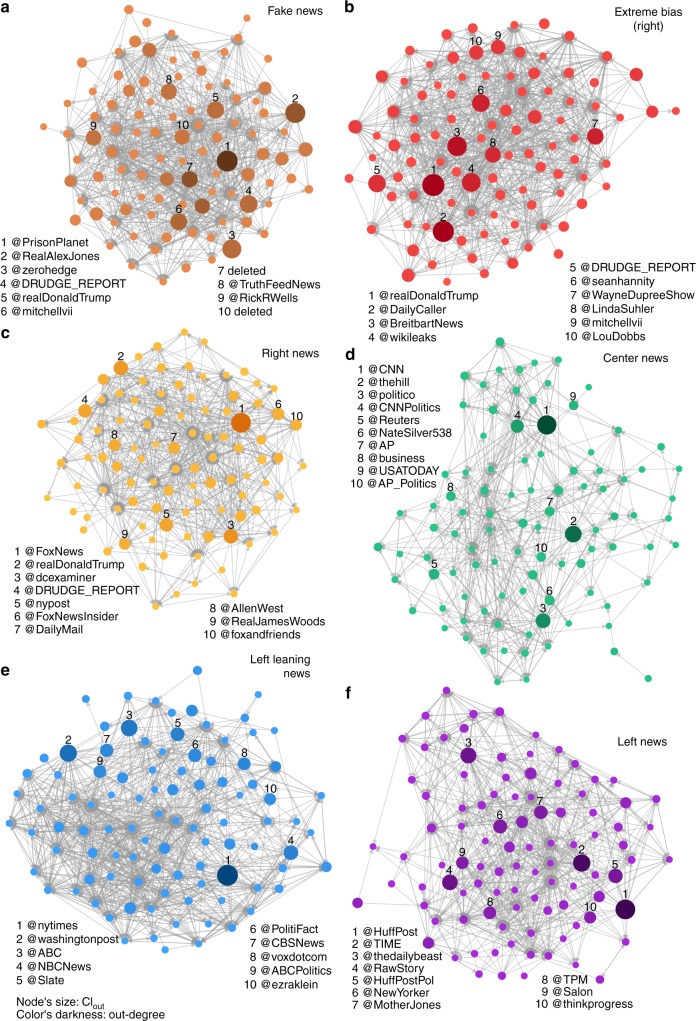
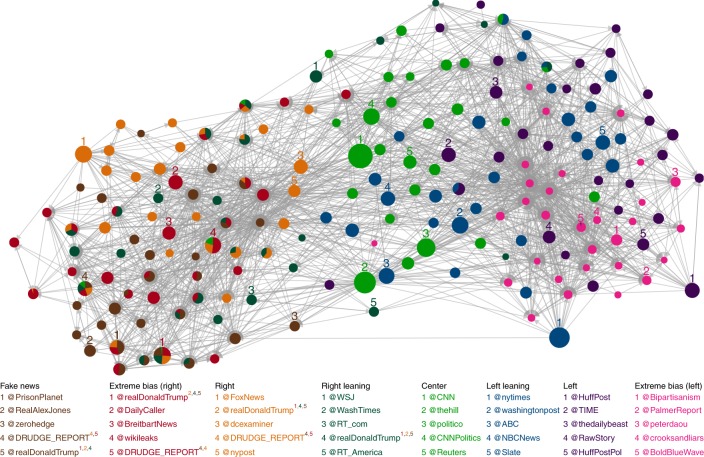
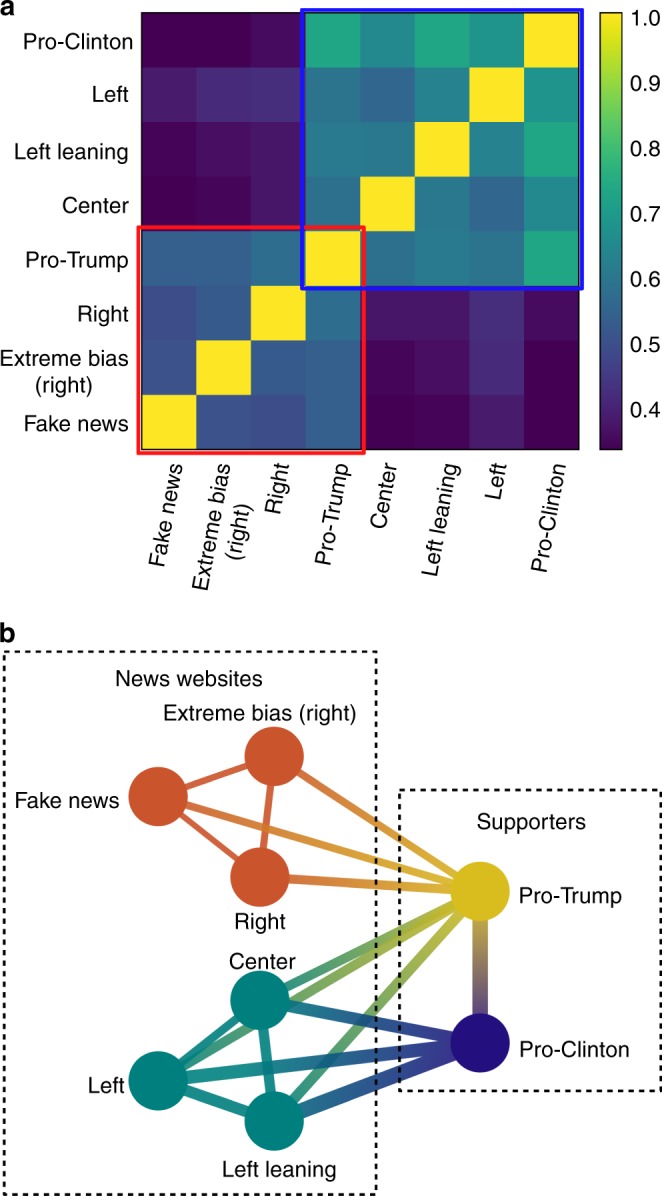
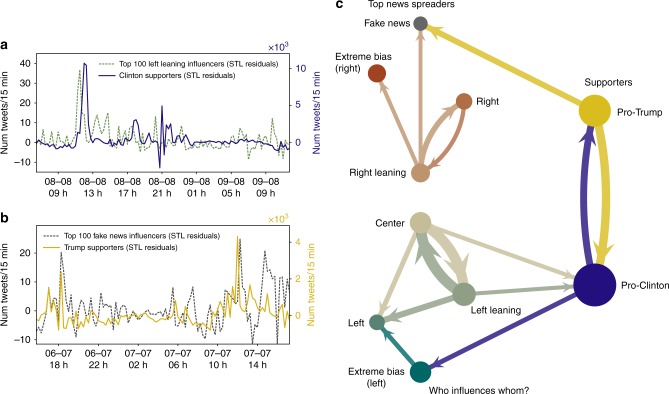
The dynamics and influence of fake news on Twitter during the 2016 US presidential election remains to be clarified. Here, we use a dataset of 171 million tweets in the five months preceding the election day to identify 30 million tweets, from 2.2 million users, which contain a link to news outlets. Based on a classification of news outlets curated by www.opensources.co , we find that 25% of these tweets spread either fake or extremely biased news. We characterize the networks of information flow to find the most influential spreaders of fake and traditional news and use causal modeling to uncover how fake news influenced the presidential election. We find that, while top influencers spreading traditional center and left leaning news largely influence the activity of Clinton supporters, this causality is reversed for the fake news: the activity of Trump supporters influences the dynamics of the top fake news spreaders.
Overview
The claims and statistics of this paper haven’t been checked yet.
Free: it reads the open-access text and checks the first 5 claims that cite a source we can check. Create a free account to check every claim.
Integrity signals
Registry
Cites
Statistics
Figures
Verification
Claims the paper makes
The claims and statistics of this paper haven’t been checked yet.
Free: it reads the open-access text and checks the first 5 claims that cite a source we can check. Create a free account to check every claim.
Claims other papers make about this one
Each is checked against this paper’s own text: does it say what the citing paper says it does?
The cited source says what the claim attributes to it.
In the citing paper
“Real and present concerns exist over the role of mis- and disinformation in public discourse (116–118), the emergence of echo chambers (119) and deepening political polarization (120, 121), in particular around big societal issues like climate change (122).”
From The benefits and dangers of anthropomorphic conversational agents (2025) · cites this paper as [117]
Self-check
Percentages, sums and reported differences re-computed from the paper’s own numbers.
The self-check needs the paper’s full text.
Citations
Cites
1 retracted
Limited individual attention and online virality of low-quality information
Qiu, X., F. M. Oliveira, D., Sahami Shirazi, A., Flammini, A., & Menczer, F. (2017) · Nature Human Behaviour · doi:10.1038/s41562-017-0132 · Cited by 180
RetractedControlling the False Discovery Rate: A Practical and Powerful Approach to Multiple Testing
Benjamini, Y., & Hochberg, Y. (1995) · Journal of the Royal Statistical Society Series B: Statistical Methodology · doi:10.1111/j.2517-6161.1995.tb02031.x · Cited by 109,482
Investigating causal relations by econometric models and cross-spectral methods
Granger, C. W. J. (1969) · Econometrica · doi:10.2307/1912791 · Cited by 22,989
The spread of true and false news online
Vosoughi, S., Roy, D., & Aral, S. (2018) · Science · doi:10.1126/science.aap9559 · Cited by 8,847
Causation, Prediction, and Search
Spirtes, P., Glymour, C., & Scheines, R. (2001) · doi:10.7551/mitpress/1754.001.0001 · Cited by 4,521
A New Status Index Derived from Sociometric Analysis
Katz, L. (1953) · Psychometrika · doi:10.1007/bf02289026 · Cited by 3,866
Exposure to ideologically diverse news and opinion on Facebook
Bakshy, E., Messing, S., & Adamic, L. A. (2015) · Science · doi:10.1126/science.aaa1160 · Cited by 3,245
The spreading of misinformation online
Del Vicario, M., Bessi, A., Zollo, F., Petroni, F., Scala, A., Caldarelli, G., Stanley, H. E., & Quattrociocchi, W. (2016) · Proceedings of the National Academy of Sciences · doi:10.1073/pnas.1517441113 · Cited by 2,407
Confirmation, disconfirmation, and information in hypothesis testing
Klayman, J., & Ha, Y.-W. (1987) · Psychological Review · doi:10.1037/0033-295x.94.2.211 · Cited by 2,094
Ferrara, E., Varol, O., Davis, C., Menczer, F., & Flammini, A. (2016) · Communications of the ACM · doi:10.1145/2818717 · Cited by 1,973
Research works printed but not linked: 2
- Howell L Digital wildfires in a hyperconnected world WEF Rep. 2013 3 15 94
- Cleveland RB Cleveland WS McRae JE Terpenning I STL: a seasonal-trend decomposition procedure based on loess J. Off. Stat. 1990 6 3 73
Cited by
Items 401–500 of 1,000
Hoax News Detection on Social Media: A Survey
Assiroj, P., Meyliana, M., Hidayanto, A. N., Prabowo, H., & Warnars, H. L. H. S. (2018) · Indonesian Association for Pattern Recognition International Conference (INAPR) · doi:10.1109/inapr.2018.8627053 · Cited by 18
A Survey on Event Tracking in Social Media Data Streams
Han, Z., Shi, L., Liu, L., Jiang, L., Fang, J., Lin, F., Zhang, J., Panneerselvam, J., & Antonopoulos, N. (2023) · Big Data Mining and Analytics · doi:10.26599/bdma.2023.9020021 · Cited by 18
People lie, actions Don't! Modeling infodemic proliferation predictors among social media users
Raj, C., & Meel, P. (2022) · Technology in Society · doi:10.1016/j.techsoc.2022.101930 · Cited by 18
Factorization of Fact-Checks for Low Resource Indian LanguagesPreprint
Singhal, S., Shah, R. R., & Kumaraguru, P. (2021) · arXiv (Cornell University) · doi:10.48550/arxiv.2102.11276 · Cited by 18
Stable quantum dots/polymer matrix and their versatile 3D printing frameworks
Xu, R., Qiao, C., Xia, M., Bai, B., Li, Y., Liu, J., Liu, J., Rong, H., Xu, M. K., & Zhang, J. (2021) · Journal of Materials Chemistry C · doi:10.1039/d1tc00861g · Cited by 18
Firdaus, N., Jumroni, J., Aziz, A., Sumartono, E., & Purwanti, A. (2024) · The journal of academic science. · doi:10.59613/x6akpn10 · Cited by 18
Identifying influential spreaders in reversible process
Qu, J., Tang, M., Liu, Y., & Guan, S. (2020) · Chaos Solitons & Fractals · doi:10.1016/j.chaos.2020.110197 · Cited by 18
Rumor detection on social networks focusing on endogenous psychological motivation
Yan, Y., Wang, Y., & Zheng, P. (2023) · Neurocomputing · doi:10.1016/j.neucom.2023.126548 · Cited by 17
Barrio, M. G., Carbonell-Alcocer, A., Arcos, R., Arribas, C. M., Linares, V. C., & Benítez-Aranda, N. (2024) · Open Research Europe · doi:10.12688/openreseurope.18180.2 · Cited by 18
Javed, D., Jhanjhi, N. Z., Khan, N. A., Ray, S. K., Al-Dhaqm, A., & Kebande, V. R. (2025) · IEEE Access · doi:10.1109/access.2025.3551993 · Cited by 17
Lepird, C. S., Ng, L. H. X., Wu, A., & Carley, K. M. (2024) · Social Media + Society · doi:10.1177/20563051241245950 · Cited by 17
The Diffusion of Mainstream and Disinformation News on Twitter: The Case of Italy and France
Pierri, F. (2020) · International World Wide Web Conference (WWW) · doi:10.1145/3366424.3385776 · Cited by 17
Reshaping the urban hierarchy: patterns of information diffusion on social media
Yang, J., Tsou, M., Janowicz, K., Clarke, K., & Jankowski, P. L. (2019) · Geo-spatial Information Science · doi:10.1080/10095020.2019.1641970 · Cited by 17
Так ли страшен фейк? Ложные новости и их роль в современном мире
Kazun, A. (2020) · Monitoring obŝestvennogo mneniâ: èkonomičeskie i socialʹnye peremeny · doi:10.14515/monitoring.2020.4.791 · Cited by 17
Terradillos, J. O., Morales-i-Gras, J., & Ureta, A. L. (2020) · Revista Mediterránea de Comunicación · doi:10.14198/medcom2020.11.2.2 · Cited by 17
Towards Explainable Fact CheckingPreprint
Augenstein, I. (2021) · arXiv (Cornell University) · doi:10.48550/arxiv.2108.10274 · Cited by 17
Uncovering the essence of diverse media biases from the semantic embedding space
Huang, H., Zhu, H., Liu, W., Gao, H., Jin, H., & Liu, B. (2024) · Humanities and Social Sciences Communications · doi:10.1057/s41599-024-03143-w · Cited by 17
Hou, L. (2022) · Physica A Statistical Mechanics and its Applications · doi:10.1016/j.physa.2022.126879 · Cited by 17
Huang, Y.-H., Liu, T., Lee, S.-R., Alvarado, F. H. C., & Chen, Y.-S. (2020) · International World Wide Web Conference (WWW) · doi:10.1145/3366423.3380158 · Cited by 17
Social bots: detection and challenges
Yang, K.-C., Varol, O., Nwala, A. C., Sayyadiharikandeh, M., Ferrara, E., Flammini, A., & Menczer, F. (2025) · Edward Elgar Publishing eBooks · doi:10.4337/9781802207309.00049 · Cited by 18
Aletheia: A Fake News Detection System for Hindi
Badam, J., Bonagiri, A., Raju, K., & Chakraborty, D. (2022) · Joint International Conference on Data Science & Management of Data (CODS-COMAD) · doi:10.1145/3493700.3493736 · Cited by 17
Political Elites in the Attention Economy: Visibility Over Civility and Credibility?
Biswas, A., Lin, Y., Tai, Y. C., & Desmarais, B. A. (2025) · Proceedings of the International AAAI Conference on Web and Social Media · doi:10.1609/icwsm.v19i1.35814 · Cited by 17
Jóvenes y fake news. Un análisis sociodemográfico aplicado al caso andaluz
Calderón, B. J. G., Córdoba-Cabús, A., & Nieto, A. M. (2020) · IC Revista Científica de Información y Comunicación · doi:10.12795/ic.2020.i17.21 · Cited by 19
Yen, C.-C., Ghosal, D., Zhang, M., & Chuah, C. (2021) · IEEE Transactions on Intelligent Transportation Systems · doi:10.1109/tits.2021.3056658 · Cited by 19
Hannan, A. (2023) · Politea Jurnal Politik Islam · doi:10.20414/politea.v6i1.7252 · Cited by 17
Affective and interactional polarization align across countriesPreprint
Falkenberg, M., Zollo, F., Quattrociocchi, W., Pfeffer, J., & Baronchelli, A. (2023) · PsyArXiv (OSF Preprints) · doi:10.31234/osf.io/ngsb6 · Cited by 16
Hate-sharing: A case study of its prevalence and impact on Gab
Weigel, M., & Gitomer, A. (2024) · New Media & Society · doi:10.1177/14614448241245349 · Cited by 16
Analyzing the changing landscape of the Covid-19 vaccine debate on Twitter
Santoro, A., Galeazzi, A., Scantamburlo, T., Baronchelli, A., Quattrociocchi, W., & Zollo, F. (2023) · Social Network Analysis and Mining · doi:10.1007/s13278-023-01127-3 · Cited by 16
Fake news and its electoral consequences: a survey experiment on Mexico
Iida, T., Song, J., Rodríguez, J. L. E., & Takahashi, Y. (2022) · AI & Society · doi:10.1007/s00146-022-01541-9 · Cited by 32
GS2F: Multimodal Fake News Detection Utilizing Graph Structure and Guided Semantic Fusion
Zhou, D. M., Ouyang, Q., Lin, N., Zhou, Y., & Yang, A. (2025) · ACM Transactions on Asian and Low-Resource Language Information Processing · doi:10.1145/3708536 · Cited by 16
Trust and Believe - Should We? Evaluating the Trustworthiness of Twitter Users
Khan, T., & Michalas, A. (2020) · IEEE International Conference on Trust, Security and Privacy in Computing and Communications (TrustCom) · doi:10.1109/trustcom50675.2020.00246 · Cited by 16
Fake news, technology and ethics: Can AI and blockchains restore integrity?
Lacity, M. C. (2021) · Journal of Information Technology Teaching Cases · doi:10.1177/2043886921999065 · Cited by 16
Supervised Sentiment Analysis of Twitter Handle of President Trump with Data Visualization Technique
Sahu, K., Bai, Y. D., & Choi, Y. (2020) · IEEE Annual Computing and Communication Workshop and Conference (CCWC) · doi:10.1109/ccwc47524.2020.9031237 · Cited by 16
Seeing and Believing: Evaluating the Trustworthiness of Twitter Users
Khan, T., & Michalas, A. (2021) · IEEE Access · doi:10.1109/access.2021.3098470 · Cited by 16
Zhang, X., Rui, G., Xu, Y., Zhang, F., Du, Y., Lin, X., Wang, A., & Zhao, W. S. (2020) · Optics Letters · doi:10.1364/ol.389376 · Cited by 16
Dhanawade, R. N., Pawar, N. S., Chougule, M. A., Hingangavkar, G. M., Nimbalkar, T. M., Chavan, G. T., Jeon, C., & Patil, V. B. (2023) · ChemistrySelect · doi:10.1002/slct.202204750 · Cited by 16
Postmortem memory of public figures in news and social media
West, R., Leskovec, J., & Potts, C. (2021) · Proceedings of the National Academy of Sciences · doi:10.1073/pnas.2106152118 · Cited by 15
“One of the key contributions of this study is the comparison between mainstream news and Twitter—a prominent social media platform—on a fixed set of attention subjects, thus extending a rich literature on the interplay between the two media [21, 5, 63, 32].”
BackgroundFake News Detection on Social Media: A Temporal-Based Approach
Jang, Y., Park, C.-H., Lee, D., & Seo, Y. (2021) · Computers, materials & continua/Computers, materials & continua (Print) · doi:10.32604/cmc.2021.018901 · Cited by 16
Fenomena Partisipasi Masyarakat Kota Bandung dalam Pemilihan Presiden 2024 Melalui Media Tiktok
Kandias, M. R. N., & Karniawati, N. (2024) · Jurnal Politik dan Pemerintahan Daerah · doi:10.36355/jppd.v6i1.140 · Cited by 15
Trolls, Pressure and Agenda: The discursive fight on Twitter in Turkey
Baloğlu, U. (2021) · Media and Communication · doi:10.17645/mac.v9i4.4213 · Cited by 15
Lee, C. J., & Chua, H. N. (2021) · Lecture notes in networks and systems · doi:10.1007/978-981-16-5120-5_54 · Cited by 15
Fu, Z., Wang, K., Xin, W., Zhou, L., Chen, S., Ge, Y., Janies, D. A., & Zhang, D. (2024) · arXiv (Cornell University) · doi:10.48550/arxiv.2409.00022 · Cited by 15
Rachmawati, I., Kuncoro, H. R., Sari, D. L., & Tahalea, S. P. (2024) · Advances in Social Science, Education and Humanities Research/Advances in social science, education and humanities research · doi:10.2991/978-2-38476-247-7_57 · Cited by 15
Switchable terahertz chiral metasurface for linear and circular dichroism
Zhuang, L., Liu, J., Jiang, Z., Ge, Z., Ren, H. J., Cheng, B. H., Wei, X., & Song, G. (2025) · Optics Express · doi:10.1364/oe.559294 · Cited by 15
Tang, H., Sun, S., Nie, K., Li, A., Sergeeva, A., & Lc, R. (2025) · Proceedings of the ACM on Human-Computer Interaction · doi:10.1145/3748600 · Cited by 14
Exploring the Role of Emotions in Arabic Rumor Detection in Social Media
Al-Saif, H. F., & Al-Dossari, H. Z. (2023) · Applied Sciences · doi:10.3390/app13158815 · Cited by 14
A Survey on Fake News Detection in Social Media Using Graph Neural Networks
Mahdi, A. S., & Shati, N. M. (2024) · Journal of Al-Qadisiyah for Computer Science and Mathematics · doi:10.29304/jqcsm.2024.16.21539 · Cited by 14
Post-hoc Evaluation of Nodes Influence in Information Cascades: The Case of Coordinated Accounts
Marco, N. D., Brunetti, S., Cinelli, M., & Quattrociocchi, W. (2025) · ACM Transactions on the Web · doi:10.1145/3700644 · Cited by 14
A behavioural analysis of credulous Twitter users
Balestrucci, A., Nicola, R. D., Petrocchi, M., & Trubiani, C. (2021) · Online Social Networks and Media · doi:10.1016/j.osnem.2021.100133 · Cited by 14
Opinion Dynamic Modeling of News Perception
Milli, L. (2021) · Applied Network Science · doi:10.1007/s41109-021-00412-4 · Cited by 14
Understanding Reactions to Natural Disasters: a Text Mining Approach to Analyze Social Media Content
Razavi, S. Z., & Rahbari, M. (2020) · International Conference on Social Networks Analysis, Management and Security (SNAMS) · doi:10.1109/snams52053.2020.9336570 · Cited by 14
Fake news no WhatsApp: um estudo da percepção dos efeitos em terceiros
Lemos, A., & Oliveira, F. (2020) · Comunicação & Sociedade · doi:10.15603/2175-7755/cs.v42n1p193-227 · Cited by 15
Busioc, C., Dumitru, V. C., Ruşeţi, Ş., Terian-Dan, S., Dascălu, M., & Rebedea, T. E. (2021) · Smart innovation, systems and technologies · doi:10.1007/978-981-16-3930-2_16 · Cited by 14
Election Fraud and Misinformation on Twitter: Author, Cluster, and Message Antecedents
Chiu, M. M., Park, C. H., Lee, H., Oh, Y. W., & Kim, J. (2022) · Media and Communication · doi:10.17645/mac.v10i2.5168 · Cited by 14
CoVaxxy: A global collection of English Twitter posts about COVID-19 vaccines
DeVerna, M., Pierri, F., Truong, B. T., Bollenbacher, J., Axelrod, D., Loynes, N., Torres-Lugo, C., Yang, K.-C., Menczer, F., & Bryden, J. (2021) · Europe PMC (PubMed Central) · Cited by 14
Cross-lingual Transfer Learning for Fake News Detector in a Low-Resource LanguagePreprint
Han, S. (2022) · arXiv (Cornell University) · doi:10.48550/arxiv.2208.12482 · Cited by 14
Few-shot fake news detection via prompt-based tuning
Gao, W., Ni, M., Deng, H., Zhu, X., Zeng, P., & Hu, X. (2023) · Journal of Intelligent & Fuzzy Systems · doi:10.3233/jifs-221647 · Cited by 14
COVID-19 and Misinformation: A Large-Scale Lexical Analysis on Twitter
Antypas, D., Camacho-Collados, J., Preece, A. D., & Rogers, D. (2021) · doi:10.18653/v1/2021.acl-srw.13 · Cited by 14
Characterization of polarized scientific digital messages: a scoping review
Jucá, A. M., Lotto, M., Cruvinel, A. F. P., & Cruvinel, T. (2024) · Journal of Science Communication · doi:10.22323/2.23080201 · Cited by 14
Qu, J., Tang, M., Liu, Y., & Guan, S. (2021) · Frontiers of Physics · doi:10.1007/s11467-021-1082-9 · Cited by 14
Conspiracy Theories, Radicalisation and Digital Media
Allington, D. (2021) · Research Portal (King's College London) · Cited by 14
The 2019 Indonesian Presidential Election: Propaganda in Post-Truth Era
Aminulloh, A., Artaria, M. D., Surya, Y. W. I., & Zajączkowski, K. (2021) · Nyimak Journal of Communication · doi:10.31000/nyimak.v5i1.3882 · Cited by 14
Mapping the global election landscape on social media in 2024
Pecile, G., Marco, N. D., Cinelli, M., & Quattrociocchi, W. (2025) · PLoS ONE · doi:10.1371/journal.pone.0316271 · Cited by 13
#MakeSwedenGreatAgain: Media events as politics in the deterritorialised nationalism debate
Robinson, J. Y., & Enli, G. S. (2022) · Nordic Journal of Media Studies · doi:10.2478/njms-2022-0004 · Cited by 13
Generalized Local Prominence for Source Detection in Real-World Rumor Networks
Ali, S. S., Rastogi, A., Anwar, T., Rizvi, S. A. M., Yang, J., Wu, J. X., & Sheng, Q. Z. (2025) · IEEE Transactions on Knowledge and Data Engineering · doi:10.1109/tkde.2025.3567282 · Cited by 13
The Impact of Deepfakes on Elections and Methods of Combating Disinformation in the Virtual World
Michałkiewicz-Kądziela, E. (2024) · Teka Komisji Prawniczej PAN Oddział w Lublinie · doi:10.32084/tkp.8615 · Cited by 13
Quantum Social Computing Approaches for Influence Maximization
Dinh, T. N., Nguyen, A. N., Nguyen, U., & Nguyen, V. G. (2022) · Globecom · doi:10.1109/globecom48099.2022.10000698 · Cited by 13
Social Identity Theory and Algorithmic Bias: Ingroup and Outgroup Acrophily in Recommender Systems
Carrasco-Farré, C., Grimaldi, D., Torrens, M., & Longobuco, E. (2025) · Journal of Management Information Systems · doi:10.1080/07421222.2025.2561382 · Cited by 13
Finn, P. (2019) · Perspectives of the ASHA Special Interest Groups · doi:10.1044/2019_pers-st-2019-0001 · Cited by 13
Fake News Shared on WhatsApp During Covid-19: An Analysis of Groups and Statuses in Pakistan
Ahmed, M., Riaz, M. Q., Qamar, M., & Asghar, R. (2021) · Mediaobrazovanie · doi:10.13187/me.2021.1.4 · Cited by 13
Vasist, P. N., & Sebastian, M. P. (2022) · International Journal of Information Management Data Insights · doi:10.1016/j.jjimei.2022.100133 · Cited by 13
Exploring Author Profiling for Fake News Detection
Rathod, S. (2022) · IEEE Annual International Computer Software and Applications Conference (COMPSAC) · doi:10.1109/compsac54236.2022.00256 · Cited by 13
Crude, anonymous, partisan, sectoral and anti-elitist. Electoral disinformation in Spain (2019-2022)
Santos, D. L., Gamir-Ríos, J., & Abad, G. L. (2023) · El Profesional de la Informacion · doi:10.3145/epi.2023.sep.06 · Cited by 13
Feature Drift in Fake News Detection: An Interpretable Analysis
Fu, C., Pan, X., Liang, X., Yu, S., Xu, X.-K., & Min, Y. (2023) · Applied Sciences · doi:10.3390/app13010592 · Cited by 13
XAI in Automated Fact-Checking? The Benefits Are Modest and There's No One-Explanation-Fits-All
Lim, G., & Perrault, S. T. (2023) · Australian Conference on Computer-Human Interaction (OzCHI) · doi:10.1145/3638380.3638388 · Cited by 13
ElectionRumors2022: A Dataset of Election Rumors on Twitter During the 2022 U.S. Midterms
Schafer, J. S., Duskin, K., Prochaska, S., Wack, M., Beers, A., Bozarth, L., Agajanian, T., Caulfield, M., Spiro, E. S., & Starbird, K. (2025) · Journal of Quantitative Description Digital Media · doi:10.51685/jqd.2025.002 · Cited by 13
Cox, L. T. J., & Piatkowski, T. M. (2024) · Performance Enhancement & Health · doi:10.1016/j.peh.2024.100289 · Cited by 14
Classification of Hoax/Non-Hoax News Articles on Social Media using an Effective Deep Neural Network
Kaliyar, R. K., Fitwe, K., Rajarajeswari, P., & Goswami, A. (2021) · International Conference on Computing Methodologies and Communication (ICCMC) · doi:10.1109/iccmc51019.2021.9418282 · Cited by 13
Characterizing and Detecting Propaganda-Spreading Accounts on TelegramPreprint
Kireev, K., Mykhno, Y., Troncoso, C., & Overdorf, R. (2024) · arXiv (Cornell University) · doi:10.48550/arxiv.2406.08084 · Cited by 13
Nutakki, B., Navarrete, R. M., Carteny, G., & Weber, I. G. (2025) · Journal of Quantitative Description Digital Media · doi:10.51685/jqd.2025.004 · Cited by 13
A Real-Time System for Credibility on Twitter.
Iftene, A., Gîfu, D., Miron, A.-R., & Dudu, M.-Ș. (2020) · Language Resources and Evaluation · Cited by 13
Political communication in post-truth society: The case of the 2016 US election
Gorenc, N. (2020) · Ars & Humanitas · doi:10.4312/ars.14.1.73-87 · Cited by 13
Modelling election dynamics and the impact of disinformation
Brody, D. C. (2019) · Information Geometry · doi:10.1007/s41884-019-00021-2 · Cited by 13
The role of narcissism and motivated reasoning on misinformation propagation
Haupt, M. R., Cuomo, R. E., Mackey, T. K., & Coulson, S. (2024) · Frontiers in Communication · doi:10.3389/fcomm.2024.1472631 · Cited by 12
Online disinformation in the 2020 U.S. election: swing vs. safe states
Pratelli, M., Petrocchi, M., Saracco, F., & Nicola, R. D. (2024) · EPJ Data Science · doi:10.1140/epjds/s13688-024-00461-6 · Cited by 12
Guo, W., Zhang, M., Xue, Z., Chu, P. K.-H., Mei, Y., Tian, Z., & Di, Z. (2023) · Advanced Materials Interfaces · doi:10.1002/admi.202300482 · Cited by 12
The influence of coordinated behavior on toxicity
Loru, E., Cinelli, M., Tesconi, M., & Quattrociocchi, W. (2024) · Online Social Networks and Media · doi:10.1016/j.osnem.2024.100289 · Cited by 12
Peterson‐Salahuddin, C. (2024) · Journal of the Association for Information Science and Technology · doi:10.1002/asi.24879 · Cited by 12
Noise, Fake News, and Tenacious Bayesians
Brody, D. C. (2022) · Frontiers in Psychology · doi:10.3389/fpsyg.2022.797904 · Cited by 12
Analysing centralities for organisational role inference in online social networks
Sánchez, R., Bilbao-Jayo, A., Zulaika, U., & Almeida, A. (2020) · Engineering Applications of Artificial Intelligence · doi:10.1016/j.engappai.2020.104129 · Cited by 12
Do You Really Follow Them? Automatic Detection of Credulous Twitter Users
Balestrucci, A., Nicola, R. D., Petrocchi, M., & Trubiani, C. (2019) · Lecture notes in computer science · doi:10.1007/978-3-030-33607-3_44 · Cited by 12
Uyheng, J., & Carley, K. M. (2021) · Proceedings of the International AAAI Conference on Web and Social Media · doi:10.1609/icwsm.v15i1.18098 · Cited by 13
Sinophobia was popular in Chinese language communities on Twitter during the early COVID-19 pandemic
Zhang, Y., Lin, H., Wang, Y., & Fan, X. (2023) · Humanities and Social Sciences Communications · doi:10.1057/s41599-023-01959-6 · Cited by 12
McHugh, P. J., & Perrault, E. (2022) · Cogent Social Sciences · doi:10.1080/23311886.2022.2135236 · Cited by 14
Straub, J., Spradling, M., & Fedor, B. (2022) · Societies · doi:10.3390/soc12020061 · Cited by 12
Park, C. S. (2023) · Journalism Studies · doi:10.1080/1461670x.2023.2289878 · Cited by 12
Automatic Fake News Detection: Are current models “fact-checking” or“gut-checking”?
Kelk, I., Basseri, B., Lee, W., Qiu, R., & Tanner, C. (2022) · Fact Extraction and VERification Workshop (FEVER) · doi:10.18653/v1/2022.fever-1.4 · Cited by 12
Matos, Á. B., Arteaga, F., Baldi, V., Paisana, M., Crespo, M., Cardoso, G., Rementeria, M. J., Philippe, O., Calvo, B., Buslón, N., et al. (2023) · doi:10.15581/026.002 · Cited by 13
Aguerri, J. C., & Llinares, F. M. (2022) · IDP Revista de Internet Derecho y Política · doi:10.7238/idp.v0i37.397192 · Cited by 13
MD-MBPLS: A novel explanatory model in computational social science
Lu, S., Zhao, J., & Wang, H. (2021) · Knowledge-Based Systems · doi:10.1016/j.knosys.2021.107023 · Cited by 13
Metadata
- Authors
- Bovet, A., & Makse, H. A.
- Affiliations
- City College of New York (US)
- Corresponding author
- Makse, Hernán A.
- Venue
- Nature Communications
- Published
- 2019-01-02
- Volume
- 10
- Issue
- 1
- Pages
- 7-7
- ISSN
- 2041-1723 (ISSN-L)
- PMC
- PMC6315042
- OpenAlex
- W2792307011
- Cited by
- 701
- References
- 40
- Citations by year
- 2026: 38 · 2025: 106 · 2024: 114 · 2023: 105 · 2022: 109 · 2021: 114 · 2020: 86 · 2019: 28
- FWCI
- 130.25
- Type
- journal article
- Language
- en
- Open access
- gold
- doi.org
- Licence
- cc-by
- creativecommons.org/licenses/by/4.0 (tdm)
- creativecommons.org/licenses/by/4.0 (vor)
- Locations
- Nature Communications (publishedVersion, cc-by)
- Europe PMC (PubMed Central) (publishedVersion, other-oa)
- PubMed Central (publishedVersion, cc-by)
- PubMed (publishedVersion)
- Repository of the University of Namur (publishedVersion, cc-by)
- arXiv (Cornell University) (submittedVersion)
- RePEc: Research Papers in Economics (submittedVersion)
- DOAJ (DOAJ: Directory of Open Access Journals) (submittedVersion)
- DOAJ (DOAJ: Directory of Open Access Journals) (submittedVersion, cc-by-sa)
- arXiv (Cornell University) (cc-by)
- Funders
- National Science Foundation
- Schweizerischer Nationalfonds zur Förderung der Wissenschaftlichen Forschung (165158)
- Topics
- Social Sciences › Sociology and Political Science › Misinformation and Its Impacts
- Physical Sciences › Physics and Astronomy › Statistical and Nonlinear Physics › Complex Network Analysis Techniques
- Social Sciences › Communication › Social Media and Politics
- Keywords
- fake news, 2016 US presidential election, Twitter, information dissemination, influential spreaders, election influence, Trump supporters, social media misinformation
About these checks
Registry, retraction, Cites and statistics results are computed, not judged, with one exception: a printed reference that no index lists is read once by a model before it counts as a citation error. Claims are extracted by a model and kept only when their quote appears verbatim in the text; each cited source is then checked, with a model’s help, for whether it says what the claim relies on. Those verdicts can be wrong — read the claim’s quote and the cited source before relying on one.
Statistics and arithmetic are recomputed, not judged.
Confidence bands are shown only for fields calibrated on our annotated test set. None is calibrated yet, so no band is shown.
What counts as a claim ›How we measure confidence ›How we check this ›
Are you an author, or do you see a problem with this page? Request a review
Data sources
Bibliographic data: Semantic Scholar, OpenAlex, Crossref.
Contains information from the Semantic Scholar Academic Graph Datasets, made available under the ODC Attribution License (ODC-BY 1.0).
Semantic Scholar’s data is described in: Kinney, R., et al. (2023). The Semantic Scholar Open Data Platform. arXiv:2301.10140.
