

Influence of fake news in Twitter during the 2016 US presidential election
Open accessThe DOI matches its Crossref record; 44 of the 44 references it cites were found in a registry or an index.
Abstract
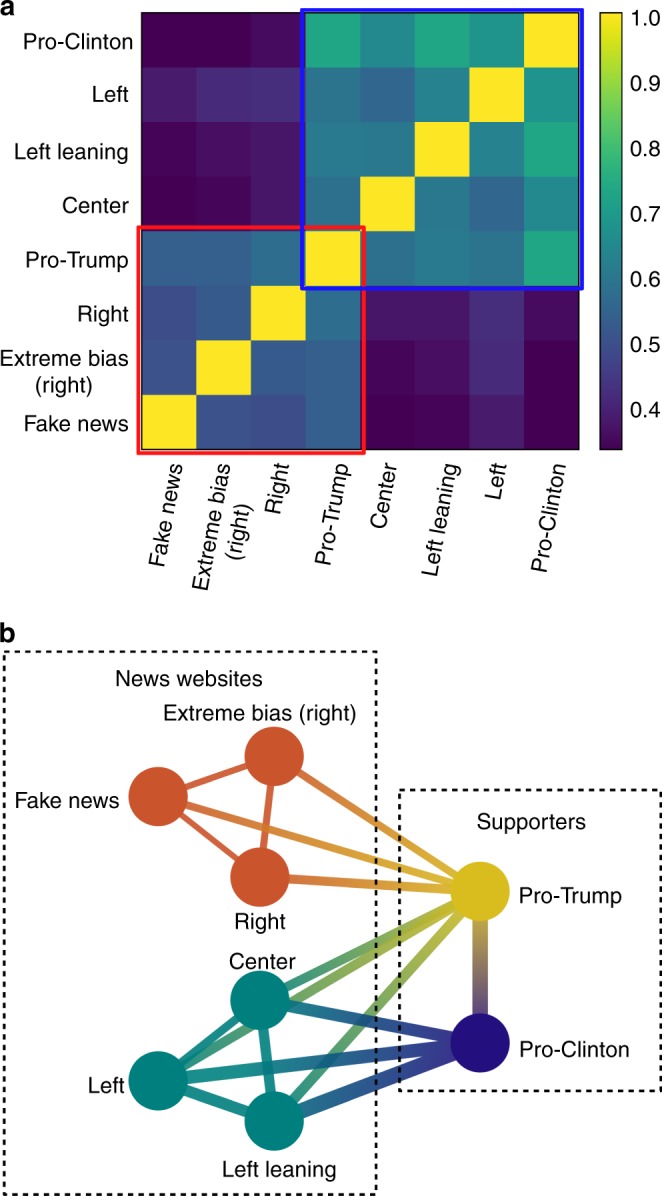
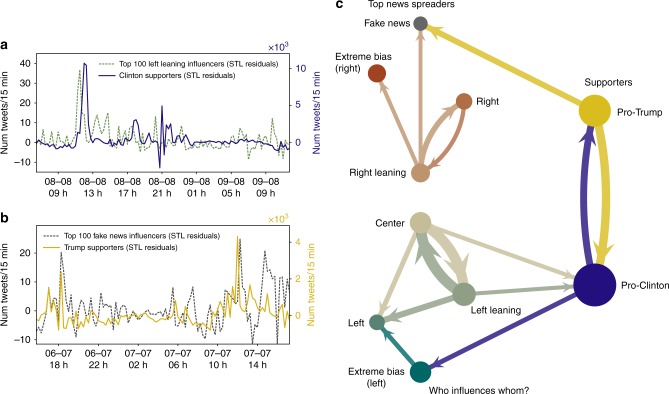
The dynamics and influence of fake news on Twitter during the 2016 US presidential election remains to be clarified. Here, we use a dataset of 171 million tweets in the five months preceding the election day to identify 30 million tweets, from 2.2 million users, which contain a link to news outlets. Based on a classification of news outlets curated by www.opensources.co , we find that 25% of these tweets spread either fake or extremely biased news. We characterize the networks of information flow to find the most influential spreaders of fake and traditional news and use causal modeling to uncover how fake news influenced the presidential election. We find that, while top influencers spreading traditional center and left leaning news largely influence the activity of Clinton supporters, this causality is reversed for the fake news: the activity of Trump supporters influences the dynamics of the top fake news spreaders.
Overview
The claims and statistics of this paper haven’t been checked yet.
Free: it reads the open-access text and checks the first 5 claims that cite a source we can check. Create a free account to check every claim.
Integrity signals
Registry
Cites
Statistics
Figures
Verification
Claims the paper makes
The claims and statistics of this paper haven’t been checked yet.
Free: it reads the open-access text and checks the first 5 claims that cite a source we can check. Create a free account to check every claim.
Claims other papers make about this one
Each is checked against this paper’s own text: does it say what the citing paper says it does?
The cited source says what the claim attributes to it.
In the citing paper
“Real and present concerns exist over the role of mis- and disinformation in public discourse (116–118), the emergence of echo chambers (119) and deepening political polarization (120, 121), in particular around big societal issues like climate change (122).”
From The benefits and dangers of anthropomorphic conversational agents (2025) · cites this paper as [117]
Self-check
Percentages, sums and reported differences re-computed from the paper’s own numbers.
The self-check needs the paper’s full text.
Citations
Cites
1 retracted
Limited individual attention and online virality of low-quality information
Qiu, X., F. M. Oliveira, D., Sahami Shirazi, A., Flammini, A., & Menczer, F. (2017) · Nature Human Behaviour · doi:10.1038/s41562-017-0132 · Cited by 180
RetractedControlling the False Discovery Rate: A Practical and Powerful Approach to Multiple Testing
Benjamini, Y., & Hochberg, Y. (1995) · Journal of the Royal Statistical Society Series B: Statistical Methodology · doi:10.1111/j.2517-6161.1995.tb02031.x · Cited by 109,482
Investigating causal relations by econometric models and cross-spectral methods
Granger, C. W. J. (1969) · Econometrica · doi:10.2307/1912791 · Cited by 22,989
The spread of true and false news online
Vosoughi, S., Roy, D., & Aral, S. (2018) · Science · doi:10.1126/science.aap9559 · Cited by 8,847
Causation, Prediction, and Search
Spirtes, P., Glymour, C., & Scheines, R. (2001) · doi:10.7551/mitpress/1754.001.0001 · Cited by 4,521
A New Status Index Derived from Sociometric Analysis
Katz, L. (1953) · Psychometrika · doi:10.1007/bf02289026 · Cited by 3,866
Exposure to ideologically diverse news and opinion on Facebook
Bakshy, E., Messing, S., & Adamic, L. A. (2015) · Science · doi:10.1126/science.aaa1160 · Cited by 3,245
The spreading of misinformation online
Del Vicario, M., Bessi, A., Zollo, F., Petroni, F., Scala, A., Caldarelli, G., Stanley, H. E., & Quattrociocchi, W. (2016) · Proceedings of the National Academy of Sciences · doi:10.1073/pnas.1517441113 · Cited by 2,407
Confirmation, disconfirmation, and information in hypothesis testing
Klayman, J., & Ha, Y.-W. (1987) · Psychological Review · doi:10.1037/0033-295x.94.2.211 · Cited by 2,094
Ferrara, E., Varol, O., Davis, C., Menczer, F., & Flammini, A. (2016) · Communications of the ACM · doi:10.1145/2818717 · Cited by 1,973
Research works printed but not linked: 2
- Howell L Digital wildfires in a hyperconnected world WEF Rep. 2013 3 15 94
- Cleveland RB Cleveland WS McRae JE Terpenning I STL: a seasonal-trend decomposition procedure based on loess J. Off. Stat. 1990 6 3 73
Cited by
Items 701–800 of 1,000
Dhall, S., Kumar, S. S., & Kumar, S. (2025) · SN Computer Science · doi:10.1007/s42979-025-04240-6 · Cited by 5
Do markets pay attention to political disinformation?
Hartwell, C. A., & Hubschmid-Vierheilig, E. (2024) · Finance research letters · doi:10.1016/j.frl.2024.106366 · Cited by 5
Alkomah, B., & Sheldon, F. T. (2023) · International Conference on Computational Science and Computational Intelligence (CSCI) · doi:10.1109/csci62032.2023.00142 · Cited by 5
Zhu, Y., Bowen, S. A., & Lyu, X. (2022) · International Journal of Strategic Communication · doi:10.1080/1553118x.2021.2014499 · Cited by 5
Khan, M. L. (2025) · Oxford University Press eBooks · doi:10.1093/oso/9780197814222.003.0007 · Cited by 5
Salamanos, N., Jensen, M. J., Iordanou, C., & Sirivianos, M. (2023) · Lecture notes in computer science · doi:10.1007/978-981-99-5177-2_4 · Cited by 5
A Socio-Behavioral Approach to Understanding the Spread of Disinformation
Lee, E. H., & Lee, T. (2021) · Asian Communication Research · doi:10.20879/acr.2021.18.3.168 · Cited by 5
Aghajari, Z. (2023) · ACM Conference on Computer Supported Cooperative Work (CSCW) · doi:10.1145/3584931.3608915 · Cited by 5
Bots against Bias: Critical Next Steps for Human–Robot Interaction*
Seaborn, K. (2024) · Cambridge University Press eBooks · doi:10.1017/9781009386708.023 · Cited by 5
Detecção Automática de Desinformação em Diferentes Cenários: Eleições nos Estados Unidos e no Brasil
Reis, J. C. S., & Benevenuto, F. (2022) · Anais do Brazilian Workshop on Social Network Analysis and Mining (BraSNAM) · doi:10.5753/brasnam.2022.225908 · Cited by 5
Feature analysis of fake news: improving fake news detection in social media
Leung, J., Vatsalan, D., & Arachchilage, N. A. G. (2023) · Journal of Cyber Security Technology · doi:10.1080/23742917.2023.2237206 · Cited by 5
Temporal propagating network approach to long-term evolutionary process of public opinion
Cai, S., Liu, P., & Huang, P. (2021) · International Journal of Modern Physics C · doi:10.1142/s0129183121500480 · Cited by 5
Mutlu, E. Ç., & Garibay, I. I. (2021) · Springer proceedings in complexity · doi:10.1007/978-3-030-77517-9_7 · Cited by 5
Melo, J. D. M., Uribe, J. F. P., Gómez, L. M., & Pardo, A. C. (2023) · Democracias · doi:10.54887/27376192.74 · Cited by 6
The Times They Are A-Changin’: Characterizing Post-Publication Changes to Online News
Tsoukaladelis, C., Kondracki, B., Balasubramanian, N., & Nikiforakis, N. (2024) · IEEE Symposium on Security and Privacy (S&P) · doi:10.1109/sp54263.2024.00033 · Cited by 5
Identificação de “Fake News” no contexto político brasileiro: uma abordagem computacional
de Almeida, L. D., Fuzaro, V., Nieto, F. V., & Santana, A. L. M. (2021) · doi:10.5753/wics.2021.15966 · Cited by 5
Identifying Behavioral Factors Leading to Differential Polarization Effects of Adversarial Botnets
Lee, Y., Özer, M., Corman, S. R., & Davulcu, H. (2023) · ACM SIGAPP Applied Computing Review · doi:10.1145/3610409.3610412 · Cited by 5
Detecting Misinformation: Identifying False News Spread by Political Leaders in the Global South
Pereira, F. B., Bueno, N., Nunes, F., Pavão, N. D. C., dos Santos, J. ̃. P. O., & Wirtschafter, V. (2024) · Journal of Quantitative Description Digital Media · doi:10.51685/jqd.2024.007 · Cited by 5
Unbiased evaluation of ranking algorithms applied to the Chinese green patents citation network
Liu, X., & Li, X. (2024) · Scientometrics · doi:10.1007/s11192-024-05023-1 · Cited by 5
Porto, R. B., Júnior, A. F. D. M., Aragão, L. M., & Borges, C. P. (2021) · ReMark - Revista Brasileira de Marketing · doi:10.5585/remark.v20i4.18570 · Cited by 5
Fake news and Nigeria’s 2019 presidential election
Omotola, J. S. (2024) · Politikon · doi:10.1080/02589346.2024.2428881 · Cited by 5
Insights from Tweets: Analysing Destination Topics and Sentiments, and Predicting Tourist Arrivals
LI, Y. (2023) · Durham e-Theses (Durham University) · Cited by 5
Jiang, Y., & Porter, M. D. (2026) · Social Network Analysis and Mining · doi:10.1007/s13278-025-01575-z · Cited by 5
FAKE NEWS E SUAS ABORDAGENS NO BRASIL: Balanço de uma agenda de pesquisa em formação
Schlegel, R., & Freitas, A. (2021) · Confluências | Revista Interdisciplinar de Sociologia e Direito · doi:10.22409/conflu.v23i3.44497 · Cited by 5
News, Media, and Communication in a Polarized World: A Spanish perspective
Palau-Sampio, D., & García, G. L. (2025) · SpringerBriefs in political science · doi:10.1007/978-3-031-86620-3 · Cited by 5
A Framework for Enhancing Social Media Misinformation Detection with Topical-Tactics
Bagozzi, B. E., Goel, R., de Fabritz, B. A. L., Cummings, K. K., & Balasubramanian, K. (2024) · Digital Threats Research and Practice · doi:10.1145/3670694 · Cited by 5
Chakraborty, S., Castro-González, L., Margetts, H. Z., Rajpal, H., Guariso, D., & Bright, J. (2024) · arXiv (Cornell University) · doi:10.48550/arxiv.2402.08765 · Cited by 5
Raising guardrails: The role of the political commentator in a post-expert age
Williams, P. D. (2020) · Queensland Review · doi:10.1017/qre.2020.7 · Cited by 5
Wang, Q., Wang, X., Li, J., Qin, T., Sang, D., Liu, J., Ke, F., Wang, X., Li, Y., & Liu, C. (2021) · Journal of Materials Chemistry C · doi:10.1039/d1tc00382h · Cited by 5
de Colombia, P. N., Garzón, A. L. M., Betancourth, M. L. G., de Colombia, P. N., González, R. C., de Colombia, P. N., Osorio, L. E. S., de Colombia, P. N., Goyeneche, J. A. M., SAS, L. &. T. C., et al. (2022) · Editorial de la Dirección Nacional de Escuelas de la Policía Nacional de Colombia (Vicerrectoría de Investigación) eBooks · doi:10.22335/edne.63 · Cited by 5
Understanding electoral violence in the United States: The role of social media
Sholademi, D. B., & Omowon, A. (2024) · World Journal of Advanced Research and Reviews · doi:10.30574/wjarr.2024.24.3.3749 · Cited by 5
Beers, A. (2024) · Information Communication & Society · doi:10.1080/1369118x.2024.2430628 · Cited by 4
Villa, E. M. S. (2019) · Digital Library of Theses and Dissertations (Universidade de São Paulo) · doi:10.11606/t.11.2019.tde-29082019-121159 · Cited by 4
Wang, X., Liu, Y., Wu, S., Zhao, Z., Hu, Y., Li, W., & Bai, Q. (2026) · Neurocomputing · doi:10.1016/j.neucom.2026.134333 · Cited by 5
From likes to trusts: How trust feedback reduces misinformation on social media
Ceylan, G., & Wood, W. (2026) · Behavioral Science & Policy · doi:10.1177/23794607261423714 · Cited by 5
Khatua, A., & Nejdl, W. (2022) · doi:10.1145/3524010.3539499 · Cited by 4
Emotions and Interests of Evolving Twitter Bots
Fazzolari, M., Pratelli, M., Martinelli, F., & Petrocchi, M. (2020) · IEEE Conference on Evolving and Adaptive Intelligent Systems (EAIS) · doi:10.1109/eais48028.2020.9122703 · Cited by 4
Bots on Social Media: The Past, Present and Future
Rossi, S. (2024) · OpenArchive@CBS (Copenhagen Business School) · doi:10.22439/phd.19.2024 · Cited by 4
Analyzing the Existence of Organization Specific Languages on Twitter
Sánchez, R., Zubiaga, A., & Almeida, A. (2021) · IEEE Access · doi:10.1109/access.2021.3102865 · Cited by 4
Hakak, S., Shahid, W., Jamshidi, B., Khan, W. Z., Khan, M. K., & Isah, H. (2022) · doi:10.36227/techrxiv.19169795.v1 · Cited by 4
George Floyd and cosmopolitan memory formation in online networks: A report from Northern Europe
Robinson, J. Y. (2022) · Revista Mediterránea de Comunicación · doi:10.14198/medcom.21834 · Cited by 4
Scantamburlo, T., & Zollo, F. (2026) · ACM Transactions on the Web · doi:10.1145/3796546 · Cited by 4
Holt, J. R., Bernaola, L., Britt, K. E., McCullough, C., Roth, M., Wagner, J., Ragozzino, M., Aviles, L., Li, Z., Huval, F. B., et al. (2020) · Journal of Insect Science · doi:10.1093/jisesa/ieaa077 · Cited by 4
Investigating leadership discussion on social media: A NLP and machine learning perspective
Shankar, S., & Tewari, V. (2025) · Technology in Society · doi:10.1016/j.techsoc.2025.102936 · Cited by 4
Rumor management in public health: a system dynamics analysis based on social trust
Dong, W., Wang, Y., & Li, F. (2025) · Frontiers in Public Health · doi:10.3389/fpubh.2025.1713731 · Cited by 4
Nanyanzi, A., Barker, K., Radhakrishnan, S., Zhang, Z., & Ramírez-Márquez, J. E. (2025) · Reliability Engineering & System Safety · doi:10.1016/j.ress.2025.112021 · Cited by 4
DeBuse, M., & Warnick, S. C. (2024) · IEEE Conference on Decision and Control (CDC) · doi:10.1109/cdc56724.2024.10885979 · Cited by 4
Shattock, E. (2019) · Revista Publicum · doi:10.12957/publicum.2019.47210 · Cited by 4
Fake news e as eleições democráticas: uma revisão de escopo da literatura
Grizenti, E., Barros, S., & Resende, R. C. (2025) · Revista de Sociologia e Política · doi:10.1590/1678-98732433e005 · Cited by 4
Modelling Context and Content Features for Fake News Detection
Phan, H. T., Hwang, D., Seo, Y., & Nguyên, N. T. (2025) · Expert Systems · doi:10.1111/exsy.13839 · Cited by 4
Profiling Accounts Political Bias on Twitter
Guimar�ães, N., Figueira, Á., & Torgo, L. (2021) · Iberian Conference on Information Systems and Technologies (CISTI) · doi:10.23919/cisti52073.2021.9476652 · Cited by 4
Fluctuations and extreme events in the public attention on Italian legislative elections
Auconi, A., Federico, L., Riotta, G., & Caldarelli, G. (2024) · Scientific Reports · doi:10.1038/s41598-024-69354-y · Cited by 4
IdeoTrace: a framework for ideology tracing with a case study on the 2016 U.S. presidential election
Manickam, I., Lan, A., Dasarathy, G., & Baraniuk, R. G. (2019) · IEEE/ACM International Conference on Advances in Social Networks Analysis and Mining (ASONAM) · doi:10.1145/3341161.3342887 · Cited by 4
IT in Peace, Conflict, and Security Research
Reuter, C., Aldehoff, L., Riebe, T., & Kaufhold, M. (2019) · Springer eBooks · doi:10.1007/978-3-658-25652-4_2 · Cited by 4
Portuguese Twitter Dataset on COVID-19
Jonker, R. A. A., Poudel, R., Fajarda, O., Matos, S., Oliveira, J. L., & Lopes, R. P. (2022) · IEEE/ACM International Conference on Advances in Social Networks Analysis and Mining (ASONAM) · doi:10.1109/asonam55673.2022.10068592 · Cited by 4
A Twitter Narrative of the COVID-19 Pandemic in Australia
Lamsal, R., Rodriguez, M. A., & Karunasekera, S. A. (2023) · Proceedings of the ... International ISCRAM Conference · doi:10.59297/gqed8281 · Cited by 4
Fact-checking: relevance assessment of references in the Polish political domain
Sawczyn, A., Binkowski, J., Janiak, D., Augustyniak, Ł., & Kajdanowicz, T. J. (2021) · Procedia Computer Science · doi:10.1016/j.procs.2021.08.132 · Cited by 4
Comprehensive dataset of user-submitted articles with ideological and extreme bias from Reddit
Ravi, K., & Vela, A. (2024) · Data in Brief · doi:10.1016/j.dib.2024.110849 · Cited by 4
García, F. P., & de la Cruz, M. R. (2021) · Socialium · doi:10.26490/uncp.sl.2021.5.1.743 · Cited by 4
Identification of vital nodes in the fake news propagation
Zhao, Z. (2020) · Europhysics Letters (EPL) · doi:10.1209/0295-5075/131/16001 · Cited by 4
Tracking the Impact of Fake News on US Election Cycles
Alkhalili, O., & Robila, S. A. (2021) · International Conference on Information Technology for Social Good (GoodIT) · doi:10.1145/3462203.3475920 · Cited by 4
Classification of Hoax News Using Machine Learning and Neural Networks with BERT Embeddings
Juarto, B. (2023) · International Conference on Electronic and Electrical Engineering and Intelligent System (ICE3IS) · doi:10.1109/ice3is59323.2023.10335413 · Cited by 4
Scharfbillig, M., Lewandowsky, S., Altay, S., Alstyne, M. V., Kozyreva, A., Hertwig, R., Lorenz-Spreen, P., DiResta, R., Sebastián, V., Egidy, S., et al. (2025) · Joint Research Centre (European Commission) · doi:10.2760/9358883 · Cited by 5
From Perils to Possibilities: Understanding how Human (and AI) Biases affect Online ForaPreprint
Morini, V., Pansanella, V., Abramski, K., Cau, E., Failla, A., Citraro, S., & Rossetti, G. (2024) · arXiv (Cornell University) · doi:10.48550/arxiv.2403.14298 · Cited by 4
Enhanced Fake News Detection with Bi-LSTM Networks and TF-IDF
Ghafoor, A. A., & Aish, M. A. (2024) · Journal of Innovative Computing and Emerging Technologies · doi:10.56536/jicet.v4i2.124 · Cited by 4
Interpretable Cross-Platform Coordination Detection on Social Networks
Emeric, A., & Chomel, V. (2024) · Studies in computational intelligence · doi:10.1007/978-3-031-53503-1_12 · Cited by 4
Hold On! Your Emotion and Behaviour when Falling for Fake News in Social MediaPreprint
Vatsalan, D., & Arachchilage, N. A. G. (2021) · Preprints.org · doi:10.20944/preprints202105.0477.v1 · Cited by 4
Role extraction, dynamics, and optimisation on networks
Tian, Y. (2022) · Oxford University Research Archive (ORA) (University of Oxford) · doi:10.5287/ora-kzeg5yjnw · Cited by 4
León-Quismondo, J. (2023) · International Journal of Environmental Research and Public Health · doi:10.3390/ijerph20020895 · Cited by 4
Many Hands Make Light Work: Group-based Information Diffusion Prediction over Long-Context Cascades
Feng, Z. Y., Yang, Y., Huang, X. S., Wang, X., Gao, H., & Hu, Q. (2026) · International World Wide Web Conference (WWW) · doi:10.1145/3774904.3792082 · Cited by 4
Content-Context-Based Graph Convolutional Network for Fake News Detection
Phan, H. T., Nguyên, N. T., & Hwang, D. (2022) · Lecture notes in computer science · doi:10.1007/978-3-031-08530-7_48 · Cited by 4
Passing vs Non-Passing: Latina/o/x Experiences and Understandings of Being Presumed White
Rodríguez, F. J. L. (2020) · CSUSB ScholarWorks (California State University, San Bernardino) · Cited by 3
Technology and Fake News: Shaping Social, Political, and Economic Perspectives
(2023) · Biomedical Science and Clinical Research · doi:10.33140/bscr.02.02.10 · Cited by 3
Infodemics on Youtube: Reliability of Content and Echo Chambers on COVID-19Preprint
Marco, N. D., Cinelli, M., & Quattrociocchi, W. (2021) · arXiv (Cornell University) · doi:10.13140/rg.2.2.27101.33766 · Cited by 3
Evaluating the Impact of LLM-Manipulated Content on Fake News Detection
Huang, D., Ng, D., Wang, Z., Pen, H., & Cambria, E. (2025) · Lecture notes in computer science · doi:10.1007/978-981-96-8197-6_28 · Cited by 3
Networks and Influencers in Online Propaganda Events: A Comparative Study of Three Cases in India
Sen, A., De, S., & Pal, J. (2024) · Proceedings of the ACM on Human-Computer Interaction · doi:10.1145/3653709 · Cited by 3
Tweet Credibility Ranker: A Credibility Features’ Fusion Model
Qureshi, K. A., & Malick, R. A. S. (2025) · Cognitive Computation · doi:10.1007/s12559-025-10413-5 · Cited by 3
Promoting prevention to fake news through an educational software
Santos, V. V. D. A., & Pereira, C. P. (2024) · Journal on Interactive Systems · doi:10.5753/jis.2024.3769 · Cited by 3
Marchal, N. (2020) · SSRN Electronic Journal · doi:10.2139/ssrn.3536281 · Cited by 3
Optimal structure of groups under exposure to fake news
Berekméri, E., Derényi, I., & Zafeiris, A. (2019) · Applied Network Science · doi:10.1007/s41109-019-0227-z · Cited by 3
Exploring agent interaction patterns in the comment sections of fake and real news
Zhu, K., Peng, S., Nie, J., Ruan, Z., Yu, S., & Xuan, Q. (2024) · Journal of The Royal Society Interface · doi:10.1098/rsif.2024.0483 · Cited by 3
Shahi, G. K. (2023) · Lecture notes in business information processing · doi:10.1007/978-3-031-43590-4_4 · Cited by 3
Classification of unlabeled online media
Prakash, S. K. A., & Tucker, C. S. (2021) · Scientific Reports · doi:10.1038/s41598-021-85608-5 · Cited by 3
Moral responses to the COVID-19 crisisPreprint
Navajas, J., Heduan, F. Á., Garbulsky, G., Tagliazucchi, E., Ariely, D., & Sigman, M. (2020) · OSF Preprints (OSF Preprints) · doi:10.31219/osf.io/ktv6z · Cited by 3
Egli, A., Lynn, T., Rosati, P., & Sinclair, G. (2025) · Online Information Review · doi:10.1108/oir-06-2024-0376 · Cited by 3
Finding Fake News Websites in the Wild
Araujo, L., Couto, J. M. M., Nery, L. F., Rodrigues, I., Almeida, J. M., Reis, J. C. S., & Benevenuto, F. (2024) · Brazilian Symposium on Multimedia and the Web · doi:10.5753/webmedia.2024.243115 · Cited by 3
Disentangling Sources of Influence in Online Social Networks
Piškorec, M., Šmuc, T., & Šikić, M. (2019) · IEEE Access · doi:10.1109/access.2019.2940762 · Cited by 3
Akar, E., Hakyemez, T. C., Bozanta, A., & Akar, S. (2021) · Online Journal of Communication and Media Technologies · doi:10.30935/ojcmt/11278 · Cited by 3
CredBERT: Credibility-aware BERT model for fake news detection
Anju, R., & Pervin, N. (2025) · Data & Knowledge Engineering · doi:10.1016/j.datak.2025.102461 · Cited by 3
González-Celi, S., Roa, H. N., Cruz-Silva, J., Loza-Aguirre, E., Reyes, N. E. S., & Guaña–Moya, J. (2025) · Lecture notes in networks and systems · doi:10.1007/978-3-031-99965-9_30 · Cited by 3
Álvarez-García, E., García-Costa, D., Paniagua, S., Vicens, J., Vila‐Francés, J., & Grimaldo, F. (2024) · International Journal of Computational Intelligence Systems · doi:10.1007/s44196-024-00629-y · Cited by 3
Liotsiou, D., Ganesh, B., & Howard, P. N. (2020) · arXiv (Cornell University) · doi:10.48550/arxiv.2010.14950 · Cited by 3
The Impact of Deepfake Technology on Elections and Democratic Trust
Raj, P. (2025) · Indian Journal of Law. · doi:10.36676/ijl.v3.i6.137 · Cited by 3
Biased news sharing and partisan polarization on social mediaPreprint
del Pozo, S. M., Pinto, S., Serafino, M., García, L., Makse, H. A., & Balenzuela, P. (2023) · Research Square · doi:10.21203/rs.3.rs-3611040/v1 · Cited by 3
Self-citationRethinking Misinformation Mitigation: The Case for Personalized Digital Interventions
Barman, D. (2025) · ACM SIGWEB Newsletter · doi:10.1145/3726831.3726835 · Cited by 3
Kang, T., & Sim, J. (2021) · Proceedings of the International AAAI Conference on Web and Social Media · doi:10.1609/icwsm.v15i1.18059 · Cited by 3
HarmLLaMA: Harmful Language Detection with Large Language Models
Truică, C., Apostol, E. S., Ilie, A.-G., & Paschke, A. (2025) · IEEE International Conference on Intelligent Computer Communication and Processing (ICCP) · doi:10.1109/iccp68926.2025.11427180 · Cited by 3
General perceptions and information sources of people in Turkey in the process of Covid-19 outbreak
Avşar, Z., Ayaşlıoğlu, E., Zararsız, Ö. F., & Tuncer, C. O. (2021) · International Journal of Social Sciences and Education Research · doi:10.24289/ijsser.838429 · Cited by 3
Topîrceanu, A. (2024) · Mathematics · doi:10.3390/math12172765 · Cited by 3
Metadata
- Authors
- Bovet, A., & Makse, H. A.
- Affiliations
- City College of New York (US)
- Corresponding author
- Makse, Hernán A.
- Venue
- Nature Communications
- Published
- 2019-01-02
- Volume
- 10
- Issue
- 1
- Pages
- 7-7
- ISSN
- 2041-1723 (ISSN-L)
- PMC
- PMC6315042
- OpenAlex
- W2792307011
- Cited by
- 701
- References
- 40
- Citations by year
- 2026: 38 · 2025: 106 · 2024: 114 · 2023: 105 · 2022: 109 · 2021: 114 · 2020: 86 · 2019: 28
- FWCI
- 130.25
- Type
- journal article
- Language
- en
- Open access
- gold
- doi.org
- Licence
- cc-by
- creativecommons.org/licenses/by/4.0 (tdm)
- creativecommons.org/licenses/by/4.0 (vor)
- Locations
- Nature Communications (publishedVersion, cc-by)
- Europe PMC (PubMed Central) (publishedVersion, other-oa)
- PubMed Central (publishedVersion, cc-by)
- PubMed (publishedVersion)
- Repository of the University of Namur (publishedVersion, cc-by)
- arXiv (Cornell University) (submittedVersion)
- RePEc: Research Papers in Economics (submittedVersion)
- DOAJ (DOAJ: Directory of Open Access Journals) (submittedVersion)
- DOAJ (DOAJ: Directory of Open Access Journals) (submittedVersion, cc-by-sa)
- arXiv (Cornell University) (cc-by)
- Funders
- National Science Foundation
- Schweizerischer Nationalfonds zur Förderung der Wissenschaftlichen Forschung (165158)
- Topics
- Social Sciences › Sociology and Political Science › Misinformation and Its Impacts
- Physical Sciences › Physics and Astronomy › Statistical and Nonlinear Physics › Complex Network Analysis Techniques
- Social Sciences › Communication › Social Media and Politics
- Keywords
- fake news, 2016 US presidential election, Twitter, information dissemination, influential spreaders, election influence, Trump supporters, social media misinformation
About these checks
Registry, retraction, Cites and statistics results are computed, not judged, with one exception: a printed reference that no index lists is read once by a model before it counts as a citation error. Claims are extracted by a model and kept only when their quote appears verbatim in the text; each cited source is then checked, with a model’s help, for whether it says what the claim relies on. Those verdicts can be wrong — read the claim’s quote and the cited source before relying on one.
Statistics and arithmetic are recomputed, not judged.
Confidence bands are shown only for fields calibrated on our annotated test set. None is calibrated yet, so no band is shown.
What counts as a claim ›How we measure confidence ›How we check this ›
Are you an author, or do you see a problem with this page? Request a review
Data sources
Bibliographic data: Semantic Scholar, OpenAlex, Crossref.
Contains information from the Semantic Scholar Academic Graph Datasets, made available under the ODC Attribution License (ODC-BY 1.0).
Semantic Scholar’s data is described in: Kinney, R., et al. (2023). The Semantic Scholar Open Data Platform. arXiv:2301.10140.
