

Influence of fake news in Twitter during the 2016 US presidential election
Open accessThe DOI matches its Crossref record; 44 of the 44 references it cites were found in a registry or an index.
Abstract
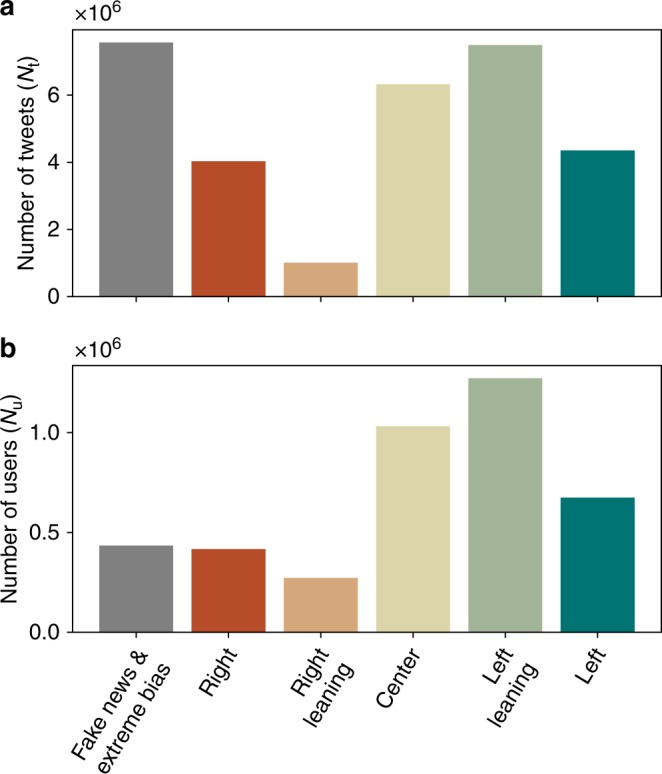
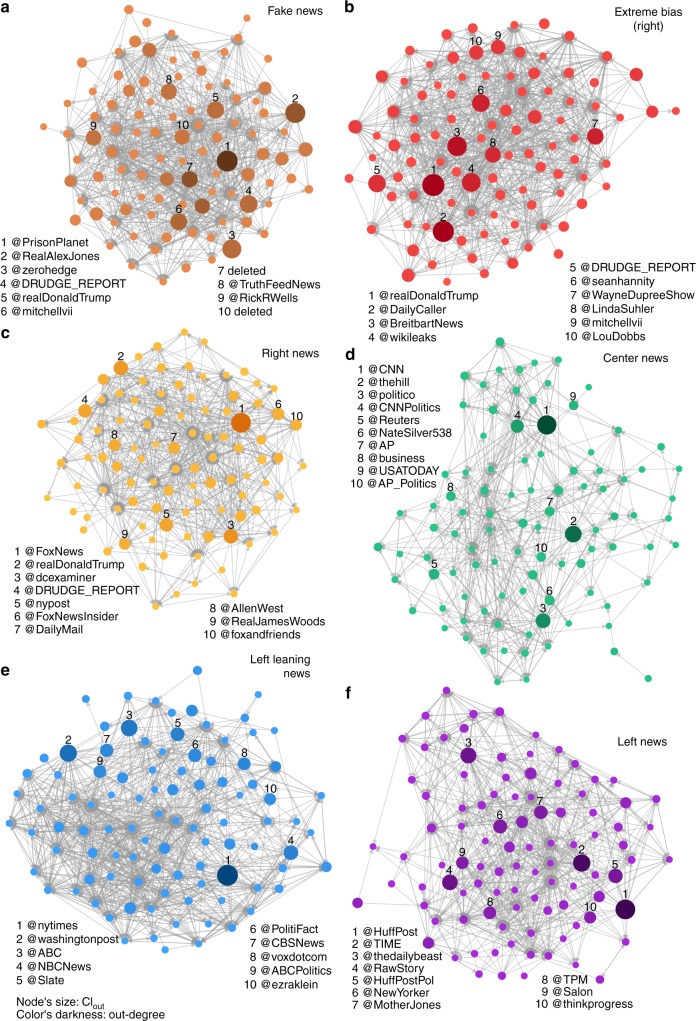
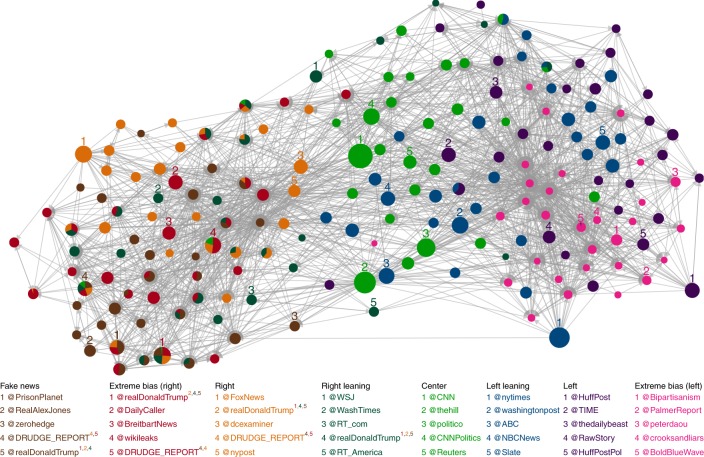
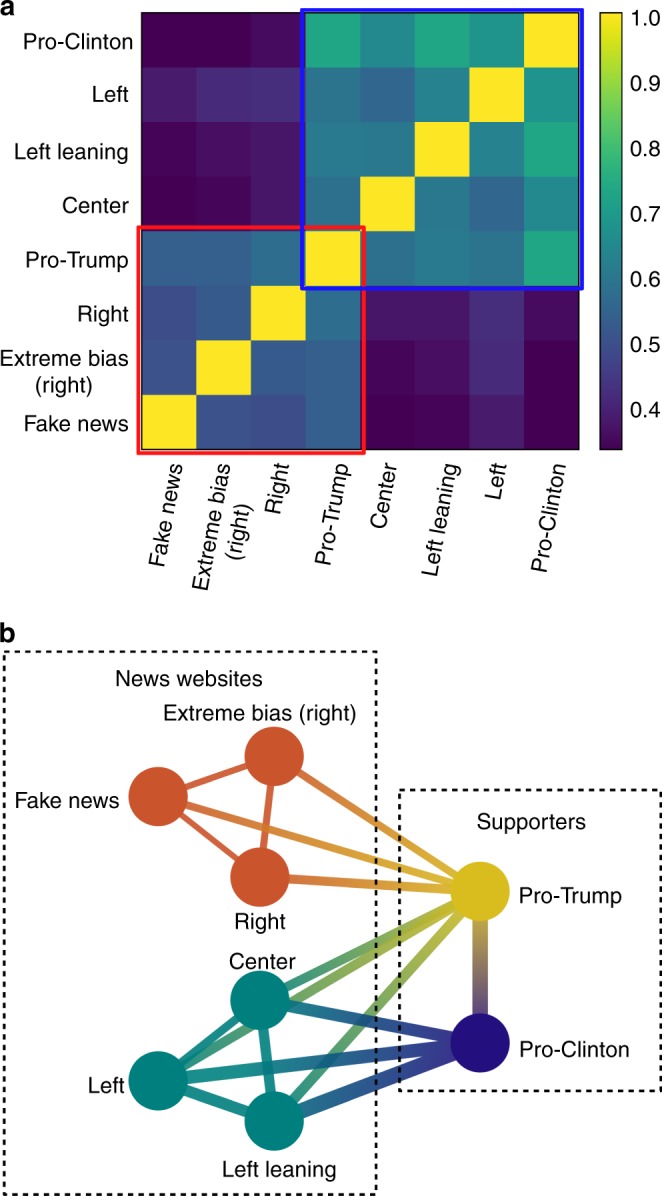
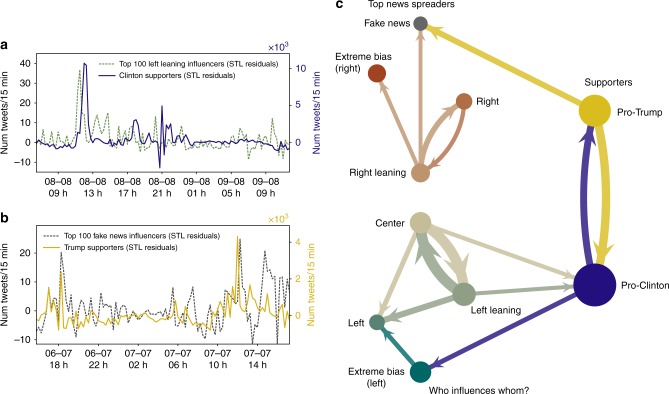
The dynamics and influence of fake news on Twitter during the 2016 US presidential election remains to be clarified. Here, we use a dataset of 171 million tweets in the five months preceding the election day to identify 30 million tweets, from 2.2 million users, which contain a link to news outlets. Based on a classification of news outlets curated by www.opensources.co , we find that 25% of these tweets spread either fake or extremely biased news. We characterize the networks of information flow to find the most influential spreaders of fake and traditional news and use causal modeling to uncover how fake news influenced the presidential election. We find that, while top influencers spreading traditional center and left leaning news largely influence the activity of Clinton supporters, this causality is reversed for the fake news: the activity of Trump supporters influences the dynamics of the top fake news spreaders.
Overview
The claims and statistics of this paper haven’t been checked yet.
Free: it reads the open-access text and checks the first 5 claims that cite a source we can check. Create a free account to check every claim.
Integrity signals
Registry
Cites
Statistics
Figures
Verification
Claims the paper makes
The claims and statistics of this paper haven’t been checked yet.
Free: it reads the open-access text and checks the first 5 claims that cite a source we can check. Create a free account to check every claim.
Claims other papers make about this one
Each is checked against this paper’s own text: does it say what the citing paper says it does?
The cited source says what the claim attributes to it.
In the citing paper
“Real and present concerns exist over the role of mis- and disinformation in public discourse (116–118), the emergence of echo chambers (119) and deepening political polarization (120, 121), in particular around big societal issues like climate change (122).”
From The benefits and dangers of anthropomorphic conversational agents (2025) · cites this paper as [117]
Self-check
Percentages, sums and reported differences re-computed from the paper’s own numbers.
The self-check needs the paper’s full text.
Citations
Cites
1 retracted
Limited individual attention and online virality of low-quality information
Qiu, X., F. M. Oliveira, D., Sahami Shirazi, A., Flammini, A., & Menczer, F. (2017) · Nature Human Behaviour · doi:10.1038/s41562-017-0132 · Cited by 180
RetractedControlling the False Discovery Rate: A Practical and Powerful Approach to Multiple Testing
Benjamini, Y., & Hochberg, Y. (1995) · Journal of the Royal Statistical Society Series B: Statistical Methodology · doi:10.1111/j.2517-6161.1995.tb02031.x · Cited by 109,482
Investigating causal relations by econometric models and cross-spectral methods
Granger, C. W. J. (1969) · Econometrica · doi:10.2307/1912791 · Cited by 22,989
The spread of true and false news online
Vosoughi, S., Roy, D., & Aral, S. (2018) · Science · doi:10.1126/science.aap9559 · Cited by 8,847
Causation, Prediction, and Search
Spirtes, P., Glymour, C., & Scheines, R. (2001) · doi:10.7551/mitpress/1754.001.0001 · Cited by 4,521
A New Status Index Derived from Sociometric Analysis
Katz, L. (1953) · Psychometrika · doi:10.1007/bf02289026 · Cited by 3,866
Exposure to ideologically diverse news and opinion on Facebook
Bakshy, E., Messing, S., & Adamic, L. A. (2015) · Science · doi:10.1126/science.aaa1160 · Cited by 3,245
The spreading of misinformation online
Del Vicario, M., Bessi, A., Zollo, F., Petroni, F., Scala, A., Caldarelli, G., Stanley, H. E., & Quattrociocchi, W. (2016) · Proceedings of the National Academy of Sciences · doi:10.1073/pnas.1517441113 · Cited by 2,407
Confirmation, disconfirmation, and information in hypothesis testing
Klayman, J., & Ha, Y.-W. (1987) · Psychological Review · doi:10.1037/0033-295x.94.2.211 · Cited by 2,094
Ferrara, E., Varol, O., Davis, C., Menczer, F., & Flammini, A. (2016) · Communications of the ACM · doi:10.1145/2818717 · Cited by 1,973
Research works printed but not linked: 2
- Howell L Digital wildfires in a hyperconnected world WEF Rep. 2013 3 15 94
- Cleveland RB Cleveland WS McRae JE Terpenning I STL: a seasonal-trend decomposition procedure based on loess J. Off. Stat. 1990 6 3 73
Cited by
Items 601–700 of 1,000
Toney, A., Pandey, A., Guo, W., Broniatowski, D. A., & Caliskan, A. (2021) · IEEE International Conference on Semantic Computing (ICSC) · doi:10.1109/icsc50631.2021.00019 · Cited by 8
Bernardi, A. J. B. (2019) · Lume (Universidade Federal do Rio Grande do Sul) · Cited by 8
Garnes-Tarazona, I. (2024) · Discourse & Communication · doi:10.1177/17504813241285907 · Cited by 9
Como as plataformas produzem desinformação: interfaces, algoritmos e conteúdos falsos
Oliveira, F., & Lemos, A. (2025) · Revista Contracampo · doi:10.22409/v95zqw38 · Cited by 8
Uncertainty Resolution in Misinformation Detection
Orlovskiy, Y., Thibault, C., Imouza, A., Godbout, J., Rabbany, R., & Pelrine, K. (2024) · Workshop on Uncertainty-Aware NLP (UncertaiNLP) · doi:10.18653/v1/2024.uncertainlp-1.10 · Cited by 8
Does United Kingdom parliamentary attention follow social media posts?
Bollenbacher, J., Loynes, N., & Bryden, J. (2022) · EPJ Data Science · doi:10.1140/epjds/s13688-022-00364-4 · Cited by 8
Sohail, S. S., Khan, M. M., & Alam, M. A. (2021) · arXiv (Cornell University) · doi:10.48550/arxiv.2105.10245 · Cited by 8
Carrasco-Farré, C. (2024) · Business & Society · doi:10.1177/00076503241255343 · Cited by 7
Infodemics on Youtube: Reliability of Content and Echo Chambers on COVID-19 (Preprint)Preprint
Marco, N. D., Cinelli, M., & Quattrociocchi, W. (2021) · doi:10.2196/preprints.32258 · Cited by 7
Vadlamudi, P. S., Gunasekaran, M., & Nagalakshmi, T. J. (2023) · International Conference on Intelligent and Innovative Technologies in Computing, Electrical and Electronics (IITCEE) · doi:10.1109/iitcee57236.2023.10090978 · Cited by 7
Wirtz, B. W., Weyerer, J. C., & Müller, T. F. (2026) · International Journal of Information Management · doi:10.1016/j.ijinfomgt.2026.103066 · Cited by 7
Content Analysis in the Research Field of Disinformation
Staender, A., & Humprecht, E. (2022) · Springer eBooks · doi:10.1007/978-3-658-36179-2_29 · Cited by 7
Sohail, S. S., Khan, M. M., Madsen, D. Ø., Alam, M. A., & Irshad, R. R. (2025) · Human Behavior and Emerging Technologies · doi:10.1155/hbe2/1376983 · Cited by 7
WhatsApp tiplines and multilingual claims in the 2021 Indian assembly elections
Shahi, G. K., & Hale, S. A. (2025) · Online Social Networks and Media · doi:10.1016/j.osnem.2025.100323 · Cited by 7
Bursts of contemporaneous publication among high- and low-credibility online information providers
Budak, C., Bozarth, L., Bond, R. M., Margolin, D., Jones, J. J., & Garrett, R. (2023) · New Media & Society · doi:10.1177/14614448231183617 · Cited by 7
Design and analysis of tweet-based election models for the 2021 Mexican legislative election
Vigna-Gómez, A., Murillo, J., Ramirez, M., Borbolla, A., Márquez, I., & Ray, P. K. (2023) · EPJ Data Science · doi:10.1140/epjds/s13688-023-00401-w · Cited by 7
Causal Insights into Parler's Content Moderation Shift: Effects on Toxicity and Factuality
Kumarswamy, N., Singhal, M., & Nilizadeh, S. (2025) · International World Wide Web Conference (WWW) · doi:10.1145/3696410.3714865 · Cited by 8
Meng, X., Dai, C., Zhao, Y., & Zhou, Y. (2023) · Library Hi Tech · doi:10.1108/lht-02-2023-0073 · Cited by 7
Risk analysis of disinformation weaponized against critical networks
Barker, K., Bessarabova, E., Radhakrishnan, S., González, A. D., Weber, M. S., Ramírez-Márquez, J. E., Vorobeychik, Y., & Jiang, J. N. (2025) · Risk Analysis · doi:10.1111/risa.70062 · Cited by 7
Rodič, B. (2020) · International Scientific Conference ITEMA. Recent Advances in Information Technology, Tourism, Economics, Management and Agriculture · doi:10.31410/itema.2020.231 · Cited by 7
Dijital Çağda Dijital Pandemi: Türkiyede COVID-19 Gündemi
YILDIRIM, A. (2020) · Intermedia International e-journal · doi:10.21645/intermedia.2020.87 · Cited by 7
Pierri, F., Artoni, A., & Ceri, S. (2020) · arXiv (Cornell University) · doi:10.48550/arxiv.2001.10926 · Cited by 7
Analyzing Impact Dynamics of Misinformation Spread on X (Formerly Twitter) With a COVID-19 Dataset
Duzen, Z., Riveni, M., & Aktaş, M. S. (2024) · IEEE Access · doi:10.1109/access.2024.3488579 · Cited by 7
Artificial intelligence language models and the false fantasy of participatory language policies
Lau, M. (2021) · Working papers in Applied Linguistics and Linguistics at York · doi:10.25071/2564-2855.5 · Cited by 7
A structural approach to detecting opinion leaders in Twitter by random matrix theory
Mohammadi, S., Moradi, P., Trufanov, A. I., & Jafari, G. (2023) · Scientific Reports · doi:10.1038/s41598-023-48682-5 · Cited by 7
Linking the Dynamics of User Stance to the Structure of Online Discussions
Largeron, C., Mardale, A., & Rizoiu, M.-A. (2021) · Lecture notes in computer science · doi:10.1007/978-3-030-74251-5_22 · Cited by 7
FNDaaS: Content-agnostic Detection of Websites Distributing Fake News
Papadopoulos, P., Spythouris, D., Markatos, E. P., & Kourtellis, N. (2023) · IEEE International Conference on Big Data (BigData) · doi:10.1109/bigdata59044.2023.10386830 · Cited by 7
Leveraging Cross-Modals for Cheapfakes Detection
Nguyen, T., Dang, V., Tran, M., & Dang‐Nguyen, D. (2023) · doi:10.1145/3592571.3592975 · Cited by 7
Kanakaris, N., Ping, H., Xiao, X., Ahmed, N. K., Luceri, L., Ferrara, E., & Bogdan, P. (2025) · International World Wide Web Conference (WWW) · doi:10.1145/3701716.3717539 · Cited by 7
Exploring Large Digital Bodies for the Study of Human Behavior
Albuquerque, U. P., Cantalice, A. S., Oliveira, E. S., de Moura, J. M. B., dos Santos, R. K. S., da Silva, R. H., Júnior, V. D. M. B., & Júnior, W. S. F. (2023) · Evolutionary Psychological Science · doi:10.1007/s40806-023-00363-2 · Cited by 7
Early Anomaly Detection by Learning and Forecasting Behavior.Preprint
Zhao, T., Ni, B., Yu, W., & Jiang, M. (2020) · arXiv (Cornell University) · Cited by 7
Entropy-Based Active Learning for Precise Influence Evaluation in Complex Networks
Zhu, B., Sun, Q., Li, J., & Li, D. (2025) · IEEE Transactions on Systems Man and Cybernetics Systems · doi:10.1109/tsmc.2025.3623009 · Cited by 7
Global Research Trend on Social Media for Election: A Bibliometrics Analysis
Subekti, D., Nurmandi, A., & Salahudin, S. (2021) · Lecture notes in networks and systems · doi:10.1007/978-3-030-85799-8_32 · Cited by 7
Fake News Detection: Do Complex Problems Need Complex Solutions?
Palacio-Marín, I., & Arroyo, D. (2020) · Advances in intelligent systems and computing · doi:10.1007/978-3-030-57805-3_22 · Cited by 7
Kübler, J., Sekwenz, M.-T., Rachinger, F., König, A., Gsenger, R., Pírková, E., Wagner, B., Kettemann, M. C., Krennerich, M., & Ferro, C. (2023) · Hawaii International Conference on System Sciences (HICSS) · doi:10.24251/hicss.2023.493 · Cited by 7
Impact of Stricter Content Moderation on Parler's Users' DiscoursePreprint
Kumarswamy, N., Singhal, M., & Nilizadeh, S. (2023) · arXiv (Cornell University) · doi:10.48550/arxiv.2310.08844 · Cited by 7
Retroactive Gatekeepers: Fact-Checkers, Electoral Disinformation, and Audience Engagement in India
Roy, E., Laskar, K. A., & Reyaz, M. (2025) · Emerging Media · doi:10.1177/27523543251395190 · Cited by 8
Drifting Away from Truth: GenAI-Driven News Diversity Challenges LVLM-Based Misinformation DetectionPreprint
Li, F., Wu, J., Fu, T., Dong, Y., Song, B., & Zhou, W. Q. (2025) · AAAI Publications (The Association for the Advancement of Artificial Intelligence (AAAI)) · doi:10.48550/arxiv.2508.12711 · Cited by 7
Narang, P. A., Singh, A. V., & Monga, H. (2024) · ICST Transactions on Scalable Information Systems · doi:10.4108/eetsis.5069 · Cited by 7
Deep Level Analysis of Legitimacy in Bengali News Sentences
Das, S., Rai, P., & Chatterji, S. (2021) · ACM Transactions on Asian and Low-Resource Language Information Processing · doi:10.1145/3459928 · Cited by 7
Quantifying Polarization: A Comparative Study of Measures and MethodsPreprint
Martino, E. D., Cinelli, M., Cerqueti, R., & Quattrociocchi, W. (2025) · arXiv (Cornell University) · doi:10.48550/arxiv.2501.07473 · Cited by 7
Shoeibi, N., Mateos, A. M., Rivas, A., & Corchado, J. M. (2020) · Advances in intelligent systems and computing · doi:10.1007/978-3-030-53036-5_31 · Cited by 7
On Comparative Classification of Relevant Covid-19 Tweets
Bakal, G., & Abar, O. (2021) · International Conference on Computer Science and Engineering (UBMK) · doi:10.1109/ubmk52708.2021.9558945 · Cited by 7
ARTIFICIAL INTELLIGENCE IN HYBRID WARFARE: A LITERATURE REVIEW AND CLASSIFICATION
Șușnea, E., & BUȚĂ, I.-C. (2021) · STRATEGIES XXI - Security and Defense Faculty · doi:10.53477/2668-2001-21-37 · Cited by 7
The bi-directional h-index and B-core decomposition in directed networks
Zhai, L., Yan, X., & Zhang, G. (2019) · Physica A Statistical Mechanics and its Applications · doi:10.1016/j.physa.2019.121715 · Cited by 7
Supporting verification of news articles with automated search for semantically similar articlesPreprint
Gupta, V., Beckh, K., Giesselbach, S., Wegener, D., & Wirtz, T. (2021) · arXiv (Cornell University) · doi:10.48550/arxiv.2103.15581 · Cited by 7
Aarnes, P. R., Setty, V., & Galuščáková, P. (2024) · arXiv (Cornell University) · doi:10.48550/arxiv.2408.01118 · Cited by 7
Investigating Fake and Reliable News Sources Using Complex Networks Analysis
Mazzeo, V., & Rapisarda, A. (2022) · Frontiers in Physics · doi:10.3389/fphy.2022.886544 · Cited by 6
The public’s appropriation of multimodal discourses of fake news on social media
Al‐Rawi, A., & Prithipaul, D. (2023) · The Communication Review · doi:10.1080/10714421.2023.2242070 · Cited by 6
Habib, H., Stoldt, R., High, A. C., Ekdale, B., Peterson, A., Biddle, K., Ssozi, J., & Nithyanand, R. (2025) · Proceedings of the ACM on Human-Computer Interaction · doi:10.1145/3757656 · Cited by 6
The adaptive community-response (ACR) method for collecting misinformation on social media
Kauk, J., Kreysa, H., Scherag, A., & Schweinberger, S. R. (2024) · Journal Of Big Data · doi:10.1186/s40537-024-00894-w · Cited by 6
The Liar’s Dividend: Can Politicians Use Deepfakes and Fake News to Evade Accountability?
Schiff, K. J., Schiff, D. S., & Bueno, N. (2022) · doi:10.31235/osf.io/q6mwn · Cited by 6
Hakak, S., Shahid, W., Jamshidi, B., Khan, W. Z., Khan, M. K., & Isah, H. (2022) · doi:10.36227/techrxiv.19169795 · Cited by 6
A WebApp for Reliability Detection in Social Media
David, F., Guimar�ães, N., & Figueira, Á. (2023) · Procedia Computer Science · doi:10.1016/j.procs.2023.01.285 · Cited by 6
Twitter trends in #Parasitology determined by text mining and topic modelling
Ellis, J., & Reichel, M. P. (2023) · Current Research in Parasitology and Vector-Borne Diseases · doi:10.1016/j.crpvbd.2023.100138 · Cited by 6
Artificial intelligence for detecting fake news on social media - attitude survey
Kovačević, A., & Demić, E. (2023) · Medjunarodni problemi · doi:10.2298/medjp2304685k · Cited by 6
What's all that noise: analysis and detection of propaganda on Twitter
Kellner, A., Wressnegger, C., & Rieck, K. (2020) · European Workshop on System Security · doi:10.1145/3380786.3391399 · Cited by 6
A Dynamic Analysis of Conspiratorial Narratives on Twitter During the Pandemic
Shao, C., Kwon, K. H., Walker, S., & Li, Q. (2023) · Cyberpsychology Behavior and Social Networking · doi:10.1089/cyber.2022.0218 · Cited by 6
Bernard, S., Rahman, I., Liu, S., & Nanu, L. (2022) · Journal of Global Hospitality and Tourism · doi:10.5038/2771-5957.1.2.1009 · Cited by 6
Alonso-Muñoz, L., García, A. T., & Casero-Ripollés, A. (2024) · Online Information Review · doi:10.1108/oir-03-2024-0138 · Cited by 6
Detecting Fake News on Social Media: The Case of Turkey
BOZKANAT, E. (2020) · Advances in social networking and online communities book series · doi:10.4018/978-1-7998-4718-2.ch004 · Cited by 6
An ontological analysis of misinformation in online social networksPreprint
Alsmadi, I. M., Alazzam, I., & Al-Ramahi, M. A. (2021) · arXiv (Cornell University) · doi:10.48550/arxiv.2102.11362 · Cited by 6
Fact-checking: uma prática recente em Portugal? Análise da perceção da audiência
Baptista, J. P., Gradim, A., Loureiro, M., & Ribeiro, F. F. (2023) · Anuario electrónico de estudios en Comunicación Social Disertaciones · doi:10.12804/revistas.urosario.edu.co/disertaciones/a.12426 · Cited by 8
Detecting and Measuring the Polarization Effects of Adversarial Botnets on Twitter
Lee, Y., Özer, M., Corman, S. R., & Davulcu, H. (2023) · ACM Symposium on Applied Computing · doi:10.1145/3555776.3577730 · Cited by 6
Coculescu, D., Motte, M., & Pham, H. (2024) · Mathematics and Financial Economics · doi:10.1007/s11579-024-00355-1 · Cited by 6
Can you fool AI by doing a 180? — A case study on authorship analysis of texts by Arata Osada
Nieuważny, J., Nowakowski, K., Ptaszynski, M. E., & Masui, F. (2021) · Information Processing & Management · doi:10.1016/j.ipm.2021.102644 · Cited by 6
Profiling Fake News: Learning the Semantics and Characterisation of Misinformation
Agarwal, S., & Samavedhi, A. (2022) · Lecture notes in computer science · doi:10.1007/978-3-030-95405-5_15 · Cited by 6
PoliWAM: An Exploration of a Large Scale Corpus of Political Discussions on WhatsApp Messenger
Srivastava, V. P., & Singh, M. (2021) · Workshop on Noisy User-generated Text (W-NUT) · doi:10.18653/v1/2021.wnut-1.15 · Cited by 6
Perceived Versus Actual Ability to Identify Fake News: Evidence From Israel’s 2019–2020 Elections
Yarchi, M., Samuel-Azran, T., & Hayat, T. (2023) · International journal of communication · Cited by 6
Patterns, Models, and Challenges in Online Social Media: A Survey
Marco, N. D., Bonetti, A., Martino, E. D., Loru, E., Nudo, J., Pandolfo, M. E., Pecile, G., Sangiorgio, E., Scalco, I., Zollo, S., et al. (2026) · ACM Transactions on the Web · doi:10.1145/3796548 · Cited by 6
Serafino, M., Zhou, Z., Andrade, J. S., Bovet, A., & Makse, H. A. (2024) · EPJ Data Science · doi:10.1140/epjds/s13688-024-00464-3 · Cited by 6
Self-citationFenomena Speak Up pada Media Twitter (Study Deskriptif Korban Penipuan Melalui Gerakan “A Thread”)
Kinanti, T. A., & Suyono, S. (2023) · Jurnal Bisnis dan Komunikasi Digital · doi:10.47134/jbkd.v1i1.1912 · Cited by 6
The Scamdemic Conspiracy Theory and Twitter’s Failure to Moderate COVID-19 Misinformation
Rossi, S. (2022) · Hawaii International Conference on System Sciences (HICSS) · doi:10.24251/hicss.2022.015 · Cited by 6
SCG: Spotting Coordinated Groups in Social MediaPreprint
Wang, J., Lévy, S., Wang, R., Kulshrestha, A., & Rabbany, R. (2019) · arXiv (Cornell University) · doi:10.48550/arxiv.1910.07130 · Cited by 6
Digital corporate communication and disinformation
Olivieri, M., Mäkelä, R.-M., Romenti, S., & Luoma‐aho, V. (2023) · Edward Elgar Publishing eBooks · doi:10.4337/9781802201963.00042 · Cited by 6
Haque, M., Bari, A. S. M. H., & Gavrilova, M. L. (2025) · Journal of Cybersecurity and Privacy · doi:10.3390/jcp5040104 · Cited by 6
A graph theory approach to analyze birth defect associations
Elías, D., Campaña, H., Poletta, F. A., Heisecke, S. L., Gili, J. A., Ratowiecki, J., Giménez, L. G., Pawluk, M. S., Santos, M. R., Cosentino, V., et al. (2020) · PLoS ONE · doi:10.1371/journal.pone.0233529 · Cited by 7
Coelho, B. G., Mirza, S., Cui, Y., Pöpper, C., & McCoy, D. (2025) · arXiv (Cornell University) · doi:10.48550/arxiv.2503.22877 · Cited by 6
Personalized Large Language Models Can Increase the Belief Accuracy of Social NetworksPreprint
Proma, A. M., Pate, N., Kelty, S., Ghoshal, G., Druckman, J. N., & Hoque, M. E. (2025) · arXiv (Cornell University) · doi:10.48550/arxiv.2506.06153 · Cited by 6
Predicting nodal influence via local iterative metrics
Zhang, S., Hanjalić, A., & Wang, H. (2024) · Scientific Reports · doi:10.1038/s41598-024-55547-y · Cited by 6
Magnetic Nanoparticles from Bacteria
Markande, A. R., Mistry, K. J., Undaviya, S., & Jha, A. (2021) · Nanotechnology in the life sciences · doi:10.1007/978-3-030-61985-5_4 · Cited by 6
Disambiguating Disinformation: Extending Beyond the Veracity of Online ContentPreprint
Erhardt, K. D., & Pentland, A. (2022) · arXiv (Cornell University) · doi:10.48550/arxiv.2206.12915 · Cited by 6
Concept Drift Influenced by Topic Change in Data Streams from Social Media
Sarnovský, M., & Babič, F. (2025) · IEEE World Symposium on Applied Machine Intelligence and Informatics (SAMI) · doi:10.1109/sami63904.2025.10883281 · Cited by 6
Freedom of Expression and the Regulation of Disinformation in the European Union
Koltay, A. (2025) · Cambridge University Press eBooks · doi:10.1017/9781009373272.010 · Cited by 6
Ligo, V. A. C., Cheung, L. Y., Lee, R. K.-W., Saha, K., Tandoc, E. C., & Kumar, N. (2025) · International World Wide Web Conference (WWW) · doi:10.1145/3701716.3717542 · Cited by 6
Blanco‐Herrero, D. (2023) · Gredos (University of Salamanca) · doi:10.14201/gredos.156044 · Cited by 6
Marsili, M., & Wróblewska-Jachna, J. (2024) · Media i Społeczeństwo · doi:10.5604/01.3001.0054.6506 · Cited by 6
Before & After: The Effect of EU's 2022 Code of Practice on Disinformation
Papadogiannakis, E., Papadopoulos, P., Kourtellis, N., & Markatos, E. P. (2025) · International World Wide Web Conference (WWW) · doi:10.1145/3696410.3714898 · Cited by 6
A Telegram Dataset of Propaganda and its Moderation
Kireev, K., Mykhno, Y., Troncoso, C., & Overdorf, R. (2025) · Proceedings of the International AAAI Conference on Web and Social Media · doi:10.1609/icwsm.v19i1.35952 · Cited by 6
Gao, Y., Su, X. M., Wei, J., Sun, J., Zhang, M., Tan, H., Zhang, J., Ouyang, J., & Na, N. (2022) · Nanoscale · doi:10.1039/d2nr02662g · Cited by 6
Kumar, A., Surendran, R., & Madhusundar., N. (2023) · International Conference on Intelligent Computing and Control for Engineering and Business Systems (ICCEBS) · doi:10.1109/iccebs58601.2023.10449101 · Cited by 6
Zhu, C., Peng, S., Zhang, X., Yao, Y., Huang, X., Yan, Y., Zhang, D., Shi, J., & Jin, Z. H. (2021) · Nanotechnology · doi:10.1088/1361-6528/abfa56 · Cited by 6
Fan, J., Hu, G., Su, H., Shi, Y., Du, K., Peng, Z., Sun, Q., Zhang, Y., Wu, K., & Cao, Y. (2022) · Sustainable Energy & Fuels · doi:10.1039/d1se01880a · Cited by 6
Martin, P. G., Alhaddad, O., Verbelen, Y., Satou, Y., Igarashi, Y., & Scott, T. B. (2020) · Scientific Data · doi:10.1038/s41597-020-00626-8 · Cited by 6
Roy, M., & DeRoche, M. (2025) · Telematics and Informatics Reports · doi:10.1016/j.teler.2025.100214 · Cited by 5
Investigating “Who” in the Crowdsourcing of News Credibility
Bhuiyan, M. M., Zhang, A. X., Sehat, C. M., & Mitra, T. (2020) · Cited by 5
Centralities in Complex Networks
Bovet, A., & Makse, H. A. (2022) · Encyclopedia of complexity and systems science series · doi:10.1007/978-1-0716-1454-9_765 · Cited by 5
Self-citationSwinging in the States: Does disinformation on Twitter mirror the US presidential election system?
Pratelli, M., Petrocchi, M., Saracco, F., & Nicola, R. D. (2023) · International World Wide Web Conference (WWW) · doi:10.1145/3543873.3587638 · Cited by 5
Social Media Influencers and Politics
Makse, H. A., & Zava, M. (2024) · Understanding complex systems · doi:10.1007/978-3-031-78058-5_2 · Cited by 5
Self-citationFungible Citizenship: On the Internet No-One Knows You’re a Swede
Robinson, J. Y. (2022) · M/C Journal · doi:10.5204/mcj.2883 · Cited by 5
Metadata
- Authors
- Bovet, A., & Makse, H. A.
- Affiliations
- City College of New York (US)
- Corresponding author
- Makse, Hernán A.
- Venue
- Nature Communications
- Published
- 2019-01-02
- Volume
- 10
- Issue
- 1
- Pages
- 7-7
- ISSN
- 2041-1723 (ISSN-L)
- PMC
- PMC6315042
- OpenAlex
- W2792307011
- Cited by
- 701
- References
- 40
- Citations by year
- 2026: 38 · 2025: 106 · 2024: 114 · 2023: 105 · 2022: 109 · 2021: 114 · 2020: 86 · 2019: 28
- FWCI
- 130.25
- Type
- journal article
- Language
- en
- Open access
- gold
- doi.org
- Licence
- cc-by
- creativecommons.org/licenses/by/4.0 (tdm)
- creativecommons.org/licenses/by/4.0 (vor)
- Locations
- Nature Communications (publishedVersion, cc-by)
- Europe PMC (PubMed Central) (publishedVersion, other-oa)
- PubMed Central (publishedVersion, cc-by)
- PubMed (publishedVersion)
- Repository of the University of Namur (publishedVersion, cc-by)
- arXiv (Cornell University) (submittedVersion)
- RePEc: Research Papers in Economics (submittedVersion)
- DOAJ (DOAJ: Directory of Open Access Journals) (submittedVersion)
- DOAJ (DOAJ: Directory of Open Access Journals) (submittedVersion, cc-by-sa)
- arXiv (Cornell University) (cc-by)
- Funders
- National Science Foundation
- Schweizerischer Nationalfonds zur Förderung der Wissenschaftlichen Forschung (165158)
- Topics
- Social Sciences › Sociology and Political Science › Misinformation and Its Impacts
- Physical Sciences › Physics and Astronomy › Statistical and Nonlinear Physics › Complex Network Analysis Techniques
- Social Sciences › Communication › Social Media and Politics
- Keywords
- fake news, 2016 US presidential election, Twitter, information dissemination, influential spreaders, election influence, Trump supporters, social media misinformation
About these checks
Registry, retraction, Cites and statistics results are computed, not judged, with one exception: a printed reference that no index lists is read once by a model before it counts as a citation error. Claims are extracted by a model and kept only when their quote appears verbatim in the text; each cited source is then checked, with a model’s help, for whether it says what the claim relies on. Those verdicts can be wrong — read the claim’s quote and the cited source before relying on one.
Statistics and arithmetic are recomputed, not judged.
Confidence bands are shown only for fields calibrated on our annotated test set. None is calibrated yet, so no band is shown.
What counts as a claim ›How we measure confidence ›How we check this ›
Are you an author, or do you see a problem with this page? Request a review
Data sources
Bibliographic data: Semantic Scholar, OpenAlex, Crossref.
Contains information from the Semantic Scholar Academic Graph Datasets, made available under the ODC Attribution License (ODC-BY 1.0).
Semantic Scholar’s data is described in: Kinney, R., et al. (2023). The Semantic Scholar Open Data Platform. arXiv:2301.10140.
