

Influence of fake news in Twitter during the 2016 US presidential election
Open accessThe DOI matches its Crossref record; 44 of the 44 references it cites were found in a registry or an index.
Abstract
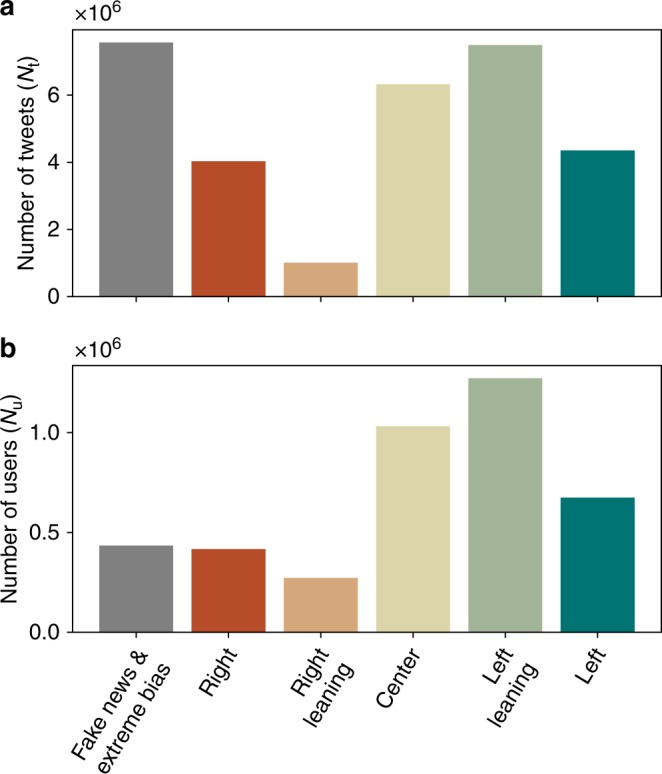
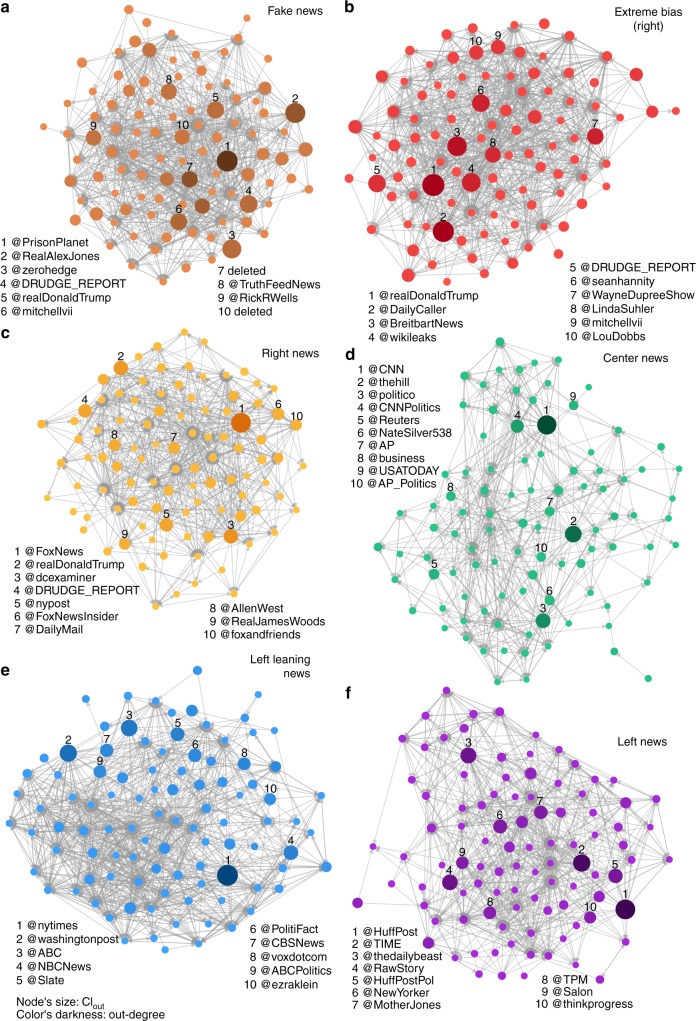
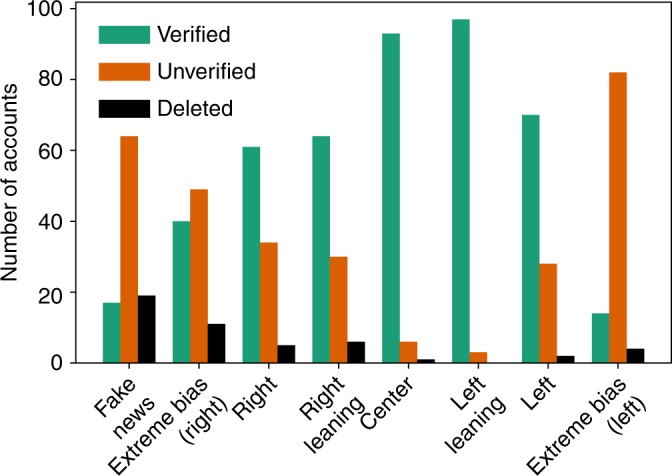
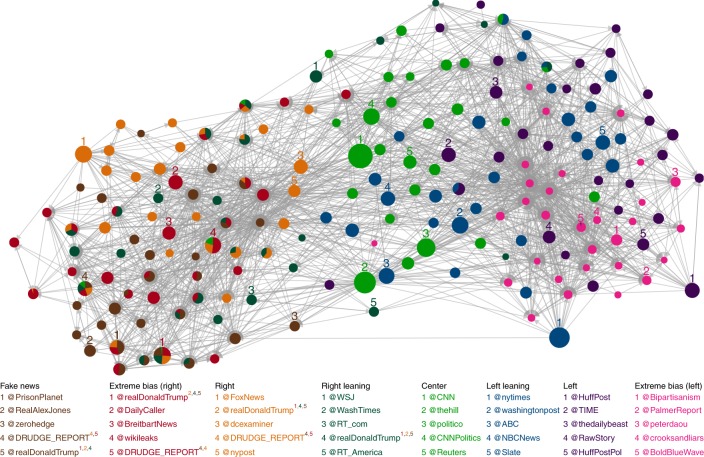
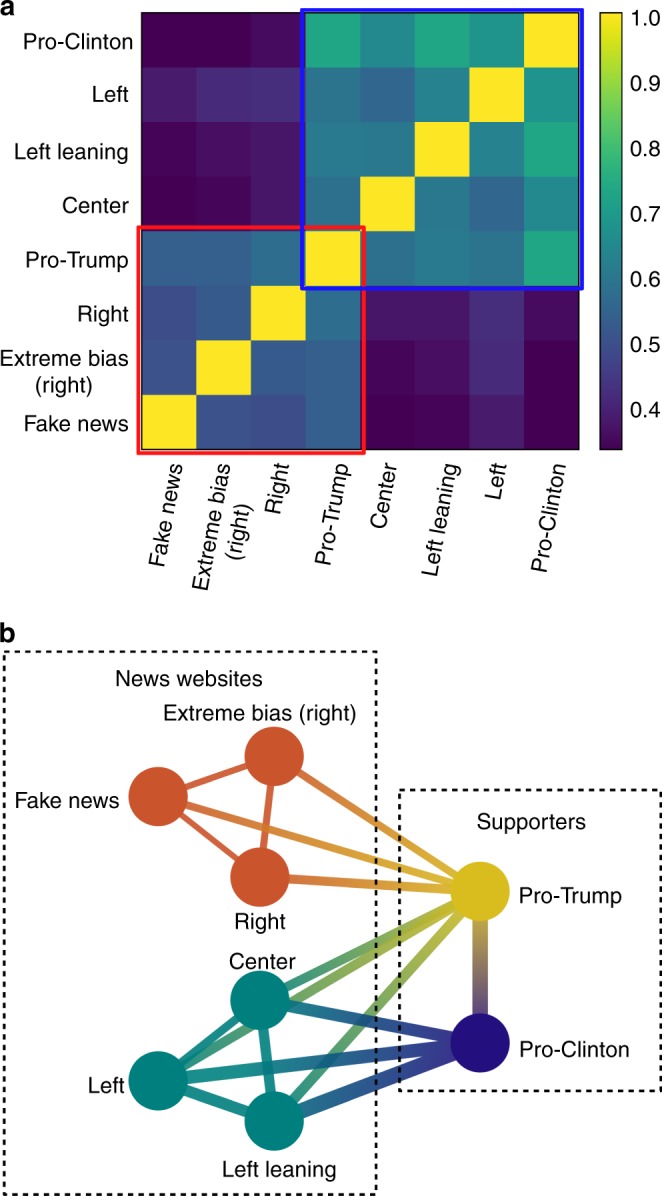
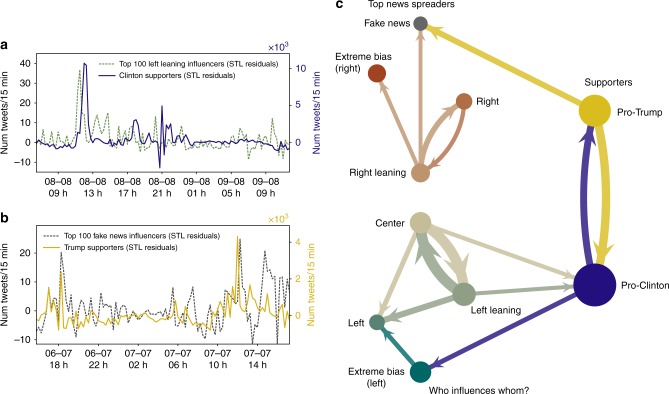
The dynamics and influence of fake news on Twitter during the 2016 US presidential election remains to be clarified. Here, we use a dataset of 171 million tweets in the five months preceding the election day to identify 30 million tweets, from 2.2 million users, which contain a link to news outlets. Based on a classification of news outlets curated by www.opensources.co , we find that 25% of these tweets spread either fake or extremely biased news. We characterize the networks of information flow to find the most influential spreaders of fake and traditional news and use causal modeling to uncover how fake news influenced the presidential election. We find that, while top influencers spreading traditional center and left leaning news largely influence the activity of Clinton supporters, this causality is reversed for the fake news: the activity of Trump supporters influences the dynamics of the top fake news spreaders.
Overview
The claims and statistics of this paper haven’t been checked yet.
Free: it reads the open-access text and checks the first 5 claims that cite a source we can check. Create a free account to check every claim.
Integrity signals
Registry
Cites
Statistics
Figures
Verification
Claims the paper makes
The claims and statistics of this paper haven’t been checked yet.
Free: it reads the open-access text and checks the first 5 claims that cite a source we can check. Create a free account to check every claim.
Claims other papers make about this one
Each is checked against this paper’s own text: does it say what the citing paper says it does?
The cited source says what the claim attributes to it.
In the citing paper
“Real and present concerns exist over the role of mis- and disinformation in public discourse (116–118), the emergence of echo chambers (119) and deepening political polarization (120, 121), in particular around big societal issues like climate change (122).”
From The benefits and dangers of anthropomorphic conversational agents (2025) · cites this paper as [117]
Self-check
Percentages, sums and reported differences re-computed from the paper’s own numbers.
The self-check needs the paper’s full text.
Citations
Cites
1 retracted
Limited individual attention and online virality of low-quality information
Qiu, X., F. M. Oliveira, D., Sahami Shirazi, A., Flammini, A., & Menczer, F. (2017) · Nature Human Behaviour · doi:10.1038/s41562-017-0132 · Cited by 180
RetractedControlling the False Discovery Rate: A Practical and Powerful Approach to Multiple Testing
Benjamini, Y., & Hochberg, Y. (1995) · Journal of the Royal Statistical Society Series B: Statistical Methodology · doi:10.1111/j.2517-6161.1995.tb02031.x · Cited by 109,482
Investigating causal relations by econometric models and cross-spectral methods
Granger, C. W. J. (1969) · Econometrica · doi:10.2307/1912791 · Cited by 22,989
The spread of true and false news online
Vosoughi, S., Roy, D., & Aral, S. (2018) · Science · doi:10.1126/science.aap9559 · Cited by 8,847
Causation, Prediction, and Search
Spirtes, P., Glymour, C., & Scheines, R. (2001) · doi:10.7551/mitpress/1754.001.0001 · Cited by 4,521
A New Status Index Derived from Sociometric Analysis
Katz, L. (1953) · Psychometrika · doi:10.1007/bf02289026 · Cited by 3,866
Exposure to ideologically diverse news and opinion on Facebook
Bakshy, E., Messing, S., & Adamic, L. A. (2015) · Science · doi:10.1126/science.aaa1160 · Cited by 3,245
The spreading of misinformation online
Del Vicario, M., Bessi, A., Zollo, F., Petroni, F., Scala, A., Caldarelli, G., Stanley, H. E., & Quattrociocchi, W. (2016) · Proceedings of the National Academy of Sciences · doi:10.1073/pnas.1517441113 · Cited by 2,407
Confirmation, disconfirmation, and information in hypothesis testing
Klayman, J., & Ha, Y.-W. (1987) · Psychological Review · doi:10.1037/0033-295x.94.2.211 · Cited by 2,094
Ferrara, E., Varol, O., Davis, C., Menczer, F., & Flammini, A. (2016) · Communications of the ACM · doi:10.1145/2818717 · Cited by 1,973
Research works printed but not linked: 2
- Howell L Digital wildfires in a hyperconnected world WEF Rep. 2013 3 15 94
- Cleveland RB Cleveland WS McRae JE Terpenning I STL: a seasonal-trend decomposition procedure based on loess J. Off. Stat. 1990 6 3 73
Cited by
Items 501–600 of 1,000
Qword at CheckThat! 2021: An Extreme Gradient Boosting Approach for Multiclass Fake News Detection.
Utsha, R. S., Keya, M., Hasan, M. A., & Islam, M. S. (2021) · CLEF (Working Notes) · Cited by 12
Selecting energy efficient inputs using graph structure
Klickstein, I. S., & Sorrentino, F. (2022) · International Journal of Control · doi:10.1080/00207179.2021.2022218 · Cited by 12
Analysis of flows in social media uncovers a new multi-step model of information spread
Serafino, M., Clemente, G. V., Flamino, J., Szymanski, B. K., Ližardo, O., & Makse, H. A. (2024) · Journal of Statistical Mechanics Theory and Experiment · doi:10.1088/1742-5468/ad8748 · Cited by 12
Self-citationSoK: Machine Learning for Misinformation DetectionPreprint
Xiao, M., & Mayer, J. R. (2023) · arXiv (Cornell University) · doi:10.48550/arxiv.2308.12215 · Cited by 12
An Adaptive Approach for Fake News Detection in Social Media: Single vs Cross Domain
Rastogi, S., Gill, S. S., & Bansal, D. (2021) · International Conference on Computational Science and Computational Intelligence (CSCI) · doi:10.1109/csci54926.2021.00280 · Cited by 12
Social diffusion sources can escape detection
Waniek, M., Holme, P., Cebrián, M., & Rahwan, T. (2022) · iScience · doi:10.1016/j.isci.2022.104956 · Cited by 12
From Misinformation to Truth: Fake News Detection with Transformer-Based Models
Mewada, A., Ansari, M. A., & Maurya, S. K. (2025) · IEEE International Conference on Communication Systems and Network Technologies (CSNT) · doi:10.1109/csnt64827.2025.10967607 · Cited by 12
How to model fake newsPreprint
Brody, D. C., & Meier, D. M. (2018) · arXiv (Cornell University) · Cited by 12
Twitter communities are associated with changing user’s opinion towards COVID-19 vaccine in Japan
Wu, Q., Sano, Y., Takayasu, H., Havlin, S., & Takayasu, M. (2025) · Scientific Reports · doi:10.1038/s41598-025-95595-6 · Cited by 11
SOCIAL MEDIA AND THE INFLUENCE OF FAKE NEWS DETECTION BASED ON ARTIFICIAL INTELLIGENCE
Shyam Swaroop, T. (2024) · ShodhKosh Journal of Visual and Performing Arts · doi:10.29121/shodhkosh.v5.i7.2024.1955 · Cited by 11
Arroyo‐Machado, W., Herrera‐Viedma, E., & Torres‐Salinas, D. (2025) · Journal of the Association for Information Science and Technology · doi:10.1002/asi.24998 · Cited by 11
Inference of social media opinion trends in 2022 Italian elections
Zollo, S., Cinelli, M., Etta, G., Cerqueti, R., & Quattrociocchi, W. (2025) · Expert Systems with Applications · doi:10.1016/j.eswa.2024.126377 · Cited by 11
Mobile Phone Data for Children on the Move: Challenges and Opportunities
Sekara, V., Omodei, E., Healy, L., Beise, J., Hansen, C., You, D., Blume, S., & García–Herranz, M. (2019) · Springer eBooks · doi:10.1007/978-3-030-12554-7_3 · Cited by 11
Hawkins, I., & Campbell, S. W. (2025) · Computers in Human Behavior · doi:10.1016/j.chb.2025.108658 · Cited by 11
Fake News Detection Using Sentiment Analysis Approach in Indonesian Language
Rozi, I. F., Arianto, R., & Mahdyan, H. H. (2023) · International Conference on Advanced Mechatronics, Intelligent Manufacture and Industrial Automation (ICAMIMIA) · doi:10.1109/icamimia60881.2023.10427891 · Cited by 11
Campis, E. M. S. (2023) · Empiria Revista de metodología de ciencias sociales · doi:10.5944/empiria.57.2023.36434 · Cited by 11
Unifying information propagation models on networks and influence maximization
Tian, Y., & Lambiotte, R. (2022) · Physical review. E · doi:10.1103/physreve.106.034316 · Cited by 11
Analyzing User Profiles for Detection of Fake News Spreaders on Twitter.
Espinosa, M. S., Centeno, R., & Rodrigo, Á. Á. (2020) · CLEF (Working Notes) · Cited by 11
Fake News on Twitter in 2016 U.S. Presidential Election: A Quantitative Approach
Padda, K. K. (2020) · The Journal of Intelligence Conflict and Warfare · doi:10.21810/jicw.v3i2.2374 · Cited by 11
Annotation-Scheme Reconstruction for “Fake News” and Japanese Fake News Dataset
Murayama, T., Hisada, S., Uehara, M., Wakamiya, S., & Aramaki, E. (2022) · Language Resources and Evaluation Conference (LREC) · doi:10.63317/5e27qk2tkrfz · Cited by 11
Influence maximization based on community structure and second-hop neighborhoods
Cheng, J., Yang, K., Yang, Z., Zhang, H., Zhang, W., & Chen, X. (2022) · Applied Intelligence · doi:10.1007/s10489-021-02880-8 · Cited by 11
Song, W., Zhang, K., Dong, X., Xu, L., Li, Y., Hu, R., Yin, Z., Yang, Z., Qiu, J., & Song, Z. (2024) · Inorganic Chemistry Frontiers · doi:10.1039/d4qi01168f · Cited by 11
Navigating the Unknown: Anticipating Concerns and Gaps in Generative AI Research
Parker, L., Hayes, J., Loper, A. J., & Karakas, A. (2024) · Springer eBooks · doi:10.1007/978-3-031-65691-0_1 · Cited by 10
Guimar�ães, N., Figueira, Á., & Torgo, L. (2021) · Mathematics · doi:10.3390/math9222988 · Cited by 10
Electoral Crisis Communications: Combatting Disinformation & the Contest for Electoral Legitimacy
Winger, G. H., Calfano, B., Vićić, J., & Harknett, R. J. (2023) · American Politics Research · doi:10.1177/1532673x231184440 · Cited by 25
Epistemic obligations and free speech
Millar, B. (2022) · Analytic Philosophy · doi:10.1111/phib.12279 · Cited by 10
Zhang, Y., Chen, F., Suk, J., & Yue, Z. (2023) · Communication Methods and Measures · doi:10.1080/19312458.2023.2278177 · Cited by 10
Dong, C., Xu, G., & Meng, L. (2024) · Chinese Physics B · doi:10.1088/1674-1056/ad531f · Cited by 10
Lemos, A., & Oliveira, F. (2021) · Fronteiras - estudos midiáticos · doi:10.4013/fem.2021.232.06 · Cited by 10
The Effect of Social Media on Shaping Individuals Opinion Formation
Gündüç, S. (2019) · Studies in computational intelligence · doi:10.1007/978-3-030-36683-4_31 · Cited by 10
Multi-modality frequency-aware cross attention network for fake news detection
Cui, W., Zhang, X., & Shang, M. (2023) · Journal of Intelligent & Fuzzy Systems · doi:10.3233/jifs-233193 · Cited by 10
Analyzing user ideologies and shared news during the 2019 argentinian elections
del Pozo, S. M., Pinto, S., Serafino, M., Garcia, L., Makse, H. A., & Balenzuela, P. (2024) · EPJ Data Science · doi:10.1140/epjds/s13688-024-00493-y · Cited by 10
Self-citationQAnon Propaganda on Twitter as Information Warfare: Influencers, Networks, and NarrativesPreprint
Dilley, L. C., Welna, W., & Foster, F. (2022) · arXiv (Cornell University) · doi:10.48550/arxiv.2207.05118 · Cited by 10
Fonseca, L., Ferreira, C. H. G., & Reis, J. C. S. (2024) · Anais do Simpósio Brasileiro de Sistemas de Informação (SBSI) · doi:10.1145/3658271.3658303 · Cited by 10
Xing, Y., Guo, Z., Su, W., Wen, W., Wang, X., & Zhang, H. (2021) · New Journal of Chemistry · doi:10.1039/d0nj05673a · Cited by 10
Multilingual Detection of Fake News Spreaders via Sparse Matrix Factorization
Koloski, B., Pollak, S., & Škrlj, B. (2020) · Zenodo (CERN European Organization for Nuclear Research) · doi:10.5281/zenodo.4059634 · Cited by 10
Iasulaitis, S., Valejo, A., Greco, B. C., Perillo, V. G., Messias, G. H., & Vicari, I. (2025) · PLoS ONE · doi:10.1371/journal.pone.0316626 · Cited by 10
Arısoy, Ç., Mandal, A., & Saxena, N. (2022) · Conference on Privacy, Security and Trust · doi:10.1109/pst55820.2022.9851990 · Cited by 10
Combating Fake News Online: Turkish Fact-Checking Services
Çömlekçi, M. F. (2020) · Advances in media, entertainment and the arts (AMEA) book series · doi:10.4018/978-1-7998-2543-2.ch013 · Cited by 10
Ibrahim, N. T., & Attia, N. A. H. M. (2025) · Seikei ronsō/Review of economics and political science · doi:10.1108/reps-12-2024-0104 · Cited by 10
Wang, Q., Zhou, D., Gong, K., Lv, X., Li, P., & Liu, Y. (2024) · Journal of Materials Chemistry C · doi:10.1039/d4tc02630f · Cited by 10
Koronawirus wyzwaniem współczesnego społeczeństwa : media i komunikacja społeczna
Marcinkiewicz, K., Nowak, P., Popielec, D., & Wilk, M. (2020) · Jagiellonian University Repository (Jagiellonian University) · Cited by 10
A Study of the Impact of Evolutionary-Based Feature Selection for Fake News Detection
Smith, M., Richardson, A., Brown, B., Dozier, G. V., King, M. C., & Morris, J. (2020) · IEEE Symposium Series on Computational Intelligence (SSCI) · doi:10.1109/ssci47803.2020.9308613 · Cited by 10
Plohl, N., Mlakar, I., Aquilino, L., Bisconti, P., & Smrke, U. (2025) · International Journal of Human–Computer Interaction · doi:10.1080/10447318.2024.2384821 · Cited by 9
“Until recently, false information has mainly spread through written text, such as news articles and tweets (e.g., Allcott & Gentzkow, 2017; Bovet & Makse, 2019).”
Ignorance of the crowd: dysfunctional thinking in social networks
Seeme, F. B., Green, D., & Kopp, C. (2025) · Frontiers in Communication · doi:10.3389/fcomm.2025.1547489 · Cited by 9
The Propagation of Misinformation in Social Media: A Cross-platform Analysis
Rogers, R. (2023) · Amsterdam University Press eBooks · doi:10.1515/9789048554249 · Cited by 9
Unpacking the Risk of Misinformation: A Communication‐Based Critique
Balog‐Way, D. H. P., & McComas, K. A. (2025) · Risk Analysis · doi:10.1111/risa.70093 · Cited by 10
Bassolas, A., Massachs, J., Cozzo, E., & Vicens, J. (2025) · Royal Society Open Science · doi:10.1098/rsos.241974 · Cited by 9
Centralities in Complex Networks
Bovet, A., & Makse, H. A. (2021) · Springer eBooks · doi:10.1007/978-3-642-27737-5_765-1 · Cited by 9
Self-citationIsani, M. A. (2020) · Contemporary Review of the Middle East · doi:10.1177/2347798920976283 · Cited by 9
Towards a pragmatic detection of unreliable accounts on social networks
Guimar�ães, N., Figueira, Á., & Torgo, L. (2021) · Online Social Networks and Media · doi:10.1016/j.osnem.2021.100152 · Cited by 9
Measuring the impact of candidates’ tweets on their electoral results
Kartsounidou, E., Papaxanthi, D., & Andreadis, I. (2022) · Journal of Information Technology & Politics · doi:10.1080/19331681.2022.2069181 · Cited by 9
Is it fake or not? A comprehensive approach for multimodal fake news detection
Mura, D. A., Usai, M., Loddo, A., Sanguinetti, M., Zedda, L., Ruberto, C. D., & Atzori, M. (2025) · Online Social Networks and Media · doi:10.1016/j.osnem.2025.100314 · Cited by 9
Donato, K. M., Singh, L., Arab, A., Jacobs, E., & Post, D. (2022) · Harvard Data Science Review · doi:10.1162/99608f92.a4d9a7c7 · Cited by 9
Jing, J., Zhang, Z., Choo, K. R., Fan, K., Song, B., & Zhang, L. (2022) · IEEE Transactions on Dependable and Secure Computing · doi:10.1109/tdsc.2022.3165324 · Cited by 9
Hobbs, A., Aldosery, A., & Kostkova, P. (2024) · PLoS ONE · doi:10.1371/journal.pone.0296444 · Cited by 9
Leaders or Followers? A Temporal Analysis of Tweets from IRA Trolls
Balasubramanian, S. K., Bilgic, M., Culotta, A., Hemphill, L., Nikolich, A., & Shapiro, M. A. (2022) · Proceedings of the International AAAI Conference on Web and Social Media · doi:10.1609/icwsm.v16i1.19267 · Cited by 9
The geography of corporate fake news
Darendeli, A., Sun, A., & Tay, W. P. (2024) · PLoS ONE · doi:10.1371/journal.pone.0301364 · Cited by 9
Biju, P. R., & Gayathri, O. (2023) · The International Journal of Information Diversity & Inclusion (IJIDI) · doi:10.33137/ijidi.v7i1/2.39409 · Cited by 9
Thakur, N., Patel, K. A., Poon, A., Shah, R., Azizi, N., & Han, C. (2023) · Future Internet · doi:10.3390/fi15100346 · Cited by 10
Fake News Detection using Temporal Features Extracted via Point ProcessPreprint
Murayama, T., Wakamiya, S., & Aramaki, E. (2020) · arXiv (Cornell University) · doi:10.48550/arxiv.2007.14013 · Cited by 9
Fake News Encoder Classifier (FNEC) for Online Published News Related to COVID-19 Vaccines
Qaiser, A., Hina, S., Kazi, A. K., Ahmed, S., & Asif, R. (2023) · Intelligent Automation & Soft Computing · doi:10.32604/iasc.2023.036784 · Cited by 9
Three-state opinion model with mobile agents
Ferri, I., Gaya-Àvila, A., & Díaz-Guilera, A. (2023) · Chaos An Interdisciplinary Journal of Nonlinear Science · doi:10.1063/5.0152674 · Cited by 9
Asomah, R. K., Assamah, G., Commey-Mintah, P., & Boateng, F. O. (2022) · European Journal of Education and Pedagogy · doi:10.24018/ejedu.2022.3.5.425 · Cited by 9
A Cross-Validated Fine-Tuned GPT-3 as a Novel Approach to Fake News Detection
Hemina, K., Boumahdi, F., Madani, A., & Remmide, M. A. (2023) · Lecture notes in networks and systems · doi:10.1007/978-3-031-40598-3_5 · Cited by 9
Learning User Latent Attributes on Social Media
Huang, B. (2020) · Figshare · doi:10.1184/r1/12307157 · Cited by 9
Irribarra, N., Michell, K., Bermeo, C., & Kristjanpoller, W. (2024) · Applied Soft Computing · doi:10.1016/j.asoc.2024.112062 · Cited by 9
Launcher nodes for detecting efficient influencers in social networks
Martins, P., & Martins, F. A. (2021) · Online Social Networks and Media · doi:10.1016/j.osnem.2021.100157 · Cited by 9
Fundamentals of Volunteered Geographic Information in Disaster Management Related to Floods
Arapostathis, S. G. (2020) · IntechOpen eBooks · doi:10.5772/intechopen.92225 · Cited by 9
Beyond the West: social media polarization and political realignment in Pakistan
Baqir, A., Galeazzi, A., Drocco, A., & Zollo, F. (2026) · EPJ Data Science · doi:10.1140/epjds/s13688-026-00692-9 · Cited by 9
Martin, P. G., Jones, C. P., Bartlett, S. A., Ignatyev, K., Smith, D., Satou, Y., Cipiccia, S., Batey, D., Rau, C., Sueki, K., et al. (2020) · Scientific Reports · doi:10.1038/s41598-020-79169-2 · Cited by 9
Tang, J., Zhu, H., Lan, J., Song, S., Qu, J., & Du, Q. (2023) · Social Network Analysis and Mining · doi:10.1007/s13278-023-01098-5 · Cited by 9
Optimal control and cost-effectiveness analysis of scam rumor propagation over social networks
Belhdid, S., Balatif, O., & Khajji, B. (2024) · Results in Control and Optimization · doi:10.1016/j.rico.2024.100441 · Cited by 9
Akash, B. S., Badam, J., Raju, K., & Chakraborty, D. (2021) · ACM SIGCAS Conference on Computing and Sustainable Societies (COMPASS) · doi:10.1145/3460112.3471974 · Cited by 9
The Liar’s Dividend: Can Politicians Claim Misinformation to Evade Accountability?
Schiff, K. J., Schiff, D. S., & Bueno, N. (2023) · doi:10.31235/osf.io/x43ph · Cited by 8
Zollo, S., Sangiorgio, E., Etta, G., Marco, N. D., Cinelli, M., Cerqueti, R., & Quattrociocchi, W. (2026) · Technological Forecasting and Social Change · doi:10.1016/j.techfore.2026.124668 · Cited by 8
Israeli, A., Kremiansky, A., & Tsur, O. (2022) · International World Wide Web Conference (WWW) · doi:10.1145/3485447.3512238 · Cited by 8
Artificial intelligence for elections: the case of 2019 Argentina primary and presidential electionPreprint
Zhou, Z., & Makse, H. A. (2019) · arXiv (Cornell University) · doi:10.48550/arxiv.1910.11227 · Cited by 8
Self-citationVaccinItaly: monitoring Italian conversations around vaccines on Twitter
Pierri, F., Pavanetto, S., Brambilla, M., & Ceri, S. (2021) · Europe PMC (PubMed Central) · Cited by 8
Digital Misinformation & Disinformation: The Global War of Words
Yang, J., & Luttrell, R. M. (2022) · Emerald Group Publishing Limited eBooks · doi:10.1108/978-1-80071-597-420221030 · Cited by 8
Internet, \"fake news\" e responsabilidade civil
Biolcati, F. H. D. O. (2021) · Digital Library of Theses and Dissertations (Universidade de São Paulo) · doi:10.11606/t.2.2021.tde-17082022-112907 · Cited by 8
Using two-sided messages to facilitate misinformation correction for strongly held beliefs
Xu, M., & Petty, R. E. (2025) · Journal of Experimental Social Psychology · doi:10.1016/j.jesp.2025.104807 · Cited by 8
Escobar, M., Moreno, E. G., & López, C. C. (2022) · Empiria Revista de metodología de ciencias sociales · doi:10.5944/empiria.53.2022.32614 · Cited by 10
A Brief Overview on the Strategiesto Fight Back the Spreadof False Information
Figueira, Á., Guimar�ães, N., & Torgo, L. (2019) · Journal of Web Engineering · doi:10.13052/jwe1540-9589.18463 · Cited by 8
Improving association discovery through multiview analysis of social networks
Shebaro, M., de Moura, L. N., & Tešić, J. (2024) · Social Network Analysis and Mining · doi:10.1007/s13278-023-01197-3 · Cited by 8
Murayama, H., Suzuki, K., & Matsuzawa, T. (2023) · Applied Sciences · doi:10.3390/app13106054 · Cited by 8
User anonymity and the informativeness of social media: evidence from a natural experiment
Huang, K., Wang, Y., Wong, T. J., & Zhang, T. (2026) · Review of Accounting Studies · doi:10.1007/s11142-026-09953-4 · Cited by 8
An organized review of key factors for fake news detectionPreprint
Guimar�ães, N., Figueira, Á., & Torgo, L. (2021) · arXiv (Cornell University) · doi:10.48550/arxiv.2102.13433 · Cited by 8
Uphill from here: Sentiment patterns in videos from left- and right-wing
Soldner, F., Ho, J. C., Makhortykh, M., van der Vegt, I., Mozes, M., & Kleinberg, B. (2019) · Workshop on Natural Language Processing and Computational Social Science (NLP+CSS) · doi:10.18653/v1/w19-2110 · Cited by 8
Political Elections Under (Social) Fire? Analysis and Detection of Propaganda on TwitterPreprint
Kellner, A., Rangosch, L., Wressnegger, C., & Rieck, K. (2019) · arXiv (Cornell University) · doi:10.48550/arxiv.1912.04143 · Cited by 8
Shi, B., Xu, K., & Zhao, J. (2022) · The Science of The Total Environment · doi:10.1016/j.scitotenv.2022.161160 · Cited by 8
Fusion of Semantic, Visual and Network Information for Detection of Misinformation on Social Media
Ahuja, N., & Kumar, S. (2022) · Cybernetics & Systems · doi:10.1080/01969722.2022.2130248 · Cited by 8
Social reinforcement inducing discontinuous spreading in complex networks
Zhou, Y., Yue, Z., Liu, Q.-H., & Wang, W. (2020) · Europhysics Letters (EPL) · doi:10.1209/0295-5075/128/68002 · Cited by 8
Parity‐Time Symmetry in Magnetic Materials and Devices
Zhang, Z., Xin, C., & Liu, H. (2023) · Advanced Electronic Materials · doi:10.1002/aelm.202300674 · Cited by 8
Identify influential nodes in network of networks from the view of weighted information fusion
Lei, M., Liu, L., & Xiao, F. (2022) · Applied Intelligence · doi:10.1007/s10489-022-03856-y · Cited by 8
Seasonal-Trend Time Series Decomposition on Graphics Processing Units
Serykh, D., Oehmcke, S., Oancea, C. E., Masiliū̄nas, D., Verbesselt, J., Cheng, Y., Horion, S., Gieseke, F. C., & Hinnerskov, N. H. (2023) · IEEE International Conference on Big Data (BigData) · doi:10.1109/bigdata59044.2023.10386208 · Cited by 8
Abdullah, A., Yazid, Y., Jayus, J., Sumaiyah, S., Khairi, A., Edison, E., & Astuti, D. S. (2024) · Politicon Jurnal Ilmu Politik · doi:10.15575/politicon.v6i2.34636 · Cited by 8
Mahama, W. N. (2020) · ScholarWorks (Walden University) · Cited by 8
Achieving Online and Scalable Information Integrity by Harnessing Social Spam Correlations
Xu, H., Liu, P., Guan, B., Wang, Q., Silva, D. D., & Hu, L. (2023) · IEEE Access · doi:10.1109/access.2023.3236604 · Cited by 8
Fake News Detection in Social Media Using Supervised Learning Techniques
Vardhan, K. V., Josephine, B. M., & Rao, K. V. S. N. R. (2022) · International Conference on Sustainable Computing and Data Communication Systems (ICSCDS) · doi:10.1109/icscds53736.2022.9760961 · Cited by 8
Metadata
- Authors
- Bovet, A., & Makse, H. A.
- Affiliations
- City College of New York (US)
- Corresponding author
- Makse, Hernán A.
- Venue
- Nature Communications
- Published
- 2019-01-02
- Volume
- 10
- Issue
- 1
- Pages
- 7-7
- ISSN
- 2041-1723 (ISSN-L)
- PMC
- PMC6315042
- OpenAlex
- W2792307011
- Cited by
- 701
- References
- 40
- Citations by year
- 2026: 38 · 2025: 106 · 2024: 114 · 2023: 105 · 2022: 109 · 2021: 114 · 2020: 86 · 2019: 28
- FWCI
- 130.25
- Type
- journal article
- Language
- en
- Open access
- gold
- doi.org
- Licence
- cc-by
- creativecommons.org/licenses/by/4.0 (tdm)
- creativecommons.org/licenses/by/4.0 (vor)
- Locations
- Nature Communications (publishedVersion, cc-by)
- Europe PMC (PubMed Central) (publishedVersion, other-oa)
- PubMed Central (publishedVersion, cc-by)
- PubMed (publishedVersion)
- Repository of the University of Namur (publishedVersion, cc-by)
- arXiv (Cornell University) (submittedVersion)
- RePEc: Research Papers in Economics (submittedVersion)
- DOAJ (DOAJ: Directory of Open Access Journals) (submittedVersion)
- DOAJ (DOAJ: Directory of Open Access Journals) (submittedVersion, cc-by-sa)
- arXiv (Cornell University) (cc-by)
- Funders
- National Science Foundation
- Schweizerischer Nationalfonds zur Förderung der Wissenschaftlichen Forschung (165158)
- Topics
- Social Sciences › Sociology and Political Science › Misinformation and Its Impacts
- Physical Sciences › Physics and Astronomy › Statistical and Nonlinear Physics › Complex Network Analysis Techniques
- Social Sciences › Communication › Social Media and Politics
- Keywords
- fake news, 2016 US presidential election, Twitter, information dissemination, influential spreaders, election influence, Trump supporters, social media misinformation
About these checks
Registry, retraction, Cites and statistics results are computed, not judged, with one exception: a printed reference that no index lists is read once by a model before it counts as a citation error. Claims are extracted by a model and kept only when their quote appears verbatim in the text; each cited source is then checked, with a model’s help, for whether it says what the claim relies on. Those verdicts can be wrong — read the claim’s quote and the cited source before relying on one.
Statistics and arithmetic are recomputed, not judged.
Confidence bands are shown only for fields calibrated on our annotated test set. None is calibrated yet, so no band is shown.
What counts as a claim ›How we measure confidence ›How we check this ›
Are you an author, or do you see a problem with this page? Request a review
Data sources
Bibliographic data: Semantic Scholar, OpenAlex, Crossref.
Contains information from the Semantic Scholar Academic Graph Datasets, made available under the ODC Attribution License (ODC-BY 1.0).
Semantic Scholar’s data is described in: Kinney, R., et al. (2023). The Semantic Scholar Open Data Platform. arXiv:2301.10140.
