

Influence of fake news in Twitter during the 2016 US presidential election
Open accessThe DOI matches its Crossref record; 44 of the 44 references it cites were found in a registry or an index.
Abstract
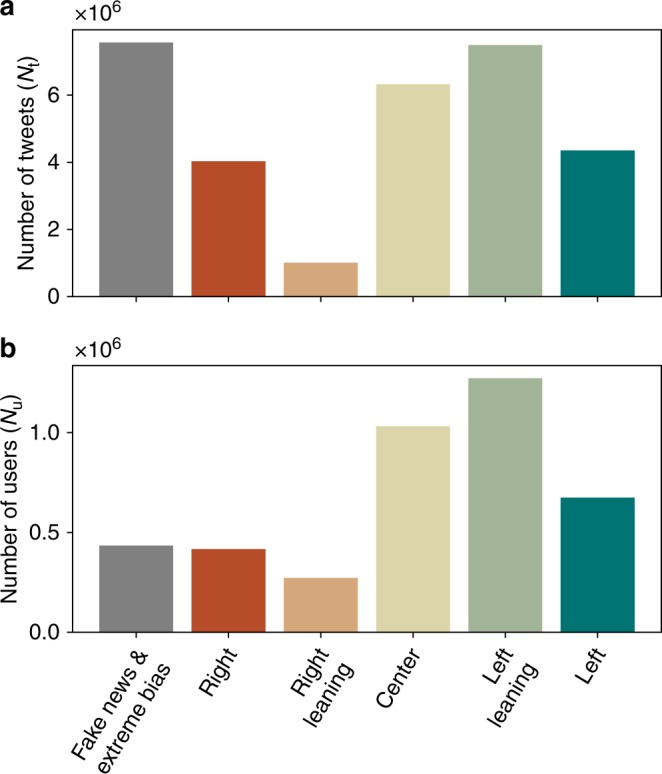
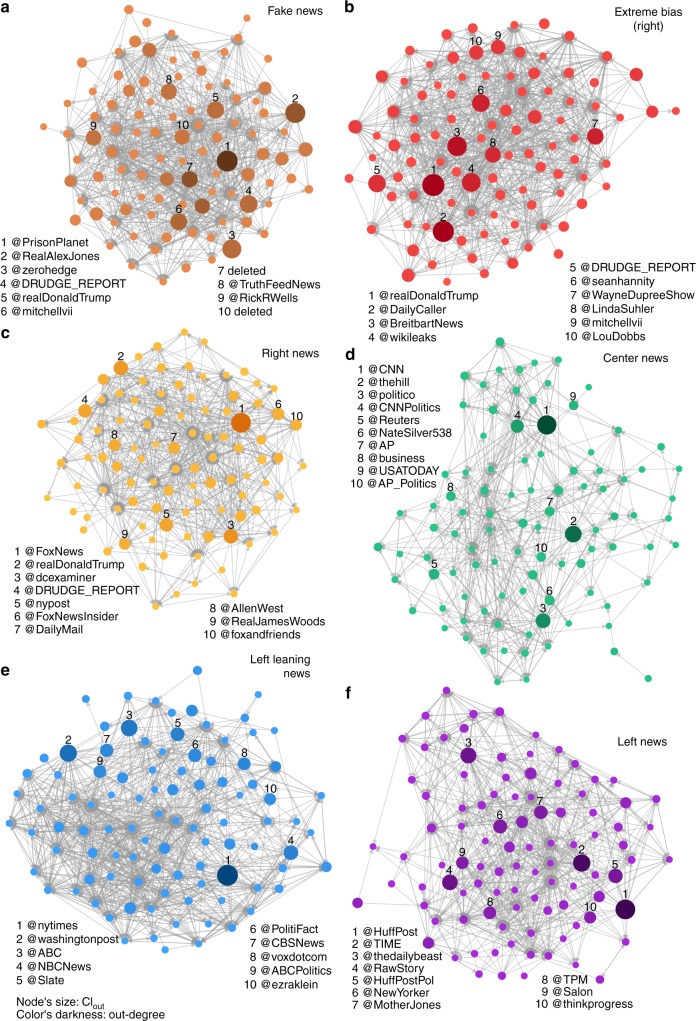
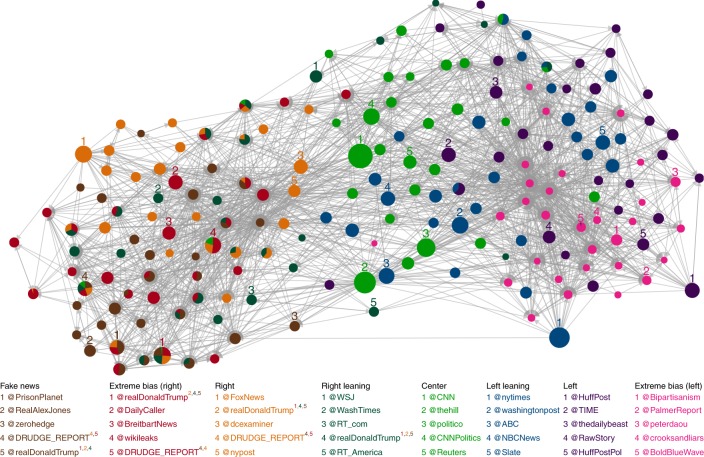
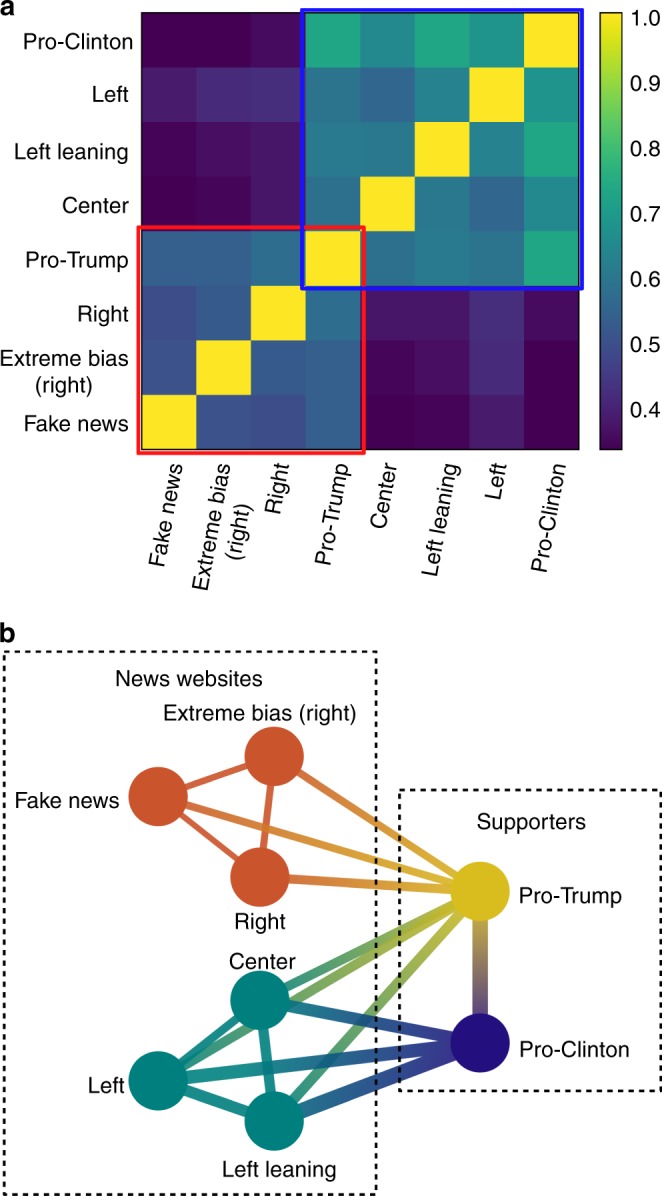
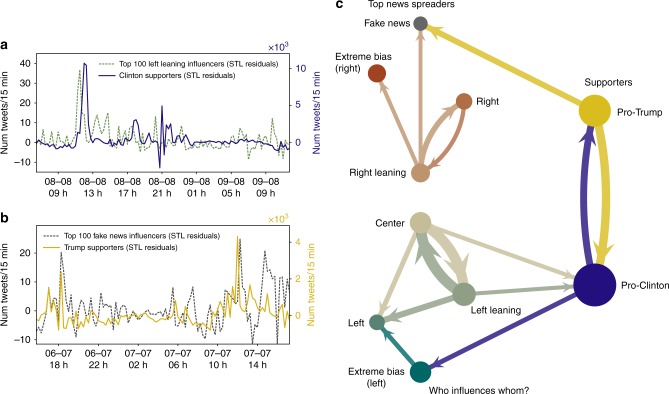
The dynamics and influence of fake news on Twitter during the 2016 US presidential election remains to be clarified. Here, we use a dataset of 171 million tweets in the five months preceding the election day to identify 30 million tweets, from 2.2 million users, which contain a link to news outlets. Based on a classification of news outlets curated by www.opensources.co , we find that 25% of these tweets spread either fake or extremely biased news. We characterize the networks of information flow to find the most influential spreaders of fake and traditional news and use causal modeling to uncover how fake news influenced the presidential election. We find that, while top influencers spreading traditional center and left leaning news largely influence the activity of Clinton supporters, this causality is reversed for the fake news: the activity of Trump supporters influences the dynamics of the top fake news spreaders.
Overview
The claims and statistics of this paper haven’t been checked yet.
Free: it reads the open-access text and checks the first 5 claims that cite a source we can check. Create a free account to check every claim.
Integrity signals
Registry
Cites
Statistics
Figures
Verification
Claims the paper makes
The claims and statistics of this paper haven’t been checked yet.
Free: it reads the open-access text and checks the first 5 claims that cite a source we can check. Create a free account to check every claim.
Claims other papers make about this one
Each is checked against this paper’s own text: does it say what the citing paper says it does?
The cited source says what the claim attributes to it.
In the citing paper
“Real and present concerns exist over the role of mis- and disinformation in public discourse (116–118), the emergence of echo chambers (119) and deepening political polarization (120, 121), in particular around big societal issues like climate change (122).”
From The benefits and dangers of anthropomorphic conversational agents (2025) · cites this paper as [117]
Self-check
Percentages, sums and reported differences re-computed from the paper’s own numbers.
The self-check needs the paper’s full text.
Citations
Cites
1 retracted
Limited individual attention and online virality of low-quality information
Qiu, X., F. M. Oliveira, D., Sahami Shirazi, A., Flammini, A., & Menczer, F. (2017) · Nature Human Behaviour · doi:10.1038/s41562-017-0132 · Cited by 180
RetractedControlling the False Discovery Rate: A Practical and Powerful Approach to Multiple Testing
Benjamini, Y., & Hochberg, Y. (1995) · Journal of the Royal Statistical Society Series B: Statistical Methodology · doi:10.1111/j.2517-6161.1995.tb02031.x · Cited by 109,482
Investigating causal relations by econometric models and cross-spectral methods
Granger, C. W. J. (1969) · Econometrica · doi:10.2307/1912791 · Cited by 22,989
The spread of true and false news online
Vosoughi, S., Roy, D., & Aral, S. (2018) · Science · doi:10.1126/science.aap9559 · Cited by 8,847
Causation, Prediction, and Search
Spirtes, P., Glymour, C., & Scheines, R. (2001) · doi:10.7551/mitpress/1754.001.0001 · Cited by 4,521
A New Status Index Derived from Sociometric Analysis
Katz, L. (1953) · Psychometrika · doi:10.1007/bf02289026 · Cited by 3,866
Exposure to ideologically diverse news and opinion on Facebook
Bakshy, E., Messing, S., & Adamic, L. A. (2015) · Science · doi:10.1126/science.aaa1160 · Cited by 3,245
The spreading of misinformation online
Del Vicario, M., Bessi, A., Zollo, F., Petroni, F., Scala, A., Caldarelli, G., Stanley, H. E., & Quattrociocchi, W. (2016) · Proceedings of the National Academy of Sciences · doi:10.1073/pnas.1517441113 · Cited by 2,407
Confirmation, disconfirmation, and information in hypothesis testing
Klayman, J., & Ha, Y.-W. (1987) · Psychological Review · doi:10.1037/0033-295x.94.2.211 · Cited by 2,094
Ferrara, E., Varol, O., Davis, C., Menczer, F., & Flammini, A. (2016) · Communications of the ACM · doi:10.1145/2818717 · Cited by 1,973
Research works printed but not linked: 2
- Howell L Digital wildfires in a hyperconnected world WEF Rep. 2013 3 15 94
- Cleveland RB Cleveland WS McRae JE Terpenning I STL: a seasonal-trend decomposition procedure based on loess J. Off. Stat. 1990 6 3 73
Cited by
Items 801–900 of 1,000
PELATIHAN MENGHADAPI BERITA PALSU DI ERA REVOLUSI INDUSTRI 4.0 DI KABUPATEN KUBU RAYA
Aunurrahman, A., Hafis, M., & Sahrawi, S. (2020) · GERVASI Jurnal Pengabdian kepada Masyarakat · doi:10.31571/gervasi.v3i2.1575 · Cited by 3
Text-Based Fake News Detection via Machine Learning
Mertoğlu, U., Genç, B., & Sever, H. (2021) · Lecture notes on data engineering and communications technologies · doi:10.1007/978-3-030-79357-9_12 · Cited by 3
Multilingual News Feed Analysis using Intelligent Linguistic Particle Filtering Techniques
Kumar, S. R., Nagasubramanian, G., Muthuramalingam, S., & Al-Turjman, F. M. (2023) · ACM Transactions on Asian and Low-Resource Language Information Processing · doi:10.1145/3569899 · Cited by 3
SGP: Spotting Groups Polluting the Online Political Discourse.Preprint
Wang, J., Lévy, S., Wang, R., Kulshrestha, A., & Rabbany, R. (2019) · arXiv (Cornell University) · Cited by 3
Romanian Fake News Identification using Language Models
Preda, A., Ruşeţi, Ş., Terian, S.-M., & Dascălu, M. (2022) · RoCHI - International Conference on Human-Computer Interaction (RoCHI) · doi:10.37789/rochi.2022.1.1.13 · Cited by 3
Identifying multiple influential spreaders in complex networks based on spectral graph theory
Cui, D.-X., He, J., Xiao, Z.-F., & Ren, W.-P. (2022) · Chinese Physics B · doi:10.1088/1674-1056/acac0b · Cited by 3
Election research in the age of regulated data access under the EU Digital Services Act
Darius, P., Breuer, J., Kruschinski, S., Löecherbach, F., Riedl, J., & Stier, S. (2026) · Internet Policy Review · doi:10.14763/2026.1.2080 · Cited by 3
Kohlbrenner, A., Kaiser, B., Kandula, K., Weiss, R., Mayer, J. R., Han, T., & Helmer, R. (2022) · arXiv (Cornell University) · doi:10.48550/arxiv.2211.02274 · Cited by 3
da Silva, T. V., Gonçalves, S., & da Cunha, B. R. (2022) · The European Physical Journal B · doi:10.1140/epjb/s10051-024-00762-9 · Cited by 3
Regulating social media in a democracy: The case of South Korea
Yu, J. S. (2025) · Otago University Research Archive (University of Otago) · Cited by 3
Religious Tweets During COVID-19: Qualitative Analysis of Articulation of Ideas of Netizens
Parthasarathi, A., & Kumari, G. (2022) · Media Watch · doi:10.1177/09760911221086677 · Cited by 3
Fake News Detection Using Machine Learning
Dhanuka, O., & Tiwari, S. (2024) · International Journal of Research Publication and Reviews · doi:10.55248/gengpi.5.0124.0264 · Cited by 3
How to detect information voids using longitudinal data from social media and web searches
Scalco, I., Gesualdo, F., Cerqueti, R., & Cinelli, M. (2026) · Scientific Reports · doi:10.1038/s41598-026-69786-8 · Cited by 3
Pitfalls in Popular Misinformation Detection Methods and How to Avoid Them
Bozarth, L. (2022) · Deep Blue (University of Michigan) · doi:10.7302/6199 · Cited by 3
Interpretable BERT and RoBERTa based Fake News Detection using LIME
Hameed, S., & Wasim, M. (2025) · International Conference on Innovation in Artificial Intelligence and Internet of Things (AIIT) · doi:10.1109/aiit63112.2025.11082880 · Cited by 3
Alshalabi, N., Lahiani, H., & Yasin, A. R. (2024) · Theory and Practice in Language Studies · doi:10.17507/tpls.1410.06 · Cited by 4
Priam's Folly: United States v. Alvarez and the Fake News Trojan HorsePreprint
Goodyear, M. P. (2021) · SSRN Electronic Journal · doi:10.2139/ssrn.3769351 · Cited by 3
Node center identification in complex networks based on Jensen–Shannon divergence
Han, B., Feng, G., & Shang, P. (2025) · Communications in Nonlinear Science and Numerical Simulation · doi:10.1016/j.cnsns.2025.108977 · Cited by 3
Harnessing sentiment analysis for political campaigns: Trends, platforms, and future directions
Gurung, K. (2025) · JeDEM - eJournal of eDemocracy and Open Government · doi:10.29379/jedem.v17i3.1069 · Cited by 3
Combatting Cybersecurity Threats on Social Media: Network Protection and Data Integrity Strategies
Zaidieh, A. J. Y. (2024) · Journal of Artificial Intelligence and computational technology. · doi:10.70274/jaict.2024.1.1.32 · Cited by 3
Análisis de sentimientos en la predicción de resultados de elecciones presidenciales
Garcia-Moreno, V. E., Alvarez-Caicedo, C. R., & Vásquez-Saenz, N. G. (2021) · Revista de investigación de Sistemas e Informática · doi:10.15381/risi.v14i1.21866 · Cited by 3
A pandemia de fake news no Facebook durante a covid-19
Amarante, E. (2020) · Estudos em Comunicação · doi:10.25768/20.04.03.31.03 · Cited by 3
Optical force induced by strong exciton-plasmon coupling
Li, W., Yu, Y., Yan, H., Zeng, Q., & Xiao, T. (2021) · Optics Express · doi:10.1364/oe.443686 · Cited by 3
Spanish Politicians Dealing with Fake News in the April 2019 General Election
Abad, G. L., García, G. L., & Cano‐Orón, L. (2021) · Wiley eBooks · doi:10.1002/9781119743347.ch7 · Cited by 3
Shifting Polarization and Twitter News Influencers between two U.S. Presidential ElectionsPreprint
Flamino, J., Galezzi, A., Feldman, S. I., Macy, M. W., Cross, B., Zhou, Z., Serafino, M., Bovet, A., Makse, H. A., & Szymanski, B. K. (2021) · arXiv (Cornell University) · doi:10.48550/arxiv.2111.02505 · Cited by 3
Self-citationToxic Synergy Between Hate Speech and Fake News ExposurePreprint
Kim, M., Elmas, T., & Menczer, F. (2024) · arXiv (Cornell University) · doi:10.48550/arxiv.2404.08110 · Cited by 3
Dixit, G., & Kushwaha, A. K. (2022) · Journal of Business Analytics · doi:10.1080/2573234x.2022.2100834 · Cited by 2
Distinguishing In-Groups and Onlookers by Language Use
Minot, J. R., Trujillo, M. Z., Rosenblatt, S., de Anda‐Jáuregui, G., Moog, E., Roth, A. M., Samson, B. P. V., & Hébert‐Dufresne, L. (2022) · Workshop on Computational Approaches to Subjectivity, Sentiment and Social Media Analysis (WASSA) · doi:10.18653/v1/2022.wassa-1.15 · Cited by 2
Issues and Concerns for Human–Robot Interaction
Barfield, W., Weng, Y.-H., & Pagallo, U. (2024) · Cambridge University Press eBooks · doi:10.1017/9781009386708.013 · Cited by 2
METACOMMUNICATION AND APPROPRIATION IN THE DESIGN OF THE INTERACTIVE INTERNET OF THINGS
Chagas, B. A. (2020) · doi:10.17771/pucrio.acad.50190 · Cited by 2
Don't You Know That You're Toxic? How Influencer‐Driven Misinformation Fuels Online Toxicity
Domenico, G. D., Mangiò, F., & Dineva, D. (2026) · Psychology and Marketing · doi:10.1002/mar.70106 · Cited by 2
A Community-Aware Spatio-Temporal Hypergraph Contrastive Learning Method for Social Bot Detection
Liu, F., Li, Z., & Ma, R. (2025) · IEEE Transactions on Information Forensics and Security · doi:10.1109/tifs.2025.3637684 · Cited by 2
Multimodal Learning-Based Relational Graph Neural Networks for Social Bot Detection
Wu, K., Lin, Y., Wang, X., & Wang, L. (2026) · IEEE Transactions on Network and Service Management · doi:10.1109/tnsm.2026.3667016 · Cited by 2
An Analysis of Relationship Between Social Bots and Echo Chambers on X in Modern Japan
Ippa, S., Okubo, T., & Hashimoto, M. (2024) · International Symposium on Computing and Networking · doi:10.1109/candar64496.2024.00014 · Cited by 2
Multi-objective model to protect infrastructure networks from disinformation diffusion
Rocco, C. M., Barker, K., Radhakrishnan, S., & Ramírez-Márquez, J. E. (2025) · Social Network Analysis and Mining · doi:10.1007/s13278-025-01448-5 · Cited by 2
The Utilization of Social Media by Far-Right Political Parties: A Study on Victory Party
Çakıcı, Z., & Aslıbay, E. (2025) · Advances in wireless technologies and telecommunication book series · doi:10.4018/979-8-3693-9999-6.ch009 · Cited by 2
Chagas, B. T. (2025) · Advances in wireless technologies and telecommunication book series · doi:10.4018/979-8-3693-9999-6.ch008 · Cited by 2
How and Why to Regulate False Political Advertising in Australia
Hill, L., Douglass, M., & Baltutis, R. (2022) · Springer eBooks · doi:10.1007/978-981-19-2123-0 · Cited by 3
Ravazzi, C., Dabbene, F., Lagoa, C. M., & Proskurnikov, A. V. (2020) · arXiv (Cornell University) · doi:10.48550/arxiv.2007.06713 · Cited by 2
Unequal penalties: user status dynamics in the spread of social media misinformation
Bae, S. Y., & DeFranza, D. (2026) · Journal of Computer-Mediated Communication · doi:10.1093/jcmc/zmag005 · Cited by 2
A Case Study in Twitter Bot Identification: Are They Still a Problem?
Wang, T., Wu, F., & Sinnott, R. (2020) · International Conference on Social Networks Analysis, Management and Security (SNAMS) · doi:10.1109/snams52053.2020.9336537 · Cited by 2
Dissemination of false information and societal polarization: an empirical investigation
Choudhary, P. K., Chakradhar, J., & Poola, D. (2025) · Journal of Information Technology & Politics · doi:10.1080/19331681.2025.2519053 · Cited by 2
The Mutual Reinforcement of Populism and Post-Truth in Undermining Deliberative Democracy
Loobuyck, P., & Lukić, V. (2025) · Res Publica · doi:10.1007/s11158-025-09734-x · Cited by 2
Ty, J. A., & Maurat, J. I. C. (2025) · IEEE Symposium on Wireless Technology & Applications (ISWTA) · doi:10.1109/iswta68114.2025.11329625 · Cited by 2
Exploiting Social Networks. Technological Trends (Habilitation Thesis)Preprint
Iftene, A. (2020) · arXiv (Cornell University) · doi:10.48550/arxiv.2004.14386 · Cited by 2
User Reputation Indicators to Reduce the Spread of False News on Social Media
Jagayat, A. (2024) · doi:10.32920/26866507 · Cited by 2
ProFNSE: propagation dynamics-derived fake news detection in social networks
You, F., Ding, M., Luo, H., Ma, Y., & Li, H. (2025) · The Journal of Supercomputing · doi:10.1007/s11227-025-07860-0 · Cited by 2
Role of false news in discursive coherence and decision making
Salazar, A. S. C., Caramés, M. A., Larrosa, P. N. F., & Cevasco, J. (2023) · Salud Ciencia y Tecnología - Serie de Conferencias · doi:10.56294/sctconf2023123 · Cited by 2
Fake News and Social Processes: A Short Review
Palshikar, G. K. (2020) · The information retrieval series · doi:10.1007/978-3-030-62696-9_12 · Cited by 2
Rethinking the Reliability of Evidence in End-to-End Fact-Checking from the Causal Perspective
Liu, X., Guo, W., Yan, R., Liu, X., Zhang, Y., & Ru, Z. (2025) · ACM International Conference on Multimedia (ACM MM) · doi:10.1145/3746027.3755859 · Cited by 2
Weaponising Social Media, Mental Health and Surveillance Capitalism Another Side of the Coin
Chaudhary, A. A., Ayub, U., Riaz, A., Mirza, F., & Latif, S. (2022) · Journal of history and social sciences · doi:10.46422/jhss.v13i2.226 · Cited by 2
Stringency without efficiency is not adequate to combat pandemics
Lipić, T., Štajduhar, A., Medvidović, L., Wild, D., Korošak, D., & Podobnik, B. (2022) · Chaos Solitons & Fractals · doi:10.1016/j.chaos.2022.112217 · Cited by 2
The Role of Social Networks in the Spread of Fake News
Rodič, B. (2024) · doi:10.18690/um.fov.3.2024.64 · Cited by 2
Influence blocking maximization under refutation
Luo, Q., Yu, D., Wang, D., Zhang, Y., Zheng, Y., & Cai, Z. (2023) · Social Network Analysis and Mining · doi:10.1007/s13278-023-01123-7 · Cited by 2
Multidisciplinary Fusion Perspective Analysis Method for False Information Recognition
FAN, W., & WANG, Y. (2024) · Advances in Electrical and Computer Engineering · doi:10.4316/aece.2024.01007 · Cited by 2
Fake News Classification Using Vectorized Semantic and Syntactical Analysis
Kumar, S., Dhingra, P., Jaiswal, P., & Bharti, R. (2022) · Lecture notes in networks and systems · doi:10.1007/978-981-16-5689-7_47 · Cited by 2
Ganie, A. G., & Dadvandipour, S. (2021) · Communications in computer and information science · doi:10.1007/978-3-030-82322-1_1 · Cited by 2
Integrating the CRAAP Framework to Support Critical Thinking and Information Literacy
Ong, J. S. H., Loh, K. X. J., Han, J. Y., & Fung, F. M. (2026) · Journal of Chemical Education · doi:10.1021/acs.jchemed.5c00624 · Cited by 2
Peace Informatics: Bridging Peace and Conflict Studies with Computer Science
Reuter, C., Gonsior, A.-L., Riebe, T., & Kaufhold, M. (2024) · Technology, peace and security · doi:10.1007/978-3-658-44810-3_2 · Cited by 2
Díaz, J. B., Martín-Vicario, L., & Perelló-Sobrepere, M. (2025) · Hipertext net Revista Académica sobre Documentación Digital y Comunicación Interactiva · doi:10.31009/hipertext.net.2025.i30.07 · Cited by 2
Fake Tweets Detection and Its Impacts on the 2020 U.S. Election Prediction
Qorib, M., & Kim, J. (2024) · International Symposium on Networks, Computers and Communications (ISNCC) · doi:10.1109/isncc62547.2024.10758954 · Cited by 2
Towards a Typology of Intentionally Inaccurate Representations of Reality in Media Content
Davis, M. J., & Fors, P. (2020) · IFIP advances in information and communication technology · doi:10.1007/978-3-030-62803-1_23 · Cited by 2
PoliWAM: An Exploration of a Large Scale Corpus of Political Discussions on WhatsApp MessengerPreprint
Srivastava, V. P., & Singh, M. P. (2020) · Zenodo (CERN European Organization for Nuclear Research) · doi:10.5281/zenodo.4115660 · Cited by 2
Straub, J., Spradling, M., & Fedor, B. (2022) · Information · doi:10.3390/info13050252 · Cited by 2
Spradling, M., & Straub, J. (2022) · Information · doi:10.3390/info13110516 · Cited by 2
Fake News Detection: Do Complex Problems Need Complex Solutions?Preprint
Marín, I. P., & Arroyo, D. (2020) · SSRN Electronic Journal · doi:10.2139/ssrn.3721249 · Cited by 2
Automated clustering of COVID-19 anti-vaccine discourse on TwitterPreprint
Quintana, I. O., Cheong, M., Alfano, M., Reimann, R., & Klein, C. (2022) · arXiv (Cornell University) · doi:10.48550/arxiv.2203.01549 · Cited by 2
Understanding the Strategies of Creating Fake News in Social MediaPreprint
Vatsalan, D., & Arachchilage, N. A. G. (2020) · Preprints.org · doi:10.20944/preprints202011.0369.v2 · Cited by 2
Deep Learning Techniques for Fake News Detection
Fang, K. (2022) · Highlights in Science Engineering and Technology · doi:10.54097/hset.v16i.2638 · Cited by 2
All Trolls Have One Mission: An Entropy Analysis of Political Misinformation Spreaders
Diaz-Garcia, J. A., & Amador, J. (2023) · Lecture notes in computer science · doi:10.1007/978-3-031-42935-4_13 · Cited by 2
Amri, S. (2024) · Papyrus : Institutional Repository (Université de Montréal) · doi:10.71781/9839 · Cited by 2
Challenges in Automated Detection of COVID-19 Misinformation
Herrmannová, D., Thakur, G. M., Grant, J. N., Tansakul, V., Eaton, B., Kotevska, O., Burdette, J., Smyth, M., & Smith, M. L. (2021) · OSTI OAI (U.S. Department of Energy Office of Scientific and Technical Information) · doi:10.5281/zenodo.4697992 · Cited by 2
Kicking Politics: How Football Fan Communities Became Arenas for Political Influence
Paffard, H., & Pacheco, D. F. (2026) · Studies in computational intelligence · doi:10.1007/978-3-032-16723-1_16 · Cited by 2
Fake News Detection about Covid-19 in the Portuguese Language
Filho, A. P. B., Araújo, D. D. C., Ferreira, M. A. D., & Neto, P. S. G. D. M. (2021) · doi:10.5753/eniac.2021.18278 · Cited by 2
pytwanalysis: Twitter Data Management And Analysis at Scale
Nogueira, L., & Tešić, J. (2021) · International Conference on Social Networks Analysis, Management and Security (SNAMS) · doi:10.1109/snams53716.2021.9732079 · Cited by 2
Identificando Websites de Desinformação no Brasil
Araújo, L., Nery, L. F., Rodrigues, I. C., Couto, J. M. M., Reis, J. C. S., da Silva, A. P. C., Almeida, J. M., & Benevenuto, F. (2022) · Simpósio Brasileiro de Bancos de Dados (SBBD) · doi:10.5753/sbbd.2022.225351 · Cited by 2
Trump’s Rhetoric on Social Networks and the Dominance of Computerized Propaganda
Dojčinović, N., & Ljajić, S. (2022) · Društvene i humanističke studije · doi:10.51558/2490-3647.2022.7.1.131 · Cited by 2
Pro-Russian Biases in Anti-Chinese Tweets about the Novel CoronavirusPreprint
Toney, A., Pandey, A., Guo, W., Broniatowski, D. A., & Caliskan, A. (2020) · arXiv (Cornell University) · Cited by 2
Percepções discentes acerca da desordem informacional: um estudo exploratório no ensino fundamental
Manara, L. M., & Fonseca, C. V. (2023) · #Tear Revista de Educação Ciência e Tecnologia · doi:10.35819/tear.v12.n2.a6882 · Cited by 2
Leveraging Traditional Machine Learning and TF-IDF for Robust Fake News Detection
Hameed, Q. A. (2025) · International Journal of Computational and Electronic Aspects in Engineering · doi:10.26706/ijceae.6.3.20250605 · Cited by 2
Is change the only constant? Profile change perspective on #LokSabhaElections2019Preprint
Neha, K., Srikanth, S., Singhal, S., Singh, S., Buduru, A. B., & Kumaraguru, P. (2019) · arXiv (Cornell University) · doi:10.48550/arxiv.1909.10012 · Cited by 2
Natural Language Processing for Scam Detection. Classic and Alternative Analysis TechniquesPreprint
Marín, I. P. (2019) · SSRN Electronic Journal · doi:10.2139/ssrn.3540954 · Cited by 2
Lyu, H., Zheng, Z., & Luo, J. (2021) · arXiv (Cornell University) · Cited by 2
Salamanos, N., Jensen, M. J., Iordanou, C., & Sirivianos, M. (2020) · arXiv (Cornell University) · doi:10.48550/arxiv.2006.09938 · Cited by 2
A Multi-Branch Feature Fusion Approach for Health Misinformation Detection and PropagationPreprint
Sikosana, M., Maudsley-Barton, S., & Ajao, O. (2026) · arXiv (Cornell University) · doi:10.48550/arxiv.2609.00403 · Cited by 2
A gated recurrent unit-based model for fake news detection in online social networks
Mallick, C., Mishra, S., Satpathy, S., & Chalapathi, M. M. V. (2025) · Journal of Information and Optimization Sciences · doi:10.47974/jios-2013 · Cited by 2
Enhancing fake review detection: A robust and adaptive approach for data streams
Zhang, Z., Ngai, E. W. T., Xia, S., & Wu, Z. (2025) · Knowledge-Based Systems · doi:10.1016/j.knosys.2025.115025 · Cited by 2
The Role of Conceptual Blending in Cognitive Metaphor and Humor
Nahi, K. A. (2025) · Evolutionary Studies in Imaginative Culture · Cited by 2
Democracia y el control de contenidos en la red: Especial referencia a España
Alberti, J. R., & Rausseo, A. E. (2024) · Revista Chilena de Derecho y Tecnología · doi:10.5354/0719-2584.2024.67714 · Cited by 2
Liars Know How to Argue: An Approach to Disinformation Analysis Based on Argument Mining
Diaz-Garcia, J. A., Ruiz, M. D., & Martín-Bautista, M. J. (2025) · Lecture notes in networks and systems · doi:10.1007/978-3-031-73997-2_6 · Cited by 2
Notícias falsas e teorias da conspiração face ao absurdo
Pires, A. F. S. (2022) · Lumina · doi:10.34019/1981-4070.2022.v16.38614 · Cited by 2
Analysis of E-mail Account Probing Attack Based on Graph Mining
Wen, Y., Chen, X., Zeng, X., & Wang, W. (2020) · Scientific Reports · doi:10.1038/s41598-020-63191-5 · Cited by 2
ПРОБЛЕМА «ЦИФРОВОЙ ОТМЕНЫ» ГРАЖДАН РОССИИ
Diskin, E. I. (2024) · Труды по Интеллектуальной Собственности · doi:10.17323/tis.2024.22297 · Cited by 2
QuTI! Quantifying Text-Image Consistency in Multimodal DocumentsPreprint
Springstein, M., Müller-Budack, E., & Ewerth, R. (2021) · arXiv (Cornell University) · doi:10.48550/arxiv.2104.13748 · Cited by 2
Modeling Factual Claims with Semantic Frames
Arslan, F., Jimenez, D., Caraballo, J., & Li, C. (2020) · Figshare · doi:10.5281/zenodo.3710506 · Cited by 2
Applying Behavioral Science in Combating COVID-19 at the Workplace: A Narrative ReviewPreprint
Ahadzi, D. F., Owusu, H.-M., Otoo, J. E., & Akumah, E. E. (2021) · Preprints.org · doi:10.20944/preprints202104.0136.v1 · Cited by 1
The cognitive and social dynamics of social correction of misinformation: a scoping review
Vithanage, S. S., Ransom, K., Mendoza, A., & Karunasekera, S. A. (2026) · Behaviour and Information Technology · doi:10.1080/0144929x.2026.2651115 · Cited by 1
Deepfake jako dowód w procesie cywilnym – rozważania na tle polskiego postępowania cywilnego
Michalik, P., & Zaremba, P. (2025) · PRAWO i WIĘŹ · doi:10.36128/priw.vi57.1206 · Cited by 1
A Novel Hybrid Algorithm for Fake News Detection
Sharma, P., Al-Dayyeni, W. S., Nagpal, T., Rana, A. K., Purohit, R. V., & Elaraby, A. E. (2025) · Digital Threats Research and Practice · doi:10.1145/3728473 · Cited by 1
Metadata
- Authors
- Bovet, A., & Makse, H. A.
- Affiliations
- City College of New York (US)
- Corresponding author
- Makse, Hernán A.
- Venue
- Nature Communications
- Published
- 2019-01-02
- Volume
- 10
- Issue
- 1
- Pages
- 7-7
- ISSN
- 2041-1723 (ISSN-L)
- PMC
- PMC6315042
- OpenAlex
- W2792307011
- Cited by
- 701
- References
- 40
- Citations by year
- 2026: 38 · 2025: 106 · 2024: 114 · 2023: 105 · 2022: 109 · 2021: 114 · 2020: 86 · 2019: 28
- FWCI
- 130.25
- Type
- journal article
- Language
- en
- Open access
- gold
- doi.org
- Licence
- cc-by
- creativecommons.org/licenses/by/4.0 (tdm)
- creativecommons.org/licenses/by/4.0 (vor)
- Locations
- Nature Communications (publishedVersion, cc-by)
- Europe PMC (PubMed Central) (publishedVersion, other-oa)
- PubMed Central (publishedVersion, cc-by)
- PubMed (publishedVersion)
- Repository of the University of Namur (publishedVersion, cc-by)
- arXiv (Cornell University) (submittedVersion)
- RePEc: Research Papers in Economics (submittedVersion)
- DOAJ (DOAJ: Directory of Open Access Journals) (submittedVersion)
- DOAJ (DOAJ: Directory of Open Access Journals) (submittedVersion, cc-by-sa)
- arXiv (Cornell University) (cc-by)
- Funders
- National Science Foundation
- Schweizerischer Nationalfonds zur Förderung der Wissenschaftlichen Forschung (165158)
- Topics
- Social Sciences › Sociology and Political Science › Misinformation and Its Impacts
- Physical Sciences › Physics and Astronomy › Statistical and Nonlinear Physics › Complex Network Analysis Techniques
- Social Sciences › Communication › Social Media and Politics
- Keywords
- fake news, 2016 US presidential election, Twitter, information dissemination, influential spreaders, election influence, Trump supporters, social media misinformation
About these checks
Registry, retraction, Cites and statistics results are computed, not judged, with one exception: a printed reference that no index lists is read once by a model before it counts as a citation error. Claims are extracted by a model and kept only when their quote appears verbatim in the text; each cited source is then checked, with a model’s help, for whether it says what the claim relies on. Those verdicts can be wrong — read the claim’s quote and the cited source before relying on one.
Statistics and arithmetic are recomputed, not judged.
Confidence bands are shown only for fields calibrated on our annotated test set. None is calibrated yet, so no band is shown.
What counts as a claim ›How we measure confidence ›How we check this ›
Are you an author, or do you see a problem with this page? Request a review
Data sources
Bibliographic data: Semantic Scholar, OpenAlex, Crossref.
Contains information from the Semantic Scholar Academic Graph Datasets, made available under the ODC Attribution License (ODC-BY 1.0).
Semantic Scholar’s data is described in: Kinney, R., et al. (2023). The Semantic Scholar Open Data Platform. arXiv:2301.10140.
