

High levels of AAV vector integration into CRISPR-induced DNA breaks
Open accessThe DOI matches its Crossref record; 41 of the 41 references it cites were found in a registry or an index.
Abstract
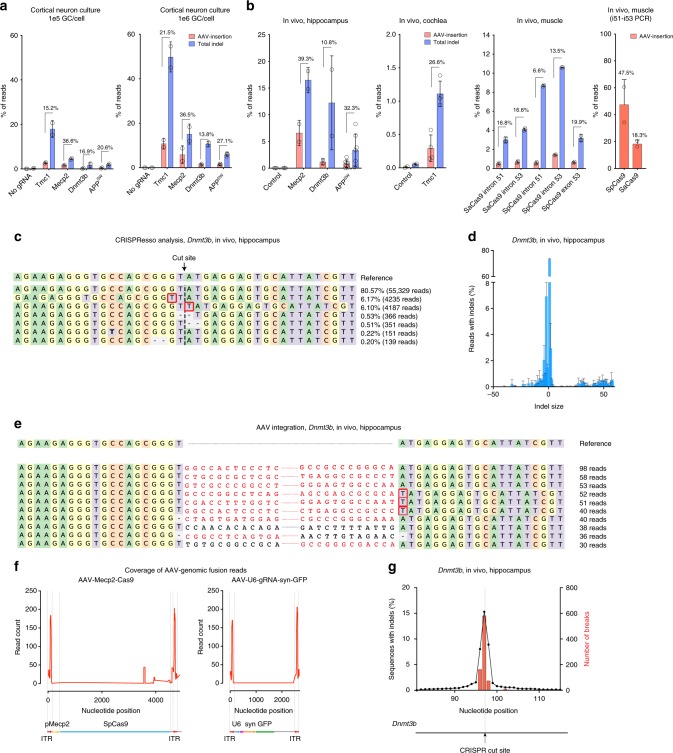
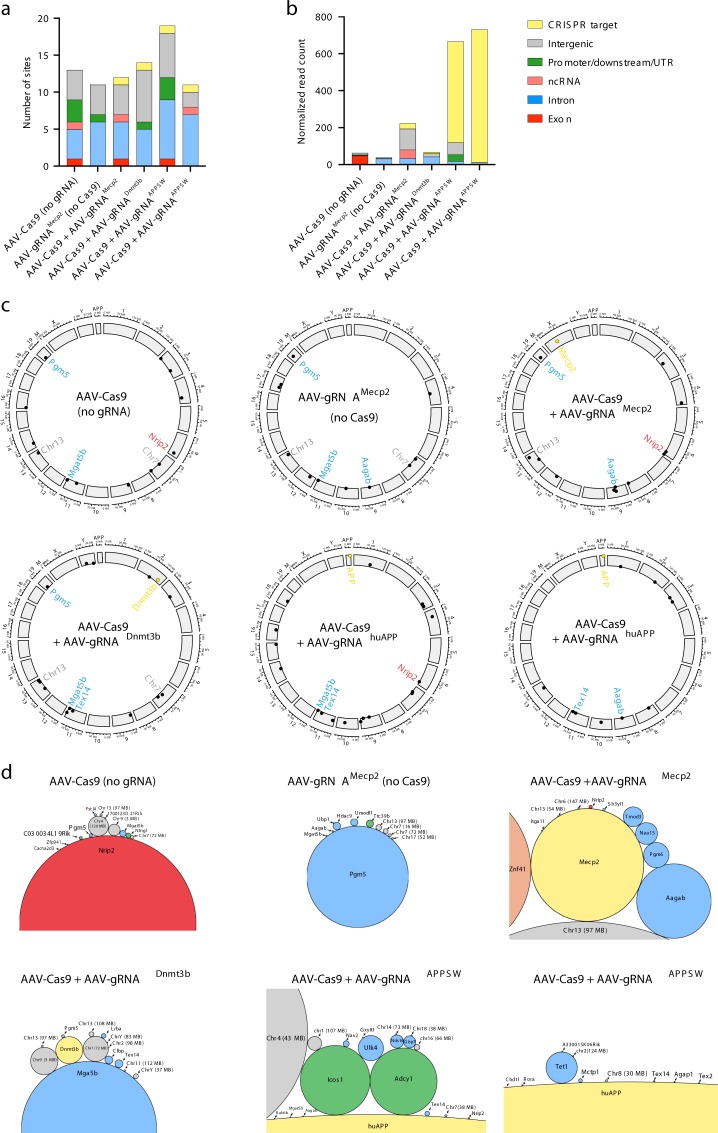
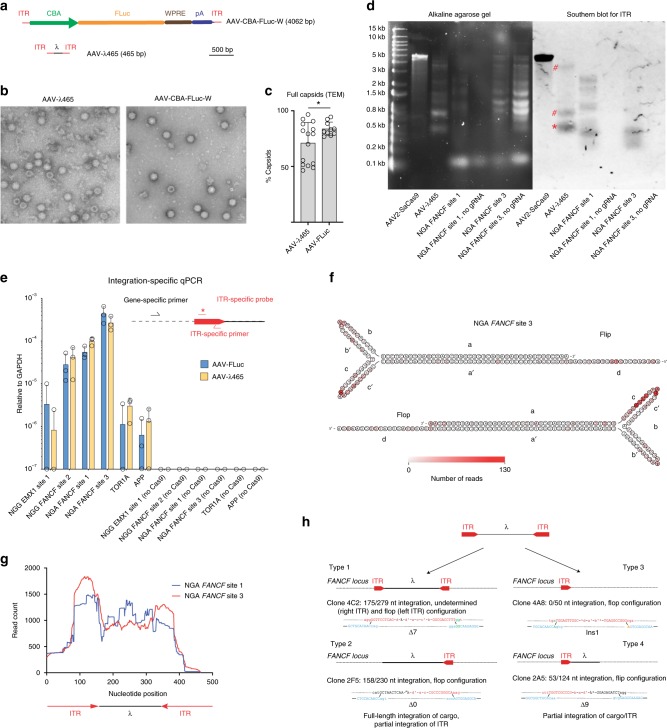
Adeno-associated virus (AAV) vectors have shown promising results in preclinical models, but the genomic consequences of transduction with AAV vectors encoding CRISPR-Cas nucleases is still being examined. In this study, we observe high levels of AAV integration (up to 47%) into Cas9-induced double-strand breaks (DSBs) in therapeutically relevant genes in cultured murine neurons, mouse brain, muscle and cochlea. Genome-wide AAV mapping in mouse brain shows no overall increase of AAV integration except at the CRISPR/Cas9 target site. To allow detailed characterization of integration events we engineer a miniature AAV encoding a 465 bp lambda bacteriophage DNA (AAV-λ465), enabling sequencing of the entire integrated vector genome. The integration profile of AAV-465λ in cultured cells display both full-length and fragmented AAV genomes at Cas9 on-target sites. Our data indicate that AAV integration should be recognized as a common outcome for applications that utilize AAV for genome editing.
Overview
The claims and statistics of this paper haven’t been checked yet.
Free: it reads the open-access text and checks the first 5 claims that cite a source we can check. Create a free account to check every claim.
Integrity signals
Registry
Cites
Statistics
Figures
Verification
Claims the paper makes
The claims and statistics of this paper haven’t been checked yet.
Free: it reads the open-access text and checks the first 5 claims that cite a source we can check. Create a free account to check every claim.
Claims other papers make about this one
Each is checked against this paper’s own text: does it say what the citing paper says it does?
The cited source doesn’t support the claim as written.
In the citing paper
“However, if left active in cells, functional rAAV-CRISPR/Cas9 systems do increase the number of off-target integration events into the genome [218].”
From Recombinant Adeno-Associated Viral Vectors (rAAV)-Vector Elements in Ocular Gene Therapy Clinical Trials and Transgene Expression and Bioactivity Assays (2020) · cites this paper as [218]
Checked by a reasoning model — may be wrong.
Experimental — accuracy not yet measured
Self-check
Percentages, sums and reported differences re-computed from the paper’s own numbers.
The self-check needs the paper’s full text.
Citations
Cites
ANNOVAR: functional annotation of genetic variants from high-throughput sequencing data
Wang, K., Li, M., & Hakonarson, H. (2010) · Nucleic Acids Research · doi:10.1093/nar/gkq603 · Cited by 14,621
Genome engineering using the CRISPR-Cas9 system
Ran, F. A., Hsu, P. D., Wright, J., Agarwala, V., Scott, D. A., & Zhang, F. (2013) · Nature Protocols · doi:10.1038/nprot.2013.143 · Cited by 11,133
High-fidelity CRISPR-Cas9 nucleases with no detectable genome-wide off-target effects
Kleinstiver, B. P., Pattanayak, V., Prew, M. S., Tsai, S. Q., Nguyen, N. T., Zheng, Z., & Joung, J. K. (2016) · Nature · doi:10.1038/nature16526 · Cited by 2,673
Self-citationRationally engineered Cas9 nucleases with improved specificity
Slaymaker, I. M., Gao, L., Zetsche, B., Scott, D. A., Yan, W. X., & Zhang, F. (2016) · Science · doi:10.1126/science.aad5227 · Cited by 2,414
GUIDE-seq enables genome-wide profiling of off-target cleavage by CRISPR-Cas nucleases
Tsai, S. Q., Zheng, Z., Nguyen, N. T., Liebers, M., Topkar, V. V., Thapar, V., Wyvekens, N., Khayter, C., Iafrate, A. J., Le, L. P., et al. (2015) · Nature Biotechnology · doi:10.1038/nbt.3117 · Cited by 2,268
Self-citationDeficiency of methyl-CpG binding protein-2 in CNS neurons results in a Rett-like phenotype in mice
Chen, R. Z., Akbarian, S., Tudor, M., & Jaenisch, R. (2001) · Nature Genetics · doi:10.1038/85906 · Cited by 1,275
Enhanced proofreading governs CRISPR-Cas9 targeting accuracy
Chen, J. S., Dagdas, Y. S., Kleinstiver, B. P., Welch, M. M., Sousa, A. A., Harrington, L. B., Sternberg, S. H., Joung, J. K., Yildiz, A., & Doudna, J. A. (2017) · Nature · doi:10.1038/nature24268 · Cited by 1,168
Self-citationIn vivo genome editing improves muscle function in a mouse model of Duchenne muscular dystrophy
Nelson, C. E., Hakim, C. H., Ousterout, D. G., Thakore, P. I., Moreb, E. A., Rivera, R. M. C., Madhavan, S., Pan, X., Ran, F. A., Yan, W. X., et al. (2016) · Science · doi:10.1126/science.aad5143 · Cited by 1,144
In vivo gene editing in dystrophic mouse muscle and muscle stem cells
Tabebordbar, M., Zhu, K., Cheng, J. K. W., Chew, W. L., Widrick, J. J., Yan, W. X., Maesner, C., Wu, E. Y., Xiao, R., Ran, F. A., et al. (2016) · Science · doi:10.1126/science.aad5177 · Cited by 1,046
Dnmt1 and Dnmt3a maintain DNA methylation and regulate synaptic function in adult forebrain neurons
Feng, J., Zhou, Y., Campbell, S. L., Le, T., Li, E., Sweatt, J. D., Silva, A. J., & Fan, G. (2010) · Nature Neuroscience · doi:10.1038/nn.2514 · Cited by 1,019
Long, C., Amoasii, L., Mireault, A. A., McAnally, J. R., Li, H., Sanchez-Ortiz, E., Bhattacharyya, S., Shelton, J. M., Bassel-Duby, R., & Olson, E. N. (2016) · Science · doi:10.1126/science.aad5725 · Cited by 937
Targeted integration of adeno-associated virus (AAV) into human chromosome 19.
Samulski, R. J., Zhu, X., Xiao, X., Brook, J. D., Housman, D. E., Epstein, N., & Hunter, L. A. (1991) · The EMBO Journal · doi:10.1002/j.1460-2075.1991.tb04964.x · Cited by 784
In vivo interrogation of gene function in the mammalian brain using CRISPR-Cas9
Swiech, L., Heidenreich, M., Banerjee, A., Habib, N., Li, Y., Trombetta, J., Sur, M., & Zhang, F. (2015) · Nature Biotechnology · doi:10.1038/nbt.3055 · Cited by 772
Development of a gene-editing approach to restore vision loss in Leber congenital amaurosis type 10
Maeder, M. L., Stefanidakis, M., Wilson, C. J., Baral, R., Barrera, L. A., Bounoutas, G. S., Bumcrot, D., Chao, H., Ciulla, D. M., DaSilva, J. A., et al. (2019) · Nature Medicine · doi:10.1038/s41591-018-0327-9 · Cited by 707
Broadening the targeting range of Staphylococcus aureus CRISPR-Cas9 by modifying PAM recognition
Kleinstiver, B. P., Prew, M. S., Tsai, S. Q., Nguyen, N. T., Topkar, V. V., Zheng, Z., & Joung, J. K. (2015) · Nature Biotechnology · doi:10.1038/nbt.3404 · Cited by 611
Self-citationGene editing restores dystrophin expression in a canine model of Duchenne muscular dystrophy
Amoasii, L., Hildyard, J. C. W., Li, H., Sanchez-Ortiz, E., Mireault, A., Caballero, D., Harron, R., Stathopoulou, T.-R., Massey, C., Shelton, J. M., et al. (2018) · Science · doi:10.1126/science.aau1549 · Cited by 546
Treatment of autosomal dominant hearing loss by in vivo delivery of genome editing agents
Gao, X., Tao, Y., Lamas, V., Huang, M., Yeh, W.-H., Pan, B., Hu, Y.-J., Hu, J. H., Thompson, D. B., Shu, Y., et al. (2018) · Nature · doi:10.1038/nature25164 · Cited by 536
Analyzing CRISPR genome-editing experiments with CRISPResso
Pinello, L., Canver, M. C., Hoban, M. D., Orkin, S. H., Kohn, D. B., Bauer, D. E., & Yuan, G.-C. (2016) · Nature Biotechnology · doi:10.1038/nbt.3583 · Cited by 459
Integration of Adeno-Associated Virus (AAV) and Recombinant AAV Vectors
McCarty, D. M., Young, S. M., & Samulski, R. J. (2004) · Annual Review of Genetics · doi:10.1146/annurev.genet.37.110801.143717 · Cited by 450
Long-term evaluation of AAV-CRISPR genome editing for Duchenne muscular dystrophy
Nelson, C. E., Wu, Y., Gemberling, M. P., Oliver, M. L., Waller, M. A., Bohning, J. D., Robinson-Hamm, J. N., Bulaklak, K., Castellanos Rivera, R. M., Collier, J. H., et al. (2019) · Nature Medicine · doi:10.1038/s41591-019-0344-3 · Cited by 430
Vector design influences hepatic genotoxicity after adeno-associated virus gene therapy
Chandler, R. J., LaFave, M. C., Varshney, G. K., Trivedi, N. S., Carrillo-Carrasco, N., Senac, J. S., Wu, W., Hoffmann, V., Elkahloun, A. G., Burgess, S. M., et al. (2015) · Journal of Clinical Investigation · doi:10.1172/jci79213 · Cited by 403
Bengtsson, N. E., Hall, J. K., Odom, G. L., Phelps, M. P., Andrus, C. R., Hawkins, R. D., Hauschka, S. D., Chamberlain, J. R., & Chamberlain, J. S. (2017) · Nature Communications · doi:10.1038/ncomms14454 · Cited by 387
Self-citationIn vivo CRISPR editing with no detectable genome-wide off-target mutations
Akcakaya, P., Bobbin, M. L., Guo, J. A., Malagon-Lopez, J., Clement, K., Garcia, S. P., Fellows, M. D., Porritt, M. J., Firth, M. A., Carreras, A., et al. (2018) · Nature · doi:10.1038/s41586-018-0500-9 · Cited by 321
Self-citationAdeno-Associated Virus Vector Genomes Persist as Episomal Chromatin in Primate Muscle
Penaud-Budloo, M., Le Guiner, C., Nowrouzi, A., Toromanoff, A., Chérel, Y., Chenuaud, P., Schmidt, M., von Kalle, C., Rolling, F., Moullier, P., et al. (2008) · Journal of Virology · doi:10.1128/jvi.00649-08 · Cited by 317
Beethoven, a mouse model for dominant, progressive hearing loss DFNA36
Vreugde, S., Erven, A., Kros, C. J., Marcotti, W., Fuchs, H., Kurima, K., Wilcox, E. R., Friedman, T. B., Griffith, A. J., Balling, R., et al. (2002) · Nature Genetics · doi:10.1038/ng848 · Cited by 282
CRISPR/Cas9-Mediated Genome Editing as a Therapeutic Approach for Leber Congenital Amaurosis 10
Ruan, G.-X., Barry, E., Yu, D., Lukason, M., Cheng, S. H., & Scaria, A. (2017) · Molecular Therapy · doi:10.1016/j.ymthe.2016.12.006 · Cited by 270
Adeno-associated virus vectors integrate at chromosome breakage sites
Miller, D. G., Petek, L. M., & Russell, D. W. (2004) · Nature Genetics · doi:10.1038/ng1380 · Cited by 266
Genetic Fate of Recombinant Adeno-Associated Virus Vector Genomes in Muscle
Schnepp, B. C., Clark, K. R., Klemanski, D. L., Pacak, C. A., & Johnson, P. R. (2003) · Journal of Virology · doi:10.1128/jvi.77.6.3495-3504.2003 · Cited by 262
Rescue of hearing by gene delivery to inner-ear hair cells using exosome-associated AAV
György, B., Sage, C., Indzhykulian, A. A., Scheffer, D. I., Brisson, A. R., Tan, S., Wu, X., Volak, A., Mu, D., Tamvakologos, P. I., et al. (2017) · Molecular Therapy · doi:10.1016/j.ymthe.2016.12.010 · Cited by 243
Self-citationCharacterization of Adeno-Associated Virus Genomes Isolated from Human Tissues
Schnepp, B. C., Jensen, R. L., Chen, C.-L., Johnson, P. R., & Clark, K. R. (2005) · Journal of Virology · doi:10.1128/jvi.79.23.14793-14803.2005 · Cited by 231
Southern, E. (2006) · Nature Protocols · doi:10.1038/nprot.2006.73 · Cited by 230
Allele-specific gene editing prevents deafness in a model of dominant progressive hearing loss
György, B., Nist-Lund, C., Pan, B., Asai, Y., Karavitaki, K. D., Kleinstiver, B. P., Garcia, S. P., Zaborowski, M. P., Solanes, P., Spataro, S., et al. (2019) · Nature Medicine · doi:10.1038/s41591-019-0500-9 · Cited by 196
Self-citationGyörgy, B., Lööv, C., Zaborowski, M. P., Takeda, S., Kleinstiver, B. P., Commins, C., Kastanenka, K., Mu, D., Volak, A., Giedraitis, V., et al. (2018) · Molecular Therapy Nucleic Acids · doi:10.1016/j.omtn.2018.03.007 · Cited by 190
Self-citationGil-Farina, I., Fronza, R., Kaeppel, C., Lopez-Franco, E., Ferreira, V., D'Avola, D., Benito, A., Prieto, J., Petry, H., Gonzalez-Aseguinolaza, G., et al. (2016) · Molecular Therapy · doi:10.1038/mt.2016.52 · Cited by 179
Robust ZFN-mediated genome editing in adult hemophilic mice
Anguela, X. M., Sharma, R., Doyon, Y., Miller, J. C., Li, H., Haurigot, V., Rohde, M. E., Wong, S. Y., Davidson, R. J., Zhou, S., et al. (2013) · Blood · doi:10.1182/blood-2013-04-497354 · Cited by 178
Human Gene Targeting by Adeno-Associated Virus Vectors Is Enhanced by DNA Double-Strand Breaks
Miller, D. G., Petek, L. M., & Russell, D. W. (2003) · Molecular and Cellular Biology · doi:10.1128/mcb.23.10.3550-3557.2003 · Cited by 128
Induction of hepatocellular carcinoma by in vivo gene targeting
Wang, P.-R., Xu, M., Toffanin, S., Li, Y., Llovet, J. M., & Russell, D. W. (2012) · Proceedings of the National Academy of Sciences · doi:10.1073/pnas.1117032109 · Cited by 105
McCullough, K. T., Boye, S. L., Fajardo, D., Calabro, K., Peterson, J. J., Strang, C. E., Chakraborty, D., Gloskowski, S., Haskett, S., Samuelsson, S., et al. (2019) · Human Gene Therapy · doi:10.1089/hum.2018.193 · Cited by 79
Microhomology-assisted scarless genome editing in human iPSCs
Kim, S.-I., Matsumoto, T., Kagawa, H., Nakamura, M., Hirohata, R., Ueno, A., Ohishi, M., Sakuma, T., Soga, T., Yamamoto, T., et al. (2018) · Nature Communications · doi:10.1038/s41467-018-03044-y · Cited by 60
Ho, D. W., Sze, K. M., & Ng, I. O. (2015) · Oncotarget · doi:10.18632/oncotarget.4187 · Cited by 56
Pryadkina, M., Lostal, W., Bourg, N., Charton, K., Roudaut, C., Hirsch, M. L., & Richard, I. (2015) · Molecular Therapy - Methods & Clinical Development · doi:10.1038/mtm.2015.9 · Cited by 53
Research works printed but not linked: 1
- Miller Daniel G Petek Lisa M Russell David W Adeno-associated virus vectors integrate at chromosome breakage sites Nature Genetics 2004 36 7 767 773 10.1038/ng1380 15208627 · DOI · Paper page
Cited by
Viral vector platforms within the gene therapy landscape
Bulcha, J. T., Wang, Y., Ma, H., Tai, P. W. L., & Gao, G. (2021) · Signal Transduction and Targeted Therapy · doi:10.1038/s41392-021-00487-6 · Cited by 1,404
Drug delivery systems for RNA therapeutics
Paunovska, K., Loughrey, D., & Dahlman, J. E. (2022) · Nature Reviews Genetics · doi:10.1038/s41576-021-00439-4 · Cited by 1,349
Adeno-associated virus as a delivery vector for gene therapy of human diseases
Wang, J.-H., Gessler, D. J., Zhan, W., Gallagher, T. L., & Gao, G. (2024) · Signal Transduction and Targeted Therapy · doi:10.1038/s41392-024-01780-w · Cited by 904
“470,471 Other factors postulated to in fl uence vector genome integration include rAAV serotype, promoter/enhancer elements, and vector impurities.”
BackgroundOff-target effects in CRISPR/Cas9 gene editing
Guo, C., Ma, X., Gao, F., & Guo, Y. (2023) · Frontiers in Bioengineering and Biotechnology · doi:10.3389/fbioe.2023.1143157 · Cited by 704
“While this property might be favored in gene supplementation applications, AAV-mediated gene editing likely exhibits the propensity to accumulate undesired off-target mutations over time (Hanlon et al., 2019; Kim et al., 2019).”
BackgroundCRISPR-Based Therapeutic Genome Editing: Strategies and In Vivo Delivery by AAV Vectors
Wang, D., Zhang, F., & Gao, G. (2020) · Cell · doi:10.1016/j.cell.2020.03.023 · Cited by 527
“, 2019), and AAV vector genome integration (Hanlon et al., 2019; Nelson et al., 2019).”
Metadata
- Authors
- Hanlon, K. S., Kleinstiver, B. P., Garcia, S. P., Zaborowski, M. P., Volak, A., Spirig, S. E., Muller, A., Sousa, A. A., Tsai, S. Q., Bengtsson, N. E., Lööv, C., Ingelsson, M., Chamberlain, J. S., Corey, D. P., Aryee, M. J., Joung, J. K., Breakefield, X. O., Maguire, C. A., & György, B.
- Affiliations
- Harvard University (US)
- Poznan University of Medical Sciences (PL)
- Massachusetts General Hospital (US)
- Institute of Molecular and Clinical Ophthalmology Basel (CH)
- St. Jude Children's Research Hospital (US)
- University of Washington (US)
- Uppsala University (SE)
- Corresponding author
- Maguire, Casey A.
- György, Bence
- ORCID
- Venue
- Nature Communications
- Published
- 2019-09-30
- Volume
- 10
- Issue
- 1
- Pages
- 4439-4439
- ISSN
- 2041-1723 (ISSN-L)
- PMC
- PMC6769011
- OpenAlex
- W2976425815
- Cited by
- 431
- References
- 41
- Citations by year
- 2026: 57 · 2025: 67 · 2024: 75 · 2023: 64 · 2022: 57 · 2021: 59 · 2020: 47 · 2019: 4
- FWCI
- 25.16
- Type
- journal article
- Language
- en
- Open access
- gold
- doi.org
- Licence
- cc-by
- creativecommons.org/licenses/by/4.0 (tdm)
- creativecommons.org/licenses/by/4.0 (vor)
- Locations
- Nature Communications (publishedVersion, cc-by)
- PubMed Central (publishedVersion, cc-by)
- PubMed (publishedVersion)
- Uppsala University Publications (Uppsala University) (submittedVersion, other-oa)
- RePEc: Research Papers in Economics (submittedVersion)
- DOAJ (DOAJ: Directory of Open Access Journals) (submittedVersion)
- DOAJ (DOAJ: Directory of Open Access Journals) (submittedVersion, cc-by-sa)
- Funders
- U.S. Department of Health & Human Services | NIH | Center for Information Technology (R01DC017117)
- Topics
- Life Sciences › Biochemistry, Genetics and Molecular Biology › Genetics › Virus-based gene therapy research
- Life Sciences › Biochemistry, Genetics and Molecular Biology › Molecular Biology › CRISPR and Genetic Engineering
- Life Sciences › Biochemistry, Genetics and Molecular Biology › Molecular Biology › RNA Interference and Gene Delivery
- Keywords
- adeno-associated virus vectors, AAV integration, CRISPR/Cas9, DNA double-strand breaks, genome editing, mouse brain, muscle, cochlea
- MeSH terms
- Gene Editing, Dependovirus, Animals, Brain, Cell Line, Chromosome Mapping, Cochlea, Endonucleases, Genetic Vectors, Humans, Male, Mice, Inbred C57BL, Mice, Transgenic, Muscles, Neurons, Bacteriophage lambda, Genetic Therapy, Virus Integration, Genome, Treatment Outcome, Gene Targeting, Mice, Targeted Gene Repair, DNA Breaks, Clustered Regularly Interspaced Short Palindromic Repeats, CRISPR-Cas Systems
About these checks
Registry, retraction, Cites and statistics results are computed, not judged, with one exception: a printed reference that no index lists is read once by a model before it counts as a citation error. Claims are extracted by a model and kept only when their quote appears verbatim in the text; each cited source is then checked, with a model’s help, for whether it says what the claim relies on. Those verdicts can be wrong — read the claim’s quote and the cited source before relying on one.
Statistics and arithmetic are recomputed, not judged.
Confidence bands are shown only for fields calibrated on our annotated test set. None is calibrated yet, so no band is shown.
What counts as a claim ›How we measure confidence ›How we check this ›
Are you an author, or do you see a problem with this page? Request a review
Data sources
Bibliographic data: Semantic Scholar, OpenAlex, Crossref.
Contains information from the Semantic Scholar Academic Graph Datasets, made available under the ODC Attribution License (ODC-BY 1.0).
Semantic Scholar’s data is described in: Kinney, R., et al. (2023). The Semantic Scholar Open Data Platform. arXiv:2301.10140.
