

High levels of AAV vector integration into CRISPR-induced DNA breaks
Open accessThe DOI matches its Crossref record; 41 of the 41 references it cites were found in a registry or an index.
Abstract
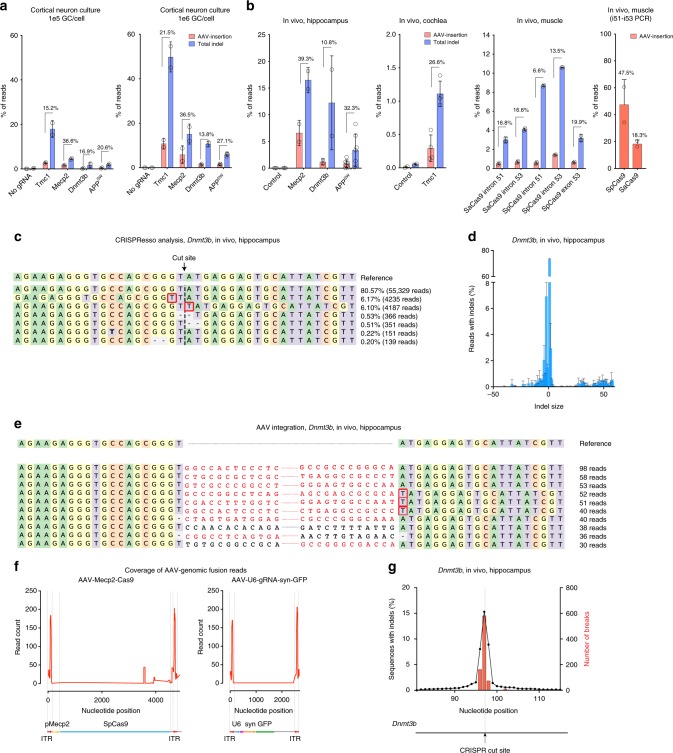
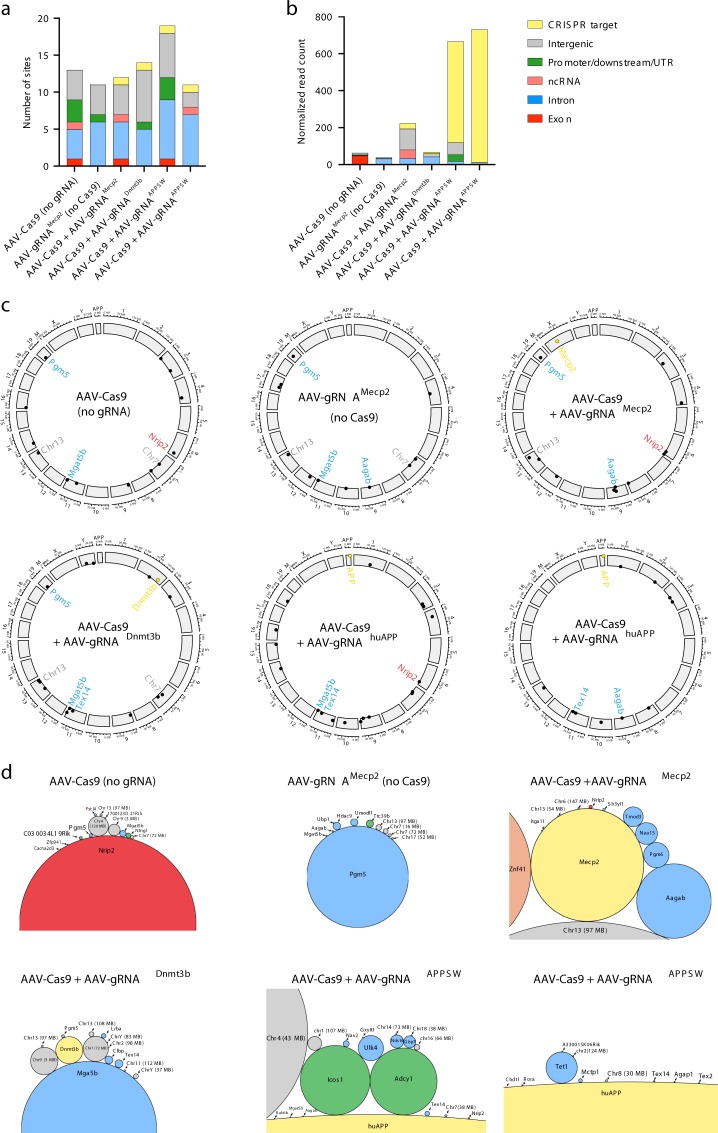
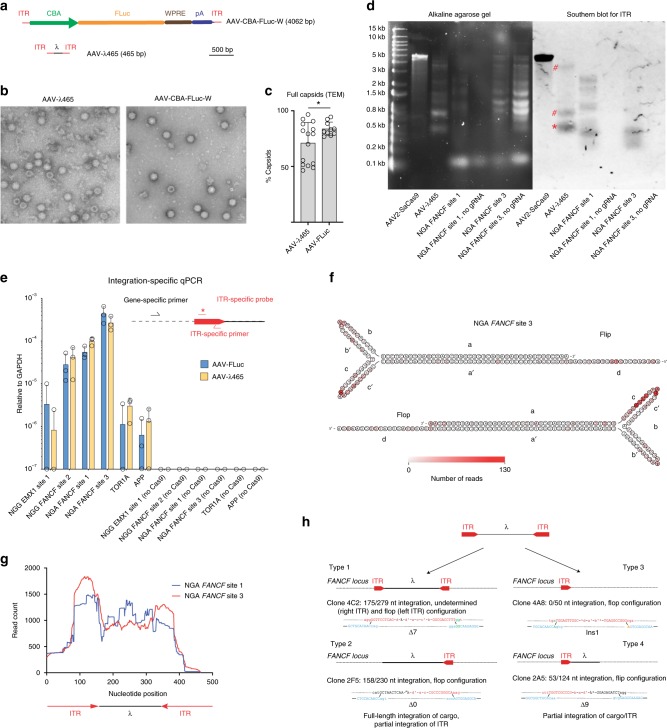
Adeno-associated virus (AAV) vectors have shown promising results in preclinical models, but the genomic consequences of transduction with AAV vectors encoding CRISPR-Cas nucleases is still being examined. In this study, we observe high levels of AAV integration (up to 47%) into Cas9-induced double-strand breaks (DSBs) in therapeutically relevant genes in cultured murine neurons, mouse brain, muscle and cochlea. Genome-wide AAV mapping in mouse brain shows no overall increase of AAV integration except at the CRISPR/Cas9 target site. To allow detailed characterization of integration events we engineer a miniature AAV encoding a 465 bp lambda bacteriophage DNA (AAV-λ465), enabling sequencing of the entire integrated vector genome. The integration profile of AAV-465λ in cultured cells display both full-length and fragmented AAV genomes at Cas9 on-target sites. Our data indicate that AAV integration should be recognized as a common outcome for applications that utilize AAV for genome editing.
Overview
The claims and statistics of this paper haven’t been checked yet.
Free: it reads the open-access text and checks the first 5 claims that cite a source we can check. Create a free account to check every claim.
Integrity signals
Registry
Cites
Statistics
Figures
Verification
Claims the paper makes
The claims and statistics of this paper haven’t been checked yet.
Free: it reads the open-access text and checks the first 5 claims that cite a source we can check. Create a free account to check every claim.
Claims other papers make about this one
Each is checked against this paper’s own text: does it say what the citing paper says it does?
The cited source doesn’t support the claim as written.
In the citing paper
“However, if left active in cells, functional rAAV-CRISPR/Cas9 systems do increase the number of off-target integration events into the genome [218].”
From Recombinant Adeno-Associated Viral Vectors (rAAV)-Vector Elements in Ocular Gene Therapy Clinical Trials and Transgene Expression and Bioactivity Assays (2020) · cites this paper as [218]
Checked by a reasoning model — may be wrong.
Experimental — accuracy not yet measured
Self-check
Percentages, sums and reported differences re-computed from the paper’s own numbers.
The self-check needs the paper’s full text.
Citations
Cites
ANNOVAR: functional annotation of genetic variants from high-throughput sequencing data
Wang, K., Li, M., & Hakonarson, H. (2010) · Nucleic Acids Research · doi:10.1093/nar/gkq603 · Cited by 14,621
Genome engineering using the CRISPR-Cas9 system
Ran, F. A., Hsu, P. D., Wright, J., Agarwala, V., Scott, D. A., & Zhang, F. (2013) · Nature Protocols · doi:10.1038/nprot.2013.143 · Cited by 11,133
High-fidelity CRISPR-Cas9 nucleases with no detectable genome-wide off-target effects
Kleinstiver, B. P., Pattanayak, V., Prew, M. S., Tsai, S. Q., Nguyen, N. T., Zheng, Z., & Joung, J. K. (2016) · Nature · doi:10.1038/nature16526 · Cited by 2,673
Self-citationRationally engineered Cas9 nucleases with improved specificity
Slaymaker, I. M., Gao, L., Zetsche, B., Scott, D. A., Yan, W. X., & Zhang, F. (2016) · Science · doi:10.1126/science.aad5227 · Cited by 2,414
GUIDE-seq enables genome-wide profiling of off-target cleavage by CRISPR-Cas nucleases
Tsai, S. Q., Zheng, Z., Nguyen, N. T., Liebers, M., Topkar, V. V., Thapar, V., Wyvekens, N., Khayter, C., Iafrate, A. J., Le, L. P., et al. (2015) · Nature Biotechnology · doi:10.1038/nbt.3117 · Cited by 2,268
Self-citationDeficiency of methyl-CpG binding protein-2 in CNS neurons results in a Rett-like phenotype in mice
Chen, R. Z., Akbarian, S., Tudor, M., & Jaenisch, R. (2001) · Nature Genetics · doi:10.1038/85906 · Cited by 1,275
Enhanced proofreading governs CRISPR-Cas9 targeting accuracy
Chen, J. S., Dagdas, Y. S., Kleinstiver, B. P., Welch, M. M., Sousa, A. A., Harrington, L. B., Sternberg, S. H., Joung, J. K., Yildiz, A., & Doudna, J. A. (2017) · Nature · doi:10.1038/nature24268 · Cited by 1,168
Self-citationIn vivo genome editing improves muscle function in a mouse model of Duchenne muscular dystrophy
Nelson, C. E., Hakim, C. H., Ousterout, D. G., Thakore, P. I., Moreb, E. A., Rivera, R. M. C., Madhavan, S., Pan, X., Ran, F. A., Yan, W. X., et al. (2016) · Science · doi:10.1126/science.aad5143 · Cited by 1,144
In vivo gene editing in dystrophic mouse muscle and muscle stem cells
Tabebordbar, M., Zhu, K., Cheng, J. K. W., Chew, W. L., Widrick, J. J., Yan, W. X., Maesner, C., Wu, E. Y., Xiao, R., Ran, F. A., et al. (2016) · Science · doi:10.1126/science.aad5177 · Cited by 1,046
Dnmt1 and Dnmt3a maintain DNA methylation and regulate synaptic function in adult forebrain neurons
Feng, J., Zhou, Y., Campbell, S. L., Le, T., Li, E., Sweatt, J. D., Silva, A. J., & Fan, G. (2010) · Nature Neuroscience · doi:10.1038/nn.2514 · Cited by 1,019
Research works printed but not linked: 1
- Miller Daniel G Petek Lisa M Russell David W Adeno-associated virus vectors integrate at chromosome breakage sites Nature Genetics 2004 36 7 767 773 10.1038/ng1380 15208627 · DOI · Paper page
Cited by
Viral vector platforms within the gene therapy landscape
Bulcha, J. T., Wang, Y., Ma, H., Tai, P. W. L., & Gao, G. (2021) · Signal Transduction and Targeted Therapy · doi:10.1038/s41392-021-00487-6 · Cited by 1,404
Drug delivery systems for RNA therapeutics
Paunovska, K., Loughrey, D., & Dahlman, J. E. (2022) · Nature Reviews Genetics · doi:10.1038/s41576-021-00439-4 · Cited by 1,349
Adeno-associated virus as a delivery vector for gene therapy of human diseases
Wang, J.-H., Gessler, D. J., Zhan, W., Gallagher, T. L., & Gao, G. (2024) · Signal Transduction and Targeted Therapy · doi:10.1038/s41392-024-01780-w · Cited by 904
“470,471 Other factors postulated to in fl uence vector genome integration include rAAV serotype, promoter/enhancer elements, and vector impurities.”
BackgroundOff-target effects in CRISPR/Cas9 gene editing
Guo, C., Ma, X., Gao, F., & Guo, Y. (2023) · Frontiers in Bioengineering and Biotechnology · doi:10.3389/fbioe.2023.1143157 · Cited by 704
“While this property might be favored in gene supplementation applications, AAV-mediated gene editing likely exhibits the propensity to accumulate undesired off-target mutations over time (Hanlon et al., 2019; Kim et al., 2019).”
BackgroundCRISPR-Based Therapeutic Genome Editing: Strategies and In Vivo Delivery by AAV Vectors
Wang, D., Zhang, F., & Gao, G. (2020) · Cell · doi:10.1016/j.cell.2020.03.023 · Cited by 527
“, 2019), and AAV vector genome integration (Hanlon et al., 2019; Nelson et al., 2019).”
Latest Developed Strategies to Minimize the Off-Target Effects in CRISPR-Cas-Mediated Genome Editing
Naeem, M., Majeed, S., Hoque, M. Z., & Ahmad, I. (2020) · Cells · doi:10.3390/cells9071608 · Cited by 457
Kenjo, E., Hozumi, H., Makita, Y., Iwabuchi, K. A., Fujimoto, N., Matsumoto, S., Kimura, M., Amano, Y., Ifuku, M., Naoe, Y., et al. (2021) · Nature Communications · doi:10.1038/s41467-021-26714-w · Cited by 300
Delivery of CRISPR-Cas tools for in vivo genome editing therapy: Trends and challenges
Taha, E. A., Lee, J., & Hotta, A. (2022) · Journal of Controlled Release · doi:10.1016/j.jconrel.2022.01.013 · Cited by 259
Assessing and advancing the safety of CRISPR-Cas tools: from DNA to RNA editing
Tao, J., Bauer, D. E., & Chiarle, R. (2023) · Nature Communications · doi:10.1038/s41467-023-35886-6 · Cited by 207
György, B., Lööv, C., Zaborowski, M. P., Takeda, S., Kleinstiver, B. P., Commins, C., Kastanenka, K., Mu, D., Volak, A., Giedraitis, V., et al. (2018) · Molecular Therapy Nucleic Acids · doi:10.1016/j.omtn.2018.03.007 · Cited by 190
Self-citationCRISPR-Cas Tools and Their Application in Genetic Engineering of Human Stem Cells and Organoids
Hendriks, D., Clevers, H., & Artegiani, B. (2020) · Cell Stem Cell · doi:10.1016/j.stem.2020.10.014 · Cited by 192
rAAV immunogenicity, toxicity, and durability in 255 clinical trials: A meta-analysis
Shen, W., Liu, S., & Ou, L. (2022) · Frontiers in Immunology · doi:10.3389/fimmu.2022.1001263 · Cited by 173
“In addition to immune responses, AAV toxicity can result from potential insertional mutagenesis. rAAV exists mainly as an episome, but still be able to integrate into host chromosome DNA (80).”
BackgroundCas9 gene therapy for Angelman syndrome traps Ube3a-ATS long non-coding RNA
Wolter, J. M., Mao, H., Fragola, G., Simon, J. M., Krantz, J. L., Bazick, H. O., Oztemiz, B., Stein, J. L., & Zylka, M. J. (2020) · Nature · doi:10.1038/s41586-020-2835-2 · Cited by 160
Regulated control of gene therapies by drug-induced splicing
Mas, A., Hundley, A. A., Ranum, P. T., Tecedor, L., Muehlmatt, A., Lim, E., Lukashev, D. E., Sivasankaran, R., & Davidson, B. L. (2021) · Nature · doi:10.1038/s41586-021-03770-2 · Cited by 137
Ferrari, S., Jacob, A., Cesana, D., Laugel, M., Beretta, S., Varesi, A., Unali, G., Conti, A., Canarutto, D., Albano, L., et al. (2022) · Cell stem cell · doi:10.1016/j.stem.2022.09.001 · Cited by 133
“, 2021) has uncovered a significant rate of vector integration in tissues following in vivo administration (Hanlon et al., 2019; Nelson et al., 2019), which may build-up with time as spontaneous DSBs occur in the cellular genome.”
Gautam, M., Jozic, A., Su, G. L.-N., Herrera-Barrera, M., Curtis, A., Arrizabalaga, S., Tschetter, W., Ryals, R. C., & Sahay, G. (2023) · Nature Communications · doi:10.1038/s41467-023-42189-3 · Cited by 123
CRISPR/Cas9: Principle, Applications, and Delivery through Extracellular Vesicles
Horodecka, K., & Düchler, M. (2021) · International Journal of Molecular Sciences · doi:10.3390/ijms22116072 · Cited by 121
Challenges in delivery systems for CRISPR-based genome editing and opportunities of nanomedicine
Sioson, V. A., Kim, M., & Joo, J. (2021) · Biomedical Engineering Letters · doi:10.1007/s13534-021-00199-4 · Cited by 135
Off-target effects in CRISPR-Cas genome editing for human therapeutics: Progress and challenges
Kalter, N., Fuster‐García, C., Silva, A., Ronco-Díaz, V., Roncelli, S., Turchiano, G., Gorodkin, J., Cathomen, T., Benabdellah, K., Lee, C. M., et al. (2025) · Molecular Therapy — Nucleic Acids · doi:10.1016/j.omtn.2025.102636 · Cited by 135
Global detection of DNA repair outcomes induced by CRISPR–Cas9
Liu, M., Zhang, W., Xin, C., Yin, J., Shang, Y., Chen, A., Li, J., Meng, F., & Hu, J. (2021) · Nucleic Acids Research · doi:10.1093/nar/gkab686 · Cited by 127
“The ITR region forms a hairpin structure that affects the vector stability and, therefore, the ITR regions become a hotpot for plasmid integration (Figure 3G, bottom in salmon) (39).”
BackgroundResultHołubowicz, R., Du, S. W., Felgner, J. H., Šmidák, R., Choi, E. H., Palczewska, G., Menezes, C. R., Dong, Z., Gao, F., Medani, O., et al. (2024) · Nature Biomedical Engineering · doi:10.1038/s41551-024-01296-2 · Cited by 120
“Lastly, there is a non-zero risk of viral genome integration, even when non-integrating viral vectors are used 29 , and this risk could even be worsened by the deployment of Cas9 nucleases and nickases 30,31 .”
Tools for efficient genome editing; ZFN, TALEN, and CRISPR
Shamshirgaran, Y., Liu, J., Sumer, H., Verma, P. J., & Taheri-Ghahfarokhi, A. (2022) · Methods in molecular biology · doi:10.1007/978-1-0716-2301-5_2 · Cited by 114
Principles of Genetic Engineering
Lanigan, T. M., Kopera, H. C., & Saunders, T. L. (2020) · Genes · doi:10.3390/genes11030291 · Cited by 133
Ibraheim, R., Tai, P. W. L., Mir, A., Javeed, N., Wang, J., Rodríguez, T., Namkung, S., Nelson, S. J., Khokhar, E. S., Mintzer, E., et al. (2021) · Nature Communications · doi:10.1038/s41467-021-26518-y · Cited by 121
Signaling cascades in the failing heart and emerging therapeutic strategies
He, X., Du, T., Long, T., Liao, X., Dong, Y., & Huang, Z. (2022) · Signal Transduction and Targeted Therapy · doi:10.1038/s41392-022-00972-6 · Cited by 114
“What’s more, a study published in 2019 indicated that AAV vector was commonly integrated into the DNA breaks, which could lead to potential risk.(523) Therefore, this therapy is still restricted to highly selective gene defects.”
BackgroundCorrection of muscular dystrophies by CRISPR gene editing
Chemello, F., Bassel-Duby, R., & Olson, E. N. (2020) · Journal of Clinical Investigation · doi:10.1172/jci136873 · Cited by 99
“Third, there remains the possibility of adeno-associated virus (AAV) integration into the cut site (47).”
BackgroundComprehensive assessment of miniature CRISPR-Cas12f nucleases for gene disruption
Xin, C., Yin, J., Yuan, S., Ou, L., Liu, M., Zhang, W., & Hu, J. (2022) · Nature Communications · doi:10.1038/s41467-022-33346-1 · Cited by 110
Gene therapy for CNS disorders: modalities, delivery and translational challenges
Gao, J., Gunasekar, S., Xia, Z. J., Shalin, K., Jiang, C., Chen, H., Lee, D., Lee, S., Pisal, N. D., Luo, J. N., et al. (2024) · Nature reviews. Neuroscience · doi:10.1038/s41583-024-00829-7 · Cited by 102
“Although AAVs also have multiplexing potential, they come with notable safety concerns, particularly regarding their integration into therapeutic genes within the brain after inducing DSBs with the Cas9 nuclease 159 .”
Next-Generation CRISPR Technologies and Their Applications in Gene and Cell Therapy
Zeballos C., M. A., & Gaj, T. (2021) · Trends in Biotechnology · doi:10.1016/j.tibtech.2020.10.010 · Cited by 94
“Finally, considering recent observations indicating their integration into the genome when delivering Cas9 [79,80], it will be important to determine at what frequency base editor-encoding AAV vectors are also integrated into a host cells’ genome.”
BackgroundmRNA trans-splicing dual AAV vectors for (epi)genome editing and gene therapy
Riedmayr, L. M., Hinrichsmeyer, K. S., Thalhammer, S. B., Mittas, D. M., Karguth, N., Otify, D. Y., Böhm, S., Weber, V. J., Bartoschek, M. D., Splith, V., et al. (2023) · Nature Communications · doi:10.1038/s41467-023-42386-0 · Cited by 103
“…likely explanation for this observation is that the AAV sequences were inserted into the corresponding Cas9 target site in the genome as described in previous studies 40 and subsequently joined together during the regular cis-splicing process with the downstream part of the endogenous transcript.”
MethodDubrot, J., Lane-Reticker, S. K., Kessler, E. A., Ayer, A., Mishra, G., Wolfe, C. H., Zimmer, M. D., Du, P. P., Mahapatra, A., Ockerman, K. M., et al. (2021) · Immunity · doi:10.1016/j.immuni.2021.01.001 · Cited by 91
Buck, T., & Wijnholds, J. (2020) · International Journal of Molecular Sciences · doi:10.3390/ijms21124197 · Cited by 92
“However, if left active in cells, functional rAAV-CRISPR/Cas9 systems do increase the number of off-target integration events into the genome [218].”
BackgroundFrequency and mechanisms of LINE-1 retrotransposon insertions at CRISPR/Cas9 sites
Tao, J., Wang, Q., Mendez‐Dorantes, C., Burns, K. H., & Chiarle, R. (2022) · Nature Communications · doi:10.1038/s41467-022-31322-3 · Cited by 96
Advances in CRISPR-Cas technology and its applications: revolutionising precision medicine
Azeez, S. S., Hamad, R. S., Hamad, B., Shekha, M. S., & Bergsten, P. (2024) · Frontiers in Genome Editing · doi:10.3389/fgeed.2024.1509924 · Cited by 107
Pavani, G., Fabiano, A., Laurent, M., Amor, F., Cantelli, E., Chalumeau, A., Maule, G., Tachtsidi, A., Concordet, J., Cereseto, A., et al. (2021) · Blood Advances · doi:10.1182/bloodadvances.2020001996 · Cited by 104
Feng, X., Li, Z. Y., Liu, Y., Chen, D., & Zhou, Z. (2024) · Experimental Hematology and Oncology · doi:10.1186/s40164-024-00570-y · Cited by 103
“Adeno-associated virus (AAV) delivers and persists plasmid DNA containing CRISPR / Cas9 components into target cells, which leads to an increased chance of off-target activity [84].”
BackgroundTargeted nonviral delivery of genome editors in vivo
Tsuchida, C. A., Wasko, K. M., Hamilton, J. R., & Doudna, J. A. (2024) · Proceedings of the National Academy of Sciences · doi:10.1073/pnas.2307796121 · Cited by 90
The hidden risks of CRISPR/Cas: structural variations and genome integrity
Aussel, C., Cathomen, T., & Fuster‐García, C. (2025) · Nature Communications · doi:10.1038/s41467-025-62606-z · Cited by 91
“Further genotoxic consequences may result from knock-in approaches, including the unintended integration of partial or full-length DNA templates at both on-target and OT sites 28 – 31 .”
An optimized CRISPR/Cas9 approach for precise genome editing in neurons
Fang, H., Bygrave, A. M., Roth, R. H., Johnson, R. C., & Huganir, R. L. (2021) · eLife · doi:10.7554/elife.65202 · Cited by 80
Toward the correction of muscular dystrophy by gene editing
Olson, E. N. (2021) · Proceedings of the National Academy of Sciences · doi:10.1073/pnas.2004840117 · Cited by 87
“A concern for all AAV-dependent gene therapies is possible integration of the AAV vector into the genome (51, 64, 65).”
BackgroundCRISPR Therapeutics for Duchenne Muscular Dystrophy
Erkut, E. J. N., & Yokota, T. (2022) · International Journal of Molecular Sciences · doi:10.3390/ijms23031832 · Cited by 96
“Another challenge associated with AAV-mediated delivery is the risk of AAV integration into DNA DSB sites [113].”
BackgroundMeijboom, K. E., Abdallah, A., Fordham, N. P., Nagase, H., Rodríguez, T., Kraus, C., Gendron, T. F., Krishnan, G., Esanov, R., Andrade, N. S., et al. (2022) · Nature Communications · doi:10.1038/s41467-022-33332-7 · Cited by 85
Chamberlain, C. A., Bennett, E., Kverneland, A. H., Svane, I. M., Donia, M., & Met, Ö. (2022) · Molecular Therapy — Oncolytics · doi:10.1016/j.omto.2022.01.004 · Cited by 86
“Importantly, the bulk of off-target reports have utilized viral or plasmid-based systems that can increase off-target events via mechanisms such as continuous Cas9 protein expression(37,54) or viral integration.(36,55) Our use of a highly transiently expressed, via-electroporation-delivered RNP complexes, engineered C…”
BackgroundHaldrup, J., Andersen, S., Labial, A. R. L., Wolff, J. H., Frandsen, F. P., Skov, T. W., Rovsing, A. B., Nielsen, I. H., Jakobsen, T. S., Askou, A. L., et al. (2023) · Nucleic Acids Research · doi:10.1093/nar/gkad676 · Cited by 80
“…delivery of gene cas-settes potentially causes prolonged cellular exposure to ac-ti v e Cas9 / sgRNA comple xes, which may lead to genotox-icity ( 4 ) including formation of large deletions ( 5 , 6 ) and translocations ( 7 , 8 ), chromothripsis ( 9 ), and unwanted genomic integration ( 10 , 11 ).”
BackgroundGenetic engineering meets hematopoietic stem cell biology for next-generation gene therapy
Ferrari, S., Valeri, E., Conti, A., Scala, S., Aprile, A., Di Micco, R., Kajaste-Rudnitski, A., Montini, E., Ferrari, G., Aiuti, A., et al. (2023) · Cell Stem Cell · doi:10.1016/j.stem.2023.04.014 · Cited by 70
CRISPR/Cas9 ribonucleoprotein-mediated genome and epigenome editing in mammalian cells
Bloomer, H., Khirallah, J., Li, Y., & Xu, Q. (2021) · Advanced Drug Delivery Reviews · doi:10.1016/j.addr.2021.114087 · Cited by 78
Curing hemophilia A by NHEJ-mediated ectopic F8 insertion in the mouse
Zhang, J.-P., Cheng, X.-X., Zhao, M., Li, G.-H., Xu, J., Zhang, F., Yin, M.-D., Meng, F.-Y., Dai, X.-Y., Fu, Y.-W., et al. (2019) · Genome Biology · doi:10.1186/s13059-019-1907-9 · Cited by 71
“More recently, high levels of AAV integration into Cas9-induced doublestrand breaks were observed in cultured mouse tissues [27].”
BackgroundSchimmel, J., Muñoz-Subirana, N., Kool, H., van Schendel, R., van der Vlies, S., Kamp, J. A., de Vrij, F. M. S., Kushner, S. A., Smith, G. C. M., Boulton, S. J., et al. (2023) · Cell Reports · doi:10.1016/j.celrep.2023.112019 · Cited by 74
Recent advances in therapeutic gene-editing technologies
Liu, D., Cao, D., & Han, R. (2025) · Molecular Therapy · doi:10.1016/j.ymthe.2025.03.026 · Cited by 76
“220–222”
Marchetti, F., Cardoso, R., Chen, C. L., Douglas, G. R., Elloway, J. M., Escobar, P. A., Harper, T. A., Heflich, R. H., Kidd, D., Lynch, A. M., et al. (2023) · Mutation Research/Reviews in Mutation Research · doi:10.1016/j.mrrev.2023.108466 · Cited by 77
Evolving AAV-delivered therapeutics towards ultimate cures
He, X., Urip, B. A., Zhang, Z., Ngan, C. C., & Feng, B. (2021) · Journal of Molecular Medicine · doi:10.1007/s00109-020-02034-2 · Cited by 73
“Similarly, through genome-wide mapping of the mouse brain DNA after stereotactic injection of AAV vectors, a high level of AAV integration with strong preference at the target sites was observed [192].”
BackgroundNanocarriers: A novel strategy for the delivery of CRISPR/Cas systems
Hejabi, F., Abbaszadeh, M. S., Taji, S., O’Neill, A., Farjadian, F., & Doroudian, M. (2022) · Frontiers in Chemistry · doi:10.3389/fchem.2022.957572 · Cited by 77
“Recombined rAAV can reduce the offtargeting rate due to its capability to identify the target cell more efficiently (Gaj et al., 2016; Bak and Porteus, 2017; Hanlon et al., 2019; Krooss et al., 2020).”
BackgroundCRISPR nuclease off-target activity and mitigation strategies
Wienert, B., & Cromer, M. K. (2022) · Frontiers in Genome Editing · doi:10.3389/fgeed.2022.1050507 · Cited by 77
“For instance, if the nuclease or DNA repair template is delivered by adeno-associated virus (AAV), there is the possibility that non-homologous integration of inverted terminal repeats (ITRs) could occur (Hanlon et al., 2019; Nelson et al., 2019), however this may have minimal effect on adjacent genes if the template…”
BackgroundSuchy, F. P., Karigane, D., Nakauchi, Y., Higuchi, M., Zhang, J., Pekrun, K., Hsu, I., Fan, A. C., Nishimura, T., Charlesworth, C. T., et al. (2024) · Nature Biotechnology · doi:10.1038/s41587-024-02171-w · Cited by 69
“Although other groups reported anomalous insertions of AAV into Cas9 cut sites, those analyses used PCR preamplification 12,13 .”
Breton, C., Clark, P. M., Wang, L., Greig, J. A., & Wilson, J. M. (2020) · BMC Genomics · doi:10.1186/s12864-020-6655-4 · Cited by 57
In-depth assessment of the PAM compatibility and editing activities of Cas9 variants
Zhang, W., Yin, J., Zhang-Ding, Z., Xin, C., Liu, M., Wang, Y., Ai, C., & Hu, J. (2021) · Nucleic Acids Research · doi:10.1093/nar/gkab507 · Cited by 65
“Plasmid integrations have been widely observed during CRISPR–Cas9 genome editing with DNA-based delivery systems including adeno-associated virus (AAV) and plasmids (24,34,35).”
BackgroundDelivery technologies for in utero gene therapy
Palanki, R., Peranteau, W. H., & Mitchell, M. J. (2021) · Advanced Drug Delivery Reviews · doi:10.1016/j.addr.2020.11.002 · Cited by 64
Wang, L., Breton, C., Warzecha, C. C., Bell, P., Yan, H., He, Z., White, J., Zhu, Y., Li, M., Buza, E. L., et al. (2021) · Molecular Therapy · doi:10.1016/j.ymthe.2021.02.020 · Cited by 59
Hematopoietic Stem Cell Gene-Addition/Editing Therapy in Sickle Cell Disease
Germino-Watnick, P., Hinds, M., Le, A., Chu, R., Liu, X., & Uchida, N. (2022) · Cells · doi:10.3390/cells11111843 · Cited by 68
Mueller, K. P., Piscopo, N. J., Forsberg, M. H., Saraspe, L. A., Das, A., Russell, B., Smerchansky, M. E., Cappabianca, D., Shi, L., Shankar, K., et al. (2022) · Journal for ImmunoTherapy of Cancer · doi:10.1136/jitc-2021-004446 · Cited by 66
“16 Additionally, vector integration into the genome with AAVs can occur when used in conjunction with Cas9, 15 and cellular response to the introduction of viral elements could affect T cell phenotypes.”
InfluentialSelf-citationWang, Q., Zhong, X., Li, Q., Su, J., Liu, Y., Mo, L., Deng, H., & Yang, Y. (2020) · Molecular Therapy — Methods & Clinical Development · doi:10.1016/j.omtm.2020.06.025 · Cited by 61
“AAV could be integrated into the host genome, albeit at a very low frequency compared to that of lentivirus.37,38 Some murine studies have documented that AAV-mediated gene therapy could result in insertional mutagenesis.39,40 Hanlon et al.41 found high levels of AAV vector integration into CRISPRinduced DSBs. Deep se…”
BackgroundEngineering extracellular vesicles to deliver CRISPR ribonucleoprotein for gene editing
Whitley, J. A., & Cai, H. (2023) · Journal of Extracellular Vesicles · doi:10.1002/jev2.12343 · Cited by 61
“Viral vectors may lead to an immune response and unwanted integration into the host genome (Bulcha et al., 2021; Hanlon et al., 2019).”
BackgroundOu, L., Przybilla, M. J., Ahlat, O., Kim, S., Overn, P., Jarnes, J., O’Sullivan, M. G., & Whitley, C. B. (2020) · Molecular Therapy · doi:10.1016/j.ymthe.2020.03.018 · Cited by 56
“Notably, the AAV integration at double-strand breaks could be a full or partial vector.(54,55) Moreover, another study leveraged this mechanism and created a homology-independent targeted integration (HITI) method for in vivo gene editing.”
BackgroundTargeted long-read sequencing captures CRISPR editing and AAV integration outcomes in brain
Simpson, B. P., Yrigollen, C. M., Izda, A., & Davidson, B. L. (2023) · Molecular Therapy · doi:10.1016/j.ymthe.2023.01.004 · Cited by 56
“19,30 Using the region of high ITR coverage for ddPCR assay design (Figure S7B), we con fi rmed ITR containing AAV integrations at gRNA4 and gRNA5 sites at frequencies of 4% – 5.5% (Figures 5E – 5H).”
MethodResultInfluentialLi, J., Wang, K., Zhang, Y., Qi, T., Yuan, J., Zhang, L., Qiu, H., Wang, J., Yang, H.-T., Dai, Y., et al. (2021) · Circulation · doi:10.1161/circulationaha.121.054628 · Cited by 58
Gene Editing of Hematopoietic Stem Cells: Hopes and Hurdles Toward Clinical Translation
Ferrari, S., Vavassori, V., Canarutto, D., Jacob, A., Castiello, M. C., Omer, A., & Genovese, P. (2021) · Frontiers in Genome Editing · doi:10.3389/fgeed.2021.618378 · Cited by 57
“Moreover, unintended on-target events, such as excision or insertion of arbitrary DNA fragments, have been reported upon gene editing in nonhematopoietic cell types (Kosicki et al., 2018; Hanlon et al., 2019; Nelson et al., 2019).”
BackgroundVavassori, V., Mercuri, E., Marcovecchio, G. E., Castiello, M. C., Schiroli, G., Albano, L., Margulies, C. M., Buquicchio, F. A., Fontana, E., Beretta, S., et al. (2021) · EMBO Molecular Medicine · doi:10.15252/emmm.202013545 · Cited by 53
“…since only one CD40LG allele is present in male patient cells, this “purifying” selection allows eliminating cells that carry non-HDR rearrangements, such as NHEJ-mediated mutations, deletions, and translocations, or on site integrations of AAV6 fragments (Hanlon et al, 2019; Nelson et al, 2019).”
BackgroundIn vivo PCSK9 gene editing using an all-in-one self-cleavage AAV-CRISPR system
Li, Q., Su, J., Liu, Y., Jin, X., Zhong, X., Mo, L., Wang, Q., Deng, H., & Yang, Y. (2021) · Molecular Therapy — Methods & Clinical Development · doi:10.1016/j.omtm.2021.02.005 · Cited by 55
Genome editing in large animal models
Maynard, L. H., Humbert, O., Peterson, C. W., & Kiem, H. (2021) · Molecular Therapy · doi:10.1016/j.ymthe.2021.09.026 · Cited by 51
Genome editing in the mouse brain with minimally immunogenic Cas9 RNPs
Stahl, E. C., Sabo, J. K., Kang, M. H., Allen, R., Applegate, E., Kim, S., Kwon, Y., Seth, A., Lemus, N., Salinas-Rios, V., et al. (2023) · Molecular Therapy · doi:10.1016/j.ymthe.2023.06.019 · Cited by 51
Molecular correction of Duchenne muscular dystrophy by splice modulation and gene editing
Hanson, B., Wood, M. J. A., & Roberts, T. C. (2021) · RNA Biology · doi:10.1080/15476286.2021.1874161 · Cited by 54
“Specifically, that AAV genomic DNA has been reported to integrate at Cas9induced DSBs [96,101,153].”
BackgroundTran, N. T., Danner, E., Li, X., Graf, R., Lebedin, M., de la Rosa, K., Kühn, R., Rajewsky, K., & Chu, V. T. (2022) · Science Advances · doi:10.1126/sciadv.abm9106 · Cited by 49
“Preparations of GUIDE-seq and AAV-seq libraries followed previous protocols (15, 42) with specific primer sets (table S3).”
Ocular delivery of CRISPR/Cas genome editing components for treatment of eye diseases
Yu, W., & Wu, Z. (2020) · Advanced Drug Delivery Reviews · doi:10.1016/j.addr.2020.06.011 · Cited by 50
CRISPR-Editing Therapy for Duchenne Muscular Dystrophy
Chemello, F., Olson, E. N., & Bassel‐Duby, R. (2023) · Human Gene Therapy · doi:10.1089/hum.2023.053 · Cited by 53
Structural and cellular biology of adeno-associated virus attachment and entry
Zengel, J. R., & Carette, J. E. (2020) · Advances in virus research · doi:10.1016/bs.aivir.2020.01.002 · Cited by 54
Genome-wide detection of DNA double-strand breaks by in-suspension BLISS
Bouwman, B. A. M., Agostini, F., Garnerone, S., Petrosino, G., Gothe, H. J., Sayols, S., Moor, A. E., Itzkovitz, S., Bienko, M., Roukos, V., et al. (2020) · Nature Protocols · doi:10.1038/s41596-020-0397-2 · Cited by 51
van Hees, M., Slott, S., Hansen, A. H., Kim, H. S., Ji, H. P., & Astakhova, K. (2021) · Molecular Therapy · doi:10.1016/j.ymthe.2021.06.003 · Cited by 47
Loesch, R., Caruso, S., Paradis, V., Godard, C., Gougèlet, A., Renault, G., Picard, S., Tanaka, I., Renoux-Martin, Y., Perret, C., et al. (2021) · Journal of Hepatology · doi:10.1016/j.jhep.2022.02.023 · Cited by 52
Hemophilia Gene Therapy: The End of the Beginning?
Wolf, D. D., Singh, K., Chuah, M., & VandenDriessche, T. (2023) · Human Gene Therapy · doi:10.1089/hum.2023.112 · Cited by 50
Recent Advances in Gene Therapy for Hemophilia: Projecting the Perspectives
Chernyi, N., Gavrilova, D., Saruhanyan, M., Oloruntimehin, E. S., Karabelsky, A. V., Bezsonov, E. E., & Malogolovkin, A. S. (2024) · Biomolecules · doi:10.3390/biom14070854 · Cited by 48
“With the use of this LNP-AAV hybrid technique, accurate genome integration was made possible, leading to transient Cas9 expression and stable FIX expression driven by the endogenous Alb promoter, which decreased the possibility of off-target reductions [110].”
Haider, S., & Mussolino, C. (2025) · International Journal of Molecular Sciences · doi:10.3390/ijms26094067 · Cited by 51
“Despite these improvements, the use of viral-based templates poses challenges, including low-frequency integration events, AAV’s limited packaging capacity (~4.7 kb), risks of insertional mutagenesis, and immune responses against viral components [70,71].”
InfluentialRecent applications, future perspectives, and limitations of the CRISPR-Cas system
Park, S.-J., Lee, G. E., Cho, S. M., & Choi, E.-H. (2025) · Molecular Therapy — Nucleic Acids · doi:10.1016/j.omtn.2025.102634 · Cited by 48
“102,103 Nonviral modalities including lipid nanoparticles, gold nanoparticles, and polymeric carriers offer promise for transient delivery of Cas ribonucleoprotein complexes, reducing off-target and immunogenic problems.”
Technologies and Computational Analysis Strategies for CRISPR Applications
Clement, K., Hsu, J. Y., Canver, M. C., Joung, J. K., & Pinello, L. (2020) · Molecular Cell · doi:10.1016/j.molcel.2020.06.012 · Cited by 51
“For example, capture of integration-deficient lentiviral vectors (IDLVs) (Wang et al., 2015b), protected double-stranded oligonucleotides (GUIDE-seq) (Nobles et al., 2019; Tsai et al., 2015), or AAV genomes (Hanlon et al., 2019) have been used to identify off-target sites.”
BackgroundSelf-citationZeng, W., Zheng, L., Li, Y., Yang, J., Mao, T., Zhang, J., Liu, Y., Ning, J., Zhang, T., Huang, H., et al. (2023) · Emerging Microbes & Infections · doi:10.1080/22221751.2023.2284286 · Cited by 48
“While viral vectors such as adeno-associated virus have been approved for clinical trials to deliver CRISPR/Cas9 for genetic disease treatment, concerns have been raised regarding the risks of integrated mutagenesis and o ff -target editing [14,15].”
BackgroundBuilding CRISPR Gene Therapies for the Central Nervous System: A Review
Salomonsson, S. E., & Clelland, C. D. (2024) · JAMA Neurology · doi:10.1001/jamaneurol.2023.4983 · Cited by 46
CRISPR/Cas genome editing in plants: mechanisms, applications, and overcoming bottlenecks
Hwarari, D., Radani, Y., Ke, Y., Chen, J., & Yang, L. (2024) · Functional & Integrative Genomics · doi:10.1007/s10142-024-01314-1 · Cited by 53
Aulicino, F., Pelosse, M., Toelzer, C., Capin, J., Ilegems, E., Meysami, P., Rollarson, R., Berggren, P., Dillingham, M. S., Schaffitzel, C., et al. (2022) · Nucleic Acids Research · doi:10.1093/nar/gkac587 · Cited by 44
Paving the way towards precise and safe CRISPR genome editing
Śledziński, P., Dabrowska, M., Nowaczyk, M., & Olejniczak, M. (2021) · Biotechnology Advances · doi:10.1016/j.biotechadv.2021.107737 · Cited by 45
Adeno-Associated Virus-Based Gene Therapy for Lifelong Correction of Genetic Disease
Brommel, C. M., Cooney, A. L., & Sinn, P. L. (2020) · Human Gene Therapy · doi:10.1089/hum.2020.138 · Cited by 47
“Sequencing results identified that fragments of AAV ITRs had integrated in SpCas9-induced indels at the gRNA target both in vitro and in vivo.(54,55) AAV integration frequencies ranged from 10% to 39% of all indel formations.”
BackgroundBloomer, H., Smith, R. H., Hakami, W., & Larochelle, A. (2020) · Molecular Therapy · doi:10.1016/j.ymthe.2020.12.010 · Cited by 44
He, X., Zhang, Z., Xue, J., Wang, Y., Zhang, S., Wei, J., Zhang, C., Wang, J., Urip, B. A., Ngan, C. C., et al. (2022) · Nature Communications · doi:10.1038/s41467-022-34898-y · Cited by 43
Han, H., Chen, B., Yang, L., Wang, Y., Xing, L., Wang, H., Zhou, T., & Jiang, H. (2023) · Journal of Controlled Release · doi:10.1016/j.jconrel.2023.12.024 · Cited by 43
Targeted Gene Delivery: Where to Land
Pavani, G., & Amendola, M. (2021) · Frontiers in Genome Editing · doi:10.3389/fgeed.2020.609650 · Cited by 55
“, 2018); donor DNA integration can occur by different DNA repair mechanisms with outcomes sometimes difficult to predict (Canaj et al., 2019; Hanlon et al., 2019; Nelson et al., 2019); the target site needs to be functionally validated for safety and disposability (Papapetrou and Schambach, 2016).”
BackgroundLee, J. H., Han, J. P., Song, D. W., Lee, G. S., Choi, B. S., Kim, M., Lee, Y., Kim, S., Lee, H., & Yeom, S. C. (2023) · Molecular Therapy — Nucleic Acids · doi:10.1016/j.omtn.2023.03.008 · Cited by 41
Adeno-Associated Virus (AAV) - Based Gene Therapies for Retinal Diseases: Where are We?
Ail, D., Malki, H., Zin, E. A., & Dalkara, D. (2023) · The Application of Clinical Genetics · doi:10.2147/tacg.s383453 · Cited by 40
“targets effects.(70,84,85) So far, CRISPR/Cas9 transfer into the retina in its ribonucleoprotein (RNP) conformation has been used to target the VEGFA gene, whose overexpression is involved in AMD.”
BackgroundMethodPackaged delivery of CRISPR–Cas9 ribonucleoproteins accelerates genome editing
Karp, H., Zoltek, M., Wasko, K. M., Vazquez, A. L., Brim, J. I., Ngo, W., Schepartz, A., & Doudna, J. A. (2025) · Nucleic Acids Research · doi:10.1093/nar/gkaf105 · Cited by 42
“RNP delivery also avoids risks of random DNA integration posed by viral vectors, including lentivirus and adeno-associated virus [ 11 , 12 ].”
Kabra, M., Shahi, P. K., Wang, Y., Sinha, D., Spillane, A., Newby, G. A., Saxena, S., Tong, Y., Chang, Y., Abdeen, A. A., et al. (2023) · Journal of Clinical Investigation · doi:10.1172/jci171356 · Cited by 48
“%) for all of the biologics mentioned above (30–32).”
Chen, Z., Kelly, K., Cheng, H., Dong, X., Hedger, A. K., Li, L., Sontheimer, E. J., & Watts, J. K. (2023) · GEN Biotechnology · doi:10.1089/genbio.2023.0045 · Cited by 41
The road toward AAV-mediated gene therapy of Duchenne muscular dystrophy
Bengtsson, N. E., Tasfaout, H., & Chamberlain, J. S. (2025) · Molecular Therapy · doi:10.1016/j.ymthe.2025.03.065 · Cited by 40
“165,186 The chief concerns include the integration of AAV vector sequences at sites of CRISPR-induced dsDNA breaks, large genomic rearrangements, and elicited anti-Cas immune responses.”
Self-citationApproaches to gene modulation therapy for ALS
Meijboom, K. E., & Brown, R. H. (2022) · Neurotherapeutics · doi:10.1007/s13311-022-01285-w · Cited by 38
“AAV sequences do not typically integrate into the host genome [114], although in some usages (such as CRISPR/Cas9 editing), there may be some incorporation of AAV fragments into the host genome [115].”
Background
Metadata
- Authors
- Hanlon, K. S., Kleinstiver, B. P., Garcia, S. P., Zaborowski, M. P., Volak, A., Spirig, S. E., Muller, A., Sousa, A. A., Tsai, S. Q., Bengtsson, N. E., Lööv, C., Ingelsson, M., Chamberlain, J. S., Corey, D. P., Aryee, M. J., Joung, J. K., Breakefield, X. O., Maguire, C. A., & György, B.
- Affiliations
- Harvard University (US)
- Poznan University of Medical Sciences (PL)
- Massachusetts General Hospital (US)
- Institute of Molecular and Clinical Ophthalmology Basel (CH)
- St. Jude Children's Research Hospital (US)
- University of Washington (US)
- Uppsala University (SE)
- Corresponding author
- Maguire, Casey A.
- György, Bence
- ORCID
- Venue
- Nature Communications
- Published
- 2019-09-30
- Volume
- 10
- Issue
- 1
- Pages
- 4439-4439
- ISSN
- 2041-1723 (ISSN-L)
- PMC
- PMC6769011
- OpenAlex
- W2976425815
- Cited by
- 431
- References
- 41
- Citations by year
- 2026: 57 · 2025: 67 · 2024: 75 · 2023: 64 · 2022: 57 · 2021: 59 · 2020: 47 · 2019: 4
- FWCI
- 25.16
- Type
- journal article
- Language
- en
- Open access
- gold
- doi.org
- Licence
- cc-by
- creativecommons.org/licenses/by/4.0 (tdm)
- creativecommons.org/licenses/by/4.0 (vor)
- Locations
- Nature Communications (publishedVersion, cc-by)
- PubMed Central (publishedVersion, cc-by)
- PubMed (publishedVersion)
- Uppsala University Publications (Uppsala University) (submittedVersion, other-oa)
- RePEc: Research Papers in Economics (submittedVersion)
- DOAJ (DOAJ: Directory of Open Access Journals) (submittedVersion)
- DOAJ (DOAJ: Directory of Open Access Journals) (submittedVersion, cc-by-sa)
- Funders
- U.S. Department of Health & Human Services | NIH | Center for Information Technology (R01DC017117)
- Topics
- Life Sciences › Biochemistry, Genetics and Molecular Biology › Genetics › Virus-based gene therapy research
- Life Sciences › Biochemistry, Genetics and Molecular Biology › Molecular Biology › CRISPR and Genetic Engineering
- Life Sciences › Biochemistry, Genetics and Molecular Biology › Molecular Biology › RNA Interference and Gene Delivery
- Keywords
- adeno-associated virus vectors, AAV integration, CRISPR/Cas9, DNA double-strand breaks, genome editing, mouse brain, muscle, cochlea
- MeSH terms
- Gene Editing, Dependovirus, Animals, Brain, Cell Line, Chromosome Mapping, Cochlea, Endonucleases, Genetic Vectors, Humans, Male, Mice, Inbred C57BL, Mice, Transgenic, Muscles, Neurons, Bacteriophage lambda, Genetic Therapy, Virus Integration, Genome, Treatment Outcome, Gene Targeting, Mice, Targeted Gene Repair, DNA Breaks, Clustered Regularly Interspaced Short Palindromic Repeats, CRISPR-Cas Systems
About these checks
Registry, retraction, Cites and statistics results are computed, not judged, with one exception: a printed reference that no index lists is read once by a model before it counts as a citation error. Claims are extracted by a model and kept only when their quote appears verbatim in the text; each cited source is then checked, with a model’s help, for whether it says what the claim relies on. Those verdicts can be wrong — read the claim’s quote and the cited source before relying on one.
Statistics and arithmetic are recomputed, not judged.
Confidence bands are shown only for fields calibrated on our annotated test set. None is calibrated yet, so no band is shown.
What counts as a claim ›How we measure confidence ›How we check this ›
Are you an author, or do you see a problem with this page? Request a review
Data sources
Bibliographic data: Semantic Scholar, OpenAlex, Crossref.
Contains information from the Semantic Scholar Academic Graph Datasets, made available under the ODC Attribution License (ODC-BY 1.0).
Semantic Scholar’s data is described in: Kinney, R., et al. (2023). The Semantic Scholar Open Data Platform. arXiv:2301.10140.
