

Social and environmental analysis of food waste abatement via the peer-to-peer sharing economy
Open accessThe DOI matches its Crossref record; 53 of the 54 references it cites were found in a registry or an index.
Abstract
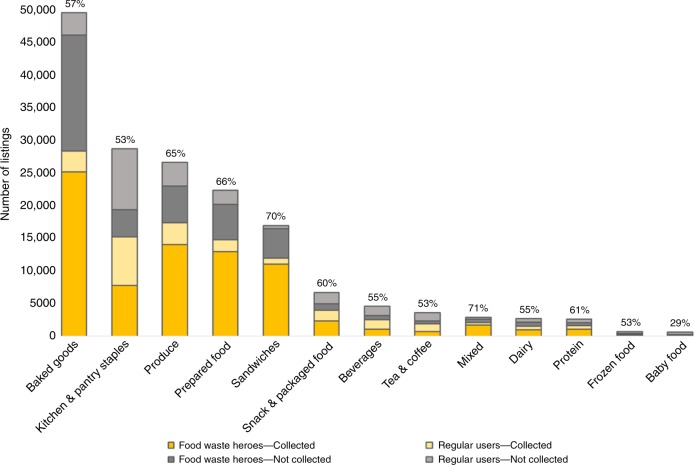
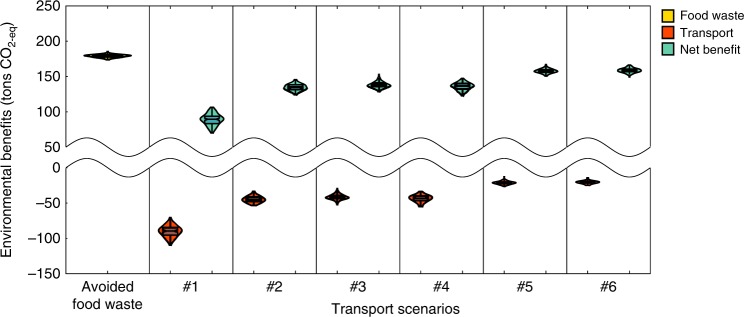
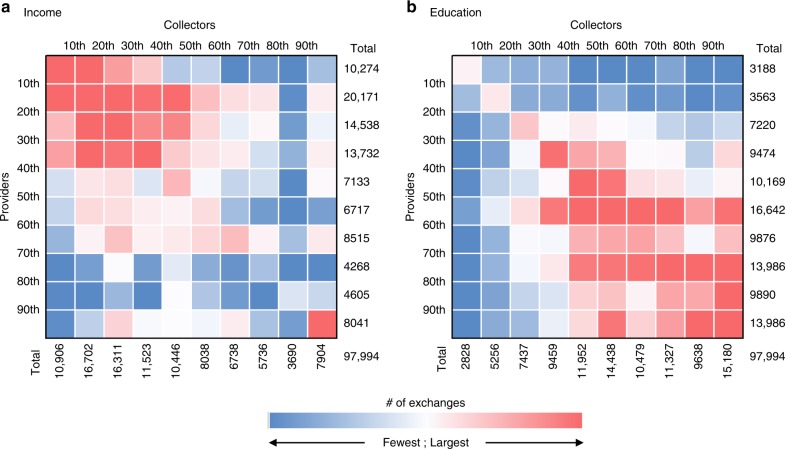
Reducing food waste is widely recognized as critical for improving resource efficiency and meeting the nutritional demand of a growing human population. Here we explore whether the sharing economy can provide meaningful assistance to reducing food waste in a relatively low-impact and environmentally-sound way. Analyzing 170,000 postings on a popular peer-to-peer food-sharing app, we find that over 19 months, 90t of food waste with an equivalent retail value of £0.7 million were collected by secondary consumers and diverted from disposal. An environmental analysis focused on Greater London reveals that these exchanges were responsible for avoiding emission of 87–156t of CO 2 eq. Our results indicate that most exchanges were among users associated with lower income yet higher levels of education. These findings, together with the high collection rates (60% on average) suggest that the sharing economy may offer powerful means for improving resource efficiency and reducing food waste.
Overview
The claims and statistics of this paper haven’t been checked yet.
Free: it reads the open-access text and checks the first 5 claims that cite a source we can check. Create a free account to check every claim.
Integrity signals
Registry
Cites
Statistics
Figures
Verification
Claims the paper makes
The claims and statistics of this paper haven’t been checked yet.
Free: it reads the open-access text and checks the first 5 claims that cite a source we can check. Create a free account to check every claim.
Claims other papers make about this one
Each is checked against this paper’s own text: does it say what the citing paper says it does?
The cited source says what the claim attributes to it.
In the citing paper
“In developed countries, a large portion of all food waste occurs at the consumer level (Makov et al., 2020).”
From Eco-Feedback for Food Waste Reduction in a Student Residence (2021) · cites this paper as Makov et al., 2020
Self-check
Percentages, sums and reported differences re-computed from the paper’s own numbers.
The self-check needs the paper’s full text.
Citations
Cites
Food Security: The Challenge of Feeding 9 Billion People
Godfray, H. C. J., Beddington, J. R., Crute, I. R., Haddad, L., Lawrence, D., Muir, J. F., Pretty, J., Robinson, S., Thomas, S. M., & Toulmin, C. (2010) · Science · doi:10.1126/science.1185383 · Cited by 11,943
Solutions for a cultivated planet
Foley, J. A., Ramankutty, N., Brauman, K. A., Cassidy, E. S., Gerber, J. S., Johnston, M., Mueller, N. D., O’Connell, C., Ray, D. K., West, P. C., et al. (2011) · Nature · doi:10.1038/nature10452 · Cited by 8,476
Reducing food's environmental impacts through producers and consumers
Poore, J., & Nemecek, T. (2018) · Science · doi:10.1126/science.aaq0216 · Cited by 6,085
Options for keeping the food system within environmental limits
Springmann, M., Clark, M., Mason-D’Croz, D., Wiebe, K., Bodirsky, B. L., Lassaletta, L., de Vries, W., Vermeulen, S. J., Herrero, M., Carlson, K. M., et al. (2018) · Nature · doi:10.1038/s41586-018-0594-0 · Cited by 3,380
Global diets link environmental sustainability and human health
Tilman, D., & Clark, M. (2014) · Nature · doi:10.1038/nature13959 · Cited by 3,026
Putting the sharing economy into perspective
Frenken, K., & Schor, J. (2017) · Environmental Innovation and Societal Transitions · doi:10.1016/j.eist.2017.01.003 · Cited by 1,105
Consumer-related food waste: causes and potential for action
Aschemann-Witzel, J., De Hooge, I., Amani, P., Bech-Larsen, T., & Oostindjer, M. (2015) · Sustainability · doi:10.3390/su7066457 · Cited by 910
Household Food Security in the United States in 2013
Coleman-Jensen, A., Gregory, C., & Singh, A. (2014) · SSRN Electronic Journal · doi:10.2139/ssrn.2504067 · Cited by 896
PIANTADOSI, S., BYAR, D. P., & GREEN, S. B. (1988) · American Journal of Epidemiology · doi:10.1093/oxfordjournals.aje.a114892 · Cited by 821
Impacts of Peer-to-Peer Accommodation Use on Travel Patterns
Tussyadiah, I. P., & Pesonen, J. (2016) · Journal of Travel Research · doi:10.1177/0047287515608505 · Cited by 804
Total and per capita value of food loss in the United States
Buzby, J. C., & Hyman, J. (2012) · Food Policy · doi:10.1016/j.foodpol.2012.06.002 · Cited by 660
Assessing the efficiency of changes in land use for mitigating climate change
Searchinger, T. D., Wirsenius, S., Beringer, T., & Dumas, P. (2018) · Nature · doi:10.1038/s41586-018-0757-z · Cited by 617
Buzby, J. C., Farah-Wells, H., & Hyman, J. (2014) · SSRN Electronic Journal · doi:10.2139/ssrn.2501659 · Cited by 575
Clewlow, R., & Mishra, G. S. (2017) · RePEc: Research Papers in Economics · Cited by 558
Household food waste: drivers and potential intervention points for design – an extensive review
Hebrok, M., & Boks, C. (2017) · Journal of Cleaner Production · doi:10.1016/j.jclepro.2017.03.069 · Cited by 501
Reynolds, C., Goucher, L., Quested, T., Bromley, S., Gillick, S., Wells, V. K., Evans, D., Koh, L., Carlsson Kanyama, A., Katzeff, C., et al. (2019) · Food Policy · doi:10.1016/j.foodpol.2019.01.009 · Cited by 487
Eshel, G., Shepon, A., Makov, T., & Milo, R. (2014) · Proceedings of the National Academy of Sciences · doi:10.1073/pnas.1402183111 · Cited by 466
Self-citationThe Potential for Cannibalization of New Products Sales by Remanufactured Products*
Guide, Jr., & Li, J. (2010) · Decision Sciences · doi:10.1111/j.1540-5915.2010.00280.x · Cited by 447
Gustafsson, J., Cederberg, C., Sonesson, U., & Emanuelsson, A. (2013) · KTH Publication Database DiVA (KTH Royal Institute of Technology) · Cited by 410
Opening the black box of food waste reduction
Garrone, P., Melacini, M., & Perego, A. (2014) · Food Policy · doi:10.1016/j.foodpol.2014.03.014 · Cited by 394
Relationship between food waste, diet quality, and environmental sustainability
Conrad, Z., Niles, M. T., Neher, D. A., Roy, E. D., Tichenor, N. E., & Jahns, L. (2018) · PLOS ONE · doi:10.1371/journal.pone.0195405 · Cited by 360
Greenhouse Gas Emission Estimates of U.S. Dietary Choices and Food Loss
Heller, M. C., & Keoleian, G. A. (2015) · Journal of Industrial Ecology · doi:10.1111/jiec.12174 · Cited by 329
Mapping the carbon footprint of EU regions
Ivanova, D., Vita, G., Steen-Olsen, K., Stadler, K., Melo, P. C., Wood, R., & Hertwich, E. G. (2017) · Environmental Research Letters · doi:10.1088/1748-9326/aa6da9 · Cited by 316
Household Food Security in the United States in 2015
Coleman‐Jensen, A., Rabbitt, M. P., Gregory, C., Singh, A. P., Coleman‐Jensen, A., Rabbitt, M. P., Gregory, C., & Singh, A. P. (2016) · AgEcon Search (University of Minnesota, USA) · doi:10.22004/ag.econ.262191 · Cited by 285
Paradoxes of openness and distinction in the sharing economy
Schor, J. B., Fitzmaurice, C., Carfagna, L. B., Attwood-Charles, W., & Poteat, E. D. (2016) · Poetics · doi:10.1016/j.poetic.2015.11.001 · Cited by 275
Understanding Food Sharing Models to Tackle Sustainability Challenges
Michelini, L., Principato, L., & Iasevoli, G. (2018) · Ecological Economics · doi:10.1016/j.ecolecon.2017.09.009 · Cited by 270
Austerity, sanctions, and the rise of food banks in the UK
Loopstra, R., Reeves, A., Taylor-Robinson, D., Barr, B., McKee, M., & Stuckler, D. (2015) · BMJ · doi:10.1136/bmj.h1775 · Cited by 257
Chitnis, M., Sorrell, S., Druckman, A., Firth, S. K., & Jackson, T. (2014) · Ecological Economics · doi:10.1016/j.ecolecon.2014.07.003 · Cited by 250
The value of food waste: An exploratory study on retailing
Cicatiello, C., Franco, S., Pancino, B., & Blasi, E. (2016) · Journal of Retailing and Consumer Services · doi:10.1016/j.jretconser.2016.01.004 · Cited by 245
The opportunity cost of animal based diets exceeds all food losses
Shepon, A., Eshel, G., Noor, E., & Milo, R. (2018) · Proceedings of the National Academy of Sciences · doi:10.1073/pnas.1713820115 · Cited by 213
Self-citationBuzby, J. C., Wells, H. F., Hyman, J. J., Buzby, J. C., Farah-Wells, H., & Hyman, J. (2014) · AgEcon Search (University of Minnesota, USA) · doi:10.22004/ag.econ.164262 · Cited by 212
Food sharing, redistribution, and waste reduction via mobile applications: A social network analysis
Harvey, J., Smith, A., Goulding, J., & Branco Illodo, I. (2020) · Industrial Marketing Management · doi:10.1016/j.indmarman.2019.02.019 · Cited by 192
Lost water and nitrogen resources due to EU consumer food waste
Vanham, D., Bouraoui, F., Leip, A., Grizzetti, B., & Bidoglio, G. (2015) · Environmental Research Letters · doi:10.1088/1748-9326/10/8/084008 · Cited by 182
An exploratory study of food waste management practices in the UK grocery retail sector
Filimonau, V., & Gherbin, A. (2017) · Journal of Cleaner Production · doi:10.1016/j.jclepro.2017.07.229 · Cited by 182
Online Grocery Retail: Revenue Models and Environmental Impact
Belavina, E., Girotra, K., & Kabra, A. (2017) · Management Science · doi:10.1287/mnsc.2016.2430 · Cited by 176
Psychological aspects of the rejection of recycled water: Contamination, purification and disgust
Rozin, P., Haddad, B., Nemeroff, C., & Slovic, P. (2015) · Judgment and Decision Making · doi:10.1017/s193029750000317x · Cited by 173
Does the Circular Economy Grow the Pie? The Case of Rebound Effects From Smartphone Reuse
Makov, T., & Font Vivanco, D. (2018) · Frontiers in Energy Research · doi:10.3389/fenrg.2018.00039 · Cited by 160
Self-citationContaminated Interaction: Another Barrier to Circular Material Flows
Baxter, W., Aurisicchio, M., & Childs, P. (2017) · Journal of Industrial Ecology · doi:10.1111/jiec.12612 · Cited by 133
Food insecurity and low income in an English inner city
Tingay, R. S., Tan, C. J., Tan, N. C. W., Tang, S., Teoh, P. F., Wong, R. Y. S., & Gulliford, M. C. (2003) · Journal of Public Health · doi:10.1093/pubmed/fdg032 · Cited by 120
Morone, P., Falcone, P. M., Imbert, E., & Morone, A. (2018) · Journal of Cleaner Production · doi:10.1016/j.jclepro.2018.01.208 · Cited by 120
Sharing food and risk in Berlin’s urban food commons
Morrow, O. (2018) · Geoforum · doi:10.1016/j.geoforum.2018.09.003 · Cited by 107
Feed People First: A Service Ecosystem Perspective on Innovative Food Waste Reduction
Baron, S., Patterson, A., Maull, R., & Warnaby, G. (2018) · Journal of Service Research · doi:10.1177/1094670517738372 · Cited by 102
Food waste in the sharing economy
Richards, T. J., & Hamilton, S. F. (2018) · Food Policy · doi:10.1016/j.foodpol.2018.01.008 · Cited by 102
Tomayko, E. J., Mosso, K. L., Cronin, K. A., Carmichael, L., Kim, K., Parker, T., Yaroch, A. L., & Adams, A. K. (2017) · BMC Public Health · doi:10.1186/s12889-017-4498-y · Cited by 93
A Simple Command to Calculate Travel Distance and Travel Time
Weber, S., & Péclat, M. (2017) · The Stata Journal Promoting communications on statistics and Stata · doi:10.1177/1536867x1801700411 · Cited by 92
Urban food sharing: Emerging geographies of production, consumption and exchange
Davies, A. R., & Evans, D. M. (2018) · Geoforum · doi:10.1016/j.geoforum.2018.11.015 · Cited by 88
Gong, J. Z., & Song, Y. A. (2017) · SSRN Electronic Journal · doi:10.2139/ssrn.2971072 · Cited by 82
What Affects the Secondhand Value of Smartphones: Evidence from eBay
Makov, T., Fishman, T., Chertow, M. R., & Blass, V. (2019) · Journal of Industrial Ecology · doi:10.1111/jiec.12806 · Cited by 73
Self-citationThornton, L. E., Pearce, J. R., & Ball, K. (2013) · Public Health Nutrition · doi:10.1017/s1368980013000347 · Cited by 70
Food talks back: exploring the role of mobile applications in reducing domestic food wastage
Farr-Wharton, G., Choi, J. H.-J., & Foth, M. (2014) · Proceedings of the 26th Australian Computer-Human Interaction Conference on Designing Futures: the Future of Design · doi:10.1145/2686612.2686665 · Cited by 70
Quantity, Components, and Value of Waste Materials Landfilled in the United States
Powell, J. T., & Chertow, M. R. (2018) · Journal of Industrial Ecology · doi:10.1111/jiec.12752 · Cited by 50
Self-citationWeymes, M., & Davies, A. R. (2018) · Geoforum · doi:10.1016/j.geoforum.2018.11.005 · Cited by 46
Winne, M. (2005) · Agriculture and Human Values · doi:10.1007/s10460-004-8279-8 · Cited by 15
Research works printed but not linked: 1
- 65. Makov T., Wolfram P. & Blass V. What is my share? Assessing the environmental impacts of secondary consumption. in: PLATE Product Lifetimes And The Environment 2019-Conference Proceedings (eds Nissen N. F. & Jaeger-Erben M.) (TU Berlin University Press, 2019).
Cited by
Demand-side solutions to climate change mitigation consistent with high levels of well-being
Creutzig, F., Niamir, L., Bai, X., Callaghan, M., Cullen, J., Díaz-José, J., Figueroa, M., Grubler, A., Lamb, W. F., Leip, A., et al. (2022) · Nature Climate Change · doi:10.1038/s41558-021-01219-y · Cited by 579
Aldaco, R., Hoehn, D., Laso, J., Margallo, M., Ruiz-Salmón, J., Cristobal, J., Kahhat, R., Villanueva-Rey, P., Bala, A., Batlle-Bayer, L., et al. (2020) · Science of The Total Environment · doi:10.1016/j.scitotenv.2020.140524 · Cited by 298
The Sharing Economy: Rhetoric and Reality
Schor, J. B., & Vallas, S. P. (2021) · Annual Review of Sociology · doi:10.1146/annurev-soc-082620-031411 · Cited by 172
Do, Q., Ramudhin, A., Colicchia, C., Creazza, A., & Li, D. (2021) · International Journal of Production Economics · doi:10.1016/j.ijpe.2021.108209 · Cited by 147
“P2P users are commonly found to be in the group with lower income yet higher education level (Makov et al., 2020).”
BackgroundInfluentialZhang, Y., Chen, J., Han, Y., Qian, M., Guo, X., Chen, R., Xu, D., & Chen, Y. (2021) · Land Use Policy · doi:10.1016/j.landusepol.2021.105306 · Cited by 124
Metadata
- Authors
- Makov, T., Shepon, A., Krones, J., Gupta, C., & Chertow, M.
- Affiliations
- Ben-Gurion University of the Negev (IL)
- Harvard University (US)
- Boston College (US)
- University of California, Davis (US)
- Yale University (US)
- Corresponding author
- Makov, Tamar
- Venue
- Nature Communications
- Published
- 2020-03-10
- Volume
- 11
- Issue
- 1
- Pages
- 1156-1156
- ISSN
- 2041-1723 (ISSN-L)
- PMC
- PMC7064594
- OpenAlex
- W3011315259
- Cited by
- 125
- References
- 54
- Citations by year
- 2026: 10 · 2025: 24 · 2024: 21 · 2023: 22 · 2022: 33 · 2021: 12 · 2020: 3
- FWCI
- 11.35
- Type
- journal article
- Language
- en
- Open access
- gold
- doi.org
- Licence
- cc-by
- creativecommons.org/licenses/by/4.0 (tdm)
- creativecommons.org/licenses/by/4.0 (vor)
- Locations
- Nature Communications (publishedVersion, cc-by)
- Europe PMC (PubMed Central) (publishedVersion, cc-by)
- PubMed Central (publishedVersion, cc-by)
- PubMed (publishedVersion)
- RePEc: Research Papers in Economics (submittedVersion)
- DOAJ (DOAJ: Directory of Open Access Journals) (submittedVersion, cc-by-sa)
- Funders
- Alfred P. Sloan Foundation
- Yale | Institute for Biospheric Studies, Yale University
- AS is supported by the Nature Conservancy.
- Topics
- Life Sciences › Agricultural and Biological Sciences › Food Science › Food Waste Reduction and Sustainability
- Social Sciences › Business, Management and Accounting › Marketing › Sharing Economy and Platforms
- Physical Sciences › Environmental Science › Waste Management and Disposal › Waste Management and Recycling
- Keywords
- food waste reduction, sharing economy, resource efficiency, Greater London
About these checks
Registry, retraction, Cites and statistics results are computed, not judged, with one exception: a printed reference that no index lists is read once by a model before it counts as a citation error. Claims are extracted by a model and kept only when their quote appears verbatim in the text; each cited source is then checked, with a model’s help, for whether it says what the claim relies on. Those verdicts can be wrong — read the claim’s quote and the cited source before relying on one.
Statistics and arithmetic are recomputed, not judged.
Confidence bands are shown only for fields calibrated on our annotated test set. None is calibrated yet, so no band is shown.
What counts as a claim ›How we measure confidence ›How we check this ›
Are you an author, or do you see a problem with this page? Request a review
Data sources
Bibliographic data: Semantic Scholar, OpenAlex, Crossref.
Contains information from the Semantic Scholar Academic Graph Datasets, made available under the ODC Attribution License (ODC-BY 1.0).
Semantic Scholar’s data is described in: Kinney, R., et al. (2023). The Semantic Scholar Open Data Platform. arXiv:2301.10140.
