

Disproportionate exposure to urban heat island intensity across major US cities
Open accessThe DOI matches its Crossref record; 96 of the 98 references it cites were found in a registry or an index; 37 of the 73 sources its claims cite were checked for support.
Abstract
Urban heat stress poses a major risk to public health. Case studies of individual cities suggest that heat exposure, like other environmental stressors, may be unequally distributed across income groups. There is little evidence, however, as to whether such disparities are pervasive. We combine surface urban heat island (SUHI) data, a proxy for isolating the urban contribution to additional heat exposure in built environments, with census tract-level demographic data to answer these questions for summer days, when heat exposure is likely to be at a maximum. We find that the average person of color lives in a census tract with higher SUHI intensity than non-Hispanic whites in all but 6 of the 175 largest urbanized areas in the continental United States. A similar pattern emerges for people living in households below the poverty line relative to those at more than two times the poverty line.
Overview
CoChat Summary
## TL;DR
The paper finds that summer daytime surface urban heat island (SUHI) exposure is systematically higher for people of color and for poorer populations across major US urbanized areas. Using census tract-level SUHI and 2017 ACS demographic data for 175 urbanized areas, the authors report this pattern in nearly all cities, with only 6 exceptions for people of color versus non-Hispanic whites.
## Key findings
- Across the 175 largest urbanized areas in the continental US, the average person of color lives in a census tract with higher summer daytime SUHI intensity than non-Hispanic whites in all but 6 cities.
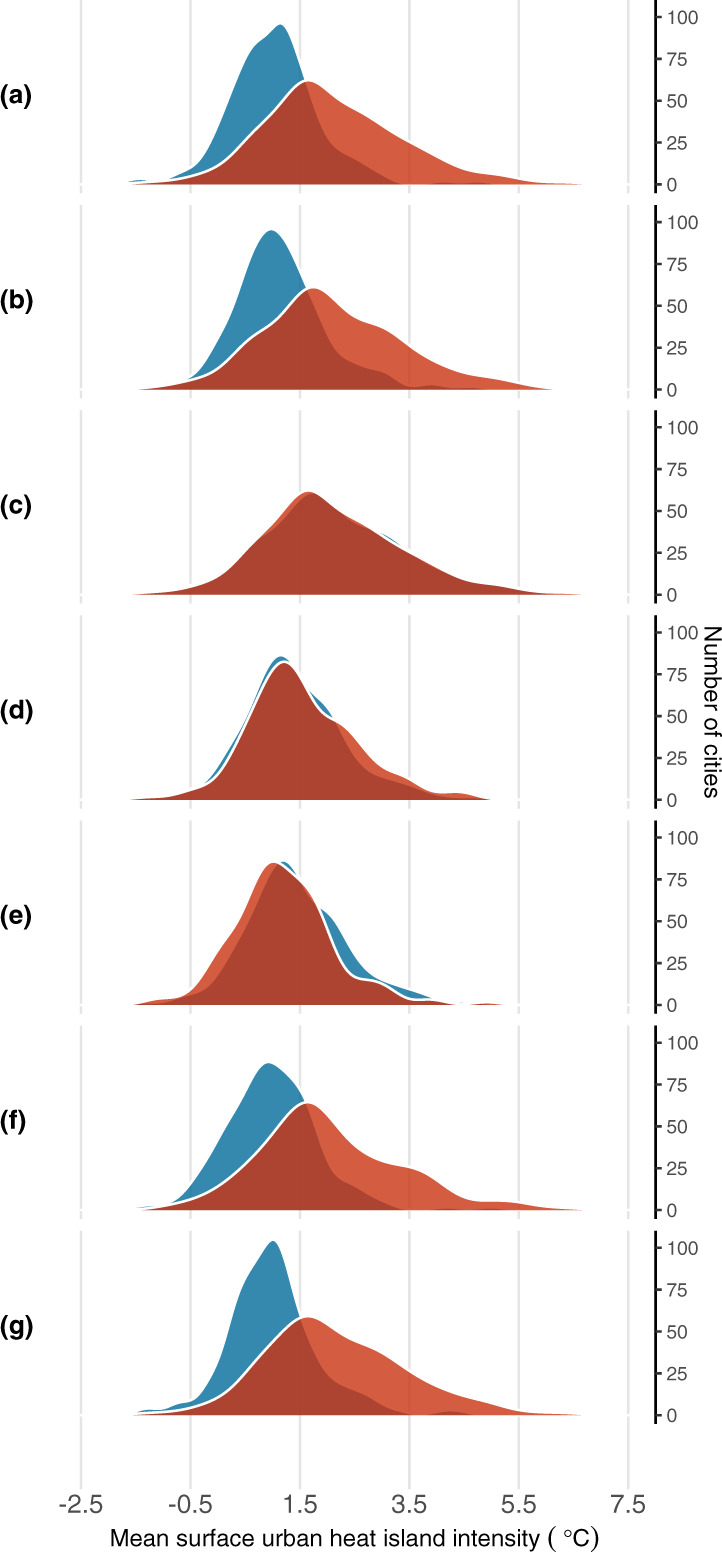
- Nationally, people of color have a mean SUHI exposure of 2.77 ± 2.70 °C (also reported as 3.12 ± 2.67 °C in the climate-zone breakdown), compared with 1.47 ± 2.60 °C for non-Hispanic whites.
- People living below the poverty line have higher exposure than those above twice the poverty line; the paper reports 2.77 ± 2.73 °C for people below poverty versus lower exposure for the higher-income group, with the overall low-income vs high-income difference significant at p < 0.01.
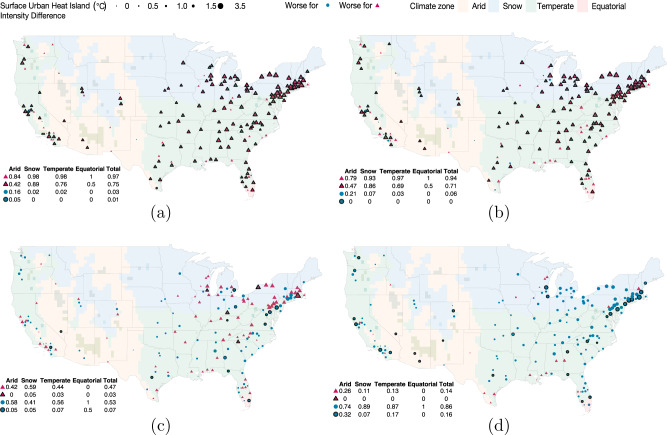
- City-level maps show the disparity is widespread: people of color have higher SUHI exposure than non-Hispanic whites in 97% of cities nationally, and this difference is significant in three quarters of cities; for income, people below poverty have significantly higher exposure in over 70% of cities.
## Methods
- Observational environmental equity analysis of summer daytime SUHI exposure, focusing on 175 census-defined urbanized areas in the continental US with more than 250,000 residents.
- Exposure data came from a census-tract-level SUHI database using June–August satellite-based land surface temperature data (NASA MODIS) and ESA land cover data; demographic data came from the 2017 ACS 5-year Data Profile for 46,346 census tracts.
- The main analysis compared weighted mean SUHI exposure across race/ethnicity, income, and age groups, and also used the Kolm–Pollak inequality index and equally distributed equivalent (EDE) framework to assess within-group dispersion in exposure.
## Limitations
- The paper states that SUHI intensity is only a proxy for heat stress and that the analysis assumes SUHI is harmful; it notes this may not apply in extreme winter-cold settings, though the study is restricted to summer and says winter benefits may not materialize.
- The authors note satellite-based estimates may slightly overestimate urban heat island magnitude relative to in situ stations, especially during daytime, and that the work does not capture humidity, wind speed, or radiation.
- The analysis assigns each person the SUHI of their census tract and assumes people remain in that tract all day; it also does not evaluate inequities over time.
Model-written summary. Check it against the paper before relying on it.
Integrity signals
Registry
Cites
Statistics
Figures
Verification
Claims the paper makes
27 Valid · 2 Not valid · 10 Not checked · 61 Own results and interpretations
Every source the paper cites for this claim was checked and supports it.
In the paper
“SUHI intensity, however, is still a useful proxy for the urban contribution to local heat stress35.”
§ Disproportionate exposure to urban heat island intensity across major US cities > Discussion > Study limitations
What the sources say
- Supportedcites [35] Chakraborty T Hsu A Manya D Sheriff G A spatially explicit surface urban heat island database for the United States: characterization, uncertainties, and possible applications ISPRS J. Photogramm. Remote Sens. 2020 168 74 88 source
The Conclusions (page unavailable in our copy) call UHI a useful proxy for isolating urbanization’s impact on local temperatures and say SUHI represents the additional impacts of urbanization. Section 3.5 uses SUHI to examine environmental disparities, while noting that absolute temperature may better indicate environmental stress. Together, these support the qualified claim that SUHI is a useful proxy, rather than a direct measure, of the urban contribution to local heat stress. (LLM, conf=0.88)
states an association- Asserted: passes — The authors put it forward as true.
- Checkable: passes — It can be checked against evidence.
- Load-bearing: passes — The paper’s conclusions depend on it.
- Based: passes — The paper gives a reason why it holds.
- Supported
The cited sources support only part of this claim — read each source’s verdict below.
In the paper
“Instead, research linking intracity differences in heat exposure to sociodemographic factors has typically been done in an ad hoc manner for a small number of individual cities23,29–32.”
§ Disproportionate exposure to urban heat island intensity across major US cities > Introduction
What the sources say
- Partly supportedcites [23] Voelkel J Hellman D Sakuma R Shandas V Assessing vulnerability to urban heat: a study of disproportionate heat exposure and access to refuge by socio-demographic status in Portland, Oregon Int. J. Environ. Res. Public Health 2018 15 640 29601546 PMC5923682 sourceExperimental — accuracy not yet measured
The Methods (§2.3) link within-city heat exposure to sociodemographic factors, and the Conclusions (§5) say the findings are specific to Portland. The paper therefore supports the citation as an example of a single-city study, but it does not establish that such research has typically been ad hoc or confined to a small number of cities. Page numbers are unavailable in our copy. (LLM, conf=0.86)
- Not checked — no full text of the sourcecites [29] Uejio CK Intra-urban societal vulnerability to extreme heat: the role of heat exposure and the built environment, socioeconomics, and neighborhood stability Health Place 2011 17 498 507 21216652 source
- Not checked — no full text of the sourcecites [30] Johnson DP Wilson JS The socio-spatial dynamics of extreme urban heat events: the case of heat-related deaths in Philadelphia Appl. Geogr. 2009 29 419 434 source
- Not checked — no full text of the sourcecites [31] Harlan SL Brazel AJ Prashad L Stefanov WL Larsen L Neighborhood microclimates and vulnerability to heat stress Social Sci. Med. 2006 63 2847 2863 16996668 source
- Not checked — no full text of the sourcecites [32] Huang G Zhou W Cadenasso ML Is everyone hot in the city? Spatial pattern of land surface temperatures, land cover and neighborhood socioeconomic characteristics in Baltimore, MD J. Environ. Manag. 2011 92 1753 1759 21371807 source
plainstates an association- Asserted: passes — The authors put it forward as true.
- Checkable: passes — It can be checked against evidence.
- Load-bearing: passes — The paper’s conclusions depend on it.
- Based: passes — The paper gives a reason why it holds.
- Partly supported
The cited sources support only part of this claim — read each source’s verdict below.
In the paper
“During summer months, relatively large SUHI intensity is associated with increased local warming and extreme heat events in urban areas13,36,37.”
§ Disproportionate exposure to urban heat island intensity across major US cities > Results
What the sources say
- Not checked — no full text of the sourcecites [13] Peng S Surface urban heat island across 419 global big cities Environ. Sci. Technol. 2012 46 696 703 22142232 source
- Partly supportedcites [36] McCarthy, M. P., Best, M. J. & Betts, R. A. Climate change in cities due to global warming and urban effects. Geophys. Res. Lett.10.1029/2010GL042845 (2010). sourceExperimental — accuracy not yet measured
The Method section defines this paper’s urban heat island as a near-surface air-temperature difference, not a surface urban heat island (SUHI). Section 4 reports greater increases in extreme hot nights in cities than in neighboring rural areas, supporting the urban-warming and extreme-heat portion of the claim. Its analysis does not establish the stated association specifically during summer months or for SUHI intensity. (LLM, conf=0.88)
- Partly supportedcites [37] IPCC. Climate Change 2014 Synthesis Report Summary Chapter for Policymakers10.1017/CBO9781107415324 (IPCC, 2014). sourceExperimental — accuracy not yet measured
The Glossary defines an urban heat island as a city's relative warmth compared with surrounding rural areas. The Summary for Policymakers (p. 19) discusses heat waves, but neither passage links relatively large surface urban heat island intensity to local warming or extreme heat events during summer. (LLM, conf=0.78)
plainstates an association- Asserted: passes — The authors put it forward as true.
- Checkable: passes — It can be checked against evidence.
- Load-bearing: unclear — It is unclear whether the paper’s conclusions depend on it.
- Based: passes — The paper gives a reason why it holds.
The cited sources support only part of this claim — read each source’s verdict below.
In the paper
“These findings provide comprehensive evidence supporting the narrative presented by earlier case studies that minority and low-income communities bear the brunt of the urban heat island effect23,25,26,29–32,35, air temperature23, and heat stress31 in individual or multicity studies.”
§ Disproportionate exposure to urban heat island intensity across major US cities > Discussion > Framework for understanding inequalities in SUHI
What the sources say
- Supportedcites [23] Voelkel J Hellman D Sakuma R Shandas V Assessing vulnerability to urban heat: a study of disproportionate heat exposure and access to refuge by socio-demographic status in Portland, Oregon Int. J. Environ. Res. Public Health 2018 15 640 29601546 PMC5923682 source
The Results (section 3.3.1) report higher urban-heat-island temperatures in Portland census blocks with larger shares of several non-white populations. The Discussion (section 4) reports higher temperatures for groups with low adaptive capacity and near affordable housing. This Portland case study supports the urban-heat-island portion of the citing sentence. (LLM, conf=0.91)
- Partly supportedcites [25] Chakraborty T Hsu A Manya D Sheriff G Disproportionately higher exposure to urban heat in lower-income neighborhoods: a multi-city perspective Environ. Res. Lett. 2019 14 105003 sourceExperimental — accuracy not yet measured
Split into 2 atoms — 0 confirmed, 2 partially supported, 0 disputed, 0 misattributed, 0 unverifiable. Expand the claim to see per-atom verdicts.
- Supportedcites [26] Hoffman JS Shandas V Pendleton N The effects of historical housing policies on resident exposure to intra-urban heat: a study of 108 U.S. urban areas Climate 2020 8 12 source
The Discussion and Conclusions report that, across 108 US cities, formerly redlined neighborhoods—described as predominantly lower-income communities of color—were hotter than non-redlined neighborhoods in nearly all cases. This supports the cited narrative about unequal exposure to intra-urban heat. (LLM, conf=0.91)
boostedstates an association- Asserted: passes — The authors put it forward as true.
- Checkable: passes — It can be checked against evidence.
- Load-bearing: unclear — It is unclear whether the paper’s conclusions depend on it.
- Based: passes — The paper gives a reason why it holds.
- Supported
Every source the paper cites for this claim was checked and supports it.
In the paper
“For example, ref. 57 finds positive correlations between heat-related mortality rates and poverty for neighborhoods in New York City.”
§ Disproportionate exposure to urban heat island intensity across major US cities > Discussion > Framework for understanding inequalities in SUHI
What the sources say
- Supportedcites [57] Rosenthal JK Kinney PL Metzger KB Intra-urban vulnerability to heat-related mortality in New York city, 1997–2006 Health Place 2014 30 45 60 25199872 PMC4348023 source
The Results section reports significant positive associations (p<0.05) between heat-mortality rates and neighborhood-level poverty in New York City. The Conclusions likewise identify poverty rates among the neighborhood factors correlated with excess heat-related mortality. (LLM, conf=0.94)
plainstates an association- Asserted: passes — The authors put it forward as true.
- Checkable: passes — It can be checked against evidence.
- Load-bearing: unclear — It is unclear whether the paper’s conclusions depend on it.
- Based: passes — The paper gives a reason why it holds.
- Supported
48 more claims · 6 with their cited sources checked
Create a free account to see all 100 claims and to verify the 10 references still open.
- Probably not a substantial claim. 21
- It may state two separate claims as one. 28
- The quote only partly states this claim. 1
Self-check
Percentages, sums and reported differences re-computed from the paper’s own numbers.
Each contradiction between two passages listed here was confirmed by an independent check.
Rated minor: it would not touch a result — a value no result rests on, a p-value that stays on the same side of the significance level, or a conflict that is clerical, resolved elsewhere in the paper, or outside its own findings.
In the paper
§ Disproportionate exposure to urban heat island intensity across major US cities > Results > Mean SUHI intensity across sociodemographic groups
“A similar pattern emerges across income groups: people living below the poverty line have the highest exposure in each zone (national average 2.70 ± 2.64 °C), while people living at above twice the poverty line have the lowest (1.80 ± 2.69 °C).”
§ Disproportionate exposure to urban heat island intensity across major US cities > Discussion > Complexity in disentangling race, income, and SUHI
“Table 1 shows that this hypothesis is unsupported: across the entire sample the mean SUHI exposure of a person of color (2.77 ± 2.70 °C) is practically identical to that of a person living below poverty (2.77 ± 2.73 °C).”
Citations
Cites
Ror2 signaling regulates Golgi structure and transport through IFT20 for tumor invasiveness
Nishita, M., Park, S.-Y., Nishio, T., Kamizaki, K., Wang, Z., Tamada, K., Takumi, T., Hashimoto, R., Otani, H., Pazour, G. J., et al. (2017) · Scientific Reports · doi:10.1038/s41598-016-0028-x · Cited by 15,947
Google Earth Engine: Planetary-scale geospatial analysis for everyone
Gorelick, N., Hancher, M., Dixon, M., Ilyushchenko, S., Thau, D., & Moore, R. (2017) · Remote Sensing of Environment · doi:10.1016/j.rse.2017.06.031 · Cited by 14,719
World map of the Köppen-Geiger climate classification updated
Kottek, M., Grieser, J., Beck, C., Rudolf, B., & Rubel, F. (2006) · Meteorologische Zeitschrift · doi:10.1127/0941-2948/2006/0130 · Cited by 11,456
A Theory of Justice: Original Edition
Rawls, J. (1971) · doi:10.4159/9780674042605 · Cited by 9,496
On the measurement of inequality
Atkinson, A. B. (1970) · Journal of Economic Theory · doi:10.1016/0022-0531(70)90039-6 · Cited by 6,550
The energetic basis of the urban heat island
Oke, T. R. (1982) · Quarterly Journal of the Royal Meteorological Society · doi:10.1002/qj.49710845502 · Cited by 4,670
Wolch, J. R., Byrne, J., & Newell, J. P. (2014) · Landscape and Urban Planning · doi:10.1016/j.landurbplan.2014.01.017 · Cited by 4,309
Wickham, H. (2011) · WIREs Computational Statistics · doi:10.1002/wics.147 · Cited by 4,304
Strong contributions of local background climate to urban heat islands
Zhao, L., Lee, X., Smith, R. B., & Oleson, K. (2014) · Nature · doi:10.1038/nature13462 · Cited by 1,577
Surface Urban Heat Island Across 419 Global Big Cities
Peng, S., Piao, S., Ciais, P., Friedlingstein, P., Ottle, C., Bréon, F.-M., Nan, H., Zhou, L., & Myneni, R. B. (2012) · Environmental Science & Technology · doi:10.1021/es2030438 · Cited by 1,456
Magnitude of urban heat islands largely explained by climate and population
Manoli, G., Fatichi, S., Schläpfer, M., Yu, K., Crowther, T. W., Meili, N., Burlando, P., Katul, G. G., & Bou-Zeid, E. (2019) · Nature · doi:10.1038/s41586-019-1512-9 · Cited by 1,221
Anderson, G. B., & Bell, M. L. (2011) · Environmental Health Perspectives · doi:10.1289/ehp.1002313 · Cited by 1,191
Cardinal Utility in Welfare Economics and in the Theory of Risk-taking
Harsanyi, J. C. (1953) · Journal of Political Economy · doi:10.1086/257416 · Cited by 1,156
Neighborhood microclimates and vulnerability to heat stress
Harlan, S. L., Brazel, A. J., Prashad, L., Stefanov, W. L., & Larsen, L. (2006) · Social Science & Medicine · doi:10.1016/j.socscimed.2006.07.030 · Cited by 1,124
The urban heat island and its impact on heat waves and human health in Shanghai
Tan, J., Zheng, Y., Tang, X., Guo, C., Li, L., Song, G., Zhen, X., Yuan, D., Kalkstein, A. J., Li, F., et al. (2010) · International Journal of Biometeorology · doi:10.1007/s00484-009-0256-x · Cited by 1,112
Rubel, F., & Kottek, M. (2010) · Meteorologische Zeitschrift · doi:10.1127/0941-2948/2010/0430 · Cited by 1,086
New refinements and validation of the collection-6 MODIS land-surface temperature/emissivity product
Wan, Z. (2014) · Remote Sensing of Environment · doi:10.1016/j.rse.2013.08.027 · Cited by 1,075
Climate change, mortality, and adaptation: Evidence from annual fluctuations in weather in the US
Deschênes, O., & Greenstone, M. (2011) · American Economic Journal: Applied Economics · doi:10.1257/app.3.4.152 · Cited by 1,064
Temperature and the Allocation of Time: Implications for Climate Change
Graff Zivin, J., & Neidell, M. (2014) · Journal of Labor Economics · doi:10.1086/671766 · Cited by 1,024
Determinants of Risk: Exposure and Vulnerability
Cardona, O.-D., van Aalst, M. K., Birkmann, J., Fordham, M., McGregor, G., Perez, R., Pulwarty, R. S., Schipper, E. L. F., Sinh, B. T., Décamps, H., et al. (2012) · Managing the Risks of Extreme Events and Disasters to Advance Climate Change Adaptation · doi:10.1017/cbo9781139177245.005 · Cited by 1,007
Green spaces and cognitive development in primary schoolchildren
Dadvand, P., Nieuwenhuijsen, M. J., Esnaola, M., Forns, J., Basagaña, X., Alvarez-Pedrerol, M., Rivas, I., López-Vicente, M., De Castro Pascual, M., Su, J., et al. (2015) · Proceedings of the National Academy of Sciences · doi:10.1073/pnas.1503402112 · Cited by 942
Kolm, S.-C. (1976) · Journal of Economic Theory · doi:10.1016/0022-0531(76)90037-5 · Cited by 915
Ziter, C. D., Pedersen, E. J., Kucharik, C. J., & Turner, M. G. (2019) · Proceedings of the National Academy of Sciences · doi:10.1073/pnas.1817561116 · Cited by 891
The Urban Heat Island: Implications for Health in a Changing Environment
Heaviside, C., Macintyre, H., & Vardoulakis, S. (2017) · Current Environmental Health Reports · doi:10.1007/s40572-017-0150-3 · Cited by 849
Hoffman, J. S., Shandas, V., & Pendleton, N. (2020) · Climate · doi:10.3390/cli8010012 · Cited by 842
Climate change in cities due to global warming and urban effects
McCarthy, M. P., Best, M. J., & Betts, R. A. (2010) · Geophysical Research Letters · doi:10.1029/2010gl042845 · Cited by 821
Asynchronous carbon sink saturation in African and Amazonian tropical forests
Hubau, W., Lewis, S. L., Phillips, O. L., Affum-Baffoe, K., Beeckman, H., Cuní-Sanchez, A., Daniels, A. K., Ewango, C. E. N., Fauset, S., Mukinzi, J. M., et al. (2020) · Nature · doi:10.1038/s41586-020-2035-0 · Cited by 782
Heat stress in older individuals and patients with common chronic diseases
Kenny, G. P., Yardley, J., Brown, C., Sigal, R. J., & Jay, O. (2010) · Canadian Medical Association Journal · doi:10.1503/cmaj.081050 · Cited by 771
Tennekes, M. (2018) · Journal of Statistical Software · doi:10.18637/jss.v084.i06 · Cited by 761
EFFECTS OF EXURBAN DEVELOPMENT ON BIODIVERSITY: PATTERNS, MECHANISMS, AND RESEARCH NEEDS
Hansen, A. J., Knight, R. L., Marzluff, J. M., Powell, S., Brown, K., Gude, P. H., & Jones, K. (2005) · Ecological Applications · doi:10.1890/05-5221 · Cited by 740
Cardinal Utility in Welfare Economics and in the Theory of Risk-Taking
Harsanyi, J. C. (1980) · Essays on Ethics, Social Behavior, and Scientific Explanation · doi:10.1007/978-94-010-9327-9_1 · Cited by 703
McGeehin, M. A., & Mirabelli, M. (2001) · Environmental Health Perspectives · doi:10.1289/ehp.109-1240665 · Cited by 669
Engemann, K., Pedersen, C. B., Arge, L., Tsirogiannis, C., Mortensen, P. B., & Svenning, J.-C. (2019) · Proceedings of the National Academy of Sciences · doi:10.1073/pnas.1807504116 · Cited by 668
Impact of urban form and design on mid-afternoon microclimate in Phoenix Local Climate Zones
Middel, A., Häb, K., Brazel, A. J., Martin, C. A., & Guhathakurta, S. (2014) · Landscape and Urban Planning · doi:10.1016/j.landurbplan.2013.11.004 · Cited by 648
Environmental Justice: The Economics of Race, Place, and Pollution
Banzhaf, S., Ma, L., & Timmins, C. (2019) · Journal of Economic Perspectives · doi:10.1257/jep.33.1.185 · Cited by 615
Nesbitt, L., Meitner, M. J., Girling, C., Sheppard, S. R. J., & Lu, Y. (2019) · Landscape and Urban Planning · doi:10.1016/j.landurbplan.2018.08.007 · Cited by 612
Methods to Calculate the Heat Index as an Exposure Metric in Environmental Health Research
Anderson, G. B., Bell, M. L., & Peng, R. D. (2013) · Environmental Health Perspectives · doi:10.1289/ehp.1206273 · Cited by 573
A Review of Epidemiologic Studies on Greenness and Health: Updated Literature Through 2017
Fong, K. C., Hart, J. E., & James, P. (2018) · Current Environmental Health Reports · doi:10.1007/s40572-018-0179-y · Cited by 542
Cool communities: strategies for heat island mitigation and smog reduction
Rosenfeld, A. H., Akbari, H., Romm, J. J., & Pomerantz, M. (1998) · Energy and Buildings · doi:10.1016/s0378-7788(97)00063-7 · Cited by 540
The role of city size and urban form in the surface urban heat island
Zhou, B., Rybski, D., & Kropp, J. P. (2017) · Scientific Reports · doi:10.1038/s41598-017-04242-2 · Cited by 537
MODIS detected surface urban heat islands and sinks: Global locations and controls
Clinton, N., & Gong, P. (2013) · Remote Sensing of Environment · doi:10.1016/j.rse.2013.03.008 · Cited by 521
Chakraborty, T., & Lee, X. (2019) · International Journal of Applied Earth Observation and Geoinformation · doi:10.1016/j.jag.2018.09.015 · Cited by 507
Self-citationUejio, C. K., Wilhelmi, O. V., Golden, J. S., Mills, D. M., Gulino, S. P., & Samenow, J. P. (2011) · Health & Place · doi:10.1016/j.healthplace.2010.12.005 · Cited by 504
Urban adaptation can roll back warming of emerging megapolitan regions
Georgescu, M., Morefield, P. E., Bierwagen, B. G., & Weaver, C. P. (2014) · Proceedings of the National Academy of Sciences · doi:10.1073/pnas.1322280111 · Cited by 499
Clark, L. P., Millet, D. B., & Marshall, J. D. (2014) · PLoS ONE · doi:10.1371/journal.pone.0094431 · Cited by 463
Connecting people and place: a new framework for reducing urban vulnerability to extreme heat
Wilhelmi, O. V., & Hayden, M. H. (2010) · Environmental Research Letters · doi:10.1088/1748-9326/5/1/014021 · Cited by 442
Disparities in PM 2.5 air pollution in the United States
Colmer, J., Hardman, I., Shimshack, J., & Voorheis, J. (2020) · Science · doi:10.1126/science.aaz9353 · Cited by 391
Interactions between urbanization, heat stress, and climate change
Oleson, K. W., Monaghan, A., Wilhelmi, O., Barlage, M., Brunsell, N., Feddema, J., Hu, L., & Steinhoff, D. F. (2015) · Climatic Change · doi:10.1007/s10584-013-0936-8 · Cited by 367
Zhou, H., Chen, S., Wang, M., Jia, R., Zhu, D., Liu, M., Liu, F., Yang, Q., Wu, Y., Sun, K., et al. (2017) · Scientific Reports · doi:10.1038/srep44518 · Cited by 364
Chakraborty, T., Hsu, A., Manya, D., & Sheriff, G. (2019) · Environmental Research Letters · doi:10.1088/1748-9326/ab3b99 · Cited by 362
Self-citationEstoque, R. C., Ooba, M., Seposo, X. T., Togawa, T., Hijioka, Y., Takahashi, K., & Nakamura, S. (2020) · Nature Communications · doi:10.1038/s41467-020-15218-8 · Cited by 346
Effect of temperature on task performance in office environment
Seppänen, O., Fisk, W. J., & Lei, Q. H. (2006) · University of North Texas Digital Library (University of North Texas) · Cited by 337
Ventilation and performance in office work
Seppanen, O., Fisk, W. J., & Lei, Q. H. (2006) · Indoor Air · doi:10.1111/j.1600-0668.2005.00394.x · Cited by 303
Promoting Environmental Justice Through Urban Green Space Access: A Synopsis
Jennings, V., Johnson Gaither, C., & Gragg, R. S. (2012) · Environmental Justice · doi:10.1089/env.2011.0007 · Cited by 300
Huang, G., Zhou, W., & Cadenasso, M. L. (2011) · Journal of Environmental Management · doi:10.1016/j.jenvman.2011.02.006 · Cited by 299
Intra-urban vulnerability to heat-related mortality in New York City, 1997–2006
Klein Rosenthal, J., Kinney, P. L., & Metzger, K. B. (2014) · Health & Place · doi:10.1016/j.healthplace.2014.07.014 · Cited by 294
Voelkel, J., Hellman, D., Sakuma, R., & Shandas, V. (2018) · International Journal of Environmental Research and Public Health · doi:10.3390/ijerph15040640 · Cited by 278
A Case-Only Study of Vulnerability to Heat Wave–Related Mortality in New York City (2000–2011)
Madrigano, J., Ito, K., Johnson, S., Kinney, P. L., & Matte, T. (2015) · Environmental Health Perspectives · doi:10.1289/ehp.1408178 · Cited by 230
Park, R. J., Goodman, J., Hurwitz, M., & Smith, J. (2020) · American Economic Journal: Economic Policy · doi:10.1257/pol.20180612 · Cited by 230
Heat-Related Deaths — United States, 2004–2018
Vaidyanathan, A., Malilay, J., Schramm, P., & Saha, S. (2020) · MMWR. Morbidity and Mortality Weekly Report · doi:10.15585/mmwr.mm6924a1 · Cited by 221
Spatial patterns of natural hazards mortality in the United States
Borden, K. A., & Cutter, S. L. (2008) · International Journal of Health Geographics · doi:10.1186/1476-072x-7-64 · Cited by 220
The Complexities and Processes of Racial Housing Discrimination
Roscigno, V. J., Karafin, D. L., & Tester, G. (2009) · Social Problems · doi:10.1525/sp.2009.56.1.49 · Cited by 208
Chakraborty, T., Hsu, A., Manya, D., & Sheriff, G. (2020) · ISPRS Journal of Photogrammetry and Remote Sensing · doi:10.1016/j.isprsjprs.2020.07.021 · Cited by 201
Self-citationCao, B., Liu, Q., Du, Y., Roujean, J.-L., Gastellu-Etchegorry, J.-P., Trigo, I. F., Zhan, W., Yu, Y., Cheng, J., Jacob, F., et al. (2019) · Remote Sensing of Environment · doi:10.1016/j.rse.2019.111304 · Cited by 196
Aubrecht, C., & Özceylan, D. (2013) · Environment International · doi:10.1016/j.envint.2013.03.005 · Cited by 183
Johnson, D. P., & Wilson, J. S. (2009) · Applied Geography · doi:10.1016/j.apgeog.2008.11.004 · Cited by 182
Heal, G., & Park, J. (2016) · Review of Environmental Economics and Policy · doi:10.1093/reep/rew007 · Cited by 179
Hot Temperature and High-Stakes Performance
Park, R. J. (2022) · Journal of Human Resources · doi:10.3368/jhr.57.2.0618-9535r3 · Cited by 158
Cui, Y. Y., & de Foy, B. (2012) · Journal of Applied Meteorology and Climatology · doi:10.1175/jamc-d-11-0104.1 · Cited by 146
Socioeconomic indicators of heat-related health risk supplemented with remotely sensed data
Johnson, D. P., Wilson, J. S., & Luber, G. C. (2009) · International Journal of Health Geographics · doi:10.1186/1476-072x-8-57 · Cited by 145
Healthy Environment: The Need to Mitigate Urban Heat Island Effects on Human Health
Shahmohamadi, P., Che-Ani, A. I., Etessam, I., Maulud, K. N. A., & Tawil, N. M. (2011) · Procedia Engineering · doi:10.1016/j.proeng.2011.11.139 · Cited by 145
O’Lenick, C. R., Wilhelmi, O. V., Michael, R., Hayden, M. H., Baniassadi, A., Wiedinmyer, C., Monaghan, A. J., Crank, P. J., & Sailor, D. J. (2019) · The Science of The Total Environment · doi:10.1016/j.scitotenv.2019.01.002 · Cited by 121
Spatially Explicit Mapping of Heat Health Risk Utilizing Environmental and Socioeconomic Data
Hu, K., Yang, X., Zhong, J., Fei, F., & Qi, J. (2017) · Environmental Science & Technology · doi:10.1021/acs.est.6b04355 · Cited by 117
Temperature Extremes, Health, and Human Capital
Zivin, J. G., & Shrader, J. (2016) · The Future of Children · doi:10.1353/foc.2016.0002 · Cited by 113
Lin, S., Hsu, W.-H., Van Zutphen, A. R., Saha, S., Luber, G., & Hwang, S.-A. (2012) · Environmental Health Perspectives · doi:10.1289/ehp.1104728 · Cited by 105
Besbris, M., & Faber, J. W. (2017) · Sociological Forum · doi:10.1111/socf.12378 · Cited by 101
Should Cities Embrace Their Heat Islands as Shields from Extreme Cold?
Yang, J., & Bou-Zeid, E. (2018) · Journal of Applied Meteorology and Climatology · doi:10.1175/jamc-d-17-0265.1 · Cited by 97
Heat stress vulnerability and risk at the (super) local scale in six Brazilian capitals
Lapola, D. M., Braga, D. R. G. C., Giulio, G. M. D., Torres, R. R., & Vasconcellos, M. P. (2019) · Climatic Change · doi:10.1007/s10584-019-02459-w · Cited by 94
(2013) · ESA Living Planet Symposium · Cited by 90
Zhang, P., Bounoua, L., Imhoff, M. L., Wolfe, R. E., & Thome, K. (2014) · Canadian Journal of Remote Sensing · doi:10.1080/07038992.2014.935934 · Cited by 89
Households and Heat Stress: Estimating the Distributional Consequences of Climate Change
Park, J., Bangalore, M., Hallegatte, S., & Sandhoefner, E. (2018) · Environment and Development Economics · doi:10.1017/s1355770x1800013x · Cited by 88
Co-production of urban climate planning: Insights from the Barcelona Climate Plan
Satorras, M., Ruíz-Mallén, I., Monterde, A., & March, H. (2020) · Cities · doi:10.1016/j.cities.2020.102887 · Cited by 88
Hamstead, Z. A., Kremer, P., Larondelle, N., McPhearson, T., & Haase, D. (2016) · Ecological Indicators · doi:10.1016/j.ecolind.2015.10.014 · Cited by 87
Wang, C., Zhang, Z., Zhou, M., Zhang, L., Yin, P., Ye, W., & Chen, Y. (2017) · Science of The Total Environment · doi:10.1016/j.scitotenv.2017.01.218 · Cited by 80
Planning, Urban Revitalization, and the Inner City: An Exploration of Structural Racism
Ross, C. L., & Leigh, N. G. (2000) · Journal of Planning Literature · doi:10.1177/08854120022092719 · Cited by 75
Lo, Y. T. E., Mitchell, D. M., Gasparrini, A., Vicedo-Cabrera, A. M., Ebi, K. L., Frumhoff, P. C., Millar, R. J., Roberts, W., Sera, F., Sparrow, S., et al. (2019) · Science Advances · doi:10.1126/sciadv.aau4373 · Cited by 70
Zoning and weighting in urban heat island vulnerability and risk mapping in Helsinki, Finland
Räsänen, A., Heikkinen, K., Piila, N., & Juhola, S. (2019) · Regional Environmental Change · doi:10.1007/s10113-019-01491-x · Cited by 64
Freeze-frame imaging of synaptic activity using SynTagMA
Perez-Alvarez, A., Fearey, B. C., O’Toole, R. J., Yang, W., Arganda-Carreras, I., Lamothe-Molina, P. J., Moeyaert, B., Mohr, M. A., Panzera, L. C., Schulze, C., et al. (2020) · Nature Communications · doi:10.1038/s41467-020-16315-4 · Cited by 54
A review of drivers of tree diversity in suburban areas: Research needs for North American cities
Nitoslawski, S. A., Duinker, P. N., & Bush, P. G. (2016) · Environmental Reviews · doi:10.1139/er-2016-0027 · Cited by 53
Health Risk, Inequality Indexes, and Environmental Justice
Sheriff, G., & Maguire, K. B. (2020) · Risk Analysis · doi:10.1111/risa.13562 · Cited by 41
Self-citationIyer, H. S., Valeri, L., James, P., Chen, J. T., Hart, J. E., Laden, F., Holmes, M. D., & Rebbeck, T. R. (2020) · Environmental Epidemiology · doi:10.1097/ee9.0000000000000087 · Cited by 39
Intervention Costs From Communities Putting Prevention to Work
Honeycutt, A., Khavjou, O., Bradley, C., Neuwahl, S. J., Hoerger, T. J., Bellard, D., & Cash, A. J. (2016) · Preventing Chronic Disease · doi:10.5888/pcd13.150368 · Cited by 38
Developing High-Resolution Descriptions of Urban Heat Islands: A Public Health Imperative
Voelkel, J., Shandas, V., & Haggerty, B. (2016) · Preventing Chronic Disease · doi:10.5888/pcd13.160099 · Cited by 31
Some Like It (Less) Hot: Extracting Trade-Off Measures for Physically Coupled Amenities
Klaiber, H. A., Abbott, J. K., & Smith, V. K. (2017) · Journal of the Association of Environmental and Resource Economists · doi:10.1086/692842 · Cited by 25
Byard, R. W. (2013) · Forensic Science Medicine and Pathology · doi:10.1007/s12024-013-9413-y · Cited by 14
Research works printed but not linked: 1
- Mather, M., Rivers, K. L. & Jacobsen, L. A. The American Community Survey, Vol. 60, issue 3 (Population Reference Bureau, 2005).
Cited by
Environmental Justice: The Economics of Race, Place, and Pollution
Banzhaf, S., Ma, L., & Timmins, C. (2019) · Journal of Economic Perspectives · doi:10.1257/jep.33.1.185 · Cited by 615
Qian, Y., Chakraborty, T. C., Li, J., Li, D., He, C., Sarangi, C., Chen, F., Yang, X., & Leung, L. R. (2022) · Advances in Atmospheric Sciences · doi:10.1007/s00376-021-1371-9 · Cited by 362
“Of note, the SUHI literature has recently focused on systematic disparities in LST and SUHI intensity by race and income across multiple cities (Chakraborty et al., 2019, 2020; Hoffman et al., 2020; Hsu et al., 2021; Benz and Burney, 2021).”
BackgroundSelf-citationGlobal Inequality in Cooling from Urban Green Spaces and its Climate Change Adaptation Potential
Li, Y., Svenning, J.-C., Zhou, W., Zhu, K., Abrams, J. F., Lenton, T. M., Teng, S. N., Dunn, R. R., & Xu, C. (2023) · arXiv · doi:10.48550/arxiv.2307.09725 · Cited by 366
Green spaces provide substantial but unequal urban cooling globally
Li, Y., Svenning, J.-C., Zhou, W., Zhu, K., Abrams, J. F., Lenton, T. M., Ripple, W. J., Yu, Z., Teng, S. N., Dunn, R. R., et al. (2024) · Nature Communications · doi:10.1038/s41467-024-51355-0 · Cited by 292
Surface warming in global cities is substantially more rapid than in rural background areas
Liu, Z., Zhan, W., Bechtel, B., Voogt, J., Lai, J., Chakraborty, T., Wang, Z.-H., Li, M., Huang, F., & Lee, X. (2022) · Communications Earth & Environment · doi:10.1038/s43247-022-00539-x · Cited by 194
“rban residents can experience greater heat exposure during heatwave events than the general population because of the urban heat island (UHI) 1,2 , the phenomenon of temperatures over urban land than over the surrounding rural land 3 .”
BackgroundSelf-citation
Metadata
- Authors
- Hsu, A., Sheriff, G., Chakraborty, T., & Manya, D.
- Affiliations
- University of North Carolina at Chapel Hill (US)
- Arizona State University (US)
- Yale University (US)
- Corresponding author
- Sheriff, Glenn
- Venue
- Nature Communications
- Published
- 2021-05-25
- Volume
- 12
- Issue
- 1
- Pages
- 2721-2721
- ISSN
- 2041-1723 (ISSN-L)
- PMC
- PMC8149665
- OpenAlex
- W3164760838
- Semantic Scholar
- c60014265fa77d11b3aa7988b13332383442cae8
- Cited by
- 846
- References
- 98
- Citations by year
- 2026: 201 · 2025: 224 · 2024: 197 · 2023: 130 · 2022: 66 · 2021: 28
- FWCI
- 145.75
- Type
- journal article
- Language
- en
- Update notices
- correction (2021-06-28)
- Open access
- gold
- doi.org
- Licence
- cc-by
- creativecommons.org/licenses/by/4.0 (tdm)
- creativecommons.org/licenses/by/4.0 (vor)
- Locations
- Nature Communications (publishedVersion, cc-by)
- PubMed Central (publishedVersion, cc-by)
- PubMed (publishedVersion)
- Carolina Digital Repository (University of North Carolina at Chapel Hill) (submittedVersion, cc-by)
- RePEc: Research Papers in Economics (submittedVersion)
- DOAJ (DOAJ: Directory of Open Access Journals) (submittedVersion, cc-by-sa)
- UNC Libraries
- Funders
- National University of Singapore (NUS_ECRA_FY18_P15)
- Samuel Centre for Social Connectedness (Grant Number: AWDR14157) and National University of Singapore Early Career Award
- Topics
- Social Sciences › Sociology and Political Science › Environmental Justice and Health Disparities
- Physical Sciences › Environmental Science › Environmental Engineering › Urban Heat Island Mitigation
- Physical Sciences › Environmental Science › Health, Toxicology and Mutagenesis › Climate Change and Health Impacts
- Keywords
- urban heat island, heat exposure, health disparities, racial disparities, socioeconomic disparities, poverty, census tracts, summer heat, built environment, environmental justice, American cities
- MeSH terms
- Black or African American, Cities, Environmental Exposure, Geography, Hot Temperature, Hispanic or Latino, Humans, Income, Maryland, Poverty, South Carolina, United States, Urban Health, Heat Stress Disorders, White People, Health Status Disparities
About these checks
Registry, retraction, Cites and statistics results are computed, not judged, with one exception: a printed reference that no index lists is read once by a model before it counts as a citation error. Claims are extracted by a model and kept only when their quote appears verbatim in the text; each cited source is then checked, with a model’s help, for whether it says what the claim relies on. Those verdicts can be wrong — read the claim’s quote and the cited source before relying on one.
The claim verdicts this report counts are experimental: their accuracy is not yet measured.
A language model drew the claims from the paper on 2026-10-10, under version 3 of the claim definition (model deepseek-v4.1-flash, prompt extract-v3).
A second model labelled each claim on 2026-10-10 (model jev-1.13-20260917, definition revision gold-guideline-v0.2).
Cited sources are checked with a language model’s help (gpt-6-sol).
Statistics and arithmetic are recomputed, not judged.
Confidence bands are shown only for fields calibrated on our annotated test set. None is calibrated yet, so no band is shown.
What counts as a claim ›How we measure confidence ›How we check this ›
Are you an author, or do you see a problem with this page? Request a review
Data sources
Bibliographic data: Semantic Scholar, OpenAlex, Crossref.
Contains information from the Semantic Scholar Academic Graph Datasets, made available under the ODC Attribution License (ODC-BY 1.0).
Semantic Scholar’s data is described in: Kinney, R., et al. (2023). The Semantic Scholar Open Data Platform. arXiv:2301.10140.
