

Recent advances and applications of deep learning methods in materials science
Open accessThe DOI matches its Crossref record; 404 of the 404 references it cites were found in a registry or an index.
Abstract
Deep learning (DL) is one of the fastest-growing topics in materials data science, with rapidly emerging applications spanning atomistic, image-based, spectral, and textual data modalities. DL allows analysis of unstructured data and automated identification of features. The recent development of large materials databases has fueled the application of DL methods in atomistic prediction in particular. In contrast, advances in image and spectral data have largely leveraged synthetic data enabled by high-quality forward models as well as by generative unsupervised DL methods. In this article, we present a high-level overview of deep learning methods followed by a detailed discussion of recent developments of deep learning in atomistic simulation, materials imaging, spectral analysis, and natural language processing. For each modality we discuss applications involving both theoretical and experimental data, typical modeling approaches with their strengths and limitations, and relevant publicly available software and datasets. We conclude the review with a discussion of recent cross-cutting work related to uncertainty quantification in this field and a brief perspective on limitations, challenges, and potential growth areas for DL methods in materials science.
Overview
The claims and statistics of this paper haven’t been checked yet.
Free: it reads the open-access text and checks the first 5 claims that cite a source we can check. Create a free account to check every claim.
Integrity signals
Registry
Cites
Statistics
Figures
Verification
Claims the paper makes
The claims and statistics of this paper haven’t been checked yet.
Free: it reads the open-access text and checks the first 5 claims that cite a source we can check. Create a free account to check every claim.
Self-check
Percentages, sums and reported differences re-computed from the paper’s own numbers.
The self-check needs the paper’s full text.
Citations
Cites
ImageNet classification with deep convolutional neural networks
Krizhevsky, A., Sutskever, I., & Hinton, G. E. (2017) · Communications of the ACM · doi:10.1145/3065386 · Cited by 112,155
LeCun, Y., Bengio, Y., & Hinton, G. (2015) · Nature · doi:10.1038/nature14539 · Cited by 84,126
BERT: Pre-training of Deep Bidirectional Transformers for Language Understanding
Devlin, J., Chang, M.-W., Lee, K., & Toutanova, K. (2018) · arXiv · doi:10.48550/arxiv.1810.04805 · Cited by 73,173 · cited 1×
“More recently, sequence-to-sequence models based on a “transformer” architecture, such as Google’s Bidirectional Encoder Representations from Transformers (BERT) model [53, 70], have helped address some of the issues of traditional RNNs.”
BERT: Pre-training of Deep Bidirectional Transformers for Language Understanding
Devlin, J., Chang, M.-W., Lee, K., & Toutanova, K. (2019) · Proceedings of the 2019 Conference of the North American Chapter of the Association for Computational Linguistics: Human Language Technologies, Volume 1 (Long and Short Papers) · doi:10.18653/v1/n19-1423 · Cited by 54,325 · cited 1×
“More recently, sequence-to-sequence models based on a “transformer” architecture, such as Google’s Bidirectional Encoder Representations from Transformers (BERT) model [53, 70], have helped address some of the issues of traditional RNNs.”
PyTorch: An Imperative Style, High-Performance Deep Learning Library
Paszke, A., Gross, S., Massa, F., Lerer, A., Bradbury, J., Chanan, G., Killeen, T., Lin, Z., Gimelshein, N., Antiga, L., et al. (2019) · arXiv · doi:10.48550/arxiv.1912.01703 · Cited by 31,473
Semi-supervised classification with graph convolutional networks
Kipf, T. N., & Welling, M. (2016) · arXiv · doi:10.48550/arxiv.1609.02907 · Cited by 24,853 · cited 6×
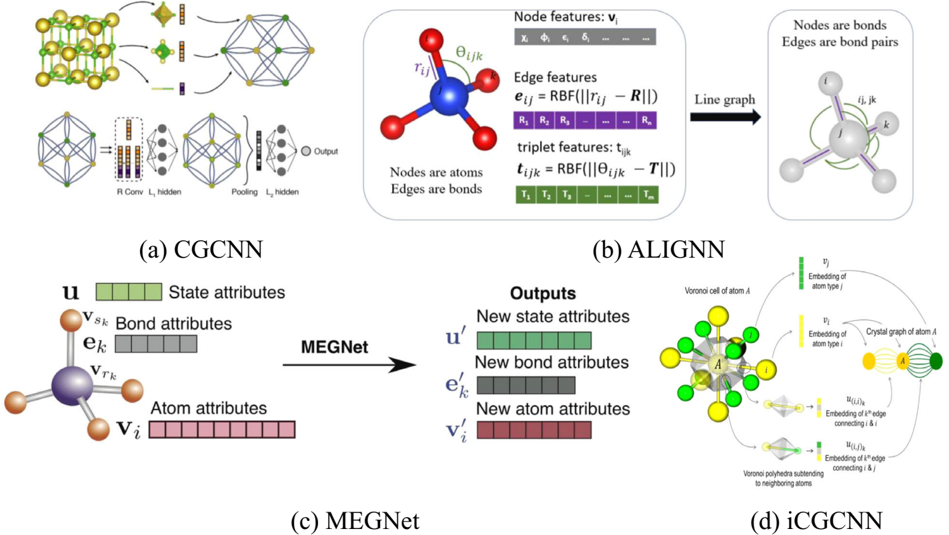
“Models such as SchNet, crystal graph convolutional neural network (CGCNN), improved crystal graph convolutional neural network (iCGCNN), directional message passing neural network (DimeNet), atomistic line graph neural network (ALIGNN) and materials graph neural network (MEGNet) shown in Table 1 have been used to pred…”
MethodInfluentialThe Elements of Statistical Learning
Hastie, T., Friedman, J., & Tibshirani, R. (2001) · Springer Series in Statistics · doi:10.1007/978-0-387-21606-5 · Cited by 24,162
A logical calculus of the ideas immanent in nervous activity
McCulloch, W. S., & Pitts, W. (1943) · The Bulletin of Mathematical Biophysics · doi:10.1007/bf02478259 · Cited by 18,566
The FAIR Guiding Principles for scientific data management and stewardship
Wilkinson, M. D., Dumontier, M., Aalbersberg, I. J., Appleton, G., Axton, M., Baak, A., Blomberg, N., Boiten, J.-W., da Silva Santos, L. B., Bourne, P. E., et al. (2016) · Scientific Data · doi:10.1038/sdata.2016.18 · Cited by 18,423 · cited 2×
“Through the Materials Genome Initiative (MGI) [3] and the increasing adoption of Findable, Accessible, Interoperable, Reusable (FAIR) [4] principles, several large experimental and computational datasets have been developed [5–12].”
Breiman, L. (1996) · Machine Learning · doi:10.1007/bf00058655 · Cited by 16,325 · cited 1×
“Similar to bagging 60 , the use of dropout brings about the same effect of training a collection of randomly chosen models which prevents the co-adaptations among the neurons, consequently reducing the likelihood of the model from over fi tting.”
Background
Research works printed but not linked: 12
- 61. LeCun, Y. et al. The Handbook of Brain Theory and Neural Networks vol. 3361 (MIT press Cambridge, MA, USA 1995).
- 83. Onken, D. et al. A neural network approach for high-dimensional optimal control. arXiv. https://arxiv.org/abs/2104.03270 (2021). · arXiv
- 85. Chen, L., Zhang, W., Nie, Z., Li, S. & Pan, F. Generative models for inverse design of inorganic solid materials. J. Mater. Inform. 1, 4 (2021).
- 104. Artrith, N. & Urban, A. An implementation of artificial neural-network potentials for atomistic materials simulations: Performance for tio2. Comput. Mater. Sci. 114, 135-150 (2016). · DOI · Paper page
- 140. Liu, R. et al. Deep learning for chemical compound stability prediction. In Pro- ceedings of ACM SIGKDD workshop on large-scale deep learning for data mining (DL-KDD), 1-7. https://rosanneliu.com/publication/kdd/ (ACM SIGKDD, 2016).
- 179. Rakita, Y. et al. Studying heterogeneities in local nanostructure with scanning nanostructure electron microscopy (snem). arXiv https://arxiv.org/abs/ 2110.03589 (2021).
- 198. Kong, S. et al. Density of states prediction for materials discovery via contrastive learning from probabilistic embeddings. arXiv. https://arxiv.org/abs/2110.11444 (2021). · arXiv
- 206. Choudhary, A. et al. Graph neural network predictions of metal organic framework co2 adsorption properties. arXiv. https://arxiv.org/abs/2112.10231 (2021). · arXiv
- 282. Haque, E. Effect of electron-phonon scattering, pressure and alloying on the thermoelectric performance of tmcu _3 ch _4(tm= v, nb, ta; ch= s, se, te). arXiv. https://arxiv.org/abs/2010.08461 (2020). · arXiv
- 300. Wilson, A. G., Hu, Z., Salakhutdinov, R. & Xing, E. P. Deep kernel learning. in Artificial intelligence and statistics, 370-378 (PMLR, 2016).
- 348. Fung, V., Hu, G., Ganesh, P. & Sumpter, B. G. Machine learned features from density of states for accurate adsorption energy prediction. Nat. Commun. 12, 1-11 (2021). · DOI · Paper page
- 357. Ede, J. M. & Beanland, R. Partial scanning transmission electron microscopy with deep learning. Sci. Rep. 10, 1-10 (2020). 358. 116. Somnath, S., Smith, C. R., Laanait, N., Vasudevan, R. K. & Jesse, S. Usid and pycroscopy-open source frameworks for storing and analyzing imaging and spectroscopy data. Microsc. Microanal. 25, 220-221 (2019). · DOI
Cited by
Items 901–1,000 of 1,001
Advancing Material Property Prediction With AI and Deep Learning Technologies
Garapati, D. P., Iniyan, S., Sultanuddin, S. J., Manivannan, R., & Pragadish, N. (2025) · Advances in computational intelligence and robotics book series · doi:10.4018/979-8-3693-7974-5.ch014
Hafen, J., Teague, J., Fleming, B., Ruthstrom, J., Moore, M. E., Lukow, S., Suazo, J., Grow, D., Choudhury, S. D., & Gigax, J. G. (2025) · Nuclear Engineering and Design · doi:10.1016/j.nucengdes.2025.114064
Zuo, H., Xu, Y., Li, M., & Wang, H. (2025) · Robotic Intelligence and Automation · doi:10.1108/ria-11-2024-0249
A Streamlined YOLOv3 and ResNet-50 for Effective Leukemia Detection
Roselin, G. L., & Sabimozhi, M. (2025) · Information systems engineering and management · doi:10.1007/978-3-031-77296-2_1
Fan, S., Yang, Z., Peng, M., Hong, Y., Duan, Y., Zhou, X., & Li, M. V. (2025) · JOM · doi:10.1007/s11837-025-07426-8
Modern Physics in Medicine: From Quantum Mechanics to Medical Imaging
Abboud, H. A. M., Rahim, A. M. F. A., Jabir, H. A. M., Ali, A. A. H. A., Sharrad, G. A. T., & Bard, W. K. H. (2025) · Bright Sky Publications eBooks · doi:10.62906/bs.book.359
A Signals–Systems Perspective on Electronic Structure Theory
Yadav, A., Hedman, D., & Jeong, H. (2025) · Lecture notes in networks and systems · doi:10.1007/978-981-97-9926-8_13
Effect of barium doping on dielectric and conducting properties of KHP crystals
Gaonkar, N., Naik, V., Naik, J., Kumar, R. M., & Vaidya, R. G. (2025) · Journal of Materials Science Materials in Electronics · doi:10.1007/s10854-025-14970-1
Fabris, G. S. L., Ferrer, M. M., Almeida, C. R. R., Paskocimas, C. A., Sambrano, J. R., & Porta, F. A. L. (2025) · Physchem · doi:10.3390/physchem5020022
“[ 6–10] In general, it is known that this traditional path involves high costs and takes a lot of time, in addition to the high number of possible combinations.”
BackgroundAn emerging paradigm for scientific decision: the AI evaluation of space science projects
Deng, Q., Wen, Y., Liu, C., Yue, X., Sun, J., & Han, Y. (2025) · Life Sciences in Space Research · doi:10.1016/j.lssr.2025.06.006
Nanomaterial-modified Electrodes for the Detection of Various Dyes
Halfadji, A., & Naous, M. (2025) · Royal Society of Chemistry eBooks · doi:10.1039/9781837675289-00184
A data-driven predictive model for solubility: A case study of the NaCl-Na2SO4-H2O system
Wang, Y., Chen, M., Tian, J., Zhang, W., & Liu, D. (2025) · Chinese Journal of Chemical Engineering · doi:10.1016/j.cjche.2025.05.019
Transfer Learning for Alloy Classification Based on Microstructure Images
Deshmukh, A., & Eidel, B. (2025) · Studies in computational intelligence · doi:10.1007/978-3-031-85470-5_6
3D CNNs for Smart Manufacturing Voxel-Based Classification of Industrial Workpieces
Hirono, M., Nagata, F., Habib, M. K., Watanabe, K., Nakamura, H., & Tamano, H. (2025) · Advances in computational intelligence and robotics book series · doi:10.4018/979-8-3693-7994-3.ch001
A Novel Framework for Solving Pdes: Continuous Physics-Informed Neural NetworksPreprint
pan, Y., Dai, D., & Fang, Z. (2025) · SSRN Electronic Journal · doi:10.2139/ssrn.5351974
Best of both worlds: Enforcing detailed balance in machine learning models of transition rates
Talapatra, A., Pandey, A., Wilson, M. S., Li, Y. W., Pilania, G., Uberuaga, B. P., & Pérez, D. (2025) · Computer Physics Communications · doi:10.1016/j.cpc.2025.109752 · Cited by 2
“More details can be found in several recent reviews 51–54 .”
Transforming Carbon-Based Material: The Role of AI and ML Regression Techniques in Material Science
Muthukrishnaraj, A., Kalaivani, S. S., Manikandan, A., Soman, K. P., & Henini, M. (2025) · Studies in computational intelligence · doi:10.1007/978-3-031-89983-6_4
Bollineni, R. K., Deng, Z., Kesler, M. S., Tonks, M., Li, L., & Kurian, S. (2025) · SSRN Electronic Journal · doi:10.2139/ssrn.5383372
Deep Learning and COVID-19: Two Pathways to Scientific Evolution
Kang, H., Dong, H., Ding, Y., Jin, Z., Fu, L., Ding, J., Wang, X., Zhou, L., & Zhou, C. (2025) · Applied Sciences · doi:10.3390/app15168912
Leveraging Data Science and Artificial Intelligence for Enhanced Monitoring Systems
Arena, F., Collotta, M., Pau, G., Ricciardello, A., Ruggieri, M., Salerno, V. M., & Scuro, C. (2025) · IEEE International Workshop on Metrology for Living Environment (MetroLivEnv) · doi:10.1109/metrolivenv64961.2025.11107156
“Combining these approaches provides invaluable insights into complex datasets, thereby facilitating data-informed decision-making across diverse sectors [7].”
InfluentialTransformative Role of Machine Learning in Precision Medicine for Enhanced Healthcare Environments
Arena, F., Collotta, M., Pau, G., Ricciardello, A., Ruggieri, M., Salerno, V. M., & Scuro, C. (2025) · IEEE International Workshop on Metrology for Living Environment (MetroLivEnv) · doi:10.1109/metrolivenv64961.2025.11107053
“Additionally, future studies ought to investigate the socio-economic barriers to implementing ML-based technologies in lower-resource areas—such as sub-Saharan Africa—where AI could play a vital role in bridging healthcare gaps [7].”
InfluentialFast Marching Method-Inspired Inversion Neural Network for Permeability Prediction
Yan, B. (2025) · IntechOpen eBooks · doi:10.5772/intechopen.115629
Comparing the Visual Quality of Deep Generative Models for Steel Microstructures
Wentzien, M., Ingber, J., Schlötterer, J., & Schmalzried, D. (2025) · Lecture notes in computer science · doi:10.1007/978-3-032-02813-6_23
Eckstein, U. R., & Webber, K. G. (2025) · Japanese Journal of Applied Physics · doi:10.35848/1347-4065/ae08c1
Deep learning-based prediction of magnetic properties in electrodeposited Co–Ni alloy thin films
Güler, H., Özdemir, R., & Coşkun, A. (2025) · Journal of Materials Science · doi:10.1007/s10853-025-11544-8 · Cited by 1
585Transforming healthcare with machine learning
Mahalakshmi, M. S., Sujatha, S. N. N., Banumathi, S., Purushothaman, V., & Kumar, K. S. (2025) · De Gruyter eBooks · doi:10.1515/9783111503202-013
Sculpting the future: harnessing artificial intelligence for revolutionary drug discovery
Lavecchia, A. (2025) · Elsevier eBooks · doi:10.1016/b978-0-443-33885-4.00003-2
Yang, Y., Liu, Y. H., He, Y., Pan, Z., & Li, Z. (2025) · Modelling—International Open Access Journal of Modelling in Engineering Science · doi:10.3390/modelling6040126
“However, their studies largely rely on the large, well-annotated datasets, which are costly and time-consuming to obtain in real-world industrial scenarios [35,36].”
Physics of Local Optimization in Complex Disordered Systems
Shen, M., Ortíz, G., Dong, Z., Weigel, M., & Nussinov, Z. (2026) · Physical Review Letters · doi:10.1103/kcbw-6zkv · Cited by 1
Artificial intelligence in quality control and product development
AYDINOCAK, E. U. (2025) · Elsevier eBooks · doi:10.1016/b978-0-443-34076-5.00004-3
Tumor Classification by using Deep Learning Architecture in Mammogram images
Punitha, M., Jeyavani, M., & Nandhini, V. (2025) · International Conference on Innovative Mechanisms for Industry Applications · doi:10.1109/icimia67127.2025.11200666
Shift-Left and Continuous Testing in Quality Assurance Engineering Ops and DevOps
Kesavan, E. (2024) · International Journal of Scientific Research and Modern Technology. · doi:10.38124/ijsrmt.v3i1.859
Deep Learning Approaches for Predicting Strain Energy in Heterogeneous Materials
Gautam, J., Acharya, P., & Hu, Z. Y. (2025) · Recent Progress in Materials · doi:10.21926/rpm.2504016
Deep Learning–Accelerated Multiscale Analysis Method for Continuous Fiber CompositesPreprint
Wang, Z., Liu, S., Wei, Z., Tang, J., Zheng, S., & Ren, F. (2025) · SSRN Electronic Journal · doi:10.2139/ssrn.5660585
Šekrst, K. (2025) · Springer eBooks · doi:10.1007/978-3-032-05562-0_9
Deep Learning–Accelerated Multiscale Analysis Method for Continuous Fiber CompositesPreprint
Wang, Z. (2025) · SSRN Electronic Journal · doi:10.2139/ssrn.5678525
Object Identification Based on Extended State Observer on Artificial Cat Whiskers
Cortez, R., Galicia-Montoya, Y., Cruz-Cambray, L., Sandoval-Chileño, M. A., Luviano‐Juárez, A., Lozada-Castillo, N. B., & Rincon-Martinez, K. (2025) · Processes · doi:10.3390/pr13113473
Introduction to Nanoengineered Materials
Gupta, K. K., Dey, S., & Mukhopadhyay, T. (2025) · Materials horizons · doi:10.1007/978-981-95-2660-4_1
Deep Learning and Beyond: Innovations, Limitations, and the Road Ahead
Goyat, A., Maan, A., & Malhotra, V. (2025) · Lecture notes in networks and systems · doi:10.1007/978-3-032-06671-8_44
Dong, X., Zhang, T., Zheng, F., Li, Q., Xu, Z., Liu, Y., & Wang, G. (2025) · Spectrochimica Acta Part A Molecular and Biomolecular Spectroscopy · doi:10.1016/j.saa.2025.127169 · Cited by 1
DT-MIM: A network suitable for alloy microstructure evolution prediction and characterizationPreprint
Zhang, Y., Lu, Z. S., Zhou, J., Li, J., Liu, A., & Zhang, Z. (2025) · SSRN Electronic Journal · doi:10.2139/ssrn.5797767
Shariaty, F., Tsybin, O. Y., Pavlov, V. A., & Baranov, M. (2025) · International Conference on Electrical Engineering and Photonics (EExPolytech) · doi:10.1109/eexpolytech66949.2025.11251976
“While machine learning (ML) and deep learning (DL) have revolutionized image analysis in materials science [8] and bioimaging, a critical gap remains.”
Gajoch, S., Wilk-Kołodziejczyk, D., Marcjan, Ł., Corizzo, R., Bitka, A., Małysza, M., & Skomin, G. (2025) · Materials · doi:10.3390/ma18225207
Surya, M. S., Kumar, V. N., Srivastava, J. P., Gugulothu, S. K., & Prasanthi, G. (2025) · Journal of Bio- and Tribo-Corrosion · doi:10.1007/s40735-025-01087-5
Animal Track Detection and Classification Using Vision-Based Deep Models
Prathyakshini, Prathwini, P., Rao, D. S., & Bhat, V. K. (2025) · IEEE International Conference on Distributed Computing, VLSI, Electrical Circuits and Robotics (DISCOVER) · doi:10.1109/discover66922.2025.11258956
“Based on deep learning [3-4] techniques, this research creates an accurate and effective system for classifying animal foot-prints.”
A comprehensive understanding of the use of machine learning in polyoxometalates
Ghosh, S., & Rani, B. (2025) · Elsevier eBooks · doi:10.1016/b978-0-443-15686-1.00013-2
Datasets and tools in materials science
Yousefi, S. (2025) · Elsevier eBooks · doi:10.1016/b978-0-323-95464-8.00009-8
Artificial intelligence applications in electrospinning of biocompatible polymers
Nasirinezhad, M., Etminanrezaeieh, S., & Sedaghat, S. A. (2025) · Elsevier eBooks · doi:10.1016/b978-0-323-95464-8.00013-x
Gallego, M., Roca-Jerat, S., Zueco, D., & Carrete, J. (2025) · Machine Learning Science and Technology · doi:10.1088/2632-2153/ae29bb
Chakrabarty, S., Choudhary, K. K., Wines, D., Li, Y., Gupta, V., Kilic, M. N. T., Choudhary, A., & Agrawal, A. (2025) · The Journal of Physical Chemistry C · doi:10.1021/acs.jpcc.5c04792 · Cited by 1
Self-citationIncorporating defects and moisture in MOE evaluation for automated timber grading
Ji, M., Zhang, W., Cai, L., Zhao, Y., Hu, M., Gao, R., Wang, G., Han, J., Diao, X., & Zha, Z. (2025) · Scientific Reports · doi:10.1038/s41598-025-00325-7
“Simultaneously, the mechanical stress grading method can fulfill the requirements to a certain extent 22,23 .”
Huang, Z., He, L., Yang, Y., Li, A., Zhang, Z., Wu, S., Wang, Y., He, Y. Z., & Xujie, L. (2024) · Figshare · doi:10.6084/m9.figshare.26157035
Huang, Z., He, L., Yang, Y., Li, A., Zhang, Z., Wu, S., Wang, Y., He, Y. Z., & Xujie, L. (2024) · Figshare · doi:10.6084/m9.figshare.26157404
Inversion of the Optoelectronic Properties of Aluminum Nitride Materials Based on Deep Learning
Wu, C., & Wang, Y. (2025) · e-Journal of Surface Science and Nanotechnology · doi:10.1380/ejssnt.2025-050
Sharma, R., Sundram, S., & Kagithala, N. R. (2025) · De Gruyter eBooks · doi:10.1515/9783111681870-006
Nelluri, K. D. D., Rahaman, S. A., Kommoju, M., & Alaparthi, B. (2025) · De Gruyter eBooks · doi:10.1515/9783111681870-009
Peiyan, L., Jiayi, L., Zhaoyi, W., Muhai, L., Ying’en, F., Ronghua, Z., Xinyu, Z., Hoa, D. N., & Jianhui, L. (2025) · Sustainable polymer & energy · doi:10.70322/spe.2025.10013 · Cited by 1
XINCAI, L., & JIAYU, L. (2025) · SSRN Electronic Journal · doi:10.2139/ssrn.5934618
Xuemei, Y. (2025) · SSRN Electronic Journal · doi:10.2139/ssrn.5934621
Gong, W., Sun, J., Liu, D., Li, H., Yuan, W., & Chen, F. (2025) · Physics of Fluids · doi:10.1063/5.0303296
Choi, J. H., Kim, J.-H., Kim, U. S., & Han, K. (2025) · Journal of the Australian Ceramic Society · doi:10.1007/s41779-025-01318-5
“Machine learning (ML) has emerged as a transformative tool for addressing prediction and classification challenges across diverse industries [1 ].”
Concept of the Obstacles Optical Detection System for the Aircraft and Unmanned Aerial Vehicles
Gecejová, N., Češkovič, M., & Kurdel, P. (2025) · New Trends in Aviation Development (NTAD) · doi:10.1109/ntad67887.2025.11302532
“In particular, Deep Learning Techniques are widespread and remarkably reliable [17,18].”
GUDR-Net-Based MMF Wavemeters for High-Resolution Wavelength Prediction Across the Full C-Band
Hu, J., Liu, Z., Lu, W., & Shieh, W. (2025) · IEEE Photonics Technology Letters · doi:10.1109/lpt.2025.3648451
“Deep learning has recently attracted significant attention as a powerful technique driving major advancements across various scientific fields [7], [8], [9].”
Computational and artificial intelligence-driven battery design of solid-state batteries
Alen Rufus, P., Gunasekaran, K., Samikannu, R., Begam, K. M., & Murugan, S. (2025) · Energy Exploration & Exploitation · doi:10.1177/01445987251400457
“Best-suited NN types for each SSB computational model are listed in Table 7 (Choudhary et al., 2022; Darbar and Bhattacharya, 2022; Guo et al., 2024; Menon and Ranganathan, 2022; Schmitt et al., 2023; Tang et al., 2023; Wang et al., 2024; Yao et al., 2022).”
Prediction of Grit Size Surface Roughness from Microscopy Images using Deep Learning
Ametov, R., Das, S., & Choudhury, M. D. (2025) · IEEE International Conference for Women in Innovation, Technology & Entrepreneurship (ICWITE) · doi:10.1109/icwite64848.2025.11307024
“With the outcomes from this work, it can further push the boundaries of these fields by allowing for more studies to expand into a subject that has not been sufficiently explored [11].”
Wan, L., Fan, H., Chen, X., & Guo, F. (2025) · Journal of Composites Science · doi:10.3390/jcs10010002
“As a result, deep learning frameworks have been increasingly adopted in materials science to accelerate microstructure characterization, property prediction, and virtual testing [21,22].”
Goyal, V., Purohit, S., Dadhich, A., & Jain, R. (2026) · Engineering materials · doi:10.1007/978-981-95-4180-5_19 · Cited by 2
Artificial Intelligence and its Implications for Media Sustainability in Romania
Stănescu, G. C. (2026) · CSR, sustainability, ethics & governance · doi:10.1007/978-3-032-00086-6_5
Liu, J. (2026) · Open Journal of Social Sciences · doi:10.4236/jss.2026.141010
Altinses, D., Torres, D. O. S., Holstein, V., Hermes, M., & Schwung, A. (2026) · Applied Intelligence · doi:10.1007/s10489-026-07089-1 · Cited by 1
Chang, M.-C., Amsler, M., Sutherland, D. R., Ament, S., Gann, K. R., Zhou, L., Smieska, L., Woll, A. R., Gregoire, J. M., Gomes, C. P., et al. (2026) · PRX Intelligence · doi:10.1103/c362-349b · Cited by 1
Deep learning architectures for multimodal fusion
Savithri, M., & Gnanamonickam, A. A. (2026) · Elsevier eBooks · doi:10.1016/b978-0-443-27528-9.00004-8
Machine Learning Applications in Composite Material Synthesis and Property Prediction
Rao, D. S., Narasimharao, M., Jamadar, B. N., Powar, A. A., Vhankhande, B., & Umbarkar, A. J. (2025) · International Conference on Future Technologies (ICFT) · doi:10.1109/icft66708.2025.11336698
Doped metal oxides: Prediction of properties by machine learning
Sahu, B. B., Moharana, S., & Deshmukh, K. (2026) · Elsevier eBooks · doi:10.1016/b978-0-443-29271-2.00001-5
Tong, J., Wang, G., Wang, S., & Moraros, J. (2026) · Urban Climate · doi:10.1016/j.uclim.2026.102780
Synergies between data science methods and innovative drug delivery technologies
Winkler, D. A. (2026) · Advanced Drug Delivery Reviews · doi:10.1016/j.addr.2026.115783
Skeleton integrity: A method for the efficient fine-tuning of pose estimation models for pigs
Brunner, D., Bordes, M., Mayrhuber, E., Winkler, S., Dorfer, V., & Oczak, M. (2026) · Biosystems Engineering · doi:10.1016/j.biosystemseng.2025.104380 · Cited by 1
Lai, Z., Li, J., & Zhu, X. (2026) · Nanoscale · doi:10.1039/d5nr05302a
Wen, B., Xu, H., Ding, Y., Wang, Q., Zhang, P., Zhang, C., & Wang, W. (2026) · Microsystems & Nanoengineering · doi:10.1038/s41378-026-01164-w · Cited by 1
Challenges and future directions in medical image analysis
Ashayeri, H., Sobhi, N., Vahedi, H., Alizadehsani, R., & Jafarizadeh, A. (2026) · Elsevier eBooks · doi:10.1016/b978-0-443-33082-7.00007-3
Wu, Z. Y., Tohei, T., Hayashi, Y., Usami, S., Imanishi, M., Mori, Y., Takino, J., Sumitani, K., Imai, Y., Kimura, S., et al. (2026) · Materials & Design · doi:10.1016/j.matdes.2026.115669
DT-MIM: A network suitable for alloy microstructure evolution prediction and characterization
Lu, Z. S., Zhou, J., Li, J., Liu, A., Zhang, Y., & Zhang, Z. (2026) · Journal of Materials Research and Technology · doi:10.1016/j.jmrt.2026.02.083
Mechanical Property Prediction of Porous Ceramic Materials Based on Convolutional Neural Network
Liu, K., Xu, W., & Liang, F. (2025) · International Conference on Robot Systems and Applications (ICRSA) · doi:10.1109/icrsa66467.2025.11383818
“This not only significantly improves the efficiency of data processing but also reduces experimental costs and optimizes the design and performance evaluation process of materials [6] .”
Development and Validation of a Neural Network Interatomic Potential for Silicon Carbide
Qi, R., Li, H. X., Zhang, Y., He, W., & Yang, W. (2025) · International Conference on Computer, Big Data and Artificial Intelligence (ICCBD+AI) · doi:10.1109/iccbdai66607.2025.11388968
“To bridge the gap between first-principles precision and empirical efficiency, machine learning potentials (MLPs) have emerged as a promising alternative [10].”
Intelligent Methods for Materials Discovery and Design
Agrawal, A., Singh, J., Jain, A., Tiwari, A. K., Kushwah, A. S., & Verma, N. K. (2026) · Advances in computational intelligence and robotics book series · doi:10.4018/979-8-3373-6127-7.ch001
Self-citationZhou, Y., Xu, S., Yang, X., Yu, H., Pan, Y., & Lei, Y. (2026) · Canadian Geotechnical Journal · doi:10.1139/cgj-2025-0670
Nath, S., Jilkar, S., Udgaonkar, A., Lu, Y., & Mesbah, A. (2026) · Advanced Intelligent Discovery · doi:10.1002/aidi.202500238
Generative Modeling of Entangled Polymers with a Distance-Based Variational Autoencoder
Chiarantoni, P., Serra, O., Mowlaei, M. E., Choutipalli, V. S. K., DelloStritto, M. J., Shi, X. M., Klein, M. L., & Carnevale, V. (2026) · Journal of Chemical Theory and Computation · doi:10.1021/acs.jctc.5c01953
Interpretable deep learning for atomicity classification of platinum nanoclusters in STEM images
Tsukamoto, K., Hirata, N., Tona, M., & Nakajima, A. (2026) · npj Computational Materials · doi:10.1038/s41524-026-02014-z · Cited by 1
Li, M. X., Gao, H., Yue, Z., Bai, S., Wang, Y., Yao, E., & Wang, Q. (2026) · Measurement Science and Technology · doi:10.1088/1361-6501/ae4d68
“Recently, image processing techniques have been widely applied in the analysis of material microstructures [5].”
Neural networks in predicting mechanical properties of Al-Zn alloys: A review and model development
Kumar, V., Negi, A., Mandal, A., Ji, G., Gautam, G., Saxena, R., & Singh, M. K. (2026) · AIP conference proceedings · doi:10.1063/5.0317593
Zhang, Y., Sadiq, M., Fraz, M. M., aldhahri, E. A., Almazroi, A. A., Iqbal, M., Hayat, A., Geng, Y., Algamdi, A. S. R., Noreen, A., et al. (2026) · Sustainable materials and technologies · doi:10.1016/j.susmat.2026.e01949 · Cited by 2
Gupta, V., Choudhary, K. K., Li, Y., Kilic, M. N. T., Wines, D., Liao, W., Choudhary, A., & Agrawal, A. (2026) · Materials Research Express · doi:10.1088/2053-1591/ae5148 · Cited by 1
Self-citationEnhancing CAP Education with a multi-guideline knowledge graph: a mixed-methods study
Liu, F., Xiong, Z., Gao, P., Lu, M., & Li, P. (2026) · BMC Medical Education · doi:10.1186/s12909-026-09028-7
“Emerging evidence suggests that KGs improve medical education by providing structured, interactive learning experiences [19–21].”
Drop-in density-aware partitioning for tree-based anomaly detection
Yeom, S., & Jung, J.-H. (2026) · Machine Learning Science and Technology · doi:10.1088/2632-2153/ae5390
“Despite the dominance of deep neural networks (DNNs) in many areas of machine learning [1, 2], classical isolation tree-based models continue to outperform them in anomaly detection.”
Li, M., Feng, N., Wang, Q., & Chen, D. (2026) · IEEE Transactions on Instrumentation and Measurement · doi:10.1109/tim.2026.3676165
“In materials science, segmentations are widely used to analyze microstructures [39], such as precipitations, grains [40], and second-phase particles.”
SMIR-LM: Scalable Information Retrieval Frameworks for Large-Scale Multilingual Environments
Liang, X. (2026) · International Conference on Image Processing and Capsule Networks (ICIPCN) · doi:10.1109/icipcn67432.2026.11438675
Experimental investigation of magnetic properties of MnFeCo4Si2 discovered by GNoME
Naganuma, S., & Kitagawa, J. (2026) · Journal of Magnetism and Magnetic Materials · doi:10.1016/j.jmmm.2026.174056 · Cited by 1
Lobitos, O. A., & Edig, M. M. N. (2026) · Journal of Learning and Educational Policy · doi:10.55529/jlep.61.14.26
Environmental Degradation Prediction of Coating Materials Based on FT-Transformer
Nie, R., Wu, L., Zhou, L., & Li, Y. (2025) · International Conference on Cyberworlds (CW) · doi:10.1109/cw68232.2025.00047
“Studies have successfully applied various ML techniques to corrosion prediction [3], with deep learning methods demonstrating particular effectiveness for complex materials problems [4].”
Metadata
- Authors
- Choudhary, K., DeCost, B., Chen, C., Jain, A., Tavazza, F., Cohn, R., Park, C. W., Choudhary, A., Agrawal, A., Billinge, S. J. L., Holm, E., Ong, S. P., & Wolverton, C.
- Affiliations
- National Institute of Standards and Technology (US)
- University of California San Diego (US)
- Lawrence Berkeley National Laboratory (US)
- Carnegie Mellon University (US)
- Northwestern University (US)
- Columbia University (US)
- ORCID
- Venue
- npj Computational Materials
- Published
- 2022-04-05
- Volume
- 8
- Issue
- 1
- ISSN
- 2057-3960 (ISSN-L)
- OpenAlex
- W3208687975
- Semantic Scholar
- 5aaeb50d8051890e9fbb9b9b8f34d9f3f2d85c1a
- Cited by
- 1,172
- References
- 401
- Citations by year
- 2026: 248 · 2025: 386 · 2024: 316 · 2023: 187 · 2022: 35
- FWCI
- 64.93
- Type
- journal article
- Language
- en
- Open access
- gold
- doi.org
- Licence
- cc-by
- creativecommons.org/licenses/by/4.0 (tdm)
- creativecommons.org/licenses/by/4.0 (vor)
- Locations
- npj Computational Materials (publishedVersion, cc-by)
- arXiv (Cornell University) (submittedVersion)
- eScholarship (California Digital Library) (submittedVersion, cc-by)
- OSTI OAI (U.S. Department of Energy Office of Scientific and Technical Information) (submittedVersion, cc-by)
- DOAJ (DOAJ: Directory of Open Access Journals) (submittedVersion)
- arXiv (Cornell University) (cc-by)
- Funders
- National Science Foundation (DEAC02-05CH11231, 2053929, 70NANB19H005, 1826218, 1922234)
- U.S. Department of Energy (-AC02-05CH11231, DE-AC02-05-CH11231: Materials Project program KC23MP, 70NANB19H005, KC23MP, DE AC02 05CH11231, DE-AC02-)
- U.S. Department of Commerce (70NANB19H005, 70NANB19H117)
- Northwestern University (70NANB19H005)
- University of Warwick
- National Institute of Standards and Technology (70NANB19H117, 70NANB19H005)
- Office of Science (DEAC02–05CH11231, DE-AC02, DE-AC02-05-CH11231: Materials Project Program KC23MP)
- Division of Civil, Mechanical and Manufacturing Innovation (CMMI-2053929)
- Basic Energy Sciences (DE-AC02, DE-AC02-05CH11231., KC23MP, DE-AC02-05-, AC02–05CH11231)
- Topics
- Physical Sciences › Materials Science › Materials Chemistry › Machine Learning in Materials Science
- Physical Sciences › Physics and Astronomy › Atomic and Molecular Physics, and Optics › Advanced Chemical Physics Studies
- Physical Sciences › Physics and Astronomy › Statistical and Nonlinear Physics › Model Reduction and Neural Networks
- Keywords
- deep learning, atomistic simulation, materials imaging, spectral analysis, natural language processing, synthetic data, generative models, uncertainty quantification, materials database, spectral data
About these checks
Registry, retraction, Cites and statistics results are computed, not judged, with one exception: a printed reference that no index lists is read once by a model before it counts as a citation error. Claims are extracted by a model and kept only when their quote appears verbatim in the text; each cited source is then checked, with a model’s help, for whether it says what the claim relies on. Those verdicts can be wrong — read the claim’s quote and the cited source before relying on one.
Statistics and arithmetic are recomputed, not judged.
Confidence bands are shown only for fields calibrated on our annotated test set. None is calibrated yet, so no band is shown.
What counts as a claim ›How we measure confidence ›How we check this ›
Are you an author, or do you see a problem with this page? Request a review
Data sources
Bibliographic data: Semantic Scholar, OpenAlex, Crossref.
Contains information from the Semantic Scholar Academic Graph Datasets, made available under the ODC Attribution License (ODC-BY 1.0).
Semantic Scholar’s data is described in: Kinney, R., et al. (2023). The Semantic Scholar Open Data Platform. arXiv:2301.10140.
