

Recent advances and applications of deep learning methods in materials science
Open accessThe DOI matches its Crossref record; 404 of the 404 references it cites were found in a registry or an index.
Abstract
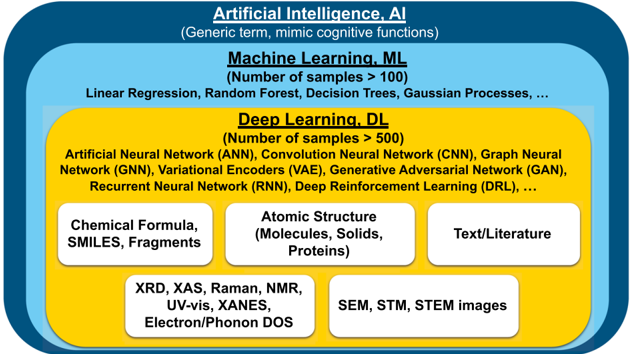
Deep learning (DL) is one of the fastest-growing topics in materials data science, with rapidly emerging applications spanning atomistic, image-based, spectral, and textual data modalities. DL allows analysis of unstructured data and automated identification of features. The recent development of large materials databases has fueled the application of DL methods in atomistic prediction in particular. In contrast, advances in image and spectral data have largely leveraged synthetic data enabled by high-quality forward models as well as by generative unsupervised DL methods. In this article, we present a high-level overview of deep learning methods followed by a detailed discussion of recent developments of deep learning in atomistic simulation, materials imaging, spectral analysis, and natural language processing. For each modality we discuss applications involving both theoretical and experimental data, typical modeling approaches with their strengths and limitations, and relevant publicly available software and datasets. We conclude the review with a discussion of recent cross-cutting work related to uncertainty quantification in this field and a brief perspective on limitations, challenges, and potential growth areas for DL methods in materials science.
Overview
The claims and statistics of this paper haven’t been checked yet.
Free: it reads the open-access text and checks the first 5 claims that cite a source we can check. Create a free account to check every claim.
Integrity signals
Registry
Cites
Statistics
Figures
Verification
Claims the paper makes
The claims and statistics of this paper haven’t been checked yet.
Free: it reads the open-access text and checks the first 5 claims that cite a source we can check. Create a free account to check every claim.
Self-check
Percentages, sums and reported differences re-computed from the paper’s own numbers.
The self-check needs the paper’s full text.
Citations
Cites
ImageNet classification with deep convolutional neural networks
Krizhevsky, A., Sutskever, I., & Hinton, G. E. (2017) · Communications of the ACM · doi:10.1145/3065386 · Cited by 112,155
LeCun, Y., Bengio, Y., & Hinton, G. (2015) · Nature · doi:10.1038/nature14539 · Cited by 84,126
BERT: Pre-training of Deep Bidirectional Transformers for Language Understanding
Devlin, J., Chang, M.-W., Lee, K., & Toutanova, K. (2018) · arXiv · doi:10.48550/arxiv.1810.04805 · Cited by 73,173 · cited 1×
“More recently, sequence-to-sequence models based on a “transformer” architecture, such as Google’s Bidirectional Encoder Representations from Transformers (BERT) model [53, 70], have helped address some of the issues of traditional RNNs.”
BERT: Pre-training of Deep Bidirectional Transformers for Language Understanding
Devlin, J., Chang, M.-W., Lee, K., & Toutanova, K. (2019) · Proceedings of the 2019 Conference of the North American Chapter of the Association for Computational Linguistics: Human Language Technologies, Volume 1 (Long and Short Papers) · doi:10.18653/v1/n19-1423 · Cited by 54,325 · cited 1×
“More recently, sequence-to-sequence models based on a “transformer” architecture, such as Google’s Bidirectional Encoder Representations from Transformers (BERT) model [53, 70], have helped address some of the issues of traditional RNNs.”
PyTorch: An Imperative Style, High-Performance Deep Learning Library
Paszke, A., Gross, S., Massa, F., Lerer, A., Bradbury, J., Chanan, G., Killeen, T., Lin, Z., Gimelshein, N., Antiga, L., et al. (2019) · arXiv · doi:10.48550/arxiv.1912.01703 · Cited by 31,473
Semi-supervised classification with graph convolutional networks
Kipf, T. N., & Welling, M. (2016) · arXiv · doi:10.48550/arxiv.1609.02907 · Cited by 24,853 · cited 6×
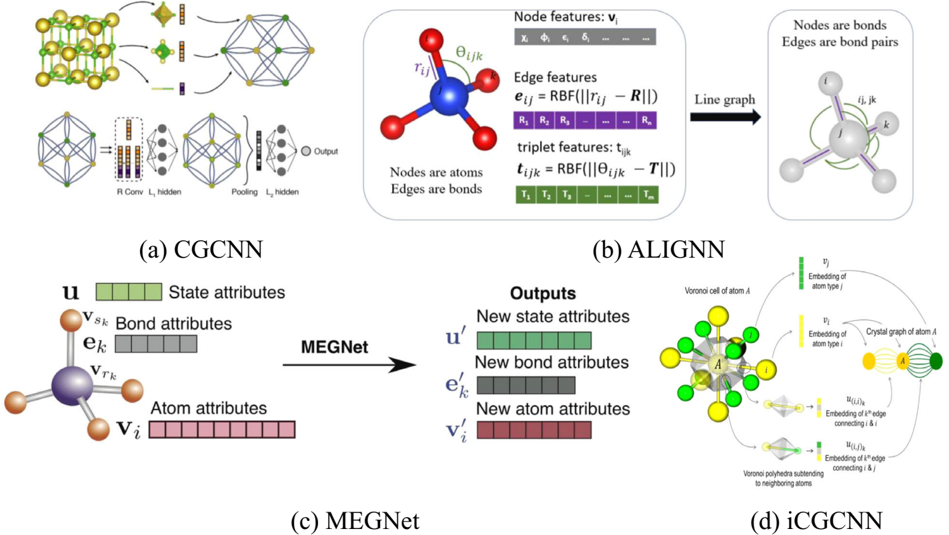
“Models such as SchNet, crystal graph convolutional neural network (CGCNN), improved crystal graph convolutional neural network (iCGCNN), directional message passing neural network (DimeNet), atomistic line graph neural network (ALIGNN) and materials graph neural network (MEGNet) shown in Table 1 have been used to pred…”
MethodInfluentialThe Elements of Statistical Learning
Hastie, T., Friedman, J., & Tibshirani, R. (2001) · Springer Series in Statistics · doi:10.1007/978-0-387-21606-5 · Cited by 24,162
A logical calculus of the ideas immanent in nervous activity
McCulloch, W. S., & Pitts, W. (1943) · The Bulletin of Mathematical Biophysics · doi:10.1007/bf02478259 · Cited by 18,566
The FAIR Guiding Principles for scientific data management and stewardship
Wilkinson, M. D., Dumontier, M., Aalbersberg, I. J., Appleton, G., Axton, M., Baak, A., Blomberg, N., Boiten, J.-W., da Silva Santos, L. B., Bourne, P. E., et al. (2016) · Scientific Data · doi:10.1038/sdata.2016.18 · Cited by 18,423 · cited 2×
“Through the Materials Genome Initiative (MGI) [3] and the increasing adoption of Findable, Accessible, Interoperable, Reusable (FAIR) [4] principles, several large experimental and computational datasets have been developed [5–12].”
Breiman, L. (1996) · Machine Learning · doi:10.1007/bf00058655 · Cited by 16,325 · cited 1×
“Similar to bagging 60 , the use of dropout brings about the same effect of training a collection of randomly chosen models which prevents the co-adaptations among the neurons, consequently reducing the likelihood of the model from over fi tting.”
Background
Research works printed but not linked: 12
- 61. LeCun, Y. et al. The Handbook of Brain Theory and Neural Networks vol. 3361 (MIT press Cambridge, MA, USA 1995).
- 83. Onken, D. et al. A neural network approach for high-dimensional optimal control. arXiv. https://arxiv.org/abs/2104.03270 (2021). · arXiv
- 85. Chen, L., Zhang, W., Nie, Z., Li, S. & Pan, F. Generative models for inverse design of inorganic solid materials. J. Mater. Inform. 1, 4 (2021).
- 104. Artrith, N. & Urban, A. An implementation of artificial neural-network potentials for atomistic materials simulations: Performance for tio2. Comput. Mater. Sci. 114, 135-150 (2016). · DOI · Paper page
- 140. Liu, R. et al. Deep learning for chemical compound stability prediction. In Pro- ceedings of ACM SIGKDD workshop on large-scale deep learning for data mining (DL-KDD), 1-7. https://rosanneliu.com/publication/kdd/ (ACM SIGKDD, 2016).
- 179. Rakita, Y. et al. Studying heterogeneities in local nanostructure with scanning nanostructure electron microscopy (snem). arXiv https://arxiv.org/abs/ 2110.03589 (2021).
- 198. Kong, S. et al. Density of states prediction for materials discovery via contrastive learning from probabilistic embeddings. arXiv. https://arxiv.org/abs/2110.11444 (2021). · arXiv
- 206. Choudhary, A. et al. Graph neural network predictions of metal organic framework co2 adsorption properties. arXiv. https://arxiv.org/abs/2112.10231 (2021). · arXiv
- 282. Haque, E. Effect of electron-phonon scattering, pressure and alloying on the thermoelectric performance of tmcu _3 ch _4(tm= v, nb, ta; ch= s, se, te). arXiv. https://arxiv.org/abs/2010.08461 (2020). · arXiv
- 300. Wilson, A. G., Hu, Z., Salakhutdinov, R. & Xing, E. P. Deep kernel learning. in Artificial intelligence and statistics, 370-378 (PMLR, 2016).
- 348. Fung, V., Hu, G., Ganesh, P. & Sumpter, B. G. Machine learned features from density of states for accurate adsorption energy prediction. Nat. Commun. 12, 1-11 (2021). · DOI · Paper page
- 357. Ede, J. M. & Beanland, R. Partial scanning transmission electron microscopy with deep learning. Sci. Rep. 10, 1-10 (2020). 358. 116. Somnath, S., Smith, C. R., Laanait, N., Vasudevan, R. K. & Jesse, S. Usid and pycroscopy-open source frameworks for storing and analyzing imaging and spectroscopy data. Microsc. Microanal. 25, 220-221 (2019). · DOI
Cited by
Items 801–900 of 1,001
Zhang, X., Liu, M., Li, Y., Yun, L., & Chen, Z. (2026) · Journal of Nondestructive Evaluation · doi:10.1007/s10921-026-01362-6 · Cited by 1
“As an important branch of machine learning, deep learning has demonstrated remarkable performance in predicting key material properties due to the strong learning capabilities of deep neural networks on large-scale datasets[15].”
Machine Learning for Superconductor Discovery: From Data-Driven Insights to Accelerated Design
Zhang, J., Zhong, C., Xiao, C., Wu, H., Kong, W., Cai, Z., He, J., Chen, H., Li, J. W., Hu, K., et al. (2026) · ACS Omega · doi:10.1021/acsomega.6c01100 · Cited by 1
Hunter, A., Agrawal, V., Beyerlein, I. J., Ghosh, S., Oskay, C., Gu, B., Chen, Y., Foster, S. C., Wilkerson, J. W., Sun, X., et al. (2026) · Modelling and Simulation in Materials Science and Engineering · doi:10.1088/1361-651x/ae773d · Cited by 1
“Data science enables efficient extraction of relevant features (e.g. for RVEs [37]), identification of underlying patterns (e.g. dislocation formation in continuum models [236]), and estimating simulation parameters (e.g. initial microstructures or hardening parameters [240, 246]).”
Self-citationFarris, B. R., Meckstroth, J., & Leonard, K. C. (2026) · Green Chemistry · doi:10.1039/d6gc01753c · Cited by 3
Kumari, A., Shrivastava, A., & Adam, J. (2026) · Computational Materials Today · doi:10.1016/j.commt.2026.100059 · Cited by 1
Kirch, A., Baptista, A. D. T., Araujo, W. W. R., Torres, A., Lin, D. N., Oliveira, G. M., & Miranda, C. R. (2026) · The European Physical Journal Special Topics · doi:10.1140/epjs/s11734-026-02440-6 · Cited by 2
Miao, B., Lin, G.-Q., & Yuan-xun, X. (2026) · Journal of Alloys and Compounds · doi:10.1016/j.jallcom.2026.189384 · Cited by 2
Cao, P., Zhang, P., Ding, Y., Gao, Z., & Lai, C. (2026) · Journal of Sustainable Metallurgy · doi:10.1007/s40831-026-01571-3 · Cited by 1
“In recent years, machine learning (ML), particularly deep learning (DL), has emerged as a powerful data analysis tool, demonstrating immense potential across the field of materials science [41, 42].”
Kaya, H., Ekinci, F., Selçuk, A. Y., Koçkar, N., DEMİR, Ö., Ugurlu, G., Güzel, M. S., & Güzel, M. S. (2026) · Physica B Condensed Matter · doi:10.1016/j.physb.2026.419022 · Cited by 1
Autonomous laboratories for sustainable nanomaterials discovery
Jathar, A., Nawghare, B. R., & Ganure, K. A. (2026) · Next Materials · doi:10.1016/j.nxmate.2026.102883 · Cited by 2
Huang, J., Li, W., Cao, Y., Guo, M., Jin, H., & Liu, Y. (2026) · Food Research International · doi:10.1016/j.foodres.2026.120173 · Cited by 1
Zhang, R., Chen, B., Yuan, R., Wang, Y. W., Wang, J., & Li, J. (2026) · Metals Advances · doi:10.1016/j.metadv.2026.06.006 · Cited by 1
Moghanian, A., Kızılkurtlu, A. A., Pazhouheshgar, A., Esfahani, M. N., Akpek, A., Marović, D., Safaee, S., & Haugen, H. J. (2026) · Acta Biomaterialia · doi:10.1016/j.actbio.2026.08.005 · Cited by 1
Machine learning driven synthesis of nickel phosphate for advanced hybrid supercapacitors
Chavare, C. D., Chavare, P. C., Chavan, S. V., Padwal, C., Wang, X., Kulkarni, H. R., Dubal, D. P., & Lohar, G. M. (2026) · Journal of Energy Storage · doi:10.1016/j.est.2026.124029 · Cited by 1
Sun, L., Liu, X., Qianghua, D., Zhang, L., Zhang, D., Ma, P., Wan, Z., Peng, J., Yang, W., Cao, A., et al. (2026) · Green Energy & Environment · doi:10.1016/j.gee.2026.09.008 · Cited by 1
Multi-Tissue Analysis Using Synchrotron Radiation Micro-CT Images
Sieverts, M., Rabbitt, N., Parkinson, D. Y., Sborov, D. W., & Acevedo, C. (2022) · IEEE International Conference on eScience · doi:10.1109/escience55777.2022.00022 · Cited by 1
“In addition to the U-net’s success in biomedical imaging applications, the U-net has been used in material science applications [26], [27].”
MethodAn Effectivity Deep Learning Optimization Model to Traditional Batak Culture Ulos Classification
Muliono, R., Iranita, M. S., & Syah, R. B. Y. (2023) · International Journal of Advanced Computer Science and Applications · doi:10.14569/ijacsa.2023.0140469 · Cited by 3
“Deep learning models are capable of recognizing complex patterns in images, text, sound, and other data in order to generate insights and accurate predictions [11].”
BackgroundMachado, H. G., & Mundim, K. C. (2023) · Revista Processos Químicos · doi:10.19142/rpq.v18i32.663 · Cited by 1
", Kourtit, K., & Nijkamp, P. J. (2023) · Transylvanian Review of Administrative Sciences · doi:10.24193/tras.69e.4 · Cited by 1
IDToolkit: A Toolkit for Benchmarking and Developing Inverse Design Algorithms in Nanophotonics
Yang, J., Xu, Y., Shen, J.-L., Fan, K., Zhan, D., & Yang, Y. (2023) · ACM SIGKDD Conference on Knowledge Discovery and Data Mining (KDD) · doi:10.1145/3580305.3599385 · Cited by 1
Artificial Intelligence for Infectious Disease Surveillance
Sankar, S., Ganesh, P. S., & Eswaramoorthy, R. (2023) · BENTHAM SCIENCE PUBLISHERS eBooks · doi:10.2174/9789815136807123010005 · Cited by 3
Deep Learning for Targeted Treatment
Vanitha, C. N., Sathyamoorthy, M., & Krishna, S. A. (2023) · Studies in computational intelligence · doi:10.1007/978-981-99-4303-6_11 · Cited by 1
Machine Learning and Gene Editing at the Helm of a Societal Evolution
Zakaria, S., Marler, T., Cabling, M., Genc, S., Honich, A., Virdee, M., & Stockwell, S. (2023) · Rand health quarterly · doi:10.7249/rhq-11-02-05 · Cited by 2
Oil Palm USB (Unstripped Bunch) Detector Trained on Synthetic Images Generated by PGGAN
Aji, W. S., Ghazali, K. H., & Akbar, S. A. (2023) · Journal of Robotics and Control (JRC) · doi:10.18196/jrc.v4i5.19499 · Cited by 2
“The ability of GAN to produce synthetic data is an opportunity to overcome this problem, so many researchers use GAN to build synthetic datasets that are used to train object detectors [53], [54] [55], [56], [57], [58], [59], [60], and [61].”
BackgroundApplication of Neural Networks to Analyze Semiconductor Luminescence Spectra
Drotenko, V. D., Taban, A. A., Lipadat, Y. O., Чукита, В. И., Voronov, A. V., & Pogrebnaya, A. F. (2024) · IEEE Conference of Russian Young Researchers in Electrical and Electronic Engineering · doi:10.1109/elcon61730.2024.10468150 · Cited by 1
“If a large number of samples are provided, we move smoothly towards the minimum point, but it may happen that this minimum is not global and the model becomes poorly trained as a result [14].”
BackgroundGauthier, P., Bilodeau, V., & Sosa, J. M. (2024) · The minerals, metals & materials series · doi:10.1007/978-3-031-50308-5_121 · Cited by 1
Accelerating ensemble uncertainty estimates in supervised materials property regression models
Agrawal, V., Zhang, S., Schultz, L. E., & Morgan, D. D. (2024) · Computational Materials Science · doi:10.48550/arxiv.2404.09896 · Cited by 1
“In the last 10 years there has been a remarkable surge in machine learning for predicting the properties of materials, as which has been explored and documented in several review papers (1– 4).”
Lagüela, S., Garrido, I., Balado, J., López-Rebollo, J., & Pisonero, J. (2024) · Elsevier eBooks · doi:10.1016/b978-0-443-16001-1.00005-x · Cited by 1
Jannesar, N., Akbarzadeh-Sherbaf, K., Safari, S., & Vahabie, A. (2024) · Neural Networks · doi:10.1016/j.neunet.2024.106368 · Cited by 3
Research on image restoration of Bi4B2O9 porous foam ceramics media using Transformer architecture
Yin, Y., Pan, J., Wang, F., Li, P., Li, S., Cai, Z. H., & Xu, X. (2024) · Materials Today Communications · doi:10.1016/j.mtcomm.2024.109329 · Cited by 1
Hepp, A. F., & Raffaelle, R. P. (2024) · Elsevier eBooks · doi:10.1016/b978-0-323-90188-8.00002-6 · Cited by 3
Lei, W., Zanchettin, C., Santos, F., & Amaral, L. A. N. (2024) · APL Machine Learning · doi:10.1063/5.0213905 · Cited by 1
Data-driven deep learning prediction of boron-doped graphene work function
Lu, Y., Yu, J., Zhang, Q., Zhang, J., Zhang, C., & Bi, Q. (2024) · Materials Today Communications · doi:10.1016/j.mtcomm.2024.109924 · Cited by 1
Early-stage stroke prediction based on Parkinson and wrinkles using deep learning
Haritha, T., & Babu, A. V. S. (2024) · Neural Computing and Applications · doi:10.1007/s00521-024-10189-z · Cited by 4
“Deep learning strategies have lately been shown to perform better than traditional machine learning methods in a broad variety of scientific fields, including chemistry, physics, biology, and materials science [39].”
PROFiT-Net: Property-Networking Deep Learning Model for Materials
Kim, S., Kim, W. J., Kim, C., Lee, E. K., & Kim, H. (2024) · Journal of the American Chemical Society · doi:10.1021/jacs.4c05159 · Cited by 2
Retrieval of total precipitable water from INSAT-3D Imager observations using deep neural network
Gangwar, R. K., & Thapliyal, P. K. (2024) · Advances in Space Research · doi:10.1016/j.asr.2024.09.036 · Cited by 1
Bouchta, H., Selhaoui, N., Poletaev, D. O., Boukideur, M. A., Bendarma, A., Kardellass, S., Marjaoui, A., Zanouni, M., & Khadija, A. (2024) · Calphad · doi:10.1016/j.calphad.2024.102747 · Cited by 1
Artificial intelligence algorithms of patients with irritable Bowel syndrome
Haripriyaa, M., Suthindhiran, K., & Jayasri, M. A. (2024) · Elsevier eBooks · doi:10.1016/b978-0-443-22348-8.00010-6 · Cited by 1
Lee, M., Park, T., & Min, K. (2024) · Journal of Chemical Information and Modeling · doi:10.1021/acs.jcim.4c01676 · Cited by 3
Evaluating Performance Trade-offs of Caching Strategies for AI-Powered Querying Systems
Oh, H.-J., Zhang, W., Rickett, C. D., Sukumar, S. R., & Byna, S. (2024) · IEEE International Conference on Big Data (BigData) · doi:10.1109/bigdata62323.2024.10825819 · Cited by 1
Interactive AI for Advancing and Generating Women's Traditional Fashion in Saudi Arabia
Al-Barhamtoshy, H. M., Deabes, R., & Baalamash, F. A. (2025) · International Conference on Advanced Innovations in Smart Cities (ICAISC) · doi:10.1109/icaisc64594.2025.10959690 · Cited by 1
“Addressing these matters necessitates establishing clear frameworks and guidelines designed to protect traditional artisans' rights while promoting innovation through AI [4, 5, 6, 8].”
Data-Driven Design of Thermoplastic Composites with Tailored Compliance
Upadhyay, N., Zawaski, C. E., Peco, C., & Reinhart, W. F. (2025) · Journal of Engineering Mechanics · doi:10.1061/jenmdt.emeng-7824 · Cited by 1
Digital Platform for Accelerated Materials Development: Status, Challenges, Prospects, Technologies
Aleksandrov, E. V., Koltsov, A. Y., Melikyants, D. G., & Tatunashvili, L. V. (2025) · doi:10.33920/pro-01-2505-05 · Cited by 1
Adugna, A., Abebaw, D., Abebaw, A., & Jemal, M. (2025) · Frontiers in Artificial Intelligence · doi:10.3389/frai.2025.1521886 · Cited by 3
“In addition to model overfitting, deep learning models for influenza dynamics face significant challenges like data scarcity and model interpretability (Choudhary et al., 2022).”
OOD Generalization of GNNs Through Causal Stabilization Learning
Liu, L. (2025) · Lecture notes in computer science · doi:10.1007/978-981-95-0006-2_11 · Cited by 1
An Overview of Medical Image Segmentation Methods
Jaber, H. A., Al-Ghali, B. A., Kareem, M. M., Çankaya, İ., & Algın, O. (2025) · Al-Nahrain Journal for Engineering Sciences · doi:10.29194/njes.28030420 · Cited by 1
“Several supervised classifiers, such as support vector machines, decision trees, assignment methods, relevance vector machines, nearest-neighbor algorithms, and random forests, can perform the pixel-wise classification process in medical image segmentation [52][53][54].”
Generative Deep Learning for the Inverse Design of Materials
Zhang, Y., Long, T., & Zhang, H. (2026) · Machine intelligence for materials science · doi:10.1007/978-3-032-04129-6_8 · Cited by 6
Pereira, L., Martins, B., Azevedo, R., & Costa, P. (2024) · Journal of Artificial Intelligence for Materials Science · doi:10.68159/j332117740 · Cited by 1
Development of Scalable and Generalizable Machine Learned Force Field for PolymersPreprint
Mohanty, S., Stevenson, J., Browning, A. R., Jacobson, L. D., Leswing, K., Halls, M. D., & Afzal, M. A. F. (2023) · Research Square · doi:10.21203/rs.3.rs-2468010/v1 · Cited by 1
Wang, W. Y., Zhang, Y., Ren, K., Gao, X., Yuan, R., Wang, J., Wang, Y., Song, H., Liang, X., & Li, J. (2023) · Research Square · doi:10.21203/rs.3.rs-2436395/v1 · Cited by 1
Detection and attribution of climate change using a neural network.
Bône, C. (2023) · EGU General Assembly Conference Abstracts · doi:10.5194/egusphere-egu23-3448 · Cited by 1
Tewari, A., Bajpai, R., Shukla, A., & Kumar, J. (2023) · ChemRxiv · doi:10.26434/chemrxiv-2023-rknfd · Cited by 1
Transferable prediction of formation energy across lattices of increasing sizePreprint
Pasini, M. L., Karabin, M., & Eisenbach, M. (2023) · ChemRxiv · doi:10.26434/chemrxiv-2023-c14r3-v2
Fine-Tuning Dual Single-Atom Metal Sites on Graphene Toward Enhanced ORR ActivityPreprint
Xie, E., & Wang, X. (2023) · ChemRxiv · doi:10.26434/chemrxiv-2023-cxfm5-v3
Xie, E., & Wang, X. (2023) · ChemRxiv · doi:10.26434/chemrxiv-2023-cxfm5
Causal Analysis of Wood Performance Based on Liang-Kleeman Information FlowPreprint
Huang, J., Kuang, Z., Ma, J., & Fang, Y. (2023) · Preprints.org · doi:10.20944/preprints202312.1106.v1 · Cited by 1
Zaheer, Q., Qiu, S., Shah, S. M. A. H., Ai, C., & Wang, J. (2023) · SSRN Electronic Journal · doi:10.2139/ssrn.4680261 · Cited by 1
Shokor, F., Croiseau, P., Gangloff, H., Saintilan, R., Tribout, T., Mary‐Huard, T., & Cuyabano, B. C. D. (2024) · bioRxiv (Cold Spring Harbor Laboratory) · doi:10.1101/2024.03.23.585208 · Cited by 1
Shao, Q. (2024) · doi:10.1002/9783527839834.ch2 · Cited by 1
Welding Defect Detection with Image Processing on a Custom Small Dataset: A Comparative StudyPreprint
Szőlősi, J., Magyar, P., Bán, A., Farkas, G., Szekeres, B. J., & Andó, M. (2024) · SSRN Electronic Journal · doi:10.2139/ssrn.4804529 · Cited by 2
Qin, N., Wei, L., & Chen, H. (2024) · SSRN Electronic Journal · doi:10.2139/ssrn.4813130 · Cited by 1
Accelerating Dental Adhesive Innovations Through Active Learning and Bayesian OptimizationPreprint
Issa, R., Sorenson, R., & Sparks, T. D. (2024) · ChemRxiv · doi:10.26434/chemrxiv-2024-qvpz7 · Cited by 1
Fabricated fractals as unique fingerprints for data and image encryption
Shivadas, D., Kamathe, V., & Nagar, R. (2022) · Materials Advances · doi:10.1039/d2ma00499b
Velo, R., Tamatave, J., & Sahambala, S. (2023) · International Journal of Enterprise Modelling · doi:10.35335/emod.v17i2.22 · Cited by 2
“Research in this area has the potential to advance the field of machine learning and data mining by contributing to the development of more accurate and interpretable classification models (Choudhary et al., 2022) (A. Sharma et al., 2022)(Kavakiotis et al., 2017)(Peña‐Guerrero et al., 2021).”
BackgroundNano1D: An accurate Computer Vision model for segmentation and analysis of low-dimensional objectsPreprint
Moradpur‐Tari, E., Vlassov, S., Oras, S., Ernits, M., Damerchi, E., Kyritsakis, A., & Zadin, V. (2023) · Research Square · doi:10.21203/rs.3.rs-3195930/v1
Performance Evaluation of MobileNetV2 CNN Architecture in Localized Datasets
Gonzales, S. L., & Arcaya, R. C. (2023) · International Journal of Advanced Research in Science Communication and Technology · doi:10.48175/ijarsct-12195
Surface Defect Detection on Strip Steel Based on Hybrid Attention Mechanism and Yolov8Preprint
Zhang, Y., Shen, S., & Xu, S. (2023) · SSRN Electronic Journal · doi:10.2139/ssrn.4588486
Stoicănescu, M., Petre, M., & ALRO SA, S. (2023) · RECENT - REzultatele CErcetărilor Noastre Tehnice · doi:10.31926/recent.2023.71.188
Stokes Shift Prediction of Fluorescent Organic Dyes Using Machine Learning Regression TechniquesPreprint
Mahato, K. D. (2023) · SSRN Electronic Journal · doi:10.2139/ssrn.4667356
Qiu, D., & Li, Y. (2023) · Computational Materials Science · doi:10.1016/j.commatsci.2023.112761
Khoiroh, M., & Ladamay, O. M. M. A. (2023) · CENDEKIA Jurnal Studi Keislaman · doi:10.37348/cendekia.v9i2.362
Human Activity Recognition a Comparison Between Residual Neural Network and Recurrent Neural Network
Anu, K. P., & Benifa, J. V. B. (2024) · Lecture notes in networks and systems · doi:10.1007/978-981-99-8479-4_9
Shobeyri, G., Najafabadi, S. H. G., & Abed, M. (2024) · Iranian Journal of Science and Technology Transactions of Mechanical Engineering · doi:10.1007/s40997-023-00742-x
Retracted: Analyzing the Potential of Deep Learning for Enhancing Data Science Practices
Raajini, X. M., Deshmukh, G. B., Prabha, S., Singh, J., Agarwal, A., & Manu, S. E. (2023) · International Conference on Smart Generation Computing, Communication and Networking (SMART GENCON) · doi:10.1109/smartgencon60755.2023.10442264
RetractedArtificial intelligence and data-driven computational simulation
He, L. I., Xu, Y., WenHui, D. U. A. N., RuiJuan, X. I. A. O., & HongMing, W. E. N. G. (2024) · Zhongguo kexue. Wulixue Lixue Tianwenxue · doi:10.1360/sspma-2024-0030 · Cited by 3
Restoration of Porous Foam Ceramic Media Images Using Transformer ArchitecturePreprint
Yin, Y., Pan, J., Wang, F., Li, P., Li, S., Cai, Z. H., & Xu, X. (2024) · SSRN Electronic Journal · doi:10.2139/ssrn.4801364
Recent Advancements and Challenges in Deep Learning and Internet of Things for Precision AgriculturePreprint
Khan, J. A., Bakr, M. A., Aslam, S., & Saeed, A. (2024) · SSRN Electronic Journal · doi:10.2139/ssrn.4838597 · Cited by 2
The Role of California Fires in Predicting Valley Fever
Valenzuela, N., & Bañuelos, M. (2024) · Lecture notes in computer science · doi:10.1007/978-3-031-62836-8_22
A Hybrid Predictive Modelling Approach for Catalyzed Polymerization ReactorsPreprint
Sobhani, O., Toliati, H., Elmaz, F., Gerdposhteh, S. P., Carius, B., Mets, K., & Mercelis, S. (2024) · SSRN Electronic Journal · doi:10.2139/ssrn.4887382
A CNN-GA Hybrid Approach for Efficient Analysis of Size and Shape of Nanoparticle
Sushma, K., Sarkar, A., & Sanyal, G. (2024) · International Conference on Advances in Modern Age Technologies for Health and Engineering Science (AMATHE) · doi:10.1109/amathe61652.2024.10582100
“Furthermore, utilizing evolutionary algorithms can assist researchers in obtaining valuable insights into nanoparticle behavior and properties, which can aid in developing innovative nanomaterials and their applications in diverse fields such as medicine, catalysis, electronics, and more [15-16].”
MethodZhu, J., Xu, L., Yu, R., Liu, X., Wang, S., & Wang, Z. (2024) · Journal of the American Ceramic Society · doi:10.1111/jace.20187 · Cited by 1
Do materials have a genome, and if they do, what can be done with it?
Billinge, S. J. L. (2024) · Matter · doi:10.1016/j.matt.2024.06.026
Self-citationReducing Memory Footprint in Deep Network Training by Gradient Space Reutilization
Dong, Y., & Lin, Z. (2024) · Lecture notes in computer science · doi:10.1007/978-981-97-8490-5_27
Mohandas, P., & Koppiahraj, K. (2024) · AIP conference proceedings · doi:10.1063/5.0233013
Park, J., Kang, J., Seo, S.-M., & Oh, C. (2024) · MATERIALS TRANSACTIONS · doi:10.2320/matertrans.mt-mb2024007
Equivariant Neural Networks for Controlling Dynamic Spatial Light Modulators
Shankar, S. V., Wang, R., D’Souza, D., Singer, J. P., & Walters, R. (2024) · Integrating materials and manufacturing innovation · doi:10.1007/s40192-024-00383-1
The role of artificial intelligence in materials science: a review
Lakshmi, D., Nambiar, R., & Kumar, P. (2024) · Elsevier eBooks · doi:10.1016/b978-0-443-13849-2.00009-0 · Cited by 1
Endalew, A. A., Meshesha, M., Getaneh, A. T., Alemu, B. T., Truwork, B. A., & Beyene, M. Y. (2024) · International Conference on Information and Communication Technology for Development for Africa (ICT4DA) · doi:10.1109/ict4da62874.2024.10777127
“Deep learning is a subset of machine learning that uses artificial neural networks to model and understand complex patterns in data [5].”
A comparative hybrid-DFT study of energy-efficient halide perovskite under hydrostatic pressure
Hassan, S. S., & Gillani, S. S. A. (2024) · Physica Scripta · doi:10.1088/1402-4896/ad9da0
Modeling performance of data collection systems for high-energy physics
Olin-Ammentorp, W., Wu, X., & Chien, A. A. (2024) · APL Machine Learning · doi:10.1063/5.0232456
Empowering Tomorrow’s Cities: Navigating Power Challenges through Deep Learning Solutions
Priyadarsini, K., Karthik, S. S., & Tamilarasi, R. (2024) · International Conference on Electronics, Communication and Aerospace Technology (ICECA) · doi:10.1109/iceca63461.2024.10800978
“As a subset of artificial intelligence, deep learning serves as a powerful tool for unraveling the complexities of urban power consumption patterns, offering unique insights for more effective management [3-4].”
Shenouda, M., Whitney, H. M., Giger, M. L., & Armato, S. G. (2024) · Journal of medical imaging · doi:10.1117/1.jmi.11.6.064503
Explaining Misleading Claims Using Graphs of Entities
Haniková, K. (2025) · Lecture notes in computer science · doi:10.1007/978-3-031-78955-7_10
FPGA-Based Real-Time Deep Learning Application in PYNQ: A Review Toward Agricultural Prospects
Bej, G., Sutradhar, T., Kamilya, S., Dey, T., Pal, A., Akuli, A., & Ghosh, A. (2024) · Springer eBooks · doi:10.1007/978-981-97-5157-0_47 · Cited by 1
Qin, N., Liu, L., Wei, L., & Chen, H. (2025) · Journal of Alloys and Compounds Communications · doi:10.1016/j.jacomc.2025.100067 · Cited by 4
Guo, Y., Cao, X., & Zhou, M. (2025) · International Computational Imaging Conference (CITA) · doi:10.1117/12.3055536
Machine Learning Algorithms for Applications in Materials Science II
Ayushi, A., Tiwari, N. K., Reid, T.-E. R., & Basant, N. (2025) · Challenges and advances in computational chemistry and physics · doi:10.1007/978-3-031-78736-2_10
Paredes‐Miguel, J. R., Lara, M. C., García‐Granada, A., Espinal, A., Villaseñor-Aguilar, M. J., Martínez–Jiménez, L., & Rostro‐González, H. (2025) · Advanced Photonics Research · doi:10.1002/adpr.202400113
Local community beads: Representation to enhance learning about the Bohr structure in science
Liveve, A. K., & Mukwambo, M. (2025) · Aquademia · doi:10.29333/aquademia/16291
“DL-based techniques offer a promising solution to this issue (Choudhary et al., 2022).”
Metadata
- Authors
- Choudhary, K., DeCost, B., Chen, C., Jain, A., Tavazza, F., Cohn, R., Park, C. W., Choudhary, A., Agrawal, A., Billinge, S. J. L., Holm, E., Ong, S. P., & Wolverton, C.
- Affiliations
- National Institute of Standards and Technology (US)
- University of California San Diego (US)
- Lawrence Berkeley National Laboratory (US)
- Carnegie Mellon University (US)
- Northwestern University (US)
- Columbia University (US)
- ORCID
- Venue
- npj Computational Materials
- Published
- 2022-04-05
- Volume
- 8
- Issue
- 1
- ISSN
- 2057-3960 (ISSN-L)
- OpenAlex
- W3208687975
- Semantic Scholar
- 5aaeb50d8051890e9fbb9b9b8f34d9f3f2d85c1a
- Cited by
- 1,172
- References
- 401
- Citations by year
- 2026: 248 · 2025: 386 · 2024: 316 · 2023: 187 · 2022: 35
- FWCI
- 64.93
- Type
- journal article
- Language
- en
- Open access
- gold
- doi.org
- Licence
- cc-by
- creativecommons.org/licenses/by/4.0 (tdm)
- creativecommons.org/licenses/by/4.0 (vor)
- Locations
- npj Computational Materials (publishedVersion, cc-by)
- arXiv (Cornell University) (submittedVersion)
- eScholarship (California Digital Library) (submittedVersion, cc-by)
- OSTI OAI (U.S. Department of Energy Office of Scientific and Technical Information) (submittedVersion, cc-by)
- DOAJ (DOAJ: Directory of Open Access Journals) (submittedVersion)
- arXiv (Cornell University) (cc-by)
- Funders
- National Science Foundation (DEAC02-05CH11231, 2053929, 70NANB19H005, 1826218, 1922234)
- U.S. Department of Energy (-AC02-05CH11231, DE-AC02-05-CH11231: Materials Project program KC23MP, 70NANB19H005, KC23MP, DE AC02 05CH11231, DE-AC02-)
- U.S. Department of Commerce (70NANB19H005, 70NANB19H117)
- Northwestern University (70NANB19H005)
- University of Warwick
- National Institute of Standards and Technology (70NANB19H117, 70NANB19H005)
- Office of Science (DEAC02–05CH11231, DE-AC02, DE-AC02-05-CH11231: Materials Project Program KC23MP)
- Division of Civil, Mechanical and Manufacturing Innovation (CMMI-2053929)
- Basic Energy Sciences (DE-AC02, DE-AC02-05CH11231., KC23MP, DE-AC02-05-, AC02–05CH11231)
- Topics
- Physical Sciences › Materials Science › Materials Chemistry › Machine Learning in Materials Science
- Physical Sciences › Physics and Astronomy › Atomic and Molecular Physics, and Optics › Advanced Chemical Physics Studies
- Physical Sciences › Physics and Astronomy › Statistical and Nonlinear Physics › Model Reduction and Neural Networks
- Keywords
- deep learning, atomistic simulation, materials imaging, spectral analysis, natural language processing, synthetic data, generative models, uncertainty quantification, materials database, spectral data
About these checks
Registry, retraction, Cites and statistics results are computed, not judged, with one exception: a printed reference that no index lists is read once by a model before it counts as a citation error. Claims are extracted by a model and kept only when their quote appears verbatim in the text; each cited source is then checked, with a model’s help, for whether it says what the claim relies on. Those verdicts can be wrong — read the claim’s quote and the cited source before relying on one.
Statistics and arithmetic are recomputed, not judged.
Confidence bands are shown only for fields calibrated on our annotated test set. None is calibrated yet, so no band is shown.
What counts as a claim ›How we measure confidence ›How we check this ›
Are you an author, or do you see a problem with this page? Request a review
Data sources
Bibliographic data: Semantic Scholar, OpenAlex, Crossref.
Contains information from the Semantic Scholar Academic Graph Datasets, made available under the ODC Attribution License (ODC-BY 1.0).
Semantic Scholar’s data is described in: Kinney, R., et al. (2023). The Semantic Scholar Open Data Platform. arXiv:2301.10140.
