

Recent advances and applications of deep learning methods in materials science
Open accessThe DOI matches its Crossref record; 404 of the 404 references it cites were found in a registry or an index.
Abstract
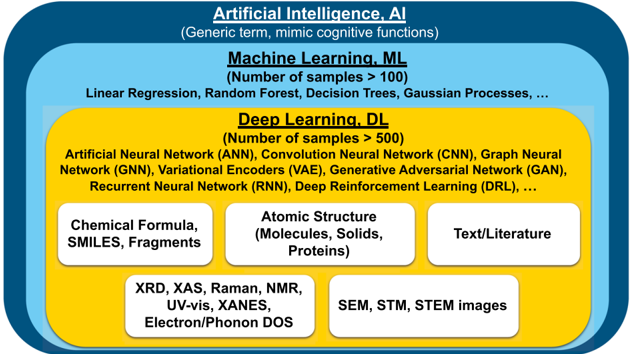
Deep learning (DL) is one of the fastest-growing topics in materials data science, with rapidly emerging applications spanning atomistic, image-based, spectral, and textual data modalities. DL allows analysis of unstructured data and automated identification of features. The recent development of large materials databases has fueled the application of DL methods in atomistic prediction in particular. In contrast, advances in image and spectral data have largely leveraged synthetic data enabled by high-quality forward models as well as by generative unsupervised DL methods. In this article, we present a high-level overview of deep learning methods followed by a detailed discussion of recent developments of deep learning in atomistic simulation, materials imaging, spectral analysis, and natural language processing. For each modality we discuss applications involving both theoretical and experimental data, typical modeling approaches with their strengths and limitations, and relevant publicly available software and datasets. We conclude the review with a discussion of recent cross-cutting work related to uncertainty quantification in this field and a brief perspective on limitations, challenges, and potential growth areas for DL methods in materials science.
Overview
The claims and statistics of this paper haven’t been checked yet.
Free: it reads the open-access text and checks the first 5 claims that cite a source we can check. Create a free account to check every claim.
Integrity signals
Registry
Cites
Statistics
Figures
Verification
Claims the paper makes
The claims and statistics of this paper haven’t been checked yet.
Free: it reads the open-access text and checks the first 5 claims that cite a source we can check. Create a free account to check every claim.
Self-check
Percentages, sums and reported differences re-computed from the paper’s own numbers.
The self-check needs the paper’s full text.
Citations
Cites
ImageNet classification with deep convolutional neural networks
Krizhevsky, A., Sutskever, I., & Hinton, G. E. (2017) · Communications of the ACM · doi:10.1145/3065386 · Cited by 112,155
LeCun, Y., Bengio, Y., & Hinton, G. (2015) · Nature · doi:10.1038/nature14539 · Cited by 84,126
BERT: Pre-training of Deep Bidirectional Transformers for Language Understanding
Devlin, J., Chang, M.-W., Lee, K., & Toutanova, K. (2018) · arXiv · doi:10.48550/arxiv.1810.04805 · Cited by 73,173 · cited 1×
“More recently, sequence-to-sequence models based on a “transformer” architecture, such as Google’s Bidirectional Encoder Representations from Transformers (BERT) model [53, 70], have helped address some of the issues of traditional RNNs.”
BERT: Pre-training of Deep Bidirectional Transformers for Language Understanding
Devlin, J., Chang, M.-W., Lee, K., & Toutanova, K. (2019) · Proceedings of the 2019 Conference of the North American Chapter of the Association for Computational Linguistics: Human Language Technologies, Volume 1 (Long and Short Papers) · doi:10.18653/v1/n19-1423 · Cited by 54,325 · cited 1×
“More recently, sequence-to-sequence models based on a “transformer” architecture, such as Google’s Bidirectional Encoder Representations from Transformers (BERT) model [53, 70], have helped address some of the issues of traditional RNNs.”
PyTorch: An Imperative Style, High-Performance Deep Learning Library
Paszke, A., Gross, S., Massa, F., Lerer, A., Bradbury, J., Chanan, G., Killeen, T., Lin, Z., Gimelshein, N., Antiga, L., et al. (2019) · arXiv · doi:10.48550/arxiv.1912.01703 · Cited by 31,473
Semi-supervised classification with graph convolutional networks
Kipf, T. N., & Welling, M. (2016) · arXiv · doi:10.48550/arxiv.1609.02907 · Cited by 24,853 · cited 6×
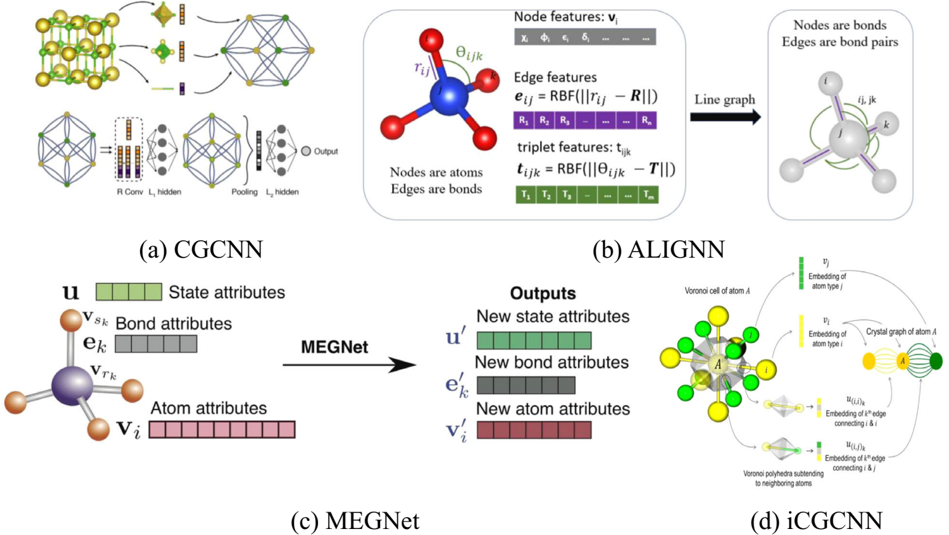
“Models such as SchNet, crystal graph convolutional neural network (CGCNN), improved crystal graph convolutional neural network (iCGCNN), directional message passing neural network (DimeNet), atomistic line graph neural network (ALIGNN) and materials graph neural network (MEGNet) shown in Table 1 have been used to pred…”
MethodInfluentialThe Elements of Statistical Learning
Hastie, T., Friedman, J., & Tibshirani, R. (2001) · Springer Series in Statistics · doi:10.1007/978-0-387-21606-5 · Cited by 24,162
A logical calculus of the ideas immanent in nervous activity
McCulloch, W. S., & Pitts, W. (1943) · The Bulletin of Mathematical Biophysics · doi:10.1007/bf02478259 · Cited by 18,566
The FAIR Guiding Principles for scientific data management and stewardship
Wilkinson, M. D., Dumontier, M., Aalbersberg, I. J., Appleton, G., Axton, M., Baak, A., Blomberg, N., Boiten, J.-W., da Silva Santos, L. B., Bourne, P. E., et al. (2016) · Scientific Data · doi:10.1038/sdata.2016.18 · Cited by 18,423 · cited 2×
“Through the Materials Genome Initiative (MGI) [3] and the increasing adoption of Findable, Accessible, Interoperable, Reusable (FAIR) [4] principles, several large experimental and computational datasets have been developed [5–12].”
Breiman, L. (1996) · Machine Learning · doi:10.1007/bf00058655 · Cited by 16,325 · cited 1×
“Similar to bagging 60 , the use of dropout brings about the same effect of training a collection of randomly chosen models which prevents the co-adaptations among the neurons, consequently reducing the likelihood of the model from over fi tting.”
Background
Research works printed but not linked: 12
- 61. LeCun, Y. et al. The Handbook of Brain Theory and Neural Networks vol. 3361 (MIT press Cambridge, MA, USA 1995).
- 83. Onken, D. et al. A neural network approach for high-dimensional optimal control. arXiv. https://arxiv.org/abs/2104.03270 (2021). · arXiv
- 85. Chen, L., Zhang, W., Nie, Z., Li, S. & Pan, F. Generative models for inverse design of inorganic solid materials. J. Mater. Inform. 1, 4 (2021).
- 104. Artrith, N. & Urban, A. An implementation of artificial neural-network potentials for atomistic materials simulations: Performance for tio2. Comput. Mater. Sci. 114, 135-150 (2016). · DOI · Paper page
- 140. Liu, R. et al. Deep learning for chemical compound stability prediction. In Pro- ceedings of ACM SIGKDD workshop on large-scale deep learning for data mining (DL-KDD), 1-7. https://rosanneliu.com/publication/kdd/ (ACM SIGKDD, 2016).
- 179. Rakita, Y. et al. Studying heterogeneities in local nanostructure with scanning nanostructure electron microscopy (snem). arXiv https://arxiv.org/abs/ 2110.03589 (2021).
- 198. Kong, S. et al. Density of states prediction for materials discovery via contrastive learning from probabilistic embeddings. arXiv. https://arxiv.org/abs/2110.11444 (2021). · arXiv
- 206. Choudhary, A. et al. Graph neural network predictions of metal organic framework co2 adsorption properties. arXiv. https://arxiv.org/abs/2112.10231 (2021). · arXiv
- 282. Haque, E. Effect of electron-phonon scattering, pressure and alloying on the thermoelectric performance of tmcu _3 ch _4(tm= v, nb, ta; ch= s, se, te). arXiv. https://arxiv.org/abs/2010.08461 (2020). · arXiv
- 300. Wilson, A. G., Hu, Z., Salakhutdinov, R. & Xing, E. P. Deep kernel learning. in Artificial intelligence and statistics, 370-378 (PMLR, 2016).
- 348. Fung, V., Hu, G., Ganesh, P. & Sumpter, B. G. Machine learned features from density of states for accurate adsorption energy prediction. Nat. Commun. 12, 1-11 (2021). · DOI · Paper page
- 357. Ede, J. M. & Beanland, R. Partial scanning transmission electron microscopy with deep learning. Sci. Rep. 10, 1-10 (2020). 358. 116. Somnath, S., Smith, C. R., Laanait, N., Vasudevan, R. K. & Jesse, S. Usid and pycroscopy-open source frameworks for storing and analyzing imaging and spectroscopy data. Microsc. Microanal. 25, 220-221 (2019). · DOI
Cited by
Items 301–400 of 1,001
The JARVIS infrastructure is all you need for materials design
Choudhary, K. K. (2025) · Computational Materials Science · doi:10.1016/j.commatsci.2025.114063 · Cited by 31
“Such frameworks incorporate multi-modal datasets, automated workflows, and ML models, enabling both forward design (predicting properties from structures) [6, 7, 8, 9] and inverse de-sign (identifying structures with desired properties) [10, 11, 12, 13].”
Self-citationBenchmarking scientific machine-learning approaches for flow prediction around complex geometries
Rabeh, A., Herron, E., Balu, A., Sarkar, S., Hegde, C., Krishnamurthy, A., & Ganapathysubramanian, B. (2025) · Communications Engineering · doi:10.1038/s44172-025-00513-3 · Cited by 35
“TheemergenceofSciMLhasbeendrivenbyadvancementsin neuralnetworks,whichhavedemonstratedremarkablecapabilitiesin learningcomplex,nonlinearmappingsfromhigh-dimensionaldata 8 .”
Generation of synthetic microstructures containing casting defects: a machine learning approach
Raghavendra, A. K. M., Lacourt, L., Marcin, L., Maurel, V., & Proudhon, H. (2023) · Scientific Reports · doi:10.1038/s41598-023-38719-0 · Cited by 13
“Furthermore, the current approach to generate defects can be further developed by various means given the increasing popularity of deep learning techniques in materials science 65,66 .”
BackgroundHo, B., Zhao, J., Liu, J., Tang, L., Guan, Z., Xiao, L., Li, M., Howard, E., Wheeler, R., & Bae, J. (2023) · ACS Materials Letters · doi:10.1021/acsmaterialslett.3c00909 · Cited by 13
Ikemba, S., Song-hyun, K., Scott, T. O., Ewim, D. R. E., Abolarin, S. M., & Fawole, A. A. (2024) · Sustainable Energy Research · doi:10.1186/s40807-023-00096-7 · Cited by 18
“Deep learning, which is a sub-set of machine learning, has been gaining popularity in recent times due to dynamic nature of information technologies (Alzubaidi et al., et al. 2021; Choudhary et al., et al. 2022; Pichler & Hartig, 2023; Sarker, 2021).”
BackgroundUsoltsev, O., Tereshchenko, A. A., Skorynina, A. A., Kozyr, E. G., Soldatov, A. V., Safonova, О. V., Clark, A. H., Ferri, D., Nachtegaal, M., & Bugaev, A. L. (2024) · Small Methods · doi:10.1002/smtd.202301397 · Cited by 13
Teklemariam, T. A. (2024) · Applied Spectroscopy Practica · doi:10.1177/27551857241250014 · Cited by 16
“22 Convolutional neural network (CNN) is one of the most widely used and established DLs, particularly in the areas of computer vision.”
Artificial Intelligence Reinventing Materials Engineering: A Bibliometric Review
Vergara, D., Λαμπρόπουλος, Γ., Fernández‐Arias, P., & Antón‐Sancho, Á. (2024) · Applied Sciences · doi:10.3390/app14188143 · Cited by 18
Onyibo, E. C., Gazioglu, A., Ahmed, A. A. M., Ameer, A. A., Abdelrahman, M. E. B., Oladipupo, O. A., Sarkon, G. K., Sahmani, S., & Safaei, B. (2024) · Acta Mechanica · doi:10.1007/s00707-024-04139-y · Cited by 13
“The unique properties of engineered lattice structures, for instance, their high ratio of strength to weight and tunable mechanical properties, have led to their great interest in several fields, including aerospace engineering [46, 47], biomedical engineering [48–50], and materials science [51].”
Nanomaterials for spin-based quantum information
Ding, P., Chen, D., Ko, P. K., Qammar, M., Geng, P., Guo, L., & Halpert, J. E. (2025) · Nanoscale · doi:10.1039/d4nr04012k · Cited by 19
Chen, C., Wang, Y., Zhao, J., Wu, D., Li, H., & Zhao, H. (2025) · Journal of Multidisciplinary Healthcare · doi:10.2147/jmdh.s509004 · Cited by 24
“20,21 Upon completing the training, depth features can either be integrated with semantic features for radiomics analysis or used directly for model predictions.”
Self-citationArtificial intelligence for advanced functional materials: exploring current and future directions
Malica, C., Novoselov, K. S., Barnard, A. S., Kalinin, S. V., Spurgeon, S. R., Reuter, K., Alducin, M., Deringer, V. L., Cśanyi, G., Marzari, N., et al. (2025) · Journal of Physics Materials · doi:10.1088/2515-7639/adc29d · Cited by 33
Self-citationHu, H., Wang, B., Zhang, D., Yan, K., Tan, T., & Wu, D. (2025) · Journal of Materials Chemistry C · doi:10.1039/d5tc00865d · Cited by 14
Smart design A2Zr2O7-type high-entropy oxides through lattice-engineering toughening strategy
Zhang, Y., Ren, K., Wang, W. Y., Gao, X., Wang, J., Wang, Y., Song, H., Liang, X., & Li, J. (2024) · npj Computational Materials · doi:10.1038/s41524-024-01462-9 · Cited by 12
“This study employed a diverse range of machine learning (ML) models, including MLP, SVM, K-Nearest Neighbors (KNN), Ada-Boost, Logistic Regression (LR), LightGBM, Decision Tree (DT), Extremely Randomized Trees (ET), CatBoost, Random Forest (RF), and XGBoost for regression analysis 39,44 .”
Qureshi, N., Bang, J., & Doh, J. (2025) · Nanotechnology Reviews · doi:10.1515/ntrev-2025-0200 · Cited by 14
Xu, L., Hong, M., Guo, J., Shen, F., Xu, D., Zhang, J., Zhang, Y., Zheng, J., & Lu, J. (2026) · Nano-Micro Letters · doi:10.1007/s40820-026-02099-7 · Cited by 16
“Graph neural networks (GNNs) are well suited for representing local environments in complex cathode lattices and have been increasingly adopted for materials-property prediction [169–171].”
Losi, G., Chehaimi, O., & Righi, M. C. (2023) · Journal of Chemical Theory and Computation · doi:10.1021/acs.jctc.3c00459 · Cited by 11
Exploring model complexity in machine learned potentials for simulated properties
Rohskopf, A., Goff, J., Sema, D. G., Gordiz, K., Nguyen, N. C., Henry, A. S., Thompson, A. P., & Wood, M. A. (2023) · Journal of materials research/Pratt's guide to venture capital sources · doi:10.1557/s43578-023-01152-0 · Cited by 15
“Molecular dynamics (MD) simulations are an indispensable tool for studying this motion, and have enabled computational prediction and discovery in fields as diverse as materials science [1], energy storage [2, 3], catalysis [4], and molecular biology [5].”
Hajji, M., Jebbari, N., Ajili, M., Garcia-Loureiro, A. J., Vidu, R., & Kamoun, N. (2024) · Optical Materials · doi:10.1016/j.optmat.2024.115399 · Cited by 12
Application of digital twins for simulation based tailoring of laser induced graphene
Santos-Ceballos, J. C., Salehnia, F., Romero, A., & Vilanova, X. (2024) · Scientific Reports · doi:10.1038/s41598-024-61237-6 · Cited by 15
“In various research, ANNs have been employed to predict the properties of materials 21–23 .”
Xue, S.-D., & Hong, Q. (2024) · Materials · doi:10.3390/ma17174176 · Cited by 16
A Physics-Informed Neural Network-Based Waveguide Eigenanalysis
Khan, M. R., Zekios, C. L., Bhardwaj, S., & Georgakopoulos, S. V. (2024) · IEEE Access · doi:10.1109/access.2024.3452160 · Cited by 15
Wang, P. P., Huang, G., Li, Y., Zhang, Y. F., Cai, T. C., Song, T. N., Liu, Y., Xu, Z., & Shen, Z. (2024) · Journal of Cleaner Production · doi:10.1016/j.jclepro.2024.143651 · Cited by 12
Evolution of prediction models for road surface irregularity: Trends, methods and future
Wu, Y., Pang, Y., & Zhu, X. (2024) · Construction and Building Materials · doi:10.1016/j.conbuildmat.2024.138316 · Cited by 16
Nan, S., Li, Z., Jin, S., Du, W., & Shen, W. (2025) · Industrial & Engineering Chemistry Research · doi:10.1021/acs.iecr.4c03293 · Cited by 14
Accurate prediction of pitting corrosion in aluminum alloys via integrated multi-model methods
Xu, Z., Li, X., Cai, B., Liu, G., Yan, L., & Gao, K. (2025) · Progress in Natural Science Materials International · doi:10.1016/j.pnsc.2025.03.015 · Cited by 12
Amirian, B., Brahme, A. P., Lebensohn, R. A., & Inal, K. (2025) · International Journal of Plasticity · doi:10.1016/j.ijplas.2025.104404 · Cited by 13
Exploiting Machine Learning in Multiscale Modelling of Materials
Anand, G., Ghosh, S., Zhang, L., Anupam, A., Freeman, C. L., Ortner, C., Eisenbach, M., & Kermode, J. R. (2022) · Journal of The Institution of Engineers (India) Series D · doi:10.1007/s40033-022-00424-z · Cited by 14
Wei, Z., Zhong, Q., Pan, J., Lim, F. H., Chi, L., & Du, S. (2025) · Journal of the American Chemical Society · doi:10.1021/jacs.5c03730 · Cited by 14
Liao, W., Xue, X., Li, J., Fan, J., Song, L., Shang, X., Lookman, T., & Yuan, R. (2025) · Acta Materialia · doi:10.1016/j.actamat.2025.121608 · Cited by 19
Jing, Y., Zhang, C., Mine, S., Zhang, X., He, C., Zhang, N., Guo, X. M., Anzai, A., Oka, K., Toyoshima, R., et al. (2025) · ACS Catalysis · doi:10.1021/acscatal.5c06074 · Cited by 15
Gupta, K. K., Barman, S., Sankar, A., Dey, S., & Mukhopadhyay, T. (2026) · Archives of Computational Methods in Engineering · doi:10.1007/s11831-025-10486-3 · Cited by 16
Accurate experimental band gap predictions with multifidelity correction learning
Breuck, P.-P. D., Heymans, G., & Rignanese, G. (2022) · Journal of Materials Informatics · doi:10.20517/jmi.2022.13 · Cited by 14
Artificial intelligence in diagnosis and management of Huntington’s disease
Parekh, N., Bhagat, A., Raj, B., Chhabra, R. S., Buttar, H. S., Kaur, G., Ramniwas, S., & Tuli, H. S. (2023) · Beni-Suef University Journal of Basic and Applied Sciences · doi:10.1186/s43088-023-00427-z · Cited by 19
“These scan the input image to detect local patterns, edges, and textures [14, 35].”
Detection and Attribution of Climate Change Using a Neural Network
Bône, C., Gastineau, G., Thiria, S., Gallinari, P., & Mejía, C. (2023) · Journal of Advances in Modeling Earth Systems · doi:10.1029/2022ms003475 · Cited by 18
“It is a statistical tool increasingly used in recent years in many scientific fields (Choudhary et al., 2022).”
MethodSingle-Pixel Infrared Hyperspectral Imaging via Physics-Guided Generative Adversarial Networks
Wang, D.-Y., Bie, S.-H., Chen, X.-H., & Yu, W.-K. (2024) · Photonics · doi:10.3390/photonics11020174 · Cited by 11
Sundaram, G. A., Kanniah, R., Anbalagan, K., Kulandaivelu, K., & Váldes, H. (2024) · Catalysts · doi:10.3390/catal14030169 · Cited by 11
“Progress in surface science requires a transition towards more realistic composites and comprehensive model systems, given their significant contributions to various solid surface applications [21].”
BackgroundSidnov, K., Konov, D. A., Smirnova, E. A., Ponomareva, A. V., & Belov, M. P. (2024) · Metals · doi:10.3390/met14040438 · Cited by 11
Review on automated 2D material design
Al-Maeeni, A. R., Lazarev, M., Kazeev, N., Novoselov, K. S., & Ustyuzhanin, A. (2024) · 2D Materials · doi:10.1088/2053-1583/ad4661 · Cited by 14
“It allows for relatively efficient calculation of the electron ground state and its properties, such as the energy and the band structure, etc. DFT has been used to generate huge material databases [9] and to train ML algorithms [10].”
BackgroundMethodBond sensitive graph neural networks for predicting high temperature superconductors
Gu, L., Liu, Y., Chen, P., Huang, H., Chen, N., Li, Y., Lookman, T., Lu, Y., & Su, Y. (2024) · Materials Genome Engineering Advances · doi:10.1002/mgea.48 · Cited by 15
A Systematic Review of Facial Recognition Methods: Advancements, Applications, and Ethical Dilemmas
Fola-Rose, A., Solomon, E., Bryant, K., & Woubie, A. (2024) · IEEE International Conference on Information Reuse and Integration (IRI) · doi:10.1109/iri62200.2024.00070 · Cited by 15
Minhas, H., Jena, M. K., Sharma, R. K., & Pathak, B. (2024) · Chemistry of Materials · doi:10.1021/acs.chemmater.4c02294 · Cited by 11
Zhou, J., Li, C., Kim, Y. K., & Park, S. (2025) · Foods · doi:10.3390/foods14010127 · Cited by 11
“Moreover, a key strength of our approach, compared to previous studies, is the utilization of advanced computational techniques, such as deep learning models (random forest regression), for accurately predicting the potential activity (pIC 50 values) of compounds against AD-related targets [23–25].”
Talreja, J., & Chauhan, D. (2025) · Elsevier eBooks · doi:10.1016/b978-0-443-29162-3.00007-1 · Cited by 13
Wang, D., Ban, H., & Jiang, P. (2025) · International Journal of Heat and Mass Transfer · doi:10.1016/j.ijheatmasstransfer.2025.126886 · Cited by 19
Katzer, B., Klinder, S., & Schulz, K. (2025) · Materials Today Communications · doi:10.1016/j.mtcomm.2025.112186 · Cited by 19
“Especially, combining information from experiments, simulations and theory is of great significance as different aspects are considered at each discipline that together, ultimately, form a holistic picture [1, 2, 3, 4].”
Gao, S., Luo, Y., Liu, X., & Marom, N. (2025) · Digital Discovery · doi:10.1039/d4dd00396a · Cited by 15
Wu, M., Yan, S., & Ren, J. (2025) · npj Computational Materials · doi:10.1038/s41524-025-01583-9 · Cited by 17
“Emergingasapowerfultechnologyofthedata-drivenparadigminmaterials science,machinelearning(ML)hasconsiderablyacceleratedthedesignand discoveryofpromisingmaterialsinrecentyears 1 – 4 , including ML intera-tomic potentials 5 , inverse design of materials 6 , ef fi cient property predictions 7 – 9 .”
Zhou, H., Xie, Q., Gu, S., Li, X., Zhou, Y., Liang, D., & Liu, J. (2025) · Carbon · doi:10.1016/j.carbon.2025.120387 · Cited by 12
Yuan, S., Liu, Y., Yan, L., Zhang, R., & Wu, S. (2025) · Fractal and Fractional · doi:10.3390/fractalfract9080541 · Cited by 12
Forbes, T. P., Gillen, J. G., Souna, A. J., & Lawrence, J. A. (2022) · Analytical Chemistry · doi:10.1021/acs.analchem.2c03913 · Cited by 11
Leveraging local structural disorder for enhanced ion transport
Deck, M. J., & Hu, Y. (2023) · Journal of materials research/Pratt's guide to venture capital sources · doi:10.1557/s43578-023-01023-8 · Cited by 14
Andolina, C. M., & Saidi, W. A. (2023) · Digital Discovery · doi:10.1039/d3dd00046j · Cited by 17
Rezasefat, M., & Hogan, J. D. (2024) · Machine Learning Science and Technology · doi:10.1088/2632-2153/ad290c · Cited by 15
“In recent years, deep learning models and convolutional neural networks (CNNs) have emerged as powerful tools for field predictions in the domains of engineering and material science [1, 2].”
BackgroundAI-driven design and applications of quantum dots
Soni, P. K., Satnami, M. L., Nagwanshi, R., Chawre, Y., Kujur, A. B., Sinha, A., Miri, P., Karbhal, I., & Ghosh, K. K. (2026) · Nano Today · doi:10.1016/j.nantod.2026.102974 · Cited by 17
Combining variational autoencoders and physical bias for improved microscopy data analysis ∗
Biswas, A., Ziatdinov, M. A., & Kalinin, S. V. (2023) · Machine Learning Science and Technology · doi:10.1088/2632-2153/acf6a9 · Cited by 19
Bajpai, R., Shukla, A., Kumar, J., & Tewari, A. (2023) · Computational Materials Science · doi:10.1016/j.commatsci.2023.112525 · Cited by 14
张, C.-Z. 城. Z., & 付, X.-Q. 小. F. (2023) · Chinese Physics B · doi:10.1088/1674-1056/ad01a4 · Cited by 12
Multiscale Attention-Based Instance Segmentation for Measuring Crystals With Large Size Variation
Neubauer, T., Berg, A., Wimmer, M., Lenis, D., Major, D., Winter, P. M., Paolis, G. R. D., Novotny, J., Lüftner, D., Reinharter, K., et al. (2023) · IEEE Transactions on Instrumentation and Measurement · doi:10.1109/tim.2023.3345916 · Cited by 12
“In recent studies [3], deep learning-based segmentation methods are getting more popular as they are able to learn the context-dependent appearance of complex data.”
BackgroundMethodYe, X., Zhang, A., Huang, J., Kang, W., Jiang, W., Li, X., Yin, J., & Kang, J. (2024) · Aggregate · doi:10.1002/agt2.524 · Cited by 10
Yenikaya, M. A., Kerse, G., & Oktaysoy, O. (2024) · Frontiers in Public Health · doi:10.3389/fpubh.2024.1386110 · Cited by 14
“It is suggested that deep learning, which is one of the sub-branches of artificial intelligence, has allowed for progress in many activities such as navigation, chip design, drug discovery, astrophysics and object recognition, and is therefore widely used in different sectors (32).”
BackgroundZhang, T., Li, C., Yu, Y., Yang, H.-J., Ryu, M. S., Wu, X., Jeong, D., & Park, S. (2024) · Food Bioscience · doi:10.1016/j.fbio.2024.104531 · Cited by 11
Predicting melting temperatures across the periodic table with machine learning atomistic potentials
Andolina, C. M., & Saidi, W. A. (2024) · Digital Discovery · doi:10.1039/d4dd00069b · Cited by 13
Zhang, S., Cao, B., Su, T., Wu, Y., Feng, Z., Xiong, J., & Zhang, T. (2024) · IUCrJ · doi:10.1107/s2052252524005323 · Cited by 14
Usman, J., Abba, S. I., Usman, A. G., Yogarathinam, L. T., Bafaqeer, A., Baig, N., & Aljundi, I. H. (2024) · Journal of the Taiwan Institute of Chemical Engineers · doi:10.1016/j.jtice.2024.105704 · Cited by 11
Toward accelerated discovery of solid catalysts using extrapolative machine learning approach
Toyao, T. (2024) · Chemistry Letters · doi:10.1093/chemle/upae163 · Cited by 10
Amano, N., Lei, B., Müller, M. J., Mücklich, F., & Holm, E. A. (2024) · Materials Characterization · doi:10.1016/j.matchar.2024.114600 · Cited by 11
Self-citationPhishing Website Detection: An In‐Depth Investigation of Feature Selection and Deep Learning
Mousavi, S., & Bahaghighat, M. (2025) · Expert Systems · doi:10.1111/exsy.13824 · Cited by 14
Pala, M. A. (2025) · Molecular Diversity · doi:10.1007/s11030-025-11197-4 · Cited by 12
Walicki, D., Zawistowski, P., & Ryszkowska, J. (2025) · Computational Materials Science · doi:10.1016/j.commatsci.2025.113909 · Cited by 10
Building an end-to-end battery recipe knowledge base via transformer-based text mining
Lee, D., Mizuseki, H., Choi, J., & Lee, B. (2025) · Communications Materials · doi:10.1038/s43246-025-00825-z · Cited by 20
Moqadam, H., & Eisen, O. (2025) · The Cryosphere · doi:10.5194/tc-19-2159-2025 · Cited by 24
DetectNano: deep learning detection in TEM images for high-throughput nanostructure characterization
Ferji, K. (2025) · Nanoscale · doi:10.1039/d5nr02446c · Cited by 12
Mining Chemical Space with Generative Models for Battery Materials
Parida, C., Roy, D., Lastra, J. M. G., & Bhowmik, A. (2025) · Batteries & Supercaps · doi:10.1002/batt.202500309 · Cited by 10
A research database for experimental electrocatalysis: Advancing data sharing and reusability
Mahajan, R., Aleman, A. M., Crago, C. F., Bhasker-Ranganath, S., Kreider, M. E., Zeledon, J. A. Z., Schröder, J., Kamat, G. A., Hubert, M. A., Nielander, A. C., et al. (2025) · The Journal of Chemical Physics · doi:10.1063/5.0280821 · Cited by 9
Single-Atom Catalysis for the Dry Reforming of Methane: Recent Advances
Raza, M., Ali, L., Maghrabi, L. M., Polychronopoulou, K., & Altarawneh, M. (2025) · ACS Engineering Au · doi:10.1021/acsengineeringau.5c00064 · Cited by 11
Machine learning-aided band gap prediction of semiconductors with low concentration doping
Tang, Y., Chen, H., Wang, J., & Niu, X. (2023) · Physical Chemistry Chemical Physics · doi:10.1039/d3cp02431h · Cited by 10
Pretto, T., Baum, F., Gouvêa, R. A., Brolo, A. G., & Santos, M. J. L. (2024) · The Journal of Physical Chemistry C · doi:10.1021/acs.jpcc.3c06801 · Cited by 11
Golnary, F., & Asghari, M. (2024) · International Journal of Mechanics and Materials in Design · doi:10.1007/s10999-024-09711-x · Cited by 10
“Commonly used methods in material science for this task include Gaussian Process Regressor (GPR), ensemble learning regressors, random forest regressors, and deep learning-based regressors (Wei et al. 2019; Mueller et al. 2016; Choudhary, et al. 2022; Zhang et al. 2023).”
Stiefel, M., Müller, M., Bachmann, B.-I., Guitar, M. A., Nayak, U. P., & Mücklich, F. (2024) · MRS Communications · doi:10.1557/s43579-024-00549-0 · Cited by 18
“15–18] For example, ML-supported microstructure analysis has been conducted on steel, [12,19,20] nickel-base alloys, [21] ceramics, [22] or metal powder.”
Song, Z., Niu, X., & Chen, H. (2024) · Physical Chemistry Chemical Physics · doi:10.1039/d4cp00386a · Cited by 10
Machine Learning-Enabled Image Classification for Automated Electron Microscopy
Day, A. L., Wahl, C. B., Gupta, V., dos Reis, R., Liao, W., Mirkin, C. A., Dravid, V. P., Choudhary, A., & Agrawal, A. (2024) · Microscopy and Microanalysis · doi:10.1093/mam/ozae042 · Cited by 10
Self-citationHuang, Z., He, L., Yang, Y., Li, A., Zhang, Z., Wu, S., Wang, Y., He, Y. Z., & Liu, X. (2024) · Journal of Cheminformatics · doi:10.1186/s13321-024-00874-5 · Cited by 16
“However, the task of identifying named entities in materials science (MatNER) [1–5] is extremely challenging because there are multiple entities in the materials science literature and their complex combinations, such as acronyms, misspellings, synonyms of compound names, etc.”
BackgroundGurniak, E. J., Yuan, S., Ren, X., & Branicio, P. S. (2024) · Computational Materials Science · doi:10.1016/j.commatsci.2024.113257 · Cited by 12
Comparison of super-resolution deep learning models for flow imaging
Sofos, F. D., Drikakis, D., & Kokkinakis, I. W. (2024) · Computers & Fluids · doi:10.1016/j.compfluid.2024.106396 · Cited by 13
Zhong, Y., Chen, L., Ding, F., Ou, W., Zhang, X., & Weng, S. (2024) · Frontiers in Oncology · doi:10.3389/fonc.2024.1401095 · Cited by 9
Qiao, B., Wang, S., Hou, M., Chen, H., Zhou, Z., Xie, X., Pang, S., Yang, C., Yang, F., Zou, Q., et al. (2024) · Bioinformatics · doi:10.1093/bioinformatics/btae581 · Cited by 9
“Deep learning is one of the fastest-growing topics in biology (Tang et al. 2021, Ao et al. 2022, Choudhary et al. 2022, Li et al. 2023, Wang et al. 2023, Yan et al. 2023) and achieved great success in the last few years (Zeng et al. 2022).”
Xie, X., & Zhang, X. (2024) · Journal of Environmental Management · doi:10.1016/j.jenvman.2024.122724 · Cited by 12
Rosenberger, J., Tlatlik, J., Beckmann, C., Rohrmüller, B., & Münstermann, S. (2024) · Engineering Fracture Mechanics · doi:10.1016/j.engfracmech.2024.110586 · Cited by 10
Dai, J., Mao, X., Wu, P., Zhou, H., & Cao, L. (2024) · PLoS ONE · doi:10.1371/journal.pone.0305639 · Cited by 18
Nguyen, D. M. Q., Lukito, W. D., Liu, X., & Liu, C. (2024) · Electronics · doi:10.3390/electronics14010125 · Cited by 11
Yin, Z., Wang, H., Chen, B., Sun, H., Li, A., & Zhou, C. (2025) · Biomedical Signal Processing and Control · doi:10.1016/j.bspc.2024.107388 · Cited by 9
Wani, A. A. (2025) · Materials Sciences and Applications · doi:10.4236/msa.2025.162005 · Cited by 11
Nasr, M. M., & Anwar, S. (2025) · The International Journal of Advanced Manufacturing Technology · doi:10.1007/s00170-025-15366-5 · Cited by 9
“AI methods can anticipate complicated nonlinear systems and interactions in varied datasets [49, 50, 52, 53].”
Slautin, B. N., Liu, Y., Dec, J., Shvartsman, V. V., Lupascu, D. C., Ziatdinov, M. A., & Kalinin, S. V. (2025) · Digital Discovery · doi:10.1039/d4dd00391h · Cited by 10
Raihan, A. S., Harper, A., Era, I. Z., Al-Shebeeb, O. A., Wuest, T., Das, S., & Ahmed, I. (2025) · Journal of Manufacturing Processes · doi:10.1016/j.jmapro.2025.03.118 · Cited by 9
Smart nanocomposite hydrogel for controlled bioactive delivery in environmental remediation
Martin, S. S., Zhang, L., Cen, X., Liu, P., Zhou, J., Tan, Z., Shi, H. S., & Li, X. (2025) · Journal of environmental chemical engineering · doi:10.1016/j.jece.2025.117367 · Cited by 9
Ahmed, M. J., Mozó, A., & Karamchandani, A. (2025) · PeerJ Computer Science · doi:10.7717/peerj-cs.3097 · Cited by 16
Programmable Biointerfaces and Adaptive Functionality in Next-Generation Green Nanomaterials
Rabiee, N. (2025) · ACS Synthetic Biology · doi:10.1021/acssynbio.5c00620 · Cited by 10
Machine Learning Applied to High Entropy Alloys under Irradiation
Esfandiarpour, A., Nori, S. T., Bonfanti, S., Alava, M. J., Wadowski, A., Huo, W., Kurpaska, Ł., Pecelerowicz, M., & Wróbel, J. S. (2025) · Advanced Engineering Materials · doi:10.1002/adem.202402280 · Cited by 13
Metadata
- Authors
- Choudhary, K., DeCost, B., Chen, C., Jain, A., Tavazza, F., Cohn, R., Park, C. W., Choudhary, A., Agrawal, A., Billinge, S. J. L., Holm, E., Ong, S. P., & Wolverton, C.
- Affiliations
- National Institute of Standards and Technology (US)
- University of California San Diego (US)
- Lawrence Berkeley National Laboratory (US)
- Carnegie Mellon University (US)
- Northwestern University (US)
- Columbia University (US)
- ORCID
- Venue
- npj Computational Materials
- Published
- 2022-04-05
- Volume
- 8
- Issue
- 1
- ISSN
- 2057-3960 (ISSN-L)
- OpenAlex
- W3208687975
- Semantic Scholar
- 5aaeb50d8051890e9fbb9b9b8f34d9f3f2d85c1a
- Cited by
- 1,172
- References
- 401
- Citations by year
- 2026: 248 · 2025: 386 · 2024: 316 · 2023: 187 · 2022: 35
- FWCI
- 64.93
- Type
- journal article
- Language
- en
- Open access
- gold
- doi.org
- Licence
- cc-by
- creativecommons.org/licenses/by/4.0 (tdm)
- creativecommons.org/licenses/by/4.0 (vor)
- Locations
- npj Computational Materials (publishedVersion, cc-by)
- arXiv (Cornell University) (submittedVersion)
- eScholarship (California Digital Library) (submittedVersion, cc-by)
- OSTI OAI (U.S. Department of Energy Office of Scientific and Technical Information) (submittedVersion, cc-by)
- DOAJ (DOAJ: Directory of Open Access Journals) (submittedVersion)
- arXiv (Cornell University) (cc-by)
- Funders
- National Science Foundation (DEAC02-05CH11231, 2053929, 70NANB19H005, 1826218, 1922234)
- U.S. Department of Energy (-AC02-05CH11231, DE-AC02-05-CH11231: Materials Project program KC23MP, 70NANB19H005, KC23MP, DE AC02 05CH11231, DE-AC02-)
- U.S. Department of Commerce (70NANB19H005, 70NANB19H117)
- Northwestern University (70NANB19H005)
- University of Warwick
- National Institute of Standards and Technology (70NANB19H117, 70NANB19H005)
- Office of Science (DEAC02–05CH11231, DE-AC02, DE-AC02-05-CH11231: Materials Project Program KC23MP)
- Division of Civil, Mechanical and Manufacturing Innovation (CMMI-2053929)
- Basic Energy Sciences (DE-AC02, DE-AC02-05CH11231., KC23MP, DE-AC02-05-, AC02–05CH11231)
- Topics
- Physical Sciences › Materials Science › Materials Chemistry › Machine Learning in Materials Science
- Physical Sciences › Physics and Astronomy › Atomic and Molecular Physics, and Optics › Advanced Chemical Physics Studies
- Physical Sciences › Physics and Astronomy › Statistical and Nonlinear Physics › Model Reduction and Neural Networks
- Keywords
- deep learning, atomistic simulation, materials imaging, spectral analysis, natural language processing, synthetic data, generative models, uncertainty quantification, materials database, spectral data
About these checks
Registry, retraction, Cites and statistics results are computed, not judged, with one exception: a printed reference that no index lists is read once by a model before it counts as a citation error. Claims are extracted by a model and kept only when their quote appears verbatim in the text; each cited source is then checked, with a model’s help, for whether it says what the claim relies on. Those verdicts can be wrong — read the claim’s quote and the cited source before relying on one.
Statistics and arithmetic are recomputed, not judged.
Confidence bands are shown only for fields calibrated on our annotated test set. None is calibrated yet, so no band is shown.
What counts as a claim ›How we measure confidence ›How we check this ›
Are you an author, or do you see a problem with this page? Request a review
Data sources
Bibliographic data: Semantic Scholar, OpenAlex, Crossref.
Contains information from the Semantic Scholar Academic Graph Datasets, made available under the ODC Attribution License (ODC-BY 1.0).
Semantic Scholar’s data is described in: Kinney, R., et al. (2023). The Semantic Scholar Open Data Platform. arXiv:2301.10140.
