

Recent advances and applications of deep learning methods in materials science
Open accessThe DOI matches its Crossref record; 404 of the 404 references it cites were found in a registry or an index.
Abstract
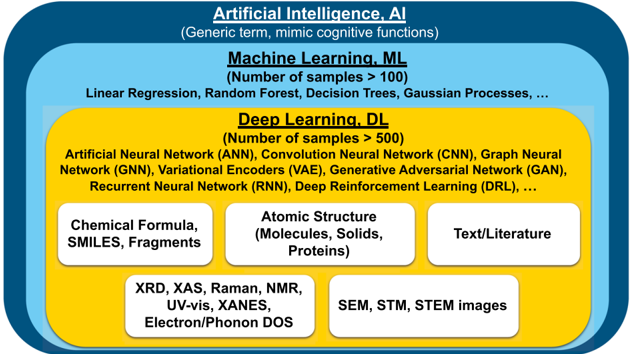
Deep learning (DL) is one of the fastest-growing topics in materials data science, with rapidly emerging applications spanning atomistic, image-based, spectral, and textual data modalities. DL allows analysis of unstructured data and automated identification of features. The recent development of large materials databases has fueled the application of DL methods in atomistic prediction in particular. In contrast, advances in image and spectral data have largely leveraged synthetic data enabled by high-quality forward models as well as by generative unsupervised DL methods. In this article, we present a high-level overview of deep learning methods followed by a detailed discussion of recent developments of deep learning in atomistic simulation, materials imaging, spectral analysis, and natural language processing. For each modality we discuss applications involving both theoretical and experimental data, typical modeling approaches with their strengths and limitations, and relevant publicly available software and datasets. We conclude the review with a discussion of recent cross-cutting work related to uncertainty quantification in this field and a brief perspective on limitations, challenges, and potential growth areas for DL methods in materials science.
Overview
The claims and statistics of this paper haven’t been checked yet.
Free: it reads the open-access text and checks the first 5 claims that cite a source we can check. Create a free account to check every claim.
Integrity signals
Registry
Cites
Statistics
Figures
Verification
Claims the paper makes
The claims and statistics of this paper haven’t been checked yet.
Free: it reads the open-access text and checks the first 5 claims that cite a source we can check. Create a free account to check every claim.
Self-check
Percentages, sums and reported differences re-computed from the paper’s own numbers.
The self-check needs the paper’s full text.
Citations
Cites
ImageNet classification with deep convolutional neural networks
Krizhevsky, A., Sutskever, I., & Hinton, G. E. (2017) · Communications of the ACM · doi:10.1145/3065386 · Cited by 112,155
LeCun, Y., Bengio, Y., & Hinton, G. (2015) · Nature · doi:10.1038/nature14539 · Cited by 84,126
BERT: Pre-training of Deep Bidirectional Transformers for Language Understanding
Devlin, J., Chang, M.-W., Lee, K., & Toutanova, K. (2018) · arXiv · doi:10.48550/arxiv.1810.04805 · Cited by 73,173 · cited 1×
“More recently, sequence-to-sequence models based on a “transformer” architecture, such as Google’s Bidirectional Encoder Representations from Transformers (BERT) model [53, 70], have helped address some of the issues of traditional RNNs.”
BERT: Pre-training of Deep Bidirectional Transformers for Language Understanding
Devlin, J., Chang, M.-W., Lee, K., & Toutanova, K. (2019) · Proceedings of the 2019 Conference of the North American Chapter of the Association for Computational Linguistics: Human Language Technologies, Volume 1 (Long and Short Papers) · doi:10.18653/v1/n19-1423 · Cited by 54,325 · cited 1×
“More recently, sequence-to-sequence models based on a “transformer” architecture, such as Google’s Bidirectional Encoder Representations from Transformers (BERT) model [53, 70], have helped address some of the issues of traditional RNNs.”
PyTorch: An Imperative Style, High-Performance Deep Learning Library
Paszke, A., Gross, S., Massa, F., Lerer, A., Bradbury, J., Chanan, G., Killeen, T., Lin, Z., Gimelshein, N., Antiga, L., et al. (2019) · arXiv · doi:10.48550/arxiv.1912.01703 · Cited by 31,473
Semi-supervised classification with graph convolutional networks
Kipf, T. N., & Welling, M. (2016) · arXiv · doi:10.48550/arxiv.1609.02907 · Cited by 24,853 · cited 6×
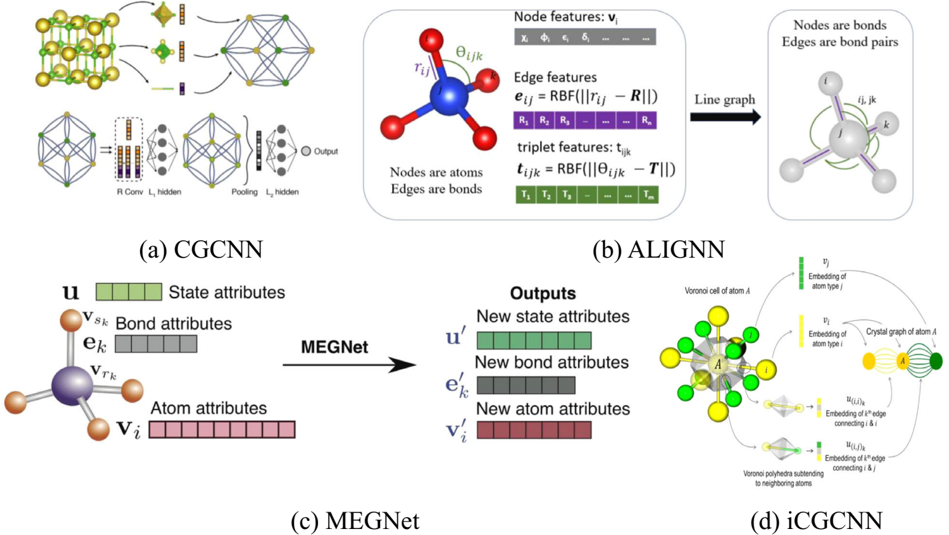
“Models such as SchNet, crystal graph convolutional neural network (CGCNN), improved crystal graph convolutional neural network (iCGCNN), directional message passing neural network (DimeNet), atomistic line graph neural network (ALIGNN) and materials graph neural network (MEGNet) shown in Table 1 have been used to pred…”
MethodInfluentialThe Elements of Statistical Learning
Hastie, T., Friedman, J., & Tibshirani, R. (2001) · Springer Series in Statistics · doi:10.1007/978-0-387-21606-5 · Cited by 24,162
A logical calculus of the ideas immanent in nervous activity
McCulloch, W. S., & Pitts, W. (1943) · The Bulletin of Mathematical Biophysics · doi:10.1007/bf02478259 · Cited by 18,566
The FAIR Guiding Principles for scientific data management and stewardship
Wilkinson, M. D., Dumontier, M., Aalbersberg, I. J., Appleton, G., Axton, M., Baak, A., Blomberg, N., Boiten, J.-W., da Silva Santos, L. B., Bourne, P. E., et al. (2016) · Scientific Data · doi:10.1038/sdata.2016.18 · Cited by 18,423 · cited 2×
“Through the Materials Genome Initiative (MGI) [3] and the increasing adoption of Findable, Accessible, Interoperable, Reusable (FAIR) [4] principles, several large experimental and computational datasets have been developed [5–12].”
Breiman, L. (1996) · Machine Learning · doi:10.1007/bf00058655 · Cited by 16,325 · cited 1×
“Similar to bagging 60 , the use of dropout brings about the same effect of training a collection of randomly chosen models which prevents the co-adaptations among the neurons, consequently reducing the likelihood of the model from over fi tting.”
Background
Research works printed but not linked: 12
- 61. LeCun, Y. et al. The Handbook of Brain Theory and Neural Networks vol. 3361 (MIT press Cambridge, MA, USA 1995).
- 83. Onken, D. et al. A neural network approach for high-dimensional optimal control. arXiv. https://arxiv.org/abs/2104.03270 (2021). · arXiv
- 85. Chen, L., Zhang, W., Nie, Z., Li, S. & Pan, F. Generative models for inverse design of inorganic solid materials. J. Mater. Inform. 1, 4 (2021).
- 104. Artrith, N. & Urban, A. An implementation of artificial neural-network potentials for atomistic materials simulations: Performance for tio2. Comput. Mater. Sci. 114, 135-150 (2016). · DOI · Paper page
- 140. Liu, R. et al. Deep learning for chemical compound stability prediction. In Pro- ceedings of ACM SIGKDD workshop on large-scale deep learning for data mining (DL-KDD), 1-7. https://rosanneliu.com/publication/kdd/ (ACM SIGKDD, 2016).
- 179. Rakita, Y. et al. Studying heterogeneities in local nanostructure with scanning nanostructure electron microscopy (snem). arXiv https://arxiv.org/abs/ 2110.03589 (2021).
- 198. Kong, S. et al. Density of states prediction for materials discovery via contrastive learning from probabilistic embeddings. arXiv. https://arxiv.org/abs/2110.11444 (2021). · arXiv
- 206. Choudhary, A. et al. Graph neural network predictions of metal organic framework co2 adsorption properties. arXiv. https://arxiv.org/abs/2112.10231 (2021). · arXiv
- 282. Haque, E. Effect of electron-phonon scattering, pressure and alloying on the thermoelectric performance of tmcu _3 ch _4(tm= v, nb, ta; ch= s, se, te). arXiv. https://arxiv.org/abs/2010.08461 (2020). · arXiv
- 300. Wilson, A. G., Hu, Z., Salakhutdinov, R. & Xing, E. P. Deep kernel learning. in Artificial intelligence and statistics, 370-378 (PMLR, 2016).
- 348. Fung, V., Hu, G., Ganesh, P. & Sumpter, B. G. Machine learned features from density of states for accurate adsorption energy prediction. Nat. Commun. 12, 1-11 (2021). · DOI · Paper page
- 357. Ede, J. M. & Beanland, R. Partial scanning transmission electron microscopy with deep learning. Sci. Rep. 10, 1-10 (2020). 358. 116. Somnath, S., Smith, C. R., Laanait, N., Vasudevan, R. K. & Jesse, S. Usid and pycroscopy-open source frameworks for storing and analyzing imaging and spectroscopy data. Microsc. Microanal. 25, 220-221 (2019). · DOI
Cited by
Items 501–600 of 1,001
Teng, Y., Tan, H., Huang, W., & Shan, G. (2025) · Communications Physics · doi:10.1038/s42005-025-02399-1 · Cited by 13
“Consequently, recent studies have applied DL methods to predict molecular properties 34 , have especially utilized graph neural network (GNN) 35 to process molecular structural information 36 .”
Environmental acoustic intelligence through sound event localization and detection: a review
Yeow, J.-W., Tan, E.-L., Peksi, S., & Gan, W. (2025) · npj Acoustics · doi:10.1038/s44384-025-00036-3 · Cited by 14
“Different classes of specialized architectures have emerged, each tai-loredtospeci fi cdatastructures 12,38,41 .”
Joshi, H., Wilde, N., Asche, T. S., & Wolf, D. (2022) · Chemie Ingenieur Technik · doi:10.1002/cite.202200071 · Cited by 6
Multi-stage Transfer Learning for Corn Leaf Disease Classification
Yong, C., Macalisang, J. R., & Hernandez, A. A. (2023) · IEEE International Conference on Automatic Control and Intelligent Systems (I2CACIS) · doi:10.1109/i2cacis57635.2023.10193168 · Cited by 6
“More recently, pre-trained models were introduced to provide better performance on salient object detection, classification, including, SqueezeNet, MobileNetv2, Xception, Inceptionv2, ShuffleNet, and DarkNet, among others [9-10].”
MethodRyan, E. M., Roshandelpoor, A., Pollard, Z. A., Goldfarb, J. L., & Vakili, P. (2023) · MRS Communications · doi:10.1557/s43579-023-00478-4 · Cited by 8
“[3,19] While some question whether ML methods can indeed “[find] extraordinary materials”, [9] the recent striking success of DeepMind in solving the five decades-old “protein folding problem” [22,23] firmly established the potential power of deep learning and natural language processing…”
BackgroundChen, J., Zhu, L., & Wang, J. (2024) · SAR and QSAR in environmental research · doi:10.1080/1062936x.2024.2312527 · Cited by 6
“The integration of deep learning models within the Quantitative Structure-Property Relationship (QSPR) framework is an emerging and rapidly expanding area of research in the field of materials data science [18].”
BackgroundTu, S., & Vo, P. (2024) · Journal of Thermal Spray Technology · doi:10.1007/s11666-024-01736-0 · Cited by 6
The Role of Artificial Intelligence in Early Cancer Detection: A Primer on Artificial Intelligence
Thaker, N. G., Dicker, A. P., Loaiza‐Bonilla, A., Manda, S., Frank, S. J., Orio, P. F., & Doria, C. (2024) · AI in Precision Oncology · doi:10.1089/aipo.2024.0003 · Cited by 7
Ghaderi, S., Mohammadi, M., Sayehmiri, F., Mohammadi, S., Tavasol, A., Rezaei, M., & Ghalyanchi‐Langeroudi, A. (2024) · Journal of Magnetic Resonance Imaging · doi:10.1002/jmri.29364 · Cited by 8
“Additionally, 95.5% of the studies acknowledged and reported uncertainties associated with their performance metrics (CLAIM Item 29).”
InfluentialSingle-Image-Based Deep Learning for Precise Atomic Defect Identification
Li, K., Han, X., Meng, Y., Li, J., Hong, Y., Chen, X., You, J., Lin, Y., Hu, W., Xia, Z., et al. (2024) · Nano Letters · doi:10.1021/acs.nanolett.4c02654 · Cited by 9
“Machine learning (ML), particularly deep learning (DL), revolutionizing the field of image recognition, has been widely applied in medical imaging diagnosis [17], autonomous vehicles [18], facial recognition systems [19, 20], and various domains of science [21, 22].”
BackgroundLiu, H., Peng, C., Zhang, C., & Huang, X. (2024) · The Journal of Physical Chemistry A · doi:10.1021/acs.jpca.4c04849 · Cited by 6
Léon-García, R. A., Rojas-Pablos, E., Mejía-Méndez, J. L., Sanchez-Martinez, A., Navarro-López, D. E., Sánchez-López, A. L., Lozano, L. M., Ceballos-Sanchez, O., López-Mena, E. R., & Sanchez‐Ante, G. (2024) · Chemical Engineering Journal Advances · doi:10.1016/j.ceja.2024.100669 · Cited by 6
Accelerating spin Hall conductivity predictions via machine learning
Zhao, J., Lai, J., Wang, J., Zhang, Y., Li, J., Chen, X., & Liu, P. (2024) · Materials Genome Engineering Advances · doi:10.1002/mgea.67 · Cited by 7
Welding defect detection with image processing on a custom small dataset: A comparative study
Szőlősi, J., Szekeres, B. J., Magyar, P., Adrián, B., Farkas, G., & Andó, M. (2024) · IET Collaborative Intelligent Manufacturing · doi:10.1049/cim2.70005 · Cited by 9
An intelligent grading system for mangosteen based on improved convolutional neural network
Zhang, Y., & Chuah, J. H. (2024) · Knowledge-Based Systems · doi:10.1016/j.knosys.2024.112904 · Cited by 8
Xu, X., Zhao, R., Wu, Z., Chu, Z., Weng, L., Nie, J., Liu, Q., & Sun, H. C. (2024) · Computers and Geotechnics · doi:10.1016/j.compgeo.2024.106982 · Cited by 6
Lin, Y., Ma, J., Jia, Y., Yu, C., & Cheng, J. (2025) · Coordination Chemistry Reviews · doi:10.1016/j.ccr.2025.216436 · Cited by 7
Dash, S. S., Mohanty, P., Kar, P. K., & Bhaskaran, R. (2025) · Journal of Fluorescence · doi:10.1007/s10895-024-04132-7 · Cited by 6
Mind the gap: Bridging the divide between AI aspirations and the reality of autonomous microscopy
Guinan, G., Salvador, A., Smeaton, M. A., Glaws, A., Egan, H., Wyatt, B. C., Anasori, B., Fiedler, K. R., Olszta, M. J., & Spurgeon, S. R. (2025) · APL Machine Learning · doi:10.1063/5.0267699 · Cited by 12
Casukhela, R., Vijayan, S., Jinschek, J. R., & Niezgoda, S. R. (2022) · Integrating materials and manufacturing innovation · doi:10.1007/s40192-022-00280-5 · Cited by 6
Zhong, S., Liu, D., Huang, L., Zhang, Y., Dong, Q., & Dang, Z. (2022) · iEnergy · doi:10.23919/ien.2022.0049 · Cited by 6
Self-supervised generative models for crystal structures
Liu, F., Chen, Z., Liu, T., Song, R., Lin, Y., Turner, J. J., & Jia, C. (2024) · iScience · doi:10.1016/j.isci.2024.110672 · Cited by 10
Discovering mathematical formulas from data via GPT-guided Monte Carlo Tree Search
Li, Y., Li, W., Yu, L., Wu, M., Liu, J., Li, W., & Hao, M. (2025) · Expert Systems with Applications · doi:10.1016/j.eswa.2025.127591 · Cited by 23
A reproducibility study of atomistic line graph neural networks for materials property prediction
Li, K., DeCost, B., Choudhary, K. K., & Hattrick-Simpers, J. R. (2024) · Digital Discovery · doi:10.1039/d4dd00064a · Cited by 10
Self-citationKatzer, B., Betsche, D., von Hoegen, F., Jochum, B., Böhm, K., & Schulz, K. (2024) · Modelling and Simulation in Materials Science and Engineering · doi:10.1088/1361-651x/ad4b4c · Cited by 5
Ryou, S., Lim, J., Jang, M., Eom, K., Lee, S., & Lee, H. (2025) · Advanced Science · doi:10.1002/advs.202417811 · Cited by 5
Automated image segmentation for accelerated nanoparticle characterization
Day, A. L., Wahl, C. B., dos Reis, R., Liao, W., Li, Y., Kilic, M. N. T., Mirkin, C. A., Dravid, V. P., Choudhary, A., & Agrawal, A. (2025) · Scientific Reports · doi:10.1038/s41598-025-01337-z · Cited by 9
Self-citationLu, Z., An, C., Liu, X., Mei, Z., Xie, X., Li, K., Wu, Y., Liao, Q., & Fu, H. (2025) · Advanced Optical Materials · doi:10.1002/adom.202402405 · Cited by 5
Islam, M. A., Deighan, D., Bhattacharjee, S., Tantalo, D., Singh, P., Salač, D., & Faghihi, D. (2025) · Computational Materials Science · doi:10.1016/j.commatsci.2025.114035 · Cited by 6
Grain Boundary Engineering: A Shortcut to Efficient Electrocatalytic Reactions
Zhou, J., Ji, Y., Wang, Y., Xie, L., & Wang, L. (2025) · Advanced Sustainable Systems · doi:10.1002/adsu.202500644 · Cited by 6
Mukherjee, A., Giri, D., & Rajan, K. (2025) · Journal of Chemical Information and Modeling · doi:10.1021/acs.jcim.5c00612 · Cited by 6
Pelayo-Punzano, G., Cuesta, R., Calvino, J. J., Dominguez-Vera, J. M., López‐Haro, M., de Vicente, J., & Gálvez, N. (2025) · ACS Applied Materials & Interfaces · doi:10.1021/acsami.5c11459 · Cited by 7
Rom, H., Peleg, O., Rom, Y., Mirelman, A., Blumrosen, G., & Maidan, I. (2025) · BMC Medical Informatics and Decision Making · doi:10.1186/s12911-025-03104-6 · Cited by 7
Guo, Y., Wang, Y., Zhang, W., Shen, Z., & Zeng, L. (2025) · Archives of Computational Methods in Engineering · doi:10.1007/s11831-025-10342-4 · Cited by 7
High-fidelity grain growth modeling: Leveraging deep learning for fast computations
Tep, P., & Bernacki, M. (2025) · Acta Materialia · doi:10.1016/j.actamat.2025.121486 · Cited by 5
Alimbekova, N., Rai, H. M., Turymbetov, T., & Zhumadillayeva, А. (2025) · PLoS ONE · doi:10.1371/journal.pone.0336927 · Cited by 5
“The dataset applied in this study contains 295,327 samples and contains features such as wavelength, absorbance, reference signals, sample signals, and category-specific characteristics [16,17].”
Behrooznia, S., & Hooshmand, M. (2025) · ACS Omega · doi:10.1021/acsomega.5c04997 · Cited by 8
Yang, H., Chen, Q., Chen, T., Li, Y., Norris, E., Little, J. M., Sun, J., Shrestha, S., Chen, E., Ren, S., et al. (2026) · Nature Communications · doi:10.1038/s41467-026-68484-3 · Cited by 13
“To collect the data points for the next loop, the prediction model used Monte Carlo simulation 52 – 54 , and a hybrid acquisition function termed A Score (represented by Eq.”
Khan, A. Q., Muhammad, S. G., Raza, A., & Pimanmas, A. (2026) · Journal of Road Engineering · doi:10.1016/j.jreng.2025.07.002 · Cited by 6
Multiscale computational design of hydrogen-compatible integrated structural-functional alloys
Wu, R., Toor, Z. S., Hashmi, M. R., Tanabe, K., Park, H., Ha, H., Orimo, S., & Kim, H. S. (2026) · Progress in Materials Science · doi:10.1016/j.pmatsci.2026.101727 · Cited by 5
Stratified GNN Explanations through Sufficient Expansion
Ji, Y., Shi, L., Liu, Z., & Wang, G. (2024) · Proceedings of the AAAI Conference on Artificial Intelligence · doi:10.1609/aaai.v38i11.29180 · Cited by 9
“They help to establish trust and ensure fairness in critical applications such as chemistry (Reiser et al. 2022), material science (Choudhary et al. 2022), and finance (Wu, Chao, and Li 2023).”
BackgroundComputational synthesis of a new generation of 2D-based perovskite quantum materials
Ekuma, C. E. (2024) · APL Machine Learning · doi:10.1063/5.0189497 · Cited by 5
Application of Machine Learning Tools to Material Science: A Mini-Review
Orhadahwe, T. A. (2024) · Physical Science & Biophysics Journal · doi:10.23880/psbj-16000269 · Cited by 6
Na, G. S., & Kim, H. W. (2024) · Applied Soft Computing · doi:10.1016/j.asoc.2024.111935 · Cited by 9
Computer vision for enhanced quantification of FEA of ballistic impact
He, J., Yuan, Z., Xu, W., Pan, Z., Chen, X., Xu, P., & Lu, Z. (2024) · International Journal of Mechanical Sciences · doi:10.1016/j.ijmecsci.2024.109630 · Cited by 5
An intelligent mangosteen grading system based on an improved convolutional neural network
Zhang, Y., Khairuddin, A. S. M., Chuah, J. H., Zhao, X., & Huang, J. (2024) · Signal Image and Video Processing · doi:10.1007/s11760-024-03492-8 · Cited by 5
“Choudhary et al. [7] developed a fruit identification method using the well-known "Fruits 360" dataset.”
Optimizing the Electrocatalytic Discovery with Machine Learning as a Novel Paradigm
Wani, A. H., & Sharma, A. (2024) · Springer eBooks · doi:10.1007/978-3-031-65902-7_7 · Cited by 6
Feature mining for thermoelectric materials based on interpretable machine learning
Liu, Y., Mu, Z., Hong, P., Yang, Y., & Lin, C. (2024) · Nanoscale · doi:10.1039/d4nr03271c · Cited by 5
Kamarian, S., Khalvandi, A., Heidarizadi, E., Saber‐Samandari, S., & Song, J. (2024) · Mechanics of Advanced Materials and Structures · doi:10.1080/15376494.2024.2418975 · Cited by 5
Swami, A. K., Verma, D. K., Soni, R., & Goswami, D. (2025) · Materials Today Communications · doi:10.1016/j.mtcomm.2025.112553 · Cited by 12
A study on quantum graph neural networks applied to molecular physics
Piperno, S., Ceschini, A., Chang, S. Y., Grossi, M., Vallecorsa, S., & Panella, M. (2025) · Physica Scripta · doi:10.1088/1402-4896/add8e9 · Cited by 9
“Until recently, traditional computers have played a key role in advancing our understanding of molecular structures [1]–[4].”
BackgroundChannel Quality Prediction in 5G LTE Small Cell Mobile Network Using Deep Learning
Diouf, N., Ndong, M., Diop, D., Talla, K., Sarr, M., & Beye., A. C. (2022) · International Conference on Soft Computing & Machine Intelligence (ISCMI) · doi:10.1109/iscmi56532.2022.10068487 · Cited by 5
“The deep learning architecture is flexible to be adapted to new problems in the future [32], such as the case of CQI prediction in this paper.”
BackgroundSubtransfer Learning in Human Activity Recognition: Boosting the Outlier User Accuracy
Kanjilal, R., Küçük, M. F., & Uysal, I. (2023) · IEEE Sensors Journal · doi:10.1109/jsen.2023.3312146 · Cited by 5
“The recent advancement of deep learning approaches in various fields [40], especially in HAR requires overcoming the data imbalance problem and supporting the training of the more complex models using synthetic data augmentation techniques.”
MethodPhi, N. H., Bui, H. N., Moon, S., & Lee, J. (2024) · Advanced Intelligent Systems · doi:10.1002/aisy.202300565 · Cited by 7
Nam, C. (2024) · Materials Chemistry and Physics · doi:10.1016/j.matchemphys.2024.129076 · Cited by 5
Moradpur‐Tari, E., Vlassov, S., Oras, S., Ernits, M., Damerchi, E., Polyakov, B., Kyritsakis, A., & Zadin, V. (2024) · Ultramicroscopy · doi:10.1016/j.ultramic.2024.113949 · Cited by 5
“While autonomous design and synthesis has attracted some attention [1–3], autonomous characterization methods are still not sufficiently versatile and reliable.”
BackgroundDeductive Machine Learning Challenges and Opportunities in Chemical Applications
Jin, T., & Savoie, B. M. (2024) · Annual Review of Chemical and Biomolecular Engineering · doi:10.1146/annurev-chembioeng-100722-111917 · Cited by 5
Feature selection for high-dimensional neural network potentials with the adaptive group lasso
Sandberg, J., Voigtmann, T., Devijver, É., & Jakse, N. (2024) · Machine Learning Science and Technology · doi:10.1088/2632-2153/ad450e · Cited by 11
“During the last decade, machine learning interaction potentials (MLIPs) have become a commonplace method for molecular dynamics simulations in material science and chemistry [1, 2], following a broader trend of data-driven approaches in material science [3, 4].”
BackgroundInfluentialModernizing Cancer Diagnosis with an Intelligent Model for Lung and Colon Cancer
Seelam, N. R. (2024) · Journal of Electrical Systems · doi:10.52783/jes.2851 · Cited by 5
Machine Learning-Based Prediction and Analysis of Air and Noise Pollution in Urban Environments
Vijayalakshmi, A. V., Ebenezer Abishek, B., Rubi, J., Dhivya, A. J. A., Kavidoss., K., & Aakas Ram, A. S. (2024) · International Conference on Sustainable Computing and Smart Systems (ICSCSS) · doi:10.1109/icscss60660.2024.10625644 · Cited by 8
“These algorithms have shown effectiveness in capturing temporal and spatial patterns in environmental data, enabling more accurate predictions and insights into pollution dynamics [15-17].”
BackgroundKim, S., Lee, B. D., Cho, M. Y., Pyo, M., Lee, Y., Park, W. B., & Sohn, K. (2024) · npj Computational Materials · doi:10.1038/s41524-024-01402-7 · Cited by 11
“Further details on the 3D electron density data preparation are available in Supplementary Note 2, 3, and 4.”
Latent Space Bayesian Optimization With Latent Data Augmentation for Enhanced Exploration
Boyar, O., & Takeuchi, I. (2024) · Neural Computation · doi:10.1162/neco_a_01708 · Cited by 13
“Then, the LSBO was applied to various problems such as neural architecture search [9], image generation [10], material discovery [11], and protein design [12].”
MethodTripartite interaction representation algorithm for crystal graph neural networks
Yang, Y., Chen, Z., Feng, T., Xiong, F., Wang, J., Wang, Y., & Wang, Z. (2024) · Scientific Reports · doi:10.1038/s41598-024-76309-w · Cited by 11
“This transformation is particularly evident in the field of new materials design, where machine learning methods now achieve levels comparable to density functional theory 1,2 , while surpassing previous computational speeds by an order of magnitude 3 .”
Electrical digital twins–enabled smart grid
Tiwari, D., Bhatele, K. R., Jha, A., & Chaudhary, K. (2024) · Elsevier eBooks · doi:10.1016/b978-0-443-28884-5.00021-x · Cited by 6
Leveraging interpolation models and error bounds for verifiable scientific machine learning
Chang, T. H., Gillette, A., & Maulik, R. (2025) · Journal of Computational Physics · doi:10.1016/j.jcp.2025.113726 · Cited by 9
“In recent years, artificial neural network (ANN) models have become popular methods for surrogate modeling in scientific machine learning [48, 49, 50, 51, 52, 53].”
Rezaei, M. J., Sedighi, M., Poletti, M. C., Pourbashiri, M., & Warchomicka, F. (2025) · Materials Characterization · doi:10.1016/j.matchar.2025.115000 · Cited by 5
Choudhary, K. K. (2025) · Integrating materials and manufacturing innovation · doi:10.1007/s40192-025-00410-9 · Cited by 13
Self-citationCNN-Based Model for Copy Detection Pattern Estimation and Authentication
Alfarozi, S. A. I., & Pratama, A. R. (2023) · Jurnal Nasional Teknik Elektro dan Teknologi Informasi (JNTETI) · doi:10.22146/jnteti.v12i1.6205 · Cited by 5
“Deep learning (DL) has become a new technology applicable to several fields [7]–[9].”
BackgroundAnalysis of black hole solutions in parabolic class using neural networks
Hatefi, E., Hatefi, A., & López-Sastre, R. J. (2023) · The European Physical Journal C · doi:10.1140/epjc/s10052-023-11781-8 · Cited by 5
“Artificial neural networks have found applications in almost all scientific fields ranging from bioinformatics [50] and material sciences [51], to natural language processing [52].”
BackgroundKamble, A., He, S., Howse, J. R., Ward, C., & Hamerton, I. (2023) · Computational Materials Science · doi:10.1016/j.commatsci.2023.112374 · Cited by 5
Wang, J., Song, T., Wen, T., Yang, S., Dong-Ying, J. U., & Zhang, X. (2025) · Materials Today Communications · doi:10.1016/j.mtcomm.2025.111691 · Cited by 7
Petković, M., Vicent‐Luna, J. M., Dinne, E. B., Menkovski, V., & Calero, S. (2025) · Journal of Materials Chemistry A · doi:10.1039/d5ta02482j · Cited by 4
Yogarathinam, L. T., Abba, S. I., Usman, J., Muthuramamoorthy, M., & Aljundi, I. H. (2025) · Cleaner Chemical Engineering · doi:10.1016/j.clce.2025.100187 · Cited by 4
Li, Z., Wang, P., Su, Z., Liu, H., Duan, Y., & Zhu, C. (2025) · Analytical Chemistry · doi:10.1021/acs.analchem.5c01554 · Cited by 5
Pham, V. H., Chon, B. H., & Ahn, H. K. (2025) · Measurement · doi:10.1016/j.measurement.2025.118459 · Cited by 4
Benaissa, W., Saidi, F., & Rahmouna, K. (2025) · The European Physical Journal B · doi:10.1140/epjb/s10051-025-00999-y · Cited by 4
“Advancements in experimental techniques, such as X-ray and neutron diffraction, enable the measurement of lattice constants, which are essential for understanding material behavior [21].”
Horváth, V., Megyeri, D., Kopniczky, J., Darwish, M., Geretovszky, Z., & Kohut, A. (2025) · ACS Applied Nano Materials · doi:10.1021/acsanm.5c02891 · Cited by 4
Choudhary, K. K. (2025) · The Journal of Physical Chemistry Letters · doi:10.1021/acs.jpclett.5c02456 · Cited by 4
Self-citationGhosh, S. (2025) · Solar Energy Materials and Solar Cells · doi:10.1016/j.solmat.2025.114010 · Cited by 4
Universal differential equations as a unifying modeling language for neuroscience
El-Gazzar, A., & van Gerven, M. A. J. (2025) · Frontiers in Computational Neuroscience · doi:10.3389/fncom.2025.1677930 · Cited by 23
“…which are starting to embrace this approach (Raissi, 2018; Keith et al., 2021; Davies et al., 2021; Duraisamy et al., 2019; Kusner et al., 2017; Choudhary et al., 2022), this remains an underexplored opportunity in neuroscience with a potential to generate data-driven hypotheses in the form of…”
Najar, M. S., Bhat, M. R., Assad, A., Anjum, G., Singh, M., & Bhat, F. H. (2025) · Modelling and Simulation in Materials Science and Engineering · doi:10.1088/1361-651x/ae1990 · Cited by 4
“Recently, artificial intelligence, especially machine learning (ML), has emerged as a powerful tool for discovering materials by identifying patterns in large datasets, and predicting key properties [14, 18].”
Upadhyay, S., Singh, P. P., Thakur, V., & Ranganathan, R. (2025) · Journal of the American Ceramic Society · doi:10.1111/jace.70241 · Cited by 5
“229,230 Abstracting the complex mineralization process of nature, for the development of state-of-the-art high-performance materials, has traditionally been a challenge, which has partly been overcome over the past few decades thanks to advancements in theoretical understanding of these processes…”
Han, D., Wang, M., Xiang, Y., Zhang, T., Liu, J., & Tan, Y. (2026) · Sustainable Cities and Society · doi:10.1016/j.scs.2026.107287 · Cited by 5
Gowda, H. D. S., Raju, H., Kumar, V. G. P., Bharat, P. B., Suresha, B., & Bhat, S. K. (2026) · Discover Applied Sciences · doi:10.1007/s42452-026-08663-5 · Cited by 7
Erçetin, A., Arpacı, İ., Memiş, S., Akagić, A., & Özgün, Ö. (2026) · Archives of Computational Methods in Engineering · doi:10.1007/s11831-026-10641-4 · Cited by 7
AI-ML innovations in membrane technology: current progress and future prospects
Ramkumar, N., Chandran, D. G., & Monash, P. (2026) · Chemical Engineering Journal Advances · doi:10.1016/j.ceja.2026.101408 · Cited by 4
Es-samlali, L., Haloui, Y. E., Hassani, F. O., Tlidi, A., & bekri, A. (2024) · Case Studies in Construction Materials · doi:10.1016/j.cscm.2024.e03877 · Cited by 5
Automatic Generation of Contrast Maps in Terms of van der Waals Material Properties in Bimodal AFM
Santos, S., Elsherbiny, L. S., Lai, C.-Y., Askar, K. A., Gadelrab, K., & Chiesa, M. (2024) · The Journal of Physical Chemistry C · doi:10.1021/acs.jpcc.4c06040 · Cited by 4
Post-Quantum Cryptography: Securing Critical Infrastructure Against Emerging Quantum Threats
Chandre, P. R., Hingoliwala, H. A., Uttarkar, A., Shendkar, B. D., Lokare, D. A., & Sontakke, P. (2024) · IEEE International Conference on ICT in Business Industry & Government (ICTBIG) · doi:10.1109/ictbig64922.2024.10911612 · Cited by 11
“Other Notable Algorithms (e.g., Isogeny-Based Cryptography): A more recent method is isogeny-based cryptography, which computes isogenies between elliptic curves—a challenge that is challenging for quantum computers to accomplish[19].”
SLICES-PLUS: A crystal representation leveraging spatial symmetry
Wang, B., Xu, Z., Han, Z., Nie, Q., Chen, X., Xiao, H., & Yan, G. F. (2025) · Materials & Design · doi:10.1016/j.matdes.2025.113856 · Cited by 7
Predicting soil stress–strain behaviour with bidirectional long short-term memory networks
Cerek, K., Gupta, A., Dao, D. A., Hadjiloo, E., & Grabe, J. (2025) · Machine Learning and Data Science in Geotechnics · doi:10.1108/mlag-08-2024-0007 · Cited by 6
Götz, A., Lutter, F., Possart, D., Augsburger, D., Arslan, U., Pechmann, S., Rubach, C., Buwen, M., Sultan, U., Kichigin, A., et al. (2025) · Tomography of Materials and Structures · doi:10.1016/j.tmater.2025.100069 · Cited by 7
Enhancing 1D ionic conductivity in lithium manganese iron phosphate with low-energy optical phonons
Oh, H., Noh, C., Cho, A. Y., Kim, J. C., Kim, N. S., & Kim, K. H. (2025) · Scientific Reports · doi:10.1038/s41598-025-13769-8 · Cited by 6
“With recent advancements in artificial intelligence, the development of graph neural network-based universal interatomic potentials (IAPs) has significantly extended the limited length and time scales of AIMD, while delivering more reliable data compared to classical MD simulations 26–28 .”
Nonlinear gyrotropic magnetic vortices for efficient pattern recognition
Khosla, A., & Medwal, R. (2025) · Applied Physics Letters · doi:10.1063/5.0292811 · Cited by 4
GAN-Based One-Class Classification SVM for Real time Medical Image Intrusion Detection
Hussain, F., Tbarki, K., & Ksantini, R. (2023) · International Journal of Computing and Digital Systems · doi:10.12785/ijcds/130150 · Cited by 5
Zhou, Q., Liu, X., Yun, H., Zhao, Y., Shu, K., Chen, Y., & Chen, S. (2023) · Biomolecules and Biomedicine · doi:10.17305/bb.2023.9519 · Cited by 7
“…in machine learning techniques, from traditional linear models to advanced deep learning architectures, have shown the ability to handle large, heterogeneous datasets and capture intricate relationships among variables that may not be apparent using conventional statistical methods [11–13].”
BackgroundRegular paper Comparative Analysis of Deep Learning Models for Sentiment Analysis on IMDB Reviews
Kanak Pandit, H. P. (2024) · Journal of Electrical Systems · doi:10.52783/jes.1345 · Cited by 8
Semantic Segmentation Using U-Net for Autonomous Driving
Natte, V. S., Kadicherla, J., Katukojwala, S. D., Swaraja, K., Vignesh, N. A., & Aouthu, S. (2024) · International Conference on Distributed Computing and Electrical Circuits and Electronics (ICDCECE) · doi:10.1109/icdcece60827.2024.10548323 · Cited by 4
“The paper [8] gave a high-level review of deep learning techniques and then explored more recent advances in deep learning for spectrum analysis, atomistic modeling, material imaging, and natural language processing.”
BackgroundLiu, X., Huang, Q., Su, C., Shao, N., Zhang, L., Tian, Y., & Zhou, H. (2025) · Materials Today Physics · doi:10.1016/j.mtphys.2025.101723 · Cited by 8
Material Characterization of Aluminum Castings Using Machine Learning Techniques
Akbari, M., Wang, L., & Wang, Q. G. (2025) · International Journal of Metalcasting · doi:10.1007/s40962-025-01672-x · Cited by 5
Metadata
- Authors
- Choudhary, K., DeCost, B., Chen, C., Jain, A., Tavazza, F., Cohn, R., Park, C. W., Choudhary, A., Agrawal, A., Billinge, S. J. L., Holm, E., Ong, S. P., & Wolverton, C.
- Affiliations
- National Institute of Standards and Technology (US)
- University of California San Diego (US)
- Lawrence Berkeley National Laboratory (US)
- Carnegie Mellon University (US)
- Northwestern University (US)
- Columbia University (US)
- ORCID
- Venue
- npj Computational Materials
- Published
- 2022-04-05
- Volume
- 8
- Issue
- 1
- ISSN
- 2057-3960 (ISSN-L)
- OpenAlex
- W3208687975
- Semantic Scholar
- 5aaeb50d8051890e9fbb9b9b8f34d9f3f2d85c1a
- Cited by
- 1,172
- References
- 401
- Citations by year
- 2026: 248 · 2025: 386 · 2024: 316 · 2023: 187 · 2022: 35
- FWCI
- 64.93
- Type
- journal article
- Language
- en
- Open access
- gold
- doi.org
- Licence
- cc-by
- creativecommons.org/licenses/by/4.0 (tdm)
- creativecommons.org/licenses/by/4.0 (vor)
- Locations
- npj Computational Materials (publishedVersion, cc-by)
- arXiv (Cornell University) (submittedVersion)
- eScholarship (California Digital Library) (submittedVersion, cc-by)
- OSTI OAI (U.S. Department of Energy Office of Scientific and Technical Information) (submittedVersion, cc-by)
- DOAJ (DOAJ: Directory of Open Access Journals) (submittedVersion)
- arXiv (Cornell University) (cc-by)
- Funders
- National Science Foundation (DEAC02-05CH11231, 2053929, 70NANB19H005, 1826218, 1922234)
- U.S. Department of Energy (-AC02-05CH11231, DE-AC02-05-CH11231: Materials Project program KC23MP, 70NANB19H005, KC23MP, DE AC02 05CH11231, DE-AC02-)
- U.S. Department of Commerce (70NANB19H005, 70NANB19H117)
- Northwestern University (70NANB19H005)
- University of Warwick
- National Institute of Standards and Technology (70NANB19H117, 70NANB19H005)
- Office of Science (DEAC02–05CH11231, DE-AC02, DE-AC02-05-CH11231: Materials Project Program KC23MP)
- Division of Civil, Mechanical and Manufacturing Innovation (CMMI-2053929)
- Basic Energy Sciences (DE-AC02, DE-AC02-05CH11231., KC23MP, DE-AC02-05-, AC02–05CH11231)
- Topics
- Physical Sciences › Materials Science › Materials Chemistry › Machine Learning in Materials Science
- Physical Sciences › Physics and Astronomy › Atomic and Molecular Physics, and Optics › Advanced Chemical Physics Studies
- Physical Sciences › Physics and Astronomy › Statistical and Nonlinear Physics › Model Reduction and Neural Networks
- Keywords
- deep learning, atomistic simulation, materials imaging, spectral analysis, natural language processing, synthetic data, generative models, uncertainty quantification, materials database, spectral data
About these checks
Registry, retraction, Cites and statistics results are computed, not judged, with one exception: a printed reference that no index lists is read once by a model before it counts as a citation error. Claims are extracted by a model and kept only when their quote appears verbatim in the text; each cited source is then checked, with a model’s help, for whether it says what the claim relies on. Those verdicts can be wrong — read the claim’s quote and the cited source before relying on one.
Statistics and arithmetic are recomputed, not judged.
Confidence bands are shown only for fields calibrated on our annotated test set. None is calibrated yet, so no band is shown.
What counts as a claim ›How we measure confidence ›How we check this ›
Are you an author, or do you see a problem with this page? Request a review
Data sources
Bibliographic data: Semantic Scholar, OpenAlex, Crossref.
Contains information from the Semantic Scholar Academic Graph Datasets, made available under the ODC Attribution License (ODC-BY 1.0).
Semantic Scholar’s data is described in: Kinney, R., et al. (2023). The Semantic Scholar Open Data Platform. arXiv:2301.10140.
