

Recent advances and applications of deep learning methods in materials science
Open accessThe DOI matches its Crossref record; 404 of the 404 references it cites were found in a registry or an index.
Abstract
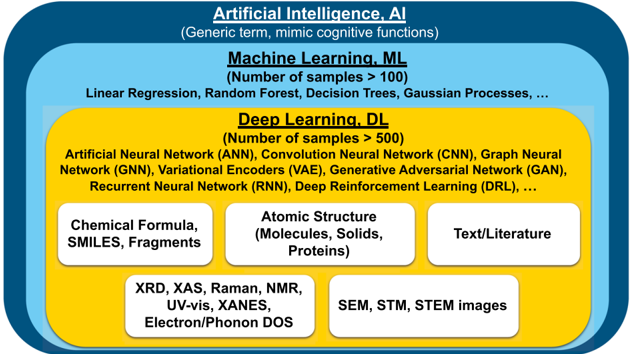
Deep learning (DL) is one of the fastest-growing topics in materials data science, with rapidly emerging applications spanning atomistic, image-based, spectral, and textual data modalities. DL allows analysis of unstructured data and automated identification of features. The recent development of large materials databases has fueled the application of DL methods in atomistic prediction in particular. In contrast, advances in image and spectral data have largely leveraged synthetic data enabled by high-quality forward models as well as by generative unsupervised DL methods. In this article, we present a high-level overview of deep learning methods followed by a detailed discussion of recent developments of deep learning in atomistic simulation, materials imaging, spectral analysis, and natural language processing. For each modality we discuss applications involving both theoretical and experimental data, typical modeling approaches with their strengths and limitations, and relevant publicly available software and datasets. We conclude the review with a discussion of recent cross-cutting work related to uncertainty quantification in this field and a brief perspective on limitations, challenges, and potential growth areas for DL methods in materials science.
Overview
The claims and statistics of this paper haven’t been checked yet.
Free: it reads the open-access text and checks the first 5 claims that cite a source we can check. Create a free account to check every claim.
Integrity signals
Registry
Cites
Statistics
Figures
Verification
Claims the paper makes
The claims and statistics of this paper haven’t been checked yet.
Free: it reads the open-access text and checks the first 5 claims that cite a source we can check. Create a free account to check every claim.
Self-check
Percentages, sums and reported differences re-computed from the paper’s own numbers.
The self-check needs the paper’s full text.
Citations
Cites
ImageNet classification with deep convolutional neural networks
Krizhevsky, A., Sutskever, I., & Hinton, G. E. (2017) · Communications of the ACM · doi:10.1145/3065386 · Cited by 112,155
LeCun, Y., Bengio, Y., & Hinton, G. (2015) · Nature · doi:10.1038/nature14539 · Cited by 84,126
BERT: Pre-training of Deep Bidirectional Transformers for Language Understanding
Devlin, J., Chang, M.-W., Lee, K., & Toutanova, K. (2018) · arXiv · doi:10.48550/arxiv.1810.04805 · Cited by 73,173 · cited 1×
“More recently, sequence-to-sequence models based on a “transformer” architecture, such as Google’s Bidirectional Encoder Representations from Transformers (BERT) model [53, 70], have helped address some of the issues of traditional RNNs.”
BERT: Pre-training of Deep Bidirectional Transformers for Language Understanding
Devlin, J., Chang, M.-W., Lee, K., & Toutanova, K. (2019) · Proceedings of the 2019 Conference of the North American Chapter of the Association for Computational Linguistics: Human Language Technologies, Volume 1 (Long and Short Papers) · doi:10.18653/v1/n19-1423 · Cited by 54,325 · cited 1×
“More recently, sequence-to-sequence models based on a “transformer” architecture, such as Google’s Bidirectional Encoder Representations from Transformers (BERT) model [53, 70], have helped address some of the issues of traditional RNNs.”
PyTorch: An Imperative Style, High-Performance Deep Learning Library
Paszke, A., Gross, S., Massa, F., Lerer, A., Bradbury, J., Chanan, G., Killeen, T., Lin, Z., Gimelshein, N., Antiga, L., et al. (2019) · arXiv · doi:10.48550/arxiv.1912.01703 · Cited by 31,473
Semi-supervised classification with graph convolutional networks
Kipf, T. N., & Welling, M. (2016) · arXiv · doi:10.48550/arxiv.1609.02907 · Cited by 24,853 · cited 6×
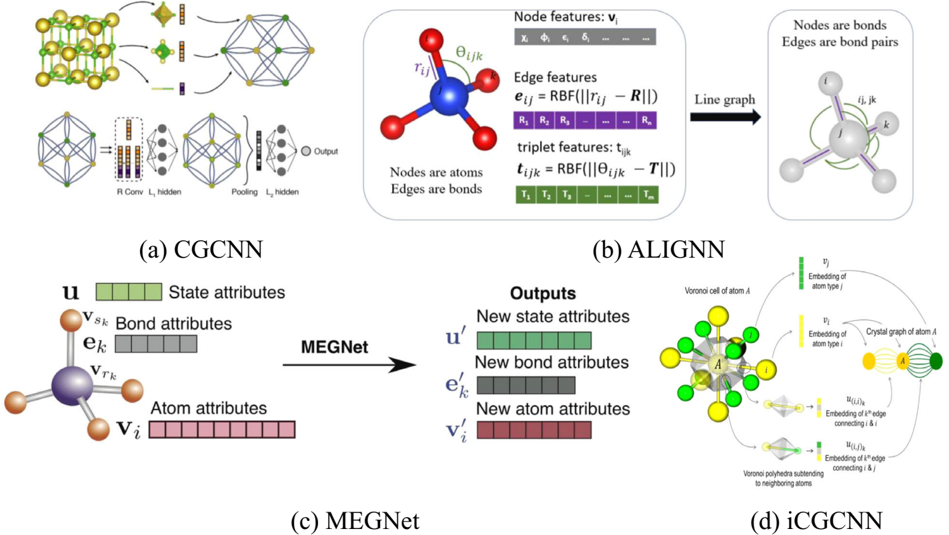
“Models such as SchNet, crystal graph convolutional neural network (CGCNN), improved crystal graph convolutional neural network (iCGCNN), directional message passing neural network (DimeNet), atomistic line graph neural network (ALIGNN) and materials graph neural network (MEGNet) shown in Table 1 have been used to pred…”
MethodInfluentialThe Elements of Statistical Learning
Hastie, T., Friedman, J., & Tibshirani, R. (2001) · Springer Series in Statistics · doi:10.1007/978-0-387-21606-5 · Cited by 24,162
A logical calculus of the ideas immanent in nervous activity
McCulloch, W. S., & Pitts, W. (1943) · The Bulletin of Mathematical Biophysics · doi:10.1007/bf02478259 · Cited by 18,566
The FAIR Guiding Principles for scientific data management and stewardship
Wilkinson, M. D., Dumontier, M., Aalbersberg, I. J., Appleton, G., Axton, M., Baak, A., Blomberg, N., Boiten, J.-W., da Silva Santos, L. B., Bourne, P. E., et al. (2016) · Scientific Data · doi:10.1038/sdata.2016.18 · Cited by 18,423 · cited 2×
“Through the Materials Genome Initiative (MGI) [3] and the increasing adoption of Findable, Accessible, Interoperable, Reusable (FAIR) [4] principles, several large experimental and computational datasets have been developed [5–12].”
Breiman, L. (1996) · Machine Learning · doi:10.1007/bf00058655 · Cited by 16,325 · cited 1×
“Similar to bagging 60 , the use of dropout brings about the same effect of training a collection of randomly chosen models which prevents the co-adaptations among the neurons, consequently reducing the likelihood of the model from over fi tting.”
Background
Research works printed but not linked: 12
- 61. LeCun, Y. et al. The Handbook of Brain Theory and Neural Networks vol. 3361 (MIT press Cambridge, MA, USA 1995).
- 83. Onken, D. et al. A neural network approach for high-dimensional optimal control. arXiv. https://arxiv.org/abs/2104.03270 (2021). · arXiv
- 85. Chen, L., Zhang, W., Nie, Z., Li, S. & Pan, F. Generative models for inverse design of inorganic solid materials. J. Mater. Inform. 1, 4 (2021).
- 104. Artrith, N. & Urban, A. An implementation of artificial neural-network potentials for atomistic materials simulations: Performance for tio2. Comput. Mater. Sci. 114, 135-150 (2016). · DOI · Paper page
- 140. Liu, R. et al. Deep learning for chemical compound stability prediction. In Pro- ceedings of ACM SIGKDD workshop on large-scale deep learning for data mining (DL-KDD), 1-7. https://rosanneliu.com/publication/kdd/ (ACM SIGKDD, 2016).
- 179. Rakita, Y. et al. Studying heterogeneities in local nanostructure with scanning nanostructure electron microscopy (snem). arXiv https://arxiv.org/abs/ 2110.03589 (2021).
- 198. Kong, S. et al. Density of states prediction for materials discovery via contrastive learning from probabilistic embeddings. arXiv. https://arxiv.org/abs/2110.11444 (2021). · arXiv
- 206. Choudhary, A. et al. Graph neural network predictions of metal organic framework co2 adsorption properties. arXiv. https://arxiv.org/abs/2112.10231 (2021). · arXiv
- 282. Haque, E. Effect of electron-phonon scattering, pressure and alloying on the thermoelectric performance of tmcu _3 ch _4(tm= v, nb, ta; ch= s, se, te). arXiv. https://arxiv.org/abs/2010.08461 (2020). · arXiv
- 300. Wilson, A. G., Hu, Z., Salakhutdinov, R. & Xing, E. P. Deep kernel learning. in Artificial intelligence and statistics, 370-378 (PMLR, 2016).
- 348. Fung, V., Hu, G., Ganesh, P. & Sumpter, B. G. Machine learned features from density of states for accurate adsorption energy prediction. Nat. Commun. 12, 1-11 (2021). · DOI · Paper page
- 357. Ede, J. M. & Beanland, R. Partial scanning transmission electron microscopy with deep learning. Sci. Rep. 10, 1-10 (2020). 358. 116. Somnath, S., Smith, C. R., Laanait, N., Vasudevan, R. K. & Jesse, S. Usid and pycroscopy-open source frameworks for storing and analyzing imaging and spectroscopy data. Microsc. Microanal. 25, 220-221 (2019). · DOI
Cited by
Items 701–800 of 1,001
Machine learning in magnetism: Progress, challenges, and perspectives
Jiang, C., Xie, W., Wang, M. Z., Zhou, T., Song, W., Yue, Y., & Hu, X. (2026) · Computational Materials Science · doi:10.1016/j.commatsci.2026.114652 · Cited by 2
Strategies for Photoelectrochemical Splitting of Water
Ortiz, B. A., Trejo-Valdez, M. D., Kumari, P., & Torres-Torres, C. (2026) · International Journal of Molecular Sciences · doi:10.3390/ijms27073015 · Cited by 2
“Furthermore, as complementary tools for material identification and process optimization, machine learning and data-based optimization approaches were investigated [130].”
Machine-Learning-Guided Discovery of CH 4 Combustion Catalysts Operating in the Presence of SO 2
Jing, Y., Ting, K. W., Qin, J., Yamada, K., Tajima, D., Anzai, A., Mine, S., Toyoshima, R., Kondoh, H., Takigawa, I., et al. (2026) · Journal of the American Chemical Society · doi:10.1021/jacs.6c01560 · Cited by 3
Sustainable Materials Design With Multi‐Modal Artificial Intelligence
Xu, T., Wei, T., Ge, Y., Peng, B., Li, Y., Wang, M., Wen, P., Yang, C., & Wei, Y. (2026) · Advanced Science · doi:10.1002/advs.202524273 · Cited by 8
“Here we use “multi-modality” to denote the principled fusion of such heterogeneous evidence, including crystal and microstructural representations, images, spectra, text corpora and tabular or numeric measurements, into coherent AI systems [ 47, 64–67 ].”
Wang, Z., Liu, S., Wei, Z., Tang, J., Zheng, S., & Ren, F. (2026) · Composites Science and Technology · doi:10.1016/j.compscitech.2026.111667 · Cited by 2
Sang, S., Wang, Z., & Fan, J. (2026) · European Journal of Mechanics - A/Solids · doi:10.1016/j.euromechsol.2026.106197 · Cited by 2
Confidence-bound early stopping of experiments with sequential calibration
Xiao, Y., Zhu, M., Zhang, Y., Tsaoulidis, D. A., & Chen, T. (2026) · Process Safety and Environmental Protection · doi:10.1016/j.cherd.2026.05.013 · Cited by 2
Tipu, G. H., Anwar, K., Khan, G. K., & Yao, F. (2026) · International Journal of Theoretical Physics · doi:10.1007/s10773-026-06355-9 · Cited by 3
Lakshmaiya, N. (2026) · Next Materials · doi:10.1016/j.nxmate.2026.102525 · Cited by 2
Arora, G., Bhowmik, P., Kumar, M., Ayyappan, V., Sharma, H., Sehgal, A. K., Rangappa, S. M., & Siengchin, S. (2026) · International Journal on Interactive Design and Manufacturing (IJIDeM) · doi:10.1007/s12008-026-02670-x · Cited by 2
AI for science: Progress, challenges, and perspectives
Xu, Y., Shao, Z., Liu, X., Li, Y., An, Z., Fu, C., Huang, C., Zhang, L., Gao, F., Li, J., et al. (2026) · The Innovation · doi:10.1016/j.xinn.2026.101530 · Cited by 16
An optimization-based supervised learning algorithm for PXRD phase fraction estimation
Hosein, P. A., & Greasley, J. (2023) · Materials Today Communications · doi:10.1016/j.mtcomm.2023.106423 · Cited by 2
Management and application of research data in condensed matter science
Wang, D., Zhou, M., Huang, D., Li, Y., Lin, Z., Liu, J., Zhu, T., Zhu, Y., Li, M., Xiao, R., et al. (2024) · Chinese Science Bulletin (Chinese Version) · doi:10.1360/tb-2023-0463 · Cited by 3
Digital Image Enhancement Using MirNet and Zero-Deep Curve Estimation (Zero-DCE)
Purbandini, Fatichah, C., & Amaliah, B. (2023) · International Conference on Information Technology, Information Systems and Electrical Engineering (ICITISEE) · doi:10.1109/icitisee58992.2023.10404895 · Cited by 2
Comparison of Deep Learning Methods for Detecting Brain Tumor
Bedi, K. P., & Jadon, J. S. (2024) · International Conference on Cloud Computing, Data Science & Engineering (Confluence) · doi:10.1109/confluence60223.2024.10463287 · Cited by 2
Chen, S., Yin, A., & Song, L. (2024) · Physica Scripta · doi:10.1088/1402-4896/ad385b · Cited by 2
Application of Speech Feature Extraction Method Based on Deep Learning in Speech Cloning
Zhang, J., Chen, Y., & Ma, H. (2024) · International Conference on Integrated Circuits and Communication Systems (ICICACS) · doi:10.1109/icicacs60521.2024.10498500 · Cited by 2
“Choudhary K believed that deep learning can even shine brightly in materials science and has now become one of the fastest growing subjects in materials data science [10].”
BackgroundPrediction of Watershed Flow Behavior from Rainfall Events Using Machine Learning
Reid, C., Williams, M., Roberts, N., & Smith, M. (2024) · IEEE SoutheastCon · doi:10.1109/southeastcon52093.2024.10500262 · Cited by 2
“It was developed to help address the vanishing gradient problem in RNNs [30].”
BackgroundPredictive ultrafast laser-induced formation of MoO x using machine learning algorithms
Lara, M. C., Espinal-Jiménez, A., Camacho-López, S., García‐Granada, A., & Rostro‐González, H. (2024) · Applied Optics · doi:10.1364/ao.530032 · Cited by 2
Machine learning assisted sorting of active microswimmers
Torrik, A., & Zarif, M. (2024) · The Journal of Chemical Physics · doi:10.1063/5.0216862 · Cited by 3
Structural Embedding Methods for Machine Learning Models Accelerate Research on Stacked 2D Materials
Chen, X., Ru, G., & Qi, W. (2024) · The Journal of Physical Chemistry C · doi:10.1021/acs.jpcc.4c02953 · Cited by 2
Samiri, A., Khmich, A., & Hasnaoui, A. (2024) · Materials Today Communications · doi:10.1016/j.mtcomm.2024.110494 · Cited by 2
Application and prospect of machine learning in photoelectron spectroscopy
Deng, X., Wu, L., Zhao, R., Wang, J., & Zhao, L. (2024) · Acta Physica Sinica · doi:10.7498/aps.73.20240957 · Cited by 4
Magnetic Prediction of Doped Two-Dimensional Nanomaterials Based on Swin–ResNet
Zhang, Y., Zhou, C., Liang, F., Liu, G., & Zhu, J. (2024) · Coatings · doi:10.3390/coatings14101271 · Cited by 2
Machine‐Learned Modeling for Accelerating Organic Solvent Design in Metal‐Ion Batteries
Sukmas, W., Qin, J., & Chanajaree, R. (2024) · Advanced Theory and Simulations · doi:10.1002/adts.202401048 · Cited by 4
Li, M., Liu, Y., Chen, D., & Wang, Q. (2025) · Measurement · doi:10.1016/j.measurement.2025.116744 · Cited by 3
Fan, H.-H., Wang, X., Feng, J., & Li, W. (2025) · Separations · doi:10.3390/separations12020022 · Cited by 3
Gupta, V., Liao, W., Choudhary, A., & Agrawal, A. (2024) · International Conference on Machine Learning and Applications · doi:10.1109/icmla61862.2024.00145 · Cited by 4
Self-citationA Machine learning approach for predicting orientation-dependent elastic properties of 2D materials
Yalameha, S. (2025) · Computational Materials Science · doi:10.1016/j.commatsci.2025.113819 · Cited by 2
Introduction to Machine Learning for Predictive Modeling I
Chen, Z., Li, N., & Li, X. (2025) · Challenges and advances in computational chemistry and physics · doi:10.1007/978-3-031-78728-7_1 · Cited by 3
khan, A. W. A., Raja, M. A. Z., Chang, C., Khan, M. P., Khan, Z. A., Shoaib, M., & Shu, C. (2025) · The European Physical Journal Plus · doi:10.1140/epjp/s13360-025-06419-5 · Cited by 3
AI-powered deep ultraviolet laser diode design for resource-efficient optimization
Sarwar, A., Usman, M., Hussain, M., Jadoon, K. K., Manzoor, T., & Ali, S. (2025) · Journal of Computational Electronics · doi:10.1007/s10825-025-02352-z · Cited by 2
“ML models are designed to learn the coefficients, weights, or parameters associated with a given dataset, which in this study correspond to the structural attributes of the application [54].”
Python Data Driven framework for acceleration of Phase-Field simulations
Fetni, S., Delahaye, J., & Habraken, A. M. (2023) · Software Impacts · doi:10.1016/j.simpa.2023.100563 · Cited by 2
Yi, T., Luo, J., Liao, R., Wang, L., Wu, A., Li, Y., Zhou, L., Ni, C., Wang, K., Tang, X., et al. (2024) · Biomolecules · doi:10.3390/biom14030267 · Cited by 2
Modeling extended L-band fiber amplifiers using neural networks trained on experimental data
Rabbani, H., Jalilpiran, S., Monga, K. J.-J., LaRochelle, S., & Rusch, L. A. (2024) · Optics Express · doi:10.1364/oe.513568 · Cited by 2
Equivariant Parameter Sharing for Porous Crystalline Materials
Petković, M., Romero-Marimon, P., Menkovski, V., & Calero, S. (2024) · Lecture notes in computer science · doi:10.1007/978-3-031-58547-0_11 · Cited by 2
“Deep Learning has shown to be of great use in materials science, in tasks like property prediction and high-throughput screening of potential materials [5].”
BackgroundXie, E., & Wang, X. (2023) · ChemRxiv · doi:10.26434/chemrxiv-2023-cxfm5-v2 · Cited by 1
Agarwal, A., Srinivasan, S. G., & Rai, B. (2024) · ChemRxiv · doi:10.26434/chemrxiv-2024-9j0cm · Cited by 1
Welding Defect Detection with Image Processing on a Custom Small Dataset: A Comparative StudyPreprint
Szőlősi, J., Szekeres, B. J., Magyar, P., Bán, A., Farkas, G., & Andó, M. (2024) · SSRN Electronic Journal · doi:10.2139/ssrn.4841939 · Cited by 2
Physics-enhanced neural networks for equation-of-state calculations
Callow, T. J., Nikl, J., Kraisler, E., & Cangi, A. (2023) · Machine Learning Science and Technology · doi:10.1088/2632-2153/ad13b9 · Cited by 4
Guo, Y., Cao, X., Dong, W., Peng, K., Tian, W., & Zhou, M. (2023) · Conference proceedings/Conference proceedings - IEEE International Conference on Systems, Man, and Cybernetics · doi:10.1109/smc53992.2023.10394178 · Cited by 1
“The application of deep learning has resulted in discoveries and advancements in numerous scientific fields, such as physics and materials science [4], [5].”
BackgroundGuo, Y., Cao, X., Dong, W., Peng, K., Tian, W., & Zhou, M. (2023) · IEEE Smart World Congress (SWC) · doi:10.1109/swc57546.2023.10449191 · Cited by 3
“…and theoretical-based approaches are accelerating their integration with data-based deep learning methods, which are gradually becoming a new paradigm for scientific research and rapidly and profoundly influencing scientific fields such as physics, chemistry, materials science, and biology [5]–[7].”
BackgroundFAST: Feature Aware Similarity Thresholding for Weak Unlearning in Black-Box Generative Models
Panda, S., & Prathosh, A. P. (2024) · IEEE Transactions on Artificial Intelligence · doi:10.1109/tai.2024.3499939 · Cited by 7
“…authentic data is limited, exemplified by their application in fields such as medical imaging [1], [2], remote sensing [3], [4], hyperspectral imagery [5], [6], and others [7], [8], [9] and also in various downstream tasks, including but not limited to classification [10], [11], segmentation [12] etc.”
Woodward, D., Sujithra, L. R., Nisha, P., & Saikia, B. (2024) · Advances in Complex Systems · doi:10.1142/s1793962325500217 · Cited by 1
Benchmarking Quantum-Assisted PINN (QA-PINN) for Computational Fluid Dynamics
Shah, J., Lineswala, R., & Chopra, A. (2024) · IEEE International Conference on Quantum Computing and Engineering (QCE) · doi:10.1109/qce60285.2024.00199 · Cited by 1
“Material science, for example, is rapidly adopting deep learning for atomistic simulations, material imaging, spectral analysis, and even natural language processing of vast material databases [2].”
Bouchta, H., Bendarma, A., Poletaev, D. O., Boukideur, M. A., Kardellass, S., Selhaoui, N., Rabhi, L., & Idbenali, M. (2025) · Calphad · doi:10.1016/j.calphad.2025.102805 · Cited by 1
Quantum Secure Email Communication for Phishing Prevention
Chandre, P. R., Sontakke, P., Patil, R. V., Shendkar, B. D., Dhotre, D. R., & Vanarote, V. (2024) · IEEE Pune Section International Conference (PuneCon) · doi:10.1109/punecon63413.2024.10895686 · Cited by 1
“Studying quantum-based defences that can offer more robust and dependable security measures is vital as phishing assaults grow more complex[7].”
Anjum, N., Suma, Rakesh, M., Anjum, R., Chikkadevegowda, S. S., & Sandeep, B. (2025) · Journal of Mines Metals and Fuels · doi:10.18311/jmmf/2025/48262 · Cited by 1
Image-Based Machine Learning Methods in Materials Microstructure and Failure Analysis
Akbari, M., Wang, A. Y.-D., Wang, Q. G., & Yan, C. (2025) · SAE technical papers on CD-ROM/SAE technical paper series · doi:10.4271/2025-01-8324 · Cited by 1
Deep‐Learning‐Enhanced Electron Microscopy for Earth Material Characterization
van Melick, H., Taylor, R., & Plümper, O. (2025) · Journal of Geophysical Research Machine Learning and Computation · doi:10.1029/2024jh000549 · Cited by 1
Yan, H., Liang, R., Zhang, Y., Zhou, J., Cheng, Z., Tang, L., Wang, N., Zhang, Y., & Zhang, Z. (2025) · Materials Characterization · doi:10.1016/j.matchar.2025.115150 · Cited by 1
Predicting Many Crystal Properties via an Adaptive Transformer-Based Framework
Xu, H., Qian, D., & Wang, J. (2025) · Chinese Physics Letters · doi:10.1088/0256-307x/42/7/070706 · Cited by 8
Zhang, J. M., Luo, Y., Zhang, Y., Zhang, S., Liu, J., Feng, Y., Cai, F., Zhang, C., Guo, Y. Q., & Zhao, Y. X. (2025) · Journal of Materials Chemistry C · doi:10.1039/d5tc00059a · Cited by 1
Mo, Y., Cao, W., Zhao, L., Tang, Z., Zheng, L., & Cai, Z. (2025) · 化学学报 · doi:10.6023/a25030076 · Cited by 1
Mishra, L., Singh, G., & Singh, A. (2025) · International Journal of Innovations in Science Engineering and Management. · doi:10.69968/ijisem.2025v4i2313-319 · Cited by 1
Review on Advancement of AI in Cell Engineering and Molecular Biology
Swargiary, D., Saikia, A., Basumatary, D., & Borah, J. C. (2025) · Methods in molecular biology · doi:10.1007/978-1-0716-4690-8_10 · Cited by 2
Artificial Neural Networks for Impact Strength Prediction of Composite Barriers
Zhang, Y., Logachev, A., Smirnov, A. L., & Kazarinov, N. A. (2025) · Materials · doi:10.3390/ma18133001 · Cited by 3
“CNNs have demonstrated significant promise in solid mechanics, particularly in the design and optimization of composites [21,22], metamaterials [23,24], nanomaterials [25], and other complex structures [26].”
Generative Data Modelling for Diverse Populations in Africa: Insights from South Africa
Simmons, S. S., Hagan, J. E., & Schack, T. (2025) · Information · doi:10.3390/info16070612 · Cited by 1
Papadimitriou, I., Gialampoukidis, I., Vrochidis, S., & Kompatsiaris, I. Y. (2025) · IEEE International Conference on Engineering, Technology and Innovation (ICE/ITMC) · doi:10.1109/ice/itmc65658.2025.11106594 · Cited by 1
“2) Deep Learning Applications: While deep learning has shown considerable promise in materials science [7], [20], its application often requires large datasets and significant computational resources.”
Dmitriev, P., Alexandrov, A. A., Poltavskiy, A. V., Dmitrieva, A. A., & Kozlovsky, B. L. (2025) · International Journal of Remote Sensing · doi:10.1080/01431161.2025.2546156 · Cited by 1
“Although, deep ML allows the analysis of unstructured data and automatic feature identification (Choudhary et al. 2022), the structure of the dataset can play a major role in improving classification accuracy.”
Microbes and artificial intelligence
Akinsemolu, A. A., & Onyeaka, H. N. (2025) · Elsevier eBooks · doi:10.1016/b978-0-443-24040-9.00008-2 · Cited by 1
Singh, H., Sundeep, D., Sastry, C. C., & Varadharaj, E. K. (2025) · Materials Chemistry and Physics · doi:10.1016/j.matchemphys.2025.131465 · Cited by 1
Leveraging machine learning and deep learning in research: tools, algorithms, and applications
Joshi, J. (2025) · Elsevier eBooks · doi:10.1016/b978-0-443-31606-7.00015-6 · Cited by 1
Eliciting Multimodal Approaches for Machine Learning-Assisted Photobook Creation
Bittner, S.-J., Barz, M., & Sonntag, D. (2025) · IFIP TC13 International Conference on Human-Computer Interaction · doi:10.1007/978-3-032-05002-1_31 · Cited by 2
“Machine learning (ML) is increasingly applied in a wide range of fields [12].”
Chen, Q., Xie, T., Yang, Z., Yang, Z., Wang, A., & Gong, W. (2025) · Arabian Journal of Chemistry · doi:10.25259/ajc_93_2024 · Cited by 1
Research on the Application of Deep Learning and VR Technology in Youth Physical Education Teaching
Xu, J. H. (2025) · International Conference on Intelligent Computing and Knowledge Extraction (ICICKE) · doi:10.1109/icicke65317.2025.11136525 · Cited by 1
“K. Choudhary et al. (2022) [25] offered a comprehensive review of recent advances in deep learning applications within materials science.”
Dommalapati, L., Guenter, R. E., Golivi, Y., Ganji, S. P., Sandhya, T., Nagaraju, G. P., & Saddala, M. S. (2025) · Biochimica et Biophysica Acta (BBA) - Reviews on Cancer · doi:10.1016/j.bbcan.2025.189456 · Cited by 2
Advances in intelligent epitaxy of semiconductor materials
Shen, C., Yang, K., Zhan, W., Xu, B.-W., Li, Z., Pan, S., Chen, S., Wang, Z., & Zhao, C. F. (2025) · Progress in Quantum Electronics · doi:10.1016/j.pquantelec.2025.100587 · Cited by 2
Integrative Approaches for DNA Sequence‐Controlled Functional Materials
Gadzekpo, A., Oprzeska‐Zingrebe, E. A., Kozłowska, M., Hilbert, L., & Stoev, I. D. (2025) · Advanced Functional Materials · doi:10.1002/adfm.202519573 · Cited by 7
Liyanage, S., Irugalbandara, A., Thushara, D., Chathuranga, H., Perera, I., & Costa, S. (2025) · Moratuwa Engineering Research Conference (MERCon) · doi:10.1109/mercon67903.2025.11217088 · Cited by 1
Xu, C., Su, T., Xiong, J., Wu, Y., Dong, S., Jiang, T., He, M., Chen, S., & Zhang, T. (2026) · npj Computational Materials · doi:10.1038/s41524-026-02015-y · Cited by 10
97Chapter 5 AI-powered polymer sequence design: applications and innovations
Ali, S. S., Dey, H., Khan, A., Chaudhary, B., Yarun, & Asif, M. (2025) · De Gruyter eBooks · doi:10.1515/9783111681870-005 · Cited by 1
Xiaoying, S. (2025) · Scientific Reports · doi:10.1038/s41598-025-14510-1 · Cited by 1
“This hybrid architecture combines the strengths of both DNN and CatBoost, effectively handling complex feature interactions and improving prediction accuracy 33–35 .”
Ma, X., Fu, J., Fan, L., Wu, J., Qi, H., Liu, S., & Chen, J. (2025) · npj Computational Materials · doi:10.1038/s41524-025-01847-4 · Cited by 2
“WiththerapiddevelopmentofdeeplearningbasedonArti fi cialNeural Networks (ANNs), it has been widely applied across various fi elds, particularly making a signi fi cant impact in materials science 24,25 .”
Lee, G., Ndikumana, J., Choi, H., Choi, S., Yang, J., & An, K. (2025) · Journal of Mechanical Science and Technology · doi:10.1007/s12206-025-2502-5 · Cited by 1
Patch-sampled contrastive learning for dense prediction pretraining in metallographic images
Li, M., Liu, Y., Chen, D., Bao, J., & Huo, Y. (2025) · Scientific Reports · doi:10.1038/s41598-025-32855-5 · Cited by 1
“Thus, methods 26–30 based on deep learning have become the mainstream for solving metallographic image-related tasks.”
Critical role of lanthanide for piezoelectricity in ReCa4O(BO3)3 crystals
Ma, X., Huo, C., 涂小牛, Tan, H., Qi, H., Liu, S., & Chen, J. (2025) · Chinese Chemical Letters · doi:10.1016/j.cclet.2025.111895 · Cited by 1
Borgard, O., Chomsaeng, N., Wongtimnoi, K., & Mezeix, L. (2025) · Bulletin of Materials Science · doi:10.1007/s12034-025-03511-5 · Cited by 2
Li, X., & Li, J. (2025) · Microchemical Journal · doi:10.1016/j.microc.2025.116773 · Cited by 1
Wildman, J. L., Cascione, V., Henk, D. A., & Shea, A. (2026) · Biotechnology for Sustainable Materials · doi:10.1186/s44316-025-00051-0 · Cited by 1
“…approaches have been used to classify mould on building materials, and these studies demonstrate good potential for automated detection, such methods can require large training data sets, careful tuning, and computational resources that may limit their use in routine testing environments [76–78].”
Evaluating large language models for inverse semiconductor design
Kilic, M. N. T., Wines, D., Choudhary, K. K., Gupta, V., Li, Y., Chakrabarty, S., Liao, W., Alok, C., & Agrawal, A. (2026) · Digital Discovery · doi:10.1039/d5dd00544b · Cited by 4
Self-citationMultimode propellant discovery: a computational high-throughput screening paradigm
Parmar, S. M., Cohen, O., Persson, K. A., Vaghjiani, G. L., McDaniel, J. G., & Wirz, R. E. (2026) · Journal of Electric Propulsion · doi:10.1007/s44205-025-00174-6 · Cited by 1
Talanov, M. V., & Trotsenko, E. G. (2026) · Materials Horizons · doi:10.1039/d5mh02064f · Cited by 2
Orhadahwe, T. A., Adeleke, A. A., Boyede, I. D., Oladunni, G. O., & Oladunni, A. A. (2026) · Elsevier eBooks · doi:10.1016/b978-0-443-40447-4.00013-x · Cited by 1
Yu, X. (2026) · Microchemical Journal · doi:10.1016/j.microc.2026.117114 · Cited by 1
AI-Enabled Mapping of Structure-Hazard Relationships for Emerging Contaminants
Zhang, S., Guo, J., Qian, Y., Mao, M., & An, D. (2026) · Environment & Health · doi:10.1021/envhealth.5c00623 · Cited by 1
Sondak, D., Fougere, N., Higgins, J., Jammalamadaka, A., Laskowski, G. M., Bi, J., Ngoc, C. N., & Oancea, V. G. (2026) · AIAA SciTech Forum · doi:10.2514/6.2026-1966 · Cited by 1
The enhanced EME-YOLOv11 for real-time polarizer defect detection
Liu, R., Jing, C., Zhang, T., & Zhang, J. (2026) · Scientific Reports · doi:10.1038/s41598-026-37884-2 · Cited by 1
Material Discovery, Renewable Energy, and the Scope of Shallow Learning and Deep Learning
Das, H. S., Maity, H., Banerjee, S., Chakrabarty, M., Roymahapatra, G., & Bag, B. (2026) · Advances in computational intelligence and robotics book series · doi:10.4018/979-8-3373-6127-7.ch002 · Cited by 1
Combining multimodal fatigue fracture surface images for analysis with a CNN
Jones, K., Shade, P. A., John, R., Musinski, W. D., Holm, E. A., & Rollett, A. (2026) · Scientific Reports · doi:10.1038/s41598-025-97184-z · Cited by 1
Self-citationLi, Q., Zhang, B., & Fang, X. (2026) · Scientific Reports · doi:10.1038/s41598-026-41852-1 · Cited by 2
Bollineni, R. K., Deng, Z., Kesler, M. S., Tonks, M., Li, L., & Mirzaeifar, R. (2026) · Computational Materials Science · doi:10.1016/j.commatsci.2026.114613 · Cited by 1
Gyawali, P., Bautista-Hernández, A., & Romero, A. H. (2026) · Journal of Physics Materials · doi:10.1088/2515-7639/ae512f · Cited by 1
“Subsequent developments expanded this paradigm toward automated structure generation, inverse design, and closed-loop optimization, often combining deep learning, graph-based representations, and active learning strategies [5–7].”
Computational techniques to model nanomaterials
Pakzad, S. Z., & Esfahani, M. N. (2026) · Elsevier eBooks · doi:10.1016/b978-0-443-28820-3.00007-x · Cited by 1
Yue, W., Guo, Q., Mehdi, M. R., Ponon, G., Dernek, O., Olatunde, A. E., Tripathi, P. K., Whitney, B., Spangenberger, A. G., Lados, D. A., et al. (2026) · Machine Learning Science and Technology · doi:10.1088/2632-2153/ae55f8 · Cited by 1
“Deep-learning models offer a promising alternative to conventional physics-driven analysis [10].”
Lu, J., Wang, Y., Lu, M., Wang, D., Pan, M., Jiang, H., & Chenlong, D. U. A. N. (2026) · Minerals Engineering · doi:10.1016/j.mineng.2026.110279 · Cited by 1
Deep learning in chemical engineering: Strengths, weaknesses, opportunities, and threats
Prasad, K. S. N. V., Purohit, B. K., Bethi, B., Talari, V. K., & Rao, A. V. R. (2026) · The Canadian Journal of Chemical Engineering · doi:10.1002/cjce.70392 · Cited by 1
Deep learning-based masked autoencoder predicts CO2 working capacity of metal–organic frameworks
Singal, R., & Krishnan, M. (2026) · Computational Materials Science · doi:10.1016/j.commatsci.2026.114768 · Cited by 1
Raihan, A. S., Liu, Z., Bhuiyan, T. H., & Ahmed, I. (2026) · Applied Soft Computing · doi:10.1016/j.asoc.2026.115463 · Cited by 5
Physics-informed graph neural network representation learning for crystal property prediction
Cao, J., Huang, K., Mao, J., Zhong, M., Chen, C., Li, K., & Liu, T. (2026) · npj Computational Materials · doi:10.1038/s41524-026-02131-9 · Cited by 4
Self-citation
Metadata
- Authors
- Choudhary, K., DeCost, B., Chen, C., Jain, A., Tavazza, F., Cohn, R., Park, C. W., Choudhary, A., Agrawal, A., Billinge, S. J. L., Holm, E., Ong, S. P., & Wolverton, C.
- Affiliations
- National Institute of Standards and Technology (US)
- University of California San Diego (US)
- Lawrence Berkeley National Laboratory (US)
- Carnegie Mellon University (US)
- Northwestern University (US)
- Columbia University (US)
- ORCID
- Venue
- npj Computational Materials
- Published
- 2022-04-05
- Volume
- 8
- Issue
- 1
- ISSN
- 2057-3960 (ISSN-L)
- OpenAlex
- W3208687975
- Semantic Scholar
- 5aaeb50d8051890e9fbb9b9b8f34d9f3f2d85c1a
- Cited by
- 1,172
- References
- 401
- Citations by year
- 2026: 248 · 2025: 386 · 2024: 316 · 2023: 187 · 2022: 35
- FWCI
- 64.93
- Type
- journal article
- Language
- en
- Open access
- gold
- doi.org
- Licence
- cc-by
- creativecommons.org/licenses/by/4.0 (tdm)
- creativecommons.org/licenses/by/4.0 (vor)
- Locations
- npj Computational Materials (publishedVersion, cc-by)
- arXiv (Cornell University) (submittedVersion)
- eScholarship (California Digital Library) (submittedVersion, cc-by)
- OSTI OAI (U.S. Department of Energy Office of Scientific and Technical Information) (submittedVersion, cc-by)
- DOAJ (DOAJ: Directory of Open Access Journals) (submittedVersion)
- arXiv (Cornell University) (cc-by)
- Funders
- National Science Foundation (DEAC02-05CH11231, 2053929, 70NANB19H005, 1826218, 1922234)
- U.S. Department of Energy (-AC02-05CH11231, DE-AC02-05-CH11231: Materials Project program KC23MP, 70NANB19H005, KC23MP, DE AC02 05CH11231, DE-AC02-)
- U.S. Department of Commerce (70NANB19H005, 70NANB19H117)
- Northwestern University (70NANB19H005)
- University of Warwick
- National Institute of Standards and Technology (70NANB19H117, 70NANB19H005)
- Office of Science (DEAC02–05CH11231, DE-AC02, DE-AC02-05-CH11231: Materials Project Program KC23MP)
- Division of Civil, Mechanical and Manufacturing Innovation (CMMI-2053929)
- Basic Energy Sciences (DE-AC02, DE-AC02-05CH11231., KC23MP, DE-AC02-05-, AC02–05CH11231)
- Topics
- Physical Sciences › Materials Science › Materials Chemistry › Machine Learning in Materials Science
- Physical Sciences › Physics and Astronomy › Atomic and Molecular Physics, and Optics › Advanced Chemical Physics Studies
- Physical Sciences › Physics and Astronomy › Statistical and Nonlinear Physics › Model Reduction and Neural Networks
- Keywords
- deep learning, atomistic simulation, materials imaging, spectral analysis, natural language processing, synthetic data, generative models, uncertainty quantification, materials database, spectral data
About these checks
Registry, retraction, Cites and statistics results are computed, not judged, with one exception: a printed reference that no index lists is read once by a model before it counts as a citation error. Claims are extracted by a model and kept only when their quote appears verbatim in the text; each cited source is then checked, with a model’s help, for whether it says what the claim relies on. Those verdicts can be wrong — read the claim’s quote and the cited source before relying on one.
Statistics and arithmetic are recomputed, not judged.
Confidence bands are shown only for fields calibrated on our annotated test set. None is calibrated yet, so no band is shown.
What counts as a claim ›How we measure confidence ›How we check this ›
Are you an author, or do you see a problem with this page? Request a review
Data sources
Bibliographic data: Semantic Scholar, OpenAlex, Crossref.
Contains information from the Semantic Scholar Academic Graph Datasets, made available under the ODC Attribution License (ODC-BY 1.0).
Semantic Scholar’s data is described in: Kinney, R., et al. (2023). The Semantic Scholar Open Data Platform. arXiv:2301.10140.
