

Recent advances and applications of deep learning methods in materials science
Open accessThe DOI matches its Crossref record; 404 of the 404 references it cites were found in a registry or an index.
Abstract
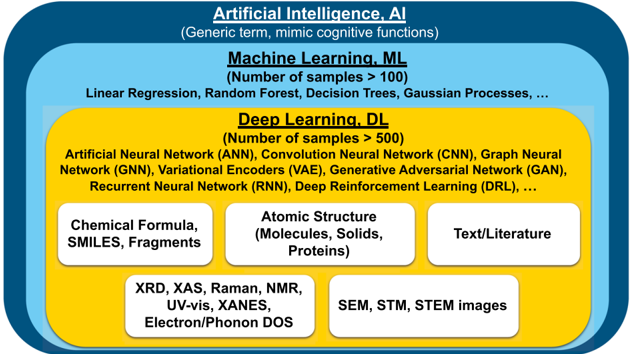
Deep learning (DL) is one of the fastest-growing topics in materials data science, with rapidly emerging applications spanning atomistic, image-based, spectral, and textual data modalities. DL allows analysis of unstructured data and automated identification of features. The recent development of large materials databases has fueled the application of DL methods in atomistic prediction in particular. In contrast, advances in image and spectral data have largely leveraged synthetic data enabled by high-quality forward models as well as by generative unsupervised DL methods. In this article, we present a high-level overview of deep learning methods followed by a detailed discussion of recent developments of deep learning in atomistic simulation, materials imaging, spectral analysis, and natural language processing. For each modality we discuss applications involving both theoretical and experimental data, typical modeling approaches with their strengths and limitations, and relevant publicly available software and datasets. We conclude the review with a discussion of recent cross-cutting work related to uncertainty quantification in this field and a brief perspective on limitations, challenges, and potential growth areas for DL methods in materials science.
Overview
The claims and statistics of this paper haven’t been checked yet.
Free: it reads the open-access text and checks the first 5 claims that cite a source we can check. Create a free account to check every claim.
Integrity signals
Registry
Cites
Statistics
Figures
Verification
Claims the paper makes
The claims and statistics of this paper haven’t been checked yet.
Free: it reads the open-access text and checks the first 5 claims that cite a source we can check. Create a free account to check every claim.
Self-check
Percentages, sums and reported differences re-computed from the paper’s own numbers.
The self-check needs the paper’s full text.
Citations
Cites
ImageNet classification with deep convolutional neural networks
Krizhevsky, A., Sutskever, I., & Hinton, G. E. (2017) · Communications of the ACM · doi:10.1145/3065386 · Cited by 112,155
LeCun, Y., Bengio, Y., & Hinton, G. (2015) · Nature · doi:10.1038/nature14539 · Cited by 84,126
BERT: Pre-training of Deep Bidirectional Transformers for Language Understanding
Devlin, J., Chang, M.-W., Lee, K., & Toutanova, K. (2018) · arXiv · doi:10.48550/arxiv.1810.04805 · Cited by 73,173 · cited 1×
“More recently, sequence-to-sequence models based on a “transformer” architecture, such as Google’s Bidirectional Encoder Representations from Transformers (BERT) model [53, 70], have helped address some of the issues of traditional RNNs.”
BERT: Pre-training of Deep Bidirectional Transformers for Language Understanding
Devlin, J., Chang, M.-W., Lee, K., & Toutanova, K. (2019) · Proceedings of the 2019 Conference of the North American Chapter of the Association for Computational Linguistics: Human Language Technologies, Volume 1 (Long and Short Papers) · doi:10.18653/v1/n19-1423 · Cited by 54,325 · cited 1×
“More recently, sequence-to-sequence models based on a “transformer” architecture, such as Google’s Bidirectional Encoder Representations from Transformers (BERT) model [53, 70], have helped address some of the issues of traditional RNNs.”
PyTorch: An Imperative Style, High-Performance Deep Learning Library
Paszke, A., Gross, S., Massa, F., Lerer, A., Bradbury, J., Chanan, G., Killeen, T., Lin, Z., Gimelshein, N., Antiga, L., et al. (2019) · arXiv · doi:10.48550/arxiv.1912.01703 · Cited by 31,473
Semi-supervised classification with graph convolutional networks
Kipf, T. N., & Welling, M. (2016) · arXiv · doi:10.48550/arxiv.1609.02907 · Cited by 24,853 · cited 6×
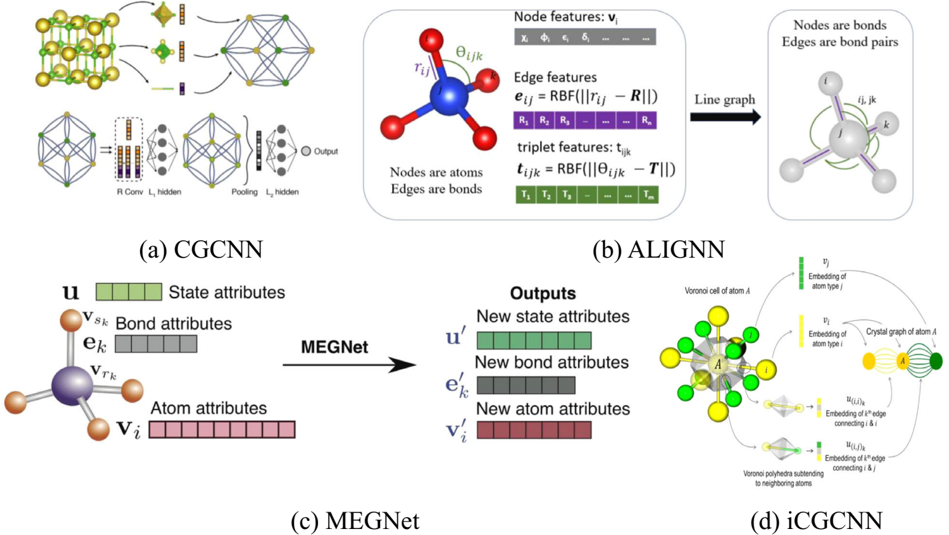
“Models such as SchNet, crystal graph convolutional neural network (CGCNN), improved crystal graph convolutional neural network (iCGCNN), directional message passing neural network (DimeNet), atomistic line graph neural network (ALIGNN) and materials graph neural network (MEGNet) shown in Table 1 have been used to pred…”
MethodInfluentialThe Elements of Statistical Learning
Hastie, T., Friedman, J., & Tibshirani, R. (2001) · Springer Series in Statistics · doi:10.1007/978-0-387-21606-5 · Cited by 24,162
A logical calculus of the ideas immanent in nervous activity
McCulloch, W. S., & Pitts, W. (1943) · The Bulletin of Mathematical Biophysics · doi:10.1007/bf02478259 · Cited by 18,566
The FAIR Guiding Principles for scientific data management and stewardship
Wilkinson, M. D., Dumontier, M., Aalbersberg, I. J., Appleton, G., Axton, M., Baak, A., Blomberg, N., Boiten, J.-W., da Silva Santos, L. B., Bourne, P. E., et al. (2016) · Scientific Data · doi:10.1038/sdata.2016.18 · Cited by 18,423 · cited 2×
“Through the Materials Genome Initiative (MGI) [3] and the increasing adoption of Findable, Accessible, Interoperable, Reusable (FAIR) [4] principles, several large experimental and computational datasets have been developed [5–12].”
Breiman, L. (1996) · Machine Learning · doi:10.1007/bf00058655 · Cited by 16,325 · cited 1×
“Similar to bagging 60 , the use of dropout brings about the same effect of training a collection of randomly chosen models which prevents the co-adaptations among the neurons, consequently reducing the likelihood of the model from over fi tting.”
Background
Research works printed but not linked: 12
- 61. LeCun, Y. et al. The Handbook of Brain Theory and Neural Networks vol. 3361 (MIT press Cambridge, MA, USA 1995).
- 83. Onken, D. et al. A neural network approach for high-dimensional optimal control. arXiv. https://arxiv.org/abs/2104.03270 (2021). · arXiv
- 85. Chen, L., Zhang, W., Nie, Z., Li, S. & Pan, F. Generative models for inverse design of inorganic solid materials. J. Mater. Inform. 1, 4 (2021).
- 104. Artrith, N. & Urban, A. An implementation of artificial neural-network potentials for atomistic materials simulations: Performance for tio2. Comput. Mater. Sci. 114, 135-150 (2016). · DOI · Paper page
- 140. Liu, R. et al. Deep learning for chemical compound stability prediction. In Pro- ceedings of ACM SIGKDD workshop on large-scale deep learning for data mining (DL-KDD), 1-7. https://rosanneliu.com/publication/kdd/ (ACM SIGKDD, 2016).
- 179. Rakita, Y. et al. Studying heterogeneities in local nanostructure with scanning nanostructure electron microscopy (snem). arXiv https://arxiv.org/abs/ 2110.03589 (2021).
- 198. Kong, S. et al. Density of states prediction for materials discovery via contrastive learning from probabilistic embeddings. arXiv. https://arxiv.org/abs/2110.11444 (2021). · arXiv
- 206. Choudhary, A. et al. Graph neural network predictions of metal organic framework co2 adsorption properties. arXiv. https://arxiv.org/abs/2112.10231 (2021). · arXiv
- 282. Haque, E. Effect of electron-phonon scattering, pressure and alloying on the thermoelectric performance of tmcu _3 ch _4(tm= v, nb, ta; ch= s, se, te). arXiv. https://arxiv.org/abs/2010.08461 (2020). · arXiv
- 300. Wilson, A. G., Hu, Z., Salakhutdinov, R. & Xing, E. P. Deep kernel learning. in Artificial intelligence and statistics, 370-378 (PMLR, 2016).
- 348. Fung, V., Hu, G., Ganesh, P. & Sumpter, B. G. Machine learned features from density of states for accurate adsorption energy prediction. Nat. Commun. 12, 1-11 (2021). · DOI · Paper page
- 357. Ede, J. M. & Beanland, R. Partial scanning transmission electron microscopy with deep learning. Sci. Rep. 10, 1-10 (2020). 358. 116. Somnath, S., Smith, C. R., Laanait, N., Vasudevan, R. K. & Jesse, S. Usid and pycroscopy-open source frameworks for storing and analyzing imaging and spectroscopy data. Microsc. Microanal. 25, 220-221 (2019). · DOI
Cited by
Items 201–300 of 1,001
Yang, X., Zhou, K., He, X., & Zhang, L. (2024) · Science China Materials · doi:10.1007/s40843-024-2851-9 · Cited by 24
“Deep learning models primarily refer to neural networks based on deep learning [3,156].”
Chung, J., Zhang, J., Saimon, A. I., Liu, Y., Johnson, B. N., & Kong, Z. (2024) · Scientific Reports · doi:10.1038/s41598-024-63285-4 · Cited by 23
Uncertainty-aware particle segmentation for electron microscopy at varied length scales
Rettenberger, L., Szymanski, N. J., Zeng, Y., Schuetzke, J., Wang, S., Ceder, G., & Reischl, M. (2024) · npj Computational Materials · doi:10.1038/s41524-024-01302-w · Cited by 21
“Such models have been reported to provide state-of-the-art performance when compared with more traditional methods for segmentation 13 – 15 .”
MethodInsights into One-Dimensional Thermoelectric Materials: A Concise Review of Nanowires and Nanotubes
Latronico, G., Eivari, H. A., Mele, P., & Assadi, M. H. N. (2024) · Nanomaterials · doi:10.3390/nano14151272 · Cited by 25
“Noticeably, in the past few years, reliance on data analytic methods in materials discovery has increased exponentially, encompassing many aspects [84–86].”
BackgroundKato, T., Goto, K., Niwa, T., Shimizu, T., Fujii, A., Okumura, B., Oka, H., & Kadoura, H. (2025) · Scientific Reports · doi:10.1038/s41598-025-89362-w · Cited by 21
Applications of deep learning in tea quality monitoring: a review
Wu, T., Zhou, L., Zhao, Y., Qi, H., Pu, Y., Zhang, C., & Liu, Y. (2025) · Artificial Intelligence Review · doi:10.1007/s10462-025-11335-2 · Cited by 27
“In the field of materials science, DL techniques such as CNNs and graph neu - ral networks (GNNs) have been employed to analyze crystal structures and microscopy images, enabling accurate material property prediction and image-based structural recognition (Choudhary et al. 2022).”
Machine learning in X-ray diffraction for materials discovery and characterization
Davel, C. M., Bassiri‐Gharb, N., & Correa‐Baena, J. (2025) · Matter · doi:10.1016/j.matt.2025.102272 · Cited by 28
How Machine Learning Has Driven the Development of Rechargeable Ion Batteries
Liu, H., Li, S., Zhu, S., Hu, Y., Han, X., Shi, C., He, F., Chunnian, H., Chen, B., & Zhao, N. (2025) · Advanced Energy Materials · doi:10.1002/aenm.202504095 · Cited by 28
Precise Surface Profiling at the Nanoscale Enabled by Deep Learning
Bonagiri, L. K. S., Wang, Z., Zhou, S., & Zhang, Y. (2024) · Nano Letters · doi:10.1021/acs.nanolett.3c04712 · Cited by 25
Nie, X., Xue, J. Q., Zhao, L., Deng, S., & Xiong, H. (2024) · Energy · doi:10.1016/j.energy.2024.130553 · Cited by 23
Thanh, H. V., Rahimi, M., Tangparitkul, S., & Promsuk, N. (2024) · International Journal of Hydrogen Energy · doi:10.1016/j.ijhydene.2024.08.100 · Cited by 20
Machine-Learning Predictions of Critical Temperatures from Chemical Compositions of Superconductors
Jung, S. G., Jung, G., & Cole, J. M. (2024) · Journal of Chemical Information and Modeling · doi:10.1021/acs.jcim.4c01137 · Cited by 24
Monitoring MBE Substrate Deoxidation via RHEED Image-Sequence Analysis by Deep Learning
Khaireh-Walieh, A., Arnoult, A., Plissard, S., & Wiecha, P. R. (2023) · Crystal Growth & Design · doi:10.1021/acs.cgd.2c01132 · Cited by 24
“[14] Kamal Choudhary, Brian DeCost, Chi Chen, Anubhav Jain, Francesca Tavazza, Ryan Cohn, Cheol Woo Park, Alok Choudhary, Ankit Agrawal, Simon J.”
BackgroundArtificial intelligence for materials research at extremes
Maruyama, B., Hattrick-Simpers, J. R., Musinski, W. D., Graham-Brady, L. L., Li, K., Hollenbach, J. D., Singh, A., & Taheri, M. L. (2022) · MRS Bulletin · doi:10.1557/s43577-022-00466-4 · Cited by 22
Probe microscopy is all you need *
Kalinin, S. V., Vasudevan, R. K., Liu, Y., Ghosh, A., Roccapriore, K. M., & Ziatdinov, M. A. (2023) · Machine Learning Science and Technology · doi:10.1088/2632-2153/acccd5 · Cited by 33
“Note that there is also a large number of datasets of simulated data in materials science, many of which are discussed in recent reviews [43].”
BackgroundCui, C., Chamasemani, F. F., Paulachan, P., Sinojiya, R. J., Rosc, J., Reisinger, M., Imrich, P. J., Hartner, W., & Brunner, R. (2024) · npj Materials Degradation · doi:10.1038/s41529-024-00456-8 · Cited by 23
Pathway to a fully data-driven geotechnics: Lessons from materials informatics
Wu, S., Otake, Y., Higo, Y., & Yoshida, I. (2024) · SOILS AND FOUNDATIONS · doi:10.1016/j.sandf.2024.101471 · Cited by 25
Zhang, J., Gao, H., Liu, Y., & Wang, J. (2024) · JOM · doi:10.1007/s11837-024-06922-7 · Cited by 21
Choudhary, K. K. (2025) · The Journal of Physical Chemistry Letters · doi:10.1021/acs.jpclett.5c01257 · Cited by 23
“8 However, in this work, I choose to use the above publicly available data sets for proof of concept applications.”
Self-citationAI Design for High Entropy Alloys: Progress, Challenges and Future Prospects
Xie, E., & Yang, C. (2025) · Metals · doi:10.3390/met15091012 · Cited by 26
Mim, J. J., Mamun, A. A., Nayem, M. H., Mahmud, S., Nath, A., Rahman, S., Fidal, S. A., & Hossain, N. (2025) · Materials Today Communications · doi:10.1016/j.mtcomm.2025.114485 · Cited by 42
Bals, J., & Epple, M. (2023) · Advanced Intelligent Systems · doi:10.1002/aisy.202300004 · Cited by 22
Lu, S., & Jayaraman, A. (2023) · JACS Au · doi:10.1021/jacsau.3c00275 · Cited by 24
Hardness and fracture toughness models by symbolic regression
Zhao, J., Liu, P., Wang, J.-T., Li, J., Niu, H., Sun, Y. P., Li, J., & Chen, X. (2023) · The European Physical Journal Plus · doi:10.1140/epjp/s13360-023-04273-x · Cited by 21
Xiao, S., Li, J., Bordas, S., & Kim, T. (2023) · Advances in applied mechanics · doi:10.1016/bs.aams.2023.09.001 · Cited by 21
Rosenberger, J., Tlatlik, J., & Münstermann, S. (2023) · Engineering Fracture Mechanics · doi:10.1016/j.engfracmech.2023.109686 · Cited by 19
Chandre, P. R., Shendkar, B. D., Deshmukh, S., Kakade, S., & Potdukhe, S. D. (2023) · International Journal on Recent and Innovation Trends in Computing and Communication · doi:10.17762/ijritcc.v11i11s.8300 · Cited by 24
Mondal, A., & Sharma, S. (2024) · International Journal of Heat and Mass Transfer · doi:10.1016/j.ijheatmasstransfer.2024.125499 · Cited by 19
Ruyhan, Usman, M. H., Bibi, N., Noreen, S., Alqarni, A. S., Aziz, A., Rahman, S., Aziz, Z., & Abbasi, R. A. (2024) · Materials Today Communications · doi:10.1016/j.mtcomm.2024.108908 · Cited by 19
Data-driven design of high pressure hydride superconductors using DFT and deep learning
Wines, D., & Choudhary, K. K. (2024) · Materials Futures · doi:10.1088/2752-5724/ad4a94 · Cited by 36
Self-citationFan, T., & Оганов, А. Р. (2025) · Journal of Materials Chemistry C · doi:10.1039/d4tc03403a · Cited by 22
Li, S., Gao, H. O., & You, F. (2024) · Nexus · doi:10.1016/j.ynexs.2024.100026 · Cited by 25
Krishnamoorthy, U., & Balasubramani, S. (2024) · Advanced Theory and Simulations · doi:10.1002/adts.202400479 · Cited by 22
Li, C., Han, X., Yao, C., Guo, Y., Li, Z., Jiang, L., Liu, W., Huang, H., Fu, H., & Ban, X. (2025) · Acta Materialia · doi:10.1016/j.actamat.2025.120962 · Cited by 27
Nneoma, U. C., Chukwudi, O. F., Nnenna, U. J., & Paul-Chima, U. O. (2025) · Frontiers in Energy Research · doi:10.3389/fenrg.2025.1654079 · Cited by 22
“This systems-level insight helps inform the design of robust microbial communities and synthetic strains tailored to specific biofuel production goals (Choudhary et al., 2022).”
A simple denoising approach to exploit multi-fidelity data for machine learning materials properties
Liu, X., Breuck, P.-P. D., Wang, L., & Rignanese, G. (2022) · npj Computational Materials · doi:10.1038/s41524-022-00925-1 · Cited by 21
Zheng, F., Lu, J., Zhu, Z., Jiang, H., Yan, Y., He, Y., Yuan, S., & Sun, Q. (2023) · ACS Nano · doi:10.1021/acsnano.3c06405 · Cited by 19
Mapping microstructure to shock-induced temperature fields using deep learning
Li, C., Verduzco, J. C., Lee, B. H., Appleton, R. J., & Strachan, A. H. (2023) · npj Computational Materials · doi:10.1038/s41524-023-01134-0 · Cited by 24
Benzouid, H., Boudebane, S., Ferkous, H., Lekoui, F., Nayan, N., Delimi, A., Alreshidi, M. A., Arshad, M., Yadav, K. K., Ernst, B., et al. (2023) · Materials Today Communications · doi:10.1016/j.mtcomm.2023.107405 · Cited by 18
Zhu, Z., Lu, J., Yuan, S., He, Y., Zheng, F., Jiang, H., Yan, Y., & Sun, Q. (2024) · The Journal of Physical Chemistry Letters · doi:10.1021/acs.jpclett.3c03504 · Cited by 26
Wu, J., Liu, Y., Ge, F., & Yu, D. (2024) · Computers in Biology and Medicine · doi:10.1016/j.compbiomed.2024.108227 · Cited by 19
Jacobs, R. M., Schultz, L. E., Scourtas, A., Schmidt, K. J., Price-Skelly, O., Engler, W., Foster, I. T., Blaiszik, B. J., Voyles, P. M., & Morgan, D. D. (2024) · Machine Learning Science and Technology · doi:10.1088/2632-2153/ad95db · Cited by 39
Deep learning assisted Raman spectroscopy for rapid identification of 2D materials
Qi, Y., Hu, D., Zheng, M., Jiang, Y., & Chen, Y. P. (2024) · Applied Materials Today · doi:10.1016/j.apmt.2024.102499 · Cited by 24
“To address these challenges, there has been a growing interest in integrating machine learning techniques with Raman spectroscopy [13-16].”
Gu, Y., Wang, K., Zhang, Z., Yao, Y., Xin, Z., Cai, W., & Li, L. (2025) · npj Materials Degradation · doi:10.1038/s41529-024-00549-4 · Cited by 21
Crystal Structure Prediction Meets Artificial Intelligence
Chen, Z., Meng, Z., He, T., Li, H., Cao, J. Z., Xu, L., Xiao, H., Zhang, Y., He, X. D., & Fang, G. (2025) · The Journal of Physical Chemistry Letters · doi:10.1021/acs.jpclett.4c03727 · Cited by 25
Su, B.-R., Liu, J., Zhao, D., Wu, D., Hu, C., Qiu, P., Zhang, Y., Fu, C., & Zhang, Q. (2025) · Rare Metals · doi:10.1007/s12598-025-03631-1 · Cited by 17
“Additionally, traditional design methodologies struggle to establish meaningful links across atomic, nanoscale, and macroscale domains, creating barriers for translating theoretical predictions into practically achievable environmental functionalities [40].”
Shengcao, Y., Qin, X., Wang, Q., Yang, H., Chai, Y., Xia, D., Jiang, B., & Kim, H. S. (2026) · Journal of Material Science and Technology · doi:10.1016/j.jmst.2026.02.007 · Cited by 20
Otto, J., Sauer, L. M., Brink, M., Schaum, T., Lingnau, L. A., Barrientos, M. M., & Walther, F. (2023) · Materials & Design · doi:10.1016/j.matdes.2023.112401 · Cited by 18
Patterns Lead the Way to Far-from-Equilibrium Materials
Knoll, P., Ouyang, B., & Steinbock, O. (2023) · ACS Physical Chemistry Au · doi:10.1021/acsphyschemau.3c00050 · Cited by 22
Pretraining Strategies for Structure Agnostic Material Property Prediction
Huang, H., Magar, R., & Farimani, A. B. (2024) · Journal of Chemical Information and Modeling · doi:10.1021/acs.jcim.3c00919 · Cited by 24
Machine learning assisted optimization of soft magnetic properties in ternary Fe–Si–Al alloys
Milyutin, V. A., Búreš, R., Fáberová, M., Birčáková, Z., Molčanová, Z., Kunca, B., Сташкова, Л. А., Kollár, P., & Füzer, J. (2024) · Journal of Materials Research and Technology · doi:10.1016/j.jmrt.2024.02.215 · Cited by 21
Artificial intelligence and Eddy covariance: A review
Lucarini, A., Cascio, M. L., Marras, S., Sirca, C., & Spano, D. (2024) · The Science of The Total Environment · doi:10.1016/j.scitotenv.2024.175406 · Cited by 20
Ji, M., Wei, Z., Han, J.-K., Hu, M., Diao, X., & Wang, G. (2024) · Industrial Crops and Products · doi:10.1016/j.indcrop.2024.119671 · Cited by 23
Jin, J., Faraji, S., Liu, B., & Liu, M. (2024) · The Journal of Physical Chemistry C · doi:10.1021/acs.jpcc.4c03212 · Cited by 18
Wang, P. P., Huang, G., Li, Y., Luo, B., & Li, Y. F. (2024) · Renewable Energy · doi:10.1016/j.renene.2024.121929 · Cited by 16
Olanrewaju, O. F., Oladele, I. O., & Adelani, S. O. (2025) · Hybrid Advances · doi:10.1016/j.hybadv.2025.100474 · Cited by 17
Onyelowe, K. C., Kamchoom, V., Hanandeh, S. M., Ebid, A. M., Villagran, J. A. V., Perez, R., Benavides, F. U. C., Awoyera, P. O., & Avudaiappan, S. (2025) · Scientific Reports · doi:10.1038/s41598-025-99091-9 · Cited by 17
Loaiza‐Bonilla, A., Thaker, N. G., Chung, C. D., Parikh, R. B., Stapleton, S., & Borkowski, P. (2025) · American Society of Clinical Oncology Educational Book · doi:10.1200/edbk-25-100048 · Cited by 21
Mulla, H. S., Sawant, D. S., Gaikwad, S. V., Fulari, A. V., Nimat, R. K., Dubal, D. P., & Lohar, G. M. (2025) · ChemSusChem · doi:10.1002/cssc.202402559 · Cited by 22
Liu, Y., Yuan, S., Zhang, R., Yan, L., Dong, H., & Feng, L. (2025) · Nonlinear Dynamics · doi:10.1007/s11071-025-11502-8 · Cited by 19
Li, W., Xie, G., Luo, X., Tai, H., Jiang, Y., Cheng, X., & Su, Y. (2025) · Materials Today Chemistry · doi:10.1016/j.mtchem.2025.102955 · Cited by 29
Performance of Multi-layered Transfer Learning in Classification of Philippine Rice Leaf Diseases
Castillo, W. M., Dioses, I. A. M., Robles, M. J. R., Gañgan, M. G. T., Gonzales, K. K. C., Paguirigan, J. V., & Tababa, J. B. (2025) · IEEE Control and System Graduate Research Colloquium (ICSGRC) · doi:10.1109/icsgrc65918.2025.11159791 · Cited by 16
Thermal design automation (TDA) for multiscale thermal management of electronics
Cao, B. (2025) · Journal of Applied Physics · doi:10.1063/5.0288828 · Cited by 22
Nabavi, S. F., Garmestani, H., & Fekri, F. (2025) · Journal of Manufacturing Processes · doi:10.1016/j.jmapro.2025.11.035 · Cited by 21
Unaccounted Microplastics in the Outlet of Wastewater Treatment Plants—Challenges and Opportunities
Gangula, A., Chhetri, T., Atty, M., Shanks, B. C., Kannan, R., Upendran, A., & Afrasiabi, Z. (2023) · Processes · doi:10.3390/pr11030810 · Cited by 17
Xie, E., & Wang, X. (2023) · The Journal of Physical Chemistry Letters · doi:10.1021/acs.jpclett.3c02273 · Cited by 15
Bhattacharya, S., & Roy, A. (2023) · Computational Materials Science · doi:10.1016/j.commatsci.2023.112581 · Cited by 18
“, 2019], using bond lengths and capturing any defects at A-site and B-site atoms from Scanning Electron Microscope (SEM) images [Choudhary et al., 2022] to depict octahedral environment with related oxygen vacancies are more quantitative approaches.”
BackgroundYue, W., Tripathi, P. K., Ponon, G., Ualikhankyzy, Z., Brown, D. W., Clausen, B., Strantza, M., Pagan, D. C., Willard, M. A., Ernst, F., et al. (2024) · Integrating materials and manufacturing innovation · doi:10.1007/s40192-023-00328-0 · Cited by 24
Advancing electron microscopy using deep learning
Chen, K., & Barnard, A. S. (2024) · Journal of Physics Materials · doi:10.1088/2515-7639/ad229b · Cited by 23
Inductive Conformal Prediction Enhanced LSTM-SNN Network: Applications to Birds and UAVs Recognition
Zhu, N., Xi, Z., Wu, C., Zhong, F., Qi, R. Q., Chen, H., Xu, S., & Ji, W. (2024) · IEEE Geoscience and Remote Sensing Letters · doi:10.1109/lgrs.2024.3361481 · Cited by 20
“While these networks can effectively enhance the accuracy of UAV and bird recognition, it is exceptionally challenging for radar systems to acquire more detailed feature information about these small objects [2], [3].”
BackgroundLiu, R., Wang, J., Shen, Z.-H., & Shen, Y. (2024) · Energy storage materials · doi:10.1016/j.ensm.2024.103612 · Cited by 22
Zhang, X., Xu, Y., Han, S., Weng, X., Che, W., Gu, K., Guan, Y., Yu, Y., Hao, D., & Hou, J. (2025) · Journal of Cleaner Production · doi:10.1016/j.jclepro.2025.145061 · Cited by 16
Sui, T., Liu, S., Cong, B., Xu, X., Shan, D., Milano, G., Zhao, Y., Xu, S., & Mao, J. (2025) · npj Computational Materials · doi:10.1038/s41524-025-01773-5 · Cited by 16
Large Language Models (LLMs) for Materials Design
Zhang, L., Liu, Z., Ni, B., & Wang, Q. (2025) · Advanced Functional Materials · doi:10.1002/adfm.202525897 · Cited by 36
Detecting Web Attacks From HTTP Weblogs Using Variational LSTM Autoencoder Deviation Network
Jagat, R. R., Sisodia, D. S., & Singh, P. (2024) · IEEE Transactions on Services Computing · doi:10.1109/tsc.2024.3453748 · Cited by 15
Artificial Intelligence and Machine Learning for materials
Zheng, Y. (2024) · Current Opinion in Solid State and Materials Science · doi:10.1016/j.cossms.2024.101202 · Cited by 16
Kolmogorov–Arnold Network Made Learning Physics Laws Simple
Wu, Y., Su, T., Du, B., Hu, S., Xiong, J., & Pan, D. (2024) · The Journal of Physical Chemistry Letters · doi:10.1021/acs.jpclett.4c02589 · Cited by 19
Jung, S. G., Jung, G., & Cole, J. M. (2024) · Journal of Chemical Information and Modeling · doi:10.1021/acs.jcim.4c01862 · Cited by 20
Rathore, S., Kumar, A., Kumar, A., Mishra, K., & Singh, A. (2025) · International Journal of Fatigue · doi:10.1016/j.ijfatigue.2025.108804 · Cited by 18
Choudhary, K. K. (2025) · The Journal of Physical Chemistry Letters · doi:10.1021/acs.jpclett.4c03137 · Cited by 25
“The AI/ML techniques have been successfully used for both forward (structure to property) and inverse (property to structure) tasks in materials design.”
Self-citationMursal, N., Shelake, A. R., Ahir, S. A., Sonawane, P. P., Selvaraj, M., Assiri, M. A., Kulkarni, S. V., Sutar, S. S., Amate, R. U., Jeon, C., et al. (2025) · Colloids and Surfaces A Physicochemical and Engineering Aspects · doi:10.1016/j.colsurfa.2025.138392 · Cited by 16
Guo, C., Tang, X., Chen, Y., Gao, C., Shan, Q., Wei, H., Liu, X., Lu, C., Fu, M., Wang, E. H., et al. (2025) · International Journal of Minerals Metallurgy and Materials · doi:10.1007/s12613-025-3217-4 · Cited by 19
Latest Advances in Manufacturing and Machine Learning of Bulk Metallic Glasses
Graeve, O. A., García-Vázquez, M. S., Ramírez‐Acosta, A. Á., & Cadieux, Z. (2023) · Advanced Engineering Materials · doi:10.1002/adem.202201493 · Cited by 18
Applying a Deep-Learning-Based Keypoint Detection in Analyzing Surface Nanostructures
Yuan, S., Zhu, Z., Lu, J., Zheng, F., Jiang, H., & Sun, Q. (2023) · Molecules · doi:10.3390/molecules28145387 · Cited by 17
“By leveraging deep learning algorithms and their image recognition capabilities, computer vision techniques offer the potential to overcome the limitations of manual analysis and provide accurate results with much improved efficiency and consistency [29,30].”
Realizing the cooking recipe of materials synthesis through large language models
Thik, J., Wang, S., Wang, C., Mansourifar, H., Lin, H., Okubo, K., & Ling, C. (2023) · Journal of Materials Chemistry A · doi:10.1039/d3ta05457h · Cited by 14
Navarro-López, D. E., Perfecto‐Avalos, Y., Zavala, A., de Luna, M. A., Sanchez-Martinez, A., Ceballos-Sanchez, O., Tiwari, N., López-Mena, E. R., & Sanchez‐Ante, G. (2024) · Antibiotics · doi:10.3390/antibiotics13030220 · Cited by 15
“This data is then fed into a machine learning algorithm to identify patterns and relationships between variables, which can be used to predict future events or better understand underlying phenomena [25].”
MethodAdvancing autonomy through lifelong learning: a survey of autonomous intelligent systems
Zhu, D., Bu, Q., Zhu, Z., Zhang, Y., & Wang, Z. (2024) · Frontiers in Neurorobotics · doi:10.3389/fnbot.2024.1385778 · Cited by 29
“Lifelong learning algorithms can help systems automatically discover and learn new features and patterns, thereby improving their perception and understanding (Choudhary et al., 2022).”
BackgroundWang, D., Ban, H., & Jiang, P. (2024) · Applied Physics Reviews · doi:10.1063/5.0191073 · Cited by 19
Mannodi‐Kanakkithodi, A. (2024) · Computational Materials Science · doi:10.1016/j.commatsci.2024.113108 · Cited by 18
Optimization of Deep Learning Models to Predict Lung Cancer Using Chest X-Ray Images
Alzaidi, E. R. (2024) · International Academic Journal of Science and Engineering · doi:10.71086/iajse/v11i1/iajse1140 · Cited by 31
FGTN: Fragment-based graph transformer network for predicting reproductive toxicity
Ren, J.-N., Chen, Q., Ye, H.-Y.-X., Cao, C., Guo, Y.-M., Yang, J., Wang, H., Khan, M. Z. I., & Chen, J. (2024) · Archives of Toxicology · doi:10.1007/s00204-024-03866-4 · Cited by 18
“…(GCN), graph attention network (GAT), and graph recurrent network (GRN), to achieve remarkable results in different toxicity predictions (Long et al. 2023; Ma et al. 2021; Wu et al. 2021; Xu et al. 2017) and other deep learning tasks (Choudhary et al. 2022; Sinha et al. 2023; Tan et al. 2023).”
Danchin, A. (2024) · Microbial Biotechnology · doi:10.1111/1751-7915.70014 · Cited by 19
“This implies that the outcome of the process varies depending on these conditions, often ignored by the user [some of the vast literature in the domain can be found in Choudhary et al., 2022].”
BackgroundAtomVision: A Machine Vision Library for Atomistic Images
Choudhary, K. K., Gurunathan, R. L., DeCost, B., & Biacchi, A. J. (2023) · Journal of Chemical Information and Modeling · doi:10.1021/acs.jcim.2c01533 · Cited by 19
“The application of such libraries encompasses multiple science domains such as materials science, condensed matter physics, biology etc [5,8,36].”
InfluentialSelf-citationRole of length-scale in machine learning based image analysis of ductile fracture surfaces
Zheng, X., Battalgazy, B., Molkeri, A., Tsopanidis, S., Osovski, S., & Srivastava, A. (2023) · Mechanics of Materials · doi:10.1016/j.mechmat.2023.104661 · Cited by 14
Large Language Models and Logical Reasoning
Friedman, R. (2023) · Encyclopedia · doi:10.3390/encyclopedia3020049 · Cited by 19
“Deep learning models are already impacting scientific research and investigations into natural phenomena [54,55].”
BackgroundBatalović, K., Mamula, B. P., Ilić, M. M., Kuzmanović, B., Radaković, J., Stanković, B., & Novaković, N. (2024) · International Journal of Hydrogen Energy · doi:10.1016/j.ijhydene.2024.09.454 · Cited by 13
Fetni, S., & Kamachali, R. D. (2025) · Engineering Analysis with Boundary Elements · doi:10.1016/j.enganabound.2025.106200 · Cited by 16
Unlocking a self-driving research workflow for perovskite photovoltaics
Xie, L., Zhang, Y., Peterkes, N., Li, X., Guo, Y., & Zhou, Y. (2025) · Matter · doi:10.1016/j.matt.2025.102097 · Cited by 16
Deep learning-driven spectral exploration for metal-insulator-metal plasmonic metasurfaces
Tao, W., Shen, L., Wu, Y., Zheng, S., Hu, Q., Yin, L., Bassir, D., Maurer, T., & Fleischer, M. (2025) · Optics Express · doi:10.1364/oe.565179 · Cited by 13
Akhlaghi, Z. A., Shahmir, H., & Sharafat, A. R. (2025) · Intermetallics · doi:10.1016/j.intermet.2025.108892 · Cited by 14
Metadata
- Authors
- Choudhary, K., DeCost, B., Chen, C., Jain, A., Tavazza, F., Cohn, R., Park, C. W., Choudhary, A., Agrawal, A., Billinge, S. J. L., Holm, E., Ong, S. P., & Wolverton, C.
- Affiliations
- National Institute of Standards and Technology (US)
- University of California San Diego (US)
- Lawrence Berkeley National Laboratory (US)
- Carnegie Mellon University (US)
- Northwestern University (US)
- Columbia University (US)
- ORCID
- Venue
- npj Computational Materials
- Published
- 2022-04-05
- Volume
- 8
- Issue
- 1
- ISSN
- 2057-3960 (ISSN-L)
- OpenAlex
- W3208687975
- Semantic Scholar
- 5aaeb50d8051890e9fbb9b9b8f34d9f3f2d85c1a
- Cited by
- 1,172
- References
- 401
- Citations by year
- 2026: 248 · 2025: 386 · 2024: 316 · 2023: 187 · 2022: 35
- FWCI
- 64.93
- Type
- journal article
- Language
- en
- Open access
- gold
- doi.org
- Licence
- cc-by
- creativecommons.org/licenses/by/4.0 (tdm)
- creativecommons.org/licenses/by/4.0 (vor)
- Locations
- npj Computational Materials (publishedVersion, cc-by)
- arXiv (Cornell University) (submittedVersion)
- eScholarship (California Digital Library) (submittedVersion, cc-by)
- OSTI OAI (U.S. Department of Energy Office of Scientific and Technical Information) (submittedVersion, cc-by)
- DOAJ (DOAJ: Directory of Open Access Journals) (submittedVersion)
- arXiv (Cornell University) (cc-by)
- Funders
- National Science Foundation (DEAC02-05CH11231, 2053929, 70NANB19H005, 1826218, 1922234)
- U.S. Department of Energy (-AC02-05CH11231, DE-AC02-05-CH11231: Materials Project program KC23MP, 70NANB19H005, KC23MP, DE AC02 05CH11231, DE-AC02-)
- U.S. Department of Commerce (70NANB19H005, 70NANB19H117)
- Northwestern University (70NANB19H005)
- University of Warwick
- National Institute of Standards and Technology (70NANB19H117, 70NANB19H005)
- Office of Science (DEAC02–05CH11231, DE-AC02, DE-AC02-05-CH11231: Materials Project Program KC23MP)
- Division of Civil, Mechanical and Manufacturing Innovation (CMMI-2053929)
- Basic Energy Sciences (DE-AC02, DE-AC02-05CH11231., KC23MP, DE-AC02-05-, AC02–05CH11231)
- Topics
- Physical Sciences › Materials Science › Materials Chemistry › Machine Learning in Materials Science
- Physical Sciences › Physics and Astronomy › Atomic and Molecular Physics, and Optics › Advanced Chemical Physics Studies
- Physical Sciences › Physics and Astronomy › Statistical and Nonlinear Physics › Model Reduction and Neural Networks
- Keywords
- deep learning, atomistic simulation, materials imaging, spectral analysis, natural language processing, synthetic data, generative models, uncertainty quantification, materials database, spectral data
About these checks
Registry, retraction, Cites and statistics results are computed, not judged, with one exception: a printed reference that no index lists is read once by a model before it counts as a citation error. Claims are extracted by a model and kept only when their quote appears verbatim in the text; each cited source is then checked, with a model’s help, for whether it says what the claim relies on. Those verdicts can be wrong — read the claim’s quote and the cited source before relying on one.
Statistics and arithmetic are recomputed, not judged.
Confidence bands are shown only for fields calibrated on our annotated test set. None is calibrated yet, so no band is shown.
What counts as a claim ›How we measure confidence ›How we check this ›
Are you an author, or do you see a problem with this page? Request a review
Data sources
Bibliographic data: Semantic Scholar, OpenAlex, Crossref.
Contains information from the Semantic Scholar Academic Graph Datasets, made available under the ODC Attribution License (ODC-BY 1.0).
Semantic Scholar’s data is described in: Kinney, R., et al. (2023). The Semantic Scholar Open Data Platform. arXiv:2301.10140.
