

Recent advances and applications of deep learning methods in materials science
Open accessThe DOI matches its Crossref record; 404 of the 404 references it cites were found in a registry or an index.
Abstract
Deep learning (DL) is one of the fastest-growing topics in materials data science, with rapidly emerging applications spanning atomistic, image-based, spectral, and textual data modalities. DL allows analysis of unstructured data and automated identification of features. The recent development of large materials databases has fueled the application of DL methods in atomistic prediction in particular. In contrast, advances in image and spectral data have largely leveraged synthetic data enabled by high-quality forward models as well as by generative unsupervised DL methods. In this article, we present a high-level overview of deep learning methods followed by a detailed discussion of recent developments of deep learning in atomistic simulation, materials imaging, spectral analysis, and natural language processing. For each modality we discuss applications involving both theoretical and experimental data, typical modeling approaches with their strengths and limitations, and relevant publicly available software and datasets. We conclude the review with a discussion of recent cross-cutting work related to uncertainty quantification in this field and a brief perspective on limitations, challenges, and potential growth areas for DL methods in materials science.
Overview
The claims and statistics of this paper haven’t been checked yet.
Free: it reads the open-access text and checks the first 5 claims that cite a source we can check. Create a free account to check every claim.
Integrity signals
Registry
Cites
Statistics
Figures
Verification
Claims the paper makes
The claims and statistics of this paper haven’t been checked yet.
Free: it reads the open-access text and checks the first 5 claims that cite a source we can check. Create a free account to check every claim.
Self-check
Percentages, sums and reported differences re-computed from the paper’s own numbers.
The self-check needs the paper’s full text.
Citations
Cites
ImageNet classification with deep convolutional neural networks
Krizhevsky, A., Sutskever, I., & Hinton, G. E. (2017) · Communications of the ACM · doi:10.1145/3065386 · Cited by 112,155
LeCun, Y., Bengio, Y., & Hinton, G. (2015) · Nature · doi:10.1038/nature14539 · Cited by 84,126
BERT: Pre-training of Deep Bidirectional Transformers for Language Understanding
Devlin, J., Chang, M.-W., Lee, K., & Toutanova, K. (2018) · arXiv · doi:10.48550/arxiv.1810.04805 · Cited by 73,173 · cited 1×
“More recently, sequence-to-sequence models based on a “transformer” architecture, such as Google’s Bidirectional Encoder Representations from Transformers (BERT) model [53, 70], have helped address some of the issues of traditional RNNs.”
BERT: Pre-training of Deep Bidirectional Transformers for Language Understanding
Devlin, J., Chang, M.-W., Lee, K., & Toutanova, K. (2019) · Proceedings of the 2019 Conference of the North American Chapter of the Association for Computational Linguistics: Human Language Technologies, Volume 1 (Long and Short Papers) · doi:10.18653/v1/n19-1423 · Cited by 54,325 · cited 1×
“More recently, sequence-to-sequence models based on a “transformer” architecture, such as Google’s Bidirectional Encoder Representations from Transformers (BERT) model [53, 70], have helped address some of the issues of traditional RNNs.”
PyTorch: An Imperative Style, High-Performance Deep Learning Library
Paszke, A., Gross, S., Massa, F., Lerer, A., Bradbury, J., Chanan, G., Killeen, T., Lin, Z., Gimelshein, N., Antiga, L., et al. (2019) · arXiv · doi:10.48550/arxiv.1912.01703 · Cited by 31,473
Semi-supervised classification with graph convolutional networks
Kipf, T. N., & Welling, M. (2016) · arXiv · doi:10.48550/arxiv.1609.02907 · Cited by 24,853 · cited 6×
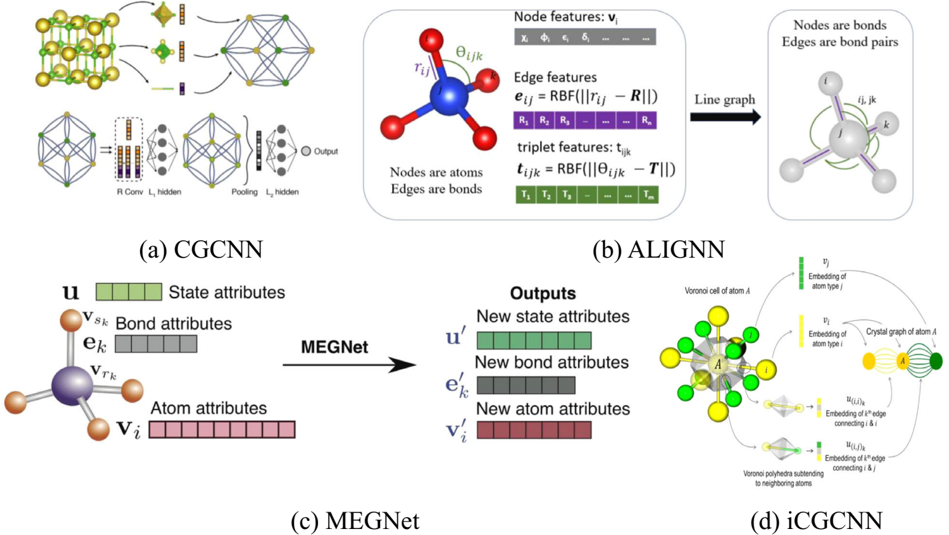
“Models such as SchNet, crystal graph convolutional neural network (CGCNN), improved crystal graph convolutional neural network (iCGCNN), directional message passing neural network (DimeNet), atomistic line graph neural network (ALIGNN) and materials graph neural network (MEGNet) shown in Table 1 have been used to pred…”
MethodInfluentialThe Elements of Statistical Learning
Hastie, T., Friedman, J., & Tibshirani, R. (2001) · Springer Series in Statistics · doi:10.1007/978-0-387-21606-5 · Cited by 24,162
A logical calculus of the ideas immanent in nervous activity
McCulloch, W. S., & Pitts, W. (1943) · The Bulletin of Mathematical Biophysics · doi:10.1007/bf02478259 · Cited by 18,566
The FAIR Guiding Principles for scientific data management and stewardship
Wilkinson, M. D., Dumontier, M., Aalbersberg, I. J., Appleton, G., Axton, M., Baak, A., Blomberg, N., Boiten, J.-W., da Silva Santos, L. B., Bourne, P. E., et al. (2016) · Scientific Data · doi:10.1038/sdata.2016.18 · Cited by 18,423 · cited 2×
“Through the Materials Genome Initiative (MGI) [3] and the increasing adoption of Findable, Accessible, Interoperable, Reusable (FAIR) [4] principles, several large experimental and computational datasets have been developed [5–12].”
Breiman, L. (1996) · Machine Learning · doi:10.1007/bf00058655 · Cited by 16,325 · cited 1×
“Similar to bagging 60 , the use of dropout brings about the same effect of training a collection of randomly chosen models which prevents the co-adaptations among the neurons, consequently reducing the likelihood of the model from over fi tting.”
Background
Research works printed but not linked: 12
- 61. LeCun, Y. et al. The Handbook of Brain Theory and Neural Networks vol. 3361 (MIT press Cambridge, MA, USA 1995).
- 83. Onken, D. et al. A neural network approach for high-dimensional optimal control. arXiv. https://arxiv.org/abs/2104.03270 (2021). · arXiv
- 85. Chen, L., Zhang, W., Nie, Z., Li, S. & Pan, F. Generative models for inverse design of inorganic solid materials. J. Mater. Inform. 1, 4 (2021).
- 104. Artrith, N. & Urban, A. An implementation of artificial neural-network potentials for atomistic materials simulations: Performance for tio2. Comput. Mater. Sci. 114, 135-150 (2016). · DOI · Paper page
- 140. Liu, R. et al. Deep learning for chemical compound stability prediction. In Pro- ceedings of ACM SIGKDD workshop on large-scale deep learning for data mining (DL-KDD), 1-7. https://rosanneliu.com/publication/kdd/ (ACM SIGKDD, 2016).
- 179. Rakita, Y. et al. Studying heterogeneities in local nanostructure with scanning nanostructure electron microscopy (snem). arXiv https://arxiv.org/abs/ 2110.03589 (2021).
- 198. Kong, S. et al. Density of states prediction for materials discovery via contrastive learning from probabilistic embeddings. arXiv. https://arxiv.org/abs/2110.11444 (2021). · arXiv
- 206. Choudhary, A. et al. Graph neural network predictions of metal organic framework co2 adsorption properties. arXiv. https://arxiv.org/abs/2112.10231 (2021). · arXiv
- 282. Haque, E. Effect of electron-phonon scattering, pressure and alloying on the thermoelectric performance of tmcu _3 ch _4(tm= v, nb, ta; ch= s, se, te). arXiv. https://arxiv.org/abs/2010.08461 (2020). · arXiv
- 300. Wilson, A. G., Hu, Z., Salakhutdinov, R. & Xing, E. P. Deep kernel learning. in Artificial intelligence and statistics, 370-378 (PMLR, 2016).
- 348. Fung, V., Hu, G., Ganesh, P. & Sumpter, B. G. Machine learned features from density of states for accurate adsorption energy prediction. Nat. Commun. 12, 1-11 (2021). · DOI · Paper page
- 357. Ede, J. M. & Beanland, R. Partial scanning transmission electron microscopy with deep learning. Sci. Rep. 10, 1-10 (2020). 358. 116. Somnath, S., Smith, C. R., Laanait, N., Vasudevan, R. K. & Jesse, S. Usid and pycroscopy-open source frameworks for storing and analyzing imaging and spectroscopy data. Microsc. Microanal. 25, 220-221 (2019). · DOI
Cited by
Items 601–700 of 1,001
Evolution of prosthetic materials and additive manufacturing of next generational ribcage prothesis
Dzogbewu, T. C., & de Beer, D. J. (2025) · Results in Engineering · doi:10.1016/j.rineng.2025.105738 · Cited by 5
Shen, Y., Zhao, S., Lv, Y., Chen, F., Fu, L., & Karimi‐Maleh, H. (2025) · Computers, materials & continua/Computers, materials & continua (Print) · doi:10.32604/cmc.2025.067427 · Cited by 11
Wang, J., Liu, R., & Xiao, H. T. (2025) · Ocean Engineering · doi:10.1016/j.oceaneng.2025.122223 · Cited by 7
Transferring predictions of formation energy across lattices of increasing size*
Pasini, M. L., Karabin, M., & Eisenbach, M. (2024) · Machine Learning Science and Technology · doi:10.1088/2632-2153/ad3d2c · Cited by 3
“So far, existing studies that use GCNN models for solid solution alloys have been limited to crystal structures of small/moderate scale [31, 34, 38, 41].”
BackgroundMethodImproved steel surface defect detection algorithm based on YOLOv8
Kong, H., & You, C. (2024) · International Conference on Computer Information Science and Application Technology (CISAT) · doi:10.1109/cisat62382.2024.10695239 · Cited by 4
“Deep learning models provide a remedy by automatically extracting abstract features via multi-layer neural networks [2].”
BackgroundPAH101: A GW+BSE Dataset of 101 Polycyclic Aromatic Hydrocarbon (PAH) Molecular Crystals
Gao, S., Liu, X., Luo, Y., Wang, X., Zhao, K., Chang, V., Schatschneider, B., & Marom, N. (2025) · Scientific Data · doi:10.1038/s41597-025-04959-0 · Cited by 6
Huang, Z., Li, X., Li, A., Yang, Y., He, L., Zhang, Z., Wu, S., Wang, Y., Cai, S., He, Y., et al. (2024) · Journal of Chemical Information and Modeling · doi:10.1021/acs.jcim.4c01093 · Cited by 3
Kawama, A., Mwangi, W. R., & Nderu, L. (2024) · Engineering Reports · doi:10.1002/eng2.13069 · Cited by 6
“Deep learning (DL) has become essential in medical imaging, enabling automatic feature extraction and aiding in tasks like tumor detection and classification without the need for manual input [13, 14].”
Salin Raj, S. S., Dhanaraj, C. J., & Rasappan, T. (2025) · Applied Biochemistry and Biotechnology · doi:10.1007/s12010-024-05178-w · Cited by 4
“This module utilizes the capabilities of ANNs to process complex data-sets and perform accurate predictions and classifications [53].”
Hage, I. S., Seif, C. Y., Quinsaat, J. E. Q., van de Pas, D. J., Vendamme, R., Eevers, W., Vanbroekhoven, K., & Féghali, E. (2025) · Polymer · doi:10.1016/j.polymer.2025.128235 · Cited by 5
Li, Y., Li, T., Tang, L., Ma, S., Wu, Q., Gupta, P., & Bauchy, M. (2024) · Materials Science and Engineering A · doi:10.1016/j.msea.2025.148173 · Cited by 4
“These empirical results, together with the insights provided in recent literature [56 – 58], support the conclusion that while ensemble approaches (e.g., ConvFeatNet Ensemble) yield substantial improvements in predictive accuracy, they demand significantly greater computational resources.”
Harnessing the leading edge: machine learning ventures in chemistry and materials science
Li, Y., Guo, F., Lien, S., Yusoff, A. R. B. M., Zheng, Z., Zhang, J., & Gao, P. (2025) · Physical Chemistry Chemical Physics · doi:10.1039/d5cp00373c · Cited by 5
Fetni, S., & Kamachali, R. D. (2025) · Software Impacts · doi:10.1016/j.simpa.2025.100753 · Cited by 3
Model distillation driven machine learning for automatic microstructure detection and segmentation
Zheng, Z., Yue, X., & Wang, H. (2025) · Journal of Material Science and Technology · doi:10.1016/j.jmst.2025.04.045 · Cited by 3
Zhang, Q., Zhang, H., Su, Z., Sun, Y., & Hu, W. (2025) · Journal of Chemical Theory and Computation · doi:10.1021/acs.jctc.5c00713 · Cited by 3
Machine Learning-Driven Deconvolution of Mixed X-ray Absorption Spectra
Wang, K., Yu, H., Lu, X., & Chen, K. (2025) · The Journal of Physical Chemistry A · doi:10.1021/acs.jpca.5c02158 · Cited by 3
Huang, C., Zhang, Y., Li, S., Wang, H., Wang, Y., Wei, S., & Sun, S. (2025) · Chemical Science · doi:10.1039/d5sc00494b · Cited by 5
“19,20 33 There is wide interest in analyzing the structure of materials from X-ray absorption near-edge structure (XANES) spectra using machine learning tools.”
Ensemble and Hybrid Models in Automated Essay Scoring: A Literature Review
Ramnarain-Seetohul, V., Rosunally, Y. Z., & Bassoo, V. (2025) · SN Computer Science · doi:10.1007/s42979-025-04245-1 · Cited by 6
“However, the RNN model suffers from some drawbacks, such as the problem of paralleliza - tion, and hence the difficulty in training on large datasets and difficulty in preserving long-range contextual informa - tion due to the “vanishing gradient” problem [42].”
Goud, B. K., & Pradhan, S. (2025) · Optics & Laser Technology · doi:10.1016/j.optlastec.2025.113813 · Cited by 3
Lü, T., Yu, F., Yu, Y., & Zhang, L. (2025) · Scientific Reports · doi:10.1038/s41598-025-98420-2 · Cited by 3
“Choudhary, K., et al. 27 developed a fruit recognition approach using this dataset, i.e. the CNN-based ResNet-50 method was employed for extracting features and fruit identification, and has been determined to be 99% accurate.”
Normahmedov, O., Ma, H., Peng, J., Dong, H., Zhuo, J., Shi, M., Wang, L., Jiang, S., & Shi, Y. (2025) · Advanced Intelligent Systems · doi:10.1002/aisy.202500917 · Cited by 4
TD U-Net for Shell Segmentation and Thickness Evaluation in Core–Shell TiO2 TEM Images
Ning, Z., Shi, C., Wu, D., Zhang, Y. L., Pu, J., & Zhu, Y. (2025) · Materials · doi:10.3390/ma18215007 · Cited by 3
Andriyani, A. D., Ghazali, K. H., & Riyadi, S. (2025) · International Conference on Information Technology and Computing (ICITCOM) · doi:10.1109/icitcom66635.2025.11265104 · Cited by 3
“CNNs struggle to simulate long-range spectrum dependencies, which are necessary to discriminate between materials that may exhibit similar spatial properties but differ in their spectral fingerprints, even if they excel in capturing spatial information [14].”
Zhang, R., Yao, J., Mateen, M., Wahab, A., & Xiaosen, Y. (2025) · Microchimica Acta · doi:10.1007/s00604-025-07701-0 · Cited by 5
Reinforcement Learning in Materials Science: Recent Advances, Methodologies and Applications
Li, J., Zhang, X., Shang, C., Ran, X., Wang, Z., Tang, C., Zhang, X., Nie, M., Xu, W., & Lu, X. (2025) · Acta Metallurgica Sinica (English Letters) · doi:10.1007/s40195-025-01934-x · Cited by 8
Artificial intelligence integration in materials science
Abu-Shams, M. (2026) · Discover Applied Sciences · doi:10.1007/s42452-026-08249-1 · Cited by 4
“The rapid development of AI tools and ML applications have accelerated materials scientists’ discovery, testing and refining of new and existing materials [4, 9, 58, 59].”
InfluentialApplication of artificial intelligence in predicting and optimizing material properties
Randhawa, K. S. (2026) · Engineering Research Express · doi:10.1088/2631-8695/ae3bac · Cited by 3
Rani, S., Rout, A., Soni, P., Gupta, M., Kumar, N., & Kumar, K. (2026) · Diagnostics · doi:10.3390/diagnostics16030461 · Cited by 7
“With rapid improvements in the field of AI and ML and their applications, better and more accurate architectures are being proposed every year [178].”
Sustainable Enhanced Oil Recovery(EOR): From Laboratory Coreflooding to AI-Driven Field Deployment
Mahmoud, A., & Gajbhiye, R. N. (2026) · Arabian Journal for Science and Engineering · doi:10.1007/s13369-026-11095-3 · Cited by 3
“Whilepromising,MLapplications require large, high-quality datasets and careful feature selection to avoid overfitting and ensure physical interpretability of results [386–388].”
Chaturvedi, P., Flies, A. S., Han, S. C., & Connelly, W. M. (2026) · Ecological Solutions and Evidence · doi:10.1002/2688-8319.70216 · Cited by 4
Generative Active Learning Discovers High-Performance O2 Reduction Catalysts for H2O2 Production
Mok, D. H., Yan, Y., Yu, G., Li, Y., Jiang, K., & Back, S. (2026) · ACS Catalysis · doi:10.1021/acscatal.5c07832 · Cited by 7
Artificial Intelligence for advancing Sustainable Development Goals a comprehensive thematic review
Khan, S., Ali, M. Z., & Sharif, M. B. (2026) · Discover Artificial Intelligence · doi:10.1007/s44163-026-01120-7 · Cited by 7
“AI can identify and develop new storage materials, optimize battery cycles, and reduce costs [77, 78].”
Overcoming Roadblocks for Implementing AI/ML Methods for Materials Advancement
Warren, J. A., Tavazza, F., McDannald, A., Kusne, A. G., Joress, H., Hoogerheide, D. P., DeCost, B., Choudhary, K. K., & Audus, D. J. (2026) · Annual Review of Materials Research · doi:10.1146/annurev-matsci-072924-102951 · Cited by 6
“Yet, significant roadblocks such as concerns about accuracy, transferability, and computational cost, continue to limit the widespread adoption of AI in computational materials science (82).”
Self-citationHosseinian, S. B., Ghani, M., & Raoof, J. B. (2026) · Green Analytical Chemistry · doi:10.1016/j.greeac.2026.100367 · Cited by 4
Novel Materials Discovery via High-Throughput Automated Tribological Testing of Thin Films
Babuska, T. F., Dorman, K., Hall, J. M., Jain, M., Dugger, M. T., Krick, B. A., Mangolini, F., DelRio, F. W., Adams, D. P., Boyce, B. L., et al. (2026) · Tribology Letters · doi:10.1007/s11249-026-02171-8 · Cited by 3
Which Deep Learning Framework Should I Use: A Comparative Study For Deep Regression Modeling
Gupta, V., Liao, W., Choudhary, A., & Agrawal, A. (2022) · International Conference on Computational Science and Computational Intelligence (CSCI) · doi:10.1109/csci58124.2022.00018 · Cited by 5
“Such opensource implementations of DL algorithms have been adopted and shared in various frameworks that have been employed and improved upon by people in their respective fields of research for various applications including natural language processing, speech recognition, computer vision, and various domainspecific…”
BackgroundSelf-citationApplications of Artificial Intelligence in Biomedical Fields: An Overview
Yadav, V. P., Yadav, V. K., Shukla, A. K., & Kshatrya, B. S. (2023) · International Journal of Newgen Research in Pharmacy & Healthcare · doi:10.61554/ijnrph.v1i1.2023.17 · Cited by 3
Wang, Y., Lin, G., & Yang, S. (2024) · APL Machine Learning · doi:10.1063/5.0177062 · Cited by 3
Tsuruta, H., Katsura, Y., & Kumagai, M. (2023) · International Conference on Machine Learning and Applications · doi:10.1109/icmla58977.2023.00029 · Cited by 3
“Machine learning (ML) has emerged as a powerful tool for accelerating the design of new materials [1].”
BackgroundMethodSun, J., Xiong, P., Hao, H., & Liu, H. (2024) · Journal of Wuhan University of Technology-Mater Sci Ed · doi:10.1007/s11595-024-2912-8 · Cited by 4
“Moreover, feature selection was performed by variance screening, Pearson correlation coefficient screening, and recursive feature elimination(RFE) [41,42] .”
Deep Learning and Machine Learning for Materials Design
Mudabbiruddin, M., Takacs, J., Mosavi, A. H., Imre, F., & Nabipour, N. (2024) · IEEE International Symposium on Logistics and Industrial Informatics (LINDI) · doi:10.1109/lindi63813.2024.10820388 · Cited by 4
So, B., Kwon, M.-J., Kim, J., Kim, S., & So, H. (2025) · International Journal of Energy Research · doi:10.1155/er/9934909 · Cited by 3
“Additionally, trained deep learning models possess signi fi cant potential for real-time monitoring owing to their rapid computational capabilities [30].”
Prediction of Composite Performance of Refractory and Ceramic Materials Based on Deep Learning
Yin, X., Li, R., Sun, X., Feng, Q., Zhang, B., & Zhao, S. (2025) · JOM · doi:10.1007/s11837-025-07258-6 · Cited by 3
Convolutional neural network-based prediction of hardness in bulk metallic glasses with small data
Nam, C. (2025) · Journal of Non-Crystalline Solids · doi:10.1016/j.jnoncrysol.2025.123451 · Cited by 3
Shao, S., Yan, L., Li, J., Zhang, Y., Zhang, J., Kim, H. W., & Kim, S. S. (2025) · ACS Sensors · doi:10.1021/acssensors.4c03085 · Cited by 6
Recent Monte Carlo-Based Simulations for Modeling Disease Spread
Chakroun, M., Haddad, S., Shakir, W. M. R., Sayah, J., Kallab, C., & Falou, S. E. (2024) · International Conference on Computer and Applications (ICCA) · doi:10.1109/icca62237.2024.10927993 · Cited by 3
“By merging real-time data with machine learning, this study was able to effectively describe the dynamics of contact tracing and the impact it has on disease containment [86][87].”
Kamau, B., Malenje, B., Wamwea, C., & Onyango, L. A. (2025) · American Journal of Mathematical and Computer Modelling · doi:10.11648/j.ajmcm.20251001.13 · Cited by 4
Materials Engineering and Artificial Intelligence Innovations: A Comprehensive Review
Bouiti, K., Hamdouni, Y. E., Labjar, N., Labjar, H., Lagmiri, S. N., Nasrellah, H., & Hajjaji, S. E. (2025) · Journal of Materials Engineering and Performance · doi:10.1007/s11665-025-11040-9 · Cited by 4
“Neural network models have been used in the field of materials science with great success, in problem areas such as predicting phase stability and transformations in alloy systems, and determining the relationship between processing parameters and microstructural features (Ref 67, 69, 75).”
An optimized TCN–LSTM model for predicting PM 2.5 in metro systems
Yang, C., Kai, Z., Wang, X., Hu, T., & Liu, H. (2025) · Environmental Science Processes & Impacts · doi:10.1039/d5em00249d · Cited by 3
Bloodworth, S., Willoughby, C., & Coles, S. J. (2025) · Beilstein Journal of Organic Chemistry · doi:10.3762/bjoc.21.70 · Cited by 8
Liu, Y., Wang, B., Xu, X., & Xu, J. J. (2025) · Spectrochimica Acta Part A Molecular and Biomolecular Spectroscopy · doi:10.1016/j.saa.2025.126336 · Cited by 3
Kapitan, V. Y., & Choi, M. C. H. (2025) · BMC Bioinformatics · doi:10.1186/s12859-025-06185-2 · Cited by 4
Ethier, J. G., Paluch, A. S., & Varshney, V. (2025) · APL Machine Learning · doi:10.1063/5.0282683 · Cited by 4
Graphene concentration effect on the structural and morphological properties of ZnO/G nanocomposites
Boutamine, M., Bakha, Y., Makhlouf, M., Boutamine, L., Grine, L., Saidani-Scott, H., Hachemi, H., Billel, S., & Bellel, A. (2025) · Journal of Materials Science Materials in Electronics · doi:10.1007/s10854-025-15394-7 · Cited by 3
“…can be used in various fields such as electronics, optics, and semiconductors has been committed to including new functional materials, either by combining with a known material, it is mainly to form nanocomposites or by using a new description of a new class of materials structure [ 1 – 10].”
Yin, J., Wang, B., Wang, T., & Tang, Z. (2025) · Fundamental Research · doi:10.1016/j.fmre.2025.09.014 · Cited by 4
“Within the RNN architecture, specialized models like gated recurrent units (GRUs) and LSTM networks are frequently employed [ 154 , 157 ].”
Sahu, D. P., Mohanty, A., Palai, G., Mahapatra, C., Kaushik, S. D., & Singh, A. K. (2025) · Applied Physics A · doi:10.1007/s00339-025-09021-9 · Cited by 3
“This tendency reduces the size and performance of electronic devices [1, 2].”
Transfer learning with fine-tuned deep CNN model for COVID-19 diagnosis from chest X-ray images
(2023) · International Journal of Advanced Technology and Engineering Exploration · doi:10.19101/ijatee.2022.10100044 · Cited by 7
Moran, M. J., Gaultois, M. W., Gusev, V. V., & Rosseinsky, M. J. (2023) · Digital Discovery · doi:10.1039/d3dd00005b · Cited by 3
“(d) The site features tensor of dimensions [100,101] is denoted by S◦ i,f , and (e) the interaction features tensor is denoted by I ◦ i,j,f , [100,100,2], where i and j represent the site index, and f is the featurization axis.”
Neural structure fields with application to crystal structure autoencoders
Chiba, N., Suzuki, Y., Taniai, T., Igarashi, R., Ushiku, Y., Saito, K., & Ono, K. (2023) · Communications Materials · doi:10.1038/s43246-023-00432-w · Cited by 6
Classification of Saudi Traditional Costumes using Deep Learning Technique
Baalamash, F. A., Debis, R., & Al-Barhamtoshy, H. M. (2024) · التصميم الدولية · doi:10.21608/idj.2024.254693.1106 · Cited by 5
A combined EBSD and machine learning study of predicting deformation twinning in BCC Fe81Ga19 alloy
Ma, Z., Zhang, Y., Xia, Y., Wang, Y., Misra, R. D. K., Fang, F., Wang, Y., & Zhang, X. (2024) · Materials Today Communications · doi:10.1016/j.mtcomm.2024.108477 · Cited by 3
Zhang, C., Yang, D., Yang, S., He, D., Xia, Y., & Li, J. (2024) · Surfaces and Interfaces · doi:10.1016/j.surfin.2024.104529 · Cited by 3
Development of Three Tier Online Test Diagnostic of Misconception for Topic Free Fall Motion
Nisa, E. K., & Habibbulloh, M. (2024) · Schrödinger Journal of Physics Education · doi:10.37251/sjpe.v5i2.797 · Cited by 3
“Misconceptions about free fall movement material often occur among students, and this research aims to develop a more sophisticated and effective diagnostic tool to identify and overcome these misconceptions [34], [35], [36].”
BackgroundKong, J.-G., Zhao, K.-L., Li, J., Li, Q., Liu, Y., Zhang, R., Zhu, J.-J., & Chang, K. (2024) · Machine Learning Science and Technology · doi:10.1088/2632-2153/ad612b · Cited by 6
“The deep learning method[15], a rising star of the machine learning family, has also achieved remarkable performance in materials science[16] with its huge number of trainable parameters and high non-linearity.”
MethodFrom Deep Learning to ChatGPT for Materials Design
Mudabbiruddin, M., Mosavi, A. A., & Imre, F. (2024) · IEEE International Conference on Computational Cybernetics (ICCC) · doi:10.1109/iccc62278.2024.10582940 · Cited by 6
Metallurgical Alchemy: Synthesizing Steel Microstructure Images Using DCGANs
Muñoz-Ródenas, J., García‐Sevilla, F., Miguel, V., Coello, J., & Martínez-Martínez, A. (2024) · Applied Sciences · doi:10.3390/app14156489 · Cited by 3
Ndikumana, J., & An, K. (2024) · Nanoscale · doi:10.1039/d4nr01301h · Cited by 3
Predicting magnetic properties of van der Waals magnets using graph neural networks
Minch, P., Bhattarai, R., Choudhary, K. K., & Rhone, T. D. (2024) · Physical Review Materials · doi:10.1103/physrevmaterials.8.114002 · Cited by 3
Self-citationBertrandie, J., Noyan, M. A., Hernandez, L. H., Sharma, A., & Baran, D. (2025) · Advanced Energy Materials · doi:10.1002/aenm.202403707 · Cited by 5
Wróbel, J., & Kulawik, A. (2022) · Materials · doi:10.3390/ma15113792 · Cited by 3
“Choudhary et al. [11], in their paper, reviewed the literature on the application of deep learning in materials engineering.”
BackgroundBeniwal, D., & Ray, P. (2023) · PHYSICAL REVIEW MATERIALS · doi:10.1103/physrevmaterials.7.043802 · Cited by 4
Prediction of melt pool morphology of Ti alloy based on deep learning method
Pan, Y., Guo, Y., Huang, S., Qian, W., Geng, S., & Xie, J. (2024) · Materials Today Communications · doi:10.1016/j.mtcomm.2024.111179 · Cited by 2
Innovative CNN approach for reliable chicken meat classification in the poultry industry
Anraeni, S., Mustari, M., Ramdaniah, R., Kurniati, N., & Mubarak, S. (2024) · Bulletin of Social Informatics Theory and Application · doi:10.31763/businta.v8i2.686 · Cited by 2
Zhang, Y., Khairuddin, A. S. M., Chuah, J. H., Chen, D., Xia, C., & Huang, J. (2025) · Journal of Food Composition and Analysis · doi:10.1016/j.jfca.2025.107394 · Cited by 2
Machine Learning Algorithms for Applications in Materials Science I
Abdolmaleki, A., Shiri, F., & Ahmadi, S. (2025) · Challenges and advances in computational chemistry and physics · doi:10.1007/978-3-031-78736-2_9 · Cited by 3
Statistical Language Model for Information Retrieval System Implementation in Digital Library
Hasani, M. F., Buananta, S. E. A., Adidarma, R., Tamin, R. O., Shiddiqi, H. A., Santonso, V., & Sugito, A. (2025) · International Conference on Computer Research and Development · doi:10.1109/iccrd64588.2025.10963077 · Cited by 2
“Since university libraries often house extensive and complex documents like textbooks, theses, and dissertations, this research will also assess whether integrating statistical language models enhances user experience and improves the search functionality in the digital library's IRS [20], [21].”
Inverse design of GaN HEMT heterostructures via deep learning with enhanced auto-encoder framework
Wei, S., Hao, M., Yu, L., Li, W., Sun, L., Wu, M., Pang, Y., & Han, J. (2025) · Materials Today Communications · doi:10.1016/j.mtcomm.2025.112629 · Cited by 4
Research progress of amorphous micro-nano structured materials
Liu, G., & Huang, H. (2025) · Frontiers in Materials · doi:10.3389/fmats.2025.1589830 · Cited by 2
Prediction of local electric polarization using graph neural networks
Ma, Y., Chen, Y., Zhang, B., Yang, Y., Yu, H., Gong, X.-G., Zhong, Y., & Xiang, H. (2025) · Physical review. B./Physical review. B · doi:10.1103/physrevb.111.184105 · Cited by 2
Pasini, M. L., Zhang, P., Choi, J. Y., Samolyuk, G. D., Eisenbach, M., & Yang, Y. (2025) · Computational Materials Science · doi:10.1016/j.commatsci.2025.113908 · Cited by 5
Confusion-Driven Machine Learning of Structural Phases of a Flexible, Magnetic Stockmayer Polymer
Perera, D., McAllister, S., Cerdà, J. J., & Vogel, T. (2025) · Journal of Chemical Theory and Computation · doi:10.1021/acs.jctc.5c00381 · Cited by 2
Gupta, A. K., & Ganguly, S. (2025) · Materials Today Communications · doi:10.1016/j.mtcomm.2025.113309 · Cited by 2
Automated electron microscopy sample preparation system
Milsted, D., Mishra, T. P., Walters, L. N., Fei, Y., Rendy, B., Nevatia, P., Kim, H., & Ceder, G. (2025) · Digital Discovery · doi:10.1039/d5dd00116a · Cited by 6
Zhang, Y., Chuah, J. H., Khairuddin, A. S. M., Chen, D., Zhao, X., Huang, J., Xia, C., Li, J., & He, W. (2025) · Engineering Applications of Artificial Intelligence · doi:10.1016/j.engappai.2025.112070 · Cited by 3
Campos, D., Macêdo, B. D. S., Al-Khafaji, Z. S., Bozkurt, M. A., Kayral, İ. E., Gontijo, T. S., Bodini, M., Saporetti, C. M., & Goliatt, L. (2025) · Materials Today Sustainability · doi:10.1016/j.mtsust.2025.101200 · Cited by 2
Zhang, L., Song, X., Li, P., Yuan, Y., Wan, K., Huang, F., Guo, Y., & Zhang, H. (2025) · Arabian Journal of Chemistry · doi:10.25259/ajc_33_2025 · Cited by 2
Ye, L., Islam, M. A., & Saha, B. B. (2025) · Thermal Science and Engineering Progress · doi:10.1016/j.tsep.2025.104188 · Cited by 2
Artificial intelligence in chemical engineering data acquisition and integration
Mghouchi, Y. E. (2025) · Elsevier eBooks · doi:10.1016/b978-0-443-34076-5.00024-9 · Cited by 2
Dasari, H. A., & Rammohan, A. (2025) · Engineering Research Express · doi:10.1088/2631-8695/ae16fe · Cited by 3
Development of LLM-assisted data curation tools for the Starrydata materials science database
Katsura, Y., Tomoya, M. A. T. O., Takada, Y., Koyama, E., Yana, D., Tanaka, A., & Kumagai, M. (2025) · Science and Technology of Advanced Materials Methods · doi:10.1080/27660400.2025.2590811 · Cited by 2
Yang, T., Liang, S., Wang, L., & Yang, Z. (2025) · Structures · doi:10.1016/j.istruc.2025.110604 · Cited by 3
Generative-AI-assisted knowledge-based augmented exploration in nanophotonics
Iwanaga, M., & Watanabe, K. (2025) · Science and Technology of Advanced Materials Methods · doi:10.1080/27660400.2025.2596940 · Cited by 3
“To extend the use of genAI to other scientific disciplines, ML-based approaches have progressed over the past decade [13–22].”
What Do Large Language Models Know About Materials?
Ehrenhofer, A., Wallmersperger, T., & Cuniberti, G. (2025) · Advanced Engineering Materials · doi:10.1002/adem.202501876 · Cited by 2
Data-driven assisted design of highly stable and superhard high-entropy diborides
Ren, Y., Wang, Q., Han, Z., Ji-Xuan, L. I. U., Fan, Y., Zuo, C., Yue, G., Zheng, X., Liang, Y., & ZHANG, G.-J. (2026) · Materials Science and Engineering A · doi:10.1016/j.msea.2026.149749 · Cited by 2
Fani, M., Akinloye, O., Nathani, A., Mubassira, S., Ghamarian, I., & Xu, S. (2026) · Journal of Applied Physics · doi:10.1063/5.0304829 · Cited by 2
Zhu, H., Zong, C., Fang, L., Zhang, H., Sun, Y., Tian, Y., Zhang, S., & Wang, X. (2026) · Processes · doi:10.3390/pr14020255 · Cited by 2
Dhifallah, I., & Askri, B. (2026) · X-Ray Spectrometry · doi:10.1002/xrs.70080 · Cited by 2
A generative machine learning model for designing metal hydrides applied to hydrogen storage
Liu, X. P., Hacker, C., Wang, S., & Duan, Y. (2026) · International Journal of Hydrogen Energy · doi:10.1016/j.ijhydene.2026.153744 · Cited by 3
“…in NNs and deep learning have enabled the use of models such as Diffusion Probabilistic Models, Graph Neural Networks (GNNs), and Recurrent Neural Networks (RNNs), which demonstrate enhanced accuracy and greater potential in predicting material properties, including formation energy [18, 19].”
Artificial intelligence at scale in the chemical industry: from legacy to leadership
Chiang, L. H., Christiansen, D., Malloure, M., Briceno-Mena, L. A., & Kim, S. H. (2026) · Current Opinion in Chemical Engineering · doi:10.1016/j.coche.2026.101229 · Cited by 2
Eddaou, I., Bom, S., Graça, A., & Marto, J. M. (2026) · International Journal of Pharmaceutics · doi:10.1016/j.ijpharm.2026.126750 · Cited by 3
Metadata
- Authors
- Choudhary, K., DeCost, B., Chen, C., Jain, A., Tavazza, F., Cohn, R., Park, C. W., Choudhary, A., Agrawal, A., Billinge, S. J. L., Holm, E., Ong, S. P., & Wolverton, C.
- Affiliations
- National Institute of Standards and Technology (US)
- University of California San Diego (US)
- Lawrence Berkeley National Laboratory (US)
- Carnegie Mellon University (US)
- Northwestern University (US)
- Columbia University (US)
- ORCID
- Venue
- npj Computational Materials
- Published
- 2022-04-05
- Volume
- 8
- Issue
- 1
- ISSN
- 2057-3960 (ISSN-L)
- OpenAlex
- W3208687975
- Semantic Scholar
- 5aaeb50d8051890e9fbb9b9b8f34d9f3f2d85c1a
- Cited by
- 1,172
- References
- 401
- Citations by year
- 2026: 248 · 2025: 386 · 2024: 316 · 2023: 187 · 2022: 35
- FWCI
- 64.93
- Type
- journal article
- Language
- en
- Open access
- gold
- doi.org
- Licence
- cc-by
- creativecommons.org/licenses/by/4.0 (tdm)
- creativecommons.org/licenses/by/4.0 (vor)
- Locations
- npj Computational Materials (publishedVersion, cc-by)
- arXiv (Cornell University) (submittedVersion)
- eScholarship (California Digital Library) (submittedVersion, cc-by)
- OSTI OAI (U.S. Department of Energy Office of Scientific and Technical Information) (submittedVersion, cc-by)
- DOAJ (DOAJ: Directory of Open Access Journals) (submittedVersion)
- arXiv (Cornell University) (cc-by)
- Funders
- National Science Foundation (DEAC02-05CH11231, 2053929, 70NANB19H005, 1826218, 1922234)
- U.S. Department of Energy (-AC02-05CH11231, DE-AC02-05-CH11231: Materials Project program KC23MP, 70NANB19H005, KC23MP, DE AC02 05CH11231, DE-AC02-)
- U.S. Department of Commerce (70NANB19H005, 70NANB19H117)
- Northwestern University (70NANB19H005)
- University of Warwick
- National Institute of Standards and Technology (70NANB19H117, 70NANB19H005)
- Office of Science (DEAC02–05CH11231, DE-AC02, DE-AC02-05-CH11231: Materials Project Program KC23MP)
- Division of Civil, Mechanical and Manufacturing Innovation (CMMI-2053929)
- Basic Energy Sciences (DE-AC02, DE-AC02-05CH11231., KC23MP, DE-AC02-05-, AC02–05CH11231)
- Topics
- Physical Sciences › Materials Science › Materials Chemistry › Machine Learning in Materials Science
- Physical Sciences › Physics and Astronomy › Atomic and Molecular Physics, and Optics › Advanced Chemical Physics Studies
- Physical Sciences › Physics and Astronomy › Statistical and Nonlinear Physics › Model Reduction and Neural Networks
- Keywords
- deep learning, atomistic simulation, materials imaging, spectral analysis, natural language processing, synthetic data, generative models, uncertainty quantification, materials database, spectral data
About these checks
Registry, retraction, Cites and statistics results are computed, not judged, with one exception: a printed reference that no index lists is read once by a model before it counts as a citation error. Claims are extracted by a model and kept only when their quote appears verbatim in the text; each cited source is then checked, with a model’s help, for whether it says what the claim relies on. Those verdicts can be wrong — read the claim’s quote and the cited source before relying on one.
Statistics and arithmetic are recomputed, not judged.
Confidence bands are shown only for fields calibrated on our annotated test set. None is calibrated yet, so no band is shown.
What counts as a claim ›How we measure confidence ›How we check this ›
Are you an author, or do you see a problem with this page? Request a review
Data sources
Bibliographic data: Semantic Scholar, OpenAlex, Crossref.
Contains information from the Semantic Scholar Academic Graph Datasets, made available under the ODC Attribution License (ODC-BY 1.0).
Semantic Scholar’s data is described in: Kinney, R., et al. (2023). The Semantic Scholar Open Data Platform. arXiv:2301.10140.
