

Widespread Denisovan ancestry in Island Southeast Asia but no evidence of substantial super-archaic hominin admixture
Open accessThe DOI matches its Crossref record; 59 of the 61 references it cites were found in a registry or an index; 16 of the 20 sources its claims cite were checked for support.
Abstract
The hominin fossil record of Island Southeast Asia (ISEA) indicates that at least two endemic 'super-archaic' species-Homo luzonensis and H. floresiensis-were present around the time anatomically modern humans arrived in the region >50,000 years ago. Intriguingly, contemporary human populations across ISEA carry distinct genomic traces of ancient interbreeding events with Denisovans-a separate hominin lineage that currently lacks a fossil record in ISEA. To query this apparent disparity between fossil and genetic evidence, we performed a comprehensive search for super-archaic introgression in >400 modern human genomes, including >200 from ISEA. Our results corroborate widespread Denisovan ancestry in ISEA populations, but fail to detect any substantial super-archaic admixture signals compatible with the endemic fossil record of ISEA. We discuss the implications of our findings for the understanding of hominin history in ISEA, including future research directions that might help to unlock more details about the prehistory of the enigmatic Denisovans.
Overview
CoChat Summary
TL;DR
The paper searches for super-archaic hominin admixture in >400 modern human genomes, including >200 from Island Southeast Asia, and finds widespread Denisovan ancestry but no evidence of substantial super-archaic introgression. It concludes that interbreeding between AMH and endemic ISEA hominins such as *H. floresiensis* and *H. luzonensis* likely did not occur, though indirect super-archaic DNA inherited via Denisovans is detectable.
Key findings
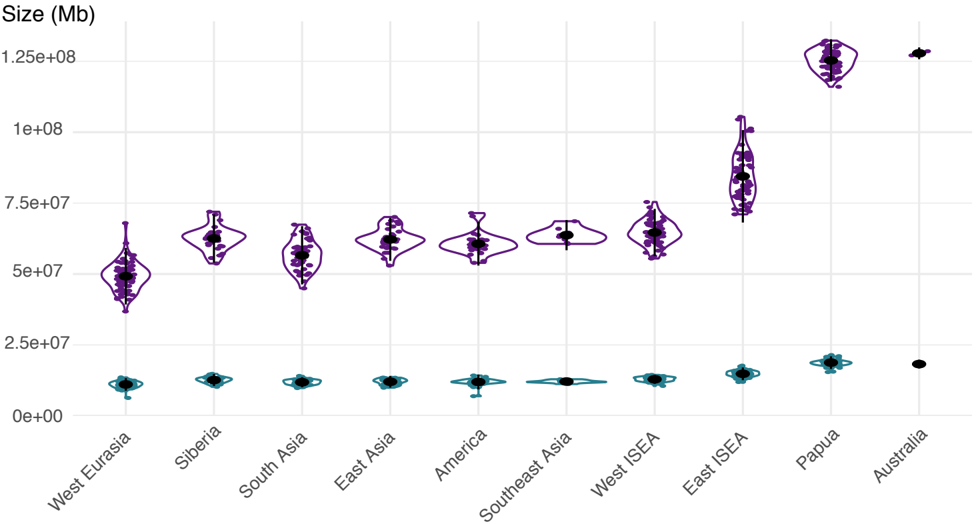
- Across 426 human genomes, including 214 from Papuan and ISEA populations, the authors detected ~12.5 Mb of residual Archaic sequence per individual, with slightly higher amounts in East ISEA (~15 Mb) and Papuan/Australian populations (~18 Mb), but no significant super-archaic admixture signal compatible with the endemic ISEA fossil record.
- ISEA, Papuan, and Australian populations carried the largest amounts of Denisovan ancestry, reaching ~60 Mb in Papuan and Australian genomes, while having the lowest proportion of residual Archaic sequence relative to total archaic ancestry.
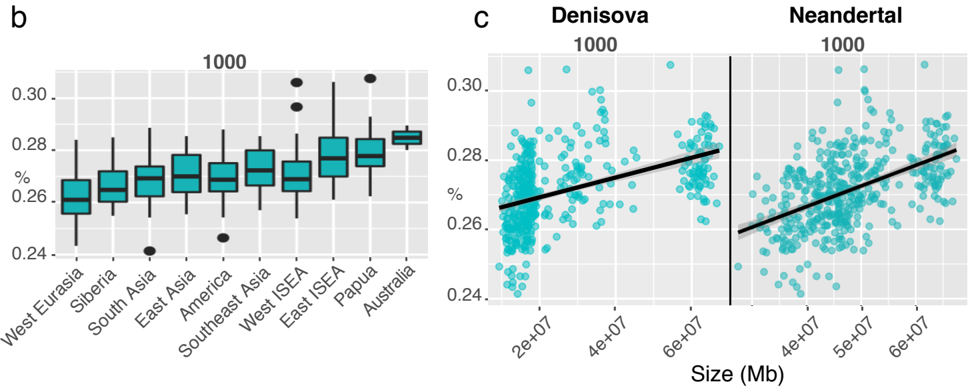
- Mutation motifs expected under super-archaic introgression were not globally elevated: Papuan genomes showed <2% of the [1000] motif, and no corresponding increase in the [0111] motif; empirical [1000] and [0111] proportions (~27% and ~6%) fit simulations with 0.1% or 0% super-archaic introgression better than higher levels.
- The pipeline recovered 20 out of 20 previously reported indirectly introgressed super-archaic segments embedded within Denisovan sequences, with 100% of each block’s sequence length recovered; 17 of 20 were also included in the residual Archaic set, with an average of 47.5% of each block recovered.
Methods
- The study analyzed 426 individuals from 10 populations, including 214 from Papuan and ISEA populations, using publicly available genomic data and the Indonesian Genome Diversity Project.
- It extended the Jacobs et al. pipeline by adding HMMArchaic, a reference-free HMM detection method, alongside ChromoPainter and a reference-based HMM; residual Archaic blocks were defined as HMMArchaic blocks not overlapping Neanderthal or Denisovan blocks inferred by CP and/or HMM.
- The authors used mutation motifs of the form [X, D, N, H] and coalescent simulations in msprime under an empirically informed Australo-Papuan demographic model, testing super-archaic introgression levels of 2%, 1%, 0.1%, and 0%.
Limitations
- The paper states that the absence of a genome sequence for extinct ISEA hominins makes inference far more complex than for Neanderthal or Denisovan introgression, and that the sparse Denisovan fossil record makes morphological comparisons difficult.
- The authors state they cannot outright reject interbreeding if encounters did not produce viable progeny or if viable lineages later died out; they also note that residual Archaic signal may be a methodological artefact, ancient population structure, incomplete lineage sorting, balancing selection, or unassigned Neanderthal/Denisovan ancestry.
- Evident from the text: the conclusions rely on modern genomes and simulations rather than direct fossil or ancient DNA evidence from ISEA, and the simulations depend on a specific demographic model and assumed divergence of the super-archaic source.
Model-written summary. Check it against the paper before relying on it.
Integrity signals
Registry
Cites
Statistics
Figures
Verification
Claims the paper makes
5 Valid · 1 Not valid · 2 Not checked · 61 Own results and interpretations
The cited sources support only part of this claim — read each source’s verdict below.
In the paper
“The hominin fossil record of Island Southeast Asia (ISEA) indicates that at least two endemic 'super-archaic' species Homo luzonensis and H. floresiensis - were present around the time anatomically modern humans (AMH) arrived in the region >50,000 years ago.”
- Also stated in: § Main Text · p. 4 · hedged
“At least two additional endemic species lived in ISEA during the Pleistocene and are likely to have survived until the arrival of anatomically modern humans (AMH) >50 thousand years ago (ka) 5-8 : H. floresiensis on Flores, in the Lesser Sunda Islands (also part of modern Indonesia) 9,10 , and H. luzonensis on Luzon, in the northern Philippines 11 .”
What the sources say
- Partly supportedcites [5] 5. Westaway, K. E. et al. An early modern human presence in Sumatra 73,000-63,000 years 632 sourceExperimental — accuracy not yet measured
The paper’s discussion of the Lida Ajer chronology reports anatomically modern humans in Sumatra 73,000–63,000 years ago, supporting arrival in Island Southeast Asia more than 50,000 years ago. Its comparison of the teeth mentions H. floresiensis, but the paper does not establish that it was present at the same time, and the passages found do not mention H. luzonensis or describe two endemic ‘super-archaic’ species. (LLM, conf=0.88)
- Partly supportedcites [6] 7. Bowdler, S. 'Human occupation of northern Australia by 65,000 years ago' (Clarkson et al. 636 sourceExperimental — accuracy not yet measured
The passage labelled References (page unavailable) says the chronology extends the overlap of modern humans and H. floresiensis in eastern Indonesia to at least 15,000 years. The Abstract and Discussion and implications date human occupation of northern Australia to about 65,000 years ago. Our copy does not mention H. luzonensis or establish that two endemic ‘super-archaic’ species were present when modern humans arrived in Island Southeast Asia. (LLM, conf=0.88)
- Not checked — no full text of the sourcecites [7] 6. Clarkson, C. et al. Human occupation of northern Australia by 65,000 years ago. Nature 634 source
- Partly supportedcites [8] 8. O'Connell, J. F. et al. When did Homo sapiens first reach Southeast Asia and Sahul? Proc. 638 sourceExperimental — accuracy not yet measured
The Archaeology section reports that H. floresiensis persisted on Flores until 50–60 ka, around the paper’s proposed timing of AMH arrival. The copy does not identify H. luzonensis or establish that two endemic species were present then. It also describes AMH arrival as after 50 ka, rather than confidently more than 50 ka ago; the Fossil Evidence section calls earlier fossil evidence questionable. (LLM, conf=0.89)
hedged- Asserted: passes — The authors put it forward as true.
- Checkable: passes — It can be checked against evidence.
- Load-bearing: passes — The paper’s conclusions depend on it.
- Based: passes — The paper gives a reason why it holds.
- Also stated in: § Main Text · p. 4 · hedged
The cited sources support only part of this claim — read each source’s verdict below.
In the paper
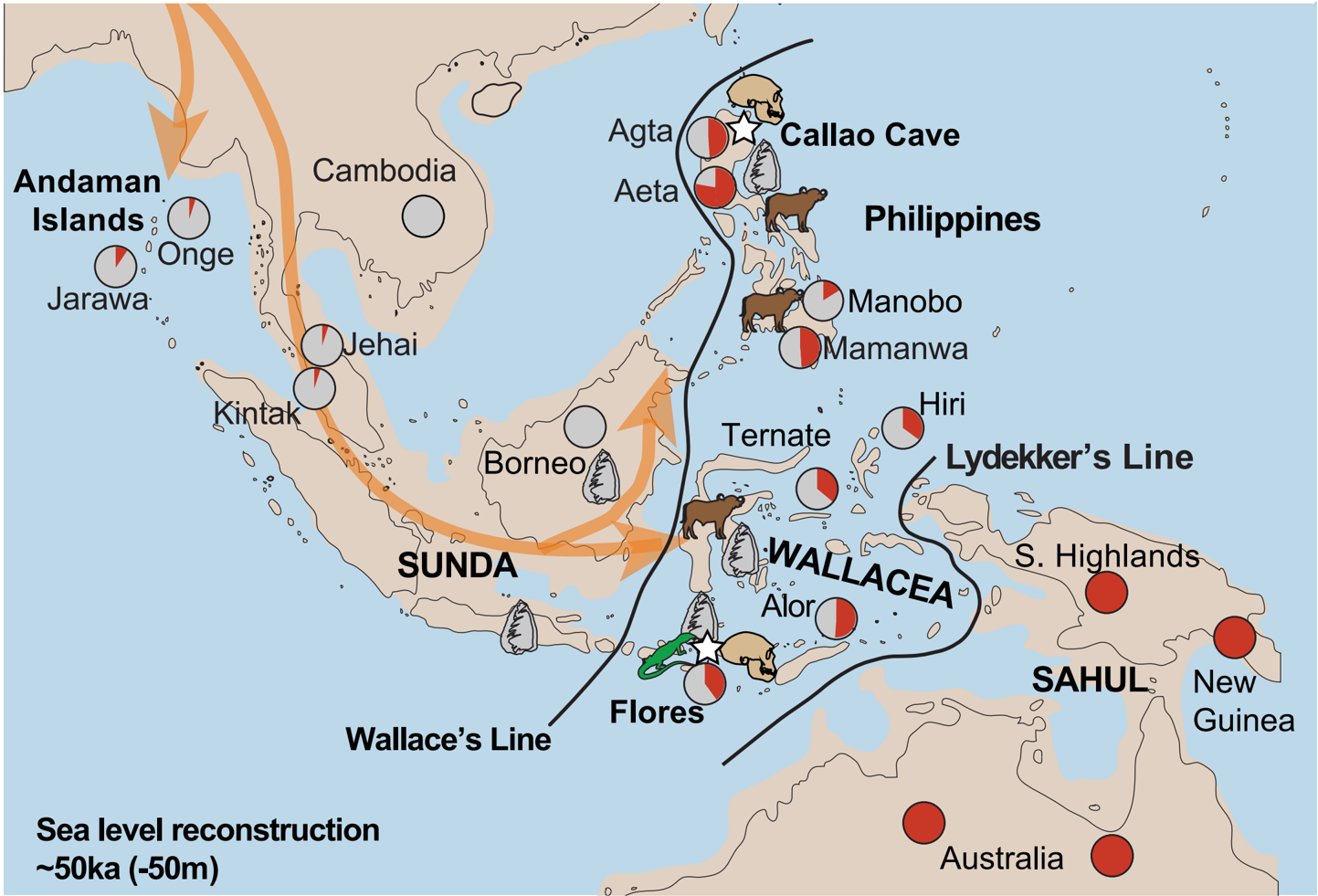
“Nonetheless, the current fossil and archaeological records, together mounting genetic evidence from across ISEA, point to the widespread presence of archaic hominins east of Wallace's Line 26 , and indicate that the first AMH populations to arrive in ISEA most likely encountered a variety of hominin populations, no matter which route they took to enter Sahul 4752 .”
What the sources say
- Not checked — no full text of the sourcecites [47] 47. O'Connell, J. F. & Allen, J. Forum The Restaurant At The End Of The Universe: Modelling 721 - the colonisation of Sahul. Aust. Archaeol. 74 , 5-31 (2012). 722 source
- Not checked — no full text of the sourcecites [48] 48. Kealy, S., Louys, J. & O'Connor, S. Islands Under the Sea: A Review of Early Modern 723 - Human Dispersal Routes and Migration Hypotheses Through Wallacea. J. Island Coast. 724 - Archaeol. 11 , 364-384 (2016). 725 source
- Could not verifycites [49] 49. Kealy, S., Louys, J. & O'Connor, S. Reconstructing Palaeogeography and Inter-island 726 - Visibility in the Wallacean Archipelago During the Likely Period of Sahul Colonization, 727 - 65-45 000 Years Ago. Archaeol. Prospect. 24 , 259-272 (2017). 728 sourceExperimental — accuracy not yet measured
Our copy of Kealy et al. (2017) is a palaeogeography/intervisibility modelling study: the Introduction (p. 259-261) and Discussion (p. 268-270) treat only which Sunda-to-Sahul routes AMHs likely used (northern favoured on intervisibility grounds, southern/Timor-Aru routes possible later, citing Gomes et al. 2015 and Hudjashov et al. 2007 for multiple routes). No passage states or discusses archaic hominin populations being present east of Wallace's Line or first AMHs encountering other hominins; searches for 'archaic hominins', 'Denisovans', 'Homo floresiensis / erectus', 'admixture/interbreeding' returned nothing in the body text. The Flores 'hobbits' appear only as an uncited reference-list entry (ref. 40, Morwood and Van Oosterzee 2007, References p. 271), which credits that book and says nothing about AMH-hominin encounters. So the encounter claim cannot be checked against this source, and nothing in our copy contradicts it either. (LLM, conf=0.72)
- Could not verifycites [50] 50. Kealy, S., Louys, J. & O'Connor, S. Least-cost pathway models indicate northern human 729 - dispersal from Sunda to Sahul. J. Hum. Evol. 125 , 59-70 (2018). 730 sourceExperimental — accuracy not yet measured
Our copy of Kealy et al. (2018) is a least-cost pathway modelling study: the Abstract, Section 2.1 (Study area and period), Section 4 (Discussion) and Section 5 (Conclusions) deal only with the relative likelihood of Birdsell's northern vs southern routes at 65/70 ka, the dearth of Wallacean archaeological dates and dating-method controversies. No passage states or discusses archaic hominin presence east of Wallace's Line or encounters between incoming AMH and other hominin populations on either route; searches for 'archaic hominin', 'Homo floresiensis/Homo erectus/Denisovan', 'encounters along the northern and southern routes' and 'introgression/admixture' returned nothing on this point. The nearest remark (Discussion, p. n/a) is that 'savanna ecosystems were likely attractive environments for early hominins in Sunda and by extension Wallacea (Louys and Turner, 2012)', which concerns habitat preference, not AMH-hominin contact, so the claim cannot be checked against this source. (LLM, conf=0.70)
- Could not verifycites [51] 51. Bird, M. I. et al. Palaeogeography and voyage modeling indicates early human colonization 731 - of Australia was likely from Timor-Roti. Quat. Sci. Rev. 191 , 431-439 (2018). 732 sourceExperimental — accuracy not yet measured
Our copy of Bird et al. (2018) treats the southern (Timor-Roti to NW Australia) and northern (via Sulawesi) routes into Sahul, the palaeogeography, drift/voyage modeling and founding-population genetics (Abstract p.2; Introduction pp.3-4; 3.4 Genetic evidence p.13; Conclusions pp.13-14), and nowhere states or implies that incoming AMHs encountered other hominin populations. Searches for 'archaic hominins / Denisovans', 'Homo floresiensis archaic human interbreeding admixture' and 'Wallace's Line fossil archaeological record hominin' returned only passages about AMH dispersal routes and marine resource exploitation, with no mention of any co-resident or earlier hominin; the paper's reference list includes Liang Bua/Flores (Westaway et al., 2009) only as an environmental/stratigraphic citation, not as an encounter claim. Nothing in our copy contradicts the assertion either, so the encounter element attributed to this source cannot be checked against it. (LLM, conf=0.68)
- Partly supportedcites [52] 52. Bird, M. I. et al. Early human settlement of Sahul was not an accident. Sci. Rep. 9 , (2019). 733 734 735 736 737 738 739 740 741 742 743 744 Acknowledgements: We thank Christian Huber and Joshua Schmidt for useful discussions on the genetic analyses, and Kieren Mitchell and Fernando Racimo for comments on the manuscript. This work was supported by ARC Indigenous Discovery Grant IN180100017 (JCT and RT) and ARC Laureate Fellowships FL100100195 (CMST) and FL140100260 (AC). CS acknowledges funding from the Calleva Foundation and The Human Origins Research Fund. Author contributions: JCT, KMH sourceExperimental — accuracy not yet measured
The Introduction (page unavailable) says pre-modern hominins reached some western Wallacean islands before modern humans and describes northern and southern routes into Sahul. The Results (page unavailable) identify evidence from Sulawesi and Flores, but do not establish that the first modern humans encountered a variety of hominin populations on either route. (LLM, conf=0.83)
hedged- Asserted: passes — The authors put it forward as true.
- Checkable: passes — It can be checked against evidence.
- Load-bearing: passes — The paper’s conclusions depend on it.
- Based: passes — The paper gives a reason why it holds.
A result the paper reports from its own data — it cites no other source for it, so there is none to check. The quote shows it is in the paper.
In the paper
“Similarly, the mutational motifs observed in 0.1% and 0% super-archaic introgression models provide a closer fit to the empirical data than do higher levels of super-archaic introgression.”
plainstates an association- Asserted: passes — The authors put it forward as true.
- Checkable: passes — It can be checked against evidence.
- Load-bearing: passes — The paper’s conclusions depend on it.
- Based: passes — The paper gives a reason why it holds.
A result the paper reports from its own data — it cites no other source for it, so there is none to check. The quote shows it is in the paper.
In the paper
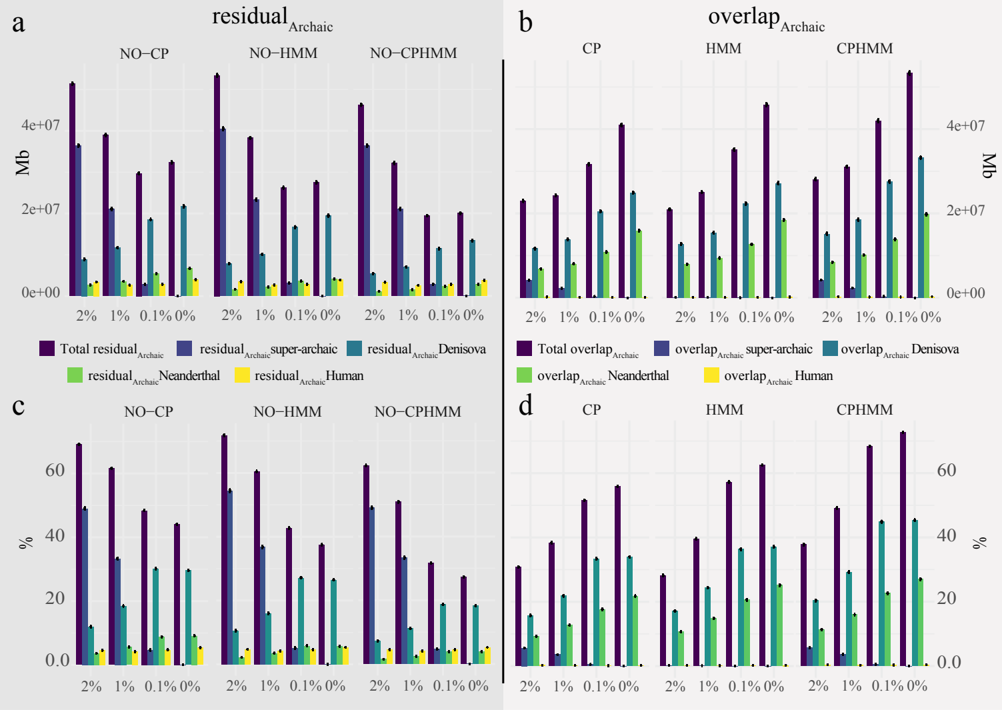
“For these models, the majority of the residual Archaic signal originates from Neanderthal and Denisovan introgression that went undetected by CP and HMM (Figure 2a and Supplementary Figure 12).”
plainstates a cause- Asserted: passes — The authors put it forward as true.
- Checkable: passes — It can be checked against evidence.
- Load-bearing: passes — The paper’s conclusions depend on it.
- Based: passes — The paper gives a reason why it holds.
A result the paper states — it cites no source for it, so there is none to check. The quote shows it is in the paper.
In the paper
“Both CP and HMM consistently detect Neanderthal introgression at a higher rate than Denisovan introgression, irrespective of the amount of super-archaic introgression present in the simulations (Supplementary Figure 9).”
plainstates an association- Asserted: passes — The authors put it forward as true.
- Checkable: passes — It can be checked against evidence.
- Load-bearing: unclear — It is unclear whether the paper’s conclusions depend on it.
- Based: passes — The paper gives a reason why it holds.
29 more claims
Create a free account to see all 69 claims and every source verdict.
- Probably not a substantial claim. 13
- It may state two separate claims as one. 28
Self-check
Percentages, sums and reported differences re-computed from the paper’s own numbers.
Each contradiction between two passages listed here was confirmed by an independent check.
Rated minor: it would not touch a result — a value no result rests on, a p-value that stays on the same side of the significance level, or a conflict that is clerical, resolved elsewhere in the paper, or outside its own findings.
In the paper
§ Models of super-archaic introgression · p. 25
“the 1% and 0.1% models contained slightly less genetic sequence than the 0% an 1% models (~2.88Gb and ~2.65Gb simulated sequence, respectively)”
§ Models of super-archaic introgression · p. 25
“We were able to reduce the amount of super-archaic ancestry present in the simulated sequences to ~1% and ~0.1%”
Citations
Cites
The complete genome sequence of a Neanderthal from the Altai Mountains
Prüfer, K., Racimo, F., Patterson, N., Jay, F., Sankararaman, S., Sawyer, S., Heinze, A., Renaud, G., Sudmant, P. H., de Filippo, C., et al. (2014) · Nature · doi:10.1038/nature12886 · Cited by 2,254
Genetic history of an archaic hominin group from Denisova Cave in Siberia
Reich, D., Green, R. E., Kircher, M., Krause, J., Patterson, N., Durand, E. Y., Viola, B., Briggs, A. W., Stenzel, U., Johnson, P. L. F., et al. (2010) · Nature · doi:10.1038/nature09710 · Cited by 1,991
A high-coverage genome sequence from an archaic denisovan individual
Meyer, M., Kircher, M., Gansauge, M.-T., Li, H., Racimo, F., Mallick, S., Schraiber, J. G., Jay, F., Prüfer, K., de Filippo, C., et al. (2012) · Science · doi:10.1126/science.1224344 · Cited by 1,967
Inference of Population Structure using Dense Haplotype Data
Lawson, D. J., Hellenthal, G., Myers, S., & Falush, D. (2012) · PLoS Genetics · doi:10.1371/journal.pgen.1002453 · Cited by 1,188 · cited 2×
“Reproducibility We searched for genomic signatures compatible with introgression from archaic hominins using three different publicly available methods: ChromoPainter (CP - Lawson et al. 2012); a Hidden Markov Model (HMM - Jacobs et al. 2019); and HMMArchaic (Skov et al. 2018).”
MethodHuman occupation of northern Australia by 65,000 years ago
Clarkson, C., Jacobs, Z., Marwick, B., Fullagar, R., Wallis, L., Smith, M., Roberts, R. G., Hayes, E., Lowe, K., Carah, X., et al. (2017) · Nature · doi:10.1038/nature22968 · Cited by 1,185
A new small-bodied hominin from the Late Pleistocene of Flores, Indonesia.
Brown, P., Sutikna, T., Morwood, M. J., Soejono, R. P., Jatmiko, Wayhu Saptomo, E., & Awe Due, R. (2004) · Nature · doi:10.1038/nature02999 · Cited by 1,075
Insights into human genetic variation and population history from 929 diverse genomes
Bergström, A., McCarthy, S. A., Hui, R., Almarri, M. A., Ayub, Q., Danecek, P., Chen, Y., Felkel, S., Hallast, P., Kamm, J., et al. (2020) · Science · doi:10.1126/science.aay5012 · Cited by 1,020
Homo naledi, a new species of the genus Homo from the Dinaledi chamber. South Africa.
Berger, L. R., Hawks, J., de Ruiter, D. J., Churchill, S. E., Schmid, P., Delezene, L. K., Kivell, T. L., Garvin, H. M., Williams, S. A., DeSilva, J. M., et al. (2015) · eLife · doi:10.7554/elife.09560 · Cited by 703
Denisova Admixture and the First Modern Human Dispersals into Southeast Asia and Oceania
Reich, D., Patterson, N., Kircher, M., Delfin, F., Nandineni, M. R., Pugach, I., Ko, A. M.-S., Ko, Y.-C., Jinam, T. A., Phipps, M. E., et al. (2011) · The American Journal of Human Genetics · doi:10.1016/j.ajhg.2011.09.005 · Cited by 656
A genomic history of Aboriginal Australia
Malaspinas, A.-S., Westaway, M. C., Muller, C., Sousa, V. C., Lao, O., Alves, I., Bergström, A., Athanasiadis, G., Cheng, J. Y., Crawford, J. E., et al. (2016) · Nature · doi:10.1038/nature18299 · Cited by 650
Cited by
Genome of a middle Holocene hunter-gatherer from Wallacea
Carlhoff, S., Duli, A., Nägele, K., Nur, M., Skov, L., Sumantri, I., Oktaviana, A. A., Hakim, B., Burhan, B., Syahdar, F. A., et al. (2021) · Nature · doi:10.1038/s41586-021-03823-6 · Cited by 117
Philippine Ayta possess the highest level of Denisovan ancestry in the world
Larena, M., McKenna, J., Sanchez-Quinto, F., Bernhardsson, C., Ebeo, C., Reyes, R., Casel, O., Huang, J.-Y., Hagada, K. P., Guilay, D., et al. (2021) · Current Biology · doi:10.1016/j.cub.2021.07.022 · Cited by 93
“Hence, the presence of multiple archaic human remains in the region, together with the genomic evidence presented here and elsewhere,(15,16,31,37,39) raises the possibility that the Denisovans comprised deeply structured populations with considerable genetic and phenotypic diversity, enabling them to adapt into a wide…”
A Middle Pleistocene Denisovan molar from the Annamite Chain of northern Laos
Demeter, F., Zanolli, C., Westaway, K., Joannes‐Boyau, R., Duringer, P., Morley, M. W., Welker, F., Rüther, P. L., Skinner, M. M., McColl, H., et al. (2022) · Nature Communications · doi:10.1038/s41467-022-29923-z · Cited by 125
Purnomo, G. A., Mitchell, K. J., O’Connor, S., Kealy, S., Taufik, L., Schiller, S., Rohrlach, A. B., Cooper, A., Llamas, B., Sudoyo, H., et al. (2021) · Genes · doi:10.3390/genes12070965 · Cited by 77
“Additionally, modern human genomes from ISEA, New Guinea, and Australia contain traces of multiple separate historical admixture events with now-extinct archaic hominin species [6,88–90], and Wallacea has been identified as a plausible location of some of these events [91].”
Self-citationFossils, fish and tropical forests: prehistoric human adaptations on the island frontiers of Oceania
Roberts, P., Douka, K., Tromp, M., Bedford, S., Hawkins, S., Bouffandeau, L., Ilgner, J., Lucas, M., Marzo, S., Hamilton, R., et al. (2022) · Philosophical Transactions of the Royal Society B Biological Sciences · doi:10.1098/rstb.2020.0495 · Cited by 57
“Understanding the process of human dispersals into Oceania has been given additional global importance by modern gen-etic and archaeogenetic evidence for our species ’ interaction with other hominin species (i.e. Denisovans) in this part of the world [14].”
BackgroundInfluentialA male Denisovan mandible from Pleistocene Taiwan
Tsutaya, T., Sawafuji, R., Taurozzi, A. J., Fagernäs, Z., Patramanis, I., Troché, G., Mackie, M., Gakuhari, T., Oota, H., Tsai, C., et al. (2025) · Science · doi:10.1126/science.ads3888 · Cited by 79
The genetic origins and impacts of historical Papuan migrations into Wallacea
Purnomo, G. A., Kealy, S., O’Connor, S., Schapper, A., Shaw, B., Llamas, B., Teixeira, J. C., Sudoyo, H., & Tobler, R. (2024) · Proceedings of the National Academy of Sciences · doi:10.1073/pnas.2412355121 · Cited by 53
“Specific technologies ( 23 ), art forms ( 24 , 25 ), fauna ( 26 ), and the recently proposed Greater West Bomberai (GWB) language family spoken in eastern Wallacea are all thought to be introductions from West Papua ( 27 ).”
Self-citationThe genetic origins and impacts of historical Papuan migrations into WallaceaPreprint
Purnomo, G. A., Kealy, S., O’Connor, S., et al. (2024) · bioRxiv (Cold Spring Harbor Laboratory) · doi:10.1101/2024.06.02.597070 · Cited by 39
Self-citationOur Tangled Family Tree: New Genomic Methods Offer Insight into the Legacy of Archaic Admixture
Ahlquist, K. D., Bañuelos, M. M., Funk, A., Lai, J., Rong, S., Villanea, F. A., & Witt, K. E. (2021) · Genome Biology and Evolution · doi:10.1093/gbe/evab115 · Cited by 38
Koller, D., Wendt, F. R., Pathak, G. A., De Lillo, A., De Angelis, F., Cabrera-Mendoza, B., Tucci, S., & Polimanti, R. (2022) · BMC Biology · doi:10.1186/s12915-022-01449-2 · Cited by 27
“Although few studies investigated archaic introgression in non-EURdescent groups such as Pacific [25], East Asian [26], Tibetan [27], and Island South East [28] populations, to our knowledge no investigation systematically explored the impact of archaic introgression across human traits and diseases across multiple an…”
BackgroundArchaeology as History: Telling Stories from a Fragmented Past
Frieman, C. J. (2023) · Cambridge University Press eBooks · doi:10.1017/9781009052412 · Cited by 28
Weiss, T. L., Linsley, B. K., Gordon, A. L., Rosenthal, Y., & Dannenmann, S. (2022) · Paleoceanography and Paleoclimatology · doi:10.1029/2021pa004361 · Cited by 22
“the middle of MIS 3 (Borregine et al., 2022; Clarkson et al., 2017; de Bruyn et al., 2014; Husson et al., 2020; Kealy et al., 2018; O’Connell et al., 2018; Teixeira et al., 2021) when our results show an exposed Sunda Shelf and Karimata Strait would have facilitated migration from the mainland.”
BackgroundResultEast and Southeast Asian hominin dispersal and evolution: A review
Sawafuji, R., Tsutaya, T., Takahata, N., Pedersen, M. W., & Ishida, H. (2024) · Quaternary Science Reviews · doi:10.1016/j.quascirev.2024.108669 · Cited by 23
Introgressive Hybridization and Hypoxia Adaptation in High-Altitude Vertebrates
Storz, J. F., & Signore, A. V. (2021) · Frontiers in Genetics · doi:10.3389/fgene.2021.696484 · Cited by 17
“Denisova Cave is located at only 700m elevation, and the largest shares of Denisovan ancestry have been identified in the genomes of lowland Asians, indigenous Australians, andMelanesians (Reich et al., 2010, 2011; Mallick et al., 2016; Sankararaman et al., 2016; Browning et al., 2018; Jacobs et al., 2019; Teixeira et…”
BackgroundUnveiling the Genetic History of the Maniq, a Primary Hunter-Gatherer Society
Göllner, T., Larena, M., Kutanan, W., Lukas, H., Fieder, M., & Schaschl, H. (2022) · Genome Biology and Evolution · doi:10.1093/gbe/evac021 · Cited by 16
Infectious disease in the Pleistocene: Old friends or old foes?
Houldcroft, C. J., & Underdown, S. (2023) · American Journal of Biological Anthropology · doi:10.1002/ajpa.24737 · Cited by 18
Evolutionary genetics and acclimatization in nephrology
Adeyemo, A., Shriner, D., Bentley, A. R., Gbadegesin, R., & Rotimi, C. N. (2021) · Nature Reviews Nephrology · doi:10.1038/s41581-021-00483-7 · Cited by 13
Pop, E., Hilgen, S. L., Adhityatama, S., Berghuis, H. W. K., Veldkamp, A., Vonhof, H., Sutisna, I., Alink, G., Noerwidi, S., Roebroeks, W., et al. (2023) · Journal of Human Evolution · doi:10.1016/j.jhevol.2022.103312 · Cited by 16
Understanding the human settlement of the Pacific – Are we there yet?
Matisoo-Smith, E. A., & Gosling, A. L. (2025) · Journal of Archaeological Science · doi:10.1016/j.jas.2025.106307 · Cited by 10
Florin, S. A. (2022) · Mitteilungen der Gesellschaft für Urgeschichte · doi:10.51315/mgfu.2021.30002 · Cited by 9
Berghuis, H. W. K., Kaifu, Y., Wibowo, U. P., van Kolfschoten, T., Sutisna, I., Noerwidi, S., Adhityatama, S., van den Bergh, G. D., Pop, E., Suriyanto, R. A., et al. (2025) · Quaternary Environments and Humans · doi:10.1016/j.qeh.2025.100068 · Cited by 11
Human Genetic Research in Wallacea and Sahul: Recent Findings and Future Prospects
Taufik, L., Teixeira, J. C., Llamas, B., Sudoyo, H., Tobler, R., & Purnomo, G. A. (2022) · Genes · doi:10.3390/genes13122373 · Cited by 7
Self-citationHogg, A. G., Lorrey, A. M., TURNEY, C. S. M., Palmer, J., Boswijk, G., & Fenwick, P. (2021) · Quaternary Geochronology · doi:10.1016/j.quageo.2021.101251 · Cited by 8
Self-citationUnderrepresented Populations at the Archaic Introgression Frontier
Villanea, F. A., & Witt, K. E. (2022) · Frontiers in Genetics · doi:10.3389/fgene.2022.821170 · Cited by 6
Peopling island rainforests: global trends from the Early Pleistocene to the Late Holocene
Gaffney, D. (2022) · World Archaeology · doi:10.1080/00438243.2022.2121316 · Cited by 9
“Several discrete H. sapiens populations dispersed into insular tropical rainforests from MIS-4 to MIS-3, first in Wallacea pushing beyond the Weber Line (O’Connor 2010), then in the Philippines 5000 km A R U A U S T R A L I A P A C I F I C O C E A N G U L F o f C A R P E N T A R I A A R A F U R A S E A T O R R E S S T…”
BackgroundInfluentialReconstructing the Human Population History of East Asia through Ancient Genomics
Bennett, A. E., Liu, Y., & Fu, Q. (2024) · Cambridge University Press eBooks · doi:10.1017/9781009246675 · Cited by 8
The Broad Spectrum Species: Plant Use and Processing as Deep Time Adaptations
Florin, S. A., & Ramsey, M. N. (2025) · Journal of Archaeological Research · doi:10.1007/s10814-025-09214-z · Cited by 8
Recent DNA Studies Question a 65 kya Arrival of Humans in Sahul
Allen, J., & O’Connell, J. F. (2025) · Archaeology in Oceania/Archæology & physical anthropology in Oceania · doi:10.1002/arco.70002 · Cited by 6
Koller, D., Wendt, F., Pathak, G., Lillo, A. D., Angelis, F. D., Cabrera-Mendoza, B., Tucci, S., & Polimanti, R. (2021) · bioRxiv · doi:10.1101/2021.08.12.456138 · Cited by 4
The Multivariate Basis of Human Brain Evolution: The Prerequisites of Fire Control and Cooking
Ortells, M. O., & Stewart, S. (2025) · Evolutionary Anthropology Issues News and Reviews · doi:10.1002/evan.70008 · Cited by 4
Ancient DNA: a direct window into the human past
Teixeira, J. C. (2024) · Antropologia Portuguesa · doi:10.14195/2182-7982_41_17 · Cited by 1
“…which has fostered intense debates about the true identity of this group and whether they could be represented by fossil specimens in Asia and ISEA (e.g., H. erectus , H. floresiensis and H. luzonensis ), for which no genetic data currently exists (Teixeira and Cooper, 2019; Teixeira et al. 2021).”
Self-citationFossil Hominins, the Bipedal Primates
Fleagle, J. G., Baden, A. L., & Gilbert, C. C. (2025) · Elsevier eBooks · doi:10.1016/b978-0-12-815809-8.00017-5 · Cited by 2
Curnoe, D., bin Sauffi, M. S., Goh, H. M., Sun, X., & Peiris, R. (2025) · PLoS ONE · doi:10.1371/journal.pone.0338786 · Cited by 1
“…most likely represents geneflow with H. neanderthalensis , as seen in all non-African populations, and the Denisovans, which reaches highest frequencies among Melanesians, Indigenous Australians and Insular Southeast Asians but is found also in ancient DNA samples from China and Mongolia [16–19].”
Different species on the horizon: The Denisova hominins
Viola, B. (2022) · Elsevier eBooks · doi:10.1016/b978-0-12-821428-2.00015-9 · Cited by 7
Adaptive Archaic Introgression
Dolgova, O., & Lao, Ó. (2024) · Oxford University Press eBooks · doi:10.1093/med/9780197676592.003.0007 · Cited by 1
Computational Genomics and Its Applications to Anthropological Questions
Witt, K. E., & Villanea, F. A. (2024) · American Journal of Biological Anthropology · doi:10.1002/ajpa.70010 · Cited by 3
“…as human populations whose ancestors may have overlapped in time and space with other fossil hominins have not yet shown evidence for super-archaic introgression (Teixeira et al. 2021), and the patterns in African populations may also be explained by deep structure in Africa (Ragsdale et al. 2023).”
Bello, S. M., & Stringer, C. B. (2025) · Quaternary Environments and Humans · doi:10.1016/j.qeh.2025.100070 · Cited by 1
Self-citationUnsere Vorfahren: Crashkurs und Update
Spitzer, M. (2021) · Nervenheilkunde · doi:10.1055/a-1389-6941 · Cited by 1
“[96] Teixeira JC, Jacobs GS, Stringer C, et al.”
BackgroundComparing Contemporary Evangelical Models Regarding Human Origins
Luskin, C. R. (2023) · Religions · doi:10.3390/rel14060748 · Cited by 4
A review of the spread and habitat of the genus Homo: Focusing on East Asia
Sawafuji, R., Tsutaya, T., & Ishida, H. (2022) · Anthropological Science (Japanese Series) · doi:10.1537/asj.220214
Hominin Evolution I: The Origins of Homo sapiens
Tracy, D. K. (2022) · Cambridge University Press eBooks · doi:10.1017/9781009030564.005 · Cited by 1
Modern Humans Disperse From Africa
Langdon, J. H. (2022) · Springer texts in social sciences · doi:10.1007/978-3-031-14157-7_19
Homo sapiens' birth and ProgRetrogProg evolution by DNA's extreme climate-induced rearrangementPreprint
ÇAKIR, Ş. (2023) · OSF Preprints (OSF Preprints) · doi:10.31219/osf.io/ph247
Herrera, R. J., & Garcia‐Bertrand, R. (2023) · Elsevier eBooks · doi:10.1016/b978-0-12-819086-9.00016-6
Hung, H. (2023) · Elsevier eBooks · doi:10.1016/b978-0-323-90799-6.00263-9 · Cited by 2
Wallacean mammalogy and zooarchaeology: remembrances and a renaissance
Helgen, K. M., & Jones, R. K. (2023) · Records of the Australian Museum · doi:10.3853/j.2201-4349.75.2023.1780 · Cited by 1
Self-citationIntroduction: The human histories of West New Guinea
Gaffney, D., & Tolla, M. (2025) · ANU Press eBooks · doi:10.22459/ta58.2024.01
Daniel Strand, Anna Källén & Charlotte Mulcare (eds). Critical Perspectives on Ancient DNA
Nordfors, U., & O’Sullivan, R. J. (2026) · Current Swedish Archaeology · doi:10.37718/csa.2025.15
Der moderne Mensch: Homo sapiens
Graw, J. (2026) · Springer eBooks · doi:10.1007/978-3-662-72246-6_3
Kaharudin, H. A. F., O’Connor, S., & Kealy, S. (2026) · Journal of Archaeological Research · doi:10.1007/s10814-026-09224-5
McAllister, N. P., Zöllner, S., & Zhang, X. (2026) · bioRxiv (Cold Spring Harbor Laboratory) · doi:10.64898/2026.06.25.734355 · Cited by 1
“A further limitation is that deep population structure and introgression remain intrinsically difficult to separate [35, 63].”
Metadata
- Authors
- Teixeira, J. C., Jacobs, G. S., Stringer, C., Tuke, J., Hudjashov, G., Purnomo, G. A., Sudoyo, H., Cox, M. P., Tobler, R., Turney, C. S. M., Cooper, A., & Helgen, K. M.
- Affiliations
- The University of Adelaide (AU)
- Nanyang Technological University (SG)
- Natural History Museum (GB)
- Massey University (NZ)
- Eijkman Institute for Molecular Biology (ID)
- The University of Sydney (AU)
- UNSW Sydney (AU)
- South Australian Museum (AU)
- Australian Museum (AU)
- Corresponding author
- Teixeira, João C.
- ORCID
- Venue
- Nature Ecology & Evolution
- Published
- 2021-03-22
- Volume
- 5
- Issue
- 5
- Pages
- 616-624
- ISSN
- 2397-334X (ISSN-L)
- OpenAlex
- W3136579004
- Cited by
- 51
- References
- 61
- Citations by year
- 2026: 4 · 2025: 11 · 2024: 6 · 2023: 8 · 2022: 13 · 2021: 9
- FWCI
- 34.11
- Type
- journal article
- Language
- en
- Open access
- green
- doi.org
- Licence
- www.springernature.com/gp/researchers/text-and-data-mining (tdm)
- www.springernature.com/gp/researchers/text-and-data-mining (vor)
- Locations
- Nature Ecology & Evolution (publishedVersion)
- PubMed (publishedVersion)
- Digital Commons - University of South Florida (University of South Florida) (submittedVersion)
- Adelaide Research & Scholarship (AR&S) (University of Adelaide) (submittedVersion)
- DR-NTU (Nanyang Technological University) (submittedVersion)
- Apollo (University of Cambridge) (submittedVersion)
- Apollo
- Funders
- Australian Research Council
- Calleva FoundationThe Human Origins Research Fund
- Topics
- Social Sciences › Anthropology › Pleistocene-Era Hominins and Archaeology
- Life Sciences › Biochemistry, Genetics and Molecular Biology › Genetics › Forensic and Genetic Research
- Life Sciences › Biochemistry, Genetics and Molecular Biology › Genetics › Genetic diversity and population structure
- Keywords
- Island Southeast Asia, Homo floresiensis, Homo luzonensis, introgression, modern human genomes, hominin fossil record, Denisovans
- MeSH terms
- Animals, Asia, Southeastern, Fossils, Humans, Hominidae, Neanderthals, Islands
About these checks
Registry, retraction, Cites and statistics results are computed, not judged, with one exception: a printed reference that no index lists is read once by a model before it counts as a citation error. Claims are extracted by a model and kept only when their quote appears verbatim in the text; each cited source is then checked, with a model’s help, for whether it says what the claim relies on. Those verdicts can be wrong — read the claim’s quote and the cited source before relying on one.
The claim verdicts this report counts are experimental: their accuracy is not yet measured.
A language model drew the claims from the paper on 2026-10-10, under version 3 of the claim definition (model deepseek-v4.1-flash, prompt extract-v3).
A second model labelled each claim on 2026-10-10 (model jev-1.13-20260917, definition revision gold-guideline-v0.2).
Cited sources are checked with a language model’s help (gpt-6-sol and qwen3.8-omni-flash).
Statistics and arithmetic are recomputed, not judged.
Confidence bands are shown only for fields calibrated on our annotated test set. None is calibrated yet, so no band is shown.
What counts as a claim ›How we measure confidence ›How we check this ›
Are you an author, or do you see a problem with this page? Request a review
Data sources
Bibliographic data: Semantic Scholar, OpenAlex, Crossref.
Contains information from the Semantic Scholar Academic Graph Datasets, made available under the ODC Attribution License (ODC-BY 1.0).
Semantic Scholar’s data is described in: Kinney, R., et al. (2023). The Semantic Scholar Open Data Platform. arXiv:2301.10140.
